Reform UK leader was paid to make remarks about imprisoned rapper and ex-Honduran president in Cameo videos

Nigel Farage called for the release of the imprisoned rapper Sean “Diddy” Combs and commended the efforts to free a former Honduran president jailed in the US for drug trafficking.

The Reform UK leader was paid to make the remarks on the personalised video platform Cameo, which allows users to commission celebrities and public figures to record short video clips.

Continue reading…

This post was originally published here

Engineer Alexey Grigorev was using Claude Code—a popular Anthropic tool that helps developers write and run code—to update a new website. 

At first everything seemed normal, until he realized the system had begun destroying the site’s live environment: the network, services and, most critically, the database holding years of course data. 

The root cause was a small setup mistake on a new laptop that confused the automation about what was “real” and what was safe to delete, so it erased the actual production system instead of just cleaning up duplicates. 

While Grigorev eventually managed to restore his data with help from AWS support, he later wrote that he had “over‑relied on the AI agent” and, by letting it make and execute the changes end‑to‑end, had removed safety checks that should have prevented the deletion.

“AI assistants are great and saving a lot of time,” Grigorev told Fortune. “But I hope people learn from mistakes I made and incorporate the safeguards into their workflow.”

Anthropic’s Claude Code has settings that give a user control over when and how often the agent checks back with the user before taking actions. A user can specify that the agent should not take certain actions without asking for permission from the user. But some coders prefer to let the AI agent execute more decisions autonomously, in part because it saves time. As of press time, Anthropic had not responded to a request to comment for this story.

Even as AI coding tools promise faster development and automation, mistakes in AI-generated code are common and risk bringing down critical systems, wiping out years of work, and creating unexpected costs. Last week, Amazon convened a “deep dive” meeting after a series of outages affected its website and app. At least one of the system failures was, according to news reports in several publications, involved AI-assisted changes.

A spokesperson for Amazon told Fortune that the meeting was a “regular weekly operations meeting.” The company has also said publicly that only one of the incidents involved AI, and “the cause was unrelated to AI and instead our systems allowed an engineering team user error to have broader impact than it should have.”

However, internal Amazon documents viewed by both CNBC and the Financial Times, originally cited “Gen-AI assisted changes” as a factor in a “trend of incidents.” The reference to AI’s role in the outages was later deleted from the document ahead of the meeting, CNBC reported. According to the Financial Times, a December outage at Amazon Web Services occurred after engineers allowed Amazon’s own Kiro AI coding tool to make changes—something Amazon has since said was a “user error.”

The excitement around AI-assisted software development has reached a fever-pitch over the last few months, but the errors are starting to pile up. Companies, emboldened by advances in AI coding agents and stories of dramatic productivity gains within AI labs, have started pushing engineers to produce more and more code with AI tools, often without proper oversight in place. For large enterprises, the poor quality of some of this code may prove to be AI’s Achilles heel.

An over-reliance on AI tools

Across the industry, engineers say that reliance on AI assistants to write and deploy code is rapidly changing the nature of software development jobs—and introducing new risks.

“People are becoming so reliant on AI that essentially they stop reviewing the code altogether,” one Amazon engineer, who asked to remain anonymous, told Fortune.

The developer said that even technically skilled staff are moving into more of a “review role” rather than actively coding, with AI handling much of the actual implementation. While these tools allow for faster feature delivery, they also create what some call “production noise,” code that is delivered quickly but isn’t always needed or fully tested. In some cases, it could even affect critical systems.

David Loker, VP of AI at CodeRabbit, said the consequences aren’t always as visible as an outage. In one instance, he said an AI assistant generated code that looked perfectly valid but was built on faulty assumptions about their underlying system—code that might have passed a quick review but would have crashed their database in production if they’d rolled it out.

“If you just rolled that out, it would have taken down our database in production,” he said.

Because AI coding lowers the technical knowledge needed to perform certain software development tasks, engineers say companies are also outsourcing tasks normally done by senior engineers to junior or less technical staff, only to find that low-quality output creates more work than it saves. 

“A lot of what was built was fairly bad quality, broke often, and ended up being more of a burden,” one London-based engineer at an enterprise software company, who asked to remain anonymous because they were not authorized to discuss company matters with the press, said. “The time won by getting the cheap people to write it is offset by having someone paid far more—a senior or principal—to have to go fix it when it breaks.”

Broader data suggests the burden of reviewing and repairing AI-assisted work is falling disproportionately on more experienced engineers. While senior engineers have the skills to spot a logistical error or security flaw that a junior might miss, allowing them to ship faster, they’re also paying a growing “correction tax.”

A July 2025 Fastly survey found that senior engineers ship nearly 2.5x more AI-generated code than junior ones, because they’re better at catching mistakes before they compound. But nearly 30% of seniors said fixing AI output ate up most of the time they’d saved, compared to 17% of junior developers. Junior developers often feel like they’ve banked bigger productivity gains because they don’t yet see the full technical debt or latent vulnerabilities that their AI-assisted changes are quietly adding to the system.

The productivity paradox 

Part of the problem is C-Suite FOMO. Engineers at leading AI labs have been claiming productivity surges that would have seemed implausible just a few years ago, and larger organizations across a variety of industries want to encourage similar gains. 

For example, Anthropic’s head of Claude Code, Boris Cherny, previously said he hasn’t written a line of code in months, instead relying on the company’s AI model to generate it. Within the rest of Anthropic, the company told Fortune that between 70% and 90% of its total code was now AI-generated.  At Spotify, co-CEO Gustav Söderströn said last month that the company’s best developers hadn’t written a single line of code since December and have shipped over 50 new features in 2025 using AI-assisted workflows.

But, as demonstrated by Amazon’s recent issues, the productivity gains that are most visible at AI labs and agile startups may be harder to replicate at large enterprises with legacy systems and complex codebases. Where smaller teams can move fast and absorb mistakes, companies like Amazon operate infrastructure where a single bad deployment can affect millions of customers.

A September report from Bain & Company found that even though programming was “one of the first areas to deploy generative AI,” the actual savings have been modest and the results “haven’t lived up to the hype.” Meanwhile, research from security firm Apiiro showed that developers using AI introduced roughly ten times more security issues than those who did not.

AI models, as AI researcher Andrej Karpathy has noted, can make subtle conceptual errors, over-complicate code, and leave unused code behind—problems that are manageable in a controlled environment but harder to catch and fix at scale. A December report from code review firm CodeRabbit, which analyzed 470 open-source GitHub pull requests, found that AI-authored code contained roughly 1.7 times more issues overall than human-written code. Larger organizations tend to have more stakeholders, more review layers, and more dependencies, an environment where AI-generated code is more likely to introduce unexpected failures.

“It’s just going to take longer for larger organizations like AWS, or like Nvidia to implement this…because you have so much legacy code,” Loker said.. “There’s way less documentation within it, there’s less searchability for the AI to pick up on…so it’s harder to find the context sometimes. You’re going to end up introducing problems.”

There are also questions about whether the benchmarks used to measure AI’s coding ability reflect real-world tasks. A recent study by METR, an AI evaluation organization, found that half of AI coding solutions graded as passing on a prominent industry test—which is itself graded by an AI model—would actually have been rejected by human reviewers for inadequate quality.

Toby Ord, Senior Researcher at the Oxford Martin AI Governance Initiative, said current estimates of AI coding ability are “indeed overstating things, and perhaps by a significant factor.”

Another issue is how the companies themselves are measuring the “success” of AI coding, according to Loker. “It’s very easy to measure throughput increase,” he said. “What is not easy to measure at this point is the causality of what happens after.” The metrics traditionally used to gauge developer productivity—features shipped, code committed—look strong when AI is involved, but don’t capture downstream consequences like bugs, rollbacks, or time spent cleaning up. “That’s not necessarily the only metric of my company’s code health as a whole,” he said.

Companies rolling out AI at scale also risk accumulating what engineers call technical debt—code that functions in the short term but becomes increasingly costly to maintain. “We’re producing tech debt using AI at a clip that I can’t even fathom,” Loker said. “It’s probably three to four times what it was previously.”

This story was originally featured on Fortune.com

This post was originally published here

The bloc’s foremost troublemaker could lose April’s election, but the headaches he’s caused will not necessarily disappear with him

Don’t get This Is Europe delivered to your inbox? Sign up here

How do you solve a problem like Viktor Orban? By crossing your fingers and hoping it disappears in just over three weeks’ time. But even if the European Union’s disruptor-in-chief is ousted in elections next month (which is far from certain), Europe’s Hungary problem is unlikely to vanish overnight.

EU leaders will gather in Brussels on Thursday and Friday for yet another summit that will be at least partly hijacked by Orbán, Hungary’s illiberal prime minister.

Continue reading…

This post was originally published here

In a high-stakes balancing act, Apple CEO Tim Cook is rejecting political labels while aggressively aligning his company with the Trump administration’s “America First” economic agenda.

Highlighting a massive $600 billion investment in U.S. operations, Cook defended his proximity to the White House as a necessary pursuit of pro-growth policy — even as he faces a firestorm from the left over his attendance at the “Melania” documentary screening.

“You were at the inauguration last year, just feet from the president. You gave him a nice gift at the White House. You were at the screening of ‘Melania,’ the documentary for the First Lady. There’s so many people [who] say you’re really close to the administration, and you’re being criticized for that,” “Good Morning America” co-host Michael Strahan told Cook during an interview discussing Apple’s 50th anniversary.

“Well, what I do is I interact on policy, not politics,” Cook responded.

NEW EMOJIS COMING TO APPLE IPHONE IN LATEST UPDATE

“I’m not a political person on either side. I’m not political. And so I’m kind of straight down the middle, and I focus on policy,” the CEO continued. “And so, I’m very pleased that the president and the administration is accessible to talk about policy.”

Apple has openly been collaborating with President Donald Trump to reshore critical supply chains and move away from overseas reliance, aiming to secure a made-in-America future that hedges against global trade volatility. Cook further discussed the leading tech company’s $600 billion commitment to the domestic economy over the next four years.

“If you looked at your iPhone today, the front cover and the back cover, all of that glass will be coming out of Kentucky by the end of this year. The engine, the system on a chip, we’re gonna make over 100 million of those in Arizona this year,” Cook said.

“We’re going to make over 20 billion semiconductors in the U.S. And again, this is not only for the U.S. market-sold iPhones, it’s for worldwide iPhones,” he added. “We’ve invested more in the U.S. Absolutely. We’re a very proud American company and want to do as much here as we possibly can.”

As Apple approaches its 50th birthday on April 1, Cook also took the opportunity to shut down speculation that he is preparing to step down as CEO.

GET FOX BUSINESS ON THE GO BY CLICKING HERE

“I haven’t said that,” he clarified. “That’s a rumor going around.”

“Here’s the way I look at it: I love what I do deeply. 28 years ago, I walked into Apple, and I’ve loved every day of it since… I can’t imagine life without Apple.”

READ MORE FROM FOX BUSINESS

This post was originally published here
IDF engaged in intense fighting with militants in at least three key areas in battle for control of border towns

Israel and Hezbollah are engaged in intense ground clashes in at least three strategic areas in south Lebanon as Israel pushes on with its ground invasion of its neighbour, according to a Lebanese security source and residents of the affected towns.

Much of the fighting was concentrated around the strategic hilltop city of Khiam, with the Israel Defense Forces carrying out an air and artillery campaign against Hezbollah fighters dug into the city. Fighting escalated there after days of clashes, with a Hezbollah spokesperson acknowledging there were “heightened clashes” on the eastern and northern outskirts of the city.

Continue reading…

This post was originally published here

Beijing seeks to decipher effect of Iran war on US midterms and best way to apply pressure when Trump meets Xi

The White House said on Wednesday that China had agreed to postpone Donald Trump’s visit to Beijing, as war in the Middle East rages on, complicating the US president’s position at home and abroad.

China has not yet commented on the delay to the highly anticipated trip, in which Trump and the Chinese president, Xi Jinping, will meet in person for the first time since October. Trump previously said he hoped to delay the trip, originally scheduled to run from 31 March to 2 April, for “five or six weeks”.

Continue reading…

This post was originally published here


Strategy (NASDAQ:MSTR) holds 761,068 Bitcoin (CRYPTO: BTC), just 23,000 coins behind BlackRock’s (NYSE:BLK) 784,062 BTC, after purchasing 22,337 BTC last week for $1.57 billion.

The Race To Become Largest Holder

BlackRock’s iShares Bitcoin Trust (NASDAQ:IBIT) has seen cumulative net inflows of $63.21 billion since launching in January 2024. 

The fund holds 784,062 Bitcoin, representing 3.7% of the total 21 million coin supply. BlackRock doesn’t buy Bitcoin for itself—investors buy IBIT shares through Nasdaq, and BlackRock holds Bitcoin on behalf of IBIT shareholders.

Strategy purchased 22,337 BTC last week for $1.57 billion, the fifth-largest acquisition on record. 

Total holdings now stand at 761,068 BTC, putting the …

Full story available on Benzinga.com

This post was originally published here
The U.S.-Israeli war on Iran is already lost for the United States. Even if Iran is militarily defeated, it is unlikely the United States’ political objectives will be achieved. And, on balance, the United States will come out weakened from this war.

President Trump’s biggest problem lies in his attempt to square an impossible circle: imposing regime change in Iran without committing ground troops. Trump understands that neither his MAGA base nor the U.S. public has any appetite for another prolonged ground war in the Middle East. But regime change from the air does not work for a 90 million-strong country that is four times the size of Iraq and has been preparing for this eventuality for decades. The United States is beleaguered by the paradox of a leadership wanting to reimpose its global might through coercion and hard power and a population fundamentally opposed to any war that entails a significant expenditure of U.S. lives.

Why Iran Is Harder to Break Than It Looks

Despite all the talk of a downgraded Iran in the last two years, recent events have demonstrated the country’s capacity to resist. Iran’s resilience relies on a military and security architecture that is highly decentralized, with overlapping command structures between the regular armed forces and the Islamic Revolutionary Guard Corps. Recent days have shown how thoroughly Iran has developed extensive contingency planning designed to ensure continuity even under sustained attack. Airstrikes on Iran’s leadership have been ineffective — possibly even counterproductive, given their radicalizing effect on pro-government sectors of the population and their triggering of predetermined war protocols.

Equally important, Iran’s strategy is built around asymmetric warfare and escalation management. Its arsenal of weapons and proxy networks allow it to reap chaos across the region while imposing high costs on its adversaries. Iranian drones and missiles are relatively cheap to produce, but shooting them down requires interceptors that cost as much as 200 times more — and are limited in supply.

This leaves Trump facing a strategic trap. He must choose between the political cost of failing to achieve his regime change objectives and the political cost of walking back on his domestic promise of no more forever wars. The only viable exit strategy is to manufacture the appearance of victory: declaring that the objectives have been met even when they clearly have not.

The Peace Deal That Was Sabotaged the Day Before the Attack

Even if Trump manages to save face domestically, the war has already been lost at the international level — and the most damning evidence of that may be what happened the day before the bombs fell.

The first source of resentment is that the United States entered this war at Israel’s behest. Israel has been pushing for a decisive confrontation with Iran for years, against the repeated warnings of Washington’s other traditional partners in the Persian Gulf. Gulf states, organized in the Gulf Cooperation Council, opposed this war from the start — they understood that a major conflict with Iran would destabilize the entire region. They were not given prior notice of an attack meticulously planned with Israel. Prince Turki al-Faisal, Saudi Arabia’s former intelligence chief, was reflecting broadly felt regional sentiment when he told CNN: “This is Netanyahu’s war.”

This opposition led several states to support diplomatic efforts that were actively underway when the attack began. The day before the attack, Oman announced a breakthrough: Iran had agreed not to stockpile fissile material — a concession that went beyond anything Iran had agreed to in the 2015 JCPOA, which Trump had previously scuttled. “A peace deal is within our reach,” the Omani foreign minister said — before declaring the following day, once the strikes had begun: “I am dismayed. Active and serious negotiations have yet again been undermined.”

That agreement died on the runway. It is worth sitting with that fact.

How the War Is Fracturing U.S. Alliances in the Gulf

The Gulf states’ second grievance is that this war has seriously jeopardized their own security. As a result of the U.S.-Israeli attack, Iran retaliated against installations in Gulf states hosting U.S. military bases. In the Gulf, Iranian drones and missiles have struck targets in Bahrain, Kuwait, the United Arab Emirates, Oman, Saudi Arabia, and Qatar. There is rising anger in these countries that whereas the United States has done little to shield them from these strikes, it has done a great deal to protect Israel. This dynamic creates precisely the strategic outcome Iran has long sought: to erode the foundations of the U.S. security architecture in the Gulf. If trust between Washington and its Gulf partners weakens — potentially leading some states to eventually downgrade their security cooperation — that alone represents a significant strategic victory for Iran.

Bahrain did successfully lead a UN Security Council resolution condemning Iran for these strikes. But Gulf states’ hostility toward Iran is not the new development here. The new development is the regional resentment toward the United States — given that all parties knew Iran would likely attack its neighbors if Washington struck first.

The situation could deteriorate further if Washington, encouraged by Israel, chooses to double down on the total destruction of Iran rather than seek an exit strategy. Nobody in the region — except Israel — wants a prolonged war or the total collapse of the Iranian state. The specter of Libya’s failed state and Syria’s civil war still haunts the region. As a result, Iran’s neighbors mostly distrust the CIA’s renewed support for Kurdish militants, as well as growing talk of stoking Azeri, Baloch, and Arab nationalist movements.

Yet many of Trump’s domestic allies remain oblivious to these concerns. A good if baffling example of this deep-seated ignorance was Sen. Lindsey Graham’s recent threat to GCC states. “Get more involved as this fight is in their backyard… if not, consequences will follow” — captures the depth of that disconnect.

The Global Economic Fallout

Beyond the Middle East, this war now threatens the entire global economy. Oil prices have surged as a result of the selective closure of the Strait of Hormuz. In the United States, gas prices have risen sharply, fueling fear among Republicans that a continued energy crisis could hurt them in the midterm elections. In parts of Asia, the impact is being felt not only in rising fuel and liquefied gas prices but in supply constraints — several countries in South and Southeast Asia are already experiencing energy rationing, resulting in shortened work weeks, business closures, and partial school shutdowns.

Europe faces its own vulnerabilities. With the end of winter providing some relief, gas reserves nevertheless remain low. Russia has been quick to offer Europe an energy lifeline — which Europeans have so far rejected, determined to uphold their sanctions. Meanwhile, Washington first gave permission to India to purchase limited quantities of Russian oil, then removed sanctions on Russian oil altogether, albeit temporarily. Russia looks set to be among the war’s clearest beneficiaries.

China, highly dependent on Gulf oil imports, will also be forced to seek alternative energy sources — likely accelerating its reliance on Russian oil. But in the longer run, the war tilts the strategic balance decisively in Beijing’s favor. A protracted conflict consumes U.S. military resources globally, including in East Asia — the removal of the THAAD missile defense system from South Korea is an early example of that overreach.

The war will further erode Washington’s global prestige and deepen doubts among key allies about the reliability of U.S. leadership. China has spent years carefully nurturing its relations with Gulf states, including Saudi Arabia — and a net result of this war will be the consolidation of those ties. Some analysts have also argued that the energy shock could further accelerate a global transition toward renewables, raising global demand for Chinese solar panels, electric vehicles, and batteries. Against the backdrop of U.S. military adventurism, China’s reputation for diplomacy and economic stability will continue to gain global appeal.

The Nuclear Paradox

One of the great ironies of this war is that it marks the end of any significant deterrence of Iran — including on its nuclear program. If Iran survives the devastating destruction brought upon it, its appetite for a nuclear deterrent will have significantly increased. A likely consequence of this war, therefore, will be to accelerate the very threat it professed to avert.

Operation Epic Fury is increasingly looking like an epic fail. What began as an attempt to demonstrate the ongoing relevance of unrivaled U.S. military power is fast becoming one of the most consequential strategic miscalculations of this century — a pivotal moment in the steady erosion of U.S. hegemony.

The opinions expressed in Fortune.com commentary pieces are solely the views of their authors and do not necessarily reflect the opinions and beliefs of Fortune.

This story was originally featured on Fortune.com

This post was originally published here

Corporate America is making one of the biggest capital bets in decades on artificial intelligence while simultaneously cooling the labor market needed to make that investment pay off.

This is not fiscal prudence. It is operational paralysis. According to a recent survey of more than 350 public-company CEOs and investors managing $19 trillion in assets, 66% of CEOs plan to freeze or cut hiring through the rest of 2026.

As a gender economist, I see a deeper structural failure: CEOs are buying powerful computational engines while cutting the middle-management and HR functions required to implement, govern, and scale them. The explanation given is a wait-and-see approach to AI ROI. But waiting is not a neutral act.

Why 66% of CEOs Hit Pause

The freeze is the aftershock of 2025. Corporate America eliminated more than 1.17 million jobs under the logic that excess labor had to be cut to fund the future of AI.

Early enthusiasm has now met operational reality — and the disconnect is measurable. Investors want near-term returns, with 53% expecting AI payback within six months. CEOs are more realistic: 84% acknowledge that meaningful ROI is a multiyear project.

That tension has produced operational paralysis. The labor market softened enough to shrink headcount without the stigma of mass layoffs — and by February 2026, that retrenchment had hardened into a freeze. In the process, many leaders cut the very HR and middle-management roles that help define future jobs, redesign workflows, and create organizational clarity.

The Shift CEOs Are Underestimating

Too many leaders are still managing for 2024. They are operating in 2026.

Generative AI helped workers produce more content. Agentic AI goes further: it can initiate tasks, coordinate multistep workflows, and act across enterprise systems with less human input. This is no longer a content story. It is a control story.

CEOs are hesitating because agentic systems introduce nonlinear scale. A single digital agent can coordinate thousands of actions. But without the human agent mesh, that scale quickly turns into operational risk. By late 2026, 20% of companies are expected to use AI to flatten their hierarchies, eliminating more than half of mid-tier roles. That protects margins in the short term. It strips out a critical supervisory layer in the long term.

The Layer Companies Are Cutting — and Shouldn’t

AI is flattening the corporate pyramid. The data shows how fast.

Labor market data shows a 30% drop in entry-level job listings and a 42% drop in middle management postings since 2022. The operating logic is that if AI can summarize and coordinate, the middle layer is redundant.

This logic is flawed. Middle managers are the connective tissue. They translate strategy, coach talent, and manage exceptions — the complex human problems algorithms are not equipped to handle. Removing them trades long-term stability for short-term margin. The result: decision latency, an expertise gap, and junior professionals who never learn to recognize value themselves.

What Fortune 500 Boards Are Missing

OpenAI’s most telling recent hire wasn’t an engineer. Their decision to hire a Head of Preparedness at a $555,000 salary is a highly relevant data point for the Fortune 500.

OpenAI recognized that as models become agentic, the risk shifts to frontier threats like cybersecurity vulnerabilities and autonomous system evolution.

Silicon Valley is solving for preparedness at the product level. Who is solving for it at the workforce level in your organization? Many companies treat HR as an administrative function and are deploying autonomous agents without sophisticated human oversight. Operating intelligence at scale requires managing responsibility at scale.

The New C-Suite Role That Fixes This

To bridge this governance gap, organizations need to hire a Chief Workforce Architect — the Agentic CHRO. The role sits at the intersection of technology, economics, and ethics — and it carries P&L responsibility.

1. The Technologist: Designing the Human-Agent Mesh
The CWA must understand code as well as they understand people. They design the agentic mesh — a robust ecosystem where humans and AI agents collaborate. They define the universal agent protocol and monitor value per cognitive run rather than just headcount.

2. The Economist: Labor as Strategic Capital
The CWA uses labor economics to identify where human capital extracts margins AI cannot — specifically in critical thinking and negotiation. They protect the Succession Spine by ensuring leadership feeder roles are preserved during structural transitions.

3. The Ethicist: Equity as Economic Safety
In an autonomous workforce, equity is not a values statement. It is a P&L lever. Across 4,161 companies in 29 countries, my research found that every 10% increase in intersectional gender equity is associated with a 1% to 2% increase in revenue.

Hiring a CWA also requires the C-suite to reset three assumptions:

  • Stop viewing the workforce as an expense to be minimized — treat it as strategic capital to be engineered.
  • Stop categorizing middle management as structural redundancy — value it as connective tissue and strategic asset.
  • Redefine productivity from headcount per unit to value per cognitive run.

The $3.1 Trillion Signal CEOs Are Ignoring

The 66% freezing hiring are missing one of the most reliable growth levers available. The ROI of equity is already established.

Closing the gender equity gap would add $3.1 trillion to the U.S. economy. For a Chief Workforce Architect, these figures represent the foundational math of economic growth.

By fixing the first leak in the pipeline — the transition from entry-level to first-level manager — organizations add millions more women to the talent pool for P&L roles. In the agentic era, that equity prevents models from drifting into biased decision-making and provides the managerial clarity required to ensure every talent decision closes the gap rather than widens it.

As we move through 2026, the most successful companies will align technology with talent, evidence, and judgment. Growth must be extracted from internal productivity. To achieve this, we must transitionf rom viewing the workforce as an expense to engineering it as a complex system. The ROI of AI will not be found in the savings from those who depart. It will be found in the architecture of those who remain.

The governance gap is real — and the Board owns it. It is time to stop treating HR as an administrative function and start hiring Chief Workforce Architects.

Corporate America does not need fewer people. It needs better architecture.

The opinions expressed in Fortune.com commentary pieces are solely the views of their authors and do not necessarily reflect the opinions and beliefs of Fortune.

This story was originally featured on Fortune.com

This post was originally published here

Britannica and Merriam-Webster have filed a lawsuit against OpenAI, alleging that the AI giant has built its $730 billion company on the back of their researched content.

In a filing submitted to the Southern District of New York, the companies accuse OpenAI of cannibalizing the traffic and ad revenue that publishers depend on to survive. “ChatGPT starves web publishers, like [the] Plaintiffs, of revenue,” the complaint reads. Where a traditional search engine sends users to a publisher’s website, Britannica and Merriam-Webster allege ChatGPT instead absorbs the content and delivers a polished answer. It also alleges the AI company fed its LLM with researched and fact-checked work of the companies’ hundreds of human writers and editors.

The case is the latest in a series accusing AI firms of data theft, raising questions about what counts as public knowledge and what information online should be off-limits for AI use. A group of anonymous individuals sued OpenAI in 2023, alleging that the AI giant stole “vast amounts” of personal information to train its AI models. And in 2024, two writers sued the company, representing writers whose copyrighted work they allege had been “pilfered by” OpenAI and partner Microsoft. But these lawsuits aren’t solely confined to the ChatGPT maker. Anthropic, Perplexity, and nearly every other major AI company have all faced lawsuits alleging some form of copyright infringement.

The lawsuit argues that OpenAI’s use of their content could produce a positive feedback loop in which declining advertising and subscription revenue leads to lower-quality content, which in turn further reduces revenue. 

“Less content of poorer quality will further result in reduced revenue, and thus less spending on content creation,” the complaint alleges, “spawning even less content of even poorer quality and even less revenue, and so on in a downward spiral for content creators like Plaintiffs.” 

The lawsuit comes after the plaintiffs reached out to OpenAI in November 2024 to discuss a potential licensing agreement, that OpenAI rebuffed, according to the complaint. The plaintiffs seek to hold OpenAI accountable for the substantial harm and “illicit profits” it is generating from allegedly infringing on their copyrighted material. The lawsuit alleges OpenAI is also in violation of the Lanham Act (which covers trademark registration) when ChatGPT makes up content or hallucinates content and falsely attributing information to the plaintiffs. They’re asking the court for a permanent injunction to stop OpenAI from continuing to use their material.

“ChatGPT helps enhance human creativity, advance scientific discovery and medical research, and enable hundreds of millions of people to improve their daily lives,” a spokesperson for OpenAI said in a statement to Fortune. They added that their AI models “empower innovation and are trained on publicly available data and grounded in fair use.”

The alleged plagiarism of “plagiarize” and the Hamilton-Burr duel

But Merriam-Webster and Encyclopedia Britannica allege ChatGPT plagiarizes the information their human researchers, writers, and editors produce. In an apt example, the complaint describes a prompt asking “How does Merriam-Webster define plagiarize?” to which the model reportedly responded with a definition identical to the one found in the Merriam-Webster dictionary. The complaint adds that the dictionary has been registered with the U.S. Copyright Office.

That alleged plagiarism extends beyond copying dictionary definitions. The complaint outlines questions about specific historical events, for example, to show how the AI mimics the publishers’ unique selection and curation of content. When a user asked ChatGPT for “10 Things You Need to Know About the Hamilton-Burr Duel, According to Hamilton’s Burr,” ChatGPT reportedly reproduced an identical specific selection and ordering of quotes found in a copyrighted Britannica article, including the exact snippets curated by Britannica’s editors. The model also noted that Britannica had fact-checked the article.

The plaintiffs ultimately argue that these practices threaten to seriously undermine their longstanding business models. “OpenAI imperils the very market for the high-quality content that it copies and reproduces.”

This story was originally featured on Fortune.com

This post was originally published here


XRP (CRYPTO: XRP) is approaching a key resistance zone near $2 as improving technicals and shifting market dynamics point to a potential breakout.

XRP’s Technical Setup

XRP rose about 5% over the past week, boosting trader optimism as it nears a critical resistance level.

In a Mar. 17 podcast, crypto analyst Cryptoinsightuk said XRP is showing multiple signs of a potential bottom, though short-term volatility remains likely.

On higher timeframes, XRP maintains a bullish structure after breaking out of a multi-year accumulation range.

The price is holding support between $1.38 and $1.60, while the relative strength index has returned to oversold levels, a condition that has historically marked macro …

Full story available on Benzinga.com

This post was originally published here

Marius Borg Høiby accused of 39 offences, but denies the most serious charges of four rapes

Marius Borg Høiby, the son of Norway’s crown princess, should receive more than seven years in prison if he is found guilty of 39 offences, including four rapes and assaults, according to prosecutors.

On Wednesday, the penultimate day of the more than six-week-long trial at Oslo district court, the prosecution said it believed that Høiby was guilty of 39 of the 40 offences with which he was charged, which, as well as rape and domestic abuse, include multiple breaches of restraining orders, assault, drug and driving offences.

Continue reading…

This post was originally published here
With graduation season just weeks away, millions of college seniors are preparing to walk across commencement stages and become the youngest members of the workforce. But for the class of 2026, that transition may be rockier than ever, with BlackRock CEO Larry Fink issuing a warning that the promise of a four-year degree as a pathway to a stable career is beginning to crack.

Fink stressed at BlackRock’s 2026 Infrastructure Summit that he’s “worried that when this year’s college graduates enter the workforce, we could see the highest unemployment rate among them in years—even without a recession.”

At the core of his concern: tech is rapidly reshaping the very entry-level roles that have long served as the first rung for college graduates.

“The speed at which AI is changing, we’re not adapting our society fast enough,” the 73-year-old added. “Really post World War II, the pathway to a white-collar job was a college education, and AI is going to disrupt many of those types of jobs.”

The unemployment rate among recent college graduates ages 22 to 27 currently sits at 5.6%, according to the Federal Reserve Bank of New York—near levels not seen since 2013, excluding the pandemic. And demand for early-career roles continues to tighten. Job postings on Handshake, a platform for college students and recent graduates, fell more than 16% between August 2024 and August 2025, while the average number of applications per role has jumped 26%. 

For Gen Z soon entering the workforce, it’s an early sign that the traditional first rung of the career ladder is starting to give way.

AI will create skilled-trade jobs—but the workforce isn’t ready, Larry Fink warns

Despite the warning, Fink pushed back on the idea that college is no longer worth it at all—and he pointed to his own experience. 

After graduating from the University of California, Los Angeles in 1974 with a political science degree, Fink said he didn’t feel ready for the workforce. He went on to earn an MBA with a focus in real estate and then launched a career first at investment firm First Boston (later acquired by Credit Suisse) before spending the last four decades building BlackRock into the world’s largest asset manager.

Still, he cautioned that the college-to-career pipeline is no longer universal, arguing that the traditional four-year degree is becoming just one of several viable paths to success.

“The key for life for everyone is to find their purpose,” Fink said. “For some people, their purpose will remain to get a four-year or advanced degree, and they could take that forward—but that’s not going to be the pathway for everybody.”

Where demand is growing—with not enough supply—is in the skilled trades, fueled in part by the expansion of AI infrastructure like data centers.

“[AI] is going to create many jobs and we’re not prepared as a society to fulfill those jobs,” Fink said. “And to me, this is a crisis.”

To help address the gap, BlackRock committed last week to invest $100 million in skilled-trade programs. The initiative aims to work with nonprofit and workforce development partners to reach 50,000 workers over the next five years in roles like electricians, HVAC technicians, plumbers, and ironworkers.

“AI is going to create a lot of skilled jobs needs and the biggest issue confronting our country today and other countries is the speed at which this change is occurring,” he added.

Last year, BlackRock led a group of investors including Microsoft and Nvidia to purchase Aligned Data Centers for $40 billion.

Fortune reached out to BlackRock for further comment.

As Fink warns of a job ‘crisis,’ other CEOs encourage Gen Z to lean into the uncertainty

Fink isn’t alone in his concerns. More than half of employers view the job market for the class of 2026 as “poor” or “fair,” according to a survey from the National Association of Colleges and Employers—the most pessimistic reading since the start of the pandemic.

Still, many CEOs are striking a more optimistic tone, framing the moment not just as disruption, but opportunity.

AMD CEO Lisa Su pointed to the upside for graduates entering the workforce who lean on the technology to find new ways to innovate.

“The Class of 2026 will be graduating at an exciting time, as AI transforms our world and expands what is possible,” she said in a statement announcing her as MIT’s 2026 commencement speaker. “And I look forward to celebrating them as they prepare to share their skills and ideas with the world.”

Bank of America CEO Brian Moynihan struck a similar tone—acknowledging the anxiety many young people feel, but encouraging them to channel it. 

“If you ask them if they’re scared, they say they are. And I understand that,” Moynihan told CBS News earlier this year. “But I say, harness it … It’ll be your world ahead of you.”

This story was originally featured on Fortune.com

This post was originally published here


The bitcoin miner took a series of major write-offs last year, many in the fourth quarter, and received some major new investment to shore up its finances heading into a new chapter

image credit: Bamboo Works

Key Takeaways:

  • Cango recorded a $622 million loss last year, much of that from write-downs and other charges, but remained EBITDA positive for the period
  • The company has validated and is now preparing to scale up a new business that converts idle bitcoin mining space to use for high-performance AI computing

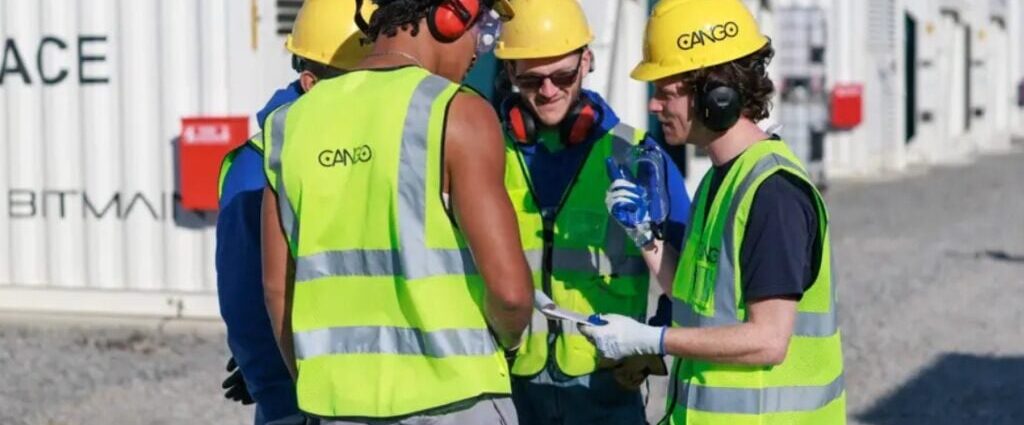
When the history books are written, the end of 2025 and beginning of 2026 are likely to be remembered as a pivotal time for Cango Inc. (NYSE:CANG). If current trends continue, history will show that’s when the company began to sharply scale back its year-old bitcoin mining business and race full throttle into a newer, more stable business providing high-performance computing (HPC) services for AI companies.

That newer business has taken some key steps forward lately, including the establishment of a U.S.-based subsidiary led by an industry veteran experienced in the type of distributed computing that will become Cango’s new focus. The company said it has also validated a “plug-and-play” model that allows for quick conversion of former bitcoin mining space into capacity usable for HPC clients, many of those smaller businesses running AI applications.

Cango discussed such a move as early as the middle of last year, back when bitcoin was still trading near record highs. But back then it portrayed the shift as more gradual, with bitcoin mining and HPC services serving as the company’s dual engines.

Fast forward to the present, when Cango’s latest quarterly report for the fourth quarter of 2025 shows the transformation has taken on sudden urgency, as the company shores up its balance sheet to prepare for its new chapter. That financial cleanup became necessary following a plunge that saw Cango’s bitcoin holdings lose half of their value in a matter of months, as the cryptocurrency tumbled from a record high of about $124,000 last October to a trough of about $63,000 in February.

Cango revealed the extent of its internal cash-crunch in its latest report, and detailed steps it took to strengthen its …

Full story available on Benzinga.com

This post was originally published here

Government’s first published land use framework maps how land is used and how it can be adapted to meet changing needs

About 7% of England’s land – an area roughly two-and-a-half times the size of Cornwall – will need to be given over to nature, forests and renewable energy, to meet the UK’s environmental targets, new data shows.

But there will still be enough land to grow the food needed, and to house a growing population, according to the government’s first land use framework, published on Wednesday.

Placing a high priority on restoring peatland, all but 13% of which is degraded across England, but this will not include an outright ban on development such as wind or solar farms.

Encouraging the “multi-use” of land, for instance with livestock grazing alongside wind and solar farms, and wildlife protection and nature restoration on arable land.

Encouraging local authorities to put nature reserves in urban areas as well as in the countryside.

Grouse moors to come under closer scrutiny and tighter regulation, which will go further than EU rules.

No new “right to roam” is included in the framework, but there will be a consultation on “making landowner liability more proportionate”, which could open up areas for public access.

A national soil map will be published.

A new land use unit will be established.

Government planning for changes to the UK’s landscape under global heating of 2C above preindustrial levels, and of much higher heating of 4C.

Continue reading…

This post was originally published here

The Iran war has rattled the global flow of oil, with steeper fuel costs already straining households worldwide. And in the U.S., drivers are now facing the highest prices they’ve seen at the pump in about two and a half years.

According to motor club AAA, the national average for a gallon of regular gasoline jumped over $3.84 on Wednesday, up from $2.98 consumers were paying before the U.S. and Israel launched the war with joint attacks against Iran on Feb. 28. The last time gas prices were as expensive as they are now was in September 2023.

“It’s pretty hard. I mean, times are tough for everybody right now,” Amanda Acosta, a Louisiana resident, told The Associated Press while filling up her car’s tank this week. “I’m getting way less gas and paying way more money.”

She isn’t alone. Pain at the pump has been one of the most immediate economic impacts of the conflict, because the price of crude oil — the main ingredient in gasoline — has soared and swung rapidly in recent weeks, due to supply chain disruptions and cuts from major producers across the Middle East. Brent crude, the international standard, was trading at nearly $108 a barrel Wednesday, up from roughly $70 just weeks ago. And benchmark U.S. crude is now going for almost $98 a barrel.

Many eyes are on the White House. Before the war, President Donald Trump once bragged about keeping gas prices low. But he’s since pivoted to try and paint high oil prices as a positive outcome for the U.S. Last week, Trump said that because the U.S. is now largest crude producer in the world, “when oil prices go up, we make a lot of money.”

Companies that supply oil benefit from higher prices. But steeper costs always pinch consumers’ wallets — and today’s prices arrive as many households continue to face wider cost of living strains. It could also push up already stubborn inflation, at least in the short run, and potentially hammer the economy more significantly if rising costs drag on. Experts say that could apply more pressure on the Trump administration, particularly as affordability continues to stay at the top of voters’ minds.

Drivers see impact of higher fuel prices

“I just want all of it to end. I just want to get out of there, out of Iran,” said Meghan Adamoli, a New Jersey resident who was among customers filling up at a Multani station on Tuesday. While Adamoli said she can personally “roll with the punches” when it comes to gas prices, she knows that a lot of others can’t.

Dan Bradley, a flatbed truck driver from Pennsylvania, said he’s felt the rising prices for both his work and personal vehicles. Beyond regular gasoline, the U.S. average for diesel neared $5.07 a gallon on Wednesday, per AAA, its highest level since 2022. Before the Iran war started, diesel was averaging at about $3.76 a gallon.

“It sucks when you’re filling up,” said Bradley. “What are you going to do, not get gas?”

Meanwhile, Texas resident Clay Plant said rising oil costs is good for the economy of his town, Lubbock. He sees more people work as drilling picks up.

“It’s kind of a good sign for us in west Texas,” Plant said. “I look at it as my friends and family get to eat and they get to go to work.”

Search for more supply and uncertainty ahead

The U.S. is now a net exporter of oil — and other parts of the world that rely more heavily of fuel imports from the Middle East, notably Asia, have seen starker energy shocks amid the war. But that doesn’t mean America is immune to price spikes.

Oil is a globally-traded commodity. And most of what the U.S. produces is light, sweet crude — but refineries on the East and West coasts are primarily designed to process heavier, sour product. So the country also needs imports.

The road ahead is uncertain, and prices could worsen if the war drags on. Iran has effectively halted nearly all tanker movement in the key Strait of Hormuz, where roughly one-fifth of the world’s oil once sailed through on a typical day. That’s led to cuts from some major producers in the region, because their crude has nowhere to go. Trump has demanded that other countries send warships to reopen the waterway, but has yet to garner sign-ons as many ask for more clarity about America’s next steps for the war. Meanwhile, Iran, Israel and the U.S. have all struck oil and gas facilities.

All of this has left countries scrambling for other supply. Last week, the International Energy Agency pledged to release 400 million barrels of oil from its member nations’ stockpiles. Trump, who previously downplayed the need for reserve oil, later confirmed that the U.S. would pull 172 million barrels from the Strategic Petroleum Reserve as part of this effort. The administration also announced it will temporarily free up Russian oil from U.S. sanctions for its war on Ukraine.

Still, analysts say these efforts will be a short-term bridge. Refineries buy crude oil in advance, and it takes time for new supply to trickle down to consumers. While steep crude costs is the top driver of gas prices today, a handful of other factors are also on the table. U.S. gas prices typically tick up a bit at this time of year, as more drivers hit the road and the warming weather brings a shift to “summer blend” fuel, which is more expensive to make than winter blend.

As always, some states also have pricier averages than others, due to factors ranging from nearby supply to differing tax rates. On Wednesday, California had the highest average of over $5.56 per gallon, while Kansas had the lowest of about $3.23.

Experts warn all of this could eat into wider spending. As consumers pay more to cover necessities like gas, many households — particularly those that are middle or low income — will be forced to cut their budgets in other places, explains Francesco D’Acunto, a finance professor at Georgetown University. More expensive fuel also impacts other sectors, from transporting groceries to household utility bills.

These combined inflation shocks, and overall high uncertainty during times of war, also “makes many houses and consumers freeze,” D’Acunto added. He said that could cause some to hold off on bigger financial decisions — like buying a car or house — farther down the road. “So potentially even that will have such an effect on the overall economy.”

________

AP Journalists Stephen Smith in Madisonville, Louisiana, Geoff Mulvihill in Cherry Hill, New Jersey, and Mingson Lau in Claymont, Delaware, contributed.

This story was originally featured on Fortune.com

This post was originally published here


Bitcoin (CRYPTO: BTC) is holding above $70,000 for now, but prominent analyst Trader Mayne foresees a broader macro downturn.

Bitcoin Still Holding Key Levels

In a Mar. 17 podcast, Mayne said Bitcoin’s recent rebound appears to be a countertrend move rather than the start of a sustained bull run.

He argued the broader market structure remains bearish, warning that a loss of support around $70,000 could open the door to further downside.

While he acknowledged that holding this level could support a bullish case, Mayne said his base view is that the market has not yet reached its bottom.

He

Full story available on Benzinga.com

This post was originally published here

(RTTNews) – A report released by the Energy Information Administration on Wednesday showed crude oil inventories in the U.S. jumped by much more than expected in the week ended March 13th.

This post was originally published here

Polymarket, one of the two leading prediction market sites, built its platform on blockchain rails—a design that offers efficiency but that can also add a layer of unwanted complexity.  On Wednesday, the fast-growing company took a step that will help it tuck those blockchain elements further into the background: Polymarket announced it is acquiring Brahma, a startup that specializes in providing crypto and DeFi infrastructure for businesses and individuals managing digital assets. The financial terms of the deal were not disclosed. 

“Building reliable infrastructure across blockchain networks and traditional financial rails is hard—there are no shortcuts,” said Shayne Coplan, founder and CEO of Polymarket, in an email to Fortune. “The Brahma team has shown they can design, operate and scale complex products for sophisticated users.”

While Polymarket expects the acquisition will improve its user experience, the move also signals the company—which has quickly grown to a reported $20 billion valuation—is doubling down on its crypto roots. Polymarket has been using blockchain rails since its inception, whereas its main competitor Kalshi functions largely with fiat currency. 

One way that Brahma could help Polymarket is by bringing additional liquidity to smaller wagers. Larger event contracts, like those in sports or politics, easily bring lots of money into the pool. But smaller wagers focused on niche areas such as, for instance, the outcome of a bowling match in Spain, struggle to amass a sizable amount of liquidity. Brahma’s experience in DeFi, a decentralized field of crypto defined by rapid trading and users with a high capacity for risk, could help draw in additional capital to more thinly traded contracts.

Alessandro Tenconi, one of the co-founders of Brahma, said in an interview with Fortune that his startup could remove the friction for Polymarket users when it comes to creating a wallet, depositing and converting shares, and redeeming outcome tokens.  

Brahma, started in 2021 by Tenconi and his co-founders Akanshu Jain and Bapi Reddy Karri, has helped both businesses and individuals use DeFi at scale. The startup says that it has processed more than $1 billion in transactions. When it joins Polymarket, Brahma will wind down its projects with other companies and individuals. 

This is not the first time that Polymarket has sought to expand by hiring talent through an acquisition. In February, the prediction market platform acquired Dome, a Y Combinator backed startup, to bolster its developer tools. Polymarket also acquired a boutique executive search firm called Lunch in February.

Tenconi says that one night in September, at 1 AM, he got a Telegram message from someone saying that Coplan, the CEO of Polymarket, wanted to talk to him. Ten minutes later, the two were on a call. He says that Coplan was looking for people who could build fast, build quality, and who had the chops. “It was like builders talking to builders,” Tenconi said, about that first phone call. “The rest happened very naturally.”

This story was originally featured on Fortune.com

This post was originally published here

Oklahoma senator has repeatedly made cryptic claims about ‘overseas’ work and war experience, while refusing to explain them

Markwayne Mullin, the Oklahoma senator chosen by Donald Trump to lead the Department of Homeland Security who will be considered by the Senate on Wednesday, has never served in the US military, but he routinely speaks as if he did in interviews.

Two days after the US attacked Iran, for instance, Mullin told Fox News: “War is ugly. It smells bad. And if anybody has ever been there and been able to smell the war that’s happening around you and taste it, and feel it in your nostrils, and hear it, it’s something you’ll never forget. And it’s ugly.”

Continue reading…

This post was originally published here


U.S. equity markets slipped into the red on Wednesday in early morning trading in New York as hotter-than-expected February producer price data reignited inflation fears just hours before the Federal Reserve is set to deliver its rate decision and updated economic projections, while Brent crude surged above $108 a barrel following an Israeli strike on Iran’s South Pars natural gas processing complex.

South Pars Strike Marks Major Escalation

Israel struck Iran’s South Pars gas processing facility in Assaluyeh on Wednesday morning, hitting tanks and infrastructure at the complex.

South Pars is Iran’s largest natural gas field and the source of roughly 70% of the country’s gas output. It shares a reservoir with Qatar’s North Field — the world’s largest natural gas deposit.

Iran’s Revolutionary Guards immediately issued evacuation warnings for several Gulf energy facilities. Iranian state media declared that Gulf energy sites are now “legitimate targets.” Iran’s Foreign Ministry said Tehran would retaliate. Qatar’s foreign ministry called the strike “a dangerous and irresponsible step amid the current military escalation.”

Prediction odds of the Strait of Hormuz reopening by April 30 fell to 25%, as tracked by Polymarket.

Brent crude surged 4.8% to $108.50 a barrel. WTI crude – as tracked by the United States Oil Fund

Full story available on Benzinga.com

This post was originally published here

Emanuel Fabian says his routine report became focus of wager with $23m at stake on online prediction platform

An Israeli journalist received threatening messages from users of the online prediction platform Polymarket after one of his reports, on a minor missile strike near Jerusalem, suddenly became the focus of an unresolved bet about the Israel-Iran conflict.

“After you make us lose $900,000 we will invest no less than that to finish you,” said one message to the journalist, Emanuel Fabian.

Continue reading…

This post was originally published here

Offer to reform taxes, tackle ‘rip-off Britain’ and overhaul fiscal rules could tempt exasperated Labour supporters

The venue for Zack Polanski’s economic speech on Wednesday – a sunny north London garden centre – could hardly have been more different to the sombre City backdrop for Rachel Reeves’s Mais lecture on Tuesday.

The chancellor was, as it happens, the last politician to give a major economic speech at the New Economics Foundation (NEF), the leftwing thinktank that invited the Green party leader, Polanski, to set out his stall as part of its 40th anniversary celebrations. Back in 2018 it hosted the speech in which, as a backbencher, Reeves called for an “everyday economics” that would prioritise the needs of low-paid workers.

Continue reading…

This post was originally published here

U.S. companies will be allowed to do business with Venezuela’s state-owned oil and gas company after the Treasury Department eased sanctions, with some limitations, on Wednesday as the Trump administration looks for ways to boost world oil supplies during the Iran war.

The Treasury issued a broad authorization allowing Petróleos de Venezuela S.A, or PDVSA, to directly sell Venezuelan oil to U.S. companies and on global markets, a massive shift after Washington for years had largely blocked dealings with Venezuela’s government and its oil sector.

The move highlights the increased pressure that the Republican administration is under to ease soaring oil prices as the United States, along with Israel, wages a war with Iran without a foreseeable end date. Global oil prices have since spiked as Iran halted traffic through the narrow Strait of Hormuz, where one-fifth of the world’s oil typically passes through from the Persian Gulf to customers worldwide.

The U.S. action is designed to incentivize new investment in Venezuela’s energy sector and is intended to benefit both the U.S and Venezuela, while increasing the global oil supply, a Treasury official told The Associated Press. The official was not authorized to discuss the matter publicly and spoke one condition of anonymity.

Since the ouster and arrest of Nicolás Maduro as Venezuela’s president during a U.S. military operation in January, President Donald Trump has said the U.S. would effectively “run” Venezuela and sell its oil.

The Treasury Department’s license provides targeted relief from sanctions, but does not lift the penalties altogether. The license allows companies that existed before Jan. 29, 2025, to buy Venezuelan oil and engage in transactions that would normally be banned under American sanctions, reopening trade for a major oil producer to global markets.

There are some limits.

Payments cannot go directly to sanctioned Venezuelan entities such as PDVSA, but must be sent instead to a special U.S.-controlled account. In other words, the U.S. will allow the oil trade but will control the cash flow.

Additionally, deals involving Russia, Iran, North Korea, Cuba and some Chinese entities will not be allowed. Transactions involving Venezuelan debt or bonds will not be allowed.

The license is expected to give a massive boost to Venezuela’s oil-dependent economy and help encourage companies that have been apprehensive to invest. The decision is part of the Trump administration’s phased-in plan to turn around Venezuela. But critics of the acting Venezuelan government argue that the move rewards Venezuela’s leadership -– all loyal to Maduro and the ruling party -– while repression, corruption and human rights abuses continue.

Many public sector workers survive on roughly $160 per month, while the average private sector employee earned about $237 last year, when the annual inflation rate soared to 475%, according to Venezuela’s central bank, and sent the cost of food beyond what many can afford.

Venezuela sits atop the world’s largest oil reserves and used them to power what was once Latin America’s strongest economy. But corruption, mismanagement and U.S. economic sanctions saw production steadily decline from the 3.5 million barrels per day pumped in 1999, when Maduro’s mentor, Hugo Chávez, took power, to less than 400,000 barrels per day in 2020.

A year earlier, the Treasury Department under the first Trump administration locked Venezuela out of world oil markets when it sanctioned PDVSA as part of a policy punishing Maduro’s government for corrupt, anti-democratic and criminal activities. That forced the government to sell its remaining oil output at a discount — about 40% below market prices — to buyers such as China and in other Asian markets. Venezuela even started accepting payments in Russian rubles, bartered goods or cryptocurrency.

The new license does not allow payments in gold or cryptocurrency, including the petro, which was a crypto token issued by the Venezuelan government in 2018. __

Garcia Cano reported from Caracas, Venezuela.

This story was originally featured on Fortune.com

This post was originally published here
Commonwealth ombudsman also finds Victoria and Queensland police not keeping adequate records

The New South Wales police force is overusing intrusive technology to monitor the phones and computers of people suspected of committing less serious crime, the commonwealth ombudsman has found.

The watchdog said Victoria and Queensland police were not keeping sufficient records to justify their use of the electronic surveillance powers, while NSW police “were unable to demonstrate” they were meeting the requirements of the Telecommunications (Interception and Access) Act 1979.

Continue reading…

This post was originally published here

Hopes for uniform nationwide gun control reform fade as states walk back federal cabinet commitment after Bondi beach massacre

The South Australian premier, Peter Malinauskas, assured gun lobbyists that he had no plans to strengthen firearm laws in the state despite agreeing to a national crackdown after the Bondi beach massacre.

In a letter signed a day before the government entered caretaker mode for the state election on 21 March, Malinauskas told a peak shooters group that SA had some of the strictest gun laws in the country and there was “currently … no plans to amend” them.

Continue reading…

This post was originally published here

Hopes for uniform nationwide gun control reform fade as states walk back federal cabinet commitment after Bondi beach massacre

The South Australian premier, Peter Malinauskas, assured gun lobbyists that he had no plans to strengthen firearm laws in the state despite agreeing to a national crackdown after the Bondi beach massacre.

In a letter signed a day before the government entered caretaker mode for the state election on 21 March, Malinauskas told a peak shooters group that SA had some of the strictest gun laws in the country and there was “currently … no plans to amend” them.

Continue reading…

Exclusive: Drug users face felonies and prison under Prop 36, with analysis showing racial disparities and little help

California prosecutors have filed nearly 20,000 drug possession felony cases under a tough-on-crime measure passed in 2024. But despite promises to get people into services, the vast majority of those arrested have not received drug treatment, state data reveals.

Proposition 36, a state ballot measure, enacted harsher penalties for minor theft and drug offenses, with proponents pledging the crackdown would lead to “mass treatment to keep people alive, out of jail, and off our streets”.

Continue reading…

This post was originally published here

Independent retailers are struggling to get fuel from the majors and say farmers have only responded to soaring prices and lack of availability

Rural fuel distributor Paul McCallum hopes the worst is over.

At the start of the month, as fuel prices surged after the US and Israel bombed Iran, farmers started bringing their diesel orders forward, requesting “a boisterous but not over the top” 1.5m litres from his company Inland Petroleum.

Continue reading…

This post was originally published here

Research shows average front garden size has declined by 46% in areas where older low-density homes have been replaced by larger, modern houses

Sydney’s increasingly supersized driveways are shrinking suburban front yards as residential redevelopment accelerates, a research paper has found.

The research, which details the loss of private tree space due to knock down-rebuilds, lays bare the gaps in the planning system for minimum private green space standards.

Continue reading…

This post was originally published here
Mr. Flower Fantastic is a graffiti artist turned floral designer who keeps his identity a secret. His new show is an ode to NYC in orchids. Oh, and did we mention he’s allergic to flowers?

(Image credit: New York Botanical Garden)

This post was originally published here

Scientists trying to work out why Gauls chose to bury some of their dead in seated position facing west

Children at a primary school in eastern France found a strange attraction next to their playground this week: a skeleton sitting upright, peeking out of a circular pit.

It is the latest in a series of bodies discovered in the city of Dijon that were buried in a seated position facing west.

Continue reading…

This post was originally published here

Leader uses first major economic speech to prioritise public services and reduction of inequality over growth

A government led by the Green party would not set targets for GDP growth but would instead focus on people’s mental health, social cohesion and community welfare, Zack Polanski has said in a major speech to set out his plans for the economy.

In his first policy address since taking over as leader of the Greens in England and Wales six months ago, Polanski condemned what he called “rip-off Britain”, where a minority of asset owners benefited at the expense of people obliged to pay unaffordable sums for housing and other basics.

Continue reading…

This post was originally published here
Ilya Remeslo sends Telegram post titled ‘Five reasons why I stopped supporting Vladimir Putin’ to his 90,000 followers

For years, Ilya Remeslo was a reliable pro-Kremlin operator, going after critics of the regime and smearing independent journalists, bloggers and opposition politicians.

Then the 42-year-old lawyer abruptly turned on the country’s most powerful man. Late on Tuesday, Remeslo posted a manifesto to his 90,000 Telegram followers titled: “Five reasons why I stopped supporting Vladimir Putin.”

Continue reading…

This post was originally published here

The war in Iran has already transformed the world’s energy map. It might yet redraw America’s auto market.

Now in its third week, the U.S. and Israeli military campaign in Iran has escalated to involve targets across the Middle East, including the Strait of Hormuz — a narrow waterway at the mouth of the Persian Gulf that serves as the world’s most critical fossil fuel chokepoint. The war has effectively closed the oil tanker traffic that used to navigate the strait, which on a normal day carries up to 20% of the world’s traded petroleum.

Fuel costs worldwide have soared as a result. Average gas prices in the U.S. are now $3.79 a gallon, up from $2.92 a month ago, reminding drivers of the 2022 energy shortage and even of the devastating oil shocks of the 1970s.

But unlike during those crises, the world now possesses a massive, rapidly scaling, and for the most part readily available asset to soften the blow: the electric vehicle.

The global EV fleet has been growing for years, gradually chipping away at the world’s oil consumption as drivers turn to charging ports instead of gas stations. Last year, EVs worldwide avoided the consumption of 1.7 million barrels of oil per day, according to a report published Wednesday by Ember, an independent energy think tank based in the U.K. That’s roughly 70% of the 2.4 million barrels Iran exported daily through the Strait of Hormuz in 2025.

While the crisis has sent global oil prices soaring, the declining need for petroleum in transportation is providing a critical cushion in some countries. And the longer fuel prices remain elevated, the more attractive EVs become to buyers.

“Oil is a particularly tricky resource to replace,” Daan Walter, a researcher at Ember and the report’s lead author, told Fortune. “It has been for 125 years now, except for the past five or six years, when we’ve had this new competitive lever in electric vehicles.”

Electrifying demand

In the U.S., EV purchases hit a wall over the past few months as President Donald Trump rescinded many of the subsidies and incentives the Biden administration had installed to facilitate the transport sector’s electrification. Those measures mostly expired in September, and EV sales for the year ended up falling by 2%.

But the Iran conflict has sparked a revival of consumer interest. Search traffic for EVs during the first week of the conflict jumped 20%, according to CarEdge, a car shopping platform, with interest in popular models like the Tesla Model Y and Chevrolet Equinox nearly doubling.

For now, the conflict in Iran and higher gasoline prices are likely to only influence drivers who were already in the market for a new car, Elaine Buckberg, a senior fellow at Harvard University’s Salata Center for Climate and Sustainability and a former chief economist for General Motors, told Fortune.

But that could change if prices stay high for much longer. “Gasoline prices are one of the biggest elements of people’s perception of inflation because you buy it so regularly,” Buckberg said. “It takes three to six months of persistently higher prices before people say, ‘Maybe I should go out and switch cars to one that’s more fuel efficient, including an EV.’”

EV drivers outside the U.S. already know how much they might be able to save. In the U.K., EV drivers saved an average of £870 ($1,162) a year by charging their cars instead of fueling up, according to an analysis published last week by the nonprofit Energy & Climate Intelligence Unit. But if oil prices remain above $100 a barrel, as they have for most of the conflict, those annual savings could jump to £1,000 ($1,336).

In the U.S., the costs of owning and charging an EV depend on several factors, including local electricity prices and whether drivers can charge their cars at home. And for now, buying an electric car tends to be more expensive than buying a gas-powered one, although prices are falling due to greater competition and more choices of lower-priced models.

But EV drivers are likely to be rewarded over the course of their car’s lifetime—the New York Times found last year that driving 100 miles in a home-charged EV costs on average a little more than $5, while the same distance in a standard gas-powered car costs on average $12.80.

Nowhere to hide

The Trump administration has framed the pain Americans are feeling at the pump as a short-term problem, and claimed that the U.S. is insulated from the oil crisis because it is a large producer in its own right. But being a net exporter of oil does little to shield the U.S. from volatility, according to Ember’s Walter.

“In some ways, no one is safe,” he said. “Even if you live between a gas well and a refinery, even then your prices are going up.”

Oil is a global commodity, and unless a government enacts export bans, a barrel of oil produced in the U.S. will go to whoever pays the most wherever they are, Walter said. That means American consumers remain tethered to the same price volatility as the rest of the world, regardless of how much crude is pumped from U.S. soil. In Texas, for example, one of the world’s largest oil-exporting regions, gasoline prices have risen 25% since the war began, faster than in oil-importing nations like the U.K. and France during the same period, Walter said.

Because volatile gasoline prices have such a significant bearing on consumer sentiment, experts have long argued that transportation reliant on locally generated electricity can be an economic and political hedge.

“A shift towards EV basically would protect the economy from downside,” Buckberg said. “That link from oil geopolitics to oil prices to gasoline prices could be broken.”

The last time a global geopolitical shock sparked an energy crisis was in 2022, when Russia’s invasion of Ukraine sent global oil and gas markets into a frenzy. A lot has changed since then to make EVs a more palatable option as gasoline prices rise, Buckberg said. For one, the world is no longer limited by a microchip shortage that strained EV manufacturing in the early 2020s. 

But electric and hybrid vehicles have also become more affordable and accessible to a wider variety of consumers, particularly in emerging markets in East and Southeast Asia, according to previous Ember research. In China, the world’s biggest EV market, the country’s existing electric car fleet accounts for more than $28 billion a year in avoided oil imports, Ember’s latest report found.

“We’re no longer living in a world of risk-free fossil fuels. We’re living in a world where everything is risky and it now becomes a question of which risks do you want to take,” Walter said. 

This story was originally featured on Fortune.com

This post was originally published here

Coinbase’s 60-second spot, “Your Way Out,” drops viewers into a low-resolution video game world where everyone moves in a loop: commuting, working, spending. The protagonist is an NPC, a non-playable character, stuck inside a system he didn’t build and can’t control, until he strains against his preprogrammed slumped over state and breaks free. The environment shifts from pixelated game world to the full color of reality as he gains agency, set to Sammy Davis Jr.’s “I’ve Gotta Be Me.” The ad only reveals itself to be about Coinbase at the end, with a single tagline: “Your way out of their system.”

The ad is extraordinary for what it captures in the culture: an ever-gnawing desperation to escape what’s become known as the “permanent underclass.” The phrase, once niche Silicon Valley gallows humor, has become a genuine cultural fixation. As leaders of AI companies boast that their technology will replace most jobs within the next decade, people are worried they’ll be sorted into a category Karl Marx once called the lumpenproletariat: the lowest stratum of the industrial working class itself.

Only it’s 2026, and the word for it is the permanent underclass, a world with no upward mobility. Online, the term is lobbed at people who aren’t heeding AI’s headwinds, the kinds of FOMO-stoking posts that happen to work very well for selling. Which, of course, is what Coinbase is doing.

“Today, because of the maturity of Coinbase, we have a broader set of products that we think can offer true alternatives to an outdated system,” Catherine Ferdon, Coinbase’s CMO, said in a statement sent to Fortune.

The whole thing was shot using real actors and no CGI, Toby-Treyer Evans, the founder of the advertising agency that produced it, wrote in advertising trade site Muse by Clio. The game-world look was built in-camera, using suits with printed-on fabric details and pixelated set design made to look indistinguishable from a video game. Extras were trained to walk like game characters, Treyer- Evans wrote. It’s a genuine feat of filmmaking, and it isn’t Coinbase’s first. The company has built a reputation for splashy, viral big-event ads, including their memorable Super Bowl ad.

The ad’s central metaphor, the NPC, is a cultural artifact of that same corner of the internet. “Non-playable character” started as a gaming term, then by 2018 became a political meme to describe people who parrot talking points without thinking. Now, it’s Gen-Z’s default insult for anyone who appears to be on autopilot: going through the motions, lacking agency, playing by someone else’s rules. It sounds like the classic complaint the youth have always had about the status quo: “you’re the system, man!”

But this is different. These fears are shared by most Americans, and validated by the very people building the technology everyone’s afraid of. The noise around AI and its potential effects has grown so loud that you don’t need to be a 17-year-old dorm-room philosopher to conclude: a lot of people are about to lose control of their financial lives and not even realize it.

Coinbase’s answer, naturally, is to trade cryptocurrency. The pitch is compelling because it’s true that crypto has created real wealth for people bold enough, and lucky enough, to invest at the right time. The number of crypto millionaires globally hit nearly 242,000 last year, up 40% in twelve months, according to Henley & Partners. An entire subculture has formed around the shared belief that the traditional financial system was never going to let them in anyway. Those “crypto bros” are now perfectly positioned to capitalize on the broader anxiety about AI and displacement.

But for every crypto millionaire minted in the past two years, there are retail investors who lost their savings in the FTX collapse, got liquidated on leveraged bets they didn’t fully understand, or watched memecoins they bought on hype go to zero. FTX itself ran a Super Bowl ad in 2022—the same year as Coinbase’s famous ad—starring Larry David dismissing crypto as a fad. The company turned out to be a multibillion-dollar fraud. 

So even if the permanent underclass may or may not be coming, the ads for it are already here.

This story was originally featured on Fortune.com

This post was originally published here

More than 200 Americans at Balad site say they have no evacuation plan as fears grow of a post-Ramadan assault

Hundreds of US contractors are stranded on a major military base near Baghdad, Iraq, with no evacuation plan, while local Iran-backed militants are possibly making plans to attack the base, three sources said.

The contractors are employed on the Martyr Brigadier General Ali Flaih Air Base, formerly Balad Air Base, to support the Iraqi government’s F-16 fighter jet program.

Continue reading…

This post was originally published here

Perfect Corp. (NYSE:PERF) shares rose in Wednesday’s premarket session after the company announced it had received a preliminary, non-binding proposal for a going-private transaction at $1.95 per share.

The proposal came from CyberLink International Technology Corp. and Perfect Chairwoman Alice H. Chang. It represents a 44.4% premium to the company’s March 17, 2026 closing price.

The board plans to review the proposal and form a special committee to evaluate it. That process may include hiring independent advisers.

The company said it wants to pursue a successful transaction, but noted that no definitive agreement has been reached. The proposed deal would be …

Full story available on Benzinga.com

This post was originally published here

Micron Technology Inc (NASDAQ:MU) shares surged during Wednesday’s premarket session. This follows a 4.5% gain on Tuesday.

Investors are positioning themselves before the company’s fiscal second-quarter results. The report drops after the closing bell on Wednesday.


Analysts Expect Massive Year-Over-Year Growth

Wall Street expects a significant jump in financial performance. According to Benzinga Pro data, the consensus revenue estimate is $19.26 billion. This compares to $8.05 billion in the year-ago period.

Analysts project quarterly earnings of $8.77 per share. Last year, the company reported just $1.56 per share.

TD Cowen analyst Krish Sankar is even more optimistic. He expects earnings of $10.40 per share for the February quarter. Sankar maintained a Buy rating and raised his price target to …

Full story available on Benzinga.com

This post was originally published here

These 7 steps can help you launch a side business, along with the pros and cons, ideas for what works, and other considerations

This post was originally published here

Bitcoin (CRYPTO: BTC) has been unable to durably break $75,000 despite landmark SEC and CFTC joint guidance clarifying crypto token classifications and seven consecutive days of ETF inflows totaling over $1.4 billion.

The SEC/CFTC Framework

The SEC and CFTC issued joint interpretive guidance dividing crypto tokens into five categories: digital commodities, digital collectibles, digital tools, stablecoins, and digital securities. 

The framework marks a shift from case-by-case enforcement, clarifying which tokens are securities and which fall under lighter CFTC oversight.

“The practical effect is a more coherent and less burdensome regulatory environment,” Tagus Capital said. “Legal uncertainty declines, the risk of retroactive enforcement is reduced, and compliance becomes more predictable.”

The guidance supports institutional participation, exchange development, and product innovation while improving market structure through …

Full story available on Benzinga.com

This post was originally published here

Sri Lanka has just introduced a four‑day workweek—not to boost work‑life balance, but because the war in Iran is threatening to drain its petrol tanks dry.  

The government has declared every Wednesday a holiday for most public institutions in a desperate bid to slash petrol use, as war in the Middle East threatens vital oil shipments through the Strait of Hormuz.

All state institutions, along with schools and universities, will shift to a four-day work week, starting this Wednesday. Essential services like hospitals will stay open, but everyone else is being told to stay home, log on where possible, and use as little gas as they can. 

Even the private sector is being asked to follow the mandate, too.

Officials say Sri Lanka has roughly just six weeks of fuel reserves left. That’s why they’ve rolled out the four‑day week almost overnight, suspended public ceremonies, and launched a National Fuel Pass to ration how much petrol people can buy. And they’re not the only country introducing these emergency measures to avoid running out of fuel. 

There’s a pattern worth naming here. The three major crises since 2020—the pandemic, the 2022 European energy shock, now the Iran war—have each pushed governments to reach for the same lever: send people home, cut the commute, compress the week. And every time, some portion of that change proves permanent. Workers adjust. Productivity holds. And the five-day, in-office standard quietly loses a little more of its claim to inevitability. Look around Asia to see how Sri Lanka is far from alone.

Pakistan, the Philippines, and other Asian nations are welcoming a 4-day week and remote work

Across Asia, governments are quietly cutting working days, commutes, and non‑essential travel in a bid to stretch fuel supplies as far as possible.

Pakistan has already implemented a four-day week for some government offices and shut schools, as well as imposing a ban on in-person meetings. Meanwhile, all public and private firms are being mandated to ask 50% of their workforce to work from home. 

The Philippines is also adopting a four-day work week for government staff, and urged workers more generally to work from home where possible. Vietnam is also telling citizens to stay home, as well as to ride bikes, carpool, and use public transport, and restrict personal vehicle usage.

Other Asian nations are taking quirkier energy-saving steps. In Thailand, the government is urging office workers to ditch suits for short‑sleeved shirts so buildings can dial down the air‑conditioning. It’s also called on people to take the stairs instead of elevators

Myanmar is limiting private cars on alternate days. Bangladesh has introduced early Ramadan holidays and India has asked consumers not to panic, because hoarding—or turning to the black market—will only make the situation worse. 

Where the four‑day work week is here to stay

While these emergency measures are temporary, elsewhere, the four‑day work week has been introduced under far less dramatic circumstances—and often with surprisingly positive results. 

The U.K. ran the world’s largest four‑day week pilot in 2022, involving dozens of companies that paid staff 100% of their salary for 80% of the time in exchange for a commitment to maintain performance. A year later, 89% of participating firms were still operating a four‑day week and just over half had made the switch permanent—citing higher revenues, better retention, and employees who were less burned out and more loyal. And many other countries have been trialling shorter weeks across dozens of companies with strong early feedback on productivity and quality of life.

Across Europe and beyond, the idea is slowly moving from a rare perk to a mainstream policy experiment. Belgium passed legislation allowing workers to compress a full‑time job into four longer days, the UAE shifted its public sector to a four‑and‑a‑half‑day week, and even companies that don’t want to make permanent changes have launched “recharge days” and Summer Fridays.  

Sri Lanka’s emergency measures may be lifted the moment oil flows freely again. But the precedent—that a shorter week is a policy tool, not just a perk—is becoming established across three continents and counting.

This story was originally featured on Fortune.com

This post was originally published here

As of March 18, 2026, two stocks in the health care sector could be flashing a real warning to investors who value momentum as a key criteria in their trading decisions.

The RSI is a momentum indicator, which compares a stock’s strength on days when prices go up to its strength on days when prices go down. When compared to a stock’s price action, it can give traders a better sense of how a stock may perform in the short term. An asset is typically considered overbought when the RSI is above 70, according to Benzinga Pro.

Here’s the latest list of major overbought players in this sector.

Arcellx Inc (NASDAQ:ACLX)

  • On Feb. 23, Gilead Sciences Inc. (NASDAQ:

Full story available on Benzinga.com

This post was originally published here

Intel Corp. (NASDAQ:INTC) shares are trading higher during Wednesday’s premarket session. The move follows a series of product launches and strategic partnership updates.

New High-Performance Chips For Gamers

On Tuesday, Intel announced its Core Ultra 200HX Plus mobile processors. These chips target high-performance laptops for gamers and creators.

The lineup includes the Core Ultra 9 290HX Plus and Core Ultra 7 270HX Plus. These chips offer up to 8% faster gaming performance.

Nvidia Partnership Buzz Drives Momentum

Intel shares gained earlier this week on …

Full story available on Benzinga.com

This post was originally published here

Good morning. Agentic AI could be the catalyst that gets most finance chiefs on board with using AI to support the finance function.

Aneel Bhusri, cofounder and CEO of Workday, an enterprise HR and finance platform with AI, returned to the role last month, two years after stepping down, succeeding Carl Eschenbach, Fortune reported. “I think there’s a lot of misinformation out in the marketplace about AI and SaaS applications,” Bhusri said during a virtual press conference on March 12. “There’s this idea that AI is going to replace a lot of these applications with things like vibe coding. I’m a technologist, and I’ve been in this space for a long time. I just don’t see that happening.”

There will exist a hybrid world, where the best of enterprise apps are paired with the best of AI, and where low-level, rote work gets replaced by agents that drive business processes underneath, Bhusri said. In his first month back as CEO at Workday, he spent time with many financial customers and prospects—and found that many accounting departments are still “running old systems like the one I was part of at PeopleSoft,” he said.

Cloud computing improved software and user experience, but finance teams were slower to adopt it because their systems served fewer users and were heavily customized. But AI is different: it can cut costs, automate complex work, and even enable near real-time audits, he said. “That was not possible with either the legacy on-premise systems or the newer cloud systems,” he said. “They were still business process automation systems, not reasoning and probabilistic engineering systems.”

That distinction is resonating with finance chiefs. For CFOs, “the agentic story and solutions are really what are catching their eye right now,” Bhusri said. “CFOs look at it as, ‘The new way to differentiate how we do business. We need to embrace AI.’” And that, he said, is the reason many will finally move from a legacy system to an AI-driven cloud system.

The shift appears to be gaining momentum more broadly. Gartner recently predicted that 40% of enterprise applications will be integrated with task-specific AI agents by the end of 2026, up from less than 5% in 2025 — a sign that agentic AI is moving from concept to corporate priority.

Workday (No. 455 on the Fortune 500) is moving quickly to capture that momentum. On Tuesday, the company launched Sana from Workday, a new AI tool that can answer questions, complete tasks, and automate routine work across HR and finance. It uses AI agents that can carry out multi-step tasks on their own, for example, reviewing email for receipts and submitting them for approval , and works across apps like Gmail, Outlook, Salesforce, Google Drive, and SharePoint while following company security rules. The tool is based on Workday’s $1.1 billion acquisition of Sana Labs, completed in November 2025.

AI could be the catalyst to spur some finance teams to modernize.

Sheryl Estrada
sheryl.estrada@fortune.com

This story was originally featured on Fortune.com

This post was originally published here

Snub comes as Iran vows revenge for killing of Ali Larijani. Plus, judge orders reinstatement of Voice of America staff

Good morning.

Donald Trump has said the US does not need Nato after a number of the organization’s members rejected his call to send their warships to reopen the strait of Hormuz.

How many people have been displaced in Iran? Up to 3.2 million people, according to the UN’s refugee agency. Here, Tehran residents speak about their daily life under bombardment.

For the latest updates, follow our liveblog.

Continue reading…

This post was originally published here

With escalating conflict in the Middle East and surging oil prices, the market is bracing for a near-term shock, warned Professor Jeremy Siegel, Senior Economist to WisdomTree and Emeritus Professor of Finance at The Wharton School of the University of Pennsylvania.

Siegel observed a change in market sentiment due to the increasing oil prices and the expanding Middle East conflict. He suggested that the markets could see a 10% correction from recent highs, although a major decline for the S&P 500 is not expected.

“The mood has clearly changed,” said Siegel.

The economist emphasized that the primary concern is not just the crude oil price, but the effect of rising gasoline prices on consumer psychology. Despite the broader economic effect being more balanced, the immediate impact on consumer sentiment is significant.

At 7:27 AM ET, WTI crude oil was trading 0.55% lower at $95.68 per barrel. Meanwhile, the national gas prices stood at …

Full story available on Benzinga.com

This post was originally published here

On CNBC’s “Halftime Report Final Trades,” Joshua Brown, co-founder and CEO of Ritholtz Wealth Management, said he remains long on Uber Technologies, Inc. (NYSE:UBER).

Uber announced on Monday an expansion of its autonomous vehicle partnership with Nvidia. The companies announced plans late Monday to launch a global fleet of autonomous vehicles. These cars will run entirely on Nvidia software. The rollout is scheduled for the first half of 2027.

Brian Belski, founder, CEO and chief investment officer at Humilis Investment Strategies, named Pinnacle Financial Partners, Inc. (NASDAQ:PNFP) as his final trade.

Lending support to his …

Full story available on Benzinga.com

This post was originally published here

Sky News Arabia has been accused of broadcasting propaganda and whitewashing genocide in Sudan

Sky is considering terminating its joint venture with the United Arab Emirates (UAE) after accusations it is involved in broadcasting propaganda and genocide denial.

Sky is in talks with its partner in the UAE on Sky News Arabia over the potential termination next year of the licence to use its brand.

Continue reading…

This post was originally published here

Bitcoin‘s (CRYPTO: BTC) rally to $76,000 follows the same pattern as the 2022 and 2018 midterm years, where February lows led to March rallies that ultimately formed lower highs before crashes, according to prominent analyst Benjamin Cowen.

The Stablecoin Dominance Pattern

Stablecoin dominance (USDT + USDC) exploded from 8.5% to 12.5% after sweeping prior highs, exactly as Cowen predicted two months ago when Bitcoin traded above $90,000. 

The current pullback in stablecoin dominance mirrors patterns seen in Bitcoin dominance, palladium, and the Hang Seng Index over the past four years.

“When I look at stablecoin dominance, I would have to say objectively, it’s hard to say that this won’t just be a higher low,” Cowen said. 

“If it takes out the low, then I’m wrong. But for now, this simply looks like what we’ve previously seen in other markets that exhibited a very similar pattern,” he added.

The pattern works like this: an asset sets a high, sells off, sets …

Full story available on Benzinga.com

This post was originally published here

The days of the quarterly earnings report could be numbered as the Securities and Exchange Commission is said to weigh a rule change. What it could mean for investors is likely to stir debate.

This post was originally published here

The stars of Sex Education and The Morning Show will appear in a new West End production of Edward Albee’s classic, directed by Marianne Elliott

Gillian Anderson is to return to the West End in a role she has coveted “for decades”. The Sex Education star will appear opposite Billy Crudup in a revival of Edward Albee’s marital meltdown classic Who’s Afraid of Virginia Woolf? in the autumn. Staged in-the-round, the production will be directed by Marianne Elliott at the intimate @sohoplace theatre.

Anderson will play Martha who spars with her professor husband George over drinks with a young married couple in the 1962 play. “Martha’s rage is inseparable from her longing, her disappointment and her need to be seen – all things still eminently relatable 60 years on,” said Anderson. The role was first played on Broadway by Uta Hagen, on screen a few years later by Elizabeth Taylor (opposite her husband Richard Burton) and in a 1996 London revival by Diana Rigg. “I’ve wanted to play Martha for decades,” said Anderson. “I’m thrilled Billy Crudup is joining me in the ring as George.”

Continue reading…

This post was originally published here

Accenture plc (NYSE:ACN) will release earnings for its second quarter before the opening bell on Thursday, March 19.

Analysts expect the company to report earnings of $2.84 per share. That’s up from $2.82 per share in the year-ago period. The consensus estimate for Accenture’s quarterly revenue is $17.83 billion (it reported $16.66 billion last year), according to Benzinga Pro.

Ahead of quarterly earnings, TD Cowen analyst Bryan C. Bergin, on Monday, maintained Accenture with a Buy and lowered the price target from $282 to $275.

With the recent buzz around Accenture, some investors may be eyeing potential gains from the company’s dividends too. As of now, Accenture has an annual dividend yield of 3.28%, which is a quarterly dividend amount of $1.63 per share ($6.52 a year).

To figure out how to earn $500 monthly from Accenture, we start with the yearly target of …

Full story available on Benzinga.com

This post was originally published here

U.S. stock futures were higher this morning, with the Dow futures gaining around 200 points on Wednesday.

Shares of Clearpoint Neuro Inc (NASDAQ:CLPT) fell sharply in pre-market trading after the company announced a wider-than-expected quarterly loss.

ClearPoint Neuro reported quarterly losses of 23 cents per share which missed the analyst consensus estimate of losses of 20 cents per share. The company reported quarterly sales of $10.400 million which beat the analyst consensus estimate of $10.050 million.

Clearpoint Neuro shares dipped 6.4% to $10.45 in pre-market trading.

Here are some other stocks moving lower in pre-market trading.

  • New Era Energy & Digital Inc (NASDAQ:NUAI) dipped 7.7% to $5.52 …

Full story available on Benzinga.com

This post was originally published here

$11.3bn more than enough to fund EPA or National Cancer Institute, where administration sought to slash budgets

The US spent $11.3bn on just the first week of its military assault on Iran. This huge expenditure dwarves the annual budgets of many of the public health and scientific agencies the Trump administration has sought to cut, raising stark questions about the country’s priorities.

In the six days that followed the US and Israel’s joint attack on Iran on 28 February, $11.3bn was spent on American taxpayer-funded bombs that hit the country and caused hundreds of deaths, the Pentagon has told lawmakers. This figure does not capture the full cost of the conflict, such as deployment of forces, and will now be far higher given the ongoing nature of the war.

Continue reading…

This post was originally published here

With alarming headlines coming out of the Middle East, economists will be wary of sharing forecasts that might unnecessarily spook consumers or investors. Nonetheless, while Wall Street has remained calm(ish) about the disruption to global oil and energy supplies, Moody’s Mark Zandi warns that the longer-term macroeconomic picture has taken a turn for the worse.

Zandi shared that, even prior to the U.S. and Israel launching strikes on Iran, recession odds for the economy had crept up to an alarming threshold. The latest reading on Moody’s economic indicator model—for February, prior to the military action—placed odds of a recession at 49% over the next 12 months.

“Behind the recent jump are primarily the weak labor market numbers, but almost all the economic data have turned soft since the end of last year,” Zandi wrote in a note. Indeed, an image Zandi shared of the Moody’s recession indicator shows that historically, it has been fairly accurate. The indicator spiked above a benchmark of 50 in 2020, in 2007, and 2001—all of which were followed by recessions as defined by the Federal Bank of St Louis.

“It isn’t a stretch to expect the indicator to cross the key 50% threshold amid the Iranian conflict and the resulting surge in oil prices,” Zandi continued. “Oil prices are an important variable in the model, and with good reason: every recession since WWII, save the pandemic recession, has been preceded by a spike in oil prices.”

Moody’s recession call is higher compared to many on Wall Street, where most estimates say the likelihood is growing but is perhaps not in 50/50 territory. Indeed, Oxford Economics’s modelling suggests that oil prices would have to hit $140 a barrel over a two-month period to plunge the world economy into a recession. The strength of the subsequent recovery following a resolution of conflict in the Middle East depends on how quickly shipping through the Strait of Hormuz is normalised.

“The rebound in financial markets has been quick following past major military conflicts in the Middle East since the 1990s, but this time it could be more gradual,” noted Ben May, director of global macro research at Oxford Economics, and Ryan Sweet, chief global economist.

Zandi agrees with the premise, saying higher oil prices won’t level the same amount of economic damage as years prior because production and consumption are better aligned, but added consumers will suffer a significant uptick in the cost of living when they “were already increasingly nervous spenders.”

The Moody’s chief economist said his peers “will be loath to utter the word ‘recession,’” despite evidence to support such a statement, because many were proven wrong when they called a downturn calls over Fed policy a couple of years ago. But Zandi added: “If oil prices remain elevated for much longer (weeks and not months), a recession will be difficult to avoid.”

Happier odds

Some investors feel significantly more optimistic about the probability of a recession. Indeed, while economists generally go by the rule that a recession might happen once every five years, if not more frequently, Apollo Investment’s chief economist Torsten Slok suggests economic downturns are becoming less frequent.

“Between recessions, investors should prepare for sector-specific cycles, such as the current downturn in software, where one or two subsectors face distress while the rest of the economy is fine,” Slok wrote in a note published yesterday. “The bottom line is that credit opportunities arise not just during recessions, but also when there are sector-specific cycles during expansions.”

Oxford Economics’ latest Global Risk Survey is similarly more buoyant. The survey, conducted between February 26 and March 11, found there had been a sharp downturn of expectations since the outbreak of the conflict. However, odds of a global recession still stand at a 1-in-6 chance.

The war has driven scepticism over the prospects of the U.S. economy, Oxford notes. Prior to the military action, three-quarters of respondents felt the recent period of U.S. exceptionalism would continue, but that figure fell significantly as the conflict continued, with little more than half the 174 clients surveyed now expecting the U.S. to remain the fastest-growing G7 economy this year.

Indeed, Wall Street is more widely inclined to agree with lower recession odds. David Mericle of Goldman Sachs wrote this week that the bank’s outlook odds had increased, up by 5 percentage points to 25%, while JP Morgan predicted at the end of last year that the likelihood of a 2026 recession was 35%.

This story was originally featured on Fortune.com

This post was originally published here

GE Aerospace (NYSE:GE) announced Wednesday plans to invest more than 110 million euros (~$127 million) across its European sites in 2026 to raise output and expand advanced manufacturing.

The move highlights the company’s push to meet stronger aerospace demand and deepen its presence in the region.

The investment will cover several countries and fund hiring, equipment upgrades and infrastructure improvements across major facilities.

Investment Breakdown Across Europe

The company will spread the money across five countries to strengthen manufacturing and technical operations.

Italy will receive the biggest allocation, with 77 million euros set aside for test cells, machining systems and additive manufacturing upgrades.

Poland will get 15 million euros to improve grinding, welding and inspection capabilities at multiple sites.

The Czech Republic will receive 8 million euros for precision manufacturing and quality system improvements.

The United Kingdom will get 10 million …

Full story available on Benzinga.com

This post was originally published here

SoFi Technologies Inc (NASDAQ:SOFI) shares stabilized on Wednesday morning. The move follows a sharp rebuttal against Muddy Waters Research.

The short-seller released a scathing report on Tuesday afternoon.

SoFi management characterized the claims as a “fundamental lack of understanding” of their business. The company also signaled intent to “explore potential legal action” against the firm.

Muddy Waters Alleges Accounting Red Flags

The conflict began Tuesday when Muddy Waters, led by Carson Block, labeled SoFi a “financial engineering treadmill.”

The report alleged that SoFi’s 2025 adjusted EBITDA was inflated by 90%. Muddy Waters suggested the true figure was $103 million rather …

Full story available on Benzinga.com

This post was originally published here
Bitcoin continues to trade around $73,000, following $199.4 million in net ETF inflows on Tuesday, while Ethereum ETFs reported $138.25 million in net inflows.  


Cryptocurrency
Ticker Price
Bitcoin (CRYPTO: BTC) $73,071
Ethereum (CRYPTO: ETH) $2,273
Solana (CRYPTO: SOL) $92.13
XRP (CRYPTO: XRP) $1.50
Dogecoin (CRYPTO: DOGE) $0.09903
Shiba Inu (CRYPTO: SHIB) $0.056050

Meme coin market capitalization is down 1.1% over the past 24 hours to $35.7 billion.

Trader …

Full story available on Benzinga.com

This post was originally published here

During times of turbulence and uncertainty in the markets, many investors turn to dividend-yielding stocks. These are often companies that have high free cash flows and reward shareholders with a high dividend payout.

Benzinga readers can review the latest analyst takes on their favorite stocks by visiting Analyst Stock Ratings page. Traders can sort through Benzinga’s extensive database of analyst ratings, including by analyst accuracy.

Below are the ratings of the most accurate analysts for three high-yielding stocks in the industrials sector.

Automatic Data Processing Inc (NASDAQ:ADP)

  • Dividend Yield: 3.24%
  • Stifel analyst David Grossman maintained a Hold rating and cut the price target from $280 to $270 on Feb. 9, 2026. This analyst has an accuracy rate of 58%.
  • Morgan Stanley analyst James Faucette maintained an Equal-Weight rating and slashed the price target from $311 to $274 on Jan. 29, 2026. This analyst has an accuracy rate of 64%
  • Recent News: On Jan. 28, Automatic Data Processing posted upbeat quarterly …

Full story available on Benzinga.com

This post was originally published here

Good morning. In today’s Fortune:

  • It’s Fed day—expect Powell to keep rates at 3.5%.
  • Iran: As Trump rages against his allies, Republicans want to know what the plan is.

  • Chaos in the Gulf is producing ‘butterfly effects’ far away.
  • Why the U.S. doesn’t have enough minesweepers to open the Strait of Hormuz.
  • Prediction markets see the war getting longer.
  • Nvidia might pay engineers in AI tokens
  • Exclusive: AI isn’t destroying consultants, Capgemini says.
  • Exclusive: Hinge CEO on the ‘dating recession.’

This story was originally featured on Fortune.com

This post was originally published here