Members reportedly agree rise of 206,000 barrels a day in May but move symbolic with strait of Hormuz effectively closed

Iranian drones struck Kuwait’s oil infrastructure on Sunday, causing “severe material damage” that threatened to further disrupt oil supplies already hit by the US and Israel’s war with Tehran.

It came hours before members of the Opec+ group that represents major global oil suppliers gathered to discuss how to bolster output despite Iran’s effective closure of the crucial strait of Hormuz shipping route.

Continue reading…

This post was originally published here

Marjorie Taylor Greene and Bernie Sanders among those responding with alarm to Trump writing ‘open the fuckin’ strait, you crazy bastards’

Some US politicians have reacted with alarm and questioned the US president’s mental state after Donald Trump issued an abusive, expletive-laden threat to Iran in which he called on the regime to “open the fuckin’ strait [of Hormuz], you crazy bastards”, as he threatened to further attack the country’s energy and transport infrastructure.

The US president wrote on his Truth Social platform: “Tuesday will be Power Plant Day, and Bridge Day, all wrapped up in one, in Iran. There will be nothing like it!!! Open the Fuckin’ Strait, you crazy bastards, or you’ll be living in Hell – JUST WATCH! Praise be to Allah. President DONALD J. TRUMP.”

Continue reading…

This post was originally published here

Incident prompts political scrutiny across Hungary as Viktor Orbán trails in polls before next Sunday’s election

Serbia has said it found “explosives of devastating power” near a pipeline that carries Russian natural gas to Hungary and beyond, sparking claims by Hungary’s leading opposition candidate of a possible “false flag” operation aimed at influencing the country’s elections.

On Sunday, Hungary’s prime minister, Viktor Orbán, said he had been informed by Serbia’s president, Aleksandar Vučić, of the discovery near an extension of the TurkStream pipeline, which transports Russian gas through the Balkans to central and eastern Europe.

Continue reading…

This post was originally published here

Jared Isaacman says odds of evidence we are not alone are ‘pretty high’ four days after Artemis II rocket lifted off

The top official at Nasa says that the chance of alien existence is a factor in how the US space agency plans its missions.

Speaking on Sunday, Nasa administrator Jared Isaacman told CNN’s Meet the Press that investigating the existence of alien life “goes to the heart of many things that we do at Nasa”, adding: “Our job here is to go out and try and unlock the secrets of the universe.”

Continue reading…

This post was originally published here

Nasa team get deeper into space than any humans have ever ventured

Astronauts on the historic Artemis II mission are expected to reach the far side of the moon on Monday, venturing deeper into space than any humans before.

Nasa has reported satisfaction with progress toward the lunar fly-round since the team’s launch on Wednesday, with the three Americans and one Canadian on course to break the record for maximum range from Earth just as a total solar eclipse awaits.

Continue reading…

This post was originally published here

Donald Trump will claim rescue as a triumph but 48-hour drama should be a caution against launching ground operation

Donald Trump will inevitably claim the rescue of the second crew member of the downed F-15 fighter as a propaganda triumph, though the 48-hour drama is a reminder that an undefeated Iran is able to fight back and inflict costs on the US.

It also ought to be a caution for a White House still contemplating whether to launch a ground operation in Iran to seize an island in the Persian Gulf – particularly if there a serious ambition to extract Iran’s highly enriched uranium from deep underground.

Continue reading…

This post was originally published here

Protesters held on Sunday after joining a Lakenheath Alliance for Peace encampment outside airbase in Suffolk

Seven people have been arrested under suspicion of supporting the banned group Palestine Action after a protest in Suffolk.

They were arrested on Sunday morning after joining a peace encampment to create a blockade outside the main gate of Lakenheath airbase. The protest was organised after media reports that a US fighter jet shot down in Iran on Friday had taken off from the Lakenheath base.

Continue reading…

This post was originally published here

Road and rail travel also disrupted across the UK before weather warnings lifted on Sunday

Storm Dave left thousands of homes across Wales, Scotland and Northern Ireland without power and disrupted road and rail travel across the UK before high wind and snow warnings were lifted on Sunday morning.

Winds of up to 93mph were recorded in Capel Curig in north Wales – 20mph higher than forecast – while the Met Office issued a yellow severe weather warning for heavy snow and blizzards across the Scottish Highlands, Argyll and the Western Isles on Saturday.

Continue reading…

This post was originally published here

President Donald Trump announced early Sunday that the U.S. had rescued an aviator nearly two days after he was shot down over Iran.

The extraction came after a frantic search in what appears to be a remote, mountainous region of Iran. A second crew member had been rescued Friday, soon after the F-15E Strike Eagle crashed. It was the first U.S. aircraft to be downed by Iranian fire since the U.S. and Israel launched the war on Feb. 28.

“This is the first time in military memory that two U.S. Pilots have been rescued, separately, deep in Enemy Territory,” Trump wrote on Truth Social. “WE WILL NEVER LEAVE AN AMERICAN WARFIGHTER BEHIND!”

Here’s what we know about the rescue:

Frantic search conducted behind enemy lines

Trump noted that Friday’s rescue of the first airman was conducted in “broad daylight.” The White House avoided confirming the rescue to avoid jeopardizing the search for the second aviator, which was conducted overnight Saturday into Sunday.

That overnight rescue involved “dozens of aircraft,” armed with lethal weaponry, Trump said. Iran had promised a sizable reward to anyone who captured the service member.

Throughout the ordeal, the U.S. had been monitoring the fallen airman’s location “24 hours a day, and diligently planning for his rescue,” Trump said.

“This brave Warrior was behind enemy lines in the treacherous mountains of Iran, being hunted down by our enemies, who were getting closer and closer by the hour,” he wrote.

Pilot wounded but expected to recover

Trump said the airman held the rank of colonel and had been seriously wounded. Nonetheless, Trump said he would be “just fine.”

Trump gave no details about the first crewman’s condition.

The US destroyed 2 planes during the getaway

Iran’s state TV showed a picture of black smoke from what it said were a destroyed American transport plane and two helicopters.

A regional intelligence official briefed on the mission said the U.S. military was forced to bring in additional aircraft to complete the rescue due to a technical malfunction. The official said the U.S. blew up two transport planes it was forced to leave because of the mishap. He spoke on condition of anonymity to discuss the covert mission.

Iran says it downed another plane

Iranian state media on Friday also said a second U.S. plane — an A-10 aircraft — crashed after being hit by Iranian forces. The U.S. military has not commented on the status of that aircraft or its crew.

This story was originally featured on Fortune.com

U.S. President Donald Trump on Sunday made new, expletive-laden threats to escalate strikes on Iran and its infrastructure if it doesn’t open the Strait of Hormuz by his deadline, after American forces rescued an aviator whose Iran-downed plane had fallen behind enemy lines.

A defiant Iran showed no sign of backing down, striking economic and infrastructure targets in neighboring Gulf Arab countries and challenging the U.S. account of the rescue.

In a social media post, Trump promised strikes on Iran’s power plants and bridges. He vowed the “crazy bastards” would be “living in Hell” if the strait, a crucial waterway for global trade, isn’t opened to marine traffic by Tuesday. He ended with “Praise be to Allah.”

Trump has issued such deadlines before but extended them when mediators have claimed progress toward ending the war, which has killed thousands, shaken global markets, cut off key shipping routes and spiked fuel prices in just over five weeks.

Both sides have threatened and hit civilian targets like oil fields and desalination plants critical for drinking water, bringing warnings of possible war crimes.

U.S. describes a dramatic rescue

The rescue of the U.S. airman followed an intense search after Friday’s crash of the F-15E Strike Eagle, while Iran had promised a reward for anyone who turned in an “enemy pilot.”

Trump said that the service member was “seriously wounded and really brave” and rescued from “deep inside the mountains” in Iran.

Trump said a second crew member was rescued in “broad daylight” within hours of the crash. The fighter jet was the first known American aircraft to crash in Iranian territory since the U.S. and Israel launched the war with strikes on Iran on Feb. 28.

Iran also shot down another U.S. military plane, demonstrating both the perils of the bombing campaign and the ability of Iran’s degraded military to hit back. The other plane was a U.S. A-10 attack aircraft. Neither the status of the crew nor where it crashed is known.

On Sunday, Iran’s state television aired a video showing what it claimed were parts of U.S. aircraft shot down by Iranian forces, along with a photo of thick, black smoke rising. The broadcaster said that Iran had shot down a transport plane and two helicopters that were part of the rescue operation.

However, a regional intelligence official briefed on the mission told The Associated Press that the U.S. military blew up two transport planes because of a technical malfunction and brought in additional aircraft to complete the rescue. The official spoke on condition of anonymity to discuss the covert mission.

Iran’s military joint command on Sunday said that four U.S. aircraft were destroyed during the operation, and warned of stepping up retaliatory attacks on regional oil and civilian infrastructure if the U.S. and Israel attack such targets in the Islamic Republic, according to state television.

“We once again repeat: if you commit aggression again and strike civilian facilities, our responses will be more forceful,” a spokesman said in comments published by the IRNA news agency.

Diplomatic efforts continue

Trump’s deadline of 9 p.m. EDT Monday (0100 GMT Tuesday), centers on growing alarm over Iran’s grip on the Strait of Hormuz.

The waterway is a critical choke point for commerical trade, especially oil and gas moving from the Persian Gulf to Europe and Asia, and is key to the delivery of humanitarian supplies. Disruptions have shaken markets and pushed oil and gas-importing countries to seek alternatives.

Gen. Ali Abdollahi Aliabadi with Iran’s joint military command late Saturday responded to Trump’s warnings by threatening all infrastructure used by the U.S. military in the region.

Diplomatic efforts continued, seeking to calm the situation.

Oman’s Foreign Ministry said that deputy foreign ministers and experts from Iran and Oman met to discuss “a number of visions and proposals” to ensure “smooth transit” through the strait. Oman has often served as a mediator between the U.S. and Iran in the past.

Egypt said that Foreign Minister Badr Abdelatty had spoken by phone with U.S. envoy Steve Witkoff and Iranian Foreign Minister Abbas Araghchi, as well as with Turkish and Pakistani counterparts who are helping to mediate.

Pakistan’s Foreign Ministry said it had conveyed to Araghchi that Islamabad supports “all efforts aimed at de-escalation.” Last week, Islamabad said that it would soon host talks between the U.S. and Iran.

A proposed compromise includes a cessation of hostilities to allow a diplomatic settlement, according to a regional official involved in the efforts and a Gulf diplomat briefed on the matter. The official spoke earlier on condition of anonymity to discuss closed-door diplomacy.

An escalation, however, could see Iranian-backed Houthi rebels in Yemen resuming attacks on vessels in the Bab el-Mandeb Strait, a key waterway for global traffic to and from the Suez Canal.

Iran attacks Gulf infrastructure and economic targets

In Kuwait, Iranian drone attacks caused significant damage to power plants and a petrochemical plant. They also put a water desalination station out of service, according to the Ministry of Electricity. It said that no injuries were reported.

In Bahrain, a drone attack caused a fire at one of the national oil company’s storage facilities and a state-run petrochemical plant, the kingdom’s official news agency said.

In the United Arab Emirates, authorities responded to fires at a petrochemical plant in Ruwais that they said were caused by intercepted debris, halting operations.

The strikes came a day after Israel struck a major petrochemical plant in Iran that Israeli Prime Minister Benjamin Netanyahu said generated revenue used to fund the war.

The petrochemical industry is a key sector in many Gulf states, converting oil and gas into products like plastics and fertilizer and bringing billions of dollars in export revenue.

Meanwhile, more than 1,900 people have been killed in Iran since the war began.

In Gulf Arab states and the occupied West Bank, more than two dozen people have died, while 19 have been reported dead in Israel and 13 U.S. service members have been killed. In Lebanon, more than 1,400 people have been killed and more than 1 million people have been displaced. Ten Israeli soldiers have died there.

This story was originally featured on Fortune.com

The screenwriters union and Hollywood studios reached a surprise four-year tentative agreement after roughly three weeks of negotiation.

The Writers Guild of America West said on X that its negotiating committee unanimously approved a tentative agreement with The Alliance of Motion Picture and Television Producers, which represents studios. The alliance confirmed the deal in a separate statement on its website Saturday.

“We look forward to building on this progress as we continue working toward agreements that support long-term industry stability,” read the alliance statement.

The precise terms of the deals were not immediately announced, but it is expected to include several writers’ priorities such as better health care plans and more protections against artificial intelligence. The union said on X that the deal protects the writers’ health plan builds on gains from 2023 and “helps address free work challenges.”

The contract agreement, a year longer than a typical three-year deal, must be approved by the guild’s board and members before it is ratified.

The surprise agreement came within weeks of negotiation — a stark contrast to the contentious contract negotiation three years ago when Hollywood writers went on a historic strike that partially brought the industry to a standstill.

The screenwriters voted almost unanimously to approve that agreement, which provided them with more compensation, length of employment and control of artificial intelligence. The current contract was set to expire in May.

The studios were also working on new deals with union leaders representing actors and directors, whose contracts are set to expire at the end of June. Sean Astin, president of the SAG-AFTRA, said in a February interview with The Associated Press that he has seen signs that the studios want “to work as partners again.” Hollywood actors also walked out of their jobs for months in 2023 demanding for a better contract.

The writers’ tentative deal with studios came as the Writers Guild of America West faces an ongoing strike by its own staff union that started in February. More than 100 people working in legal, events and residuals departments went on strike over allegations of unfair labor practice, according to the Los Angeles Times.

It is not clear how, or whether, the weekslong strike would have an impact on the tentative deal with the studios. The union announced last month it canceled its annual award ceremony because of the staff union strike.

This story was originally featured on Fortune.com

For Delta employees, Valentine’s Day lately has come with a little something extra: a bigger paycheck, thanks to Delta’s now robust profit-sharing program.

The payout is sizeable: this year, Delta dispersed over $1 billion to its roughly 100,000 employees. For Delta CEO Ed Bastian, keeping employees happy is just a key to the airline’s success. 

Delta first began its profit-sharing incentive in 2007, which, Bastian notes, “at the time, people didn’t think too much about it because it wasn’t paying anything,” as the company was “far from” profitable. But that quickly changed when the CEO turned the airline from bankruptcy to the $43.6 billion company it is today, and the most profitable U.S. airline. 

“They’ll get a 15% effective return on profits for as long as we’re around,” Bastian told Fortune Editor-in-Chief Alyson Shontell during the Fortune 500: Titans and Disruptors of Industry podcast of the program. “This is not like a short-term thing, because they created the 15% investment return. I thought [it] was a pretty good idea to get people excited.”

Profit sharing distributes a slice of company earnings directly to workers as a cash bonus. At Delta, the formula is simple: 10% of the first $2.5 billion in adjusted profits, and 20% of everything above that. The 15% number Bastian refers to derives as a shorthand between those two percentages.

As Delta’s success grows, the greater the reward for its staff.

This year, Delta distributed $1.3 billion to its employees, marking the ninth time in the past decade that the company distributed more than $1 billion to its workers. That’s equal to about four weeks of additional pay for the average employee. Since 2015, Delta has distributed more than $11 billion this way, and way more than the rest of the U.S. airline industry combined.

“The sharing of success is just core to the culture,” Bastian said. “Core to the competitive advantage that Delta has in the culture and the people.”

That culture definitely seems to strike a chord with the company’s employees. Nearly 9 in 10 say they envision working at Delta for a long time, which is about 4 points higher than the average for Fortune 100 Best Companies to Work For (2025). Even Bastian said as much himself: “I’m here 30 years, but I’m actually not one of the more senior people in the company. Many people have 40, 50, up to 60 years of service.” As a result, it took the 11th spot on this year’s World’s Most Admired Companies list and ranked higher than any other airline on the Top 50 list.

All that employee satisfaction leads to good results. Delta has a Net Promoter Score of 41 to 43, a customer loyalty metric ranging from -100 to +100 that measures the likelihood of customers recommending the company. Delta attributes nearly a quarter (24%) of its score to employee interactions with customers, and that score translates to 14% more revenue for seat miles, compared to Delta’s competitors.

From bust to boom

The program was born from a crisis. In 2004, Bastian, who was then the airline’s CFO, returned to Delta at half his salary after briefly quitting, on one condition: the company had to file for bankruptcy. “Sometimes your voice is actually louder when you leave than when you stay,” he said. Bastian then led the restructuring of what became one of the largest bankruptcies in U.S. history. Unfortunately, that meant asking a lot of Delta employees, from decreased salaries to the loss of their retirement safety net.

“When we went through the restructuring, we had to make a lot of hard decisions that resulted in large amounts of pay cuts, loss of jobs, loss of benefits, loss of pensions in certain cases. And when you’re at the bottom and you’re looking up, you don’t know how deep you have to go,” Bastian said. “And there was always a concern with our people saying, ‘yeah, we understand we have to make sacrifices, but how do we know what you’re going to do with the money that we’re going to give you?’”

Enter the profit-sharing program. “The great failsafe measure is when we are profitable, and we were far from it at the time,” he said. “Maybe the first year, $100 million distributed across still wasn’t a whole lot of money. But eventually, it became real dollars.”

It wasn’t until a few years into the scheme that the profit sharing crossed the billion-dollar threshold. “That’s life-changing money for a lot of people,” he said.

Shareholders jump on the bandwagon

At first, Wall Street grew restless with Delta’s decision. 

“Years ago, I used to get a lot of pushback when we started getting into some big numbers from shareholders. Why are you doing this? This is our money you’re giving away,” said Bastian. But the CEO maintained the measure, adding it was a win-win all around, and that mentality eventually reached investors.

“It’s a great alignment with your shareholders because our customers win, because our employees are doing a great job for them, and the better job they do serving our customers, the better job our shareholders are going to do in terms of the returns into Delta,” Bastian said.

In fact, investors have turned around so much on the profit-sharing scheme that they’d fight to keep it. 

“I would tell you if I was to announce—and I’m not—that we were going to end the profit sharing or change the profit sharing formula, the shareholders would be the first people that would come after me,” Bastian told Shontell.

The results proved him right. Delta is now America’s most profitable airline, a position it holds even after accounting for the profit-sharing payouts. “The most profitable airline that pays more profit sharing than all of the other airlines put together, and still has the highest profits as a result of that,” Bastian said.

All of this combined, Bastian said, creates a “virtuous circle” that leaves everyone—employees, customers, and stakeholders—driving up Delta’s bottom line.

It’s “taking care of the people so they can take care of the customers, who then reward our shareholders with their loyalty,” Bastian said. It’s “kind of right out in front of them.”

This story was originally featured on Fortune.com

Now more than halfway to the moon, the Artemis II astronauts prepared for their historic lunar fly-around to push deeper into space than even the Apollo astronauts.

On the downside, their toilet is on the blink again.

The three Americans and one Canadian are set to reach their destination Monday, photographing the mysterious lunar far side as they zoom around. It is the first moon-bound crew in more than 53 years, picking up where NASA’s Apollo program left off.

“The Earth is quite small, and the moon is definitely getting bigger,” pilot Victor Glover reported.

Until the Orion capsule’s bathroom is fixed, Mission Control has instructed the astronauts to break out more of the backup urine collection bags. The so-called lunar loo malfunctioned following Wednesday’s liftoff and has been hit-and-miss ever since. A version of the Artemis II toilet was tested on the International Space Station several years ago.

Engineers suspect ice may be blocking the line that is preventing urine from completely flushing overboard. The toilet is still open for No. 2 business.

Debbie Korth, NASA’s Orion program deputy manager, said the astronauts have also reported a smell coming from the bathroom, which is buried in the floor of the capsule with a door and curtain for privacy.

“Space toilets and bathrooms are something everybody can really understand .. it’s always a challenge,” she said, noting that the space shuttle toilet was also often on the fritz.

John Honeycutt, chair of the mission management team, said it is human nature to be interested in the space commode, and even though it is “in a good state right now,” he’d like it to be working at 100%.

“They’re OK,” he said of the astronauts. “They trained to manage through the situation.”

Artemis II is poised to set a distance record for humans, traveling more than 252,000 miles (400,000 kilometers) from Earth before hanging a U-turn behind the moon and heading home without stopping or entering lunar orbit. The record is currently held by Apollo 13.

The Canadian Space Agency celebrated the country’s role in the mission, speaking from Quebec with astronaut Jeremy Hansen as he headed toward his lunar rendezvous. Hansen is the first non-U.S. citizen to fly to the moon.

“Today he is making history for Canada,” Canadian Space Agency President Lisa Campbell said. “As we watch him taking this bold step into the unknown, let his journey remind us that Canada’s future is written by those who dare to reach for more.”

In the live televised linkup, Hansen said he has already witnessed “extraordinary” views from NASA’s Orion capsule.

Hansen, Glover, Reid Wiseman and Christina Koch are the world’s first lunar astronauts since Apollo 17’s crew of three in 1972. Koch and Glover are the first female and first Black astronauts to the moon, respectively.

Their nearly 10-day mission — ending with a Pacific splashdown on April 10 — is the first step in NASA’s bold plans for a sustainable moon base. The space agency is aiming for a landing by two astronauts near the lunar south pole in 2028.

This story was originally featured on Fortune.com

The backlash against data centres chimes with energy Nimbyism of the past

This post was originally published here

For the first time on record, average diesel prices in San Francisco have surged past $8 per gallon, according to new data from GasBuddy—marking an unprecedented milestone for any U.S. city.

The jump comes as the war with Iran pushes global oil prices higher, underscoring the volatility in fuel markets and how California-specific factors—like stricter regulations, higher taxes and limited supply—can drive prices well above the national average.

San Francisco has long had some of the highest fuel costs in the country, but crossing the $8 threshold for diesel represents a new benchmark—even for a state accustomed to elevated energy prices. 

BUYING A HOME JUST GOT MORE EXPENSIVE AS THE IRAN WAR DRIVES UP MORTGAGE RATES

Diesel, which powers much of the nation’s freight, shipping and public transportation systems, is especially sensitive to refining capacity and global supply disruptions.

The surge is expected to ripple beyond the Bay Area. Higher diesel costs often translate into increased transportation and shipping expenses, which can ultimately push up prices for goods and services nationwide.

Meanwhile, gas prices are rising across nearly every region, with some states already well above the national average.

As of April 5, the national average for regular gasoline stood at $4.11 per gallon, according to AAA – up 86 cents from a month earlier. On the West Coast, drivers are seeing the highest costs, with prices reaching $5.92 per gallon in California and $5.37 in Washington. 

MAPPED: WHERE GAS PRICES ARE RISING THE FASTEST FROM THE IRAN CONFLICT

On the East Coast, gas prices are exceeding $4 in several areas, including $4.27 in Washington, D.C., and $4.06 in New York. 

In the Midwest, Illinois stands out at $4.29 per gallon, while much of the region remains in the mid-$3 range. Southern states remain cheaper overall, though prices are rising. Texas averages about $3.82 and South Carolina at $3.82, while Florida is higher at $4.20.

President Donald Trump on Sunday directed a profanity-laced message to Iran, saying the U.S. will target the regime’s power plants and bridges this week if the Strait of Hormuz is not reopened.

The Strait of Hormuz, a waterway between Iran, the United Arab Emirates and Oman, is a critical energy choke point.

GET FOX BUSINESS ON THE GO BY CLICKING HERE

“Tuesday will be Power Plant Day, and Bridge Day, all wrapped up in one, in Iran,” Trump’s post read. “There will be nothing like it!!!” 

“Open the F—– Strait, you crazy bastards, or you’ll be living in Hell – JUST WATCH!” read Trump’s message to Iran’s leaders. “Praise be to Allah.”

While prices may fluctuate in the coming weeks, the milestone signals how vulnerable fuel markets remain to supply shocks—and how quickly costs can climb to historic levels.

This post was originally published here. 

Human brains are designed to detect faces as quickly as possible, which can lead to the perception of ‘false faces’

Faces: we see them in clouds, electrical outlets and even a $28,000 toasted sandwich said to look like the Virgin Mary.

Known as face pareidolia, seeing faces in inanimate objects or patterns of light and shadow is a common phenomenon.

Continue reading…

This post was originally published here

Judge says boy should go back to his community to learn about stories and rituals ‘that can only be taught on country’

An Aboriginal child who was moved 1,700km from his remote Northern Territory community should be returned to ensure he can experience his culture, the family court has found.

The boy, known as X in the court proceedings, was born in 2016, when his mother was in prison. She did not take part in the court proceedings, and the man believed to be the boy’s father only took a limited part in the case.

Continue reading…

This post was originally published here

Concerns raised over minors placed in adult detention centres since removals began under scheme in September

More than 70 children from various conflict zones whose ages were disputed by the Home Office have been held in detention centres in the UK in preparation for forced removal to France under the government’s “one in, one out” scheme, research shows.

The one in, one out initiative means each small boat arrival can be forcibly returned to France in exchange for another person – who has not attempted the crossing – being brought to the UK legally.

Continue reading…

This post was originally published here

Immigration agents have spread into rural western Wisconsin, taking dozens of people from towns in more politically conservative areas

The Mexican restaurant where multiple workers were taken in February still sits dark, across the road from a travel plaza where people were also arrested by federal agents.

An Ecuadorian market in a nearby town targeted by immigration agents is back open again, with a sign on the door telling people to ring the bell before entering.

Continue reading…

This post was originally published here

U.S. stocks closed a shortened week with broad losses as markets observed the Good Friday holiday, trimming trading activity on Friday.

Nike, Inc. (NYSE:NKE) decreased 14.29% this week after the company reported third-quarter financial results. Also, the company issued fourth-quarter sales guidance below estimates. Multiple analysts lowered their price forecast on the stock.

Texas Pacific Land Corporation (NYSE:TPL) decreased 14.30% this week.

Sysco Corporation (NYSE:SYY) slumped 13.56% this week after the company announced it will acquire Jetro Restaurant Depot. Also, multiple analysts lowered their price forecast on the stock.

Venture Global, …

Full story available on Benzinga.com

This post was originally published here

EMJ Capital’s Eric Jackson on Sunday noted that the signal that preceded Tesla Inc.’s (NASDAQ:TSLA) bull run of over 190% over 12 months twice has just fired again.

Why Is Jackson Bullish On Tesla?

Jackson highlighted in his analysis that Tesla CEO Elon Musk’s acknowledgment of competition in the humanoid robotics space as well as the decision to end the production of the company’s flagship vehicles, has sent strong signals about the billionaire CEO’s discipline.

The hedge fund manager pointed to Musk’s comments during Tesla’s fourth-quarter earnings call in January this year, noting that an analysis of the CEO’s statements showed that “every bubble indicator moderated.”

“This is not the language of a CEO at peak euphoria. This is the language of a CEO who sees a constraint and is forced to spend against it,” Jackson said, referring to Musk’s comments about a question regarding Tesla’s $20 billion capital expenditure plans during 2026.

“The vision is still present. Autonomy. Optimus. TerraFab. But for the first time in 15 years, the …

Full story available on Benzinga.com

This post was originally published here

U.S. stocks ended the shortened week on a strong note, with several large-cap names posting sharp gains.

VinFast Auto Ltd., Alcoa Corporation and Regencell Bioscience Holdings Limited led the rally amid upbeat sector sentiment and company-specific catalysts.

VinFast Auto Ltd. (NASDAQ:VFS) jumped 42.77% this week. The company sees strong EV momentum at home while Canada rebates boost affordability and demand for its VF 8 in North America.

Alcoa Corporation (NYSE:AA) gained 24.12% this week. Shares of aluminum-related companies are trading higher as expectations for a swift conclusion …

Full story available on Benzinga.com

This post was originally published here

This week was a whirlwind of events in the world of finance and technology. From Coinbase Global Inc. securing a conditional approval to operate as a national trust company, to the looming quantum threat to Bitcoin and the ongoing debate on financial inclusivity, the stories were as diverse as they were impactful. Here’s a quick recap of the top stories.

Coinbase Gets Conditional Approval To Operate As National Trust Company

Coinbase Global Inc. announced on Thursday that it has received conditional approval from the Office of the Comptroller of the Currency to form a federally chartered national trust company. The company clarified that it is not transitioning into a commercial bank and will not be taking retail deposits or engaging in fractional reserve banking. The charter aims to bring federal regulatory uniformity to …

Full story available on Benzinga.com

This post was originally published here
No injuries reported and no suspect found after a search of park and surrounding area, agency says

The US Secret Service said on Sunday it was investigating reports of overnight gunfire near Lafayette Park, which is across the street from the White House.

No injuries were reported and no suspect was found after a search of the park and the surrounding area after midnight, the agency said in an online post.

Continue reading…

This post was originally published here

Elections seem top-of-mind for the Maha movement as key polling indicates anti-vaccine views are a liability

US health officials appear to be shying away from voicing negative views of vaccines in public as November’s midterm elections loom and key polling indicates anti-vaccine views are a liability.

Health officials have made unprecedented changes to routine vaccine recommendations in the past year – slashing one-third of the US childhood schedule, including the recommendation for hepatitis B immunization at birth. But even before a federal judge essentially invalidated these moves, officials haven’t championed their dramatic changes after Donald Trump’s pollsters recommended veering away from anti-vaccine ideology ahead of the midterms.

Continue reading…

This post was originally published here

Exclusive: Animal welfare charities ‘bitterly disappointed’ that Labour plans to backtrack on manifesto commitments

The government is to break a manifesto commitment to ban foie gras imports, and has declined to stop fur imports, after the EU made these red lines in its discussions for a trade deal.

Animal welfare charities say they are “bitterly disappointed” that ministers are failing to use powers granted by Brexit to restrict the import of these “cruel” items.

Continue reading…

This post was originally published here
Ministry clarifies clause affecting those up to age 45 that is part of legislation that came into effect in January

A little-noticed clause in sweeping changes to Germany’s military service policy has caused uproar after it emerged that the law requires men aged up to 45 to get permission from the armed forces before any significant stay abroad, even in peacetime.

The legislation, which went into effect on 1 January, aims to bolster the military and demands all 18-year-old men fill out a questionnaire to gauge their suitability to serve in the armed forces, but stops short of conscription.

Continue reading…

This post was originally published here

Letters to US agency raise concerns over tech firms’ plans to use reflective satellites and expand numbers in low Earth orbit

Proposals to deploy reflective mirrors and up to 1m more satellites in low Earth orbit could have far-reaching consequences for human health and ecosystems, leading sleep and circadian rhythm researchers have said.

Presidents of four international scientific societies representing about 2,500 researchers from more than 30 countries are among those who have raised concerns in letters to the US Federal Communications Commission (FCC).

Continue reading…

This post was originally published here

Business leaders love to debate the myth of work-life balance. But for Netflix cofounder Marc Randolph, the rule was simple: every Tuesday at 5 p.m., he walked out—no matter what.

“I’ve worked hard, for my entire career, to keep my life balanced with my job,” Randolph wrote in 2023 LinkedIn post that has recirculated on social media. 

“For over thirty years, I had a hard cut-off on Tuesdays. Rain or shine, I left at exactly 5 p.m. and spent the evening with my best friend. We would go to a movie, have dinner, or just go window-shopping downtown together.”

It’s no question that it can be difficult for founders and CEOs to set strict work-life boundaries; sometimes they need to tune into late-night meetings with clients in different time zones, or feel that they should always be on call in times of business emergency. 

But even while serving as chief executive of $416 billion entertainment giant Netflix for seven years, Randolph stuck true to his Tuesday exception for the sake of his sanity. 

“Nothing got in the way of that,” Randolph said. “No meeting, no conference call, no last-minute question or request. If you had something to say to me on Tuesday afternoon at 4:55, you had better say it on the way to the parking lot. If there was a crisis, we are going to wrap it up by 5:00.”

“Those Tuesday nights kept me sane. And they put the rest of my work in perspective.”

Why some CEOs think work-life balance is a myth

There are many CEOs who put no limits on their professional lives, contrary to Randolph’s work-life philosophy—and they think it’s essential to be successful. Lucy Guo, the cofounder of Scale AI, often starts her workday at 5:30 a.m. and will keep going until midnight. At just 30 years old, she became a self-made billionaire from her 5% stake in the $29 billion AI company. And she might not have reached those heights if it wasn’t for her intense work ethic. 

“I probably don’t have work-life balance,” Guo told Fortune last year, adding that those who chase it are probably in the wrong job. “For me, work doesn’t really feel like work. I love doing my job…I would say that if you feel the need for work-life balance, maybe you’re not in the right work.”

Andrew Feldman, the cofounder and CEO of $8.1 billion AI chip company Cerebras, said it’s possible for workers to have a “great life” clocking in at 9 a.m. and heading out at 5 p.m. However, if they want to launch the next unicorn company or generation-defining product, they won’t get very far working a traditional work schedule. 

“This notion that somehow you can achieve greatness, you can build something extraordinary by working 38 hours a week and having work-life balance, that is mind-boggling to me,” Feldman said on the 20VC podcast in 2025. “It’s not true in any part of life.”

“The path to build something new out of nothing, and make it great, isn’t part-time work. It isn’t 30, 40, 50 hours a week. It’s every waking minute. And of course, there are costs.”

The case for clocking out

Operating on hyperdrive with no breaks has become a badge of honor for CEOs—but others warn against the grind. JPMorgan’s Jamie Dimon encouraged the up-and-coming generation of business leaders to break away from work for the sake of their relationships and well-being. 

“You need to have work-life balance,” Dimon said to students at the Georgetown University Psaros Center for Financial Markets and Policy in 2024. “What we tell our people at JPMorgan is you have to take care of your mind, your body, your spirit, your soul, your friends, your friends, your health. You really have to.”

Whole Foods CEO Jason Buechel isn’t willing to overwork himself in the top role, either.

Despite frequently traveling for business and having a “minimum of 10 meetings per day,” he fully uses up his PTO benefits each year. He’s also made changes within the company to ensure that all employees of the $13.7 billion grocery store chain take all their days off by placing a cap on how many hours can be banked. Buechel told Fortune in 2024 it “really forces people to make sure they are taking PTO…and ultimately having a great work-life balance.”

“I think it’s important for me to help set that example.”

A version of this story was published on Fortune.com on November 7, 2025.

This story was originally featured on Fortune.com

Branding and marketing executives have always loved nothing more than seizing the latest, abstraction that can somehow bend the ever-changing Zeitgeist to their favor and tell a tale, full of sound and fury, signifying nothing.

In recent years, CEOs, CMOs and brand managers swooned over leverage, alignment, blue-skying, thought leadership, convergence, unleash, pivot, impact, 30,000 feet, bandwidth, best practices, innovation, breakthrough, people-first and, of course, paradigm shift. Never to be outgunned in the jargon department, advertising agencies fell in and out of love with synergy, connected, transformation, disruption, scaling up, human-centered, omnichannel, media agnostic, relevance, purpose-driven and creative effectiveness to make their offering indispensable. And everyone has been caught slow dancing in dive bars with rockstar, brand evangelist, the customer journey and, of course, authenticity.

But a new shibboleth has seized the day. Unlike the overheated adjectives that preceded it, this bit of legerdemain is a proper noun. A title, one spoken of in hushed, awed tones: The Storyteller.

Like some fabled creature risen from primordial waters, The Storyteller is said to be gifted with the wisdom of poets, like Milton and Homer; endowed with an otherworldly insight into the human condition; as rendered in the novels of Austen, Dickens and Dostoevsky; seized by the futuristic vision of H.G. Wells, Orwell and Atwood; tested in the battle-scarred knowledge of life’s granularities transmuted into the emotional anthems of Springsteen, Dylan and Chuck D; and driven to deliver the subversive truth-telling of comedians like Lenny Bruce, George Carlin and Dave Chappelle.

Like all prophets, The Storyteller arrives at an auspicious moment in human history. Consumers—fickle, distrustful, bored, overstimulated, conspiracy-leaning—have lost faith in government institutions, the Fourth Estate, politicians and cultural gatekeepers, as well as academics, scientists, physicians and philosophers. The common bonds that held the fabric of society together have been torn to shreds and sewn together into robes that adorn the would-be benevolent dictators of culture who explain everything, apologize for nothing and lend their credibility to anyone willing to pay their fee.

Corporations, businesses and brands have raced into the arms of these gurus for hire—the podcasters, TikTokers, content creators and celebrity brand ambassadors—who have mastered the alchemy of low-information persuasion and can imbue their clients with borrowed meaning. This kind of influence is crucial as businesses are locked in a desperate race to defeat the algorithms that pervert our everyday choices and use our own pattern recognition against us to circumscribe our free will.

But now, the owners of capital want to bring the unifying corporate narrative in-house and entrust it to an insider who can create a mythology that converts brand promise into a hero’s journey, an epic tale that stars every consumer who commits him or herself to the brand’s belief system.

The Storyteller must Frankenstein together the most useful pieces from the far-flung guts of the corporate machine to birth a new version of Genesis, an origin myth that leads the brand through flood and fire and doubt to its predestined place in the world.

But these newly installed Storytellers will face a harsh reality. The fight for share of mind has become an arms race that escalated beyond common sense and lacks even the fraught guardrails of the Cold War doctrine of mutually assured destruction.

Today’s anything-goes, zero-sum war for attention ignores the lessons learned in the Golden Age of advertising in the 1960s, when brands were sold with thoughtful, artistic, wise and playful takes on the human condition. Volkswagen made history by asking drivers to “Think Small.” Alka-Seltzer understood our common frailties with “I Can’t Believe I Ate The Whole Thing.” Brooklyn-based Levy’s Rye used a variety of ethnic faces to expand its New York base to the heartland with, “You Don’t Have To Be Jewish To Love Levy’s.”

Today, by comparison, BMW boasts that it is “The Ultimate Driving Machine,” which elevates the suburban soccer wagon to the status of a teleportation device. Bayer proclaims the optimistic but bloviating mission to provide “Health For All, Hunger For None.” Red Bull doesn’t just amp you up, it will transform you into an otherworldly entity, because “Red Bull Gives you Wiiings.” Advertising once was intrinsically relevant; it now requires a quantum approximation of relevancy.

Adidas promises “Impossible Is Nothing” if you slip into their footwear, which only works if you are not taking Skyrizi (“Nothing Is Everything”). Kleenex presents the existential premise, “For Whatever Happens Next Grab Kleenex.” Burger King glorifies customers by consecrating them with the rubric, “You Rule.” Samsung offers to help consumers engage their inner Albert Einsteins to “Do What You Can’t.” ExxonMobil issues a Da Vinci Code-like challenge that invites car drivers to answer the intransitive phrase, “Let’s Solve This,” which might mean the fate of a dying planet or, perhaps, the persistence of potholes. Brands exhort consumers to undergo life changes: Cottonelle wants you to “Come Clean,” American Eagle insists you “Live Your Life,” Claude AI reminds you to “Keep Thinking,” which assumes cleverness but invites self-negation, and Under Armour recruits you to “Protect This House,” a poetically inconclusive ask. Numerous brands vow to unleash the unfathomable furies of the unconscious mind: Honda proffers “The Power Of Dreams,” LVMH is devoted to “The Art Of Crafting Dreams” and Disney Parks allow you to manifest “Where Dreams Come True.”

Of course, the hyperbolic nature of current branding is both a reflection of and a catalyst for the unrealistic expectations of modern consumers, trapped in a culture driven by a narcissism that values fame, fortune, beauty and power but feeds on the dopamine addiction for likes, views and comments, a feedback loop that turns us into rats running through an ever-expanding maze to chase down the next hit in a dwindling supply of rewards.

So it would seem that our Storyteller, who presumes to be omniscient, will face a brutal environment of economic, political, cultural and technological headwinds while attempting to perform the role of savant, seer and savior, all while looking over their shoulder at the line of would-be Gandalfs massing behind them.

But, given the Alice In Wonderland unreality of our modern world, perhaps The Storyteller can take a page from The King Of Hearts: “If there’s no meaning in it, that saves a world of trouble, you know, as we needn’t try to find any.”

The opinions expressed in Fortune.com commentary pieces are solely the views of their authors and do not necessarily reflect the opinions and beliefs of Fortune.

This story was originally featured on Fortune.com

There’s a new acronym reshaping how workers think about their careers: FOBO — the Fear of Becoming Obsolete. Unlike traditional job insecurity, FOBO isn’t about getting fired. It’s about becoming irrelevant. Four in 10 workers now name AI-driven job loss as one of their primary fears — a share that has nearly doubled in a single year, according to KPMG. Sixty-three percent say AI will make the workplace feel less human. Skill demands in AI-exposed roles are shifting 66% faster than they did just one year ago. In 2026, FOBO became the defining psychological condition of the American workplace.

After Dario Amodei, CEO of Anthropic, claimed last year that AI could eliminate 50% of entry-level white-collar positions within five years, he was joined within months by Microsoft AI CEO Mustafa Suleyman, who offered a similar outlook. More recently, Senator Mark Warner (D-VA) said that AI leaders themselves have been surprised and alarmed at the pace of disruption, and they are “literally consciously pulling back on their predictions because of the short-term economic disruption.” Warner put the new college grad unemployment at 35% within two years.

These are the predictions feeding FOBO — and they’re landing. A massive new study from MIT wants to pump the brakes. Not on the fear — FOBO, it turns out, is pointing in roughly the right direction — but on the timeline. And the timeline, it turns out, changes everything.

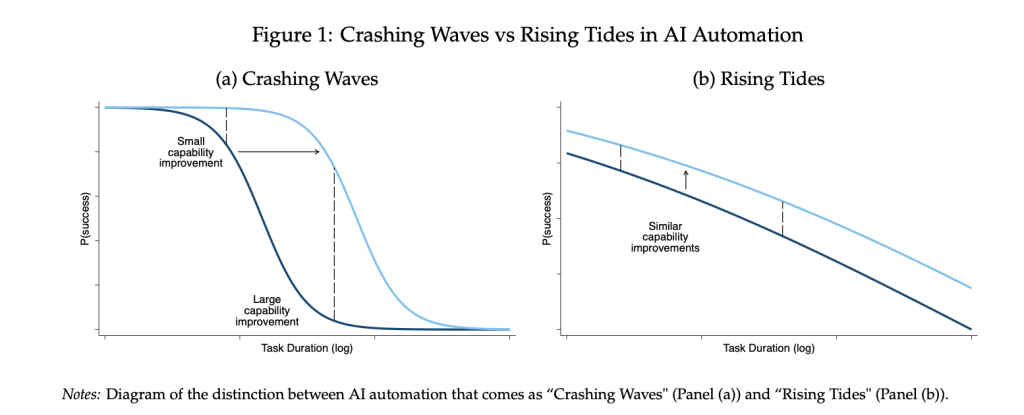
Researchers at MIT FutureTech published findings this week showing that AI’s march through the labor market looks far less like a sudden catastrophe and far more like a slow, rising flood — serious and accelerating, but not the overnight apocalypse that has dominated headlines and executive anxiety for the past two years.

“Rather than arriving in crashing waves that transform a certain set of tasks at a time,” the researchers write, “progress typically resembles a rising tide, with widespread gains across many tasks simultaneously.”

The study, titled “Crashing Waves vs. Rising Tides,” is one of the most comprehensive empirical examinations of AI’s real-world task performance to date. The team of nine researchers led by Matthias Mertens and Neil Thompson collected more than 17,000 evaluations of LLM outputs from domain-expert workers across more than 3,000 labor market tasks drawn from the U.S. Department of Labor’s O*NET classification system. Those tasks spanned everything from legal analysis to food preparation, management to computer science. More than 40 AI models were tested, ranging from GPT-3.5 Turbo to GPT-5, Claude Opus 4.1, Gemini 2.5 Pro, and DeepSeek R1.

For anyone gripped by FOBO, the core question the researchers asked is also the most unsettling one: Can AI complete these tasks well enough that a manager would accept the output without any edits? The answer is already yes — frequently.

Across all models and job categories tested, AI successfully completed roughly 50% to 75% of text-based labor market tasks at a minimally acceptable quality level. That’s not a future projection. That’s today. More specifically, the study found that by the third quarter of 2024, frontier AI models were already hitting a 50% success rate on tasks that take humans about a full workday to complete.

The improvement trajectory is steep. Between the second quarter of 2024 and the third quarter of 2025, frontier models went from clearing a 50% success threshold on 3- to 4-hour tasks to clearing the same bar on tasks that take humans an entire week. Failure rates are halving roughly every two to three years across the board, which translates to annual gains of 15 to 16 percentage points in success rates.

Extrapolating those trends — and the researchers are careful to note this represents an optimistic, upper-bound scenario — AI systems could complete most text-based tasks with 80% to 95% success rates by 2029 at a minimally sufficient quality level. For the majority of survey tasks, which take a few hours for a human to complete, the projected 2029 success rate approaches 90%.

MIT doesn’t use the phrase but this is FOBO, calibrated. The fear isn’t irrational — it’s premature. The water is rising. But the MIT data suggests the floorboards won’t be underwater by next Tuesday. The researchers’ most consequential line for anxious workers: “Workers are likely to have some visibility into these changes, rather than facing discontinuous jumps in AI-driven automation.” The rising tide gives you time to move. The question is whether you’re moving.

FOBO at the institutional level

Here’s the irony: even as MIT documents AI’s sweeping capability gains, most companies have yet to deploy the tools at all. FOBO isn’t just a personal condition, then — it’s an organizational one. According to Goldman Sachs economists Sarah Dong and Joseph Briggs, citing Census Bureau data in their March 2026 AI Adoption Tracker, fewer than 19% of U.S. establishments have adopted AI. Goldman projects that adoption will reach only 22.3% over the next six months.

Compounding that paralysis: only about one-third of workers say their employer is providing adequate AI training, guidance, or reskilling opportunities — down nearly 10 percentage points from 2024, according to research from workforce nonprofit JFF. Most companies are leaving workers to manage FOBO alone, without the infrastructure that would actually resolve it.

That gap has a measurable cost. Enterprise workers who do use AI are recapturing 40 to 60 minutes per day, according to OpenAI enterprise data from December 2025, and 75% say they can now complete tasks they previously couldn’t do at all.

“We continue to observe large impacts on labor productivity in the limited areas where generative AI has been deployed,” Goldman’s economists wrote. “Academic studies imply a 23% average uplift to productivity, while company anecdotes imply slightly larger efficiency gains of around 33%.”

Put simply: the companies using AI are pulling ahead. And the math is unforgiving. Across a team of 50, that 40-to-60-minute daily time saving translates to 33 to 50 hours of recovered productivity every single day. The race is on, then, but many companies are still strapping on their running shoes and waiting for the whistle to blow.

FOBO with a corner office

The MIT data lands at a moment when corporate leaders are scrambling to get their arms around a technology that, as one senior executive put it, is “outpacing the ability for humans and businesses to adopt it.” Joe Depa, the global chief innovation officer at EY, told Fortune in a recent interview that “the technology is in many ways ready, but it’s taking some time for us to … take advantage of it.”

Depa, who oversees AI strategy for one of the world’s largest professional services firms, described the pressure he sees across industries as relentless. “Every day there’s a new headline, every day there’s a new, you know, something that we have to get ready for. Every day, I get an email from my boss asking about some new event that happened somewhere in the world that’s raising the stakes of how fast things are moving within AI.”

That pressure is sharpened by a stark internal reality at many companies: 83% of executives — drawn from a survey of 500 business leaders — say they lack the right data infrastructure to fully leverage AI.

EY’s clients, based on 4,500 surveys, say they still lack the right data infrastructure to fully leverage AI. In other words, the technology is racing ahead while the organizational plumbing needed to actually use it lags far behind.

FOBO’s cruelest irony

That’s where the “rising tide” framing offers some reassurance to the many companies grappling with this dynamic. The MIT findings directly challenge research from METR, a prominent AI safety organization, which has argued that AI capabilities surge abruptly for specific sets of tasks — a “crashing waves” model that implies workers could suddenly find themselves obsolete with very little warning. “We find little evidence of crashing waves,” they wrote, “but substantial evidence that rising tides are the primary form of AI automation.”

The MIT data, drawn from realistic and representative job tasks rather than stylized benchmarks, consistently shows a flatter performance curve. AI doesn’t suddenly master a narrow set of tasks and leave everything else untouched. Instead, it gets broadly, incrementally better across nearly all task types and durations simultaneously.

“Workers are likely to have some visibility into these changes,” the researchers write, “rather than facing discontinuous jumps in AI-driven automation.” More broadly, the projection of AI improvement to a near-perfect automation level through the next three years, not the next 18 months of doomsday scenarios, provides what the researchers call “a window for worker adjustment, particularly in tasks with low tolerance for errors.” Furthermore, their estimates assume AI progress continues at the pace seen over the last two years, meaning it’s an upper-bound or particularly fast scenario. AI just may not keep evolving and advancing as fast as it has recently.

That matters for how companies plan and how workers prepare. A crashing-wave model demands emergency triage; a rising-tide model demands strategic adaptation. The MIT researchers argue the latter is the more accurate frame — though they’re emphatic that “gradualism is not inherently protective.”

There are meaningful differences by profession. Legal work had the lowest AI success rate among the domains tested, at just 47%. Installation, maintenance, and repair work — for text-based tasks specifically — topped the chart at 73%. Management tasks came in around 53%; healthcare practitioners at 66%; business and financial operations at 57%. In other words, no white-collar sector is immune, but some are considerably closer to the inflection point than others.

Depa said he sees this sorting happening in real time inside EY’s own workforce, and humans are acting unpredictably, even strangely at the prospect of this strange new work partner. The firm is the third-largest Microsoft Copilot user in the world, he shared, and the adoption data tells a generational story: junior employees are all in; senior leaders are lagging. “When I look at the breakdown,” he said, “two of my junior levels — high adoption, right out of the gate … and then when you get to the more senior levels, that’s where the adoption starts to drop off.”

He described a particularly worrying cohort: skilled, experienced workers who are simply refusing to use AI tools. “We’ve got some software engineers that are 10x, 20x more productive than last year using AI, like, they’re just killing it.” He said he’s seen workers go from “mediocre” to really “at the top of their game” once they master these new tools. At the same time, you have others “that used to be really, really strong software developers that are somewhat resistant to using AI,” he said. They have an attitude that they can do it better, so they don’t need the tool. “And they’ve gone from being top of their class to now bottom of the peer group, right. And those are the ones I worry about the most.”

The fear of becoming obsolete, in other words, is accelerating the very outcome that workers dread most. Left untreated, a serious case of FOBO becomes self-fulfilling.

These AI resisters, with tremendous functional skills and experience that are super critical, but productivity lagging their peer group at 10x or even 20x, “at some point, those individuals would have to find a different role,” Depa said. “And I think those are the ones that we’re trying to figure out.”

What’s still missing from the AI-at-work story

The MIT team is careful not to oversell its own findings. High task-level success rates, they note, don’t automatically translate into job displacement. The “last-mile costs” of integrating AI into actual workflows — organizational friction, liability concerns, the economics of deployment at smaller firms — remain significant barriers that are poorly captured by any benchmark.

Near-perfect AI performance on most tasks also remains years beyond 2029. The flat logistic curve that makes the rising tide gradual also means the final climb toward 99%-plus reliability is a long one, a meaningful buffer for error-intolerant professions in law, medicine, and engineering.

“While progress is significant,” the researchers write, “widespread automation, particularly in domains with low tolerance for errors, may still be some distance away.”

The bottom line is more complicated than either the doomers or the dismissers want to admit. AI is already capable, improving fast, and headed for most of your inbox in the next three to five years. But the transformation is likely to arrive as a steady, visible tide rather than a sudden drowning, which means the window to adapt is real, if not infinite. If you want to adapt, that is.

FOBO is rational. The MIT data confirms it. But the antidote isn’t denial or paralysis — it’s exactly what the workers thriving inside EY are already doing: treating AI as a tool, not a verdict. The window is open. The question is whether you’ll walk through it.

This story was originally featured on Fortune.com

Cambio Roasters has put together a “dream team” with experience working in the C-suites of some of the biggest names in the food and beverage industries with the goal of helping to revolutionize the world of single-serve coffee. The team at Cambio Roasters is looking to help Americans have a better-tasting and more sustainable cup of coffee without drastically changing their routines or shrinking their wallets.

In February 2024, Keurig Dr. Pepper announced in its Q4 2023 report that approximately 40 million American households had a Keurig brewing system, meaning that millions of plastic K-Cups, also known as coffee pods, were thrown in landfills. Cambio Roasters is looking to put an end to the mass waste by introducing an aluminum alternative.

“The coffee doesn’t actually like the plastic because plastic lets in too much oxygen to keep the coffee’s magic,” Cambio Roasters CEO and co-Founder Kevin Hartley explained to Fox Business. Plastic is porous and allows oxygen in, damaging the coffee’s flavor, whereas aluminum keeps the coffee air-tight and fresh, according to Hartley.

KEURIG RECALLS MORE THAN 80K MCCAFÉ DECAF K-CUP PODS OVER CAFFEINE MIX-UP

Hartley was previously a C-suite executive at Keurig Green Mountain before its merger with Dr Pepper, where he helped drive the company’s growth. He co-founded Cambio Roasters with Ann Hutson, who has a background in strategic marketing and program management. The company’s leadership team also includes COO Mike Cunningham and CMO Dave Sachs, both former Keurig Green Mountain executives.

Hartley, Cunningham and Sachs all underscored the pride they have in the work they did for Keurig, with Sachs saying that they all remain “big fans” of the machine. However, they also noted an increase in consumers’ concerns about the amount of single-use plastic that gets thrown out daily as well as the consumption of microplastics.

Consumers have become increasingly concerned about the presence of microplastics in food and beverages, especially when the items are exposed to heat while in plastic containers. However, the long-term health risks are still not fully understood.

Mohamed Abdallah, a professor of environmental chemistry at the University of Birmingham in the U.K. who studied the issue, told Time that he found “significant levels of microplastics” when inspecting coffee made from pods. He confirmed the source of the microplastics by tracing them back to the plastics used to make the pod, according to Time.

“I just can’t see how plastic is going to be sustainable. I mean, it’s just people are becoming much more aware and concerned about the environment, concerned about what’s going into their body, and they’re looking for options,” Hutson told Fox Business.

WHO STARTED KEURIG’S K-CUP COFFEE POD?

While consumers are worried about microplastics, there are still aspects of single-serve coffee pods that keep them coming back, which is what Cambio Roasters aims to keep.

“What they love about it is it’s perfect every time, it’s simple, it’s fast, there’s no mess, no cleanup, one cup at a time. We thought there’s got to be a better way to deliver those benefits to the consumer. And we believe we found one that offers both a fresher cup of coffee and less waste,” Sachs said.

Cunningham explained that while the plastic used in coffee pods is recyclable in theory, there are multiple issues that prevent them from being turned into new pods or other items. First, the size of the pods makes it so they often go into the trash. Second, it’s cheaper to buy virgin plastic than recycled plastic, making it less likely that a single-use coffee pod gets turned into something else.

“You take aluminum and all those dynamics flip,” Cunningham explained. He said that because the diameter of an aluminum pod expands when it is squeezed, it makes it less likely that the pods get lost in the process. Additionally, aluminum is more valuable to recyclers, making it more likely that they will work harder to get the pods recycled.

GET FOX BUSINESS ON THE GO BY CLICKING HERE

The philosophy of reducing waste goes beyond the elimination of plastic from the pods. Cambio Roasters’ leadership also recognizes that traditional drip coffee causes waste.

“The factual truth is from a traditional drip coffee maker, the largest single consumer of coffee is the kitchen sink,” Cunningham said. “It’s not just the coffee, it’s all the water that went into growing the coffee and whatnot, so right off the bat, like we believe that the single serve coffee market has inherent value because you’re not wasting.”

Hartley also highlighted the company’s pledge to support struggling coffee-farming families, committing 20% of its profits to the effort. He said the initiative reflects a broader shift among consumers seeking products that align with both their preferences and their values. Cambio Roasters is betting that shift will reshape how Americans brew their morning coffee.

This post was originally published here. 

Average traditional funeral now costs £4,623, up 1.3% since January, says report from Pure Cremation

The war in Iran is pushing up the cost of living in the UK but it is also driving up the “cost of dying” as higher gas prices feed through to funerals.

A report has found the average cost of a funeral in Britain is running ahead of inflation, with the war seemingly partly to blame as it has pushed up the price of gas used in crematoriums.

Continue reading…

This post was originally published here

Man working for V2X died in night attack as five sources say they are being placed in harm’s way

A man employed by the US defense contractor V2X has been killed in a drone attack on Erbil airbase, amid concerns from colleagues that they are being placed in harm’s way and pressured to remain in Iraq despite security risks, five sources said.

The worker, from Kenya, died in a night attack in his sleeping quarters on the base on 24 March. Another five workers were injured. They are from Kenya and India, and are among a group of about 45 workers employed by V2X who have remained on the base. One of the workers is in a critical condition with severe burns, sources said.

Continue reading…

This post was originally published here

Prosecutors say Anthony Odiong exploited his parishioners’ emotional dependency to engage in sexual conduct with them

A Roman Catholic priest with ties to Texas and south-east Louisiana and criminally charged with abusing his position as a clergyman to pursue sex with three spiritually vulnerable female congregants faces being taken to trial on all of those cases at once.

The Texas district attorney’s office prosecuting Anthony Odiong filed a motion seeking to consolidate the three cases in late March, ahead of a trial date that the Guardian understands has tentatively been set for 4 May. Prepared by McLennan county first assistant district attorney Ryan Calvert, the motion notes that Texas state law allows “a defendant [to] be prosecuted in a single criminal action” if the crimes alleged “are connected or … are the repeated commission of the same or similar offenses”.

Continue reading…

This post was originally published here

New research from the Democratic Republic of Congo offers a behavioral and anatomical portrait of a species that can achieve surprising athletic feats.

(Image credit: Pacifique Kiwele Mutambala)

This post was originally published here
JPMorgan Chase CEO Jamie Dimon didn’t mince words in his message to workers: Get over the fact that work is hard.

Speaking with Patricia Devine, JPMorgan’s global head of corporate sales, at the Female Quotient lounge in Davos, Switzerland, in January, Dimon laid out the harsh reality for workers striving for instant gratification: “There’s going to be a grunt part to every part of a job. Get over it.”

Dimon’s advice stands out in an era of growing disengagement among young workers, a demographic that recently showed notable declines in workplace engagement, according to Gallup, with Gen Z employee engagement dipping five percentage points between 2024 and 2025. A 2025 report from recruitment firm Randstad also shows the average tenure at a company for a Gen Z worker in their first five years of work has shrunk to just 1.1 years. This stands in stark contrast to the 2.9-year average tenure for baby boomers when they were early in their career. While the Randstad study attributes these short stints to a desire to grow rather than a matter of job hopping, Dimon says young people ought to see a job through to further their career. He didn’t clarify how long he recommends a young person stay in a job. 

“Do not get a new job,” Dimon said. “Some people are always thinking, and they’re ruining their lives because they should just enjoy what they’re doing.”

Dimon critiques the much-lauded preference for work-life balance over other priorities, such as competitive compensation and benefits packages, or purpose-driven work. The CEO has been a vocal advocate of in-person work, enforcing a full-time office policy in 2025. Work-life balance today dominates workplace discourse, and now outranks pay as a top motivator for job seekers, according to Randstad. Dimon has also said work-life balance should be a priority for his workers, especially those with a family. But he says that to balance the two, one must “work smart.” 

Still, nothing can replace hard work in the pursuit of career success, according to the CEO. 

“Work hard. There’s no replacement,” Dimon said. “I still see a lot of people who think they can make a shortcut to a heroic ‘something’. It’s almost never true.” 

Why does Gen Z’s early career look so different from their parents’?

Young workers are entering a dramatically different workforce from that of older generations. Many Gen Zers came of working age during the COVID pandemic and have assumed remote or hybrid work as the norm. However, Dimon has said that mindset may be detrimental to career growth, telling Gen Z workers “you can’t learn from your basement,” after urging corporate workers to return to full-time in-person work, adding the move would push workers to innovate.

Yet, Gen Z’s defiance may not be about laziness. Part of the backlash is structural. Junior opportunities are dwindling for young workers as entry-level skills are increasingly becoming automated, leaving a void where traditional early growth used to take place. The CEO recently acknowledged the current hardships of the economy, noting that the American dream is slipping out of reach for many Americans.

But in another interview with The Economist at the World Economic Forum meeting in Davos, Dimon advised workers: “Don’t put your head in the sand,” in the face of AI automation. “It is what it is,” he said, as he admitted he’d probably hire fewer workers in the coming years because of AI.

Jamie Dimon’s top career tips

Aside from telling workers to work hard, talk succinctly, and develop empathy, Dimon advised workers to remain open-minded, especially in an era in which career trajectories are swiftly changing.

“Be open-minded about relationships, changing jobs, trying something different,” he advised. “Then you’ll have a great career.”

Dimon also emphasized the necessity of purpose in a career. The “grunt work” he implores workers to face isn’t necessarily a hurdle, but a step on the road to accomplishment. He says purpose can be found in a variety of professions, not just in banking and finance, but in teaching or caregiving. 

“When they say ‘the pursuit of happiness’ in the Declaration, this was about accomplishing something in life, doing something meaningful,” Dimon said.

A version of this story was published on Fortune.com on Jan. 23, 2026.

More on the future of work:

  • Gen Z is turning “welcomer cities” into America’s next big tech towns.
  • Nvidia CEO Jensen Huang tells workers scared of AI they’re confusing their job with the tools needed to do it.
  • Some companies across the globe are moving to a four-day workweek due to the Iran war.

This story was originally featured on Fortune.com

American schools are at a crossroads. Artificial intelligence companies say their technology will completely reshape the workforce, and no one knows how, as the definition of career readiness is being rewritten. Education advocate Ted Dintersmith believes the stakes couldn’t be higher. 

“It’s a world where all of these jobs are going to just vanish. We don’t have time to mold this for 10 years,” Dintersmith told Fortune. “Would you rather spend thousands of hours on math you’ll never use in school, or get really good at something that can help you pursue a career you find fulfilling and can support yourself. What do you care about: the future of a kid or data for the state rankings?” 


Dintersmith, in his new book, Aftermath: The Life-Changing Math That Schools Won’t Teach You, argues that the education system is designed to fail students. It’s still teaching kids to learn things a machine can easily do, and it isn’t offering real world knowledge. He argues that math taught in schools has little relevance to real work or life, and it’s undermining American society. Kids should be learning real-world probability and statistics instead of algebra and calculus equations.  

The book is the culmination of 15 years studying the American education system strengths and weaknesses. He sees a system that defines academic success on “high-stakes” standard exams that ask questions that a computer could easily answer, while failing to give students skills that would prepare them for their lives and careers. If the American education system doesn’t change, millions will enter adulthood unprepared, sowing “the seeds for democracy’s collapse,” said Dintersmith.

Beyond math, he believes Americans need to rethink the automatic high-school-to college-pipeline, in a world where more college graduates feel like their degrees are not worth the cost.  

In 2023, Dintersmith visited a school district in Winchester, Va., a small town of about 28,000 located an hour and a half outside Washington, D.C. He met students learning at the Emil & Grace Shihadeh Innovation Center, a technical training center for high school students. While technical education offerings are typical of many secondary schools across the country, Winchester’s approach is different, Dintersmith said, because vocational education is not stigmatized as a place to dump students who weren’t college-bound.  

It wasn’t treated like an afterthought, Dintersmith said, and he found that about 90% of the district’s high schoolers take a class at the center. What he saw inspired him to make the film Multiple Choice in 2025. It was shown at the Sundance Film Festival earlier this year. 

An unlikely advocate

Dintersmith, 73, is an unlikely candidate taking up the charge of transforming American education. After attending the College of William & Mary in 1974 and getting a PhD in engineering from Stanford University in 1981, Dintersmith worked at a microchip startup for seven years, before becoming a venture capitalist and general partner at Charles River Ventures, where he worked for more than 20 years, and has since stayed on a partner emeritus.


While at CRV, he managed a number of funds ranging from $50 million to upwards of $450 million. He was even ranked by Business 2.0 as the country’s top-performing venture capitalist between 1995 to 1999. But Dintersmith credits having children later in life for his seemingly abrupt career shift.

Turning his attention to education, Dintersmith said, came as a surprise to himself as well. 

“I never imagined doing anything related to school,” Dintersmiths said. “And then, honestly, when my kids got to middle school, I just said, ‘Whoa. None of this makes any sense to me.’” His interest started in 2011, when his son’s middle school began offering a program on life skills, but Dintersmith didn’t find any of the skills relevant to real life. His son and daughter are now in their 30s, he said. 

Since then, Dintersmith has written three books and produced nine documentaries about the failures of the American educational system. His work also led him to take an education odyssey during the 2016 school year, he visited 200 schools across 50 states to see how different schools across the country functioned. And detailed the experience in a book What School Could Be, published in 2018. 

Vocational training opens doors

At Winchester’s Innovation Center students didn’t have to choose between welding or Advanced Placement Chemistry to convey that they were an academically rigorous student to colleges because vocation training was the norm. They could take classes on carpentry, welding, plumbing, and electrical work, or train to be EMTs, lab technicians, firefighters, and nursing aides. The courses are tied to the needs of the local economy, and many instructors are business owners or experts who work in the area and volunteer their time to work with the students. Several students have gone on to start careers at their instructors’ companies. 

Liz, a student featured in the documentary, is now a pre-law student at the University of Virginia who wrote about her experience taking welding classes in her college applications. Another student, Malachi, came to a firefighting class asking the instructor for “guidance in life and discipline.” Outside of his classes, he became a volunteer firefighter, and the local station became a place where he could be mentored or just have a place to call home.  

“They were really focused on helping every kid find their lane, and it was tied to what skills would help that local community,” Dintersmith said. 

Winchester can serve as a model for other schools, Dintersmith said. Many high schools offer some form of career and technical education, so “they’re not starting from zero,” he added. Community input is key, he explained. To build the 54,000 square-foot Innovation Center, a local philanthropist donated $1 million, and the State of Virginia and the local community also contributed to the project. 

“It’s really just bridging the gap between finishing high school and being able to say, I’m good at something that matters to the adult world,” he said. 

This story was originally featured on Fortune.com

The leader of a trade group that represents most major automakers called on the federal government to eliminate its gasoline tax and replace it with a vehicle fee to finance road infrastructure needs.

Alliance for Automotive Innovation CEO John Bozzella, whose group represents automakers such as General Motors, Toyota, Volkswagen, Hyundai and other leading car manufacturers, put forward a proposal that urged the federal government to address the growing shortfall in the Highway Trust Fund with a vehicle fee.

The proposal would function like a vehicle registration fee that’s assessed on all vehicles based on their weight, and was first reported by Reuters. It comes as the federal government’s current surface transportation law is set to expire on September 30, which could prompt debate over policy changes.

“This policy would guarantee every vehicle on the road contributes something to maintaining America’s transportation network,” Bozzella said. “Those driving older, less fuel-efficient vehicles or who travel long distances bear the financial burden. That’s not fair.”

AMERICANS DITCH EVS FOR BIGGER VEHICLES AS AUTO TRENDS REVERSE

The Highway Trust Fund, which finances the federal government’s surface transportation programs involving highways and mass transit, is projected to reach insolvency in 2028, at which time it would face a 46% spending cut, according to the nonpartisan Committee for a Responsible Federal Budget.

Revenue from the 18.4-cents per gallon gasoline tax has declined 60% in real terms, as the federal gas tax hasn’t been increased since 1993 and wasn’t indexed to inflation.

THE $10,000 CAR LOAN TAX DEDUCTION: HERE’S WHO QUALIFIES AND HOW TO CLAIM IT

The shortfall has caused Congress and successive administrations to shift more than $275 billion from the federal government’s general fund to help pay for road repairs since 2008, as spending has consistently outstripped revenue.

Gas tax revenue has also declined amid the emergence of electric vehicles (EVs) and more fuel-efficient hybrids that reduce the frequency of fill-ups by drivers.

CAR DEALERS WARNED BY FTC ABOUT DECEPTIVE PRICING PRACTICES, HIDDEN FEES

A proposal by House Republicans last year would have imposed a new $250 annual fee on EVs and $100 for hybrid EVs, though it wasn’t included in the One Big Beautiful Bill Act.

Last year, an EV advocacy group known as the Electrification Coalition argued that the proposed $250 fee on EVs was unfair because an average gas-powered vehicle pays just $88 a year in federal gas taxes.

GET FOX BUSINESS ON THE GO BY CLICKING HERE

Reuters contributed to this report.

This post was originally published here. 

Picture this: your neighbor installs a new doorbell camera, maybe two. One faces their driveway, and the other has a pretty clear view of your front yard. They didn’t ask, not that they have to. And depending on who made that camera and what that company does with the footage, you may be in someone’s database without ever knowing it.

It’s exactly the kind of scenario that Hilary Schneider, CEO of SimpliSafe, deals with, and says people, maybe thanks to a recent Super Bowl commercial that put that idea on full blast, are growing even more concerned about. But video surveillance is only a portion of her job at a company that promises security over surveillance: she now says it’s convincing consumers that the company watching over their home isn’t watching them.

“There’s a growing focus on who gets to control the data, how it’s used, and how it’s protected,” Schneider told Fortune. “When you think about your home, what we’re really securing is your home and your family. Those videos are capturing things that are inherently private to you. And the whole idea that that information could be shared, or that there are business partnerships that enable other people to use it, I think it’s inherently a little creepy to customers.”

The anxiety is no longer hypothetical. During Super Bowl LX, Ring aired a commercial meant to be heartwarming about a lost dog, with AI cameras rallying the neighborhood to help. Instead, it went viral for all the wrong reasons, with viewers calling it “dystopian” and vowing to ditch the product entirely. Days later, Ring quietly canceled a planned integration with Flock Safety, the AI-powered license plate reader company whose contracts are being terminated by cities across the country over fears its footage could be shared with federal immigration enforcement without local consent. In February, Americans began physically destroying Flock cameras in acts of public protest.

For Schneider, none of it is surprising. She sees it as consumers finally catching up to something the industry has long sidestepped. “Consumers are speaking with their feet when they think something feels too big brother,” she said. “The first signal companies are getting isn’t ‘is this legally correct?’ It’s ‘Does this feel wrong?’”

The legal frameworks governing surveillance technology of what companies can collect, store, share, and sell are, by her own assessment, badly out of date. “Our old definition of legal controls is just not moving fast enough to anticipate all the changes happening in the world of AI,” Schneider said. “The regulation and what’s acceptable will get litigated over time. But right now, you have consumers acting first.”

Home protection with privacy

With SimpliSafe, the customer owns the video, and that idea is embedded in both the policy and the hardware. Law enforcement must provide valid warrants, subpoenas, or court orders to access any customer footage: no voluntary sharing, no government data arrangements. Indoor cameras come equipped with a mechanical privacy shutter, which audibly engages and physically prevents streaming when not in use. Live monitoring agents can only pull up video during an active triggered alarm, after a customer has explicitly opted into the service. All stored footage is purged after 30 days. “The data belongs to the customer,” Schneider said plainly. “We believe we can protect people’s homes while also protecting their privacy with the same level of care.”

That positioning is increasingly a business strategy as much as a values statement. In February, the same month the Ring Super Bowl ad ignited a privacy firestorm, SimpliSafe reported that Schneider called for a “material increase in consumer demand.” She ties it in part to the disappearance of Nancy Guthrie, a case that gripped the country and prompted millions of Americans to think seriously about their own security for the first time. But she’s quick to add a caveat that gets buried in most marketing: a camera, on its own, is not a security system.

“There are a lot of sophisticated consumers who have a video doorbell and think they have a security program,” she said. “When they’re not there, there’s really nobody on deck. Having video doesn’t protect you if you don’t have a human who can intervene.”

That gap between passive surveillance and active, accountable protection is where Schneider sees the market heading. As the cultural conversation around AI and data privacy intensifies, she believes the companies that survive the next phase of growth will be the ones that made a clear choice early.

“I think the American zeitgeist is just starting to tease apart the implications,” she said. “What makes me feel secure? What makes my life easier? Versus — what gives me a lack of control, where all of a sudden I’m giving up information that I don’t feel anybody else has the right to have?”

This story was originally featured on Fortune.com

Here is the paradox at the center of the American insurance industry: the companies that dominate market share today got there not by explaining what they sell, but by refusing to mention it. Warren Buffett’s GEICO spends more than $2 billion a year on advertising. Almost none of it describes a policy. Almost all of it produces comedy.

I’ve spent a career studying how the screen reshapes commerce—as President and CEO of The Museum of Television & Radio (now The Paley Center for Media), as Harvard Law School’s inaugural Visiting Professor of Entertainment and Media Law, and as a bipartisan adviser to four presidential administrations on media, communications, and technology policy (Carter, Clinton, George W. Bush, and Obama). What GEICO, Progressive, Allstate, and Liberty Mutual have built is something I have not seen any other industry replicate: a competitive landscape where the primary corporate asset is not the product or the distribution network, but a comedy franchise.

The numbers bear this out. The GEICO Gecko has been on television longer than most sitcom characters. Progressive now runs two parallel comedy franchises simultaneously—Flo, who has become a genuine pop culture icon, and Dr. Rick, the “parenta-life coach” whose campaign about new homeowners turning into their parents won a Bronze Lion at Cannes. Allstate’s Mayhem, played by Dean Winters as a dark-comic personification of catastrophe, proved so successful that the company launched a second franchise, “Knowers,” alongside it. Liberty Mutual’s LiMu Emu has higher name recognition than most cable news anchors.

These aren’t ad campaigns. They’re entertainment portfolios, managed the way a network manages multiple shows. Together, these four companies have become the most prolific and consistent producers of short-form entertainment on American television, spending more on creative content than most studios spend developing scripted series. And they did it to solve a problem that defeated generations of corporate strategists: how to build brand loyalty for a commoditized product that nobody wants to think about until the moment they desperately need it.

Their answer was to abandon the product almost entirely and become entertainment brands that happen to sell insurance. The Gecko is worth a staggering amount to Berkshire Hathaway. Flo is Progressive’s most valuable intellectual property. Mayhem functions as a franchise character with sequel potential. These companies didn’t just buy media time. They built characters that audiences choose to spend time with, an asset class that appreciates rather than depreciates.

The competitive consequences have been decisive. The insurers that made this entertainment pivot now dominate their markets. The ones that didn’t—the “good hands” and “good neighbor” holdouts from the trust-and-authority era—have been forced to follow or fall behind. A comedy franchise has become a barrier to entry in American insurance. That is not a marketing insight. That is a structural transformation of an industry.

And the underlying logic extends well beyond insurance. When nobody wants to think about what you sell until the moment they desperately need it, the only viable long-term strategy is to give people a reason to think about you when they don’t need you. Entertainment does that. Product advertising doesn’t. Banking, utilities, telecommunications, healthcare, and indeed any sector where the product is commoditized and the purchase decision is infrequent, faces the same problem. The insurance companies cracked it first. The playbook is sitting in plain sight.

So why haven’t more companies followed? This is where the story gets uncomfortable for most boardrooms. Building an entertainment franchise requires a commitment that few CEOs are prepared to make: years of consistent investment in characters and narratives, a willingness to let the creative property become bigger than any individual campaign, and the discipline to resist the quarterly pressure to pivot to whatever seems urgent this month. 

The Gecko debuted in 1999. Flo arrived in 2008. Mayhem launched in 2010. Each character was sustained through market cycles, leadership changes, and the relentless churn of digital disruption because the companies understood that the franchise, not the campaign, was the unit of value.

Patience is the hardest part of this model to replicate. It is also, for any company selling a product consumers would prefer not to think about, the most important competitive advantage. The insurance industry figured that out a generation ago. The rest of American business can still catch up.

The opinions expressed in Fortune.com commentary pieces are solely the views of their authors and do not necessarily reflect the opinions and beliefs of Fortune.

This story was originally featured on Fortune.com

Amid record anxiety about the future of work—and growing warnings about the potential erosion of white-collar careers—one unlikely field may be getting the last laugh. 

Accounting, long stereotyped as dull and tedious, has struggled for years to attract young talent. On top of a greying workforce, more than 300,000 accountants left the profession between 2019 and 2022, leaving firms scrambling to fill roles—and, in some cases, contributing to costly reporting errors.

Now, that narrative is starting to flip.

Lower barriers to entry, more conversations about burnout and work-life balance, and the growing use of artificial intelligence to handle repetitive tasks are helping reshape the profession’s image. At the same time, Gen Z workers—more pragmatic about job security and pay—are taking a fresh look.

The result: a quiet resurgence in accounting, with young professionals flowing into a field offering stability, strong demand, and increasingly, lucrative starting salaries.

Take 24-year-old Jack Blazevich. After finishing his degree at the University of Iowa in late 2024, he had a job offer lined up immediately as an assurance associate at PwC in Chicago, making nearly six figures. Though he chose to delay his start until September 2025 to pass all four sections of the CPA exam, it was not out of necessity, but because he could afford to.

“I have not talked to another accounting person who has a degree in accounting who cannot find a job,” Blazevich told Fortune.

Austin Price, working in technology risk assurance at EY, graduated from Brigham Young University last spring and had a similar experience.

“For many of my classmates, it felt like we were recruiting firms just as much as they were recruiting us,” Price said. “We had the luxury of choosing from multiple offers rather than worrying about whether we’d land a job at all. This allowed us to be deliberate about finding the right fit.”

Their experiences stand in stark contrast to the broader job market, where many recent graduates are sending out dozens—sometimes hundreds—of applications. Accounting majors, by comparison, are fielding steady demand, with entry-level salaries hovering around $80,000.

Accounting is delivering near perfect-outcomes at many universities

The appeal of accounting has been more than stability for Blazevich—it’s about optionality.

“When you major in accounting, and you study accounting, you are learning the language of business,” he said.

“I have that flexibility. Accounting people can go to HR, sales, marketing… but finance and HR people, they cannot go into accounting.”

University outcomes reflect that advantage. At Blazevich’s alma mater—the University of Iowa—95% of the class of 2025’s accounting graduates secured a job or continued their education, with median salaries of $75,000.

Similarly, at the University of Texas—ranked No. 1 in accounting by U.S. News & World Report—96.5% of master’s in professional accounting graduates report accepting a job within six months of earning their diploma, with median salaries of $80,000. At the University of Illinois’ Gies College of Business, ranked No. 3, 97% of accounting students in the class of 2025 achieved what the school calls “successful outcomes”—meaning a job or further education—with a median salary of $82,000. 

Kristina Right, a senior career services director at Gies, said that in the wake of shifting trade winds, accounting firms have become more targeted in their recruiting strategies, and thus many students are finding success with the networks they build through internships, for example. 

“Accounting is probably one of the industries where we still see really strong employment, and our students are probably less impacted by the current market,” she told Fortune.

As a whole, the profession’s pipeline is showing signs of recovery. About 55,000 students graduated with a bachelor’s or master’s degree in accounting in the 2023–2024 academic year, a decline of 6.6% compared to the prior year, according to the American Institute of CPAs. But that drop is notably smaller than the 9.6% decline in 2022–23 and the 7.4% slide in 2021–22, suggesting the freefall may be leveling off.

Broader enrollment data points even more clearly toward a rebound. Total postsecondary accounting enrollment hit 313,397 students in 2025, up from 293,759 the year before, according to the National Student Clearinghouse Research Center.

Many entry-level accounting roles require only a bachelor’s degree, though candidates looking to sit for the CPA exam typically need 150 credit hours, which many fulfill through a master’s or a combined five-year program.

AI may be reshaping the job market—but for accountants, it’s making the job easier

Artificial intelligence—often framed as a threat to white-collar work—is quietly reshaping accounting in ways that may actually make it more attractive.

Rather than replacing jobs, AI is increasingly handling the most tedious parts of the job: data entry, transaction reconciliation, and organizing financial records. That shift is freeing early-career professionals to spend more time on analysis and client-facing work. A report from Stanford’s Graduate School of Business found that accountants who use AI support more clients per week and close monthly books 7.5 days faster than those using traditional methods, while spending 8.5% less time on back-office processing.

Ruth Mavashev has seen this firsthand.

At just 26, she’s earning $113,000 as a CPA at a boutique tax firm—a career she arrived at circuitously. After graduating with a finance degree from Arizona State University in 2021, she accepted a role as an accounting specialist at an insurance company and “fell in love” with the work. She went back to school for a master’s in accounting and hasn’t looked back.

While the busy tax season has brought long hours—around 50 a week—Mavashev sees it as a sign of the profession’s health, not a drawback: “It’s very, very rewarding. It feels like you’re playing your part in making the economy better,” she told Fortune.

Blazevich, for his part, isn’t losing sleep over AI rendering his skills obsolete. If anything, he sees the versatility of accounting as a built-in safety net. 

That confidence isn’t entirely misplaced. A recent Anthropic study found AI could theoretically handle over 90% of tasks in math and business roles—putting accounting, which sits at the intersection of both, squarely in its sights. But in practice, adoption has been slower. Researchers point to legal constraints, technical hurdles, and the continued need for human oversight.

In accounting, especially, that human layer is hard to remove. A CPA’s signature carries legal weight, client relationships are built over years, and even small errors can trigger regulatory scrutiny.

“At the end of the day, there is going to need to be some human being signing off, or at least reviewing what the AI did,” Blazevich said. “If the accounting labor market shrinks, there’s still going to be a [broader] labor market.”

This story was originally featured on Fortune.com

When Natalie Marshall, better known as Corporate Natalie, landed her first brand deal (a sponsored post for Twisted Tea), she made $500 and felt invincible.

“I was like, I am the richest woman in the world,” she told Fortune. The then-nascent content creator took her friends out to the nicest sushi restaurant she could find in San Francisco (but was really a “hole in the wall place,” she said) and bought everyone dinner. 

Marshall, a Notre Dame alum and former Deloitte consultant, started Corporate Natalie as a side project. Over the past six years, she’s developed a character built around the absurdities of office life, from passive-aggressive Slack messages to buzzword-heavy all-hands meetings. The skits resonated. She now has 1.4 million followers on Instagram, 827,000 on TikTok, and 276,000 on LinkedIn—numbers that have attracted brand partners ranging from major tech firms to consumer goods companies.

Pretty soon after Marshall started making content, she realized she could make real money from content creation. To build rapport and the illusion that she was already a well-established creator, she created a fake assistant.

“I made an assistant who was actually just me, operating on my other email alias, looping in my assistant to handle this brand deal,” Marshall said. “So it seemed like I had this whole business and this world around me.”

She may have been orchestrating somewhat of an illusion then, but it worked. Now, Marshall has an entire brand and character in which she parodies office culture across TikTok, Instagram, and LinkedIn, and has three full-time employees working for her. She was also recognized as a 2023 LinkedIn Top Voice and appeared on the Forbes 30 Under 30 list and appeared in a Dunkin’ Donuts commercial with Will Arnett and on a Roku series in a Kris Jenner wig playing Charlie Puth’s “momager.” Marshall, 29, also previously produced a podcast, Demoted, with fellow B2B creator Ross Pomerantz, known as Corporate Bro. She declined to share revenue or income with Fortune, and influencer income can vary greatly between follower count, content type, and platform—but some content creators have been known to bring in millions of dollars per year.

Corporate Natalie has gained such a following and been such a success that she’s launching Expand Co-Lab, a creator-led influencer marketing agency, which she believes can overhaul a system she says is fundamentally broken. 

“Brands pay massive amounts of money for one singular video to creators, and they often never meet them or talk to them,” Marshall said. “Agencies play this intermediary role that creates separation between the creator and the brand. I sat with that with my team, and we decided we wanted to launch [a] creator led influencer marketing agency.”

The influencer marketing industry

The timing of Marshall’s Expand Co-Lab comes at an inflection point for the global influencer marketing industry, which is estimated to reach $32.55 billion in 2025, up 35% from 2024, according to Influencer Marketing Hub. 

Brands are increasingly pouring those dollars into B2B channels. According to TopRank Marketing’s 2025 B2B Influencer Marketing Report, 99% of B2B marketers using an always-on influencer strategy rate their programs as effective, and 72% of the most advanced teams have a dedicated influencer budget they expect to grow. 

But for Marshall, more money doesn’t always equate to better outcomes. She argues it’s actually made influencer marketing less efficient. 

When you’re a creator, Marshall explained, a brand or agency will reach out to you and offer a certain amount of money to talk about certain topics on their channel, and they’re given a creative brief. But “oftentimes these briefs are written by copywriters, not creators,” which means there can sometimes be several calls to action, many text overlays, and requests for making brand points that have all been approved by their legal teams, she said. She’s rewritten scripts up to 10 times to satisfy briefs that were never built for the type of content she makes.

“We understand that there’s things you have to do to get your message across, but it’s often really difficult, because me, as a comedy creator… how am I supposed to make a joke but also mention all of these things?” Marshall said. “I think the sweet spot that really makes incredible content is when I meet with the brand directly, and we talk through [the] main problem point [they’re] trying to solve.”

Corporate Natalie’s solution to influencer marketing friction

Expand Co-Lab’s premise is simple: Bring creators into the room earlier. 

Rather than handing off a 60-slide deck, the agency facilitates direct conversations between brands and creators during the briefing process. This helps everyone focus on what Marshall calls the “one hero moment or message” a brand actually needs. Plus, many content creators almost never get feedback on their work from the brands they work with.

“I don’t know how the campaign performed. I don’t know if I’ll ever speak to them again. Were they happy? Were they sad? I don’t know,” Marshall said. “There’s no communication.”

Expand Co-Lab doesn’t represent talent or take commissions from creators. Instead, it works with a collective of creators interested in the consulting and ideation aspects of the process. Some of the creators Expand Co-Lab works with include Brandon Smithwrick, Varun Rana, Sara Uy, Corporate Bro, Rachel Tokar, Matthew Kearney, and Morgan Young. Marshall said she’s meeting with dozens of new creators weekly to build out the collective. The B2B space is where Marshall sees the biggest white space and where she’s staking her claim.

Marshall has spent six years operating at the intersection of creator culture and the professional world, so she knows both how brands think and how creators work. But even as Marshall continues to expand her business ventures, she’s careful not to make it seem as if everyone can or should be a content creator, no matter how fun or fulfilling the job may be.

“I don’t think everyone needs to be a content creator. If you love filming yourself and you love filming videos, absolutely—stick with it,” she said. “Find the thing that makes you uniquely you… that single point of failure. If you left the company because you’re so good at this one thing, the company would fall apart in some small way.”

This story was originally featured on Fortune.com