About six months before the first U.S.-Israeli attack on Iran, the Trump administration gutted the Bureau of Energy Resources (ENR), an 80-person team within the State Department tasked with leading international energy diplomacy. The cuts were part of the then Elon Musk-led Department of Government Efficiency (DOGE) initiative to reduce the federal workforce, with the goal of slashing the federal budget.

More than a month into the conflict—with President Donald Trump indicating he will redouble attacks on Iran in the coming weeks—former ENR officials are warning DOGE eliminated key roles that would have helped the administration navigate and mitigate the energy chaos of the conflict and its impact on global oil markets, as well as foresee potential consequences of ongoing actions.

Fortune spoke with two former ENR officials—who wished to remain anonymous out of fear of retribution from the department—who are sounding the alarm on the insights and knowledge the federal government has lost as a result of the cuts, especially during a period of widespread oil and energy disruptions. 

“It’s shocking how poorly prepared the administration is,” one former employee told Fortune. “You took away the people with the expertise and contacts who would be insanely useful in this context.”

Created in 2011 by then-Secretary of State Hillary Clinton under the Obama administration, ENR was intended to navigate the geopolitical complexities of the global energy industry. Made up of diplomats and policy experts, the bureau developed close ties with embassies, foreign energy ministries, and private sector energy companies. Officials compiled relevant information to brief the Secretary of State and other department officials, as well as engaged with stakeholders such as private energy companies.

In July 2025, ENR effectively ceased to exist, with media outlets reporting the remnants of the bureau would be folded into the Bureau of Economic, Energy, and Business Affairs (EEB). About 1,300 personnel were cut from the State Department by summer 2025. The only ENR staff retained were those working on critical minerals and renewable energy.

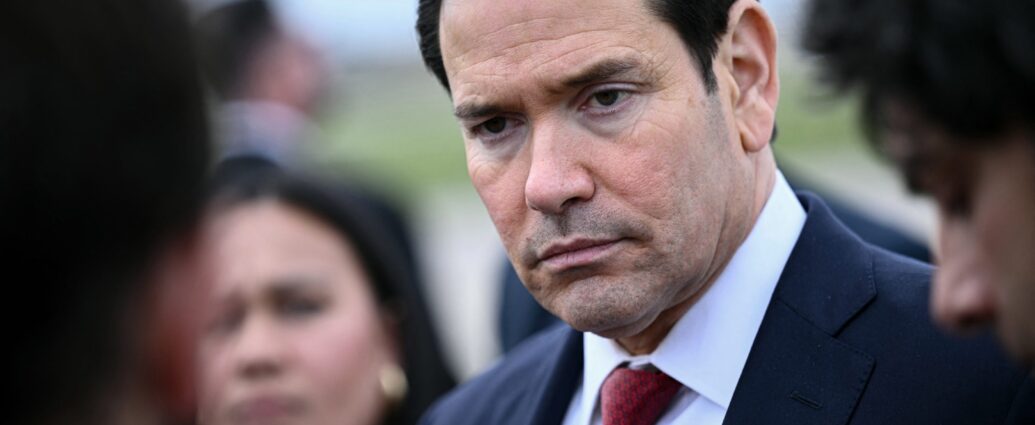
Former officials were particularly befuddled by the cuts given Secretary of State Marco Rubio’s previous comments about wanting the U.S. to play a significant role in global energy.

“We need to be at the table to have conversations about not just what our role in energy is, but how we help invest or partner with countries that have a supply of energy,” Rubio said in a budget hearing last May.

“Nobody knows why they cut us,” one former ENR employee said. “Especially since a key part of the office’s mission was to monitor and engage with major fossil fuel companies and ministries.”

A State Department spokesperson confirmed to Fortune that ENR’s capabilities have been incorporated into EEB.

“Following this comprehensive reorganization, the Department’s energy policy teams are performing better than ever,” the spokesperson said in a statement. “EEB is coordinating the release of strategic reserves with allies and partners in response to Iran’s attacks, driving increased exploration and production with U.S. companies in key theaters globally, especially in Central Asia, Africa, and the Western Hemisphere including Venezuela, and hosting the Secretary’s historic Critical Minerals Ministerial earlier this year with 55 international delegations in one of the largest ministerials at the State Department.”

Impacts of the war

As a result of the U.S. and Israeli attacks and subsequent Iranian counter attacks, the Strait of Hormuz, a crucial chokepoint through which roughly 20% of the world’s oil flows, has been effectively closed, roiling energy supply chains and driving up the price of crude above $100 per barrel. Gas prices have jumped above $4 per gallon on average, the highest since 2022. The ongoing attacks have sent global markets reeling, stoking concerns of a global oil shock.

The former ENR officials said the existence of the bureau today would not have stopped the war, but could have provided key data to the private sector and Rubio to inform decision-making on energy supply and distribution. 

“So many current and former federal government experts assess that this particular administration would likely have ignored guidance that waging this war would be foolish and unlikely to advance U.S. security and economic interests,” another former employee said. “But there is a zero percent chance that Secretary Rubio, particularly in his very empowered dual role, would not have been made aware of these particular eventualities or predictions.”

One former official said one ENR role during the conflict could have been to work with foreign ministries and U.S. embassies to identify vulnerable critical infrastructure in the Gulf region, such as in the South Pars in Iran or the North Field in Qatar, and strategize a path forward if that infrastructure was attacked. Those analyses would have revolved around how attacks would impact oil and gas production, and how supply could be diverted to alternative pipelines to keep energy going out to global markets.

ENR also had contract agreements with specialized private firms that looked at shipping data tracking major oil tankers. Both former employees Fortune spoke with had close connections with oil companies such as Chevron, BP, and ExxonMobil, and in times of conflict, could have used those channels to obtain shipping data and help determine the amount of oil and natural gas already in tankers heading to market. During non-conflict times, ENR was these companies’ first call for non-U.S. investments, one official said.

These communications could have reduced the elements of surprise for U.S. government officials about energy disruptions and vulnerabilities to Iranian attacks, as well as the consequences of attacks on global oil supply.

“If nothing else, our energy sector and foreign private sector companies could have been better informed about what [the U.S. government] is considering,” one official said. “And our government could have had much more information about the concerns of other countries and other companies.”

Long-term ramifications

These deep institutional connections were gutted along with the personnel maintaining the relationships, representing a loss to what one official called the “continuity of experts” the State Department once had access to. The functional bureaus, such as ENR, were made up of subject-matter experts in longer-term government roles who once trained foreign service officers, many of whom are still employed at the agency.

“The DOGE cuts have created structural gaps in the State Department’s knowledge on energy of all forms, and definitely oil and gas,” one former official said.

Top ENR officials had close connections with ministries and private companies who could have picked up the phone and called these stakeholders directly. Many existing energy experts stationed in the Gulf had to evacuate their embassies, and were unlikely to easily and quickly communicate with decision-makers. Many ENR officials were based in Washington, D.C., and if the bureau was still around today, could have filled in some of the gaps in immediate communications.

“We could have easily picked up a chunk of their work while they were in transit back to the U.S. as part of full or partial embassy draw-downs,” an expert said.

The former ENR officials’ concerns go beyond the immediate ramifications of the conflict in Iran. 

In addition to having comprehensive market knowledge of energy in the Middle East, Gulf, and North African regions, ENR also worked closely with East Asian counterparts. Without key State Department personnel, the picture on how China is making decisions on energy investments are not as complete or accessible as it once was, one former official said. Reduced coverage could impact the U.S. awareness of Gulf energy flows to China. China imports about 1.3 million barrels per day from Iran, making up about 13% of its total oil imports. With the Strait of Hormuz effectively closed, China could be doubling down on coal investments, or reducing energy consumption because of shifts towards renewables.

“There was expertise and institutional capacity that was thrown into the garbage,” a former employee said.

If you’re a current or former federal employee with a tip, or if you’d like to share your experience, please contact Sasha Rogelberg on Signal @sashrogel.13.

This story was originally featured on Fortune.com

An analysis of 84 Microsoft Corp. (NASDAQ:MSFT) earnings calls reveals a stark shift in CEO Satya Nadella‘s strategic communication. Eric Jackson highlights that for the first time in a decade, his sweeping narrative regarding Artificial Intelligence is running significantly ahead of fundamental financial evidence.

The Gap Between Ambition And Proof

According to a comprehensive study by EMJ Capital founder Jackson, on Substack, Microsoft has transitioned from a “Cash Machine” era—where nearly every executive statement was firmly backed by realized financial metrics—to an “AI Tailwind” phase.

While Nadella’s conviction remains exceptionally high, linguistic data shows the company is currently projecting a vision that its revenue has yet to fully validate.

This disconnect is most evident in the rollout of Microsoft 365 Copilot. While the company heavily promotes AI integration across its ecosystem, Microsoft’s own investor relations team quietly admitted to analysts that “it took some time to find product-market fit” and emphasized the critical need to “fuel seat sales and move faster.”

This post was originally published here

Dianne Thompson and Lois Kirk tell Victoria police in letter ‘we did not expect to feel invisible’ after Neal Thompson’s death

The sisters of Neal Thompson, one of the two police officers shot dead by Dezi Freeman in Porepunkah last August, plan to sue Victoria police for negligence following an inquest into the officers’ deaths, their lawyer says.

Police accountability lawyer Jeremy King, who is representing Dianne Thompson and Lois Kirk, confirmed on Sunday that the sisters would bring a negligence claim against Victoria police after the conclusion of a coronial inquest. A date for the inquest has not yet been announced.

Continue reading…

This post was originally published here

Shirine Khoury-Haq and other managers did not receive annual bonus after damaging cyber-attack in 2025

The former boss of the Co-op collected almost £2m before her sudden departure last month despite a difficult year when the retailer was pushed into the red by a damaging cyber hack.

Shirine Khoury-Haq’s total annual pay package amounted to £1.9m in 2025, including a £165,000 “rewarding growth” bonus that was approved by the mutual’s board despite falling sales and the slide to an underlying loss of £125m.

Continue reading…

This post was originally published here

Under outgoing mayor Anne Hidalgo, the French capital added bike lanes, cut traffic and reclaimed public space, but not without resistance

When Corentin Roudaut moved to Paris 10 years ago, he was too scared to cycle. The IT developer had biked everywhere as a student in Rennes but felt overwhelmed by the bustling French capital. Cars were everywhere. Cyclists had almost no protection.

But once authorities carved out space for a segregated bike lane on Boulevard Voltaire near his home in the 11th arrondissement, Roudaut returned to the two-wheel commute and did not look back. He now volunteers with Paris en Selle, a cycling campaign group, and has watched with wonder as the city has shaken off its car-centric reputation.

Continue reading…

This post was originally published here

As geopolitical tensions in Iran and stagflation fears drag broader U.S. markets into the red, small-cap stocks are showing surprising resilience, leaving market experts sharply divided on what comes next.

A Striking Market Divergence

Despite the specter of war and rising crude oil prices, the iShares Russell 2000 ETF (NYSE:IWM) has managed to stay in the green, posting a 1.31% year-to-date gain.

In stark contrast, the broader markets have stumbled out of the gate in 2026. The S&P 500 index has declined 4.02% YTD, the Nasdaq Composite is down 5.84%, and the Dow Jones has tumbled 3.88%. The overall data reflects a market leaning on the domestic strength of small-cap equities to weather the geopolitical storm.

The Bull Case: A ‘Massive Surge’

Louis Navellier, founder and chief investment officer of Navellier & Associates, believes the macroeconomic shockwaves are actually a catalyst for small-cap outperformance.

“The Iran war is setting the stock market up for a massive surge, since the uncertainty in the world is being eliminated,” Navellier explained. He noted …

Full story available on Benzinga.com

This post was originally published here

Exclusive: Starmer urged to go further with exemptions if he wants to avoid widespread anger from his own MPs

A number of ministers concerned about Shabana Mahmood’s immigration changes are working behind the scenes with backbenchers to secure more exemptions, the Guardian has learned.

Keir Starmer is consulting on the proposed changes, which would make it harder to achieve settled status in the UK, and is under pressure from within his own party to say the measures should not apply to people who have already entered the UK.

Continue reading…

This post was originally published here

Cornerstone of the UK’s Employment Rights Act ‘in danger of becoming a dead duck’, says Unite boss

The government has asked its new employment rights watchdog to reduce the regulatory burden on business, it has emerged, a request that worker advocates said risks turning the agency into “a dead duck”.

The Fair Work Agency (FWA), which is being launched on Tuesday, is a cornerstone of Labour’s Employment Rights Act. It will bring together several existing labour enforcement bodies and its responsibilities will include policing the minimum wage, holiday pay and modern slavery.

Continue reading…

This post was originally published here

A U.S. service member who has been missing since Iran shot down a fighter jet has been rescued, President Donald Trump wrote in a social media post early Sunday.

A frantic U.S. search-and-rescue operation unfolded after the crash of the F-15E Strike Eagle jet on Friday, as Iran also promised a reward for anyone who turned in the “enemy pilot.”

A second crew member was rescued earlier.

“This brave Warrior was behind enemy lines in the treacherous mountains of Iran, being hunted down by our enemies, who were getting closer and closer by the hour,” Trump wrote.

Trump said that the aviator is injured but “will be just fine,” adding that the rescue involved “dozens of aircraft” and that U.S. had been monitoring his location “24 hours a day, and diligently planning for his rescue.”

The fighter jet was the first U.S. aircraft to have crashed in Iranian territory since the conflict in late February.

Trump said last week that the U.S. had “decimated” Iran and would finish the war “very fast.” Two days later, Iran shot down two U.S. military planes, showing the ongoing perils of the bombing campaign and the ability of a degraded Iranian military to continue to hit back.

The war began with joint U.S.-Israel strikes on Feb. 28 and has killed thousands, shaken global markets, cut off key shipping routes and spiked fuel prices. Both sides have threatened, and hit, civilian targets, bringing warnings of possible war crimes.

The other jet to go down was a U.S. A-10 attack aircraft. Neither the status of the crew nor exactly where it crashed was immediately known.

Trump renews threat

Trump renewed his threats for Iran to open up the Strait of Hormuz, a crucial waterway for global energy shipments that has been choked off by Tehran, by Monday or face devastating consequences, writing Saturday in a social media post: “Remember when I gave Iran ten days to MAKE A DEAL or OPEN UP THE HORMUZ STRAIT. Time is running out — 48 hours before all Hell will reign down on them.”

“The doors of hell will be opened to you” if Iran’s infrastructure is attacked, Gen. Ali Abdollahi Aliabadi with the country’s joint military command said late Saturday in response to Trump’s renewed threat, state media reported. In turn, the general threatened all infrastructure used by the U.S. military in the region.

But Pakistan’s Foreign Ministry spokesperson, Tahir Andrabi, told The Associated Press that his government’s efforts to broker a ceasefire are “right on track” after Islamabad last week said that it would soon host talks between the U.S. and Iran.

Iran’s foreign minister, Abbas Araghchi, said that Iranian officials “have never refused to go to Islamabad.”

Mediators from Pakistan, Turkey and Egypt were working to bring the U.S. and Iran to the negotiating table, according to two regional officials.

The proposed compromise includes a cessation of hostilities to allow a diplomatic settlement, according to a regional official involved in the efforts and a Gulf diplomat briefed on the matter. They spoke on condition of anonymity to discuss closed-door diplomacy.

A second U.S. Air Force combat aircraft went down in the Middle East on Friday, according to a U.S. official, who spoke on condition of anonymity to discuss a sensitive military situation. It wasn’t clear if the aircraft crashed or was shot down, or whether Iran was involved.

Iranian state media said a U.S. A-10 attack aircraft crashed in the Persian Gulf after being struck by Iran’s defense forces.

The Bab el-Mandeb Strait

Iran’s parliamentary speaker, Mohammad Bagher Qalibaf, issued a veiled threat late Friday to disrupt traffic through a second strategic waterway in the region, the Bab el-Mandeb.

The strait, 32 kilometers (20 miles) wide, links the Red Sea with the Gulf of Aden and the Indian Ocean. More than a tenth of seaborne global oil and a quarter of container ships pass through it.

“Which countries and companies account for the highest transit volumes through the strait?” Qalibaf wrote.

More than 1,900 people have been killed in Iran since the war began.

In Gulf Arab states and the occupied West Bank, more than two dozen people have died, while 19 have been reported dead in Israel and 13 U.S. service members have been killed. In Lebanon, more than 1,400 people have been killed and more than 1 million people have been displaced. Ten Israeli soldiers have died there.

This story was originally featured on Fortune.com

The rescue of the air man from the F-15E fighter jet was announced by Donald Trump in a late night social media post

The second crew member of a downed F-15E fighter jet has been rescued by US forces, ending a dramatic two day search after the warplane crashed in south west Iran.

The crew member sustained some injuries, said Donald Trump in a social media post soon after midnight EST. The US president called the operation to recover the airman “one of most daring search and rescue operations in U.S history”.

Continue reading…

This post was originally published here

Ofcom data points to more passive consumption amid changes to apps and fears about mental health and past posts

Posting significant events in your life, from birthdays to weddings and promotions, is a social media staple. But Jenny, like many other Britons recently, has hesitated over contributing to the infinite scroll.

“I wouldn’t have even posted my wedding really,” she says. “But I had to because … There’s like an etiquette. Nobody else can post your wedding until you’ve posted. So my friends were like: ‘Please post, it’s been like a week.’”

Continue reading…

This post was originally published here

Walker Smith, 54, who worked for retailer for 17 years, says he grabbed bag from thief before they escaped

A Waitrose employee of 17 years has described his devastation after being sacked for stopping a shoplifter who had ransacked a display of Lindt Gold Bunny Easter eggs.

Walker Smith, a shop assistant at a branch of Waitrose in Clapham Junction, south London, was going about his normal duties when a customer stopped him. “They told me someone had filled up a Waitrose bag with the eggs,” he said.

Continue reading…

This post was originally published here

Most of the stations hit with penalty infringement notices were in regional NSW, while 23 were in Sydney

Ninety-three service stations in New South Wales have been issued on-the-spot fines for misrepresenting their prices amid Australia’s fuel crisis – although none are facing penalties for price gouging.

A two-week compliance blitz has seen inspectors visit about 75% – or just under 1,800 – of stations registered with fuel price app FuelCheck in NSW, issuing 93 penalty infringement notices, the state government said on Sunday.

Continue reading…

This post was originally published here

Federal government chases supply guarantees from countries including Singapore, South Korea, Malaysia and Japan amid Iran war

Asian trading partners have reassured Australia that the “normal supply” of fuel will continue amid the Middle East conflict, as the government prepares to intensify efforts to avert shortages of petrol and diesel.

The federal government has been chasing supply guarantees from countries including Singapore, South Korea, Malaysia and Japan as the Iran war and closure of the strait of Hormuz wreaks havoc on the global oil market.

Continue reading…

This post was originally published here

What was once seen as a virtue is now viewed as a moral weakness — leaving a society mired in toxicity

This post was originally published here

Renowned investor Steve Eisman is rejecting the idea that GameStop Corp. (NYSE:GME) is a value stock, dismissing hopes that the video game retailer can successfully pivot its business through major acquisitions.

A ‘Pipe Dream’ Strategy

Despite retail investors and high-profile figures like Michael Burry pointing to GameStop’s massive war chest as a catalyst for future growth, Eisman remains deeply skeptical.

Responding to a viewer question on his podcast about the company’s stockpiled capital, Eisman stated unequivocally that betting on the retailer to buy profitable businesses is a “pipe dream.”

“I do not find this argument compelling at all,” Eisman said, addressing the company’s recently reported $9 billion in cash and equivalents. “Maybe they buy something good, and maybe they buy something not so good. Maybe they buy something at a good price, and maybe not. Too many maybes for me.”

Eisman emphasized that GameStop ultimately operates a “declining business” as the broader industry continues its permanent shift toward digital downloads and online sales.

Cost-Cutting Masks Top-Line …

Full story available on Benzinga.com

This post was originally published here

Billionaire entrepreneur Mark Cuban warned that most CEOs lack the AI knowledge to navigate displacement by AI-native startups, framing the challenge as an “Innovator’s AI Dilemma” with shareholder litigation risk on both sides

The ‘Innovator’s AI Dilemma’

In a post on X Saturday, Cuban said that every entrepreneur who understands AI is creating companies aimed at completely replacing established players. If those startups gain momentum and cannot be acquired, CEOs face a tough choice: either dismantle and rebuild their companies as AI-native or stay the course and risk falling behind.

“Every entrepreneur that knows how to use AI is trying to find ways to build AI native companies that completely displace incumbents,” Cuban wrote on X.

Full story available on Benzinga.com

This post was originally published here

Murder charge laid after missing woman’s body discovered in Victorian town of Little River, near Melbourne

A man has faced court accused of murder after he was arrested while trying to board an overseas flight.

Allan Keys, 67, was arrested at Melbourne International Airport on Friday afternoon before he stepped onto the overseas-bound plane, Victoria police said.

Continue reading…

This post was originally published here

At least 15 people injured in incident with authorities saying some of the injuries believed to be serious

At least 15 people were injured on Saturday after an alleged drunk driver ploughed into pedestrians at a Louisiana parade celebrating the Lao New Year. Some of the injuries are believed to be serious, authorities said.

Louisiana State Police said a man had been charged with driving while impaired, 18 counts of first-degree negligent injuring and careless operation, after the incident in New Iberia.

Continue reading…

This post was originally published here

This live blog is now closed. Our coverage of the Middle East crisis continues here

Iran has executed two men convicted of membership in a banned opposition group and carrying out disruptive actions aimed at overthrowing the Islamic republic, the judiciary said.

The executions on Saturday were the latest in a series targeting members of the banned People’s Mujahedin of Iran (MEK), after four other convicted members of the group were executed earlier in the week.

Continue reading…

This post was originally published here

Fifty ‘founder’ bilbies were released in fenced breeding area in 2019 with the aim of establishing first wild population there in a century

Efforts to reintroduce bilbies in the far south-west of New South Wales are showing signs of success, with numbers climbing to almost 2,000, seven years after the first breeding trial at Mallee Cliffs national park.

Fifty “founder” bilbies, including 30 from Thistle Island off the coast of South Australia, were released in a fenced breeding area in 2019 with the aim of establishing a wild population in the Mallee Cliffs habitat for the first time in a century.


Sign up for a weekly email featuring our best reads

Continue reading…

This post was originally published here

War-time economics have, of course, sent gas prices skyrocketing, but have also pushed mortgage rates higher over the last five weeks, from a low of 5.99% to a high of 6.64%. Rates have fallen a bit recently, but higher rates have slowed some of the housing data down.

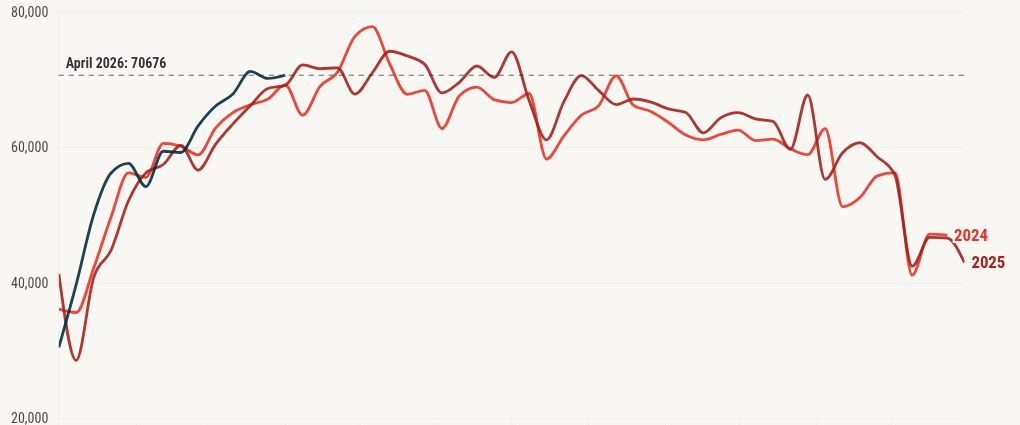
In the past, mortgage rates above 7% would have dampened the data, but we still haven’t broken above 6.64% in 2026. Let’s take a look at this weekend’s Housing Market Tracker data to get a sense of where we are at, since we are on day 36 of this conflict with Iran.

Weekly pending sales

Our weekly pending home sales data provides a week-to-week perspective, though results can be affected by holidays and short-term fluctuations. Until last week, we had a streak of six weeks in a row showing year-over-year growth, but even though week-to-week data grew last week, the streak of positive weekly year-over-year growth ended with a small decline. We had some year-over-year decline data earlier in the year, but most of that was due to the epic snowstorm.

Weekly pending sales usually take 30-60 days to hit the sales data. Typically, mortgage rates above 6.64% and breaking over 7% really impact the data. Under 6.25% has been the sweet spot over the past several years, excluding short-term variables.

Weekly pending sales last week over the last two years:

  • 2026: 70, 676
  • 2025: 72,191

Total pending sales

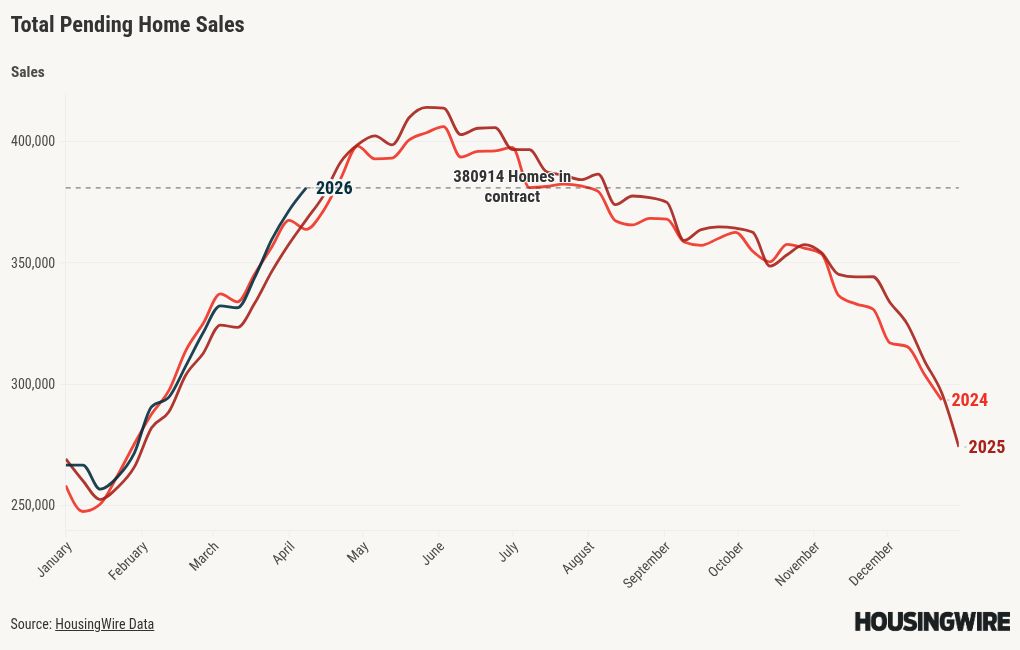
I don’t traditionally show our total pending sales data, as it’s more of a moving average and doesn’t capture the week-by-week volatility I like to track with our weekly pending sales. With that said, as you can see below, total pending sales data still shows clear growth compared to 2025, as most of our weekly data in 2026 has been positive year-over-year.

A big theme of my work this year is that housing data hasn’t been that exciting, as rate volatility was very low early in the year, but it is now starting to pick up due to the length of the Iran conflict.

Total  pending sales last week over the last two years:

  • 2026: 380,914 
  • 2025: 367,777

visualization

Mortgage purchase application data

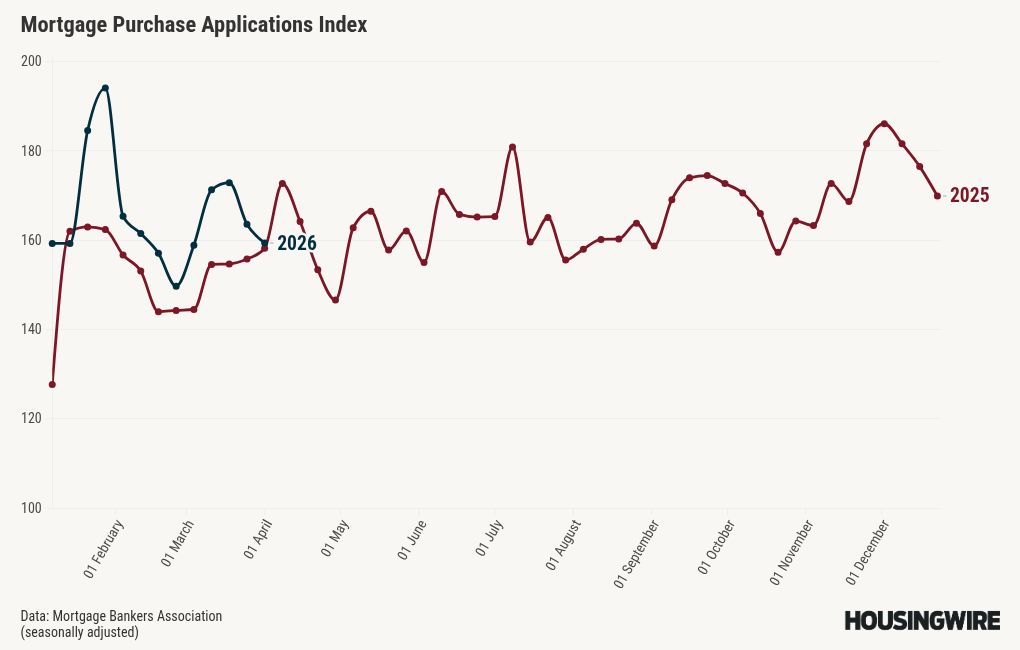
Purchase application data is a forward-looking indicator: growth here leads home sales by roughly 30-90 days. Last week, we saw year-over-year growth slow from 5% to 1% with a week-to-week decline of 3%. So, higher mortgage rates are impacting this data line a bit more clearly, but nothing too negative yet. 

For this data line, what I really value is at least 12-14 weeks of positive week-to-week data. If we can get that positive week-to-week data to go with year-over-year growth, then we have something cooking. For 2026, every week has shown positive year-over-year growth, but that growth rate has slowed for the last two weeks. 

Here’s 2026 so far:

  • 5 positive week-over-week prints
  • 6 negative week-to-week prints
  • 1 flat week-to-week print
  • 7 weeks of double-digit year-over-year growth
  • 12 weeks of positive year-over-year growth

visualization

10-year yield and mortgage rates

In the 2026 HousingWire forecast, I anticipated the following ranges:

  • Mortgage rates between 5.75% and 6.75%
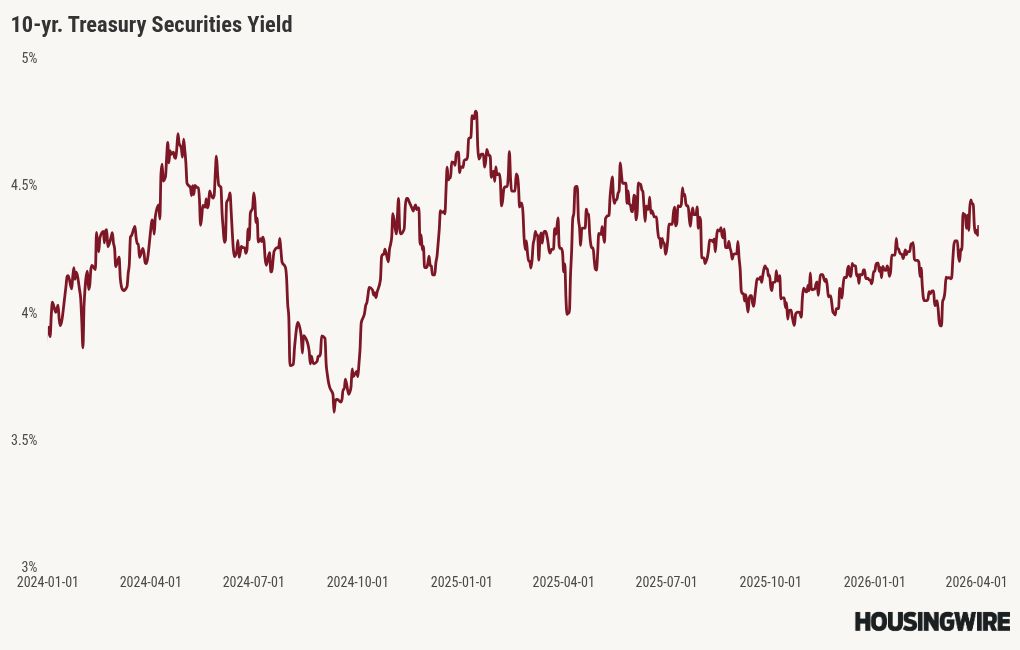
  • The 10-year yield fluctuating between 3.80% and 4.60%

When the Iran conflict started, I talked about how I would be shocked if it continued past March 21 because of the economic implications of war, including higher energy and input costs, especially in a mid-term year. The longer the conflict goes on, the more problematic it becomes not only for our economy but for the world. Remember, tankers are very big, slow-moving ships, so you can’t flip a switch for speed here.

Two Fridays ago, I wrote about how the 10-year yield was starting to diverge from the oil trade, meaning oil prices were heading higher, but the 10-year yield wasn’t following along. Last week was another example of that, as oil prices rose after Trump’s very hawkish address to the nation. However, the 10-year yield never rose above 4.48%, the year’s high so far, during trading hours. I believe the 10-year yield is trying to get ahead of the deal because it isn’t so tied to the supply of oil but more to Fed policy.

visualization

Mortgage rates ended the week at 6.45%, according to Mortgage News Daily, and Polly’s mortgage rate lock data shows a weekend rate of 6.51%.

Mortgage spreads

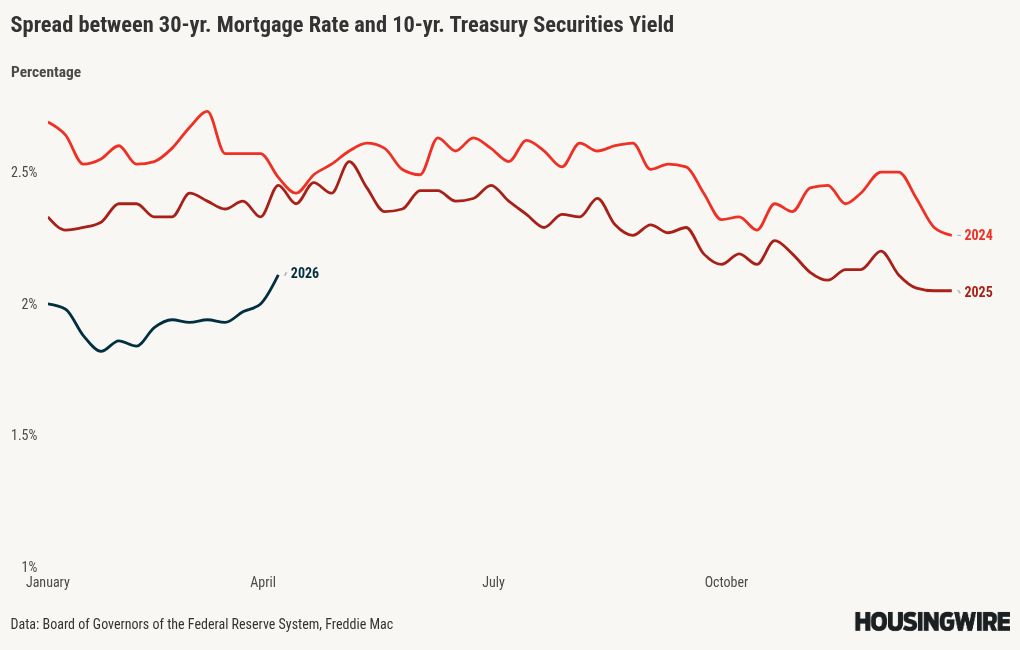
Mortgage spreads remain a positive story for housing in 2026, as mortgage rates would have easily been over 7% in 2023, 2024 and close to 7% in 2025, with the worst levels of the spreads. However, the spreads, which were getting worse in February as yields fell, compressing volatility on the downside, are now heading even higher with this war. But even now, as you can see below, we are still at better levels than the past two years.

visualization

Historically, mortgage spreads have ranged from 1.60% to 1.80%. Last week, spreads closed at 2.11%. 

However, I wanted to compare last week’s rates to the worst levels of the spreads over the past three years, with the 10-year yield at its current level.

  • If we had the worst mortgage spread levels in 2023, mortgage rates would be 7.45% today, not 6.45%.
  • If we had the worst levels of 2024, mortgage rates would be 7.07% today.
  • If we had the worst levels of 2025, mortgage rates would be 6.88% today.

Housing inventory

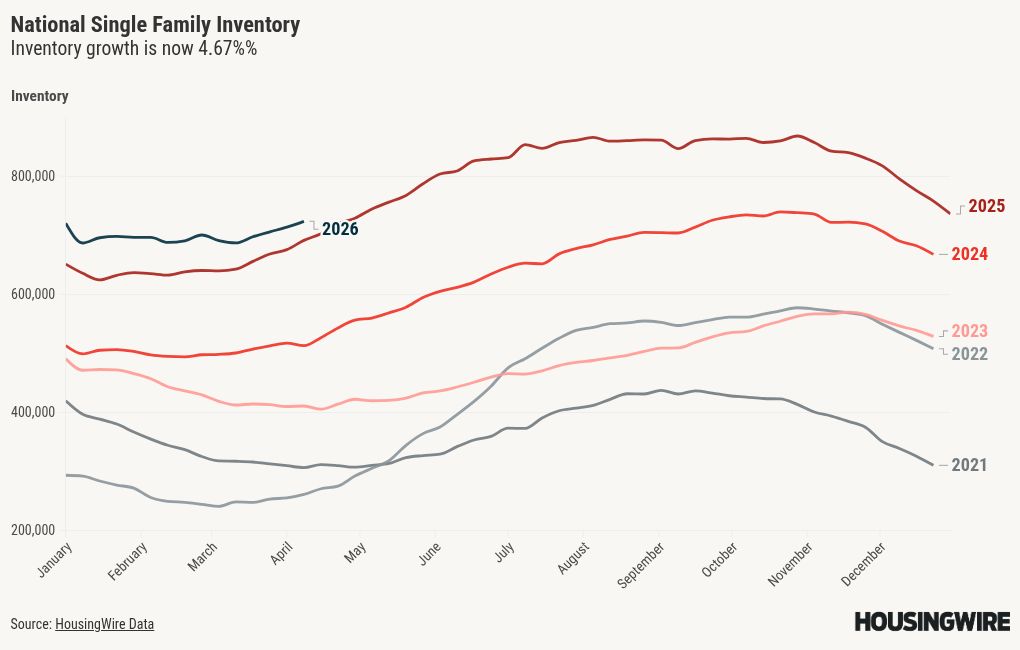
The seasonal increase in housing inventory is now in full swing. That said, the growth rate of inventory has really slowed from last year’s peak levels. However, we are far from the unhealthy levels seen in 2021, 2022, and 2023, which is a huge positive for housing.

We have gone from 33% year-over-year growth in inventory at the highest point in 2025, to 4.67% last week. In the past, inventory growth picked up amid higher rates, softening demand and rising year-over-year new listings. 

  • Weekly inventory change: (March 28- April 3): Inventory rose from 713,549 to 723,460
  • Same week last year: (March 29 -April 4): Inventory rose from 675,557 to 691,173

visualization

New listings

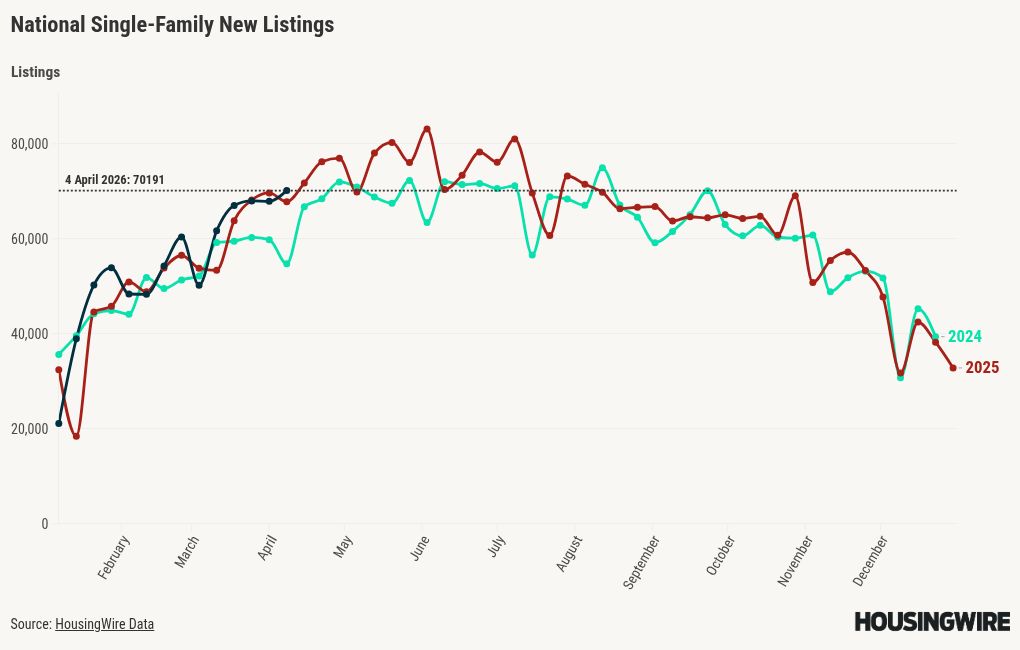
I have been disappointed with the new listing data this year. New listings had a slow week and was negative year over year. We should get new listings above 80,000 per week during the seasonal peak months, which would be on the low end of the number we would see in a normal period.

I am hoping for the new listings data to range between 80,000 and 100,000 per week during the seasonal peak periods, as it did from 2013 to 2019. However, it’s looking less and less likely that this will occur. For context, during the housing bubble crash, new listings ranged from 250,000 to 400,000 per week for several years.

Here is last week’s new listings data for the past two years:

  • 2026: 70,191
  • 2025: 71,777

visualization

Price-cut percentage

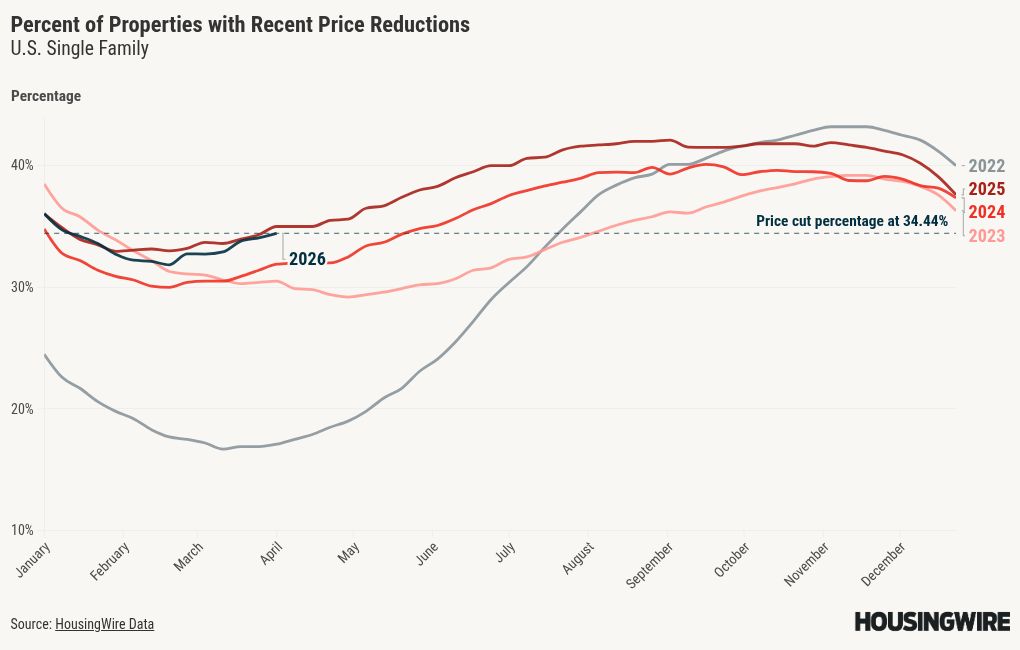
Typically, about one-third of homes undergo price reductions before they sell, reflecting the dynamic nature of the housing market. As mortgage rates and inventory rise together, the percentage of price cuts increases.

In my 2026 home-price forecast, I had a negative 0.62% call for the year nationally. However, mortgage rates were lower than I thought they would be at the start of the year, and the FHFA’s announced purchase of mortgage-backed securities pushed mortgage spreads lower than I expected. I believed we would see that improvement later on in the year; spreads are higher than that level today due to the conflict. 

So, before the conflict started, my forecast for 2026 turned out to be wrong. Now, if rates head higher and stay higher for longer, I do have a shot at my call being more correct. Still, the percentage of price cuts is below last year at this time.

The price-cut percentage for last week:

  • 2026: 34.44%
  • 2025: 35%

visualization

The week ahead: Iran, Iran, Iran, inflation and existing home sales

Of course, as always, the conflict with Iran will be the main theme until this conflict ends; we can’t break out of the short, medium and long-term implications of this conflict to the economy until that happens. We do have inflation data and existing home sales coming out this week, along with some other reports, but the Iran conflict is still front and center after we gave Iran another 48 hours to make a deal or else.

This post was originally published on here. 

On Friday, global oil markets showed an unusual split between Brent crude changing hands for immediate delivery and the price investors are paying for Brent contracts tied to late June, a gap that signals traders expect the Strait of Hormuz disruption to be brief even as physical supplies tighten. That disconnect is landing alongside push for embargo arguments from Robin Brooks, who has said cutting off Iran’s oil exports is the kind of pressure campaign he believes is required to change state behavior.

In his Substack post, Brooks wrote that, despite the attention on the surging “spot” Brent number, the price he treats as the key benchmark is the front-month Brent futures contract, now the end-of-June contract, sitting at $112 a barrel. He describes the current setup as a scramble for prompt barrels after the Strait of Hormuz closure, while the futures curve reflects an assumption that conditions look better by June.

Why Brent Futures Are The Focus Now

In his post, Brooks lays out why the June futures contract matters more than the headline spot quote: futures embed expectations about when the conflict winds down and shipping routes normalize. Brooks also notes Brent was $72.5 before the war, so even the $112 futures level implies the market is not projecting a full return to pre-war conditions.

Brooks explains that when a futures contract gets close enough to expiration, it tends to get pulled toward the …

Full story available on Benzinga.com

This post was originally published here

Lucid Group (NASDAQ:LCID) shares closed down on Friday as the company faced challenges with its vehicle deliveries due to a supplier quality issue.

“During the quarter, deliveries of the Lucid Gravity were disrupted for 29 days due to a supplier quality issue with the second-row seats,” the firm said in a press release. 

This disruption impacted the production of the Lucid Gravity for 29 days, which has raised concerns about the company’s ability to meet customer demand.

During the first quarter, Lucid produced 5,500 vehicles and delivered 3,093, but the supplier issue has led the company to reaffirm its production guidance of 25,000-27,000 vehicles. To enhance shareholder engagement, Lucid is partnering with Say Technologies for a Q&A session during its upcoming earnings call on May 5, 2026.

The Consumer Discretionary sector, where Lucid operates, ranked 8 out of 11 sectors, closing unchanged, indicating that the stock’s decline may be more related to company-specific issues than broader market trends.

Technical Analysis

At $9.94, the stock is trading 4.1% below its 100-day simple moving average (SMA), suggesting a bearish trend in the intermediate term. Additionally, it is also trading 9.8% below its 200-day SMA, indicating continued weakness in the longer-term trend.

The stock’s 12-month performance shows a decline …

Full story available on Benzinga.com
This post was originally published here

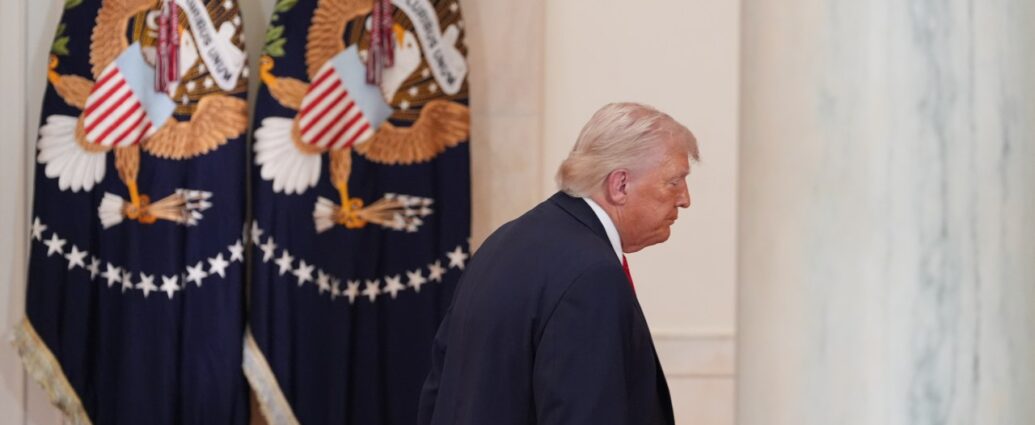
President Donald Trump wants to spend $152 million to revive the historic Alcatraz prison.

The controversial move aims to transform the former island penitentiary into a modern high-security detention facility.

The proposal outlines initial funding to rebuild infrastructure and restart operations at the long-shuttered site near San Francisco.

BBC reports the plan has already sparked political backlash and logistical concerns.

Project Details And Strategic Intent

Trump’s budget seeks to reestablish Alcatraz as a cutting-edge correctional facility housing high-risk offenders.

Officials say the funding will cover early-stage reconstruction and operational setup.

The administration earlier signaled coordination between federal agencies, including the Justice Department and Homeland Security, to execute the plan. Trump stated the revamped prison would hold “America’s most ruthless and violent offenders.”

Political Pushback And Cost Concerns

Critics across …

Full story available on Benzinga.com

This post was originally published here

Precious metals experienced another wild week of price action, including a notable rally.The US-Iran war and US President Donald Trump’s rhetoric remain the driving forces behind price action for gold, silver, platinum and palladium. The precious metals continue to move inversely to oil prices and the US dollar. However, their positive fundamentals have not been lost in the fog of war. Investors may be buying the dips and taking profits on the upside, but the reality of a strong long-term precious metals outlook remains firmly in place. Surprisingly, while all of them posted gains, this week palladium was the best-performing of the asset class. Let’s take a look at what’s got the precious metals moving over the past week.

​Gold price
The gold price has gained more than 6.4 percent over the past week, but remains down more than 16 percent from the record of US$5,589.38 per ounce that it reached on January 28.The price of gold experienced a “V-shaped” recovery this week as the market shifted from a liquidation-driven selloff to a rally fueled by geopolitical de-escalation. However, the four day rally quickly reversed on Thursday (April 2) following Trump’s televised address on Wednesday (April 1) night in which he vowed to strike Iran “extremely hard” over the coming weeks. Any expectations of a quick de-escalation evaporated overnight and gold reversed course. “(T)ensions in the Middle East play a dual role in influencing gold. On one hand, continued military escalation supports safe-haven demand and pushes prices higher. On the other hand, any signs of de-escalation or limited political agreements could trigger downward corrections,” Simon Massabni, head of business development at XS.com, explained in market commentary shared with the Investing News Network (INN). “This suggests that gold may experience short-term upward waves driven by media sentiment, but any sustained move above current resistance levels would likely require concrete developments confirming ongoing geopolitical risks,” he added. “I believe investors need to closely monitor news flow and avoid relying solely on isolated statements, as these may be temporary and primarily fuel speculative trading without altering the broader market trend.”On March 26, gold reached an intraday high of US$4,477.55 in morning trade before losing nearly US$100 to close at US$4,378.18. In response to a stronger dollar, traders sold their gold positions to cover margin calls.However, gold gained ground the next day, with the price overtaking the US$4,500 level to hit a high of US$4,551.49 in morning session; it later closed at US$4,493.79. Commerzbank (ETR:CBK,OTCPL:CRZBF) has upped its 2026 gold forecast from US$4,900 to US$5,000 and is projecting a price of US$5,200 for next year. On Monday (March 30), gold started the week strong with a fresh rally, posting a high of US$4,578.51 in early morning trade. Although it sank to a low of US$4,493.32 midday, it managed a close above the key US$4,500 level at US$4,511.24. Declining US treasury yields made non-yielding gold more attractive, prompting institutional dip buying. Gold gained serious ground the following day, surging to a high of US$4,685.58 in midday trade before closing just a bit below at US$4,667.48. The momentum was driven by rumors of a shifting stance from the White House on the timeline for exiting the war in Iran, easing the longer-term inflation outlook brought about by elevated oil prices.By Wednesday, Trump’s Tuesday (March 31) night declaration that the war would end in two to three weeks lit a fire in the gold market, with the price rising to US$4,792.85 in morning trade before closing at US$4,758.76.However, the mercurial Trump lived up to his reputation, and on Wednesday night had reverted back to a more aggressive stance on Iran despite reiterating that the war would soon come to an end.Gold reacted by dropping as low as US$4,583.02 in the early morning trade on Thursday. By 10:00 a.m. PST on Thursday, gold was back up to US$4,659.50.

Chart via the Investing News Network.Gold price chart, March 26 to April 2, 2026.Here are the primary drivers for gold this past week:Trump’s pivot toward a quicker exit from the Iran war eased the pressure of higher-for-longer oil prices, and in turn higher interest rates. However, his reversal in tone the next day led the market back in the other direction. The region-wide conflict in the Middle East has blocked transport through the Strait of Hormuz, an important route for global oil markets.Both the dollar and 10 year treasury yields have declined slightly, easing the opportunity cost for holding non-yielding assets like gold and supporting the metal’s four day rally.Analysts initially grew more confident in the potential for the US Federal Reserve to cut interest rates in the second half of this year and into next year, contributing to upside in the gold price. But that confidence faded once again on Thursday with Trump’s reversal.For more insight into what’s moving the gold market, check out INN’s recent interviews:David Nicholas: Gold, Silver — Use This Entry Point as Prices SlideSteve Barton: Gold, Silver, Uranium, Oil — Price Targets, Key LevelsIn other gold market news, the World Gold Council released its Central Bank Gold Statistics Report for February, showing that central banks bought a net 19 metric tons of gold in February. Poland was the biggest buyer at 20 metric tons, while Uzbekistan marked its fifth consecutive month of net buying with the purchase of 8 metric tons of the metal.

Silver price​
The silver price has gained nearly 6.5 percent over the past week, but is down more than 40 percent from its all-time high of US$121.62 per ounce, which it set on January 29. The precious metal has found solid support from the same factors moving its sister gold, as well as from tighter supply in the face of strong industrial demand.Silver hit an intraday high of US$69.68 the morning of March 26, then went on to slide as low as US$66.88 later in the session. The white metal managed to close the day at US$67.97. Like gold, silver lost ground as traders sold positions in the paper market to cover margin calls. The white metal rebounded on March 27 to a high of US$70.35 before sliding to close at US$68.88 as the market stabilized.On Monday, silver made further gains, reaching an intraday high of US$71.72 in early morning trade before settling to close at US$70.12 as retreating US treasury yields increased the appeal of non-yielding assets.The following day, silver rallied as the dollar softened on the potential for a near-term ceasefire in the Iran war. The metal hit a high of US$75.35 in the afternoon session before ending the day at US$75.12.Wednesday saw silver climb to a high of US$76.13 midday and close just slightly above the US$75 level at US$75.09. The same day, China’s 9 percent VAT rebate on solar exports came to an end.Silver slid to a low of US$69.58 early on Thursday before rebounding to US$72.38 by 10:00 a.m. PST.

Chart via the Investing News Network.Silver price chart, March 26 to April 2, 2026.The structural supply deficit in silver amid strong industrial demand is still a source of firm price support for the metal. Silver is essential in thousands of applications, making it the second most-used commodity after oil.In silver-mining news, Santacruz Silver Mining (TSXV:SCZ,NASDAQ:SCZM) reported revenues of US$326.4 million, up 15 percent year-on-year, driven by a 36 percent rise in the average realized price of silver.

​Platinum price
Platinum continues to outperform gold and silver, with the price up nearly 7.8 percent this past week.The price of platinum was trading at a low of US$1,817 per ounce midday on March 26, before recovering to US$1,845.50 by closing. On March 27, the precious metal’s price was at an intraday low of US$1,807.50 in early morning trade, but rose to a high of US$189.40 before closing lower at US$1,855. Platinum rose on buy-the-dip trading early on Monday, hitting a high of US$1,937.30 in the session. However, the metal retreated quickly to a low of US$1,978.10 in the afternoon before closing up at US$1,892.90. The following day, platinum rallied with the other precious metals, starting the day at US$1,906.80, surging to US$1,974 in the afternoon and closing out the day at US$1,966.10. Platinum rose on expectations that a de-escalation in the Middle East would lower energy costs, eventually benefiting the automotive manufacturing sector.On Wednesday, platinum rose to its highest weekly price of US$1,993.90 in the morning, but sank back down to close at US$1,965.50. The precious metal lost more ground the next day in morning trade, falling to US$1,903.90 before climbing back up to US$1,991.02 by 10:00 a.m. PST.

Chart via the Investing News Network.Platinum price chart, March 26 to April 2, 2026.Like silver, platinum is responding to market forces as both a precious and an industrial metal. Tight mine output persists out of South Africa, which accounts for more than 70 percent of global supply. The World Platinum Investment Council is forecasting a fourth consecutive annual deficit for 2026 at a projected 240,000 ounces.On the demand side, automakers still prefer to use platinum in catalytic converters, anchoring long-term industrial demand. As for investment demand, investors are increasingly viewing platinum as a cheaper alternative to gold, sparking a rotation into platinum exchange-traded funds and physical bullion products.For more on the supply and demand fundamentals shaping the platinum market, check out: Edward Sterck: Platinum Records Biggest Deficit Ever in 2025, What’s Next?

​Palladium price
Palladium put up the best price performance of the precious metals this week, gaining 8.9 percent. On March 26, the palladium price was trading at US$1,385 per ounce in the early morning before falling to US$1,347.50 and rising back up to US$1,388. By midday, it was back down to US$1,348 before closing at US$1,380.The volatility continued on March 27, with palladium trading at US$1,385 in the early morning before rising to US$1,414. The price of palladium closed back down at a five month low of US$1,376.50. Palladium had a much better day on Monday, rising off of five month lows to US$1,449 in the morning session, but closed down at US$1,411.50. On Tuesday, palladium really picked up the pace of its gains, starting the day at US$1,451.50. By the afternoon, the price of palladium was trading as high as US$1,497.50; it went on to close down slightly lower at US$1,492. The market has begun to price in the possibility of anti-dumping duties on Russian palladium, set to be resolved by mid-2026. The decision could have an effect on the US supply/demand balance.The following day, palladium rose to an intraday high of US$1,519 before closing at US$1,481.50 later in the trading session. However, the metal mustered up another close of US$1,439.The price of palladium was trading as low as US$1,446 early on Thursday morning before retracing upward to US$1,503.10 as of 10:00 a.m. PST.

Chart via the Investing News Network.Palladium price chart, March 26 to April 2, 2026.On top of the factors driving the precious metals, palladium also found further support from high industrial demand. “Russia’s Nornickel, the world’s largest palladium producer, highlighted rising industrial demand beyond the automotive sector,” reports Trading Economics. “The company is investing US$100 million to cultivate new palladium markets and aims to generate approximately 1.7 million troy ounces of annual demand by 2030, including near-term applications in electrochemistry for anodes and water treatment.”

Don’t forget to follow us @INN_Resource for real-time updates!Securities Disclosure: I, Melissa Pistilli, hold no direct investment interest in any company mentioned in this article.Editorial Disclosure: The Investing News Network does not guarantee the accuracy or thoroughness of the information reported in the interviews it conducts. The opinions expressed in these interviews do not reflect the opinions of the Investing News Network and do not constitute investment advice. All readers are encouraged to perform their own due diligence.

This post was originally published here

Silver achieved the hitherto unthinkable feat of triple-digit prices in the first quarter of 2026.The rise came as the silver market benefited from both expanding industrial uses and strong safe-haven demand. However, economic and geopolitical uncertainty brought about by the US-Iran war, as well as US monetary policy shifts, injected more volatility and downward momentum into silver’s price movements as Q1 continued. Unpredictable headwinds aside, the basic fundamentals of the silver market remain bullish for the precious metal’s long-term outlook. Here’s what happened to silver in the year’s first quarter.

What happened to the silver price in Q1?
Silver shattered its record high of US$49.95 in October 2025. For much of the remainder of the year, the price of silver was on an uptrend, and at the open of 2026 it was trading at US$74.02. That represents a more than 150 percent increase from silver’s price at the start of 2025. By January 14, the white metal’s value had risen to a new all-time high of US$92.20, up by nearly 25 percent in less than two weeks. The price of silver continued to soar during the second half of January, surging past US$100 and into triple-digit territory on January 26, as rising high as US$116.67 that day. The precious metal achieved its current all-time high of US$121.62 a few days later on January 29.

Chart via the Investing News Network.Silver price, Q1 2026.Much of silver’s gains for the month of January were wiped out on February 2, with the white metal falling by 35 percent from its peak to US$71. The rapid decline came on the back of US President Donald Trump’s nomination of the hawkish Kevin Warsh to replace Jerome Powell as chair of the Federal Reserve.However, by February 11 the price of silver had regained some ground, rising back up to the US$86 level. Much of the rest of February saw silver see-saw amid significant price swings. The metal was back down to US$78.24 by February 18, and then back up to US$94.14 on February 27.The first half of March brought more stability to the silver price as the metal for the most part stayed trading in the US$82 to US$88 range. But the second half of the month was a different story. By mid-March, silver had once again encountered a steep downward trend as the US-Iran war’s impact on oil prices and inflation began to dampen demand for precious metals. By the March 23 trading session, silver had fallen as low as US$61.At the close of the month, silver had climbed back up to US$75.15.

US-Iran war, Fed rattle silver market
Even more so than his first term in office, Trump has become a wild card in geopolitics and the global economy. Whether it be capturing heads of state in Venezuela, threatening the annexation of Greenland, sparking a worldwide tariff war or warring with Iran and the Fed, the decisions made by the White House have had an oversized impact on commodities markets since Trump took the helm in the US again. Early in Q1, his feud with the Fed stoked concerns over the central bank’s independence and raised expectations of lower interest rates, both of which weakened the US dollar and strengthened safe havens.Prior to the breakout of the US-Iran war, silver was on a clear path into triple-digit territory, with calls that the metal could go even higher by the end of the year. It seemed certain that the Fed would see fit to lower rates in the second half of the year on a weakening labor market, rising national debt and an inflation rate within sight of its target. Even though Trump’s nomination of Warsh as the next Fed head caused a course correction for silver in early February, the consensus among analysts was that the Fed would have no choice but to lower rates. The prevailing view was that gold and silver’s deep price correction at the time was a normal and healthy event in the next leg of the current bull cycle, and that both metals would quickly regain that ground in the weeks and months ahead.Throwing a wrench in the works was another event happening at the same time — namely the escalation of tensions between the US, Israel and Iran, which broke out into a full-on regional war in the Middle East in early March. At first, the geopolitical upheaval sent investors flocking to gold and silver as safe-haven assets, pushing silver back up near triple-digit territory. However, the price spikes were short-lived — profit taking soon set in, as did rising oil prices once the conflict began impacting shipping through the Strait of Hormuz. Rania Gule, senior market analyst at XS.com, sees the geopolitical forces playing out in the Middle East as the most complex factor currently impacting the silver sector. “In theory, such tensions should boost demand for safe-haven assets, including silver. However, the current reality presents a clear paradox: precious metals are not fully benefiting from these conditions,” explained Gule in a late March note on the market shared with the Investing News Network (INN). “In my view, the primary reason lies in rising energy prices, which in turn influence global monetary policy expectations. As inflation increases due to higher energy costs, central banks become less inclined to cut interest rates and may instead maintain tighter policies for longer.”As oil is priced in US dollars, this strengthened the greenback, making gold and silver more expensive for international buyers. At the same time, the risk of higher inflation the longer the war drags on caused the Fed to hold rates steady for the second time this year, also putting to rest any notion of rate cuts in 2026. The perfect storm set gold and silver prices on course for another historic single-day slide on March 23. “This shift in monetary expectations places direct pressure on silver, as it is a non-yielding asset. In such an environment, investors tend to favor income-generating assets like bonds or even the dollar itself over precious metals,” said Gule. “As a result, I see silver currently caught between two opposing forces: theoretical support from geopolitical tensions and tangible pressure from tight monetary policy.”

Short-term pain for long-term gain?
On the flip side, Chen Lin of Lin Asset Management sees the current silver price environment as one of short-term pain for long-term gain. Speaking during the Silver in Focus roundtable discussion, presented by INN during the March Kinvestor Mining & Energy Virtual Investor Conference, Lin explained that one of the purposes of precious metals like silver is to store wealth in order to buy what you need in times of an emergency.“In the short term, as we see war goes on, people will sell gold … to feed (their) family,” he said. “(This is) especially true in Dubai, especially true in India. In India we see the biggest selling … because they depend on Middle East oil and gas and they need to feed themselves — they don’t even have fertilizer for the spring (planting season).” The elephant in the room for Lin is the US$39 trillion US national debt, which continues to grow at a rate of US$2 trillion per year. In his view, the US-Iran war will increase that debt load, and the interest paid to service that debt will also increase, placing further pressure on the Fed to lower rates down the road. “This will really benefit gold and silver in the long run,” said Lin.

Silver’s growing industrial uses
Although its value as an investment metal has grown in recent years, silver’s industrial demand has skyrocketed as well. The white metal’s exceptional electrical and thermal conductivity make it highly suited for a vast number of uses in modern technology such as solar panels, artificial intelligence (AI) infrastructure and electric vehicles.Peter Krauth, editor of Silver Stock Investor and Silver Advisor, also participated in the Silver in Focus roundtable, where he shared his thoughts on how new industrial uses for silver are shaping the investment thesis for the metal. Krauth pointed out that over the past five years, silver demand from industrial uses has climbed a full third, rising from 50 percent to about 65 to 67 percent. “In types of applications, silver is the second most-used commodity after oil. It has something like 10,000 different applications,” the expert explained. “The interesting thing to point out is not only is industrial demand requiring more, but what that does is it squeezes out the available silver for investment demand,” he added. “So if you think about five years ago, when half of silver went to industry, the other half was available for investment. Now today only a third is available.” This scenario has been price positive for silver, and explains how the January high occurred as silver investment increased rapidly and squeezed demand, Krauth told listeners at the online event. On the other hand, as an industrial metal, the silver price is also subject to the whims of market drivers behind the sectors it services. “(Silver’s) price movements remain more sensitive to economic fluctuations compared to gold, given its dual role as both an investment asset and an industrial metal,” said Gule. For example, hits to AI sector in February, which brought a dramatic drop in the share price values of chipmakers and AI tech firms, also added downward pressure to the silver price. In addition, higher silver prices over the past year have increased manufacturing costs for solar panel makers, leading the firms to look for alternatives such as copper, or to pursue thrifting, a practice that involves limiting the amount of silver used in the manufacturing process.

​Silver supply deficit in sixth straight year 
On the supply side, silver is in a multi-year deficit, and it takes about a decade to bring a new silver discovery through to production. Released in February, the Silver Institute’s latest forecast, based on analysis by consultancy Metals Focus, projects a 67 million ounce silver shortfall in 2026, with total demand outstripping total supply.This deficit is why some of the world’s biggest economies have designated silver as a critical mineral.As of January 1, China has expanded its restrictions on silver exports in an effort to secure domestic supply for key industries. China is the world’s second largest silver producer, producing 3,400 metric tons of the metal in 2025. The Asian naion also hosts the third largest silver reserves at 67,000 metric tons.Last year, the US added silver to its critical minerals list, citing the precious metal’s important role in manufacturing advanced energy and defense technologies. While still among the 10 largest silver-producing nations, US production amounted to 1,100 metric tons last year, up only 50 metric tons from the previous year. At the same time, the country imported 7,600 metric tons of the metal compared to 4,430 metric tons in 2025. For Alex Ebkarian, co-founder of Allegiance Gold, the move to secure domestic silver supply speaks to the positive long-term outlook for demand and a higher silver price. “Yes, we have some structural deficits. Yes, we have more demand than available supply,” he said in a March interview with INN. “When silver was added, (as a) critical metal here in the US, that was not a noise — that was a signal that we need it, and we want to control it.”

Silver price forecast for 2026
Silver had a fantastic start to the year, and despite the current volatility in the market, as of April 1 the metal was still trading up 130 percent over the same period last year. What does the remainder of the year hold for the silver price?”I think silver this year will challenge the three-digit level. We could very well see another US$100 level,” said Ekbarian. “I think the fundamentals are still there. It was good for silver to have a little bit more retraction so that way we can solidify and have more of a tested level, as opposed to this wild ride.”Commerzbank (ETR:CBK,OTCPL:CRZBF) is forecasting that silver will be at the US$90 level by year end, and US$95 by the end of 2027. UBS Group (NYSE:UBS) is more conservative, projecting the white metal will average $85 by the end of 2026. For its part, Deutsche Bank (NYSE:DB) is more bullish, with an eye toward US$100 by the end of the year.For her part, Gule sees the silver price battling volatility in the near near term, with some support if the dollar loses some steam. “However, I only see the potential for a strong and sustained uptrend if one of two conditions is met: either a clear shift toward more accommodative global monetary policy, or a sharp geopolitical escalation that drives investors collectively toward precious metals,” she added.

Don’t forget to follow us @INN_Resource for real-time updates!Securities Disclosure: I, Melissa Pistilli, hold no direct investment interest in any company mentioned in this article.Editorial Disclosure: The Investing News Network does not guarantee the accuracy or thoroughness of the information reported in the interviews it conducts. The opinions expressed in these interviews do not reflect the opinions of the Investing News Network and do not constitute investment advice. All readers are encouraged to perform their own due diligence.

This post was originally published here

Dr. Mark Thornton, senior fellow at the Mises Institute, shares his thoughts on the gold price, outlining its key drivers and explaining why it’s gone down since the Iran war began. He also weighs in on the US economy and discusses growing issues in private credit. Don’t forget to follow us @INN_Resource for real-time updates!Securities Disclosure: I, Charlotte McLeod, hold no direct investment interest in any company mentioned in this article.

This post was originally published here