

Gen Z are already more bullish than millennials about early retirement—and many think they can quit work for good with just $500,000
Retirement may be a long way away for Gen Z and millennials, but they’re already ambitiously planning the seven-figure sum they’ll need to be able to kick their feet up and retire one day—and an optimistic cluster are hoping that’s much sooner than usual.
That’s because a 2024 YouGov survey revealed that for millennials, the magic number to quit working for good is somewhere between $1 million and $2 million.
Meanwhile, the majority of Gen Zers (37%) estimate they’d be able to comfortably live on around $500,000 to $1 million in their old age, or in some cases, even before even hitting middle age.
14% of the youngest generation of workers aim to retire in their 40s—double the number of millennials who expect to retire between the ages of 40 and 50.
But with an estimated life expectancy of around 100 years old, frugal Gen Zers will need to make do with their pot sum of half a million for a staggering 60 years.
Most millennials realistically think they’ll retire between 51 and 60 years old.
That’s still shy of the actual age workers in the U.S. generally retire (at around 64) today, and it does not account for the fact the retirement age keeps rising as people live longer.
Although various attempts have been made to raise the full retirement age to 70, less than 2% of Gen Z and millennials predict retiring after their 70th birthday.
They’re more likely to still be working, with at least one in 10 of both generations declaring that they never want to retire—like Dolly Parton.
Pension pots not stretching
It’s all well and good estimating that by 40, you’ll be kicking up your feet and saying adios to your work inbox for good when you’re in your twenties.
But in reality, those who are actually reaching retirement age are taking stock of the current climate and realizing they can’t afford to retire.
In fact, 18% of baby boomers and late Gen Xers have been forced to unretire—or they plan to—because their pension pot isn’t stretching quite like they thought it would.
The current climate is having a double-whammy impact on pensioners’ pockets: For more than a third of respondents, the cost of living is now higher than they’d planned for, and 24% said that their retirement income is no longer enough to actually live on. In fact, the average American thinks they’d need $1.46 million to retire comfortably.
Separate research has echoed that the number of those who have continued to work past 65 in the U.S. has quadrupled since the 1980s, according to the Pew Research Center.
What’s more—and perhaps a word of warning to bullish Gen Zers—nearly half of those who retired early during the pandemic fell into poverty.
Plan for retirement early
Although Gen Z’s early retirement plans may be somewhat unrealistic, starting retirement planning is never too soon.
The renowned financial expert Suze Orman even thinks that Gen Z and millennials could retire as millionaires if they make the most of compound growth.
Depositing a monthly investment of $100 into an account with a 12% yield would net someone approximately $1,188,342 in 40 years’ time. But the longer you delay your investment journey, the lower the accumulated amount of money will be.
A millennial who started their investment journey just five years later, at age 30, would accumulate around $649,626 by age 65.
What’s more, the 12% annual average rate of return, which would make a Gen Z worker a millionaire before the age of retirement, is a conservative percentage, according to Orman, who estimates you can expect up to a 25% rate of return on your money.
“You want to play and have fun, that’s on you later on in life when you can’t pay your bills,” she warned. “If there’s anything the younger generation needs to understand, it’s that the key ingredient to any financial freedom recipe is compounding.”
A version of this story originally published on Fortune.com on April 23, 2024.
Read more on retirement from Fortune’s Orianna Rosa Royle
- 24-year-old eats a 65-cent breakfast every day, skips salon visits and has saved $90K—she’s part of Gen Z’s FIRE movement and plans to retire by 40
- Baby boomers say they don’t need to retire now that they can work from home—and they’ve got side hustles on top of their 9-to-5s
- As baby boomers are forced to ‘unretire’ because they’ve not saved enough, 6-year-olds in Germany are being given retirement accounts
- As boomer and Gen X bosses retire, working from home will make a major comeback, new research predicts—and you have work-life balance loving Gen Z to thank
This story was originally featured on Fortune.com



Trump calms markets to fight longer and always uses the military assets he deploys as more combat power heads to Iran, Mideast expert says
President Donald Trump has alternated between threats to obliterate Iran’s economy and claims that the U.S. is in talks with the regime, giving investors whiplash as Wall Street tries to figure out how much longer the war will take.
Meanwhile, Trump is sending more troops and warships to the Middle East as Iran’s control over the Strait of Hormuz remains firmly in place.
For Firas Maksad, managing director for the Middle East and North Africa practice at Eurasia Group, that sets up an inflection point for Trump by mid-April, when all that additional combat power will be in place. By then, Trump’s latest timeline for the war lasting two to three more weeks will converge with his stated option to “take the oil in Iran.”
“The president is going to have to make a decision whether he wants to go all in or whether he wants to take an offramp,” Maksad told CNBC on Thursday. “And I think the domestic standing here in the U.S., the energy impact, but also Iran’s residual military capabilities are going to be key factors.”
Indeed, despite the U.S. and Israel decimating Iran’s military, it still packs enough punch to keep the Strait of Hormuz closed with its missiles and drones. And on Friday, Iran shot down a U.S. F-15 and A-10, forcing the airmen on board to eject.
Two crew members have been recovered while another remains in Iran, with search-and-rescue teams frantically trying to find him. Failure to bring him back safely could escalate the war even further.
But even before the U.S. planes were shot down, Trump was preparing for escalation. The USS George H. W. Bush aircraft carrier is headed for the region. With the USS Gerald Ford is due to rejoin the Iran war after undergoing repairs in Croatia, there will soon be three carriers in the fight.
At the same time, several thousand ground troops are assembling. The 11th Marine Expeditionary Unit and paratroopers from the 82nd Airborne Division are en route, and the 31st MEU is already in the Mideast.
“Every time the president has chosen to deploy military assets—whether it was in the 12-day war against Iran some year and a half ago, or whether it was against Maduro and Venezuela, and then the lead up to this war—he’s actually used those military assets once they’re in in theater,” Maksad pointed out.
Still, markets largely rallied over the past week on hopes that the war could end soon, easing supply pressure on global oil markets.
Unless the Strait of Hormuz reopens quickly, oil prices will soar even higher as physical shortages take hold. In fact, countries in Asia, which gets most of its energy from the Persian Gulf region, have already started rationing supplies.
While Trump’s statements about negotiations with Iran seem erratic, Maksad said he sees a “clear, discernible” communication strategy.
“It’s in the interest of the administration to try and manage oil prices, manage the markets, keep them under control in order to prosecute this war longer and further degrade Iran’s military capabilities,” he explained. “So if we see a lot of back and forth in terms of what the administration is signaling, it’s part of that strategy of actually trying to manage the markets. It’s not necessarily indicative of where the president is going. I’m watching the military deployments much closer than I’m actually watching and indexing around what the president is saying.”
This story was originally featured on Fortune.com


Labor market turns upside down as the economy can shed jobs and still keep unemployment low amid immigration reversal
The most closely watched U.S. economic indicators have turned upside down as President Donald Trump’s immigration crackdown sends the labor force into reverse.
According to a report from Dallas Fed economists on Tuesday, the breakeven rate of employment growth, or the number of net new jobs needed each month to keep the unemployment rate steady, actually went negative during the summer and fall of last year.
That means the economy can shed jobs without lifting the jobless rate, signaling an overall balanced labor market despite a lack of net hiring.
For years, monthly job gains of around 125,000-150,000 were considered necessary to absorb new entrants into the workforce. But with the collapse of net immigration into the U.S., the size of the labor force has stagnated.
Meanwhile, Trump’s trade war last year and war on Iran this year have created economic uncertainty that’s fueling a low-hire, low-fire job market. But a negative breakeven rate could make a no-hire, low-fire market sustainable.
Drawing on data in immigration court records and revised estimates of self-deportations, the Dallas Fed economists calculated that net unauthorized immigration was negative in the second half of 2025, averaging -55,000 per month.
As a result, total net unauthorized immigration for 2025 reached -548,000, about 50% more than the Congressional Budget Office’s latest projection of -365,000.
“Incorporating these updated estimates of net unauthorized immigration into our full model—allowing the labor force participation rate to vary over time—yields substantially lower break-even employment growth than previously estimated,” they wrote. “The breakeven rate peaked at about 250,000 jobs per month in 2023, fell to roughly 10,000 by July 2025, and declined to near zero thereafter, averaging about –3,000 jobs per month from August to December 2025, indicating, if anything, a modest net jobs loss over this period.”
Coinciding with the immigration crackdown, labor force participation has also been in a gradual decline. And Friday’s jobs report showed another drop in participation, helping the unemployment rate dip. The declines were concentrated among men in their 20s and 30s, women between ages 20 and 24, and men over 55.
While the Dallas Fed economists noted it’s difficult to single out factors for the decline, other research has shown that immigrant worker flows boosted employment one for one in recent years.
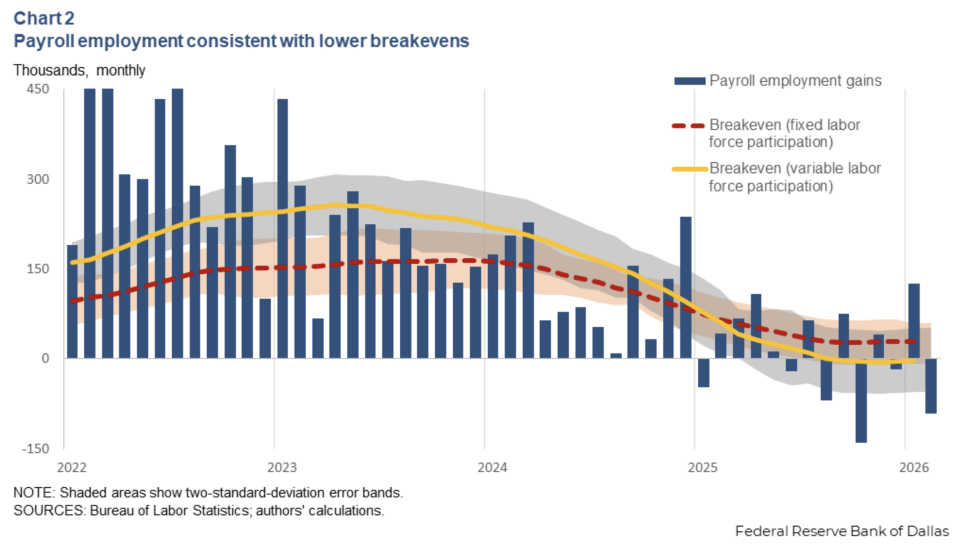
The report’s findings carry major implications for the Federal Reserve, which is charged with pursuing maximum employment and price stability.
Fed Chairman Jerome Powell has pointed to the unemployment rate as a key gauge of the labor market. Despite last year’s dive in average monthly payroll gains, the jobless rate has barely moved and remains at historically low levels, leading the Fed to proceed cautiously with interest rate cuts.
In fact, the 4.3% unemployment rate in March was little changed from the 4.2% rate in February 2025, Trump’s first full month back in the White House.
“Real-time data point to an important change in the U.S. labor market: The benchmark for evaluating payroll growth has moved significantly,” the Dallas Fed economists said. “As net outflows of unauthorized immigrants reduced employment growth in late 2025, payroll gains that might historically have signaled economic slack are now consistent with a balanced labor market.”
This story was originally featured on Fortune.com


Iran says Iraqi ships are allowed to use Strait of Hormuz
The Iranian military said major oil producer Iraq is exempt from shipping restrictions in the Strait of Hormuz, a potentially significant move for global crude supplies.
“Brotherly Iraq is exempt from any restrictions we have imposed on the Strait of Hormuz,” Iran’s military spokesman said in an Arabic-language video statement published by state-run Islamic Republic News Agency.
The declaration has the potential to unleash as much as 3 million barrels a day of Iraqi oil cargoes. An Iraqi official, however, cautioned that the usefulness of the exemption will depend on whether shipping companies are willing to risk entering the strait to collect cargoes.
It’s not immediately clear if the exemption will apply to all Iraqi oil or just the nation’s tankers, or indeed how it will be enforced.
Read More: Secret Codes, Yuan Fees Get Ships Through Iran’s Hormuz Tolls
Even as fighting continues and the US steps up its threats, vessel traffic through the vital strait has ticked up slightly, with a handful of Asian nations negotiating safe passage. A French container ship crossed the strait this week in a first for a western European vessel, and a Japanese-owned LNG tanker also made it out.
Still, the number of transits remains a small fraction of the pre-war rate, when one-fifth of the world’s oil and liquefied natural gas passed the strait.
Read More: Here’s a List of Gulf Energy Infrastructure Damaged in Iran War
Early in the war that has raged for five weeks, Iraq and other key Persian Gulf oil producers were forced to slash crude output as the primary export route closed and storage tanks filled to capacity.
Iraqi oil exports plunged by roughly 97% to a daily average of 99,000 barrels in March from the prior month as production shrank and overseas shipments were restricted to a pipeline system that transverses Turkey to the Mediterranean port of Ceyhan.
Iran’s loosening of Hormuz restrictions opens at least an opportunity for Iraq to resume some seaborne shipments, though other hurdles remain, including a lack of clarity on when and by how much the nation’s oil fields can ramp up output.
Regional Brothers
It’s also unclear, given weeks of shipping turmoil, how much tanker capacity will be immediately available to load and haul Iraqi crude from Persian Gulf ports.
Iraq is the second-largest oil producer in OPEC, second only to Saudi Arabia.
The Iranian statement distinguished “brotherly” Iraq from “hostile” states that Tehran has repeatedly said the strait is closed to. Speaking in Arabic rather than Iran’s native Persian, the military spokesman thanked the Iraqi people for their support since the war began.
The two neighbors have close ties — despite a brutal eight-year war in the 1980s — thanks in part to their majority Shia Muslim populations. Iraqi militias form a key node in Iran’s network of regional proxies opposed to the US and Israel, and Baghdad also relies on Tehran for supplies of natural gas.
This story was originally featured on Fortune.com



U.S. deploys bulk of stealthy long-range missile for Iran war
The next steps in the US military campaign against Iran will commit nearly its entire inventory of stealthy JASSM-ER cruise missiles, drawing them from stockpiles devoted to other regions.
The order to pull the $1.5 million weapon from Pacific stockpiles was issued at the end of March, according to a person with direct knowledge of the matter. Missiles at US facilities elsewhere, including the continental US, will be moved to US Central Command bases or Fairford in the UK, said the person, who was granted anonymity to discuss sensitive details.
After the moves, only about 425 JASSM-ER out of a prewar inventory of 2,300 will remain available for the rest of the globe. That would be roughly enough for 17 B-1B bombers on a single mission. Another 75 or so are “unserviceable” because of damage or technical faults.
The JASSM-ER, or Joint Air-to-Surface Missile-Extended Range, can fly more than 600 miles and was designed to hit targets at a safer distances to avoid an enemy’s air defenses.
Along with the shorter-range JASSM — which has a range of about 250 miles, about two-thirds of US stockpiles have been committed to the Iran war, the person said.
Supplies of missile interceptors and long-range strike weapons have been at issue since the US and Israel launched their air campaign on Feb. 28. Replacing what has been used would take many years’ worth of production at current levels.
Read More: Trump Warns Iran It Has 48 Hours Left as Airman Remains Missing
The US has been using large numbers of long-range weapons like JASSM-ER for strikes, limiting the risk to service members but reducing stocks of systems meant for more capable adversaries such as China.
The US and Israel have said they destroyed a significant portion of Iran’s air defenses, allowing them to use cheaper weapons to hit targets in the country. But a US F-15E strike fighter was shot down on Friday. Soon afterward, an A-10 attack jet was downed and two combat search-and-rescue helicopters were hit by Iranian fire, the New York Times reported.
US operations through the first four weeks of the war consumed more than 1,000 JASSM-ERs, the person said, speaking on condition of anonymity because of the sensitivity of the matter. US aircraft also fired 47 during the raid to capture Venezuelan President Nicolas Maduro, the person said.
The US has allocated funds to buy more than 6,200 JASSMs since 2009, and production of the baseline JASSM for US supplies ended about 10 years ago.
Lockheed Martin Corp.’s scheduled production rate for 2026 is 396 of the longer-range version, although as many as 860 can be manufactured if the line, which also produces the LRASM anti-ship missile, is fully geared toward JASSMs.
Committing so many JASSM-ERs to the Iran war does not mean they will all be used. So far they have been launched from B-52 and B-1B bombers, as well as strike fighters.
US Central Command and the Department of Defense did not immediately respond to requests for comment.
‘Stone Ages’
It’s not clear what President Donald Trump is planning next for the US campaign. As ground troops, including Marines and paratroopers, move to the region, speculation has swirled about seizing Kharg island, home to Iran’s main oil terminals.
Trump said in a Wednesday night speech that “over the next two to three weeks, we’re going to bring them back to the stone ages where they belong,” without specifying what that meant for Iran’s civilians, military or government.
On Tuesday, Chairman of the Joint Chiefs General Dan Caine said the US had begun to fly B-52s over Iran, implying that airspace was now safer for attacks using cheaper and more plentiful JDAM precision bombs.
But along with the two US planes downed on Friday, Iran has also destroyed more than 12 MQ-9 strike drones during the course of the war.
The fact that the older, slower B-52s were only now flying over Iran “raises questions about the degree to which the US has continued to rely on standoff capabilities,” said Kelly Grieco, a senior fellow at the Stimson Center.
Iran has launched more than 1,600 ballistic missiles around the region, according to Gulf countries’ official reporting, and about 4,000 Shahed-type rudimentary cruise missiles. Defending against ballistic missiles alone would consume at least 3,200 interceptors.
While Lockheed Martin makes about 650 Patriot PAC-3 interceptors per year, the company signed an agreement in January to make 2,000 a year by 2030. The company also makes 96 THAAD interceptors per year, but reached a separate deal to increase that number to 400.
The US has fired hundreds of Tomahawk cruise missiles during the attack on Iran. There were about 4,000 Tomahawks in US stockpiles before the war — including older models and anti-ship variants. RTX Corp. produced about 100 new missiles in 2025, while about 240 older models were upgraded to the latest Block V standard.
This story was originally featured on Fortune.com

Trump warns Iran it has 48 hours left as airman remains missing
President Donald Trump said Saturday that time was running out on his 10-day deadline for Iran to make a peace deal with the US and threatened that the Islamic Republic would face “all hell” in 48 hours.
“Remember when I gave Iran ten days to MAKE A DEAL or OPEN UP THE HORMUZ STRAIT,” Trump said in a social-media post the day before Easter. “Time is running out — 48 hours before all Hell will reign down on them. Glory be to God!”
Trump had extended a five-day deadline to April 6 as preliminary discussions for peace talks got under way in late March. As attacks intensified from all sides, including Iran’s downing of two US military aircraft, Trump’s rhetoric has hardened from his recent attempts to find a way out of the growing conflict.
Trump has warned that if Iran doesn’t agree to his terms — which the government has rejected — and open the Strait of Hormuz to all shipping traffic out of the Persian Gulf, the US would bomb the country’s civilian energy infrastructure, strikes that would likely constitute a war crime under international law.
Missing Pilot
In Iran, the US continued search-and-rescue operations for a crew member from an F-15E fighter jet shot down by Iran on Friday, as Tehran kept up attacks on Gulf Arab states and Israel.
A second US combat plane reportedly crashed in the Persian Gulf the same day. The incidents mark a significant blow for Washington as the war enters its sixth week with energy prices risingand little sign of an end to the conflict.
Read More: US Deploys Bulk of Stealthy Long-Range Missile for Iran War
Trump declined to discuss the search-and-rescue operations in an interview with NBC News on Friday. He said the events wouldn’t affect any peace negotiations with Iran, according to a reporter who spoke to him on a call.
On Saturday, Iran said US-Israeli strikes hit petrochemical plants and forced the evacuation of a large industrial zone. Other attacks targeting the perimeter of Iran’s Bushehr nuclear power plant left one security staff member dead, Iran’s semi-official Tasnim news agency reported. The main sections of the facility, where Russia’s state nuclear company Rosatom has workers, were unaffected, Tasnim said.
Iran continued to fire missiles and drones across much of the Middle East. Dubai authorities reported that debris from an aerial interception fell on the facade of an Oracle Corp. building in Dubai Internet City on Saturday morning. They also reported debris hitting a building in the nearby Dubai Marina area. No fire or injuries were reported.
Iran fired more missiles at Israel. There was damage to a parking lot in Tel Aviv and to buildings in several outlying towns, authorities said, describing the impacts as caused by debris from interceptions. There were no immediate reports of casualties.
The downing of the US jet came despite Trump’s claim in a primetime address on Wednesday that Iran no longer had anti-aircraft equipment. His military commanders, as well as Defense Secretary Pete Hegseth, have previously touted US air superiority over Iranian territory.
It’s the first known combat loss of a US or Israeli plane since the two countries began attacking Iran on Feb. 28. Three US aircraft were downed by friendly fire in Kuwait early in the war, while others have been destroyed or damaged at airbases by Iranian drones and missiles.
Read More: Iran Says Iraqi Ships Are Allowed to Use Strait of Hormuz
The US rescued one of the F-15 crew members, according to an American official who asked not to be identified discussing sensitive information. The status of the second person is unclear and Iranian media said Tehran offered a reward of about $66,000 to citizens who capture the person alive.
The lone pilot of the second plane — an A-10 Warthog — was safely rescued, the New York Times reported.
Read More: Italy’s Meloni Visits Doha to Bolster Energy Supplies Hit by War
Iran Hits Energy Plants
Iran has continued to hit key energy infrastructure in the past two days.
The UAE’s largest natural gas processing facility, Habshan, suspended operations after debris from a projectile interception sparked a fire. A drone attack set ablaze Kuwait’s Mina Al-Ahmadi oil refinery, which can process almost 350,000 barrels a day of crude.
The United Arab Emirates, of which Dubai is a member, said it detected 79 projectiles fired from Iran on Saturday, including 23 ballistic missiles. That was the highest number of projectiles since March 8, according to data published by UAE authorities, and continued a trend of more numerous attacks over the last three days.
The UAE, like other Gulf states and Israel, has intercepted the vast majority of Iranian attacks.
Israel’s military said it hit air defense sites and missile storage facilities in a wave of airstrikes on Tehran on Friday. Iran said US-Israeli strikes hit a petrochemical zone in Mahshahr, in the southwestern Khuzestan province on Saturday. Authorities ordered the evacuation of all personnel and said any potential pollutants don’t pose a risk to nearby cities, the semi-official Fars news agency reported.
Peace Efforts Stall
Iran has shown little sign of accepting Trump’s demands for peace and has laid out its own conditions — most of them unacceptable to the US and Israel.
The New York Times, citing US intelligence reports, said Iranian personnel have been digging out underground missile bunkers and silos struck by American and Israeli bombs and returning them to operation hours after attacks. That casts doubt on the US and Israel’s ability to destroy Iran’s missile capability — one of their key war goals.
Despite Trump’s weekend threat, the president signaled this week he may be willing to pull US forces out of the conflict in two to three weeks, even if the Strait of Hormuz is still effectively shut.
Read More: HORMUZ TRACKER: Weekly Transits Reach Highest Since War Began
US allies are stepping up efforts to ensure the waterway — through which one fifth of the world’s oil and liquefied natural gas supplies normally flow — is reopened soon.
Iran’s military said Saturday that Iraq would be exempt from shipping restrictions in the trait, opening the potential of as much as 3 million barrels a day of Iraqi oil cargoes.
More than 40 of their foreign ministers met virtually on Thursday to discuss plans, signaling to Trump their concern about the closure.
On Saturday, Turkish President Recep Tayyip Erdogan said in a social media post that he spoke by phone with Mark Rutte, secretary-general of the North Atlantic Treaty Organization saying the situation was heading for a deadlock and “urged the international community to step up efforts to end the war.”
The group, convened by the UK, was clear that any ceasefire talks with Iran needed to include a solution for Hormuz, people familiar with the discussions said. Still, the meeting, which the US and Iran were not part of, showed the coalition of countries deem it necessary to prepare for having to reopen the strait without Washington.
Nations such as France and the UK have said military options are unlikely to work until there’s a ceasefire.
Bahrain, supported by Jordan and Arab Gulf states, is proposing a United Nations Security Council resolution aimed at helping re-open Hormuz, according to the UAE. It would provide “a clear legal basis for all states to mobilize and support safe passage,” the UAE said in a post on X.
It’s unclear when a vote on the resolution will take place.
Russia, an Iranian ally, pushed back on the initiative, with Foreign Minister Sergei Lavrov saying it would “legitimize aggression against Iran.” The comments signal Moscow may use its veto power, as one of five permanent members of the Security Council.
Ships Trickle Through Strait
Iran appeared to tighten its grip on the strait on Thursday, when its media reported that the government is drafting a protocol with Oman to monitor traffic. That would require shippers to pay tolls to Iran, according to its deputy foreign minister.
The passage is officially in international waters and any attempt by Iran to assert control over traffic will be opposed strongly by Western powers and Gulf Arab states.
A trickle of ships is managing to pass through. A French container ship and a Japanese-owned tanker have crossed the Strait of Hormuz in the past two days, in what appear to be the first such transits since the war in Iran shuttered the crucial waterway.
The energy shock, which has seen gasoline pump prices in the country jump to more than $4 a gallon on average carries political risks for Trump and his Republican Party in the November midterm elections.
US benchmark oil prices, or WTI futures, closed at more than $111 a barrel last week and have almost doubled this year.
More than 5,000 people have been killed in the conflict, almost three-quarters of them in Iran, according to government organizations and the US-based Human Rights Activists News Agency. Just over 1,300 people have been killed in Lebanon, where Israel is fighting a parallel war against Iran-allied Hezbollah.
This story was originally featured on Fortune.com

Ryanair CEO says book summer trips before fares soar, predicting French air traffic controllers more likely to cause flight chaos than fuel shortages
If the U.S.-Israel war on Iran continues into the summer, then airlines will start running out of jet fuel and will be forced to trim flights, according to Ryanair CEO Michael O’Leary.
In an interview Thursday with the U.K.’s ITV News, he said carriers will be in an “unknown scenario” if the Strait of Hormuz stays closed for two to three more months, warning 5%-10% of flights in May, June, and July might have to be canceled.
By that point, O’Leary added airlines won’t be able to choose which flights to cancel, explaining that they will get little advance notice and it would depend on how much jet fuel each airport still has available.
“So we will then look around, and we will be trying to ground one or two aircraft and minimize the inconvenience for customers,” he said. “But it’s going to be difficult. It’s going to be challenging.”
Despite the risk of cancellations, O’Leary said he would “strongly advise” that anyone planning a trip this summer book as soon as possible, before airfares get pricier.
In fact, jet fuel prices have soared even higher than gasoline prices have as the Iran war has not only bottled up one-fifth of the world’s oil supply but a big chunk of the refining capacity that churns out jet fuel.
The U.S isn’t immune either, and top airport hubs like Chicago, Houston, Los Angeles and New York have seen the average price for a gallon of jet fuel hit $4.88 per gallon, nearly double compared to the prewar price.
As a result, more airlines are hiking fees for checking luggage, and United Airlines is bracing for a prolonged war that sends oil as high as $175 a barrel and is making contingency plans that include reducing capacity.
When asked if booking a flight now would be a gamble given the possibility that a flight may not exist this summer, O’Leary replied he doesn’t think so.
“Life is a gamble,” he added. “I think we’re looking at maybe the risk to 5 or 10% of cancellations in June or July, but 95-90% of flight will still operate. So I think you’re really not taking much of a gamble. I would be much more concerned if you delay your booking, that actually you and your family will be paying much higher prices.”
O’Leary acknowledged that travelers who face canceled trips wouldn’t be able to get refunded as airlines could claim circumstances beyond their control.
But he pointed out anyone flying within Europe won’t be stranded and is entitled to have airlines reroute a trip or get them back home.
“At Ryanair, we have lots of flights on a daily basis. We will re-accommodate you, get you back, get you out, whatever it’s going to be,” O’Leary vowed. “You might be stuck for a day or two. But if you’re staying within Europe, you should be reasonably confident that, A, your original flight will operate and, B, if there is a disruption, bear in mind there’ll be far more disruptions this summer from French air traffic controllers not showing up to work.”
This story was originally featured on Fortune.com
Two more arrested on suspicion of murder after pedestrian dies in Barnsley collision
Total of four, including 17-year-old boy, in police custody after fatal incident in Cudworth area on Friday evening
Two further suspects, including a 17-year-old boy, have been arrested on suspicion of murder after a fatal collision in Barnsley on Friday afternoon.
This comes after two people, a 60-year-old man and a 38-year-old woman, were arrested earlier in the day on suspicion of murder after a man died after a collision in the Cudworth area of Barnsley. These two suspects remain in custody.
This post was originally published here
German researchers set right the story of a 9,000-year-old shaman’s grave
When a 9,000 year-old grave of a shaman was discovered in Nazi Germany, the discovery was quickly politicized to support Nazi propaganda. But new analysis shows that initial narrative was all wrong.

This post was originally published here
Man arrested at court while attending hearing of Jewish ambulance arson suspects
Met police say 19-year-old was detained in connection with attack after officers recognised him at arraignment
A fourth person has been arrested in connection with the arson attack on Jewish volunteer ambulances in north-west London, the Metropolitan police has said.
The force said the 19-year-old man was arrested on Saturday morning at Westminster magistrates court, where three other men were charged over the arson attack.
This post was originally published here
Three-week-old mountain lion cub rescued by California biologists
Crimson, seen alone in Santa Monica mountains for days, gets care in Oakland zoo after mother nowhere to be found
It was an unusual scene. A lion cub alone for days in southern California’s sprawling Santa Monica mountains, emitting a noise that sounded like a cross between a purr and a light squeal, perhaps calling out for his mother.
Where was his mother?
This post was originally published here
Iran conflict to forefront of UK religious and political leaders’ Easter messages
Archbishop of Canterbury to issue urgent call for peace, as PM exhorts Britons to ‘choose community over division’
Religious and political leaders in the UK are highlighting the conflict in the Middle East in their Easter messages, calling for “peace, justice and freedom” in the region.
The archbishop of Canterbury will deliver her first Easter sermon at Canterbury Cathedral on Sunday as the Church of England’s top bishop. Dame Sarah Mullally will call “with renewed urgency” for peace in the Middle East and pray for “an end to the violence and destruction” in the region.
This post was originally published here
Rise in number of girls being identified as victims in county lines exploitation, data shows
Charities suggest ‘gendered understanding’ of crime means services often fail to recognise girls and young women as victims
An increasing number of girls are being identified as victims of county lines exploitation, figures have shown.
Data from Catch22, the charity that provides the national county lines support service, said girls and young women formed 22% of its caseload in 2025, up from 15% the previous year.
This post was originally published here

With no missile alerts and a regime’s internet blackout, app offers lifeline to Iranian civilians
As the U.S. and Israel round out a fifth week of war with Iran, some 93 million civilians living inside Iran are stuck in a conflict zone without a missile alert system or access to the internet. Another 4 million people of Iranian origin worldwide are cut off from their friends and family still in Iran.
While the Islamic Republic has left its own people in the dark, Holistic Resilience, a group of engineers focused on internet freedom, is using an app called Mahsa Alert to light the way.
The app is named after Mahsa Amini, a 22-year-old Iranian woman who died in 2022 after an arrest by Iran’s “morality police.” This group regularly detains women it believes do not comply with the country’s mandatory hair-covering laws. Her death became the impetus for widespread protests after decades of oppression. Amini’s image is now a symbol of what has become known as the Woman, Life, Freedom movement.
NY FED PRESIDENT JOHN WILLIAMS WARNS IRAN-DRIVEN OIL SPIKE COULD RIPPLE THROUGH ECONOMY
Holistic Resilience said it first recognized the lack of civilian protections during the 12-day war between Israel and Iran in June 2025.
“They’re checking on the surroundings of their loved ones’ neighborhoods to make sure there is no location that could be potentially a target of these strikes and inform them to stay away from them,” said Ahmad Ahmadian, the executive director of Holistic Resilience.
Using crowdsourcing and open-source intelligence, volunteers analyze about 100 tips a day for validity and accuracy. These reports can come in the form of social media videos or photos or messages on Telegram. They also pore through footage from some 18,000 CCTV cameras around the country.
As the 17th-largest country in the world by area, Iran presents a significant mapping challenge.
“We have to be up to be able to immediately push out that notification. The last one was, I guess, in the middle of the night,” said Ahmadian. “I have colleagues that are working near 16 hours on this project. We have been self-funding this project from the beginning, and we never stopped doing that despite all of the challenges. The reason for that is it’s something that people need to have, and it saves lives.”
IRAN GUARDS RECRUITING CHILDREN AS YOUNG AS 12, PUTTING THEM ON FRONT LINES OF WAR
The Israel Defense Forces occasionally posts evacuation notices on its Farsi-language X account. A previous post from the account shows warnings like: “In the coming hours, the IDF will operate in the area, as it has in recent days across Tehran, to strike military infrastructure of the Iranian regime. For your safety and well-being, we ask that you immediately leave the area indicated on the map.”
With internet connectivity in Iran estimated at less than 1%, Israeli evacuation notices often fail to reach the civilians they are intended to aid.
Civilians who evacuate to towns or cities they are unfamiliar with can use the Mahsa Alert app as a critical lifeline, identifying hospitals, blood banks, government checkpoints or shelters while offline.
“We’ve realized, OK, if people start to move around and get displaced, they need to see the essentials, the essential locations,” said Ahmadian.
The Iranian government is prioritizing its objectives beyond its borders over its own people, according to Holistic Resilience.
KEVIN O’LEARY FORECASTS GLOBAL POWER SHIFT IN STRAIT OF HORMUZ AS IRAN CONFLICT RATTLES OIL MARKETS
“Instead of the sirens, sending crisis alerts to the mass population, every day they’re sending text messages by the Ministry of Intelligence threatening people, [saying] if you share information with others, we will know about it and we’ll come after you,” said Ahmadian.
The government has accused those volunteering information to the platform of acting as Israeli spies or gathering intelligence for the U.S. military. The group has come under attack from the Iranian government, both from hacking and from deliberately sending misinformation to undermine the group’s credibility. Palo Alto Networks’ Unit 42 has reported a widespread increase in cyberthreat activity by Iranian actors since the conflict began in late February.
CLICK HERE TO GET FOX BUSINESS ON THE GO
In one instance, Ahmadian said a tip alleged missiles were being launched from a specific building, which the group later identified as a girls’ dormitory at a university. He said the group believed the tip may have been intended to mislead targeting, giving the Iranian government ammunition for its anti-Israel and anti-U.S. media campaign, though this could not be independently verified by FOX Business.
“By increasing the number of civilian casualties, they pump up their propaganda war,” Ahmadian said. “This is not our war. This has never been our war.”
Artemis II’s Jeremy Hansen calls Project Hail Mary ‘a real treat’ before his space mission
Astronaut calls fellow Canadian Ryan Gosling’s movie ‘extraordinary’ ahead of Artemis II crew’s lunar fly-around
The new space movie Project Hail Mary starring Ryan Gosling has gotten a rave review from more than halfway to the moon.
Canadian astronaut Jeremy Hansen said on Saturday that he and his Artemis II crewmates got to watch the film with their families before launching on the lunar fly-around. He said it was “a real treat” to view the movie while getting ready for his own space adventure.
This post was originally published here
Artemis II’s Jeremy Hansen calls Project Hail Mary ‘a real treat’ before his space mission
Astronaut calls fellow Canadian Ryan Gosling’s movie ‘extraordinary’ ahead of Artemis II crew’s lunar fly-around
The new space movie Project Hail Mary starring Ryan Gosling has gotten a rave review from more than halfway to the moon.
Canadian astronaut Jeremy Hansen said on Saturday that he and his Artemis II crewmates got to watch the film with their families before launching on the lunar fly-around. He said it was “a real treat” to view the movie while getting ready for his own space adventure.
This post was originally published here



Polymarket removes wagers on U.S. service member rescue mission in Iran
Rep. Seth Moulton, D-Mass., called the market “DISGUSTING” and said bettors were wagering on whether American troops would be saved.
This post was originally published here
California protection crews contain parts of wildfire that burned 4,100 acres
Springs fire, which had spread quickly by windy conditions, at least 45% contained on Saturday, say fire officials
California fire protection crews on Saturday were getting a handle on the wildfire that broke out the previous evening in Riverside county, fanned by high winds that quickly spread the flames to more than 4,100 acres.
The Springs fire, about 64 miles (103km) east of Los Angeles, was at least 45% contained on Saturday, a fire department spokesperson said. It was 25% contained late on Friday evening.
This post was originally published here
Halting $400m White House ballroom project is national security risk, Trump officials say
US National Park Service lawyers cite materials that will be installed to make ‘heavily fortified’ facility
Donald Trump’s administration is arguing that a judge’s order to halt construction of a $400m White House ballroom creates a security risk for the US president as his team asks a federal appeals court to pause the ruling.
In a motion filed on Friday, US National Park Service (NPS) lawyers say that the federal judge’s order to suspend construction of the new facility is “threatening grave national-security harms to the White House, the president and his family, and the president’s staff”.
This post was originally published here










Trump administration asks appeals court to pause order halting White House ballroom construction
Lawyers said the judge’s order is “threatening grave national-security harms to the White House, the President and his family, and the President’s staff.”
This post was originally published here

NATO Chief Rutte Heading to Washington as Trump Ramps Up Pressure
NATO Secretary General Mark Rutte will travel to Washington, D.C., from April 8012, for high-level meetings and events.
The visit comes amid rising tensions between the United States and its European allies over defense cooperation and the ongoing Iran conflict.
Rutte plans to meet President Donald Trump, Secretary of State Marco Rubio and Defense Secretary Pete Hegseth during his trip, according to official announcements.
Politico reports that the discussions are expected to address alliance unity, military commitments, and geopolitical tensions.
High-Stakes Diplomatic Engagement
Rutte will begin his visit on Wednesday with meetings at the White House and State Department. These talks aim to address strained relations within NATO and concerns over burden-sharing among member nations.
The visit follows recent criticism from Trump regarding NATO allies’ limited support …
This post was originally published here

Understanding the Cash Conversion Cycle (CCC) for Business Efficiency
This post was originally published here

Auditor: Definition, Types, and Essential Qualifications
This post was originally published here



MSCI Explained: Understanding Its Role and Impact in Investing
This post was originally published here
MSCI Explained: Understanding Its Role and Impact in Investing
This post was originally published here

Vetting Explained: How It Works and Why It Matters
This post was originally published here
Vetting Explained: How It Works and Why It Matters
This post was originally published here











US authorities arrest relatives of late Iranian military commander who were living in Los Angeles
State department said niece and grandniece of Qassem Soleimani, killed in 2020 US drone strike, celebrated attacks against US soldiers
US federal agents have arrested the niece and grandniece of the late Iranian military commander Qassem Soleimani after the Trump administration’s top diplomat, Marco Rubio, revoked their lawful permanent resident status, officials said on Saturday.
“Hamideh Soleimani Afshar and her daughter are now in the custody of US Immigration and Customs Enforcement,” or ICE, the state department said in a statement.
This post was originally published here
US authorities arrest relatives of late Iranian military commander who were living in Los Angeles
State department said niece and grandniece of Qassem Soleimani, killed in 2020 US drone strike, celebrated attacks against US soldiers
US federal agents have arrested the niece and grandniece of the late Iranian military commander Qassem Soleimani after the Trump administration’s top diplomat, Marco Rubio, revoked their lawful permanent resident status, officials said on Saturday.
“Hamideh Soleimani Afshar and her daughter are now in the custody of US Immigration and Customs Enforcement,” or ICE, the state department said in a statement.
This post was originally published here
‘Horror movie’: officials investigate after 21 dead dogs wash up on Washington state shore
Carasses wash ashore Guemes Island in ‘creepy mystery’, with authorities saying canines appear to be the same size
Officials are investigating after nearly two dozen dead canines washed ashore on a Washington state island, in what one local has compared to “the start of a horror movie”.
The Skagit county sheriff’s office said 21 canines had been found on the shoreline of Guemes Island, about 80 miles north of Seattle, between 26 March and Friday.
This post was originally published here
‘Horror movie’: officials investigate after 21 dead dogs wash up on Washington state shore
Carasses wash ashore Guemes Island in ‘creepy mystery’, with authorities saying canines appear to be the same size
Officials are investigating after nearly two dozen dead canines washed ashore on a Washington state island, in what one local has compared to “the start of a horror movie”.
The Skagit county sheriff’s office said 21 canines had been found on the shoreline of Guemes Island, about 80 miles north of Seattle, between 26 March and Friday.
This post was originally published here
Federal judge halts White House effort to collect university data on applicants’ race
Trump ordered data collection after raising concern about race being used as factor in college admissions
A federal judge on Friday halted efforts by the Trump administration to collect data that proves higher education institutions aren’t considering race in admissions.
The ruling from the US district court judge F Dennis Saylor IV in Boston granting the preliminary injunction follows a lawsuit filed earlier this month by a coalition of 17 Democratic state attorneys general. It will only apply to public universities in plaintiffs’ states.
This post was originally published here
Federal judge halts White House effort to collect university data on applicants’ race
Trump ordered data collection after raising concern about race being used as factor in college admissions
A federal judge on Friday halted efforts by the Trump administration to collect data that proves higher education institutions aren’t considering race in admissions.
The ruling from the US district court judge F Dennis Saylor IV in Boston granting the preliminary injunction follows a lawsuit filed earlier this month by a coalition of 17 Democratic state attorneys general. It will only apply to public universities in plaintiffs’ states.
This post was originally published here
Judge halts Trump effort requiring colleges to show they don’t consider race in admissions
A federal judge on Saturday said the Trump Administration the demand to collect data from universities was rolled out in a “rushed and chaotic” manner.
(Image credit: Alex Brandon)

This post was originally published here

NATO’s Rutte to Meet With Trump Next Week




Gap Risk Explained: Definition, Functionality, and Example
This post was originally published here

Understanding Takaful Insurance: Islamic Insurance Explained
This post was originally published here


Inferior Goods: Definition, Examples, and Impact on Consumer Behavior
This post was originally published here










Connecticut furniture standby Jordan’s Furniture offers $50 million of refunds to the whole state depending on March Madness
College basketball players aren’t the only ones poised to win big in this year’s March Madness.
A New England furniture chain is offering to reimburse customers for products purchased earlier this year if both the UConn men’s and women’s basketball teams reach the championship games.
That means some 20,000 Jordan’s Furniture customers could be fully repaid for $50 million worth of sales if the two teams win their Final Four games on Friday and Saturday.
For Brian Mazzilli of Plymouth, Massachusetts, that could mean a $3,800 refund for a living room sofa and coffee table. Not previously a college sports fan, he has declared himself an enthusiastic new follower of the Huskies.
“We thought the chances were pretty slim, but now we’re pretty excited,” Mazzilli said in the aftermath of the UConn men’s stunning buzzer-beater win over Duke in last weekend’s Elite Eight. “It just didn’t seem that both teams from one school making it to the finals — that seems kind of a long shot.”
When UConn’s Braylon Mullins hit the winning, 35-foot shot to beat Duke, Mazzilli said he was jumping up and down like he did when the Patriots’ Adam Vinatieri kicked the winning, last-second field goal against the Rams in the 2002 Super Bowl to give New England its first NFL title.
Jordan’s isn’t on the hook for the $50 million itself. It got insurance for the promotion like it did in 2007 when it offered a similar deal if the Boston Red Sox won the World Series — which they did. In that deal, more than 24,000 customers were reimbursed about $35 million.
“We want this to happen,” Eliot Tatelman, the retired president of Jordan’s who is still the face of the Massachusetts-based retailer in TV ads, said in a phone interview Thursday. “Whether they win or lose, I got to pay for the insurance.”
Tatelman said he came up with the UConn promotion idea while thinking of ways to increase the company’s stature in Connecticut, where other furniture businesses have been around longer.
The promotion was offered to customers who bought furniture, mattresses and accessories at Jordan’s from Jan. 20 to Feb. 16 of this year, with some exceptions. The company will send out refund checks if both UConn teams make it to the championship games.
Jordan’s, incorporated in 1928 in Waltham, Massachusetts, by Tatelman’s grandfather, has eight retail locations in New England. The company was sold to Warren Buffett’s Berkshire Hathaway in 1999. It’s known for entertainment attractions at its stores — including IMAX 3D movie theaters, a rope course and, in Reading, Massachusetts, depictions of Boston landmarks made of millions of jelly beans.
The undefeated, No. 1-seeded UConn women take on South Carolina in the Final Four on Friday night, while the men’s team — a No. 2 seed — plays Illinois on Saturday.
This story was originally featured on Fortune.com

Former Turnstile guitarist gets attempted murder charge for hitting bandmate’s father with his car
A former guitarist for Grammy-winning Baltimore hardcore band Turnstile has been charged with attempted murder after authorities say he chased down and struck a former bandmate’s father with his car, badly injuring him.
Montgomery County police officers responding to a Sunday report about a pedestrian being struck in the Washington, D.C., suburb of Silver Spring found William Yates, the 79-year-old father of lead singer Brendan Yates, injured in a front yard, according to charging documents.
Yates’ family said guitarist Brady Ebert, a neighbor who parted ways with the band several years ago, had struck him with a car, police wrote. Yates’ daughter, Erin Gerber, told authorities that she and her husband were getting their kids out of their car when Ebert drove up honking at them and yelling obscenities, then drove into her father.
In video footage obtained from a neighbor, Ebert could be seen driving a gold Buick LeSabre and swerving toward William Yates but missing him, according to the charging documents. Yates then threw a rock at Ebert’s vehicle and Gerber dragged her 3-year-old son onto the lawn to avoid being hit. Ebert then turned sharply into Yates’ driveway and struck him as he was trying to run away, investigators wrote. Ebert finally drove across the lawn and left.
Yates told a detective that as he was injured on the ground, Ebert returned and yelled that he “deserved it” before driving off again, according to charging documents.
Yates said Ebert used to be in a band with his son and had been causing problems for his family since being kicked out. He said Ebert had been taunting them for long time, but that his behavior had been escalating.
Ebert, 33, was arrested Tuesday and charged with attempted second-degree murder and first-degree assault, court records show.
During a bond hearing Thursday in which he appeared via video, Ebert called William Yates a “maniac” who threw a rock at him asked the judge to watch the surveillance footage, saying it would “contradict” the authorities’ narrative of what happened, The Baltimore Banner reported.
But prosecutor Dominic Plantamura said the footage shows it was a “clearly targeted attack” and that Yates is lucky he wasn’t injured more seriously.
Ebert’s lawyer, John Costello, acknowledged Ebert’s contentious history with his former bandmate, but said, “That does not, in this instance, warrant extra detention.” Costello’s office declined to comment to The Associated Press.
The judge ordered Ebert held without bond.
According to Plantamura, William Yates was injured so badly that a bone stuck out of one leg.
In a statement, Turnstile said it cut ties with Ebert in 2022, “in response to a consistent pattern of harmful behavior.” It said a boundary had to be set after he began threatening violence. While Ebert’s “baseless tirades” continued in public since then, the band said it didn’t address them to protect his privacy. Threats escalated in recent months and then there was a physical attack on Brendan Yates’ father this week, the band wrote.
“We are grateful that Mr. Yates survived, has successfully undergone surgery, and we’re hoping for the best possible outcome in his recovery,” the band said. “We have no language left for Brady.”
Turnstile were underground stalwarts until their 2021 album “Glow On” launched them into mainstream consciousness. They cemented their status this year by winning Grammys for Best Rock Album and Best Metal Performance.
This story was originally featured on Fortune.com

Feds sue 3 states for trying to bring Kalshi and Polymarket under more control
The federal government on Thursday sued Connecticut, Arizona and Illinois, challenging their efforts to regulate prediction market operators such as Kalshi and Polymarket.
All three states have sent cease and desist orders to such companies accusing them of engaging in illegal online gambling under state law. Arizona also filed criminal charges last month against Kalshi for allegedly violating state gambling laws and a law that makes betting on elections illegal.
The Commodity Futures Trading Commission contends in court filings that it, not the states, regulates these companies.
“The CFTC will continue to safeguard its exclusive regulatory authority over these markets and defend market participants against overzealous state regulators,” CFTC Chairman Michael S. Selig said in a written statement. He said Congress “rejected such a fragmented patchwork of state regulations” because it led to increased risk of fraud and poor consumer protection.
Last month, the Trump administration threw its support behind the operators Kalshi and Polymarket in a critical legal battle that could have implications for how sports betting is regulated.
Connecticut Attorney General William Tong on Thursday accused the Trump administration of “recycling industry arguments” that have been rejected in district courts across the country.
“These contracts are plainly unlicensed illegal gambling under time-worn state law, and we will aggressively defend Connecticut’s commonsense consumer protection laws,” he said.
This story was originally featured on Fortune.com

Meet a 74-year-old New Yorker who unretired to become an Uber driver: ‘I’m amazed at what people will tell me’
Before Stu Goldberg begins his night shift driving for Uber, he pulls out a notebook to read a handwritten list of reminders. “No tickets. Full stops,” he’d scrawled in the book. “Careful backing up. Watch for pedestrians and bikes.”
With a Ph.D in neuropsychology and decades of experience running his own business, Goldberg, 74, didn’t picture chauffeuring strangers around when he retired. But financially, things didn’t go as planned. So he makes the best of his situation shuttling passengers through New York City at night.
“I like the freedom. I like the flexibility. I like meeting people,” Goldberg said. “I like that most of the time I can get, once or twice a day, a good conversation with somebody.”
Goldberg is one of a growing number of Americans who have “unretired” in recent years. After concluding decades-long careers at hospitals, universities and corporations, they returned to the workforce due to insufficient retirement savings, rising living costs and a desire to stay active.
Some are finding gig work, or contract jobs, through apps or digital platforms. Delivering people and parcels, taking care of pets or folding other people’s laundry suits them because they can set their own hours and work, or not, when they choose.
“We’re living longer, so people are working longer because they have to fund those extra years,” said Carly Roszkowski, vice president of financial resilience at the nonprofit organization AARP. “And this concept of retirement for most people as like a cliff or a day they’re working towards really isn’t a reality for most.”
Goldberg wanted to teach after winding down his software and telemarketing company. But he needed to earn more money than what the occasional adjunct professor job teaching statistics would pay.
“Uber came up, and it was not a bad choice for me because I was comfortable driving people,” he said. “I felt it could be a good way to make money and keep most of it.”
About 1 in 5 Americans over age 50 who aren’t retired say they have no retirement savings, according to a survey the AARP conducted in January 2025.
Retirees and employment experts say gig work has advantages and downsides, including limited job protections and wages that may be insufficient to cover on-the-job expenses. Here are some factors to consider.
Stay active, but know your limits
Barbara Baratta, 72, retired as a pediatric nurse in 2018. But she got restless after a few years and signed up with the pet care app Rover, which connected her to jobs walking dogs and using her nursing skills to administer medications to cats.
The work keeps her active. “I get my steps in and do hill climbing,” she said.
In a leafy New Jersey suburb, Baratta set out to coax Barley, a mix of pit bull, beagle and shepherd, into the afternoon air with a wind chill pushing the temperature down into the 20s.
“Barley, if you turn this way, the wind will be blowing behind you,” she said gently, leading the dog down a wide street.
Baratta likes the physical nature of dog walking. She ran two half-marathons in the past year but notices that “being older and not having knees that are totally great” makes steep or uneven terrain a challenge even for her. She advises people in her age group to be careful about which pets they agree to walk.
“Some dogs are big and strong, which can be an issue, a lesson I learned very early on,” Baratta said. “An 80-pound dog, … they’re going to pull, they’re going to run away.”
Driving can be hard on the back and legs, and the challenge of finding restrooms to use on the go becomes difficult to deal with as you age, Goldberg cautioned.
A social buzz
Days can feel long and lonely after one retires. Working part-time can provide social interaction.
Baruch Schwartz, 78, was a wedding photographer for decades until the work became too physically demanding to do full-time. He started driving for Uber and Lyft and derives satisfaction from feeling needed. “I feel like I’m on a mission,” he said after taking a passenger home from a kidney dialysis appointment.
Driving for Uber gives Goldberg a chance to meet a variety of people. One night he spoke with a Scottish historian about the movie “Braveheart.” Another night a passenger asked him how to know whether it was the right time to propose to his girlfriend.
“I’m amazed at what people will tell me about their relationships,” Goldberg said.
Flexibility — for a price
One of the draws of working for gig platforms is the ability to set your own hours. Baratta’s schedule allowed her to babysit her grandchildren.
Goldberg appreciated the flexibility of setting his own hours when there was a recent death in his family. But between that unplanned trip and a root canal, and no vacation or sick days offered by his job, he went several days without income.
“When that happens, even though you have the flexibility, which you like, and you don’t have to call anybody and say ‘I’m not driving today,’ you still don’t make the money that day. And you’re still paying insurance,” Goldberg said.
Make sure the work is worth it
Before investing time into gig work, research what percentage the company takes from workers’ earnings.
“The house always wins, so the amount of money you are going to get as a driver or delivery worker is very much controlled by the platform,” said Alexandrea Ravenelle, a sociologist and gig economy researcher at The University of North Carolina at Chapel Hill. “There are no workplace protections, so if you get injured on the job, if you have any types of problems, if you have a car accident, for instance, you are entirely out of luck.”
Uber maintains commercial auto insurance coverage on behalf of its drivers, although New York City requires drivers to hold that insurance themselves, said Uber spokesman Ryan Thornton.
Goldberg hit three nasty potholes in three weeks, paying $144 each time to replace the tires. He lost money those weeks, despite working, he said.
“I’d say most drivers are not happy with the money that they’re making, unless they’re working more hours than I’m willing to do,” Goldberg said.
LisaKay “LK” Foyle, 64, of Orange, Texas, found a way to maximize her earnings on Poplin, an app which connects her with clients who need help with laundry. She has seniority among workers on the app so chooses to accept express orders, which pay the highest rate, and declines lower-paying jobs.
Foyle marvels at the state of some families’ dirty laundry: “all the socks are inside-out, all the underwear is in the pants, and you’ve got to check every single pocket, or you’re washing marbles or frogs or the snacks they had that day.”
Baratta’s dog-walking income supplements several small pensions and Social Security benefits. She charges $20 for a half-hour walk, not including her driving time to and from the location. Rover keeps about 20%, she said. The $1,000 to $2,000 she makes per month helps pay the bills, she said.
“The dogs and cats are delights,” Baratta said. “I’m not becoming rich doing this, … but I’ve met a lot of great families doing it.”
This story was originally featured on Fortune.com

Amazon slaps 3.5% fuel and logistics charge on sellers because of Iran war
Amazon is slapping a 3.5% fuel and logistics surcharge on third-party sellers using its platform starting later this month amid a spike in fuel prices since the war in Iran started.
The temporary charge is effective April 17 for many of the sellers who use Amazon’s fulfillment services, the online behemoth confirmed to The Associated Press in an email Thursday.
“Elevated costs in fuel and logistics have increased the cost of operating across the industry,” Amazon said in the emailed statement.
The Seattle-based company said it has absorbed these increases so far but similar to other major carriers, when costs remain elevated, it implements temporary surcharges to partially recover these costs. It noted the charge is “meaningfully” lower than surcharges applied by other major carriers.
“We remain committed to our selling partners’ success and to maintaining broad selection and low prices for customers,” Amazon added.
Amazon’s fuel and logistics-related surcharge will apply to U.S. and Canadian sellers using its Fulfillment by Amazon option. Starting May 2, the surcharge will take effect with sellers using the Buy with Prime and Multi-Channel Fulfillment options.
Amazon joins a growing list of carriers imposing surcharges to recoup rising energy costs as the Iran war drags on.
United Parcel Service and FedEx have increased their fuel surcharges. The United States Postal Service announced last week it was imposing an 8% fuel surcharge that would apply to packages to be shipped starting April 26. The surcharge would remain in place until Jan. 17 2027, it said.
This story was originally featured on Fortune.com

Trump sons to Gulf states: we’ve got some drone interception tech to sell you
A drone maker backed by President Donald Trump’s two oldest sons is trying to sell to Gulf countries while they are under attack by Iran and dependent on the U.S. military led by their father.
The sales drive by Florida-based Powerus – which announced a deal last month to bring aboard Eric Trump and Donald Trump Jr. – positions the company to potentially benefit from a war that their father began.
“These countries are under enormous pressure to buy from the sons of the president so he will do what they want,” said Richard Painter, a former chief White House ethics lawyer under President George W. Bush. “This is going to be the first family of a president to make a lot of money off war — a war he didn’t get the consent of Congress for.”
Powerus co-founder Brett Velicovich told The Associated Press that the company is making sales pitches that include drone demonstrations in several Gulf countries to show how its defensive drone interceptors could help them ward off Iranian attacks.
“Our team is doing many demos across the Middle East right now for our interceptors,” Velicovich said in an text exchange. “We have very incredible tech that can save lives.”
He declined to name the countries or give more details.
The Trump brothers’ deal with Powerus could give them sizable equity stakes. Their father, as commander in chief, launched the strikes with Israel against Iran over a month ago that began the war, the impetus for why these Gulf countries now need protection.
Powerus denied there were any conflicts when the Trump brothers’ stake was first announced. Velicovich emphasized its determination to help the U.S. catch up with Chinese and Russian drone makers and beat them.
“We are at war, my friend, we are in an arms race and America will lose if we don’t build fast,” said Velicovich, an Army veteran who had come under fire from the same Russian drones now being used by Iran. He added, “We should be thankful anyone is trying to invest in American manufacturing now. That idea transcends politics.”
The president’s oldest sons have expanded their business interests beyond hotels and golf courses since their father took office again. The companies they’ve invested in or been named advisers for — with equity stakes — run the gamut from cryptocurrency ventures to prediction markets to federal contractors making rocket parts and rare earth magnets.
This latest Trump venture has its sights on $1.1 billion set aside by the Pentagon to build up a U.S. manufacturing base for armed drones to fill a hole left when the Trump administration banned such imports from China.
The Trump Organization, where the two sons are executives, didn’t respond to a request for comment, but has dismissed claims of conflicts of interest in the past. The sons have said they didn’t get credit for their restraint in expanding their businesses in their father’s first term so have decided not to hold back much this time.
Asked about potential Powerus conflicts of interest specifically, Eric Trump sent AP a statement last month saying, “I am incredibly proud to invest in companies I believe in. Drones are clearly the wave of the future.”
Founded by U.S. Army Special Operations veterans about a year ago, Powerus makes drones for commercial uses, from spreading fertilizer to putting out forest fires. But it is bulking up fast to supply drones for military uses.
The company recently raised $60 million from investors and hopes to tap additional financing by doing a “reverse merger” with a Trump company listed on the Nasdaq stock exchange that owns a few golf courses in Florida. Such a merger allows a private business to quickly go public by taking over a company that already has publicly traded shares, shortening the process of filing paperwork and meeting various requirements of regular initial public offering.
This story was originally featured on Fortune.com
What are peptides, are they safe and is there evidence to back up the hype?
Influencers and athletes are among those claiming substances can help with injury repair, weight loss and angi-ageing
From influencers to athletes, high-profile figures are hailing peptides as the route to wellness, claiming they help with injury repair, weight loss, anti-ageing and mood. We take a look at what these substances are, and the murky industry surrounding them.
This post was originally published here
Medicines watchdog to investigate UK peptide clinics over health claims
Exclusive: Guardian investigation finds several clinics making potentially unlawful claims about benefits of unregulated therapies
The medicines regulator is investigating whether UK clinics are breaking the law by making claims about the benefits of unregulated, experimental peptide therapies, the Guardian can reveal.
Interest in experimental peptides has boomed in recent years. The substances are delivered by injection and are touted by sellers, influencers and even some medics as aiding everything from anti-ageing to recovery from injury.
This post was originally published here
Fugitive mafia boss wanted for murder arrested at Amalfi coast luxury villa
Roberto Mazzarella, head of a notorious Camorra clan, had been on the run for more than a year
An Italian mafia boss, who was one of Italy’s most dangerous fugitives, has been arrested on murder charges after more than a year on the run, Italian police said on Saturday.
Roberto Mazzarella was the head of the notorious Mazzarella clan of the Camorra – the Naples-based organised crime gang.
This post was originally published here

After the Minnesota surge, ICE is moving to a quieter enforcement approach
ICE seems to be changing from aggressive immigration enforcement on city streets to an apparent return to operations that rely heavily on local law enforcement. But even in Florida, where sheriffs are required to cooperate with ICE, some conservative sheriffs have concerns about pursuing immigrants with no criminal records.
(Image credit: Joe Raedle)

This post was originally published here







European ministers urge EU to impose windfall taxes on energy companies as prices spike ‘to ensure that this burden is distributed fairly’
The finance ministers of Spain and four other European countries are urging the European Union to impose a bloc-wide windfall tax on energy companies, concerned that surging oil and gas prices driven by the war in Iran will fuel inflation and strain households.
Spanish Economy Minister Carlos Cuerpo said Saturday that his counterparts from Germany, Italy, Portugal and Austria had signed a letter to the European Commission citing “market distortions” caused by the price spike.
“The conflict in the Middle East has caused oil prices to rise, placing a significant burden on the European economy and on European citizens,” the letter, dated Friday and made public by Cuerpo in an online post, said.
“It is important to ensure that this burden is distributed fairly,” it added.
Europe is largely dependent on imported oil and gas, leaving it vulnerable to external shocks. In 2022, turmoil in energy markets following Russia’s full-scale invasion of Ukraine pushed inflation into double digits in many European countries.
At the time, the EU imposed a “solidarity contribution” that included caps on excess energy profits.
“Given the current market distortions and fiscal constraints, the European Commission should swiftly develop a similar EU-wide contribution instrument,” the letter said. “It would also send a clear message that those who profit from the consequences of the war must do their part to ease the burden on the general public.”
Driven largely by higher oil prices, the annual inflation rate in the 21 countries that use the euro rose to 2.5% in March, from 1.9% in February.
Iran has blocked most tanker traffic through the Strait of Hormuz — a chokepoint for about 20% of global oil and gas — in a move that threatens to stress fuel markets for months.
European Union Energy Commissioner Dan Jorgensen warned this week that disruption caused by the closure means fuel prices are unlikely to “go back to normal in a foreseeable future.”
This story was originally featured on Fortune.com

Artemis II astronauts are more than halfway to the moon as they seek to break a distance record for humans set by Apollo 13
Now more than halfway to the moon, the Artemis II astronauts were toasted by Canada on Saturday as they prepared for their historic lunar fly-around to push deeper into space than even the Apollo astronauts.
The three Americans and one Canadian will reach their destination Monday, photographing the mysterious lunar far side as they zoom around. It’s the first moonbound crew in more than 53 years, picking up where NASA’s Apollo program left off.
Artemis II was poised to set a distance record for humans, traveling more than 252,000 miles (400,000 kilometers) from Earth before hanging a U-turn behind the moon and heading home without stopping or entering lunar orbit. The record is currently held by Apollo 13.
The Canadian Space Agency celebrated the country’s role in the mission, speaking from Quebec with astronaut Jeremy Hansen as he headed toward his lunar rendezvous. Hansen is the first non-U.S. citizen to fly to the moon.
“Today he is making history for Canada,” said Canadian Space Agency President Lisa Campbell. “As we watch him taking this bold step into the unknown, let his journey remind us that Canada’s future is written by those who dare to reach for more.”
In the live televised linkup, Hansen said he’s already witnessed “extraordinary” views from NASA’s Orion capsule.
Hansen, Reid Wiseman, Victor Glover and Christina Koch are the world’s first lunar astronauts since Apollo 17’s crew of three in 1972. Koch and Glover are the first female and first Black astronauts to the moon, respectively.
Their nearly 10-day mission — ending with a Pacific splashdown on April 10 — is the first step in NASA’s bold plans for a sustainable moon base. The space agency is aiming for a moon landing by two astronauts near the lunar south pole in 2028.
This story was originally featured on Fortune.com

Trump touted cuts to ‘woke’ programs 34 times in his budget with a $1.5 trillion boost for his Department of War
President Donald Trump has proposed boosting defense spending to $1.5 trillion in his 2027 budget released Friday, the largest such request in decades, reflecting his emphasis on U.S. military investments over domestic programs.
The sizable increase for the Pentagon, some 44%, had been telegraphed by the Republican president even before the U.S.-led war against Iran. The president’s plan would also reduce spending on non-defense programs by 10%.
“President Trump promised to reinvest in America’s national security infrastructure, to make sure our nation is safe in a dangerous world,” wrote Budget Director Russell Vought.
The president’s annual budget is considered a reflection of the administration’s values and does not carry the force of law. The massive document typically highlights an administration’s priorities, but Congress, which handles federal spending issues, is free to reject it and often does.
This year’s White House document is intended to provide a road map from the president to Congress as lawmakers build their own budgets and annual appropriations bills to keep the government funded. Vought spoke to House GOP lawmakers on a private call Thursday.
Trump, speaking ahead of an address to the nation this week about the Iran war, signaled the military is his priority, setting up a clash ahead in Congress.
“We’re fighting wars. We can’t take care of day care,” Trump said at a private White House event Wednesday.
“It’s not possible for us to take care of day care, Medicaid, Medicare — all these individual things,” he said. “They can do it on a state basis. You can’t do it on a federal.”
Money for immigration enforcement, air traffic controllers and national parks
Among the priorities the White House called for:
—Supporting the Trump administration’s immigration enforcement and deportation operations by eliminating aspects of a refugee resettlement aid program, maintaining Immigration and Customs Enforcement funds at current year levels and drawing on last’s year’s increases for the Department of Homeland Security funds to continue opening detention facilities, including 100,000 beds for adults and 30,000 for families.
— A 13% increase in funding for the Department of Justice to focus on violent criminals and the president’s promise to stop what the White House calls migrant crime.
— A $10 billion fund within the National Park Service for “construction and beautification” projects in Washington, D.C.
— A $481 million increase in funding to enhance aviation safety and support an air traffic controller hiring surge.
Cuts to green energy, housing and health programs
— Cancels more than $15 billion from the Biden-era bipartisan infrastructure law, including funds for renewable energy projects and National Oceanic and Atmospheric Administration, or NOAA, grants.
— A 19% cut in the Department of Agriculture, ending certain university grants, a 13% cut for the Department of Housing and Urban Development, and about a 12% decrease to the Health and Human Services department, including cuts to a low-income heating assistance program.
The White House is touting cuts of what it calls “woke programs” that often direct federal investments toward low-income communities. The budget used the word “woke” 34 times
For example, the administration is looking to cut Community Services Block Grants, which funds activities such as financial and job counseling and helping people obtain adequate housing. The administration says its cuts would target grants “hijacked by radicals” to promote equity-building and green energy initiatives.
The president also seeks to cut $106 million in funding from the Agency for Healthcare Research and Quality, which it says has “pushed radical gender ideology onto children.”
Supporters and detractors
The Republican chairmen of the House and Senate Armed Services committees applauded Trump’s request for defense spending, saying the money would ensure the country’s military remains the most advanced in the world while confronting growing threats from China, Russia, Iran and others.
“America is facing the most dangerous global environment since World War II,” said Sen. Roger Wicker, R-Miss., and Rep. Mike Rogers, R-Ala.
The top Democrat on House Budget Committee, Rep. Brendan Boyle of Pennsylvania, said the president was demanding a massive increase in defense while cutting billions from health care, housing and more.
“This budget represents ‘America Last,’” Boyle said.
Debt, deficits and tough choices ahead
With the nation running nearly $2 trillion annual deficits and the debt swelling past $39 trillion, the federal balance sheets have long been operating in the red.
About two-thirds of the nation’s estimated $7 trillion in annual spending covers the Medicare and Medicaid health care programs, as well as Social Security income, which are essentially growing — along with an aging population — on autopilot.
It’s the rest of the annual budget where much of the debate in Congress takes place, as Democrats over the years have insisted that changes in the level of spending for defense and non-defense need to be equitable.
The GOP’s big tax breaks bill that Trump signed into law last year boosted his priorities beyond the budget process — with at least $150 billion for the Pentagon over the next several years, and $170 billion for Trump’s immigration and deportation operations at the Department of Homeland Security.
The administration is counting on its allies in the Republican-led Congress to push part of president’s beefed up defense spending through its own budget process, as it was able to do last year.
It suggests $1.1 trillion for defense would come through the regular appropriations process, which typically requires support from both parties for approval, while $350 billion would go in the budget reconciliation process that Republicans can accomplish on their own, through party-line majority votes.
Congress still fighting over 2026 spending
The president’s budget arrives as the House and Senate remain tangled over current-year spending and stalemated over DHS funding, with Democrats demanding changes to Trump’s immigration enforcement regime that Republicans are unwilling to accept.
Trump announced Thursday he would sign an executive order to pay all DHS workers who have gone without paychecks during the record-long partial government shutdown that has reached 49 days.
Last year, in the president’s first budget since returning to the White House, Trump sought to fulfill his promise to vastly reduce the size and scope of the federal government, reflecting the efforts of billionaire Elon Musk’s Department of Government Efficiency.
However, while Trump had sought a roughly one-fifth decrease in non-defense spending, Congress kept such spending relatively flat.
Sen. Patty Murray, the top Democrat on the Senate Appropriations Committee, called Trump’s new budget “morally bankrupt.”
“Trump wants to build a ballroom,” Murray said, referring to the White House renovation. “I want to build more affordable housing, and only one of us sits on the Appropriations Committee.”
___
Associated Press reporter Bill Barrow in Atlanta contributed to this report.
This story was originally featured on Fortune.com
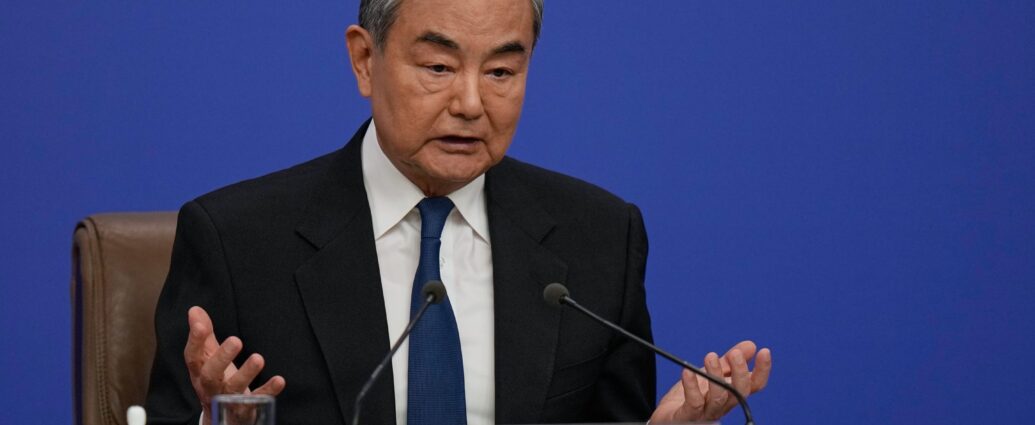
China steps forward into world leadership role on Iran war, crisis as America looks on with disinterest
China is stepping up its diplomacy on the Iran war, putting forward a five-point proposal with Pakistan, rallying support from Gulf countries and opposing a United Nations proposal to use any force necessary to open the Strait of Hormuz.
It is China’s latest push for a more prominent role in global affairs, though it may prove to be more rhetorical than substantive, with the U.S. appearing uninterested in Beijing’s efforts.
“The war with Iran is the priority of all countries in and outside the region,” said Sun Yun, director of the China program at the Stimson Center, a Washington-based think tank. “It is an opportunity China will not miss to demonstrate its leadership and diplomatic initiative.”
Danny Russel, a former senior U.S. diplomat, described China’s diplomacy as “performative” and compared the five-point proposal for ending the Iran war with its 12-point plan for Ukraine in 2023, which was “filled with platitudes but never acted on.”
“Its narrative is that while Washington is reckless, aggressive and heedless of the cost to others, China is a principled and responsible champion of peace,” said Russel, a distinguished fellow at the Asia Society Policy Institute. “What we are seeing from China is messaging, not mediation.”
China has been working “tirelessly for peace” since the outbreak of the war, said Liu Pengyu, spokesperson for the Chinese Embassy in Washington.
How the US views China’s diplomacy
The Trump administration appears to have little enthusiasm for the prospect of China’s mediation, according to U.S. officials.
The U.S. has soured on third-party mediation efforts, and it has little interest in boosting China’s international stature or giving it an opening to claim success in the Middle East, said three U.S. officials, who spoke on condition of anonymity because they were not authorized to publicly discuss potential diplomatic options.
One of the officials described the administration’s position on the Chinese-Pakistani effort as “agnostic,” neither endorsement nor rejection, but all three stressed that could change if President Donald Trump weighs in before his planned summit with Chinese President Xi Jinping.
For Beijing, there could be an incentive to see the war subside before Trump travels to China in mid-May. Citing demands of the war, Trump postponed the trip initially set for the end of March.
“There is no guarantee that Trump may not delay the trip to China again if the war rages on,” Sun said.
The war saw a major escalation Friday when Iran shot down two U.S. military aircraft, a first since the war began five weeks ago. Trump told NBC News that it would not impact negotiations with Iran, just days after declaring in a national address that the U.S. has “beaten and completely decimated Iran.”
Beijing is calculating the pain from the closure of the Strait of Hormuz
For now, China is more insulated from the disruption in the Strait of Hormuz than other countries after diversifying its energy sources and reducing dependence on fossil fuels.
China relies on Iran for only about 13% of its oil imports, and Beijing is working with Tehran to allow the passage of Chinese-flagged vessels through the critical waterway, where Iran’s stranglehold has sent energy prices soaring. China also maintains a large strategic petroleum reserve.
While China has positioned itself to cushion short-term shocks, analysts say Beijing is worried about a protracted war and has an interest in trying to bring it to an end.
“An escalation of the conflict will start to harm Chinese interests,” Russel said. “Because China’s growth model is so export-heavy, prolonged energy shocks and shipping disruption will mean costlier inputs and weaker global demand that damage its vulnerable economy.”
Besides not wanting to see a long war, China “welcomes the opportunity to suggest that it is helping mitigate a crisis of America’s making, especially as the Trump administration’s lack of a considered strategy for containing the fallout becomes more apparent,” said Ali Wyne, a senior research and advocacy adviser on U.S.-China relations at the International Crisis Group.
China has undertaken a flurry of diplomacy
After the war began, Chinese Foreign Minister Wang Yi spoke with counterparts from Russia, Oman, Iran, France, Israel, Saudi Arabia and the United Arab Emirates. He told Iran that China cherished its friendship, urged Israel to cease military actions and expressed that China would be willing to play a role in seeking peace.
This past week, Wang hosted his Pakistani counterpart in Beijing to hash out their five-point proposal, calling for an end to hostilities and the reopening of the strait.
He has held more than 20 phone calls with regional foreign ministers, and a special envoy has visited several countries in the region, aiming to promote peace and deescalate tensions, Liu said.
Wang sought support for China’s plan from the European Union’s foreign policy chief Kaja Kallas, telling her it represented “broad, international consensus,” the Chinese foreign ministry said. Wang told Saudi Foreign Minister Prince Faisal bin Farhan that halting the fighting was the most urgent matter.
Wang also spoke this week with Bahrain’s foreign minister, Abdullatif bin Rashid Al Zayani, to explain why China opposed Bahrain’s U.N. proposal to allow military force to open the Strait of Hormuz. Wang said actions by the U.N. Security Council should help ease tensions “rather than endorse illegal acts of war, still less add fuel to the fire.”
China and Russia argued that the U.S. or other countries could exploit a U.N.-backed mechanism to escalate the deadly war, according to a U.N. diplomat, who spoke on the condition of anonymity to discuss diplomatic conversations.
Both countries appear to have less immediate need to see the strait fully open. While China has been able to pay to get some of its ships through, Russia is benefiting from the high price of oil, its main export.
Hoping to avoid a veto, Bahrain significantly watered down its proposal to authorize defensive — but not offensive — action to ensure vessels can safely transit the strait. A vote was pushed back until next week.
To solve the problem of the strait, China says a ceasefire is needed. But its plan with Pakistan has been met with mostly silence from the U.S.
One of the U.S. officials said the plan is difficult to assess because it is less of a roadmap to peace than a vague appeal for respect for international law and the importance of diplomacy and the U.N.’s role.
___
Amiri reported from the United Nations.
This story was originally featured on Fortune.com
Former US air force master sergeant pleads guilty to defrauding military out of $37m
Alan Hayward James, who called himself ‘Al Capone’, admitted to rigging bids for IT contracts with Pentagon
A former US air force master sergeant who nicknamed himself “Al Capone” has pleaded guilty to defrauding the military branch out of $37m by inflating the cost of IT contracts – and giving some of the extra money to an individual he called “Godfather”.
Alan Hayward James, from Texas, ran a nine-year scam, beginning in April 2016, which also saw him funnel excess funds to himself, his family and his co-conspirators.
This post was originally published here
Why US and Russia are backing Viktor Orbán in Hungary election
As voters head to polls, Washington support and alleged interference from Moscow raise questions about influence
The official announcement that JD Vance was to visit, days before Hungarians cast their ballots in a hotly contested election, was greeted by Budapest with no less than four exclamation marks and three emojis.
“!!Official!!” Viktor Orbán’s political director, Balázs Orbán, wrote on social media as he confirmed the news. The White House said Vance, along with his wife Usha, will land in Hungary on Tuesday, in what is widely seen as an attempt to bolster Orbán as he trails in the polls.
This post was originally published here
Second suspect arrested in Brooklyn stray-bullet killing of seven-month-old baby
Matthew Rodriguez, 18, was apprehended in Pennsylvania in connection to shooting that killed Kaori Patterson-Moore
A second suspect in the stray-bullet killing of a seven-month-old baby on a Brooklyn street was arrested on Friday, investigators said, two days after a shooting the New York police department (NYPD) commissioner called “a tragedy that truly shocks the conscience”.
Matthew Rodriguez, 18, was apprehended in Pennsylvania by NYPD detectives working with US marshals, according to authorities.
This post was originally published here










The World Cup is supposed to be an economic windfall. But ‘you’re seeing a number of headwinds’ now
When FIFA awarded the 2026 World Cup to North America, the pitch was irresistible.
The U.S. was set to benefit from its broad offering of existing football mega-stadiums that could be adapted for soccer, a growing domestic fan base, and a new format that expanded the tournament to 48 teams from 32. That combination was meant to make it the biggest and most lucrative World Cup in the worldwide soccer governing body’s history.
A study by FIFA and the World Trade Organization published last year predicted the 39-day event would bring in 6.5 million fans and yield an overall $30.5 billion economic impact in the U.S. alone for just $11.1 billion in expenditures. A year ago, the tourism outlook also looked “promising,” according to the report.
“The influx of visitors will likely generate billions of dollars in economic activity, benefiting the hospitality, transportation, and retail sectors. Host city hotels anticipate record occupancy, and local businesses will benefit from increased visitor traffic,” the report read.
But with the tournament just over two months away, geopolitical shocks and immigration obstacles in the U.S. are threatening to discourage international visitors and potentially dim the World Cup’s initially rosy ambitions.
“You’re seeing a number of headwinds coming to what many thought was going to be a crowning and incredibly successful event,” said Mark Conrad, a professor of law and ethics at Fordham University’s business school and director of its sports business concentration.
Attendance is now at risk, he told Fortune. More than a month after the U.S. attacked Iran, Brent crude prices have held above the psychological threshold of $100 per barrel for just over a week and were sitting at $109 per barrel as of Friday afternoon. As Iran blocks the Strait of Hormuz, through which a fifth of all global oil flows, the U.S. and other countries are starting to panic.
Gas in the U.S. hit an average of over $4 per gallon this week for the first time since 2022, potentially meaning fewer people will drive to nearby states to attend a game. The price of plane tickets is also increasing as jet fuel, which makes up more than 40% of airlines’ operating costs, has nearly doubled over the past several weeks. The average cost has shot up 148% for an intercontinental flight to $414 by the middle of March from $167 in late February, according to an analysis by Deutsche Bank.
Other issues, may factor in. Even before the war in Iran, 150,000 people in the Netherlands signed a petition in January calling for the Dutch national team to boycott the games over “aggressive U.S. military intervention,” as President Donald Trump threatened to take over Greenland, which is a semi-autonomous territory of Denmark.
Obstacles for tourists
All this turmoil spells trouble for the single biggest sporting event on the planet, according to Conrad. There will be 104 matches total, most of which will take place in the U.S. across 11 cities. Matches will also be played in five cities across Canada and Mexico. Yet, international fans may have more trouble attending games in the U.S.
The Trump administration has made it difficult or inconvenient for foreigners to visit the U.S. Some of these policies include a sweeping travel ban that would prevent fans from qualifying teams such as Iran, Haiti, and the Democratic Republic of the Congo from attending games in the U.S. All three teams have games scheduled in the U.S.
Even travelers who aren’t banned still face other hurdles. As part of Trump’s One Big Beautiful Bill Act, the price of the Electronic System for Travel Authorization (ESTA) doubled to $40 from $21 for many European visitors. Europe has 16 teams in the tournament. The base price of non-immigrant visas, such as tourist visas, for citizens of countries not eligible for ESTA rose to $185 from $160 previously. And while it’s not yet being collected, a $250 “visa integrity fee” would bring the total price of tourist visas from countries like Mexico and Brazil to $435 per person.
In addition to the increased fees, visitors from other qualifying nations with games in the U.S., including Algeria, Cape Verde, Ivory Coast, and Senegal, must also pay a bond of either $5,000, $10,000, or $15,000, that will be decided at their visa interview.
That still leaves the issue of Iran’s participation. While Trump said last month Iran’s players should skip the World Cup “for their own life and safety,” FIFA President Gianni Infantino said this week Iran’s team would play in the tournament. It’s unclear whether he meant they will play in the U.S. as scheduled.
On top of the added costs, worries about Immigrations and Customs Enforcement (ICE), which has previously arrested tourists with valid visas, may make soccer fans not want to attend anyway, Conrad said.
“If I’m from a certain country, I may think twice to go through that, you know, to feel not welcome, if you will,” he said.
But despite all the anxiety, the short-term rental data tells a more optimistic story so far. Jamie Lane, the chief economist at AirDNA, a firm that tracks short-term rental bookings, says demand for this category of accommodation during the tournament dates between June and July is higher than it was last year during the same period across U.S. host cities.
“We expect in most markets to essentially not have enough in the short term rental inventory to house all the people that want to stay in short term rentals around the games,” he said.
In Boston, for example, occupancy for short term rentals during the group stage in June is already sitting at 47%, compared to 26% at the same point last year. Some property owners for Airbnbs near host stadiums have spiked their prices more than 100% in anticipation for World Cup games. Airbnb has also offered up to $750 to incentive first time home renters.
The increase in bookings may also not just be limited to host cities, but may trickle into surrounding areas. Lane said in the Buffalo-Niagara Falls area—an hour flight away from New Jersey where games will be played at Met Life Stadium—overall demand for June is up about 30% year over year, an abnormal spike which Lane said could be attributed to trips being planned by World Cup attendees while they are in the U.S.
“This doesn’t appear to be an increased demand just in these [host] cities,” Lane said. “It does appear that it’s going to drive overall stronger bookings this summer.”
To be sure, there is some evidence hotels aren’t seeing the boost they expected. The City reported late last month that hotel bookings in New York City for the dates of the World Cup were trending 2% below the same time last year when no major event was scheduled. The New York City comptroller also estimated in a report that even if the event met the high expectations set by FIFA of bringing in $3 billion in economic activity and 1.2 million visitors, the city may still lose money because of costs like policing, The City reported.
“The bookings have been softer than expected,” Sarah Bratko, the vice president and policy counsel for the American Hotels & Lodging Association, told the outlet.
While international visitors may not come to the U.S. in droves as previously expected, domestic tourism may pick up some of the slack, and the event has the potential to be successful anyway, said Conrad.
“I don’t think it will be a complete disaster by any means,” he said. But for tourists, “it’s not going to be as easy for a lot of reasons.”
This story was originally featured on Fortune.com

Watches like this $455,000 timepiece can’t be made by a machine—and that’s exactly why they’re the ultimate flex amid the analog revival
Kevin Koenig, a Connecticut-based yacht consultant, was recently helping a prospective client buy his first boat. Koenig nurtures a 278,000-strong Instagram community under the handle @theyachtfella. The Yacht Fella is also a Watch Fella, and he and his client got to talking, as horology nerds do, about their metal. “I asked him what his ‘daily’ is,” Koenig recalls.
To his yacht-aspiring wrist, the buyer buckles a Rolex Oyster Perpetual Explorer II, a watch designed to commemorate Sir Edmund Hillary’s 1953 summit of Everest. Turns out Koenig’s daily is also a Rolex Explorer II, though his model is the Polar, whose avalanche-white face is coveted by collectors. Regardless: Twinsies! Said Koenig to his fellow explorer, “I knew I liked you.”
Neither Koenig nor his buyer has plans to trek to Everest or, per Rolex, “into the unknown, where the boundary between night and day is blurred.” But the Explorer II binds the men in a common narrative—that if they wanted to, their timepiece would have a glow-in-the-dark Chromalight display to aid their perilous ascent.
That feature is what’s known in horology as a “complication.” The term encompasses everything from second hands to details that follow the positions of planets; it can be as straightforward as a GMT (Greenwich Mean Time) hand that tracks an alternate time zone or as intricate as a tourbillon, a byzantine mechanism that counteracts the effect of gravity on timekeeping.
Unlike in most relationships, complications in the timepiece world are highly desired. They hint that the wearer has stories to tell, that they’re the type who needs to know the exact time in Berlin while they’re lingering over omakase in Vancouver. They also signal a connoisseur’s appreciation for the kind of exacting craftsmanship that only a human can execute.

Collectors covet these pieces, explains Yoni Ben-Yehuda, head of watches for luxury retailer Material Good, because “similar to the handmade stitches on a Birkin bag, machines simply cannot do these complications”—a comforting notion and powerful value proposition as we cruise, driverless, toward an AI-slopped horizon.
Material Good runs four Audemars Piguet joint-venture boutiques in the U.S. and a forthcoming Vacheron Constantin shop in Aspen. These venerable Swiss houses represent peak legacy watchmaking, and their most expensive and rarest pieces tend to be deliciously complicated. (Vacheron Constantin’s Solaria Ultra Grande Complication La Première, rolled out last year, incorporates a mind-bending 41 features.) Compared with their tourbillons and minute repeaters, a seconds-counting hand is peasant fare. “A complication, the way it is used in our nomenclature, is a watch that is complex,” Ben-Yehuda says.
A complication needn’t be that intricate to add value. Colored a prominent tangerine, the additional hour hand on the Explorer II pops against the black or white face and points to a 24-hour bezel. It provides a clearer way to keep time in extreme environments, but Koenig, who’s on the road 120 days a year, finds utility for it as a reminder of his home base. By rotating the bezel to local time in London, say, or Dubai, he can make sure the orange hand follows the local zone, while the primary hand remains on Greenwich (Connecticut) time.
“No one needs these timepieces. Our phones will keep more accurate time. This is about beauty, emotional connection, the transmission of community.”
Yoni Ben-Yehuda, head of watches, Material Good
But that’s also kind of a 101 complication. According to Ben-Yehuda, the industry threshold for intricacy is the perpetual calendar, a constellation of sub-dials tracking day, month, year (even leap years) and sometimes moon phase. “If civilization shut down the way we know it, those perpetual calendars, which keep accurate time for 104 years without any use of computing, would become one of the most important instruments on earth. They connect us to the cosmos,” he philosophizes, “to something bigger than us.”
Watches are time-telling instruments, but more important, storytelling instruments. “No one needs these timepieces,” says Ben-Yehuda. “Our phones will keep more accurate time. This is much more about beauty, emotional connection, the transmission of community.” And the nichier the complication—from the regatta timer (a bidirectional rotating bezel) of the Rolex Yacht-Master for sailboat racers to the planetary orbit positioner on the star-sprayed dial of Van Cleef & Arpels’s seductive Midnight Planétarium—and the greater number of them on a given piece, the more Shakespearean the tale the watch tells.

Jaeger-LeCoultre’s 2025 Reverso Tribute Geographic might announce itself as a svelte Art Deco companion whose reversible face reveals a world clock for a gentleman-athlete to keep time across the British Empire. Vanguart’s spellbinding Black Hole Tourbillon, with its time-winding joystick and virtuosic levitating tourbillon, might entreat collectors: Peer into my vortex of descending graduated discs, a mysterious galaxy of 755 pieces, where only the true masters of the universe govern time and space.
It’s these complex watches that get collectors in the $60 billion luxury watch market hot and bothered. At Sotheby’s, the December Fine Watches auction brought in $42.8 million, and included a Patek Philippe with a cloisonné world-time complication and fittingly envy-green alligator strap. “Niche areas of [watch-collecting] have grown in popularity,” timepiece journalist Caleb Anderson wrote for Sotheby’s, “with collectors and enthusiasts being drawn to objects that serve as artistic and horological showcases both of themselves and of their wearers.”
Put more plainly by Ben-Yehuda, “Super-collectors look for those design cues to delineate between good and great watchmaking. That is one of the reasons one watch costs $15,000 and a watch with the same quote-unquote complication costs $50,000.”
“And people that know watches know what you spent on that complication,” Koenig says, summarizing this society’s joystick-measuring tendencies. “Watch culture is, for better or worse, a flex culture.” Horological equals, he and his yacht-seeking Explorer II buddy closed the deal.
Luxury timepieces
Five watches worth a complicated relationship
1. Rolex Explorer II
From $10,600
Are you afraid of the dark? Not with this Rollie, whose abyss-black or snow-white dial hosts three hands and hour markers that, like a bioluminescent deep-sea creature, emit a blue glow in the absence of light.
2. Jaeger-LeCoultre 2025 Reverso Tribute Geographic
From $22,800
Never be late for a regatta in Rio or cocktails in Karachi, two global destinations on the 24-hour world clock and map hiding on the rear face of Jaeger-LeCoultre’s slim Reverso Geographic, available in stainless steel or 18-karat pink gold.
3. Audemars Piguet Royal Oak Perpetual Calendar Champagne Dial
$125,000
The yellow gold and chunky silhouette would look good on Tony Soprano, but the perpetual calendar—including a dreamy moon-phase complication—in the octagonal Champagne dial of AP’s 1972 design gives it a more-than-meets-the-eye intellectual quality.
4. Daniel Roth Rose Gold Tourbillon
$212,000
A pioneer in the independent watchmaking world in the 1980s and ’90s, this Swiss maison (and its signature double-ellipse dial) now lives on as part of Louis Vuitton’s Fabrique du Temps, which just debuted a pair of individually numbered knockouts. The tourbillon version encases an appealing tension between the 270-piece complication’s visceral architecture and Roth’s flair for aristocratic typefaces and theatrical curves.
5. Vanguart Black Hole Tourbillon
From $455,000
With concentric hour, minute, and tenths-of-a-minute discs surrounding a hypnotic levitating tourbillon, the futuristic Black Hole evokes the contraption that frees the baddies at the climax of the movie Thirteen Ghosts. Available in titanium or rose gold and with Arabic numerals.
This article appears in the April/May 2026 issue of Fortune with the headline “Taking time to tell stories: Why ‘complex’ is the new flex for watch fans.”
This story was originally featured on Fortune.com

3 reasons OpenAI buying daily tech show TBPN for hundreds of millions isn’t totally crazy
This essay appeared in the April 4, 2026 edition of the Fortune 500 Digest newsletter, which rounds up the headlines driving the week’s most important business news and coverage of Fortune 500 companies. Subscribe to receive it in your inbox every Saturday morning.
One of the keys to startup success is knowing when to sell.
John Coogan and Jordi Hays, the two young founders of TBPN, a daily tech show that streams on YouTube and X, perfectly timed their exit this week, selling to OpenAI for a price in the “low hundreds of millions,” according to the FT.
The initial reaction from the industry was, “What the?!” Even inside OpenAI, some employees reportedly thought it was an April Fools’ joke. But TBPN, which stands for Technology Business Programming Network, could theoretically help OpenAI in a couple of ways.
First, it gives OpenAI access to distribution for its own marketing and communications at scale. For over a year, the company has seriously struggled with its public image, and TBPN could help—though the founders say there’s a clause in the deal terms that will allow them to maintain editorial integrity. It’s also possible that this was an acqui-hire, and that the hosts of TBPN could fill a communications and marketing void going forward for the AI giant. The chief communications officer role at OpenAI has remained vacant since Hannah Wong departed earlier this year. The TBPN acquisition was internally championed by Fidji Simo, OpenAI’s CEO of applications, who has been overseeing its communications department. (Simo announced Friday that she’d be taking a planned medical leave for several weeks.)
AI in general has a bit of a PR problem in the United States. Optimism about the technology is considerably lower in the U.S. than in China, which some worry could prevent the United States from winning the global AI race. A more AI-positive show like TBPN could help change the broader narrative.
Finally, live video programming is arguably one of the most defensible and trustworthy forms of media in an AI-generated content world. As AI gets ever better at video and audio creation, how will anyone know what’s true and made by a human—or what’s fabricated by AI? A live broadcast can clear up a lot of those gray areas.
So, is the acquisition a smart move? For TBPN, absolutely. The founders appear to be selling their 1.5-year-old startup at a huge multiple to what they are generating—the show did roughly $5 million in revenue in 2025, and was targeting around $30 million this year. We will likely look back on this exit for creators as a parallel to the Huffington Post–AOL acquisition moment, when HuffPo’s $315 million sale convinced investors that digital media could be much more than boxer-clad bloggers in their parent’s basements.
This story was originally featured on Fortune.com

U.S. military continues frantic search for missing F-15 airman shot down over Iran, while Tehran calls on public to find ‘enemy pilot’
The U.S. military pressed ahead Saturday in a frantic search for a missing pilot over a remote area in southwestern Iran, after the Middle Eastern country shot down an American warplane and called on people to turn the pilot in, promising a reward.
The plane, identified by Iran as a U.S. F-15E Strike Eagle, was one of two attacked on Friday, with one service member rescued and at least one missing. It was the first time the United States lost aircraft in Iranian territory during the war, now in its sixth week, and could mark a new turning point in the campaign.
The conflict, launched by the U.S. and Israel on Feb. 28, has rippled across the region. It has so far killed thousands, upended global markets, cut off key shipping routes, spiked fuel prices and shows no signs of slowing as Iran responds to U.S. and Israeli airstrikes with attacks across the region.
The downing of the military planes came just two days after President Donald Trump said in a national address that the U.S. has “beaten and completely decimated Iran” and was “going to finish the job, and we’re going to finish it very fast.” The U.S. and Israel had boasted recently that Iran’s air defenses were decimated.
Missile and drone strikes continued Saturday with an apparent Iranian drone damaging the headquarters of the U.S. technology giant Oracle in Dubai. Israel’s military said Iran had launched missiles toward the country.
Meanwhile, the Atomic Energy Organization of Iran said on social media that an airstrike hit near its Bushehr nuclear facility, killing a security guard and damaging a support building. It is the fourth time the facility has been targeted during the war.
Also Saturday, Iran’s top diplomat reiterated his government’s willingness to join talks aimed at stopping the war. Foreign Minister Abbas Araghchi said they “have never refused to go to Islamabad.” Pakistan said last week that it would soon host talks between the U.S. and Iran, but it’s not clear when or if they will take place.
Two U.S. planes attacked
Saturday’s search for the pilot focused on a mountainous region in the country’s southwestern province of Kohgiluyeh and Boyer-Ahmad.
Neither the White House nor the Pentagon released public information about the downed planes.
In an email from the Pentagon obtained by The Associated Press, meanwhile, the military said it received notification of “an aircraft being shot down” in the Middle East, without providing more details.
A U.S. crew member from that plane was rescued. But the Pentagon also notified the House Armed Services Committee that the status of a second service member on the fighter jet was not known. A U.S. military search-and-rescue operation continued Saturday.
In a brief telephone interview with NBC News, Trump declined to discuss the search-and-rescue efforts but said what happened would not affect negotiations with Iran.
Separately, Iranian state media said a U.S. A-10 attack aircraft crashed in the Persian Gulf after being struck by Iranian defense forces.
A U.S. official who spoke on condition of anonymity to discuss a sensitive military situation said it was not clear if the aircraft crashed or was shot down or whether Iran was involved. Neither the status of the crew nor exactly where it went down was immediately known.
An anchor on a TV channel affiliated with Iranian state television urged residents to hand over any “enemy pilot” to the police.
Throughout the war, Iran has made a series of claims about shooting down piloted enemy aircraft that turned out not to be true. Friday was the first time the Iranian public was urged to look for a downed pilot.
Iranian state media said in a post on the social platform X its military shot down a U.S. F-15E Strike Eagle. The aircraft is a variation of the Air Force fighter jet that carries a pilot and a weapons system officer.
Tech giant Oracle hit in Dubai following Iranian threats
An apparent Iranian drone damaged the Dubai headquarters of Oracle on Saturday after Iran’s paramilitary Revolutionary Guard threatened the firm.
The attack targeted the headquarters, which sits along Dubai’s main Sheikh Zayed Road highway. Footage verified by The Associated Press outside the United Arab Emirates showed damage to the building. A large hole could be seen in the building’s southwestern corner, with the “e” in “Oracle” on a neon sign damaged.
The sheikhdom’s Dubai Media Office, which speaks for its government, said a “minor incident caused by debris from an aerial interception that fell on the facade of the Oracle building in Dubai Internet City,” adding there were no injuries.
Oracle, based in Austin, Texas, did not immediately respond to a request for comment.
The Guard has accused some of America’s largest tech companies of being involved in “terrorist espionage” operations against the Islamic Republic and said they were legitimate targets.
Earlier Iranian drone strikes hit Amazon Web Services facilities in both the UAE and Bahrain.
Iran keeps a chokehold on the Strait of Hormuz and issues a veiled threat to disrupt a second waterway
In a social media post late Friday, Mohammad Bagher Qalibaf, Iran’s parliament speaker, issued a veiled threat to disrupt traffic through the Bab-el-Mandeb, a second strategic waterway. The strait, 32 kilometers (20 miles) wide, links the Red Sea with the Gulf of Aden and the Indian Ocean. It is one of the busiest choke-points in global trade, with more than a tenth of seaborne global oil and a quarter of container ships passing through it.
“What share of global oil, LNG, wheat, rice, and fertilizer shipments transits the Bab-el-Mandeb Strait?” Qalibaf wrote. “Which countries and companies account for the highest transit volumes through the strait?”
Iran has already greatly disturbed the flow of oil through the Strait of Hormuz, sending fuel prices skyrocketing and jolting the world economy. World leaders are struggling to end Iran’s stranglehold on the strait as the U.N. Security Council is expected to take up the matter Saturday.
Trump has vacillated on America’s role in the strait, alternately threatening Iran if it does not open the strait and telling other nations to “go get your own oil.” On Friday, he said in a post on social media: “With a little more time, we can easily OPEN THE HORMUZ STRAIT, TAKE THE OIL, & MAKE A FORTUNE.”
More than 1,900 people have been killed in Iran since the war began. In a review released Friday, the Armed Conflict Location and Event Data, a U.S.-based group, said it found that civilian casualties were clustered around strikes on security and state-linked sites “rather than indiscriminate bombardment” of urban areas.
In Gulf Arab states and the occupied West Bank, more than two dozen people have died, while 19 have been reported dead in Israel and 13 U.S. service members have been killed. In Lebanon, over 1,300 people have been killed and more than 1 million displaced. Ten Israeli soldiers have also died there.
This story was originally featured on Fortune.com

In this buyer’s market, one home seller took an offer $10,000 below asking price, covered $5,000 in closing costs, and paid for $12,000 in repairs
The economic fallout from the war with Iran is driving up the cost of buying a home, even as other housing market trends in many parts of the country favor home shoppers this spring.
Mortgage rates have been rising since the war began, as surging energy prices heighten worries about higher inflation, pushing up the yield on U.S. 10-year Treasury bonds, which lenders use as a guide to pricing home loans.
As recently as the last week of February, the average rate on a 30-year mortgage dropped to just under 6%, its lowest level in more than three and a half years. It climbed this week to 6.46%, its highest level in nearly seven months.
The conflict is also injecting more uncertainty into the U.S. economic outlook at a time when the job market is sputtering.
While rates are still down from a year ago, their recent upward trend has already led to a slowdown in mortgage applications. Further increases threaten to put a damper on home sales during what’s traditionally the busiest time of the year for the housing market.
“The war in Iran has seriously complicated the spring buying season,” said Joel Berner, senior economist at Realtor.com. “I expect that many buyers will be put off by rising rates and mounting economic uncertainty, choosing to bide their time rather than jumping on board for a purchase before rates go up.”
Home shoppers who can afford to buy at current mortgage rates this spring are likely to find a more buyer-friendly housing market than this time last year. That means they’ll have more leverage when negotiating with sellers, who in many cases are watching their property go unsold for weeks, potentially making them more willing to lower their initial asking price or offer buyers money for closing costs, repairs or other concessions in order to get a deal done, real estate agents say.
In the Dallas-Fort Worth metro area, lower listing prices and more homes on the market are forcing many sellers to price their home more competitively or consider offering some incentives to land a buyer, said Matthew Crites, an agent with Coldwell Banker Realty.
“It’s been a really good buyer’s market to kind of start the year off with,” he said.
The trends helped give home shopper Anne King a strong hand when she set her sights on a three-bedroom, two-bath ranch-style house in Fort Worth listed at $275,000.
The contract administrator offered $10,000 below the listing price. She also asked that the seller kick in $5,000 toward closing costs. The seller accepted, and later agreed to throw in another $12,000 for repairs after a home inspection revealed roof damage.
“Fortunately for me, the seller was in a position they needed to sell,” said King, 57. The purchase was finalized in late February, just before the start of the conflict in the Middle East.
King had hoped mortgage rates would ease further before she bought the home, but decided it made sense to buy sooner, rather than risk having to compete this spring against more homebuyers who could potentially trigger a bidding war — something she experienced last May when she bought a two-bedroom, two-bath townhouse in Arlington, Texas.
She locked in a 6% rate on her mortgage and plans to refinance to a lower rate whenever rates drop.
“I feel like I got a good deal on this property, and that’s all that matters,” she said.
Home shoppers gain more leverage
While the inventory of homes for sale nationally is still low by historical standards, active listings — a tally that encompasses all homes on the market except those pending a finalized sale — jumped nearly 8% in February from a year earlier, according to data from Realtor.com.
The increase varies across the U.S., with the West, Midwest and South far outpacing the Northeast. Still, some 43 of the 50 largest metro areas had more homes for sale in February than a year earlier, with listings up between 10% and 38.5% in many markets, including Seattle, Indianapolis, Las Vegas and Houston and Denver.
As homes take longer to sell, prices have started falling. The median listing price was down in February from a year earlier in just over half of the nation’s biggest 50 metro areas, including a nearly 9% drop in Austin and Memphis, and declines of more than 5% in Washington D.C., San Diego and Los Angeles.
In another sign that buyers may have the edge negotiating with sellers this spring, an analysis by Redfin estimates that there were about 46% more sellers than prospective buyers in the market nationally in February. That’s up from about 30% a year earlier and represents the largest gap between buyers and sellers on records going back to 2013, according to Redfin.
Miami, Nashville and Austin are among the metro areas where sellers most outnumber buyers, Redfin found.
A buyer’s market, if you can afford it
The U.S. housing market has been in a sales slump since 2022, when mortgage rates began to climb from pandemic-era lows. Sales of previously occupied U.S. homes were essentially flat last year, stuck at a 30-year low. They have remained sluggish so far this year, declining in January and February versus a year earlier.
While the pace of home price growth has slowed or fallen in many metro areas, affordability hurdles remain daunting for many aspiring homebuyers because wage growth has not kept up with home prices.
Consider, the median price of an existing home sold in February was $398,000, according to the National Association of Realtors. That’s nearly five times the median household income. A historic rule of thumb was that homes generally cost three times the household income.
The recent increase in mortgage rates adds slightly to the affordability challenge. On a $400,000 home near downtown Dallas, for example, factoring in a 20% down payment and a 30-year mortgage at 6%, the buyer’s monthly payment would be about $2,248. At a 6.4% rate, that payment would climb to $2,331.
And while mortgage rates are still lower than a year ago, making monthly payments more manageable, rates are still much higher than the sub-3% averages available to homebuyers during most of 2020 and 2021 as the weakened economy dealt with the coronavirus pandemic and its aftermath.
Sellers under pressure
The housing market has cooled considerably since earlier this decade, when rock-bottom mortgage rates set off a frenzy that sent home prices soaring. Back then, it wasn’t uncommon for a home to fetch well above the seller’s asking price after receiving offers from multiple buyers.
While some sellers are still receiving multiple offers now, it’s far from the norm.
Jo Chavez, a Redfin agent in Kansas City, tells clients looking to sell to expect that their home probably won’t sell right away. She also advises them to be “reasonable” with how they price their home.
“We have a lot of sellers who have that idea of like, ‘well, my neighbors sold for this much, and so I think I should price $10,000 above them,’” said Chavez. “And that’s obviously not a logical approach, because there were less sales last year.”
Kansas City is among the few metro areas where the median listing price isn’t falling. It rose 4.1% in February from a year earlier, according to Realtor.com. However, the number of homes on the market soared by nearly 20%.
Gail Sanders and her husband, David, put their four-bedroom, three-bath home in Olathe, Kansas, on the market in late February. But even after hosting a couple of open houses, and after lowering their asking price from $535,000 to $525,000, the couple had yet to receive any offers as March drew to a close.
The couple wants to sell the house and buy a home in another Kansas City suburb closer to their three adult children and grandchildren. But until they find a buyer, those plans are on hold.
“We just didn’t think it was fair to somebody else to put a contingent offer on (another house), but then also lock ourselves into something when we weren’t sure how fast ours was going to move,” said Gail Sanders, a senior claims director. “I don’t want to be stuck with two house mortgages on the off chance.”
This story was originally featured on Fortune.com
Basic business class is here with new, stripped-down United Polaris fares
United is overhauling its fare classes, offering cheaper business class and premium economy fares that are more restrictive.
This post was originally published here
Trump warns Iran ’48 hours before all Hell will reign down,’ while search for missing crew member intensifies
The U.S. military continued to search for a missing American airman on Saturday after an F-15E fighter jet was shot down over southwestern Iran.
This post was originally published here
Parts of UK braced for heavy snow and gale-force winds as Storm Dave arrives
Storm expected to cause Easter weekend travel disruption, though warm weather could return next week
Storm Dave is expected to cause travel disruption this Easter weekend, with warnings for heavy snow and gale-force winds issued across northern parts of the UK, but a reprieve from the cold snap could be on the way, with temperatures forecast to reach the mid-20s next week.
The Met Office has issued a yellow severe weather warning in Scotland for heavy snow and blizzards causing some travel and power disruption. Up to 30 centimetres of snow could fall. An amber weather warning for wind has been issued for parts of northern England, Scotland and Wales on Saturday evening.
This post was originally published here
Melissa Gilbert defends husband Timothy Busfield as actor faces child sexual abuse charges
The former Little House on the Prairie star said husband was ‘last person in world who would hurt a child’
Melissa Gilbert has staunchly defended her husband and fellow actor Timothy Busfield in her first interview since New Mexico prosecutors charged him with child sexual abuse in early February.
In part of a conversation scheduled to be broadcast on Monday on Good Morning America but circulated in advance as a preview, Gilbert told ABC host George Stephanopoulos that she believed the Emmy winner whom she married in 2013 to be “the last person in the world who would hurt a child”.
This post was originally published here





















U.S.-Iran war ‘tax’ begins to hit American businesses and consumers
A U.S.-Iran war ‘tax’ is beginning to hit consumers as diesel and jet fuel prices rise and stress business profitability, and there is no relief in sight.
This post was originally published here
Nike is the most oversold stock on Wall Street after a wild week of trading
Nike issued Tuesday a weak sales forecast, sparking a sell-off of its shares.
This post was originally published here
These are Bank of America’s top picks for the second quarter after a tough start to 2026
The firm called out the stocks it sees outperforming over the next three months.
This post was originally published here














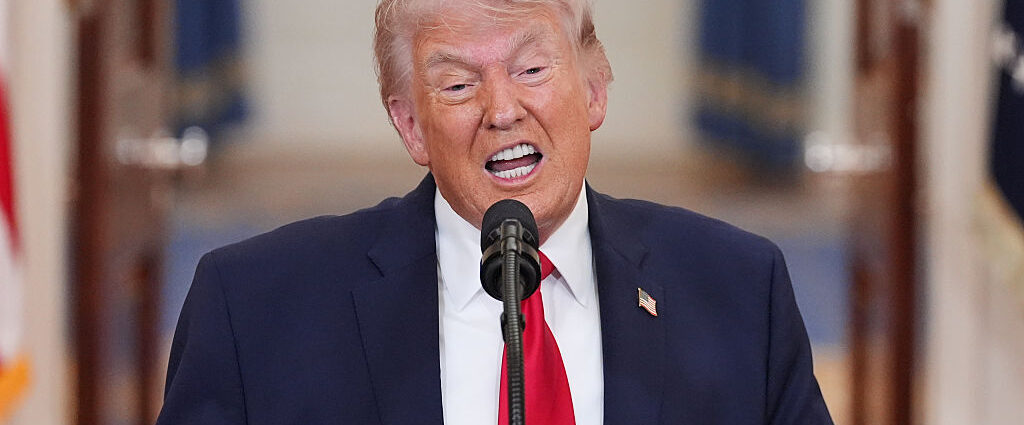













The AI gold rush is real — but great companies don’t need to mine it
Artificial intelligence now dominates the investment conversation. It is front and center in headlines, company narratives, and — most visibly — in capital flows. In 2025, AI and machine-learning deals accounted for nearly two-thirds of all U.S. venture capital dollars — up from roughly 10% a decade earlier.
That level of concentration reflects a real and powerful shift. AI represents a profound technological transformation, one likely to reshape productivity, cost structures, and competitive dynamics across the global economy. Many of the most compelling growth companies today are directly enabling — or benefiting from — this transition, and several may emerge as category-defining public companies of the next decade.
But the intensity of the market’s focus raises a more subtle question for investors: does a company need to be an AI company to be a great company?
Public markets offer a clear answer. Some of the strongest, most valuable companies in the world are explicitly not AI businesses. Their success is driven by durable competitive advantages, attractive unit economics, disciplined execution, and the ability to compound through cycles — not by proximity to a single technology narrative.
Private markets, however, do not always price this distinction cleanly. As attention concentrates around AI, valuation dispersion has widened. Perceived AI category leaders can raise multiple rounds in rapid succession, often at successively higher prices, reinforcing momentum and further concentrating capital.
At the same time, many high-quality non-AI businesses face a very different funding environment. Despite strong fundamentals and large addressable markets, they may attract less investor demand simply because they lack an explicit AI story.
For disciplined investors, this divergence creates both risk and opportunity.
The case is not to be skeptical of AI — quite the opposite. Investors should consider opportunities in derisked AI businesses where valuations align with long-term underwriting assumptions. Equal weight should be given to non-AI companies where fundamentals remain strong and market dynamics have become more favorable as capital concentrates elsewhere.
This pattern is familiar. Periods of technological transformation often coincide with capital over-concentration, valuation compression outside the favored theme, and eventual normalization. The lesson is not that transformative technologies fail to deliver value — it is that technology alone is never sufficient.
AI adoption is moving faster than any prior platform shift, and we remain early in the cycle. Some eventual category leaders may not yet exist, while others will face competition, commoditization, or changing economics over time.
In that environment, selectivity matters more than enthusiasm.
For long-term investors, the goal is not to build an “AI portfolio” or a “non-AI portfolio,” but to allocate capital where fundamentals, valuation, and durability intersect. That means leaning into AI where risk is appropriately priced — while recognizing that many of tomorrow’s great public companies will emerge from sectors and business models that attract far less attention today.
AI is reshaping the investment landscape. But seeing the full picture requires remembering that great companies have always been defined by more than a single technology wave.
The opinions expressed in Fortune.com commentary pieces are solely the views of their authors and do not necessarily reflect the opinions and beliefs of Fortune.
This story was originally featured on Fortune.com
My friends owe me money from 8 months ago—is it too late for me to ask? What etiquette experts say
Asking for money after a long layoff can feel uncomfortable, but etiquette pros say it’s not impolite to circle back with your friends who owe.
This post was originally published here
Buffett may end donations to Gates charity over Bill’s ties to Epstein
Revelations about Jeffrey Epstein’s ties to Bill Gates have strained his friendship with Warren Buffett and the Omaha billionaire’s annual multi-billion-dollar donations to the Gates Foundation.
This post was originally published here
Warsh nomination moves ahead, putting Trump’s competing Fed plans on a collision course
A Senate committee will consider Kevin Warsh’s nomination even as one of its members still plans to block it.
This post was originally published here
‘Unconstrained’ Trump seems to be on a quest to name most everything after himself
President has affixed his name to institutions and edifices, and his visage now glowers from several federal buildings
The US has a history of naming things after its presidents.
Washington DC has the Ronald Reagan airport, while John F Kennedy international airport is New York’s main air transport thoroughfare. The Hoover Dam straddles Nevada and Arizona; Theodore Roosevelt is one of several former presidents to have a Washington DC building named after them; Franklin Delano Roosevelt has an island; Abraham Lincoln has the Lincoln Memorial; and George Washington has the nation’s capital and an entire state.
This post was originally published here






Rocket Lab, Beyond Meat, Micron Technology And More: 5 Stocks Investors Couldn’t Stop Buzzing About This Week
Retail investors talked up five hot stocks this week (March 30 to April 2) on X and Reddit’s r/WallStreetBets, driven by retail hype, Iran war, earnings, AI buzz, and corporate news flow.
Tesla Inc. (NASDAQ:TSLA), Micron Technology Inc. (NASDAQ:MU), Rocket Lab Corp. (NASDAQ:RKLB), Nike Inc. (NYSE:NKE), and Beyond Meat Inc. (NASDAQ:BYND), spanning investing, crypto, streaming, semiconductors, social media, and gaming, reflected diverse investor interests.
Tesla
- TSLA reported the first quarter 2026 vehicle deliveries this week. It came in at 358,000 units, missing Wall Street expectations around 372,000. It was also down sequentially, despite a modest year-over-year rise and stronger China-made EV sales.
- Some retail investors mocked TSLA for the stock decline despite falling after missing delivery targets.

- The stock had a 52-week range of $214.25 to $498.83, trading around $360 to $361 per share, as of the publication of this article. It rose 27.53% over the year, fell by 17.30% and 19.82% over the last six months and year-to-date, respectively.
- TSLA had a weaker price trend in the short, medium, and long term, with a moderate growth ranking, as per Benzinga’s Edge Stock Rankings.
Micron Technology
- MU saw a volatile trading week as investor concerns over Google’s newly released TurboQuant AI algorithm, which could significantly compress memory requirements and potentially dampen long-term demand for high-bandwidth memory. However, analysts like Shawn Kim and Lennart Heim dismissed the market’s negative response, predicting that the technology will broaden AI adoption and fuel long-term demand. Consequently, they viewed the stock drop as a prime buying opportunity.
- Some retail investors were joking about the volatility that MU’s stock has witnessed this week.
This post was originally published here