Viral reviews of artisan cafes across the capital are sparking a debate over cost, culture – and who gets a slice of the city

The video that started it all was innocuous enough: a woman in her 20s posted on TikTok about how she spends a perfect weekend in north London. On her list were the bakeries Jolene and Gail’s, and the De Beauvoir Deli.

The reaction, however, was anything but. Many locals commented that they had never heard of the businesses she mentioned. One north Londoner, Moses Combe, 21, was equally incredulous. “If this is where all the north London girlies come in the morning, I’d be a bit surprised,” he said in a viral video.

Continue reading…

This post was originally published here

NPR’s Scott Simon reflects on the successful launch of NASA’s Artemis II this week. The four astronauts aboard will travel around the moon.

(Image credit: Chris O’Meara)

This post was originally published here

Benzinga examined the prospects for many investors’ favorite stocks over the last week — here’s a look at some of our top stories.

U.S. stocks snapped a five-week losing streak with a strong rebound, as shifting signals from President Donald Trump around a potential Iran ceasefire briefly lifted investor sentiment. The S&P 500 posted its best weekly performance in months, recovering from a prolonged selloff even as volatility remained elevated. Optimism around diplomatic progress initially pushed oil prices lower and fueled a sharp rally, but markets quickly turned choppy as mixed messaging on the conflict reintroduced uncertainty.

Energy markets remained the dominant force, with crude surging back above $110 per barrel and triggering unusual pricing dynamics. The spike — driven by ongoing disruptions in the Strait of Hormuz and strong domestic refining demand — reinforced concerns about persistent inflation and its impact on economic growth. Despite the rebound in equities, elevated oil prices continued to cap upside and keep investors cautious.

Sector performance reflected the uneven recovery, with consumer-focused names under pressure as the war’s economic effects began to filter through earnings. Investors are now balancing signs of technical recovery against ongoing risks from geopolitics, inflation and energy markets, suggesting volatility is likely to persist in the near term.

Benzinga provides daily reports on the stocks most popular with investors. Here are a few of this past week’s most bullish and bearish posts that are worth another look.

The Bulls

“EXCLUSIVE: Xanadu Jumps In Nasdaq Debut — Meet The Newest Quantum Stock,” by Erica Kollmann, reports that Xanadu Quantum Technologies Inc. (NASDAQ:XNDU) shares surged in their Nasdaq debut, jumping about 15% as investors cheered the company’s …

Full story available on Benzinga.com

This post was originally published here

Despite hostile rhetoric Trump let a Russian ship break his blockade – could it herald a Venezuela-style outcome?

When a sanctioned Russian oil tanker, the Anatoly Kolodkin, docked at Cuba’s Matanzas oil terminal on Tuesday, unloading 700,000 barrels of crude, it was not immediately clear why the ship had been allowed to pass through Donald Trump’s oil blockade.

In January, the US president had proclaimed on social media: “THERE WILL BE NO MORE OIL OR MONEY GOING TO CUBA – ZERO!” yet last week he told reporters, “If a country wants to send some oil into Cuba right now, I have no problem with it” – and waved the Russian ship through.

Continue reading…

This post was originally published here

As Israel expands its invasion of southern Lebanon, people are having to bury their dead in temporary graves

In Lebanon, the dead are usually given one last glimpse of their home town before they are laid to rest. Hoisted high above the heads of the living, their casket is slowly marched through the streets where they grew up.

It is the hands of their loved ones that guide them into their final resting place, already dug, and gently sprinkle dirt on their body.

Continue reading…

This post was originally published here
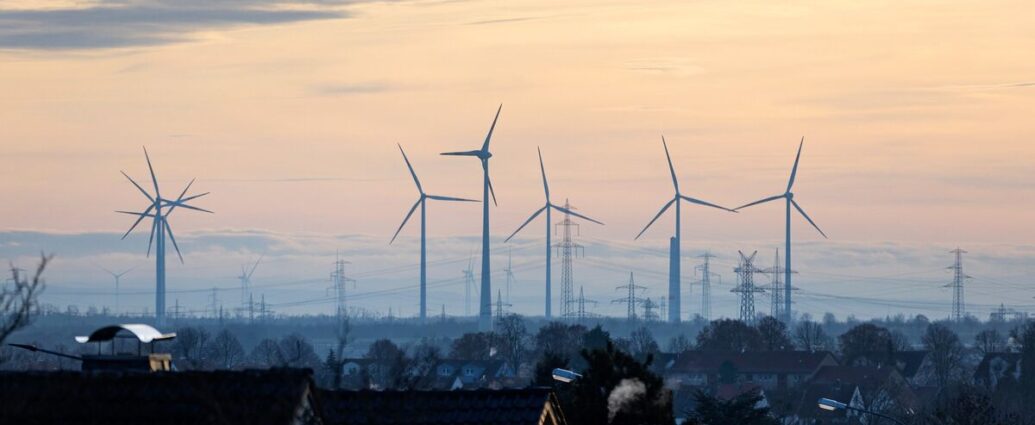
The rightwing populist has been in power for 16 years but a new generation of voters are preparing to vote for his opponent, polls suggest

As he rushed to finish off his cigarette before heading to class, Ákos, 20, confessed that he has more at stake than most as Hungarians prepare to head to the polls in the coming days.

“If things remain the same, or get even worse, I can’t see a future here,” said the aspiring teacher. “There are many people who want to try living elsewhere, and that’s totally fine, but I’m not one of them. For so long I’ve dreamed of working and teaching here.”

Continue reading…

This post was originally published here

Strain found in 29 states and Puerto Rico carries spike mutations, but no data shows increased severity

BA.3.2, an Omicron variant of Covid-19 with dozens of new spike mutations, has been detected in 29 US states and Puerto Rico, according to the Centers for Disease Control and Prevention, but experts say there is not yet evidence it is more severe than other recent variants.

“The right response to BA.3.2 is serious attention, not alarm,” says Dr Jake Scott, a Stanford professor and infectious disease expert who authored a systematic review of Covid vaccines for the New England Journal of Medicine.

Continue reading…

This post was originally published here

Crew members can now see the moon, which one described as ‘a beautiful sight’, from their spacecraft’s docking hatch

The Artemis II crew are now closer to the moon than the Earth, Nasa said on Saturday morning, as the four astronauts completed the third day of their flight to the moon.

“We can see the moon out of the docking hatch right now. It’s a beautiful sight,” said an unnamed member of the crew, which Nasa shared in a post on X.

Continue reading…

This post was originally published here

There’s a boom in the economy: economics papers on the souring prospects of the recent college graduate in the AI-era economy of the 2020s. Harvard economists Lawrence Katz and Claudia Goldin found in September 2025 that the college wage premium remains, but has barely moved since 2000, while the San Francisco Fed attributed that stagnation primarily to less demand for those workers, in a working paper shortly afterward. The World Economic Forum found earlier this year that AI skills now command a 23% wage premium versus only 8% for a bachelor’s degree in isolation. Dallas Fed economist J. Scott Davis may have made the biggest splash in February 2026 with a paper that found AI is simultaneously reducing entry-level hiring and raising wages for experienced workers in the same AI-exposed occupations.

But what about the college grads that intentionally got degrees in supposedly “AI-proof” disciplines, like psychology or education? 

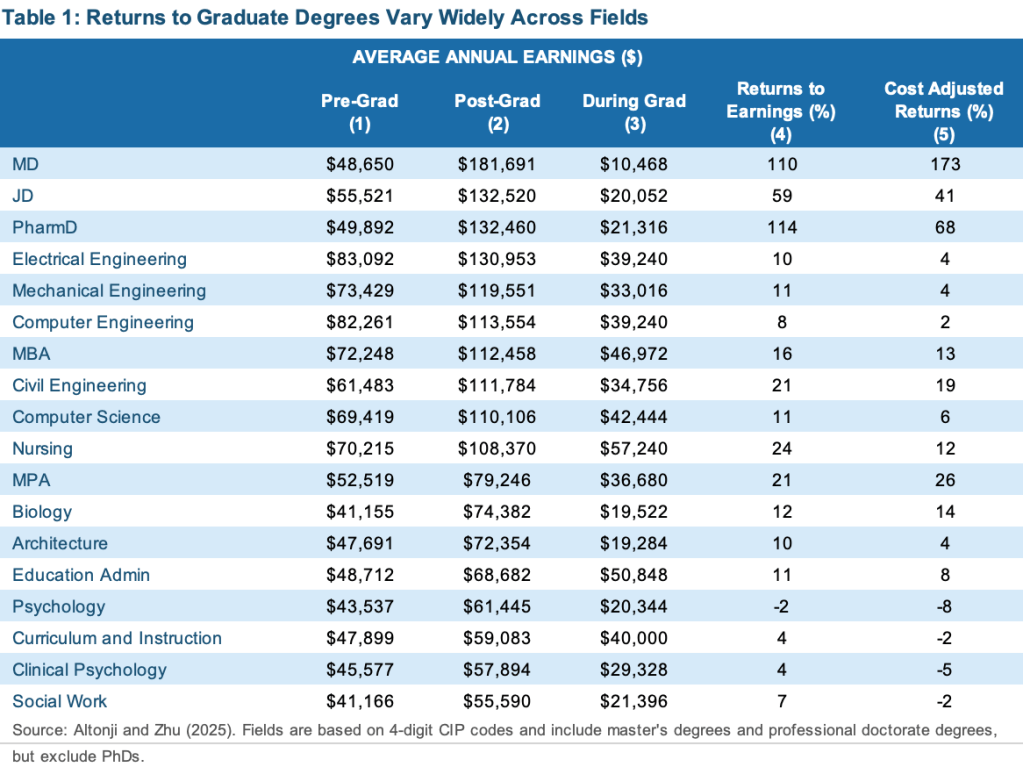
A new report released by the Postsecondary Education and Economic Research Center maps out the estimated payoff of a graduate degree. When factoring in the costs of a graduate degree—tuition and fees—some degree holders are actually coming out the other end with negative returns. The worst returns are for psychology graduate degrees, with a -8% cost-adjusted return, or the estimated change in lifetime income after accounting for the cost of attendance.

The report also found that clinical psychology—a specialized branch of psychology—offers -5% cost-adjusted returns. Social work and curriculum and instruction degrees also offer negative returns, according to the study. Other popular degrees, such as computer science, yield only a 6% return after adjusting for costs.

“If you’re thinking about graduate school, you want to get some information about what the earnings potential is coming out of the degree as well as the kinds of occupations and jobs it leads to,” Joseph G. Altonji, a professor of economics at Yale and co-author of the study, told Fortune.

Over the years, more and more students have hedged their bets on a graduate degree to boost their salaries. The percentage of Americans with a graduate degree grew from 31% in 1993 to 42% in 2022, according to the U.S. Census Bureau. But as AI threatens the future of white-collar work, Gen Z, the generation just entering the workforce, is being forced to break with traditional work norms as the technology sparks a white-collar reckoning.

Research from Anthropic last month revealed that AI is theoretically capable of performing the majority of tasks in white-collar fields, such as engineering, law, and business and finance. As the Census suggests, many are still turning to the post-graduate degree (but a growing number are also ditching college altogether). Yet even as AI threatens to take jobs, some of the roles considered relatively safe from automation offer little in the way of job security.

To calculate the estimates, researchers Altonji and co-author Zhengren Zhu, a professor at Vassar College, used administrative data from the Texas Education Research Center to develop causal estimates for 121 specific advanced degrees. The study moves beyond salary comparisons by accounting for a student’s outside options—the estimated earnings they would have achieved had they not pursued the graduate degree.

The hidden cost of going back to school

Students are increasingly questioning the value proposition of higher education. Aside from the threats of AI, some are finding it hard to justify even a four-year degree. The unemployment rate of recent college graduates has recently surpassed the unemployment rate for all workers, according to data from the Federal Reserve Bank of New York. But it’s also possible that the key motivation for many students entering a graduate program isn’t to boost their salary. Many could be looking to make a career pivot, for example.

To be sure, graduate degrees overall do on average increase students’ earnings by around 17%, according to the researchers. And even as AI threatens to overtake law and business jobs, law degree and MBA holders still make 41% and 13% in cost-adjusted returns, respectively—solid returns, though still a far cry from the 173% returns a doctor of medicine (MD) degree offers. The greater than double returns of the MD come even after factoring in the average $228,959 students of medicine must pay to earn the degree.

Engineering, one of the most vulnerable careers to automation, is already seeing relatively low returns. While the average annual earnings for all engineering graduates is six figures, the payoff is slim. Electrical and mechanical engineering graduates only see 4% cost-adjusted returns. For computer engineering, the cost-adjusted return is just 2%.

Of course, many heading into those master’s degrees often majored in the same fields in undergraduate degrees, which already have high average annual earnings, explaining the marginal gains observed in the study. Electrical and computer engineering graduates, for instance, earn over $82,000 annually before even starting their graduate programs, according to the study.

But Altonji said the payoff for those degrees could still be particularly high for those coming from humanities degrees. “The percentage gain in earnings is higher for those degrees,” he said. “It’s higher for people who come from some fields like say, English, or some of the humanities majors, some of the majors that are associated with lower earnings.”

This story was originally featured on Fortune.com

Initial reports suggested parts of arena’s wall had collapsed, but Alianza Lima says there were no structural failures

One person has been killed and dozens more injured at the Alejandro Villanueva Stadium in Lima, Peru, according to the football club Alianza Lima.

Hundreds of fans were attending a “flag-waving event” on Friday around the stadium, a day before a derby match between the home team Alianza Lima and local rivals Universitario de Deportes.

Continue reading…

This post was originally published here

Senior figures express concerns over medical union’s refusal of pay rise that is higher than offer to other NHS staff

Trade unions have privately expressed qualms about the forthcoming doctors’ strikes, expressing frustration at the conduct of the talks and the demands of the British Medical Association.

The BMA is pushing for a pay rise higher than the 3.5% offered to doctors by the government, with strikes planned for next week.

Continue reading…

This post was originally published here

Business leaders look everywhere for inspiration, from eyeing their peers’ successes to tapping industry vets for insight. But Delta’s CEO, Ed Bastian, chose to form a close relationship with seven-time Super Bowl champion Tom Brady to shape the airline giant’s leadership—and Brady’s wisdom is revamping the company’s playbook. 

“He’s a great leader,” Bastian recently told Fortune’s Editor-in-Chief Alyson Shontell on the Fortune 500: Titans and Disruptors of Industry podcast. “He’s got a great mind. He’s [got] a way of continuing to push the envelope.”

The leader of the $42.2 billion business doesn’t want his operating philosophy to exist in an echo chamber. Bastian explained that after a number of years at the top, companies don’t appreciate how hard it is to maintain their success. Many may fall into the trap of repeating the same formula over and over again in hopes of sustaining that momentum—but the Delta CEO says that’s the wrong approach. What really fuels success is constantly evolving. 

“What got you to the top is continuing to reinvent, continuing to think differently, to be bold, push against all the strategies that made you great in order to sustain even greater performance,” Bastian continued. “And I don’t know anyone, at least in the sports world, for a longer time on a global stage that did that better than Tom did.”

The football star is bringing his own leadership flair to the company’s more than 100,000 employees with his “Tom Brady playbook.” Young staffers pose questions on how to succeed, move forward, and grapple with challenges; he’s also part of a video series that Delta workers complete as part of the company’s learning and development experience. 

Staffers hear directly from Brady on his own personal career lessons—and Bastian says he leans on the quarterback legend “for an awful lot” in the transformation.

“Rather than just hearing from me all the time, having different voices come into our room and our leadership meetings and our 100,000 people, to share what greatness means—not to get there, but to sustain it—Tom is a great advocate for it,” the CEO said. 

Brady’s post-football retirement in the corporate world

Brady first partnered with Delta Airlines in 2023, when the champion athlete, whose mother was, fittingly, a flight attendant, signed on as a strategic advisor to the Fortune 500 company. Bastian said his team needed continued inspiration to keep climbing up the industry ranks, and the five-time Super Bowl MVP was a perfect fit. 

“He’s going to be talking to our people about greatness, about resilience, about excellence, about performance,” Bastian told CNBC in 2023, right after announcing their partnership. “He played with the greatest teams in the world. I think we run the greatest team in the airline space in the world, and putting our two brands together, magic is going to happen.”

Earlier that year, Brady had retired from an iconic 23-season stint in the NFL; however, he wasn’t ready to throw in the towel on his career just yet. Since 2023, he’s staked a claim in the business world as well; he’s become a part-owner of companies like NoBull and CardVault, while also speaking at major businesses, including Cisco and Cloudera. At Delta, he says he’s helping inspire people and grow a great team of workers. 

“In this next chapter of my life, to continue to do things like that really stimulates my own personal growth in a lot of ways,” Brady told CNBC alongside Bastian in 2023. “I’m excited to share a lot of the lessons I’ve learned.”

The football icon says that successful teamwork “always starts at the top”; leaders should inspire others to maximize their opportunities and potential. And even though he spent decades performing at the top of the game, Brady says he’s not immune to criticism. In fact, he encourages it; Brady says resting on his reputation would be “the worst thing to do.” Throughout his football career, and in his current partnership as a strategic advisor, he still values being coached to sustain his ongoing success. 

“I’m always one of the teammates,” Brady told Bastian in a 2024 Delta Gaining Altitude podcast episode. “Some of these guys were brand-new, but I wanted them to treat me like it was my first day on the job, too.”

Even during the early days of his football career, success didn’t come immediately, and Brady learned a lot from failure. He got his start as a benched, second-string quarterback on his California high school team, which didn’t win a single game. Even though he played at University of Michigan as a starting quarterback, he was a sixth-round pick in the 2000 NFL draft, selected 199th overall. Still, he persisted and became one of the greatest athletes of all time. Staying resilient in the face of failure is key to success in any profession, from sports to business. 

“The reality of your business and career is overcoming adversity,” Brady told Shontell at the Fortune Global Forum in 2024. “The only way to do that is to fail, and the only way to fail is to put yourself in uncomfortable positions.” 

“If you fail, and then you figure out a solution for the people you work with to overcome the failure, you gain a lot of self-confidence, and if you gain self-confidence, you’ll get a better chance for the next opportunity to succeed.”

This story was originally featured on Fortune.com

President Donald Trump’s second-term appointments set a record for the wealthiest presidential administration in modern history, an early indication Trump had no problem welcoming business magnates into his inner political circle. Those individuals included Tesla CEO Elon Musk, with a net worth of $805 billion, to lead the Department of Government Efficiency (DOGE), as well as Commerce Secretary Howard Lutnick, longtime CEO of financial services firm Cantor Fitzgerald.

With Trump himself a real estate developer with deep ties to cryptocurrencies, it’s perhaps not a surprise that among the priorities for building the government workforce would be to create more opportunities for private sector workers, as well as to create a more permeable barrier between the two sectors. Office of Personnel Management Director Scott Kupor—the former managing partner at venture capital giant Andreessen Horowitz before joining the Trump administration in 2025—has been tasked with carrying that out. 

“One of the things that I’m hoping to do a better job on is getting people from the private sector—who’ve been in the private sector their whole career—who also spend a couple years in government at some point in their career, and learn something,” Kupor told Fortune.

Tightening private sector ties

Kupor has helped create a number of initiatives to welcome private sector workers into the government. In December of last year, OPM launched the U.S. Tech Force, an initiative hiring 1,000 engineers and specialists meant to improve AI infrastructure in the government. The program is in “collaboration with leading technology companies,” according to the government website, including Amazon Web Services, Apple, Google, Nvidia, Palantir, OpenAI, and Oracle, among others.

After two years of participation in the program, Tech Force members can apply for full-time jobs with these companies, which have committed to weighing employment for those who completed the initiative. These companies can similarly nominate their own employees to complete the program.

OPM brought back Amanda Scales, former OPM chief of staff and DOGE leader, who was previously the head of talent acquisition at Musk’s xAI, to help scale the U.S. Tech Force.

Kupor said he wants these opportunities to serve government roles to be effectively a way to dip one’s toes into public sector work without committing to a multi-decade career. He similarly wants federal workers to explore the private sector for a few years and decide if they want to rejoin the federal workforce.

“Maybe I’m just old fashioned,” he said. “But I think people having diversity of experience between the public and private sector is mutually beneficial to both organizations.”

Transforming the federal workforce

The recruitment efforts are perhaps a tone shift from the first year of Trump’s second term, in which the federal government shed 386,826 workers, including about 17,000 from reductions in force and thousands more who resigned or retired, largely a result of DOGE’s efforts to slash government headcount to trim the federal budget. Thousands of those employees were also probationary, holding their position for less than one year. 

About 122,000 employees also joined the federal workforce in the space between January 2025 to January 2026, but it was a 55% decrease from the number of new hires in 2024, resulting in a net reduction of 264,000 employees in 2025.

Though DOGE was dissolved as a centralized entity in late 2025, federal workers told Fortune DOGE personnel are still active in individual agencies, and the mass firings and resignations have disrupted day-to-day workflow and in some cases burdened remaining employees with greater workloads.

Kupor said he sees the simultaneous hiring and firing as a reprioritization of filling workforce gaps rather than simply cutting. This week, OPM launched the Early Career Talent Network, a recruitment pipeline for entry-level workers to join the federal payroll working jobs in finances, human resources, engineering, product management, or procurement.

Among Kupor’s concerns with the government workforce is its older skew, with half of workers within 10 years of retirement age, he noted. Meanwhile, only 7% of the federal workforce is made up of entry-level workers compared to more than 20% in the broader U.S. workforce, according to OPM.

“If you just did nothing else, you’ve got this major demographic challenge of a large number of people who will likely either retire or certainly be retirement-eligible over the near term, without us actually replenishing the pipeline of early-career people coming in,” Kupor said.

Conflict of interest realities

The ample ties between the Trump administration and the private sector have raised concerns of conflicts of interest, and Kupor said he would not “dismiss” those risks. Rather, in some cases, it is one the administration is willing to take.

“We have not done a good job in government—which I hope we do better—is we’ve got to balance potential risks with potential upside,” he said. “In some cases, we think, okay, if there is some modicum of risk, therefore we just ignore whether there’s upside potential. And not in all cases, but I think in many cases, the upside potential of having people with different backgrounds and different experiences is, I think, really important.”

The administration has come under scrutiny over conflicts of interest. Public Citizen has identified 137 Trump appointees with prior private sector ties, including some in industries they have been tasked with regulating. The president’s own close ties with the private sector have caused some experts to sound the alarms. Last July, Trump signed the GENIUS Act, a bill (which stands for Guiding and Establishing National Innovation for U.S. Stablecoins) establishing rules for stablecoins, a type of cryptocurrency pegged to the U.S. dollar. As of March 2025, $1.8 billion of Trump’s net worth came from crypto-related entities.

(Federal laws prohibit government employees from participating in official decision that would directly impact their own financial interests or the interests of their families or commercial partners.)

“It’s a really big problem that the president has an indirect financial relationship with a stablecoin issuer,” Todd Phillips, a banking and administrative law professor at Georgia State University, told Fortune at the time. “That stablecoin issuer may go to the OCC asking for a license, and if the OCC doesn’t give it to them, the president can fire the comptroller.”

Kupor, for his part, said OPM would put up guardrails to mitigate conflicts of interest in the U.S. Tech Force. OPM would not, for example, put a former private sector employee in the position to make a procurement decision.

“It’s worth at least thinking through those problems and taking some modicum of risk, as long as we feel like we can contain it.” he said. “The upside opportunities are very great for the organization.”

This story was originally featured on Fortune.com

The cakes – usually baked in the shape of a lamb using a special pan – have a long history in Central Europe, from the German osterlamm, to the Polish baranek wielkanocny, to the Alsatian lammele.

(Image credit: Charra Jarosz)

This post was originally published here

Photographer Julia Gunther and writer-filmmaker Nick Schönfeld chronicle the rhythms of daily life on Tristan da Cunha, the world’s most remote inhabited island.

(Image credit: Nick Schönfeld for NPR)

This post was originally published here

On paper, Catholicism looks like it’s having a moment.

The global Catholic population has surpassed 1.4 billion. Eucharistic processions are drawing record crowds. And last summer, more than 50,000 people packed into Indianapolis for the National Eucharistic Congress — the first of its kind in 83 years.

But on the ground, the picture looks very different.

Across the United States, dioceses are merging parishes, closing churches and asking fewer priests to cover more communities.

CATHOLIC CONFERENCE SHATTERS ATTENDANCE RECORDS AS 26,000 YOUNG PEOPLE FLOCK TO FAITH EVENT

Even as interest — especially among younger adults — begins to rebound, the Church keeps running into the same hard limit:

It needs priests. And there aren’t enough of them.

When asked about the priest shortage, Dan Monastra, a seminarian for the Archdiocese of Philadelphia, said, “One reason is the overall lack of desire in our culture to commit oneself to something permanent, especially among younger generations. We see this not only with the priesthood but with marriage as well. Another reason is that the priesthood is antithetical to what modern culture offers; namely, comfort.”

This is the paradox of the present moment: a renewed interest in Catholicism colliding with a severe priest shortage and the business of staffing, financing, and sustaining parish life. The Catholic population is growing with fewer priests to guide it.

The priest shortage isn’t just a perception — it shows up clearly in the data.

According to the Church’s statistical yearbook, the number of priests worldwide fell to 406,996 in 2023 — down from the year before and continuing a multiyear decline.

The pipeline is shrinking, too.

Globally, the number of seminarians dropped from 108,481 in 2022 to 106,495 in 2023 — part of a steady slide that’s now lasted more than a decade.

That creates a long-term problem: fewer priests today means even fewer tomorrow.

“With fewer priests to staff parishes, many dioceses across our country have engaged in restructuring or consolidating of parishes to deal with this reality,” Rev. John Donia, pastor at St. Elizabeth Parish in Chester Springs, Pennsylvania, told Fox News Digital.

The result is a growing gap between demand and supply.

Older priests are retiring or dying, often in clusters. At the same time, the need for Mass, confession, hospital visits and pastoral care isn’t going away.

CATHOLIC CONVERSIONS RISE AS YOUNG ADULTS ‘HUNGRY FOR TRUTH’ TURN TO FAITH AND REJECT SECULARISM, BISHOP SAYS

In the United States, that gap is especially visible.

The Church still operates with a footprint built for a different era — one with far more priests. Now, many dioceses are being forced to rethink everything from parish boundaries to staffing models.

And it’s happening nationwide.

“We are entering into a different time with new challenges. The world is constantly changing, and it is up to the Church to find ways to bear witness to Christ in the midst of these changes while still upholding the ancient faith,” Monastra said, when asked why parishes are still closing even when interest in Catholicism is rising.

“This has been true throughout history, and it remains true today. My hope is that, rather than looking at parish closures in a negative light, we see them for what they really are: occasions to find new ways to bring Christ to others.”

Even where younger adults are more visible, the math still bites. A parish can be reviving spiritually while still being financially fragile or difficult to staff.

The Catholic priesthood in the United States is at a critical juncture. 

Formation is expensive. The Center for Applied Research in the Apostolate (CARA) reported 2,920 seminarians in post-baccalaureate formation (pre-theology and theology) in 2023–2024. 

The direct educational costs are significant. CARA reports the average annual tuition of about $24,763 and room and board of about $15,254 for seminarians in theology programs.

Those numbers don’t include the broader costs of things like counseling, healthcare, and operational overhead.

As a result, dioceses are making tough investment decisions: fewer dollars, fewer candidates, and higher expectations for formation quality.

MARK WAHLBERG PARTNERS WITH HALLOW PRAYER APP FOR ‘PRAY 40’ LENT CHALLENGE INITIATIVE TO ENCOURAGE FAITH

But why are there fewer candidates if religion is seeing a resurgence?

Rev. Donia noted some contributing factors in his interview.

“There are a number of factors to consider: fewer large families with a natural pipeline to the priesthood… Clergy abuse scandals… Priesthood is counter cultural, especially in our instant-gratification culture,” he explained.

As a result, the pipeline increasingly relies on international vocations.

CARA reported that 17% of graduate-level seminarians were born outside the U.S. in 2024-2025. 

‘ROSARY’ BEATS ROGAN: IS FAITH-BASED MEDIA BECOMING MAINSTREAM?

But relying on international priests comes with risks — visa issues, cultural challenges, and shifting global needs as many “sending” countries face their own growth and pastoral demands — forcing staffing to be redesigned in real time.

As priests cover more parishes, dioceses are expanding the roles of deacons and lay leaders for administration, catechesis, and pastoral work while also confronting a hard limit: only priests can celebrate Mass and absolve sins in confession.

This isn’t just a staffing problem.

It’s a sacramental one. 

When one priest covers multiple communities, it means fewer Masses, fewer confessions, less time for hospital visits — and less presence overall.

If more young people are showing up, why are churches still shutting down?

Because parish closures aren’t about one good Sunday.

They’re about whether a parish can survive long-term.

Several pressures are hitting at once:

Put it together, and you get a paradox:

More spiritual energy — but less physical infrastructure.

Parishes can feel alive on Sunday and still be unsustainable on paper.

As the Church confronts these challenges, there is a noticeable rise in renewed Catholic energy, especially among committed younger adults.

There is a return to the core practices of Eucharistic adoration, confession, a disciplined spiritual life, and a desire for reverent liturgy.

The U.S. bishops emphasized Eucharistic renewal through the National Eucharistic Revival (2022–2025), culminating in the 2024 Congress. Their conclusion? If Catholicism is going to regenerate, it will do so because of what makes it distinct — especially faith in the Real Presence of Jesus Christ in the Eucharist.

And there is a proposed connection to vocations: a culture that treats the Eucharist as central — rather than symbolic — is more likely to foster priestly vocations.

“Traditional expressions, including reverent liturgy and clear teaching, resonate strongly with younger Catholics,” Rev. Donia told Fox News Digital. 

Here’s the key shift: younger generations are less tied to institutions — but still searching for meaning.

Springtide Research, surveying ages 13–25, consistently finds that the dominant story (“young people don’t care about faith”) is incomplete; many still say they believe — even if they don’t attend regularly.

EXCLUSIVE: CARLO ACUTIS’ MOTHER ON HIS CANNONIZATION AND HOW THE FIRST MILLENNIAL SAINT CHANGED HER LIFE

Pew Research Center shows a similar trend: younger adults are less likely to identify as Christian than older cohorts, and religious switching is common — yet many still express some form of spiritual belief.

Pope Leo XIV has repeatedly acknowledged what he describes as a “crisis” in priestly vocations, warning of strain within the priesthood while urging young people to consider religious life.

Monastra, a Gen Z seminarian, said his call to the priesthood was driven by a desire for something “real and authentic.”

“I have found that ‘something,’ because there is nothing more true, more good, and more beautiful than Christ Jesus,” he said. “I have experienced great love from Him, and my desire to one day become a priest is simply a response to that love.”

There are several factors driving the recent resurgence in spirituality, including:

1) A mental health and meaning crisis:

Anxiety, loneliness, and “purpose fatigue” are widely reported across Gen Z. Barna’s Gen Z research emphasizes needs around meaningful relationships, hope, healthy digital habits and purpose — all of which faith communities can address when they’re strong and credible. 

In that environment, religion can reemerge as an answer to a basic question: What am I for? Catholicism, when presented in a serious and coherent way, offers identity, moral formation, community, and a transcendent framework.

2) Distrust of institutions and hunger for authenticity:

Gen Z and millennials are often skeptical of institutions. The Church has been affected by scandal and declining trust in some regions.

Yet that same skepticism can create openness to more intentional forms of faith. When young adults return, they often seek coherent teaching, serious spiritual practices, and authentic community.

3) Community as an antidote to fragmentation:

Younger adults live in an era of high connectivity and low belonging. A parish that offers genuine friendship, intergenerational support, and a shared mission can feel like a lifeline.

4) A search for embodied practice, not just opinions:

Many young adults are tired of spirituality that stays in the head. Catholicism is a whole-body faith: kneeling, fasting, feasting, pilgrimage, sacramental signs, daily prayer, moral discipline. For people shaped by screen life, embodied practices can be a form of recovery.

5) Social media makes subcultures possible, including Catholic ones:

Online life has clear downsides, but it also allows dispersed communities to connect and enables priests and creators to share teaching widely. This can accelerate “micro-revivals,” even if it does not immediately show up in national data.

MOST POPULAR PRIEST ON SOCIAL MEDIA REACTS TO VIRAL TIKTOKS ABOUT GOD, INTERPRETATIONS OF THE BIBLE

Rev. Donia pointed to Bishop Robert Barron, founder of Word on Fire, to summarize the contrasting effects of social media on today’s youth.

“Bishop Robert Barron noted that social media offer a ‘golden age’ for evangelization and apologetics,” Donia said. “Yet it exacerbates divisiveness and can turn committed Catholics against each other in ways that scandalize outsiders.”

Though he said social media “accelerates discovery and devotion for many,” he argued the overall effect depends on how “intentionally” people use it.

Without priests, the sacraments become harder to access — and renewal becomes harder to sustain.

Without renewal, fewer men may answer the call to the priesthood.

The practical side can’t be ignored. Seminaries must be funded, formation must be excellent, and dioceses must redesign staffing without hollowing out parish life.

WHAT’S THE WEIRDEST THING THAT EVER HAPPENED THAT MADE YOU THINK GOD WAS REAL?

At the same time, the spiritual side cannot be reduced to strategy. Even the most effective vocation plan will fall short if Catholics do not recover a lived sense that the Eucharist is central.

Rev. Donia called that insight “profoundly true” and urged Catholics to take it seriously.

“It’s one of the most important insights into the current state of Catholic life, especially regarding vocations,” he said.

And that is what many younger Catholics appear to be signaling — sometimes quietly, sometimes visibly, as in Indianapolis in 2024 — a willingness to return not to a purely cultural Catholicism, but to a more demanding, sacramental, and Christ-centered faith.

The Church’s challenge is whether it can meet that desire with enough priests, sufficient formation, and the institutional capacity to rebuild — not just buildings, but belief.

This post was originally published here. 

Your phone – and the online world – know you perfectly. It knows your face, your preferences, and your payment details. It anticipates what you want before you ask. So why, when AI has made our digital lives frictionless and intuitive, does the physical world still ask you to prove who you are? Step into any airport, offices and hospitals and the world around you reverts to the 20th century, asking for tickets, badges and manual checks. 

For all the progress AI has made in our digital lives, it has remained trapped behind glass, forcing the physical world to ask us again and again to prove who we are. Finally, that’s changing. still asks us to prove who we are.

For years, now, we have been forced to tap, swipe, and scan in an outdated infrastructure, built for a pre-intelligent era. The digital world long ago learned to recognize us. The physical world still asks us to prove who we are. The gap between these two realities is no longer just an inconvenience; it is economically inefficient and structurally outdated.

The next frontier of AI is the real world—building physical intelligence. Intelligence cannot remain confined to screens,  while the world continues to operate like it’s the 20th century. If AI is as transformative as its trajectory suggests, it must extend beyond content and computation into the environments that define daily life.

Three forces have converged to make this shift not just possible, but inevitable:

  • AI systems are now reliable enough to operate in complex, real-world conditions rather than controlled digital environments.
  • Computer vision, once experimental, is commercially deployable at scale across existing camera networks embedded in physical spaces.
  • Consumer expectations have shifted permanently — we are accustomed to digital systems that remember us, anticipate our preferences, and complete transactions in the background.

History shows that truly transformational innovation doesn’t make existing systems more efficient, it renders them obsolete. The printing press didn’t make scribes faster. GPS didn’t improve printed maps. Each advancement made the baseline antiquated.

For more than a century, physical commerce and access have relied on tokens that stand in for identity: keys grant entry, tickets grant passage, cards authorize payment, badges signal permission. The deeper problem isn’t inconvenience; it’s that these systems were designed to simply authorize access, not create belonging. The model is inefficient by design and increasingly vulnerable in practice. Credentials can be lost, copied, skimmed, photographed, or forged. Fraud scales because identity is mediated by objects rather than anchored to the individual. When your presence validates the transaction, you eliminate the attack surface entirely.

Just as subscriptions redefined access and rideshares reshaped mobility, the Recognition Economy reflects a broader transition from device-based interaction to presence-based infrastructure. We are moving from repeatedly proving who we are through transferable credentials to being verified by the systems we inhabit. The Recognition Economy doesn’t just make payments faster or check-ins smoother but fundamentally changes the concepts of “paying” and “checking in,” making them disappear seamlessly into our daily lives.

At Metropolis, we started with the vehicle because that’s where the pain points are most obvious and the value most immediate. But this vision is universal — restaurants, hotels, stadiums, offices, retail stores, healthcare facilities, and transportation hubs. Any physical environment where people move and interact.

Consider a major airport. Today, identity is re-verified at nearly every step: curbside parking, terminal entry, security screening, boarding, lounge access, rental car pickup. Each checkpoint exists because identity is fragmented across siloed systems. In the Recognition Economy, identity flows securely across the entire environment. 

Security protocols remain rigorous, but the infrastructure no longer treats each interaction as if they’re new. Throughput increases, operational strain decreases, and the environment begins to function as an integrated system rather than a patchwork of manual controls. This is the structural shift AI makes possible when it moves beyond screens and into the real world.

Embedding intelligence into physical space inevitably raises questions about power and privacy. It should. Any technology that reshapes how identity interacts with infrastructure carries consequence. But the critical issue is not whether this layer will emerge, because we know that it will. The more important question is whether it emerges responsibly.

A fair exchange of value is a requirement. Recognition scales when value is irrefutable. We accept the friction of an airport security line because the exchange — our safety — is profound. We would never accept that same level of friction for a marginal discount on lunch. This shift can only succeed when the value returned to individuals is significant, transparent, and immediate.

The most consequential AI platforms of the coming decade will not merely generate content or automate workflows, but will embed intelligence into infrastructure that orchestrates mobility, access, and daily life. We know that this is happening; now we need to ask, who will build it, how fast it will spread, and whether the systems that emerge treat recognition as a tool of convenience or a mechanism of control. The real world is the next frontier, and recognition is the key that unlocks it.

This story was originally featured on Fortune.com

The Trump administration takes pleasure in deploying dysphemism to describe the killing of Iranians

On 23 March, Donald Trump said that if things didn’t go to his liking in Iran, “we just keep bombing our little hearts out”. A week later the US president told journalists on Air Force One: “You never know with Iran because we negotiate with them and then we always have to blow them up.”

On 4 March, Pete Hegseth squirmed in pleasure as he described “death and destruction from the sky all day long”. Whatever happened to the subtle art of political euphemism?

Continue reading…

This post was originally published here

Exclusive: research finds Jackdaw field would provide only about 2% of current demand, and Rosebank only 1%

Opening major new fields in the North Sea would make almost no difference to the UK’s reliance on gas imports, research has shown.

The Jackdaw field, one of the largest unexploited gasfields in the North Sea, would displace only 2% of the UK’s current imports of gas, which would leave the UK still almost entirely dependent on supplies from Norway and a few other sources.

Continue reading…

This post was originally published here

Exclusive: research finds Jackdaw field would provide only about 2% of current demand, and Rosebank only 1%

Opening major new fields in the North Sea would make almost no difference to the UK’s reliance on gas imports, research has shown.

The Jackdaw field, one of the largest unexploited gasfields in the North Sea, would displace only 2% of the UK’s current imports of gas, which would leave the UK still almost entirely dependent on supplies from Norway and a few other sources.

Continue reading…

This post was originally published here

The conventional fear about artificial intelligence and jobs runs something like this: the robots are coming for everything, and only the most creative, deeply human work will survive. A new paper by one of the world’s leading economists of automation turns that assumption on its head—and in doing so, arrives at a conclusion that is simultaneously more reassuring and more unsettling than the standard nightmare scenario.

Pascual Restrepo, an associate professor of economics at Yale University and one of the field’s foremost researchers on automation and labor markets, argues in a working paper published by the National Bureau of Economic Research that most human work won’t be automated in an era of artificial general intelligence. The reason isn’t that AI lacks the capability. It’s that most of what people do for a living simply isn’t important enough to bother replacing.

“The model opens up the intriguing possibility that much of today’s work may not be essential for future growth and may never be automated,” Restrepo writes in the paper, titled We Won’t Be Missed: Work and Growth in the AGI World. “Instead, compute may be directed toward bottleneck work critical for future progress—such as reducing existential risks, defending against asteroids, or mastering fusion energy—leaving large parts of the labor market unchanged.”

Not obsolete—just irrelevant

The main point, he argues, is that fundamentally, “AGI does not render human skills obsolete; it revalues them.” The new scarcity in the economy isn’t skilled labor or intelligence; it’s compute. This means that skills are valued at the opportunity cost of compute required to replicate them.

“In fact, if compute and human skill are the only scarce resources, average wages are higher in a post-AGI world. On the other hand, labor’s relative role shrinks.”

His analysis extends this logic to assume that compute will go to the areas that are most valuable for economic growth, leaving jobs that are less important to be filled by humans.

Two kinds of work in the AI economy

The paper draws a sharp distinction between two types of work. “Bottleneck” work consists of tasks that are essential for economic growth—things like producing energy, maintaining infrastructure, advancing science, and national security.

“Supplementary” work, by contrast, is everything the economy can do without and still expand: arts and crafts, customer support, hospitality, design, academic research, even the work of professional economists. In Restrepo’s framework, the economy will eventually automate every bottleneck task using compute—the raw computational resources of AI systems. But supplementary work? AI may simply ignore it.

That sounds like good news for the baristas and the novelists. Jobs in hospitality, live performance, and socially intensive work could survive largely intact, Restrepo argues, not because of any special human magic, but because the massive computing resources needed to fully replicate them would never justify the expense when AI has bigger problems to solve.

Crucial bottleneck work, in Restrepo’s telling, is very science-fiction sounding: “reducing existential risks, defending against asteroids, or mastering fusion energy.” Socially intensive work, on the other hand will include hospitality, live performances and entertainment: non-essential for future growth, costly to replicate with compute, and thus likely to remain human. “These domains could continue to offer familiar and meaningful work.”

Surviving automation is not the same as sharing in growth

But here is where the paper delivers its more sobering message. Surviving automation and prospering from economic growth are two very different things.

In an AGI world, Restrepo shows, wages would become decoupled from GDP. Today, as the economy grows, workers tend to share in that growth as wages rise and living standards improve. In the post-AGI economy he models, that link breaks. Once AI systems handle all the tasks essential for growth, economic expansion is driven entirely by adding computational resources.

Human work, whether essential or supplementary, is valued not by its contribution to growth, but by what it would cost to replace it with compute. That ceiling is, in the long run, a low one.

Labor’s share of GDP goes to zero

The paper’s starkest finding is that labor’s share of GDP converges to zero. Total computational resources in the economy could eventually reach 10⁵⁴ floating-point operations per second. The computing power of all human brains combined amounts to roughly 10¹⁸ flops.

In an economy where wages are anchored to what compute would cost to replicate human work, human labor becomes economically marginal—not worthless, but negligibly small relative to the overall pie. “Most income will accrue to owners of computing resources,” the paper concludes.

That means the distribution question of who owns the compute becomes the defining political and economic challenge of the AGI era. Already, that question is becoming urgent. BlackRock CEO Larry Fink warned in his closely watched annual letter that AI “threatens to repeat that pattern at an even larger scale—concentrating wealth among the companies and investors positioned to capture it,” noting that the top 1% of U.S. households now hold more wealth than the bottom 90% and that AI is likely to exacerbate this gap.

Restrepo notes that in such an economy, “one approach is to redistribute these gains through universal income. Another is to treat compute as a public resource—akin to land or natural capital—and distribute its returns broadly.”

Two modes of automation

The paper also makes important distinctions about the path to that future, and not all of them are comforting for workers navigating the transition today. Restrepo identifies two modes of automation. In a “compute-binding” transition, AI adoption is constrained by available hardware; adjustment is gradual, wages follow continuous paths, and workers have time to reallocate.

In an “algorithm-binding” transition—the one that looks more like the current moment, with AI capabilities advancing in sudden leaps—the picture is jagged and destabilizing. “Inequality may rise sharply: workers whose tasks cannot yet be automated enjoy large temporary wage premiums, while others face sudden wage declines as theirs are,” he writes.

This bears a strong resemblance to what’s happening in the trades as of 2026, with electricians, plumbers and HVAC technicians commanding strong premiums, especially on data-center construction. Construction workers on data center projects currently earn an average of about $81,800 annually—roughly 32% more than those on non-data center builds—according to data from Skillit, an AI-powered hiring platform.

Some electricians are pulling in $260,000 a year, with electrical work accounting for an estimated 45% to 70% of total data center construction costs. The U.S. will need roughly 300,000 new electricians over the next decade, in addition to replacing the 200,000 expected to retire.

We won’t be poorer—but we may not be richer either

Restrepo does offer one piece of meaningful reassurance: workers as a group are not made worse off by the transition. Because AGI expands what the economy can produce, total labor income in the post-AGI world—across all workers—is higher than in the pre-AGI baseline.

The arrival of AI cannot make us collectively poorer, the paper argues, because we could always retreat to a no-AI zone and produce exactly as we did before. The fact that we don’t means the new arrangement is better in aggregate. “The arrival of AGI cannot make us collectively worse off,” Restrepo writes.

But that collective gain is cold comfort if it is concentrated at the top of the income distribution—among the companies, investors, and nations that own the data centers.

Indeed, 40% of Americans currently lack meaningful exposure to capital markets, according to Fink. And without structural intervention—he suggests tools like tokenization and expanded retirement investment options—the AI-driven boom will leave them further behind.

‘We Won’t Be Missed’

The paper’s title, borrowed from its closing argument, captures the existential wager of the AGI economy. “Historically, work provided not only income but also recognition that one’s efforts improved society’s well-being,” Restrepo writes. “Work gave people the sense that they would be missed. In an AGI world, that connection is severed.”

Today, he notes, if half the workforce stopped showing up, the economy would collapse. In the AGI world, we would not be missed.

For Restrepo—whose work with Nobel laureate Daron Acemoglu has shaped the economics profession’s understanding of automation for more than a decade—the message is not one of despair, but of clear-eyed reckoning. The question is not whether AI will take your job. It may be that your job was never important enough for the question to matter.

For this story, Fortune journalists used generative AI as a research tool. An editor verified the accuracy of the information before publishing.

This story was originally featured on Fortune.com

Riccione’s leftwing mayor, Daniela Angelini, says public purchase is victory for town and ‘act of love and vision’

An Italian council has bought a villa where Benito Mussolini spent his summer holidays, partly to avoid the property falling into the hands of “fascist nostalgics”.

Daniela Angelini, the leftwing mayor of Riccione, a town close to Rimini along Italy’s Adriatic coast, said the acquisition of Villa Mussolini through an auction was “an act of love and vision” and that bringing it back into public hands was a victory for the entire town.

Continue reading…

This post was originally published here
Lack of regulation for specialist classes leaves UK fitness enthusiasts at risk, say professional bodies

The boom in reformer pilates has created a “wild west” of studios where poor regulation has resulted in inexperienced teachers and a rise in injuries, professional standards bodies have warned.

Pilates is not formally or legally regulated, and as its popularity has surged, industry experts say, so too has the growth of packed reformer-based classes often led by instructors with limited training.

Continue reading…

This post was originally published here

Fears of Easter chaos over scaling up of new EU border system are eased, with no facial IDs for Eurotunnel and Eurostar passengers

Passengers crossing the Channel from the UK to France will not face new biometric checks in the coming weeks, despite an imminent deadline for the complete implementation of the EU’s entry-exit system (EES), ports say.

Airlines and airports across Europe have feared chaos over the Easter holidays.

Continue reading…

This post was originally published here

Venture capitalist Chamath Palihapitiya warned private companies to go public immediately or risk being shut out of capital markets, citing shrinking investor appetite and AGI-driven valuation uncertainty, as companies like SpaceX, OpenAI, and Anthropic gear up for potential IPOs this year.

Speaking on an episode of the All-In podcast released late on Friday, Palihapitiya discussed the risks tied to the upcoming initial public offerings of several tech giants. He said the IPO market may be nearing saturation and warned that companies entering later in the cycle could face greater risks.

“I think the risk increases when you are at the tail end because the risk is that the diners will run out of space… you just can’t absorb incrementally trillions of dollars of new demand,” he said.

Sharing his views on the impending IPO frenzy and the potential risks involved, Palihapitiya compared the IPO pipeline to a Thanksgiving feast, stating that the initial companies to go public would have a competitive advantage, while those at the end of the chain might struggle …

Full story available on Benzinga.com

This post was originally published here

The U.S. may continue to “obliterate” Iran militarily over the coming weeks—as President Trump repeatedly threatens—but Iran’s likelihood of maintaining some control over energy flows through the Strait of Hormuz chokepoint increases daily and could ultimately equate to a “major victory” in the war.

That potential win for Iran, and for its allies Russia and China, would result in higher oil and gas prices—and greater inflation—longer term, leaving the world notably worse off than before the U.S. and Israel initiated the war, energy and geopolitical experts told Fortune.

“Seizing the strait and controlling traffic through it—even if that control is imperfect—is a major victory for a regime that has no other successes to celebrate besides survival,” said Matt Reed, vice president of geopolitical and energy consultancy Foreign Reports. “Iran is confident that it will exert some control, and it will insist on collecting tolls to legitimize its role and pay for post-war reconstruction.”

The alternatives are the U.S. intensifying the military pressure—including by putting troops on the ground—or the current stalemate dragging on for longer. Trump has said attacks will escalate for two or three weeks, but he’s also telling other countries that they should get their own oil and that the U.S. doesn’t need to control the strait.

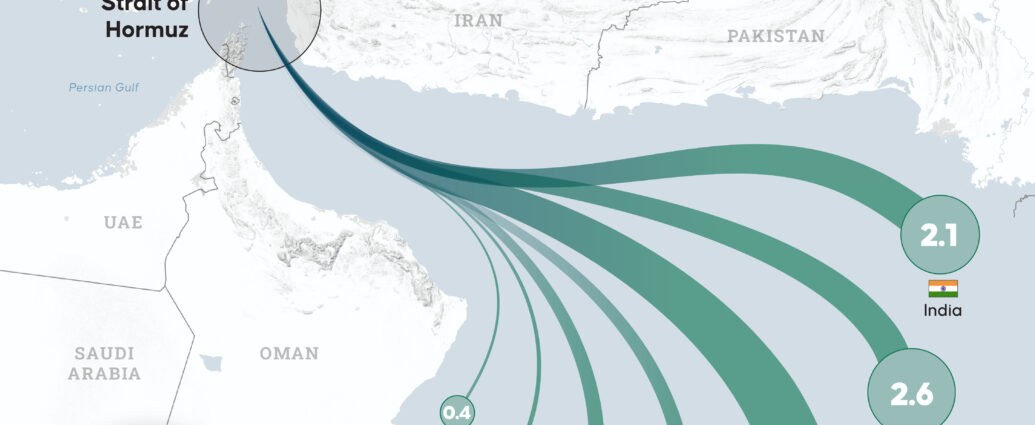
Iran already is picking winners and losers from an energy standpoint, allowing a trickle of shipments to trek to China, Vietnam, Malaysia, and the Philippines—a group that includes the neediest Asian nations—but these shipments are being individually negotiated. Overall vessel traffic from the Persian Gulf in March plunged to just 5% of February levels, according to S&P Global Commodities at Sea, and volumes have increased only slightly in April thus far.

“Economies around the world will break if this drags on too long. Cracks are already starting to show,” Reed said. “Everyone loses if Iran retains control of the strait much longer, because oil and other prices will climb to intolerable levels.” The only way to avoid that outcome, he said, is if either an outright U.S. victory or peace deal with Iran is achieved relatively soon.

Getty Images

Evolving traffic flows

Most of the fortunate few tankers exiting the strait are taking a route close to the Iranian shoreline, after paying tolls of up to $2 million per vessel. A small handful began moving through closer to the Omani coast on April 2, potentially offering a small hike in traffic. But close to 400 large oil and gas tankers remain stranded in the Gulf—not even counting smaller vessels and container ships, said Rohit Rathod, senior analyst with the Vortexa cargo tracking firm.

About 135 vessels typically pass through the strait each day—carrying close to 20% of the world’s oil, liquefied natural gas, agricultural fertilizer, and petrochemicals. The transits are now in the single digits each day, Rathod said. Prices for oil future benchmarks sit near $110 per barrel, with many physical, spot barrels selling above $140.

“If [nations and shippers] want to have their vessels go through unmolested, they’ll have to have some sort of channel of communication with the Iranians,” Rathod said. “And I think [Iran] will still try to cause trouble with some of the Western-affiliated tankers carrying cargoes going to the U.S. or Europe.”

In the meantime, Russia is selling more of its oil at much higher prices than before the war, gaining a windfall. China, which imports more oil from the Middle East than anyone, is secure for now because of its world-leading reserve stockpiles. The developing Asian countries have suffered the most from supply shocks, and now Europe is seeing increasing signs of energy shortages. The average price of retail gasoline has risen above $4.10 per gallon in the U.S., but that’s cheap relative to the rest of the world.

Even in the best-case scenario of a truce or peace deal soon, experts said, traffic flows won’t return to normalcy before mid-summer. And that flow won’t replace the hundreds of millions of barrels lost in the interim. Prices could remain elevated for years.

For now, the military conflict is escalating. A U.S. fighter jet was shot down April 3; in Kuwait, Iranian drone attacks damaged an oil refinery, a water desalination plant, and a power plant. An estimated 3,000 people have been killed to date in Iran and from Israel’s attacks in Lebanon, where it is targeting Hezbollah, the Iran-allied militia.

“Even if the war were to end today, there will be a state of permanence to this mess until Iran has won some concessions from all of its neighbors individually,” said Samir Madani, cofounder of TankerTrackers.com. He argued that a broader peace deal is unlikely because of “individual grievances” with each neighbor—Saudi Arabia, the United Arab Emirates, Qatar, Kuwait, Iraq, and Bahrain.

“They will want to apply pressure on those countries to end their relationships with the U.S.,” Madani said.

Rhetoric and reality

Trump’s primetime speech April 1 offered little clarity as he vowed to wind down the operations after “two or three weeks” of bombing Iran “back to the Stone Ages where they belong.”

Simultaneously, he said other countries must “go to the strait and just take it,” arguing that “when this conflict is over, the strait will open up naturally.”

Unsurprisingly, oil prices rose as he spoke. “That seems optimistic,” a Piper Sandler analyst note retorted the next morning. “The best explanation is likely this: Trump doesn’t know what he is going to do.”

Trump has set an already postponed deadline of April 6 for Iran to either make a peace deal or have its energy infrastructure bombed.

Indeed, Trump’s inconsistency has continued via social media since his speech. After saying the U.S. didn’t need to seize the strait, he posted April 3, “With a little more time, we can easily OPEN THE HORMUZ STRAIT, TAKE THE OIL, & MAKE A FORTUNE.”

The premise of leaving control of the strait up to U.S. allies and Iran to work out is a “really bad idea,” said oil forecaster Dan Pickering, founder of the Pickering Energy Partners consulting and research firm.

“The ripple effects of Iran in control of the Strait of Hormuz are really bad,” Pickering said.

If the U.S. withdraws and Iran maintains some control, then there likely would be a “period of relative quiet” during which prices come down, Pickering said. But they would almost certainly remain elevated from their February levels because of higher geopolitical tensions, supply chains woes, and higher risk premiums for tanker insurance, he said.

This state of affairs would create an untenable balance, with Israel and all of Iran’s Gulf neighbors upset about the U.S. having ceded any control to Iran, and facing a threat of extortion from the Iranian regime. And it would only be a matter of time before Iran or its proxy allies, the Houthis or Hezbollah, act out again, Pickering said.

“We’re likely to have structurally higher oil prices for the next two to five years,” Pickering said. “I think Iran wins in that situation. I think the losers are global consumers because prices will be higher.”

This story was originally featured on Fortune.com

Royal visitors have long been popular in the US, and Charles has decades of diplomacy under his belt. But can soft power save the special relationship?

What’s the worst that could happen when King Charles visits Donald Trump in Washington at the end of this month? And what will be the best outcome from Keir Starmer’s point of view, since it is the prime minister who directed the visit to go ahead in the hope of improving our battered, supposedly special relationship? While the relationship is still apparently meaningful to Britain, to the US it appears to not mean so much – especially now.

The king goes where he is told, whether he would prefer to stay at home or not. This time to a land whose president denounces our aircraft carriers as toys and accuses us of cowardice, and whose defence secretary talks derisively of our Royal Navy. Perhaps Charles ought to wear his naval admiral’s uniform when he goes to the White House, medals and all.

Continue reading…

This post was originally published here

Previously unreleased report obtained via freedom of information battle says Pezzullo exceeded ‘boundaries of normal public service practice’


The former head of the Department of Home Affairs’ engagement with a Liberal powerbroker was “reckless”, “ill-advised” and beyond the boundaries of normal public service practice, a previously unreleased confidential report found.

The independent probe led to the sacking of Michael Pezzullo as secretary of the Department of Home Affairs in November 2023 after it concluded he had breached the government’s code of conduct at least 14 times. This included using his power for personal benefit.

Continue reading…

This post was originally published here