Sector cites ‘billions of pounds in additional costs’ from new business rates and increase in minimum wage thresholds

Two-thirds of hospitality businesses are planning to cut jobs as a result of “suffocating” costs imposed by government, as new business rates and higher wage bills come into force.

Many pubs, restaurants and hotel companies will see their costs increase significantly from 1 April after Rachel Reeves’s changes to business rates and an increase in minimum wage thresholds announced at the chancellor’s November budget.

Continue reading…

This post was originally published here

UK researcher uses maths to explain seeming inevitability of phenomenon experienced by many motorists

It is a situation experienced by many motorists: one driver overtakes another only to find the slower car is right behind them when they reach a red light. Now a researcher has used mathematics to reveal why the situation feels inevitable.

Dr Conor Boland from Dublin City University has called his work “The Voorhees law of traffic”.

Continue reading…

This post was originally published here

Pentagon chief’s remarks come after US army said crews suspended amid investigation into incident in Tennessee

Defense secretary Pete Hegseth said the crews of two US army AH-64 Apache helicopters that hovered next to the singer Kid Rock’s swimming pool while he clapped and saluted on Saturday are no longer suspended.

“No punishment. No investigation,” Hegseth wrote on social media. “Carry on, patriots.”

Continue reading…

This post was originally published here

Venture Capital firm Sycamore has announced a $65 million seed funding round aimed at developing an operating system for autonomous enterprise AI. 

The announcement highlights that this funding will help organizations deploy AI agents efficiently and securely.

• Invesco QQQ Trust, Series 1 stock is trading near recent highs. What’s next for QQQ stock?

The funding round was led by Coatue and Lightspeed Venture Partners, with contributions from Abstract Ventures, Dell Technologies Capital, 8VC, Fellows Fund and E14 Fund. Notable angel investors include former OpenAI Chief Research Officer Bob McGrew, Intel CEO Lip-Bu Tan and Databricks CEO Ali Ghodsi.

Sycamore’s platform aims to revolutionize enterprise computing by providing …

Full story available on Benzinga.com

This post was originally published here

Trump administration claims list is part of an EEOC investigation into antisemitic discrimination at university

A federal judge on Tuesday ordered the University of Pennsylvania to hand over records about Jewish employees on campus to a federal agency as part of an investigation into antisemitic discrimination but said it did not have to reveal any employee’s affiliation with a specific group.

US district judge Gerald Pappert said employees can refuse to take part in the US Equal Employment Opportunity Commission (EEOC) investigation but the agency “needs the opportunity to talk to them directly to learn if they have evidence of discrimination”.

Continue reading…

This post was originally published here

President has falsely claimed ‘legendary’ fraud for limiting mail-in ballots and himself voted by mail last week

Donald Trump signed an executive order directing his administration to compile a national voter file and to restrict the use of mail-in ballots, an unprecedented move that is probably unconstitutional.

The executive order directs the Department of Homeland Security to work with the Social Security Administration to compile a list of verified US citizens who can vote in every state. It also directs the United States Postal Service (USPS) to begin rule-making on a process that would require states to notify the agency of voters who intend to receive a mail-in ballot and prohibit them from receiving one unless they are on a USPS-approved list of eligible voters.

Continue reading…

This post was originally published here

Milpitas approves measure to distribute smart doorbells and says residents can upload footage to police database

A Silicon Valley city will offer its residents free wireless doorbells equipped with cameras to help police collect video evidence.

The city council of Milpitas, a suburb north of San Jose, California, recently approved $60,000 to provide these devices on a one-camera-per-household, first-come, first-served basis, as was first reported by Milpitas Beat and confirmed by the Guardian.

Continue reading…

This post was originally published here

Bernard Looney, whose tenure as CEO of BP ended with him embattled in controversy, is entering the AI age as the new CEO of Wyoming-based Prometheus Hyperscale, leading a bevy of data center campus developments in the Cowboy State as well as the Lone Star state of Texas.

Looney, who pushed BP toward renewables in the energy transition, resigned suddenly from that company’s CEO post in 2023 amid a probe by the company into undisclosed personal relationships. Since then, BP has struggled financially, cutting costs and pivoting away from renewables and back to fossil fuels.

Coincidentally, BP’s new CEO takes over April 1. Meg O’Neill, the former Woodside Energy head, becomes the first-ever woman CEO of a Big Oil giant.

Looney became non-executive chair of Prometheus in late 2024. He takes over as CEO from the company’s founder, Trenton Thornock, who will remain a board member.

Prometheus is primarily focused on two flagship data center projects in Wyoming—in Evanston and Casper—with a combined initial capacity of 2.5 gigawatts, enough to power almost 2 million homes. The two projects are expected to cost more than $30 billion.

Prometheus is focused on speed of construction and on cleaner energy, utilizing a combination of behind-the-meter natural gas and battery storage to get projects completed and then utilize more wind, solar and even advanced nuclear power. The data centers are expected to use a proprietary geothermal cooling technology that doesn’t require water, according to the company.

“As artificial intelligence and digital technologies continue to reshape our world, it is crucial that we build the necessary infrastructure responsibly. This is the mission we have set ourselves,” Looney said in a statement, touting Prometheus being at the “forefront of next-generation data center development.”

Prometheus is backed by In-Q-Tel, the venture capital fund backed by the Central Intelligence Agency and the broader U.S. intelligence community, and others, and has power partnerships with Conduit Power, France’s Engie, Sam Altman-backed nuclear player Oklo, and more.

This story was originally featured on Fortune.com

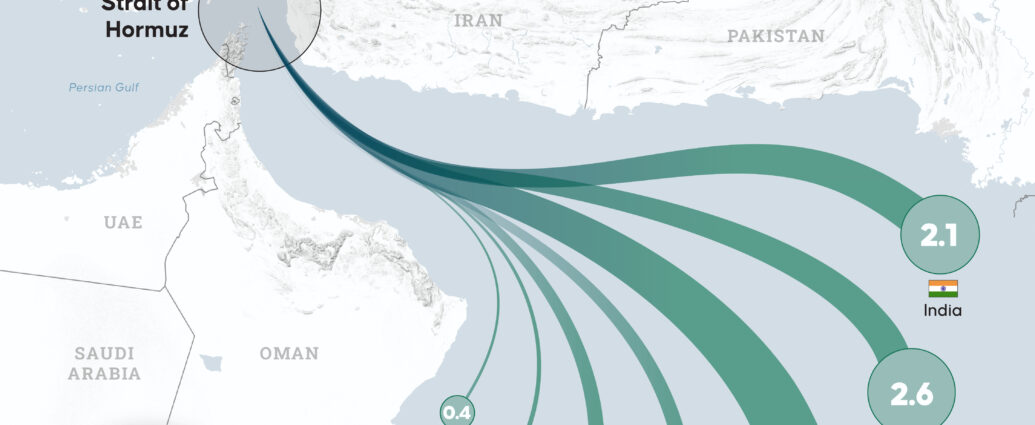
As Donald Trump searches for an exit to the Iran war, the narrow Strait of Hormuz increasingly looks like a labyrinth in which the commander-in-chief has no good options. 

Any ceasefire or U.S. disengagement that cedes control of the strait risks creating new problems, including potentially triggering a nuclear arms race among Gulf states, experts say. But taking control of the strait militarily requires massive costs and risks, including a strategic invasion that comes short of occupying the country. Trump said March 31 he wants to leave Iran in two or three weeks, hours after he vented against allies to “Go get your own oil!”

Continuing with the status quo, meanwhile—in which the U.S. and Israel pound Iranian targets, while Iran charges multi-million dollar tolls to let select ships pass through the strait—could send the global economy into a recession.

“If this goes on for another two months, we’re in a global recession. There’s no way around it,” Jim Wicklund, a veteran oil analyst and managing director for PPHB energy investment firm, told Fortune, arguing the U.S. is staring down the barrel of a credit crash and sky-high inflation. 

Even a slight opening of the strait would bring only temporary relief. Oil and natural gas prices may fall as more traffic flows through the strait, but they would remain much higher than in February before the U.S. and Israel initiated the war, especially if Iran continues to charge a $2 million toll per vessel. “The whole world won’t stand for a long-term toll,” said Wicklund. “There will be a higher risk premium even if the strait opens tomorrow.”

The U.S. must either put “boots on the ground” to take control of the narrow strait—through which 20% of the world’s oil, liquefied natural gas, and petrochemicals pass—or make some kind of truce that’s unlikely to last, he said. “Trump has to do something, and he has to do something soon.”

Bob McNally, former White House energy adviser under George W. Bush and founder of the Rapidan Energy Group, took it a step further if the U.S. were to walk away without militarily seizing control of the strait.

“That would be a catastrophic setback for U.S. foreign policy interests that would, in my view, transcend even our defeat in Vietnam,” McNally told Fortune. “One would struggle to find a precedent or a parallel for what a defeat that would be.”

Where we are

More than a month into the slog of war, the average U.S. price for a gallon of regular gasoline rose above $4.00 on March 31 for the first time since 2022. California, Oregon, and Hawaii all exceeded $5.

And the impacts remain much worse in the rest of the world where supply shortages are mounting in Asia, and where Europe is now beginning to see scattered fuel shortfalls. This is where demand destruction escalates in April.

On March 30, Trump threatened “completely obliterating” Iranian power and water infrastructure if the strait is not opened—potentially a war crime. One day later, he lashed out at U.S. allies for not helping enough. “You’ll have to start learning how to fight for yourself, the U.S.A. won’t be there to help you anymore, just like you weren’t there for us. Iran has been, essentially, decimated. The hard part is done. Go get your own oil!” he posted on social media.

“We leave because there’s no reason for us to do this,” Trump later told reporters at the White House. “We’ll be ‌leaving very soon.”

With Pakistan and now China increasingly serving as the negotiation mediators, they offered a five-point peace initiative March 31 that included a call to “restore normal passage through the strait as soon as possible.”

Rystad Energy chief economist Claudio Galimberti sees a tenuous peace as the most likely outcome in the coming weeks. After all, only about 5% of the typical traffic is passing through the strait, which is not sustainable.

“It would be a very fragile ceasefire. It’s very unstable,” Galimberti said.

If a ceasefire only allows 50% or less of traffic to resume, then “this would be a very high inflationary scenario” for the world with oil prices likely remaining above $100 per barrel, he said. If it’s almost fully opened under a tolling scenario, then prices would fall further, but still remain well elevated above February levels before the war.

That is why McNally and Wicklund see U.S. boots on the ground as more likely to see the military campaign through. They think Trump is frustrated, but mostly posturing for now.

“What I think is likely is we’re going to see an intensification of combined operations—air, sea, and land—to degrade Iran’s ability to threaten Hormuz traffic,” McNally said.

Getty Images

The doctrine effect

The alternatives are much worse, McNally argued.

“The Arab Gulf countries and Israel would not accept Iran’s long-term domination of Hormuz. I think it would make another conflict just a matter of time. And it’s a conflict the United States would likely get dragged [back] into,” McNally said. “I don’t think it’s a durable scenario where we just sort of leave and say, ‘Hey, cut your deals with Iran. They’re the toll keeper now. Good luck.’”

The geopolitical precedent also would prove awful, McNally said, effectively canceling the Reagan Corollary to the Carter Doctrine. The 1980 Carter Doctrine said the U.S. would intervene militarily to protect its interests in the Middle East against external powers, which was in response to the Soviet Union’s invasion of Afghanistan. The 1981 Reagan Corollary, which came during the Iran-Iraq War, extended the doctrine but also pledged to secure internal stability in the Middle East, especially Saudi Arabia.

“We would be canceling the Reagan Corollary to the Carter Doctrine, and eventually, perhaps the doctrine itself,” he said. “I think eventually a China or Russia would want to step in there.”

This story was originally featured on Fortune.com

As the bell rang out over the New York Stock Exchange on Tuesday afternoon, it was an unusually beautiful day: 71 degrees, sun pouring on the faces of people swarming through the city. After the brutal cold of winter, it felt like something of a miracle.

The markets had spent the day chasing one of their own.

Iran’s official news agency reported an unconfirmed phone call between President Masoud Pezeshkian and the European Council president, where Pezeshkian said Iran had the “necessary will” to end the war; provided that “essential conditions are met, especially the guarantees required to prevent repetition of the aggression.” The S&P went vertical immediately afterwards. It didn’t matter that Pezeshkian had said nearly the same thing on X earlier this month, or that it wasn’t even clear how big a development this was.

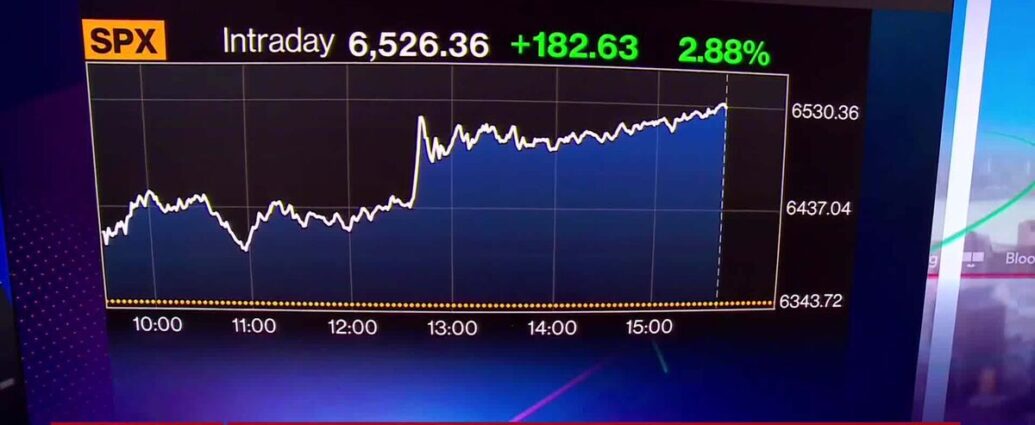
The Nasdaq still snapped back 795 points, recovering nearly half of its total drawdown over the course of the U.S.-Israeli-Iran war in a single day. The S&P soared 2.89%, representing $1.7 trillion alone, recovering about 30% of its total drawdown since the war began. The Ddow also soared 1,125 points. All three indexes had their biggest single-day signs since May.

The incredible thing about the rally today wasn’t the scale of it, but the fragility of what it was built on. 

It started Monday night, when the WSJ reported that Trump had told aides he was willing to end the military campaign against Iran even if the Strait of Hormuz remained closed for the most part. Futures immediately rallied up something like 1.5%. But the same report noted that military options were still being considered, and if the U.S. drew out it would leave other nations to deal with the complex process of reopening the Strait, one of the world’s most critical oil chokepoints where 20% of the world’s oil flows out of.

Trump made his preference clear the next morning with a post calling on allies to gather up their “delayed courage” and deal with the Strait themselves.

 “Iran has been, essentially, decimated. The hard part is done,” Trump wrote. “Go get your own oil!” Soon after, Defense Secretary Pete Hegseth and Joint Chiefs Chairman Gen. Dan Caine held a before-the-bel press conference, where they didn’t commit to either leaving the Strait or defending it, nor any sort of timeline on the war. But they said it was going well, and when the stock market opened, most of the major indexes were rallying above 1%.

Then the confusion began. On Monday, White House press secretary Karoline Leavitt told reporters that talks with Iran were ‘continuing and going well,’ adding that ‘what is said publicly is, of course, much different than what’s being communicated to us privately.’ Then, Iran’s foreign ministry spokesperson said the opposite, that there had been in fact, no direct negotiations with the United States in 31 days of war, only ‘messages’ passed through intermediaries like Pakistan. But that wasn’t enough to dampen the high before Tuesday’s main event.

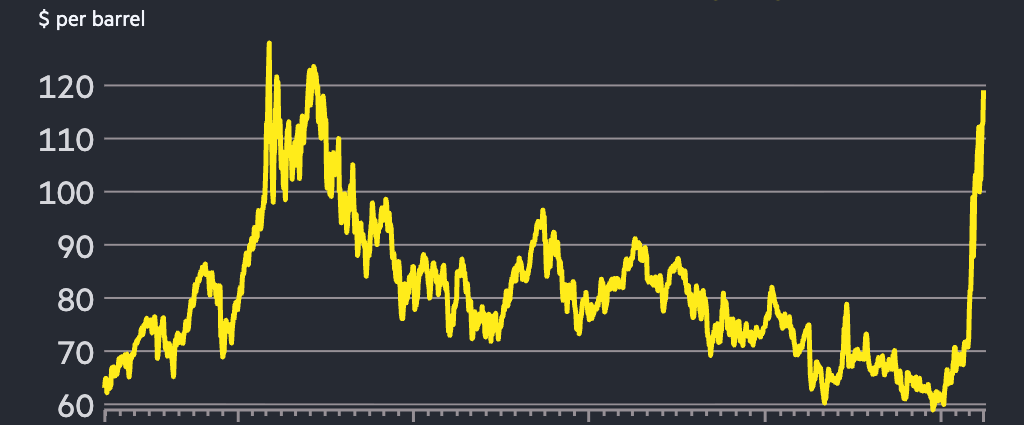
The oil market looked at the same information and reached a more sober conclusion. Brent crude settled upwards nearly 5% at $118.35 a barrel, its highest close since June 2022, after Bloomberg reported that Iran had struck a Kuwaiti oil tanker in Dubai waters. Oil said war, and stocks said peace, and both closed higher.

This story was originally featured on Fortune.com

Sandhu Ponnachan, 36, charged with grievous bodily harm, dangerous driving and possession of a bladed article

A 36-year-old man has been charged after seven people were injured when a car hit pedestrians in Derby, police have said.

Sandhu Ponnachan, of Chariot Close, Alvaston, was charged on Tuesday night with six counts of causing grievous bodily harm with intent, one count of attempted grievous bodily harm, one count of dangerous driving and one count of possession of a bladed article, Derbyshire police said.

Continue reading…

This post was originally published here

Scientists tracked bird population in Canberra’s botanic gardens and found climate impacts starting to affect them

A common and well-loved bird of bush and garden could go extinct within 30-40 years due to the weather impacts of climate change, researchers say.

Data derived from nearly 30 years of weekly observations tracked the lives of superb fairy wrens in Canberra’s botanic gardens, noting the changing weather’s impacts on them.

Continue reading…

This post was originally published here

The U.S. Department of Labor has proposed a rule that would make it easier for retirement plan sponsors to include alternative investments — such as private equity, private credit, real estate and cryptocurrency — in workers’ 401(k) plans while reducing regulatory burdens and the threat of lawsuits.

The rule aims to carry out goals that President Donald Trump outlined in an executive order last summer.

Experts say it could shift some of the trillions of dollars now held in stocks and bonds into more opaque and higher-risk holdings, including private credit.

The first Trump administration issued guidance in 2020 that effectively gave a green light to incorporating private equity, but the Biden administration later took a more cautionary approach, The New York Times reported this week.

The proposal would allow plan overseers to meet fiduciary obligations under federal law by following a “process-based safe harbor” and evaluating investments using six factors — including performance, fees, complexity and liquidity.

“Our goal is to deliver on President Trump’s promise for a new golden age by fostering a retirement system that allows more Americans to retire with dignity,” U.S. Secretary of Labor Lori Chavez-DeRemer said in a statement. “This proposed rule will show how plans can consider products that better reflect the investment landscape as it exists today. This greater diversity will drive innovation and result in a major win for American workers, retirees, and their families.”

The rule is subject to a 60-day comment period ending June 1. Proponents say the addition of alternative investments can boost returns and provide diversification — while critics point to added risks and opacity.

Dennis Kelleher, CEO of the nonprofit Better Markets, called the proposal dangerous.

“The legal immunity created by this safe harbor will incentivize financial advisers to pitch these toxic products,” he told the Times. “(Those) will become ticking time bombs in tens of millions of retirement accounts.”

Alicia Munnell, a senior adviser at the Center for Retirement Research at Boston College, questioned the role of outside influence in drafting the proposal.

“As far as I can see, the only party pushing for private equity in 401(k) plans is the private-equity industry,” she said. “Moreover, private equity comes with numerous negatives, and our studies on the performance of state and local pension plans show that the addition of private equity has not increased the return or reduced the volatility in these plans.”

Since taking office, the Trump administration has proposed additional uses and funding avenues for 401(k) plans — including penalty free withdrawals for home down payments and the creation of a retirement savings plan for workers without an employer-sponsored account.

This post was originally published on here. 

All eyes are on Lennar’s forthcoming 10-K filing, maybe as soon as Thursday, as a wave of investor questions converges around one central issue: How much financial risk – recognized or not – sits inside the company’s land-light strategy?

In recent days, that question has pitched from a routine analyst inquiry into a whirlwind of accounting scrutiny, capital markets skepticism and sharply different interpretations.

For now, the point is this:

The answers are not yet fully known. What matters for homebuilding leaders is how and why those questions are being asked and what is known.

And a big part of what is known is that Lennar’s bold strategy to shift a key part of its business away from land and real estate speculation toward a data-driven focus on design, construction, retail marketing, sales, and customer service for its homes and neighborhoods has been exactly that – bold, and difficult.

What’s more, the timing for undertaking such a major transformation was never going to be perfect.

As it turns out, however, it could have been a whole lot better than it is now. It has been, is and will likely continue to be a time with an ugly-but-true label: VUCA. VUCA stands for volatility, uncertainty, complexity and ambiguity.

It’s those last two – complexity and ambiguity – that figure most prominently in this analysis.

A statement meant to reassure – and the reaction it triggered

On March 30, Lennar issued a public statement addressing its land-light strategy, its use of land banks, and its accounting treatment.

“The structure, costs, and accounting treatment associated with our land-light strategy have been consistently and transparently disclosed in Lennar’s public filings,” the company said. “We are confident in the accuracy of our financial statements and the adequacy of our public disclosures.”

Lennar characterized the strategy as a long-term transformation:

“We made a strategic decision to migrate our business from a model built around on-balance sheet land ownership… to one built around land option platforms,” the company said, adding that the goal was to operate “as a manufacturing company: disciplined, capital-efficient, and focused entirely on the process of building homes.”

The company also highlighted the operational principles of the model:

“This model strengthens returns on inventory and equity over the long term and builds a more resilient homebuilding enterprise.”

The goal was clear: address increasing investor questions and boost confidence. The reaction to the press release proved to be more complicated, only adding fuel to speculation that something’s up.

As Evercore ISI senior managing director Stephen Kim notes, the release “added extra drama to an already intense debate,” and “probably did more harm than good,” amplifying attention rather than resolving it.

At the heart of the debate is not Lennar’s business strategy itself – but how its financial tactics and for accounting purposes recordings are measured, timed and disclosed.

Three interweaving financial and operational flows are driving investor concern.

Option maintenance fees – and when they show up

Under Lennar’s land-light model, the company pays ongoing fees to land banking partners to maintain purchase options.

As one large regional homebuilding company’s top strategic executive told me:

“An unmentioned factor is the impact of the Millrose deal – and the lot purchase obligations at ever-increasing prices – on their production strategy. My understanding is that the Millrose contracts have cross defaults and they have no alternative to continuing to gag down the lots. This is probably creating pressure to keep starting houses.” 

These fees:

  • Are paid in cash today
  • Often capitalized on the balance sheet
  • And recognized later through cost of goods sold

As Evercore’s Stephen Kim explains, these fees are “paid in cash but capitalized on the balance sheet,” with the effect that they “will lead to lower gross margins in future periods when [they are] eventually amortized.”

That timing dynamic is standard in homebuilding accounting.

What’s under scrutiny is scale.

Management has previously indicated that Millrose-related fees would represent “roughly 100bps headwind to gross margins over the next two years.”

The question now is whether the broader system extends beyond that.

How large is the total land bank exposure?

Millrose is only part of the picture. Investor attention and questions have turned to what lies beyond Millrose – i.e. other large institutional investment-backed land banks – which may or may not involve a whole lot more risk:

  • Exposure to other institutional land banks
  • The scale of capitalized costs tied to those relationships
  • And the degree of disclosure clarity

Evercore notes that the balance sheet line “Deposits and pre-acquisition costs” has grown significantly – even as optioned lot counts declined – leading some investors to infer that non-Millrose exposure could be “2x to 3x as large.” In other words, not a 1% drag on earnings, but rather a 2%-to-3% drag.

That conclusion is not confirmed.

But this debate about what is “under the hood” at Lennar has intensified.

What’s inside the accounting – and what isn’t

A counterpoint under review is that this balance sheet growth indicates more than just land banking.

Evercore emphasizes that the line includes multiple components:

  • Infrastructure spending, including Municipal Utility District investments
  • Land development costs subject to reimbursement
  • Property taxes and other pre-acquisition expenses

In fact, the firm notes that “it is a mistake to think that OMF is the primary driver,” adding that such fees likely accounted for “less than half” of recent increases.

Infrastructure spending alone may account for “over $300 million” of recent growth.

This matters because it introduces a materially different interpretation:

Some of the apparent buildup may represent temporary, reimbursable, or timing-related costs—not structural margin pressure.

The more aggressive interpretation – and its limits

An analysis from Hunterbrook advances what amounts to a sharply critical “kitchen sink” thesis, where a host of issues and inferences are heaped into a grand narrative of unstated business risk. It argues that Lennar’s land banking model may involve substantial ongoing costs:

“Lennar’s pivot to land banking has locked the company into paying… more than $2 billion a year in annual fees,” according to its estimates.

It further contends that these costs may not be immediately reflected in earnings:

“Instead, Lennar appears to be capitalizing some of these disbursements—recording billions… as though it is an asset… This approach… enables Lennar to present better earnings today, at the expense of worse (cost-of-goods-sold) COGS  tomorrow.”

At the same time, the analysis itself acknowledges limits:

  • The accounting treatment “may be perfectly legal”
  • Key details of agreements “are largely kept private”

For business leaders, rather than the conclusion, the analysis signals the range and depth of concerns around interpretations in play.

Context: strategy under pressure, not in isolation

Any assessment of these issues must be based on Lennar’s operating environment.

As detailed in recent coverage, the company has:

  • Prioritized volume over margin
  • Used pricing and incentives as a “circuit breaker”
  • Focused on maintaining production flow despite affordability constraints

As CEO Stuart Miller stated, the strategy is to drive “consistent volume and match production and sales pace,” using margin as a control mechanism. Miller’s characterization here beams a second lens on current performance:

  • Margin compression may reflect strategic pricing choices
  • Or embedded costs yet to be recognized

Untangling those drivers is at the core of current investor analysis.

What the 10-K may be expected to clarify

Against this backdrop, the upcoming 10-K filing has become a focal point. Not because it will resolve every question – but because it could speak to and clarify several key areas:

  • The scale of exposure to land banks beyond Millrose
  • The composition of capitalized costs on the balance sheet
  • The timing of expense recognition tied to option agreements
  • The forward implications for margins and cash flow

Then again, it also may test whether Lennar’s existing disclosures are sufficient – or whether greater granularity may now be required. Stakeholders can tolerate only just so much volatility, uncertainty, complexity and ambiguity, after all.

Why this matters beyond Lennar

If you think this is just a Lennar story, think again. It reflects a broader industry pivot we’ve seen play out dramatically over the past couple of years:

  • Asset-light land strategies
  • Institutional capital partnerships
  • More complex financial structures

Lennar stands as one of the most scaled and boldest implementations of that model. The current moment functions as a real-time case study, and this particular real-time is no ordinary time at all. It’s a VUCA moment and it will stress-test the land-light-asset-light formula’s capacity to shield homebuilders’ notorious cyclical vulnerability. The idea – and NVR‘s practice of it – are right on. For others, the question remains one of how complexity, transparency and market expectations intersect when conditions tighten.

A question, not a verdict

At this stage, three realities coexist:

  • Investor concerns around scale, timing, and disclosure are real
  • More measured analysis suggests some interpretations may overstate risk
  • And definitive answers depend on disclosures not yet fully available

That leaves the market – and the industry – asking a familiar question: How far the asset-light model can stretch before its complexity becomes a focal point of risk.

This post was originally published on here. 

California lawmakers are weighing bills that would reduce regulatory barriers to revive condominium construction, which has dropped significantly from its peak in the years before the Great Recession.

Assembly Bill 1406 would raise the state’s liquidated-damages limit on new condominium sales from 3% of the purchase price to 6%. Backers frame the bill as “condo deposit reform” to modernize a rule that is among the strictest in the country.

The other bill, AB 1903 filed in February, proposes changing condo construction defect liability rules to create a true “right-to-repair” process for condo defect claims so developers can fix problems without immediate high-stakes litigation. If enacted, the law would line California up with many other states that have similar laws on the books.

Challenges in condo construction

Condo construction has fallen to a fraction of its peak levels in 2005 and 2006, according to a 2024 study by the Terner Center for Housing Innovation at the University of California, Berkeley. In Los Angeles, for example, construction starts topped 8,000 units, dropped considerably during the Great Recession, and never recovered.

The same pattern played out across California’s major metropolitan areas, the study found.

Construction defect litigation and insurance costs shoulder much of the blame. A Terner Center follow-on study estimated the impact on hard costs on an L.A. project could be $8,100 to $18,300 per unit.

“While construction defect liability and related costs are certainly not the sole or even primary cause of relatively tepid condominium development in California, it is an important contributing factor among many others,” the study noted.

Developers have shifted their focus to building apartments instead of for-sale condos.

Reforming condo deposits

The long-standing 3% cap on condo deposits applies to most new, owner-occupied homes with up to four units and is widely treated as a bright-line rule in California residential contracts.

According to Assemblymember Chris Ward, the bill’s sponsor, and California YIMBY, that line is now part of the problem. Developers argue lenders view California condo projects as riskier because builders can only retain a small share of deposits if buyers walk away, making it harder to finance projects and pushing up borrowing costs.

In response, the bill that has passed the Assembly and awaits Senate action would let condo developers keep a larger share of buyers’ deposits when deals fall through, which supporters say is needed to jump-start construction of entry-level ownership housing.

California YIMBY leaders describe the 3% cap as the lowest in the country and note that other states allow higher presale deposits or treat larger liquidated-damages clauses as valid if they are reasonable. In Washington state, for example, a 2021 law lets condo developers collect presale deposits up to 5% of the purchase price.

Supporters say nudging California’s cap to 6% would keep the state on the consumer-protective end of the spectrum while giving lenders more confidence that projects can withstand cancellations. They link the change to the state’s sluggish condo pipeline, arguing that low deposit caps are one reason California builds far fewer condos per capita than states like Washington and Hawaii.

“This proposal is about making it possible to finance the kinds of starter homes that are missing from our market,” Ward said in a January statement after the bill cleared the Assembly. “By updating outdated rules around condo deposits, we can help expand homeownership opportunities for families who are currently shut out.”

Opposition to condo deposit reform

Realtors warn it will expose would-be homeowners to much bigger losses if life changes or financing problems force them to back out. The California Association of Realtors issued a “red alert” on the bill, arguing it would more than triple the effective cap on liquidated damages in some cases and erode long-standing consumer protections.

Opponents also question whether raising the cap would meaningfully increase construction. They say the change would shift risk onto buyers instead of addressing high land costs, fees and other barriers to building.

They make that argument even as Gov. Gavin Newsom signs laws to cut barriers and boost housing construction.

Ward and allied housing groups counter the opposition by noting that other safeguards in the state’s Subdivided Lands Law would remain intact and that the higher cap would simply allow deposits to function as true security for complex, multiyear projects. They also say larger deposits could deter speculative buyers who lock up units early and then abandon contracts, destabilizing project financing.

This post was originally published on here. 

The Department of Labor (DOL) has issued a proposed regulation that would allow retirement plans to include investments in alternative assets, specifically cryptocurrencies and private markets.

“The overarching goal of the proposed regulation is to alleviate certain regulatory burdens and litigation risk that interfere with the ability of American workers to achieve, through their retirement accounts, the competitive returns and asset diversification necessary to secure a dignified and comfortable retirement,” the executive summary reads. 

The proposal comes after President Donald Trump‘s executive order, released last year, instructed the DOL to reexamine its guidance surrounding employers and plan administrators on incorporating these assets into retirement plans.

“The Executive Order (E.O. 14330) pointed out that, currently, many Americans in employer-sponsored defined contribution plans do not have the opportunity to participate in the potential growth and diversification opportunities offered by alternative asset investments,” the proposal stated.

DOL Safe Harbor Rule

The DOL has introduced a “safe harbor” rule designed to help shield plan sponsors from lawsuits. Under the guidance, fiduciaries must carefully weigh six key factors when selecting alternative investments: performance, fees, liquidity, valuation, benchmarks, and complexity.

The rule will undergo additional review, including a 60-day period for public comment, before it can be finalized.

“Americans’ ability to participate more fully in innovation and economic growth through well-diversified long-term investments is a vitally important priority for effective retirement planning. We look forward to continuing our work to expand opportunities for Americans to build wealth and save for the future,” said SEC Chairman Paul S. Atkins in a press release.

U.S. Secretary of the Treasury Scott Bessent commented that the proposed rule is “an initial step” in implementing the Trump’s Executive Order in “a safe and smart manner.”

Last Wednesday, the Labor Department lifted restrictions that had previously discouraged the inclusion of cryptocurrencies in 401(k) retirement plans.

Trump’s Ballooning Crypto Fortune

The Labor Department under former President Joe Biden had warned about “significant risks” of adding cryptocurrency investment options to retirement plans, citing the speculative …

Full story available on Benzinga.com

This post was originally published here

German automaker Mercedes-Benz said on Tuesday it will invest $4 billion at its Alabama plant through 2030 to boost SUV production as it seeks to address significant U.S. auto tariffs.

In total, luxury automaker Mercedes-Benz said it plans to invest more than $7 billion in U.S. operations in the coming years. 

The company is moving up to 500 jobs from various locations across the country into a new, state-of-the-art research and development hub in Atlanta.

Automakers face steep tariffs imposed by President Donald Trump on imported vehicles and parts.

AS TRUMP EASES AUTO TARIFFS, MERCEDES WILL EXPAND AT ALABAMA PLANT

Mercedes-Benz said last year it would shift production of its GLC SUV from Germany to Tuscaloosa, Alabama. 

In February, Mercedes said group operating profit more than halved to 5.8 billion euros ($6.9 billion) in part due to 1 billion euros in tariff costs.

Mercedes said U.S. passenger car sales rose by 1% to 303,000 last year.

MERCEDES-BENZ CEO SIGNALS POTENTIAL FOR MORE US INVESTMENT

Mercedes North America CEO Jason Hoff said in a recent interview with Reuters that the planned move of the GLC is in part because of tariffs.

Having localized production for the biggest volume products “just makes good business sense,” said Hoff, citing the influence of tariffs.

TRUMP SLAMS SUPREME COURT JUSTICES HE APPOINTED AS ‘BAD FOR OUR COUNTRY’ AFTER TARIFF RULING

Early last year, Mercedes-Benz said that lower tariffs – or even zero-zero tariffs – between the U.S. and European Union could allow the company to step up investment in the U.S. even further.

Mercedes-Benz CEO Ola Källenius said in February 2025 that the company has “been operating in the United States for more than 120 years” and detailed the company’s American footprint.

“We have two large operations on the passenger car side, one in Alabama and one in South Carolina,” Källenius said. “Directly, we employ more than 11,000 people in the United States. If you would count in all the suppliers and the ones that kind of are dependent on those final assembly jobs, the usual calculation is roughly 1-to-10, so another 100,000 jobs are associated with those plants. Our dealer partners, strong private investors around the country, employ 28,000 people and then again, they have a residual effect. “

GET FOX BUSINESS ON THE GO BY CLICKING HERE

“The several hundred thousand jobs, tax revenue, etc. is the Mercedes-Benz footprint in the U.S.,” he explained. “What’s the point I am making? The point is we’re also an American company. Yes, we have our headquarters in Germany and our European origins, but we feel American.”

Reuters contributed to this report.

This post was originally published here. 

Meta, Tiktok and Google being investigated for allegedly disobeying Australia’s social media ban

The Australian government has accused big tech firms like Meta, TikTok and Google of disobeying the landmark ban on under-16s using social media, after the country’s online safety office warned many children had accounts.

A survey of 900 Australian parents found around a third (31%) said their children still had one or more social media accounts after the ban, compared to 49% before the laws.

Continue reading…

This post was originally published here

Exclusive: Landlords ‘leveraging up’ by exploiting property tax rules are fuelling Australia’s housing affordability crisis, e61 Institute finds

The combination of the capital gains tax discount and negative gearing rules has turbocharged debt-fuelled property speculation over recent decades, according to a new analysis of hundreds of thousands of property investments.

The federal budget in three weeks’ time is widely expected to include changes to tax breaks for investors, in an effort to rebalance the tax system away from the wealthiest Australians and to take pressure off home prices.

Continue reading…

This post was originally published here

Broadcaster did not look into separate allegations of ‘inappropriate communications’ involving the Radio 2 DJ

The BBC has apologised for its response after allegations about Scott Mills were raised with the broadcaster last year.

Mills was sacked with immediate effect by the BBC on Monday over his “personal conduct”. It then emerged he had been questioned over separate allegations of serious sexual offences against a boy aged under 16 in 2018, but the case was later closed due to lack of evidence.

Continue reading…

This post was originally published here

A tiny home in New York is going viral on social media because it has no bedrooms.

The house at 84 Wyona Ave in Selden went on the market about a month ago with a listing price of $329,900. The house was built in 1930 and is 446 square feet. It is about 10 feet wide and 37 feet long and has a small kitchen, dining room, living area and full bathroom.

It sits on a lot that is 22 by 100 feet and has a backyard shed. The tiny home has a basement with two open areas where one room can be converted into a half bath with laundry, according to the listing description.

“I went down as low as I could as far as price goes. I know [the offer] will come. We’re listening to all offers,” Denise Beckman, a licensed associate broker at HomeSmart Dynamic Realty, told Redfin News.

The tiny home also has a shed in the backyard. Photo credit: Picture Perfect

Although people on social media are stating their surprise at how high the listing price is considering the tiny home doesn’t have any bedrooms, Beckman said she has been blown away by the attention in general.

The house has a small kitchen, dining room, living area and full bathroom. Photo credit: Picture Perfect

Beckman said the seller of the house originally bought it back in 2002 and had it rented out until about 11 years ago, when he and his wife moved in. They renovated it by upgrading the heating, electrical, roof and bathroom.

“If you have vision and you’re single or newly married, it’s a great place to start and start building that equity for your future and it’s very hard for Long Islanders to do that right now,” she added.

Redfin agents said that although people on social media might be surprised by the tiny home’s high price, it makes sense because it is in a high-priced area and a commuter-friendly neighborhood.

The tiny home has a basement that can be finished. Photo credit: Picture Perfect

Selden is part of the town of Brookhaven in Suffolk County. The county is known as the home of The Hamptons, one of the most affluent neighborhoods in the U.S.

The median sale price of a home in Suffolk County was $660,000 in March and has remained the same since last year.

“Long Island is different from the nationwide market. We don’t have enough supply for the demand,” said Redfin agent Mohamed Elbaroudy. There’s been a lot of people moving into Long Island since Covid and that hasn’t stopped. People realized they can get a better quality of life and better schools and still have a good commute to the city.”

Panagiota “Peggy” Papazaharias, a Redfin agent, said this property works as a starter home for someone looking to get into the neighborhood while still being close to New York City.

“Selden is close to a lot of shopping, not too far from the city and Long Island Rail Road” she said.

The tiny home went on the market in March 2026. Photo credit: Picture Perfect

In recent years, tiny homes have continued to rise in popularity, especially since they can offer an alternative to the traditional home.

The post This $329,900 Long Island Tiny Home Is Going Viral Because It Has No Bedrooms appeared first on Redfin Real Estate News.

This post was originally published here. 

Billionaire hedge fund founder Ray Dalio had an ominous message for investors as he sounded the alarm over similarities between today’s global climate and the period before World War II.

In a February interview with Fortune, Dalio said the U.S. had entered “Stage 6” of his Big Cycle, the framework he uses to map the rise, peak, decline and restructuring of nations and global powers over long stretches of history.

He expanded on that view in a post published after the Munich Security Conference, writing that “the post-1945 world order has broken down” and that the world is now moving through a period in which “there are no rules, might is right, and there is a clash of great powers.”

That framework may already be visible in today’s geopolitical backdrop. In the same post, Dalio argued that “before there is a shooting war there is usually an economic war,” pointing to the kinds of pressure campaigns that tend to come first, including tariffs, sanctions, “asset freezes/seizures,” “blocking capital markets access,” and “embargoes/blockades.”

For investors trying to figure out what that actually means for their own retirement accounts, investment mix and time horizon, the answer is rarely obvious without a second opinion. 

SmartAsset’s free matching tool connects you with up to three advisors in 

your area after a short questionnaire, with free initial consultations. 

It is worth five minutes of your time to find out whether your current plan is built for the world Dalio is describing.

Global Powers Heading for a ‘Final Battle’

Dalio’s Big Cycle model is built on centuries of history, including the rise and fall of empires such as the Dutch, British and American orders. In his telling, Stage 6 …

Full story available on Benzinga.com

This post was originally published here

Beyond Meat Inc (NASDAQ:BYND) reported fourth-quarter financial results after the market close on Tuesday. Here’s a rundown of the plant-based meat company’s report.

Beyond Meats Misses Analyst Revenue Estimates, More

Beyond Meat reported fourth-quarter revenue of $61.59 million, missing analyst estimates of $62.57 million, according to Benzinga Pro. The company reported an adjusted loss of 29 cents for the quarter, missing estimates for a loss of 13 cents.

Total revenue was down 19.7% year-over-year, primarily driven by a 22.4% decrease in volume of products sold due to weak category demand and lower sales of chicken and burger …

Full story available on Benzinga.com

This post was originally published here

RH (NYSE:RH) shares tanked in Tuesday’s extended trading after the company released its fourth-quarter earnings report, missing estimates on the top and bottom lines.

RH Q4 Results

RH reported quarterly earnings of $1.53 per share, which missed the analyst estimate of $2.22 by 30.99%, according to Benzinga Pro data.

Quarterly revenue came in at $842.62 …

Full story available on Benzinga.com

This post was originally published here

President Donald Trump expressed frustration Tuesday with allies who have been unwilling to do more to support the U.S. war effort, telling them to “go get your own oil” as the conflict with Iran and its closure of the Strait of Hormuz sent average U.S. gas prices past $4 a gallon.

The social media post came after U.S. strikes hit the central city of Isfahan, sending a massive fireball into the sky, and Tehran attacked a fully loaded Kuwaiti oil tanker in the Persian Gulf.

The attacks showed the intensity of the war more than a month after the U.S. and Israel launched it. The conflict has left more than 3,000 dead and caused major disruptions to the world’s supply of oil and natural gas, roiling global markets and pushing up the cost of many basic goods.

Trump, who has vacillated between insisting there is progress in diplomatic talks with Iran and threatening to widen the war, had earlier shared footage of the attack on Isfahan.

Fuel prices rise, rattling global markets

Iran’s stranglehold on the strait, the waterway leading out of the Persian Gulf through which a fifth of the world’s oil is transported during peacetime, has driven up global oil prices, as have Tehran’s attacks on regional energy infrastructure.

Spot prices of Brent crude, the international standard, hovered around $107 a barrel Tuesday, up more than 45% since the war started Feb. 28.

Trump directed blame at U.S. allies like the United Kingdom and France that have refused to enter a war with no clear endgame that they were not consulted on.

“You’ll have to start learning how to fight for yourself, the U.S.A. won’t be there to help you anymore, just like you weren’t there for us. Iran has been, essentially, decimated. The hard part is done. Go get your own oil!” Trump wrote.

He singled out France for not letting planes fly over French territory while taking military supplies to Israel.

France has allowed the U.S. Air Force to use the Istres base in southern France because it had guarantees that planes landing there would not be involved in carrying out strikes.

Allies have refused to get involved

Spain, which has emerged as Europe’s loudest critic of the war, said Monday that it had closed its airspace for U.S. planes involved in the conflict.

Italy recently refused to allow U.S. military assets to use the Sigonella air base in Sicily for an operation linked to the offensive, an official with knowledge of the matter said, confirming a local press report. The official spoke on condition of anonymity because they were not authorized to speak publicly.

Italian Defense Minister Guido Crosetto wrote on X that Italy is still allowing the U.S. to use its bases, adding that there has been no cooling of relations between the two countries.

Journalist kidnapped in Iraq identified

In Iraq, officials said an American journalist was kidnapped, and Iraqi security forces were pursuing her captors.

Al-Monitor, a regional news site covering the Middle East, identified the journalist kidnapped Tuesday in Baghdad as Shelly Kittleson, a freelancer who contributed to the publication. In a statement, Al-Monitor said it was “deeply alarmed” by her kidnapping and stands by her “vital reporting.”

Kittleson has been a longtime freelancer in the region, reporting extensively from Syria and Iraq.

Two cars were involved in the kidnapping, one of which crashed, and a person inside was apprehended. The car carrying the journalist fled, two Iraqi security officials said.

The U.S. State Department said the administration was closely tracking the reports but had nothing further to share. It was not immediately clear if the kidnapping was related to the Iran war.

US has not ruled out ground forces

Trump warned this week that if a ceasefire is not reached “shortly,” and if the strait is not reopened, the U.S. would broaden its offensive, including by attacking the Kharg Island oil export hub and possibly desalination plants.

Speaking at the Pentagon, Defense Secretary Pete Hegseth would not say if U.S. ground forces would enter the war. “We don’t want to have to do more militarily than we have to,” he said.

A ground invasion could alienate Iranians who despise the ruling theocracy and who rose up in mass protests that were crushed earlier this year. Some could see it as an attack on Iran itself and rally around the flag.

A young anti-government activist in Iran said he plans to volunteer with the army if Trump follows through on such threats.

“If the idea of occupying islands or part of my country’s territory is implemented, I will definitely be available as a soldier to defend the Iranian nation,” said the 25-year-old resident of the northern town of Babol, who spoke on condition of anonymity out of fear for retribution.

Imprisoned Iranian Nobel laureate may have suffered heart attack

Supporters of imprisoned Iranian Nobel Peace Prize laureate Narges Mohammadi said she may have suffered a heart attack.

The campaign for her release, citing fellow inmates at Zanjan Prison in northern Iran, said she was found unconscious last week. Mohammadi has a heart condition and suffered multiple heart attacks while imprisoned before undergoing emergency surgery in 2022, her supporters say.

“Despite this medical emergency, and evident indications of a heart attack, authorities refused to transfer Mohammadi to a hospital or allow her to visit a specialist,” the campaign said in a statement.

Mohammadi, 53, was awarded the 2023 Nobel Peace Prize for her decades of activism. She has campaigned for women’s rights and democracy, and against the death penalty.

Iran hits oil tanker as Israel strikes Iran and Lebanon

Israel and the U.S. launched a wave of strikes on Iran, hitting Tehran in the early morning.

The Israeli military said it had launched strikes targeting what it described as Hezbollah infrastructure in the Lebanese capital, Beirut. Defense Minister Israel Katz said Israel plans to control the area south of the Litani River — some 20 miles (about 30 kilometers) north of the border.

Israel invaded southern Lebanon after Hezbollah began launching missiles into northern Israel days after the outbreak of the wider war. Many Lebanese fear another prolonged military occupation.

An Iranian drone hit a Kuwaiti oil tanker off the United Arab Emirates city of Dubai, sparking a blaze that was later put out, the Dubai Media Office said. Authorities said no oil spill resulted.

Four people were wounded by debris from an intercepted drone in Dubai, air raid sirens sounded in Bahrain, while Saudi Arabia said it intercepted three ballistic missiles launched toward its capital. Loud explosions were also heard in Israel not long after the military warned of an incoming missile barrage from Iran.

In Iran, authorities say more than 1,900 people have been killed, while 19 have been reported dead in Israel.

Two dozen people have died in Gulf states and the occupied West Bank. In Lebanon, officials said more than 1,200 people have been killed, and more than 1 million displaced.

Ten Israeli soldiers have died in Lebanon, including the four announced Tuesday, while 13 U.S. service members have been killed.

___

Corder reported from The Hague, Netherlands, and Superville from Washington. David Rising in Bangkok, Abby Sewell and Sally Abou AlJoud in Beirut, Sylvie Corbet in Paris, Amir-Hussein Radjy in Cairo, Qassim Abdul-Zahra in Baghdad and Giada Zampano in Rome contributed to this report.

This story was originally featured on Fortune.com

Credit delinquency rates are on the rise in states that have legalized sports betting, and it’s impacting Gen Z and millennials the most.

A new working paper from the Federal Reserve Bank of New York found after sports betting was legalized in the U.S., delinquencies among the total population increased 0.3%. While that figure may appear small, when the Fed researchers analyzed the population of just those who participated in sports betting, delinquency rates rose by 10%. 

The New York Fed used an analysis of consumer credit data and defined delinquency rates as being 90 days past due on any credit purchase, such as auto loans or mortgage payments.

“Our findings suggest that sports betting can have dramatic implications for household financial stability,” the authors wrote.

In 2018, the Supreme Court struck down the Professional and Amateur Sports Protection Act effective banning sports betting, opening the door for 40 states to legalize the practice in some form. Since then, participation in sports betting, particularly online, has exploded. Commercial gaming revenue hit a record $78.7 Billion in 2025, according to the American Gaming Association, a 9.2% year-over-year increase. Americans have wagered more than $520 billion on sports since the practice was legalized, and quarterly deposits have risen to $1,250 in 2025, compared to $500 five years ago, the Fed researchers found.

Millennials and Gen Z are particularly vulnerable to negative financial consequences as a result of sports betting. While 22% of Americans have an account with at least one online sportsbook, according to a 2025 Siena College Research Institute Survey, nearly half of men ages 18 to 49 have an account. People under 40 made up the largest share of individuals with credit delinquency, which rose to 26% after legalization, the Fed study found using “back-of-the-napkin” math.

The widespread financial consequences of sports betting

The New York Fed report adds to a growing base of literature showing the financial harms associated with sports betting. A working paper published by the National Bureau of Economic Research in 2024 found household bests increased $1,100 per year in states with legal online sports betting, which was also associated with a 14% decrease in net investments, such as stocks.

A 2025 study analyzing University of California Consumer Credit Panel found average credit scores in states with legal online sports betting were slashed by about 2.7 points and increased the likelihood of bankruptcy by 10%.

“The various outcomes of delinquencies and credit scores [are] just kind of indicating that it seems to be leading to some harm among consumers,” Poet Larson, the study co-author and postdoctoral fellow at the Digital Data Design Institute at the Harvard Business School, told Fortune.

Larson speculates that sports betting has become so popular. Young people, to whom online sportsbooks are marketed toward and who have less accumulated weather than older generations, could be particularly at risk, he said.

These financial effects extend beyond states where sports betting is legal. The Fed study found significant spatial spillover effects, meaning delinquency rose in states where sports betting was illegal, but which bordered legal states. Spillover delinquency rose 0.2% compared to the 0.3% baseline, a result of individuals crossing borders in order to use online sports betting platforms in states where it is legal.

The future of legal sports betting

States that have not yet legalized sports betting may still see similar trends in financial insecurity for reasons beyond spillover effects. The rise in popularity of prediction markets, such as Kalshi—which are legal and regulated by the Commodity Futures Trading Commission (CFTC) as “designated contract markets”—have effectively created a national sports betting market.

A  Citizens JMP report published this month found that in users’ first three months on a prediction market platform, they lost more money proportionate to the amount wagered than on online sportsbooks like DraftKings or FanDuel.

Still, prediction markets are relatively untapped in the U.S., with just 3% of Americans and 8% of men ages 18 to 24 reporting using a platform in the past six months, according to a Ipsos survey of more than 2,3000 adults published this month. Larson suggested the impact of these emerging platforms on financial security with depend on how popular they become.

“Because you have so many people sports gambling, you can start to see appreciable financial harms,” Larson said. “For prediction markets…if it’s small, then we might see financial harm, but it may be kind of difficult to detect.”

This story was originally featured on Fortune.com

Three women are facing criminal charges after authorities said they refused to pay an extra carry-on bag fee, triggering a confrontation that delayed a Frontier Airlines flight at Miami International Airport.

Nafisa Dockery, 30, Dionjana Cochran, 21, and Davana Cochran, 26, were each charged with trespassing after warning and resisting an officer without violence, according to arrest reports. Dockery also faces an additional battery charge.

The incident delayed a Philadelphia-bound flight by about one hour, authorities said.

According to an arrest report, the women were waiting to board a Frontier Airlines flight when an employee asked them to pay for an additional carry-on bag. A verbal confrontation followed, and the women were warned they could be removed from the flight if they did not comply.

The report states Dockery told the other two women to ignore the employee, and they proceeded onto the plane through a restricted area.

Miami-Dade Sheriff’s Office deputies responded, and a Frontier manager requested the women be removed after their boarding passes were canceled. Deputies told the women to leave the aircraft, but they refused and were given multiple warnings, the report said.

Authorities cleared the plane of passengers before the women began to exit. Dockery allegedly spat on another person during the incident, according to the report.

Deputies then instructed the women to put their hands behind their backs, but they refused, and a struggle ensued.

CLICK HERE TO GET FOX BUSINESS ON THE GO

All three women were taken to the Turner Guilford Knight Correctional Center following the incident, authorities said. Bond was set at $4,000 for Dockery and Dionjana Cochran, and $2,000 for Davana Cochran, according to jail records.

This post was originally published here. 

Virgin Galactic is reopening sales of its commercial spaceflights on a limited basis – though ticket prices have risen from the company’s previous rate.

The company made the announcement alongside its financial results for the fourth quarter and full year 2025, signaling that work on its fleet of SpaceShips is progressing to allow for commercial spaceflights to resume.

“We completed pivotal milestones during the first quarter of 2026, and with assembly of our first SpaceShip nearly complete and ground testing set to begin in April, we have released a limited number of Virgin Galactic Spaceflight Expeditions, each priced at $750,000,” Virgin Galactic Holdings CEO Michael Colglazier said in the release.

The $750,000 price point for Virgin Galactic’s commercial spaceflights is an increase of about $100,000 from what it charged before it paused spaceflights nearly two years ago to focus on building its SpaceShips that will handle the company’s space tourism business.

MUSK SAYS SPACEX SHIFTING FOCUS TO ‘SELF-GROWING CITY’ ON MOON BEFORE MARS PUSH

Colglazier said that with the company’s first SpaceShip nearly complete and ready for testing, the construction of its second SpaceShip is progressing and expected to allow for it to enter service later this year or early next year.

“Fabrication efforts are pivoting to support testing and production of our second SpaceShip, which we expect will enter service between late Q4 2026 and early Q1 2027 in line with our planned ramp in spaceflight cadence,” he explained.

ALTMAN CALLS MUSK’S SPACE DATA CENTER PLANS ‘RIDICULOUS’ FOR CURRENT AI COMPUTING NEEDS

“With production of SpaceShips well underway, we are gearing up for rocket motor assembly at our Phoenix factory, with manufacturing planned to begin in Q4 2026,” Colglazier added. 

“We continue to strategically manage our capital to support our planned ramp in cash flow from commercial spaceline operations.”

DATA CENTERS IN OUTER SPACE EMERGE AS SOLUTION TO AI’S MASSIVE ENERGY REQUIREMENTS

Virgin Galactic said in its full year 2025 financial highlights that revenue decreased from $7 million in 2024 to $2 million last year, with the commercial spaceflight pause largely driving the move.

The company’s new Delta class SpaceShips have a higher capacity of six passengers rather than four, and are also designed to handle a higher operational tempo of spaceflights than Virgin Galactic’s Unity prototype.

GET FOX BUSINESS ON THE GO BY CLICKING HERE

This post was originally published here. 

The U.S. needs to define its goals and let other problems take care of themselves.

This post was originally published here. 

Jarret Coleman is not on social media posting about interest rate moves or explaining mortgage concepts to the public — a model successfully adopted by some of his peers. Instead, the Greenwich, Connecticut-based loan officer for US Bank takes a more traditional approach to his business.

“I started in 2006 as an assistant to a loan officer, and they basically taught me the value of having real estate agents as referral partners,” Coleman said in an interview with HousingWire.

“As time moved on, that list of agents grew as I continued to expand my outreach and as things moved toward the electronic nature that we’re in today. I communicate with over 1,000 different agents now within my sphere of influence, and certainly I don’t win every deal, but I get enough referrals to grow and maintain my business.”

Coleman joined the industry “when everyone was leaving,” he said. Having just graduated from college, he didn’t have major bills — a relevant advantage in a commission-based industry. Despite the challenging environment, he adopted a simple mentality: “If it’s not broken, why change it?”

The approach has worked well. An introvert who originally went to school to become a meteorologist, Coleman ended up in the mortgage industry, eventually speaking in front of thousands of people to occupy a top position.

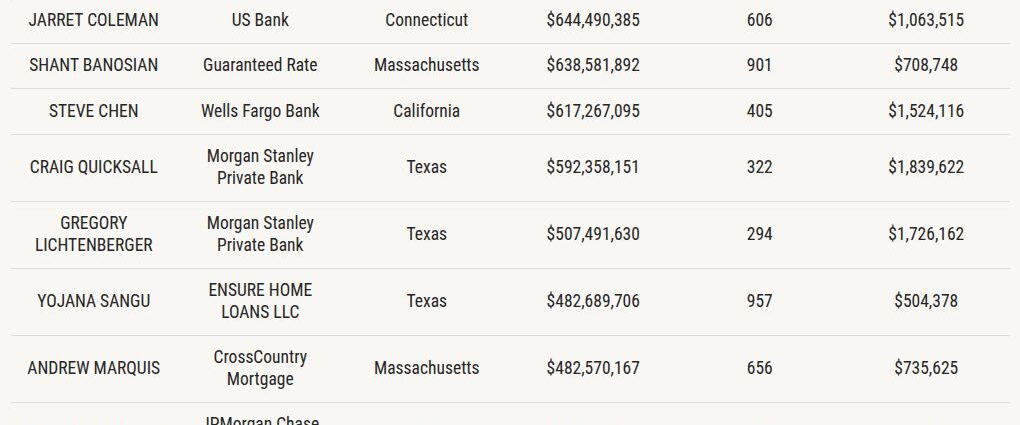
In 2025, he was the U.S. mortgage professional who generated the highest total dollar volume of loans at $644.5 million across 606 units, according to the inaugural edition of the HousingWire Mortgage Rankings. The position reflects the full scope of an originator’s production across all loan types and programs, based on mortgage data sourced through InGenius.

Last year was a difficult one, even for the top mortgage originators, as 2025 was characterized by still-high mortgage rates (which went from roughly 7% at the start of the year to 6.2% in December). Meanwhile, persistent housing shortages continued to affect markets across the country.

For the industry’s top-producing LOs, success ultimately hinged on relying on trusted partners, educating borrowers and investing in the quality of their service.

How to differentiate yourself

Shant Banosian ranked No. 2 on HousingWire’s top volume list, originating $638.5 million across 901 units. Based in Waltham, Massachusetts, he divides his time between origination and his role as president of Chicago-based lender Rate. Banosian said that his broader team generated an even higher volume last year, reaching the $1 billion mark.

“I’ve been fortunate and blessed to be surrounded by incredible team members who especially have stepped up a lot more over the course of last year, because I took on the added responsibility of being president of Rate,” Banosian said in an interview with HousingWire Editor in Chief Sarah Wheeler.

“If one of my team members runs as a point person for the application of the client, we just recognize them as the loan officer on the transaction.”

To reach the top ranking of originators, Banosian said the secret is simple: “service” and finding ways to stand out from the hundreds or thousands of competing LOs in a given market.

“Everybody has rates, has access to great products, but how do you differentiate yourself? We look at the obstacles and challenges that our clients and our partners are facing, specifically our real estate agent partners and obviously our end-user consumers,” Banosian said.

​​Banosian also invests heavily in educating partners and borrowers, which he said attracts the right kind of clients.

“If I provide enough information, it motivates people into action,” he added. “Our goal is to do business in every kind of market and really show up for people as they need us.”

While there’s a place for technology — such as automated alerts to notify originators of refinance opportunities — Banosian noted that LOs “can’t automate relationships.” The best originators, in his opinion, consistently focus on the fundamentals: picking up the phone, writing effective emails, building a strong social media presence and tracking clients’ life events.

“The average consumer, once they enter their homeownership journey, will take out 11 or 12 mortgages throughout the course of their lifetime,” Banosian said. “Most loan officers are lucky if they capture one or two of those. My mission is to capture 10, 11 or 12 of those.”

In terms of refinances, Banosian reached $154.8 million in volume last year, compared to $481.9 million in purchase volume, according to the HousingWire Mortgage Rankings.

Coleman’s approach

Coleman, meanwhile, maintained a high share of his business from refinances last year — producing $334 million in refi volume compared to $302 million in purchase volume. The reason? A high volume of purchase loans made in 2022 and 2023 when rates were rising very quickly, which provided the chance to renegotiate with small changes in rates.

“I always found that the key to longevity in this business is to maintain the purchase activity, because refis don’t last forever,” Coleman said.

But there’s a catch: Coleman focuses on high net worth clients, and the larger the loan amount, the less interest savings are needed to have a meaningful impact on a monthly payment. He is an expert in jumbo loans, which sit above the conforming limit of $832,750 for 2026.

Coleman originates many loans within the New York City metro and surrounding areas. Fairfield County, where he is located, was a sleeping county for a decade, from 2010 to 2020, he said. 

“Then, all of a sudden, everything flip-flopped with COVID. No one wanted to be in the city; everyone came roaring back. And we’re still dealing with that now. Demand far outweighs supply,” Coleman said. According to him, $2 million to $4 million homes consistently sell above list price, and he often has to write 10 preapprovals for clients before they actually get an accepted offer.

His clientele largely consists of business professionals buying their first or second home who are on an upward income trajectory.

“They are usually savvy enough so that they’re not necessarily needing the same hand-holding that a brand new first-time homebuyer would need,” he said. “We don’t have to invest nearly as much time to make sure that we’re a right fit for them. If I was dealing solely with first-time homebuyers, it takes much more time and wouldn’t necessarily allow me to operate the same numbers that we were able to do last year, as a rule of thumb.”

So far, Coleman sees 2026 starting off very strong, but it’s the supply issue that he remains concerned about in his market.

“You have a lot of people that want to sell and want to move, but there’s nowhere to move. So they don’t want to list their house until they find the house that they want to move to, and therefore they’re not listing their house. It’s like this revolving circle. I have wrapped my brain around a strategy that might fix this, and I can’t come up with anything.”

Eventually, he noted, people will have to make the decision to list and move if their current home is no longer best for their family. 

“We can do as many preapprovals as we can and put them on a drip campaign where we’ll try to communicate and just keep them apprised of what’s going on in real time, and hope that the right house comes and they’re ready to act. But yeah, that’s the best we can do. Time will tell.”

This post was originally published on here. 

Apollo Global Management is in advanced talks to acquire private jet fixed-base operator Atlantic Aviation from KKR & Co. in a move that is expected to value the company at approximately $10 billion.

The buyout may be made public in the coming days, although the process is ongoing and KKR could withdraw from its plan to offload its share of the company, Bloomberg reported, citing sources it didn’t identify.

Apollo is partnering with GIC Pte to purchase a controlling holding in Atlantic Aviation, while KKR is looking inject fresh investment into the company …

Full story available on Benzinga.com

This post was originally published here

PHILADELPHIA, March 31, 2026 /PRNewswire/ — The Aberdeen Investments U.S. Closed-End Funds (NYSE:ASGI, HQH, HQL, IFN, THQ)), (NYSE:IAF) (the “Funds” or individually the “Fund”), today announced that the Funds paid the distributions noted in the table below on March 31, 2026, on a per share basis to all shareholders of record as of March 24, 2026 (ex-dividend date March 24, 2026). These dates apply to the Funds listed below with the exception of abrdn Healthcare Investors (HQH), abrdn Life Sciences Investors (HQL), abrdn Australia Equity Fund, Inc. (IAF) and Aberdeen India Fund Inc. (IFN) which paid on March 31, 2026, to all shareholders of record as of February 20, 2026 (ex-dividend date February 20, 2026). 

Ticker

Exchange

Fund

Amount

ASGI

NYSE

abrdn Global Infrastructure Income Fund

$ 0.2300

HQH

NYSE

abrdn Healthcare Investors

$ 0.6300

HQL

NYSE

abrdn Life Sciences Investors

$ 0.5600

IAF

NYSE American

abrdn Australia Equity Fund, Inc.

$ 0.3600

IFN

NYSE

Aberdeen India Fund, Inc.

$ 0.4500

THQ

NYSE

abrdn Healthcare Opportunities Fund

$ 0.1800

Each Fund has adopted a distribution policy to provide investors with a stable distribution out of current income, supplemented by realized capital gains and, to the extent necessary, paid-in capital.

For the abrdn Healthcare Investors (HQH), abrdn Life Sciences Investors (HQL), abrdn Australia Equity Fund, Inc. (IAF) and Aberdeen India Fund Inc. (IFN) the stock distributions were automatically paid in newly issued shares of the Fund unless otherwise instructed by the shareholder to be paid in cash. Shares of common stock were issued at the lower of the net asset value (“NAV”) per share or the market price per share with a floor for the NAV of not less than 95% of the market price on March 18, 2026. The reinvestment prices per share for these distributions were as follows: $18.08 for abrdn Healthcare Investors (HQH); $16.40 for abrdn Life Sciences Investors (HQL); $12.50 for abrdn Australia Equity Fund, Inc. (IAF) and $11.75 for Aberdeen India Fund, Inc. (IFN). Fractional shares were generally settled in cash, except for registered shareholders with book entry accounts at Computershare Investor Services who had whole and fractional shares added to their account.

To have received the abrdn Healthcare Investors (HQH), abrdn Life Sciences Investors (HQL), abrdn Australia Equity Fund, Inc. (IAF) and Aberdeen India Fund Inc. (IFN) quarterly distributions payable in March 2026 in cash instead of shares of common stock, for shareholders who hold shares in “street name,” the bank, brokerage or nominee who holds the shares must have advised the Depository Trust Company as to the full and fractional shares for which they want the distribution paid in cash by March 17, 2026; and for shares that are held in registered form, written notification for the election of cash by registered shareholders must have been received by Computershare Investor Services prior to March 17, 2026.

Under applicable U.S. tax rules, the amount and character of distributable income for each Fund’s fiscal year can be finally determined only as of the end of the Fund’s fiscal year. However, under Section 19 of the Investment Company Act of 1940, as amended (the “1940 Act”) and related rules, the Funds may be required to indicate to shareholders the estimated source of certain distributions to shareholders.

The following tables set forth the estimated amounts of the sources of the distributions for purposes of Section 19 of the 1940 Act and the rules adopted thereunder. The tables have been computed based on generally accepted accounting principles. The tables include estimated amounts and percentages for the current distributions paid this month as well as for the cumulative distributions paid relating to fiscal year to date, from the following sources: net investment income; net realized short-term capital gains; net realized long-term capital gains; and return of capital. The estimated compositions of the distributions may vary because the estimated composition may be impacted by future income, expenses and realized gains and losses on securities and currencies.

The Funds’ estimated sources of the current distribution paid this month and for its current fiscal year to date are as follows:

Estimated Amounts of Current Distribution per Share

Fund

Distribution Amount

Net Investment Income

Net Realized Short-Term Gains**

Net Realized Long-Term Gains

Return of Capital

ASGI

$0.2300

Full story available on Benzinga.com

This post was originally published here

Bitcoin and other major cryptocurrencies regained some losses on Tuesday after Iran signaled a willingness to pursue peace talks.

Cryptocurrency Ticker Price
Bitcoin (CRYPTO: BTC) $67,813.58
Ethereum (CRYPTO: ETH) $2,097.47
Solana (CRYPTO: SOL) $82.54
XRP (CRYPTO: XRP) $1.34
Dogecoin (CRYPTO: DOGE) $0.09190
Shiba Inu (CRYPTO: SHIB) $0.055932

Notable Statistics:

  • CoinGlass data shows that 78,174 traders were liquidated in the past 24 hours, totaling $361.97 million.       
  • SoSoValue data shows net inflows of $69.4 million from spot Bitcoin ETFs on Monday. Spot Ethereum ETFs …

Full story available on Benzinga.com

This post was originally published here

SEALSQ Corp. (NASDAQ:LAES) shares climbed in Tuesday’s extended trading after the company released its fiscal-year earnings report. Here’s a look at the details inside.  

SEALSQ Fiscal Year Results

SEALSQ reported quarterly losses of 24 cents per share, which missed the analyst consensus estimate for a loss of five cents, according to Benzinga Pro data.

Quarterly revenue came in at $18.25 million, which beat the Street estimate of $12.9 million by 41.49% and was a 66.21% increase over $10.98 million in …

Full story available on Benzinga.com

This post was originally published here

Forget the Fed. Forget nonfarm employment. Forget even industrial production and real income. For Jim Paulsen, the real recession indicator is watching Walmart.

Paulsen, the former chief investment strategist at investment research firm Leuthold Group, devised an indicator he dubs the “Walmart Recession Signal” (WRS), which tracks the stock price of Walmart against the S&P Global Luxury Index, a basket of 80 companies producing or distributing luxury goods. He said that since economic downturns are usually felt first by lower-income individuals, an increase in Walmart stock price could indicate a potential economic downturn.

Paulsen wrote in a Substack post that the indicator is now at its highest level since the 2008 Great Recession. “‘Walmart Worries’ just keep multiplying,” he wrote. “It’s currently close to the highest level ever recorded which was during the Great Financial Crisis of 2008-09.”

The central premise of the WRS is this: During economic downturns, consumers tend to shift their spending toward discount vendors like Walmart, and away from luxury retailers. It’s one way households cut down on costs when economic pressure is high. “As economic activity slows and recession risk builds, retailing purchasing patterns tend to gravitate toward discounters like Walmart and away from luxury retailers,” he wrote.

Walmart stock has climbed steadily over the past year, up over 40% year over year to $123.95 as of Tuesday afternoon. While the S&P Global Luxury Index is up over 7.7% year over year to $5,544.98, the price has fallen 13.6% since the beginning of the year.

The economy has sat in an increasingly precarious position as a string of back-to-back shocks has rattled it. A dismal February jobs report revealed the economy unexpectedly shed 92,000 jobs, and the unemployment rate crept up to 4.5%. The Iran war has only added to the economic pressure weighing on Americans as oil and fertilizer prices are skyrocketing. Gas prices just surpassed $4 a gallon. On top of that, the housing market faces a dire affordability crisis, and consumer sentiment remains grim. 

All of these factors are crystallizing into a greater likelihood of a recession. Moody’s Analytics just raised its recession outlook for the next 12 months to 48.6%. That follows an increase from Goldman Sachs, which sets the likelihood to 30%. And EY-Parthenon sets the odds of a recession at 40%.

“I’m concerned recession risks are uncomfortably high and on the rise,” said Mark Zandi, chief economist at Moody’s Analytics. “Recession is a real threat here.”

Walmart’s booming year and heightened recession odds

Walmart, which held the number one spot on the Fortune 500 for 13 years before it was overtaken by Amazon in February, has had a booming year. The company posted revenue of $190.7 billion last quarter, up 5.6% from a year ago. Revenue for the full year was up 4.7% to $713.2 billion. 

Paulsen said the WRS has had a close historical relationship with both annual real GDP growth and the unemployment rate. During successive economic downturns throughout the 90s and 21st century, the WRS rose before real GDP growth collapsed. He adds that every increase in unemployment has been preceded by an uptick in the WRS.

As for the causes of what’s impacting the WRS, Paulsen cites the cratering consumer sentiment, dismal job postings, the impact of the Iran war, among other factors. He also warns that instead of a public credit crisis, the economy may be facing a private credit crisis, as the WRS also has a close historical relationship with the value of private credit.

Yet Paulsen isn’t betting on a recession happening just yet, saying the U.S. may be in the clear this year. 

But he adds “I am becoming more convinced that a significant U.S. economic slowdown is unfolding that will ultimately require additional economic policy accommodation and lower interest rates to arrest.”

This story was originally featured on Fortune.com

Jason Abrams moves to new Keller Williams role as chief industry and strategy officer. Keller Williams Realty has named Abrams, a longtime executive and educator, as chief industry and strategy officer, charged with the company’s global learning platform and enterprise-wide initiatives, the company announced Tuesday.

In the new role, Abrams will lead Keller Williams’ global learning strategy and oversee projects designed to position the brokerage as what it calls a “people development company where entrepreneurs thrive,” according to the announcement.

“Jason has dedicated his career to helping agents and broker owners build businesses worth owning and lives worth living,” Chris Czarnecki, the CEO and president of Keller Williams, said in a statement. “He understands that in order to live your best life, you must give your best effort to the parts that matter most.”

Czarnecki said the new position will allow Abrams to scale Keller Williams’ models and systems more broadly across its agent base.

“This new role expands his ability to drive that impact at scale,” he said.

The move comes as brokerages lean harder into training and education as a retention and productivity tool, particularly in the wake of commission litigation, shifting agent compensation structures and a slower transaction market. For large franchisors, differentiated education and business planning support have become central to value propositions for both teams and individual agents.

Abrams has been a visible driver of Keller Williams’ education efforts. Over the past two years, he helped expand the company’s learning platform and serves as host of the “Millionaire Real Estate Agent” (MREA) podcast, which has surpassed 1.8 million downloads and was named the No. 1 real estate podcast in 2026 by HousingWire.

Through the MREA podcast, Abrams focuses on translating Keller Williams’ business models into practical strategies for agents, from lead generation and database building to team structure and financials. For brokers and team leaders, the content is often used as a plug-in to in-house training calendars and recruiting conversations.

“Everything we do starts with one simple idea, it’s not about the money, it’s about being the best you can be,” Abrams said in the announcement. “Our thinking is simple: no one succeeds alone, and people have lived before you; model their success, learn from their failures, and take bold action. When we align learning, strategy, and technology around that mission, we unlock the best version of our industry and lives.”

A 25-year veteran of Keller Williams, Abrams has served as an operating principal, team leader, MAPS coach and founding board member of KW Next Gen. He also runs a mega-agent business whose teams have been recognized by RealTrends Verified, and earlier in his career gained national exposure for his work with professional athletes and as host of HGTV’s “Scoring the Deal.” He was also recognized by HousingWire as a 2025 Marketing Leader.

“At KW, we don’t chase trends; we teach universal truths, which is why the MREA book is even more relevant today than the day it was written,” Abrams said. “We’re just getting started.”

For brokers and agents, the move signals Keller Williams’ continued bet that codified business models, coaching and scalable education content will be a key competitive lever as margins compress, teams consolidate and technology reshapes lead generation and client service.

Editor’s note: This article was generated using HousingWire Automation and reviewed by a HousingWire editor before publication. The system helps convert company announcements and industry data into HousingWire-style news coverage.

This post was originally published on here. 

The U.S. housing market is facing unprecedented shifts as immigration enforcement tightens, domestic migration patterns evolve and consumer confidence sours, according to a Tuesday webinar hosted by John Burns Research & Consulting (JBRC).

The presentation, “The State of US Demographics and Consumers: Lifts and Drags on Housing for the Year Ahead,” showed immigration at its lowest level in 40 years in 2025, builders reporting sales impacts from policy shifts and consumers becoming increasingly skeptical of “dream home” marketing.

Eric Finnigan – vice president of demographics research at JBRC — opened the webinar with data on immigration in the U.S. since the Trump administration took power last year.

“The (Dallas Federal Reserve) actually estimated that there’s more unauthorized immigrants leaving the country each month than moving in,” he said. “That’s quite rare through the year. We also were tracking policy shifts that were restricting legal channels of immigration, so reducing the number of folks coming into the country.”

A new $100,000 fee applied to companies filing H-1B applications has led to an 87% drop in applications from a year ago, according to a court filing cited by Finnigan.

Finnigan said 2025 immigration fell 82% year-over-year, the lowest level since the mid-80s.

“What I can say here is we forecast this for our clients, going out 10 years, and what that means for housing demand or rent and for sale,” he said. “So, I’m not going to share any forecast here. We reserve all that for our clients. But I can say plan for 2026 to be even lower than 2025.”

The impact on housing is already evident.

A JBRC survey of homebuilders conducted in mid-March found 41% nationwide with sales and buyer traffic negatively impacted by immigration policy shifts.

Regional variation was stark — with 80% of Northwest builders reporting negative impacts.

In the rental market, two-thirds of apartment developers and investors in Florida reported impacts from immigration enforcement.

The resale market also felt the strain. From a June 2025 survey, Finnigan noted that a quarter of agents nationally saw foreign buyers pull back during the spring selling season.

“It’s not all of what drove the weak spring selling season last year, but is a big part, especially if you look at the slower markets,” he said. “It’s the Northwest, Southwest and California.”

Domestic migration cools — even in Sun Belt

With immigration and birth rates falling, domestic net migration has become a primary source of population growth for most metro areas.

But even that engine is slowing.

“Americans are still moving to the south and west. The Sun Belt is still attracting most of the relocating households today,” Finnigan said. “But comparing 2019 to 2025, the domestic migration boost to local housing demand, if you take the average of all the top markets, it’s about half of what it was before the pandemic.”

Some markets that once thrived on migration have cooled.

Florida — which ranked as the fastest-growing state in 2021 — saw domestic net migration turn briefly negative in 2024 and remain weak in 2025.

Yet within the state, Ocala emerged as the fastest-growing metro area last year, according to JBRC data.

“If we’re looking at growth in Florida and projecting growth in Florida, we can’t use the same growth rate in Tampa that we use in Ocala,” Finnigan said.

Midwest markets are beginning to heat up as affordability draws households from pricier coastal regions.

Young families are increasingly moving from high-cost areas along the coasts and Northeast into Texas and the South, Finnegan added.

“[The Midwest] didn’t see the big run ups in price appreciation in 2021 to 2023 that a lot of the big Sun Belt markets saw,” he said. “And then for the relatively stable, we see some of the stalwarts here — the Atlantas, the Dallas and the Nashvilles of the world. You have Riverside, California.

“Some markets have flipped from positive before the pandemic to now negative; central New Jersey, some Florida markets.”

Consumer confidence takes a hit

Maegan Sherlock — manager of consumer research at JBRC — detailed how economic uncertainty has become a primary obstacle for housing transactions.

Half of consumers surveyed currently think the economy is in recession — up from 37% in June 2025.

“Half of consumers are pessimistic about the trajectory of the U.S. economy over the coming year, and that’s the highest share in our survey’s history,” Sherlock said. “Half of consumers also think we’re in a recession. But despite what some headlines might suggest or not, we’re not currently in a recession.

“When asked why they think we’re in a recession, it comes down to a lot of consumers feeling really pinched — thinking that prices for goods and services just they feel too high.”

That consumer mindset is leading to tentative spending — with nearly half saying it’s a bad time to buy a home.

“While they may be moving forward with big spending decisions, they’re doing so in a more measured mindset, and that ultimately translates into slower decision-making timelines,” said Sherlock.

Fear of overpaying tops the list of stressors for prospective buyers. Among homeowners, a quarter are waiting for mortgage rates to decline before purchasing. Among renters, more than half are saving for a down payment.

Economic uncertainty is the second-most-common factor holding both groups back, and Sherlock said its influence has “worsened significantly” since December of last year.

‘Dream home’ marketing, long-term outlook

The concept of the “dream home” is shifting — and in some cases disappearing — for consumers facing affordability constraints, the presentation showed.

Thirty-five percent of young singles and couples and roughly 40% of families report that their definition of a dream home has changed due to current housing market conditions, Sherlock said.

“Specifically for many young consumers, affordability is their primary concern,” she said. “Many feel that achieving homeownership is really difficult and are downsizing their expectations accordingly to match that reality.

“This often means less space, fewer features, maybe a willingness to compromise a little bit more, whether that’s on location or the style of the home, just in order to buy.” More than 60% of prospective buyers said they are willing to compromise on these elements.

Marketing language must evolve accordingly, Sherlock said.

She stressed that consumers are tuning out idealized messaging — with half of respondents rating phrases like “dream home” and “luxury living” as overused and tired.

“Consumers are responding not to aspiration, but to evidence that a message, and more importantly, the product itself, the home, was designed with their constraints and priorities in mind,” Sherlock said. “At the end of the day, we expect this trend is very likely to continue, just given the high pricing, high-interest rate environment that we’re in.

She cited Taylor Morrison’s “Homes Built for Real Life” campaign as an example of veering away from aspirational marketing toward practical, “context-aware” messaging.

Despite near-term headwinds, Finnigan offered a cautiously optimistic long-term view for the housing market.

Societal shifts — including young adults delaying household formation and marriage — have suppressed household growth for years but could reverse.

“What the data shows is that these 25-year-olds that choose to move back in with parents, they’re not stuck there forever,” Finnigan said. “By the time they hit 35, 90% of these folks have moved out on their own.”

He noted that the largest population group today is ages 32 to 38 — the prime first-time homebuying demographic.

“[It will be a] big lift on first-time homebuying demand in the next handful of years,” Finnigan said.

This post was originally published on here. 

Ares Management Corporation (NYSE:ARES) and Antares Capital announced the completion of their second continuation vehicle, securing commitments exceeding $1.7 billion.

The new vehicle is intended to acquire assets from a closed-end private credit fund, consisting of over 300 first lien, floating rate loans that Antares originated and manages, the company press release stated. 

This initiative offers existing investors a liquidity avenue while providing new investors access to Antares’ quality private credit assets. Antares will continue to oversee the continuation vehicle and its associated loans.

“This transaction reflects our continued commitment to delivering innovative liquidity solutions to private credit institutional investors,” said Vivek Mathew, president of Antares. “Antares is pleased to once again partner with Ares and utilize the continuation vehicle …

Full story available on Benzinga.com

This post was originally published here

Oracle Corp (NYSE:ORCL) dreams of AI, but even with more than $6 billion in profits, it’s still short on cash. The solution? Fire thousands of employees.

Roughly 18% of the company’s global workforce reportedly received a 6 a.m. termination email on Tuesday from “Oracle Leadership.” Access to company systems was cut immediately with no prior warning, no manager call and no HR meeting.

TD Cowen estimates the cuts could reach 20,000 to 30,000 workers, making it the single largest tech layoff of 2026. Benzinga reached out to Oracle to confirm the estimated number of layoffs, but has not heard back.

Meanwhile, Polymarket’s AI Bubble Burst contract has jumped to 22% from 17% in late February, as speculation grows around the financial risks of AI investments. After posting $6.13 billion in net income, Oracle is still cutting thousands of jobs to free up funds—highlighting the growing tension between soaring profits and the …

Full story available on Benzinga.com

This post was originally published here

Google has warned that advances in quantum computing could eventually break the elliptic curve cryptography that secures cryptocurrencies. New research suggests these systems may be compromised with fewer resources than previously thought.

Rising Quantum Concerns

Using optimized versions of Shor’s algorithm, a sufficiently powerful quantum computer could break current cryptographic systems more quickly than earlier estimates suggested. While the threat is not immediate, it may be closer to reality than previously believed.

To prepare, Google is urging the crypto industry to transition to post-quantum cryptography (PQC), adopt safer practices such as avoiding wallet address reuse, and consider policies for vulnerable or inactive funds.

The …

Full story available on Benzinga.com

This post was originally published here

If you’d never heard of the Strait of Hormuz before, you probably have by now. Iran’s effective closure of the waterway, which usually carries about 20% of the world’s oil and gas, has put severe pressure on the global economy.

Now, some analysts are warning a new flashpoint could emerge: the Bab el-Mandeb Strait.

That’s because on March 28, the Houthis, a military group that controls large parts of northern Yemen and is aligned with Iran, entered the war, launching missiles towards Israel for the first time since the war with Iran began.

Yemen is situated on one side of the strait, and the Houthis have previously attacked shipping in the Red Sea, causing major disruption in late 2023 and 2024.

Bloomberg now reports Iran has approached the Houthis to prepare for a similar campaign.

Here’s why all eyes will be back on the Houthis, Bab el-Mandeb and the Red Sea, and what disruption of a second major chokepoint could mean for the world economy.

What is the Bab el-Mandeb Strait?

The Bab el-Mandeb Strait is about 30 kilometres wide at its narrowest point. It is situated between Yemen on the Arabian Peninsula to the northeast and Eritrea and Djibouti in Africa on the west.

Its name literally means “Gate of Tears” in Arabic, after its famously treacherous sailing conditions.

It has become so important because, along with the Suez Canal in Egypt, it allows ships to transit directly between the Mediterranean Sea and the Indian Ocean by passing through the Red Sea and the Gulf of Aden.

Before the Suez Canal’s opening in the 19th century, ships had to travel all the way around the southern tip of Africa to join these two points.

An oil tanker leaving Saudi Arabia to go to the Netherlands, for example, only has to travel 12,000 kilometres if it goes via the Red Sea, compared with more than 20,000 kilometres going south around Africa.

As you’d expect, that’s much faster too. According to the US Energy Information Administration (EIA), a trip between the Arabian Sea and the Netherlands that takes 34 days the long way around is shortened to just 19 days.

What passes through it?

In normal times, as much as 14% of global maritime trade goes through the Bab el-Mandeb Strait.

Detailed data on what passes through the Bab el-Mandeb Strait is somewhat limited. But fossil fuels are a major component.

The International Energy Agency (IEA) estimates that in 2025 about 4.2 million barrels of crude oil and petroleum liquids crossed the Bab al-Mandeb Strait per day. That’s about 5% of global production.

Given most ships use the Suez Canal as well, official data from the Suez Canal Authority allow us to paint a detailed picture of Red Sea shipping.

In the final quarter of 2025, about 40% of the 3,426 ships passing through the Suez Canal transported fossil fuels: (1,330 oil tankers, 88 liquefied natural gas (LNG) ships).

Bulk and general cargo made up another 40% (1,339 ships), typically transporting agricultural commodities such as corn, wheat and soybeans, and also coal and iron ore. Container ships made about 13% of the traffic (459 ships).

Notably, total traffic through the Red Sea has declined considerably since Houthi attacks on shipping in late 2023 and 2024, even though these attacks have largely stopped.

Can the strait be closed?

The Bab el-Mandeb Strait can’t be “closed” entirely. Its narrowest point is still a considerably wide waterway. And unlike the Strait of Hormuz, the Bab el-Mandeb Strait is not a “cul-de-sac”, where the passage is closed at one end with only one way out. Ships can still exit to the Mediterranean via the Suez Canal.

That’s little comfort for those bound for Asia, which would then have to round Africa to do so, adding weeks to the journey.

Notably, Saudi Arabia had already built a “Plan B” to avoid the Strait of Hormuz, called the East-West pipeline. This pipeline connects Abqaiq in the north with Yanbu on the Red Sea, and had already begun pumping oil at almost full capacity in response to the conflict.

But oil bound for Asia from this new exit point still has to pass through Bab el-Mandeb to avoid the long way around, meaning it could be disrupted.

We’ve been here before

To get a sense of how the Houthis could disrupt shipping again, we can look to the most recent Red Sea crisis.

According to the International Maritime Organization (IMO), 67 incidents were recorded between November 2023 and September 2024. Some ships only suffered minor equipment damage. But others faced severe fires, flooding and structural damage after being hit by missiles or drones.

However, there have been relatively few attacks since 2024. And the strait was never totally “closed” per se: some ships continued to pass through throughout the crisis.

The mere threat of attacks

These same tactics would probably apply today. But for shipping companies, the mere threat of attacks may be enough to slow or restrict shipping. There are significant risks to civilian crew, who face a threat to life.

Adding to this, insurance costs could become prohibitive enough to close the route in practical terms. Back in 2024, insurance costs were about 0.6% of the value of the cargo on a ship. After the Red Sea crisis, this rose as high as 2%.

The effective closure of both the Strait of Hormuz and Bab el-Mandeb at the same time would be severely disruptive to global supply chains and the global economy.

Flavio Macau, Associate Dean – School of Business and Law, Edith Cowan University

This article is republished from The Conversation under a Creative Commons license. Read the original article.

The Conversation

This story was originally featured on Fortune.com

While I was leading a tour of the National Air and Space Museum in January 2026, a visitor posed this insightful question: “Why has it taken so long to return to the Moon?”

After all, NASA had the know-how and technology to send humans to the lunar surface more than 50 years ago as part of the Apollo program. And, as another tour guest reminded us, computers today can do so much more than they could back then, as evidenced by the smartphones most of us carry in our pockets. Shouldn’t it be easier to get to the Moon than ever before?

The truth is that sending humans into space safely continues to be difficult, especially as missions increase in complexity.

A rocket on a launchpad overlooking water.

The Artemis II SLS rocket and Orion spacecraft Integrity en route from the vehicle assembly building to Launch Complex 39B at the Kennedy Space Center, Jan. 17, 2026. NASA/John Kraus

New technologies require years of study, development and testing before they can be certified for flight. And even then, systems and materials can behave in ways that surprise and worry engineers and mission planners; look no further than Boeing’s Starliner CFT mission or the performance of the Orion heat shield on Artemis I.

Issues with Starliner’s thrusters led NASA to return the spacecraft from the International Space Station without its crew. Unanticipated chipping of the Orion heat shield resulted in years of research, culminating in NASA altering the atmospheric reentry plans for the Artemis II mission.

NASA’s programs also require sustained political will and financial support across multiple presidential administrations, Congresses and fiscal years. As a historian of human spaceflight, I have studied the space agency’s efforts to engage the broader public to convince American taxpayers that their programs hold value for the nation.

NASA is now on the eve of the first crewed flight to the Moon since the Apollo era: Artemis II. A crew of four will conduct a lunar flyby, laying the groundwork, the agency hopes, for a landing on the Artemis IV mission.

The story of NASA’s effort to return humans to the Moon is long and winding, demonstrating the complexities of turning grand ambitions into real missions.

Post-Apollo

In early 1970, with two successful Moon landings on the books, President Richard Nixon sought to reduce NASA’s budget to better align with his administration’s priorities. This decision put the space agency in a difficult position, which ultimately led to the cancellation of three planned Apollo missions to conserve funding for its plans for long-term human activity in low Earth orbit.

NASA repurposed the third stage of a Saturn V rocket to create the first U.S. space station, Skylab, which operated from 1973 to 1974. The space agency used leftover Saturn IB rockets and Apollo command and service modules to send crews to the station.

Over the next three decades, NASA developed and operated the space shuttle. The fleet of space shuttle orbiters supported satellite deployment and microgravity research on orbital missions of up to 17 days. This work was meant to enable future long-duration human missions and provide benefits to people on Earth. For example, data from protein crystal growth experiments have informed the development of medicines.

The space shuttle program facilitated the construction, maintenance and staffing of a continuously inhabited research platform in orbit, the International Space Station. The first modules launched in late 1998.

Two modules of the space station connecting.

Space shuttle Endeavour’s robotic arm begins the sequence to deploy the Unity module of the International Space Station on Dec. 5, 1998. NASA

Where to next?

As the new millennium approached, the Clinton administration tasked NASA to think beyond the space station. What could robots and humans do next in space? And where could they do it? Notably, the White House expressed an interest in locations beyond low Earth orbit.

NASA, it turned out, was well positioned to meet the administration’s request. NASA Administrator Daniel Goldin was already thinking about preparing proposals for the next presidential administration and had recently sponsored a human lunar return study. In 1999, he established a team to investigate new technologies, missions and destinations for the 21st century.

This work took on new significance following the tragic loss of the space shuttle Columbia crew in February 2003. Many people, including those in the new George W. Bush White House, wondered whether the human spaceflight program should continue – and, if so, how.

Administration discussions culminated in Bush’s Vision for Space Exploration in 2004, which directed NASA to retire the space shuttle after the completion of the space station. It called for returning humans to the Moon on a crew exploration vehicle designed for destinations beyond low Earth orbit.

It also called for continuing robotic exploration of Mars and engaging companies and international partners in space. Fifteen years earlier, President George H. W. Bush had also announced a Moon and Mars exploration program, but congressional concerns about cost kept space travelers close to home.

George W. Bush standing at a podium with an image of the US flag on the lunar surface in the background.

President George W. Bush announces his administration’s Vision for Space Exploration at NASA Headquarters in Washington, D.C., on Jan. 14, 2004. NASA/Bill Ingalls

The Constellation program’s legacy

In December 2004, NASA began the process of finding a manufacturer for the crew exploration vehicle. By August 2006, the space agency awarded Lockheed Martin the contract to build the capsule, which it had named Orion – the same Orion planned to carry Artemis astronauts to the Moon.

Years of research, development and testing followed for Orion as well as the Ares I crew and Ares V cargo launch vehicles. Together, these technologies made up the Constellation program.

An illustration of two rockets, a thin one on the left (Ares 1) and a larger, thicker one on the right (Ares V).

An illustration of the Ares rockets from the Constellation program. The Ares I rocket with Orion spacecraft on top is on the left − it was intended for activities in low Earth orbit. The Ares V heavy-lift rocket, on the right, was designed for lunar missions. NASA

Constellation had two primary objectives: in the near term, to help transport crew to and from the space station after the space shuttle program ended; in the long term, to enable human lunar exploration.

Building systems that could work in both Earth orbit and around the Moon was supposed to save the time and cost of developing two vehicles. Similarly, adapting space shuttle program hardware could supposedly cut costs.

During the first months of Barack Obama’s presidency in 2009, the administration initiated an independent review of NASA’s human spaceflight plans. The Augustine Committee, chaired by retired aerospace executive Norman Augustine, found that the agency’s ambitions outstripped its limited budget, leading to significant delays. The first Orion spacecraft was likely to arrive after the space station ceased operations.

The committee proposed several paths forward at the current funding level, which prioritized space shuttle and space station programs. An additional annual investment of US$3 billion would allow for human exploration beyond low Earth orbit.

Ultimately, the Obama administration canceled Constellation, but two of its technologies lived on, thanks to U.S. senators from states that would have been affected by cuts.

The NASA Authorization Act of 2010 funded Orion’s continued development, shifting responsibility for space station crew transportation to commercial vehicles. It also directed NASA to develop the space launch system, a redesigned Ares V heavy booster, to send Orion to the Moon. The technical strategy had political benefits, too, preserving jobs in numerous congressional districts by providing continuity for aerospace contractors.

In December 2014, a Delta IV heavy rocket launched the first Orion capsule on a test flight, providing engineers with data on spacecraft systems and the heat shield. By October 2015, the space launch system had completed a critical design review, the last step before manufacturing could begin.

A spacecraft crew capsule floating in the ocean, with a large ship in the background.

In this photo, the Orion capsule awaits recovery after splashdown after a test flight on Dec. 5, 2014. U.S. Navy, CC BY-NC

Introducing Artemis

In December 2017, the new Trump administration issued a policy directive shifting the focus of NASA’s human spaceflight program back to the Moon. The space agency would use Orion and the space launch system in a race to meet an ambitious 2024 landing date. NASA officially named the program Artemis in May 2019.

The 25-day Artemis I mission, launched in November 2022, was a major milestone for the program. This uncrewed flight was the first flight of the space launch system and the first to integrate SLS and Orion. It laid the groundwork for Artemis II, which will be the first crewed flight of the SLS.

Over more than 50 years, each new presidential administration has reassessed the place of spaceflight among its priorities, either encouraging or curtailing NASA’s efforts to return humans to the lunar surface.

Each crewed flight requires the alignment of technical expertise, political will and financial support over years if not decades. For the space fans who plan to watch the Artemis II launch, the wait for countdown may feel long. But it’s just a blink in NASA’s long journey back to the Moon.

Emily A. Margolis, Curator of Contemporary Spaceflight, National Air and Space Museum, Smithsonian Institution

This article is republished from The Conversation under a Creative Commons license. Read the original article.

The Conversation

This story was originally featured on Fortune.com

Every society in human history, regardless of geography, language, or economic system, has had to answer the same question: how do you build something with people whose commitment has to be earned?

The answer is trust. It is what makes two strangers decide to do business, compels an employee to give more than what is required, and draws a customer back when they have a reason to walk away. At a time when trust in institutions is at an all-time low, it remains the most valuable asset any institution can hold. Trust is also most fragile at the exact moment innovation is moving fastest, and when the pressure to be the first mover is at its peak.

We live and breathe this reality every minute of every day. One in four Americans has a Synchrony credit card – putting Synchrony at the center of real, everyday financial moments: a broken refrigerator, an unexpected medical bill, a purchase that can’t wait. Every one of those moments is a real decision, for both the customer and us. We either earn their trust, or we lose it, and in financial services, there are no neutral outcomes.

The foundation of Synchrony’s business is trust. We trust consumers by responsibly extending credit so they can buy the things they want and need. We are trusted by our partners to help grow their businesses by underwriting consumers responsibly, without overextending them. And, we are trusted as a means for millions of Americans to build their credit.

We’re excellent at managing credit risk and underwriting. Yet, we disrupted ourselves because we know credit is about more than a single transaction – it can be transformational.

It would have been easy to protect what we were good at, but, instead, we saw a system that could be improved to give more people access to credit. With that in mind, we built PRISM, our proprietary underwriting system that leverages alternative data to expand credit access for people traditional models leave behind. Through this work, Synchrony’s PRISM played a key role, and we’ve approved more than 180 million accounts since January 2018.

If PRISM is about using better data to make smarter decisions, AI is enhancing those decisions at a scale and speed unimaginable a decade ago. That willingness to challenge what we were already good at is the same lens we bring to artificial intelligence. It’s reshaping how we work, how we serve customers, and how we compete.

Even so, technology alone doesn’t create value; it is ultimately people who identify opportunities to build trust. AI helps us scale those insights, act on them faster, and deliver better outcomes. It’s a partnership: people create the vision; technology helps bring it to life.

The model only works, though, when the people running it feel trusted enough to use it well. At Synchrony, 92% of employees say management trusts them without constant oversight. That trust fuels better ideas, faster action, and a culture of continuous improvement.

When employees feel trusted, they also feel accountable. It allows them to try something new. Innovation, including having the freedom, expectation, and permission to experiment with new tools – including AI – creates better outcomes for our partners and consumers. That’s the environment we work every day to create at Synchrony – never getting comfortable, always looking for ways to improve.

We demonstrate this in how we work—and where. We never mandated a return to office, instead offering in-person collaboration. At our Stamford headquarters, the majority of our employees are coming in because they recognize the value they unlock and the connections they build when in person. And, our New York City Experience Center inspires hundreds of partners and employees, serving as a physical manifestation of what’s possible when you bring people, partners, and technology together. It’s not only an office for employees, but an expression of innovation.

While challengers will always exist, we all need to focus on what matters most: continuous improvement for our employees, partners, and consumers, centered around building trust. It’s how Synchrony has risen in the Great Place to Work rankings from #37 in 2021 to the top three. This is how we create value not only for our shareholders but for society.

In the end, innovation is about maintaining the conditions that make trust possible. And the companies that get it right, consistently, are the ones that will endure.

The opinions expressed in Fortune.com commentary pieces are solely the views of their authors and do not necessarily reflect the opinions and beliefs of Fortune.

This story was originally featured on Fortune.com

Luca Cella Walker asked chatbot for best way for someone to kill themself on railway line before his death

A 16-year-old boy killed himself after asking ChatGPT for the “most successful” way to take your own life, an inquest has been told.

Luca Cella Walker, a private school pupil from Yateley, Hampshire, died on 4 May last year.

Continue reading…

This post was originally published here

Luanne James said as a librarian she had an obligation to protect the public’s right to access information

A Tennessee library director has been fired after she refused to relocate more than 100 LGBTQ+-themed children’s titles to the library system’s adult section.

The Rutherford county library board on Monday voted to fire Luanne James following a heated emergency meeting that involved supporters of hers chanting “We stand with Luanne!” while wearing shirts that read “Protect the freedom to read.”

Continue reading…

This post was originally published here

Though the US is almost certainly not going to have a draft, media commentary and online anxiety have surfaced

The United States is almost certainly not going to have a military draft to fight Iran. That hasn’t stopped the chatter, and anxiety, across the country.

In recent weeks, Donald Trump has ordered a number of marines and army paratroopers to head to the Middle East, gesturing toward a possible ground war to reopen the strait of Hormuz or secure nuclear weapons material. The provocative military activity has led to speculative conversation about what it would take to invade a country twice the population and three times the territory of Iraq.



Continue reading…

This post was originally published here