Lead may be out of gasoline and paint but it’s not out of our hearts. 

Physicians and patients alike may assume that lead poisoning is a relic of the past, with the notable exceptions of contaminated water plaguing people in Flint, Mich., or Milwaukee in recent years. A new study analyzing lead levels in bones reminds us that lead lingers in the body for a lifetime, including in the heart’s vital arteries, where it can elevate blood pressure, injure the lining of blood vessels, and raise risk of death from heart attacks.


Read the rest…

This post was originally published here. 


This is the online version of STAT’s weekly email newsletter Health Care Inc. Sign up here.

We’ve got a special themed version of Health Care Inc. this week. Feedback is as welcome as ever: bob.herman@statnews.com.

Let’s talk about jobs

Adults in America exist to have jobs, or so we’re told. And there’s no industry more responsible for employing adults than health care.

Continue to STAT+ to read the full story…

This post was originally published here. 

Bond yields are coming back down as President Donald Trump’s war on Iran looks to keep oil prices higher for longer, flipping the outlook from high inflation to a recession.

Before the war, yields eased on expectations for Federal Reserve rate cuts as inflation cooled. Then the war drove up bond yields, after soaring crude rattled the outlook for inflation and the Fed. Now rate cuts are looking possible again.

With the Strait of Hormuz still firmly in Iran’s control, making the regime the gatekeeper to one-fifth of the world’s oil and liquid natural gas supplies, the disruption to energy markets is too severe to be undone with a social media post from Trump.

Despite his claims that talks with Tehran are going well, oil continued rising on Monday with West Texas Intermediate up 2.7% to top $102 a barrel and Brent crude up 1.7% to more than $114. At the same time, the 10-year yield plunged 9 basis points to 4.35%.

The oil spike has also pushed the average gallon of regular gasoline to $3.99, up $1.01 from a month ago, according to AAA. But diesel, a key industrial fuel that affects food and other products that are shipped, has shot up even more, hitting $5.416 a gallon.

“Oil prices are higher again this morning, but Treasury yields are lower as the risks to economic growth begin to take precedence over the risks to inflation,” Oxford Economics said in a note on Monday.

Michael Brown, senior research strategist at Pepperstone, pointed out that Trump’s attempts to talk down the market now have diminishing returns, with investors demanding actual evidence of concrete steps toward de-escalation.

In a note Monday, he added that the market has finally realized expectations for central bank rates were far too hawkish.

“As I’ve been harping on about for a while now, the energy price shock will of course raise spot headline inflation in the short-term, but it will also amount to a significant negative demand shock, posing significant growth headwinds that would only be exacerbated by G10 central banks tightening policy,” Brown wrote.

Meanwhile, the Iran war is headed for a major escalation and a longer timeline. Over the weekend, 2,500 U.S. Marines arrived in the Middle East, and thousands more are en route ahead of an anticipated ground assault meant to reopen the Strait of Hormuz.

In retaliation to a ground invasion, Iran’s Houthi allies in Yemen could attack ships in the Red Sea, halting the flow of oil and cargo from a route that’s been used to bypass the Strait of Hormuz. Then oil would go even higher.

Last week, economists at Bank of America Research calculated that if U.S. oil prices stay in the $80-$100 range, the risks to inflation far outweigh the risks to the unemployment rate, making Fed rate hikes most plausible.

But above that “Goldilocks” oil price, inflation risks start declining and head toward a convergence with a rising unemployment threat, they added.

“Risks to inflation should rise initially but then fall if the shock is large enough, due to demand destruction,” BofA said. “Negative wealth effects from a sustained equity selloff would exacerbate downside risks to labor and limit the upside to inflation.”

This story was originally featured on Fortune.com

If last week’s market tumble has you worried about your 401(k) or Roth IRA investments, you’re in good company—even the ultra-wealthy are feeling the pain. Six out of the 10 top richest people in the world have experienced wealth declines between $30 and $60 billion this calendar year, totalling over $255 billion.

Jeff Bezos’s net worth is down $30.7 billion since January, whereas Mark Zuckerberg has faced a decline of $46.3 billion in wealth, according to Bloomberg’s Billionaire Index. The sharpest drop belongs to Larry Ellison, whose wealth has fallen $59.6 billion to $188 billion—well off his peak of $400 billion last September when he surpassed Elon Musk as the world’s richest person.

For billionaires, the losses are closely tied to the market. Shares of Amazon are down nearly 11% this year, Meta has fallen about 18%, and Oracle is off nearly 30%. Every member of the “Magnificent Seven”—including Alphabet, Apple, Tesla, Microsoft, and Nvidia—is now down double digits from its 52-week high.

A mix of forces is driving the downturn, from geopolitical tensions (including conflict with Iran) to growing skepticism about whether the AI-fueled stock rally can live up to high expectations. Last week’s selloff alone pushed the S&P 500 down 3% and dragged the Dow into correction territory, compounding what has already been a shaky year for equities.

Still, not every billionaire is in the red. Elon Musk, Michael Dell, and members of the Walton family have been growing their wealth this year, underscoring how uneven the market’s impact can be—even at the very top.

Billionaire wealth is still at a record high—and experts say giving it away might not be as easy as it seems

Even with recent market turbulence, global billionaire wealth is still at record highs. Total billionaire wealth hit $18.3 trillion in 2025—with the year bringing a 16% surge, three times faster than the past five-year average, according to Oxfam. Since 2020, billionaire wealth has increased 81%.

Much of that growth has been concreted at the very top. The 10 richest Americans—mostly tech founders like Musk, Bezos, and Zuckerberg—added $698 billion to their net worths between November 2024 and the same month in 2025.

That dynamic reflects how deeply the ultrawealthy are tied to financial markets. The richest 0.1% of U.S. households roughly a quarter of all equities, according to the Federal Reserve. By contrast, the bottom 50% of Americans own just 1.1% of stocks. 

The widening gap is increasingly shaping public opinion. In 1998, just 45% of Americans supported redistributing wealth through higher taxes on the richest; by 2022, that figure has climbed to 52%, according to Gallup.

Still, not everyone buys into the backlash. Earlier this month, rapper Jay-Z, whose net worth is estimated at $2.8 billion—pushed back on the blanket criticism of billionaires.

“It’s almost like a cop-out,” he told GQ. “You get to demonize this group of folks without fixing the actual system that exists, that’s in play.”

And while many billionaires have signed the Giving Pledge, a promise to give away at least 50% of their wealth to philanthropy, either during their lifetimes or in their wills, critics argue that vast fortunes remain largely intact—and difficult to meaningfully deploy.

Liz Baker, the CEO of Greater Good Charities, said the expectation that billionaires can simply give away their wealth to solve complex global problems overlooks how challenging that process actually is.

“I wish I had a billion dollars to give away, but as somebody who’s responsible for giving away money, yeah, it’s hard, because there’s a really big responsibility that goes with that,” Baker told Fortune earlier this month.

”You can’t just go at a problem and be like, here’s a billion dollars, figure out the problem,” Baker added. “It’s too complicated. It doesn’t work like that.”

This story was originally featured on Fortune.com

A federal judge in Louisiana is the latest judge to dismiss an antitrust lawsuit related to the National Association of Realtors’ (NAR) three-way membership agreement. 

Filed in early January 2025 by brokers Carla DeYoung and Carlos Alvarez, along with agents Tammy Jo Williams and Darlene Currie, the DeYoung lawsuit alleges that NAR’s three-way membership agreement violated a plethora of laws including the Fair Housing Act, the Federal Trade Commission Act, the Sherman Antitrust Act and the plaintiffs’ First Amendment rights.

Defendants in the lawsuit included NAR, the Greater Baton Rouge Association of Realtors (GBRAR), the New Orleans Metropolitan Association of Realtors (NOMAR), ROAM MLS and several other Louisiana based defendants.

In a ruling filed last Wednesday, Judge Shelly Dick permanently dismissed the federal antitrust and Fair Housing Act claims against NAR, GBRAR, NOMAR and ROAM MLS.

She also dismissed the same claims against Kenneth Damann, the registered agent for ROAM MLS and executive vice president of GBRAR, without prejudice and gave the plaintiffs three weeks to file an amended complaint. 

Additionally, Judge Dick ruled that the state law claims will be deferred to a later date. This ruling came, as Judge Dick accepted a report and recommendation written by Magistrate Judge Erin Wilder-Doomes earlier this month regarding a motion to dismiss for failure to state a claim filed by the defendants in March 2025.

In her report, Magistrate Judge wrote that despite the plaintiffs’ complaints that “the desirable service (MLS access) is impermissibly tied to the undesired membership in the associations, but nowhere do Plaintiffs explain how their forced membership in the associations harms the consumers.”

“Plaintiffs further assert that Defendants’ policies and practices disparately impact minority consumers and communities access to essential data, equitable competition in the market and market entry. However, there is not a single fact in the Amended Complaint that shows how any of Defendants’ policies specifically limit minority consumers and communities,” the report states. “Therefore, Plaintiffs’ wholly conclusory allegations are insufficient to state a disparate impact claim.”

Judge Dick’s ruling comes despite the plaintiffs filing an objection to the magistrate judge’s report, in which they claim that the report “mischaracterizes persuasive case law,” related to their claims. The judge did not address this argument in her ruling. 

In an emailed statement, an NAR spokesperson wrote that the organization was “pleased” that the court adopted the magistrate judge’s report. 

“As we have previously stated, NAR stands by the pro-competitive, pro-consumer local broker marketplaces, which local associations may choose to provide as a member benefit,” the spokesperson added. “Each local MLS sets its own requirements for determining access to the platform and for governing participants’ conduct on the platforms.”

In November of 2025, NAR unveiled a series of MLS policy changes, including allowing each MLS to set its own access and membership rules.

Federal judges in Illinois, Pennsylvania and Texas have previously dismissed similar lawsuits, however there are other lawsuits related to NAR’s three-way membership agreement pending in Michigan and Maryland. 

This post was originally published on here. 

Treasury Secretary Scott Bessent is offering what could be big money for potentially “hundreds of billions” recouped from fraudsters emboldened during a Biden administration that unwound guardrails under the guise of COVID relief urgency, he told Fox News on Monday.

“We can pay up to a 30% reward for the recovered funds,” Bessent told “Fox & Friends.”

Bessent said fraudsters were let loose as a result of former President Joe Biden’s administration reducing fraud controls to expedite hundreds of billions in pandemic-related funds out to Americans who needed it, and now the buck stops with President Donald Trump and Vice President JD Vance as fraud czar.

“We are all hands on deck because this is money that is not going to where it’s supposed to go, but more importantly, it’s being stolen from the American taxpayer,” Bessent said. “We need to be a high-trust society. We need to understand where the money is going.”

SBA FREEZES OVER 100,000 CALIFORNIA BORROWERS IN SWEEPING $9B PANDEMIC FRAUD CRACKDOWN

“This could be hundreds of billions of dollars in recouped money,” he noted.

Bessent’s Treasury Department is now offering whistleblowers a major financial incentive to help expose fraud, directing would-be tipsters to the Treasury.gov website and saying the administration has already received more than 700 leads. Treasury’s whistleblower page says eligible tipsters can receive between 10% and 30% of monetary sanctions collected in successful actions.

Bessent also blamed weaknesses in anti-fraud enforcement on the Biden administration’s handling of pandemic aid.

TOM EMMER CALLS FOR TIM WALZ, KEITH ELLISON TO ‘SERVE JAIL TIME’ IF FRAUD COVERUP ALLEGATIONS ARE TRUE

“A lot of this is a result of during COVID,” Bessent said. “Many of the agencies under the Biden administration gutted their fraud departments, their fraud detection, or took down the fraud detection to get the money out quickly for COVID relief. But they never brought back the guardians of our money. So, we have to have integrity in these programs.”

He argued stronger oversight and public visibility are needed to restore integrity to government programs, claiming that blue states like California and New York are covering for fraudsters against government oversight and investigations.

DEPUTY AG TODD BLANCHE SHEDS LIGHT ON NEW DOJ FRAUD DIVISION TO ADDRESS ‘INSANE’ PROBLEM

While Minnesota fraud among the state’s Somali community has made headlines thus far thanks to independent journalist Nick Shirley’s reporting, Bessent actually praised that state for having some level of transparency that is not permitted in California or New York.

“That’s why that young man, Nick Shirley, was able to go to see the scams, because it was: This is the name of the facility; this is the address; this is how much money they got,” Bessent said. “Oh look, it’s an empty storefront. There’s no one here. New York, California are hiding it.”

States must be more transparent, blue and red, Bessent concluded.

“We’re all in favor of states’ rights and states doing more, but the money goes into a lot of these blue states, and some of the red states could be more transparent,” he said.

This post was originally published here. 

As Iran war continues, ministers debate several options for extending support to households

Families hardest hit by the looming energy crisis caused by the Iran war could be given funds dispensed by local councils, under plans being considered by UK ministers keen to keep a lid on costs.

As concerns increase about the impact of rising fuel and energy costs in response to a drawn-out conflict in the Middle East, a government official said several options for extending support were being debated inside Whitehall.

Continue reading…

This post was originally published here

The Bond Vigilantes had been dormant for much of the past three to four years, until President Donald Trump‘s war in Iran snapped them back into action.

Now they are back, repricing sovereign bond yields from Washington to London to Frankfurt, punishing governments and central banks for any perceived leniency on inflation and forcing a wholesale rethink of where interest rates are headed in 2026.

The key question now is: Are the vigilantes right again — or has the bond market overshot, pricing a hawkish shock that will never come?

Who Are the Bond Vigilantes?

The term was coined by economist Ed Yardeni, president and chief investment strategist at Yardeni Research, in the 1980s to describe bond market investors who enforce fiscal and monetary discipline by selling government bonds — driving yields higher — when they believe a central bank or government is being too loose with inflation or spending.

Think of them as the market’s self-appointed inflation police: when they mobilize, borrowing costs rise for everyone, from governments to corporations to households with mortgages.

In his latest morning briefing on Monday, Yardeni confirmed that the vigilantes are mobilizing for both the inflationary consequences of the Iran war and the larger government deficits needed to fund defense spending.

The Strait of Hormuz — through which roughly 20 million barrels per day of crude oil and approximately one-fifth of global liquefied natural gas trade flows — remains effectively closed to all commercial vessels.

The result, Yardeni writes, is “the worst global energy shock ever.”

Earlier this month, Yardeni Research increased its probability of a U.S. recession and a bear market in stocks to 35%, up from 20% previously, warning of a potential “1970s-style stagflation scenario” that included two recessions in that decade.

“The major central banks haven’t responded yet, but the Bond Vigilantes are taking matters into their own hands and tightening credit conditions,” Yardeni wrote.

The Global Yield Scoreboard

The scale of the repricing over just four weeks of war is staggering.

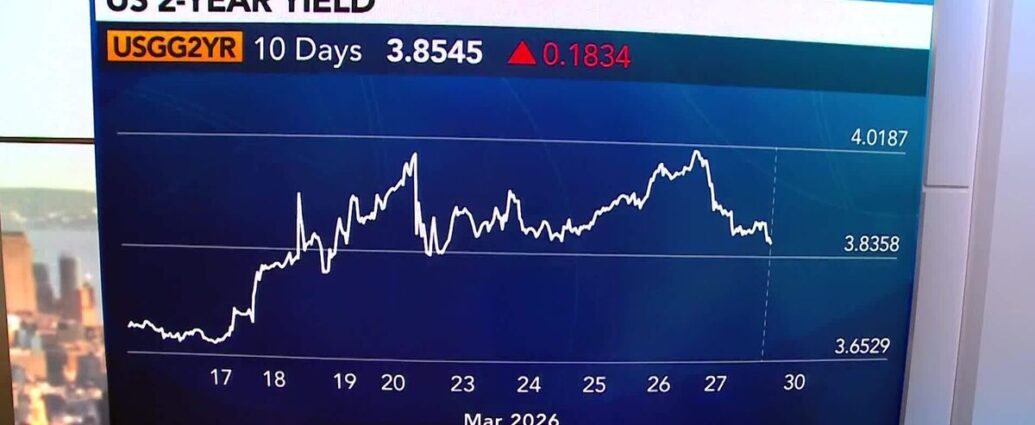
The U.S. 2-Year Treasury yield has surged approximately 50 basis points month-to-date to 3.86% — the largest one-month increase since October 2024.

Think of the 2-year yield as the bond market’s verdict on the Fed: it reflects, in real time, where investors believe interest rates will sit over the next two years, making it one of the most watched signals on Wall Street.

But the United States is the calmest story on the board.

Germany’s 2-year Bund yield has jumped roughly 64 basis points month-to-date to 2.64% — the sharpest …

Full story available on Benzinga.com

This post was originally published here. 

Micron Technology Inc. (NASDAQ:MU) shares continued their downward trajectory Monday.

This follows a volatile week triggered by Alphabet Inc. (NASDAQ:GOOGL) (NASDAQ:GOOG). Google recently unveiled TurboQuant, an AI memory compression algorithm.

The tool cuts memory requirements by six times. This development rattled the consensus AI trade of 2026. Peers like SanDisk Corp. (NASDAQ:SNDK) and Western Digital Corp. (NASDAQ:WDC) also faced selling pressure.

Analysts Debate “Demand Destruction” vs. Efficiency

Analysts remain divided on the long-term impact. Wells Fargo analyst Andrew Rocha noted …

Full story available on Benzinga.com

This post was originally published here

U.S. stocks traded mostly higher this morning, with the Dow Jones index gaining around 200 points on Monday.

Following the market opening Monday, the Dow traded up 0.44% to 45,364.88 while the NASDAQ rose 0.03% to 20,955.34. The S&P 500 also rose, gaining, 0.21% to 6,382.37.

Leading and Lagging Sectors

Utilities shares climbed by 1.3% on Monday.

In trading on Monday, industrials stocks fell by 0.7%.

Top Headline

Shares of Americas Gold and Silver Corporation (AMEX:USAS) fell around 13% on Monday after the company released earnings results for the fourth quarter.

The company reported fourth-quarter losses of 14 cents per share, versus market estimates of earnings of 4 cents per share. The company reported quarterly sales of $37.064 million which beat the analyst consensus estimate of $33.229 million.

Equities Trading UP
           

  • Bullfrog AI Holdings, Inc. (NASDAQ:BFRG) shares shot up 134% to $1.19 after the company announced a …

Full story available on Benzinga.com

This post was originally published here

Thieves made off with three paintings by Renoir, Cézanne and Matisse worth millions of euros (dollars) from a museum near the city of Parma in northern Italy, police said on Monday.

The heist took place on the night of March 22-23, with thieves forcing open the entrance door, police said.

The three stolen paintings are “Fish” by Auguste Renoir, “Still Life with Cherries” by Paul Cézanne, and “Odalisque on the Terrace” by Henri Matisse.

The Magnani Rocca Foundation, a private museum, lies in the heart of the countryside 20 kilometers (12 miles) from Parma.

Local media reported that the thieves were able to nab the paintings in less than three minutes and escape across the museum gardens.

Established in 1977, the foundation hosts the collection of the art historian Luigi Magnani and also includes works by Dürer, Rubens, Van Dyck, Goya and Monet.

The museum believes a structured and organized gang was responsible for the theft, which was interrupted by the alarm, local media reported.

The museum didn’t post any statement about the theft on its website and wasn’t reachable for a comment, as it is closed on Monday.

The crime in Parma comes after a series of high-profile heists at major European museums, including a major incident in October where thieves stole jewels and other items worth 88 million euros ($101 million) from the Louvre in Paris.

This story was originally featured on Fortune.com

At campaign launch, PM acknowledges concern over events in Ukraine and Iran as well as over rising cost of living

The 7 May elections are taking place against a backdrop of “war on two fronts”, Keir Starmer has said, as he pledged action to tackle the resurgent cost of living crisis.

Launching Labour’s English local elections campaign in Wolverhampton on Monday, the prime minister said: “We’re facing a war on two fronts – the Ukraine war, now four and a bit years in … and now the Iran war, which I know is causing huge concern.

Continue reading…

This post was originally published here

undefined

President Trump claims that there is no automatic guarantee to birthright citizenship in the Constitution. But, will that claim hold up in court?

This post was originally published here

Investors nervous over escalation of Middle East conflict as US president says he wants to ‘take the oil in Iran’

The price of oil hit nearly $117 (£89) a barrel on Monday as Donald Trump threatened to “blow up” and “completely obliterate” Iranian electricity plants, oilwells and its export hub Kharg Island if it did not agree to a deal.

Brent crude rose after the US president wrote on his social media platform Truth Social that if a deal was not agreed and the strait of Hormuz was not reopened, the US would take further action.

Continue reading…

This post was originally published here

Flow-on effect will depend on how quickly service stations sell more expensive fuel, experts warn, leaving Easter travel plans up in the air

Australians expecting relief from punishing fuel prices in time for Easter travel are set to be disappointed, with the industry predicting the effects of Labor temporarily halving the excise will take days or weeks to reach some bowsers around the country.

The halving of the fuel excise, which begins on Wednesday and lasts until the end of June, means the federal government will now collect 26.3c from every litre over the next three months instead of 52.6c a litre.

Continue reading…

This post was originally published here

The US president thumbs his nose at concerns about the most serious energy crisis in global history. But Australia, like other countries, is paying a high price

Gently, about 10 days ago, Anthony Albanese tried to send Donald Trump a message about the escalating war in Iran.

In a Hobart radio interview, the prime minister said the US had achieved its original justifications and should bring hostilities in the Middle East to an end.

Continue reading…

This post was originally published here

Jack Karlson’s rallying cry of ‘democracy manifest’ added to national collection of sound recordings that hold historical, cultural and aesthetic significance

Thirty-five years ago, when Jack Karlson was hauled into a police car outside a Chinese restaurant in Queensland, he couldn’t have known his bombastic speech would be watched by millions around the world, become a meme and now, be preserved for ever in Australia’s National Film and Sound Archive.

Karlson’s declaration – “Gentlemen, this is democracy manifest! … What is the charge? Eating a meal? A succulent Chinese meal?” – is one of nine pieces of audio that have been added to the NFSA’s Sounds of Australia collection this year, along with a pedestrian crossing signal and Missy Higgins’ 2004 hit Scar.

Continue reading…

This post was originally published here

Survey also found 65% of gen Z think ‘things are better if men do paid work and women do care work’

Younger fathers are more likely to cling to outdated ideas that frame men as the money earners and women as caregivers, new research has found.

The Australian State of the World’s Fathers report is based on a global survey of 8,000 parents, with 533 from Australia.

Continue reading…

This post was originally published here

Right-to-work advocates are cheering recent union setbacks at Wells Fargo as a sign that the Biden-era boom in interest for organized labor is over.

This post was originally published here

U.S. spot Bitcoin (CRYPTO: BTC) ETFs recorded $296 million in net outflows for the week ending March 27 amid the ongoing war between the U.S. and Iran.

The Single-Day Bleed

The weekly outflow stems from a $225.5 million exodus on March 27, the heaviest single-day bleed of the week, according to SoSoValue data. 

BlackRock’s IBIT (NASDAQ:IBIT) fund shed $201.5 million on that day alone, marking the largest single-fund outflow over the five-day trading period.

Total net assets for U.S. spot Bitcoin ETFs declined 7.5% from a March 23 peak of $91.7 billion to $84.8 billion by Friday’s close. 

The shift reversed recent positive momentum after several weeks of healthy inflows month-to-date.

Moreover, Ethereum (CRYPTO: ETH) investment products recorded the largest global withdrawals of $222 million, pushing year-to-date flows to a net outflow of $273 million—the weakest among major …

Full story available on Benzinga.com

This post was originally published here

Mikhail Khodorkovsky says Russian security services may seek to create a ‘sense of vulnerability’ in Britain

Vladimir Putin is likely to stage another Salisbury-style attack on UK soil unless the government adopts more aggressive tactics against the Kremlin, the exiled Russian billionaire Mikhail Khodorkovsky has said.

The former oil tycoon has emerged as a leading figure in Russian diaspora opposition circles and claims to be well-informed about current thinking and developments among Moscow’s elite.

Continue reading…

This post was originally published here

The U.S. war with Iran has led to a rise in oil prices, which was expected to provide a financial windfall for Russia. However, continuous Ukrainian drone attacks on Russia’s major export hubs have put a damper on these expectations.

When last checked, Brent crude oil was trading 2.89% higher at $108.46 per barrel.

Nearly 40% of Russia’s crude oil export capacity was halted on Wednesday, marking the country’s largest modern-era oil supply disruption, according to Reuters.

The attacks have compelled Moscow to review some exports and safeguard consumers, who are already grappling with high inflation. A major oil refinery in Yaroslavl, northeast of Moscow, was hit in a strike on Saturday, prompting the Kremlin to consider reinstating a gasoline export ban due to domestic fuel shortages.

Ukraine also carried out drone strikes on Russia’s major export hubs, targeting Novorossiysk, Primorsk, and Ust-Luga …

Full story available on Benzinga.com

This post was originally published here


A Matter of Perspective

Did you know that perspective was once “discovered”? It always existed, but for centuries, we didn’t know how to represent it. It wasn’t until the early Renaissance that artists like Filippo Brunelleschi unlocked the mathematical principles of perspective to accurately translate three-dimensional reality onto a flat surface.

In many ways, measuring embodied carbon mirrors that same journey. Translating the real-world complexity of buildings, their materials, sourcing, manufacturing, transportation, installation, use and eventual replacement into a model we can measure and analyze is one of the most complex challenges we face today. We rely on layers of abstraction: mathematics, coding, algorithms and databases to simulate multiple iterations and scenarios. And just like perspective, this modeling process is still evolving.

Means and Methods

When my interest in embodied carbon first started to grow, I noticed that most reports emphasized reductions, much like energy savings in energy models. That approach resonated with clients and the commercial real estate industry. But the question quickly became: reductions compared to what?

What is the universal benchmark? Is there an average per square foot? Should it vary by building type? And where were interior finishes in these studies? The truth was: there was no consensus. Defining system boundaries, scopes and baselines was messy and inconsistent. Believe me, we’ve lived through that confusion.

LEED v4 offered a starting point by requiring comparisons to a functionally equivalent baseline of the same size and scope. The Carbon Leadership Forum’s 2019 baseline guidance reinforced this need, while also spotlighting the overlooked impact of interiors. Though structural materials dominate new construction, tenant improvement projects, because of frequent renovations, can rival that impact over time, yet remain largely unsupported by standardized modeling practices.

Faced with these gaps, our team at BEYOND developed a methodology specifically designed for interiors. Like most things that involve calculations, it started with spreadsheets –  massive ones. We manually collected data from Environmental Product Declarations (EPDs), material take-offs and product specifications to piece together a working model.

At its core, our method revolves around these key principles:

  • Real project quantities. Using early design drawings to establish quantities ensures our baseline reflects actual project conditions.
  • Transparent baselines. We model the baseline to match the same size and scope as the proposed project.
  • Reliable carbon factors. We pull embodied carbon values from sources like industry-wide Environmental Product Declarations (EPDs), Carbon Leadership Forum baselines, One Click LCA databases and verified third-party studies.
  • Dynamic updates. As the design evolves, we continually refine the model from early design through bid documentation and all the way through post-value engineering reviews and construction.

This process helps us identify early opportunities where the biggest reductions can be made. For example, during one project, we discovered that 60% of the project’s embodied carbon stemmed from the carpet selection alone, driving us to prioritize low-carbon carpet options.

Lessons Learned: How Projects Made Them Real

Each project we’ve worked on has been an opportunity to refine our approach and better understand what truly drives embodied carbon reductions. The most important lessons we’ve learned come directly from experience:

For example, on the Lord Abbett project, our team was involved from the schematic design stage, working closely with the designers to specify materials and finishing below industry average values. This early alignment helped avoid last-minute compromises and contributed to the project avoiding over 1500 tons of CO₂e. Early collaboration makes all the difference.

“Less is more,” for many things in life, including embodied carbon. Steel and concrete are the usual suspects, but glass, aluminum and gypsum-based products often carry high embodied carbon values too. Identifying and minimizing their use when possible can make a major impact. On projects like Audible and Aspen, post-mortem assessments showed that glass components alone contributed significantly to overall carbon impacts, leading us to reconsider where and how these materials are used.

At Grant Thornton, an eight-story renovation project in Reading, London, reusing elements like glass partitions, carpet, ceiling finishes and access flooring became a core strategy. While these decisions were primarily carbon- driven, they ultimately deliver big budget savings along with a 75% reduction in embodied carbon, a powerful reminder that reuse, when thoughtfully implemented, is a quiet dynamo.

Generic assumptions only go so far. We now require product-specific EPDs for major material categories, especially flooring, ceiling systems and partitions. This pushes manufacturers to improve transparency and allows us to select materials with demonstrably lower global warming potential. We continue to work directly with manufacturers to better understand their products’ emissions. However, having an EPD, versus claiming your product is 90% recycled and powered by photovoltaics, makes a huge difference in credibility.

Transportation-related impacts aren’t always the biggest piece of the puzzle, but locally sourcing materials can still reduce emissions, and support local economies. For Clifford Chance’s NYC headquarters, the design team selected terrazzo with high recycled content of glass, and marble sourced within a 100-mile radius. These choices not only aligned with LEED, WELL, and overall sustainability goals but also contributed to the project’s 28% reduction in embodied carbon.

Plant-based Materials. Biobased products like wood, flax and plant-derived ceiling tiles often come with lower embodied carbon, and store carbon during their lifecycle. In the Skyfall project, combining repurposed access flooring with a palette of light, biobased finishes helped achieve a 78% reduction from baseline. If you’re an embodied carbon nerd, you might be suspicious of counting biogenic carbon storage as a sink that offsets anthropogenic emissions. And yes, there’s a lot of debate around it. We’ll discuss that another day. One thing I feel confident about is that equilibrium is key. If we only build with biobased materials, we’ll create imbalance, just as we have by relying too heavily on petrochemical-based products. Let’s be bold and explore more balanced, alternative solutions. This goes especially for manufacturers.

These five lessons have shaped our methodology and delivered tangible carbon reductions across a wide range of interior projects. We also recognize that as industry baselines improve over time, achieving large percentage reductions becomes harder, even though the design effort often increases. But this is a positive challenge that reflects real progress.

The Road Ahead

Our journey in modeling embodied carbon and using it as a tool to reduce global warming goes beyond specific strategies. It reflects a broader shift underway in our industry. More clients are setting carbon goals early. Designers are integrating embodied carbon into their decision-making, not as an afterthought but as a design driver. Manufacturers are stepping up with more transparent data and better products.

We can’t claim that we’ve perfected the method. Our approach continues to evolve with each project, each challenge and each conversation. But what we do see is progress. It is measurable, impactful and growing. Every baseline we define, every product we scrutinize and every kilogram of CO₂e we avoid brings us closer to a built environment that doesn’t just serve people, but also respects planetary boundaries.

The path to low-carbon design isn’t linear, just like the discovery of perspective. But it is becoming clearer with each project. And if these results are any indication, we’re heading in the right direction.

Read Part 1 of this series: The Fundamentals of Carbon.

Read Part 2 of this series: The Carbon Behind the Curtain.

This post was originally published here. 

Grayscale says crypto treasury firms are likely to remain a permanent fixture of the investing landscape as they diversify into new business lines.

DATs Stabilized Through Strategic Approaches

In a post on March 26, Grayscale head of research Zach Pandl noted that DATs surged last year as strong valuations enabled aggressive token accumulation and inspired similar firms.

However, by late 2025, momentum weakened as many shares traded below their underlying crypto values, raising questions about sustainability and even prompting concerns that some firms could be excluded from benchmark indices.

More recently, DATs have regained stability by improving capital structures, generating yield through staking and decentralized finance.

Examples include Strategy (NASDAQ:MSTR), which shifted its financing approach toward preferred …

Full story available on Benzinga.com

This post was originally published here

The Connecticut Sun have reached an agreement to sell the team to Rockets owner Tilman Fertitta and will move to Houston in 2027.

The WNBA Board of Governors still needs to approve the sale and the move. The Sun are being sold for a record $300 million, according to a person familiar with the deal.

The person spoke to The Associated Press on condition of anonymity because of the sensitive nature of the sale.

The team will play in Connecticut for the upcoming season before moving to Houston and becoming the Comets again.

“I would have loved to remain in the region for our fan base and for the fact that I think this region deserves a women’s basketball team,” Connecticut Sun president Jen Rizzotti told the AP. “At the same time, it wasn’t my decision and I’m at a point now where my focus turns to making this the best season we can have and a memorable one for our fans. It’s an opportunity to say thank you to them.”

This will end a 23-year run by the team in New England after the team moved to Connecticut from Orlando in 2003.

Houston was one of the groups that expressed interest in buying the team last year, eventually raising its bid to $250 million — the amount Cleveland, Detroit and Philadelphia paid for expansion fees. Now with the $300 million sale price, that’s the highest for which a team has been sold in WNBA history.

The Sun had an offer for $325 million from a group led by Celtics minority owner Steve Pagliuca that would have moved the franchise to Boston. The WNBA basically blocked that deal from happening by saying that “relocation decisions are made by the WNBA Board of Governors and not by individual teams.”

The league also went on to say that other teams had gone through the expansion process and had priority over Boston.

“This decision has always sat at the ownership level and we worked hard as a front office to make us New England’s WNBA team,” Rizzotti said. “Playing and selling out two games in Boston shows this is a market that can support a team at a significant level.”

WNBA Commissioner Cathy Engelbert said during a news conference to announce the three new expansion teams that Houston was up next.

Since Mark Davis bought the Las Vegas Aces in 2021, the league has added new owners that have some sort of NBA tie. Golden State, which came into the league last season, is owned by the Warriors. Portland and Toronto are coming into the WNBA this season and the ownership groups are connected to NBA teams.

The next three expansion teams — Cleveland, Detroit and Philadelphia — are all owned by NBA groups in those cities.

The WNBA just agreed to a new collective bargaining agreement last week where teams need to have top-notch facilities similar to those of NBA franchises.

Announcing the deal now allows the franchise to have clarity for potential free agents who could sign with the Sun next month.

“Morgan (Tuck) started last off season with the rebuild after our old roster turned over,” Rizzotti said of the Sun general manager. “She will now have clarity and strategic decisions regardless where it is if we remained in Connecticut or moving. With this new CBA in place, she can really evaluate the salary cap situation and build around the young core we established.”

The Houston Comets were one of the original franchises in the league that won the first four WNBA championships from 1997-2000. The franchise disbanded after the 2008 season.

“My family and I are thrilled for the opportunity to bring the Houston Comets back to this incredible city,” Rockets alternate governor Patrick Fertitta said. “Houston has a proud championship history in the WNBA, with banners from the Comets’ four historic championship seasons still hanging in the rafters of Toyota Center. We believe the time is right to begin the next great era of Comets basketball, and we look forward to working with the WNBA as we move through this process.”

The last WNBA team to move cities was the Las Vegas Aces, who relocated from San Antonio in 2017.

“What I don’t want people to forget is the Mohegan Tribe stepped up when nobody wanted a WNBA team and there were NBA owners folding franchises left and right,” Rizzotti said. “I hope that regardless of people’s feelings around this, they’ll remember that we had a really supportive ownership group that poured into the franchise for over two decades.

“The decision they made now doesn’t erase the fact they were there for the WNBA in a time of need and kept them going when it wasn’t as popular as it is now to have a franchise.”

This story was originally featured on Fortune.com

David Zaas will return to Duke Health as chief executive in May. Zaas served in various leadership roles at the health system for almost two decades.

This post was originally published here. 

Lantern Pharma Inc. (NASDAQ:LTRN) shares are trading higher Monday morning. The surge follows a volatile Friday where shares plummeted over 46%.

The company moved quickly to address what it termed “fabricated” information regarding its leadership.

Company Refutes False CEO Resignation

Lantern Pharma issued a statement late Friday to correct a third-party report. The report incorrectly claimed Panna Sharma had stepped down as President and CEO.

“This claim is false, entirely without basis, and appears designed to mislead investors,” the company stated. Lantern confirmed that Sharma remains fully engaged in his roles.

Board Maintains Full Confidence

The Board of Directors clarified they …

Full story available on Benzinga.com

This post was originally published here

Burglary arrest was James Farthing’s latest run-in with the law after winning the Powerball jackpot last year

A man who recently won a $167m Powerball lottery jackpot stands accused of stealing the relatively paltry sum of $12,000 after breaking into a house in his home state of Kentucky on Saturday, according to authorities who arrested him.

James Farthing’s arrest on Saturday on counts of burglary and illicit marijuana possession reportedly was at least his third since winning Kentucky’s most lucrative lottery prize ever.

Continue reading…

This post was originally published here

The debate over whether AI will kill enterprise software is missing the point entirely. Leaders from Intuit, Salesforce, Box, and others have all been quoted defending the role of SaaS in the emerging universe of AI. Thoma Bravo’s Holden Spaht recently argued, “Software is AI if you do it right.” I’d go further: SaaS and AI are not different things. This is all software. And some SaaS companies — not all, but some — with tremendous historic moats will be able to achieve a 1+1 = 3 by moving quickly to leverage AI.

The reason comes down to one thing: data.

The Architect and the Fuel

Imagine two architects. One has read every book ever written on structural engineering. The other has those same books — plus the blueprints, soil samples, and maintenance records for every building in a specific area for the last twenty years. Who do you trust to build a skyscraper on a fault line?

AI is an engine, and data is its fuel — but not all fuel is equal. Software built on generic, unstructured, unverified public internet data is essentially feeding AI low-grade kerosene. Software platforms that serve a specific purpose, handle mission-critical workflows, and have amassed trusted, proprietary data over long periods of time are running on the highest-octane fuel available. At Coupa, that means $9.5 trillion in proprietary transaction data — generated by more than 10 million buyers and suppliers conducting real business, in real time.

The Unfair Advantage

I’ve spent more than 20 years in enterprise technology — at Xerox, Oracle, SAP, and Ceridian before joining Coupa — and the companies that are winning today didn’t start their AI journey with the launch of ChatGPT three-and-a-half years ago. We started a decade ago, laying the foundation for this critical moment with machine learning and predictive analytics. For years, we’ve been “priming the pump”—using ML to clean data, categorize spend, and flag risk. The result is the difference between being a “bolt-on” and a “built-in.”

If a software vendor is just now discovering AI, they are essentially trying to install a jet engine on a horse-drawn carriage. The structural integrity isn’t there. The companies that will win are those that have been building the data foundation for this moment and are moving fast to incorporate AI into the core of the product.

There will be a clear divergence in the market:

  • The Losers: SaaS providers that function as thin UI wrappers over public models. They lack the deeply embedded workflows necessary to deliver tangible customer value, and they won’t evolve fast enough to compete.
  • The Winners: SaaS providers with domain expertise, deeply embedded workflows, and the ability to autonomously manage mission-critical actions — tax compliance, supply chain resiliency, fraud detection — while also supporting customers in transforming their workforce. Great technology that people resist using simply becomes shelfware.

The Move to Outcomes

We are seeing a fundamental shift in how software is bought and sold. The “seat license” is a dated concept. Why should a company pay for a password when they should be paying for a result?

Forward-thinking leaders are already adopting pricing models focused on outcomes. If our AI identifies $10 million in duplicate invoicing — and our customers have already realized over $300 billion in cumulative lifetime savings on the Coupa platform — our revenue should reflect that realized value, not just how many employees have a password.

The timing of this total transformation — technology and workforce alike — remains uncertain, but the velocity is staggering. Software vendors that only recently started their AI transitions may find themselves at a disadvantage. For organizations that plan to win, innovation has to start with data. The future doesn’t belong to the smartest model — it belongs to the software that has the best data and the deepest roots in a company’s daily operations.

The opinions expressed in Fortune.com commentary pieces are solely the views of their authors and do not necessarily reflect the opinions and beliefs of Fortune.

This story was originally featured on Fortune.com

Vice-president promises ‘to get to the bottom of’ reports of US government files about unidentified flying objects

JD Vance, the vice-president of the United States, said this weekend that he considers aliens to be “demons”.

As the war in Iran continues, petrol and grocery prices soar and chaos continues at US airports as a partial government shutdown endures, Vance appeared on the conservative Benny Show podcast, released Saturday, to promise that he would spend time looking into what he called his “obsession” with UFOs and extraterrestrial visitors.

Continue reading…

This post was originally published here

Treasury Secretary Scott Bessent indicated optimism about a reopening of the Strait of Hormuz for passage of cargo ships and said the administration is steadily moving to address the shortage of global oil supplies.

“Over time, the US is going to retake control of the straits, and there will be freedom of navigation — whether it is through US escorts or a multinational escort,” Bessent said in an interview Monday on Fox News.

Bessent said the global oil market is “in deficit about 10 to 12 million barrels a day, and we’re making up for that deficit.” The International Energy Agency’s coordinated release of strategic reserves amounts to about 4 million barrels a day toward that deficit, he said.

The Treasury chief also pointed to the Trump adminstration’s move to unsanction Russian and Iranian oil “that was already on the water.” He argued that this decision didn’t net either US rival additional funds, saying that there was “no extra money for either one of those regimes.”

Asked about fears of renewed disruption to supplies via the Red Sea, due to activity on the Iranian-backed Houthi militant group, Bessent said, “The Houthis have been very quiet so far.” 

Houthis launched ballistic missiles at Israel on Saturday, and Bessent said their shelling “was Israel specific.” With regard to the Red Sea, Bessent indicated that “they’ve been pretty quiet so far, and I would expect them to likely remain that way.”

This story was originally featured on Fortune.com

Five miles from their former city zoo, seven gorillas are exploring their new ‘African forest’ home

It has been an eventful few months for Bristol’s gorillas. The troop made headlines around the world when an urban explorer snapped pictures of them looking downbeat in their old, almost deserted home near the city centre. Then they were moved – under armed police escort – to a new out-of-town base and promptly suffered a shock bereavement.

On Monday, in warm spring sunshine, the western lowland gorillas were to be found exploring a new woodland habitat at Bristol Zoo Project, five miles from their former city home. They clambered up the horse chestnut tree, as tall as a three-storey building, sampled the green shoots of a hawthorn and scanned the floor for treats.

Continue reading…

This post was originally published here


Good morning, everyone, and welcome to another working week. We hope the weekend respite was relaxing and invigorating because that oh-too-familiar routine of meetings, deadlines, and the like has returned with a vengeance. You knew this would happen, yes? To cope, we are relying, as always, on cups of stimulation. Our choice today is peach ginger. Feel free to join us. Remember, no prescription is required. Meanwhile, here are some tidbits to help you along. Best of luck today on your journey, which we hope will be meaningful and productive. And, of course, do keep in touch. …

The White House has drafted legislative text for its drug pricing policy, and officials are in the process of sharing it with more than a dozen major pharmaceutical companies, according to STAT. The legislative text closely follows the outlines of the voluntary deals the administration made with drugmakers. The draft includes a policy that would allow drugs purchased in cash to count toward a patient’s insurance deductible. The Trump administration’s push for drug price legislation is part of a larger effort to get health reforms signed into law. The president’s focus on his affordability agenda in an election year has heightened the profile of the effort. Still, despite the White House digging in to get Congress to pass its plan, lawmakers have little appetite for major changes and there is no clear path to passage.

Eli Lilly wants the U.K. government to regularly raise National Health Service drug prices ​and phase out a multi-billion-dollar rebate scheme if ‌it is to resume investment, The Financial Times reports. Patrik Jonsson, international businesses president at the company, said he was in talks with U.K. ministers and ​was “optimistic” about reaching an agreement by the ⁠summer for the government to pay more for ​its medicines. The discussions also cover “innovative” pricing plans that would link payments for ​anti-obesity drugs to whether patients become well enough to return to work. Medicine prices in the U.K. had been “far too low for far too ​long, and even with the current threshold, we ​are not back to where we started more than 20 years ‌ago,” he maintained.

Continue to STAT+ to read the full story…

This post was originally published here. 

Cargo of tofu was spilled in highway accident near town of Jerome and left to ripen and rot in the open for weeks

A staggering 40,000lbs of extra-firm tofu was spilled in an accident near a small town in Missouri and left in the open for weeks, creating a smell that local officials called “unforgettable”.

The cleanup – dubbed the “Great Battle of the Jerome Tofu Monster” – began near the town of Jerome, in south-western Missouri, on 1 March, when a tractor-trailer vehicle with a cargo of tofu crashed off a local highway and plunged into a ravine.

Continue reading…

This post was originally published here

System1 Inc. (NYSE:SST) shares are trading lower Monday morning. The stock is retreating from a massive rally during the previous session.

Nasdaq futures are up 0.77% while S&P 500 futures have gained 0.77%.

Technical Reversal Follows Massive Gains

The stock skyrocketed 142.34% on Friday to close at $3.32. This move occurred without a specific news catalyst on that day. The premarket reversal indicates traders are likely taking profits after the volatile spike.

Recent Earnings Performance

On March 11, the company reported a fourth-quarter loss of $1.65 per share. This result beat the analyst loss consensus estimate of $2.02 by 18.32%.

However, …

Full story available on Benzinga.com

This post was originally published here

Ripple CTO David Schwartz told a “completely made up, hypothetical story” in 2023 where an unnamed exchange demanded millions of dollars to list XRP (CRYPTO: XRP), with the token later accounting for 20% of the exchange’s revenue after Ripple struck a deal.

The Hypothetical That Wasn’t So Hypothetical

In May 2023, Schwartz posted a cryptic tweet saying the story of Coinbase (NASDAQ:COIN) listing XRP was “the only story I most wish I could tell that I can’t.”

A month later, he followed up with a disclaimer that he was about to tell a “completely made up, hypothetical story” where any resemblance to real exchanges was “entirely coincidental.”

In his hypothetical, an unnamed exchange refuses to list XRP even though doing so …

Full story available on Benzinga.com

This post was originally published here

Wayfair Inc. (NYSE:W) shares fell in Monday’s premarket session. This follows a 2.99% decline on Friday. While broader markets show strength, internal selling weighs on the e-commerce giant.

Nasdaq futures are up 0.69% while S&P 500 futures have gained 0.73%.

Massive Insider Share Offload

Recent filings show heavy selling by top brass. CEO Niraj Shah sold 109,389 shares at a $77.19 weighted average. He also offloaded 10,611 additional shares. These transactions left him with 49,137 direct shares.

Director Joins Selling Spree

Director Steven Conine mirrored these moves. Conine sold 109,606 shares at …

Full story available on Benzinga.com

This post was originally published here

  • Human rights group says US is facing an ‘emergency’

  • ICE director said agency will play ‘key part’ at tournament

Amnesty International has warned that the World Cup, spread across three North American countries, risks becoming a “stage for repression”. The human rights organisation published a report on Monday – “Humanity Must Win” – calling on Fifa and the host countries, the US, Canada and Mexico, to take urgent action to protect fans, players and other communities.

Fifa has promised a tournament where everyone “feels safe, included and free to exercise their rights”. But Amnesty said that pledge sat in “stark contrast” to conditions in all three host nations, especially the US, which hosts three-quarters of the 104 matches.

Continue reading…

This post was originally published here

As of March 30, 2026, two stocks in the energy sector could be flashing a real warning to investors who value momentum as a key criteria in their trading decisions.

The RSI is a momentum indicator, which compares a stock’s strength on days when prices go up to its strength on days when prices go down. When compared to a stock’s price action, it can give traders a better sense of how a stock may perform in the short term. An asset is typically considered overbought when the RSI is above 70, according to Benzinga Pro.

Here’s the latest list of major overbought players in this sector.

APA Corp …

Full story available on Benzinga.com

This post was originally published here

Apple Distribution International, based in Ireland, made payments worth £635,000 to a Russian streaming service

The UK government has fined a subsidiary of Apple £390,000 for breaching sanctions against Moscow over payments it made to a Russian streaming platform.

Apple Distribution International (ADI), based in the Republic of Ireland, instructed an unnamed UK-based bank to make two payments to a company owned by a sanctioned Russian entity.

Continue reading…

This post was originally published here


In response to an opinion piece from the American Hospital Association, Dr. Catherine Gaffigan, president of health solutions at Elevance, defends the company’s new facility administrative policy.

This post was originally published here. 

As of 8:30 a.m. Eastern Time today, oil sold for $111.10 per barrel (using Brent as the benchmark, which we’ll get into momentarily). That’s 16 cents lower than yesterday morning and a $37.69 rise over the past year.

Oil price per barrel % Change
Price of oil yesterday $111.26 -0.14%
Price of oil 1 month ago $73.61 +50.93%
Price of oil 1 year ago $73.41 +51.34%

Will oil prices go up?

It’s impossible to predict the future of oil prices. Several factors determine the movement of oil, but it ultimately boils down to supply and demand. Again, when threats of economic downturn, war, etc. are high, the oil trajectory can turn rapidly.

How oil prices translate to gas pump prices

When you pay for gas at the pump, you’re paying for more than just the crude oil itself; you’re also springing for links along the chain, such as the refineries and wholesalers—not to mention taxes and local gas station markups.

Still, the crude oil aspect affects the final price most dramatically, as it typically accounts for more than half the price per gallon. When oil prices spike, so do gas prices. And frustratingly, when oil prices drop, gas prices tend to take their time drifting down to the lower price (sometimes referred to as “rockets and feathers”).

The role of the U.S. Strategic Petroleum Reserve

In case of emergency, the U.S. has a store of crude oil known as the Strategic Petroleum Reserve. Its primary purpose is energy security in case of disaster (think sanctions, severe storm damage, even war). But it can also go a long way toward softening crippling price hikes during supply shocks.

It’s not a long-term answer—more of an immediate relief to assist the consumer and keep critical parts of the economy running, like key industries, emergency services, public transportation, etc.

How oil and natural gas prices are linked

Oil and natural gas are both major energy fuels. A big change in oil prices can affect natural gas by extension. For example, if oil prices increase, some industries may swap natural gas for some segments of their operations where possible—which increases demand for natural gas.



Historical performance of oil

When examining oil’s performance, there are generally two major benchmarks:

  • Brent crude oil is the main global oil benchmark.

  • West Texas Intermediate (WTI) is the main benchmark of North America.

Between the two, Brent better represents global oil performance because it prices much of the world’s traded crude. And, it’s often the best way to track historical oil performance. In fact, even the U.S. Energy Information Administration now uses Brent as its primary reference in its Annual Energy Outlook.

Looking at the Brent benchmark across several decades, oil has been anything but steady. It’s seen spikes due to factors such as wars and supply cuts, and it’s also seen crashes from global recessions and an oversupply (called a “glut”). For example:

  • The early 1970s brought the first big oil shock when the Middle East cut exports and imposed an embargo on the U.S. and others during the Yom Kippur War.
  • Prices dropped in the mid-1980s for reasons such as lower demand and more non-OPEC oil producers entering the industry.
  • Prices spiked again in 2008 with increased global demand, but it soon plummeted alongside the global financial crisis.
  • During the 2020 COVID lockdown, oil demand collapsed like never before—bringing prices below $20 per barrel.

All to say, oil’s historical performance has been anything but smooth. Again, it’s hugely affected by wars, recessions, OPEC whims, evolving energy initiatives and policies, and much more.

Energy coverage from Fortune

Looking to stay up-to-date regarding the latest energy developments? Check out our recent coverage:

Frequently asked questions

How is the current price of oil per barrel actually determined?

The current price of oil per barrel depends largely on supply and demand, including news about potential future supply and demand (geopolitics, decisions made by OPEC+, etc.). In the U.S., prices also move based on how friendly an administration is to drilling, as it can affect future supply. For example, 2025 saw the Trump administration move to reopen more than 1.5 million acres in the Coastal Plain of the Arctic National Wildlife Refuge for oil and gas leasing, reversing the Biden administration’s policy of limiting oil drilling in the Arctic.

How often does the price of oil change during the day?

The price of oil updates constantly when the “futures” markets are open. A futures market is effectively an auction where people agree to buy or sell oil in the future. As long as people and companies are trading contracts, the oil price is changing.

How does U.S. shale oil production affect the current price of oil?

In short, shale is rock that contains oil and natural gas. Think of shale as energy yet to be tapped. The more shale the U.S. accesses, the more energy we’ll have—and the more easily oil prices can keep from spiking as much thanks to a greater supply.

How does the current price of oil impact inflation and the broader economy?

When oil is expensive, it tends to make everyday items cost more. This can be related to energy (your heating, gas utilities, etc.), but it’s also due to the logistics involved with making those items accessible to you. Shipping, for example, can affect the price of things at the grocery store, as it’s more expensive to get those products from warehouses and farms onto the shelf.

This story was originally featured on Fortune.com

Figures shows 42% of callers to Refuge identify former partner as abuser, but only 12% of adults recognise this possibility

The risk posed to women by ex-partners in cases of abuse is underestimated by large swathes of the British public, according to the charity Refuge.

Data from the charity’s helpline found that 42% of people who call Refuge for help identify a former partner as their abuser, a statistic which underlines how common it is for an ex to be a cause of harm after a relationship has ended.

Continue reading…

This post was originally published here

Good morning!

It’s one of the biggest questions leaders are facing in the age of AI: How do you incentivize workers to actually use the tech that might replace them? One London-based company thinks it has the answer, and is offering employees an “AI salary bump” on top of their annual raise.

Starting in April, managers at marketing automation platform Omnisend will award standout AI users with a 2% to 4% raise, said Bernard Meyer, Omnisend’s head of AI operations. The company has budgeted for all of their 250 employees to receive the salary increase at some point—though not everyone will get it in April, he said.

In order to get the raise, employees will be evaluated on three criteria: AI-generated time and cost savings; a tangible, outcome-based impact their AI workflow gave the company; and widespread adoption of the AI workflow they developed. Whether an employee has succeeded in these areas—and, therefore, earns the raise—is up to their manager, Meyer said.

“Before, [the focus of employees using AI] was for individual productivity and now, the focus is on impact,” Meyer says. “People are really just hustling.” 

He says he doesn’t expect more than 60% of Omnisend’s workers to receive the raise this go-around, but adds that employees will be re-evaluated on a quarterly basis. One of the best parts about this program, he says, is that it will give Omnisend benchmarks of AI proficiency to measure new hires against. New hires should be able to demonstrate an AI usage similar to or higher than existing employees who received the salary bump.

How is Meyer quantifying the expected ROI of this new program? He says he doesn’t have a great answer right now. But he points to recent Omnisend AI successes as things he’d like to see more of: For example, Omnisend’s sales team has a goal of following up on leads sent their way within 24 hours. Before using AI, the team’s success rate was at 20%, but now, the number is closer to 100%, he says.

One thing he is sure on: This salary bump approach is more solid than vaguely measuring how AI impacts worker productivity.

“I think that people feel so overwhelmed by all of the AI that’s happening,” Meyer says. “We also have generally vague directions from leadership in different companies saying that you should use AI to be more productive, but no one knows what it means in actuality…The salary bump gives people that extra bit of motivation.”

Kristin Stoller
Editorial Director, Fortune Live Media
kristin.stoller@fortune.com

This story was originally featured on Fortune.com

Advanced Micro Devices Inc. (NASDAQ:AMD) is showing significant relative strength, jumping into the top tier of Benzinga Edge’s momentum score, rising from 89.98 to 91.48 week-on-week.

What Does Momentum Ranking Entail?

This technical momentum—which measures the stock’s relative strength based on price movement patterns and volatility over multiple timeframes—aligns with a highly bullish outlook from UBS.

The firm maintained a $310 price target on the stock, representing an approximate 54% upside from Friday’s close of $201.99.

Benzinga Edge’s Stock Rankings data shows the stock is in an upward price trend across short, medium, and long-term timeframes—spanning from the last couple of months to the past year.

Beyond AI accelerators, UBS highlights that AMD remains very bullish on its CPU business, seeing upside to a long-term financial model of 18% market compound annual growth rate (CAGR) from both units and average selling prices.

Furthermore, the company boasts a growth ranking in the 97.53th percentile, measuring its combined historical expansion in earnings and revenue.

This post was originally published here

Spain’s defence minister confirms move and describes US-Israel war on Iran as ‘profoundly illegal and unjust’

Spain has ramped up its opposition to the US-Israel war on Iran by closing its airspace to US aircraft involved in attacks, underlining its position as Europe’s leading critic of the conflict.

The move, first reported by El País newspaper and confirmed by the defence minister on Monday, comes after Madrid said the US could not use jointly operated military bases in the country for operations related to the war.

Continue reading…

This post was originally published here

HM chief inspector Andy Cooke says multi-agency approach is needed to cut poverty and increase opportunities

The best way to stop people becoming criminals is to reduce poverty, target prevention strategies at young people, and increase opportunity, his majesty’s chief inspector of constabulary has said.

Sir Andy Cooke, who is preparing to leave his post and retire after 40 years in policing, told the Guardian that his decades of experience taught him that crime was a “symptom of deeper societal failures”.

Continue reading…

This post was originally published here

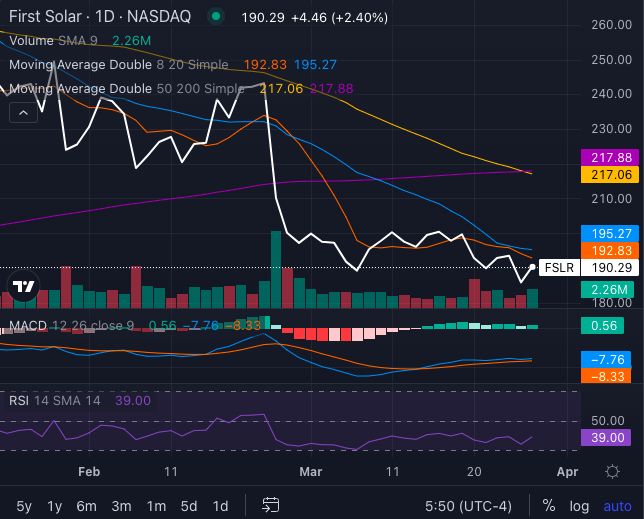
A clean chart breakdown is one thing — but when it collides with a new competitive threat, markets tend to pay attention. That’s exactly where First Solar, Inc. (NASDAQ:FSLR) finds itself now: flashing a Death Cross just as Tesla, Inc. (NASDAQ:TSLA) starts turning its solar ambitions into something far more tangible.

Momentum just snapped — and the chart isn’t being subtle about it.

Chart created using Benzinga Pro

FSLR stock has triggered a death cross, with its 50-day moving average slipping below the long-term 200-day moving average — a classic bearish signal that typically appears when trends roll over, not before. The stock is already down over 33% from its last peak on Dec. 22, and the latest setup suggests this isn’t …

Full story available on Benzinga.com

This post was originally published here

Phreesia, Inc. (NYSE:PHR) will release earnings for its fourth quarter after the closing bell on Monday, March 30.

Analysts expect the Wilmington, Delaware-based company to report quarterly earnings of 7 cents per share, up from 18 cents per share in the year-ago period. The consensus estimate for Phreesia’s quarterly revenue is $126.62 million (it reported $109.68 million last year), according to Benzinga Pro.

On March 16, Phreesia announced refinancing of bridge loan with a new $275 million revolving credit facility.

Phreesia shares fell 5.8% to close at $10.98 on Friday.

Benzinga readers can access the latest analyst ratings on the Analyst Stock Ratings page. Readers can sort by stock ticker, company name, analyst firm, rating change or other variables.

Let’s have a look at how Benzinga’s most-accurate analysts have rated …

Full story available on Benzinga.com

This post was originally published here

TD Synnex Corporation (NYSE:SNX) will release earnings for its first quarter before the opening bell on Tuesday, March 31.

Analysts expect the company to report earnings of $3.31 per share. That’s up from $2.80 per share in the year-ago period. The consensus estimate for quarterly revenue is $15.65 billion. TD Synnex reported $14.53 billion last year, according to Benzinga Pro.

With the recent buzz around TD Synnex, some investors may be eyeing potential gains from the company’s dividends too. As of now, TD Synnex has an annual dividend yield of 1.22%. That’s a quarterly dividend amount of 48 cents per share ($1.92 a year).

Want to earn $500 monthly from TD Synnex? Start with the yearly target of $6,000 ($500 x 12 months).

Next, divide this amount by TD Synnex’s $1.92 dividend: $6,000 / $1.92 = 3,125 shares.

So, an investor would need …

Full story available on Benzinga.com

This post was originally published here

U.S. stock futures were higher this morning, with the Dow futures gaining around 150 points on Monday.

Shares of Avis Budget Group Inc (NASDAQ:CAR) fell sharply in pre-market trading.

Avis Budget Group filed a prospectus to offer and sell up to 5 million shares of common stock.

Avis Budget shares dipped 9.6% to $134.10 in pre-market trading.

Here are some other stocks moving lower in pre-market trading.

  • Artelo Biosciences Inc (NASDAQ:ARTL) tumbled 22.5% to $8.05 in pre-market trading after jumping 230% on Friday. Artelo Biosciences announced a $11.0 million private placement priced at-the-market …

Full story available on Benzinga.com

This post was originally published here


  • In dollar terms, there’s $347 billion worth of stale listings in the U.S.,  more than ever before for this time of year. That’s because there are hundreds of thousands more home sellers than buyers, leading to homes sitting on the market. 
  • Stale inventory is most common in Florida, and least common in the Bay Area.
  • Through Redfin’s new partnership with Compass, sellers can work to avoid stale listings by testing the market, which could reduce the risk of homes lingering on the market. 

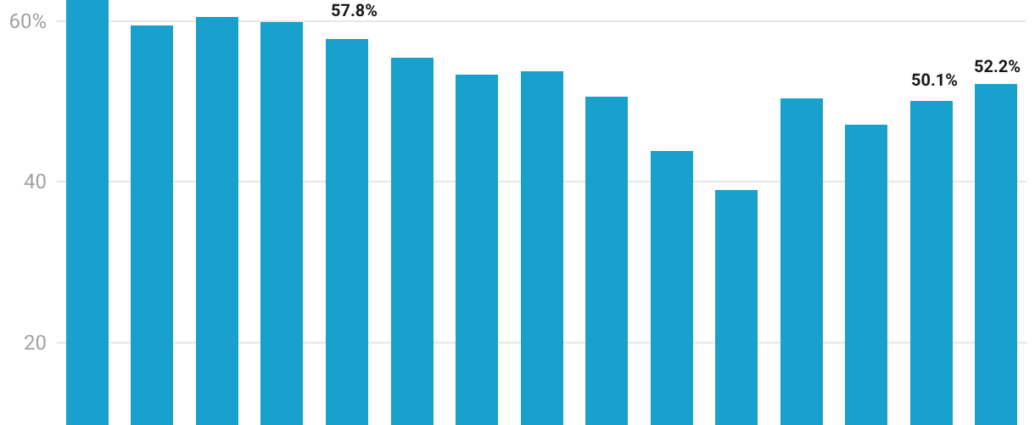
More than half (52.2%) of February’s home listings were on the market for at least 60 days without going under contract (i.e. they were stale) nationwide, up from 50.1% a year earlier and the highest share since 2019.


This is based on an analysis of listings on Redfin.com going back through 2012. For the total dollar value of all inventory on the market, we sum up the list price of all active U.S. listings as of the last day of each month; February 2026 is the most recent month for which data is available. We define “stale inventory” as home listings that spend at least 60 days on the market and are actively listed for sale on the final day of the relevant month. This data is seasonal, which is why we compare February to past Februarys. Please see the end of this report for more on methodology. 

Home Sellers Are Sitting on $347 Billion Worth of Stale Listings, a Record High For This Time of Year


In dollar terms, there’s a total of $347 billion worth of stale inventory on the market nationwide. That’s up 4.3% annually and the highest dollar amount on record for this time of year. 

Stale Inventory Is Worth $347B, A Record High For February (Column Chart)


There’s a Total of $636 Billion Worth of Homes For Sale in the U.S. 


Zooming out to all inventory, there’s a total of $636 billion worth of homes for sale, essentially unchanged from a year earlier. Like stale inventory, that’s the highest dollar amount on record for this time of year (except 2025, when it was 0.01% higher).  

Home Sellers Are Sitting on $636B in Total Inventory (Column Chart)


The total value of stale inventory–and all inventory–is higher than ever for this time of year because there are a record 630,000 more home sellers than buyers in the market, lengthening the amount of time it takes to sell a home. Here are more details:

  • Homebuying demand is slow. U.S. home sales fell 3.1% year over year in February. House hunters are wary of high mortgage rates and high prices, and they’re jittery because of economic uncertainty, including fears about layoffs, inflation and the Iran war.
  • Home selling is chugging along. The total number of homes for sale is up 1.5% year over year. While some sellers have backed off, many are still in the market, hoping to cash in on still-high home values. 
  • Days on market are at a record high. The typical home that went under contract in February spent 66 days on the market–the slowest pace in a decade for this time of year. 
  • Home prices are rising. The median home-sale price is up roughly 1% year over year. When home prices increase, so does the total dollar value of homes for sale, and the total dollar value of stale inventory. 

“Sellers know it’s a buyer’s market, but they still want to get as much money as they can for their home. So they list on the high end, expecting buyers to negotiate down, and that’s leading to listings staying on the market for a long time,” said Jason Gale, a Redfin Premier agent in New Orleans. “There are still deals to be made, but nine times out of 10, homes are selling for under their asking price. But sometimes, the price is just too high, and sellers have to pull their home off the market after six months or so.”  

Stale Listings Are Most Common in Miami 


In Miami, nearly two-thirds (62.6%) of home listings are stale, the biggest share of all the major U.S. metros. Next come San Antonio (58.3%), Pittsburgh (58.1%) and West Palm Beach (55.9%).

Listings are going stale in those places because they are major buyer’s markets; in Miami, San Antonio and West Palm Beach, there are more than twice as many home sellers as buyers. 

Stale listings are least common in the Bay Area. In San Jose, 19.8% of listings are stale, the smallest share among the major metros, followed by San Francisco (24%) and Oakland (31.1%). Next come Anaheim, CA (34%) and Seattle (34.1%). Most of those are buyer’s markets, but to a much smaller degree than the Florida metros listed above; for instance, in San Jose, there are just 10% more sellers than buyers. San Francisco is a balanced market, with a roughly equal number of sellers and buyers. 

Letting Home Sellers Test the Waters Before Listing Could Help Them Sell Faster


Homes lingering on the market can have negative effects for sellers; sometimes, buyers are wary of homes that have been on the market for a long time. 

That’s one reason Redfin partnered with Compass on phased marketing, which gives sellers more flexibility in how they introduce their homes to prospective buyers. Sellers can choose to display their homes on Redfin.com with no days on market, no price history and no home valuation estimates.

That allows sellers to gauge early interest in their property and price correctly from the beginning, which we found could help sellers in a few ways:

  • Lower the risk of listings going stale. Sellers who test pricing strategies with phased marketing may be less likely to see their homes sit on the market. Overpricing your home by 10% or more can increase time on market by more than a month. 
  • Lower the risk of losing money from a price drop. Sellers who test pricing using phased marketing may be less likely to lose money via a price cut. Redfin economists estimate that homes sell for less when they have a price cut due to the stigma. 
Metro-Level Summary: Stale Home Listings, Feb. 2026

Home listings are “stale” if they have been on the market for at least 60 days without going under contract 

U.S. metro area Total dollar value of stale inventory Share of home listings that are stale
Anaheim, CA  $3,804,979,477 34.0%
Atlanta, GA  $6,967,001,572 51.2%
Austin, TX  $4,235,317,502 53.4%
Baltimore, MD  $1,263,200,842 47.7%
Boston, MA  $2,754,374,299 38.7%
Chicago, IL  $3,158,224,864 40.9%
Cincinnati, OH  $1,048,562,696 45.6%
Cleveland, OH  $610,000,680 49.5%
Columbus, OH  $993,323,978 44.8%
Dallas, TX  $5,947,277,162 49.3%
Denver, CO  $2,733,851,592 40.3%
Detroit, MI  $463,118,430 54.0%
Fort Worth, TX  $2,310,252,422 50.6%
Houston, TX  $7,687,421,473 54.5%
Indianapolis, IN  $1,104,438,728 53.5%
Jacksonville, FL  $2,546,738,082 51.3%
Las Vegas, NV  $3,906,105,308 51.3%
Los Angeles, CA  $13,531,277,797 44.1%
Miami, FL  $15,894,396,237 62.6%
Milwaukee, WI  $508,495,433 36.3%
Minneapolis, MN  $1,963,662,229 43.7%
Montgomery County, PA  $857,609,898 43.3%
Nashville, TN  $5,190,002,567 54.8%
Nassau County, NY  $3,522,293,691 49.2%
New Brunswick, NJ  $2,152,388,676 47.1%
New York, NY  $16,939,740,119 55.1%
Newark, NJ  $1,006,363,900 46.1%
Oakland, CA  $903,312,534 31.1%
Orlando, FL  $4,222,334,231 55.7%
Philadelphia, PA  $1,179,569,999 52.6%
Phoenix, AZ  $10,150,809,424 46.1%
Pittsburgh, PA  $1,158,245,883 58.1%
Portland, OR  $2,100,910,565 48.3%
Providence, RI  $796,842,587 43.4%
Riverside, CA  $5,505,718,830 48.8%
Sacramento, CA  $1,665,099,987 41.8%
San Antonio, TX  $3,365,734,572 58.3%
San Diego, CA  $2,960,305,403 37.7%
San Francisco, CA  $687,464,464 24.0%
San Jose, CA  $524,074,518 19.8%
Seattle, WA  $2,237,074,918 34.1%
Tampa, FL  $5,980,820,981 53.4%
Virginia Beach, VA  $977,175,816 43.6%
Warren, MI  $1,093,257,329 46.2%
Washington, DC  $3,748,942,561 43.9%
West Palm Beach, FL  $11,599,537,794 55.9%
United States of America $347,358,012,659 52.2%

Methodology


This report is based on an analysis of listings on Redfin.com going back through 2012. For the total dollar value of all inventory on the market, we sum up the list price of all active U.S. listings as of the last day of each month; February 2026 is the most recent month for which data is available. Listings are included in the total if they were added on or before the last day of the month, and are still active (not sold or delisted) as of the last day of the month. Listings were excluded if the list price was higher than $300 million. 

For the purposes of this report, the term “value” is interchangeable with “asking price”; i.e., when we refer to “total home value,” we mean the sum of all list prices. 

For the stale inventory section of this report, we define “stale inventory” as home listings that spend at least 60 days on the market and are actively listed for sale on the final day of the relevant month. Listings that have been on the market for more than one year are excluded from the analysis.

The data in both the dollar value and stale inventory sections of this report tend to be seasonal; they are generally higher during the spring and summer, and lower in the winter. 

The post Over Half of Home Listings Have Been Lingering on the Market For More Than 2 Months appeared first on Redfin Real Estate News.

This post was originally published here. 

Many corners of finance—stock exchanges, banks, and payments firms—are embracing digital assets, but the private credit industry has largely stayed away from the crypto craze. The startup Valinor aims to change this, and on Monday, the company announced that it’s raised $25 million to put private credit on the blockchain. 

Castle Island Ventures led the seed round, which also included the crypto arm of marquee trading firm Susquehanna; Maven 11; and the founders of Bitcoin-mining-turned-AI company TeraWulf. Connor Dougherty and Lily Yarborough, the cofounders of Valinor, declined to specify at what valuation they raised their capital.

“I think what these guys are doing is really just like being … the translation agent between these two industries,” said Sean Judge, general partner at Castle Island Ventures, in reference to the crypto and private credit sectors.

Crypto and private credit

Wall Street already has a growing list of “translation agents” positioning themselves as go-betweens crypto and finance. Those include the Nasdaq and New York Stock Exchange, which are exploring tokenizing stocks, or putting company shares into blockchain wrappers. Banks are experimenting with tokenizing deposits. And asset managers are putting funds, including money-market funds, on the blockchain. There are also crypto-literate startups like Alpaca, which recently raised a $150 million Series D round to challenge Interactive Brokers.

Dougherty and Yarborough believe they can leverage their traditional finance pedigrees to become crypto’s go-between for yet another Wall Street category. The two started their careers as analysts at banks; moved to the private credit arm of asset manager Blackstone to work as investors; and in 2022 made the jump into crypto at a digital asset investment fund.

Two years later, the pair founded the first iteration of Valinor. Yarborough described their initial venture as focused purely on lending to crypto businesses. Eventually, she and Dougherty decided that, in addition to lending to blockchain companies, they could use blockchains themselves to make the lending process more efficient. “We realized there was a real opportunity to use crypto technology to be a more effective lender,” said Yarborough.

When it comes to private credit, large institutions typically rely on a chain of humans to check and verify each other’s work. Take, for example, a $50 million revolving credit line. Every week, a company can take out millions of dollars. If the firm repays a certain amount, it can borrow another sizable sum. It’s a rules-based process, but private credit firms use a combination of spreadsheets and humans to make it work. Dougherty and Yarborough believe that smart contracts, or blockchain-based programs that automatically route money depending on whether certain conditions are met, can replace existing systems. “Especially at a private credit firm, you’ve always had someone who’s actually pushing the wire button,” said Dougherty.

Valinor has already employed blockchain technology to spin up loans for a handful of fintech and crypto companies, said Dougherty. His firm, which currently has six employees, plans to use the new injection of capital to hand out more loans to more customers and hire more staff. And while there are existing lenders that issue loans backed by customers’ Bitcoin or Ethereum, Valinor plans to service what Dougherty calls “real economy credit.”

“We identified a use case within credit where shared ledgers added a lot of value,” said Yarborough.

This story was originally featured on Fortune.com

On CNBC’s “Halftime Report Final Trades,” Rob Sechan, CEO of NewEdge Wealth, named Vistra Corp. (NYSE:VST) as his final trade.

Supporting his view, JPMorgan analyst Jeremy Tonet, on March 19, maintained Vistra with an Overweight rating and raised the price target from $239 to $240.

Kevin Simpson, Capital Wealth Planning founder and CIO, picked Caterpillar Inc. (NYSE:CAT).

Lending support to his choice, Citigroup analyst Kyle Menges, on March 9, maintained a Buy rating on Caterpillar and raised the price target from $760 to $785.

Don’t forget to …

Full story available on Benzinga.com

This post was originally published here

Bitcoin recovered about 1.5% after dropping to $65,000 over the weekend, as broader markets rebounded and buoyed by a relief rally following options expiry; liquidations stand at $366.35 million over the past 24 hours.  

Bitcoin ETFs saw $225.5 million in net outflows on Friday, while Ethereum ETFs reported $48.5 million in net outflows.  


Cryptocurrency
Ticker Price
Bitcoin (CRYPTO: BTC) $67,367.79
Ethereum (CRYPTO: ETH) $2,049.82
Solana (CRYPTO: SOL) $83.71
XRP (CRYPTO: XRP) $1.34
Dogecoin (CRYPTO: DOGE) $0.09230
Shiba Inu (CRYPTO: SHIB) $0.056003

Meme coin market capitalization saw a 1.4% increase over the …

Full story available on Benzinga.com

This post was originally published here

Good morning. Three years ago, Dell Technologies was watching its traditional PC business contract sharply after a pandemic-era boom, raising fresh questions among analysts about its growth trajectory. Then the AI surge hit—and Dell found itself holding exactly the infrastructure enterprises suddenly couldn’t get enough of.

The numbers tell the story. In fiscal 2026, Dell recorded more than $64 billion in AI-optimized server orders, shipped $25.2 billion worth, and exited the year with a $43 billion backlog as demand accelerated faster than many expected. The company is now guiding for roughly $50 billion in AI server sales in fiscal 2027.

I recently sat down with David Kennedy, CFO of Dell (No. 44 on the Fortune 500), in New York to talk about what’s driving that momentum—and what comes next.

Beyond the surge, Kennedy is using this moment to rethink how finance operates. He’s deploying AI agents across core workflows, where they’re beginning to take on tasks that once required significant human oversight—hinting at a broader shift in how finance teams are structured.

His message to peers: this transformation is already underway. Companies that modernize their data and governance now will move faster. Those that don’t may be forced to catch up in real time.

What he’s building inside Dell’s finance function may be just as consequential as the company’s AI boom. You can read my full interview with Kennedy here.

Sheryl Estrada
sheryl.estrada@fortune.com

This story was originally featured on Fortune.com

Tehran says it will confront any land attack, as Trump says regime’s export hub on Kharg Island could be taken ‘very easily’. Plus, how Americans can rebuild its once robust peace movement

Good morning.

Iran has warned the US that it is prepared to confront any ground assault, accusing Washington of secretly planning a land attack while publicly seeking talks, as the war that has killed thousands of people and caused the biggest ever disruption to global energy supplies entered its second month.

What has Donald Trump said? In an interview published last night, the US president did little to assuage those concerns, telling the Financial Times that his “preference would be to take the oil” in Iran, and saying of Iran’s crucial export hub on Kharg Island: “We could take it very easily.”

This is a developing story. Follow the liveblog here.

Why is this important to Cuba? The thousands of barrels of crude would provide significant relief to Cuba, which, according to the president, Miguel Díaz-Canel, has not received any oil imports for three months, leading to strict rationing of gasoline and exacerbating an energy crisis that has resulted in multiple power outages across the country.

Continue reading…

This post was originally published here