

Snowflake, Circle, Arm Holdings, Trade Desk And Gamestop: Why These 5 Stocks Are On Investors’ Radars Today
The U.S. stock market experienced a downturn today, with major indices posting losses. The S&P 500 fell 0.37% to 6,556.37, while the NASDAQ dropped 0.84% to 21,761.89. The Dow Jones also saw a decline, losing over 84 points or 0.18% to settle at 46,124.06.
These are the top stocks that gained the attention of retail traders and investors through the day:
Snowflake Inc. (NYSE:SNOW)
Snowflake’s stock fell 7.38% to close at $161.34. The stock hit an intraday high of $173.29 and a low of $161.11, with a 52-week range of $280.67 to $120.10. The stock gained 1.02% to $162.98 in after-hours trading.
The company recently announced significant layoffs, affecting around 70 roles, as it pivots towards AI-generated content. This move follows a $200 million partnership with OpenAI, integrating GPT-5.2 into its AI Data Cloud. The new SnowWork platform aims to automate complex documentation processes.
Circle Internet Group (NYSE:CRCL)
Circle’s stock plummeted 20.11%, closing at $101.17. It reached a high of $127.08 and a low of $98.31, with a 52-week range of $298.99 to $49.90.
Despite urging European policymakers to fast-track updates to the EU’s digital asset framework, Circle’s stock suffered a significant drop. The …
This post was originally published here

Emily Gregory projected to win Florida special election to represent Trump, Mar-a-Lago
President Donald Trump had endorsed fellow Republican Jon Maples in the special election against Emily Gregory, the Democratic nominee.
This post was originally published here

‘Attempted corporate murder’: Judge calls on Anthropic and Department of War to explain dispute over supply chain risk
Lawyers for the Department of War and Anthropic sparred in a California federal court on Tuesday over Anthropic’s challenge to the Pentagon labeling it a “supply-chain risk” to national security and banning all government contractors from using the company’s sweeping AI tools. Anthropic is seeking an injunction barring enforcement of that order.
The case—which involves a historic first in that the Department of Defense, informally renamed the Department of War (DOW) by the Trump administration, labeled a U.S.-led business as a supply-chain risk to national security—is rooted in a contract negotiation that escalated quickly. The DOW wanted to add a blanket “all lawful use” clause to its contracts with the AI firm so the military could use Anthropic’s Claude tool for any legal purpose.
The presiding judge in the case expressed doubts about the sweeping authority the Pentagon had wielded in the case. Federal District Judge Rita Lin said she would issue a ruling on Anthropic’s legal challenge “in the next few days,” and spent Tuesday’s hearing asking the parties questions about their disagreement.
A heated dispute over how to use AI
During contract negotiations with the Pentagon in February, Anthropic balked at the possibility of the military using Claude for lethal autonomous warfare and mass surveillance of Americans, and attempted to insist on provisions expressly forbidding such use. Anthropic, led by founder Dario Amodei, said it hasn’t thoroughly tested those uses and doesn’t believe they work safely. The DOW claimed those guardrails were unacceptable and that military commanders need latitude to make determinations on missions.
On Feb. 27, President Trump posted on Truth Social directing “EVERY” federal agency to “IMMEDIATELY CEASE” all use of Anthropic’s tools. That same day in a post on X, Secretary of War Pete Hegseth labeled Anthropic a “supply-chain risk” and said “no contractor, supplier, or partner that does business with the United States military may conduct any commercial activity with Anthropic.” The risk label is usually reserved for nation states, foreign adversaries, and other threats.
Anthropic followed by filing a lawsuit on March 9, alleging the government “retaliated against it” for expressing its views on safety guardrails and had violated the First Amendment in doing so. It also claimed the government violated the process laid out in the Administrative Procedure Act and the Fifth Amendment’s right to due process.
In briefs in the case and in court on Tuesday, the government said the administration’s actions were in response to Anthropic’s refusal to implement certain terms in its contract, and argued free speech wasn’t at issue in the case. Deputy Assistant Attorney General Eric Hamilton said the government has unrestricted power to determine which companies it will contract with. Hamilton said Anthropic’s conduct had raised concerns that future software updates could be used as a “kill switch” to keep the AI from functioning in military operations.
District Judge Rita F. Lin was skeptical, and in her opening statements described the case as a “fascinating public policy debate” over Anthropic’s position versus the government’s military needs, but said her role wasn’t to “decide who is right in that debate.”
Rather, Lin said the real question to be decided by the court was whether the government “violated the law” when it went beyond just not using Anthropic’s AI services and finding a more permissible AI vendor to work with.
“After Anthropic went public with this contracting dispute, defendants seemed to have a pretty big reaction to that,” Lin said.
The reactions included banning Anthropic from ever having a government contract—excluding other entities like the National Endowment for the Arts from using it to design a website; Hegseth’s directive that anyone who wants to do business with the U.S. military sever their commercial relationship with Anthropic; and designating Anthropic as a supply-chain risk.
“What is troubling to me about these reactions is that they don’t really seem to be tailored to the stated national security concern,” said Lin. If the concern is about chain of command, DOW could just stop using Claude and go on its way, she said.
“One of the amicus briefs used the term ‘attempted corporate murder,’” she added. “I don’t know if it’s murder, but it looks like an attempt to cripple Anthropic. And specifically my concern is whether Anthropic is being punished for criticizing the government’s contracting position in the press.”
Parties rally behind Anthropic
The amicus, friend-of-the-court, briefs in the case have drawn a variety of voices including from Microsoft, retired military officers, and engineers and researchers from OpenAI and Google. Nearly all support Anthropic’s position seeking an injunction of the supply-chain risk designation.
The brief Lin referred to came from investors and the “Freedom Economy Business Association.” The brief referred to an X post written by Dean Ball, Trump’s former senior policy advisor for AI and emerging tech.
“Nvidia, Amazon, Google will have to divest from Anthropic if Hegseth gets his way,” Ball wrote. “This is simply attempted corporate murder. I could not possibly recommend investing in American AI to any investor; I could not possibly recommend starting an AI company in the United States.”
The American Federation of Government Employees, a union of 800,000 federal workers, said in its amicus brief that the Trump administration had a pattern of using national security concerns as a pretext for retaliation against free speech.
Microsoft wrote that a ban on Anthropic would hurt its own business, and could chill future defense-industry investment and engagement with AI.
The Human Rights and Technology Justice Organization brief didn’t take a position who should win in court, but argued against militarized AI broadly, and stating that its use could lead to catastrophic human rights risks.
Lin said she’ll issue an opinion this week.
This story was originally featured on Fortune.com

Canada and Norway move to capitalise on Iran war oil price surge
This post was originally published here




Merck nears $6bn biotech deal to boost cancer drug pipeline
This post was originally published here
More young people want to vote in New Zealand’s Māori electorates. What are they and how do they work?
Growing numbers of young voters are signing up to the Māori electoral roll as debate flares over the need for dedicated seats ahead of November’s election
More young people have signed up to vote in Māori electorates, new figures from the electoral commission show, as New Zealand prepares for an election this year.
The rise comes after years of tense relations between Indigenous New Zealanders and the centre-right coalition government. The latest figures show 58% of eligible 18- to 24-year-olds have registered for the Māori roll, up from 50% in 2023.
This post was originally published here
Meta ordered to pay $375M after jury finds platform enabled child predators in landmark New Mexico case
A New Mexico jury on Tuesday ordered Meta to pay $375 million after finding the company violated state law by misleading users about the safety of its platforms and allegedly enabling child sexual exploitation.
Jurors found the Facebook and Instagram parent company violated New Mexico’s consumer protection law following a lawsuit brought by Attorney General Raul Torrez, who accused Meta of failing to protect children from predators.
“The jury’s verdict is a historic victory for every child and family who has paid the price for Meta’s choice to put profits over kids’ safety,” said New Mexico Attorney General Raúl Torrez. “Meta executives knew their products harmed children, disregarded warnings from their own employees, and lied to the public about what they knew. Today the jury joined families, educators, and child safety experts in saying enough is enough.”
MARK ZUCKERBERG FACES JURY IN LANDMARK TRIAL OVER ALLEGED YOUTH HARM LINKED TO SOCIAL MEDIA
The verdict marks a major legal win for the state and is believed to be the first time a state has prevailed at trial against a major tech company over claims it harmed children through its platforms, according to the New Mexico State Justice Department.
The lawsuit, filed in 2023 by the state, alleged Meta created a “breeding ground” for child predators and misled users about safety protections on Facebook, Instagram and WhatsApp.
APPLE IMPLEMENTING AGE VERIFICATION TOOL TO ENSURE USERS ARE 18 AND UP FOR SOME APPS
The $375 million penalty is significantly lower than the roughly $2.1 billion New Mexico officials had sought, though the jury awarded the maximum allowed under state law of $5,000 per violation.
Meta said it disagrees with the verdict and plans to appeal.
META RESEARCHER WARNED OF 500K CHILD EXPLOITATION CASES DAILY ON FACEBOOK AND INSTAGRAM PLATFORMS
“We respectfully disagree with the verdict and will appeal,” a Meta spokesperson told FOX Business in a statement. “We work hard to keep people safe on our platforms and are clear about the challenges of identifying and removing bad actors or harmful content. We will continue to defend ourselves vigorously, and we remain confident in our record of protecting teens online.”
The case is separate from a high-profile Los Angeles trial over claims social media platforms contribute to youth addiction.

Democrats flip seat in Florida state house in district that includes Trump’s Mar-a-Lago
Emily Gregory defeats Republican Jon Maples in district that is home to US president’s Palm Beach estate
Democrats managed to flip a seat in the Florida state house in the district that is home to Donald Trump’s Mar-a-Lago.
Emily Gregory, a Democrat, defeated Republican Jon Maples, who had an endorsement from the US president. The Associated Press called the race on Tuesday evening.
This post was originally published here
Philippines declares ‘national energy emergency’ and boosts coal power as Iran war grinds on
President’s declaration allows officials to tackle fuel hoarding or profiteering, while energy secretary says country will lean more heavily on coal
Philippine President Ferdinand Marcos has declared a state of “national energy emergency” as a result of the Middle East war, which his administration said posed “an imminent danger of a critically low energy supply”.
The state of emergency, which will initially last for a year, was declared just hours after the country’s energy secretary said the Philippines planned to boost the output of its coal-fired power plants to keep electricity costs down as the war wreaks havoc with gas shipments.
This post was originally published here




Pentagon appears to be ‘punishing’ Anthropic in violation of free speech, judge says
This post was originally published here
Reacher star Alan Ritchson acted in self-defense in neighbor fight, Tennessee police say
Investigation concludes actor will not face criminal charges, with Ritchson also declining to pursue a potential charge against his neighbor
The Reacher star Alan Ritchson will not face criminal charges in relation to a widely publicised violent confrontation with a neighbor, after Tennessee police found he was acting in self-defense.
In a video obtained by TMZ on Sunday, the 43-year-old actor appeared to strike Ronnie Taylor several times as Taylor kneeled on the ground in a suburban neighborhood in Tennessee. Ritchson’s two children could be seen nearby sitting on motorbikes and watching the incident unfold.
This post was originally published here

Judge says government’s Anthropic ban looks like punishment
Tech company Anthropic, the maker of the Claude AI system, is suing the Trump administration over the government labeling it a “supply chain risk.”
(Image credit: Patrick Sison)

This post was originally published here

An air traffic controller was juggling extra roles during the LaGuardia plane crash
The National Transportation Safety Board said it has concerns about air traffic controllers who work the midnight shift taking on extra work in an airspace as busy as LaGuardia’s.
(Image credit: Yuki Iwamura)

This post was originally published here
Public satisfaction with the NHS rises for first time since 2019
Wes Streeting set to hail result as proof of progress, but Britons remain frustrated with long waits for GP hospital care
Public satisfaction with the NHS has risen for the first time since 2019, but people remain deeply frustrated with stubbornly long waits to receive GP, A&E or hospital care.
The proportion of voters in Britain satisfied with the way the NHS runs has increased from the record low of 21% seen last year to 26%. At the same time dissatisfaction with the health service fell 8% – the biggest drop since 1998 – although it remains high at 51%.
Only 22% are satisfied with A&E and dentistry.
GP services and hospital care score better, but only 36% and 37% are satisfied with them.
Just 50% are satisfied with the quality of care the NHS provides and just 16% think it will improve over the next five years.
Satisfaction with social care is just 14%.
This post was originally published here


Judge presses DOD on why Anthropic was blacklisted: ‘That seems a pretty low bar’
The Defense Department designated Anthropic as a risk to U.S. national security, the first time an American company had been hit with that designation.
This post was originally published here

Danish PM’s leftwing bloc wins most votes but fails to secure majority – Europe live
Mette Frederiksen’s red bloc wins 84 seats, blue bloc wins 77 seats and Moderates win 14 seats
in Copenhagen
The far-right Danish People’s Party (DPP) is attempting to win over voters by paying for their petrol.
“We would like to contribute to the debate about fuel prices, but we do not really have a desire to be party political.”
This post was originally published here


Investors snap up debt to finance Electronic Arts’ $55bn take-private
This post was originally published here
Venezuela opposition leader María Corina Machado calls for full privatization of oil industry
Machado’s remarks come as the oil industry remains hesitant to invest in Venezuela after the U.S. ousted former President Nicolas Maduro.
This post was originally published here









US to deploy more troops even as Trump praises Iran talks
This post was originally published here
Meta ordered to pay $375m after being found liable in child exploitation case
New Mexico hails ‘historic’ win after jury finds firm misled consumers over safety and enabled harm against users
A New Mexico jury on Tuesday ordered Meta to pay $375m in civil penalties after it found the company misled consumers about the safety of its platforms and enabled harm, including child sexual exploitation, against its users.
This is the first bench trial to find Meta liable for acts committed on its platform.
This post was originally published here

AI Battle Heats Up: Judge Weighs Injunction In Anthropic V. Department Of Defense
San Francisco Federal Court District Judge Rita Lin has given Anthropic until 6 p.m. PST Tuesday to provide a declaration stating that multiple government agencies have terminated or ceased the use of Anthropic’s Claude model following the U.S. Department of Defense’s designation of the company as a national security risk.
The live virtual court hearing noted that the Office of Personnel Management, the Nuclear Regulatory Commission, as well as several other agencies terminated its use of Anthropic technology.
Attorneys for the DOD have until 6 p.m. tomorrow to provide counter-evidence to this claim.
Anthropic asked Lin to temporarily halt the DOD decision to blacklist its AI model, Claude, as well as President Donald Trump’s order prohibiting federal agencies from using the technology, CNBC reported.
The artificial intelligence company stated that the blacklist is causing “severe, immediate and irreparable financial and reputational harm to the company.”
The DOD continues to argue its case that Anthropic poses a national security supply chain risk. The artificial intelligence company filed a lawsuit against the DOD earlier this month, escalating its ongoing clash with the Trump administration.
Last week, in the ongoing lawsuit, the DOD flagged new national security risks tied …
This post was originally published here
Man who talked down hospital bomber says would-be attacker asked for a cuddle
Nathan Newby set to receive George Medal for stopping a potential atrocity with an act of kindness
A hospital patient who managed to talk a man out of detonating a bomb in a maternity wing said the would-be attacker “asked for a cuddle” before standing down.
Nathan Newby, who stopped an atrocity through an act of kindness, spoke publicly for the first time about his encounter with Mohammad Farooq before receiving the George Medal for bravery.
This post was originally published here
Philadelphia airport sets world record for longest line of cheesesteaks
Nearly a thousand pounds of steak went into the meaty effort, and TSA agents, unpaid for weeks, ate the results
Philadelphia has set a world record for the “Longest Line of Cheesesteaks”, with 1,200ft of the city’s iconic sandwich stretching across the B/C connectors at the Philadelphia international airport (PHL).
The airport achieved the record on Tuesday with help from more than 100 employees and volunteers, who assembled foot-long rolls using 990lbs of Philly’s Best Steak and 225lbs of cheese sauce. According to the Philadelphia Inquirer, the full line took about an hour to complete.
This post was originally published here
New York Times accuses Pentagon of defying judge’s press access order
DoD announces ‘interim’ policy for journalists decried by newspaper as ‘end-run around the court’s ruling’
The New York Times on Tuesday accused the Pentagon of disobeying a judge’s ruling that undid much of the restrictive agreement journalists were forced to sign or lose access to the building.
The judge, Paul Friedman, granted an injunction on Friday that overturned much of the language in the “media in-brief” document that had so concerned many news organizations that cover the Pentagon that almost all journalists chose instead to give back their press badges. He also ordered that seven journalists from the Times be returned their badges.
This post was originally published here


Danish premier’s party suffers its worst election result since 1903
This post was originally published here


Arm stock pops 6% as CEO Haas issues $15 billion revenue expectation for new chip
Arm unveiled its first in-house chip on Tuesday at an event in San Francisco, with Meta as the initial customer.
This post was originally published here


















OpenAI raises additional money to bring record funding round to $120 billion, CFO tells Cramer
The fresh capital brings OpenAI’s historic fundraise to $120 billion, exceeding the ChatGPT creator’s initial target of $100 billion.
This post was originally published here



OpenAI to end Disney deal and Sora video app
This post was originally published here
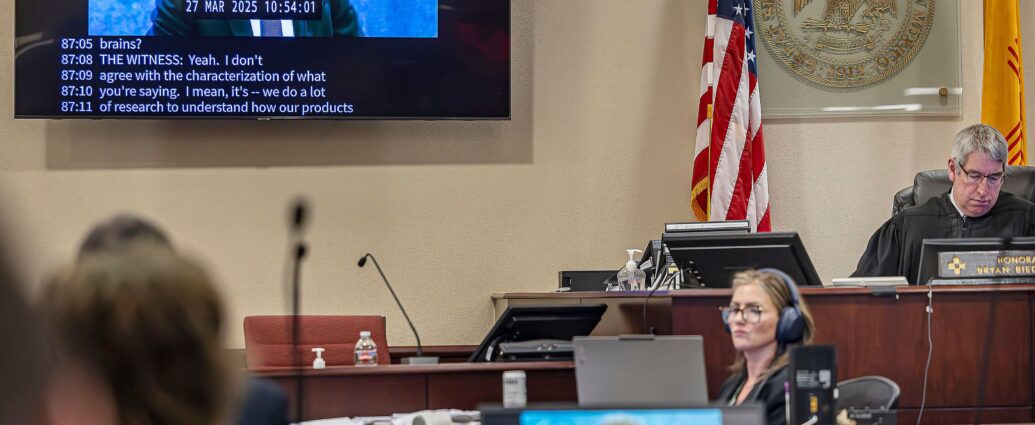
New Mexico jury says Meta harms children’s mental health and safety, violating state law
The jury agreed that Meta engaged in “unconscionable” trade practices that unfairly took advantage of the vulnerabilities of and inexperience of children. Jurors found there were thousands of violations, each counting separately toward a penalty of $375 million.
(Image credit: Jim Weber/Santa Fe New Mexican)

This post was originally published here















VW in talks with Israel’s Iron Dome maker to shift from cars to missile defence
This post was originally published here













Navigating Market Cycles: The Surprising Strategy for Optimized Returns
This post was originally published here

Is this Australia’s moment to embrace renewables? Ask Adam Morton your questions now
The impact of the war in the Middle East is likely to reshape the global economy for years – is this the moment for Australia to change the way it thinks about energy? Post your questions now for our climate and environment editor
Sign up here to ask a question
The US-Israel war on Iran has cause a surge in fossil fuel prices – again. A similar thing happened after Russia invaded Ukraine. Then it was gas, now it’s petrol and diesel.
The war has triggered a fuel crisis, and led to a surge in people considering buying electric cars. Meanwhile, a recent report found Australian federal and state government will pay or forgo A$16.3bn in fossil fuel subsidies this financial year.
This post was originally published here

Police to reassess Morgan McSweeney phone theft over address error
Force previously said it was ‘too busy’ to investigate theft despite it potentially holding sensitive information
Police are revisiting a closed investigation into the theft of Morgan McSweeney’s phone after admitting they recorded the wrong address when he reported the crime.
Keir Starmer’s former chief of staff told the Metropolitan police that his phone was stolen in central London when he was returning home from a restaurant on 20 October last year, the Times reported.
This post was originally published here




Opinion | The Fog of Diplomacy in Iran


Meta must pay $375 million for violating New Mexico law in child exploitation case, jury rules
Jury reaches a verdict in New Mexico trial in which the state’s attorney general alleged that Meta failed to safeguard its family of apps from child predators.
This post was originally published here


Using Time Horizons To Reach Your Investing Goals
This post was originally published here






‘Russia is the only one responsible’: Moldova imposes 60-day energy emergency after Russian strikes in Ukraine
Moldova’s Parliament voted on Tuesday to impose a state of emergency in the country’s energy sector after Russian strikes on neighboring Ukraine’s energy grid disconnected a key power line linking Moldova to Romania.
The overnight strikes triggered the disconnection of the high-voltage Isaccea-Vulcanesti power line, which links southern Moldova to EU member Romania, after which Moldovan authorities urged citizens to consume electricity “rationally” during peak hours while repairs were underway.
Seventy-two lawmakers in the 101-seat legislature approved the measure that will last for 60 days. No one voted against and 18 abstained.
“What is happening in the energy sector today is not an accident,” said Moldovan Prime Minister Alexandru Munteanu. “Russia’s attacks on the civilian energy infrastructure in Ukraine represent a war crime, but also an attack on us, here in the Republic of Moldova … Russia is the only one responsible for this.”
The state of emergency will begin on Wednesday. It will allow authorities to “act faster: mobilize additional resources, protect critical infrastructure and, if necessary, take additional measures to limit the effects of the crisis,” Munteanu added. “We remain vigilant and act for the safety of every citizen … This is not a measure of panic, it’s a measure of responsibility.”
Moldova’s Soviet-era energy systems remain interconnected with Ukraine, and the country has suffered periodic outages since Russia fully invaded Ukraine in 2022. Moldova’s energy minister Dorin Junghietu said estimates to repair the damaged power line is around five to seven days.
Moscow has repeatedly targeted Ukraine’s civilian infrastructure, such as dams and river ports, throughout the full invasion. The impact of the war next door has reverberated across Moldova, a former Soviet republic with EU candidate status, since the full invasion began.
Last week, tens of thousands of Moldovans were left without water after another Russian strike on a hydroelectric plant in Ukraine resulted in oil polluting a major river that flows through both countries.
The Ukrainian plant is situated about 15 kilometers (9 miles) upstream from Moldova’s northern border with Ukraine and supplies water to about 80% of Moldova’s population of about 2.5 million. In January, Moldova experienced major power outages, including in the capital, Chisinau, after a disruption to a power line from Ukraine caused a drop in voltage.
Moldovan President Maia Sandu blamed Moscow directly on Tuesday, saying that “Russia continues to deliberately undermine the security of the Republic of Moldova and endanger the lives of our citizens.”
“After the bombing of the Ukrainian hydroelectric power plant … tonight, a new brutal attack led to the disconnection of the Isaccea-Vulcanesti line, which in certain periods provides 60-70% of our electricity consumption,” she wrote on Facebook. “All these are not accidents, but deliberate actions of Russia to weaken and leave Moldova in the dark.”
Russia has repeatedly denied it is trying to destabilize Moldova.
This story was originally featured on Fortune.com

Senate Republicans, White House nearing deal to end DHS shutdown amid TSA delays
The Department of Homeland Security has been shut down since February over Democratic concerns about its immigration enforcement policies.
This post was originally published here
California governor poll raises prospect of two Republicans contesting runoff
Survey puts Steve Hilton and Chad Bianco ahead with Democratic vote split between large field of candidates
Republicans continue to lead the California governor’s race amid a crowded field of Democrats, a new poll commissioned by the state’s Democratic party found, fueling concerns of a conservative win in the famously liberal state.
The party on Tuesday published the results of a large-scale poll of 2,000 likely voters conducted by Evitarus Research that revealed that 16% of participants would back the conservative political commentator Steve Hilton in the upcoming primary, while 14% would support Chad Bianco, the Riverside county sheriff.
This post was originally published here

Amazon acquires ‘approachable’ humanoid maker Fauna Robotics
Fauna’s first product, called Sprout, is a $50,000 bipedal robot that’s 3.5 feet tall and designed to be “approachable and human-friendly.”
This post was originally published here


Blackstone, Bain, Brookfield Move From SaaS To ‘HALO’ Bets
The private credit market is ditching software and favoring industrial and asset-heavy sectors.
Major firms like Blackstone, Bain Capital, and Brookfield Asset Management are now targeting “Heavy Asset, Low Obsolescence (HALO)” companies due to their lower exposure to technological disruption, Bloomberg reported.
HALO companies rely on substantial physical capital with high barriers to replication. They own assets whose economic relevance persists across technological cycles. Examples include transmission grids, pipelines, utilities, transport infrastructure, critical machinery, and long-cycle industrial capacity.
Goldman Sachs strategists Guillaume Jaisson and Peter Oppenheimer noted last month that …
This post was originally published here

Iran, the $39 trillion national debt and dedollarization: How Trump exposed America’s Achilles Heel in Hormuz
The year was 1974 and President Richard Nixon had dispatched his Secretary of State Henry Kissinger to Saudi Arabia to strike a secret deal. Three years earlier, in August 1971, Nixon had already administered the “shock” that ended the Bretton Woods system governing global finance since World War II — suspending the dollar’s convertibility to gold in a televised address that transformed every major currency overnight. By 1973, the system had fully unraveled.
The world wouldn’t know for another 50 years what Nixon and Kissinger replaced it with, striking a deal that would quietly govern the global economy for the next half-century. Riyadh agreed to price and trade its oil in U.S. dollars and channel its petroleum windfalls back into U.S. Treasury bonds; in return, Washington promised military aid, equipment, and security guarantees—a deal that would quietly govern the global economy for the next half-century.
The existence of this secret agreement wasn’t even publicly confirmed until 2016, when Bloomberg News filed a Freedom of Information Act request with the National Archives. Other OPEC members had followed Riyadh’s lead in the years since, locking in the dollar as the indispensable currency of the modern world. The arrangement had a name only economists used: the “petrodollar” system. It was America’s greatest secret weapon—and today, in the churning waters of the Persian Gulf, it faces its most serious threat since its creation.

The Chokepoint That Moves the World
The Strait of Hormuz is a sliver of water barely 21 miles wide at its narrowest point, separating Iran from Oman. It does not look like the axis of the global economy on a map. But in 2024, roughly 20 million barrels of oil and petroleum products passed through it every day—about 20% of global petroleum liquids consumption and approximately 25% of all seaborne oil trade on Earth.
Qatar and the UAE rely on the strait for virtually all of their LNG exports, representing about 20% of global LNG trade. The bulk of the crude leaving the strait heads to China, India, Japan, South Korea, and other Asian markets, which absorb the overwhelming majority of Hormuz volumes. When Iran slammed shut this door, it didn’t just disrupt shipping lanes. It placed maximum stress on the architecture of dollar dominance at its most physical chokepoint.
For weeks, President Trump has scrambled to respond. He issued a 48-hour ultimatum threatening to “obliterate” Iran’s power plants if Tehran did not reopen the strait. Iran countered by threatening to mine the Persian Gulf and target American energy infrastructure in the region. Trump then postponed his deadline amid what the White House described as diplomatic progress—a face-saving maneuver that former Defense Secretary James Mattis warned could ultimately cede the strait to Tehran’s influence. “You’d see a tax for every ship that goes through,” Mattis said during the CERAweek by S&P Global conference, as reported by Politico.
The administration has cycled through a list of increasingly desperate options, from building a naval coalition—with Trump saying he’d approached “about seven” countries—to a reported proposal to wind down the conflict without resolving the Hormuz closure. As of Monday, Trump told CNBC: “We are very intent on making a deal.”
The $39 Trillion Liability No One Is Talking About
While the gunboat diplomacy dominates the headlines, the more existential danger may be unfolding in the bond market. The U.S. national debt crossed $39 trillion on March 18, 2026, a milestone reached just weeks into the war in Iran. The speed of accumulation is staggering, and the timing could not be worse: interest costs on the debt are projected to become the fastest-growing line item in the federal budget over coming decades, and the U.S. has already suffered credit downgrades from all three major ratings agencies — S&P in 2011, Fitch in 2023, and Moody’s in May 2025.
The reason this matters geopolitically—not just fiscally—goes back to that 1974 handshake. The petrodollar system created a perpetual buyer for U.S. Treasury bonds in the form of oil-exporting nations. The mechanism was elegant in its simplicity: oil exporters accumulated vast dollar surpluses and parked them in U.S. Treasuries, which Washington was only too happy to supply. Saudi Arabia alone held $149.5 billion in U.S. Treasury securities as recently as December 2025 — a figure that, notably, rose by $12 billion over the course of last year, even as Riyadh declined to formally renew the original petrodollar agreement. That recycling loop is what allowed Washington to borrow cheaply, run persistent deficits, and still maintain the world’s reserve currency.
In 1965, French Finance Minister Valéry Giscard d’Estaing was widely credited with a memorable criticism of the Bretton Woods system that predated the petrodollar regime as an “exorbitant privilege” enjoyed by America, with the U.S. dollar serving as the world’s reserve currency. In the 1970s, once President Richard Nixon ended Bretton Woods by decoupling the dollar from gold, that privilege was revived in oil and debt, requiring every country on Earth to accumulate dollars simply to buy oil, and then reinvest those dollars back into American debt. Former Greek Finance Minister Yanis Varoufakis, a heterodox economist whose work sits outside mainstream consensus but who captures something real about the system’s coercive logic, calls this “the global minotaur,” likening the U.S. to the ancient king of Crete who held international trade captive to tribute that would feed the monster within his labyrinth.
The unfolding crisis in the Strait of Hormuz is exposing America’s privilege as a vulnerability. The speaker of Iran’s parliament delivered a warning this week that rattled bond traders: financial institutions backing the U.S. military budget were “legitimate targets,” and buyers of U.S. Treasury bonds were purchasing “an attack on your headquarters and assets.” It was theatrical. It was also a signal—that America’s $39 trillion debt load could become a pressure point in an escalating conflict.

The De-Dollarization Accelerant
Even before Iran closed the strait, cracks in the petrodollar system were visible—though economists caution that “cracks” is very different from “collapse.” The U.S. dollar’s share of global foreign exchange reserves has fallen to roughly 56.9% as of Q3 2025, its lowest level since 1995 and down from a peak of 72% in 2001, according to IMF COFER data. That is a real, multi-decade structural decline. But here is the critical detail most alarming headlines omit: the IMF itself found that roughly 92% of the quarterly decline recorded in mid-2025 was driven by exchange-rate movements—the dollar weakening made non-dollar holdings appear larger—not by central banks actively dumping dollars. (The weakening of the dollar is a whole other story, but Trump’s tariff regime, the exploding national debt and inflation expectations rising are all widely seen as major factors, along with the “Sell America” trade.) There is a meaningful difference between erosion and exodus.
The Chinese yuan, despite years of BRICS advocacy and aggressive promotion of yuan-denominated oil contracts, represents just 2.1% of global reserves. The euro holds second place at roughly 20%, but no single currency has emerged as a credible heir apparent. The Federal Reserve’s own 2025 assessment found that dollar reserve share has been “basically unchanged since 2022,” and that U.S. sanctions on Russia following the Ukraine invasion did not trigger the feared mass reallocation out of dollars.
Saudi Arabia, in fact, chose not to formally renew the petrodollar agreement in June 2024, but the informal, secretive nature of the deal makes it hard to evaluate whether this was a policy change. What the data actually show is that the Saudis still price the overwhelming majority of their oil in dollars; global oil markets remain structurally dollar-denominated; and the network effects that sustain that arrangement—every buyer, every trader, every swap desk globally priced in dollars—do not unwind overnight. As the Hinrich Foundation noted as recently as last week, “talk of de-dollarization is prone to hyperbole,” even as the IMF data confirms a slow, real erosion, because of the weakening dollar.
What the Hormuz crisis means isn’t an end to the petrodollar—it is a threat to accelerate a shift that was previously moving at a glacial pace by raising the geopolitical temperature around a system that had long operated below the radar. Every week the strait stays closed, Asian economies are forced to test alternative supply chains — existing bypass routes like Saudi Arabia’s East-West Pipeline and the UAE’s Abu Dhabi Crude Oil Pipeline to Fujairah absorb only a fraction of normal Hormuz volumes, meaning the pressure to find workarounds is real — and, at the margin, alternative payment mechanisms. If the crisis is resolved in weeks, those experiments are quickly abandoned. If it drags into months, habits begin to form. The dollar’s dominance is not a cliff—it is a long, slow slope—and the question the Hormuz standoff raises is not whether America falls off the edge today, but whether Trump’s handling of this crisis steepens the gradient.
There is a long slope down from this exorbitant privilege, as there remains no obvious successor to the dollar. And for all of Iran’s saber-rattling, its closure of the Strait of Hormuz is not a sophisticated financial weapon aimed at the dollar’s structural foundations. Rather, it is a desperate act of asymmetric warfare by a regime under unprecedented military pressure—a tactical move, not a strategic master plan.
Economic models analyzing the Hormuz closure project global GDP losses ranging from $330 billion in a short conflict to $2.2 trillion if it drags on. Those are serious numbers. But economic disruption is not the same as dollar displacement. If anything, crisis conditions historically drive a flight to dollars, not away from them, because the deep liquidity and institutional trust underpinning the dollar have no match.
Still, the U.S. should pay attention to its own abuses of that privilege. The consequences of sustained erosion are not abstract. The IMF has flagged that the U.S. is more fiscally imbalanced than its peers and that without reserve currency status, its credit position would be far worse. Foreign demand for U.S. Treasuries could weaken, forcing Washington to offer higher interest rates to attract buyers, which would feed directly into the cost of servicing the $39 trillion debt, creating a feedback loop of deficits and borrowing costs that could spiral well beyond the projections of today’s fiscal models. The Committee for a Responsible Federal Budget forecasts annual interest payments of $1 trillion and climbing. Add a prolonged oil shock and the ingredients for a genuine fiscal crisis in the medium term are present.
Trump has said he wants a deal. But his usual playbook, what Yale Management professor Jeffrey Sonnenfeld calls his “ten commandments,” a framework of transactional pressure tactics that served him well against conventional partners, is not working with an adversary like Iran with little left to lose. And time is the one thing the architecture of American financial dominance may no longer have in abundance. The petrodollar system was built in secret in 1974 and sustained quietly for 50 years. The Strait of Hormuz has now made its fragility visible to the entire world, whether or not Trump understood that ordering strikes on Iranian energy infrastructure and military targets would expose the financial architecture those bombs were implicitly defending.
For this story, Fortune journalists used generative AI as a research tool. An editor verified the accuracy of the information before publishing.
This story was originally featured on Fortune.com






Arm Holdings Stock Soars As Company Targets $15 Billion In Annual Sales From New In-House Chip
Arm Holdings Plc (NASDAQ:ARM) shares are surging in Tuesday’s after-hours session following reports that the company is targeting $15 billion in annual sales from its new in-house chip.
- ARM Holdings stock is surging to new heights today. Why is ARM stock surging?
ARM Provides Aggressive Sales Targets For New Chip
Arm Holdings announced at an event in San Francisco on Tuesday that it will begin selling its own AGI CPU chips, with Meta Platforms Inc (NASDAQ:META) slated …







Braze Stock Shoots Higher After Q4 Revenue Surprises To Upside
Braze, Inc. (NASDAQ:BRZE) shares raced higher in Tuesday’s extended trading after the company released its fourth-quarter earnings report, with better-than-expected revenue and a $100 million share buyback program.
- BRZE stock is moving. Watch the price action here.
Q4 Details
Braze reported quarterly adjusted earnings of ten cents per share, which missed the consensus estimate of 14 cents, according to data from Benzinga Pro.
Quarterly revenue came in at $205.17 million, beating the Street’s estimate of $198.21 million.
Braze reported the following highlights:
- Delivered 28% revenue growth in the fourth quarter, 24% for the full fiscal year …


Arm shares rise as it forecasts revenue boost from in-house AI chip
This post was originally published here



Opinion | Trump Was Always a Wild Card

OpenAI shutters short-form video app Sora as company reels in costs
OpenAI said it’s closing Sora, the short-form video app that went viral after its launch six months ago
This post was originally published here




More American workers are struggling than thriving for first time: poll
American workers are feeling more pressure in their lives, with a greater share reporting that they feel they’re struggling than thriving in a new poll by Gallup.
Gallup on Tuesday released fresh data for the firm’s Life Evaluation Index, which measured how people rate their current and expected future lives since 2008. It asks respondents to evaluate their current and future lives on a 10-point scale, which is broken down as “thriving,” “struggling” or “suffering.”
The firm’s survey of U.S. workers conducted in the fourth quarter of 2025 found that the share of those thriving declined from 50% the same quarter a year ago to 46%, while those struggling rose from 46% to 49% in that period.
“For the first time since Gallup began measuring the life evaluation of the American workforce, more U.S. workers are struggling in their lives (49%) than thriving (46%),” the polling and analytics firm noted. Additionally, 5% of respondents were classified as “suffering.”
The shift comes as a contrast with the index’s findings in 2022 and 2023, when the share of American workers who said they’re “thriving” was in the low-to-mid-50s in what was an indication of resilience after the economic turbulence of the COVID-19 pandemic.
The last decade saw relatively high numbers of respondents classified as thriving, with Gallup’s metric remaining steady between 57% and 60% from 2009 to 2019.
Respondents classified as thriving briefly dipped to 55% in 2020 before it rebounded in 2021, but the figure has generally been on a steady decline since then.
The share of respondents who were thriving hit a recent peak in the third quarter of 2022, when it was 55% compared to 41% of respondents who were struggling. That 14-percentage point spread in favor of thriving was the largest differential since 2022.
“The slide in workers’ thriving rate has been gradual but consistent. No quarter since early 2024 has shown sustained improvement – meaning back-to-back quarters when the thriving rate increased,” Gallup wrote.
Workers who are struggling instead of thriving also pose challenges to employers, who may face more absenteeism or turnover from struggling workers.
“The significance to organizations and the economy is real given that worker wellbeing has a tangible impact on organizations’ bottom line. Gallup research finds that workers who are not thriving are more likely to miss work due to illness and to be seeking or watching for a new job,” the firm added.
“Thriving employees miss 53% fewer days of work due to health problems and are 32% less likely to be actively seeking a new job. As thriving falls, organizational performance risks follow,” Gallup explained.
US ECONOMIC GROWTH REVISED LOWER IN FOURTH QUARTER
While the report indicated that all major segments of the U.S. workforce experienced a worsening outlook on their lives since 2022, Gallup noted that federal workers have seen a more severe and rapid decline in their outlooks.
Federal workers were more likely than the average U.S. worker to be thriving in 2022, when they had an average of 60%. That was six points above the national average and four points higher than state and local government workers.
GET FOX BUSINESS ON THE GO BY CLICKING HERE
By late 2025, federal workers’ thriving rate fell 12 points to an average of 48%, far outpacing the decline for average U.S. workers, whose rate was down six points to 48%, as well as state and local government workers, whose combined thriving rate was down six points to 50%.




ICE agents can make twice the salary of TSA employees—and economists warn their pay is more ‘shutdown proof’ than other government jobs
Immigration and Customs Enforcement (ICE) agents are now doing the jobs of Transportation Security Administration (TSA) workers, but one big difference is that they’re getting paid for it.
The partial government shutdown, entering its 44th day, has left more than 50,000 TSA officers without pay, leading to more than 450 workers quitting and thousands calling out of work, according to Department of Homeland Security (DHS) data. President Donald Trump ordered ICE agents to U.S. airports to guard exits and check IDs to allow TSA agents to more quickly conduct security scans at checkpoints. Trump said ICE personnel can conduct immigration checks and arrests, though it’s not their primary purpose.
These ICE agents will continue to receive pay, even as TSA officers forgo earnings for five weeks, and the disparity has shined light on the pay differences between the two groups carrying out similar tasks.
According to TSA Career, a nongovernment website, the starting salary for TSA agents is $34,454, with the average officer salary between $46,000 to $55,000. The highest-paid TSA employee earns around $163,000.
Meanwhile, deportation officers are paid between $51,632 and $84,277, according to a job posting on a government website. ICE agents are also eligible for a $50,000 signing bonus, often given in $10,000 per-year increments, putting total pay at nearly double that of a TSA officer.
The American Federation of Government Employees, the largest union representing federal employees and the only one representing TSA workers, claimed ICE agents were unqualified to replace and work alongside TSA officers at airports as they lacked the appropriate training.
Everett Kelley, president of the union, demanded TSA agents be paid, rather than replaced by other government employees.
“Our members at TSA have been showing up every day, without a paycheck, because they believe in the mission of keeping the flying public safe,” Kelley said in a statement on Sunday. “They deserve to be paid, not replaced by untrained, armed agents who have shown how dangerous they can be.”
Why are ICE agents getting paid while TSA agents are not?
The reason behind why ICE agents continue to be paid while TSA agents work without paychecks comes down to where these two agencies receive their respective funding.
Despite both being under the umbrella of the DHS, ICE received a share of its funding from Trump’s One Big Beautiful Bill Act, which pumped ICE with about $75 billion over five years. TSA is funded through DHS, which the government ceased funding in February as Democrats demanded reforms on ICE following the fatal shootings of two U.S. citizens in Minneapolis in January.
On Tuesday, the Senate closed in on a proposal that would fund much of the DHS, including providing pay to TSA agents. The funding resumption would exclude ICE operations.
The libertarian think tank the Cato Institute, called funding under the One Big Beautiful Bill Act “shutdown proof” in a February report, arguing Republicans “short-circuited the system of checks and balances” by shifting funding for immigration enforcement and defense spending outside of normal appropriations, wrestling in less oversight and greater partisanship in the budgeting process.
But the breakdown of who gets paid and who doesn’t during a government shutdown is a failure of a budget structure that goes beyond a particular administration, according to Linda Bilmes, a public finance expert and senior lecturer at Harvard University’s Kennedy School of Government.
The decision of who is deemed essential and nonessential, for example, depends on department personnel, while salary appropriations can be impacted by lapses in the congressional budget, which occur multiple times a year.
“There is this overarching dysfunction of the entire process,” Bilmes told Fortune during the government shutdown in October 2025. (During this shutdown, law enforcement officers including both ICE and TSA agents received “super checks” as well as overtime pay). “Every time you get into one of these situations—which has been on average four times a year for the last four to five years—there is an arbitrariness in who ends up being paid for their work, who ends up working, who ends up being furloughed.
“The arbitrariness is almost inherent in this dysfunction—a feature as well as being a bug,” she added.
This story was originally featured on Fortune.com
This ETF Is Winning The Iran War Trade – And It’s Now In Its 11th Week Of Gains
No sector has benefited more from the Iran war than U.S. oil and gas exploration.
Since the Feb. 27 close — the final session before U.S. and Israeli forces launched Operation Epic Fury —The SPDR S&P Oil & Gas Exploration & Production ETF (NYSE:XOP) has surged 17.08%, leading every other U.S. industry exchange-traded fund tracked by CountryETFTracker.com.
Year-to-date, XOP is up 43%, its best three-month performance since April 2020.
But there’s more than just that.
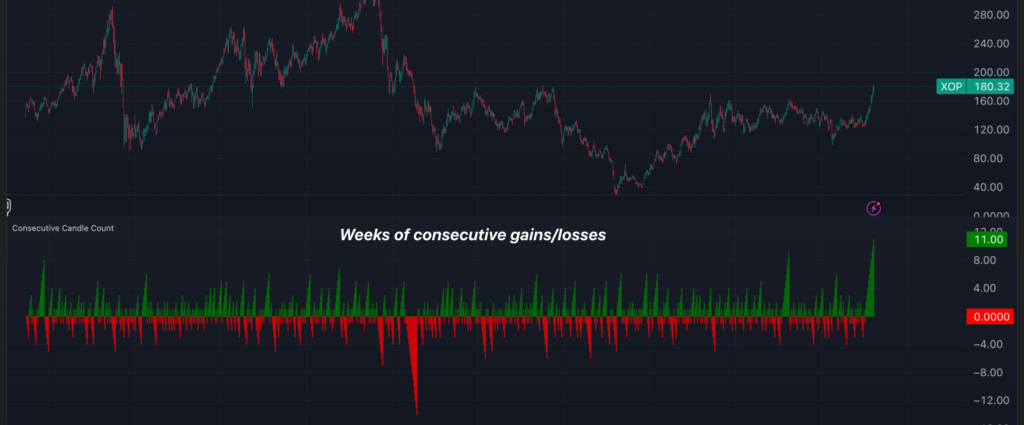
The XOP ETF is currently on its 11th straight week of gains — the longest winning streak in the fund’s history.
Chart: XOP ETF Has Never Had 11 Straight Winning Weeks. Until Now.
The 11-week streak is not just a milestone — it is unprecedented in XOP’s history. Previous record runs came during the post-COVID crude recovery and the 2022 energy supercycle.
Both broke.
The weekly chart above shows an almost uninterrupted vertical move beginning in January 2026, accelerating sharply at the outbreak of hostilities and continuing through Tuesday’s session.
The fund’s 43% year-to-date advance puts it 23.5 percentage points ahead of the SPDR S&P 500 ETF Trust (NYSE:SPY) over the same period — a relative performance gap not seen since April 2020, when the energy complex staged a violent recovery from pandemic lows.
Best And Worst Sectors Since The Iran War Began
According to CountryETFTracker.com data, the sector rotation since the start of the Iran war has been stark.
Behind XOP at the top of the ranking, the VanEck Oil Refiners ETF (NYSE:
This post was originally published here


Oil price swings below $100 in latest bout of markets volatility
This post was originally published here



Venture Capital Firm Kleiner Perkins To Raise $3.5 Billion For AI Startups
Venture capital firm Kleiner Perkins is reportedly raising $3.5 billion for artificial intelligence startups in the software, healthcare, transportation and autonomy sectors.
The firm will invest $1 billion in its 22 early-stage funds and will focus on finding AI startups in, while the remaining $2.5 billion will be invested in growth-stage companies and larger startups, Bloomberg reported .
Kleiner Perkins is an American venture capital firm headquartered in Menlo Park and has more than $21 billion in assets under management.
The firm’s portfolio includes major companies such as Google, Amazon, Figma, Glean, Harvey, Rippling, TogetherAI, OpenEvidence, Waymo, and Anthropic.
Last year, Kleiner Perkins, along with investors Greylock Partners and Index Ventures, saw profits exceeding $1.4 billion from the IPO of software company Figma
This post was originally published here

Velo3D Delivers Better-Than-Expected Q4 Results, Enters 2026 With ‘Tremendous’ Momentum
Velo3D Inc (NASDAQ:VELO) reported fourth-quarter financial results after the market close on Tuesday. Here’s a look at the key details from the print.
- Velo3D stock is charging ahead with explosive momentum. Why are VELO shares rallying?
Velo3D Beats Estimates In Q4
Velo3D reported fourth-quarter revenue of $9.44 million, beating analyst estimates of $8.68 million, according to Benzinga Pro. The additive manufacturing company reported a fourth-quarter adjusted loss of 54 cents per share, beating analyst estimates for a loss of 56 cents per share.
3D Printer and parts revenue decreased 5% year-over-year, driven by product mix and the number of systems sold. System sales are expected to remain the primary …


KB Home Stock Sinks After Q1 Revenues Fall 23%
KB Home (NYSE:KBH) shares dropped in Tuesday’s extended trading after the company released its first-quarter earnings report, missing analyst expectations on the top and bottom lines.
- KBH stock is moving. Watch the price action here.
Q1 Details
KB Home reported quarterly earnings of 52 cents per share, which missed the analyst consensus estimate of 58 cents.
Quarterly revenue came in at $1.08 billion, which missed the Street estimate of $1.1 billion and was down from $1.39 billion in the same period last year.
KB Home listed the following metrics, compared to the same quarter last year:
- Revenues were down 23% to …

Investors hold $4.8 trillion in these retirement funds—how to choose one for yourself
Target-date funds are a popular option for retirement investors, but pros say you need to look under the hood before investing.
This post was originally published here


Canadian woman held with daughter by ICE warns all immigrants to ‘lie low’
Tania Warner says she has documents showing she is in the US legally, but immigration agents were not swayed
A Canadian woman who has been imprisoned with her seven-year-old daughter by Immigration and Customs Enforcement (ICE) has cautioned other immigrants that they are at risk of detention, even if they follow the correct legal process – and warned them to keep out of sight for as long as Donald Trump is president.
“Don’t go anywhere near a checkpoint, and if your papers are in processing, just lay low. Trump meant what he said – he is trying to get rid of everyone, whether they are good or bad,” said Tania Warner, 47, who is currently held with her autistic daughter, Ayla, at the Dilley immigration processing center in south Texas.
This post was originally published here


AI agents are getting more capable, but reliability is lagging—and that’s a problem
Hello and welcome to Eye on AI. In this edition…AI’s reliability problem…Trump sends an AI legislation blueprint to Congress…OpenAI consolidates products into a super app and hires up…AI agents that can improve how they improve…and does your AI model experience emotional distress?
Like many of you, I’ve started playing around with AI agents. I often use them for research, where they work pretty well and save me substantial amounts of time. But so-called “deep research” agents have been available for over a year now, which makes them a relatively mature product in the AI world. I’ve also started trying the new crop of computer-using agents for other tasks. And here, my experience so far is that these agents are highly inconsistent.
For instance, Perplexity’s Computer, which is an agentic harness that works in a virtual machine with access to lots of tools, did a great job booking me a drop-off slot at my local recycling center. (It used Anthropic’s Claude Sonnet 4.6 as the underlying reasoning engine.) But when I asked it to investigate flight options for an upcoming business trip, it failed to complete the task—even though travel booking is one of those canonical use cases that the AI companies are always talking about. What the agent did do is eat up a lot of tokens over the course of 45 minutes of trying.
Last week, at an AI agent demo event Anthropic hosted for government and tech policy folks in London, I watched Claude Cowork initially struggle to run a fairly simple data-sorting exercise in an Excel spreadsheet, even as it later created a sophisticated budget forecasting model with seemingly no problems. I also watched Claude Code spin up a simple, text-based business strategy game I asked it to create that looked great on the surface, but whose underlying game logic didn’t make any sense.
Assessing AI agents’ reliability
Unreliability is a major drawback of current AI agents. It’s a point that Princeton University’s Sayash Kapoor and Arvind Narayanan, who cowrote the book AI Snakeoil and now cowrite the “AI As Normal Technology” blog, frequently make. And a few weeks ago they published a research paper, co-authored with four other computer scientists, that tries to think systematically about AI agent reliability and to benchmark leading AI models.
The paper, entitled “Towards a Science of AI Agent Reliability,” notes that most AI models are benchmarked on their average accuracy on tasks, a metric that allows for wildly unreliable performance. Instead, they look at reliability across four dimensions: consistency (if asked to perform the same task in the same way, do they always perform the same?); robustness (can they function even when conditions aren’t ideal?); calibration (do they give users an accurate sense of their certainty?); and safety (when they do mess up, how catastrophic are those mistakes likely to be?).
They further broke these four areas into 14 specific metrics and tested a number of models released in the 18 months prior to late November 2025 (so OpenAI’s GPT-5.2, Anthropic’s Claude Opus 4.5, and Google’s Gemini 3 Pro were the most advanced models tested). They tested the models on two different benchmark tests, one of which is a general benchmark for agentic tasks while the other simulates customer-support queries and tasks. They found that while reliability improved with each successive model release, it did not improve nearly as much as average accuracy figures. In fact, on the general agentic benchmark the rate of improvement in reliability was half that of accuracy, while on the customer service benchmark it was one-seventh!
Reliability metrics depend on the task at hand
Across the four areas of reliability the paper examined, Claude Opus 4.5 and Gemini 3 Pro scored the best, both with an overall reliability of 85%. But if you look at the 14 sub-metrics, there was still plenty of reason for concern. Gemini 3 Pro, for example, was poor judging when its answers were likely accurate, at just 52%, and terrible at avoiding potential catastrophic mistakes, at just 25%. Claude Opus 4.5 was the most consistent in its outcomes, but its score was still only 73% consistent. (I would urge you to check out and play around with the dashboard the researchers created to show the results across all the different metrics.)
Kapoor, Narayanan, and their co-authors are also sophisticated enough to know that reliability is not one-size-fits all metric. They note that if AI is being used to augment humans, as opposed to fully automating tasks, it might be ok for the AI to be less consistent and robust, since the human can act as a backstop. But “for automation, reliability is a hard prerequisite for deployment: an agent that succeeds on 90% of tasks but fails unpredictably on the remaining 10% may be a useful assistant yet an unacceptable autonomous system,” they write. They also note that different kinds of consistency matter in different settings. “Trajectory consistency matters more in domains that demand auditability or process reproducibility, where stakeholders must verify not just what the agent concluded but how it got there,” they write. “It matters less in open-ended or creative tasks where diverse solution paths are desirable.”
Either way, Kapoor, Narayanan, and their co-authors are right to call for benchmarking of reliability and not just accuracy, and for AI model vendors to build their systems for reliability and not just capability. Another study that came out this week shows the potential real-world consequences when that doesn’t happen. AI researcher Kwansub Yun and health consultant Claire Hast looked at what happens when three different AI medical tools are chained together in a system, as might happen in a real health care setting. An AI imaging tool that analyzed mammograms had an accuracy of 90%, a transcription tool that turned an audio recording of a doctor’s examination of a patient into medical notes had an accuracy of 85%, and these were then fed to a diagnostic tool that had a reported accuracy of 97%. And yet when used together their reliability score was just 74%. That means one in four patients might be misdiagnosed!
A foolish consistency may be the hobgoblin of little minds, as Ralph Waldo Emerson famously said. But, honestly, I think I’d prefer that hobgoblin to the chaotic gremlins that currently plague our ostensibly big AI brains.
Jeremy Kahn
jeremy.kahn@fortune.com
@jeremyakahn
Before we get to the news, I want to encourage everyone to read my Fortune colleague Allie Garfinkle’s awesome feature story about Cursor. Cursor is the AI coding startup that as recently as four months ago was a Silicon Valley darling, but which many people now think may be facing an existential threat because of new coding agents, such as Anthropic’s Claude Code, that seemingly obviate the need to use Cursor. Allie’s story lays bare all the contradictions around this company—how it has continued to see record revenue growth, even as many in Silicon Valley now harbor doubts about its survival; how it is racing to train its own coding agents, pivoting from the developer-centric coding interface that made it so popular with programmers in the first place; how its impossibly young CEO Michael Truell works under a portrait of Robert Caro, the biographer whose projects often lasted decades, while Cursor needs to operate in an industry in which a year can feel like a century. Allie’s story is definitely worth the time.
This story was originally featured on Fortune.com
Capital Expenditures vs. Revenue Expenditures: Key Differences and Impacts
This post was originally published here


Mullin sworn in as DHS secretary as Republicans pitch new funding offer
Senate leader proposes compromise to fund homeland security shutdown amid chaotic scenes at airports
Donald Trump on Tuesday swore in Markwayne Mullin as secretary of the Department of Homeland Security (DHS), while Senate Republicans unveiled a compromise that would restart funding to most of the agency but appears to exclude reforms to immigration enforcement Democrats have demanded.
The two parties have been at an impasse over DHS funding since mid-February, after Democrats insisted any legislation include new guardrails on immigration enforcement after federal agents killed two US citizens in Minneapolis.
This post was originally published here

GameStop Posts Mixed Q4 Results, Cash Position Grows To $9 Billion
GameStop Corp (NYSE:GME) reported financial results for the fourth quarter Tuesday after the close. Here’s a rundown of the video game retailer’s report.
- GameStop stock is trading near recent lows. What’s the outlook for GME shares?
GameStop Reports Mixed Q4 Results
GameStop reported fourth-quarter revenue of $1.10 billion, missing analyst estimates of $1.47 billion. The company reported adjusted earnings of 49 cents per share for the quarter, beating analyst estimates of 37 cents per share, according to Benzinga …

S&P 500 vs. Total Market Index Funds: Which Is Better for Long-Term Growth?
This post was originally published here