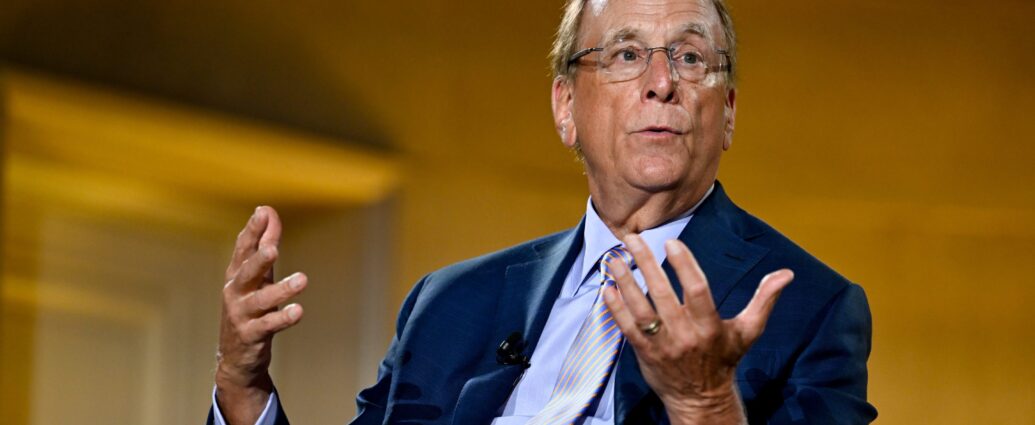
BlackRock CEO Larry Fink said in his annual chairman’s letter that Trump Accounts could provide a “very significant” boost in jump-starting savings and investment by younger Americans.

Fink noted that Americans are struggling to save money for emergencies in addition to funding retirement plans, and explained that early wealth-building accounts for newborn children can help them start life on a solid financial footing.

He said that experiments in Canada, the U.K. and Singapore have shown evidence that these accounts are a good investment, making it more likely account holders obtain advanced degrees, start a business and own a home. 

“Now the United States is adopting a form of this policy with Trump Accounts,” Fink wrote, saying that Trump Accounts created by last year’s One Big Beautiful Bill Act can be funded in a variety of ways.

HERE’S HOW MUCH TRUMP ACCOUNT BALANCES COULD GROW OVER TIME

“There is some nuance in how these accounts are funded. In some cases, it’s a pilot program funded by the government, which would need to be renewed,” Fink wrote. 

“Funding can also come through personal contributions, or through certain employer match programs, such as the one we have at BlackRock for our employees. In other cases, the money comes from private funders.”

“We’ll see how these accounts evolve, but if they are structured thoughtfully, and paired with existing investment vehicles for education and retirement (like 529 and 401(k) plans), this could be a very significant step toward more young Americans growing with their country,” Fink added.

IRS UNVEILS PROPOSED REGULATIONS FOR NEW TRUMP ACCOUNTS SAVINGS PROGRAM

Several companies, including BlackRock, Bank of America and JPMorgan Chase, among others, have announced plans to contribute to Trump Accounts for their U.S. employees’ children. 

Those companies will match the federal government’s $1,000 contribution, while other firms have planned different contribution levels.

Wealthy Americans have also made philanthropic contributions to the government to provide seed money for the accounts. 

For example, Michael and Susan Dell have committed $6.25 billion to seed 25 million accounts with $250 each, with the contributions expected to reach the accounts of most children aged 10 and under who were born prior to the qualifying date for the federal contribution.

TRUMP UNVEILS RETIREMENT PLAN WITH UP TO $1K FEDERAL MATCH

Trump Accounts will be invested in a broad index fund of U.S. stocks, much like the low-cost funds available in many retirement plans, and will be in the child’s name with their parents or guardian serving as the custodian of the account until they turn 18. 

At that time, the funds can be used at the young adult’s discretion for things like educational expenses, starting a business, a down payment on a home, saving for retirement or a rainy day fund.

Parents may contribute up to $5,000 per year to the accounts, while a parent’s employer can contribute up to $2,500 per year without impacting the employee’s taxable income.

Children born between Jan. 1, 2025, and Dec. 31, 2028, will receive $1,000 in seed funding from the federal government in addition to any other contributions. Trump Accounts are also available to children born before Jan. 1, 2025, who are under the age of 18 – although they won’t receive the $1,000 federal government.

GET FOX BUSINESS ON THE GO BY CLICKING HERE

The accounts are expected to officially launch on July 4, 2026. Parents may enroll their child in the program by making an election when they file their taxes on the new IRS Form 4547.

This post was originally published here

Hedge fund tycoon faces questions in court over sexual harassment allegations that have left his career in tatters

Facing a litany of questions over sexual harassment allegations that have left his career in tatters, hedge fund tycoon Crispin Odey told a court he does not remember cornering a female employee after a boozy lunch and saying to her “I could attack you now”.

The 67-year-old made the comments during his first day in the witness box, as part of a three-week court case which Odey hopes will overturn the City regulator’s decision to ban him from the UK’s financial services industry.

Continue reading…

This post was originally published here

Liberty Gold (TSX:LGD,OTCQX:LGDTF) has moved a step closer to advancing its flagship US asset after securing entry into the US Federal Permitting Improvement Steering Council’s FAST-41 program.The company announced that its Black Pine oxide gold project in Idaho has been accepted into the program as a “covered project,” giving it access to a coordinated federal review schedule and enhanced interagency oversight.Shares of the company rose 7.7 percent to C$1.05 following the announcement, reaching their highest point since March 2022, and have since held steady at that level.For developers, the clarity brought about by the program is often as important as speed. Created under the 2015 Fixing America’s Surface Transportation Act, FAST-41 was designed to address one of the mining sector’s most persistent challenges: unpredictable permitting timelines.Projects admitted into the program are assigned a lead agency, a defined schedule and a publicly tracked timeline through a federal dashboard. While the framework does not override environmental laws or guarantee faster approvals, it aims to reduce delays tied to fragmented reviews and shifting regulatory requirements.Liberty Gold said it expects to enter a structured coordination phase within 60 days, after which an updated permitting schedule for Black Pine will be published.

FAST-41 projects gain momentum
FAST-41 has expanded rapidly this year as US policymakers push to accelerate resource development.According to the Permitting Council, the program’s portfolio grew to 76 active projects in 2025, with 13 completing federal permitting during the year. Mining projects have become an increasingly prominent part of that pipeline, reflecting broader efforts to secure domestic supply chains for critical materials.“This has been an exciting year for the Permitting Council, as our agency has taken on a prominent role in bringing real, measurable improvements to federal permitting and getting more projects to the finish line,” said Executive Director Emily Domenech in a January press release. The agency has also introduced new tools, including expanded use of a transparency dashboard and coordination agreements with state governments, aimed at tightening timelines and improving accountability across agencies.Liberty Gold is just one of a growing list of companies turning to FAST-41 as a way to de-risk large-scale projects. Uranium Energy’s (NYSEAMERICAN:UEC) Sweetwater project in Wyoming was designated under the framework in August 2025, part of a broader push to strengthen domestic uranium production. The designation allows the company to advance modifications to existing permits and expand operations using in-situ recovery methods. Shares of Uranium Energy rose to a 52 week high of US$9.91 following the announcement and have since climbed to US$12.51, a gain of roughly 26 percent in over 7 months.Meanwhile, Equinox Gold (TSX:EQX,NYSEAMERICAN:EQX) saw a similar re-rating after its Castle Mountain Phase 2 project in California was accepted into FAST-41 the same month. The company pointed to improved regulatory certainty and a defined permitting schedule, with federal approvals expected by late 2026.Its shares have risen from US$6.65 at the time of the announcement to US$12.64, an increase of about 90 percent, supported by both project-specific developments and a stronger gold price environment.

Enhancing permitting timelines
For mining companies, permitting remains one of the longest and least predictable phases of project development. Even well-defined assets can face delays tied to environmental reviews, interagency coordination or legal challenges.While FAST-41 does not eliminate those risks, it nonetheless introduces structure. By setting timelines and making them public, the framework reduces uncertainty around the process, potentially changing how investors react and value a project.In development-stage mining, valuation often hinges on perceived risk as much as underlying resource size or economics. A project with a clearer path to approval can command a higher valuation multiple, particularly in jurisdictions where permitting has historically been a bottleneck.

Don’t forget to follow us @INN_Resource for real-time news updates!Securities Disclosure: I, Giann Liguid, hold no direct investment interest in any company mentioned in this article.

This post was originally published here

Exclusive: Group says measures to curb harmful content will also help to tackle violence against women and girls

Men and boys need as much protection as women and girls from harmful influencers and “the worst parts of the internet”, a group of MPs have told Ofcom as they called for the regulator to give specific guidance to online platforms.

More than 60 Labour MPs have written to the Ofcom chief executive, Melanie Dawes, urging her to protect men and boys from “manosphere” influencers who may expose them to gambling, sextortion and violent pornography.

Continue reading…

This post was originally published here
Tech executives have offered foreboding visions of the future of work due to AI, with ServiceNow CEO Bill McDermott predicting unemployment will exceed 30% in a matter of years.

But Perplexity CEO Aravind Srinivas says that’s nothing to be afraid of.

People should embrace the future of AI job displacement, Srinivas said in an episode of the All-In podcast released on Monday and recorded at Nvidia GTC last week. While AI may lead to unemployment, that job displacement subsequently frees people from careers they may not have enjoyed, he suggested. This, instead, gives them opportunities to pursue entrepreneurship.

“The reality is most people don’t enjoy their jobs,” Srinivas said. “There’s suddenly a new possibility, a new opportunity, to go use these tools, learn them, and start your own mini business…Even if there is temporary job displacement to deal with, that sort of glorious future is what we should look forward to.”

AI-related layoffs are already on the horizon. Last month Block CEO Jack Dorsey reduced 40% of his staff, saying “intelligence tools have changed what it means to build and run a company.” The 4,000 laid-off Block employees are part of a total of more than 101,000 AI-linked job losses in the U.S. since February 2025, according to data compiled by the nonprofit the Alliance for Secure AI.

However, some economists argue potential job displacement as a result of AI has been drastically overstated. Oxford Economics wrote in a recent note to clients companies “don’t appear to be replacing workers with AI on a significant scale” and are insteading “AI washing” by blaming workforce reductions on the technology.

Venture capitalist and Benchmark general partner Bill Gurley said the AI boom is no different from other eras of rapidly evolving technology, in which layoffs happen, but the labor market ultimately adapts and stabilizes.

“I’m not that big of a doomer, Gurley told CNBC earlier this month. “I think these waves come, and especially with AI, there have been a lot of people pumping kind of miracles into it … .They get this kind of apocalyptic view. We’ve had technology disruption before.”

How AI is building small businesses with few employees

The future of work in an AI-powered future is a departure from the rote and repetitive jobs that emerged at the turn of the 20th century, according to Srinivas.

“America has always been about entrepreneurship. We’ve been about trying to build new things, discover new things, go explore,” he said. “Henry Ford came and built factories and brought jobs and things like that, and put people into a box.”

AI instead makes people more nimble, eliminating startups’ and small businesses’ need to raise as much money because they no longer need to hire as many employees to jumpstart operations, Srinivas suggested.

“What we are going to try to do is help businesses run as autonomously as possible,” he said.

OpenAI CEO Sam Altman has long predicted AI would create the first billion-dollar business run by one person, but Srinivas claimed the feat has not yet been achieved because an AI-powered venture has not increased in U.S. GDP by $1 billion, and therefore not yet “truly creating new value.” He said the best way for this one-person unicorn to emerge is from a small business that has been optimized with AI.

A new era of AI-powered startups

This new era of startups is already emerging. A Bank of America report published this week found the number of business applications with clear plans to hire employees fell by 4.4% year-over-year in January. Meanwhile, The number of “high propensity businesses,” those likely to hire employees, jumped more than 15% in the same period. The discrepancy suggested the potential emergence of several new companies, but without plans to onboard staff to run those businesses.

In 2024, Rudy Arora and Sarthak Dhawan created an AI-powered flashcard and quiz tool called TurboAI with an initial investment of less than $300 while the pair were still in college. The pair has since growth the company to 8.5 billion users and are generating $1 million a month in revenue with just 13 employees, the pair told Fortune’s Marco Quiroz-Gutierrez. Without AI, their workforce would have swelled into the triple digits.

“If we were a company two-and-a-half years ago, it would take over 100 employees,” Arora said. “The only reason we’re able to do it with 13 employees right now is because of AI.”

This story was originally featured on Fortune.com

Airline CEOs have urged Congress to restore funding to the TSA as lengthy security lines plague US airports

Delta Air Lines is partly suspending its speciality service desk for members of Congress until funding for the Transportation Security Administration (TSA) is restored, the airline confirmed on Tuesday, as security lines stretch for hours at airports across the country due to the Department of Homeland Security (DHS) shutdown.

The service desk is used to help members of Congress book flights at special government rates, secure airport escorts and make last-minute changes to flights.

Continue reading…

This post was originally published here

Bernstein reaffirmed its $150,000 year-end Bitcoin (CRYPTO: BTC) price target, despite a 45% drawdown from October highs, calling the selloff the “weakest bear case in history.”

The Three Bullish Pillars

Bernstein analysts led by Gautam Chhugani listed three reasons for their conviction. 

First, Strategy (NASDAQ:MSTR) keeps buying despite widespread chaos among other Bitcoin treasury firms and shorts piling into the stock. The company now holds roughly 3.6% of total Bitcoin supply worth about $53.5 billion.

Second, investors continue buying Bitcoin ETFs. ETFs added $2.2 billion over the last four weeks, with more long-term allocations from wealth managers, pension funds, and sovereign funds.

Third, long-term holders haven’t sold despite the 45% drawdown. Bitcoin holders inactive for more than one year represent 60% …

Full story available on Benzinga.com

This post was originally published here

A specter is haunting the world of white-collar work: the specter of white-collar job loss. But one of Wall Street’s “Masters of the Universe,” asset management billionaire Larry Fink sees another ghost in the machine.

Writing in his annual letter to BlackRock shareholders, the CEO identified a much greater threat from technological progress to the Fortune 500. Fittingly, for the man who played a major role in the index-fund revolution, his mind was on assets and who owns them—or doesn’t. Inequality and overall wealth is the real threat. 

With asset values soaring in recent decades as salaries largely stagnate, wealth inequality will only get worse, warned Fink, who has been beating this drum often of late. AI threatens to concentrate wealth not only with those who have assets, he explained, but those who use this technology.

“The vast majority of wealth has flowed to people who owned assets, not to people who earned most of their money by working,” Fink wrote in his annual letter to shareholders on Monday.

“Now AI threatens to repeat that pattern at an even larger scale—concentrating wealth among the companies and investors positioned to capture it.”

Research from the Federal Reserve has found America’s haves and have-nots have rarely been this far apart. In the third quarter of last year, the gap was the widest it’s been since 1989, when the Fed began tracking household wealth divergence. The top 1% held 31.7% of U.S. wealth, comparable to all wealth owned by the bottom 90%. With most high-income wealth held in assets from stocks to real estate, it’s become increasingly inaccessible to a growing segment of Americans. And with the speeding growth and corporate adoption of artificial intelligence, that trend risks accelerating, according to Fink.

Uneven returns

AI-driven productivity might potentially raise wages across the board, but most evidence so far suggests AI adoption has raised wages in a relatively small pool of jobs, while excitement surrounding the technology has boosted stock markets. Fink wrote that since 1989, median wages in the U.S. have lagged stock market returns by a factor of 15.

Now, AI looks most likely to lengthen that trend rather than reverse it—at least in the short term. For people not directly exposed to its benefits, the wealth gap might soon look a lot wider.

“When market capitalization rises but ownership remains narrow, prosperity can feel increasingly distant to those on the outside,” Fink wrote. “This is where much of today’s economic anxiety comes from: a deeper feeling that capitalism is working—just not for enough people.”

In his letter, Fink described AI as the most significant technology since at least the computer, but nonetheless risks putting inequality on steroids. He warned that AI could concentrate massive wealth primarily among a handful of companies and investors best positioned to capture its value. It could accelerate “K-shaped outcomes” for the economy, he added, where firms and investors with greater access to capital benefit from faster growth, while those less exposed to rising asset valuations stagnate, driving inequality even further.

“Transformative technologies create enormous value—and much of that value accrues to the companies that build and deploy them, and to the investors who own them,” he wrote. “The companies with the data, infrastructure, and capital to deploy AI at scale are positioned to benefit disproportionately.”

The data so far seems to support Fink’s argument. The U.S. is increasingly mired in an economy supported by wealthy consumers, according to Moody’s chief economist Mark Zandi. Spending from high-earners has surged in recent years, while low and middle-income households have seen their discretionary spending slow or even plateau. 

The trend grows more worrisome with the use of this new tech, as AI-driven gains in the stock market are a big part of high-income confidence, Oxford Economics CEO Innes McFee recently told Fortune. While the technology has led to a 7% rise in U.S. wealth, that benefit is almost entirely contained to high-earning households, he said. While AI could “absolutely” even out wealth inequality eventually, it is more likely to maintain the U.S. economy’s K-shape until at least 2035, McFee said.

The same trend is visible in jobs. So far, AI-related productivity boosts are mostly reserved for workers whose jobs demand AI-related skills, roles that can expect a wage premium as high as 43%. But for most jobs, AI has yet to translate to significant productivity or wage gains, and might actually be leading to larger workloads for employees tasked with managing AI.

A long run equalizer?

Over the long term, AI-driven efficiency could lead to higher wages and job growth among low-income professions in sectors such as agriculture and manufacturing, potentially reducing inequality in countries heavily reliant on those sectors, according to modeling last year by PwC. And some experts, including analysts at the Urban Institute, have argued for a universal basic income program drawing royalties from AI companies as a measure to lessen inequality.

But for the moment, benefiting from AI requires working in a role requiring AI skills or being financially invested in its growth story. With nearly 40% of Americans not exposed to the stock market at all, a sizable portion of the population could be caught on the outside looking in.

This story was originally featured on Fortune.com

Youth organisation says its belief in ‘dignity, respect and inclusion’ is unchanged but it ‘must operate lawfully’

Transgender girls and women who are part of Girlguiding groups have been given until September to leave the organisation, under new rules introduced after the supreme court ruling on gender last year.

In an announcement on Tuesday, Girlguiding said current members who were trans girls or trans young women could stay until 6 September 2026, at which point they would have to leave.

Continue reading…

This post was originally published here

The most powerful voices in artificial intelligence (AI) really want you to worry about your job—if you’re a white-collar worker. Microsoft AI chief Mustafa Suleyman predicts AI will cause office jobs to crumble in 18 months. Anthropic CEO Dario Amodei thinks entry-level jobs in the space will be cut in half in a similar timeline. Even Federal Reserve Chair Jerome Powell has warned that AI is quietly impacting the labor market as job creation hovers close to zero.

But behind closed doors, business leaders controlling company headcounts are actually telling a more subtle story. A working paper from the National Bureau of Economic Research found that, out of a survey of 750 chief financial officers from U.S. firms, less than half (44%) say they plan on some AI-related job cuts. When the co-authors calculated what that amounts to across the broader economy, they found just 0.4%, or about 502,000 roles out of about 125 million roles, are expected to be lost this year. Just about half of those job losses will come from the white-collar world.

That 9x increase from last year’s 55,000 AI-attributed layoffs is striking — but still a rounding error against the overall workforce.

“It’s not the doomsday job scenario that you might sometimes see in the headlines,” John Graham, co-author of the study and the director of the Duke CFO survey, conducted in partnership with the Federal Reserve Banks of Atlanta and Richmond, told Fortune.

Moreover, the study finds a wide gap between the perceived and actual productivity gains from AI, finding that perceptions of AI’s gains are larger than the reality. The researchers say this likely reflects a delay in realized revenue. This reported lag matches what economists have been saying about AI’s productivity gains.

Goldman Sachs senior economist Ronnie Walker noted earlier this month that amid AI investment zeal, “we still do not find a meaningful relationship between productivity and AI adoption at the economy-wide level.” It’s not just economists; workers have reported that AI is actually making them less, not more productive, placing greater strain on their workflows, with time spent across some job responsibilities increasing by up to 346%.

Lagging productivity gains and Solow’s paradox

Economists have a name for this gap — and it dates back to the dawn of the personal computer era.

In a comparison to the lagging technological innovation associated with the dawn of the internet era, the researchers invoke Solow’s paradox, also known as the productivity paradox, to contextualize the current divide between perceived and actual productivity from AI. Coined by Nobel Laureate Robert Solow in 1987, the paradox speaks to the observation that transformative technology—like computers, or in this instance, AI—can appear ubiquitous while remaining absent from economic data. 

“You can see the computer age everywhere but in the productivity statistics,” Solow said.

Graham said what executives are seeing with productivity today is actually more of a wish than a realized fact. Companies see the potential of AI without the financial results to match. “Companies have invested and they’re realizing all these kind of cool things that they’re either starting to do or they hope to do in the near future,” he said. “But it’s not really showing up yet in revenue”

The current state of AI-related layoffs

However, the study still represents a step in the direction of heightened job losses thanks to the technology, adding some credibility to what tech execs have painted publicly. Employers reported about 55,000 layoffs attributed to AI in 2025, according to research firm Challenger, Gray & Christmas. That’s just 4.5% of all job losses from last year. Still, if the study’s numbers are right, that would mean a 9x increase in AI-related layoffs this year.

There have already been several sizable AI-related layoffs reported by firms this year. Jack Dorsey’s Block cut about 40% of its workforce, or more than 4,000 employees, because of the technology. Australian-American financial services firm Atlassian cut 10%. And Meta is reportedly planning on cutting 20% of jobs, as CEO Mark Zuckerberg reportedly creates an AI agent clone of himself. On top of that, the job market is in a lull. U.S. employers posted 92,000 jobs losses last month, and the unemployment rate ticked up to 4.4%.

But the report also finds that AI adoption could actually lead to an increase in hiring among smaller firms, further contradicting the public claims from AI’s biggest leaders. Many smaller firms, or those with fewer than 500 employees, have only just begun to invest in AI as most incur the brunt of AI-related operating expenses, slowing down adoption rates. But as adoption increases, small firms noted they plan to increase hiring in technical roles. On top of that, larger firms are planning on holding technical roles constant.

“If anything, small companies are hiring a bit on the technical side which will offset [losses] a little bit,” Graham said.

Still, the study only paints a picture for the short-term, so it’s difficult to entirely rule out the dire predictions some tech leaders have made of the technology’s ability to soak up white-collar jobs.

“Who knows what’s going to happen in 2028?” Graham said. ”I’m not making a prediction that there will never be any jobs lost two, three and five years from now to AI.”

This story was originally featured on Fortune.com

On Monday morning, it looked like President Donald Trump, the self-proclaimed “Master of the Deal,” had done it again.

After roiling oil markets over the weekend with an ultimatum on Iran, he declared victory before the opening bell, posting about 15 points of agreement and pausing his threat to bomb the country’s power plants. Nearly $2 trillion was moved within minutes as Wall Street clamored to do what it has learned to do with this president: put some TACO dip on its proverbial chip.

TACO—Trump Always Chickens Out—became the defining trade of last year’s tariff wars after the shock dip on “Liberation Day” last April. The term was coined by FT journalist Robert Armstrong to describe the pattern Trump exhibited: Escalate, terrify, then reverse course and claim victory. When traders realized that Trump, at his heart a businessman, would never let markets dip back to their levels on April 2, 2025, they began to price in the bluster and bought the dip. It worked in 2025 because tariffs are a toggle: flip them on with a Truth Social post, flip them off with another one. Through this strategy, Trump secured diplomatic and economic concessions in Brazil, India, Japan and across Southeast Asia,  all while never suffering from severe backlash by traders. 

War, however, doesn’t so easily toggle back and forth. TACO has a hidden assumption baked in: that your counterparty wants off the roller coaster as much as you do. Especially with a wounded Iranian regime that has nothing to lose and made its survival synonymous with holding the global economy hostage. 

Within hours of Trump’s announcement, Iranian state media denied any talks had occurred. The speaker of Iran’s parliament, taking a page out of Trump’s 2016 campaign playbook, wrote on X that it was “fakenews” designed to “manipulate financial and oil markets.” And as of Tuesday, it doesn’t seem like the primary objective —getting tankers to transit the Strait of Hormuz—has changed at all. 

“There is no change in the status in the Strait of Hormuz, and every day that waterway remains closed to traffic, the world is losing over 15 million barrels of oil from inventories and stocks,” Rory Johnston, an oil market analyst, told Fortune. “The longer this goes on, the worse that situation is going to get.”

The Oil Air Pocket: Why Prices Are Holding — For Now

The White House has been effective, so far, at jawboning oil prices lower than the $120-$150 levels bearish commodities analysts have warned about. Every time Brent drifted much above $110, Trump or another official comes out and declares victory over Iran, or promises to start pulling back the war. Johnston says that works, for now, because the physical shortage hasn’t actually reached most of the world yet, leading to a gaping spread between the price of Dubai crude, which has been in the $120s and $130s, and Texas futures, which have hovered below $100. 

“A lot of the physical shortage still hasn’t reached land,” Johnston said. “The tankers stopped flowing and you’re building this air pocket on the water of what normal trades look like. But eventually that air pocket hits land.”

He expects that to start happening within the next week or two. 

“Eventually the paper barrels run against the physical barrels, and you have to reconcile,” Johnston said. “And you’re going to reconcile toward physical.”

Iran Is Not Playing by Trump’s Rules

It also takes two to TACO, as other analysts have written. The tariff TACOs worked because Trump’s counterparties, China, the EU or Canada, were rational economic actors who needed stability and were fine to take a face-saving deal to get it. 

Iran is not so predictable. Its supreme leader is dead, its military infrastructure is decimated and four weeks in it’s still not behaving like a counterparty looking for an off-ramp. If anything, it’s behaving like one that thinks it’s winning. 

Despite losing senior leadership and absorbing enormous punishment from US and Israeli strikes, Iran has effectively held the global economy hostage through the Strait of Hormuz. They’re exporting more oil now than before the war; its rate of missile and drone fire has picked up; and they’re now collecting a $2 million “toll” for ships to pass through. And its strikes have inflicted serious damage on energy infrastructure across Qatar, Saudi Arabia, Kuwait, Bahrain, and the UAE—the very US allies Trump promised to protect.

Tehran has been escalating its demands. Iranian officials have called for massive reparations, the expulsion of US forces from the region, and to make the Strait’s toll booth status more permanent, with every passing ship required to pay Tehran for transit. One adviser to the supreme leader told Iranian state media that Iran would turn itself  “from a sanctioned country to an enhanced power in the region and the world.”

Johnston thinks the administration badly misread the situation from the start.

“I think Trump thought he could do in Iran what he did in Venezuela,” Johnston said. In Caracas, the US captured and arrested former President Nicolas Maduro, and a US-friendly pragmatist from within the government emerged to cut a deal. The expectation was that after the killing of Iran’s supreme leader, someone similar would step forward in Tehran.

“The Iranian regime is just deeply, deeply different in about every single way, politically, from the Chavista regime in Venezuela,” Johnston said. “I think he thought that once he killed the supreme leader and a bunch of the leadership, someone would come forward and beg for a deal. And that just isn’t what has happened.”

What happened instead is that the Islamic Revolutionary Guard Corps appears to have consolidated control, and the IRGC has a long history of being more maximalist and hardline than the regime it is replacing. During the Iran-Iraq war, Iran liberated its territory by 1982 but didn’t agree to a ceasefire until 1988, after hundreds of thousands of additional casualties and an international hostage crisis. 

Two Options, Both Historically Anathema to Trump

That leaves Trump staring at two options, both of which are historically anathema to him.

Option one: escalate to a ground war. US Marine Expeditionary Units are assembling and will arrive in the Middle East on the same day the truce is scheduled to run out, Friday. The administration might soon have the capability to invade Kharg Island or occupy coastal positions around the Strait. Trump has called this “a simple military maneuver” with “so little risk,” which military experts disagree with. 

Option two: accept a deal that falls short of the war’s stated objectives and walk away, leaving Europe to manage the Strait. But walking away would leave US Gulf allies exposed to an angry, emboldened Iran that has just demonstrated its ability to destroy their energy infrastructure at will. It would leave Iran’s stocks of highly enriched uranium largely unsecured, and it would also give Tehran the kind of mythologized martyr narrative—we withstood America and Israel—that the Islamic Republic used after the Iran-Iraq war to entrench itself for decades.

“My bias remains that he’s going to pull back, because I think he needs to pull back,” Johnston said. “But I thought that for most of the war thus far, and I’ve been wrong.”

This story was originally featured on Fortune.com

A network of seven connected Polymarket wallets netted nearly $1 million betting on US and Israeli military strikes against Iran, winning 93% of five-figure wagers over a two-year stretch, according to a blockchain investigation by Bubblemaps.

Insider Betting: A Game-Changer For Prediction Markets

The accounts placed bets hours before Israeli strikes in October 2024, hours before US airstrikes on Iranian nuclear sites in June 2025, and hours before the joint US-Israeli surprise attack on Feb. 28 that started the current war.

The suspected insider behind the network appears to still be active, having made over $100,000 predicting the February strike alone.

“All of this is strong signaling of insider activity,” Bubblemaps CEO Nick Vaiman told CNN.

Bubblemaps started with a previously flagged account linked to the IDF reservist indicted for using classified intelligence to bet on Polymarket.

On-chain analysis traced connections to six more wallets. All traded the same …

Full story available on Benzinga.com

This post was originally published here
United Airlines is accelerating its sweeping push into premium travel as surging fuel costs driven by the conflict with Iran drive oil prices higher and put downward pressure on profits.

The carrier warned oil could remain above $100 a barrel through 2027 and reach as high as $175, a scenario that would increase its annual fuel bill by roughly $11 billion — more than double its best-ever profit, CEO Scott Kirby said.

United plans to cut about five percentage points of capacity this year while expanding higher-margin premium seating, betting wealthier travelers and corporate customers will continue paying elevated fares.

The airline also expects to take delivery of more than 250 aircraft by April 2028 – the most by any airline over a two-year period – as it builds out premium offerings across its network.

A STATE-BY-STATE LOOK AT GAS PRICES AS IRAN CONFLICT PUSHES OIL HIGHER

“We’ve positioned ourselves to get through these storms that are inevitable, stay focused on the long term and keep investing for the long term,” Kirby said.

New Airbus A321neo “Coastliner” and A321XLR aircraft will feature lie-flat Polaris seats and larger premium cabins, significantly increasing high-end capacity. The A321XLR alone will double premium seating compared with the older Boeing 757 jets it is replacing.

United said the expansion will leave it with nearly twice as many lie-flat seats as its closest competitor, reflecting a broader industry shift toward higher-paying customers who are less sensitive to rising prices.

Andrew Nocella, United’s chief commercial officer, said demand remains strong.

“I can tell you that the environment is strong,” Nocella said. “We’ve been able to pass through many of the price increases necessary to cover” rising fuel costs.

United has already increased premium seats per North American departure by about 40% since 2021 while hiring more than 60,000 employees and overhauling much of its fleet.

CLICK HERE TO GET FOX BUSINESS ON THE GO

By cutting less profitable flying and expanding premium capacity, United is aiming to protect margins and offset billions in higher fuel costs without significantly weakening demand.

Reuters contributed to this report. 

This post was originally published here. 

Chris Parry referred to members of neighbourhood watch group as ‘cosplayers’ after ambulance arson attack

Reform UK has suspended one of its key mayoral candidates after he described members of a Jewish neighbourhood watch group as “cosplayers” and likened them to “Islamists on horseback”.

Chris Parry, who had remained the mayoral candidate for Hampshire despite a previous controversy in which he said David Lammy should “go home” to the Caribbean, made the latest comments on Monday about Shomrim, a volunteer group that safeguards communities including Orthodox Jewish families.

Continue reading…

This post was originally published here

Advocates say Lee Zeldin’s EPA has rolled back protections and cut staff and funding, putting health at risk

More than 160 environmental and public health organizations on Tuesday called for Lee Zeldin, the Environmental Protection Agency (EPA) administrator, to resign or be fired.

“No [EPA] administrator in history – Democratic or Republican – has so brazenly betrayed the agency’s core mission,” the groups wrote in an open letter. “EPA’s foremost purpose is to protect human health and the environment. With Administrator Lee Zeldin at the helm, EPA has abandoned its mission, creating damage that will take decades to address.”

Continue reading…

This post was originally published here

Industry groups say delay to defence investment plan (DIP) leaving UK behind in global race for funding

Defence manufacturers are going bust while others have been left in “paralysis” and “bleeding cash” as they wait for a long-delayed UK military spending plan for the next decade, MPs have heard.

Industry groups said that a more than six-month delay to the defence investment plan (DIP) has also left the UK behind Germany and the US in attracting cash from global investors.

Continue reading…

This post was originally published here

Top Wall Street analysts changed their outlook on these top names. For a complete view of all analyst rating changes, including upgrades, downgrades and initiations, please see our analyst ratings page.

Full story available on Benzinga.com

This post was originally published here
U.S. stocks traded mixed midway through trading, with the Dow Jones index gaining more than 50 points on Tuesday.

The Dow traded up 0.13% to 46,267.56 while the NASDAQ fell 0.49% to 21,839.82. The S&P 500 also fell, dropping, 0.05% to 6,577.63.

Check This Out: How To Earn $500 A Month From Goldman Sachs Stock Ahead Of Q4 Earnings

Leading and Lagging Sectors

Energy shares climbed by 2.5% on Tuesday.

In trading on Monday, communication services stocks fell by 1.2%.

Top Headline

The flash S&P Global composite PMI declined to 51.4 in March from 51.9 in February, recording its lowest reading since April 2025.

Equities Trading UP
           

  • Paranovus Entertainment Technology Ltd. (NASDAQ:PAVS) shares shot up 123% to $0.66 after the company announced that it terminated an at-the-market equity sales agreement with Alliance Global Partners.
  • Shares of NetGear Inc (NASDAQ:NTGR) got a boost, surging 11% to $24.49 after the FCC added internet routers made in foreign countries to its covered list of prohibited products.
  • ENvue Medical, Inc. (NASDAQ:FEED) shares were also up, gaining …

Full story available on Benzinga.com

This post was originally published here

Bitcoin‘s (CRYPTO: BTC) strength around $70,000 is fueling hopes of a move higher, but one analyst warns the broader trend still points to downside.

Pattern Signals Weakness

Prominent analyst Trader Mayne on Monday said Bitcoin’s price action is closely mirroring a previous range pattern, including a failed breakdown, a retest of a key level and a sweep of highs.

He said the setup suggests a repeat scenario, where price ultimately breaks down toward range lows.

In the short …

Full story available on Benzinga.com

This post was originally published here

Artificial intelligence coding startup, Cursor, faced backlash after revealing its latest Composer 2 model was built on Kimi K2.5, an open-source platform from China’s Moonshot AI. 

Tipranks reported the controversy erupted on March 19, when developer Fynn scrutinized Composer 2s API calls, alleging it was essentially Kimi 2.5 with added reinforcement learning tweaks. This claim was supported by an internal identifier found in the system’s responses, leading to criticism on platforms such as Reddit and LinkedIn.

Cursor, which has a reported valuation of $29.3 billion, initially did not mention Moonshot AI in its announcement. Lee Robinson, Cursor’s vice president of Developer Education, later acknowledged the use of an open-source base model, stating that only a quarter of the compute relied on that foundation, with the rest stemming from proprietary training.

Full story available on Benzinga.com

This post was originally published here

GB Energy chief Jürgen Maier says boost could bring economic benefits amid energy cost crisis and actually help transition from fossil fuels

The head of the UK’s national green energy champion has joined other high-profile renewable energy leaders in making the case for more North Sea oil and gas production as the government braces for an energy cost crisis.

GB Energy boss Jürgen Maier used a social media post on LinkedIn to reject the claim that more North Sea oil and gas could help to bring down energy costs which have soared as the war in Iran has escalated.

Continue reading…

This post was originally published here

A study of analyst recommendations at the major brokerages shows that Vale SA (Symbol: VALE) is the #6 broker analyst pick, on average, out of the 50 stocks making up the Metals Channel Global Mining Titans Index, according to Metals Channel. The Metals Channel Global Mining Ti

This post was originally published here

When the bombs started raining down on Iran on February 28, many business leaders hoped the conflict would be short and the economic effects would be transient. Neither has turned out to be the case. 

In the latest sign that “war effects” are becoming embedded, the World Economic Forum is the latest global organization to announce the postponement of its key Gulf conference in Saudi Arabia, citing “current regional developments”. 

The technology conference, Leap, private equity group, Partners Group Holding AG, and JP Morgan have each announced postponements or changes in venue since the war started. The risk index for the Gulf economies is rising.  

“In light of the current regional developments, and in close consultation with the Ministry of Economy and Planning of Saudi Arabia, the World Economic Forum will be rescheduling the Global Collaboration and Growth Meeting, which had been planned for April 2026 in Jeddah,” WEF said in a statement. 

“We’ve always been an organization that has global reach, multi-regional reach, and so we’ll continue, in addition to Davos, that important role of connecting people, leaders, stakeholders…”

Mirek Dusek, head of global programming for WEF

“This reflects a commitment to convening the meeting under conditions that ensure its full strategic impact. We remain committed to facilitating a forward-looking agenda for the region and beyond and will provide updates about the rescheduled meeting in due course.” 

We will be back, WEF is saying. This will be a relief to in-region business leaders concerned that confidence is, at present, only travelling in one direction. 

Initial analysis at the beginning of March suggested that the positive economic momentum of the Gulf—a center for innovation as well as liquidity—would outweigh drone attacks and retaliation strikes. As the conflict drags on, the data is becoming more negative. 

“Our analysis suggests that oil output this year could fall by around 12% in Saudi Arabia and by 16% in the UAE,” Goldman Sachs said in a note to clients as the conflict entered its second week. “In Qatar, Kuwait, and Bahrain, we think oil output could fall by over 25% this year in the event of a prolonged war.” 

Read more: An AI jobs apocalypse? The CEO of Tech Mahindra is not so sure

Second-order effects are also starting to bite. The closure of airports and the negative impact on tourism and real estate sales are obvious.  

“We estimate that the total potential contraction in real GDP this year ranges from 1% in Oman to 14% in Kuwait and Qatar,” Goldman Sachs said. “Saudi Arabia is moderately exposed, with a potential contraction in GDP of just over 3%, while the UAE could see a contraction of around 5%.” 

The region has built much of its economic forward momentum on its convening power. “Get me to the Gulf,” was the regular request of chief executives hoping to find new markets and ways of thinking. And in an age of increased regionalization, it was events like WEF Gulf that signaled intent. 

I spoke to Mirek Dusek, Head of Global Programming for WEF, before the decision was taken on the Gulf. He said that, with geopolitical instability increasing, the Forum was becoming more significant, not less—evidenced by the attendance at the WEF’s annual summit at Davos. 

“We did have overall record participation among the political leaders, the business leaders, innovators and civil society leaders. What was notable was that we really tried to put dialogue first,” Dusek said. 

“We were playing on the spirit of Davos, which is really the fact that the town of Davos has always had this spirit of really coming together for a conversation. 

“Obviously, we are operating in a more contested geo-political and geo-economic environment, and so we were not naive about this. We just wanted to make sure that we put front and center the need to have that conversation, even if people disagree. 

“We’ve always been an organization that has global reach, multi-regional reach, and so we’ll continue, in addition to Davos, that important role of connecting people, leaders, stakeholders. We have a long-standing tradition of convening our second-largest gathering in China every year, and we will be gathered in Dalian at the end of June. We call it the Annual Meeting of the New Champions.” 

WEF is committed to returning to the Gulf, which is welcome. Business and political leaders there know that the need for conversation and the hunt for solutions is now paramount. 

This story was originally featured on Fortune.com

Anthropic’s Claude has introduced a new feature that allows its AI to perform tasks directly on users’ computers. 

This capability, part of the Claude Cowork and Claude Code applications, is available in research preview for Claude Pro and Max subscribers and enhances functionality through Dispatch integration.

Claude’s computer-use feature enables the AI to control browsers, keyboards, and screens, offering a hands-free experience. It prioritizes using service connectors such as Slack or Google Calendar, but can navigate directly when they are unavailable. Users must grant explicit permission for each action and safeguards are in place to minimize risks.

The feature is currently exclusive to macOS and requires the desktop app to be running. While it aims to streamline tasks, the developers acknowledge it may not always be flawless, …

Full story available on Benzinga.com

This post was originally published here

German rescue teams have been trying to ease the humpback’s path back into deeper waters without success

A 10-metre-long humpback whale stranded on a sandbar in the Baltic Sea is in danger of dying if rescue workers do not manage to help it move into deeper waters soon, experts have said.

Believed to be a young male, the mammal was spotted by guests of a hotel in Niendorf in Lübeck Bay, northern Germany, on Monday after they heard its deep moans and alerted police.

Continue reading…

This post was originally published here

Nvidia Corporation (NASDAQ:NVDA) is the largest company in the world, but Senator Elizabeth Warren (D-Mass.) says that “allowing a single company to effectively be the gatekeeper for the world’s AI future is dangerous and poses dire economic risks.”

A Wall Street Journal investigation published Monday details how Nvidia has become the AI industry’s most powerful financier, investing tens of billions in the same startups and cloud providers that buy its GPUs.

How The Flywheel Works

Nvidia invested roughly $800 million in open-source AI startup Reflection, anchoring a $2 billion funding round.

Most of that cash flows right back to Nvidia through GPU purchases.

One large Reflection investor called the company “a business arm” of Nvidia.

At a recruiting event in London, a Reflection executive told a potential hire: “When you are talking to us, you are talking to Nvidia.”

CoreWeave (NASDAQ:CRWV), one of Nvidia’s largest outside investments, has privately told rival chipmakers that it won’t use non-Nvidia chips for fear of upsetting …

Full story available on Benzinga.com

This post was originally published here

President Donald Trump promised a Golden Age of low inflation and hot economic growth, but the first business survey since the Iran war broke out suggests he’s getting the opposite.

The warnings came from the first business surveys printed since the war started on Feb. 28.

The S&P Global Flash U.S. Composite Purchasing Managers’ Index (PMI) — a survey-based gauge of business activity across both the manufacturing and services sectors — fell to 51.4 in March.

While the broader headline reading still points toward an expansionary private sector activity, the details beneath the surface were more concerning.

Input costs posted their sharpest monthly increase in 10 months, signaling a renewed inflation pulse driven by higher energy prices. At the same time, U.S. private sector employment declined for the first time since February 2025.

This isn’t just a story of slowing growth. It’s a picture of an economy drifting toward stagflation — and a Federal Reserve with no easy response.

What The March PMI Shows — And Why It Matters

The survey, compiled between March 12 and 23, revealed a widening split across the economy:

  • The Services PMI fell to 51.1, an 11-month low and below expectations, as higher energy costs and geopolitical uncertainty weighed on demand. Export orders declined at a faster pace.
  • Manufacturing, by contrast, rose to 52.4, a two-month high. …

Full story available on Benzinga.com

This post was originally published here. 

New Yorker writer Jon Lee Anderson describes conditions in Cuba, why it’s vulnerable now — and what regime change would mean — considering the Castro family’s entrenchment in the Cuban government.

This post was originally published here

Polymarket will begin charging trading fees across nearly all market categories on March 30, expanding well beyond the crypto and sports contracts that have carried fees since earlier this year.

The prediction market on Monday announced its new structure in politics, finance, economics, culture, weather and tech.

What The Fees Look Like

The fee model is probability-based rather than a flat commission, meaning fees are highest when a contract sits near 50% and shrink toward zero as outcomes become more certain.

Crypto gets hit hardest at 1.80%, up from 1.56%. Economics lands at 1.50%.

Culture, weather and a few smaller categories sit at 1.25%. Politics, the category that put Polymarket on the map, comes in at 1.00%. Sports stays cheapest at 0.75%.

Geopolitical and world events contracts remain fee-free for now.

This …

Full story available on Benzinga.com

This post was originally published here

Back in high school, Yaxel Lendeborg wasn’t even on the basketball team (and had even been cut from the middle-school team) and played video games 12-14 hours each day. 

Now, the Michigan Wolverines Forward is the Big Ten Player of the Year—referred to as “The Dominican LeBron”—and is set to take on the Alabama Crimson Tide in the Sweet 16 on Friday.

His journey from the couch to the court is the kind of story coaches tell recruits to illustrate the success that can come from a single decision. Ahead of his senior year of high school, Lendeborg’s mother, Yissel Raposo, learned her son wasn’t on track to graduate, so she had a heart-to-heart conversation with him that served as a “wake-up call,” she told Hoops HQ in a December 2025 profile of the player. 

It was a decision that largely paid off: Lendeborg’s grades dramatically improved when he enrolled in Camden County College, so much so that he was able to join the varsity basketball team for the final 11 games of his senior season. These were the only 11 high school basketball games Lendeborg ever played.

Right after high school, Lendeborg started working with his mother at a cell-phone accessory warehouse, but felt guilty about not doing more. 

“It kind of hurt being in that space with my mom, seeing how much she’s been doing for us,” the 6-foot, 9-inch, 240-pound player told Hoops HQ. “So it was like, damn, I really messed my life up. And I’m not helping my mom out.”

That’s when everything changed. 

Yaxel Lendeborg’s career timeline

Through the grapevine, coaches at Arizona Western College learned of Lendeborg. Although he wasn’t thrilled to be going, according to Hoops HQ, Lendeborg shipped himself off to Arizona, where he played 78 games in three seasons from 2020 to 2023. There, he was a two-time NJCAA All-American and won the ACCAC Player of the Year award twice. 

In April 2023, Lendeborg transferred to the University of Alabama at Birmingham, where he helped the school earn the 2024 American Conference Tournament Title. He also earned AAC Tournament MVP honors, was named AAC Defensive Player of the Year twice, and helped the school reach the NCAA Tournament, among several other accolades.

Then in April 2025, Lendeborg committed to the University of Michigan, joining what would become the top team in the country under head coach Dusty May. His debut was somewhat injury-limited, but he quickly became Michigan’s star player. He averages 14.7 points, 6.9 rebounds, and 3.2 assists per game, according to ESPN, and led Michigan to a 19-1 Big 10 record (and 33-3 overall), the program’s first regular-season title since 2020-2021. 

This March, he was named Big Ten Player of the Year and helped Michigan earn the No. 1 seed in the Midwest Regional for this year’s March Madness tournament. Now, he’s projected as a first-round NBA draft pick.

A late bloomer who caught fire

Lendeborg’s success story defies the typical blue-chip narrative in basketball recruiting. Typically, recruiters are after a 4- or 5-star player who has been heavily scouted since middle or early high school, appears on national rankings lists, and gets dozens of scholarship offers from top programs before their senior year. 

Instead, Lendeborg, now 23, developed much later than his peers. This meant he had to outwork players with years of structured training—and now he’s competing in what’s widely considered the most physically demanding conference in college basketball. But Michigan basketball coach Dusty May says Lendeborg deserves every ounce of recognition he’s getting.

“I think it’s pretty obvious why he’s player of the year,” May told CBS reporter Tracy Wolfson in early March. “He does everything on the basketball court, and he’s incredibly unselfish while doing it. And he’s just scratching the surface of how good he can be.”

The business of breaking through

Lendeborg’s unlikely rise can serve as a compelling lesson for the business world, too. Talent without focus is just potential. For years, Lendeborg had the innate talent to perform at a high level, but lacked the motivation.

A 2007 study by American academic and psychologist Angela L. Duckworth shows that grit can be just as important in determining success as talent. 

“The achievement of difficult goals entails not only talent, but also the sustained and focused application of talent over time,” she and her co-authors wrote in the study.

So, it wasn’t until Lendeborg committed to “sustained and focused” training that he met his big break, and it’s all paying off. 

Not only has Lendeborg earned numerous accolades in recent years, but his hard work is also paying off. His name, image, and likeness (NIL) valuation is estimated at $2 million, according to On3, ranking him among the top 25 in college sports overall and No. 7 in basketball. 

But Lendeborg also said in a March interview with the Associated Press he had turned down an NIL deal from Kentucky worth $7 million to $9 million dollars to stay with May and the Wolverines. That’s because he was prioritizing his long-term goals over money.

“I was raised without it, and I went my whole life without it,” Lendeborg told the AP. “Anything was going to make me super, super happy at the time.”

“I was thinking long term. What if I mess up my career because I chased the money instead of a future? Another big reason why I went with Dusty was he didn’t talk about money at all,” he continued. “It was all about making me better and helping me achieve my goals.”

This story was originally featured on Fortune.com

Comments come as investigation continues into Iran-linked group’s claim it attacked ambulances run by Jewish charity

The number of national security cases involving hostile states carrying out operations such as spying and sabotage in the UK has increased by half in six months, the head of counter-terrorism policing has said.

As the security services continue to investigate the potential involvement of an Iran-linked group in Monday’s attack on community ambulances run by a Jewish charity, the assistant Metropolitan police commissioner Laurence Taylor warned of a worrying trend.

Continue reading…

This post was originally published here

From Gen Z to baby boomers, workers across industries are on the hunt for ways to future-proof their careers as artificial intelligence threatens to upend the labor market. Palantir CEO Alex Karp is offering a starkly simple view of who will come out ahead.

“There are basically two ways to know you have a future,” the 58-year-old billionaire said on TBPN earlier this month. “One, you have some vocational training. Or two, you’re neurodivergent.”

Karp’s first category reflects a growing consensus: skilled trades professionals—from electricians to plumbers—are difficult to automate and are increasingly in demand as Big Tech companies build out massive data centers and the U.S. faces existing labor shortages.

The second category is more personal. Karp has long spoken about living with dyslexia, the learning disability that can affect reading, writing, and information processing. More broadly, neurodivergence can include conditions such as ADHD and autism. 

For Karp, that cognitive difference can be an advantage in an AI-driven world—less because of the diagnosis itself and more because of the mindset it can foster. Success, he argued, will favor people who think differently and take risks, or in his words, be “more of an artist, look at things from a different direction, be able to build something unique.”

One-fifth of sales organizations within Fortune 500 companies are expected to actively recruit neurodivergent talent to improve business performance by 2027, according to a Gartner study.

As Alex Karp warns AI will wipe out jobs, Palantir is betting on neurodivergent talent and high school grads

While being neurodivergent is not a requirement to land a job at Palantir, the company has made it clear it sees such candidates as a strategic advantage. 

It offers a dedicated “Neurodivergent Fellowship,” aimed at recruiting talent that may think differently from traditional hires.

“Neurodivergent individuals will play a disproportionate role in shaping the future of America and the West,” the job posting stated. “They see past performative ideologies and perceive beauty in the world that still exists—which technology and art can expose.”

The emphasis reflects Karp’s broader skepticism of traditional career pathways. Despite holding three degrees to his name—including a JD from Stanford and a PhD in philosophy from Goethe University in Germany—Karp has been blunt about the limits of higher education in an AI-driven economy. 

“[AI] will destroy humanities jobs,” Karp said at the World Economic Forum’s annual meeting in Davos, Switzerland earlier this year. “You went to an elite school, and you studied philosophy—I’ll use myself as an example—hopefully, you have some other skill, that one is going to be hard to market.”

Palantir similarly launched a separate program—the Meritocracy Fellowship—designed specifically for high school graduates not enrolled in college. The program’s first cohort required Ivy League-level test scores to qualify, and attracted over 500 applicants. The 22 admitted students were a mix of those who felt attending college wasn’t compelling, or didn’t get into their dream schools, according to the Wall Street Journal.

The next round, currently recruiting for fall 2026, offers participants $5,400 a month as a stipend and pitches itself with a clear message: “Skip the debt. Reclaim years of your life. Earn the Palantir degree”—and top performers can even receive full-time offers at the company.

Entry-level roles for Gen Z are drying—but not everyone has given up on college

As traditional entry-level roles dry up for Gen Z graduates, many young people are coming to a similar conclusion as Karp: a college degree alone is no longer a guaranteed path to success.

Still, some tech leaders argue that higher education is far from obsolete—and that liberal arts in particular may become more valuable in the age of AI. Jaime Teevan, Microsoft’s chief scientist, believes the next generation will benefit from studying disciplines that emphasize how to think, not just what to do.

“Metacognitive skills will be very important—flexibility, adaptability, experimentation, thinking critically, being able to challenge things. Developing critical-thinking skills requires friction, doing things that are hard, doing deep thinking,” she told The Wall Street Journal. “For that, a traditional liberal-arts education is really important.”

In direct contrast to Karp, Daniela Amodei, cofounder of AI firm Anthropic, said studying the humanities will be “more important than ever.”

“The things that make us human will become much more important instead of much less important,” she told ABC News last month. “And what I mean by that is when we look to hire people at Anthropic today, we look for people who are great communicators, who have excellent EQ and people skills, who are kind and compassionate and curious and want to help other people.”

This story was originally featured on Fortune.com

Workplaces have long surveilled their employees, from tracking badge swipes to keyboard strokes. Now, JPMorgan Chase is rolling out a program to monitor the hours of its junior investment bankers—and the $782 billion bank says it’s for their own well-being. 

As part of JPMorgan’s new pilot plan, it will assess whether the hours claimed by junior bankers on their time sheets match up with the activity electronically recorded by its IT systems, according to recent reporting from the Financial Times. Each week, these employees will be issued reports showing the comparison between their self-reported time and a figure based on their computer footprint, including video calls, desktop keystrokes, and scheduled meetings. The tools will not be used for evaluation purposes. 

“Much like the weekly screen time summaries on a smartphone, this tool is about awareness—not enforcement,” JPMorgan said in a statement to the Financial Times. “It’s designed to support transparency, wellbeing, and encourage open conversations about workload.”

While many workers would be anxious at the idea of their employers tracking their days online, the pilot plan is actually an effort to counteract overwork among its junior staffers, according to the reporting. And it’s part of a larger movement among Wall Street titans to try and safeguard employees against potentially dangerous workloads. 

Fortune reached out to JPMorgan for comment.

Junior investment bankers were working 100+ hours a week—and one banker even died

Wall Street’s famous “always on” culture of intense, sleepless workdays has started to show cracks as of late. 

Much of the issue came to a head just two years ago, when Leo Lukenas III, a Green Beret who joined Bank of America as an investment banker, died of a blood clot after working extremely long days at the business. 

While the coroner’s report did not establish a connection between the banker’s death and his intense Wall Street workload, his death spurred attention to the long hours and health declines of overworked investment bankers. 

That same year, junior bankers were logging 100-hour workweeks—more than double the 40-hour load of many professionals. 

Banks are stepping up and helping their junior bankers avoid burnout

JPMorgan’s most recent monitoring tool is only a continuation of the banking industry’s clampdown on the concerning “rite of passage.” 

The Wall Street bank started implementing guardrails around the issue a couple of years ago; in 2024, the JPMorgan capped its junior bankers’ working hours to 80 hours a week. This policy was added on top of its “pencils down” period between 6 p.m. Friday to noon on Saturday, and the guarantee that staffers would have one full weekend off every three months. Some cases, like live deals, were exempt from the policy. 

Other banks have taken notice of widespread intense burnout. 

A 2024 Wall Street Journal investigation found that many junior investment bankers at Bank of America were routinely told by their superiors to lie about how many hours they worked in order to skirt limitations. After the reporting, the bank started encouraging its young staffers to accurately log their hours—and wave the red flag if any bosses told them to do otherwise. 

In turn, Bank of America rolled out a new monitoring tool in the fall of 2024, which required U.S.-based junior investment bankers to log their hours daily rather than weekly, the WSJ reported. The young employees were also instructed to input information on the deals they were working on, the senior bankers supervising them, and their ability to shoulder more work on a scale of 1 to 4.

This story was originally featured on Fortune.com

President called practice ‘mail-in cheating’ at Monday event after voting in Florida House race via mail

Donald Trump has described voting by mail as “cheating” at an event in Memphis, Tennessee, just days after casting a mail‑in ballot himself.

“Mail-in voting means mail-in cheating. I call it mail-in cheating, and we got to do something about it all,” the US president said on Monday, in remarks to a roundtable on his administration’s crime taskforce.

Continue reading…

This post was originally published here

Workers are ‘in the middle of chaos from political games’ as Senate Republicans try to negotiate with Democrats to reopen DHS

Workers with the Transportation Security Administration (TSA) are reeling from the White House’s deployment of immigration law enforcement into airports as TSA workers enter their sixth week without pay as the Department of Homeland Security (DHS) shutdown continues.

Over 400 TSA workers have quit since the shutdown began in February, with major US airports reporting high call-out rates among workers, leading to longer security wait times. On Sunday, over, 3,450 TSA officers called out of work, with as many as 40% of officers at some airports calling out that day, according to DHS data.

Continue reading…

This post was originally published here

The American dream of car ownership is turning into a nightmare for millions. 

Subprime auto loan delinquencies have just hit their highest level in 32 years, a record that stretches all the way back to 1994, according to Fitch data analyzed by CarEdge. At the same time, the average monthly payment for a new car has soared to $774 per month. For many borrowers, that payment is landing on top of existing credit card balances, which leaves very little room for error in the monthly budget and is pushing more people to look at consolidation tools before they fall behind.

It’s a flashing red light for the economy, signaling that a growing number of car buyers are in financial trouble.

More borrowers than ever are 60 or more days behind on their car payments, according to the replort. This isn’t just a problem for a handful of people, it’s a systemic issue concentrated among those with lower credit scores. When you’re 60 days late, the bank starts thinking about taking your car back.

For years, lenders have been stretching out loan terms to 72, 84, and even 96 months to make sky-high car prices seem more affordable. Some credit unions are even offering 10-year car loans, a practice that industry veteran Brian Binstock calls a “death trap for customers.”

These ultra-long loans are a short-term fix with disastrous long-term consequences. They may lower the monthly payment, but they leave borrowers owing more than the car is worth for years on end. You’re trapped, unable to trade in your car or sell it without coming up with thousands of dollars to cover the negative equity.

Lending standards have been getting looser and looser, perhaps aiding to recent strain. Some lenders have been approving loans for people with credit scores in …

Full story available on Benzinga.com

This post was originally published here

Oahu residents face gruelling cleanup as floods damage hundreds of homes and losses are expected to top $1bn

The worst flooding to hit Hawaii in two decades has swept homes off their foundations, floated cars out of driveways and left floors, walls and counters covered in thick, reddish volcanic mud.

Authorities said hundreds of homes had been damaged, along with some schools and a hospital. On Monday, new downpours set off a fresh round of flooding on Oahu’s south side while residents on the island’s North Shore cleaned up and assessed the destruction from last week’s torrents. The National Weather Service said showers and thunderstorms were expected to wane but the Big Island remained under a flash flood watch.

Continue reading…

This post was originally published here

Philippine President Ferdinand Marcos Jr. on Tuesday declared a state of national energy emergency to respond to the impact of the Middle East war, which his administration said posed “an imminent danger of a critically low energy supply.”

Under the declaration, which will initially last for a year, Marcos will lead a contingency committee that will ensure the availability and orderly distribution of fuel, food, medicines, agricultural products and other basic goods.

Authorities were ordered to take action against the hoarding, profiteering and manipulation of the supply of petroleum products. The Department of Migrant Workers, meanwhile, was asked to brace for the possible rescue and evacuation of Filipinos in the Middle East.

The government has started to provide 5,000 pesos ($83) each to large numbers of motorcycle taxi drivers and other public transport workers nationwide to help them cope with soaring gasoline and diesel prices. Free bus rides have also been provided to students and workers in selected cities.

About 2.4 million Filipinos live and work in the Middle East, including about 31,000 in Israel and 800 in Iran. Most have opted, however, to stay and work in the region, with only several hundreds being flown home so far with government help since the Middle East hostilities began.

A Filipina caregiver, Mary Ann de Vera, was killed in Tel Aviv, Israel, in an Iranian missile strike on Feb. 28 while helping bring her elderly charge to a bomb shelter, Philippine officials said.

This story was originally featured on Fortune.com

Had President Trump talked to allies and built public support for the Iran war in advance, he might have lost the element of surprise.

This post was originally published here. 

As states that already ban abortion look to further restrict access this year, much of the focus is on pills sent by out-of-state providers.

A survey released Tuesday helps explain the emphasis. It suggests that more women in states with bans obtained abortions last year using the pills prescribed via telehealth than by traveling to places where it’s legal.

Most of the states with the political will to impose broad bans have already done so in the nearly four years since the U.S. Supreme Court overturned Roe v. Wade and opened the door to enforcing them. So far this year, just one state has a new one.

Here’s a look at where things stand as many state legislatures are wrapping up or have completed their 2026 sessions.

States are taking steps to make abortion pills harder to get

South Dakota Gov. Larry Rhoden, a Republican, signed a bill last week that makes it a felony to advertise, distribute or sell abortion pills.

Similar measures have cleared both legislative chambers this year in Mississippi, where the House and Senate need to iron out differences before sending a bill to Republican Gov. Tate Reeves.

A survey of state abortion policies from the Guttmacher Institute, which supports abortion rights, finds that at least three states — Florida, Oklahoma and Texas — already have laws that specifically ban providers from mailing the pills to patients. Louisiana has classified mifepristone as a controlled dangerous substance.

Bills intended to keep out the pills have cleared one chamber in Arizona, Indiana and South Carolina this year. Republicans control the legislatures in all three states and the governor’s office in two of them. In Arizona, any restrictions that pass could be vetoed by Democratic Gov. Katie Hobbs.

Survey suggests more women using abortion pills in states with bans

A Guttmacher survey released Tuesday sheds light on why abortion opponents may be focusing on pills.

The report suggests that in 2025, for the first time, more women in the 13 states that ban abortion at all stages of pregnancy obtained pills through telehealth than traveled to other states for abortion.

The prescriptions come from providers in states with laws adopted since the fall of Roe that are intended to protect those who prescribe abortion pills to patients in states with bans. Most often, women using pills for abortion are prescribed a regimen of two drugs — mifepristone and misoprostol. They’re approved for use in the first 10 weeks of pregnancy.

The estimated increase in the mailing pills comes as Guttmacher’s estimates also suggest fewer women are traveling to obtain abortions in states like Colorado, Illinois, Kansas and New Mexico.

Guttmacher’s estimates are based on data from a monthly survey conducted among a random sample of U.S. abortion providers, combined with historical data from every provider in the U.S. They reflect a trend documented in other surveys of abortion providers.

Court battles are also centered on pills

Multiple states are challenging the federal rules that allow mifepristone to be prescribed via telehealth. Requiring in-person prescriptions instead would at least dent the ability of out-of-state providers to get pills into states with bans.

Louisiana has such a lawsuit in federal court there; the attorneys general of Florida and Texas have one in Texas; those two states, along with Idaho, Kansas and Missouri, are making the same case in a Missouri court.

Meanwhile, Texas has filed civil cases and Louisiana criminal ones against providers accused of sending pills into their states.

The Food and Drug Administration last year approved a generic version of mifepristone, which frustrated abortion opponents.

One state imposed a ban, but its fate is uncertain

Wyoming is the only state this year that has imposed a new abortion ban.

Under a law signed in March by Republican Gov. Mark Gordon, it became the fifth state with a ban on abortion at about six weeks’ gestational age — before many women realize they’re pregnant. Like most of the others, Wyoming’s bans abortions once cardiac activity can be detected.

But courts have rejected previous Wyoming efforts to limit abortion, and the Wyoming Supreme Court in January struck down a ban on abortion at all stages of pregnancy.

The idea of punishing women is not gaining ground

No state has adopted a measure intended to allow criminal prosecutions against women who have abortions.

Proposals to do so keep getting made but sputter early in the legislative process.

The farthest such a bill has advanced was a hearing last year before a Senate subcommittee in South Carolina. One was scheduled for a subcommittee hearing in Tennessee this month, but didn’t get one.

Pregnancy Justice, which advocates for the rights of pregnant people, says it’s tracked new “abortion-as-homicide” measures introduced in six states in 2026 — down from 13 states last year.

The major established anti-abortion groups oppose the approach. “Women require compassion and support,” said Ingrid Duran, the state legislative director for National Right to Life. “Not prosecution.”

Melissa Murray, a professor at New York University School of Law, says that by introducing bills with penalties against women, the movement’s less compromising abolitionists can break down the idea that such policies are off-limits.

“You keep pushing the boundary, pushing the envelope, eventually you will get what you’re seeking,” Murray said. “It will no longer feel fanciful or shocking.”

She also noted that women are already sometimes charged with crimes related to their pregnancies. This month, police in Georgia charged a woman with murder after allegedly using an abortion pill and the opioid painkiller oxycodone.

Abortion will be on ballots in November

Abortion questions will be before voters in at least three states in November.

Missouri lawmakers are asking voters to repeal the right to reproductive freedom that they put into the state constitution in 2024.

Elsewhere, voters are being asked to add constitutional amendments that largely mirror current state abortion laws.

In Nevada, a state constitutional amendment to allow abortion until fetal viability — generally considered to be sometime after 21 weeks of pregnancy — passed in 2024, and needs voter approval a second time to take effect.

A Virginia ballot measure would guarantee the right to reproductive freedom, including access to contraception and making decisions on abortion care during the first two trimesters of pregnancy.

___

Associated Press reporter Amelia Thomson DeVeaux contributed to this article.

This story was originally featured on Fortune.com

Top prediction market sites usher in new guardrails after senators introduced bill that could limit booming industry

Kalshi and Polymarket, the two biggest prediction market sites, rushed to institute new industry guardrails and add new surveillance tools on Monday after two key senators announced legislation that could severely curtail the industry’s prospects.

Kalshi said it would ban political candidates from trading on their own campaigns, and it would pre-emptively block anyone involved in college or professional sports from trading contracts related to the sports they play or are employed by.

Continue reading…

This post was originally published here

Lib Dems will focus on ‘rolling up their sleeves and getting things done’, leader says at launch of local election campaign

Ed Davey has accused Reform UK and the Conservatives of importing “Trump-style divisive politics” as he launched the Liberal Democrats’ 7 May local elections campaign, promising the party would focus on “fixing things for your community”.

He also raised concerns that energy bill support being considered by the UK government would not include people on middle incomes who he said were being “hammered” by price rises caused by the war on Iran.

Continue reading…

This post was originally published here

Kalshi and Polymarket, the two biggest prediction market platforms, rushed to institute new industry guardrails and add new surveillance tools on Monday after two key senators announced legislation that could severely curtail the industry’s prospects.

Kalshi said it would ban political candidates from trading on their own campaigns, and it would preemptively block anyone involved in college or professional sports from trading contracts related to the sports they play or are employed by.

In a statement, a Kalshi spokesperson said the company’s new features “further demonstrate our commitment to safe markets.”

Polymarket also instituted its own set of bans and rules. The company rewrote its rules to say clearly that users cannot trade on contracts where they might possess confidential information or could influence the outcome of an event. This would include athletes but could also include company officials, policymakers or anyone who would have enough influence to affect the outcome of an event or know the information in advance.

“These rule enhancements make our expectations abundantly clear for every participant across both platforms,” said Neal Kumar, Polymarket’s chief legal officer, in a statement.

Polymarket, in particular, has faced intense criticism after some of its users made substantial bets ahead of the war in Iran and the military action in Venezuela, earlier this year. Those users appeared to have profited handsomely from knowing in advance that President Donald Trump was going to take military action in those regions.

Sen. Adam Schiff, D-Calif., and Sen. John Curtis, R-Utah, introduced broad legislation called the “Prediction Markets are Gambling Act,” on Monday that would ban prediction markets from creating contracts related to sports. While prediction markets allow users to bet on everything from the weather to political events, much of their recent growth has been in sporting events. The bill, if enacted, would substantially destroy much of Kalshi and Polymarket’s future business prospects. Both companies have signed business deals with several sports teams and leagues in order to bolster their credibility with sports fans.

Sen Curtis’ home state of Utah has been particularly aggressive in trying to keep Kalshi and Polymarket out of its state. Gov. Spencer Cox recently signed legislation that would expand the state’s definition of gambling to include what are known as “prop bets.”

Shares of the parent company of FanDuel and DraftKings rose sharply on Monday after the senators’ announcement.

While Sen. Schiff and Sen. Curtis are not the first politicians to propose a broad ban on the activities of prediction markets, the fact that both political parties are becoming skeptical of them is a cause of alarm for the industry. Several states have preemptively banned Kalshi and Polymarket, saying that the platforms effectively are a sports betting industry with a technological twist. While Kalshi has tried to sue to get its platform allowed in certain states, like Nevada and Utah, it has found little success so far.

Kalshi and Polymarket have found backing from the Trump-controlled Commodity Futures Trading Commission, the federal regulator of derivatives and other prediction markets activities. The CFTC’s chairman, Michael Selig, has said he would back Kalshi in any of its legal battles at the state level, arguing that federal law preempts any state law on this issue.

Any friendly decision the CFTC makes on this industry could end up financially benefiting the president’s family as well. President Trump’s son, Donald Trump Jr., has invested in Polymarket through his venture capital firm and is a strategic adviser for Kalshi.

This story was originally featured on Fortune.com

NYPD have yet to catch suspect who appears to be on losing streak after stealing limited funds from Chase banks

An allegedly well-practiced New York bank robber is on a losing streak – and still on the run – after hitting six Chase branches across Queens, Brooklyn, Harlem and the Bronx over five consecutive days and coming away with just $605, according to authorities.

New York police have yet to catch the suspect, identified as 33-year-old Gustavo DeJesus Torres, who began holding up the banks on Friday, 13 March and informing tellers in a written note that they might get hurt if they didn’t hand over the cash he demanded.

Continue reading…

This post was originally published here

Diplomatic sources say negotiations may begin in Islamabad next week, though no formal agreement is in place

Pakistan’s prime minister, Shehbaz Sharif, says his country is ready to “facilitate meaningful and conclusive talks” to end the war in the Middle East amid attempts to push Islamabad as a possible venue for negotiations between the US and Iran.

Pakistani sources said the US vice-president, JD Vance, was being put forward as a probable chief negotiator from the US side if talks went ahead. Iranian sources have said they would refuse to sit down with Trump’s Middle East envoy, Steve Witkoff, or Trump’s son-in-law, Jared Kushner, who led the nuclear negotiations with Iran before the war.

Continue reading…

This post was originally published here

Swarms of low-cost Iranian drones are rewriting the rules of war, but one U.S. defense contractor says it can mass-produce autonomous military systems to match them at a fraction of the traditional cost.

“Our adversaries are not coming at us with $10-plus million fighter planes, necessarily. They’re coming at us with very, very low-cost munitions,” Trae Stephens, co-founder and executive chairman of Anduril Industries, told “Mornings with Maria” Tuesday.


The challenge, he said, is to “significantly” bring down the cost of engagement instead of firing off $2 million interceptors, noting that the company is doing so by “building… low-cost autonomous systems” that give U.S. forces the ability to “fight the wars of tomorrow, rather than the wars of yesterday.”

AMERICAN DRONE COMPANY CHALLENGES CHINESE DOMINANCE WHILE PREPARING TROOPS FOR SWARM ATTACKS

“That’s been Anduril’s focus since the beginning…” he said.

Stephens detailed the company’s autonomous systems designed to collaborate on the battlefield. Some drones act as “hunters” that scout and identify targets, while others serve as “killers” capable of striking them.

TRUMP SIGNS ORDER TO BLOCK DEFENSE COMPANIES FROM BUYING BACK STOCK UNTIL ARMS PRODUCTION IMPROVES

“You have drones that are going out and looking for other things, like our Ghost platform. You have loitering munitions that fly around looking for things, and then when they find those things, they can go and take kinetic action against them, and then you have platforms like our Barracuda 500 that are… missiles that are intended to go after targets directly,” he explained.

The aim is to replace Cold War-era technology with low-cost autonomous systems that can be mass-produced.

GET FOX BUSINESS ON THE GO BY CLICKING HERE

“We’re leveraging the advances in manufacturing techniques, the advances and autonomy in the manufacturing system to produce at high, high scale at very low cost,” he said.

The company is already moving to scale up production, with a new manufacturing facility in Ohio set to produce these autonomous military systems at high volume as wartime demand grows.

This post was originally published here.