
A $2,000 Sweater Reveals Fashion’s True Cost

Former White House teleprompter operator must turn over more than $100,000 in profits and pay a $65,000 fine in insider trading settlement
A former White House teleprompter operator accused of using inside knowledge to make bets on the prediction market Kalshi has been ordered to turn over more than $100,000 in profits and pay a $65,000 fine as part of a settlement with federal authorities.
The settlement with the Commodity Futures Trading Commission, announced Friday, also dealt Gabriel Perez a three-year trading ban. Perez was placed on unpaid leave from his job at the White House after reports emerged that he used his position to make bets on what President Donald Trump would say in speeches.
The White House did not immediately comment on the settlement. A White House official said in July that Perez was no longer in his position but did not say if he had been fired or resigned.
The commission found that Perez made $107,500 on prediction markets by betting on words and phrases that would appear in Trump’s speeches between December 2025 and February 2026.
“In his position, Perez had access to presidential speeches prior to those speeches being delivered and Perez misappropriated that information — in breach of his duty of trust and confidence,” according to a release from the commission.
Perez was ordered to repay his profits in full, along with the $65,000 civil penalty, which the commission said was a reduction because of his “exemplary cooperation.”
As details emerged July 16, White House press secretary Karoline Leavitt said it was “unfortunate” and “a disgrace.”
This story was originally featured on Fortune.com

After 6 months of war, hardliners consolidate power in Iran, but there are ‘serious differences over the future path of the country’
After six months of war, Iran’s leadership has coalesced around a hard core of military generals and clerics long entrenched in the ruling theocracy. They are ready for a potentially long confrontation with the U.S. and determined to prevent any unrest at home.
It’s a far cry from U.S. President Donald Trump’s initial hopes of toppling the Islamic Republic and his subsequent claims that “regime change” had brought more compromising officials to the fore.
Iran’s new leaders evince little faith in any agreement with Trump — after coming under attack twice while holding talks — and they may be bracing for another assault once the U.S. replenishes its supplies of interceptors. They have also threatened to escalate the war as a continuing American blockade and Trump’s plans for new sanctions threaten to suffocate Iran’s already worsening economy.
“If (Trump) wants to do something, we will retaliate in a seismic manner,” the new secretary of Iran’s Supreme National Security Council, Mohsen Rezaei, said last weekend. In a post on X, he said that “if the economic war continues, not a single drop of oil will be exported” from the Persian Gulf.
Iran is determined to smother any internal unrest
Rezaei’s appointment came in a recent set of decrees by the supreme leader, Ayatollah Mojtaba Khamenei, that formally set Iran’s new senior leadership, including top military posts. Khamenei’s father and much of the highest echelons were killed in the bombing campaign launched by the U.S. and Israel on Feb. 28.
Perhaps most telling was the newly named head of the Basij, the Revolutionary Guard’s volunteer street force, which played a major role in crushing January’s nationwide protests, when thousands were killed. That post went to Hossein Taeb, a hard-line cleric and longtime intelligence chief who led one of the first major crackdowns on protests, in 2009.
His appointment is seen as a sign that the leadership is intent on preventing any new unrest as discontent over the economy spreads.
The 56-year-old Khamenei has not been seen in public, or even appeared in video or audio, since Israeli strikes killed his father, Ayatollah Ali Khamenei, who had been Iran’s supreme leader for some 37 years. The younger Khamenei is believed to have been wounded in the strikes. His public absence could reflect the depth of security surrounding him, since he is likely in Israel’s sights, or the extent of his wounds.
The supreme leader surrounds himself with hard-line allies
With the appointments announced Aug. 11 and 12, he has surrounded himself with longtime personal allies, like Rezaei and Taeb.
They are “a clique of older senior officers who’ve served together over the last decades,” said Sascha Bruchmann, an analyst with the International Institute for Strategic Studies’ Middle East office in Bahrain.
Rezaei, 71, led the paramilitary Revolutionary Guard during its formative years, through the entire 1980-1988 war with Iraq and until 1997. He has run for president as a hard-line candidate multiple times since 2009.
Brig. Gen. Ahmad Vahidi, 68, was confirmed as head of the Guard, where he has been acting commander since his predecessor was killed along with the elder Khamenei. Also confirmed in their posts were the acting commander of the Guard’s naval forces, Gen. Ali Ozmaei, and the military chief of staff, Gen. Ali Abdollahi.
Bruchmann, who pointed out that Rezaei was Vahidi’s commander for many years, said the emphasis appears to be on ensuring unity. “It looks like internal cohesion, as in hard core people are being pulled into the inner circle,” he said.
Moderates urge restraint over economic concerns
Homayoun Falakshahi, the top oil analyst for the global commerce information firm Kpler, wrote that the appointments of Rezaei and Vahidi show “greater influence for officials associated with a tougher stance.”
Still, escalation is not inevitable, and Iran could find it difficult to “escalate enough to restore deterrence without triggering retaliation that leaves it worse off,” he said.
A ceasefire deal reached in June quickly fell apart amid exchanges of strikes. Iran has demanded the release of billions in frozen assets as called for under the deal — as well as formal authority over the Strait of Hormuz.
President Masoud Pezeshkian is one of the most prominent voices still calling for a negotiated solution. His allies argue Iran risks overplaying its hand by continuing the war as its economy suffers.
“It would be better to bring the war to an end, since today we enjoy power and dignity and the entire world approved our victory, and the U.S. is hated,” Pezeshkian said last week. He has also defended the June ceasefire deal against hard-liners’ accusations that it conceded too much.
In contrast to ultra-hard-liners who reject any talks, Rezaei has held out the possibility of a deal — if the U.S. backs down. On Monday, he told Pakistani mediator Gen. Asim Munir that the U.S. should “change its attitude and take practical action about implementing the conditions” of the ceasefire deal.
Tehran-based political analyst Ahmad Zeidabadi said there are “serious differences over the future path of the country.”
Hard-liners oppose normalization with the U.S. because “their survival depends on the existence of conflict and hostility,” he wrote in the newspaper Hammihan, which backs Pezeshkian.
Amid worries over unrest, a strong figure leads the Basij
So far there has been no sign of new protests even as Iranians find it harder to afford basic staples.
Taeb’s appointment as head of the Basij is a sign the leadership wants to preempt any potential unrest “before it even manifests,” Bruchmann said. “Putting someone from an intelligence background in charge of the people that would do the crackdown makes sense,” he said.
Taeb, a 63-year-old cleric, led the Basij when it played a key role in crushing mass protests that erupted against the 2009 reelection of hard-line President Mahmoud Ahmadinejad. Dozens were killed.
Soon after, Taeb was named chief of the Guard’s intelligence apparatus. He led the agency for nearly 13 years until he was removed in 2022, reportedly in a shake-up after Israeli espionage successes.
The Basij run a nationwide network of volunteers who maintain a presence in the streets, government offices and cultural centers, seeking to ensure loyalty and ideological purity for Iran’s theocracy.
In the decree appointing Taeb, Khamenei ordered him to deepen the Basij presence in Iranian social life, use new technologies and “promote the Basij across the world against Zionist-American arrogance” — suggesting the group may begin to form links with Iran’s proxies abroad.
The Basij boosted its presence during the war, and hard-liners have held nightly rallies in Tehran and other cities, drumming up support and intimidating any possible dissenters. It’s unclear specifically how Taeb will step up the force’s role, but in a recent speech he seemed to point to increasing control over society.
He warned that U.S. pressure on the economy aimed to create divisions within Iran. “If the mosque becomes the center of the neighborhood, the nation will protect its unity, which will be a greater deterrent than any missile.”
This story was originally featured on Fortune.com

‘What is that saying about the applicant pool?’ The FBI will no longer treat experience with prostitution as an automatic bar against hiring
The FBI is dropping a categorical hiring ban on applicants who have had sexual encounters with prostitutes and will instead consider in a more holistic manner at least some candidates who have engaged in the practice in the past, according to people familiar with the matter.
The move away from an automatic disqualification falls along a continuum of evolving recruitment standards within federal law enforcement and at the buttoned-up bureau, which several years ago relaxed its approach to candidates’ past marijuana use and has drawn more recent concern among some current and former agents about a perceived loosening of recruitment requirements as it seeks to replenish its ranks.
The bureau still intends to dismiss applicants who are revealed during the vetting process to have engaged in prostitution within the last 10 years, three or more times overall or while in a position of trust such as public safety, according to guidance issued this past spring and described by a person familiar with the matter who was not authorized to discuss internal decision-making and spoke on condition of anonymity. For others, it will allow for consideration of the context of the conduct rather than treat it as grounds for an automatic rejection from the FBI’s hiring process.
The practical impact is not immediately clear since many who have engaged in prostitution may still be either immediately disqualified or weeded out upon further scrutiny from FBI polygraphers and security officials.
The FBI said the change was meant to account for the fact that some otherwise suitable candidates, including service members, may have engaged in the practice in places where it is legal and to accommodate applicants who may done so as a young child or have themselves been victims of sexual abuse.
“It is false to suggest criminal behavior like this is no longer disqualifying at the FBI. Any applicant who has engaged in criminal sexual acts like those referenced would of course not be eligible for employment, and it is ridiculous to suggest otherwise,” the FBI said in a statement that described the background check process as “wide-ranging and extensive.”
“The FBI has and always will maintain some of the highest suitability standards for its applicants and employees in the US Government,” the statement added.
Justice Department is easing recruitment requirements in general
Even so, the shift is being made at a time when current and former officials worry that the FBI, and the Justice Department more generally, have eased recruitment requirements while facing a mass personnel exodus brought on by retirements, voluntary resignations and firings. The bureau, for instance, has taken steps to make it easier for its own professional staff to become agents and has offered a truncated training academy for applicants from other federal law enforcement agencies.
“If they’re moving the bar for sexual encounters to include prostitution, what is that saying about the applicant pool? They’re trying to bring in more people, which to me indicates that the applicant pool is extremely shallow right now,” said Daniel Brunner, a retired FBI agent who spent two decades in the bureau.
In 2015, then-Attorney General Eric Holder issued a memo reiterating that all Justice Department employees were prohibited from soliciting or accepting prostitution, including in places where it was legal. But both before and since that directive, the FBI and other federal law enforcement agencies have confronted periodic episodes in which agents serving abroad have been accused of sexual encounters with prostitutes.
As recently as last year, for instance, the Justice Department inspector general substantiated allegations that a supervisory special agent solicited and used prostitutes on multiple occasions while overseas and used a bureau-issued cellphone for the transactions.
Chris Piehota, a retired top FBI executive, said he would be more troubled if the bureau were to loosen its standards for current employees who require periodic renewals of their security clearances. But he said he could understand the FBI leaning “toward leniency” for actions taken as a teenager or college student.
“I don’t think you get a better or worse candidate from something you did in your college years,” Piehota said. “That’s why they have the screening process, that’s why they have the vetting process. And the people who do the recruiting and hiring, they look at all those things.”
Background checks, polygraph tests and more
Applicants to the FBI undergo a multistep application and vetting process that includes, among other things, a background check, a detailed questionnaire, credit checks, interviews with neighbors and colleagues and a polygraph test. The comprehensive regimen is meant to uncover any prior criminal conduct in an applicant’s past as well as embarrassing personal information that could make an employee vulnerable to blackmail.
Felony convictions, domestic violence convictions, failure of a urinalysis and the bureau’s drug policies are among factors treated as automatic disqualifiers.
Though the new guidance will allow for a broader and more contextual evaluation of applicants who disclose past experience with prostitution during their polygraph admission, such an admission has historically been typically regarded as a “death knell” for potential employees at agencies including the FBI, CIA and NSA, said Daniel Meyer, a Washington lawyer with the Tully Rinckey law firm who specializes in the background check and the security clearance process.
This story was originally featured on Fortune.com
$700 Cash Grants Transform Lives in Malawi
Warsh Sets the Tone for Fed’s Road Ahead

IBM’s CEO disagrees with JPMorgan CEO Jamie Dimon’s disdain for texting in meetings: ‘Telling people they can’t use their technology would be weird’
As more employees return to the office, some CEOs are finding they need to reteach basic meeting etiquette—including one surprisingly divisive topic: checking your devices. JPMorgan Chase CEO Jamie Dimon has been especially blunt about it.
At Fortune’s Most Powerful Women summit in fall 2025, he said he expects full attention from everyone in the room.
“If you have an iPad in front of me and it looks like you’re reading your email or getting notifications, I tell you to close the damn thing,” he told Fortune Editor-in-Chief Alyson Shontell. “It’s disrespectful.”
IBM CEO Arvind Krishna, however, sees it a bit differently. He argued it would be “weird” for a tech company to tell its employees not to use their technology—especially in larger meetings where devices can be a useful tool rather than a distraction.
“I distinguish between one-to-10-person meetings and very large meetings. If it’s a very large meeting, I’m sorry. It’s not really a meeting. It’s a communication vehicle. You’re just informing people,” Krishna told CNN in October 2025.
At the same time, the 64-year-old said that smaller, more intimate meetings should be treated attentively.
“If it’s a small meeting, I would really frown upon if somebody is sitting opposite my desk and lost in their phone,” he said. “I would tell them: ‘Why don’t you come back when you have time?’”
Dimon’s long-standing frustration with meetings
Behavior in the conference room is something Dimon has long lamented. In fact, in his annual letter to shareholders released in spring 2025, he mentioned the word “meetings” six times—urging employees to only schedule them when necessary and to make them count.
“I see people in meetings all the time who are getting notifications and personal texts or who are reading emails,” Dimon wrote. “This has to stop. It’s disrespectful. It wastes time.”
While Dimon hasn’t drawn clear lines around meeting size like Krishna has, his frustration appears to extend well beyond small gatherings.
During a conversation at Stanford University in March 2025, Dimon recalled joining a Zoom meeting where attention was clearly divided.
“There were 12 people in the room and four people on the screen and all four people on the screen were on their phone,” he recalled. “And people say, and you think you’re focusing and learning?”
Dimon’s disdain for distracted meetings comes as he’s led one of the most aggressive return-to-office mandates on Wall Street. Most JPMorgan employees are now required to work in the office five days a week—at least in part, to see a return on the company’s real-estate investments.
In late 2025, JPMorgan officially opened its new $3 billion global headquarters in Manhattan, a 60-story skyscraper equipped with 19 restaurants, a company store, and gym.
Putting the devices down might catch your boss’s attention
With a growing reliance on technology in the workplace, multitasking during a meeting has become easier than ever—especially when an AI assistant can generate a post-meeting summary and allow you to zone out.
However, multitasking in person is especially disrespectful and a bad habit, according to Gary Rich, founder of executive coaching firm Rich Leadership.
“Are manners ‘old fashioned?’ Is listening to what’s happening in a meeting ‘old school?’” Rich previously told Fortune. “When people are multitasking during a meeting, the distraction creates a ripple effect—the speaker feels disrespected, other attendees lose motivation, and the meeting becomes less productive.”
Taking the high-road—and practicing good meeting etiquette—can ultimately be an effective way to earn recognition, show genuine commitment, and build credibility.
A version of this story originally published on Fortune.com on November 4, 2025.
More on productivity
- Like Nvidia’s Jensen Huang, Siemens’ CEO has no recurring meetings with direct reports to save time—he also replies to emails with just ‘OK’ or ‘No’
- Forget RTO: Fully remote workers report the highest well-being—and are less likely to quit, new study of 7,700 employees finds
- Meetings are not work, says Southwest Airlines CEO—and he’s taking action by blocking his calendar every afternoon from Wednesday to Friday
This story was originally featured on Fortune.com
Who owns Judaism? Israel must take it back from the religious establishment – opinion
The upcoming elections will determine not only who sits in the next government but also what kind of country we want to be. Amid the debate over haredi (ultra-Orthodox) military enlistment, public funding, religious services, and Israel’s identity, a more fundamental question has been forgotten: Who actually owns our Judaism?
In Israel, a dangerous equation has taken root: Judaism is equated with religiosity, religiosity with Orthodoxy, and Orthodoxy with the rabbinical establishment and the haredi political parties.
From there, it is only a short step to sectoral demands rooted in a notion of Jewish superiority: Those who lead a religious way of life are perceived as preserving Judaism on behalf of the entire public and, as such, are entitled to special status. This ranges from exemption from the most basic civic obligation in the State of Israel – military service – to the demand that society subsidize a nonproductive way of life whose cost to the public continues to grow.
The ongoing wars, which have underscored the urgent need to integrate haredim into Israeli society and, above all, to enlist them in the IDF, cannot be separated from the struggle over the Jewish identity of the state. Nor can it be separated from the fact that haredi control of the religious establishment and religious services translates into control over the Jewish character of the state.
Kashrut, the Chief Rabbinate, religious councils, rabbinical appointments, marriage, and divorce have long since become centers of political power. They serve as instruments in reinforcing an imagined division of roles that has become embedded in the public consciousness – a division that is not only false but generates alienation from Judaism itself.

At the same time, however, the opposite phenomenon is taking place. Outside the religious establishment, official religious services, and political appointments that are handed out as spoils to haredi parties, an Israeli Judaism is flourishing: traditional, popular, cultural, and communal. It thrives in music, literature, customs, and in the Israeli way of life itself.
Israelis have not abandoned Judaism
Who decided that Judaism belongs only to those who wear a kippah? In Israel of 2026, this is no longer a philosophical or theological question. It has become a political and civic question – and even a question about our very ability to live here together.
Israelis have not abandoned Judaism. They are abandoning those who claim ownership over it.
The effort to enlist haredim in the military and integrate them into the workforce must begin by giving Judaism back to the Jews. First and foremost, we must break the notion that anyone can claim to be the “owners” of Judaism.
This is one of the great challenges facing the next government: dismantling the ideological foundation that allows one sector, on the one hand, to appropriate Judaism as its exclusive property and, on the other, to demand special privileges.
It is time to say what may have become almost taboo in Israel: Judaism does not belong to the religious establishment. It does not belong to any political party, to the rabbinate, or to any particular sector. It belongs to all of us.
In the next Knesset, this principle must be translated into action: breaking monopolies in religious services; restoring competition in kashrut services and allowing Tzohar rabbis to operate as a state-recognized authority; transforming religious services into services that truly serve the public; turning the rabbinate and religious councils from arenas of political patronage into institutions that work for the public good; giving greater power to local communities, a greater role to women, and greater freedom of choice to every citizen.
In a country increasingly divided into identities and tribes, and one that must integrate its haredi population, this is no longer merely a question of religion and state.
It is a question about our future.
The writer is a member of the Yisrael Beytenu party list.
When Netanyahu leaves, Israeli politics will have to stand for something – opinion
For many years, it has seemed that Israeli politics has ceased to revolve around the questions politics is supposed to address: security, the economy, foreign relations, religion and the state, the judicial system and the vision for Israel’s future. In their place stands one question, almost exclusively: Benjamin Netanyahu, yes or no.
Netanyahu is undoubtedly one of the most consequential figures in the history of Israeli politics. One can admire his achievements or criticize his policies, but it is difficult to dispute the fact that for years he has shaped not only the camp that supports him, but also the camp that opposes him. In fact, a significant part of Israel’s political system today defines itself not by what it believes in, but by its position on Netanyahu.
But no political era lasts forever. Sooner or later, the day will come when Netanyahu no longer leads Likud and is no longer a candidate for prime minister. That is precisely why it is worth asking now a question that is rarely raised: What happens the day after “anti-Netanyahu”?
This is not a question about Netanyahu. It is a question about his opponents.
For years, opposition to Netanyahu has managed to bring together people and parties with little in common, certainly not a shared worldview. Staunch right-wing figures have sat alongside centrists and left-wing politicians, supporters of free-market economics alongside social democrats, and conservatives alongside liberals. At times, the common denominator has been clearer than all their differences: the desire to replace Netanyahu.

The day Netanyahu leaves the political arena, that glue will weaken considerably.
Suddenly, parties will have to explain not only whom they oppose, but what they support.
What, for example, is the security doctrine of the political camp seeking to replace Netanyahu? Does it support the establishment of a Palestinian state? If so, under what conditions? If not, what alternative does it propose? Is it prepared to form a government dependent on Arab parties? What is its position on Israeli settlement in Judea and Samaria? What is its policy toward Iran?
Domestic issues will also require clear decisions. How should the authority of the Knesset be balanced against the power of the Supreme Court? Is judicial reform necessary, and if so, what kind? What should the Jewish character of the state look like? How should the crisis over haredi (ultra-Orthodox) military conscription be resolved? And what should be done about the cost of living and the growing disparities between Israel’s center and its periphery?
As long as Netanyahu remains at the center of the political arena, it is relatively easy to postpone these debates. The day after he leaves, they will erupt in full force.
But the biggest change may actually take place within Likud.
Likud is a long-established governing party with a broad electoral base, and it will not disappear when Netanyahu retires. The question will be who succeeds him and what kind of party Likud becomes. A new Likud leader could reshape Israel’s entire system of political alliances in a relatively short period of time.
Parties and politicians who have declared for years that they would not sit in a government with Netanyahu may find it difficult to explain why they would refuse to sit with Likud under a different leader. Once the personal veto disappears, the prospect of a broad unity government could shift from an almost impossible idea to a genuine possibility.
This may be the great paradox of this political era. Netanyahu is Likud’s greatest vote magnet. But when he leaves the political stage, although there is little doubt that Likud will lose seats, a new leader could retain most right-wing voters while perhaps reopening the door to cooperation with centrist parties. Parties that have built much of their identity around opposition to Netanyahu will have to reinvent themselves.
Israeli society will also have to change.
Netanyahu’s personality-driven politics
Years of personality-driven politics have created camps that barely speak to one another. Every event is immediately judged according to whether it is good or bad for Netanyahu. A diplomatic achievement becomes an argument over who deserves credit, and every disagreement quickly turns into a political indictment. Even professional and policy questions take on partisan significance.
Over the years, countless worthy and important bills have failed simply because the opposition opposed them rather than because of their substance. This happened both when Likud was in government and when it was in opposition.
This situation is unhealthy for democracy.
Democracy needs disagreement, but when disagreements descend into ugly confrontations, many people lose faith in the legislature.
Israel needs a genuine debate among the Right, Center, and Left, not between “Only Bibi” and “Anyone but Bibi.” It needs parties capable of presenting a vision, not a list of political boycotts.
The day after Netanyahu will eventually come. But the day after “anti-Netanyahu” will present a far deeper test.
Can Israeli politics return to an era in which people vote primarily for a path and a vision, rather than simply against one person?
If the answer is yes, Netanyahu’s departure may mark not only the end of an extraordinary political era, but also an opportunity to shift Israel’s political debate away from the individual and back to ideas, from boycotts to partnership, and from politics driven by hatred and disqualification to a different kind of politics, one based on genuine debate.
After years in which Netanyahu has been the question, it is time for Israeli politics to begin preparing for the day when it will finally have to provide the answers.
The writer is CEO of Radios 100FM, president of the Israeli Radio Communications Association, an honorary consul and deputy dean of the Consular Diplomatic Corps. He previously served as a correspondent for IDF Radio and as a television correspondent for NBC.
EPOS film fest explores fine art, literature, theater and more
The 17th EPOS International Art Film Festival, which presents dozens of films from Israel and abroad exploring art, literature, architecture, music, dance, theater, and photography, will take place between September 16 and September 19 at the Tel Aviv Museum of Art.
This year, the festival will expand beyond Tel Aviv for the first time with EPOS in the Gilboa, a new program at the Mishkan Museum of Art at Ein Harod, created in cooperation with the Gilboa Regional Council.
Six festival films will be screened there from September 17-19, with each screening accompanied by a short lecture connected to the film’s subject.
The festival will open with Take the Money and Run, a documentary about Danish artist Jens Haaning and an incident that became one of the contemporary art world’s most provocative controversies.
A Copenhagen museum lent Haaning half a million kroner to create a work incorporating banknotes on two large canvases.

Instead, the museum received two empty frames and a work titled Take the Money and Run. The disappearance of the money sparked an international debate over whether Haaning had created a daring conceptual artwork or simply taken the museum’s cash.
Naked Ambition explores the life of famed photographer Bunny Yeager
The closing film, Naked Ambition, focuses on Bunny Yeager, a successful photographer for Playboy Magazine during the 1950s and 1960s. Decades later, Yeager was embraced by some feminist movements as an example of an independent woman who helped other women take pride in their bodies, and her photographs were exhibited in American museums.
A special tribute will also be held in memory of Israeli director Ram Loevy, featuring a screening of Bread, about a bakery worker who loses his livelihood after 20 years and begins a hunger strike. The film was among the early Israeli works to confront the economic distress of development towns.
Israeli films at the festival include Seven Tractates on the Life of Bruria, directed by Bruria Pasternak Sharvit, an autobiographical work about her life in the mainly haredi (ultra-Orthodox) city of Bnei Brak as an artist and mother of five.
Another is On Her Own, directed by Bracha Zisman-Cohen, which portrays artist Raida Adon and the idea that, wherever she lives, only art truly feels like home.
There is also Dalit Kimor’s Ida’s Dance Club, about a ballroom-dancing competition whose participants have long passed retirement age but continue to dance, sing, fall in love, and experience disappointment.
The festival will also include two competitions centered on Tel Aviv-Jaffa. The second annual Urban Diary competition, produced in cooperation with the Tel Aviv-Jaffa City Museum, will present short films that examine the city through cultural, personal, and social perspectives.
Then, the films will be screened at Tel Aviv-Jaffa City Museum and added to its collection of urban stories. A separate short-film competition will focus on artists and art in Israel, aiming to promote cinematic work about the country’s cultural life and help preserve it through film.
For younger viewers, EPOS will present Louisa, an award-winning production by Jerusalem’s Train Theater, created by Iris Domany. Recommended for children aged five and up, the performance follows a video and animation artist whose tiny collections gradually come to life through the lens of a magnifying camera, creating the world of Louisa, a girl searching for a sense of belonging.
Poetry Movies will recognize poets and address films dealing with war and AI
Another program, Poetry Movies, curated by Yasmin Kaini, will include tributes to poets Israel Eliraz and Hedva Harechavi, as well as films dealing with war and artificial intelligence. The program will also feature the premiere of Taha: The Voice
Between the Lines, a short documentary about Palestinian poet Taha Muhammad Ali, who died in 2010. His poetry, translated into dozens of languages, dealt less directly with the conflict than with pain, suffering, and hope.
The festival will pay tribute to Czech-born British playwright Tom Stoppard, with a documentary, Tom Stoppard: A Charmed Life, offering a rare look at his life and work, as well as a screening of the film adaptation of Anna Karenina, for which Stoppard wrote the screenplay.
Music documentaries will include films about Gustav Mahler’s years in New York; the extraordinary career of cellist
Jacqueline du Pré, who Yo-Yo Ma recalls married Daniel Barenboim, and who battled with illness; conductor Simon Rattle; and German conductor Joana Mallwitz.
Other films examine the lives and work of artists including Caravaggio, Egon Schiele, conceptual artist Mierle Laderman
Ukeles, architects Winy Maas and Soren Pihlmann, photographer Martin Schoeller, dancer and choreographer Germaine Acogny, and theater director Robert Wilson.
EPOS is under the artistic direction of Miki Laron, joined by artistic directors Yotam David Zitter and Shani Kiniso.
For more information, visit the festival website at https://filmart.co.il/en/home-english/
Prague’s spires whisper Maharal’s hidden history
The anniversary of the passing of the Maharal of Prague falls on 18 Elul, which this year is August 31. This is an opportunity for Jewish travelers to visit the city where his name still seems to hover among the pointed rooftops.
Over four hundred years have passed since his death in 1609, yet in Prague, time is a flexible substance. It clings to the stones, becomes trapped between the vaulted ceilings of the synagogues, and hides in the cracks between the ancient tombstones.
Prague is beautiful. In the morning, it awakens from a thin mist rising from the Vltava River, bells ring above the rooftops, and red trams squeal along the tracks.
Czechia is considered one of the most Israel-friendly countries in Europe, and Prague gives Jewish travelers a relatively pleasant and safe feeling. While in various European destinations we are required to exercise greater caution in the face of antisemitism, on the streets of Prague I felt free to walk around even with my kippah and tzitzit openly visible.
But the deeper connection between Prague and the Jews cannot be measured by political declarations. You have to walk to the old Jewish Quarter, Josefov, and open a heavy door there.

The Altneuschul
The “Old-New Synagogue” is one of those places where it seems that history did not end, but merely took a short break. It is the oldest synagogue in Europe that is still active. It was built in 1270 and has served the community for more than 700 years.
Legend has it that stones from the ruins of the Temple in Jerusalem were incorporated into the foundations of the Altneuschul, giving rise to the interpretation that its name derives from the Hebrew words meaning “on condition,” referring to the condition that the stones would one day be taken to Jerusalem when the Messiah comes.
But the truth is less poetic. “Alt-neu” means “old-new.” At first, it was called “The New Synagogue.” Over the course of history, additional synagogues were built in the Jewish Quarter, and one of them proudly bore the name “New.” To distinguish between the two synagogues, the word “Old” was added to the name of the older one, hence the name “Old-New.”
The stone floor is lower than the entrance. Overhead rise six Gothic vaults, light filters sparingly through twelve windows, and the entire hall is steeped in that dignified dimness found in places where generations have whispered the same prayers.
The Holy Ark on the eastern wall is made of marble, and above it is a pointed arch with stone decorations. Next to the Holy Ark stands the “Maharal’s Chair,” and care is taken that no one sits on it.
In the center of the synagogue is a raised bimah with a table for reading the Torah, surrounded by iron railings. Above them flies the flag of the Jewish community dating from the 17th century. It is a red flag embroidered with a yellow Star of David, with a Jewish hat at its center. The flag also has an embroidered yellow border, at the top of which are the words “Shema Yisrael.”
And above it all is the attic. There, Prague whispers, lies the Golem.
Here the Maharal prayed and taught. Rabbi Judah Loew ben Bezalel was much more than the city’s chief rabbi. Alongside his extensive knowledge of the Talmud and Midrash, he also studied philosophy and the sciences and wrote dozens of books.
Rabbi Abraham Isaac Kook wrote that the Maharal had “redeemed” the teachings of Kabbalah from their concealment and made them accessible to the wider public. That is why most of us studied his book Netivot Olam in Yeshivot Bnei Akiva. I recommend packing it for a trip to Prague so that you can return to reading it here as well.
The Golem that never left Prague
The Maharal is probably the best-known Jewish rabbi today, even among Christians, and that is because of the story of the Golem. According to legend, when the Jews of Prague suffered from blood libels and persecution, the Maharal created a human figure out of clay and breathed life into it. Something like a modern robot. The Maharal sent the Golem into the streets of Prague “to deal” with non-Jews who harassed Jews and with those who spread blood libels.
One Friday evening, the Maharal forgot to deactivate the Golem, and it went out into the street and began to run wild and cause damage. The Maharal was informed of this in the middle of the recitation of “Mizmor Shir” of the Kabbalat Shabbat prayer.
The Maharal immediately went out into the street, brought the Golem, and deactivated it. Afterwards, the rabbi returned to the synagogue and began reciting “Mizmor Shir” once again. Since then, to this very day, the custom at the Altneuschul has been to recite “Mizmor Shir” twice during the Friday Maariv service. It is the only place in the world where this custom is observed.
The story of the Golem of Prague has no reliable historical basis. But in Prague, sometimes the legend is stronger than the footnote. Figures of the Golem peer out from the windows of souvenir shops, made of clay and wood, and the story continues to walk the streets as though someone had forgotten to erase the letter that gives it life.
A statue of the Maharal stands at the corner of Prague’s New City Hall on Mariánské námestí, near the Jewish Quarter. In the entire world, only two rabbis are commemorated as part of a city’s mythology with public statues: the Maharal in Prague and the Rambam (Maimonides) in Córdoba, Spain.
The synagogues of Prague
Several other synagogues remain in the Josefov Quarter, all within a short walking distance of one another. One of them, the Pinkas Synagogue, now serves as a Holocaust museum. Of the original synagogue, only the Holy Ark and the Torah-reading bimah remain. The names of 77,297 Jews from Bohemia who were murdered in the Holocaust are inscribed on the walls.
A walking path leads from the Pinkas Synagogue along the Old Jewish Cemetery. Here, the atmosphere changes.
Thousands of tombstones stand crowded together, leaning toward one another like old people wishing to whisper a secret. Among the graves is that of the Maharal.
Beside his tombstone, people leave notes and small stones. Some pray. Others simply stand. Perhaps this is the Maharal’s true power: not the Golem, but the fact that hundreds of years after his death, people still come to talk to him.
The Klausen Synagogue is the largest of the synagogues that remain from the old ghetto. It stands on the other side of the cemetery, in an area where houses of study established by Mordechai Maisel once operated and where the Maharal taught.
A Jewish itinerary in Prague should also include the Spanish Synagogue, built in the 19th century, whose rich Moorish design is reminiscent of the Alhambra Palace. Gold, arabesques, and geometric patterns make its interior one of the most impressive in the city.
The Maisel Synagogue was established by Mordechai Maisel, one of Prague’s wealthiest Jews and one of the community’s greatest benefactors during the Maharal’s time. Today, it houses an exhibition on the history of the Jews of Bohemia and Moravia, and among the exhibits are original writings of the Maharal.
A ticket office for admission to all the synagogues is located at Maiselova St. 38/15, opposite the Altneuschul. There is usually a long line there, so it is better to buy tickets online in advance.
Outside Josefov stands one of the most beautiful synagogues in the world, the Jerusalem Synagogue. After the gray stone and dimness of the Altneuschul, entering it feels almost like an explosion of color. The façade combines Moorish and Art Nouveau styles, with blue, red, and gold. Inside, colorful arches stretch overhead, Hebrew verses decorate the walls, and sunlight breaks through the stained-glass windows, painting the interior with color.
One Maharal against a hundred spires
Prague is a beautiful, romantic, and vibrant city with numerous opportunities for entertainment and sightseeing. Prague is also known as the “City of a Hundred Spires.” It is blessed with many tourist attractions that have no connection to Judaism. Here are a few recommendations:
Old Town Square is its beating heart. In front of the Astronomical Clock, tourists crowd together and raise their phones every hour on the hour.
From there, it is worth continuing to Charles Bridge, preferably early in the morning, when the stone is still cold, and the Vltava is silver-gray. In the first light, the statues gradually emerge from the darkness, and the spires on the far side of the river acquire edges of gold. In the center of the bridge, there is also a statue of a cross bearing the Hebrew words “Kadosh, Kadosh, Kadosh, Hashem Tzevaot” (“Holy, Holy, Holy is the Lord of Hosts”) written in gold.
Across the river rises Prague Castle, a vast complex of palaces, courtyards, and St. Vitus Cathedral.
You can cruise along the Vltava, lose yourself in the alleys of Malá Strana, or simply sit in a café and watch the trams pass by.
After a visit to Josefov, Prague looks different. Behind its Gothic and Baroque beauty lies another city, Jewish, ancient, and filled with memories, where the Maharal still seems to walk between the synagogue and the cemetery.
Perhaps that is why the Golem legend lives on: Prague itself is a little like a Golem, shaped from stone, clay, and memory, with a spirit that refuses to fade. Those who follow in the Maharal’s footsteps discover that sometimes the best way to know a city is to listen to the whispers beneath its towers.
The author is the creator of the JewishTraveler blog.
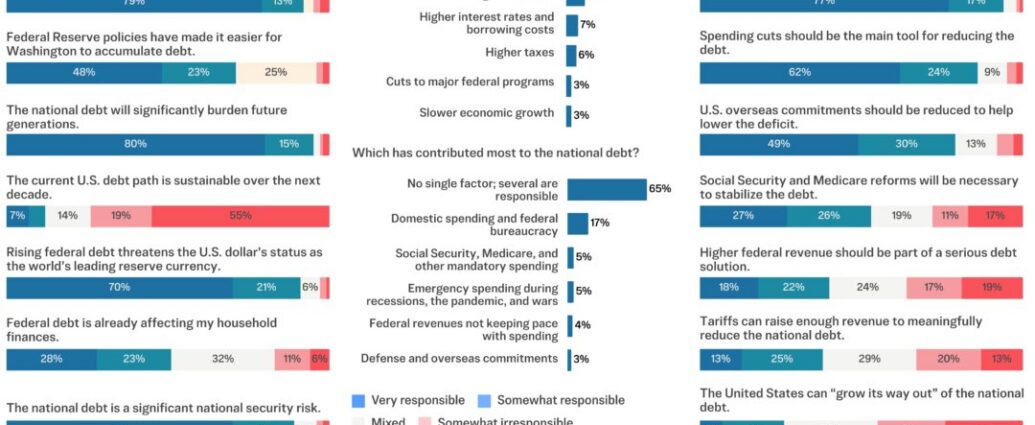
Risks, Responsibility, and Solutions: Epoch Readers React to $40 Trillion US Debt
The U.S. Treasury borrowed most of its money from global bond markets, including individual investors, pension funds, banks, and foreign governments.
Foreign officials and private investors together held some 40 percent of outstanding U.S. Treasury securities as of mid-2025, according to Brookings.
Brookings said foreign investors’ willingness to buy and hold Treasuries has direct consequences for U.S. borrowing costs, the dollar, and financial stability.
Some believed $40 trillion isn’t just a warning about the future but an explanation for the current cost-of-living crisis. …

The AI boom hasn’t stopped U.S. companies from hiring cheap offshore labor, and overseas call center employment is still skyrocketing
In September 2025, Salesforce CEO Marc Benioff said the company slashed 4,000 customer service roles:“I need less heads,” Benioff said at the time.
But as more companies adopt agentic AI in hopes of replacing or making human workers more efficient, one top economist has noted customer service roles—particularly those overseas—are only growing.
Citing data from the IT & Business Process Association of the Philippines, Apollo chief economist Torsten Slok noted in a recent blog post that from 2016 through 2025, call center employment in the Philippines has risen each year, nearly doubling to 2 million over the 10-year span.
He also found from 2021 to July 2026, unemployment rates in the Philippines have decreased from 9% to about 5%, and in India decreased from around 7% to 6%, suggesting AI has not displaced offshore workers.
“If AI were displacing white-collar work at scale, you would expect to see it first in the Philippines and India, where business process outsourcing (call centers, IT support, back-office processing) accounts for a large share of employment,” Slok wrote last week. “Instead, the unemployment rate in both countries has continued to trend lower.”
The Philippines dethroned India as the largest call center employer about 15 years ago.
Offshore call center jobs began booming in the late 1990s and early 2000s as a cost-cutting measure. The labor is considerably cheaper overseas than in the U.S., with Filipino call center workers earning wages of 15,000 to over 120,000 Philippine pesos per month, or about $243 to $1,948. In the U.S., the average monthly wage for call center workers is about $2,866, according to Indeed.
But these jobs are also among the most susceptible to AI displacement. The Brookings Institution estimated 86% of customer service representative tasks had high automation potential.
The apparent contradiction of the job’s potential to be automated alongside rising employment points to a centuries-old economic paradox reflected across labor more broadly, according to Slok.
“This is Jevons paradox in action,” he wrote. “As AI makes call center work cheaper and faster, companies are buying more of it, not less.”
Jevons paradox in the 21st century
Jevons paradox refers to an observation made by English economist William Stanley Jevons in 1865: The invention of the Watt steam engine made coal a more efficient energy source. But instead of coal consumption decreasing because of increased efficiency, consumption skyrocketed as energy became cheaper.
In the age of AI, Jevons paradox has been resurrected and applied to how the technology may be impacting the labor market: While tech leaders like Anthropic CEO Dario Amodei initially predicted AI will replace white-collar workers, Slok instead posits the cost of professional work will fall as AI boosts task efficiency, increasing demand for certain roles and ultimately expanding available jobs.
“Lower cost per interaction does not mean fewer interactions,” he said. “It means more customers served, more channels opened and more markets worth reaching. The technology that was supposed to shrink the industry is fueling its expansion.”
This is already being seen in some professions previously predicted to be replaced by AI. A decade ago, “godfather of AI” Geoffrey Hinton declared radiology would one day no longer need to be performed by humans because of its potential to be automated.
Instead, Christoph Herpfer, an economist and business administration professor at the University of Virginia’s Darden School of Business, said the number of radiologists in the U.S. has actually increased by 10% over the past decade.
“We actually have a huge shortage of radiologists. So the exact opposite of this prediction has happened,” he told Fortune.
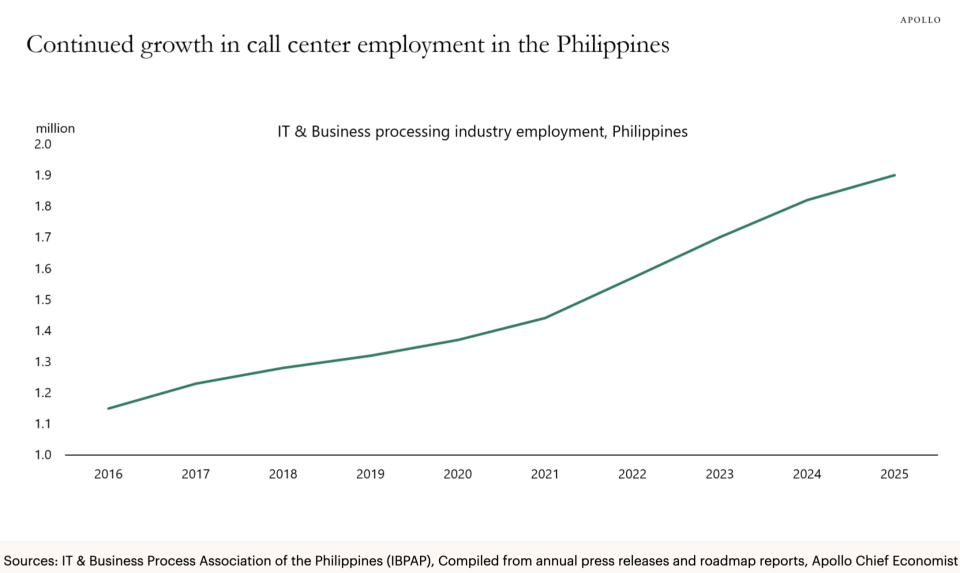
The future of call centers and automation
Labor economists are already seeing evidence of AI increasing the productivity of call center workers, which could bolster the role’s demand. A 2023 study led by Erik Brynjolfsson, director of the Stanford Digital Economy Lab, found that for more than 5,000 customer support agents, an AI-based conversational assistant tool increased productivity by an average of 14% per hour.
His research from a decade ago similarly found that an early AI feature able to translate listings on eBay increased international exports by 17.5%. Emma Harrington, an economics professor at the University of Virginia, believes this principle could be applied to today’s AI boom.
“What we’re now seeing in the data might be a modern version of the same phenomenon,” she told Fortune. “We can trade labor more easily across countries when language can be traded more seamlessly.”
While some economists expect AI’s strengths to bolster productivity and subsequent employment, others argue the technology’s weaknesses will sustain the call center industry.
Benjamin Shestakofsky, a sociologist and information science professor at Cornell University, told Fortune AI may not yet be sufficiently trained to navigate the complexities of certain problems. Moreover, humans experience something akin to “AI brain fry” if inundated with an increased case load; AI may be able to increase how many customers agents can serve, but humans still have limitations in how much they are able to process.
In other cases, some companies may explicitly seek out human customer service agents simply because of their brand, according to Shestakofsky. As the world becomes more automated, it’s sometimes a relief to talk to a human on the other line.
“Even if the LLMs get so good that eventually they can deal with those complex issues—which I don’t think they can do now—I would still expect that you would see some companies seeing the value and offering more human interactions that help customers feel seen, feel like they’re more than just a number on a spreadsheet,” he said.
A version of this story was published on Fortune.com on May 17, 2026.
More on AI and labor:
- New York added 30,640 tech workers in 3 years, surpassing San Francisco as AI hiring surges
- Bill Gates wants to tax robots to deter businesses from replacing humans with machines
- 90% of executives say AI hasn’t boosted productivity. Some are still cutting jobs
- His boss asked if AI could replace human coders. Two weeks later, he and 160 colleagues were laid off in Beijing
This story was originally featured on Fortune.com

Tech billionaires and executives like Evan Spiegel and Peter Thiel are publicly shielding their children from the products that made them rich
Despite building an increasingly screen-focused world, tech billionaires and executives are keeping their own children away from the tech they helped create.
As far back as 2010, Apple cofounder Steve Jobs told a New York Times reporter his kids had never used an iPad and that “we limit how much technology our kids use at home.”
Since then, excessive device use among children has grown more common, especially as busy parents turn to screens to find some temporary peace. The trend has accelerated so much that some young children accustomed to extensive screen time have been dubbed “iPad kids.” On average, children in the U.S. ages 8 to 18 spend 7.5 hours per day watching or using screens, according to the American Academy of Child and Adolescent Psychiatry.
At the same time, Silicon Valley billionaires and executives have increasingly sought to limit how their own families use technology and for how long, partly in response to the rise of time sucking social media and short-form video.
YouTube CEO Neal Mohan is among those taking a cautious approach. Mohan, who has three children, said he and his wife try to limit the time his children spend on platforms like YouTube.
“We do limit their time on YouTube and other platforms and other forms of media. On weekdays we tend to be more strict, on weekends we tend to be less so. We’re not perfect by any stretch,” he said in a December interview with Time.
YouTube cofounder Steve Chen also said at a talk at the Stanford Graduate School of Business last year he wouldn’t want his kids consuming only short-form content, noting it might be better to limit kids to videos longer than 15 minutes.
“Shorter-form content equates to shorter attention spans,” he said.
Different approaches
When it comes to how parents control their children’s screen time, some of the most important people in Silicon Valley have surprisingly different approaches.
Instagram CEO Adam Mosseri, who has three children, said in an interview last year he controls his kids’ weekend screen and video game time by starting at a baseline of zero minutes.
His kids can earn earn up to 90-minutes of screen time or video game time on the weekend by during by completing three 30-minute homework sessions during the week, he said. Still, he said he avoids taking away screen time that his kids have earned, because he said that caused them to act out more.
There is one exception to the rule, he said: “When really all barriers go out the window is on planes.”
Much like Mosseri, early Facebook investor and billionaire Peter Thiel previously said he lets his two young children use screens for only an hour and a half per week, a revelation that prompted audible gasps from the audience at the 2024 Aspen Ideas Festival.
Other tech leaders are a little more adaptable. That includes Snap CEO Evan Spiegel, who said he and his wife, Miranda Kerr, adapt their approach to screen time based on the child because their four boys, ages two, six, seven, and 15, vary so much in age.
Spiegel said the two-year-old gets almost zero screen time, unless he is getting a haircut, when his parents allow him to watch videos of Bobcat tractors, because “he really struggles with getting his haircut,” he told Lenny’s Podcast in June. Spiegel said the four and six-year-olds also don’t use screens often, and “we don’t give them phones or anything like that,” he added.
They do watch movies occasionally and play video games on ModRetro’s Chromatic handheld video game device, which he got them last Christmas, he said.
Meanwhile, Spiegel’s oldest son, Flynn, is “all in on on technology, whether he’s using it for school or whether he’s using it to talk with his friends or using Snapchat,” he said.
Much like Facebook investor and billionaire PayPal cofounder Peter Thiel has put said he lets his two young children use screens for only an hour and a half per week, a revelation that prompted audible gasps from the audience.
Other tech founders, including Microsoft’s Bill Gates and Tesla’s Elon Musk, have also spoken about limiting their children’s access to devices. Gates has said he did not give his children smartphones until age 14 and banned phones at the dinner table entirely. While Musk, who bought the social media company X, formerly Twitter, in 2022, said it “might’ve been a mistake” to not set any rules on social media for his children.
Social media backlash is growing
Scientific research increasingly backs up tech leaders’ instinct to rein in screen time. A 2025 study of nearly 100,000 people found short-form video use was consistently associated with poorer cognition and a decline in many aspects of mental health across both younger and older social media users.
As young people increasingly spend most of their waking moments online, the backlash against social media, and especially minors’ use of social media, has reached a breaking point.
Australia, Indonesia, and Malaysia have all banned adolescents under 16 from using social media over the past year. Several other countries, including Spain, Denmark, and the United Kingdom, are considering similar legislation.
To be sure, its unclear how effective such legislation has been. A study by a team that advised the Australian government on the rollout of its social media ban found in a July study that some test accounts for fake 16 year-olds weren’t prompted to verify their age.
Plus, several social media CEOs have publicly pushed back on claims their platforms are harmful. Mosseri testified earlier this year in a trial against its parent company, Meta, social media overuse does not constitute “clinical addiction.” Meta this week reached a $17 billion settlement in the suit brought against it by 47 states and the District of Columbia and agreed to change its platforms to limit how long teenagers can use them for and to ban certain features. The company did not admit to wrongdoing.
Far from being a new phenomenon, the idea social media use is harmful for young people has been around for years. Still, it’s the tech leaders who created the attention economy who have been the most attentive to this fact.
A version of this story originally appeared on Fortune.com on Feb. 21, 2026.
More on tech
- Flock is going from the center of the surveillance debate to bipartisan target in record time
- Deloitte sees a $566 billion lunar economy by 2050
- ‘I’m in favor of taxes,’ says Nvidia’s Jensen Huang—but he doesn’t agree with Bill Gates on his plan to slow an AI fallout
This story was originally featured on Fortune.com

Dolly Parton once turned down a song request from Elvis Presley. That was just one business decision that helped build her $650 million empire
Country music superstar Dolly Parton had a very early start to her career when she began singing at her local church at age 6. By age 13, she had recorded her first single, “Puppy Love,” which she co-wrote at age 11 with her uncle—and had even appeared on the Grand Ole Opry stage by that time, too, introduced by none other than music legend Johnny Cash.
After high school, Parton immediately moved to Nashville to continue building momentum in her music career. It was there she wrote both hit singles “Jolene” and “I Will Always Love You”—on the same day, no less—two songs that were later cemented as country classics. Her partnership with singer and television star Porter Wagoner in 1967 also helped her gain national recognition.
But what also made Parton so prominent in the music industry was her business savvy. She always retained ownership of her songs, a rare move that helped balloon her wealth to an estimated $650 million. It was especially helpful that she chose to do that when Whitney Houston’s version of “I Will Always Love You” became a global hit in the 1990s.
Notably, Parton, whose family announced her death earlier this week, even turned down Elvis Presley’s request in 1974 to record the song after his manager Colonel Tom Parker demanded half the publishing rights.
“I said, ‘I’m sorry, but I can’t give you the publishing.’ I wanted to hear Elvis sing it, and it broke my heart—I cried all night,” Parton told W Magazine in 2021. “But I had to keep that copyright in my pocket. You have to take care of your business.”

Parton had established her own publishing company in 1966, which helped her hold on to nearly all of her publishing rights. This meant she got paid a larger royalty whenever one of her songs was played or covered. And she wasn’t about to let even The King slide past those rules.
“Everybody’s going to use you if they can,” she added. “These are my songs—they’re like my children. And I expect them to support me when I’m old.”
How Dolly Parton grew her wealth
Parton built a legendary career in entertainment from her music, acting roles, and her theme park, Dollywood, in Tennessee.
While a large portion of Parton’s wealth (an estimated $150 million) came from her music catalog, she also earned millions in royalties and co-owns Dollywood, which reportedly generates hundreds of millions in revenue each year from roughly 3 million visitors.
Parton was also a dedicated philanthropist, having founded the Dollywood Foundation in 1988. Her foundation focuses on supporting children in her hometown of Sevierville, Tenn., through educational programs.
She also made multimillion-dollar donations to disaster relief, medical research, and scholarships. In 2022, she received the Carnegie Medal of Philanthropy, joining the ranks of other major philanthropists like Bill and Melinda Gates, Michael Bloomberg, Paul Allen, and the Rockefeller family.
A version of this story was originally published on Fortune.com on Oct. 8, 2025.
This story was originally featured on Fortune.com
The old pillar: Israel’s kibbutzim have changed beyond recognition – so what keeps them alive?
For much of Israel’s history, the kibbutz and moshav were not simply places to live. They were institutions through which some of the most basic tasks of the Zionist project were carried out: settling land, absorbing immigrants, farming, holding border areas, and building communities where there had been none before.
The image that grew around them was just as durable. The kibbutz meant the dining hall, equal wages, and the orchard. The moshav meant the family farm, chickens, tractors, and cooperative agriculture.
The problem, sociologist Dr. Avi Shnider argues, is that much of that Israel no longer exists.
“The ethos of the kibbutz and moshav that you have in your head isn’t there anymore,” Shnider told The Jerusalem Post. “There’s a completely different ethos.”
Series of papers examines the contemporary kibbutz
Earlier this year, Israel Studies Review, the journal of the Association for Israel Studies, published a special issue devoted entirely to kibbutzim and moshavim. Guest-edited by Shnider, of the College of Management Academic Studies in Rishon Lezion, and University of Haifa Prof. Aviad Rubin, the nine papers range from solar energy and agricultural labor to Latin American immigration, taxation, architecture, and the reconstruction of communities devastated on October 7.

Taken together, however, they ask a larger question.
If one of the old pillars of Zionist society has changed almost beyond recognition, who are the people choosing to carry it forward now? Why are they doing it, what still binds them together, and what exactly remains of the institution once much of the machinery that created it has been dismantled?
For Shnider, that question had been neglected for years.
“There is tons of research” on kibbutzim, he said, particularly on their establishment, ideological battles, and crises of the 1940s, 1950s, and later decades.
Then, in his view, the story largely stopped.
“For the last 15 years, I found myself a little frustrated,” he said. Both academic research and public discussion continued to speak about kibbutzim and moshavim through the images of the 1970s and 1980s.
The special issue was not planned before October 7.
Shnider and Rubin had met Israel Studies Review editor Oded Haklai at a conference in New York in 2023 and discussed research on kibbutzim and moshavim, but there was no proposal at the time for an entire issue.
Shnider doubted there would have been much appetite for one. “Kibbutzim and moshavim didn’t have that kind of place in the contemporary agenda of Israel studies before October 7,” he said.
Then Hamas attacked the Gaza border communities, and kibbutzim and moshavim suddenly returned to the heart of the Israeli story, specifically as places where Israelis were murdered, kidnapped, fought, evacuated, and eventually began the long process of deciding whether and how to return.
The renewed attention made the gap between image and reality harder to ignore.
One of the papers Shnider points to, Liron Shani’s “Solar Peppers: Imagination and Infrastructure between Change and Adaptation in Desert Agriculture,” examines farmers in the Arava, where an economy and identity historically built around agriculture are increasingly intertwined with solar-energy production.
“We talked, we talk, and we will talk about agriculture,” Shnider said. “But the rural space has become a space for producing electricity.”
For farmers whose income was once dominated by the uncertainties of weather, disease, and global produce markets, this infrastructure can provide something agriculture often cannot: stability.
They may continue growing peppers, but solar panels have altered what it means economically to be an Arava farmer.
Elsewhere, the old distinctions are disappearing in different ways.
Most kibbutzim have privatized at least some elements of salaries, housing, and the means of production, while moshavim have abandoned many of the cooperative systems through which produce, credit, and capital were once managed. Members increasingly work outside their communities, while agricultural settlements rely heavily on hired and migrant labor.
The question, then, is why they did not simply disappear into ordinary suburban Israel, a question Shnider has been asking for years.
His research proposed looking at the kibbutz and moshav through three dimensions: organization, space, and community.
The organizational dimension is the easiest to see and, historically, the one researchers tended to measure. Does a kibbutz still operate a communal dining room? Are salaries equal? Is property held collectively? Does a moshav market produce together or leave individual farmers to fend for themselves? By those measures, much of the old model was dismantled.
But organization, Shnider argues, was only one part of what made these communities what they were. The formal structure had been removed, but people continued to help one another and behave as members of a community.
Once researchers look not only at organization but also at the physical space of a community and the social relationships inside it, Shnider argues, the survival of the kibbutz and moshav becomes less mysterious.
It also becomes harder to maintain the sharp distinction between the two. “The division between kibbutz and moshav is beginning to break down,” he said.
Shnider grew up in Kfar Sirkin and remembers a rural world divided into distinct social systems. As a teenager, he knew young people from moshavim hundreds of kilometers away but barely knew teenagers in nearby kibbutzim.
They had different schools, youth movements, political institutions, and identities.
Today, those walls are much lower.
“Kibbutz and moshav were completely different things,” he said. What has emerged instead is increasingly “a rural space.”
In organizational terms, the two have even begun moving toward one another: Most kibbutzim have become less collective, while some moshavim have adopted forms of joint agricultural cultivation.
“What was once very different,” Shnider said, “has become very, very similar.”
The same reconsideration applies to the people who inhabit those communities.
One article in the collection, Sebastian Klor and Tal Elmaliach’s “The Rise and Fall of a Pioneering Aliyah: A Century of Latin American Jewish Migrations to Kibbutzim, 1923-2023,” traces a largely overlooked century of Latin American immigration to kibbutzim.
October 7 made that history suddenly visible. The paper notes the striking proportion of residents of Latin American origin among the Gaza border kibbutzim and among those kidnapped on October 7.
For Shnider, it exposes another problem with the image Israelis have carried forward from an earlier era. The rural settlement movement is still frequently treated as synonymous with an old secular, Ashkenazi, left-wing elite. But border moshavim in the North and South, waves of immigration from Middle Eastern countries, Latin American kibbutzim, and decades of demographic change have produced a far more complicated population.
“Who are its people?” is therefore not a rhetorical question for the researchers. Neither is the question of what motivates them.
Agriculture remains, but it is no longer necessarily the sole source of income. Socialist ideology has weakened, and settlement movements that once divided communities and even families along bitter political lines have consolidated. The state, local authorities, global markets, and private businesses now shape rural life in ways the founders could hardly have imagined.
Yet people continue to attach significance to land, border communities, small-scale communal life, and the ability to rely on neighbors.
Then came October 7, which, for a time, appeared to revive the old national relationship with the kibbutz. Volunteers streamed into agricultural communities, while talk of border settlement reemerged as a national mission. The farming communities of the Gaza border became associated not with privilege but with massacre, sacrifice, and resilience.
Shnider was skeptical from almost the beginning that the solidarity would permanently erase the divisions that preceded the attack.

Schnider doubts lasting solidarity with kibbutzim
In an interview with Haaretz shortly after October 7, he was asked whether the massacre would change the public image of the kibbutzim.
His answer was a medical analogy: “It’s like a person with diabetes who gets into a car accident – the diabetes doesn’t disappear,” he said. “The car accident that happened to Israeli society now will not save it from diabetes.”
He welcomed the displays of solidarity, he said at the time, but did not believe they would necessarily last.
Nearly three years later, his assessment remains similar. “Israeli society is a very divided society,” he told the Post. “It was before October 7, and despite all the ‘Together We Will Win,’ it remained that way after October 7.”
The analogy does not mean the solidarity was false but rather that catastrophe temporarily pushed older disputes aside without necessarily resolving them.
For the kibbutzim and moshavim, however, October 7 also demonstrated the strength of the very communal structures Shnider has spent years trying to understand.
In the immediate aftermath of the massacre, he noted in his earlier interview, kibbutzim and moshavim rapidly organized evacuation, assistance, and communal responses. But that does not mean tight communities are immune to trauma; the same solidarity that holds people together can also bind them to grief.
The physical environment of a kibbutz is not simply scenery; it is part of its communal structure. A road, a neighbor’s house, or the path to the dining hall can carry the memory of a killing, a kidnapping, or a battle. That is why the question of reconstruction is not only technical.
Idit Shachnai Ran’s article in the collection, “Utopia Has a Form: The Spatial Layout of the Kibbutz in Times of Crisis,” examines precisely the gap between a kibbutz physically designed around the collectivist ideals of the 20th century and communities whose values and daily lives have since changed.
October 7 has made that mismatch newly urgent. Rebuilding can mean reconstructing what stood before the attack, but it can also mean asking whether the physical space itself should change to accommodate the community that exists now.
The story emerging from the collection is not one of a return to the old kibbutz, which has been disappearing for decades. Nor is it simply a story of decline.
The papers instead present something more difficult to categorize: communities that gave up many of the structures that once defined them but retained enough social, spatial, and cultural cohesion to remain distinct.
That may be the most revealing legacy of the old Zionist experiment.
Even though the ideology weakened, the formal institutions were dismantled or privatized, the political movements blurred together, and the people themselves became more diverse – when catastrophe came, the communities still behaved like communities.
For Shnider, the central question is therefore no longer whether the kibbutz of the 1950s can be restored. It is why, after so much of the machinery that created the kibbutz and moshav disappeared, something recognizably theirs remained – and who, in a very different Israel, will choose to carry it forward.
American Girl once captured U.S. history’s complexity. Why not now?
What does it mean to be an American Girl during the nation’s semiquincentennial?
This year isn’t just the 250th anniversary of America’s independence — it is also the 40th anniversary of American Girl, a company founded to sell families an 18-inch, doll-sized narrative of American history.
Over the past decade, the Mattel-owned brand closed dozens of stores and restructured. Observers alleged a midlife crisis: The company launched modernized historical dolls — Kirstin with space buns — alongside brand collaborations that feel very different from the nuanced characters it was founded on.
Those original characters brought a rich past to America’s girls and challenged us to make a better future. The current focus seems more on nostalgia for the brand’s early years than on telling historical stories.
The dolls and books, which depict 9- and 10-year-olds, became part of daily life for millions of American girls. They were friends whose lives were shockingly different from their owners’ and sometimes comfortingly the same. As American Girl founder Pleasant Rowland introduced girls to their historical counterparts — Samantha, Molly, Kirsten, Felicity, Addy, Josephina, Kaya and Kit — the characters became companions in understanding what it means to be American.
Rowland’s girls live in an imperfect America. Addy’s family escapes slavery, only to discover a hierarchy of color in the North. Samantha Parkington navigates grief and the lack of child labor laws. Kirsten struggles to learn English and wrestles with white Americans’ treatment of native people.
These girls make mistakes and learn lessons while living in unfair, unequal and unjust societies in need of change.
Rowland wanted children to learn about and from the past, but adults today appear to accept only two narratives for telling our history: the U.S. as unquestionably wonderful or foundationally failed.
In his 2025 executive order “Restoring Truth and Sanity to American History,” President Donald Trump argued that modern histories reconstruct an “unparalleled legacy of advancing liberty, individual rights, and human happiness … as inherently racist, sexist, oppressive, or otherwise irredeemably flawed.” The order does not see room for America’s history to be simultaneously about advancing rights and about realities of racism, sexism and oppression.
American Girl has always offered a far more nuanced telling. Through the eyes of fictional Felicity — introduced in 1991 — girls learned the American Revolution was ideological and multidimensional: a brutal civil war, centered on colonist rights, that tore apart families and destroyed communities.
In 1774, Felicity’s father tells his apprentice Ben that “War is the worst way to solve disagreements.
“War is like a terrible illness. Everyone suffers. People die,” the paternal character explains. “Those who survive are weakened, and ‘tis a long while before they are full strength again.”
Felicity and her father still support the new nation, but they do so knowing it’s an imperfect solution to their problems. American Girl emphasized the imperfectness of history and invited girls to make the nation better.
Rowland’s vision is impossibly optimistic. Addy flees slavery, learns to read and navigates northern racism all in one year. Upper-class Samantha befriends poor Nelly and changes her snobby grandmother’s opinion on Irish immigration. All of the company’s stories end happily.
American women may have carried our love of American Girl into adulthood, but the stories remain written only for children. Mattel could tell more complicated stories to adults who love the brand. As one meme-maker joked, “We need an American Girl who survived the Triangle Shirtwaist Factory Fire.”
If America’s women embraced the world the brand built, could we have an American Girl who lived in a Japanese internment camp? What about one whose family came to the country fleeing violence?
In one way, Mattel has told such a complicated historical narrative. The 2026 Girl of the Year, Raquel Reyes, is a Mexican American resident of Kansas City, Missouri, and the great-great granddaughter of Samantha Parkington, the original American Girl. Raquel’s family blends Mexican and Mid-Atlantic heritages with little challenge. There is no attempt to discuss that Samantha’s Grandmary would not approve of this modern world and family. The character delivers nostalgia, not a historical argument.
Adult consumers are stabilizing the brand, which has profited over the past five quarters after years of losses. But American Girl is offering, and women are buying, nostalgia — like Molly-plaid tumblers — more than layered histories. In an era of polarization and oversimplified historical narratives, American women need not nostalgia but a new fleet of American Girls who can tell difficult, dangerous, heartbreaking and tenacious stories of lives past.
Americans can handle complex histories. American girls were raised on them.
Tara Strauch is the Paul L. Cantrell Associate Professor of History at Centre College, where she teaches early American history from the colonial period to the Civil War. Her courses include American holidays and American Girl.
The opinions expressed in Fortune.com commentary pieces are solely the views of their authors and do not necessarily reflect the opinions and beliefs of Fortune.
This story was originally featured on Fortune.com
Israel to face strong winds, high gusts throughout Saturday afternoon, Meteorological Service warns
Israel is expected to face strong winds on Saturday afternoon, up to 50 kph, with gusts up to 70 kph, according to a Yellow Warning from the Meteorological Service.
The warning, which lasts from 2:00 p.m. until 8:00 p.m., noted that the southwesterly winds are forecast to affect most of the country, including the entire coastline, the Golan Heights, Judean Foothills, northern Samaria, and the Negev.
The Meteorological Service advised the public of the risks posed by the high winds, including difficult driving conditions, power failures, and falling trees.
In addition, the Ben-Gurion Airport, Herzliya Airport, Haifa Airport, and Rosh Pina Airport Terminal Aerodrome Forecasts (TAF) noted temporary wind and gust advisories for arriving and departing aircraft.
A High Sea Swimming Danger Orange Warning was further issued for the Israeli coastline until 10:00 p.m., advising of waves as high as 2 meters and increasing.

According to the Meteorological Service, the significant risks associated with the warning include drowning, injury, being carried out to sea, and capsizing for small boats, with even large boats facing the risk of running aground near shore.
Weekend rain, flood warnings issued across Israel
The warnings by the Meteorological Service follow a forecast published by Walla on Friday warning of an unusual rain event expected to cause flooding in Israel during the weekend, with the Israel Fire and Rescue Authority reinforcing its forces in preparation.
Fire Commissioner Tafser Eyal Caspi instructed all districts to move to heightened readiness ahead of the storm’s peak, expected overnight between Saturday and Sunday, following a situation assessment held on Thursday.
The Walla forecast noted that the rainfall, which will be highest along the northern coast, in the Sharon region, the greater Tel Aviv area, and the Shfela, may reach as high as 20-30 millimeters, with further warnings of lightning and hail.
Yoav Etiel contributed to this report.
Russian drone strike on Kyiv-area warehouse causes detonation, killing 37
At least 37 people were killed after a Russian drone strike on a Kyiv-area warehouse sparked a detonation, officials said on Saturday, prompting calls by President Volodymyr Zelensky to punish those responsible.
Another 42 people were also injured and more than 380 evacuated from the strike area in the Bucha district, Tymur Tkachenko, governor of the Kyiv region, wrote on the Telegram app.
Tkachenko did not provide details about what was hit in the strike late on Friday. Zelensky said a strike on a warehouse had triggered a detonation and that nearby infrastructure suffered “significant damage,” including residential buildings and a facility providing care for the elderly.
Zelensky calls for those who allowed negligent storage to be held responsible
“Those who allowed this to happen must be held accountable for their decisions,” Zelensky wrote on X/Twitter, adding that criminal cases had already been opened on charges of official negligence.
“There are regulations in place – ammunition cannot be stored near homes or other residential areas. Appropriate conclusions will certainly be drawn.”
Since last evening, efforts have been underway in the village of Myla near Kyiv to deal with the aftermath of a Russian drone strike. On-site coordination centers have been set up to assist people. All necessary services are deployed. State Emergency Service units are on the… pic.twitter.com/mQU2DHZYU7
— Volodymyr Zelenskyy / Володимир Зеленський (@ZelenskyyUa) August 29, 2026
Tkachenko, the governor, said the death toll could still rise.
The attack on Friday followed two days of frequent drone waves aimed at the city and the surrounding region, damaging warehouses and homes and disrupting daily life.

College sports and ‘amateurism’ become the new ‘professional’ as an NFL player fights to return to school
Dae’Quan Wright, the former Cleveland Browns tight end, may soon make history. The former NFL player’s stint in pro football is coming to an end after being waived, but that may not be the last time he dons a football uniform, as he’s likely to return to college sports at LSU this year.
Wright, a former Ole Miss tight end who went undrafted in the 2026 NFL Draft, signed with the Philadelphia Eagles before joining the Cleveland Browns. After receiving a temporary restraining order in a lawsuit challenging the NCAA’s eligibility rules, he entered the transfer portal and reached an agreement to return to college and reunite with his former coach Lane Kiffin. The 22-year old’s aspiration to return to America’s favorite amateur sport signals just how big college football has become.
The move would have been difficult to imagine under the traditional conception of college sports. Professional athletes have joked about it in the past, with even all-time NBA great LeBron James teasing at a potential college sports journey post-retirement—albeit as more of a joke than an actual plan. But the legal and financial changes that have transformed college athletics in recent years have made the distinction between “amateur” and “professional” increasingly difficult to maintain.
The NCAA is now fighting to preserve that distinction even as college athletes receive unprecedented compensation—and Wright’s case has become a spark in exposing the difference.
Since Wright’s arrangement with LSU became public, the fight over his eligibility has escalated quickly. The SEC, Big Ten, and other major conferences adopted rules this week banning athletes who signed professional contracts from returning to college rosters, a policy aimed squarely at players like Wright. A Dallas judge has since blocked the SEC from enforcing that ban against a group of athletes that includes Wright, though the NCAA has won reversals of similar restraining orders in other cases in the same week. The legal fight remains unresolved.
“Courts across the country granting relief to ineligible athletes who already had every opportunity to compete in college—sometimes without even having a hearing—are failing to appreciate the destabilizing effect their rulings are having on college sports,” the NCAA told Fortune in a statement.
Is college football really an “amateur” sport?
The association said Congress could address the issue by passing the bipartisan Protect College Sports Act, which it said would provide student-athletes with “a level playing field with rules that apply fairly to everyone.”
The legislation has advanced in Congress. The Senate Commerce Committee approved the Protect College Sports Act in June with bipartisan support, and the bill would establish a federal framework for NIL agreements while addressing eligibility, transfers and other parts of the college sports ecosystem.
“The lawyers bringing these cases seemingly won’t be satisfied until every professional athlete can treat college sports as a fallback option,” the NCAA said.
But Wright’s case is also illustrating why the NCAA’s argument about amateurism is becoming harder to square with the economics of the modern college engine.
Professor Victoria Jackson, a sports historian and co-director of the Great Game Lab at Arizona State University, said the NCAA’s description of college sports as a “fallback” misses the larger point of the industry.
“I think that’s among the most important questions,” Jackson told Fortune of whether athletes have adequate protections as they navigate the commercialized college sports system. “Taking a step back and thinking about the kind of unique position of college sports is useful.”
Jackson said college sports are now part of a global economy in which elite athletes routinely move between developmental and professional systems. In that context, she said, college sports are not necessarily a lesser alternative to professional competition.
“These are not fallbacks—it’s that they are good places, full stop,” she said. “The competitiveness of college sports is at the top of the world. But now also the compensation opportunities are among the most competitive in the world.”
For some athletes, Jackson explained, playing in the NCAA could potentially be more lucrative than playing professionally in another country or league. Wright, for example, had signed a three-year, $3,125,000 contract with the Eagles before being acquired by the Browns—giving the undrafted Gen Z Wright an average salary of $1,041,667. But the House v. NCAA settlement from 2025 now allows schools to participate in revenue-sharing—allowing colleges to directly pay athletes a share of up to 22% of the “average shared revenue” generated by power conference revenue. Louisiana State University—the college football program Wright is expected to join—is one of the schools enrolled in revenue-sharing, and the expected cap for the 2026-27 season is $21.3 million.
LSU declined a request to comment from Fortune regarding Wright’s return.
“Depending on what kind of package you can get for yourself,” Jackson said, “it might be more lucrative for someone to play in the college space as long as they can, or even try to return to it, than it would be to play professionally.”
In other words, college athletes are no longer just receiving scholarships while forbidden from monetizing their athletic fame. For the largest programs, athletes can now receive a package that combines scholarships, NIL opportunities and direct revenue-sharing payments. But Jackson argues the compensation itself is not a new development.
“The scholarship is just part of the compensation package now because there is direct pay to some of these athletes,” she said.
A scholastic distinction
If college sports remain fundamentally educational programs, there is a case for treating them differently from professional leagues as the NCAA stipulates. But if athletes are receiving direct revenue-sharing payments, negotiating NIL contracts and competing for increasingly valuable roster spots in a multi-billion dollar sports industry, the concept of “amateurism” becomes harder to use as the dividing line. Jackson says the better distinction may be between “scholastic” and professional sports rather than “amateur.”
“It’s a conflation of scholastic and amateur,” she said. “The fact it’s taking place within a school setting—is that enough to say that it’s different from professional sports? I’m not so sure at this point.”
Jackson also noted that in many countries, elite athletes develop through professional club systems rather than college programs. Young athletes can compete alongside professionals while receiving protections designed for minors. In soccer, for example, professional clubs operate academies that develop players before and during their professional careers.
“There is no such thing as amateurism,” the professor said of the international sports system. “You play sports and you earn money because you need to pay for the training and travel and competition to stay in that sport.”
American college sports, by contrast, have historically served as the major development system for professional football. The NFL has benefitted from colleges effectively bearing much of the cost of developing players, while college programs have used the NFL as the ultimate destination for their best athletes, according to Jackson.
There are already examples in other sports of athletes moving between professional and college systems without producing the same alarm. Jackson pointed to baseball and hockey, where players can be drafted or develop through professional pathways while retaining or returning to college opportunities under certain circumstances. That flexibility, she argued, could offer a blueprint for football, rather than forcing every sport into the same eligibility code. Football, however, remains the economic center of college sports. The sport generates enormous media and sponsorship revenues, drives conference realignment and finances many of the other sports that universities operate.
That makes it harder to separate football from the rest of college athletics. A possible solution, according to Jackson, would be to “spin off football and professionalize it,”—while maintaining university branding and still using the revenue generated by football to subsidize the other sports.
Dae’Quan Wright and his agents did not immediately respond to a request for comment from Fortune.
This story was originally featured on Fortune.com

Richard Branson double-booked his own job interview. The candidate stuck in traffic with him for 2.5 hours is now Virgin’s CEO
A job interview with Richard Branson, the billionaire founder of the Virgin brand, is likely to be nerve-racking enough on its own.
But when then-31-year-old lawyer Josh Bayliss arrived at Branson’s London mansion for what he expected to be a fairly standard interview, Branson realized he had another appointment across town—and was already running late. Rather than cancel the interview, Branson invited Bayliss to come along for the ride.
“It was probably on a good day, a 45-minute drive,” Bayliss recently recalled to Fortune. In reality, it turned into a two-and-a-half hour adventure that he took full advantage of.
“We got stuck in traffic, and that was great for me,” Bayliss said. “I got a chance to really interrogate Richard and find out a lot more about what made him tick.”
Bayliss ended up landing the job of general counsel in 2005—and that long traffic-filled interview marked the beginning of a relationship with Branson that would further shape his career. By 2011, Bayliss was promoted to CEO of Virgin Group—and just this year added company chair to his resume—overseeing a sprawling portfolio that includes an airline, telecommunications giant, gym chain, and commercial space-tourism business.
Nearly two decades after that first interview, Bayliss, now 53, said what drew him to Branson in the first place remains a defining part of the Virgin Group founder.
“There is an energy to Richard and an appetite to learn about what he doesn’t already know, to try what he hasn’t already tried, which I think really does blend very well with my own ceaseless curiosity,” Bayliss said.
Bayliss went from aspiring scientist to lawyer before setting his sights on the C-suite
Bayliss was born in Auckland, the capital of New Zealand, to a modest family, with his father playing guitar and a mother working as a hairdresser. Becoming a CEO was hardly something he had mapped out for himself growing up.
In primary school, he always wanted to become a scientist, inspired by the Incredible Hulk’s transformational superpowers. But after taking a few science courses, he realized his interests leaned more toward the humanities than STEM.
“I loved history. I did classics. I loved languages. I loved philosophy,” Bayliss said.
He went on to study history and Spanish literature as an undergraduate at the University of Auckland, graduating in 1996 before turning to law. His first job out of law school was as a judge’s clerk at the Court of Appeal of New Zealand, giving him a front-row seat to consequential decisions—and to people who could disagree fiercely without letting those disagreements become personal.
“I was exposed to some of the greatest minds I’ve ever been among, disagreeing profoundly over matters of huge importance for huge numbers of people, but never falling out over that disagreement,” Bayliss said.
That experience stayed with him as he moved to a law firm in Barcelona and then to London in 1999. But the further Bayliss progressed in his career, the less satisfied he became with advising the people making the big calls.
“I wanted to be making decisions. I wanted to take responsibility, and I wanted to be accountable for improving things for people in a commercial sense,” he said. He added that the opportunity to work at Virgin—and interview with Branson at age 31—gave him just that: the chance to combine his legal background with a growing role in leadership.
Gen Z interns ‘astonish’ Bayliss—and he says those who use AI can ‘move far more rapidly’ in their careers
More than two decades into his career at Virgin, Bayliss said the qualities that helped him advance are the same ones he looks for in the next generation of workers: curiosity, adaptability, and a willingness to challenge conventional thinking.
Gen Z interns, in particular, astonish him year after year, in part because of their willingness to stand by their values.
“I’m just so impressed with the caliber of the moral fiber of these young people,” Bayliss said. “I think they bring something to the table which is unbendable, and I think that’s so important.”
That conviction could prove especially valuable as AI continues to reshape the workplace. Bayliss views the technology as an “enablement tool rather than a replacement tool,” and believes young workers who pair it with strong human qualities can move faster early in their careers.
Bayliss added: “Those young people coming into the world of work are actually able to move far more rapidly through the early stages of their career.”
This story was originally featured on Fortune.com

Dan Brand emerges as Israel’s next tennis hope after a breakthrough year on world stage
While Israelis have been focusing their attention on soccer and baseball in recent months, carefully following the results of the recent World Cup and the many accomplishments of Israeli Deni Avdija and the Portland Trail Blazers NBA basketball team, a talented young teenager from Kfar Saba has been quietly making his way to the top of the international tennis world.
Dan Brand, a 17-year-old right-handed tennis player from Kfar Saba, is ranked 24th in the world for junior boys and is likely to climb even higher in the next few months. He competed this year at the French Open at Roland Garros and at Wimbledon. In both events, he played singles and doubles.
At Roland Garros, he lost a tough first-round, three-set singles match 3-6, 7-5, 6-1 to France’s Mathys Domenc; he and partner Safir Azam of the United States lost in the doubles quarterfinals.
At Wimbledon, Brand advanced to the second round for both singles and doubles. He will play in the upcoming US Open in both singles and doubles. The juniors tournament gets underway September 8 in Queens, New York.
“Dan is absolutely our next hope,” says Yoni Erlich, Israel’s Davis Cup captain and tennis director at the Israel Tennis and Education Centers. “He is on the right track to be in the top 20 for juniors. He had a few very nice wins in a men’s Futures tournament a few weeks ago, where he reached the quarterfinals. So hopefully in the next few years, we can see another Grand Slam player. We can only hope and be patient.”

Time for new Israeli top player
It has been quite a while since Israel has had a player at the top of the tennis world. Shahar Peer, the highest-ranked Israeli tennis player, reached a career-high singles ranking of world No. 11 in 2011. Grand Slam doubles champions Andy Ram and Jonathan Erlich reached a top ranking of fifth in the world in July 2008, just after winning the Australian Open men’s doubles title.
Amos Mansdorf, who now serves as Brand’s coach, is Israel’s highest-ranking men’s singles player of all time; he reached a career-high singles ranking of 18th in the world in November 1987.
Mansdorf has been working with Brand since he was 12 years old. “It is nice to see him coming along and moving in a nice direction. He plays clever tennis and is quite good all around,” reports Mansdorf. He also views his student as “nice, quiet, low-key, hard-working, and dedicated.”
Mansdorf sees Brand as a calm player who “doesn’t panic.” He would like to see Brand ultimately reach the top 50 in the men’s professional tour. “He likes to compete, and does everything well. We are hoping he will get stronger; he still [is] young. In the future, we want him to have all the weapons for pro play – a big serve with enough power and precision to stay in with good players.”
Mansdorf anticipates that, given the young tennis star’s accomplishments and potential, he will likely receive a deferment from the IDF and play tennis “for a good US college.”
Shai, Brand’s father, considers it serendipitous, if not almost miraculous, that the Brands crossed paths with Mansdorf soon after he unexpectedly learned of his son’s potential as a tennis player. Shai, a lawyer specializing in torts as well as a Brazilian jiu-jitsu black belt competitor and former two-time world champion, recounts a meeting with the National Sport Center Tel Aviv.
“Dan was a soccer player. His coach told the kids to try other sports. I tried to get him into jiu-jitsu, but he said it was too boring!” Dan then began playing tennis in school.
“His coach said, ‘I trained hundreds of kids; your son is something special,” recalls Shai. The coach encouraged Shai to “put [Dan] in a national competition,” but Shai was reluctant. “It was too early.”
As his son continued to show potential, Shai approached Mansdorf. He has continued working privately with Mansdorf, who became the head coach at the Ra’anana City Tennis Center not far from Brand’s Kfar Saba home. Shai is proud that his son has continued playing “in a local club,” as opposed to training in Europe “at a fancy club.”
As the young Brand’s career took off, and as demands to travel around the world to tournaments have increased, Shai often travels with Dan – to watch over him, monitor his health, and look out for his safety. When he is unable to accompany his son, Shai has a network around the world that he turns to “look out for Dan.”
Shai is pleased with his son’s maturity, independence, and ability to “just be a kid who is still in a regular school.”
Dan is the oldest of three Brand children. Shai and Ruth, his speech therapist wife, also have a 15-year-old son, Nadav, and a 10-year-old daughter, Shira. “Dan’s got his mother’s calm!”
Brand spoke with the Magazine just after a driving lesson while home in Israel briefly before setting out for a pre-US Open International Tennis Federation (ITF) Grand Slam Player Development Program at the Junior Tennis Champions Center in College Park, Maryland, near Washington, DC. He is one of the few Israelis to be selected for this group.
He talks candidly about school, his hobbies, and his friends, explaining that he does all of his learning on his own, on the road, and attends school when in Israel only to take tests. He then sheepishly concedes, “My mother is pretty smart and helps a little with math and other subjects!”
In many ways, Brand is a fairly typical teenager. He reports that he enjoys playing basketball and spending time with his family and friends who “treat me the same as before.”
He reports that he has developed some warm friendships with peers from around the world, and has not experienced antisemitic incidents, with some fellow players “asking about the situation in Israel, and listen and try to understand.”
He is also reflective, self-aware, and insightful about himself as a tennis player. He describes himself as a “solid player and a counter-puncher,” acknowledging that he needs to be more aggressive and serve faster, and that he is “a pretty focused, chill guy.”
Brand enjoys playing on grass, noting, “It’s not a surface you play on every day.” He likes routine, and admires tennis legend Novak Djokovic, winner of 101 Association of Tennis Professionals (ATP) Tour-level singles titles, including 24 Grand Slam titles and an Olympic gold medal. “I like his mentality. He is so focused on the match!”
Despite Brand’s rising fame, Shai is pleased that his son continues to be “so humble,” noting that Dan’s school friends have begun to “see him on TV and hear that he is famous.”
“He’s a good example. He will play with, and talk with, everyone. He is shy.” Shai is also pleased that “everywhere he goes, people fall in love with his son and say, ‘Dan is amazing.’” He admits that “this is more important to me than the tournaments” – though he is happy with Dan’s focus and accomplishments on the court as well. Shai is particularly proud of Brand’s 6-3, 6-2 win against Jordan Lee in May, in the finals of the J300 Charleroi-Marcinelle/Astrid Bowl Charleroi Belgian International Championships. Lee is ranked eighth in the world and recently won the Wimbledon championship.
As the young Brand continues to succeed on the court, he is attracting the attention of US colleges. Shai reports that Brand may receive “ilui” (prodigy) status from the army, an even higher status than the “sportai mitstayen” (outstanding athlete) status granted to other very accomplished athletes.
The latter usually perform desk jobs in the IDF, so that they can continue practicing their sport. “Iluim” are given exemptions from the army, as they are seen to be serving their country in other ways. Yet, Shai – who notes that both he and his own father were IDF combat soldiers – predicts that Dan will serve in the IDF at some point.
Shai does not worry about his son’s safety, though he does note that “after Oct. 7, you can feel people turning their backs on you.” His son, who has reached out to some European players, hoping to team up with them as potential doubles partners, has yet to receive replies. In contrast, players from the US, South America, and Asia have been responsive and kind to the young Israeli.
Shai is proud that his son continues to proudly represent Israel, even though “a kid with a flag [of Israel]” is like a target.” He notes that his son had the opportunity to play for Germany, since he has a German passport, as his maternal grandfather is German. “He would have gotten more money, but Dan said ‘no,’ – he wants to do it the hard way!”
To prepare for the upcoming US Open, Brand is off to the International Tennis Federation’s pre-tournament grand slam player development program in Maryland. Coach Mansdorf will not be able to accompany Brand to the US Open.
Shai, as well as Danny Perekalsky, CEO of the Israel Tennis Association (ITA), will be by Brand’s side as the juniors’ tournament kicks off on September 6. Perekalsky is pleased with Brand – for his tennis accomplishments, his overall demeanor and behavior, and for the genteel way that he represents Israel.
“Dan is a really great kid. He shows a great mentality and behavior on and off the court, and he is a really great example for other kids with his behavior and style.”
Perekalsky recounts some of Brand’s recent successes: his wins in tournaments in Thailand and Belgium; and in the recent August 3-9 ITF M15 tournament two weeks ago in Astana, Kazakhstan, where he earned ATP ranking points for reaching round 16 and defeating fellow Israeli Oren Shimanov 6-3, 4-6, 7-5. “He has really made a big jump in the last six months!”
Perekalsky notes that the ITA has been providing support for Brand, along with sponsors such as Rav Bariach, the Israeli company known for its security doors and high-end locking systems.
Brand also receives support from Netanya’s prestigious Wingate Institute, the National Center for Physical Education and Sport. “He is now under their care,” reports Shai. “I am just looking out for my son as a father.”
Perekalsky adds, “We are proud to support Dan and to have such a developing talent! Bravo also to Dan’s family and to coach Mansdorf. Amos is doing a great job with Dan. It is not a coincidence he is achieving the results he has been in the past six months.”
He predicts that Brand will “be in the top 10 in January, if all goes according to plan.” He notes that as all 18-year-olds move out of this competition category, it will create an opportunity for Brand to advance his standing.
In the meantime, Perekalsky and all of Israel, which is discovering the 17-year-old Brand, are excited for what Brand has accomplished so far, and for what lies ahead. Perekalsky shares that, when he speaks with young kids, they say that they want “to play in Wimbledon like Dan.” This is no small matter given that, as Perekalsky notes, “in Israel, tennis is third after soccer and basketball.”
“Israeli is waiting to have something to be proud of in tennis. And we need more than one Dan. We are proud, but it is only a start!”
Iceland votes on whether to start EU membership talks, results too close to call
Icelanders voted on Saturday on whether to reopen membership talks with the European Union, with islanders split down the middle after a campaign focused on the cost of living, security, sovereignty, and control over fishing waters.
The race is too close to call. A Gallup poll on Friday suggested a narrow majority opposed reopening negotiations, a slight shift from earlier surveys that pointed to a narrow lead for supporters of renewed talks.
“Yes” campaigners backing talks say joining the bloc could ease high interest rates and offer more security in a world unsettled by the war in Ukraine and US President Donald Trump’s threats over another Arctic island, Greenland.
“No” campaigners argue EU membership would threaten the island’s sovereignty and fishing waters.
“Today is our encounter with history,” Iceland’s former President Olafur Ragnar Grimsson, a campaigner against EU membership, said in a post on social media.

Should voters say “yes,” that would only open the way to discussions with Brussels. Iceland would then have to hold a second referendum, likely several years later, on whether to join the EU.
Old questions, new urgency
Iceland first applied to join the EU in 2009, amid a financial crisis that hit the country’s small, exposed economy especially hard. Talks ended in 2013 when a Eurosceptic government shelved the process.
Renewed geopolitical turmoil has brought fresh urgency to an issue Icelanders have debated on and off for decades.
Foreign Minister Thorgerdur Katrin Gunnarsdottir, who has been backing ‘yes’, told Reuters last week that Saturday’s vote boils down to a simple question: can Iceland still afford to stand apart in a world where old certainties are crumbling?
“The international order that underpinned our security and prosperity for decades is under serious pressure,” she said. “In times like these, small nations need to think carefully about where they stand and who stands with them.”
Interest rates, cost of living
Debates inside Iceland have focused more on interest rates, fishing rights and the cost of living than on security.
Iceland has grappled with persistently high inflation and rates that made mortgages punishingly expensive, and supporters of a “yes” vote say EU membership, and possibly adoption of the euro, could offer some relief. Iceland’s central bank rate stands at 8.00%, against 2.25% at the European Central Bank.
“It would not solve Iceland’s structural faults, but it could become a catalyst to a more healthy economy,” said Vilhjalmur Hilmarsson, chief economist at Viska, one of Iceland’s largest labor unions.
Opposition leader Gudrun Hafsteinsdottir, who has led the “no” campaign, has argued the economic case is overstated.
“These are not problems that Brussels will solve for us. These are problems that Icelandic politicians must solve,” she said.
Fisheries as sticking point
Under EU rules, fishing quotas are based on historical fishing patterns among other things. Some officials argue that would let Iceland keep control of its waters, since no EU country has fished there for decades.
Opponents aren’t convinced. “I know that the European Union will come up with some promises of some flexibility, especially in the beginning, but we know that it will not be for good,” Hafsteinsdottir said.
A foreign ministry memo estimates accession talks could start by the end of 2026 and take 18 to 24 months, if Saturday’s vote favors reopening negotiations.
Iceland must also hold a general election by November 2028, adding a further layer of political uncertainty to any negotiating timetable that stretches into that period.
Polling stations opened at 8:00 a.m. local time across the nation of roughly 400,000 people. They are due to close at 9:00 p.m. local time.
From Iranian missiles to menorahs, Israeli blacksmith forges trauma into works of art
Yaron Bob is getting ready to receive a new shipment of seven Iranian ballistic missiles, which were fired at Israel in March. The internationally known Israeli blacksmith transforms the Iranian rockets in his blacksmith studio into works of art and Judaica, which have reached as far as the White House.
“This is my playground,” says Bob of the Qassam rockets, Grad missiles, and Iranian ballistic missiles that fill the backyard outside of his blacksmith studio.
Bob lives in Moshav Yated, about 4 km from the Egyptian and Gaza borders, where he raised his children in the open fields and relative quiet that initially drew his family there from central Israel over 25 years ago. Back then, he worked as a computer teacher at the local high school. But a Qassam rocket attack from Gaza changed Bob’s career trajectory nearly 18 years ago.
“It directly hit our high school. Although the students were able to get to the protected area of the school, I wasn’t able to get to shelter on time. The rocket blasted the ceiling. I was lucky that I didn’t sustain physical injuries. But debris and dust covered me completely. When I returned home, I couldn’t stop shaking,” he recalled.
When the PTSD symptoms and physical tremors from the rocket attack didn’t stop, Bob understood that he had to do something. “I was telling everyone I was fine, but something had changed,” he said.

Blacksmithing becomes way to move beyond reliving trauma
“Twenty years ago, there wasn’t a lot of awareness or conversation about PTSD symptoms or resilience. But I understood then that I had to find something to do to ease my mind and stop reliving that rocket attack,” Bob explained.
His initial foray into blacksmithing started after another Qassam rocket was fired at his agricultural community soon after the rocket attack on the high school. A security guard gave him some remnants of the rocket.
“I’ve always been interested in blacksmithing and working with metal. Even as a kid, I liked to make things from metal and read a lot about the world of blacksmithing,” he said.
“After the rocket attack, I started off using a pair of pliers to reshape metal forks into different animals. This helped calm me. I had this space for a workshop to craft but didn’t have all the necessary blacksmithing tools. So I built up the tools I needed.
“When I created my first rose out of rocket metal, I experienced a truly great feeling,” Bob shared. “It was as if something magical happened, like this energy cleaned away all my fear.
“Confronting my fear and turning a piece of metal that brought destruction into something beautiful was transformative for me.”
Following the creation of his first “rocket rose,” the mayor of Sderot at the time, David Buskila, encouraged him to create more. He also suggested that Bob add the map of Israel at the base of the rose, and place it at the location of Sderot, which had suffered from rocket attacks for many years. The rose sculpture became Bob’s signature piece, which Buskila would gift to dignitaries visiting Sderot.
When he was younger, Bob enjoyed trying to create metal objects described in books that he loved. Metal objects like swords and medieval armor fascinated him. However, instead of pursuing blacksmithing, he began a career in computers as a young adult.
Today, Bob, 54, works in his blacksmith studio full-time and sells his creations through his online shop, while occasionally lecturing and touring around the world. He also volunteers and teaches fork-art sculpting to youngsters who are hospitalized, both in Israel and around the world.
His studio brims with a singular set of sculptures and creations, which also include musical instruments crafted from rockets, which he calls Sounds of Peace. They are inspired by King David’s lyre; when struck, they play different musical themes from the Harry Potter movies, as well as Pirates of the Caribbean, Israel’s national anthem, “Hatikva,” and even America’s anthem, “The Star-Spangled Banner.”
Bob does not collect the rockets or Iron Dome interceptors himself. “I can’t pick up the rockets; it’s too dangerous for average citizens to do. The army and security personnel must first carry out security checks to make sure that no explosive materials are left in the rockets,” he explains.
Once the missile pieces are cleared, the raw material is then passed on to Bob, who uses an anvil, blowtorch, as well as a furnace to reshape the materials into menorahs, Shabbat candles, mezuzahs, roses, jewelry, and other artistic items that he sells to customers in Israel and around the world. Proceeds from the profits are donated to victims of terror and to constructing bomb shelters.
His enterprise, Rockets into Roses, has received official letters of appreciation for his sculptures from ambassadors, envoys, and US officials, which hang in his blacksmith workshop. Some of the recipients of his rocket metal craftsmanship include former UN secretary-general Ban Ki-moon, Tony Blair, Hillary Clinton, and Nikki Haley.
In 2025, during a visit to the White House, Prime Minister Benjamin Netanyahu gifted US President Donald Trump with a B-2 bomber-shaped mezuzah that Bob had created from a piece of an Iranian missile that had been fired into Israel.
In 2014, he was also commissioned to create a menorah from rocket shrapnel, which was presented to then-president Barack Obama. And in 2019, Trump, vice president Mike Pence, and the Cabinet gathered together for the annual Hanukkah reception at the White House, where a menorah that Bob created was lit.
While Bob has been forging for nearly two decades, the blacksmith had to stop work for several months following the Oct. 7, 2023, Hamas-led attacks on Israel. Bob and the rest of the Yated community were evacuated for eight months to Eilat and other areas in southern Israel.
“It was one of the darkest times in my life,” Bob said. “Hamas terrorists murdered two residents of Yated that day. I personally lost 40 friends from this region during the Hamas massacre.
“When we were displaced and put in a hotel in Eilat following Oct. 7, I stopped working for six months. It was chaos,” remembers Bob. For years, he has been residing part of the week in Beersheba with his partner, who refuses to live in the moshav following the brutal Hamas attacks.
“Suddenly, I got this phone call: Yaron, we need you to create something for someone very important.”
At the time, he felt that he couldn’t possibly follow up on the commission. “My head was somewhere else. I was so confused and wasn’t in a place [emotionally] to work.”
But in the end, Bob created the requested commission, and Elon Musk received Bob’s sculpture that was made from remnants of a rocket. It is inscribed with the words “Never Again,” and was presented to the renowned businessman during his January 2024 visit to Auschwitz, coordinated in collaboration with the European Jewish Association.
“I feel blessed that my rocket creations have reached important figures in the international community. It’s a great honor. But at the end of the day, I return home to my work,” he said while handling a metal rose that he has just finished completing.
“I feel that it’s my destiny to share our story – the story of Israel – with anyone willing to listen,” Bob concluded.
The writer lives with her family in Midreshet Ben-Gurion in Ramat Hanegev, where she works as an English teacher and writes in her free time. She made aliyah from Calais, Maine, in 2004.
New York Governor Kathy Hochul promises to increase holiday security at synagogues, Jewish sites
New York Governor Kathy Hochul pledged on Friday to increase security for synagogues and Jewish communities across the state ahead of the High Holidays, during remarks she delivered at Shabbat services at the Central Synagogue in Manhattan.
“If you need more money, if you need more protection, I will send the New York State Police here,” Hochul said. “We will fortify this place not only now, but certainly ahead of the approaching High Holidays.”
Her remarks came about two weeks after a man broke into services at the synagogue and attacked a worshiper and a security guard.
Hochul said that as the leader of a state home to the largest Jewish population in the world outside Israel, she feels a “special responsibility to use my voice and my platform and say: There is no place for hate in New York State.” She added that “an attack on one is an attack on all of us.”
The governor’s remarks came amid tensions between her and New York City Mayor Zohran Mamdani over issues related to Israel and antisemitism. Last week, when asked whether Mamdani’s anti-Israel rhetoric could create discomfort among New York’s Jewish community, Hochul called on him to focus more on running the city and less on Israel. She also pledged to stand firmly against antisemitism.

Manhattan’s Central Synagogue attacker charged with hate crimes
The location Hochul chose for her remarks carried particular significance. About two weeks ago, a man broke into Shabbat services at the Central Synagogue, attacked a worshiper and a security guard, and caused property damage. He was later charged with hate crimes.
Mamdani condemned the attack at the time, calling it “horrifying,” and said that every New Yorker must be able to practice their religion without fear of violence.
Hochul also addressed the rise in antisemitism since the October 7 massacre and spoke about her decision to travel to Israel immediately after the attack.
She said that in September 2023, three weeks before the massacre, she convened Jewish leaders and organizations to discuss the rise in antisemitism. After October 7, she said, “I had to go there,” in part because denial of what happened had already begun.
“I needed to be there so that I could be the person who came back and told the truth,” she said.
The governor described the difficult scenes she witnessed in Kfar Aza and said the situation has only worsened in the years since.
“The attacks, the fear, the anxiety, the cruelty of the words that are being said,” she said.
Hochul cites Oct. 7 as reason for houses of worship buffer zone push
Hochul said this was one of the reasons she pushed to pass legislation establishing a 50-foot buffer zone around houses of worship, aimed at protecting worshipers from harassment and protests outside sacred sites.
Toward the end of her remarks, Hochul spoke directly to the Jewish community, saying: “I am here for you. You are my family.”
Although Rosh Hashanah is approaching, Hochul referenced the story of Purim and Queen Esther, adding: “If necessary, I will be your Esther, every time you need me.”
Devastating Nepal flood damage may cost up to a tenth of economy to rebuild
Nepal may need $4 billion to $5 billion to rebuild after this week’s devastating floods, Finance Minister Swarnim Wagle told Reuters on Saturday, a bill equal to nearly a tenth of the economy.
“The initial estimate is between $4-$5 billion. Just an estimate,” Wagle said. “We will require much less than what we needed for the 2015 earthquake. Loss and damage is being assessed.”
A glacier collapse on Wednesday unleashed a huge torrent of rock, ice, mud, and debris through Himalayan mountain river systems, killing more than 600 people in Nepal and China’s Tibet, with more than 2,000 still unaccounted for.
The flood levelled towns in the border area, sweeping away bridges and roads and damaging major hydropower stations.
Flood reconstruction to cost less than reconstruction after 2015 earthquake
Wagle did not elaborate on why the reconstruction bill was expected to be less than the $9 billion spent after the 2015 magnitude-7.8 quake, Nepal’s worst recorded disaster. It killed nearly 9,000 people, destroyed more than half a million homes and caused losses estimated at around a third of Nepal’s economy.

Wednesday’s floods will nevertheless be a major blow to an economy reliant on remittances, tourism and hydropower, damaging power projects that account for more than 12% of national generating capacity.

Scientists are using AI to track permafrost thaw as Arctic lakes vanish in hours
Florida gets a lot of attention for its sinkholes, especially when they swallow cars and entire houses. But its sinkhole risk has nothing on Alaska’s.
Much of Alaska’s soil is permafrost – ground that remains below 32 degrees Fahrenheit (0 degrees Celsius) for at least two consecutive years. It is often rich with ice, but when that ice melts, the ground can collapse. As temperatures rise, that’s happening more often across the Arctic.
The consequences are the same as in Florida: substantial property damage as the land that buildings, roads and pipes were built on sinks.

Yet despite the high potential for damage, up-to-date maps of permafrost thaw that could help Arctic residents and community leaders prepare are often rare. To fill in the gap, our team, led by hydrologists and data scientists, created an interactive website to track permafrost thaw in near-real time across the Arctic, using a unique quality of the Arctic’s version of the sinkhole.
Clear signs of permafrost thaw
There is no way to directly measure permafrost without digging into it, but there are signs to watch for.
When ice-rich permafrost thaws, the ground surface subsides, creating what are known as thermokarst ponds – depressions that fill with water. Much of the Arctic has become dotted by ponds and lakes that formed this way, as temperatures there rise at two to three times the global average rate.

Looking at satellite imagery, it’s easy to spot these lakes. Watching how they change over time can then provide clues to how the permafrost is changing below.
When big lakes disappear overnight
Sometimes, the same process that started the sinkhole can form new stream channels that drain the lake, leaving a circular basin of bare ground behind. A lake that is several hundred meters long might have taken a millennium to form, yet permafrost thaw triggered by one unusually warm summer can completely drain the same lake in just a few hours.
When a lake abruptly disappears, that’s a strong indicator that the ice-rich permafrost has thawed. Disappearing lakes also provide a way to monitor permafrost over wide areas and track where thawing is most active.

Aerial photos starting from the late 1940s and satellite imagery that became available in the 1970s have helped scientists map what the Arctic’s permafrost landscapes looked like in the past, including where its permafrost lakes were and were not.
Using artificial intelligence, scientists can then quickly analyze new images from across large swaths of the Arctic for signs of permafrost changes, such as the appearance of new ponds or the disappearance of old ones.

An international team of scientists we work with through the Permafrost Discovery Gateway has mapped and now actively monitors over 4 million lakes across the Arctic, including 70 million thermokarst ponds – also known as trough ponds – across the Alaska tundra.
Detecting signs of permafrost thaw in those landscapes can help communities plan for changes to their environment. The new maps can show where land is underlain by ice-rich permafrost, meaning bad choices for building sites, and where the frozen soil has less ice, likely indicating it’s safer for building sites.
Permafrost changes underway in 2026
The Seward and Baldwin peninsulas in northwestern Alaska are hot spots for lakes suddenly draining.
Over the past two decades, this region lost many large lakes that had covered its landscape for thousands of years. In the summer of 2018 alone, almost 200 of the region’s approximately 4,600 lakes lost more than a quarter of their area following an unusually warm winter.

Although winter 2025-26 was on the cold side for Alaska, this region continued to lose lake area – suggesting evidence of permafrost thaw. We found around 30 more lakes that were affected by drainage in June and July 2026.
This process happens with hundreds of lakes across the Arctic every summer, especially in June and July. However, not all lake changes are caused by permafrost thaw.
For example, it is not uncommon that lakes in floodplains and wetlands change dramatically across each season due to the abundance of snowmelt water in spring. Wildlife can also play a role. Beavers, for example, can recreate a lake after it abruptly drained by blocking the newly formed drainage channels.
Living with permafrost thaw
In the past, information about where permafrost was changing was primarily available through scientific studies published years later.
With near-real-time data available today, researchers can more closely study the processes of permafrost thaw, and communities can get up-to-date insights about the status of the permafrost before they plan new construction, and know where they’re likely to have trouble.
Anna Liljedahl, Affiliated Professor in Arctic Hydrology, University of Alaska Fairbanks and Ingmar Nitze, Postdoctoral Research in Polar Geoscience, Alfred Wegener Institute Helmholtz Centre for Polar and Marine Research
This article is republished from The Conversation under a Creative Commons license. Read the original article.

This story was originally featured on Fortune.com

At 55, I became a rookie teacher after 3 decades in tech PR. Gen Z is teaching me a lot — and reminding me how to trust myself
Tech hires fast and churns faster. After 30-plus years in tech PR, I made a change, recently becoming a rookie high school teacher at age 55. It was the career upgrade I needed (I hope), and it’s giving me a front-row seat to the one skill this rising generation has that I’m still learning: radical self-trust.
It’s late July, and I’m sitting in a training session with and for high school teachers and instructional coaches and I am stress sweating like a champ. I have the least amount of classroom experience and yet I’m the only greybeard in the room. Nobody here knows or cares what I’ve built over the past thirty years. Nobody knows the campaigns, the clients, the career. My journey as I built a PR agency, tore it down, and built it again. To the teachers in this training, I’m a beginner, a new teacher.
And I can’t help thinking about how, in tech, invisibility has a way of creeping up on you. You get older. Fewer people know your name. Sometimes it feels like you’re slowly aging out of the room.
But then another thought hits me.
My bio got me in the door, but it won’t teach this class. I’m here to learn what comes next. As a beginner, a new guy, I don’t own the room like other, more experienced teachers do. This is the best kind of invisibility: defined by what’s ahead of me, not what’s behind.
Bad invisibility. Good invisibility. They can show up in the same room, on the same day, and feel almost nothing alike.
The assignment was simple enough: teach a ten-minute lesson to the rest of the room. Standing up there, I realized I wasn’t even sure I had ten minutes of material. I fumbled. I sweated. But I watched the teachers who went before and after me: how they held a room, how they recovered when something didn’t land, how generously they coached each other through it. I was a foreign body, though, dropped into a world that runs on techniques and craft I hadn’t yet learned. And somewhere in that discomfort, watching people who do this so well, the good invisibility stopped being a nice idea and started being real.
None of this was part of my plan two weeks ago. In mid July, I mentioned to an old friend that I’d thought about teaching someday. Three days later, after an intense interview process, I received an offer to teach Financial Literacy and Entrepreneurship at DSST: College View High School. I had already earned my CTE certification from the state of Colorado, but I thought it would be a year or two longer before I used it. A few days after my interview, I was talking to my business partner about him taking over our agency, and now I was sitting in teacher training wondering if I’d completely lost my mind.
The decision to join DSST (founded as the Denver School of Science and Technology) Public Schools feels right. The mission is clear: through a STEM-focused curriculum, eliminate educational inequity while preparing every student for college and the 21st century. I’ve already seen the seriousness behind that mission in training, teachers coaching each other through a rough lesson, offering feedback without ego, trading what’s worked for them over years in the classroom. The network now serves more than 7,500 students through 16 schools across Denver and Aurora. Every graduating senior leaves with a plan: a trade, community college, military service, CU Boulder, Harvard, anything in between. This year, more than 900 seniors walked across the stage at the celebratory Senior Signing Day.
I hope I can bring something real to the classroom: years of business experience, a network of people willing to talk to a room full of teenagers about what work actually looks like, and a real respect for the tested curriculum DSST’s teachers have already built and refined. But I’m afraid, too. Afraid of not being enough. Every veteran teacher I’ve talked to has told me the same thing: don’t quit in year one. Year one is a challenge for everyone. That fear and that hope live in the same place, and I don’t think one cancels the other out.
In technology, I was often hired in days and expected to prove my value in weeks. Clients could walk with 30 days’ notice. Teaching hired me just as fast, but then told me the opposite: it might take three years to become exceptional at this, and that’s fine. Expected, even. Business hires fast and judges faster (CMOs in tech average just 1.8 years in the role). Teaching is giving me patience along with an expectation of growth.
Spending time around Gen Z kids energizes me. In a world of relentlessly negative news and shifting opportunities, they often possess a quiet, solid confidence. This year’s Deloitte Global Gen Z and Millennial Survey backs that up: more than half of Gen Zs say the cost of living and housing affordability are actively reshaping their career choices, yet 53% still expect their own financial situation to improve within the next year. They may not trust the systems around them, but they trust themselves. I’m beginning to really appreciate that.
Not long after my training in July, a room full of teenagers walked into my classroom. They are writing their own stories, discovering their own superpowers. Their languages, experiences, and ways of learning are strengths to build on. With or without me, these students are going to build the future. And I am here for it.
The opinions expressed in Fortune.com commentary pieces are solely the views of their authors and do not necessarily reflect the opinions and beliefs of Fortune.
This story was originally featured on Fortune.com

ChatGPT said you’d lose your jobs right now — it’s more like 3% of workers
Do artificial intelligence tools such as ChatGPT eliminate jobs, create new ones, or both? There’s a lot of speculation regarding this question, but little solid data in the U.S. to answer it.
I’m a sociologist who researches AI, among other topics. Seeking answers to that question and others, I commissioned an online survey by YouGov, a market research agency, to ask 1,250 U.S. workers between July 30 and Aug. 4, 2026, about their experiences with AI and their attitudes toward the technology.
The survey covered workers’ current use of AI, their perceptions of how it will affect their future job opportunities, and how they believe it has affected their job opportunities up until now. It is the basis of my study in progress, the results of which have not been peer reviewed.
The findings show that four years after ChatGPT’s debut in November 2022, AI has not yet resulted in substantial job losses or gains for these workers, contrary to what some AI pessimists and optimists might have predicted.
Only about 3% of workers said they had lost a job due to AI since 2023, while roughly 6% indicated they landed a job that didn’t exist before AI. Approximately 9% said they’ve earned a promotion or advancement related to AI.
For AI pessimists like me, it’s surprising that so few of the surveyed workers said they had lost jobs due to AI. And it might raise a few eyebrows to see how uncommon it was for workers to indicate any AI-related job changes since 2023.
Limited impact so far
YouGov surveyed a sample of employed U.S. adults intended to reflect the nation’s employed population in terms of age, gender, race, education and other characteristics.
My 25-question survey included the following three questions concerning AI’s role in job changes since 2023:
1) Since 2023, have you lost a job due to AI, such as AI’s automation of your previous job’s tasks?
2) Since 2023, have you landed a new job that did not previously exist before the adoption of artificial intelligence (AI), such as an AI data labeler or AI compliance specialist?
3) Since 2023, have you received a promotion or advancement that you believe was related to AI, such as your AI skills?
Approximately 95% of surveyed workers said “no” to the first question; 90% said no to the second; and 88% said no to the last. Between 3% and 4% were “not sure” they experienced any of these AI-related job changes. The numbers for each question may add up to more than 100% due to rounding.

What this means
These results square with what some other researchers in the U.S. and elsewhere have found: AI is not having widespread effects on the labor market today. At the same time, job changes in the U.S. are a rarity, so the small percentages of surveyed workers who report AI-related job changes must be viewed in this general context.
The most important way AI appears to be affecting job opportunities so far, according to workers in my survey, is by affording some of them chances for promotion and advancement. These workers’ AI skills may very well be helping them to move up the career ladder, but it is still too early to know whether any such advantage will last.
Agentic AI, a newer form of AI that can act autonomously and automate jobs to a greater extent, may render some current AI expertise and skills less valuable in the future.
Surveys like this one offer a snapshot of the reported experiences of a group of people at one point in time. It is difficult for workers to know for sure whether AI is to blame or credit for their job changes. Also, the survey began in July 2026 when the official unemployment rate was 4.1%, but the workforce was shrinking and AI was reportedly a leading reason for many layoffs.
Those who took the survey are like average U.S. workers in important ways, but that doesn’t necessarily mean their AI experiences and attitudes are typical. They chose to participate in YouGov’s online panel, which means their responses may differ from randomly selected workers. And none were jobless, whether due to AI or another reason.
That said, my study moves beyond many predictions made by economists and analyses produced by AI companies of this technology’s impact on the labor market by asking workers themselves how they are experiencing AI. And unlike some research and an AI unemployment tracker in California, my study doesn’t focus just on job loss; it also examines job gains and promotions.
There are remaining questions about how workers are experiencing AI. For example, who is getting promoted? Are workers using AI on the job in ways that may advance their careers? And how do workers think AI will affect their opportunities in the future? These are among the other questions that my survey data can speak to and that I’m currently working on to answer.
Jeffrey C. Dixon, Professor of Sociology, College of the Holy Cross
This article is republished from The Conversation under a Creative Commons license. Read the original article.
This article is republished from The Conversation under a Creative Commons license. Read the original article.

This story was originally featured on Fortune.com


Why the Fed is often slow, late … and wrong in reading inflation
It is frequently said that the Federal Reserve steers by looking in the rearview mirror, basing monetary policy decisions on where the economy was in the past, rather than where it is today, or where it is headed. The reason is simple: the Fed relies heavily on measures that summarize the preceding 12 months. Those measures can be slow to reflect a sharp change in the current inflation run rate.
Consider the Consumer Price Index, which purports to measure “inflation” by tracking changes in consumer prices. The July CPI came in at 3.4%, slightly below the June figure of 3.5% — and still far above the Fed’s 2% policy target.
It would seem that inflation must still be a serious problem, and some Fed officials are very concerned. At the latest meeting of the Federal Open Market Committee, the Presidents of three regional Fed branches voted to increase interest rates immediately. “The longer that high inflation persists, the more challenging and costly it can be to bring it back down,” said Beth Hammack (Cleveland). “Pricing pressures are broadening rather than fading, and consumers are expressing despair over persistently higher prices.”
Neel Kashkari (Minneapolis) worried about a risk that “high inflation could become entrenched” and projected multiple rate hikes. Lorie Logan (Dallas) was also pessimistic.
But most Fed-watchers expect significant monetary tightening soon. Chairman Warsh spoke of the need to continue the battle against high inflation and promised the Fed will deliver its 2% inflation target.
There’s a problem here, and it’s in the numbers. The 3.4% CPI reading is a Year-over-Year (YoY) comparison. It shows how much prices have gone up in the last 12 months. But the trend of the last three months offers a different, more current signal. The 3-month average of the CPI since May, annualized, is just 0.49%.
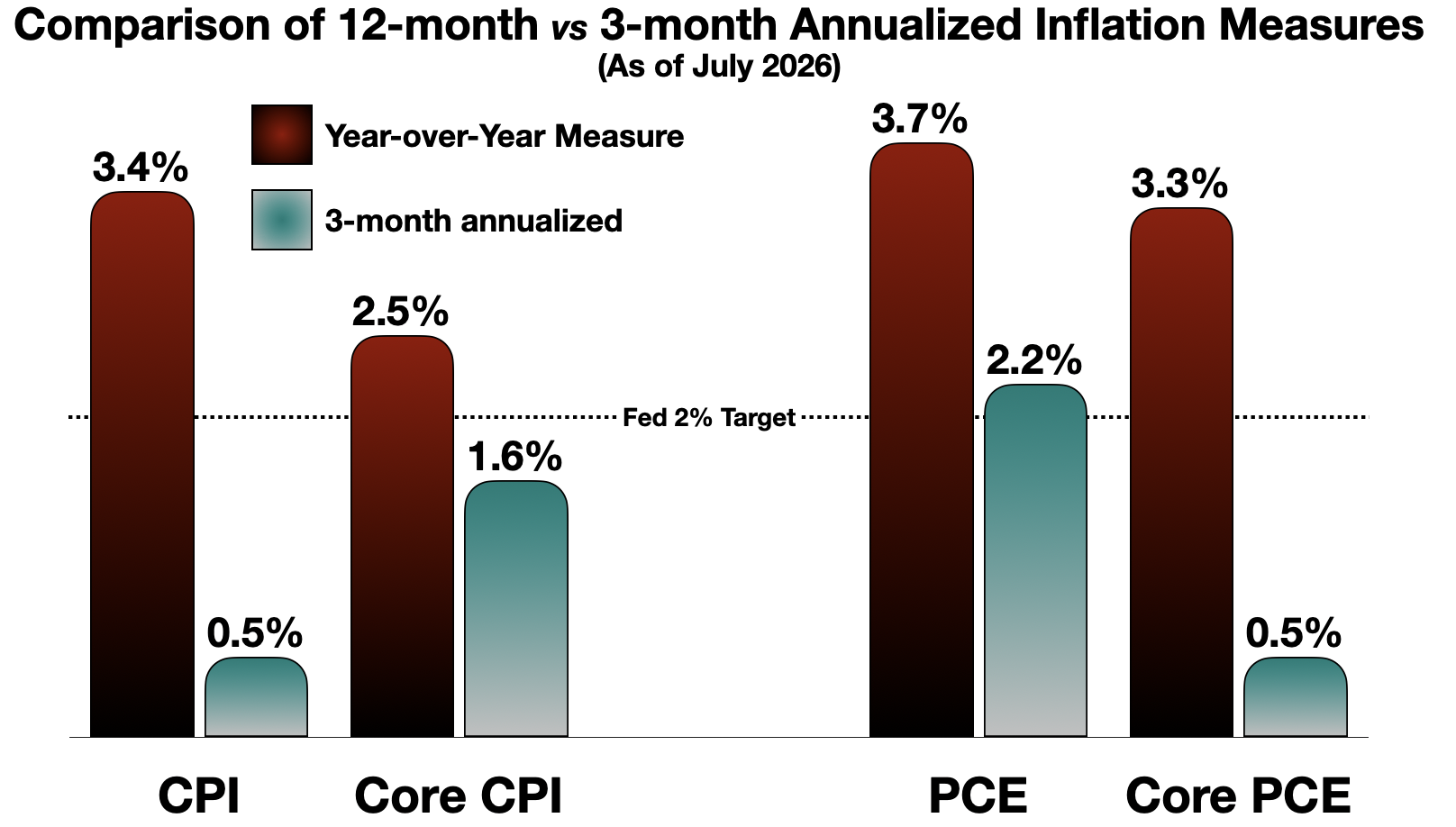
The Producer Price Index (also reported this week) was up 4.7%. Alarming, since producer prices can affect consumer prices, (though the pass-through varies widely by industry). But on a monthly basis, the PPI has been falling rapidly since April, and was negative for June and July. The 3-month annualized rate is 1.6%.
Inflation expectations have also moderated significantly since May, down by both market measures (the 5-year Breakeven Inflation forecast, inferred from the yield gap between a 5-year nominal Treasury and a comparable 5-year TIPS) and according to the Cleveland Fed’s 1-year inflation expectation model. Both measures forecast inflation in the 2.3% range, well below the headline CPI.
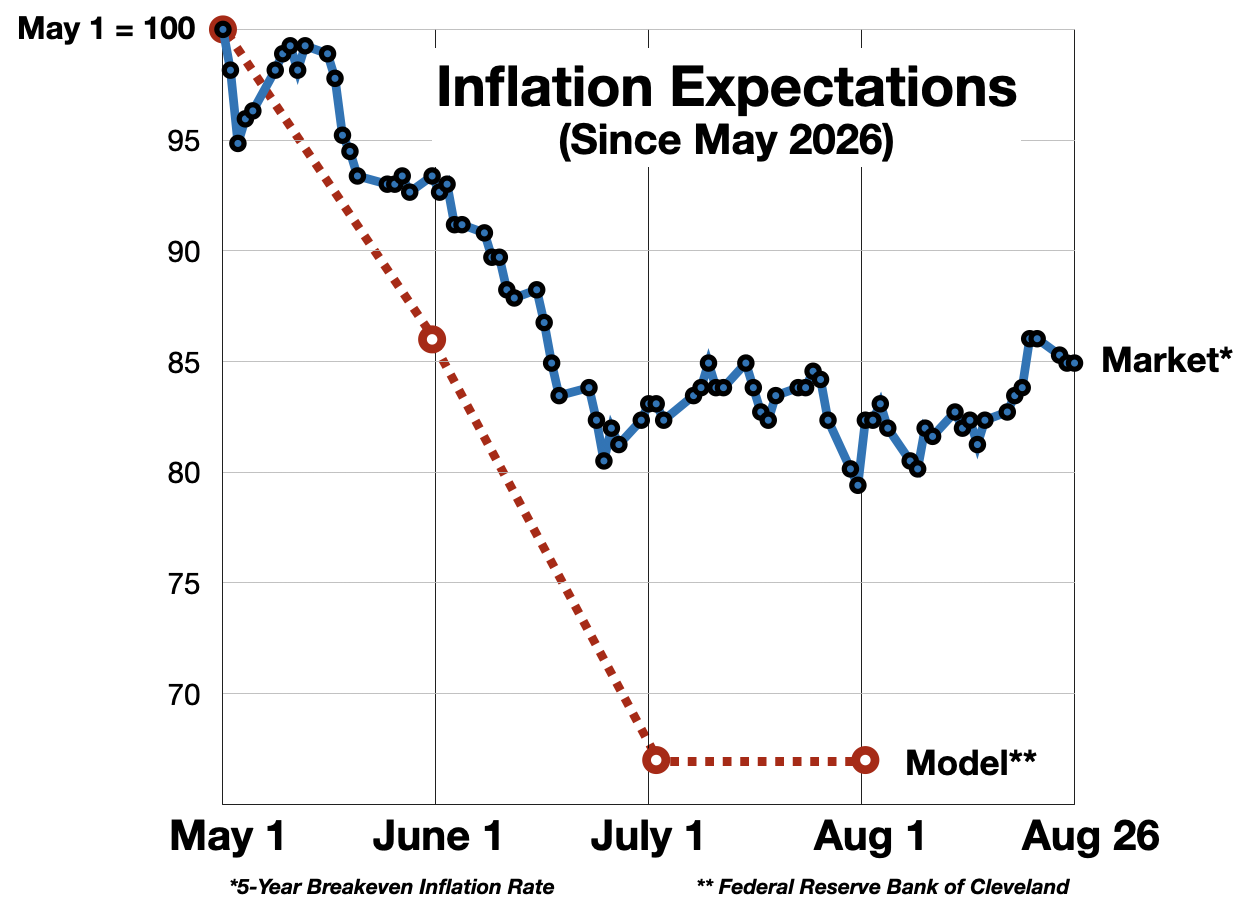
The price trend may be reversing direction more quickly than the YoY version of the CPI can detect it. “Inflation” may have already reached the 2% target, on some short-run measures. Traders seem to think so. The S&P 500 hit a new all time record the day after the CPI release. “Tame inflation data” was cited. The market consensus flipped on the question of a possible rate increase in September, from 80% “Yes” last month to about 67% “No” today. Even The Wall Street Journal hailed the return of “disinflation.”
Is this just a statistical slight-of-hand? Not at all. The idea that an annualized quarterly (AQ) measure of inflation may be superior to a a YoY measure is a mainstream proposition among economists and policy-makers. Nobelist Paul Krugman has endorsed the idea. “In the past, it may have made sense to look at changes over the last year, but in an economy going through as much turmoil as we’ve seen recently, that’s just too long a lag…many economists are now focusing on either three- or six-month changes.”
So, too, Jason Furman, the Chair of Obama’s Council of Economic Advisors, tweeted “headline CPI, the 12-month change in the overall index gets the most public attention…but to understand the inflation trend, it’s better to focus on a shorter window (3-6 months).” Former Fed Chair Jerome Powell and Vice-Chair Lael Brainard often cited inflation figures based on shorter averaging periods. The Cleveland Fed publishes an “inflation nowcast” with an AQ version of the CPI currently at 1.05%. Many “academic-style” economists at respected think tanks or working for the Fed itself have voiced support for shorter averaging windows. As one Fed economist has written: “Inflation is typically measured over the past year, inherently a slow-moving and backward-looking measure.”
The negative impact on monetary policy is twofold. A heavy reliance on backward-looking data obscures the most important moments in the trend — moments when things change. And the backwards focus exacerbates the lag in responding to those changes, with potentially serious macroeconomic consequences.
Consider the inflation spike of 2021-2023. A charitable interpretation would be that while the Fed was slow to respond, the interest rate increases that began in mid-2022 were effective in bringing down inflation.
The underlying data is the same for the annualized 3-month version. But the picture is quite different. The inflation trend changed abruptly and significantly in mid-2022, falling from 10.1% to 1.9% in a single quarter, a structural change. The three-month annualized series shows a sharp change in the short-run pace of inflation. The standard CPI first understated, and then overstated that shorter-run measure of inflation.
Monetary policy appears to have been slow to respond, late — and therefore (perhaps) unsound. By the time the Fed got around to raising rates, the inflationary surge was ending. The fire was over by the time the firemen got the hydrant open.
Of course, one might suggest that the monetary tightening in late 2022 and early 2023 prevented a resurgence of inflation. But that is not how it works. Milton Friedman famously said that monetary policy was subject to a “long and variable lag” between cause and effect, action and outcome — loosely quantified to between 9 and 24 months. This policy lag has been widely endorsed by Fed officials in recent years. In his press conference in November 2022, Chairman Powell referred to “lags” 17x to signal that the policy outcome was, in his mind, still in abeyance. And how much in abeyance? The inflation episode started in 2020/2021. The rate hikes began in March 2022. The policy may have begun to impact the economy only in late 2023 or 2024 — years after the inflationary crisis began, and after inflation had already materially declined.
There is a present danger in the failure to learn this lesson. The Fed today is in a tightening mood. Yet the annualized 3-month CPI suggests that the short-run inflation pace may be lower than the year-over-year headline indicates. Standing back from the CPI itself, is there really a case now for “restraining economic activity” (as President Hammack proposes)? The labor market has weakened. The July jobs number was negative, and June and May were revised downward by almost half. Labor participation is declining. Mortgage rates are rising and home sales are down. Bond yields are at multi-decade highs. Retail spending fell in July for the first time in nine months. Wars are raging. Geopolitical uncertainty is elevated. Tariffs are haywire, creating uncertainty for businesses and consumers. Economic uncertainty indices are at levels last seen in the pandemic. Is this the moment to hit the brakes, in response to an obviously flawed inflation measure?
The latent hawkishness at the Fed may be once again out of step with the real economy. Kevin Warsh has launched a series of Task Forces to among other things reevaluate “how the Federal Reserve understands and responds to the drivers of inflation” and to “improve the quality and timeliness of real economic signals that inform the Federal Reserve’s policy judgments.” This laudable initiative may address the problems raised here, but it will take time. In the interim, the Fed should pay more attention to the short-term trends that reveal an important “inflation regime change” may already be underway.
“Yesterday’s news has a way of getting mistaken for what is happening right now,” Warsh said in his keynote speech at the Jackson Hole Economic Symposium. “The challenge is to know the difference. In other words, we must interrogate reality to make sure we are not setting forward-looking policy based on stale or inaccurate data.”
The opinions expressed in Fortune.com commentary pieces are solely the views of their authors and do not necessarily reflect the opinions and beliefs of Fortune.
This story was originally featured on Fortune.com
Iran’s regime is at war with its own people – and executions are its weapon – opinion
Early Sunday morning, the Islamic Republic executed Shahram Sadeghi, who had been arrested in connection with the nationwide protests that erupted in January. His death came just one day after an anniversary that, for my family, has marked the brutality of this regime for nearly half a century.
On August 15, 1980, the regime executed my grandfather, Yousef Khoshkish. He had spent decades serving Iran as the head of the country’s largest commercial bank, Bank Melli, and later as the last Pahlavi-era governor of the Central Bank of Iran, building institutions meant to serve generations of Iranians. I never had the chance to know him, but his execution has been part of my family’s story for as long as I can remember, and part of Iran’s story for even longer.
Forty-six years separate those two days, and almost nothing separates the logic behind them. From its earliest days, the Islamic Republic has relied on the gallows as its language of rule. It has spent nearly five decades at war with the Iranian people, directing its anger inward whenever it emerges bruised from its foreign adventurism or fractured within.
How Iran cracks down on mass uprisings
The response to a mass uprising is always the same: arrests, torture, forced “confessions,” closed-door sham trials, and executions. These are less acts of revenge than instruments of political survival, intended to convince a population with its sights set on freedom that challenging the state is futile.
As of August 18, at least 932 people have been executed in Iran since the beginning of 2026, and the true number is likely far higher. More than 100 others face death on bogus national security charges.

On July 19, Erfan Esfandiari and Gol-Mohammad Mohammadi were hanged for sheltering protesters fleeing security forces that were trying to kill them, two of 12 men sentenced to death in a single trial. Nine days later, Amir Hossein Safari and Abolfazl Sepahi were publicly hanged in Isfahan’s Alikhani Square.
This location was chosen to convey a message, because thousands had gathered there during January protests. Security forces surrounded the execution site and fired into crowds of locals who had gathered in an attempt to stop the state-sanctioned killing.
On August 1, authorities hanged 20-year-old Arvin Kheirkhah, convicted by a Revolutionary Court on charges including moharebeh, or “waging war against Allah.” His family had gathered outside the prison the night before, hoping the execution could still be stopped.
Charges such as moharebeh, “spreading corruption on earth,” and “collaboration with hostile states” reduce Iran’s judiciary to an instrument of ideology. The last is used to dress up its conspiratorial claims of connections between Iranian protesters and the United States, Israel, or other foreign powers. These accusations are designed to deny an obvious reality: Opposition to the Islamic Republic is organic and homegrown.
Eighteen-year-old Shervin Bagherian is one of the countless Iranians who remain at risk of execution. Security forces raided his home in the dead of night, beat him, and took him to an undisclosed location. Interrogators reportedly placed a noose around his neck and staged mock executions to force a confession for state television.
This wave of executions coincides with rising concern among the regime’s Basij and IRGC over the possibility of renewed protests. In a recently leaked internal meeting, officials discussed preparations for another round of unrest and ordered personnel to identify and track Iranians posting anti-regime content online.
The aim is to raise the cost of the next uprising before it begins. For a regime that claims to embody the Iranian nation, conceding that millions of Iranians reject it would be politically fatal. So protesters become “spies,” and critics online become “saboteurs.”
Meanwhile, the state cannot reliably provide electricity, water, or economic stability, yet its machinery of repression remains remarkably organized. That contrast is a statement of priorities, and it should shape how democratic governments approach the Islamic Republic.
The West treats nuclear negotiations, terrorism, regional militias, and human rights violations as separate policy files. To the Islamic Republic, they are a single file: survival. Which is why concessions purchased at the expense of Iranian lives purchase nothing durable.
No serious Iran policy can treat the Iranian people as an afterthought. They are the central strategic question, and they are the country’s engine of change. Millions have defied guns and bullets, detention and torture, internet blackouts and executions, and they will not stop until they reclaim their motherland and their future.
The Islamic Republic understands this better than many foreign governments do. It knows where the greatest threat to its survival resides. As champion wrestler and protester Navid Afkari said before his execution in 2020, as long as this regime remains in power, it will keep “searching for necks to hang from its gallows.” My grandfather’s was one. More than a hundred Iranians are waiting to learn whether they are next.
The author is deputy communications director at the National Union for Democracy in Iran.
Relocation of US arms from Europe may expose vulnerabilities in US global military posture – report
Military planners in Washington worry that dwindling munitions stores may reduce the US’s ability to defend against potential threats from Russia and China, according to a Friday Wall Street Journal report citing US officials familiar with the matter.
While the officials noted that Western military officials have assessed that full-scale attacks from Russia and China are not imminent, they told the WSJ that insufficient weapons stockpiles have left vulnerabilities in the US’s global military posture.
Some officials described the situation as “beyond critical,” with arms moved to the Middle East from stockpiles in Europe and Asia creating shortages that could take years to replenish.
Administration officials have reportedly assessed that due to weapons being moved out of Asia for use in the war with Iran, the US may not be able to fully carry out contingency plans to defend Taiwan in case of a Chinese invasion.
Low levels of Europe-based defense assets raise concerns over defense against Russia
The officials highlighted that European-based defense assets, including precision strike munitions and interceptors, have reached low levels.

Stockpiles of Patriot air defense interceptors, Terminal High Altitude Area Defense (THAAD) interceptors, and counter-drone systems are among the arms impacted by the shortage created by the relocation of munitions, the officials added.
US European Command, according to the WSJ report, has been forced to adjust its operational plans because of dwindling munitions inventories on the European continent.
Some lawmakers stated that they are increasingly concerned about Russian hybrid and drone attacks and a Pentagon review of US military posture in Europe that could lead to a reduction in American troops in the region.
Following intelligence assessments that Russian President Vladimir Putin may attempt to test NATO’s resolve within the next few years, US Senator Roger Wicker (R – Mississippi) urged the posture review to “account for a wounded Putin lashing out.”
As weapons have been used and relocated, the US has also reportedly struggled to produce enough munitions to replenish its own stockpiles, in addition to allegedly limiting the amount of arms sent to Ukraine and Washington’s allies in Europe.
White House, Pentagon deny concerns over weapons stocks
US President Donald Trump and his administration declined to discuss with the WSJ which weapons have been moved to the Middle East and how many remain in Europe and Asia.
The Trump administration has repeatedly denied reports regarding the arms shortages, insisting that the US has sufficient supplies to continue fighting Iran and to combat other global threats.
White House spokeswoman Anna Kelly told the WSJ that “the United States Military has more than enough munitions, ammo, and stockpiles to serve all of President Trump’s strategic goals and beyond.”
Pentagon spokesman Sean Parnell also denied the reports, saying “claims of US munition shortages are false.”
Despite Washington’s insistence that there are no concerns regarding the stock levels of essential arms, the US has turned away from military strikes against Iran and has instead intensified efforts to force Tehran to make a deal through economic pressure.
Turkish presence in Syria poses threat to Israel due to Ankara’s NATO combat doctrine, expert warns
The Turkish military presence in Syria constitutes a significant threat to Israel due to its NATO combat doctrine, expert Dr. Eitan Hai Cohen told 103FM’s Prof. Aryeh Eldad and Ron Koffman in an interview on Friday.
Cohen discussed what he described as the strengthening of economic and strategic ties between Ankara and Washington in Syria and the potential implications for Israel.
According to Cohen, Turkey has become a central strategic player in the region since the fall of the Assad regime and has positioned itself as a mediator between Syria and the United States.
“Turkey began training [Syrian President] Ahmed al-Sharaa. They also approached the US to remove the American sanctions on Syria. What is the reason? To rebuild Syria,” he explained.
Cohen said Turkey has a clear economic interest in Syria’s reconstruction, particularly because of its powerful construction sector.

“The construction industry in Turkey is very strong,” he said. “They built in northern Syria; they are there as an occupying force, that is no secret. They are telling the Americans that we can share the profits together; we can make a lot of money here. The Europeans also support it because they want to get rid of the Syrian refugees.”
Turkish takeover of Syrian oil coincided with Chevron deal, Cohen says
He also addressed what he described as a military development in northeastern Syria earlier this year.
“Last January, Syrian regime forces invaded northeastern Syria, the Kurdish region, and took control of the oil wells,” said Cohen. “Immediately after the Syrian takeover, what did we see? An American company, Chevron, signed a cooperation agreement with the Syrian state oil company. This says a lot of things.”
According to Cohen, these developments could provide the United States with a new type of foothold in Syria.
“For the first time in history, the US can penetrate Syria,” Cohen explained. “Until 1918, there was a Turkish presence, then French, then communist, then Russian, then Iranian, and now, Turkey is returning there and telling the US: You were never able to enter Syria, and we can pave the way for you into Syria.”
“From an American perspective, there is a matter here of political penetration,” he added. “Erdogan is ‘paying’ [US President Donald] Trump in cash, and therefore Trump says every other day: He is a strong guy, a good guy and I like him.”
Cohen also warned about the expansion of Turkey’s presence in Syria.
“If the US does not intervene, the Turks will continue,” he warned. “They signed an agreement with the Syrian regime. They have the entire legal infrastructure. They have the ability to provide weapons, ammunition, including training.”
He said Israel must also consider the capabilities of the Turkish military.
“Turkey’s way of warfare is not that of some rickety Arab country, but rather NATO’s way of warfare,” Cohen noted. “We are talking about a very high standard, and we have to think about that.”
Cohen also addressed growing tensions between Israel and Turkey and what he described as Washington’s approach to the issue.
“Before this needs to be absorbed in Ankara, it needs to be absorbed in Washington. The US thinks that the friction between Israel and Turkey is only verbal and that it will not lead to physical friction,” he said.
Cohen: IDF’s Syria strike sought to send message to Turkey
According to Cohen, Israeli strikes in Syria were intended to send a clear message to Ankara.
“What we saw about a week ago with the Israeli bombing, and also last year in April, is essentially a red line, an Israeli declaration that Israel does not want to see any kind of Turkish presence in central Syria,” he emphasized. “We do not want to see them in southern Syria, Turkish penetration; we are not interested in seeing this.”
He said he hopes the message will also be understood in Washington.
“The US is ignoring this, and I very much hope that after this bombing in the Idlib area, an area of Turkish influence, the Turks are also very surprised that Israel bombed northwestern Syria,” he concluded.
Before Rosh Hashanah, Elul asks us to practice, persevere, and rise a little each day
Elul is the Jew’s testing device ahead of the new year. For me, the lesson of Elul is made clear when I listen in our neighborhood to young and old practicing the sounding of the shofar.
Each day the notes get stronger. Then, on Rosh Hashanah and Yom Kippur, each ba’al tekiah (the congregation member who blows the shofar) climbs the peak before all assembled.
Hearing the actual sounding of the shofar makes me especially appreciative because a half-century ago there was another Elul when I could not even get a meager sound from my shofar. This is a tale that provided me with a lesson I will not forget.
Before making aliyah in 1977, I was a Conservative rabbi at the Beth Shalom congregation in Wilmington, Delaware. Our synagogue was most fortunate because our cantor was Andrew Salzer, a Holocaust survivor from Hungary.
When World War II ended, he and his wife and children could not obtain a visa to the United States. They had no one to sponsor them. Instead, they were permitted to enter Brazil. To earn a living, the family was given a house and a little store deep in an Amazon forest.

Salzers allowed into US
After a few years, the Salzers were finally allowed into the US. A relative heard about them and brought them to Wilmington, Delaware. They were given a delicatessen by the local federation, which was well located, and succeeded.
However, one day in Elul in the 1950s, Salzer went to the Beth Shalom synagogue to say kaddish. He was asked whether he could daven (pray), and gladly, he did. The congregation’s rabbi, Jacob Kraft, heard Salzer that morning and spoke with him. The rabbi urged the synagogue board to hire him, which they did.
His training in a synagogue choir in Budapest had poignantly brought Salzer’s beautiful voice to the synagogue.
A few years later, in 1970, Rabbi Kraft retired, and I became the rabbi of the synagogue. On a list in the United States for church and synagogue architecture, Beth Shalom is found there, noted for the bronze doors by Louise Kaisch enclosing the ark of the Torah scrolls. In Beth Shalom, we had daily minyanim (a minimum of 10 men needed to conduct prayers), which I know is still the case.
As I worked with the cantor, I learned that he had taught himself to sound the shofar. A friend had taught me, so during the month of Elul, Salzer and I alternated blowing the shofar.
One morning during Elul in 1973, when the synagogue was opened for the minyan, we discovered that it had been broken into – money collected for tzedakah (charity) had been stolen, and an attempt to take the air conditioner had failed because it was too heavy.
When we climbed the stairs to the second floor where my office was located, my door was ajar and the office – a mess. I had nothing there besides books, a portable typewriter, a few dollars, and my shofar. The typewriter was gone, and I realized the shofar had been moved from the shelf where I had left it.
Since it was my turn to blow the shofar, I took it down to the minyan chapel with me. Then the unexpected occurred. I tried to blow the shofar several times – no sound whatsoever. The minyan men and the cantor said, “Wait a few minutes, then try.” I put the shofar to my lips – nothing. I said aloud for all to hear: the thieves took the money, my typewriter, and stole the shofar notes.
This Elul, while we prepare for elections, we also pray for peace. Since October 7, we have been at war constantly. Can the powerful American President Donald Trump bring the war to an end?
As I think about my shofar, which would not sound but ultimately did, I recall one of Israel’s great athletes, tennis champion Shahar Pe’er.
Why remember her this Elul – you may ask?
At one point in her career, Pe’er, with a victory after a long drought, gave many people a boost. After being in the top 10 players in the world, slipping to somewhere down in the lower 100s must have been crushing for Pe’er.
However, she did not give up. “After the recent finals in Baku, where I lost,” she noted in the press, “I thought: ‘I’m not there, I cannot handle tennis anymore, I’m not strong enough for this.’”
This wasn’t the first time such doubts got the better of her, she said, adding that “in the past six months there were at least five or six times when I said: ‘All right, I’m done with tennis. I had a great career and reached amazing places, but enough is enough. There are more important things in life.’”
But Pe’er focused on what tennis meant to her, which is why she won that Suzhou tournament in China after losing in Baku. “All in all, I have something which I really love. I love being on the court,” Pe’er determined.
Then she informed her listeners why she had succeeded in the past and hopefully in the future. Her coach had told her: “If you have lost your love for tennis, quit, but not because of what your ranking is.”
So Pe’er, back then, made the court her personal crucible, in which she would remake herself, calling on inner strength. None of us can know how much she practiced, but the results were evident.
We all have our chance on the court of life. Maybe our serves have been ineffective, maybe our backhand has failed us, maybe a few lobs go over our head.
But we know down deep that we, too, can draw upon our inner strength. We can make that major pitch; we can help our children when it is not so easy; we can finally see our experiment work; we can tread forward in our lives.
I can even blow the shofar again.
Clearly, innovative steps we have feared to take need to be taken. We must all commit and move forward. Elul is the Jew’s testing ground before the new year. Though we intone them regularly, prayers can take on new meaning if we focus on what the words really mean and what the shofar sounds tell us.
My suggestion is to take Elul one day at a time; try to raise yourself just a little every day. When all the small elevations are stitched together, you are ready for the challenges of the High Holy Days, and then, of course, for the new year 5787.
In memory of my beloved wife, Rita z’l, on her sixth yahrzeit.

Elul teaches us a Jewish lesson: The last siren has not sounded – opinion
Last Sunday evening, I went with my son and grandsons to my first Australian Rules football match – the West Coast Eagles, the local side, against Hawthorn, the visitors from Melbourne. It rained most of the night, and 43,000 people appeared not to notice it.
I will not pretend to have understood it completely: 18 men a side on a field the size of a small village, no offside, and an oval ball that bounces as it wishes, with no attempt at consistency.
What I did understand immediately was the physicality. These men wear no helmets and no padding. They run at full pace into one another, are lifted and dropped onto wet turf, and get up.
Over the years, I have seen what trauma to a shoulder can look like. For 20 minutes I watched with a clinician’s flinch, quietly triaging the injuries in my mind. Then I stopped: the flinching was mine, and nobody out there had the slightest interest in it.
In the second quarter, my grandson mentioned that this was the final match of the season. At the final siren, the table freezes: the clubs above the line go through to the grand finals, everybody else goes home for six months.
I watched the field differently after that. It was late in the season, but not too late for one last push.
During the break, I checked my phone and saw the date. The 11th of Elul.
The last round
We are, right now, in the last round.
Rosh Hashanah begins on the evening of Friday, September 11. Between now and then sits Elul, and I think we misunderstand it almost entirely. We treat it as a corridor to a courtroom. The ledger is open, the pen already moving, only the sentencing is left. Dread, with a calendar attached.
That is not what Elul is meant to feel like. Elul is the last round of the season, and the entire point of a last round is that “it’s not over till it’s over.”
Everything about the month says so. The shofar sounds every weekday morning, not to frighten us, but to wake us while there is still time on the clock. The name of the month is read as an acronym for ani l’dodi v’dodi li – I am my beloved’s and my beloved is mine. This is not the language of a tribunal.
Rabbi Shneur Zalman of Liadi gave us the image I keep returning to: in Elul the King leaves the palace and walks out into the field, where any farmer, still dressed for work, may go up and speak with Him. No appointment, and no queue.
In a lifetime of working with people, those who worried me most were never those who had done the most damage. They were the ones who had privately decided the final siren had already gone. The brother not spoken to in 11 years, by a man who had stopped imagining he ever would, over something he can’t even remember any more.
The man in his late seventies who told me, with total conviction, that he was too old to become a different sort of husband. The woman who blamed nobody but herself for the harm she had done her family, and was certain that she was beyond forgiveness.
Not one of them was out of time. They believed they were, which is a different thing and far more dangerous, because a player who believes the season is over stops playing. A person who thinks he has nothing to live for, stops living.
The Jewish answer, in this month above all others, is that yes, it is late. But late is not all over.
Play the ball, not the man
Now the thing I had not expected.
Australian rules football is brutal. It was also, as far as I could see, entirely without malice.
The game’s most repeated instruction is play the ball, not the man. You may hit him, even hard, legally, repeatedly while contesting the ball. You may not hit him when he does not have the ball, just because he is him. In two and a half hours, I did not see a punch thrown, or a man standing over an opponent whom he had just flattened. They hit each other with everything they had, and when the ball moved on, they left it on the grass.
I have watched Jewish public life for a long time, and I am no longer confident we are playing the ball and not the man.
Contact was never our problem. Argument is our inheritance; the Talmud is a record of men going at one another for centuries, and the tradition calls it beautiful: machloket l’shem shamayim, dispute for the sake of Heaven.
Our problem is that we have stopped playing the ball.
Haredi and secular. Government and hostage families. Israel and the Diaspora. Right and Left, in Jerusalem, Melbourne and Manchester. Listen to almost any of it, and you will hear people not contesting the ball at all. They have gone for the man, and gone high.
The Talmud tells us that the Second Temple fell to baseless hatred; we sat on the floor last month on Tisha B’Av and said so out loud… and then went back to it before the fast was even out.
Elul does not ask us to stop arguing. It asks us to go back to the ball. Argue and disagree by all means but keep it focused on the topic, not the person.
As it happens, the local team was well beaten on the night, and the scoreboard made for uncomfortable viewing.
We spend Elul auditing the scoreboard: the tally, the year weighed and found wanting. Nobody in that stadium was applauding the scoreboard. They were applauding the effort made by every one of those 36 players – win or lose.
I suspect that is nearer to what is actually being asked of us.
There is work that can still change the outcome, even this late in the season: a phone call not yet made, a rival not yet forgiven, an apology 11 years overdue and still, today, entirely possible. All of this can change what sort of person walks out at the beginning of next season on Rosh Hashanah.
Last Sunday night, the rain kept falling. But the lights stayed on. The final siren sounded, and 43,000 people filed out into the night.
For us, though, the final siren is not until the shofar is blown on Yom Kippur. We still have time to score more points.
The writer is a rabbi and physician. He writes and teaches on Jewish ethics, leadership, and resilience. His work appears on rabbidrjonathanlieberman.substack.com and youtube.com. @rabbidrjonathanlieberman

Trump teleprompter operator ordered to pay nearly $173K over Kalshi bets on speeches
A White House teleprompter operator who used advance access to President Donald Trump‘s speeches to bet on what the president would say has been ordered to pay nearly $173,000 and stop trading for three years, federal regulators announced Friday.
The Commodity Futures Trading Commission (CFTC) said Gabriel Perez, Trump’s teleprompter operator since 2016, misappropriated material, nonpublic information obtained through his government job to trade event contracts on Kalshi, a prediction market platform, for his personal benefit.
Perez, who was placed on paid administrative leave in July amid the investigation into his conduct, was ordered to surrender $107,539 in trading profits and pay a $65,000 civil penalty.
The CFTC also imposed a three-year trading ban and ordered Perez to cease and desist from further violations of federal commodities laws and regulations.
TRUMP ANNOUNCES ‘BIGGEST OIL DEAL IN WORLD HISTORY,’ SAYS IT WILL SUBSTANTIALLY LOWER GAS PRICES
The CFTC found that between December 2025 and February 2026, while working as a White House teleprompter operator, Perez traded “presidential mention market contracts,” which reflected words or phrases Trump might use during his speeches.
The event contracts paid out based on whether Trump used specific words or phrases during his public remarks.
According to the CFTC, Perez had access to presidential speeches before they were delivered and “misappropriated” that information in “breach of his duty of trust and confidence” to make the trades.
Perez generated more than $107,500 in profits, according to the agency.
X REVEALS FOREIGN ADVERSARY BEHIND FAKE ACCOUNTS DISSEMINATING ANTI-DATA CENTER MESSAGING
His $65,000 civil penalty represented a “substantial discount” because of his “exemplary cooperation” with the investigation, the CFTC said.
Robert DeNault, Kalshi’s head of enforcement, reacted to the enforcement action, saying traders who violate the company’s rules must be held accountable.
“A Kalshi surveillance investigation caught a White House staffer engaging in prohibited trading activity,” DeNault wrote on X.
“Today this individual was subjected to penalties by the CFTC and by our exchange,” he continued. “It doesn’t matter who you are: violate our rules or federal law and you will face the consequences.”
The trading activity first came to light months ago after Kalshi’s surveillance systems flagged a series of unusual trades involving markets tied to words and phrases expected to appear in Trump’s public remarks.
Kalshi previously said the trades stood out because they did not follow typical trading patterns and also drew complaints from market makers through the platform’s whistleblower channels.
After reviewing account information, the company said it identified the trader as a federal employee who worked as a White House teleprompter operator.
TRUMP TAKES MAJOR ACTION TO SLASH SOARING BEEF PRICES FOR US CONSUMERS
Kalshi froze the account before Perez could withdraw most of the profits, the company previously said, and referred the matter to federal regulators.
White House press secretary Karoline Leavitt addressed Perez’s conduct during a White House press briefing in July, saying Trump had been briefed on the matter.
“Obviously, I’m aware of the report. The president is, too. I spoke with him about it,” Leavitt said. “He believes it’s deeply unfortunate and, frankly, a disgrace.”
CLICK HERE TO GET FOX BUSINESS ON THE GO
FOX Business has reached out to the White House for comment and an update on Perez’s employment status.
Fox News Digital’s Stephen Sorace contributed to this report.

STAT+: A Novartis drug cut inflammation. Can it improve heart outcomes?
A newly acquired Novartis drug successfully lowered signs of inflammation in a midstage study, as experts wait to hear how the company plans to advance the drug as a potential cardiovascular treatment.
In the Phase 2 TRANQUILITY study, the drug, pacibekitug, led to sustained decreases in biomarkers of inflammation, according to results presented Saturday at the European Society of Cardiology’s annual meeting in Munich. Investigators reported a dose-dependent drop in biomarker levels on certain measures, meaning higher doses led to greater reductions, a sign the drug is having an effect.
Pacibekitug is an antibody that targets IL-6, or interleukin-6, a protein involved in regulating immune responses.
At the ‘Super Bowl of trucking,’ a driver who trained 14 years wins the golden belt buckle
This summer has been full of competition: from Spain winning the World Cup, to the NBA finals where the Knicks saw a historic comeback, to now, where an event in which drivers across the country are putting pedal to the metal and competing in the National Truck Driving Championships, colloquially known as the “Super Bowl of trucking.”
This year’s competition saw 429 drivers from 49 states who have logged a combined total of nearly 775 million safe driving miles throughout their careers, which is over 31,000 circles around the earth. Drivers from 55 companies, ranging from small mom-and-pop companies to Fortune 500 giants like Walmart, FedEx, XPO, and UPS, all vied in tests showcasing their driving, turning and parking skills as they [safely] raced for glory in Pittsburgh earlier this month.
“The entire motivation of this program is to make them better on the road and to continue to drive safe,” said Jacob Pierce, executive director of the American Trucking Associations’ Safety Management Council. “It creates a company culture where everybody buys into ‘every day is a safe day.’”

Why safety, not speed, wins
In 2024, large trucks accounted for nearly one in ten (9%) of all vehicles involved in a fatal crash, according to a National Safety Council study. And with 11 billion tons of freight moved by truck in 2024, the stakes of getting safety right extend far beyond the competition floor. Maneuvering a vehicle that weighs thousands of pounds needs extra caution when it comes to maintaining safe roads. For example, a loaded tractor trailer requires 20% to 40% more distance than cars to stop, according to data analyzed by The Insurance Institute for Highway Safety. Large trucks were involved in 5,218 fatal crashes in 2024, up 30% over the past decade, according to National Safety Council data.
Eric Ramsdell—a Walmart tank trunk driver who took first place in his division—said the championship reflects a responsibility that follows drivers on the road. “Every day we have to understand we have people’s lives at stake, equipment, our safe mileage record,” he told Fortune. The skills course, he added, puts competitors under pressure much like real-world driving does but requires them to “focus and maneuver safely around and do the pre-trip in a safe manner.”
But for companies eager to participate in the “Super Bowl of trucking,” as the competition is known as in the industry, they have to prove their drivers have what it takes to take on the open road—and aren’t afraid to hit the brakes when needed.
To qualify, drivers must win a top placement at their state competition, sport a clean, preventable accident-free safety record for the previous year, and meet full-time driving requirements with their company. And being “accident-free” isn’t as easy as avoiding a major crash: even incidents like hitting a curb and slicing a tire can cut drivers from the competition.
Pierce told Fortune he’s seen drivers go to state “20-plus times and have yet to make it to nationals, but they keep coming back because they want their chance.”
When inches matter more than speed

Competitions usually involve a mixture of timing and speed, but at NTDC, it’s all about precision—and not hitting a giant yellow duck.
The three-day competition began with a written exam that tested drivers’ road knowledge and safety. Next, there was a pre-trip inspection in which drivers are to identify planted safety-risks that they could face in real life. Decoys ranged from something big like an unsecured load, to easy-to-overlook details like a crack in the passenger side frame, a wiper blade missing, or a loose lug nut.
Competitors also faced an obstacle course in which drivers made their way down paths lined with cones and bright yellow, plastic ducks. To show off their precision skills, drivers made turns as close to the 3.5-inch-tall ducks as possible.
Factor in the lack of safety-assistance-technology like backup cameras, and drivers are forced to rely on instincts and skill. “We have to cover all that up because that would make it too easy for them,” Pierce said. “We are purists when it comes to driving a truck.”

The last truckers standing
When day three rolled in, companies like FedEx, Walmart, and UPS dominated the leaderboards. FedEx has 18 finalists across two company divisions; Walmart had nine finalists and UPS had five, while smaller freight and shipping company XPO sported three. After a grueling obstacle course where drivers navigated tight turns, tight parking reverses, and quick, controlled stops, winners were finally selected for each of the nine classes, divided by the size of the truck: from flatbeds to three, four, and five-axle vehicles.
Another Walmart driver, Richard Prescott, took first place for the flatbed division. For Prescott, a first-time national winner who has spent the last 45 years in the trucking industry, simply reaching Pittsburgh was the result of years of close calls and incremental progress. “That process is extremely hard to get through,” Prescott told Fortune. “You have to do baby steps.” When Walmart was announced as the flatbed winner, he initially thought the trophy belonged to a teammate. “My boss… grabs me from behind, and I told him Mark won, and he says, ‘No, you did,’” Prescott said. “It’s still sinking in.”
Miguel Corral competed for UPS under the four-axle division, and took home the grand champion title. Corral told Fortune he’s a nine-time NTDC competitor, and though there are always “nerves” when he competes, the event “feels like a family reunion.” The competition may be high-pressure, but its core skills are familiar. He said he approaches the pre-trip inspection much as he does before a normal shift: “I inspect my equipment every day, making sure to be thorough and complete each time.”
On the obstacle course, drivers are tested on accuracy, not speed, and Corral said that reflects the reality of the job. “Speed doesn’t prevent accidents, accuracy does,” he said. “You want to take your time and be safe.”

This story was originally featured on Fortune.com

Offshore nuclear barges could power ports and data centers—starting with California, where nuclear is banned
As the U.S. paves the way for a nuclear renaissance to power the AI data center boom, the next frontier is building small nuclear reactors offshore to power coastal facilities and merchant ships.
Strangely, the momentum could begin in California, a state that banned building new nuclear plants 50 years ago. This summer, the Port of Long Beach signed an agreement with the Trump administration to develop next-generation small modular reactors (SMRs) that could power ports, data centers, and vessels with emission-free energy.
Offshore nuclear power sounds unusual, but naval submarines and aircraft carriers have run on small nuclear reactors for decades. In 2020, Russia put the world’s first floating nuclear power station on a barge into service, powering the remote Arctic town of Pevek—population 4,000—and its harbor.
Long Beach and Los Angeles are a different scale entirely. The two ports adjoin one another and together form the largest container port complex in the Western Hemisphere. The Port of Long Beach is now working with local startup Bluecore Energy to build SMRs on floating barges—though the project remains at least a few years from reality.
“I think it’s very viable. It’s just a question of when, not if,” said Max Hopkins, a nuclear power analyst at CITIC CLSA, speaking about the growth of offshore nuclear power broadly—not California specifically—across military, maritime shipping, and AI data center applications.
“To put something into place fast, with production means, and then you can just float it somewhere—it seems like offshore barges are going to be almost ideal,” Hopkins told Fortune. “I think it’s going to become pretty accepted, much more so than people realize.”
Still, Hopkins emphasized the technology is years from commercial deployment. Regulatory frameworks need to be built, and so do the supply chains and manufacturing systems.
The progress isn’t confined to Long Beach. Denmark-based Saltfoss Energy is developing similar nuclear reactor barges in Europe.
Nuclear’s maritime moment
The future of powering military warfare and maritime merchant shipping could be nuclear, Hopkins said. Maritime vessels account for about 3% of global greenhouse gas (GHG) emissions, which may not sound like much, but it’s roughly equivalent to the total GHG emissions of all of Africa.
The federal push is accelerating on multiple fronts. This week, the U.S. Department of Transportation’s Maritime Administration (MARAD) announced a partnership with London-based Core Power to develop the regulatory frameworks and technology for a future fleet of nuclear-powered merchant cargo vessels.
A day later, the U.S. and the International Atomic Energy Agency (IAEA) launched the Atomic Technologies Licensed for Applications at Sea (ATLAS) initiative. The effort is designed to advance SMR and micro-reactor technologies for merchant shipping—“underpinned by the highest levels of nuclear safety, security, and non-proliferation,” the IAEA said.
The appeal is speed and endurance: nuclear-powered ships only need to refuel every two or three years instead of every voyage, cutting fossil fuel use, and enabling faster transit. “At the same time, innovations such as floating nuclear power plants provide versatile energy sources that could deliver reliable electricity to coastal or remote communities and industry,” the IAEA said in a statement.

A nuclear California?
Long Beach-based Bluecore was founded only in January. It raised $10 million in a pre-seed round and quickly became the first nuclear company to partner with MARAD on offshore reactors.
Founder and CEO Kofi Asante, 31, is a Ghanaian-American from Austin, Texas, who quickly became a Silicon Valley veteran before relocating to Southern California. He built his logistics and maritime-shipping expertise at Uber Freight, heavy-cargo drone company Elroy Air, and electric barge startup Arc—before starting Bluecore.
His goal: use the maritime industry to provide clean, consistent power for ports and AI data centers.
“The philosophy was really process of elimination: if you need that much energy, then you arrive at a nuclear reactor,” Asante told Fortune. “And if you need real estate, two-thirds of the world is water, so you can use barges for extra real estate.”
“We can go miles away and connect via subsea cable—so we don’t have to be near neighborhoods, and we don’t have to be co-located at the port,” he added.
All of this requires technology that’s already largely developed, Asante argued, including smaller versions of traditional light-water nuclear reactors. Each 10-megawatt reactor on a barge can power the equivalent of about 10,000 homes, can be moved via tugboats, and can be stacked alongside each other for extra power generation.
Asante recognizes he’s pursuing this technology in a state that banned the developed of new nuclear reactors in 1976, citing environmental and safety concerns, including still-unsolved issues with radioactive waste.
The Port of Long Beach knows this is a lengthy process. Port CEO Noel Hacegaba noted that state lawmakers are already debating legislation to study lifting the ban.
“Nuclear is having a moment at the Port of Long Beach, and we are engaged with the private sector, along with state and federal legislators on this issue,” Hacegaba said in an emailed statement to Fortune.
“This innovation is years away from becoming a reality due to the technological advancements and regulatory hurdles that still need to be cleared, and it cannot advance without state and federal approvals,” he added. “In the meantime, our new partners at Bluecore Energy are following state and federal laws as they provide the private-sector experience to research and develop SMR technology.”
Can it be safe—and affordable?
Two big questions loom over offshore nuclear: safety, and whether it can compete economically with natural gas and solar power.
Asante draws a manufacturing analogy—with some exaggeration—arguing that previous nuclear power plants were built bespoke, akin to constructing an entire factory to produce a single car.
“Small modular reactors like ours, you build multiple of them, so it starts to look like a factory,” he said. “Some of our team came from Rivian and Toyota, and we’re looking at it like a production facility.”
The analyst Hopkins backs up the point from a different angle: “A jet engine is actually much more complicated to build than a nuclear reactor from a materials science perspective.”
But what happens in the event of a tsunami or a major weather event? Hopkins said modern safety design wraps uranium fuel pellets in multiple layers of heavy-duty ceramics and graphite casing, and they’re rendered inert when separated.
Asante offers his own case: “Our floating nuclear power plants are mobile. In the event of severe weather, they can quickly be repositioned. They are also shielded so that they can withstand extreme weather and be underwater. And we have multiple control mechanisms that will automatically turn the reactor off if needed.”
Being on the water is an advantage, he argued. “Water is the cooling mechanism and safest place for our systems, and we have an unlimited amount of access.”
This story was originally featured on Fortune.com
IDF warns budget delay will force reserve, intelligence cuts beginning in September
The IDF will be forced to take severe, immediate measures beginning in early September because of the Finance Ministry’s “foot-dragging” in transferring the funds, despite instructions from Prime Minister Benjamin Netanyahu, senior military officials said on Thursday.
The first and most immediate measure will be a sharp reduction in reserve forces in two volatile arenas, the Northern and Southern Commands.
However, officials have decided not to reduce reserve forces in the West Bank Division due to heightened tensions and security warnings in the area. The decision also follows the IDF chief of staff placing an additional division on alert in case reinforcements are needed during the holiday.
The second measure, prompted by the budget shortfall and the Finance Ministry’s failure to fulfill its commitments, will be a sharp reduction in intelligence gathering across several arenas. The cuts will particularly affect the third circle, where intelligence operations require space-based capabilities and other highly expensive technological systems.
The third measure involves preparing for a possible escalation with Iran and other threats in the third circle, including the Houthis in Yemen and pro-Iranian Shi’ite militias in Iraq. Such preparations require regular training and sufficient stocks of spare parts and munitions.

These three measures are expected to take effect next week unless the Finance Ministry complies with the prime minister’s directive. Additional cuts are also expected, primarily affecting the IDF’s force buildup, including procurement based on the General Staff’s investigations into the October 7 attacks.
Failure to transfer funding will affect contracts with US production companies
A senior security official told Walla that the failure to transfer sufficient funding would result in lost contracts and production lines at US companies that manufacture munitions for Israel’s air, land, and naval forces. It would also affect the procurement of various aircraft and long-term projects involving space capabilities, air defense, equipment, ground weapons systems, and other areas.
“We have not managed to find a formula that makes it possible to produce intelligence in many arenas simultaneously without a budget,” the official warned.
“If they do not transfer the budget now, the next government will have 145 days to pass a new budget,” he said. “If it does not happen now, we will lose a year of work on force buildup and ongoing operations.”
The criticism is directed at the Finance Ministry, which holds budget reserves and is being called on to honor existing agreements and carry out the government’s instructions. The government determined that the Defense Ministry and the IDF need NIS 40 billion over the next four months to cover funding gaps for the current year.
The Finance Ministry had committed to transferring NIS 15 billion but later withdrew that commitment.
Judge strikes down Trump visa policy targeting foreign pro-Palestinian university students
A federal judge on Friday ruled that laws that US President Donald Trump‘s administration used to cancel visas and initiate deportation proceedings against noncitizen college students based on their pro-Palestinian advocacy and criticism of Israel are unconstitutional.
US District Judge Noel Wise in San Jose, California, in a blistering ruling chastised the US State Department and US Department of Homeland Security for how they had deployed provisions of federal immigration law to target non-citizens for deportation for expressing views they wanted to suppress.
The judge, an appointee of Democratic President Joe Biden, said that in the United States, free speech, including the freedom to criticize the government and its leaders, was evidence of the strength of the country’s democracy.
“That strength is diminished when members of our society – citizens and noncitizens alike – must self-censor and ‘behave’ or suffer the government’s retaliation,” she said.

The State Department and DHS did not immediately respond to requests for comment.
Wise focused on Trump administration’s detainment of students
Wise’s ruling focused on how the Trump administration, from March 2025, began revoking visas and detaining non-citizens who engaged in pro-Palestinian advocacy on campus, starting with the arrest of Columbia University graduate Mahmoud Khalil, who is fighting separately to avoid being deported.
Those arrests formed the basis of a lawsuit that was filed in August 2025 by Stanford University’s student newspaper, The Stanford Daily, which alleged that some of its writers with student visas had refrained from covering pro-Palestinian student protests and topics related to the Middle East conflict as a result of the administration’s policies.
The newspaper’s lawyers argued that two provisions of the Immigration and Nationality Act that the administration relied upon to cancel student visas and initiate deportation proceedings violated the US Constitution’s First and Fifth Amendments as applied to constitutionally protected speech.
Those laws allowed Secretary of State Marco Rubio to render noncitizens deportable if he personally determined someone’s action “compromises a compelling foreign policy interest” and allowed him to revoke someone’s visa at his discretion.
Wise agreed with the newspaper, saying that when a noncitizen’s speech is the reason behind a visa revocation and deportation determination, “the government is singling out that speech for disfavored treatment based on its viewpoint or content.”
Conor Fitzpatrick, whose group, the Foundation for Individual Rights and Expression, represented the student newspaper, said in a statement that the ruling “proves that free speech isn’t a privilege, but the inalienable right of every man, woman, and child.”
The ruling was similar to a decision last year by Boston-based US District Judge William Young, who similarly found the administration had acted unconstitutionally by adopting a policy of revoking visas, arresting, detaining, and deporting foreign students and faculty engaged in pro-Palestinian advocacy.
Wise, in her ruling, expressed concern that the administration had moved on to target people for expressing other types of views it disfavored, saying eventually the “targets may include anyone in the United States who exercises their freedom of speech to simply express opinions the government does not like.”
“This downward spiral is antithetical to our Constitution that recognizes our right to speak freely,” she wrote. “Here you can simultaneously hate the content of a person’s speech and love the country that cherishes the freedom to allow it.”
US Navy sailor who jumped from USS Abraham Lincoln faces disciplinary action – report
A US Navy sailor who jumped off the USS Abraham Lincoln (CVN-72) aircraft carrier earlier this month is facing disciplinary action, MS NOW reported on Wednesday.
According to the report, the sailor has been accused of violating Article 83 of the Uniform Code of Military Justice for “malingering,” or “intentionally faking an illness or hurting themselves to avoid work, duty or service,” and Article 86 for “absence without leave.”
The sailor’s wife told MS NOW that her husband had not received the care he needed and that this only compounded her husband’s struggle.
“I think they’re insane for doing this to people who need mental help. Instead of giving them help, this is just another huge stressor,” MS NOW cited her as saying.
Sailor reportedly did not get mental health care
She said that her husband had jumped overboard on August 3, was medically evacuated and returned to San Diego on August 13, spent five days at Naval Medical Center San Diego, known as Balboa, and was told to report back to work immediately after his release.

During that time, he did not receive therapy or psychiatric care. He finally began therapy on August 26, nearly a month after his attempted suicide and nearly two weeks after he arrived back in San Diego.
His wife told MS NOW that prior to jumping, the sailor went to both his chain of command and the ship’s medical team multiple times to raise concerns over his mental health but was brushed off.
She learned what happened from a message from one of her husband’s friends aboard the ship and was not contacted until four days after the incident.
The sailor and his wife are both 19 and have two children, the youngest of whom was born in February. The sailor repeatedly requested paternity leave but was denied.
Nonjudicial punishment is typically used to reprimand service members for minor rule-breaking, negating the need for a formal, lengthy court-martial process which could end in an official conviction.
Facing nonjudicial punishment, the sailor will end up in a “captain’s mast,” where a commanding officer will decide the punishment, MS NOW reported. It could cost the sailor up to half his pay.
Questions raised over military treatment of mental health
The incident is calling attention to the way in which the US Navy and other branches of the US military deal with suicide and mental health.
US military lawyers say that there is a legal mechanism for the US Defense Department to punish service members who try to commit suicide, even while the department has dedicated resources for those struggling with their mental health.
“We tell service members to reach out for help, and then we keep a criminal statute on the books for the ones who didn’t get it in time. That’s a policy choice,” Cody Harnish, a former Army judge advocate general who now represents military service members, told MS NOW.
While technically, the manual for court-martials says that suicide attempts should not be charged, ultimately, pursuing charges and a punishment is at the discretion of the commanding officer, Harnish told MS NOW.
When asked about the decision to pursue nonjudicial punishment for suicide attempts, a US Navy official told MS NOW that “the navy is fully committed to the health and well-being of every sailor.”
“We strive to foster environments that support mental health by removing barriers to seeking help, increasing awareness of resources, and taking appropriate action when someone is in need. Mental health resources are available to our Sailors 24/7, and asking for help is a sign of strength,” the official said.
Israel is failing to provide food security, leaving thousands of NGOs to fill the gaps – study
With a population of 10 million, Israel has 2,289 active nongovernmental organizations providing food assistance to its residents. For comparison, the UK has 2,500 food banks for 68 million residents, and Germany has 970 local food banks for 84 million people.
These numbers indicate significant structural issues within Israel’s system.
Germany’s Tafel food bank network operates as a unified nationwide model. In contrast, Israel’s network relies on thousands of community-driven nonprofits whose food distribution is often a secondary or informal activity alongside other social welfare support.
The UK organizes its food banks through a combination of large charitable networks mostly via public food donations, a professional referral voucher system, and volunteer-led sorting and distribution centers.
In Israel, food insecurity remains widespread. In 2024, 27.1% – or nearly one million households, including over one million children – experienced food insecurity, according to the National Insurance Institute. The figures are roughly one NGO per 1,000 food-insecure people.
Critics argue the government has increasingly shifted the vital responsibility to philanthropic organizations. Only 13% of Israeli food aid NGOs’ budgets come from government funding, forcing the sector to stay heavily reliant on private philanthropy and local fundraising. These findings come from a new study by researchers at the Hebrew University of Jerusalem (HUJI), in cooperation with Sheba Medical Center at Tel Hashomer, published in the journal Food Policy under the title “Philanthropic food assistance in high-income countries: Lessons from Israel’s food-aid network.”

Israel’s food-aid network is vast, but deeply fragmented
Although the system plays a critical role in addressing food insecurity, the research reveals major gaps in equity, coordination, and oversight. The authors declare that charity alone cannot substitute for a comprehensive national food security policy.
While philanthropic food aid plays a critical role, it can’t replace coherent, equitable, and accountable public policy, said HUJI’s Moran Accos and Prof. Aron M. Troen and Sheba’s Dr. Orly Tamir – who have been conducting the research for nearly four years.
The first comprehensive national mapping of Israel’s food-aid NGO system, the study collected and examined administrative data and records from major food banks and found a rapidly expanding but highly fragmented system.
Troen told The Jerusalem Post that the scale of Israel’s food-aid network is huge. The NGOs report an annual turnover of NIS 6.18 billion, supported by over 28,000 employees and 170,000 volunteers. However, with minimal funding coming from state coffers, the system relies overwhelmingly on donations.
“This issue should have been on the platform of every political party running for the Knesset, and they must make a commitment to action if elected. Rosh Hashanah is the perfect time to take the issue seriously,” he said.
Most organizations operate locally and distribute food products rather than vouchers, often without standardized reporting on what is provided or its nutritional value.
The study highlights significant disparities in who receives aid. “Although Arab households experience higher rates of food insecurity, only 4% of food-aid NGOs are located in Arab communities,” he said, noting, though, that nationwide NGOs like Latet and Leket also give to Arab families suffering from food insecurity.
Regional gaps are also pronounced: 29% of NGOs operate in the Jerusalem district, compared to just 9% in the North, despite similar levels of need. “This is partly due to the fact that Jerusalem has the most religion-based voluntary bodies,” he said.
There is little systematic data on food quality, basket composition, or nutritional standards. At the same time, the fragmented structure may reduce the overall impact of significant financial and human resources, said Troen, who directs HUJI’s Nutrition and Brain Health Laboratory and teaches in the School of Nutrition Science and the Braun School of Public Health and Community Medicine.
Much of his research is concerned with clarifying the basic biological connection between dietary quality and brain health. For many people, putting nutritional insight into practice is not simply a matter of lifestyle choices, but a matter of life circumstances. “Prevalent food insecurity is a key driver of ill health, deprivation and economic harm worldwide, including in high-income countries like Israel.”
Researchers say charity cannot replace government responsibility
TROEN SAID policy solutions must be based on real data rather than political interests.
There are “principled debates on what to do, but the chosen policies and solutions have to be based on real data, not spin for political reasons or vested interests. You can mobilize human capital in the community to give solutions, taking into account the wisdom and needs of those coping with difficulties. But that can’t be the primary response. There needs to be more oversight, particularly by the government.”
Citizens “are entitled to food and welfare services provided by the central government rather than private organizations that don’t necessarily save money and can’t ensure that appropriate help is fairly reaching all citizens in need,” he said.
The state budget dedicates NIS 49 million per year for a national food security initiative of the Welfare Ministry that feeds only a fraction of those in need.
While Shas leader Aryeh Deri campaigned on a promise of a billion shekels annually in food vouchers for 350,000 families, the eligibility criteria were criticized for targeting his political base and ultimately reached a population substantially smaller than the estimated number of food-insecure households.
“Public money, including philanthropy and taxes. should deliver the outcome we want,” he said. “Food insecurity is not just social welfare. We need a holistic approach, which considers production, accessibility to food that is healthful, not just calories, and suitable for people of different ages and medical conditions. We need a strategy, but there isn’t one.”
Operational challenges also plague the fragmented system. Some elderly residents prefer home-delivered cooked meals due to the difficulties of shopping and cooking. But while large food banks do safety and quality checks, smaller local partner organizations struggle to maintain the safety, heating, or refrigeration required for donated food collected from hotels and large venues.
Approximately 1.6 million Israelis reportedly receive a small sum of money or food (“Kimha le’Pischa”) from the Social Welfare Ministry before Passover and Rosh Hashanah, but critics say the number stretches credulity.
The ministry allocates a small subsidy to dozens of NGOs which in turn deliver one-time benefits to people struggling with chronic need. While the NGOs are supposed to document individual recipients and the aid delivered, there is little independent oversight or evaluation.
“Food security policy is fragmented, privatized, ad hoc, and piecemeal, and so the problem persists and is perpetuated. The fault is shifted to individual choices, and the problem and its solution are left to charity.”
Troen said the root causes are structural and can not be solved by goodwill alone. “Public and private resources should be allocated based on evidence and rational policy. We, as a country, have to organize ourselves so the skyrocketing cost of living is lowered, people get the education they need to be employed, to be productive, and have good lives. We’re not doing this.”
Troen said that nutritional security is not synonymous with poverty, and mitigating its harms requires expertise. Previous studies show a very high burden of serious diet-related diseases among food-insecure people, and some foods being distributed could actually be inappropriate for people with diabetes, hypertension, kidney disease, or other common conditions.
“Given the scale of the financial activity that we documented, the problem is not simply a shortage of resources, but of ensuring that they are being used well.”
He and his team are now doing more research to determine whether improved food security could reduce pressure on Israel’s healthcare system and save money for the health funds and hospitals,
Troen advocates for consolidating and professionalizing food banks to ensure equitable distribution, particularly for those who are ashamed to ask for help.
When a person falls between the cracks, accountability is split across numerous bodies, including NGOs, the municipality, the National Insurance Institute, and the Health and Social Welfare ministries.
“There are many people who can’t go online in Hebrew to get help. They have to go through hell to get what they need,” the professor said. “But the key issue to be addressed is structural – why do the cracks in the system exist, and who is falling through them? The NGOs fill a vacuum caused by the abandonment and privatization of welfare by the government. This is not fate. It is policy.”
Asked for one thing he would like the Israeli public to understand about food insecurity is that “it exists and is causing hunger. There are solutions, and the government has to be accountable. If not, we are paying a tremendous cost in the short term due to needs that are not met and long-term perpetuation of stunted human and social development across generations that feed social disparities and unrest and hold everybody back. Elected representatives have to be held accountable. Israel built a system that manifestly doesn’t work; it must be fixed, with mutual responsibility and solidarity, and leadership from the top. We can’t have hi-tech if people are hungry, lack basic education, and public services are funded from taxes and then diverted for narrow political reasons,” he said.
“Our findings show both the strength and the limits of philanthropy,” said Troen. “Civil society does extraordinary work, but a modern state cannot rely on charity alone to ensure access to healthy food. The real question is whether aid is being delivered equitably, effectively, and transparently – and whether philanthropy is complementing public responsibility or being asked to replace it.”
Co-researcher Accos echoed Troen, saying helping families facing food insecurity is an immediate moral imperative,
“But the policy challenge is year-round. A country cannot treat food security only as a temporary or seasonal act of generosity. It must also ask whether the system is fair, whether it reaches those most in need, and whether public institutions are taking sufficient responsibility.”
How much should you reveal on a dating profile? Israeli study finds the sweet spot – study
Unmarried people using dating websites and apps wonder how much personal information they should disclose in their profile. Will too much data deter potential partners or, rather, encourage them to make a connection?
A study led by psychology Prof. Gurit Birnbaum of Reichman University’s Baruch Ivcher School of Psychology, in collaboration with her colleagues Yovel Refaeli and Kobi Zholtack, and Prof. Harry Reis of the University of Rochester in New York, researched this question.
It examined whether the amount of personal information people disclosed in their dating profiles affected the impression they made and if this influenced what type of relationship potential partners then chose to pursue.
The study was published in the journal Current Psychology under the title, “Too much information or not enough? How self-disclosure in online dating profiles influences attraction and relationship intentions.”
“It all started when I was watching my students struggle to find compatible partners on dating apps, and I began noticing the same mistakes again and again,” Birnbaum recalled.

“How much should we self-disclose to attract the right partner? Some profiles revealed almost nothing, while others revealed a great deal,” she said.
“It made me wonder not simply what attracts attention, but what kind of impression the amount of information we share creates, and whether it attracts the kind of relationship we actually want. That question led my colleagues and me to study three aspects of dating profiles: the photos people choose, how much they disclose, and how they present that information.”
What the researchers found was that several mistakes are made when preparing dating profiles that attract the wrong people.
One is that people want to stand out in a crowded dating field, so they often confuse getting attention with attracting what they actually want.
Another is that what a person presents matters, but how it is presented might matter just as much. How one presents themselves shapes not only how potential partners see them, but also what they think that person wants and whether they can imagine connecting with that potential mate.
Previous research showed that self-disclosure fosters trust and attraction in online interactions, yet its impact on perceived relationship intentions – a key factor in dating decisions – has hardly been studied.
Too little or too much self-disclosure can backfire
According to the researchers, a few lines of self-description can reveal far more than their literal content. They found that a profile containing very little personal information may signal a lack of effort, guardedness, or limited interest in forming a meaningful relationship.
A more detailed profile, on the other hand, may convey openness and effort, but it can also come across as oversharing, reveal incompatibilities early on, or leave too little room for imagination and curiosity.
Self-disclosure – the sharing of personal information, thoughts, and feelings – is vital for developing intimacy and building relationships, but in face-to-face encounters, impressions develop gradually through conversation, tone of voice, body language, and reciprocal sharing.
A dating profile, by contrast, is generally one-sided and static, Birnbaum said. “As a result, every sentence may carry considerable weight in deciding whether a person wants to take the interaction further and whether they see the person behind the profile as a potential partner for a casual encounter or a committed relationship.”
The researchers conducted three studies involving participants who were not in a relationship. A total of 90 students (an equal number of women and men), aged 21 to 29, participated in the study.
TO MINIMIZE potential influence from specific photo-description pairings or order effects, the study randomized both the order of presentation and the pairing of photos with self-descriptions for each participant. This approach ensured that each of the three photos had an equal chance of being matched with each of the three self-descriptions throughout the study.
Birnbaum explained that in each study, participants first created their own dating profiles and then evaluated profiles with varying levels of self-disclosure.
For example, a moderate-disclosure profile included information about personality traits, hobbies, and personal preferences, while a low-disclosure profile contained only the phrase “I’m totally worth a chat!”
Participants were asked to rate the attractiveness of the people behind the profiles, assess whether they appeared to be seeking a casual or long-term relationship, and indicate what kind of relationship they themselves would want to pursue with them.
Independent judges then evaluated the messages to determine how strongly they expressed romantic interest and a desire for further interaction.
“In one of the studies, we went a step further: participants also had a brief online conversation with the person whose profile they had just viewed, who was actually a trained member of the research team. Of course, participants were fully debriefed afterward,” Birnbaum said.
The Reichman psychologist, who earned her doctorate at Bar-Ilan University 28 years ago, researches romantic relationships, human sexuality, and evolutionary psychology.
The Goldilocks principle for dating profiles
Her team found that greater self-disclosure generally created a more favorable impression and led profile owners to be viewed as more interested in a serious relationship.
However, when the self-description was the primary source of information available to viewers, moderate self-disclosure generated the greatest romantic interest.
According to the researchers, this finding reflected the Goldilocks principle: not too little and not too much, but just the right amount.
People whose profiles contained a moderate level of self-disclosure were perceived as more interested in a long-term relationship than those who disclosed very little. This perception, in turn, increased participants’ willingness to pursue a meaningful relationship with them.
Acquiring more information about someone can sometimes backfire, depending on how the information is evaluated, Birnbaum said.
“If the content of additional self-disclosure leads to negative evaluations of the discloser because it reveals dissimilarity to the self in terms of shared personality traits and values or contains too much information that is perceived as inappropriate to the context or relationship stage, interest may decrease.”
The study also found that how self-disclosure is interpreted depends on the other information presented in a profile. When profile owners clearly stated that they were looking for a casual relationship, greater self-disclosure led others to perceive them as more open to a serious relationship.
This increased participants’ interest in pursuing a long-term relationship with them. To put it simply, the way people present themselves can soften – and even, to some extent, contradict – the explicit message conveyed by their statement about the type of relationship they are seeking.
“There is no magical number of words or pieces of information that defines the ‘right’ amount of disclosure,” Birnbaum said. “Dating platforms differ in their norms. What feels like ‘too much’ also depends on the context and content. A nearly empty profile may give people too little to work with and can create the impression that the person is less serious about pursuing a committed relationship and more interested in casual sex.”
“In contrast, revealing everything at once may feel overwhelming or premature,” the psychologist continued. “Moderate disclosure gives potential partners enough information to form a meaningful impression while still leaving room for curiosity and discovery.”
Creating a dating profile is more than an exercise in self-presentation designed to attract attention, Birnbaum noted. “The amount of information people disclose can shape how others perceive their intentions and influence the kinds of relationships potential partners may want to pursue with them.”
“The practical takeaway is that the level of self-disclosure should be tailored to what a person is looking for – share enough to arouse interest and convey openness, while leaving room to discover more about each other as the connection develops.”
Seven ancient Parthian tombs unearthed in Iraq’s Kurdistan region amid survey of 6,500 sites
Seven tombs dating back to the ancient Parthian Empire were discovered during a two-month-long excavation in Koy Sanjaq (Koya), Kurdish media network Rudaw reported earlier this month, citing the Kurdistan Region’s antiquities authorities.
The discoveries were reportedly made in the Khazna area, along the new Erbil-Koya road, carried out between late April and late June.
“One of the [tombs] contained a clay coffin with a small headless figurine of a pregnant woman,” Muhammad Lashkri, director of antiquities and heritage affairs in the Kurdistan Region of Iraq, told Rudaw.
Bracelets, earrings, and cosmetic items had been found alongside the figurine, according to Lashkri.
He added that the artifacts are now being stored at the antiquities and heritage directorate in Koya.

The Parthian Empire, also known as the Arsacid Empire, was centered in ancient Iran between 247 BCE and 224 CE. At the height of its power, the empire stretched from central-eastern Turkey to present-day Afghanistan and western Pakistan.
According to Lashkri, since 2009, around 6,500 archaeological sites have been recorded in over half of the Kurdistan region, with the help of foreign archaeological teams.
“Forty-five percent remains,” he told Rudaw, explaining that the delay in identifying more sites cocmes primarily due to political issues, and sites being located in border areas and disputed territories.
Lashkri described the technology used by the directorate to “accurately identify 75 percent of the sites,” including geographic information systems (GIS) and satellite imagery.
Many foreign missions unable to return due to US-Iran war
He explained that typically there are between 25 and 35 foreign archaeological missions surveying and excavating the region.
The missions include teams from France, Germany, the UK, the Czech Republic, the Netherlands, and Japan, and one from Harvard University that has been working at a site for over a decade, according to Lashkri.
He noted that many of the archaeological missions were unable to return in 2026 due to the war between Iran and the United States, and that “some teams are taking on new work, while others are completing their projects.”
“We need to turn our archaeological sites into a source of tourism revenue,” Lashkri told Rudaw, explaining the need for greater documentation of ancient landmarks and databases for long-term heritage management in the region.
Egypt unearths three previously unknown tombs from different eras at Bahariya Oasis cemetery
Three previously unknown tombs were unearthed by an Egyptian archaeological mission during excavations at the Sheikh Soby site in the Bahariya Oasis, alongside a collection of ancient artifacts.
The tombs, whose discovery was announced earlier this month by the Egyptian Tourism and Antiquities Ministry, date to different periods of Egyptian history, including the Roman and Late periods.
The first tomb, dating back to the Late Period of Egypt (664 BCE until 332 BCE), is a rock-cut tomb carved into sandstone, believed to have been dedicated to a single family unit consisting of five individuals.
It is made up of a square-shaped shaft, approximately three meters deep, that leads to two burial chambers on its western and northern sides.
Inside the western, which itself is small and rectangular, archaeologists discovered a limestone sarcophagus resting in a recess on the chamber floor, containing a mummy covered in linen wrappings.

The placement of the sarcophagi in the chamber is consistent with the method of placing sarcophagi in Late Period tombs at the site, explained Mohamed Abdel Badi, head of the Egyptian Antiquities Sector at the Supreme Council of Antiquities.
In the larger northern chamber, archaeologists found four limestone sarcophagi, each containing a mummy covered with linen wrappings.
Two tombs date back to Roman period
The second tomb found at the site by the mission is an undecorated, staircase-style tomb and believed to date back the Roman period.
Badi noted that it consists of a small tunnel leading to a staircase made up of three steps, which end in a burial chamber. However, current archaeological evidence suggests that it had not actually been used for burial.
The third tomb, also thought to date to the Roman period, is a shaft-style tomb, made up of a tunnel leading to small, roofless hall that then breaks off into two chambers on its southern and eastern sides.
The hall is thought to have been used as a receiving room for the mummy before it was taken to its final resting place inside one of the tomb’s chambers, according to common burial practices during the Roman period.
Fragments of a ceramic coffin were found within the tomb’s southern chamber, while a limestone sarcophagus with parts of its lid missing was found in the eastern chamber.
Archaeologists also discovered four entrances set into the tomb’s entry tunnel, located on its astern, northern, and western sides.
Excavations at the eastern entrance revealed a side burial, where the deceased is interred in a lateral position, and an oval-shaped ceramic coffin that had been broken into several pieces.
The coffin’s lid was decorated with a raised depiction of a human face with clearly defined features.
Several other artifacts were found at the site, explained Professor Qutb Fawzi, head of the Central Administration of Cairo and Giza Antiquities, including a collection of pottery vessels, small bottles, and plates of various shapes and sizes, in addition to a number of offering tables made of limestone and sandstone.
A number of small terracotta statues used in religious practices as offerings (votives) and depicting motherly figures and stylized animal forms were also discovered at the site.
The discoveries provide new evidence on the history of the Bahariya Oasis, said Tourism and Antiquities Minister Sherif Fathy, who praised the ongoing efforts of both Egyptian and foreign archaeological missions operating in the region.
Uncovering more of Bahariya Oasis’ history
Dr. Sabri Farag, who heads the archaeological mission at the site and serves as Bahariya Oasis’ director general of antiquities, confirmed that excavations at the site will continue in future seasons.
The hope, Farag explained, is to uncover more tombs that could reveal ongoing settlement of the site in antiquity and shed further light on the oasis’ inhabitants.
Notably, the Sheikh Soby site is home to a Late Period cemetery containing the tombs of Bahariya Oasis rulers and priests from that period, including the Temple of El-Bawiti.
The temple was built by the ruler of the Bahariya Oasis during the 26th Dynasty in honor of Pharoah Ahmose II (also known as Amasis II) who reigned between 570 – 526 BCE.
In 570 BCE, Ahmose II conquered Cyprus, the first pharoah do so since Thutmose III’s Bronze Age campaign. His reign there, however, was brief, as Cyrus the Great took the Mediterranean island from him in 545 BCE.

‘Let us have our peace’: Fearing disruption at Ground Zero, 9/11 families ask Mamdani to stay away
Monica Iken and her husband Michael Patrick Iken were set to celebrate the second anniversary of their meeting on September 9, 2001.
The newlyweds – married 11 months prior – parted on that Tuesday morning with Michael heading to his work as a bond broker in the South Tower of the World Trade Center in NYC.
“He kissed me goodbye and said, ‘I love you; I’ll see you later.’”
A few hours later, Michael called Monica from his office and told her to turn on the television. She thought this was strange, as bond traders are the busiest in the mornings and he would not normally call until the afternoon.
“I did, and I saw this gaping hole and that a plane hit the building [the North Tower],” she recalled in a conversation with The Jerusalem Post. “He told me: ‘Everything is fine, everything is okay. They said to stay where we are. Don’t worry.’”

“Then he said, ‘I’ve got to go. I’ll call you back.’ He called me back a few minutes later and said, ‘Listen, you’ve got to call the family and friends; they keep calling me here, and there’s a lot going on.’”
Monica pulled up the phone book while still watching the TV and listening to her husband, who still sounded calm.
“I have the phone book in my left hand and the phone in the right hand, and I literally see this thing come out of the corner of the screen on the right side, like a giant jumbo jet.”
“I thought: ‘There’s no way.’ Nothing was registering. When you see something like that, your brain is not computing. I literally watched [the plane] hit the [South] Tower, and I was frozen in space because he worked in tower two on the 84th floor.”
Monica said she kept thinking Michael would get out, because his best friend did. But by September 12, she said, her “nightmare had begun.”
“To this day, I have no remains,” she told the Post. “I have nothing … not even a ring, not even an ID, nothing.”
“I had to digest that I was newly married, trying to have a baby, and he went to work but was never coming home. And even though we went down to look for him and we did all those things, the reality was – I knew he was gone.”
Monica starts NGO, September’s Mission to preserve site
After Michael was killed, Monica became concerned with the idea that the city may build over the site of all the fallen. This prompted her to start her NGO, September’s Mission.
It was founded with the primary objective of working with public and private partnerships to secure the acreage of the World Trade Center site and ensure “that we do not build over dead people in America.”
Of the approximately 16-acre site of the former World Trade Center complex, Monica and her fellow advocates managed to secure half of the site for the Ground Zero memorial.
“The good news is I have a place to go to honor my husband,” she continued. “His birthday is on September 8, so I go there on September 8. He will be 62 this September. We celebrate every year.”
“As long as I’m alive, I go to the memorial, and we sit by his name, and we have merlot, his favorite thing, and we celebrate life instead of death,” Monica said.
“He took his last breath there, his last step, and for me, that is a sacred and hallowed space. I thank God every day for that place, because if I didn’t have that place to go, I would never have survived the nightmare,” she continued.
September mission’s second objective is working with families of those killed and advocating for them to receive whatever they need.
“I help them with mental health and educational programming. I do a lot of things behind the scenes,” Monica remarked.
She doesn’t take a salary, and uses her own funds to keep the organization running.
Because of her work with September’s Mission, Monica is very involved emotionally and practically with the families, so when the discussion came up in recent months about New York City Mayor Zohran Mamdani’s planned attendance at the memorial, Monica’s main concern was how the families will feel about that.
“It’s not political for me. He’s our mayor. I’m a New Yorker. It’s more about the fact that this is our time, and the people who should be there are the ones representing that time with us and were a part of that time,” she said.
“I don’t know where he stands exactly, but he doesn’t seem to be on the same page,” Monika continued, adding that she felt that Mamdani was somewhat connected to the people who “murdered our loved ones.”
“If I go to a funeral and the murderer comes, I don’t think that’s acceptable. And I’m not saying he is a murderer. I’m just saying that he wasn’t involved. I think he needs to just respect us and let us have our time, and then he can do whatever he wants.”

Mamdani’s attendance would be disrespectful due to who he supports, husband of victim says
Giovanni Galante, whose wife Grace Catherine was among those killed by al-Qaeda terrorists on September 11, 2001, told the Post that Mamdani’s intention to attend the ceremony was “a slap in the face… Not because he is Muslim – because of who he supports. He represents values that are not ours.”
Florida real estate agent Galante was responsible for launching a petition last month, alongside other family members of those murdered on 9/11, calling for Mamdani to be excluded from the 25th-year memorial events on account of his association with extremism and refusal to condemn antisemitism.
According to the petition, concerns have been raised about Mamdani’s public positions, including a perceived reluctance to “clearly and unequivocally condemn phrases such as ‘globalize the intifada,’ which many interpret as endorsing or normalizing violence.”
Further, the mayor’s “associations with individuals whose public statements or records are viewed by family members as dismissive of American institutions or insufficiently critical of extremist ideologies,” the petition read.
It also noted that Mamdani’s own father penned a book shortly after 9/11 in which he said that suicide bombers should be “understood as a feature of modern political violence rather than stigmatized as a mark of barbarism.” Mamdani has previously said that his father has been influential in shaping his views.
The mayor has also praised Brooklyn Imam Siraj Wahhaj, who was named as an alleged co-conspirator in the 1993 World Trade Center bombing, and served as a character witness for the Blind Sheikh, Omar Rahman, who was convicted in 1995 of plotting terror attacks against the United States.
More recently, Mamdani appointed Ramzi Kassem, who previously represented Ahmed al-Darbi, a man convicted in an al-Qaeda tanker bombing plot, as New York City’s chief legal counsel.
The petition has gained over 93,00 signatures in less than a month, as well as hundreds of comments, many of which are from survivors or family members.
“For 9/11 families, this is not simply a public ceremony; it is a deeply personal day of mourning,” Galante wrote. “The presence of individuals whose words or associations are perceived as conflicting with the solemn purpose of the event risks detracting from that focus and causing additional pain.”
Mamdani acknowledged the petition by saying he will attend the ceremony and “proudly honor the families” by standing alongside them at Ground Zero.
“I will proudly honor the families, the survivors, the first responders forever impacted by that horrific terror attack by standing alongside them at this year’s 9/11 commemoration, reaffirming that we will never forget the solemn day felt by all of us who call this city home, and frankly, by all of us who call this country home.”
Galante told the Post that “the memorial is like our house, because it’s where our loved ones died. Everyone knows someone that was lost.”
He said the “right thing” would be for Mamdani to respect the families’ wishes and not attend. “But there is nothing else we can do,” Galante added.
Monica seconded Galante’s concerns about the area being, in a sense, hallowed ground, and the potential that Mamdani’s presence will addle the families.
“If the families are going to be upset, I have a problem with that because I don’t want them to be upset. I want them to go there and have their time. And if they’re disrupted, we lose sight of why we’re there, and that’s not good,” she said.
“My idea for the 25th [year since the attack] is for us to go there and commemorate our loved ones, and thank God we can still do that – not be in a political war with someone or having to worry about some of these families feeling that [Mamdani is] affiliated with people that killed our loved ones. That will stress them out and make them angry, and I don’t want anger at the memorial.”
“The memorial needs to be a sacred and hallowed space where there is peace. It’s got to be peaceful. And already I see families are getting upset, and I don’t like that. It really bothers me,” Monika went on to say.
She noted that the question of Mamdani’s attendance had recently become a religious matter too, with US Catholic League president Bill Donohue writing an open letter to Mamdani “respectfully [requesting] that he not attend the 9/11 ceremony.”
Donohue noted that, as mayor-elect, Mamdani did not attend the Veterans Day Parades, and as mayor, did not attend the Israel Day Parade.
“Given that this is the 25th anniversary of 9/11, and that your presence would clearly be divisive, that is why there is a petition seeking to stop you from going. It would be best for everyone involved if you skipped this event,” Donohue wrote.
In addition to the emotional needs of the families, Monica spoke of her own needs to grieve and mourn, which she said she cannot do if she is taking care of and advocating for the others.
“Because there’s such contention going on and anger, I can’t mourn properly. I can’t mourn when I have a family member who’s crying or angry. I’m not going to be able to have my own peace because now I have to worry about those families who are going to come to me and be crying and upset.”
Her final message to the mayor? “Just let us have our peace.”
“Don’t stress out these families. Don’t be arrogant and go because you feel like you should go because you’re being defiant now. That’s wrong.”
“Just respectfully say: ‘I see what’s going on. I am the mayor. I’ll take it into consideration. I’m not going to take it personally. Let them have their time.’”
“That’s it. Simple.”
High Court freezes legal proceedings against former IDF legal chief Tomer-Yerushalmi
The Supreme Court temporarily froze the legal proceedings against the former Military Advocate General Maj.-Gen. (res.) Yifat Tomer-Yerushalmi, regarding her role in leaking a video alleging abuse of Palestinian prisoners at Sde Teman prison, after Likud MK Avichai Boaron and the right-wing Lavi organization requested an additional hearing on the matter.
This new ruling follows a ruling from three weeks ago in which the court said that there were no grounds for judicial intervention in the investigation into the affair and also ruled that there was no basis to intervene in the decision allowing the state attorney to decide on the charges in the case against Tomer-Yerushalmi.
The court further ruled that there was no reason to grant Justice Minister Yariv Levin additional time to appoint an oversight official for the investigation, which had recently concluded. The ruling cleared the way for the prosecution, led by State Attorney Amit Isman, to advance toward a decision in the case.
However, on Thursday, MK Boaron and Lavi submitted a request for an additional Supreme Court hearing, asking the court to reconsider its decision not to intervene.
The request for an additional hearing is based, among other arguments, on the minority opinion in the original petition, in which Supreme Court Justice David Mintz argued that the petition should have been partially accepted.

Judicial opinion: Initial investigation required oversight
Mintz argued that the clear underlying premise of the previous ruling was that the investigation required the appointment of an oversight and accompanying official due to the extraordinary sensitivity of the affair. The case involves allegations that the head of the IDF’s law enforcement system was involved in leaking investigative materials and providing false information to the court.
Mintz argued that as long as the investigation had not been conducted under proper oversight, it could not be said that the basis for determining the state attorney’s inability to handle the case had changed, and therefore the time had not yet come to reconsider the issue.
He also argued that the fact that police had exhausted, in their view, their investigative actions did not justify continuing the proceedings without examining whether the process was valid, even retroactively.
Justice Mintz emphasized that he was not ignoring the fact that his conclusion could open the door to prolonging the investigation process. However, he argued that the solution was not to disregard the previous ruling, but rather to issue an order requiring the minister to exercise his authority.
The petition stated: “This request extends far beyond the boundaries of the affair: In the Boaron case, it was determined that oversight of a sensitive criminal investigation such as this one is mandatory, and from this derived the recognition of the minister’s authority, the limitations on its exercise and the operative instruction that was issued with the agreement of the entire panel; the ruling that is the subject of this request determined that oversight is only an ‘option.'”
“The two legal principles cannot coexist side by side; at the very least, the ruling raises fundamental and important questions that the honorable court itself has already found worthy of being examined by an expanded panel.”
Grounds for an expanded panel of judges
The High Court must now decide whether to hold another hearing before an expanded panel of judges or determine that there are no grounds for one. Until that decision is made, Justice Dafna Barak-Erez temporarily froze the handling of the investigation file.
In a brief decision issued Friday, Barak-Erez wrote: “The request for a further hearing was transferred to my handling yesterday, Thursday evening. For the sake of caution and without taking a position at this stage, I order a stay of execution of the ruling that is the subject of the request, by freezing the current situation regarding the handling of the investigation file by the state attorney, until another decision is issued.”
Until the High Court issues another ruling, proceedings in the military prosecutor affair remain frozen. No decision will be made on whether to file indictments in the case until then.
Muslim police recruits decline sharply under National Security Minister Ben-Gvir
The number of Arab citizens, particularly Muslims and excluding Druze, joining the Israel Police has declined sharply during National Security Minister Itamar Ben-Gvir’s four years in the position, according to police recruitment data obtained by Walla on Monday.
The decline comes despite an overall increase in police recruitment during the same period, according to data from the Ministry of National Security and the Israel Police.
This decline in Arab recruitment comes as violence in these communities, during the four years that Ben-Gvir has served as national security minister, has continued to reach new highs almost daily.
The Arab sector in Israel makes up about 21% of the country’s population, with Muslims accounting for more than 18%.
The figures indicate significant underrepresentation of a sector that makes up more than one-fifth of Israel’s population.

Officials in the Ministry of National Security attributed the decline to a directive issued by Ben-Gvir requiring all police candidates to meet the same minimum recruitment standards, including a Dapar score, a military aptitude rating, usually requiring a score of 4 out of 9, and knowledge of Hebrew.
According to ministry officials, an affirmative action policy introduced before Ben-Gvir took office was intended to increase Arab representation in the Israel Police and promote greater integration into the state. The policy allowed Arab candidates to be accepted even if their Dapar score was below the standard threshold or if they lacked Hebrew proficiency.
The officials said the policy was abolished after Ben-Gvir took over the ministry.
Police recruitment rises as Arab enlistment declines
According to police data, the Israel Police had 36,856 officers in 2025. That year, 3,294 new officers joined the force, including only 96 Muslims, two Bedouins and 12 Arab Christians.
This means that only 0.26% of police recruits in 2025 were Muslim, Bedouin or Arab Christian, a figure roughly 70 times lower than their share of the population.
The vast majority of new recruits joined the regular police force rather than the Border Police.
The Ministry of National Security has highlighted an increase in police recruitment over the past four years, attributing the rise to improved conditions for officers and a large-scale recruitment campaign on social media and other platforms.
The overall increase in recruitment has been driven by a rise in Jewish recruits, alongside a decline in the number of Arab recruits, excluding Druze, joining the police.
After a decline in Arab recruitment in 2019, and signs of recovery between 2020 and 2022, the trend has reversed again over the past four years.
According to police and Ministry of National Security data, 2,109 new officers joined the police in 2022, including 135 Muslims, six Bedouins and 48 Arab Christians.
In 2023, 2,778 new officers joined the force, including 165 Muslims, seven Bedouins and 59 Arab Christians.
In 2024, 3,814 new officers joined, including 143 Muslims, two Bedouins and 15 Arab Christians.
In 2025, 3,294 new officers joined, including 96 Muslims, two Bedouins and 12 Arab Christians.
During the first half of 2026, 2,276 people joined the police, indicating continued growth in overall recruitment. However, only 64 were Muslims, two were Bedouins, and seven were Arab Christians.
The figures do not include recruitment data from the Druze community, where enlistment rates are higher and have generally remained stable.
Ben-Gvir: ‘You will continue talking, and we will continue working’
The shift in recruitment trends comes amid rising violence in Arab communities, as the government cancels dedicated budgets for the Arab sector and redirects funding toward other priorities and sectors. It also comes as Israeli society becomes increasingly polarized and calls against integrating Arabs into key state positions grow, particularly as elections approach.
Ben-Gvir’s office responded to the data by saying:
“Even when the number of recruited police officers has risen significantly, and thousands of new officers have been added, the media still has criticism. You will continue talking, and we will continue working.”


Apple implements price hikes for its TV streaming service and ‘One’ subscription bundle
Apple raised its streaming price for Apple TV on Friday, up from $12.99 to $14.99 per month or $119 a year when it used to cost $99.
Apple also raised the price of its Apple One service, which combines Apple TV, as well as other services such as iCloud storage, Apple Music and Apple Arcade.
Apple One is now $21.95 for an individual plan, up from $19.95.
DISNEY SETTLEMENT COULD PAY YOUTUBE TV AND DIRECTV USERS
The tech giant last raised its streaming prices a year ago from $9.99 to $12.99.
Apple TV isn’t the only streaming service to go up. Peacock, Netflix, Amazon Prime, Hulu, Disney +, Paramount +, Max and YouTube Premium have all raised their prices in some form in the last few years — with some putting hikes on ad-free streaming.
Apple TV cost just $4.99 per month when it launched in 2019.
The streaming service includes favorites like “Ted Lasso,” “Your Friends and Neighbors,” “The Morning Show,” “Severance,” “Silo,” “Mark Matter,” plus it has the exclusive rights to the Charlie Brown specials and Formula 1 racing.
FIRST PREVIEW DROPS FOR ‘BROTHERS’ AS ‘TRUE DETECTIVE’ STARS REUNITE ON APPLE TV THIS SEPTEMBER
The price for Apple Music also went up in July from $10.99 to $11.99 per month.
Apple reported a record June quarter with $109.4 billion in revenue, which beat analysts’ estimates of $108.65 billion in the company’s final earnings report before CEO Tim Cook steps down.
WASHINGTON POST FACES CLASS-ACTION LAWSUIT ALLEGING ‘SURVEILLANCE PRICING’ OF SUBSCRIBERS
A 22% jump in iPhone sales, combined with record spring quarter Mac revenue, helped drive the results.
Tariff refunds also boosted Apple’s bottom line, adding roughly 5% to profit during the period.
FOX Business has reached out to Apple for comment.
FOX Business’ Susan Li contributed to this report.

Power, Betrayal and the Fall of Leon Black


Walmart agrees to pay $50M settlement over allegations its pharmacies filled illegal opioid prescriptions
Walmart has agreed to pay a $50 million settlement over allegations its pharmacies were illegally filling thousands of prescriptions for opioids and other controlled substances, according to the Department of Justice (DOJ) and Drug Enforcement Administration (DEA).
The government complaint, first filed at the end of President Donald Trump’s first term and amended during former President Joe Biden’s term, accused Walmart of violating the Controlled Substances Act.
“Today’s settlement proves this department is committed to putting Americans’ flourishing first,” Associate Attorney General Stanley Woodward said in a statement. “Congress enacted laws to promote responsibility and accountability for companies who dispense controlled substances to protect Americans.
“This department will never shy away from vigorously enforcing pharmacies’ obligations to comply with those protections, ensuring that potential profits never justify aiding our nation’s opioid epidemic.”
AS A US ATTORNEY, I SEE FENTANYL’S HORRIFYING TOLL UP CLOSE; CONGRESS MUST ACT NOW
The complaint alleged that Walmart had been filling invalid prescriptions with the knowledge of pharmacists and its compliance team since June 2013.
Some Walmart pharmacists reported the alleged illegal activity to Walmart’s corporate compliance team, including through thousands of “refusal-to-fill” forms, the DOJ said.
“The compliance team, however, prioritized other goals over CSA compliance,” the DOJ said.
“As one director on the compliance team acknowledged in an email, rather than analyzing the refusal-to-fill reports, the compliance team viewed ‘[d]riving sales and patient awareness,’ as ‘a far better use of our Market Directors and Market manger’s time.’”
WALMART MAKES CHANGES TO HOW MILLIONS OF CUSTOMERS CAN PAY AT CHECKOUT
Pharmacists also allegedly knowingly filled invalid prescriptions from “pill mill” prescribers or prescriptions that had red flags, such as dangerous opioid and nonopioid “cocktails,” repeated early fill requests of frequently abused drugs or high-dosages of opioids, according to the DOJ.
As part of the settlement, the DOJ said Walmart had entered into an agreement to establish a hotline for employees and patients to report suspected illegal activity.
The company must also proactively monitor pharmacy dispensing patterns.
Walmart did not immediately respond to FOX Business’ request for comment.


Amid high gas prices and shrinking crude stockpile, Trump says U.S. to take control of 65 billion barrels of Venezuelan oil reserves
President Donald Trump on Friday said the U.S. has entered an agreement with Venezuela to take control of 65 billion barrels of the South American country’s oil reserves.
Trump in a social media post announced the agreement he said was negotiated by Secretary of State Marco Rubio, Defense Secretary Pete Hegseth and Venezuela’s interim President Delcy Rodriguez.
“The United States of America has just entered into an Agreement with the Country of Venezuela on, THE BIGGEST OIL DEAL IN WORLD HISTORY!” Trump wrote.
The announcement of the deal comes nearly nine months after the U.S. military at Trump’s direction carried out an operation to capture Venezuela’s president Nicolás Maduro and spirit him to the United States to face federal narcoterrorism and drug trafficking charges.
Trump faces mounting pressure to address high gas prices as the war in Iran reaches a six-month milestone with no conclusion in sight. The U.S. has tapped its strategic petroleum reserves, which in early August fell below 300 million barrels, down by more than 100 million barrels since the start of 2026.
In the days following Maduro’s ouster in January, Trump floated the idea of U.S. oil companies returning to Venezuela to tap its oil reserves. Trump has argued that Venezuela stole U.S. oil when former Venezuelan President Hugo Chavez’s moved decades ago to nationalize hundreds of foreign-owned assets, including those owned by American oil companies.
Venezuela has one of the largest oil reserves in the world, with an estimated 303 billion barrels of crude oil in the ground. That’s about 17% of the world’s supply, according to the U.S. Energy Information Administration. Unlike other parts of the world, where geologists have to search for untapped oil, the reserves under Venezuela’s soil are largely mapped and known, experts say. But because of dilapidated infrastructure, the country only produces about 1% of the world’s oil.
This story was originally featured on Fortune.com

The Strait of Hormuz crisis threatened Asia’s oil and gas lifeline. Here’s how the region is rewriting its energy playbook
The Iran war exposed just how much the world relied on a narrow 20-mile-wide waterway. Soon after the U.S. launched strikes on Iran, the latter threatened to strike ships trying to traverse the Strait of Hormuz, the channel for much of the Middle East’s oil and gas exports. The threat of shortages pushed countries across Asia to impose export bans, cut import duties, and start rationing fuel to maintain supplies.
Six months since the onset of the war, doomsday scenarios—price spikes, long lines at gas stations, power outages, and grounded flights—haven’t quite come to fruition, as increased production and hefty stockpiles blunted some of the damage.
It seems that normality, in some form, could be returning to the Strait. On Wednesday, Iran announced a new revenue-sharing agreement over the waterway, though a military spokesperson blamed the U.S. for “obstructing this process.”
Yet the revelation of how easy it was for Iran to block, and continue blocking, one of the world’s most important waterways is pushing governments to diversify their sources of energy.
And now, with the prospect of a U.S.-Iran deal in the near-term on life support and Iranian control of Hormuz now looking secure for years to come, what previously saved the global oil market in the first half of the year might not work for a second time.
“Global oil and gas supply is still a major point of geopolitical leverage,” says Saul Kavonic, head of energy research at MST Financial. “Notwithstanding the rise of alternative and green technologies over the past decade, the global economy is still very reliant on oil and gas.”
“Hostile actors can threaten that for their geopolitical ends.”
A ‘big wake up call’
Before the war, roughly a fifth of the world’s oil trade passed through the Strait of Hormuz, which sits between Iran and Oman. More than 80% of that cargo was bound for Asia, primarily China, India, Japan, and South Korea.
“Before this crisis many market observers would have told you it would be impossible to block or completely close the Strait of Hormuz, because a country like Iran did not have the capabilities. They tried in the 1980s, but they did not succeed,” says Carole Nakhle, CEO at Crystol Energy, an energy consultancy.
Yet the conflict has shown “how easy and inexpensive it has become to threaten very expensive energy infrastructure,” she added, with relatively cheap drones capable of putting refineries, pipelines, ports, and other multibillion-dollar facilities at risk.
“This has been the big wake-up call for the entire global energy industry. It’s a fundamental paradigm shift of the last 50 years of the energy industry,” says Kavonic. “We’re moving from just-in-time supply chains to just-in-case supply chains.”
Energy importers are starting to diversify. Before the war, the Middle East accounted for 90% of Japan’s crude oil imports, and roughly 11% of its liquefied natural gas. “Japan found it was more vulnerable than expected, particularly when it comes to LNG—it imports 100% of its energy,” says Kavonic. “In Japan, if the LNG doesn’t arrive, the lights go off and the country shuts down.”
Now, Tokyo is investing elsewhere to shore up future supplies. Japan’s Inpex, for example, formed a joint venture to expand its LNG investment in Australia’s Northern Territory.
“It’s boomtime for Woodside and Chevron, two big LNG players who aren’t too concentrated in the Middle East. The oil majors are now also rapidly ramping up their investment in LNG,” Kavonic says, spotting an opportunity for buyers to diversify their sources of gas away from the Middle East.
Exporters, too, are diversifying. For oil exporters, the major lesson has been the need to invest in alternate supply routes. That includes ploughing billions into building out ports in ports on both the western side of Saudi Arabia and the Gulf of Oman, effectively bypassing the strait entirely. Oil producers are also investing in pipelines, like Saudi Arabia’s East-West pipeline. If all these additional investments pan out, only 10% of the world’s oil will need to travel through the Strait of Hormuz, down from 20% before the war.
Gas, far more than oil, could become the key energy commodity hurt by a prolonged closure of the Strait of Hormuz. While crude oil can be carried via pipeline–perhaps from oil producers in the Persian Gulf to ports on the western side of the Arabian Peninsula–gas can’t, meaning there are no alternative routes to get LNG to Asia if Hormuz is blocked.
Qatar, one of the world’s leading producers of LNG, is trying to find some way to keep its export routes open, through diplomacy, finding new customers, and taking rare opportunities to get their product through Hormuz. It has also set up a fast recovery timeline so it can restart production once the strait reopens.
Escaping an energy collapse
Things didn’t collapse as analysts feared at the beginning of the conflict. In April, for example, the head of the International Energy Agency predicted that flights may soon need to be grounded in Europe due to jet fuel shortages.
While oil prices did surge to as high as $126 per barrel, they didn’t hit the $150 to $200 a barrel level that some analysts feared. And while several Asian countries imposed emergency measures to conserve fuel, a lengthy and catastrophic shortage never materialized. “The global market is proving to be more resilient to major supply shocks than many thought,” Kavonic says.
One reason was the sheer amount of oil sitting in reserve. The IEA mandates that its 32 member countries stockpile at least 90 days’ worth of oil; similar mandates for gas stockpiles were imposed after Russia’s invasion of Ukraine.
In March, the agency coordinated the release of 400 million barrels from these emergency oil stockpiles, the largest such intervention in its history.
Oil producers like the U.S., Saudi Arabia and the UAE also increased their production and carrying capacity. Yet perhaps the unsung hero in the market was China, which drew on its huge stockpiles, leaving more oil in the market for other economies.
“OPEC has lost its primary role as global oil market manager,” Kavonic says, referring to the cartel that tries to maintain the global prices of oil. “It’s now moved to China.”
He notes that China’s increased leverage in oil markets will have repercussions throughout the Pacific. “We can see how dependent Pacific Island nations are on diesel to keep the lights on. So we’ve seen countries in Asia not just have to manage their own imports but support the Pacific as well. Otherwise 30 years of Pacific policy could be undermined in a few months.”
But how long this will last is unclear, particularly now that tensions between Iran and the U.S. have flared up again, and a prolonged closure of the Strait of Hormuz now looks likely.
“We spent the last four months living on the oil market credit card. And if we continue at that rate, that credit card will be maxed out in a few months,” Kavonic says.
Fortune will host several sessions on what a more complicated geopolitical world means for Asia’s businesses at the upcoming Fortune Leaders Forum, hosted in Macau on Sep. 8. Learn more here.
This story was originally featured on Fortune.com
Hegseth denies considering 2028 presidential run, says focus is on defense ministry
US Defense Secretary Pete Hegseth denied a report that he told close friends that he was considering a 2028 presidential run in a post on X/Twitter on Friday night.
The report, published by NBC on Friday, said Hegseth sees himself as appealing to US President Donald Trump’s MAGA voter base through similar attributes to the president, such as being defiant and willing to talk on social issues on the campaign trail.
Hegseth called the report “100% false,” adding that his “only job” was making the Department of Defense great.
100% false.
We told NBC that, but they just lie w/ anonymous “sources.”
My only job: Make @DeptofWar Great Again.
Carry on Patriots, and enjoy your Friday night. https://t.co/OxwekfSAjy
— Pete Hegseth (@PeteHegseth) August 28, 2026
Hegseth attends campaign events
Earlier in the month, Hegseth caught attention by attending the Iowa State Fair while campaigning for a Republican congressman there, which NBC reporter Courtney Kube described as “a place where candidates go and showcase themselves in advance of a big run.”

The Iowa State Fair was the second campaign event Hegseth attended this year, months after attending an event in Kentucky to support Trump-endorsed Representative candidate Ed Gallrein over Representative Thomas Massie.
“In both cases, he was received well. He was received like a rock star.” Kube said.

Wall Street Review: Stocks End Week Mixed Amid Strong Nvidia Earnings, Fed Clarity
Nvidia on Aug. 26 posted $96 billion in revenue for the quarter ending July 26, comfortably exceeding the $92 billion analysts had forecast, and its shares gained 8.74 percent on Aug. 27 as the report rippled through the broader tech sector.
“I would not exaggerate if I said that Nvidia’s report is more important than most others. Because its chips are at the heart of AI development, the company has become a barometer for the entire AI rally,” Arthur Azizov, CEO and founder of B2BROKER Group, told The Epoch Times….


Bnei Brak Municipality allegedly blocked road with dumpsters before Shabbat in protest – report
Officials from the Bnei Brak Municipality allegedly instructed a driver to place multiple large metal dumpsters on the access road near the Sufrim Complex before the start of Shabbat, blocking the route in protest against secular residents driving through the neighborhood on Shabbat and amid claims that some are seeking to secularize the city, Ynet reported Friday.
The municipality denied directing the placement of the dumpsters.
Police were called to the scene by secular residents who claimed they were trapped inside the neighborhood. Officers removed the containers and reopened the road to traffic.
אירוע חריג כעת בבני ברק: הגשר שמוביל לשכונת הסופרים החילונית-חרדית נחסם באמצעות מכולות בנייה ענקיות כדי למנוע את הנסיעה בשבת. לפי נהג המשאית, הוא נשלח על ידי העירייה. מדובר באירוע מסכן חיים – נהג עלול להגיע במהירות ולהתנגש במכולות. מהמשטרה נמסר כי הם מטפלים ורואים בכך מעשה חמור pic.twitter.com/Dj6tjQpxpU
— טוביה יגלניק (@tuvyayagelnik) August 28, 2026
Police summoned the drivers who placed the dumpsters for questioning on suspicion of endangering a traffic route.
The driver alleged that he placed the dumpsters there at the municipality’s instruction.

The neighborhood was established as part of the government-subsidized “Buyer’s Price” housing program, an initiative designed to help first-time buyers purchase homes at reduced prices. It is home to both haredi and secular residents.
Tensions over secular residents driving in neighborhood rise
Tensions have escalated in recent weeks over secular residents driving in the neighborhood on Shabbat. Last week, haredi residents placed a fence on the road, but police removed the barrier, ruling that it was an illegal move.
According to police: “Secular people also intentionally provoke haredim, drive recklessly, and do burnouts. Anyone who enters by car through the new Landa Bridge passes by synagogues. Secular people have another way to enter.”
Police said that no legal decision had been made to close the road and urged the disputing sides to resolve the matter through the courts.
US enters into oil agreement with Venezuela, Trump says
President Donald Trump on Friday announced an unprecedented US push to take control of a fifth of Venezuela’s vast oil reserves, betting that American companies can revive the OPEC nation’s battered energy industry while delivering a new source of crude to help bring down US fuel prices.
Trump provided few details about the agreement, saying only that the US had secured majority control of more than 65 billion barrels of Venezuela’s proven oil reserves through a partnership with private business.
“At my direction, Secretary of State Marco Rubio, and Secretary of War Pete Hegseth, working closely with Highly Respected Interim President of Venezuela, Delcy Rodriguez, and, through a partnership with private business, have secured majority US control of more than 65 BILLION BARRELS of proven Oil Reserves in Venezuela, at no cost to the American Taxpayer,” Trump wrote on Truth Social.
The announcement comes after weeks of US-Venezuelan negotiations over a deal that would give American companies long-term access to a group of Venezuelan oilfields and guarantee the resulting crude supply to the United States.
Sources previously told Reuters that a lease model was under consideration, with fields potentially auctioned to US producers, but the arrangement could face legal and constitutional challenges in Venezuela, where the state retains control over core oil industry activities.

The deal would represent a dramatic expansion of the US role in Venezuela’s oil industry as the Trump administration seeks to revive the country’s deteriorated production and secure more crude for US refineries. Venezuela holds the world’s largest proven oil reserves but produces only about 1.25 million barrels per day, far below its potential after years of underinvestment, mismanagement and sanctions.
Trump’s announcement provided few details on the structure of the agreement, the fields or companies involved, or how the United States would exercise majority control over the reserves.
Trump administration under pressure to secure stable oil flow
Since the US captured and removed former President Nicolas Maduro from power in January, Washington has been trying to secure a stable flow of Venezuelan crude for US refineries while promoting American investment in the country’s oil industry.
The Trump administration is under pressure ahead of midterm elections scheduled later this year over rising gasoline prices, which could be eased through cheaper oil supplies and expanded output. The US also has been looking for solutions to replenish its Strategic Petroleum Reserve, the oil stockpile, including the possibility of crude swaps with US producers.
Vance to speak at Republican Jewish Coalition summit after Jewish conservative criticism
US Vice President JD Vance, who has drawn the ire of a number of Jewish conservatives, will speak at the Republican Jewish Coalition’s annual summit in Las Vegas on Monday, the RJC confirmed.
“The Republican Jewish Coalition is proud to welcome Vice President JD Vance to our National Leadership Summit in Las Vegas,” said an RJC spokesperson. “JD Vance is a friend who is coming back after first joining us in 2022 as a candidate for the US Senate.”
Vance’s appearance comes as a number of Jewish Republicans and major GOP donors have indicated that they would rather support Marco Rubio for the presidential nomination in 2028 than Vance, who is seen as Donald Trump’s likeliest successor. Some of those donors will be in the room on Monday at the Venetian Resort, which is owned by the billionaire Adelson family, a major backer of Trump and various Jewish and Israeli causes.
The vice president has lost the confidence of the pro-Israel crowd with his reprimanding of Israeli officials, indulgence of anti-Israel conspiracy theories and silence on Tucker Carlson, the prominent pundit who has spread antisemitic conspiracy theories. Multiple donors told the Jewish Telegraphic Agency during last year’s confab that they would not support Vance in 2028.
Carlson, meanwhile, was a major focus of the discussion at the RJC’s 2025 summit, where signs reading “Tucker is not MAGA” were handed out to attendees. His son, Buckley Carlson, is a former Vance staffer.

Vance to speak in ‘fireside chat’
An agenda sent by the RJC lists Vance as a speaker during a Monday evening session that will be closed to press. A spokesperson confirmed that Vance will be speaking in a “fireside chat.”
A number of high-profile Republican candidates are also expected to speak at the RJC confab, which is being held on Sunday and Monday, a few months ahead of the midterm elections. Speakers include US Senate candidate Mike Collins, the Georgia congressman who is challenging Jewish Democrat Jon Ossoff, and former Rep. Mike Rogers, who is running against Abdul El-Sayed in Michigan.
Collins has faced accusations of antisemitism and having ties to the far right. He has said that some of his statements were misunderstood and has defended himself by citing his support for Israel.
Tennessee intends to name Nashville airport after Dolly Parton, Governor says
Tennessee intends to name Nashville International Airport after country music icon Dolly Parton, according to a statement on Friday, after the singer died in the country music capital at age 80 earlier this week.
The decision comes after a social media campaign by fans to change the airport’s name to honor Parton after her death. Tennessee Governor Bill Lee spoke with Parton’s team about the move this week, according to statements from the airport and Lee’s office.
“Dolly Parton’s extraordinary life is forever woven into the fabric of our state,” Lee said in the statement.
“At a place where Tennessee welcomes the world, it is fitting that Nashville International Airport would bear the name of our state’s favorite daughter and greet travelers with the enduring legacy of Dolly’s music, generosity, faith, and kindness.”

Current Airport Authority policy does not allow the naming
The proposal to rename the airport and the current Metro Nashville Airport Authority’s naming policy will be addressed at a meeting on September 17, according to the statement. The current policy prohibits naming any property after a person who has not been dead for at least two years, The New York Times reported.
Parton was born on January 19, 1946, in Pittman Center, Tennessee, and grew up in a one-room cabin in nearby Locust Ridge.
She appeared on the Grand Ole Opry, a weekly country music concert in Nashville, Tennessee, at age 13, and after graduating from high school, she moved to Nashville to pursue a music career.
With classic songs including “Coat of Many Colors,” “Jolene,” and “I Will Always Love You,” Parton became one of the best-selling female artists of all time, with over 100 million records sold. She won 11 Grammy Awards, including a Lifetime Achievement Award.

Trump announces ‘biggest oil deal in world history,’ says it will substantially lower gas prices
President Donald Trump announced a major oil agreement with Venezuela on Friday, saying the U.S. has secured majority control of more than 65 billion barrels of the country’s proven oil reserves.
“The United States of America has just entered into an Agreement with the Country of Venezuela on, THE BIGGEST OIL DEAL IN WORLD HISTORY!” Trump wrote on Truth Social.
WHAT WARSH’S JACKSON HOLE SPEECH SIGNALS ABOUT WHERE INTEREST RATES ARE HEADED
Trump said the agreement was reached through Secretary of State Marco Rubio, Secretary of War Pete Hegseth, Venezuela’s interim president Delcy Rodriguez and private business “at no cost to the American Taxpayer.”
“This Historic Transaction MORE THAN DOUBLES American Oil Reserves, greatly increases our Oil Supply, and will substantially lower Gas Prices for all Americans, long into the future,” Trump said.
The White House did not immediately respond to FOX Business’ request for comment.
This is a developing story; check back later for updates.

British far-right commentator Milo Yiannopoulos detained by ICE
British far-right political commentator Milo Yiannopoulos, who has called for supermarket ICE checkpoints and summary deportation of anyone failing to prove legal US residency, has been detained by US Immigration and Customs Enforcement, agency records showed on Friday.
ICE‘s parent agency, the US Department of Homeland Security, said Yiannopoulos, 41, was arrested on Thursday at the Louis Armstrong New Orleans International Airport and is subject to a final order of removal.

Yiannopoulos ‘overstayed welcome,’ DHS says
According to DHS, Yiannopoulos legally entered the US in May 2019 through New York City but “chose to overstay his welcome in violation of our nation’s laws.”
Yiannopoulos was not immediately available for comment, and it was not known whether he had obtained legal representation.
Transgender Israeli computer engineer detained by ICE in New Hampshire
Allison Alon, a transgender Israeli woman, is facing possible deportation from the United States after being released on parole from an American prison.
On Friday, Immigration and Customs Enforcement (ICE) posted that Alon, a former IDF intelligence technology specialist and convicted kidnapper, was arrested during raids in New Hampshire. The post referred to Alon by her birth name, Avishay.
Yoav Etiel contributed to this report.
US officials backpedal on claims that China hacked government agencies, now say they were targeted
US officials are backpedaling on claims that several government agencies were hacked by Chinese spies, now saying that the organizations were among the hackers‘ targets.
In a freshly edited statement, the Justice Department said Friday that the US Senate, the Federal Reserve, NASA, and others were “among the targets of QTFY,” a Chinese spy platform that officials called out on Wednesday during an internet domain seizure operation.
A previous version of the statement said the government agencies had been among the hackers’ victims.

Statement edited
A note left at the bottom of the newly edited statement said that “Edits have been made to ensure this press release accurately reflects the government’s allegations in the affidavit in support of the domain seizures.”
Reuters could not immediately establish which specific agencies the government now believed had been targeted and which ones had been breached. Messages seeking clarification from the Justice Department, the FBI, and CISA were not immediately returned on Friday.
Palestinian civilians in Gaza deserve a political future beyond Hamas and Fatah – opinion
The political battle has already begun, even though the elections themselves have not yet taken place.
Fatah, Hamas and other Palestinian parties and political figures are positioning themselves, discussing programs, alliances, electoral lists and political representation.
But amid this competition, one question remains largely unanswered:
What do the people of Gaza themselves want?
After decades of political rule dominated by parties and factions – from the establishment of the Palestinian Authority in the 1990s, through the 2006 legislative elections, and then Hamas’s seizure of control of Gaza by force in 2007 – ordinary civilians have increasingly found themselves outside the center of political decision-making.

The parties are competing for political power.
The people are struggling for a normal life.
Elections – and a crisis of confidence
For many people in Gaza, the word “elections” does not automatically mean hope.
People who have experienced years of division, wars, displacement, destruction and political uncertainty may not see another electoral process as the solution to their problems.
There is a significant difference between the political activity of parties and the level of political enthusiasm among ordinary civilians.
While political organizations discuss lists, programs and seats, families are still living in tents, searching for homes, rebuilding their lives and wondering what kind of future awaits their children.
The question many civilians are asking is not necessarily:
Who will win the seat?
It is:
Who will give us our lives back?
The people who paid the price of political conflict
For years, Palestinians have been asked to align themselves with parties, factions and political leaders.
But Gaza’s civilians have paid the direct price of political conflict.
The division between Fatah and Hamas was not simply a disagreement between political leaderships. It became a social, economic and security reality that shaped the lives of millions.
Then came the wars.
With every round of violence, civilians lost homes, relatives, security and opportunities.
That is why a discussion about new elections cannot be separated from the question of public trust.
There may be elections.
But is there trust?
And do ordinary citizens believe that their vote can genuinely change their lives?
A Palestinian conversation outside the traditional political equation
A different conversation is beginning among Palestinians who do not want to return to the traditional choice between Fatah and Hamas.
They are asking whether Gaza can develop a civilian political alternative that is not controlled by the established parties.
For me, this is connected to a broader idea: separating Palestinian identity from political factional identity.
A Palestinian does not have to be affiliated with Fatah or Hamas in order to be Palestinian.
The civilian population should have the right to imagine a political future beyond the existing party structures.
A proposal that generated discussion
Recently, I proposed an idea that generated considerable discussion among Palestinians and Israelis: that I could seek to represent the interests of Gaza’s civilian population inside the Israeli Knesset.
The proposal is deliberately unconventional.
It is not simply an attempt to replace Palestinian politics with Israeli politics.
It is an attempt to open a different discussion about the future relationship between Gaza and Israel.
Could there be political and civilian channels through which Gaza’s population could communicate its interests directly to Israeli society and institutions?
Could a relationship dominated for decades by military confrontation eventually become a relationship based on civilian communication and political dialogue?
There are no easy answers.
But the reaction to the idea demonstrated that Palestinians are willing to listen to unconventional political proposals when those proposals focus on their daily lives and future rather than simply reproducing the old factional struggle.
The past cannot simply be romanticized
Some Palestinians remember earlier periods of economic and civilian interaction between Gaza and Israel, including employment, medical services and everyday contact between people on both sides.
These memories should not be turned into a romantic version of the past.
There were deep political inequalities and serious conflicts.
But neither should the history of civilian interaction be forgotten.
The question is not how to return to the past exactly as it was.
The question is whether something new and better can be built.
Neighbors on both sides of the border
Perhaps the people best placed to understand this question are the communities living around Gaza and the civilian population inside Gaza.
They have lived on opposite sides of a border, but they have also lived on opposite sides of fear.
Israeli communities around Gaza experienced the trauma of October 7 and the loss of civilians, families and security.
The people of Gaza subsequently experienced enormous destruction, displacement and loss.
The suffering is not identical.
The political circumstances are not identical.
But one reality cannot be ignored:
Civilians on both sides have paid a devastating price for violence.
Perhaps those civilians can become part of building a different future.
Can people affected by war build coexistence?
This is the question that deserves serious discussion.
Perhaps politicians alone cannot create peace.
Perhaps armies alone cannot create security.
Perhaps political parties alone cannot rebuild trust.
But what if the process began with the people who experienced the suffering?
What if civilian communities in Gaza and Israel began communicating?
What if economic, medical and educational initiatives were developed?
What if Gaza’s civilian population had direct channels for dialogue with its Israeli neighbors?
And what if Israeli communities near Gaza became part of the discussion about Gaza’s future, rather than being viewed only through a security lens?
This is not a ready-made political solution.
It is an invitation to begin a different conversation.
The real election is not only about seats
The coming elections may produce new lists, alliances and political figures.
Established parties may return strongly.
But the deeper political contest is not necessarily about the number of seats.
It is about whether Gaza’s civilians will remain recipients of decisions made by political organizations – or become central actors in determining the political future they want.
The parties have been tried.
Political divisions have been tried.
Military power has been tried.
Wars have been tried.
And Gaza’s civilians have paid an enormous price.
Any new political project that does not begin with the ordinary Palestinian’s right to life, security, dignity, education, employment and a future will remain incomplete, regardless of how attractive its political program may sound.
Perhaps we need a different kind of election
The election Gaza needs may not only be an election between parties.
It may be an election between ideas.
Do Palestinians want to remain prisoners of the past?
Do Israelis and Palestinians want to continue seeing each other as permanent enemies?
Or can two societies exhausted by war begin building a different relationship?
For Gaza’s civilians, the first question may not be who governs.
It may simply be:
How do we live?
For Israelis living near Gaza, the first question may not be who governs Gaza.
It may be:
How do we make sure that this tragedy never happens again?
Perhaps these two questions can eventually meet.
Who represents the civilians?
One of the most important questions for the next stage is civilian representation.
Not only representation inside Palestinian institutions, but a direct civilian voice in discussions about Gaza’s future and its relationship with Israel and the wider world.
People who experienced war should not become merely numbers in humanitarian reports.
People who experienced October 7 should not become merely numbers in security reports.
They are human communities with interests, fears, memories and hopes.
If politicians want to compete in new elections, they should first listen to these people.
Gaza does not belong to a party
Perhaps the clearest lesson of the past decades is simple:
Gaza does not belong to Hamas.
It does not belong to Fatah.
And it does not belong to any party, faction or political personality.
Gaza belongs to its people.
They should have the right to decide how they want to live, who they want to represent them, and what kind of relationship they want to build with other Palestinians, with Israel, and with the international community.
The coming elections could be an opportunity.
But they will become a genuine turning point only if Palestinian politics moves beyond the struggle between parties and returns to the human being at the center of the political equation.
Perhaps the question that should come before every electoral program is the simplest and the most difficult:
What will each Palestinian politician do to ensure that the people of Gaza can finally live a normal life?
Because a population living in tents does not need only an electoral program.
It needs a future.
The writer is a Palestinian peace activist from Gaza who advocates for Israeli-Palestinian coexistence and amplifying the voices of Palestinians who reject violence.
The world is watching Israel’s election while ignoring the Palestinian one – opinion
When I brief diplomats, foreign journalists, and visiting dignitaries on the nuances behind the scenes of the October 27 election, they are usually the ones who ask the questions, and I do my best to provide the answers.
But there is one question I make sure to ask them: “Are you paying as close attention to the particulars of what’s happening with the upcoming Palestinian elections?”
I ask that, in part, because there is plenty being reported about our election that doesn’t make Israel look particularly good. This is not the first election where our politicians look to score points with constituents without taking into account how bad it looks abroad, but they have been especially careless lately, and it’s not the international media’s fault for noticing, doing their job, and telling the world.
The foreign press has reported extensively on Otzma Yehudit leader Itamar Ben-Gvir recently, specifically focusing on his calls for nightly killings of terrorists in Gaza, his advocacy for the death penalty, his actions regarding the Temple Mount, and the resulting global condemnations.
“Israel’s far-right national security minister, Itamar Ben-Gvir, has posted a gloating video of the construction of a gallows complex where Palestinians convicted of terror offenses – but not Jewish extremists accused of similar crimes – will be hanged,” The Guardian reported in an article that passed the test and scrutiny of pro-Israel media watchdogs.

The Los Angeles Times had a headline “Israel’s Ben-Gvir publicly advocates killing ‘30 to 40’ people in Gaza nightly.” You can blame the newspaper for using the word “people” when he clearly meant terrorists, not innocent civilians.
But it was Ben-Gvir himself who referred to “people not worthy of life” and added, “They are not even people. I am giving them a compliment by calling them people.”
Defense Minister Israel Katz suddenly became a household name internationally when he was running in the Likud primary and tried to impress hawkish party members before he accepted a reserved slot.
The Telegraph reported on his campaign videos that “celebrated airstrikes,” noting their repeated use of the word “boom.” ABC News and the Associated Press were among the media outlets that covered his announcements about expanding operations in Gaza.
The Turkey expert Fox News quoted in an article about recent threats from Prime Minister Benjamin Netanyahu and Katz said: “Turkey is chalking up the increasingly escalatory climate between Turkey and Israel to election antics/propaganda by Netanyahu.”
Tough talk is not the purview of only one side of the political map. Yashar leader Gadi Eisenkot’s definitive statement rejecting the establishment of a Palestinian state last Saturday was picked up by several international media outlets, which reported his comments as a major development in the lead-up to an election being portrayed internationally as one candidate who is too right-wing against another who is even more too right-wing.
Al Jazeera’s Simon Speakman Cordall questioned Israel’s ability to maintain its democracy, in a story headlined “Concerns Mount over Integrity of Israel’s Upcoming October elections.”
Articles exclude Palestinian elections from coverage
The article did not mention that the Palestinians are set to have an election a month later, and that if any democracy should be questioned, it’s theirs. After all, they haven’t had a parliamentary election since January 2006, and a presidential election a year before that.
Palestinian political expert Khaled Abu Toameh said the Palestinian race deserves the same scrutiny by the international media as Israel’s, but it isn’t getting it.
“The foreign media is not paying enough attention to the preparations for the Palestinian election as much as they are paying attention to the Israeli election,” he lamented. “They talk about Ben-Gvir and radicals in Israel, but no one is covering Hamas and asking why they’re even allowed to run. If you ignore them, they’ll repeat their victory of 2006. They need to start sounding the alarm bells about that now.”
Abu Toameh said he advises foreign media to pay attention to recent meetings in Cairo that worked on an “abnormal alliance” among a purported reformist in Mohammad Dahlan, Hamas, the Popular Front of the Liberation of Palestine, and other terrorist groups.
“This is the exact opposite of deradicalization,” Abu Toameh warned. “It’s empowering jihadists and terrorists responsible for Oct. 7.”
He said recent polls predicting a massive victory for convicted mass murderer Marwan Barghouti in the presidential election set for 2027 “speak volumes about the sentiments in Palestinian society.”
No less of a problem, the fact that more than 200 international cultural figures signed a petition calling for “Freedom for Marwan” indicates that the international media is not educating the world about who this unrepentant terrorist leader really is.
The list of signatories has the usual suspects like notoriously antisemitic actor Mark Ruffalo. But it also includes Jewish singer Paul Simon, who has come here and spoken fondly of the Jewish state.
Abu Toameh said he noticed Arabic media outlets promoting Palestinian Authority President Mahmoud Abbas’s son Yasser as a potential successor and rising star since Yasser won a recent election to the central committee of the Fatah Party, which his father leads.
“They are not treating him as Yair Netanyahu is treated,” he said. “They are elevating his status as a respected leader. This is what makes the PA discredited among its people and strengthens Hamas.”
A Palestinian Center for Policy and Survey Research poll published this week found that 79% of Palestinians want Abbas to resign, so if the presidential election actually takes place, someone else will apparently take over and potentially stay in office for a very long time, like Abbas and Yasser Arafat before him.
The dangers of Barghouti or Hamas head Khalil al-Hayya being elected and taking control cannot be understated.
That means that while our elections are undoubtedly important, the Palestinian election could end up being significantly more consequential and fateful for the future of Israel, the wider Middle East, and the world.
The time has come for the international media to widen its microscope, which tends to be focused exclusively on Israel.
The writer served as the chief political correspondent and analyst of The Jerusalem Post and executive director of HonestReporting and has lectured about Israel in all 50 US states.
What will happen if Iran, Egypt, Bangladesh join Mecca Joint Defense Agreement? – analysis
Less than three weeks after Saudi Arabia, Turkey, and Pakistan signed the Mecca Joint Defense Agreement, attention is shifting from the pact’s collective defense pledge to a more consequential question: Who else might join it?
Bangladesh has publicly expressed interest, Egypt says it is studying the prospect, and Iran, arguably the most consequential possible addition, has found itself at the center of conflicting reports. An Iranian parliamentary media official said Tehran had received an invitation, but the Foreign Ministry later said no official invitation had been delivered.
The uncertainty is significant because enlargement could determine whether the Aug. 7 agreement remains a trilateral security arrangement linking three major Muslim powers or develops into something broader, stretching from the Eastern Mediterranean through the Gulf and into the Indian Ocean and South Asia.
Signed in Mecca by Saudi Crown Prince Mohammed bin Salman, Turkish President Recep Tayyip Erdoğan and Pakistani Prime Minister Shehbaz Sharif, the agreement states that an armed attack against any one of the three countries would be regarded as an attack against all. Its stated goal is to strengthen collective deterrence and expand defense cooperation.
The three governments have repeatedly insisted that the agreement is defensive and is not directed against any specific country. Turkish and Pakistani officials have also made clear that the framework is open to other states. Erdoğan said at the time of signing that countries seeking regional peace and stability could participate, and Turkish Foreign Minister Hakan Fidan subsequently described the three existing members as the core of a structure that could expand further.

But beyond the collective defense language, much remains unresolved. The initial joint statement did not specify what military response would be required following an attack, and it was unclear to what extent members would be bound to undertake military action on one another’s behalf.
That distinction also complicates comparisons with NATO. NATO’s Article 5 considers an attack against one ally an attack against all, but it does not automatically require every ally to deploy troops; each member takes the action it considers necessary. The Mecca agreement is newer, far less institutionalized, and has yet to be tested in a crisis.
For Mohammad Ali Zafar, a research scholar at the University of Oxford, the importance of the pact is not limited to whether it eventually replicates NATO’s military architecture.
“The idea of a Muslim NATO-style structure under the Mecca Agreement appears to be gaining momentum among states that want to improve their security arrangements and become better aligned when it comes to a joint response to external aggression,” Zafar told The Media Line.
“With the Trump administration distancing itself from providing security guarantees to its Middle Eastern partners, with Israel being the main exception, the likely response has been a greater effort among Muslim states to rely on one another for security commitments and develop a comprehensive plan involving diplomatic coordination, the sharing of military expertise, joint defense initiatives and potentially joint defense action,” he said.
The first potential expansion could come not from another Middle Eastern power, but from South Asia.
Bangladesh’s State Minister for Foreign Affairs Humayun Kabir said this week that Dhaka had expressed interest in the agreement and was viewing participation positively.
Inclusion of Bangladesh would shift South Asian competition
Adding Bangladesh would bring another major Muslim-majority country to the grouping, while pushing its geographic reach deeper into the Indian Ocean region. But it would also add another layer of South Asian competition to an arrangement already including Pakistan.
“Bangladesh is an important potential partner for the current members of the Mecca Agreement,” Zafar said. “However, considering the recent turmoil the country has faced, it seems less likely that Bangladesh would make such a decision immediately.”
In his view, Bangladesh’s entry into an alliance such as the Mecca Agreement could also unsettle India. New Delhi would be wary of Dhaka aligning with Pakistan in a future conflict, especially under a mutual-defense clause that treats an attack on one member as an attack on them all.
Zafar also questioned whether Dhaka currently has sufficient strategic reason to assume obligations tied to conflicts far from South Asia. “It makes little sense for Dhaka to involve itself directly in these conflicts by joining the Mecca Agreement at the current stage. However, if there is a possibility of Iran and other countries joining the agreement, Bangladesh may reassess the strategic value of becoming a member,” he said.
Iran is precisely where the enlargement debate becomes more complicated.
Reports over the weekend cited Mehdi Rahimi, head of the Iranian parliament’s news agency, as saying that Tehran had been invited to join and that the proposal was under consideration. But on Aug. 24, Iranian Foreign Ministry spokesperson Esmaeil Baghaei publicly denied that Tehran had received an official invitation. The claim, therefore, remains unconfirmed.
Iranian membership would be qualitatively different from the possible admission of Bangladesh or Egypt.
The founding governments have insisted that the agreement is not aimed at Tehran. Yet its creation came amid a regional security environment transformed by direct Iranian attacks on Gulf countries and by the wider US-Israel confrontation with Iran. The three founding states share concerns about both Iran’s increasingly assertive military posture and Israel’s regional actions, while officials have rejected portraying the agreement as either an anti-Iranian axis or anti-Israel per se.

Ali Hosseini, (a pseudonym used to protect his identity), is a researcher at the Iranian Institute for BRI Studies. He argues that Iranian participation would nevertheless run contrary to Tehran’s strategic interests.
“Joining the Mecca Defense Pact is not merely illogical; it constitutes a profound strategic miscalculation. Far from generating credible deterrence against Israel, such a move would paradoxically transform Iran into a more conspicuous and vulnerable target,” Hosseini told The Media Line.
His reading of the agreement differs sharply from the official position of its signatories. While Ankara, Riyadh and Islamabad say the pact targets no particular country, Hosseini views its underlying security logic as substantially shaped by concerns about Iran.
“The strategic architecture of the Mecca Pact was explicitly conceived as a containment mechanism against Iranian military power,” he said. “For Iran to seek accession to this framework is tantamount to aligning with a coalition structurally predicated on curtailing its own strategic interests.”
For Hosseini, the fundamental question is not simply whether Tehran would be accepted, but what membership would do to Iran’s freedom to maneuver between competing powers.
“Iran’s enduring strategic power lies in its multi-vector autonomy—the capacity to navigate between [the] Eastern [Russia and China] and Western blocs while maintaining independent crisis-management leverage,” he said.
He argued instead that Tehran could benefit from keeping the question of membership diplomatically alive without becoming militarily integrated. “The prudent course of action is to treat the overture regarding this pact as a tactical diplomatic maneuver—an opportunity to test regional reactions, exacerbate intra-Arab divisions, and project an image of openness to dialogue, without ever committing to operational integration,” he argued.
Zafar reaches a different conclusion. He sees potential Iranian participation as capable of transforming the pact from a narrower security grouping into a significantly broader Muslim framework—but only if major political and strategic differences can first be addressed.
Iran joining agreement would be positive, says Zafar
“Iran joining the agreement would be a positive development,” he said. “However, that would also mean that the Organization of Islamic Cooperation would be a better platform for Muslim states to showcase a joint response to any aggression against Muslim states in the Middle East.”
Zafar argued that Tehran would need to provide substantial reassurance before existing members accepted the risks associated with collective defense.
“The current members of the Mecca Agreement would prefer not to find themselves drawn into a conflict with the United States over the issue of Iran,” he said. “Therefore, while Iranian membership could fundamentally change the character of the agreement, it would require considerable reassurance from Tehran before the existing members would be comfortable with such an arrangement.”
That tension illustrates the pact’s central contradiction. Enlargement could increase its strategic weight, but every additional member also introduces new adversaries, obligations, and competing relationships.
Egypt presents perhaps the clearest example. Egyptian Foreign Minister Badr Abdelatty has confirmed that Cairo is seriously studying membership, saying the issue requires a comprehensive review of Egypt’s constitutional and legal obligations.
Ofir Winter, a senior researcher at the Institute for National Security Studies (INSS) and Tel Aviv University, said Egypt’s hesitation reflects unanswered questions about precisely whom the agreement is supposed to deter and what military commitments membership would create. “Egypt is still considering whether to join and is looking at the real significance of the agreement and what commitments it would entail,” Winter told The Media Line.
“There are many open questions, especially whether this defense alliance is directed against anyone, and if so, against whom. Is it supposed to deter Israel, Iran, or both? There are also questions about what military commitments are included in the alliance,” he added.
Cairo must balance particularly complex relationships. It maintains a peace treaty with Israel, increasingly important ties with Turkey, long-standing connections with Saudi Arabia and the UAE, and strategic relations with countries including India.
Winter said that this helps explain Egypt’s preference for diplomatic coordination without automatically translating that cooperation into a military bloc. “Egypt does not want to choose one regional camp at the expense of another,” he said. “It wants to maintain its own neutral position and preserve good relations not only with Israel, but also with Greece and Cyprus, without becoming too closely aligned with Turkey.”
There is also a legal dimension. Article VI of the 1979 Egypt-Israel peace treaty states that neither party should enter obligations conflicting with the treaty and that, subject to the UN Charter, treaty obligations prevail where a conflict with other obligations arises. Winter argued that Egyptian officials would therefore have to examine carefully whether a new collective defense commitment could theoretically oblige Cairo to act against Israel in a conflict involving another Mecca Pact member.
Turkey remains most important variable, Winter says
From Israel’s perspective, Winter said, Turkey remains the most important variable. “I think the main Israeli concern is Turkey, because we hear the discourse and declarations of President Erdogan, his traditional support for the Muslim Brotherhood, and Turkey’s close relations with the new Syrian regime, which has its own Islamist and jihadist roots,” he said.
“When Turkey becomes part of a regional alliance, this naturally creates concerns in Israel,” he noted.
But Winter also identified a broader risk for Israel: that tensions with Israel could become one of the few issues capable of drawing otherwise competing regional actors closer together. “I think Israel is following the consolidation of these new regional axes and looking at how they could affect its own security, since it is the opposite of what the Abraham Accords stood for.”
For Pakistan, meanwhile, enlargement offers a different opportunity.
Islamabad already sits geographically outside the traditional Middle East while maintaining deep military ties with Saudi Arabia, close defense relations with Turkey, and diplomatic channels with Iran. Zafar sees that position as potentially transforming Pakistan from a primarily South Asian power into a cross-regional actor. “The broader objective, in my view, is not simply military cooperation, but greater strategic agency and influence across South Asia and the Middle East,” he said, adding that Pakistan is increasingly positioning itself as a middle power capable of engaging multiple, often competing, centers of power.
From Zafar’s perspective, the pact could simultaneously be read differently in Beijing and Washington. “China and the US may both welcome greater security cooperation among regional partners, although for different reasons. China is likely to see this as contributing to a more multipolar regional order, while Washington may value greater regional burden-sharing but remain cautious about any arrangement that reduces its strategic leverage.”
That interpretation broadly fits one important aspect of current US policy. President Trump has consistently demanded greater defense burden-sharing from American allies, and the White House has described its evolving NATO strategy as one of greater allied self-reliance. The administration has also explicitly made increasing its partners’ ability to meet defense requirements without sustained US support part of its foreign military sales policy.
Trump says agreement a good step towards better defense
President Trump welcomed the Mecca agreement on Aug. 17, portraying it as a step toward regional countries becoming better able to defend themselves.
That does not necessarily mean Washington wants to withdraw from Middle Eastern security entirely. The United States retains military bases, defense partnerships, and major arms relationships across the region. But the agreement fits a broader push for partners to assume greater responsibility while the United States retains influence through arms sales, intelligence, diplomacy and strategic partnerships.
“The Mecca Agreement is broadly the kind of arrangement that the Trump administration has been encouraging Middle Eastern states to develop,” Zafar said. “I therefore see the agreement as something that could be supported—or at least encouraged—by Washington, particularly if it allows regional states to take greater responsibility for their own security while reducing the burden on the United States.”
For now, the Mecca Pact remains more an emerging architecture than a mature alliance.
Winter remains cautious about assuming that the political declaration will automatically translate into military action. “But if countries such as Egypt, or other regional powers, join this alliance, and if there is any further escalation with Turkey or with other members that could eventually be included, such as Syria, that could have complex implications for regional dynamics and for Israel especially,” he said.
That may ultimately be the most important challenge surrounding the agreement.
If enlargement stops with states already broadly aligned with Saudi Arabia, Turkey and Pakistan, the pact could consolidate a new but relatively flexible regional security network. If countries such as Bangladesh and Egypt join, its geography and diplomatic reach would expand substantially.
Iranian accession would represent something more profound: it could blur the lines between rival camps and turn what many currently interpret as a balancing mechanism into a broader regional collective-security project. But the contradictory reports from Tehran, continuing mistrust among regional actors, and uncertainty surrounding the pact’s actual military obligations show how distant that scenario remains.
For now, the Mecca Pact’s significance lies as much in the interest it is generating as in the commitments already written into it. Its first real test may therefore not be an external attack, but whether three states with different threat perceptions can expand their alliance without importing so many competing interests that collective defense becomes harder, rather than easier, to define.



Dolly Parton likely wrote 2 of her biggest hits on the same day
The world has lost a music legend in Dolly Parton, who has died at 80 after a “brief battle” with cancer. She’s remembered for her twanging country vocals, decades of hit recordings, Grammys, Emmys and a liberal splash of acting.
But the biggest legacy Parton leaves is her songwriting, and three songs define her more than any others.
Jolene, I Will Always Love You and 9 to 5 are not just memorable Parton songs – they are integral to popular music history. They show a skilful musician who knew how to blend the story of lyrics with the drama of music.
Like many songwriters, Parton had things to say. What makes her contribution notable was when her lyrics told a story, and her music matched it.
Jolene
In Jolene, released in 1974, Parton’s lyrics capture the torment of watching your lover flirt with someone else.
It’s a powerful human experience – particularly for women despairing over how easily the next pretty young thing grabs male attention. Parton’s desperate begging for Jolene not to take her man “even though you can” is comfortingly raw and honest.
The song’s lyrics are a startling contrast to the common songwriting themes of the time about finding or losing love – such as The Carpenters’ Close to You (1970), Stevie Wonder’s You are the Sunshine of My Life (1972) and Carole King’s It’s Too Late (1971).
Instead, Jolene sits on the precipice of change, telling a vivid story of how seeing a stunning young woman can make another woman insecure.
Musically, the chords pound out an appropriately bleak minor key, ascending to higher chords with each dramatic call of the name “Jolene”. Accompanying the vocals sits an intriguing, rapid-fire, finger-picking guitar, performed in the recording studio by session musician Chip Young. It keeps an incessant motion that not only adds tension but draws admiration for skilful playing.
I Will Always Love You
I Will Always Love You was also released in 1974 and – remarkably – possibly was written on the same day as Jolene.
This song shows Parton’s ability to once again blend story and music in an excellent pairing. The fear pumping through Jolene is replaced by the grief of farewelling a deep love because, while love endures, it is not always enough of a reason to remain in a relationship. https://www.youtube.com/embed/pW2TgGy5gjY?wmode=transparent&start=0
Again, Parton captures a more sophisticated theme than the excitement and wonder of love. She knows that love can mean letting go.
The lyrics are sparse and the story of “bittersweet memories” is sketchy, but Parton once again nails the essence of human experience. We don’t need the details of what happened to relate with our own painful farewells.
The elongated singing of the word “I” translates almost as a cry of agony in Whitney Houston’s extraordinary cover version. https://www.youtube.com/embed/3JWTaaS7LdU?wmode=transparent&start=0
The chord progression Parton chose to underpin the chorus is one of the most familiar, hit-producing patterns in popular music history. It appears in songs ranging from Stand By Me (1961), Blue Moon (1934), Crocodile Rock (1973) and Every Breath You Take (1983).
But Parton’s usage is unique: the melody and lyrics don’t move with the progression. Instead, the melody holds one single note (with a few embellishments) and lets the chords do the work.
9 to 5
Parton wrote the song 9 to 5 for the movie of the same name in 1980, in which she starred alongside Jane Fonda and Lily Tomlin. It needed to match the vibe to describe the bustle of a working week.
To achieve this, Parton swapped her previously drawn out lyrics of love for the relentless patter describing the morning routine. Here Parton uses clever imperfect rhymes such as matching “kitchen” and “ambition” to sell the story. https://www.youtube.com/embed/UbxUSsFXYo4?wmode=transparent&start=0
The melody in the verse rises with each cluster of words, building the energy like the start of the day she describes. The chorus nails the hook by changing the rhythm, to let the phrase “9 to 5” ring out.
In 9 to 5, Parton moved away from love songs to a feminist theme that belted out the injustices of working tirelessly in a work place like any other employee yet not able to get a “fair promotion”. The description of the “rich man’s game” and how “they never give you credit” highlights workplace inequalities that are sadly still prevalent today.
Wendy Hargreaves, Academic in the School of Education and Creative Arts, University of Southern Queensland
This article is republished from The Conversation under a Creative Commons license. Read the original article.

This story was originally featured on Fortune.com

Meta’s $17 billion teen safety settlement is really a 1% tax — and a play to box in TikTok and YouTube
Meta has agreed to pay up to US$17 billion over 10 years to settle claims brought by a bipartisan coalition of state attorneys general. The states argued that the company deliberately designed Facebook and Instagram to hook children into using its apps, misled the public about the harm and improperly collected data from children under 13.
The settlement, announced by Meta on Aug. 26, 2026, ended a federal trial that had barely begun in Oakland, California. The potential financial exposure in the case was enormous, and Meta’s stock price took a hit. The states argued that penalties could reach hundreds of billions of dollars.
Against that backdrop, and with a $1.4 trillion question mark hanging over its valuation, Meta settled, although the company continues to deny wrongdoing. The settlement still requires approval from Judge Yvonne Gonzalez Rogers.
As a technology policy and law scholar, I follow with interest the litigation against Meta and other social media companies. The basic contours of this settlement are now public, and I believe they deserve careful attention because of the product design changes it might compel Meta, TikTok and YouTube to make.
What the states alleged
The Oakland case consolidated lawsuits filed in 2023 by 29 state attorneys general following a nationwide investigation that began in 2021.
Similar to prior litigation in Los Angeles and New Mexico, the states alleged that Meta engineered features – for example, infinite scroll, autoplay, push notifications, likes and appearance-altering filters – to exploit vulnerabilities associated with adolescent development and to maximize engagement.
States alleged that Meta’s internal research documented links between Instagram use and harms including depression, anxiety and body-image concerns among young people, while the company publicly minimized or concealed those risks.
A third set of claims concerned Meta’s collection of data from children under 13 without parental consent, allegedly in violation of federal children’s privacy law. And the states argued that these practices violated state consumer protection statutes as well.
That consumer protection claim is particularly important. For decades, Section 230 of the Communications Decency Act has protected platforms from liability for content posted by their users. But the states sued Meta instead over the company’s own product design, business practices and alleged misrepresentations, not user-generated content.
In opening arguments, California’s lawyer compressed the theory into four words, noting Meta’s business model was to “hook” users, “hold” them, “harvest” their data and “hide” the harm. And there was already precedent at the state level, in Massachusetts, of courts allowing this kind of claim to proceed. https://www.youtube.com/embed/MBL9musS6Po?wmode=transparent&start=0 The lawsuit and settlement focused on the design of Meta’s social media platforms and how the platforms need to change to protect teens.
One legal battle, several different cases
It is important not to conflate the cases. While the federal case in Oakland was settled as part of the agreement with the 47 states, major cases against Meta remain active.
In Los Angeles, a separate California state-court case resulted in a jury finding Meta and Google liable for negligently designing their products in ways that contributed to a teen girl’s mental health harms, with damages of $4.2 million against Meta and $1.8 million against Google. Those amounts look modest until multiplied across the thousands of similar individual claims now pending. Meta is appealing that decision.
And in New Mexico, the state pursued its own enforcement action, alleging that Meta endangered children and violated state consumer protection law. New Mexico won judgments against Meta totaling more than $900 million, which Meta is also challenging.
Neither of those cases was part of the federal trial, so the settlement does not resolve them, nor does it create legal precedent.
What the settlement actually changes
The design changes, such as curbing infinite scroll and autoplay, are the substantive core of the agreement. Subject to court approval, teens under 18 on Instagram and Facebook in participating states will get:
- a default two-hour daily time limit, cumulative across both apps and across multiple accounts, that only a parent can lift
- a block on app access between midnight and 6 a.m. and muted notifications during school hours (8 a.m. to 3 p.m.), excepting direct messages
- usage prompts after every 15 minutes of continuous scrolling
- the option of a non-algorithmic, nonpersonalized feed
- the ability to turn off autoplay and for parents to set the default to “off”
- hidden like counts by default
- blocks on cosmetic surgery and extreme makeup filters
- strengthened age-detection systems for under-13 accounts
Some of these measures are particularly significant because they change the default experience rather than simply adding another setting that users can choose to activate. This lowers the burden on the user. A safety tool that requires a teenager or parent to find, understand and turn on is fundamentally different from a safety constraint built into the product itself.
The agreement addresses the architecture that determines how the product operates. In doing so, it recognizes that Meta shares responsibility for the environment it creates, which is crucial because Meta holds significant power to shape how its products are used.

Why the design terms matter more than the money
Even $17 billion, spread across a decade, amounts to only roughly 1% of Meta’s expected revenue over the same period. The company has told investors that the settlement will not change its financial guidance beyond a single quarterly expense.
More consequential, for Meta and the public, is the requirement to redesign Facebook and Instagram.
However, redesign without serious transparency and accountability can quickly become another form of marketing. Meta has promised safety changes before, including teen accounts and expanded parental controls. Verification of the redesign and its real-world impact over time are key.
That is where the settlement is both promising and incomplete. An independent auditor will review Meta’s compliance annually, but only for five years, against a 10-year agreement. And Meta has committed to the strongest behavioral terms, the daily time limit and the overnight block, for just five years. It will extend to 10 with stricter defaults only if YouTube and TikTok sign on.
Meta has also committed to establish an independent research foundation. And this might address one of the deepest problems in technology governance: Platforms hold the evidence of their own effects, while independent researchers have been locked out.
But the strength of these mechanisms will depend on details not yet public. Who selects the auditor? What information can the auditor access? Can researchers independently reproduce findings? What constitutes noncompliance, and what penalties follow if Meta complies with the letter of the agreement while redesigning the product around its edges? Finally, how does the research foundation escape capture by Meta?
Technology governance increasingly fails not at the level of rules but at the level of enforcement.
There is also something the settlement forecloses. Trials produce public records, but settlements end the process of producing a record of the evidence. The internal documents and testimony surfacing in Oakland, including evidence about Meta’s own research on young users and its lawyers’ handling of those findings, will now remain only partially visible. The states secured a significant legal resolution, but the public lost part of the record of how we got here.
What comes next
Three things deserve close attention:
First, the implementation details matter.
The settlement’s significance depends on what happens after the press releases disappear. Do the new defaults actually constrain use? Are they hard to circumvent across accounts and devices? It is very hard to do age control in technology. And will teenagers simply migrate to other platforms outside the settlement’s reach, or into the direct messages the agreement itself exempts?
Second, there is the question of Meta’s competitors.
Participating states are guaranteed roughly 70% of the $17 billion, or about $12.7 billion over the decade, while the remaining 30%, about $5.3 billion, is released only if YouTube and TikTok adopt comparable teen protections and make matching payments. Meta essentially structured part of its own penalty as a recruitment device, effectively telling TikTok and YouTube that these rules are coming, and it is better to adopt them together than face the next litigation cycle alone.
There is also a clear economic incentive for Meta to try to level the playing field. Because if these measures make Meta’s products less profitable, imposing similar requirements on competitors could prevent Meta from bearing those costs alone. Whether that strategy works could matter as much as the settlement itself.
Third, federal social media policy in the United States is gridlocked. It took state attorneys general, applying consumer protection law, to produce rules about time limits, product defaults, notifications and design practices that Congress could have debated and enacted years ago.
The deeper lesson of the settlement is that product design, as a site of legal accountability, is a workable legal strategy.
Accountability starts when a company agrees to redesign its product. The settlement gives the states – and the rest of us – a decade to find out whether these changes are real, and if so, if they work for the desired policy outcome.
The critical question is whether, throughout that decade, someone independent will have the authority, access and incentives to decide what “work” really means.
Carolina Rossini, Professor of Practice and Director for Program, Public Interest Technology Initiative, UMass Amherst
This article is republished from The Conversation under a Creative Commons license. Read the original article.
This story was originally featured on Fortune.com

DOJ is turning to an ancient body of law to capture Iranian oil tankers. It’s been so long since the U.S. used it, ‘we’d have to conduct a séance’
The Trump administration is bringing back a centuries-old legal tradition that would allow it to more easily seize Iranian oil tankers and sell off their assets.
Aaron Reitz, who is the U.S. Attorney in the Houston-based Southern District of Texas, confirmed to Fortune the revival of prize law, or a set of rules allowing for military forces to seize enemy vessels.
“Our national security interests may require the United States military to seize vessels or cargo supporting the enemy during military conflict. If that happens, our federal courts must be ready to adjudicate the disposition of these captured vessels and cargo,” he said in a statement. “Prize law is an ancient body of maritime law—already codified in statute but which we are now reviving—that sets the rules for how seized maritime property is condemned, returned, or disposed of.”
Invoking prize laws would allow U.S. forces to bolster the naval blockade of Iran and recoup costs from the war. The news was first reported by Bloomberg Law.
Prize law contrasts with civil seizure laws that require the U.S. government to identify a statutory violation of a vessel and establish jurisdiction over that violation. It often entails extensive litigation, according to Michael Frevola, a maritime litigation partner at Holland & Knight LLP.
By comparison, prize law does not require a captor to have a warrant or tie a vessel’s seizure to a violation of an existing stature. Rather than law enforcement authorities like the Coast Guard having to seize a vessel under civil seizure laws, the Department of Defense, usually through military force, can seize an enemy vessel instead.
The ‘ancient’ roots of U.S. prize law
Prize laws have existed since the Middle Ages, and have been baked into the U.S. legal canon since the beginning, with the Constitution outlining rules for capturing and confiscating enemy vessels during times of war in its Captures Clause.
During the 19th century, President Abraham Lincoln used the Prize Act of 1812 to blockade Confederate seaports—an act that was contested and eventually upheld by the Supreme Court. It was most recently invoked during the Spanish-American War, which legitimized the U.S. naval detainment of Spanish vessels as prizes of war.
Reitz did not specify if the Justice Department will invoke the Prize Act of 1812, the Captures Clause, or another law. But the less complicated legal process for capturing an enemy vessel that prize law affords would have clear benefits for the Trump administration.
“There’s definitely a financial interest in being able to sell the oil and being able to to sell the vessel and then just put that money into the coffers of the United States, which is another thing that this administration has shown is a priority,” Raymond Waid, a veteran naval officer and maritime lawyer at Liskow and Lewis, told Fortune.
Will the Prize Act work in assisting the U.S. in the Iran war?
Legal experts warned that while reviving prize law could in theory expedite the process of seizing Iranian ships, they anticipate ample legal complications that would hamper how effective this legal strategy really is.
For one, there’s the sheer age of the law, which hasn’t been invoked since the Spanish-American War in 1898.
“It’s not like the DOJ has some really veteran Prize Act litigators on their staff,” Frevola quipped. “So we’d have to conduct a séance to wind up getting serious counsel in terms of this.”
The U.S. government will also need to prove that a capture takes place during a war with hostilities that are within congressional and presidential authority. Congress has not declared war against Iran, which may create some grey area around how appropriate prize law would be, and the lack of an official war declaration could also push Congress into getting more involved in a dispute it has largely avoided so far, Waid suggested.
Allison Luzwick, a maritime lawyer and Frevola’s colleague at Holland & Knight LLP, told Fortune that the U.S. will also likely face litigation about the legality of its blockade and whether it was adequately declared and communicated. This is particularly sensitive for neutral vessels carrying cargo from other states and whether they’re subject to capture.
“There’s going to be arguments about whether or not that vessel is even subject to the blockade, or if they received notice about the blockade, if they intended to run the blockade,” she said.
This story was originally featured on Fortune.com


FDA Approves Updated COVID-19 Vaccines for 2026–27 Season
WASHINGTON — The FDA has approved updated COVID-19 vaccines for the 2026–27 respiratory-virus season, clearing new formulations from Moderna, Pfizer-BioNTech and Novavax-Sanofi ahead of the fall vaccination campaign.
The updated shots are designed to target the XFG variant, the strain selected for the new season.
The approved vaccines include Moderna’s mNEXSPIKE and Spikevax, Pfizer-BioNTech’s Comirnaty, and the protein-based Novavax-Sanofi vaccine.
The decision gives pharmacies, physicians and health systems the green light to begin preparing for another fall vaccination push as respiratory illnesses typically rise when colder weather returns.
The update matters because COVID-19 vaccines are reformulated periodically as the virus changes, much like seasonal flu shots are adjusted to better match circulating strains.
For consumers, the practical question will be which product is available locally and whether insurance covers it without out-of-pocket cost.
The protein-based Novavax option may also appeal to people who prefer a vaccine that does not use mRNA technology.
The FDA’s approval does not mean every person will necessarily be advised to receive the updated shot. Recommendations on who should get vaccinated and when typically depend on federal public-health guidance, age, health status and individual risk.
Older adults, people with weakened immune systems and those with underlying medical conditions generally face the greatest risk of severe COVID-19 illness.
The updated vaccines are expected to begin reaching pharmacies and healthcare providers ahead of the fall respiratory season.
For families planning flu and COVID vaccinations together, the approval provides clarity that the next generation of COVID shots is ready for distribution.
JBizNews Desk | Washington
© JBizNews.com All Rights Reserved. Reproduction or distribution without written permission is prohibited.


Food, Jobs and Rates Take Center Stage as PayPal Deal Collapses, Anthropic Wins Pentagon Fight, Walmart Settles and Toyota China Sales Sink
Friday produced major business developments across food, employment, interest rates, payments, artificial intelligence, healthcare, autos and emerging technology.
Washington moved toward changing how American beef can be processed and sold. New employment revisions showed private-sector hiring was weaker than previously believed. Federal Reserve Chair Kevin Warsh kept another rate increase firmly in play. PayPal lost nearly 13% after a $53 billion takeover effort collapsed. Anthropic won a significant court victory against the Pentagon. Walmart settled a long-running federal opioid case. Toyota reported a 24% collapse in China sales. And a quantum-computing company with only about $19 million in annual revenue reached a roughly $2 billion public valuation.
Food & Agriculture — Washington Targets the Beef-Processing Bottleneck
A potentially significant change is coming to the way American beef gets from a ranch to a supermarket.
President Donald Trump said Friday that he is preparing a legal order aimed at giving farmers and ranchers greater ability to process and sell their own meat rather than relying on the handful of enormous companies that dominate U.S. beef processing.
Agriculture Secretary Brooke Rollins said the administration intends to begin making major beef-processing announcements on Monday, August 31, including measures designed to make interstate sales easier, expand opportunities for smaller processors and rescind regulations the administration considers outdated.
The concentration is enormous.
Four companies — Cargill, Tyson Foods, JBS USA and National Beef — control roughly 85% of U.S. meat processing.
That means a cattle rancher can raise the animal but often still needs access to a federally inspected processor before the beef can be sold broadly to consumers.
If Washington can legally create more room for smaller processors, it could give ranchers another route to market and create opportunities for regional slaughterhouses, refrigerated logistics companies and independent food distributors.
Whether it lowers supermarket prices is much less certain.
Large meatpacking plants achieve efficiencies precisely because of their scale. Industry groups are also warning that loosening processing requirements cannot come at the expense of federal food-safety inspection.
So Friday’s announcement is not yet a new meat system.
But it could become the beginning of an important fight over who controls the middle of America’s food supply chain — and how much of every beef dollar stays with the farmer versus the processor.
Jobs & Economy — America Had 178,000 Fewer Private Jobs Than Previously Estimated
A quieter government release Friday contained an important correction to the employment picture.
The Bureau of Labor Statistics said its preliminary annual benchmark indicates that total U.S. payroll employment in March was 79,000 lower than previously estimated.
That overall adjustment is relatively small — just 0.1% of total employment and below the average absolute benchmark revision of 0.2% over the past decade.
But underneath the headline, private employment was revised down by a larger 178,000 jobs.
The difference was partly offset by approximately 99,000 additional government jobs.
For employers and investors, the private-sector number is more revealing because it suggests businesses had been hiring somewhat less aggressively than the monthly jobs reports indicated.
Retail employment was substantially weaker than previously estimated, as were parts of manufacturing, wholesale trade, professional services, education and healthcare. Transportation and warehousing, financial activities and several other sectors were revised higher.
These figures are preliminary. BLS will not alter the official historical employment series until the final benchmark is incorporated in February 2027.
The timing matters because the Federal Reserve is deciding whether the economy can tolerate higher rates.
Warsh sees a labor market close to full employment. Friday’s benchmark says the overall picture remains relatively strong, but private hiring was softer than previously believed.
That makes next Friday’s August employment report considerably more important.
Rates & Consumers — Warsh Keeps Another Rate Hike in Play
Fed Chair Kevin Warsh used his Jackson Hole address Friday to make clear that the central bank is not declaring victory over inflation.
Warsh said inflation remains significantly above target, with the Fed’s preferred PCE measure running 3.7% over the past 12 months and 4.1% on a six-month basis.
He described the labor market as broadly stable and said overall financial conditions do not appear particularly restrictive.
His message was straightforward: the Fed must be confident inflation is moving clearly and sufficiently quickly toward 2%. Otherwise, policymakers still have work to do.
Warsh stopped short of promising a September rate increase, but investors took the speech as a warning that another hike remains possible.
That matters directly to businesses and consumers.
Another rate increase would mean continued pressure on mortgages, commercial real estate loans, credit cards, vehicle financing and small-business borrowing.
Consumer confidence also remains weak.
The University of Michigan’s final August Consumer Sentiment Index fell to 51.7 from 55.2 in July, leaving confidence 11.2% below a year ago. Thirty-six percent of consumers now identify inflation as the more serious economic hardship, up from 23% at the beginning of the year.
Payments & M&A — PayPal Loses Its $53 Billion Buyer
One of Friday’s largest individual stock moves came from a deal that did not happen.
A consortium led by private-equity firm Advent International and payments giant Stripe abandoned its pursuit of PayPal.
The group had offered approximately $60.50 per share, valuing PayPal at more than $53 billion.
PayPal shares collapsed 12.7% Friday as investors removed the takeover premium from the stock.
The story is remarkable when viewed against PayPal’s history.
At the height of the pandemic-era digital-payment boom in 2021, the company was worth approximately $360 billion.
Its problem today is not that online payments disappeared. It is that competition became much stronger.
Apple Pay, Shop Pay, Google Pay and other payment options increasingly sit directly between merchants and customers. PayPal must now prove that its enormous customer network, Venmo business and checkout infrastructure can grow strongly enough on their own.
New CEO Enrique Lores is reorganizing PayPal around checkout, consumer financial services — including Venmo — and payments and cryptocurrency.
The abandoned takeover means investors will now judge that turnaround without a buyer waiting in the wings.
For business owners accepting digital payments, this is another indication that the payments industry is entering a new competitive phase. The company that once largely defined online checkout is now fighting to defend its place at the register.
AI & Government — Anthropic Wins a Major Fight With the Pentagon
A federal judge delivered an important victory Friday to Anthropic, the company behind Claude.
U.S. District Judge Rita Lin blocked the Pentagon from designating Anthropic a national-security supply-chain risk, calling the government’s action unlawful.
The dispute arose after Anthropic refused to permit Claude to be used for certain U.S. surveillance activities or fully autonomous weapons. The Pentagon subsequently placed the company under an obscure procurement designation normally associated with supply-chain threats.
Anthropic argued that the label could cost it billions of dollars in business and reputational damage.
The significance extends well beyond one AI company.
Washington is becoming one of the world’s largest buyers of artificial intelligence. At the same time, AI developers are trying to decide what limits they place on how their systems can be used.
If refusing a particular military use meant losing access to government contracts across an entire company, Washington would have enormous leverage over those restrictions.
Friday’s ruling establishes an early judicial limit on that power.
A separate Anthropic case involving another government designation that could affect civilian contracts remains unresolved.
For the rapidly growing AI industry, this could become an important precedent in determining who ultimately controls the permissible uses of commercial artificial intelligence: the technology company, its customer or the government writing the contract.
Healthcare & Legal — Walmart Ends a Major Federal Opioid Case
Walmart quietly removed a significant legal threat Friday.
The retailer reached a settlement with the U.S. Justice Department over allegations that its pharmacies unlawfully dispensed opioid prescriptions in violation of the Controlled Substances Act.
The federal government filed the case in 2020 and alleged violations stretching back to 2013.
The financial terms of Friday’s settlement were not disclosed.
That is important because the potential penalties had once run into billions of dollars.
A federal judge narrowed the case in 2024 but allowed major government claims to continue, including allegations that Walmart pharmacists filled prescriptions even when company compliance personnel allegedly knew they were invalid.
This case is separate from the $3.1 billion settlement Walmart agreed to in 2022 with state and local governments over opioid-related claims.
For Walmart, settlement removes another long-running uncertainty from a pharmacy business that serves millions of customers.
For every company operating in healthcare, the broader lesson is about compliance risk.
A profitable transaction completed today can produce litigation years later if regulators conclude the company should have identified warning signs.
Autos — Toyota’s China Sales Collapse 24%
Toyota delivered another warning Friday about how dramatically the global automobile market is diverging by region.
The world’s largest automaker said global vehicle sales fell 4.8% in July to 856,125 vehicles, while global production declined 2.1% from a year earlier.
China was the biggest problem.
Toyota sales there plunged 24.3%, marking the company’s sixth consecutive monthly decline. Production in China fell an even steeper 32.7%.
U.S. sales slipped 0.8%, while Middle East sales collapsed 44.5%.
Japan moved in the opposite direction, with sales rising 11% and production increasing 12.4%.
Toyota has relied heavily on hybrids while many Chinese competitors moved aggressively into battery-powered electric vehicles and plug-in hybrids.
Higher gasoline prices are now making that positioning more difficult in China, at exactly the moment domestic manufacturers are competing intensely on price and technology.
For suppliers, dealers and investors, Toyota’s report shows why talking about “the auto market” as one business increasingly makes little sense.
The same manufacturer can be growing double digits in Japan while losing nearly a quarter of its sales in China.
Quantum Computing — A $19 Million Business Reaches a $2 Billion Valuation
The next speculative technology boom officially reached Nasdaq Friday.
French quantum-computing company Pasqal surged on its first day of public trading after completing a merger with Bleichroeder Acquisition Corp II.
The transaction valued Pasqal at approximately $2 billion and delivered about $360 million in new cash to expand the company.
Its shares rose as much as 73% intraday and were still roughly 40% higher later in the session.
Here is what makes that valuation striking: Pasqal generated only approximately €16.5 million, or $19 million, in revenue during 2025.
Investors are therefore not paying for today’s business.
They are paying for what quantum computing might become.
Traditional computers process information in bits that are either 0 or 1. Quantum systems use quantum states that can represent and manipulate information in fundamentally different ways, potentially allowing certain extremely complex calculations to be solved much faster.
Pasqal uses neutral atoms as the physical foundation for its machines and is targeting applications including drug discovery, finance and industrial optimization.
It has deployed only seven quantum computers so far, although its factories in France and Canada can currently produce as many as 13 machines annually. Saudi Aramco is among its customers.
That makes Friday’s debut both exciting and risky.
Commercial quantum computing remains extremely early. Error rates remain a major problem, and nobody yet knows when quantum machines will consistently outperform conventional computers on commercially valuable work.
Yet investors just placed a multibillion-dollar public valuation on one of the companies trying.
That tells businesses and investors where some of the capital searching for the “next AI” is beginning to move.
Energy — Oil Ends a Difficult Week Below $90
Oil prices slipped again Friday.
Brent crude settled at $89.31 a barrel, down 39 cents, while West Texas Intermediate finished at $83.40, down 13 cents.
For the week, Brent fell more than 5% and WTI lost more than 4%.
The decline came despite continued uncertainty surrounding the Strait of Hormuz.
Markets are weighing signs that alternative flows and diplomatic efforts could improve supply against the fact that actual shipping through the strait remains severely disrupted.
Warsh’s hawkish Fed message added another downward force because higher interest rates can weaken economic demand and strengthen the dollar.
For businesses, oil below $90 provides some relief for transportation and fuel costs.
But the geopolitical discount remains fragile.
A meaningful reopening of Hormuz could drive energy costs lower. A renewed deterioration could reverse that move quickly.
Markets — Major Movers Reflect the Day’s Biggest Business Stories
The Dow Jones Industrial Average closed at 53,559.99, down 9.45 points, or 0.02%.
The S&P 500 fell 19.23 points, or 0.25%, to 7,711.76, while the Nasdaq Composite dropped 138.93 points, or 0.52%, to 26,402.42.
The Russell 2000 fell 41.97 points, or 1.4%, to 2,972.37.
Among the biggest movers, Nvidia fell 4.6%, Marvell Technology plunged 10.3%, and PayPal dropped 12.7%.
Alphabet rose about 1.7% and Salesforce gained approximately 1.6%.
Despite Friday’s decline, the major indexes still finished the week higher, with the S&P 500 and Dow each gaining roughly 0.5% and the Nasdaq up around 0.8%.
The Russell 2000 fell about 1.5% for the week, reflecting renewed pressure on smaller businesses from higher interest-rate expectations.
What to Watch Next
There is no U.S. stock-market session Saturday, August 29, so the next major moves will come from developments over the weekend and Monday’s opening.
The first issue to watch is the Strait of Hormuz. Any confirmed agreement that materially increases shipping could push oil lower when futures reopen. A breakdown in talks could quickly send prices the other way.
Then on Monday, August 31, watch Washington’s promised beef-processing announcements. The exact legal mechanism will determine whether the administration is creating a meaningful new opening for independent processors and ranchers or something much narrower.
China also releases another important read on manufacturing. A continued factory contraction would matter for commodities, machinery, autos, luxury goods and American multinational companies selling into China.
Next week then quickly becomes a U.S. labor-market week.
The Bureau of Labor Statistics releases July JOLTS job-opening data Tuesday, September 1 at 10:00 a.m. ET, followed by the August Employment Situation Friday, September 4 at 8:30 a.m. ET.
After Warsh’s Friday message, that jobs report could become one of the most important economic releases of the month.
Strong employment could give the Fed more room to raise rates to fight inflation.
A visibly weakening labor market could make that decision considerably more difficult.
Friday’s broader business message was spread across very different industries.
Food policy could change how ranchers reach consumers. Employment revisions showed private hiring was softer than believed. Interest-rate risk remains elevated. PayPal showed how quickly a takeover premium can disappear. Anthropic’s court victory could shape the relationship between AI companies and government. Walmart removed a major legal risk. Toyota showed how difficult China has become for foreign automakers. And Pasqal demonstrated how aggressively investors are betting on quantum computing.
The common thread is capital, competition and control — who owns the customer, who controls the technology, who reaches the market, and who carries the risk.
JBizNews Desk | Wall Street
© JBizNews.com All Rights Reserved. Reproduction or distribution without written permission is prohibited.

‘We have work to do’: Fed Reserve Chair Warsh suggests rate hike in coming months amid high inflation
Federal Reserve Chair Kevin Warsh said Friday that inflation is still too high and suggested the central bank may have to raise interest rates in the coming months to bring it down, a clearer signal than he had sent previously about his economic outlook.
In his first high-profile speech at the Fed’s annual conference in Jackson Hole, Wyoming, Warsh acknowledged that recent U.S. reports show that inflation has cooled a bit, but “they do not tell me that underlying trends have meaningfully improved.”
“We must be confident that underlying inflation is moving to our objective, clearly and at sufficient speed,” Warsh said. “Otherwise, we have work to do.”
Comments from the new Fed chair appeared to reassure Wall Street that fighting inflation remains the priority for the central bank. Warsh did not imply that a rate hike is imminent, but he appeared to dismiss perceptions that inflation is no longer a threat.
He pointed to data showing that inflation remains stubbornly above the central bank’s 2% target. Warsh replaced Jerome Powell in late May after his predecessor’s term ended.
The U.S. stock market held steady after the speech, but expectations are building in the bond market for the Fed to hike interest rates. The yield on the two-year Treasury, which closely tracks expectations for what the Fed will do with its federal funds rate, moved from 4.22% to 4.30%, a sign that investors expect short-term yields to move higher.
Longer-term yields on 10-year and 30-year Treasuries were mostly flat, suggesting investors aren’t worried that higher rates will be needed for a long stretch of time to fight inflation.
Jon Faust, an economist at Johns Hopkins and a former adviser to Powell, said Warsh succeeded in conveying a tougher approach on inflation while avoiding the kind of detailed guidance from the Fed that he has disparaged.
“He found a way to convey that if necessary he would support raising rates, which is one thing people were concerned about,” Faust said.
Yet Michael Strain, director of economic policy studies at the American Enterprise Institute, said the Fed chair has talked tough on inflation before without hiking the Fed’s key rate. His Friday remarks don’t provide any clearer guidance on the timing of any Fed moves, he added.
The Fed chair faces high stakes with his speech as questions swirl around Wall Street about his focus on fighting inflation.
Those concerns may have contributed to rising bond yields, which can increase the cost of borrowing for the government and everyone else. Yet Warsh has said he doesn’t want to provide what analysts call “forward guidance” about whether the Fed will hike or cut rates or stay on hold at upcoming meetings. He argues that it limits the Fed’s flexibility by committing it to a specific policy.
Yet some economists have argued that he could say more about his views on Fed policy without tipping his hand about future actions.
Warsh on Friday reiterated his skepticism about providing such guidance or even outlining his broad approach to interest-rate policy.
But he did suggest that interest rates currently aren’t restricting economic activity, pointing to robust business investment in AI equipment and infrastructure and strong consumer spending. As a rule of thumb, interest rates often need to be high enough to limit borrowing and spending to cool inflation.
The Fed next meets Sept. 15-16, and Warsh’s remarks don’t necessarily signal that the central bank will raise rates then. But his speech indicated that rates may not be high enough to bring inflation down to the Fed’s 2% target.
Warsh said inflation data “are more concerning” than trends in the job market, where the unemployment rate is low. He also argued that inflation is unlikely to move back to the target on its own.
Warsh noted that in the past year, 54% of goods and services tracked by the government have seen price increases of 3% or higher. While that is down from the pandemic peak, it is “well above” the 32% that saw such increases in the two decades before the pandemic.
Inflation cooled in June and July after spiking in May from soaring gas prices, yet it remains above the central bank’s target. According to the Fed’s preferred measure, it was 3.7% in July.
Warsh also sought to clear up some areas of confusion that arose after his remarks at a July 29 news conference. He specified that short-term interest rates are the “predominant tool” the Fed can use to lower inflation.
Previous Fed chairs have often used speeches at Jackson Hole to address broad questions about interest-rate policy and the economy, or to signal upcoming changes in their approach. In 2022, with pandemic-era inflation having soared to 9.1%, Powell signaled the Fed would continue to sharply raise interest rates in a fight against runaway prices, and he acknowledged that such maneuvers would bring “pain” to consumers and businesses.
Wall Street investors now see the chances of a rate hike at the Fed’s Sept. 15-16 meeting as basically a coin flip, according to futures pricing tracked by CME FedWatch, up from about one-third before Warsh spoke.
Questions about Warsh’s approach have intensified amid President Donald Trump’s continued calls for lower interest rates. While Trump has continued to defend Warsh, whom he appointed, the president has criticized other Fed officials for supporting higher rates.
Trump has also renewed his efforts to remove Fed Governor Lisa Cook, who was appointed by former President Joe Biden. Replacing Cook would enable Trump to appoint a majority of the seven-member board. Trump tried to fire her last year but was temporarily blocked by the Supreme Court.
Longer-term rates have steadily risen in recent weeks because of a range of factors, including burgeoning U.S. government deficits and outsize borrowing by tech firms building AI infrastructure.
The rate on the 30-year Treasury bond reached the highest level in 19 years last week, prompting an unusual effort by Treasury Secretary Scott Bessent to buy back bonds and push yields lower.
This story was originally featured on Fortune.com

US Apartment Rents Rise in August for First Time Since 2022: Report
The report said the data could signal that the rental market is beginning to stabilize as new construction slows and new units get absorbed.
As of August, the national median rent stood at $1,390 per month, representing the seventh consecutive increase from the previous month.
Rents declined by 0.8 percent, or $11, from August 2025. Still, this represents an uptick from April’s bottoming-out drop of 1.6 percent. According to the report, April’s data matched a record low dating back to 2017….
People Without Kids Now Utilize 529 Accounts

Business Day in Review — Friday, August 28, 2026
Markets & Interest Rates — Stocks Slip, but Bonds Send the Bigger Warning
Wall Street ended Friday modestly lower after Federal Reserve Chair Kevin Warsh made clear that the Fed remains focused on bringing inflation back toward its 2% target.
The Dow Jones Industrial Average closed at 53,559.99, down 9.45 points, or 0.02%.
The S&P 500 fell 0.25% to 7,711.76, while the Nasdaq Composite dropped 0.52% to 26,402.42.
The declines were relatively small, but the bigger reaction came in interest-rate expectations.
Investors increased bets that the Federal Reserve could keep rates elevated longer — or potentially raise them again — if inflation fails to cool sufficiently.
That matters directly to businesses because higher-for-longer rates keep pressure on commercial loans, mortgages, credit cards, real-estate financing and corporate borrowing.
Among Friday’s major movers, Gap surged about 13.5%, while PayPal fell roughly 12%, Marvell Technology dropped about 10%, and Nvidia declined around 4% following Thursday’s powerful AI-driven rally.
Health & Pharmaceuticals — Mounjaro Gets a Much Bigger Medical Opportunity
The FDA approved Eli Lilly’s Mounjaro to reduce the risk of heart attack and stroke in adults with type 2 diabetes who are at high cardiovascular risk.
That takes Mounjaro beyond simply lowering blood sugar.
A major clinical trial showed the drug reduced serious cardiovascular events more effectively than Lilly’s older Trulicity treatment.
Mounjaro is already one of the fastest-growing medicines in the world, with quarterly sales approaching $10 billion.
The approval could strengthen Lilly’s argument to insurers, employers and government health programs that GLP-1 medicines can prevent expensive medical events rather than simply treat diabetes or obesity.
That could materially expand insurance coverage and the long-term size of the GLP-1 market.
Biotech — BioNTech Cancer Vaccine Suffers a Significant Setback
BioNTech stopped a mid-stage trial of its personalized mRNA colorectal-cancer vaccine after an independent monitoring committee concluded the treatment was unlikely to improve survival.
Investigators also observed a numerical imbalance in survival between the vaccine group and the control group.
BioNTech shares fell sharply following the announcement.
The result does not mean mRNA cancer vaccines cannot work. Other companies have shown encouraging results in different cancers.
But it is a reminder that the enormous investment flowing into personalized cancer vaccines remains scientifically risky.
For investors, it is a meaningful read-through across the emerging mRNA-oncology industry.
Quantum Computing — Pasqal Surges in Nasdaq Debut
French quantum-computing company Pasqal jumped sharply in its first day of Nasdaq trading, after climbing as much as 70% during the session.
Its SPAC combination valued the company at roughly $2 billion and provided approximately $360 million in cash for expansion.
The comparison between valuation and current business size is striking.
Pasqal generated only about €16.5 million in revenue in 2025, yet investors are already assigning the company a multibillion-dollar valuation.
The excitement reflects growing expectations that quantum computing could eventually solve problems conventional computers struggle with, including drug discovery, financial modeling, materials research and complex optimization.
The risk is equally clear.
Investors are placing enormous values on businesses whose commercial revenues remain tiny.
Global Capital Markets — Jio Moves Closer to Historic India IPO
India’s securities regulator approved Jio Platforms’ planned $3.8 billion IPO, potentially setting up the largest public offering in Indian history.
Jio has more than 533 million mobile subscribers and has expanded beyond telecommunications into cloud computing, artificial intelligence and enterprise services.
Its ownership also makes the deal globally important.
Meta owns roughly 9.9% and Google owns about 7.7%.
Most of the IPO proceeds are expected to help repay debt at Reliance Jio Infocomm.
A successful offering would put a public-market valuation on one of the world’s largest digital platforms and provide another major test of international investor appetite for India.
It would also give Meta and Google a clearer market value for investments they made years ago.
Google & Online Business — Europe Forces a Change in Search Enforcement
Google announced that it is changing how it enforces part of its search-spam policy across the European Economic Area following pressure from regulators.
The dispute centered on Google’s site reputation abuse policy, which targets third-party commercial content placed on established websites partly to benefit from those sites’ stronger Google rankings.
Publishers argued that Google was also penalizing legitimate commercial partnerships.
Beginning August 30, certain manual demotions under that policy will no longer affect users in the European Economic Area.
The policy remains unchanged elsewhere.
For online businesses, this matters because search rankings determine enormous amounts of revenue for publishers, affiliate businesses, retailers and marketers.
It also shows how European regulation can force Google to change the actual mechanics of its products — not simply pay fines.
Consumers — Confidence Falls Again
The University of Michigan’s final August consumer-sentiment reading came in at 51.7, down from 55.2 in July and significantly below where it stood a year earlier.
Consumers remain concerned about inflation and their future financial situation.
Year-ahead inflation expectations remained around 4%, while longer-term expectations stayed above the Federal Reserve’s target.
For retailers, restaurants and service businesses heading into the fall, that means consumers may continue spending — but they are becoming increasingly selective about where the money goes.
Lower- and middle-income households remain especially sensitive to food, fuel, housing and borrowing costs.
Labor Market — Job Growth Was Even Weaker Than Previously Reported
The Bureau of Labor Statistics’ preliminary benchmark revision indicated that the U.S. economy created fewer jobs during the 12 months through March than previously estimated.
That comes after recent employment reports already showed weaker hiring momentum.
The revision creates a difficult situation for the Federal Reserve.
Inflation remains high enough to argue against easier monetary policy, while the labor market is beginning to show more weakness.
For business owners, a softer hiring market could reduce some pressure finding workers.
For investors, it means every major employment report now carries even more weight.
Investor Money — Billions Flow Out of U.S. Stock Funds
Investors withdrew more than $22 billion from U.S. equity funds during the latest weekly reporting period, the largest weekly outflow in months.
Large-cap funds saw particularly heavy withdrawals, while smaller-company funds attracted some money.
Bond funds continued receiving inflows.
The headline stock indexes remain near record territory, but money underneath the market is becoming more defensive.
That does not necessarily predict a major selloff.
It does show that investors are increasingly looking for income and protection while becoming more selective about highly valued large-cap stocks.
What to Watch This Weekend and Monday
U.S. stock and bond markets are closed Saturday, but developments from Jackson Hole could still affect markets when futures reopen Sunday evening.
Investors will be watching for additional comments from Federal Reserve officials about inflation, interest rates and the strength of the economy.
Oil and Iran also remain important weekend risks.
Any escalation affecting the Strait of Hormuz or Iranian energy exports could immediately move crude prices and inflation expectations.
Looking into next week, investors will increasingly focus on employment data, the next round of corporate earnings and whether the strong AI trade can continue after the volatility surrounding Nvidia and other major technology companies.
The bigger message from Friday is that the economy is becoming increasingly divided.
Consumers are under pressure, hiring is cooling and financing remains expensive — while extraordinary amounts of capital continue flowing into AI, pharmaceuticals, quantum computing and other high-growth industries.
That divide is likely to remain one of the defining business stories heading into September.
JBizNews Desk | Wall Street
© JBizNews.com All Rights Reserved. Reproduction or distribution without written permission is prohibited.

FDA Clears New Juul Vape With Built-In Age Verification
Federal regulators on Friday cleared Juul Labs to sell a new version of its e-cigarette that can be locked until the user verifies that they are old enough to buy it.
The Food and Drug Administration’s decision allows Juul to introduce an updated device in the United States for the first time since the original launched more than a decade ago.
The Juul2 will be sold with updated tobacco- and menthol-flavored cartridges. Its age-verification feature is optional: users can activate it through an online app, requiring the device to remain locked until the verification process is completed.
The legal age to purchase e-cigarettes in the United States is 21.
The technology is central to Juul’s attempt to rebuild its business after years of controversy over teenage use. The company laid off hundreds of employees and agreed to pay roughly $3 billion to settle government and private lawsuits. In 2019, it stopped selling the fruit and candy flavors that had become especially popular among teenagers.
Regulators emphasized that Friday’s decision is a marketing authorization—not an FDA approval or endorsement. The agency continues to warn that people who do not already use tobacco products should not begin using Juul or any other e-cigarette.
The FDA’s finding is narrower: adult smokers who switch completely from combustible cigarettes to Juul products may reduce their exposure to carcinogens and other harmful chemicals produced by burning tobacco.
Company studies reviewed by the agency found that between 20% and 50% of smokers using Juul products had stopped smoking cigarettes after six weeks, depending on the flavor, nicotine strength and measurement used.
The commercial challenge is more complicated.
Juul is no longer America’s best-selling vape brand. That position belongs to Vuse, made by Reynolds American, the tobacco company behind Camel and Newport. Teen vaping has also declined overall, while many young users who continue vaping have shifted to unauthorized disposable products imported from China and sold in the fruit and candy flavors Juul abandoned.
That is the competitive problem the age lock does not solve. Unauthorized disposable vapes generally do not require digital identity verification, face little meaningful FDA oversight at the point of sale and often undercut authorized products on price.
The clearance also comes amid a changing regulatory climate. In May, the FDA authorized the first fruit-flavored e-cigarettes intended for adult smokers—a significant shift following months of lobbying by the vaping industry directed at President Donald Trump and his administration.
For retailers, the practical question is whether consumers will choose an app-connected device with optional age controls over a roughly $15 disposable vape that works immediately out of the package.
JBizNews Desk | Washington, D.C.
© JBizNews.com All Rights Reserved. Reproduction or distribution without written permission is prohibited.

Juul gets OK to sell updated vaping device with age-gating technology
WASHINGTON — Vaping company Juul Labs on Friday received federal permission to sell an updated version of its e-cigarette, which includes an optional age-verification system designed to prevent underage use.
The decision from the Food and Drug Administration allows the company to sell a new version of its top-selling vaping device for the first time since it launched more than a decade ago. In recent years, the company has had to lay off hundreds of employees while paying roughly $3 billion to settle government and private lawsuits over teen use of its products.


What Warsh’s Jackson Hole speech signals about where interest rates are headed
Federal Reserve Chair Kevin Warsh on Friday delivered his first keynote address at the annual Jackson Hole Symposium on monetary policy, outlining his views of the economy and his perspective on why he thinks the central bank’s forward guidance should be reined in.
Warsh emphasized that the Fed is focused on returning inflation to the central bank’s 2% target, acknowledging that bringing the personal consumption expenditures (PCE) index to that level is the “firm, fixed target” for policymakers. In July, PCE inflation remained at 3.7% compared with last year, which Warsh called “concerning” and said should be the focus of monetary policy.
The Fed chair also discussed the employment side of the dual mandate, saying that limited growth in labor supply is lowering monthly jobs figures, but that labor market data is “broadly consistent with full employment.”
Fed watchers have been critical of Warsh’s moves to clamp down on forward guidance about future interest rate moves, which he believes should be limited to when there are economic or financial crises – though his speech helped clarify those views for some.
WARSH SAYS FED’S MAIN FOCUS SHOULD BE ON PRICES AS CENTRAL BANK’S RATE POLICY IN FOCUS
Seema Shah, chief global strategist for Principal Asset Management, said that “Warsh untangled much of the ambiguity left by the July FOMC press conference, presenting a clearer picture of a Fed that remains laser-focused on returning inflation to target and is prepared to raise rates if progress stalls.”
“Although we expect incoming data to improve, the risk of a September hike has increased. The positive market reaction highlights that investors place a premium on policy clarity, even when that clarity carries a more hawkish message,” Shah added.
FED DISSENTERS WARN INFLATION COULD BECOME ENTRENCHED WITHOUT MONETARY POLICY TIGHTENING NOW
Gregory Daco, chief economist at EY-Parthenon, noted that Warsh’s speech came against a backdrop in which the Federal Reserve’s credibility and commitment to its price stability mandate was being questioned amid his resistance to providing forward guidance or discussing economic fundamentals.
“Nearly 100 days into his term as Fed chairman, Warsh delivered some long-awaited humility during his first address at the Kansas City Fed’s Jackson Hole Symposium, saying ‘we take our responsibility seriously, with humility and resolve,'” Daco said.
FED’S FAVORED INFLATION GAUGE ROSE MORE THAN EXPECTED IN JULY
“It appears Chairman Warsh realized that he couldn’t appear as the monetary policy maestro that he aspires to be without leading the orchestra to a flawless symphony first,” he said. “As such, he took up the task and delivered on three fronts that are basic principles for any central banker.”
“First, he provided a clear, fact-based and nuanced assessment of the U.S. economy, employment and inflation. Second, he reaffirmed PCE inflation as the gauge for the Fed’s 2% target and the fed funds rate as the main policy tool. Third, he suggested a reaction function indicating readiness to tighten should inflation fail to move sufficiently rapidly toward the 2% target,” Daco said.
Bret Kenwell, U.S. investment analyst at eToro, said that “Warsh has been adamant that the Fed should communicate less frequently, viewing forward guidance as inappropriate outside of a crisis.”
“That approach could result in more surprises for investors, and in turn, increased volatility. That’s particularly true if the Fed adopts Warsh’s view that there are ‘no excuses’ for failing to keep inflation in check,” Kenwell said.
GET FOX BUSINESS ON THE GO BY CLICKING HERE
Jeffrey Roach, chief economist at LPL Financial, explained that he believes, “We are entering a new era of monetary policy, one defined by less signaling, greater emphasis on real-time data, and a willingness to rethink economic first principles as AI reshapes the economy’s productive capacity.”
“The distinctly hawkish speech gave support to the dollar as the chairman appears comfortable keeping policy higher for longer,” Roach added.
US judge questions but won’t yet block Trump’s new birthright citizenship order
A federal judge on Friday declined to immediately block US President Donald Trump‘s newest executive order limiting the number of people eligible for birthright citizenship, even as she sharply questioned its viability after the US Supreme Court rejected his previous effort to do so.
US District Judge Deborah Boardman in Greenbelt, Maryland, rejected a request for a temporary restraining order sought by immigrant rights advocates who had last year secured a ruling from her blocking the Trump administration from enforcing his initial 2025 executive order curtailing birthright citizenship.
Boardman, an appointee of former US Democratic President Joe Biden, said because the plaintiffs’ lawsuit did not even mention Trump’s 2026 order, she was unable to block it from being implemented at this time.
But she said she would allow the groups to supplement their complaint and set a swift briefing schedule for the plaintiffs to once again challenge the order, which “tries to strike out exceptions to birthright citizenship with the stroke of a pen.”
“As far as I can tell, this is unprecedented,” Boardman said.

The US Supreme Court on June 30 rejected Trump’s initial effort to end birthright citizenship for children whose parents were not American citizens or legal permanent residents, known as green card holders, finding it violated the citizenship clause of the US Constitution’s 14th Amendment.
Trump takes aim at ‘birth tourism’
Following that decision, Trump signed a new order on August 6 that took particular aim at “birth tourism,” in which women travel to the United States to give birth so their children can obtain automatic citizenship.
Citizenship would also be denied to children whose parents work for foreign governments in the United States, engage in fraud to obtain citizenship, or are classified as “alien enemies.”
After he signed that order, lawyers pursuing a class-action lawsuit on behalf of babies who would be deprived of citizenship under Trump’s 2025 order asked Boardman to block enforcement of the Republican president’s newest order and ensure their clients’ citizenship continued to be honored.
US Department of Justice attorneys opposed, noting federal agencies had yet to issue the necessary public guidance detailing how the president’s directive would be implemented, which they are expected to do by September 5.
But Boardman at Friday’s hearing expressed skepticism about waiting until then to consider the matter, as she questioned where in the Supreme Court’s ruling “is there any reference to an exception for birthright citizenship for birth tourism?”
Following DNA trails, a Jewish family shattered by the Holocaust discovers its lost branches
For Adrianna Turk, 74, the past was long defined by a profound, unyielding silence. Growing up, family history was not discussed; it was a blank space, a closed door behind which lay the devastating wreckage of the Holocaust.
Her father, originally named Hans before changing it to John when he immigrated to New Zealand, rarely spoke of his origins. Turk’s father had built a new life far from the ashes of Europe, marrying a non-Jewish partner and avoiding Jewish institutions.
“He found himself the blondest ‘Kiwi’ New Zealand lady he could find. She wasn’t Jewish, but she was prepared to convert. My dad said, ‘If there’s another Jew hunt, I want my family left out of it.’” Turk recently told The Jerusalem Post.
What little she knew came in stark, heavy fragments: her paternal grandmother had been murdered in the Warsaw Ghetto in 1942, and her aunt, uncle, and their two young children were killed in Auschwitz in 1944.
“[My father] never spoke of it, and I never asked,” Turk recalled. “I just knew that his whole family, his mum, sister, brother-in-law, their children, were all murdered.”

For decades, that was where the story ended. It was as if the family tree had been “pruned” by industrial slaughter down to “a single stump.” But years later, after the death of her only sibling, Julian, in Auckland, Turk was struck by an overwhelming wave of grief. Suddenly, she found herself the last surviving member of her immediate family, confronting an immense internal vacuum.
“I felt this hole inside me,” she said, describing the acute isolation that followed. “It was a deep sadness.”
That grief sparked a journey spanning across the globe that would upend everything she thought she knew about her heritage, including the discovery of family members scattered across all corners of the continents.
Ultimately, it brought her to Jerusalem, where she was able to connect with a second cousin she never knew she had: 73-year-old Raanan Gidron.
Putting the missing pieces back together
Reconstructing a family tree decimated by the 20th century’s darkest chapters is no ordinary task. For descendants of survivors, the past is built on missing records, destroyed municipal registries, and relatives whose names survived only as fading memories on yellowed paper.
When Turk decided to take a DNA test, she started by searching online for a platform best suited for tracing European roots.
“I asked Google: ‘Which is the best for my European heritage?’ I was only looking for Europeans,” Turk recalled.
Turning to MyHeritage for its strong European database, she took the test out of curiosity rather than high expectations.
The results hit her like an earthquake. Instead of a dead end, Turk’s online dashboard lit up with dozens of matches scattered across Germany, Israel, Brazil, and more. The genetic breadcrumbs pointed toward a sprawling network of relatives, more than 50 in total, who had somehow survived the cataclysm and built lives across the globe.
Among her matches were a third cousin from Germany and a second cousin, who happened to be the third cousin’s mother. Because her father had escaped Germany in 1937 with a Jewish-German background, her newly found European relatives naturally carried a German surname.
Initially, Turk could hardly process what she was seeing: “I thought it was a joke. I really could not believe I was looking for Jewish ancestors.”
Treading carefully so as not to cause offense or disrupt what she feared might be an illusion, she reached out.
“I trod very carefully so as not to insult. I really wanted to know how real this was,” she said. After three contact attempts, she finally received a reply.
What followed reshaped her understanding of her family entirely. When the German branch finally responded, Turk remembered thinking they were just “real sweeties,” describing how warmly they embraced her into their lives.
Soon, the messages turned into a busy family WhatsApp group keeping everyone in daily contact. That bond grew even stronger when Renata, her daughter Thea, and little Oliver made the trip to Israel to meet their newly found relatives face-to-face.
For Gidron, watching these visits and chats come together felt nothing short of miraculous for a family line that had been shattered for decades.
“It was like waking up something that was fast asleep,” Gidron reflected. “Suddenly, names on a screen turned into real people sharing coffee, hugging, and building a future together. It’s what keeps us going.”
Tracing branches across continents and oceans
The puzzle pieces of the missing family members began falling into place, revealing a dispersion across the globe that defied the absolute destruction intended by the Nazi regime.
Turk learned that her great-uncle, Max Gusdorf, had been murdered in the Sobibor extermination camp in 1943.
Remarkably, however, other relatives had managed to outlast the war against staggering odds, including Turk’s second cousin Gidron’s mother, who miraculously survived both Theresienstadt and Auschwitz.
A direct familial link connecting Turk’s grandmother and Gidron’s grandfather as siblings, tracing back to great-grandparents Moses and Regina, was discovered. Regina came from a family of nine siblings.
Through MyHeritage, Turk’s relatives have successfully mapped multiple surviving branches. The branches of the family tree reached far and wide, reflecting the desperate, fragmented paths of Holocaust survivors seeking refuge wherever the world would open its doors.
One part of the family, for instance, remained in Europe, quietly rebuilding a life amid the ruins of a fractured society. In contrast, others moved across continents, such as to America. At the same time, a third branch daringly made its way to Mandate Palestine long before the establishment of the Jewish state.
Through this intricate web of genealogical discovery, supported and coordinated by MyHeritage representatives like Naama, who helped facilitate their initial meetings and welcomed them into her office, Turk connected with Gidron.
What followed was a profound realization: the family she thought was entirely erased had been thriving across the globe, carrying forward legacies of courage, defense, and renewal.
From The Hague to the Palmach: A legacy of defiance
For Gidron, piecing together the broader family tree also meant reflecting on the extraordinary survival and service of his own father, Reuven (John), and his grandfather, Max.
As the political landscape darkened in Germany, Max recognized the rising threat. After the Nazi Party made significant parliamentary gains in 1932, Max made the fateful decision in 1933 to uproot his family from Germany, moving them across the border to The Hague in Holland.
In Holland, Julian was sent to a specialized agricultural farm at just 15 years old, a program designed to train Jewish youth in farming to prepare them for life in British Mandatory Palestine.
By 1939, at the age of 17, Julian made the difficult choice to illegally immigrate to Mandate Palestine. The parting was bittersweet; Julian left believing his parents would somehow manage, telling them not to worry. Tragically, Max and his wife would not escape the encroaching Nazi Germany horrors and later perished in the camps.
Upon arriving in Mandate Palestine, Julian briefly trained at Deganya, one of the region’s first kibbutzim, before being recruited into the Palmach, the elite underground strike force of the Hagana.
Because he was a native German speaker, Julian was assigned to a specialized German-speaking commando unit. This covert group of roughly 45 men was meticulously trained to infiltrate and counter potential Nazi military advances should German forces push north through Egypt.
Although the British eventually thwarted the German threat to Mandate Palestine, Julian’s service was far from over. Following the end of the war in 1945, he transitioned into the British Brigade.
His unit gathered at the Rehovot railway station, traveling by rail through Egypt to Alexandria, and then by boat to Brindisi, Italy.
From there, they embarked on a massive logistical operation, driving army trucks across the Alps into Switzerland, Holland, Germany, and Poland. Their mission was deeply personal and vital: locating displaced Jewish refugees who had survived the Holocaust and organizing their covert transport onto ships bound for Israel.
Turning online matches into real family
Going from seeing a list of unfamiliar names on a screen to actually talking to living relatives took a real leap of faith, both Turk and Gidron said.
For Turk, looking at a page full of overseas matches felt completely surreal, a sudden window into a world she never knew she had.
“When you see those matches pop up, it completely changes how you view your place in the world,” Turk reflected on the moment those barriers finally fell away. “Suddenly, you realize you aren’t the end of the line after all.”
For Gidron, receiving inquiries from a newly discovered cousin across the globe brought a profound sense of validation to the history his family had lived through.
“We grew up knowing fragments, but seeing someone reach across the ocean to pick up those pieces changes everything,” Gidron noted. “It bridges the physical and emotional gaps left by history.”
Yet, taking that step meant pushing past very real fears. As someone who did not travel much, the prospect of flying halfway across the world to a country in the middle of a war was terrifying.
“I’m a very untraveled person,” Turk admitted, reflecting on the anxiety of making the trip. “This is something I had to do. Just had to do it.”
Stepping onto a plane meant confronting the uncertainty of a conflict zone, but the pull of finding her family outweighed the danger. Sending that first message months earlier had broken decades of inherited silence, and making the journey to Jerusalem meant finally trading safety behind a screen for the raw, emotional reality of meeting her flesh and blood face-to-face.
Facing old hatreds and modern tensions
Beyond the family trees and DNA tests lies a much heavier burden: what it means to inherit a history of survival in a world that still holds onto old hatreds.
For Gidron, growing up in Israel meant carrying the collective memory of a nation built by survivors, yet the shadow of the past still reaches into the present.
Both cousins have run into that same kind of hostility firsthand. When Turk first reached out to a newly discovered third cousin in Germany who carried a German-Jewish surname, she noticed he was initially uneasy and nervous about being openly linked to his Jewish roots.
Seeing someone still feel the need to hide their identity out of fear struck both of them as a chilling reminder that old dangers have not gone away.
When Turk was getting ready for her trip, she found that some acquaintances suddenly cut ties or turned hostile the moment she mentioned she was heading to Israel. Even though her only reason for going was to finally meet her newly found family, people around her instantly reduced the trip to a political statement.
For Gidron, these modern tensions are a painful echo of hostility he has faced himself. He recalled visiting family in Berlin years ago, when an elderly man sitting outside a coffee house looked right at him and bluntly said, “You’re not wanted here. Go back.”
For both cousins, there is a bitter irony in being told to return to Europe, only to run straight into prejudice once they get there – a stark reminder that the need to watch one’s Jewish back hasn’t disappeared.
Awakening the tree: A new beginning in Jerusalem
For Turk, stepping into this lineage meant embarking on her first visit to Israel, discovering a vast network of family she never knew existed, and anchoring herself directly to her Jewish roots.
Reflecting on the monumental impact of her arrival, Gidron described her with deep affection as the catalyst who awakened the entire family.
“You are a cork opener for the bottle, for this old wine bottle,” Gidron expressed during a meeting they had in Jerusalem. “You are the opener. No man in the family would rise up and say, ‘Hey, we are a family. Let’s get together.’ Turk, thank you. You haven’t just added names to a chart; you brought an open heart and said, ‘Hello, I’m here, let’s hug.’ It’s the aliveness of that tree.”
As Turk prepares to return to her life in Australia carrying the warmth of newfound familial roots in Israel, the journey to her stands as a powerful testament to resilience. What started as a private quest to fill an internal void has transformed into something enduring.
“This isn’t just about looking backward at history,” Gidron noted. “It’s about what we do with this connection now that we have it.”
Finland discontinues €20 million UNRWA funding agreement
Finland has chosen not to renew its multi-year funding agreement with the United Nations Relief and Works Agency for Palestine Refugees in the Near East (UNRWA) after it expires this year, Finnish Foreign Trade Minister Ville Tavio announced on Thursday.
The multi-year agreement, which was signed in March 2023, included Finland contributing a total of 20 million euros to UNRWA. It followed a previous 2019-2022 agreement, throughout which Finland provided 5 million euros to the agency each year.
In a post on X/Twitter, Tavio clarified that his country will not reduce its funding for humanitarian efforts in Palestinian territories and will instead contribute to organizations like the World Food Programme.
Finland previously halted UNRWA funding over alleged ties to terrorism
Tavio previously ordered Finland to suspend its contributions to the agency in 2024 over allegations that UNRWA employees participated in Hamas’s October 7, 2023 massacre against Israel.
In a January 2024 press release, Tavio asserted that his country “must make sure that not a single euro of Finland’s money goes to Hamas or other terrorists” and urged that the allegations be seriously investigated.

In March 2024, Tavio reinstated the funding, citing alleged UN efforts to improve oversight of UNRWA as the reason for continuing Finland’s contributions to the agency. At the time, Tavio noted that faults in UNRWA’s risk management remained and acknowledged that information regarding UNRWA employees’ ties to Hamas had not yet been fully uncovered.
Israel praises Finland’s decision to stop funding UNRWA
The Foreign Ministry praised Finland’s decision to discontinue the funding agreement in an X post on Friday.
“It is good to see more countries recognizing the undeniable truth in light of the conclusive evidence of UNRWA employees’ involvement in the October 7 massacre and UNRWA’s inseparable links to Hamas,” the ministry stated.
Israel welcomes Finland’s decision to end its multi-year funding for UNRWA.
It is good to see more countries recognizing the undeniable truth in light of the conclusive evidence of UNRWA employees’ involvement in the October 7 massacre and UNRWA’s inseparable links to Hamas.… https://t.co/XPaxL5KNtg
— Israel Foreign Ministry (@IsraelMFA) August 28, 2026
“UNRWA is a hotbed of terrorism. It is part of the problem, not part of the solution.”
Since the 2024 allegations, UNRWA has been plagued by additional accusations and investigations, with multiple employees being found to have participated in the October 7 massacre and maintained ties to terrorist organizations such as Hamas and Palestinian Islamic Jihad (PIJ).
Most recently, the US State Department recommended that three UNRWA staffers be disbarred for their participation in the October 7 massacre and for holding hostages kidnapped during the massacre.
According to the US Agency for International Development’s Office of Inspector General, the staffers were all former school teachers. Two of them are alleged to be Hamas terrorists who were involved in the taking and holding of hostages. The third teacher was identified as a PIJ terrorist accused of infiltrating Israel during the October 7 massacre.
Danielle Greyman-Kennard contributed to this report.
Forced birth control in Greenland violated women’s rights, didn’t constitute genocide, experts find
A campaign of forced contraception in Greenland that ran primarily in the 1960s and 1970s violated women’s human rights but did not meet the legal definition of genocide, two expert reports concluded on Friday.
Both found administering contraception without valid consent breached the women‘s right to respect for their private and family life and subjected them to degrading treatment in some cases. The reports differed on whether the practice was systemic.
At least 4,000 Greenlandic women and girls, some as young as 12, received intrauterine devices or contraceptive injections between 1966 and 1991, often without their consent or knowledge, a joint Danish-Greenlandic inquiry found in 2025.
That inquiry found the practice was intended to reduce birth rates and family sizes, which Danish authorities at the time viewed as a way to improve living standards and social and health conditions in Greenland, an Arctic island and semi-sovereign territory of Denmark, with a population of 57,000.
Documented consequences for some women included heavy bleeding, serious infections, scarring of the fallopian tubes, removal of the uterus, and the inability to have children.

In 2024, the then-government in Nuuk tasked three legal experts and one psychologist with establishing whether there have been violations of human rights and the rights of indigenous peoples and if these meet the definition of genocide. The panel split during its work, with two members resigning and submitting a separate report.
Government would establish reconciliation commission, prime minister says
Greenlandic Prime Minister Jens-Frederik Nielsen said the government would establish a reconciliation commission whose work “should not be about assigning blame, but about uncovering the truth with a view to genuine reconciliation, which will create the future we desire as a society.”
Danish Prime Minister Mette Frederiksen said she would read the reports “with great interest” and welcomed the proposal from Nielsen.
“A reconciliation commission gives us the opportunity to look back at the darkness in our shared history, engage with it critically, and acknowledge the pain it may have caused,” she said.
The Greenlandic Siumut party demanded in a statement that the genocide question should be settled by “a competent and independent international court.” “Today we could have been far more Greenlanders,” the party said.
The reports’ findings are sensitive because US President Donald Trump has pledged to take over Greenland, which aspires to full independence one day. His administration has highlighted allegations of misconduct by Danish authorities against the people of its former colony, in seeking to persuade them to turn to Washington.
The White House did not immediately respond to a request for comment when contacted by Reuters via email.
The UN Genocide Convention prohibits not just mass killing but “measures intended to prevent births” within a national, ethnic, racial or religious group, and requires proof the acts were carried out with intent to destroy that group in whole or in part.
In their report, Dalee Sambo Dorough, a lawyer from Alaska and former chair of the Inuit Circumpolar Council, and Miriam Cullen, a law professor at the University of Copenhagen, found a reasonable basis to believe that Kalaallit Inuit (Greenlandic) women had suffered involuntary contraceptive practices that violated their rights to equality and non-discrimination, to non-interference in private and family life and the right to freedom from cruel, inhuman or degrading treatment.
Genocide did not take place, report concludes
They did not, however, conclude that genocide had taken place. There was also a reasonable basis to believe that “limiting population growth” was one factor behind how doctors approached contraception, they said.
In the other report, Jonas Christoffersen, former head of the Danish Institute for Human Rights, and Jensine Nedergaard, a psychologist who worked in Greenland — the experts who resigned from the original panel — accepted women had been wronged but said the extent of the violations could not be established.
Christoffersen and Nedergaard found no evidence “any authority or health professional at any time had any intention of destroying the Greenlandic population.”
Dorough and Cullen said the evidence could not establish such an intent “on the basis of contraceptive practices alone.”
Establishing whether genocide had ever taken place, they wrote, would need to consider other violations Denmark is accused of in Greenland, such as the removal of Inuit children to Danish families. This fell outside the scope of their report.
They added that genocidal intent by Denmark “remains a possible inference” that a court might establish based on a full review.
Denmark did breach convention, one report finds
Dorough and Cullen found, however, “reasonable basis to believe” Denmark had breached the Genocide Convention by learning as early as 1969 of a serious risk that the program amounted to the preventing of births within a group, and failing to take all measures within its power. Only a court could settle that question, they said.
Under the terms of the Genocide Convention, which Denmark ratified in 1951, the country pledges not to commit genocide, and to prevent and punish it.
The reports’ authors and the women at the center of the case asked that the findings not be used in questions over Greenland’s future ties with Denmark on the grounds that the women’s experience should be considered in isolation and not drawn into geopolitical disputes.
Inger Platou, 70, was one of the women affected.
Speaking to Reuters before the experts’ findings were published, she described waking up from what she had been told was a minor operation to discover an IUD had been inserted without her consent.

“It turns out we were treated like animals,” she said. “Without consent, they just wanted to stop women from giving birth or having children. It was a very inhumane act.”
She said a doctor later told her complications from the coil had left her unable to become pregnant. She went on to adopt two children from Colombia.
“We are very deferential to authority because we are colonial children,” she said.
In 2025, Frederiksen apologized to women she said had been subjected to “systematic discrimination,” and Greenland’s Prime Minister apologized for cases that occurred after Greenland took over its health system in 1992. Denmark on Thursday passed a compensation law to pay 300,000 Danish crowns ($46,758) to each affected woman.
Both reports were peer-reviewed by two outside academics: one found the Christoffersen and Nedergaard report fell short of “recognized scientific standards.” Greenland’s justice minister said their report did not fulfill their commission.
Christoffersen said he and Nedergaard had written to the Greenlandic government in July to explain their reasoning, and that the two scholars rejected the finding that their report fell short of scientific standards.
‘I want Adam Levine to bring me the cake’: Israeli pop star Nunu on five years of war and music
On a sweltering Tuesday night at the Barby, Israeli pop star Nunu was handed a birthday cake on stage by comedian Guri Alfi, flanked by guest stars Static and Guy Mazig. The crowd was screaming, the show was entirely sold out, and, for a fleeting moment, it felt like the dizzying, untroubled heights of 2022 all over again.
It was a celebration of five years in the spotlight, but the triumph under the stage lights masked a much grittier reality. For Neomi Aharoni-Gal – the 27-year-old mastermind behind the hyper-stylized Nunu persona – reaching this milestone wasn’t just about churning out hits; it was a masterclass in creative survival.
Between stadium-sized euphoria and the sudden, crushing silence of wartime, Nunu’s five-year trajectory offers a raw look at what it actually takes to sustain an artistic vision in a market prone to fracturing overnight.
Nunu’s journey from stadium highs to backstage ecstasy
Every pop career relies on a catalyst, and for Nunu, it arrived in 2022 when she was booked to open for Maroon 5 at Yarkon Park. It was a trial by fire: thrusting a fresh, avant-garde club act onto a massive stadium stage.
“I think one of the most fun moments I’ve had, maybe the most fun day of my life, was opening for Maroon 5,” Nunu recalls. “That was one of my very first shows with my band, playing songs we had never performed live on such a massive stage before. We were all completely in the clouds – up in the clouds. I remember us coming off the stage and just jamming in a total state of ecstasy because the high was so intense.”

While headliner Adam Levine operated in strict, high-security isolation – “he arrives in a car, goes straight to the stage, and gets right back into the car afterward,” she notes – just being there was an unforgettable rush. “It doesn’t matter. Just to see him and simply be there… there are no words.”
The price of silence: Shelving ‘Haganuz’
The true test of that resilience came on October 7, 2023. As geopolitical conflict halted the nation, the local music industry dissolved overnight. For an artist, the financial and emotional toll of a sudden national crisis is brutal, but for Nunu, it meant making the painful decision to completely shelve a finished studio album.
“Of course, there was the human difficulty and the massive reality check of October 7,” Nunu opens up. “It was an immense pain in its own right, just in daily life – living through a war here is a heavy weight, and compared to that, everything else shrinks into comparison. But professionally, one of the hardest and most painful moments was deciding to shelve an album, after working on it for a whole year, investing in it artistically, and putting out all that money.”
The project, aptly named Haganuz (“The Shelved”), sat locked away for nearly three years. By holding back the music until the market stabilized enough to listen, Nunu protected the integrity of the art, finally releasing it to critical acclaim earlier this month.
Owning the persona
When local artists mature, they often look for an exit strategy from their early, theatrical brands – much like Israeli rapper Ravid Plotnik dropping his moniker to perform under his real name.
But Aharoni-Gal isn’t interested in killing off her creation. Rejecting the idea that “Nunu” is a restrictive corporate mask, she views the colorful alter-ego as a direct, unfiltered extension of her real life.
“It’s not even a thought in my mind,” she clarifies firmly. “To me, Nunu is my name. In my art, I am 100% doing what I want and being exactly who I am. I write directly from my life experience, and it’s called Nunu, and that’s great and cool and no issue at all.”
The post-crisis road map
Now, her team is moving fast to make up for lost time. With ticket demand for her anniversary show instantly exhausting the Barby’s capacity, a second date has been added for December 2.
The strategy moving forward is a blitz of regional touring and diverse festival bookings. “We are going to take this show outside the walls of the Barby for a broader tour across Israel,” she reveals. “I’m also incredibly excited to hit the festival circuit soon – including performances at InDnegev, the Smilansky Festival, and likely the Eilat Piano Festival.”
Concurrently, she is entering a creative contraction phase to draft her next commercial statement. “Right now, creatively, I’m in that stage of turning inward, writing, and trying to understand what the next thing is that I want to say.”
Looking toward the decade mark
As she approaches her 28th birthday in two weeks, the superstition of the tragic “27 Club” is just an industry joke to be laughed off. “Yes, please! Let’s skip right past that club!” she laughs. Her focus is entirely on the long game.
When asked who she hopes will bring out her cake at her 10-year career milestone, she pointed to her close creative collaborator before aiming for the stars.
“You’ll have to ask Adam,” Nunu jokes, initially referring to her director, Adam Gabay. “He always surprises me. But honestly, for the 10-year mark, it really would be amazing if Adam Levine finally brought me the cake.”
Canada cancels travel authorization of Arieh King with ‘no explanation,’ he tells ‘Post’
Jerusalem Deputy Mayor and Israel Land Fund (ILF) founder Arieh King was prevented from traveling to Canada this week after Canadian authorities canceled his electronic travel authorization (eTA).
King was set to speak at a fundraising event held by the Israel Now group in Toronto on Tuesday, August 25; however, King was notified on August 21 of the cancellation.
Canadian authorities have not yet revealed the reason for the cancellation. When contacted by The Jerusalem Post on Friday, the Immigration, Refugees and Citizenship Canada (IRCC) said: “Due to privacy laws, we cannot speak to individual cases.”
“All persons seeking to come to Canada must meet the eligibility and admissibility requirements under the Immigration and Refugee Protection Act. Decisions regarding the granting of travel documents are made independently, on a case-by-case basis, by trained officers.”
“An eTA does not guarantee entry to Canada,” the ministry added.

King told the Post “nobody told me anything, not why, not until when [the cancellation will be in place], nobody answered any question I had.”
King said that Israel’s ambassador in Ottawa approached the Canadian government for answers, and they did not provide any explanation.
He attended the Israel Now event remotely.
Cancellation of eTA may have resulted from anti-Israel campaigns
Some have speculated that the last-minute cancellation resulted from intensive campaigning by anti-Israel groups, particularly Canada’s Legal Center for Palestine (LCP), Hind Rajab Foundation, and Canadians for Justice and Peace in the Middle East (CJPME).
On August 24, LCP and HRF jointly filed a criminal complaint with the Royal Canadian Mounted Police (RCMP) War Crimes Section requesting that the RCMP investigate King while he was [supposed to be] in Canada.
CJPME also released a call for action asking the public to write to Minister of Public Safety Anandasangaree and Minister of Immigration Diab to deny King’s entry. 6,000 people joined the campaign.
Following the eTA revocation, LCP and HRF took credit.
“We are glad to see the Canadian authorities act on the facts outlined in our submissions,” said LCP. “As a facilitator of ethnic cleansing in occupied East Jerusalem, Arieh King’s actions are not only illegal under international law, they are illegal under Canadian law.”
HRF then posted: “Victory in Canada. LCP and HRF succeeded in revoking the travel authorization of Arieh King.”
HRF files US DOJ request to prosecute King
HRF subsequently filed a request for prosecution with the US Department of Justice (DOJ) ahead of King’s planned trip to the US. This, however, has yet to succeed, and King spoke to the Post from America.
The IRCC did not respond to the Post’s question regarding the influence HRF and LCP had on the revocation.
Israeli citizens abroad push to gain voting rights for upcoming elections
When Ilana Mittman, a retired social scientist with American and Israeli citizenship, began arranging a trip to Israel from her home in Baltimore, she planned to observe her late father’s Yahrzeit and cast her ballot in the national elections on Oct. 27. Checking her voter registration status online, she made a startling discovery: She had been excluded from the voter registry and was ineligible to vote.
The discovery came as a shock. Mittman’s mother was born in the British Mandate. Her parents drained swamps to create arable land and served in the Haganah, a pre-state military organization.
Mittman has lived in the United States since 1980, having moved for her husband’s medical studies and career. But she has never viewed her life abroad as severing her ties to Israel. She watches television in Hebrew, follows the country’s news, stays in frequent contact with family, donates to the country’s emergency services and engages in pro-Israel advocacy efforts.
“I didn’t really choose to leave the country; I fell in love with a man who came from overseas, and I followed him,” she said. “I’ve grieved for the loss of my country and my friends… It’s been a constant, chronic sorrow.”
Puzzled by the discovery of her voter status, Mittman reviewed her records through the Interior Ministry online portal and noticed that on March 7, 1986, her residency status had been altered under administrative “Code 51.”

That date matched a visit to the Israeli Consulate in San Francisco shortly after the birth of her son, where she went to register him as an Israeli citizen in accordance with consular requirements. She said that during that routine appointment, consular staff took away her state-issued ID card without explanation, leaving her with only her passport for foreign travel.
“I remember how bad of a feeling it was to give that document away,” Mittman recalled. “I felt I gave a part of myself away when that happened. But I didn’t know that my biggest right as a citizen – the right to vote – was just robbed from me.”
When she spoke with friends in the expat community, she learned others had found themselves in a similar situation. Some only discovered the after making expensive travel arrangements to return to Israel for the election, since voting must be done in person.
Trading notes in WhatsApp
Under Israel’s Basic Law: The Knesset, every Israeli citizen aged 18 or older has the right to vote, unless a court has deprived them of that right. In practice, however, voting is limited to those included in the voter registry.
Israelis whom the government classifies as nonresidents are assigned a designation known as “Code 51” and removed from the voter registry, even though they retain their citizenship.
As expats across North America, Europe, Australia and South Africa began to realize in the lead-up to the October vote that they were no longer in the voting registry, they began comparing their experiences in a WhatsApp group that grew to some 120 members.
Some, like Mittman, had not voted in Israel for decades. Others, like kibbutz-born Ayala Graham, had returned to vote in the previous elections, held just four years ago. Yet others retained their eligibility, such as Graham’s husband, who hadn’t cast a ballot in Israel in four decades.
“My blood is boiling from this situation,” said Graham, who left Israel in 1986. “I am a citizen through and through, and I was very offended by this arbitrary rejection. I feel that in these elections, the situation is even more acute than in 2022.”
With the grounds for rescinding voting eligibility opaque and no easy path to appeal the exclusion, the disenfranchised Israelis decided to pursue legal action. They are calling the grassroots initiative to restore their voting eligibility “Our Right to Vote – Code 51.”
To challenge the Code 51 exclusions, the group raised money for legal representation through crowdfunding. They then launched a multi-stage legal strategy to exhaust administrative remedies before escalating to the Supreme Court.
Represented by attorney Gilead Sher, they submitted a Freedom of Information request to compel the Interior Ministry to disclose the criteria behind the administrative “Code 51” designations. Then they sent letters to the Interior Ministry, the attorney-general, and the Central Elections Commission requesting the immediate restoration of their status.
The Interior Ministry has not yet responded to the group’s letter about Code 51, the criteria used to remove expats from the voter registry, or the total number of citizens affected by the regulation.
Interior Ministry spokesperson Yaffa Shai did not address questions about the meaning of Code 51 posed by the Jewish Telegraphic Agency. Instead, she pointed to Israeli election law, which requires voters to be listed in the Population Registry as residents, with an address in Israel, and stressed that the ministry had conducted “an extensive multilingual campaign” urging citizens to check their voter status.
Because the law requires the voting registry to be finalized on Sept. 3, the legal team set a one-week deadline for administrative responses. If the matter remains unresolved, they intend to file an emergency petition directly with the Central Elections Commission and the High Court of Justice.
No official count exists of how many Israeli expats have been excluded from the voter registry. “We received a rough, totally unofficial estimate of several dozen thousands, out of whom we represent about 120,” said Sher, the lawyer.
He stressed that the criteria for removing citizens living abroad from the voter registry are also unclear. “Our argument is that whatever this arbitrary Code 51 stands for or signifies, it cannot override the constitutional right to vote,” he said.
Sher acknowledged the possibility that some expats who travel to Israel to vote may only discover their status on election day. Given the tight timeframe before the election, Sher is seeking both temporary relief and an interim injunction in the petition to ensure eligible citizens are not disenfranchised while the court reviews the bureaucratic procedures.
‘Essentially voter suppression’
On the West Coast, another Israeli expat, Silicon Valley attorney Rony Sagy, was struck by the arbitrariness of the system, particularly given her past travels to Israel during election cycles.
For the IDF elite unit veteran, maintaining a close connection to Israel has been consistent over decades of living in the US. Her career as a San Francisco-based lawyer has included serving as a legal bridge between Israeli startups and American tech companies, and she travels to Israel several times a year, renews her passport, and keeps a permanent address in the country.

She suspects that her name was removed from the voter roll following a routine consulate visit for passport renewal sometime in the 1980s, during which she was required to surrender her domestic Israeli ID card. She noted that the experience was difficult enough for someone with deep connections to the country, but the lack of transparency surrounding the act added insult to injury.
“Voting was always very, very important to me,” Sagy emphasized. “My understanding was that my voting rights would not be hampered by the confiscation of my ID card. The uneven, unidentified way or form of removing certain people from the voter rolls is essentially voter suppression.”
The debate over Israeli citizens’ inability to cast ballots from abroad with limited exceptions (for example, official government representatives stationed abroad) has been ongoing for decades. Proponents of overseas voting note that most Western democracies allow it. Opponents argue that the large number of Israelis living abroad could potentially sway an election, even though those living in Israel bear the consequences of its outcome more directly.
Public opinion in Israel on overseas voting is split, though polls typically focus on whether expats should be allowed to cast ballots from abroad rather than on whether they should retain their eligibility to vote if their center of life is elsewhere.
A survey last year by the Israel Democracy Institute found that 51% of Israelis opposed allowing citizens living abroad to vote from overseas, while 39% supported it. Opposition was particularly high among Arab respondents – 55% opposed, 36% supported – relative to Jewish respondents. Among Jewish respondents, opinion was evenly divided, with 45% supporting and 45% opposing overseas voting.
Attitudes were also strongly associated with respondents’ own willingness to leave the country. Among Israelis considering moving abroad, 52.5% supported overseas voting and 40% opposed it, compared to 34% support and 55% opposition among those not considering leaving Israel.
Members of the group challenging the denial of their eligibility to vote point to the global economy, which facilitates remote work, as well as the rising number of Israelis who have left the country since Oct. 7, 2023, due to Israel’s enmeshment in several regional wars. Some have deliberately chosen to disconnect. Mittman, however, believes that the number of years spent living abroad should not define the strength of one’s connection.
“What do you mean by center of life?” she asks. “If I spend hours a day immersing myself in Israeli culture, if I am supporting friends and relatives in Israel and charitable causes in every way I can… I feel that my heart is there, that I’ve never ceased to be an Israeli. So, what does it mean to be a citizen if you cannot vote?”
She insisted that this initiative to restore expats’ voting rights is not partisan: “If somebody told me today that I can vote, I don’t know who I’m going to vote for. I have not decided.”
Regardless of whether the legal challenges are resolved ahead of the election, she plans to make the trip and spend Election Day volunteering to help elderly and mobility-impaired voters reach their polling stations.
What to watch in Israel this week: Classic action movies, and remembering Dolly Parton’s best roles
With Fauda’s new season about to drop on Netflix on September 8, you may be looking for some Middle Eastern action drama while you’re waiting, and one option is the classic commando movie The Delta Force, directed by Menahem Golan. It’s available in Israel on Apple TV and streaming platforms around the world.
The movie was released in 1986, when Golan and his producing partner, Yoram Globus, were at the height of their success with their Hollywood company, the Cannon Group, which churned out dozens of action flicks every year. Not surprisingly, many of their movies dealt with terrorism in the Middle East, like Operation Thunderbolt, about the Entebbe rescue.
The Delta Force is a slightly more polished, more international movie, where the heroes are US commandos rather than Israelis, and is loosely based on the 1985 hijacking of a TWA flight. The narration in the trailer goes, “The enemy doesn’t care who they hurt. Not how young, not how innocent, how helpless. Strangers united by the threat of death find the courage to defy their captors. It’s a new age of terror that requires a new breed of warrior. America’s elite anti-terrorist commandos are committed to destroying the enemies of freedom, because the stakes are more than pride, more than honor, more than justice, because they’re fighting to save American lives.”
The Delta Force delivers classic Middle Eastern action
It stars Chuck Norris as Major Scott McCoy, a tough, loyal fighter who quit the military after the fiasco of the US attempt to rescue the hostages held in the American embassy in 1980, in a scene that opens the movie. But Scott is lured back into the game by his commander (Lee Marvin) when a flight en route to Athens is hijacked and flown to Beirut.
Norris was perfect as the ready-for-anything commando, and the cast featured a great mix of American and Israeli stars. The international cast included German arthouse diva Hanna Schygulla, as the flight attendant ordered by the terrorists to separate out the Jewish passengers; Martin Balsam and Rat Pack member Joey Bishop (who makes a speech about how Beirut was once “the Las Vegas of the Middle East”) as two Jewish passengers and Shelley Winters (The Poseidon Adventure) and Lainie Kazan (who played Adam Sandler’s mother in You Don’t Mess with the Zohan) as their wives; Steve James, who plays one of the US commandos, and who married an Israeli model he met making the movie and had a daughter with her who is a singer and who auditioned for The Next Star for Eurovision; disaster movie stalwart George Kennedy as a priest; Susan Strasberg, who was the original Anne Frank in the Broadway production of The Diary of Anne Frank, as a young mother; and Robert Forster, an all-American actor who played the terrorist leader and whose career was rescued from the doldrums a decade later when Quentin Tarantino cast him in Jackie Brown.

The Israeli actors were similarly stellar, including Assi Dayan as an IDF liaison officer who longs to join the action; Shaike Ophir, the actor for whom the Ophir Awards were named, as a Russian Orthodox priest in Beirut with a big secret; Uri Gavriel as a terrorist; Yehuda Efroni as a passenger; and starlet Chelli Goldenberg as a flight attendant.
It’s fun just watching this cast chew the scenery, and there are a few well-staged action sequences, particularly one in which Norris inexplicably rides a motorcycle to confront the terrorists. There are also a few scenes that show that the terrorists are being backed by the Iranian government. As the French say, “Plus ça change, plus c’est la même chose.”
Dolly Parton shines on screen
THE WORLD bid goodbye this week to the iconic singer/actress Dolly Parton, whose appealing, self-deprecating persona charmed even those who didn’t usually enjoy her brand of country/pop music. Although she is best known as a singer, she had a movie career, and several of her films are available to stream in Israel. Her best-known screen role is Doralee, the cheerful secretary whose vile boss sexually harasses her in 9 to 5, which is available on Disney+ and Apple TV. This movie will also be remembered for her theme song, which is played during the opening, and the movie itself never quite matches the energy of the song.
But Parton is a delight as the woman everyone considers a dumb blond but who turns out to be as smart as she is cute, and who gets to deliver the unforgettable lines, “If you ever say another word about me or make another indecent proposal, I’m gonna get that gun of mine… and I’m gonna change you from a rooster to a hen with one shot! DON’T THINK I CAN’T DO IT!”
Shame on the unimaginative Hollywood execs for not giving her more and better parts. Other than 9 to 5, her best movie role was Steel Magnolias, where she played the “glamour technician” Truvy, who runs the beauty salon where much of the action takes place. As with 9 to 5, she plays a variation on Dolly’s persona. She also made an appearance in the finale of the Netflix series Grace and Frankie, in which she was reunited with her 9 to 5 co-stars, Jane Fonda and Lily Tomlin. Parton played a “working-class angel” the heroines meet when they go to heaven in a near-death experience.
There are also a few documentaries and concert specials about Parton available on Netflix and Apple TV. The latter service also offers some of Parton’s lesser movies, including The Best Little Whorehouse in Texas, where she sings the original version of her song “I Will Always Love You” to Burt Reynolds. That song became an even bigger hit for Whitney Houston, and many of Parton’s songs were recorded by other artists.
The Game offers a psychological thriller
The Game, which is on Yes VOD and Yes London starting August 31, is an old-fashioned psychological thriller series with terrific performances. It tells the story of Huw Miller (Jason Watkins), a police detective who retires in the first episode. His career was derailed when he was chasing a sadistic killer and missed him even though he got close.
While Miller is looking forward to a quiet retirement playing golf with his buddy, everything changes when a new neighbor, Patrick Harbottle (Robson Green), moves in. Harbottle is handsome and charming, but he starts dropping weird hints that convince Miller that he is the killer who got away.
Meanwhile, Harbottle does everything he can to create conflict between Miller and his family, and seems to be playing the long game, while Miller blunders into the increasingly sophisticated traps set for him. None of it is groundbreaking, but it’s solid entertainment.

While in the past, Apple TV has only offered movies to buy or rent, it has quietly added some popular movies for free in recent weeks. Subscribers in Israel can now stream action classics Jurassic Park, War of the Worlds (the Spielberg film with Tom Cruise), and The Bourne Identity for free, along with the original Night at the Museum movie and the 2000 Charlie’s Angels, the best movie version, with Drew Barrymore, Cameron Diaz, and Lucy Liu.
Also available for free now are Martin Scorsese’s 2023 historical drama, Killers of the Flower Moon, and the Brad Pitt racing movie, F1. To find these movies, go to the Apple TV home page and scroll down to “Great Movies Now Available.”

Mortgage Rates Hold Near 6.7%, Keeping Homebuyers Under Pressure
WASHINGTON — Mortgage rates barely moved this week, leaving would-be homebuyers stuck with borrowing costs that remain high enough to keep monthly payments elevated.
Freddie Mac said the average 30-year fixed mortgage rate was 6.66% as of August 27, up slightly from 6.65% a week earlier and above 6.56% a year ago. The average 15-year fixed rate rose to 5.98%, from 5.95% the prior week.
The bigger story is not the one-basis-point move.
It is how stubbornly mortgage rates remain in the mid-to-upper 6% range.
For a buyer taking out a $300,000 mortgage, a rate around 6.5% produces a principal-and-interest payment of roughly $1,896 a month. At 7%, that rises to about $1,996 — roughly $100 more every month before taxes, insurance or homeowners association costs are included.
That difference becomes much larger on a $500,000 or $700,000 mortgage.
Freddie Mac said the broader economy remains resilient, while more homes coming onto the market and slower price growth in some regions are giving buyers more choices.
But affordability remains the obstacle.
A buyer can negotiate on the price of a house.
It is much harder to negotiate away the cost of financing it.
Mortgage rates are influenced heavily by movements in the bond market, inflation expectations and investor views about future Federal Reserve policy. Even when the Fed eventually cuts short-term interest rates, mortgage rates do not automatically fall by the same amount.
That is why buyers waiting for a dramatic drop have largely been disappointed.
Rates have moved around during the summer, falling as low as 6.43% in early July before climbing back toward their current level.
For existing homeowners with mortgages locked in at 3% or 4%, today’s market also creates another problem.
Selling a home often means giving up that cheap mortgage and replacing it with one carrying a rate closer to 7%, discouraging some owners from putting properties on the market.
More inventory is beginning to ease that pressure in parts of the country, but financing remains expensive enough to keep many transactions from happening.
For consumers, the message is straightforward.
Mortgage rates are not surging this week.
They are simply refusing to come down enough to materially improve affordability.
JBizNews Desk | Washington
© JBizNews.com All Rights Reserved. Reproduction or distribution without written permission is prohibited.

Opinion | And There Go the Midterms

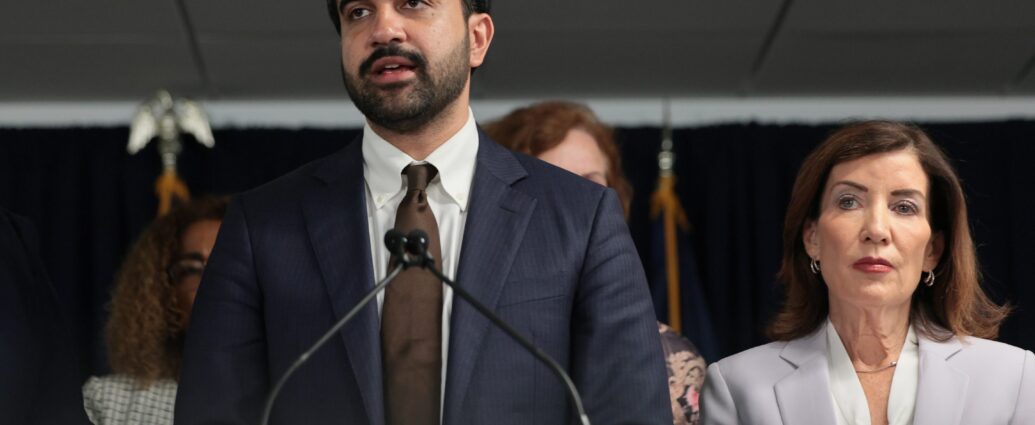
New York City sends 11,000 more pied-à-terre tax letters as it apologizes to the 1,200 wrongly targeted because it didn’t check 2025 tax returns
New York City’s Department of Finance is sending a second wave of pied-à-terre tax letters to roughly 10,800 property owners, even as it mails a very different kind of letter to other owners from the first round, telling them, in effect, never mind.
Roughly 17,000 owners received a notice this summer warning they might owe the surcharge, which applies only to non-primary residences amounts, with a rate of 0.8%–1.3% on homes over $5 million and 4%-6.5% on condos and co-ops over $1 million. But 1,210 are now being cleared outright, according to new court filings disclosed this week.
The reason has nothing to do with a change in the law and everything to do with timing: New York State sent the city’s DOF preliminary 2025 income-tax records on Aug. 12, several months earlier than the agency would normally begin receiving them. Of that group, 630 owners were cleared because their 2025 tax returns listed the property as their primary home address; another 580 were cleared using a mix of 2025 extension filings and 2024 returns.
“So by my last count, I think we sent out less than 20,000, ‘you may be subject to’ letters, I think it was about 17,000 or 18,000. And at the time that we sent those out, we did not have access to the 2025 income tax filings,” said Mayor Zohran Mamdani at a Wednesday press conference. He noted the timing wasn’t unusual on the state’s end: 2025 filings are “typically released in February of the next calendar year,” and the state simply gave DOF early access this time.
Randy Mastro, the attorney suing the city over the rollout (and a longtime suer of the city in general), made his thoughts known in the court filing. “There are many thousands fewer property owners subject to this surcharge than this administration originally boasted when it flooded the landscape with 17,000 threatening Mailed Notices.”
“The City has now effectively admitted” that some people who received the letters, Mastro said, “do not actually owe this surcharge.” He also argued the timing undercuts the city’s excuse: “The City admits that, after this lawsuit was filed on August 7, it obtained 2025 tax information within five days,” which is evidence, he claimed, that DOF could have gotten the same data before mailing anything, not just after being sued.
Mamdani laid out three categories of properties the city is targeting. One is properties owned by a corporate entity like an LLC or a trust, about 6,400 households, where DOF doesn’t have enough information on primary residence holder. The 1,210 owners who were being cleared make up the second category. The third category, about 4,400 households, consists of properties where DOF doesn’t have 2025 tax returns that would indicate whether they are primary residences. The first and third categories make up the 10,800 letters going out to people.
A rocky rollout
New York Gov. Kathy Hochul, who stood alongside Mamdani when the tax was first announced in April, said this week she “wasn’t a fan of the rollout” and that City Hall was working to correct the problems. Mamdani, at the same press conference, held firm on the tax’s revenue target: “We continue to be confident in that assessment of what the annual revenue will look like.”
A DOF spokesperson, defending the process, said: “From the beginning, we have been committed to ensuring that New Yorkers have the time and information they need. Property owners have until October 6th to file an exemption application. We have received the tax information from the state for 2025 and want to give New Yorkers more time to apply for an exemption, if applicable.”
Mamdani noted Oct. 6 isn’t necessarily the final word for owners who miss it. “If New Yorkers still want to appeal an assessment, they can still appeal to the tax commission until early next year.”
New York City’s pied-à-terre tax initially began as a Tax Day pitch. Mamdani and Hochul announced it in April, with Mamdani unveiling the plan in a video filmed outside Citadel billionaire Ken Griffin’s $238 million penthouse. The state legislature passed it May 27, and Hochul signed it the next day.
The rollout is what actually caused the uproar. DOF’s supplemental roll, meant to flag properties that might owe the surcharge, ballooned into an unfiltered list of nearly a million properties, instantly branded a “rich hit list” online, and united the ultrawealthy and merely well-off alike in opposition once thousands of legitimate primary residences got needlessly swept into DOF’s notices. That confusion is now the subject of Mastro’s active lawsuit.
This story was originally featured on Fortune.com



Opinion: The unintended consequences of the Lindsay Clancy case
Much of the focus on the Lindsay Clancy case has been on the reported systemic failures of the mental health system, with the hope that this case will revamp the approach to maternal mental health. We, as forensic and reproductive psychiatrists, agree that the system is not perfect. But we are concerned that this focus could have a dangerous unintended consequence: The legal and public scrutiny around the Clancy case could make psychiatrists more reluctant to treat mothers with mental illness.
In an ideal world, all mothers would have easy access to reproductive psychiatrists. The reality is that only about 500 reproductive psychiatrists are practicing in the United States. As a result, general psychiatrists (as in the Clancy case) and OB-GYNs are often the frontline providers for perinatal mental illnesses. Both are trained to assess and treat these disorders but do not have a dedicated focus on them.

Trump officially signs executive order directing government to rename Lake Ontario as ‘Lake America’
President Donald Trump said Thursday he is renaming Lake Ontario to be known as “Lake America” in the United States as he escalates his trade war with Canada.
The Republican president signed an executive order directing the Interior Department to update the lake’s name in the U.S. geographic naming service. Trump cannot force Canada to follow along, however.
Trump has been floating the idea of the name change in recent days as the U.S. announced it was imposing 50% tariffs on $20 billion worth of Canadian goods over the weekend after talks between the countries broke down. Trump has been needling America’s northern neighbor since he returned to the White House last year, suggesting the ally with whom the U.S. once had warm relations should instead be absorbed as the 51st state.
Canada responded to Trump’s import taxes this week by imposing retaliatory tariffs on $20 billion worth of American goods, including steel, dairy products, appliances and farm equipment.
Trump, who signed the order as he was sitting at the Resolute Desk in the Oval Office, had a large sign behind him propped on a stand with a map of the Great Lakes. Over Lake Ontario, in big red letters, the map read “Lake America.”
On the other side of the president was another map with the words, “MAKING THE GREAT LAKES EVEN GREATER.”
Trump said as he was signing the order that he’d “notified all of the various people that we have to notify. So, we’ve done everything that you have to do.”
“And this is official, effective immediately,” he added.
But the executive order Trump signed shows that the changes are supposed to be made within 30 days.
Canadian officials dismissed Trump’s move.
Canadian Prime Minister Mark Carney rejected the move, invoking the lake’s Indigenous roots and noting that the name predates both Canadian Confederation and the U.S. Declaration of Independence.
“Canadians also know that naming reality means calling it Lake Ontario — then, now and always,” he wrote.
Ontario Premier Doug Ford, who has traded insults with Trump, said on X: “It’s Lake Ontario to Canadians and the rest of the world. Now and forever.”
Nova Scotia Premier Tim Houston said, “We’re into some real foolishness now. It’s Lake Ontario, buddy.”
The lake is one of multiple Great Lakes that the U.S. and Canada share borders along. New York Gov. Kathy Hochul, a Democrat whose state shares a border on the lake, wrote on X in response to the White House’s announcement that, “New York won’t be calling it that.”
There is no single international body that determines names of international bodies of water and Trump has wide latitude over how the U.S. government recognizes geographic places and landmarks.
The name Lake Ontario comes from the Huron Indigenous people’s word “oniatarí:io,” which means “lake of shining waters.” The province of Ontario, founded in 1867, took its name from the lake.
Trump said that while his action was not meant to send any particular geopolitical message, “Canada’s been ripping us off for a long time” on trade and military issues.
“They wanted to be treated like a state and they’re not a state,” the president said. “We just can’t do that anymore.”
“We love the people of Canada,” Trump added. “I don’t think their representatives do, an appropriate job. Maybe they’ll change. I really don’t know. It doesn’t make much difference.”
The move is reminiscent of his move last year to rename the Gulf of Mexico as the “Gulf of America.”
Trump scribbled his name with a Sharpie pen on the executive order, then held it up for the cameras, offering, “And we filed all the necessary papers, documents, everything else.”
He also suggested his push to rename bodies of water may not be finished.
“So, if you think about it, we have a gulf and we have a lake. Now, all we need is an ocean,” Trump said. “So maybe we’ll have to change the name of the Atlantic and/or the Pacific. Maybe we’ll change them.”
___
Associated Press writer Rob Gillies in Toronto contributed to this report.
This story was originally featured on Fortune.com
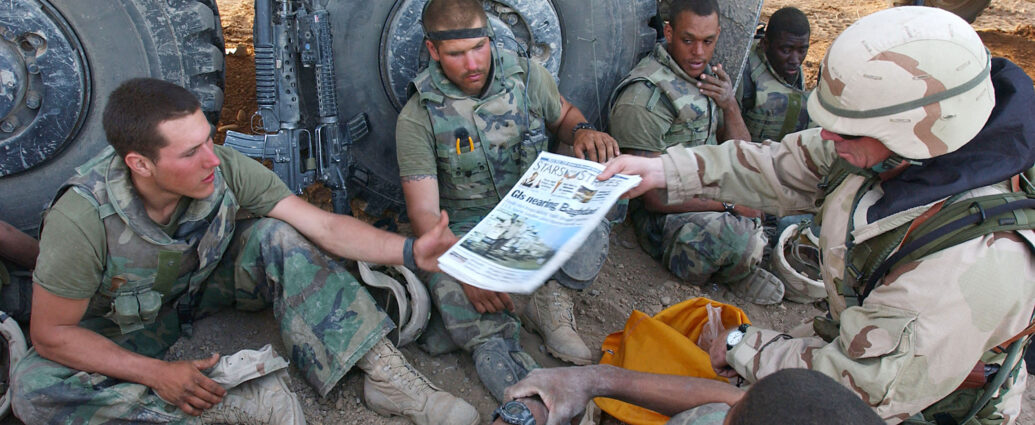
Fired Stars and Stripes staffers sue Pentagon, claiming retaliation over reporting on deteriorating aircraft carrier
Three staff members from the Stars and Stripes military news outlet are suing to challenge their recent firings by the Pentagon, accusing the Trump administration of violating their First Amendment free speech rights to speak out against government interference in their work.
Stars and Stripes publisher Max Lederer, editor-in-chief Erik Slavin and Middle East reporter Lara Korte are named as plaintiffs in the federal lawsuit filed Thursday in Washington, D.C.
The Pentagon, which partially funds the news outlet, fired them last week. A Pentagon spokesperson declined to comment on the suit’s allegations.
Slavin says he was dismissed for insubordination after giving an interview to CBS News in which he objected to potential censorship by the U.S. military. Korte participated in the same interview. Their lawsuit says they were punished in retaliation for publishing a report on deteriorating conditions aboard the U.S.S. Abraham Lincoln.
“Stripes’ historical editorial independence is critical to its core mission of gathering and providing unbiased, credible journalism to the U.S. military community, particularly servicemembers and their families stationed overseas,” the suit says.
Lederer was dismissed shortly after announcing his impending retirement, effective at the end of September. He said the Pentagon had installed a new deputy publisher, an active duty service member, under him at the newspaper without his prior knowledge.
The suit’s plaintiffs are represented by attorneys from Democracy Defenders Fund, Lawyers for Good Government, Government Accountability Project and a Yale Law School clinic.
The Defense Department and Defense Secretary Pete Hegseth are among the named defendants.
This story was originally featured on Fortune.com
Medical coexistence: As Israel faces a physician crisis, Arab Israeli doctors fill the gap
Israel is in dire need of doctors. Many serving today are nearing retirement age, which could lead to major problems within the health service and the population it serves.
A disturbing reality is that 58% of all practicing doctors in Israel received their initial medical degrees abroad primarily due to the shortage of places in medical schools here. Israel has one of the highest rates of foreign-trained doctors in the OECD.
The Arab community in Israel represents 21% of the total population, yet within Israel’s health system, the percentage of Arab Israelis increases across the medical spectrum.
In 2010, Arab physicians numbered 8% of the total number. Today, 25% of all physicians working in Israel are Arab Israelis; nurses number 27% and dentists 27%. Arab Israeli pharmacists are virtually 50% of those working within the health system. Without doubt, this participation is of paramount significance.
An Arab doctor’s perspective on Israel’s medical future
To receive the perspective of an Arab Israeli doctor, the Magazine spoke with Israeli-born Mustafa Sarhan, a 58-year-old family doctor who has been practicing family medicine since 2004.

What motivated you to enter the medical field?
From an early age, I loved helping others and saw the medical profession as a place where I could meaningfully give support to those in need. As I progressed through my school days, it became clear that medicine was the subject I wanted to study. While I was not accepted in a medical school here in Israel, I managed to obtain a place in a Bulgarian medical school; however, this meant that I could not qualify for a subsidy toward the tuition fees given to Israelis studying in Israel.
Following your return to Israel, what challenges did you confront during your initial training period?
One of the biggest hurdles to cross on returning to Israel was the Israeli Medical Licensing Examination (IMLE) – testing for many – which, fortunately, I succeeded in passing. I did my stage – medical internship – at Jerusalem’s Hadassah-University Medical Center based in Ein Kerem and Mount Scopus. The training involved varied aspects of medicine, all of which helped me acclimatize to the Israeli health system.
The most difficult part of the journey began with my choice of specialization – namely, family medicine, and being accepted for an internship; fortunately, Maccabi Healthcare Services provided this opportunity in 2001, and I have remained part of Maccabi up until today.
What aspects of medicine does your professional role embrace?
As a senior physician in the system, my role encompasses several aspects of family medicine. I am a family physician, a diabetologist, and an administrative physician. Fortunately, while at times demanding, I succeed in fulfilling my role.
How do you view Israel’s health system in comparison to other countries?
I see Israel as one of the best health systems in the world. This is a unique country because every citizen is assured of receiving full health coverage via the various kupot cholim (health maintenance organizations).
Our community health service system is a world leader. Many countries come here to see how our health service works in the hope of emulating the Israeli concept. Compared to Europe and the United States, Israel is a shining example of a system that works for all.
As an Arab Israeli doctor working within the Israeli system, have you experienced any personal negativity?
Contrary to the negative bias against Arab Israeli doctors – as projected by the press, TV, and radio – the reality is somewhat different. There is an outstanding coexistence – at every level – between Arab and Jewish doctors. We work together, we assist one another professionally and otherwise, and we celebrate together.
You have four children, three daughters and a son, all of whom have chosen medicine as a career. This is a great compliment to their father – as well as their mother, who is a dentist. Did they study abroad, and where are they today?
Yes, they all studied abroad as it was impossible to enter a medical school here. The eldest, a girl, returned to Israel to complete her medical studies and now is a gynecologist working in Nazareth.
Our son, who has completed his formal studies, is currently carrying out his stage in Nahariya; he aims to become a family doctor – just like his father.
Another daughter, having completed her initial medical studies in Russia, has now returned to Israel and is preparing for the IMLE – possibly in January – a prerequisite prior to beginning the period of stage. Her aim is to become an ophthalmologist.
The youngest daughter is currently studying medicine in Istanbul.
There can be little doubt that Israel requires far more medical schools, enabling Israeli students – both Jew and Arab – the opportunity of studying in Israel rather than abroad. The acceptance rate in Israel’s medical schools, where tuition fees are subsidized, is roughly 20% to 30%, meaning that 70% to 80% of applicants either give up the idea of studying medicine or are forced to study abroad, where the entire high cost of tuition falls on the student.
The disturbing reality is that a number of those studying abroad do not return to Israel. Percentages vary, but the Health Ministry projected that 30% might choose to stay abroad.
A July 2025 survey – publicized by Ynet – on 233 Israeli medical students in Europe and the US found that close to three-quarters said they are weighing staying abroad, not only for financial reasons but also due to better working conditions and career advancement opportunities.
What is abundantly clear is that Israel’s health service would be unable to function without the professional input of its Arab Israeli participants. The health service provides proof that Arabs and Jews can work successfully together. We can but wish that this positive reality of coexistence could be emulated – not only elsewhere in Israel but throughout the entire world.
The Magazine expresses its sincere appreciation to Dr. Sarhan for his valued contribution to this article. We wish him and his family continued success, not only within their professional careers but in all aspects of life.■
US Treasury revokes ‘critical node’ of Iranian access to US dollars in latest Tehran sanctions
The US Treasury Department proposed on Friday to revoke Banque Misr UAE’s correspondent banking access to US financial institutions, calling it a “critical node” in the Iranian regime’s access to US dollars.
The proposal is part of Operation Economic Outcast, a broader effort by the US government to sever remaining “financial lifelines” sustaining the Islamic Revolutionary Guard Corps (IRGC).
Treasury Secretary Scott Bessent said that the department had “promised to sever every economic lifeline Tehran has left and finally end the threat of the Iranian regime.”
“We also warned that Iran’s enablers cannot continue to enjoy access to the US dollar and the global financial system,” he continued. “Banque Misr UAE decided to find out the hard way, and today, we are taking the first step in holding it accountable for its continued, egregious support of the Iranian regime.”
The US Treasury estimates that Banque Misr UAE processed “approximately $1.8 billion for 103 companies that are potentially part of Iranian shadow banking networks,” the statement said, an avenue that Iran has taken following direct US sanctions on the regime.

Shadow networks provide “key access to US dollar correspondent banking relationships,” the Treasury said. “Iran uses these shadow banking networks to launder funds, procure weapons, and bankroll its regional terrorist proxy groups.”
Banque Misr is one of Egypt’s oldest and largest banks, founded in 1920 to facilitate trade between Egypt and the UAE and serve Egyptian expatriates in the Gulf.
Treasury: Front companies include those used by IRGC, Iran’s Defense Ministry
Its customers, according to the US Treasury, include “apparent front companies used by Iran’s Ministry of Defense and the Islamic Revolutionary Guard Corps to evade US sanctions, as well as to launder money on behalf of Iranian Supreme Leader Mojtaba Khamenei.”
A Treasury official said the action only applies to Banque Misr’s UAE branches, allowing the bank to continue dollar transactions through its head office in Cairo and other foreign branches. These include Paris, Frankfurt, Riyadh, Beirut and Djibouti, according to Banque Misr’s website.
Egypt’s central bank said on Friday that the US action only affected Banque Misr’s UAE branches and did not extend to any other Egyptian banks. The Central Bank of Egypt said in a statement that it and Egypt’s Ministry of Foreign Affairs were in contact with the US authorities about the measures.
The Treasury also announced on Friday new sanctions against Bank Melli, alleging it has facilitated “billions of dollars’ worth of transactions through accounts controlled by the Islamic Revolutionary Guard Corps Qods Force (IRGC-QF)” and has “allowed the IRGC-QF and its parent organization, the IRGC, to move funds inside and outside of Iran.”
Additionally, the bank has funded Iranian-aligned proxies and partners such as Iraq, the statement added.
Reza Mohammad Taeedi, the general manager of the bank’s Dubai branch, was identified as a Specially Designated Global Terrorist “for having acted or purported to act for or on behalf of, directly or indirectly, Bank Melli,” according to the statement.
Hong Kong-based Kameng Trading Limited was also sanctioned on Friday for helping sanctioned Iranians access the international financial system, the Treasury said.
Sanctions follow crackdown on ‘far-left terrorist networks’
The sanctions come two days after the Treasury cracked down on what it called “far-left terrorist networks,” with a new wave of sanctions against Italy’s Autistici Inventati, Palestine Action, a UK-based organization designated by the British government as a terrorist group in 2025, and transnational group Masar Badil.
The Treasury accused Autistici Inventati of supplying “specialized digital architecture, tools, and services for Antifa cells and other violent far-left extremists, including a foreign terrorist organization” and Masar Badil of operating “as a front for the Popular Front for the Liberation of Palestine, a designated Foreign Terrorist Organization.”
“Far-left extremists, their fronts, and their enablers should be on notice: We will bring the full weight of our economic tools to bear,” said Bessent. “Political terrorism has no place in our society, and we will continue to cut the financial lifelines of these groups until they are eliminated.”
The US identified far-left terrorist groups as one of the three major terrorist threats that the country faces today.
In July, Bessent warned of far-left terrorists “increasingly embracing organized, deadly violence in pursuit of their objectives,” and said that the Treasury’s actions reinforce the US’s commitment to disrupting the groups’ infrastructure.
Reuters contributed to this report.
No politician has the right to risk Israel’s national security – opinion
For some time, I have argued that the cognitive war being waged against Israel must be recognized for what it has become: A national-security threat.
I have written about it, as well as invited Knesset Foreign Affairs and Defense Committee chairman Boaz Bismuth to discuss its importance on TV with me. If the campaign to delegitimize Israel, isolate it from allies, influence American politics, radicalize university campuses, and endanger Jews worldwide constitutes what many now call an “eighth front,” then cognitive warfare cannot remain a secondary priority.
It is a national security issue.
But accepting this proposition has consequences. Actions capable of materially damaging Israel on the cognitive battlefield must be judged as national-security events, even when the person taking them believes passionately that he is defending Israel.
That is why what troubles me most about MK Zvi Sukkot’s recent sledgehammer episode is no longer Sukkot himself.

It is the Israeli government’s response.
How Israel fails to take cognitive warfare seriously
Sukkot entered Kafr Madama near Nablus under IDF protection and participated in demolishing a Palestinian monument that appeared to honor terrorists.
The IDF said soldiers had been diverted from operational duties for what they understood to be an authorized tour and that Sukkot then acted outside the approved framework and “without authority.”
Prime Minister Benjamin Netanyahu condemned the incident. Finance Minister Bezalel Smotrich reportedly reprimanded Sukkot and told him not to do it again.
Not to do it again?
If cognitive warfare really is national security, is that remotely sufficient?
Consider an admittedly uncomfortable comparison: Peace activist Mordechai Vanunu.
Vanunu believed Israel’s nuclear policy was morally wrong. He decided that his own judgment entitled him to disclose extraordinarily sensitive information about Israel’s nuclear program.
Israel concluded that no individual had the right to make such a national-security decision for the country. He was convicted of grave offenses and sentenced to 18 years in prison, 11 of them in solitary confinement.
Obviously, Sukkot did not reveal nuclear secrets. He did not commit espionage, and I am not suggesting his statutory offenses are equivalent to Vanunu’s.
But the distinction may be more one of degree than kind than we are comfortable acknowledging.
Imagine an IDF soldier selling several M4 rifles to an enemy. Another person sells Iran plans for upgrades to an Israeli missile defense system. The consequences are radically different, and therefore the punishments should be radically different.
But the underlying violation belongs to the same family: an individual has taken something entrusted to him within Israel’s national-security establishment and assigned to himself the right to decide how it will be used.
That principle must apply to cognitive security as well.
Sukkot effectively decided this, given that he believed the monument glorified terrorism. This argument may have merit; he believed he was entitled to decide when, where, and how Israeli power would be exercised to destroy it.
He was not.
That decision belongs to the State of Israel.
No Israeli civilian gets to walk into an air force command center and select tomorrow’s targets in Iran, Lebanon, or Gaza because he believes a particular target must be destroyed.
Why, then, should any Israeli citizen, particularly an elected official, believe he has the authority to select targets on the cognitive battlefield when his actions can affect Israel’s relationship with Washington, its diplomatic standing, Jewish communities abroad, and its global legitimization?
And this is not confined to one political camp.
In May 2025, Yair Golan, the head of the Democrats Party, declared that Israel was on the way to becoming a pariah state and said that “a sane country does not fight against civilians, does not kill children as a hobby.”
Whatever his intention, language of that kind from a senior Israeli political figure and former general in the IDF is immediately weaponized by those seeking to portray Israel as criminal and immoral.
Yet Golan is still being rewarded by the Israeli public with support and remains a major political actor with a potential 11 seats in the upcoming elections.
IN APRIL, an Israeli soldier was photographed striking a statue of Jesus with a sledgehammer in a Christian village in southern Lebanon. The image generated international outrage. The IDF investigated. Two soldiers were removed from combat duty and sentenced to 30 days in military detention.
Why?
Because one soldier’s hammer did not merely strike a statue.
It struck Israel’s strategic interests, but others who have struck Israel’s strategic interests go unpunished and even rewarded. This means the system is failing.
The same principle applies when senior politicians create unnecessary friction with Israel’s most important ally.
US Vice President JD Vance publicly rebuked Israeli ministers after they clashed over American diplomatic policy, asking in frustration: “What is your exact proposal? You’re a country of 9 million people. You can’t just kill your way out of solving every single national security problem that you have.”
A potential future president of the United States felt compelled to publicly admonish senior Israeli leaders. If the management of that relationship is not a national-security issue, what is?
The question is simple: Who has the right to jeopardize a strategic relationship, at a strategically sensitive moment, in pursuit of his own political objective?
That question is urgent now.
Israel is approaching elections. America is approaching midterm elections. Iran remains a critical strategic challenge, and Turkey is fast approaching as our next serious challenge. The relationship with Washington remains indispensable. Global antisemitism has increased dramatically. At the same time, Israel is investing unprecedented resources in public diplomacy and communications.
Yet Israelis continue to behave as though cognitive damage can be created by politicians today and repaired by hasbara (public diplomacy) professionals tomorrow.
It cannot.
A photograph travels around the world before an Israeli spokesperson has finished writing the first sentence of an explanation.
Sukkot swinging a sledgehammer beside Israeli soldiers is instantly internalized. Explaining that the monument apparently glorified terrorists, that Palestinian incitement is real, that Sukkot had previously requested its removal, and that the IDF did not authorize what happened takes several paragraphs.
Our enemies get the photograph.
We get the explanation.
That is the asymmetry of cognitive warfare.
Which brings me back to what I find more disturbing than Sukkot’s behavior: The absence of consequences commensurate with the national-security principle supposedly at stake.
A condemnation is not deterrence.
A reprimand is not doctrine.
“Don’t do it again” tells the next politician that the potential reward – headlines, social-media engagement, and support from a political base – may exceed the cost.
That is an extraordinarily dangerous message for a country fighting a cognitive war.
This government understandably sees an election only weeks away. Coalition politics matter. Political constituencies matter. But national-security leadership requires looking beyond the next election.
The government’s responsibility is not merely to survive October 27. It is to establish rules of behavior that protect Israel on October 28 and for years afterward.
If Israel wants the world, the IDF and its own citizens to take cognitive warfare seriously, then deliberately creating unauthorized strategic liabilities must carry meaningful consequences.
This principle cannot depend on whether the unauthorized national-security decision came from the Left or the Right, from a nuclear technician or an MK, or from someone leaking secrets, wielding a sledgehammer, or a former IDF general making a statement that hands Israel’s enemies a propaganda victory.
No individual gets to privatize Israel’s national security.
The elected government determines Israel’s military strategy. It determines which risks to take with Iran. It manages our relationship with the US. And it must ultimately determine how Israel conducts itself on the cognitive battlefield.
Once we call that battlefield a national-security front, we must have the courage to treat breaches of it accordingly.
And the next person who decides that personal conviction entitles him to risk Israel’s strategic interests may inflict damage that no amount of hasbara money can undo.
Israel’s next government must save the country before it is too late – opinion
I began my foreign correspondent career in 1990 in Romania, just weeks after its communist dictator, Nicolae Ceausescu, was overthrown. The new government called itself the National Salvation Front.
Romania truly did need saving. The communists had left behind an impoverished economy, shattered institutions, and a demoralized population.
There are moments when ordinary politics are not enough, and salvation is required. Israel has reached such a moment.
If Prime Minister Benjamin Netanyahu wins in October, Israel will be heading toward catastrophe. But if the polls are right and the opposition wins, it will be inheriting a traumatized country, with weakened institutions and international isolation threatening its very existence.
In such an eventuality, the opposition must then think in terms of national salvation, as it will need that level of motivation to succeed.

Everything is connected. The occupation, settlements, and wars fuel isolation; isolation damages the economy and security; and internal societal distortions further weaken the country.
It is a self-reinforcing cycle – and the next government must break it. Given that the haredi (ultra-Orthodox) birth rate, under the current incentive structure, will not decline quickly enough, there is no time to spare before the whole enterprise collapses. I therefore propose a dozen immediate tasks for Israel’s “National Salvation Front.”
Accountability and democracy
First, establish a state commission of inquiry that investigates the October 7 catastrophe without games or evasions.
Then, repeal the judicial and constitutional changes imposed by the Netanyahu coalition. In this regard, undo the legislative blitz of its final months, including the law weakening the attorney-general and the measures that undermined the independence of the courts, legal advisers, and institutional gatekeepers.
Make clear that ministers, like everyone else, will obey court rulings. Israel can one day debate judicial reform – calmly and with broad consensus.
And from here, look outward. It is time to turn military power into diplomatic gains.
Say ‘yes’ to Trump Gaza plan – and mean it
Declare that Israel accepts the framework in full and will implement it in good faith. If Hamas genuinely disarms, Israel will withdraw as agreed, cooperate fully with the international stabilization force and the Board of Peace, and accept the new Palestinian governing authority.
Israel should enthusiastically assist in rebuilding Gaza and help raise funds from Arab states and international donors.
End Jewish terrorism in West Bank
End the de facto immunity enjoyed by violent Jewish extremists. Outlaw organizations involved in terrorism, confiscate illegal weapons, dismantle violent outposts, and establish a dedicated apparatus for securing convictions.
The IDF must receive unequivocal orders that protecting Palestinians from Israeli attackers is part of its mission. Finance Minister Bezalel Smotrich’s charade is over.
Freeze settlement expansion beyond security barrier
Halt construction in settlements deep inside the West Bank and preserve the territorial possibility of future partition – because without it, there can be no Jewish state.
A Palestinian state is inconceivable as long as Hamas remains armed and the Palestinian Authority has not undergone reform, but Israel must stop making the notion of such a state impossible.
It can declare that major blocs such as Alfei Menashe, Ma’aleh Adumim, and Gush Etzion are expected to remain in Israeli hands under a future agreement, while offering generous incentives to Israelis living beyond the barrier to come home.
Rebuild a regional strategy
Offer Lebanon and Syria a fresh start. Declare that Israel has no territorial ambitions in either country beyond the Golan Heights, and offer non-belligerency pacts.
Test whether the Syrian government of Ahmed al-Sharaa genuinely wants peace, and if so, welcome it. Offer Lebanon whatever assistance it needs to confront Hezbollah.
As for Iran, replace a war of attrition with a long-term strategy coordinated with the US and its allies, combining military deterrence with diplomacy and economic pressure. End attacks carried out without coordination, explanation, or a clear objective.
And reach out to Saudi Arabia based on US President Donald Trump’s plan, which includes agreement in principle to some form of Palestinian state in the future, with the India-Middle East-Europe Economic Corridor in mind.
Thank Egypt and Jordan
Acknowledge these countries for maintaining peace through decades of difficulty, and make strengthening relations with them a national priority. Listen seriously to Cairo and Amman, and seek ways to deepen economic, security, and even cultural ties with both.
All of this will be relatively easy compared to the real challenge at home.
Embrace Arab society
Declare organized crime in Arab communities a national emergency. Triple the police presence where necessary, target the financing of criminal organizations and illegal weapons networks, and hold commanders accountable.
Every murder of an Arab citizen should be publicly treated as an Israeli tragedy. Amend the 1992 Basic Law: Human Dignity and Liberty to explicitly guarantee equality.
Establish transparent formulas for equal funding of Arab municipalities and launch a national project to repair neglected infrastructure and services. Then begin a serious dialogue with Arab community leaders about national service.
Declare state of emergency in education
Israeli students lag behind in mathematics and science, and the gaps between the strongest and weakest students are among the largest in the developed world.
A country that wants to remain a technological powerhouse cannot continue like this. Israel must massively invest in state education, teachers, mathematics, science, English, and civics.
At the same time, it must introduce an equation: No core curriculum? No state funding. Every school receiving state money or recognition must teach the full core curriculum, employ qualified teachers, and submit to supervision and standardized assessment. This includes the haredi and Arab education systems. If anyone goes berserk over this, let them.
Overhaul incentives
Gradually eliminate child allowances beginning after the third child. Restore yeshiva budgets to their previous, lower levels. Eliminate unnecessary publicly funded rabbinical and kashrut-supervision positions (and reinstate the Bennett-Lapid government’s kashrut reform).
Simultaneously, establish a national integration authority that offers adult education involving the completion of core studies, university preparation, vocational and technological training, employment assistance, and pathways into military or national service for anyone who wishes to enter the Israeli mainstream, whether haredi or Arab.
Military or national service
Yeshiva study or religion in general should no longer exempt a fit young person from military service or legally recognized national service. Israel should enact a universal service law, introduced sensitively and gradually.
Haredi draft evaders should face the same consequences as other draft evaders. Benefits can be withdrawn, and institutions that systematically facilitate evasion should lose state funding.
Initially, this will not be possible by consensus, because there are currently no partners for such an agreement – although determined implementation may eventually create them.
It is time to redirect the money, energy and national ambition back to Israel and Israelis without compromising genuine security.
Make the Negev, Galilee new national project
Radically reorder economic priorities: less money for isolated settlements, sectoral mechanisms, and political needs, and more for infrastructure, housing, transportation, healthcare and education inside sovereign Israel.
Redirect the energy and money that have been squandered to the Negev and Galilee instead. Invest in roads, railways, housing, hospitals, universities and industry, alongside aggressive tax incentives for businesses and families. In the North, build a genuine transportation network to turbocharge its economy.
Amend Basic Law
A person indicted on serious corruption charges should not be allowed to form a government. The Basic Law should be amended so that this cannot happen again.
There will be furious opposition to such an amendment, but a national salvation government cannot afford to recoil. Its mission is to confront the country’s burning structural problems, repair the damage of the past, reconnect Israel with the democratic world, and offer hope.
If these steps are not taken, the country may not survive to its centenary in 2048. Entanglement with a hostile Palestinian population combined with the rapid demographic growth of the haredi sector without radical reform will destroy Israel’s alliances and access to global markets, driving out its productive sector. What will remain is an impoverished, embattled ghetto.
But if Israel does these things with a sense of mission and urgency, perhaps the phrase I encountered in Romania all those years ago can apply in this case as well. There is much in Israel worth saving, and worth the effort. There is still a chance for national salvation.
Dan Perry is a former Cairo-based Middle East editor and London-based Europe/Africa editor of the Associated Press. He served as chairman of the Foreign Press Association in Jerusalem and authored two books about Israel.
Jon Ossoff distances himself from left-wing streamer Hasan Piker, joining several Democrats
Georgia Sen. Jon Ossoff distanced himself from left-wing streamer Hasan Piker, who has called Ossoff a “dark-horse” presidential candidate, citing Piker’s “reckless and dangerous rhetoric” about American Jews.
Ossoff is facing criticism from some of his state’s local Jewish community over his votes to block certain arms sales to Israel. He has joined a chorus of Democrats who criticized Piker this week over recent comments that many interpreted as justifying threats to American Jews, including a number of Democratic politicians.
Speaking on a Twitch livestream on Aug. 20, Piker stated, “If Jews in America keep putting this idea out there that they are singularly invested in Israel, eventually someone’s going to come around and take action.” Piker added, “Not against the state of Israel, mind you, but against American Jews.”
An Ossoff spokesperson told the Atlanta Journal-Constitution on Thursday that he “unreservedly rejects reckless and dangerous rhetoric suggesting that policy advocacy invites violence against the Jewish community or any community.”
“American Jews and all Americans must have the freedom and security to speak out and petition their government without fear of reprisal,” the spokesperson added.

Ossoff’s politics and sharp criticism of US President Donald Trump have generated buzz about him potentially running for president in 2028, and have attracted some left-wing figures who have lauded his messaging.
Piker was initially among those figures, telling the Jewish Telegraphic Agency in April that he was “intrigued” by Ossoff.
“I think he’s very charismatic, and he’s done things that I’ve found to be interesting, given his position in Georgia, when he was one of the first lone voices in the Senate that actually was critical about sending aid to Israel early on,” Piker said at the time. “I was like, that’s a unique position for – he’s Jewish as well – for a young American Jew to take in Georgia.”
Piker said that he heard from young Georgian Jews in his online community who “could not believe that their synagogues and their rabbis and their organizations in their communities took out like a full page ad yelling at Jon Ossoff for taking a stance against arming the State of Israel.”
Several Democrats condemn Piker’s comments
Ossoff’s campaign had never responded to requests for comment about Piker until Thursday, as a slew of Democrats condemned the anti-Israel streamer’s comments.
Later that day, Piker was decidedly less enthusiastic about Ossoff when speaking on his stream.
“I don’t like Jon Ossoff,” Piker said, adding that he had “wanted to see if he had the right instincts” before declaring himself a full-fledged supporter.
“This is a moment where it’s very clear that he does not have the right instincts,” he added.
Piker: Ossoff’s Israel stance sparked my interest in him as a Senator
In a post on X/Twitter, Piker also explained how Ossoff’s Israel stance was what sparked his initial excitement about the senator.
i think jon ossoff’s best strengths came from his lack of interest in attacking his left flank & focusing on trump’s corruption & scandals instead. i said he was a dark horse because he’s been smart enough to back restrictions on weapons transfers to israel at times regardless of… https://t.co/55DrUK1zVE
— hasanabi (@hasanthehun) August 27, 2026
“i think jon ossoff’s best strengths came from his lack of interest in attacking his left flank & focusing on trump’s corruption & scandals instead,” Piker wrote. “i said he was a dark horse because he’s been smart enough to back restrictions on weapons transfers to israel at times regardless of his incredibly conservative voting track record otherwise.”
The clash between Ossoff and Piker comes as members of the Jewish community in Atlanta have criticized the Jewish Democrat, largely over his votes to block certain arms sales to Israel. Ossoff is running for reelection in November in a high-profile battle against Republican Rep. Mike Collins that could determine which party controls the Senate.
Ossoff first voted to block weapons sales to Israel in November 2024, spurring a critical open letter from several Georgia Jewish organizations, including synagogues, Jewish schools, the local Anti-Defamation League chapter, and other groups. His vote also drew the attention of AIPAC, which released 30-second ads attacking US senators – including Ossoff – who had voted to block weapons sales.
Michael Morris, publisher of the Atlanta Jewish Times, penned an open letter earlier this month blasting Ossoff for voting to block weapons sales to Israel again in July 2025 and April 2026.
“I hear you claim, over and over again, that you support Israel – that your support is ‘ironclad,’” Morris wrote. “It is not.”
Morris accused Ossoff in the letter of “lying to me and your constituents” about his support for Israel. Days later, Republican former house speaker Newt Gingrich appeared to run with that accusation in a post that attacked Ossoff, in response to the Senator’s remark about Trump and his aide Natalie Harp.
“Ossoff routinely lies as the Jewish leaders in Atlanta pointed out recently, and we should accept that he is a profoundly dishonest politician with no sense of honor,” Gingrich wrote.
Asked about Ossoff’s comments on Piker, Morris told JTA he agreed with the statement, but that it wasn’t enough to win his support.
“It’s better than him supporting Piker – absolutely, 100%,” Morris said. “But, you know, talk is cheap, and trying to push one extremist a little bit out of the envelope – it’s one little step forward. Very little.”

Gap Jumps as Old Navy Gets New Leadership — With a $417 Million Tariff-Refund Twist
Gap shares surged after the retailer moved to address weakness at Old Navy while raising its annual profit outlook.
The company named Michael Francis as chief executive of Old Navy, putting an experienced retail executive in charge of Gap’s largest brand at a moment when its performance has become one of the biggest obstacles to the company’s turnaround.
Old Navy comparable sales fell 4% during the quarter, their first decline in 12 quarters.
That weakness stood in sharp contrast to the Gap brand, where comparable sales rose 10%.
Overall quarterly revenue fell 2% to roughly $3.65 billion, while adjusted earnings came in stronger than Wall Street expected.
Gap raised its full-year adjusted earnings outlook to $2.35 to $2.45 a share.
But there is another important number buried inside the quarter.
Gap recorded approximately $417 million in net tariff recovery tied to IEEPA duties.
The company says its adjusted outlook excludes the impact of that recovery, meaning investors should not simply treat the $417 million as evidence that Gap’s underlying retail operation suddenly became dramatically more profitable.
The market reaction reflects both sides of the story.
Shares jumped sharply because investors see stronger performance at the Gap brand, improved pricing discipline and a concrete attempt to fix Old Navy.
But Old Navy still matters enormously.
It is Gap’s largest banner, and the company’s broader turnaround will be difficult to sustain if Old Navy continues losing sales momentum.
The quarter therefore provides another example of why investors increasingly need to separate operating performance from temporary tariff-related financial benefits.
The real question for Gap is not how much tariff money came back.
It is whether the new leadership at Old Navy can get customers buying again.
JBizNews Desk | San Francisco
© JBizNews.com All Rights Reserved. Reproduction or distribution without written permission is prohibited.

Apple Raises Apple TV to $14.99 and Lifts Apple One Price in U.S.
CUPERTINO, Calif. — Friday, August 28, 2026
Apple is raising the price of Apple TV again, taking the streaming service to nearly three times what it cost when it launched in 2019.
The monthly subscription now costs $14.99 in the United States, up $2 from $12.99. The annual plan rises from $99 to $119, a $20 increase.
Apple also raised the Apple One Individual bundle from $19.95 to $21.95 per month. That package combines Apple TV, Apple Music, Apple Arcade and 50GB of iCloud+ storage.
The Apple One Family and Premier plans remain at $27.95 and $39.95 per month, respectively. Those two packages were already increased by $2 last month when Apple raised its music-subscription prices.
The latest changes take effect immediately for new customers. Existing subscribers are expected to receive notice before the higher rate reaches their next billing cycle.
For consumers, paying for Apple TV monthly will now cost $179.88 over a full year. The $119 annual subscription saves nearly $61 compared with paying month to month, making the yearly plan considerably cheaper for customers who intend to keep the service.
Apple TV originally launched at $4.99 per month in 2019. Its price later rose to $6.99, then $9.99, $12.99 and now $14.99 as Apple expanded its original programming and live-sports offerings.
The increase adds another expense for households already juggling multiple streaming subscriptions and gives customers another reason to review whether they are paying separately for services that might cost less when bundled.
JBizNews Desk | Cupertino, California
© JBizNews.com All Rights Reserved. Reproduction or distribution without written permission is prohibited.

Nepal monitoring two lakes, flood risk to remain until they’re fully drained, official says
Nepal is monitoring two lakes upstream of the flood zone where hundreds died on Wednesday, an official with Nepal’s Disaster Management Authority said.
Flood risks will remain until the two lakes have fully drained, the official added, as one of the two lakes began overflowing on Friday.
Satellite images showed the two lakes near the site where a glacier collapse was believed to have pushed rock, ice, mud and debris into river systems on Wednesday, causing flood waves that leveled houses and tore away bridges.
The formation of one of the two lakes had been captured in aerial footage by a Chinese rescue team on Thursday.
Footage shows water accumulating in basin, lake increasing in size
The footage on Thursday showed masses of brown water accumulating in a basin. By Friday, water was draining from that lake, according to new satellite imagery.

The imagery also showed another lake upstream that appeared to be growing in size and was bigger in surface area than the first lake, without any visible outlet as of Friday morning, meaning that water pressure may still be building there.
Nepalese authorities are relying on satellite imagery to track conditions, though monitoring is limited by the availability of images, the Nepalese official said.
Nepal plans to install cameras and sensors downstream, including near the border town of Timure, and is assessing deployment options by helicopter, he said.

Sweden to deploy fighter jets, warships to Finland amid fears of ‘deteroriating security situation’
Sweden‘s military will participate in the surveillance and protection of Finland‘s territory with Gripen fighter jets and a corvette warship, at least until the end of 2026, Finland’s defense forces said on Friday.
“The Swedish equipment strengthens air surveillance in particular, releasing the Finnish Defense Forces’ own resources for repelling violations and incidents, if need be,” Finland’s military said in a statement.
The neighboring countries, NATO’s two newest members, already have close bilateral defense cooperation. Finland has a 1,340-kilometer (833-mile) long eastern border with Russia.
“Sweden has responded to a request from Finland to strengthen its air defense due to the deteriorating security situation,” Sweden’s Defence Minister Pal Jonson told Reuters, adding that the Swedish armed forces may under the agreement, if necessary, help Finland repel violations of Finnish territory.
Besides fighter jets and vessels with drone combat capabilities, Sweden may also contribute ground-based anti-drone systems, he said.

Countries fear Russia-Ukraine war is spilling over borders
Military drones straying into the airspace of Finland, Estonia, Latvia and Lithuania are stoking concerns that the war in Ukraine is spilling over into NATO’s northern borders with Russia. As Ukraine steps up attacks on Russian Baltic Sea oil shipping ports, some of its drones have missed their targets and led to security warnings in neighboring countries.
Sweden’s SAAB SAABb.ST, the maker of Gripen, said separately on Friday it had won a 1.2 billion crown ($126 million) order from Finland for its RBS 70 NG portable air defense missile system.

Egged Partners With China’s CRRC to Bring Buses to Israel and Europe
Israel’s largest bus operator is going into business with a Chinese state-owned manufacturer designated by the Pentagon as a Chinese military company and restricted under separate U.S. transit-procurement legislation.
Egged Group and Auto Chen Mobility, part of the Belilios Group, announced Thursday that they are forming a joint venture with CRRC to import, market and sell the Chinese manufacturer’s buses. Egged said the goal is to build a full, long-term operation around CRRC products in Israel while working with the company to enter additional European markets.
Despite how the agreement has been described, this is a distribution and service venture—not a bus-manufacturing operation, at least for now.
The scale of the Chinese partner is the headline. CRRC was created in 2015 through the merger of CNR and CSR and now operates in more than 100 countries through 46 subsidiaries, employing more than 150,000 people.
The state-owned company generated approximately $38 billion in revenue last year, earned about $2 billion in profit and invested roughly $3 billion in research and development. It has sold more than 85,000 buses since entering the segment in 2006 and produced approximately 6,000 during 2025 alone.
Each partner brings a specific advantage. Auto Chen has delivered more than 4,000 Golden Dragon buses in Israel over the past decade and understands the country’s import, sales and service infrastructure.
Egged contributes experience operating large transportation fleets in Israel and Europe. Its European holdings include Mobilis in Poland, EBS in the Netherlands and a majority stake in Lithuania’s TOKS, giving the new venture an existing operational base from which to pursue European contracts.
CRRC vehicles are already beginning to reach Israel. Its electric-vehicle division has shipped minibuses to the country, while a 26-meter bi-articulated bus is expected to arrive under a Transportation Ministry tender. The vehicle is scheduled to be operated by Superbus on the Haifa Metronit system.
Executives involved in the partnership have also identified autonomous vehicles as a longer-term opportunity.
The complication is CRRC’s ownership and status in Washington.
The company is owned by the Chinese government and appears on the Pentagon’s list of Chinese military companies. Under Section 805 of the 2024 National Defense Authorization Act, the Defense Department is prohibited from entering into, renewing or extending certain contracts with companies on that list.
Congress separately enacted the Transportation Infrastructure Vehicle Security Act in 2019, restricting the use of federal transit funding to purchase buses and rail cars from Chinese state-owned or controlled manufacturers.
CRRC’s growing role in Israeli transportation has previously drawn scrutiny. In 2022, Chinese companies lost a major Tel Aviv light-rail contract amid reported American pressure and security concerns raised in both Israel and the United States. CRRC later became involved in a separate controversy surrounding the procurement of trains for Jerusalem’s Blue Line.
This agreement is different because it is being formed by commercial transportation operators and initially involves buses rather than the construction of a government rail network. U.S. transit-procurement restrictions do not govern purchases made for Israeli fleets without American federal funding.
Nevertheless, modern electric buses contain connected systems—including cameras, telematics and remotely updated software—that Israeli regulators may examine as the venture expands.
For Egged, the commercial calculation is straightforward: Chinese electric buses are competitively priced, readily available and increasingly capable, while European transportation tenders are often decided heavily on cost.
The unanswered question is whether Israeli regulators—and American officials monitoring the transportation infrastructure of a close ally—will view the partnership strictly as a commercial venture or as part of a broader strategic concern surrounding Chinese technology.
JBizNews Desk | Tel Aviv
© JBizNews.com All Rights Reserved. Reproduction or distribution without written permission is prohibited.

Utah’s Burger King magnate recalls in memoir why his greatest success was giving back
From growing up poor and fatherless in a tough Italian neighborhood in Buffalo, New York, likened to that of the film “Goodfellas,” to building a Burger King franchise empire in the mountainous West of Utah, John Gullo’s story is a quintessential example of the classic rags-to-riches tale.
Yet for this entrepreneur-turned-philanthropist, the “riches” never equated to the money he made. Gullo innately knew early in life that it was about giving back.
“It’s more important to be happy than it is to make money. And that’s a belief of mine. And when you ask me about my business, I never got into it to make money,” he told Fox News Digital.
‘SHARK TANK’ STAR DAYMOND JOHN SAYS ‘YOU’LL BE SCREWED’ IF YOU DO THIS WHEN STARTING A BUSINESS
Now 82, Gullo, who during his career opened a total of 54 franchises in Utah, Arizona and Wisconsin — including the first-ever Burger King attached to a gas station, in Hurricane, Utah — is sharing his life’s journey.
From his first stint as a night manager at the fast-food chain to establishing the nonprofit American Dream Foundation with seed money from his business success and becoming the designated “Father of Professional Pickleball,” it’s all in his memoir, “Extraordinary Adventures of an Ordinary Man.”
Gullo refers to the title as “the caption for my life.” He wrote the book, which can be found on Amazon, with the help of author Bridget Cook-Burch.
THIS POPULAR BURGER CHAIN BUILT ITS OWN ‘UNIVERSITY’ TO TRAIN FUTURE LEADERS
The reason he decided to sell his restaurants, he said, was because he wasn’t working with the kids anymore.
“I wasn’t actively involved in the day-to-day operation, and I missed that,” he said.
“Everything I do with kids is a life lesson, so when I wrote the book, I did life lessons after each chapter with the hope that kids are going to read this thing and people are going to see it, and they’re going to learn from it,” Gullo added, noting his belief that, for some reason, he has been spiritually inspired all of his life.
“Giving is just very important to me — it’s very rewarding to me,” he said, noting that the philanthropy piece of his life has always been there. “…Maybe it’s because when you have nothing, you appreciate everything so much more.”
JO FROST CALLS OUT MODERN PARENTING MISTAKES SHE SAYS ARE ROBBING CHILDREN OF BASIC LIFE SKILLS
As documented in the recent Deseret News article “How Utah’s Burger King king became the king of giving back,” Gullo has, for the last quarter-century, focused strictly on helping people and organizations that help people. In essence, his projects have served children, teens, families, classrooms, firefighters and those with disabilities.
His philanthropic efforts have gone to dozens of charitable endeavors and organizations, including Prevent Child Abuse and the Children’s Justice Center. He’s been behind the Ogden, Utah-based Enable Industries, which serves people with disabilities, as well as the American Fallen Fire Memorial, Youth in Transition, the Ogden Police Department’s Let’s Play Program, and the Treehouse Children’s Museum.
GORSUCH HIGHLIGHTS STAGGERING DECLINE IN CIVIC LITERACY THAT PROMPTED HIM TO AUTHOR NEW BOOK
The latter includes the American Freedom Trail, which every fifth-grader in Weber County can take a field trip to. It’s just one piece of what Gullo’s American Dream Foundation has funded since 2002, with more than $2 million going toward charitable causes.
Gullo is all about emphasizing the freedom to have your own opinions and the opportunities this nation has afforded him, which he’s expressed in patriotic videos featured on his foundation’s website.
“I think it’s important that the kids know the price that was paid to give them the right to burn the flag. The patriotism that existed at that time, the love of country at that time, it’s disappearing,” he explained. “We’re so segmented right now, and I do everything I can to offset that.”
Gullo himself said he has a lot of friends on both sides of the political aisle, but regardless of their beliefs, they’re able to remain friends.
“We disagree, that’s OK,” he said.
He specifically noted his friendship with former NBA player Thurl Bailey, who now does color commentary for the Utah Jazz and wrote the foreword for Gullo’s book. The two have collaborated for 20 years on charitable events.
“What this country needs more of is to have a relationship like ours,” Gullo said, noting that the two are totally different but are “brothers from another mother” and are united in how they care about people.
“We care about things and we work together. And there’s just not enough of that in the United States anymore,” Gullo said, noting his pursuit to bring organizations and people together.
Bailey called meeting Gullo at a charity event where Gullo purchased an auction item that involved Bailey giving a keynote speech at an Ogden youth program for underprivileged kids “fortuitous.”
“That’s when I really started to find out what a charitable man he was — a man successful in business in his own right, but you would never know it because he’s just so giving,” Bailey told Fox News Digital.
Later, during some country music concerts in Ogden sponsored by Gullo, the two would realize they had parallel lives growing up.
WANT TO STOP SOCIALISM? A MODERN CIVIC EDUCATION NEEDS A LOT MORE THAN YOU’D THINK
“We clicked on a lot of levels when it came to our backgrounds, even though mine turned into sports and his into business and philanthropy. We both connected on the giving side,” he said.
So where does pickleball come into Gullo’s story?
He has credited the sport with saving his life after heart failure and first discovered the game while recovering from quintuple bypass heart surgery in 2008.
It helped him lose 100 pounds and inspired him to get courts built throughout Northern Utah — hundreds of them, in fact. He went on to found the Professional Pickleball Federation and the Tournament of Champions, a national event with prize money donated from his own pocket.
All of that has led to his induction into the Pickleball Hall of Fame in 2024 for his contributions to the growth of the sport, which has skyrocketed in popularity. He’s officially been dubbed the “Father of Professional Pickleball.”
“This is the most social game ever invented. You just got to show up. You don’t have to get three guys to play golf or tennis or anything like that,” Gullo said. “…What other sport do you know where a guy like me can partner with a 24-year-old kid in a tournament and be part of it? That’s what makes this sport so great.”
A proud father of two sons, Gullo continually emphasizes the difference between positive mistakes and negative ones to the younger set.
“A positive mistake is when you’re trying to do something and you make a mistake. I can live with that. A negative mistake is when you screw up because you don’t do anything. It’s that simple,” he said, noting he also tries to keep his own grandkids on track.
“After COVID, I sat down with them and said, ‘What did you learn?’ And after some discussion, I said, COVID taught you the difference between wants and needs. What did you go without that you really don’t need in your life? Because when I was a kid, everything was a want, everything was a need because we had nothing.”
He credits the Jaycees, a civic and leadership training organization for young adults, with bringing him out of his shell and instilling in him the importance of leadership through community service.
“When I joined the Jaycees, I was an introvert, but the Jaycees really turned me around… and that’s where I learned a lot about my business and charity life because all of a sudden you’re in charge of a project and you have to get people to help you,” he said. “You’re not paying them, and you might not even like them, so I learned that part of human relations through that process …”
Now, as he undertakes a program with Thurl at Ogden High School featuring his book and leadership training, Gullo looks back and is still amazed at what he’s been able to accomplish, sometimes even making fun of certain triumphs, like being the first to put a fast-food restaurant in a gas station of any kind.
“…I went to Russia and I saw McDonald’s and a gas station and I said, ‘Father, forgive me, I know not what I do,’” he quipped.
Mostly, it’s when he realizes his American Dream Foundation has donated more than $2 million since 2002 that he stands in disbelief. In true Gullo style, all the proceeds from his book will go to charity.
“I didn’t go to college, barely got out of high school… you’re talking to a guy that grew up in poverty,” Gullo said. “I realized it took the same amount of energy to cry as it does to laugh, and the choice is mine.”
“The power of one means one person can do a lot,” he added.
“John’s a man who cares about a lot of things, but is passionate about giving,” Bailey added. “He’s a giver. The world needs more John Gullos.”

X reveals foreign adversary behind fake accounts disseminating anti-data center messaging
The social media platform X announced that it performed a probe regarding “suspected Chinese inauthentic accounts” participating in influence efforts, uncovering a bot farm of around 200,000 accounts, of which 200 accounts were posting in a way that could distort true debate regarding U.S. artificial intelligence and energy policy.
“The X Safety team conducted an investigation into suspected Chinese inauthentic accounts involved in influence operations: We identified a bot farm of approximately 200,000 accounts. Within this farm, we found 200 accounts posting in a manner that could manipulate a legitimate debate about American AI and energy policy,” the post on the X Global Government Affairs account noted.
“These posts contained claims that AI data centers are driving up household electricity prices and straining the grid. Others included AI-generated cartoons that depicted data-center operators enriching themselves at the public’s expense,” the post continued.
“We remain committed to maintaining an open and authentic platform where people debate topics of public interest. We take seriously any attempts to undermine the integrity of the global town square and suspend accounts that violate our Authenticity policy,” the notice concluded.
The post featured several screenshots of examples of relevant posts. One showed a post depicting what appeared to be an anti-data center comic strip titled, “DATA CENTERS GET SUBSIDIZED WHILE WE FOOT THE BILL!” A message at the bottom read, “ELECTRICITY RATEPAYERS GET STUCK WITH THE COST!”
OPENAI, 100+ COMPANIES WARN OF COMING SURGE IN AI-POWERED CYBERATTACKS, CALL FOR GLOBAL DEFENSE PUSH
Data centers have been a topic of debate within the U.S. amid concerns regarding environmental impacts and energy costs in local communities.
Florida Gov. Ron DeSantis wrote in a post on X last week, “The concerns by citizens from across the political spectrum re: hyperscale data centers are rooted in distrust of these Big Tech titans and their designs on expanding tech power over the citizenry. It’s not just — or even mainly — about concerns about water and power usage.”
But some, including President Donald Trump, want to ensure that China does not outpace the U.S. in AI-related advancements.
TRUMP SAYS ANY GOVERNOR OR MAYOR SHOULD WANT TO WELCOME AN AI DATA CENTER
In part of a Truth Social post last month, the president asserted, “The Radical Left Dumocrats must not be allowed to cause us to lose Data Centers, AI, and all of this incredible new Technology, to China, and other countries!”

Extreme weather has cost California farmers over $800 million this year
California farms and vineyards are facing a host of problems so far this year, including a drought caused mainly by unusually warm weather patterns in early spring, as reported by the state’s Department of Water Resources. This year’s snow levels in the Northern Sierra and Cascade mountains fell to 0% of their typical June average. These snow packs are needed each year to melt slowly throughout the summer and fall providing crucial water supply to the state.
In June, the national weather service warned millions in California to stay inside due to lethal temperatures around the state including parts of Oregon and Washington.
Almonds are California’s number one crop by acreage, number one agricultural export, second by value, and the number one specialty crop export in the country. Eighty percent of the world‘s almonds come from California with more than 7,000 almond farms across the state. Lately, water restrictions and higher costs are making it difficult for growers.
The story is the same for pistachios. California produces nearly all of the U.S. supply (about 99%) and accounts for over 60% of global pistachio production. 600,000 acres are planted across the Central Valley contributing more than $1.6 billion in annual value to the state’s economy. Fresno, Kern and Tulare counties reported a combined $800 million loss for pistachio production so far this year.
In May, officials in Kern County alone also reported a 42% loss in cherry production this year due to a hot stretch in March followed by April rain accounting for a total loss of more than $13 million for growers.
The University of California recently held workshops on how to grow grape and nut crops during extreme weather, heat, drought, pest issues and greater climate variability.
Normally, California boasts an agriculture industry with more than 350 commodities that account for over $100 billion in related economic activity.
In 2025, California passed Japan as the world’s fourth largest economy with farmers representing a large part of that milestone. In 2024 alone, 1.2 million agricultural related jobs were produced. California continues to rank as the most agriculturally productive state in the nation.
California also leads the country in Agriculture Technology innovation with 15 Agricultural Science universities and 11 Tier 1 research universities. In 2021, California Ag Tech startups received over $5 billion in venture capital funding which equals more than 18% of global Ag Tech investment.
Despite representing a relatively small share of the country’s total farmland, California leads the nation with specialty crops, fruits, vegetables, nuts, and dairy with its favorable growing conditions. California provides nearly 75% of the nation’s fruits and nuts and over one-third of all vegetables.
Extreme heat and persistent drought present serious, existential threats to California’s multi-billion dollar specialty crop industry. Fruits, vegetables, and tree nuts are highly sensitive to environmental impacts. Changing weather patterns also disrupt plant biology, deplete water infrastructure, and increase operating costs. To combat the current crisis the agriculture industry very much needs new technologies that can reduce water use and labor, grow crops faster, and increase crop yield. Traditional agricultural methods are no longer sufficient to handle the speed and intensity of these environmental changes.
Legacy farming practices depend on predictable weather patterns, but today’s extreme weather requires effective, real-time interventions to keep farms economically viable and ecologically sustainable.
State and local leaders can step up by highlighting more innovation than ever in this perilous time to support California’s vital role in global food production.
The opinions expressed in Fortune.com commentary pieces are solely the views of their authors and do not necessarily reflect the opinions and beliefs of Fortune.
This story was originally featured on Fortune.com
Dolly Parton’s advice on running a successful, sprawling business empire: ‘Rely on “higher wisdom,” look your best, and don’t boss anyone around’
Dolly Parton, the legendary singer turned business mogul and philanthropist, could always be relied on for some straight-talking advice. Even when it came to emulating her massive success, the country music star’s guidance was simple: “Work your butt off.”
Friends, family, and fans of Parton are reminiscing and celebrating her accomplishments—be it her music, entrepreneurship, or philanthropy—after her nephew and head of security, Bryan Seaver, announced her death in a statement earlier this week.
Parton died at 80 years old, with Seaver telling fans: “She never saw a door she couldn’t open, and the doors she opened made and changed history.” He added: “Dolly called me and said she wants to rest in a beautiful bed of plush cotton because after a life wearing heavy rhinestones, she finally deserves to be comfortable and have some rest.”
Indeed, the famed “9 to 5” singer suggested to Bloomberg she had always put in more than just the standard office hours.
As co-owner of the Dollywood Co., Parton helped oversee the Dollywood Theme Park, the Splash Country water park, several diner ventures, as well as a spa and hospitality venues in the Great Smoky Mountains. Her portfolio also included pet apparel business Doggy Parton, a fragrance brand, and a series of baking kits with Duncan Hines.
Forbes valued Parton—who was also a fierce philanthropist—at $450 million, though other outlets placed her wealth closer to $650 million.
But despite the brand her name became, Parton said she never became the “step on the bossman’s ladder” she once wrote about. When asked how she ran her empire so successfully, Parton said she had been “blessed” in her endeavors, working with great people and letting them get on with it.
Parton never sought to micromanage, she added: “I don’t boss anybody around, because I don’t even have the time or the energy to even do that. I just try to put people that are smarter than me in all the right places, and then I go on about my business.”
Parton, also an author, made it clear her talents lay in the creative side of the business, saying there were aspects of her empire that she didn’t know anything about—but didn’t need to because of the team she had in place.
“I’m more of the creative force and the one that has an overall sense of things,” she said. “I try to find the best people, and I try to trust them to do what they say they can do. Then I have people looking out after all of them.”
The “Islands in the Stream” singer also said her hands-off management approach with senior executives was paired with instinct, and she trusted that if an individual isn’t right for their role, it would eventually be revealed.
“We know if somebody’s not right, they’ll show themselves, or it’ll be pointed out so many times by other people that you do trust, you’ll know it’s time to move on from that person,” she said. “So I depend on my own higher wisdom of knowing if I’m in the right place with the right people.”
‘Looking like a woman and thinking like a man’
Parton, who was awarded the Carnegie Medal of Philanthropy, said that from her early days performing in Nashville, she knew she had talents she could monetize. Or as Parton put it: “Looking like a woman and thinking like a man, so to speak.”
Appearance is another area in which Parton had some sage advice—which may help Gen Z employees who reportedly are entering the workforce unsure of how they should dress for the office.
For Parton, known to be a big fan of wigs and brightly colored suits, the aim is to be comfortable, adding: “You know what business you’re in, and you pretty much know what’s expected.
“If you’ve got a dress code, just look the best you can, take it right to the limit. You can kind of bend the rules a little bit, but if that’s the job you want and you already know the rules, then go by the rules.”
A version of this story was published on Fortune.com on February 12, 2024.
This story was originally featured on Fortune.com

An 87-year-old American billionaire bought the first Ferrari Luce for $40 million, and the purchase could save him $13 million in taxes
The American billionaire who bought Ferrari’s first electric vehicle model for an eye-watering eight figures may be able to cash in on a tax write-off perk from the purchase.
Earlier this month, 87-year-old optometrist-turned-businessman-turned-philanthropist Dr. Herbert A. Wertheim bought a Ferrari Luce at a Sotheby’s public auction for $40 million. The auction was part of a charity effort to benefit the Ferrari Foundation, which funds global education initiatives.
The $40 million buying prices on the auto was more than 36 times the model’s presale estimates of $1.1 million. (The Luce retails for $640,000, but the auctioned car had a higher price tag because it had a pre-production chassis.)
Now, it seems Wertheim may end up getting a large chunk of that purchase back, as part of a longtime American tradition of the country incentivizing the nation’s wealthiest philanthropists into giving back.
Large charity donations like Wertheim’s can lend themselves to massive tax write-offs as a result of America’s tax system. Automotive content creator and television presenter Peter Greaves first brought attention to the potential for Wertheim to gain millions back on the purchase of his Luce in a recent Youtube video.
When Wertheim files his 2026 taxes, he would have to subtract the estimated sale value of $1.1 million from the $40 million the car sold for. As of the IRS’s 2026 tax rules, he would then have to take away a 0.5% floor of his adjusted gross income, which Greaves estimated to be $200 million, leaving $37.9 million. The U.S.’s 2/37ths rule created under the One Big Beautiful Bill Act, which caps tax savings of itemized deductions at 35% compared to the previous 37% for top earners, would further reduce the sum to $35.85 million. According to tax law, 37% of that total could be claimed, meaning Wertheim could receive more than $13 million back from the U.S. government for his purchase.
Wertheim, who did not immediately respond to Fortune’s request for comment, has made no public comments about possibly taking advantage of the tax write-off for the Luce, or for any previous charity auction purchases.
The philanthropist has an estimated net worth of $4.8 billion and has previously participated in a previous charity auction for luxury vehicles, reportedly paying $26 million for the Ferrari Daytona SP3, or “599+1.” He has donated more than $200 million to various causes, including $50 million to UC Berkeley Optometry and $100 million to Baptist Health Foundation. In February, Wertheim paid $2 million at a Mar-a-Lago charity event for a private visit with President Donald Trump at the White House. It’s not his only recent brush with politics: Wertheim briefly launched a Congressional bid in Florida’s 22nd District earlier this year.
For its part, the Maranello, Italy-based carmaker has weathered controversy around the rollout of its EV. Former Ferrari president and chairman Luca di Montezemolo joined analysts and investors in mocking the model as ugly and decidedly un-Ferrari-like at a time where other luxury automakers were scaling back their own EV efforts amid low demand. Ferrari may be getting the last laugh however: the Financial Times reported last month that Ferrari exceeded its short-term sales goal of 500 units.
How the Trump administration transformed charity tax breaks
Tax breaks for philanthropy is an American tradition dating back to 1917 after the passage of the War Revenue Act, in which Congress created a federal income tax deduction for charitable gifts as part of an effort to keep private philanthropy alive and well during World War I, which would relieve the U.S. from funding essential social welfare programs. Those benefits have slowly expanded over the last century.
But the Trump administration has made it more for the wealthy to get money back for their donations come tax season, with the One Big Beautiful Bill Act effectively slashing the benefit from 37% to 35%, with itemized taxpayers having to deduct donations only in excess of 0.5% of their adjusted gross income.
The policy changes with lower tax incentives may alter the future of philanthropy itself. The new 35% limit could reduce donations by between $4.1 billion and $6.1 billion, according to the Indiana University Lilly Family School of Philanthropy. Experts warn that fewer big donors—or big donors giving less—would place a larger burden on middle-class givers to bridge a gap that isn’t realistic as financial pressures for less-wealthy households increase.
“The nonprofit sector says that every dollar matters, and so incentivizing small donations from every household could have a meaningful impact for certain kinds of organizations,” Elena Patel, co-director of the Urban-Brookings Tax Policy Center, told CNBC last November. “But the truth is that those kinds of contributions, however, just are not the bulk of charitable giving in the charitable sector.
This story was originally featured on Fortune.com

‘I don’t have to announce everything, do I?’ Trump bristles at questions over blocked Hormuz, sanction-free China
President Donald Trump arrives at an awkward moment for his presidency on Friday as the U.S.-Israel war against Iran reaches the six-month mark, a notable milestone for a conflict that the Republican leader repeatedly assured Americans would be a “little excursion” lasting a matter of weeks.
The war isn’t over, though Trump claims that through bombs and blockade, he has already devastated Iran’s leadership, military and economy.
And this week his administration said it would turn its focus to increasing economic pressure — rather than military action — to try to finish off Iran. The shifting strategy centers on threats to punish any country or entity that continues to conduct business with Tehran.
The turn to using sanctions as the cudgel of choice comes as the administration weighs diminished munitions stockpiles after months of war, sparking concerns that the prolonged conflict could undermine U.S. military readiness in other parts of the globe.
As the conflict grinds on, Trump’s talk of finding a quick end to the war also appears to be fading. He stressed this week that he’s “not in a hurry” to get Iran back to the negotiating table, and he continues making the case that the Islamic Republic’s leadership is on the ropes.
“They’re not paying their troops. They’re in deep trouble. They have very little capacity,” Trump told reporters Thursday. “We don’t want to speak to them. We’re not looking to meet or anything,” he said.
It’s unclear how — or if — Trump will address the six-month anniversary of a conflict that has already cost the United States more than $37.5 billion and done damage to his popularity ahead of critical November elections for his party. The president is spending Friday in Houston, where he’ll honor the Artemis II NASA crew for their 10-day mission around the moon earlier this year.
Trump is declaring ‘mission accomplished’ — a phrase that hurt a Republican predecessor
On its face, the moment is complicated for the “America First” leader who fiercely criticized his White House predecessors for wasting American taxpayer money and U.S. troops’ lives in Middle East conflicts and vowed on the campaign trail to keep the military out of “endless wars.”
But Trump has bristled at suggestions that this war — in which no American troops have deployed into Iran — can be compared with the yearslong wars in Iraq and Afghanistan in which more than 7,000 Americans were killed.
His Republican predecessor, President George W. Bush, was widely mocked for a 2003 speech aboard the USS Abraham Lincoln beneath a White House-produced banner that read “Mission Accomplished.” It came to symbolize a premature declaration of victory for the Iraq War, which would go on for nearly nine more years. More than two decades later, there are still U.S. troops stationed in Iraq.
Trump’s war has stretched on far longer than he told Americans it would. It didn’t stop him from sharing a social media post this week declaring “MISSION ACCOMPLISHED 2026.” The AI-generated image features Trump against a backdrop of U.S. fighter jets, a warship and American flags above smaller images of Bush and former Iranian Supreme Leader Ayatollah Ali Khamenei, who was killed in an Israeli strike in the opening salvos of the war.
Trump has consistently emphasized that the U.S. and Israel campaign has been devastating for Iran’s navy and air force. Iranian officials have said the country has suffered $270 billion in direct and indirect damage. Israeli military strikes in the first weeks of the war wiped out much of the theocratic government’s leadership structure, including Khamenei.
But Iran has found leverage through its own strikes in the critical Strait of Hormuz, where relatively few vessels carrying oil and liquefied natural gas are risking passage. Trump again declared Thursday that the “Strait of Hormuz is open,” saying 24 vessels passed through a day earlier. That’s a fraction of the roughly 130 vessels that passed through the vital waterway daily before the war began.
Trump is showing little interest in talks
Mediators Qatar and Pakistan continue to press for a diplomatic off-ramp from the two sides. Qatar’s prime minister, Sheikh Mohammed bin Abdulrahman Al Thani, was in Tehran on Thursday to discuss a proposed plan between Iran and Oman to boost traffic through the Strait of Hormuz.
But in Washington, Trump has shown little interest in getting back to the preliminary deal reached in June that aimed to reopen the strait and launch talks about Iran’s nuclear program. That deal fell apart within weeks after Iran started attacking ships.
At the same time, Trump says the U.S. effort to economically choke off Tehran is working, with a U.S. naval blockade preventing Iranian oil from making it to market as the trickle of vessels carrying oil from other Gulf nations pass through.
“We have control and we have the blockade,” Trump said. “Iran is not getting anything. Nothing is going through.”
Iran is badly battered, but has a history of showing resilience
There’s no doubt that the strikes combined with decades of international sanctions have battered Iran, said Aarathi Krishnan, a geopolitical risk analyst at RAKSHA Intelligence Future.
But as Trump tries to turn to a new chapter in the war, Krishnan argues the Republican may be misguided in concluding that more pressure on Tehran — which has spent decades adapting to international economic sanctions — will produce the political outcome he wants.
Indeed, Iran’s economy in the run-up to the start of the war was mired in surging inflation, according to the International Monetary Fund. National income per person had fallen from about $8,000 in 2012 to $5,000 in 2024, according to World Bank data.
But Tehran has also shown resilience, selling discounted oil and establishing opaque shipping and financial networks, Krishnan said.
“This administration has completely underestimated the Iranian resolve,” Krishnan said. “This is not new to the Iranian regime.”
Trump must decide how far he’s willing to go with sanctions
Richard Goldberg, who served as a senior adviser on Iran at the National Security Council during Trump’s first White House term, argues that Iran now finds itself in “uncharted waters” if the administration follows through with a truly biting campaign to pressure Iranian trade partners.
“What we should be seeing is an attempt to seal off every escape hatch the regime has left,” said Goldberg, who is now at the Foundation for Defense of Democracies, a hawkish Washington think tank. “Use the economic power of the United States to layer a naval blockade with an air and land embargo while dropping the hammer on anyone who gives the regime access to hard currency — whether that’s in the Middle East, China or even Europe.”
But it remains to be seen how far the administration is willing to go.
Treasury Secretary Scott Bessent this week unveiled a campaign the White House calls “Operation Economic Outcast,” but only issued warnings to nations to cut trade and has yet to announce any secondary sanctions. Bessent told reporters the administration wanted countries to have a chance to shift away from Iran before it was too late — and acknowledged there was economic risk to the U.S., too, in moving ahead.
China, which is Iran’s biggest trade partner and oil buyer, responded by expressing its opposition to “illegal unilateral sanctions.”
Pressed Thursday about why he wasn’t already sanctioning Chinese banks, Trump offered a cryptic response.
“Who said I’m not? You don’t know if I’m doing it,” Trump said. “I don’t have to announce everything, do I?”
This story was originally featured on Fortune.com

After decades in the music industry, Pharrell Williams admits he never stops working: ‘If you do what you love everyday, you’ll get paid for free’
It’s easy to become jaded in a job that’s unfulfilling, especially when dreams of a more meaningful career clash with the need for financial stability.
But successful entrepreneurs contend that chasing their true ambition inspires them to show up and work every day; those who really love their job, like musician Pharrell Williams, never plan on retiring.
“I’m so blessed to call this a job. I’ve never stopped loving this job; I’ve never stopped being a student,” Williams said onstage after winning the Dr. Dre Global Impact Award at the 2026 Grammys. “So everyone here, I’ve just got to tell you, never stop grinding. And listen, never stop working.”
Williams has witnessed firsthand how passion plays a huge role in success; the now 53-year-old philanthropist and artist has been releasing, writing, and producing music since the 1990s, amassing more than three decades of chart-topping hits. With an estimated net worth of $250 million, the “Happy” singer’s years of musical prowess and business collaborations have resulted in a lifelong fortune. But Williams said he doesn’t think too much about the number in his bank account—what really keeps the Gen Xer working is his love for the job.
“Stop doing anything else but working. Work, man,” Williams continued. “I’m 52, I get to do this every day—I love what I do. And if you do what you love every day, you’ll get paid for free.”
Williams says the American Dream isn’t about making millions
Generations of workers have bucked their true calling for a tolerable job with a solid paycheck. With nearly half of U.S. citizens believing the American Dream is no longer possible, or never even existed, many are stuck in a lifeless, steady job rather than a profession that makes them happy.
Growing up in Virginia Beach, Williams said he often heard the same rhetoric: that careers should be centered around stability and making money. But the Grammy winner wants to change that narrative. Chasing the biggest paychecks, he said, is a misnomer.
“The American Dream is not about making the most money. In fact, the human dream and the consumers’ dream shouldn’t be about making the most money,” Williams said at the 2024 Web Summit. “It should be about spending the most time doing something that you love.”
The philanthropist pointed out that many young people are pressured to pursue high-paying careers in college, such as medicine and law, whether they want to or not. Some are able to switch tracks despite the chagrin of their family, Williams explained, but the vast majority “go after it, and they don’t get it.” After that, they might be stuck in a job they hate, prioritizing a paycheck over their true passions. Williams advised that professionals can avoid this identity crisis by working in a role or industry that interests them.
“If you can find a vocation around something that you love, you now have a dream job. You will be the first one there, and you’ll be the last one to leave,” Williams continued. “To me, that is what we should be telling our children—that is the way that we should be leading society—for people to do what they love.”
‘Pursue a career that does not feel like work’
Williams is one of many leaders who have proved that sticking with a career you love can pay off. Walmart’s former CEO, Doug McMillon, who stepped down from the top role earlier this year, spent four decades climbing the ranks of the now–$819 billion retail giant. And during his ascent from being an hourly worker all the way up to chief executive, McMillon said he’s never “been bored one single day.”
“Pursue a career that does not feel like work. Life is too short to invest so much time doing something you don’t enjoy,” McMillon told graduates during a commencement address at the University of Arkansas in 2024. “I hope you find your spot quickly like I did, but if you don’t, my advice is that you shouldn’t give up until you do … If you’re in the right place, most days, work won’t even feel like work.”
Christian Toetzke, cofounder and CEO of global fitness race Hyrox, also said that he loves his job so much that it doesn’t feel like a chore. His best advice for professionals hoping to strike the right work-life balance is to actually enjoy their careers; that way, it’s never a drag to show up at the office.
“I’m a massive believer in work-life balance, but the question is always how we look at this. And I’m a very privileged person because I don’t consider what I do as work,” Toetzke said on the Opening Bid Unfiltered podcast last year. “I do what I really love. It’s also my hobby. For me, work is not a punishment. It’s almost kind of a reward.”
A version of this story was published on Fortune.com on February 3, 2025.
This story was originally featured on Fortune.com
WATCH: IDF kills Hamas-linked former senior Jenin terror cell member in West Bank vehicle strike
The IDF killed a former senior Jenin terror cell member and two additional terrorists in an IAF airstrike on their vehicle in the West Bank on Friday, the military confirmed in a joint statement with the Shin Bet (Israel Security Agency).
The senior terrorist, Qais Bitwani, was a Hamas operative in the now-dismantled Jenin terrorist network, according to the joint statement.
Qais Bitwani was a relative of the former Jenin terrorist network commander, Noor Bitawi, who was killed by the IDF in May 2025, the military and security agency said.
The statement noted that Qais Bitwani was involved in “significant” terror activities, including “directing, funding, and executing” terrorist attacks against Israeli soldiers and civilians.
Bitwani had maintained his connections to Hamas in the Gaza Strip, as well as international operatives, the statement added.

According to the IDF and Shin Bet, the other two terrorists in Bitwani’s vehicle were his accomplices, and the vehicle also contained weapons.
Netanyahu, Israel Katz congratulate IDF for Jenin strike
Prime Minister Benjamin Netanyahu congratulated the IDF for the “successful thwarting of the terrorists in Jenin” in an X/Twitter Post earlier on Friday.
יוזמה והתקפה. אני מברך את כוחותינו על הסיכול המוצלח של המחבלים בג׳נין. שבת שלום!
— Benjamin Netanyahu – בנימין נתניהו (@netanyahu) August 28, 2026
Defense Minister Israel Katz also congratulated the IDF in an X post later on Friday, as well as the Israel Police and security forces, describing the strike as among the “fruits of the offensive and proactive policy we are leading in Judea and Samaria.”
“We do not wait for terrorism,” said Katz. “We pursue it, conquer its strongholds, and thwart its people.”
אני מברך את צה״ל, שירות הביטחון הכללי ומשטרת ישראל על הפעילות המוצלחת לחיסול מפקד חמאס במחנה ג׳נין ביחד עם מחבלים נוספים בתקיפה אווירית מדויקת.
המחנה עליו פיקד פונה מתושבים ונכבש על ידי צה״ל, וטוהר ממחבלים ותשתיות טרור וצה״ל שוהה בו באופן קבוע, כמו מחנות טרור נוספים ביו״ש, והוא…
— ישראל כ”ץ Israel Katz (@Israel_katz) August 28, 2026
He noted that the policy has led to an 80% decrease in West Bank terrorist activity, emphasizing that Israel “will continue to act forcefully and proactively to thwart any threat to its citizens, wherever it may be found.”
Four men plead guilty to March arson attack on Hatzalah ambulances in London
Four young British men pleaded guilty on Friday to charges over an arson attack on community ambulances in London, the first of a spate of incidents targeting the UK’s Jewish community earlier this year.
Hamza Iqbal, 20, Rehan Khan, 19, Judex Atshatshi, 18, and Saif Ali, 18, appeared at London’s Old Bailey court on Friday and admitted destroying or damaging property, being reckless as to whether life would be endangered.
The torching of four ambulances belonging to Jewish volunteer emergency service Hatzalah on March 23 while they were parked near a synagogue.
Prosecutors said at a previous hearing that web searches for “how much do ambulances cost” and “how long does it take for police to (investigate) arsons” were found on Iqbal’s phone after his arrest.
A fifth defendant, 18-year-old Subhan Ahmed, pleaded not guilty to a charge of assisting an offender relating to the disposal of a vehicle used in the incident. He is expected to stand trial next year.

Prosecutors say the attack targeting Hatzalah, a not-for-profit volunteer service that works alongside Britain’s National Health Service and primarily serves the Orthodox Jewish community, cost around £1 million ($1.36 million).
Pro-Iran terror group claimed responsibility for series of arson attacks
Several other attacks followed the March arson attack on the Hatzalah ambulances.
A synagogue and a former synagogue were targeted, as was Persian-language media organization Iran International and a memorial wall dedicated to people killed in Iran, in a series of incidents in April and May.
British police said at the time that they were investigating possible Iranian links to those arson attacks, with pro-Iranian terrorist group Harakat Ashab al-Yamin al-Islamiyya (HAYI) claiming responsibility for the ambulance attack and some others.
The SITE Intelligence website has said HAYI had been behind similar fires in Europe.
Rwandan genocide suspect jailed for life in Netherlands for 1994 war crimes
A Dutch court on Friday sentenced a 67-year-old man to life in prison for war crimes and genocide committed in Rwanda in 1994, where it said he had been involved in the killing of around 3,000 Tutsis who had sought refuge from Hutu attacks at a stadium.
The defendant, identified only as Eugene N., had fled to the Netherlands in 1998 and later obtained Dutch nationality. Dutch prosecutors opened an investigation into him in 2020, which led to his arrest in the Netherlands in 2024.
The court said the man had been at the stadium in Byiza in April 1994 and gave the Hutus present “instructions to let no Tutsi escape the stadium.”
“In the afternoon, shots were fired at the Tutsis, they were pelted with stones, and hand grenades were thrown onto the field. One grenade was thrown by the defendant. Survivors of the afternoon attack were killed with clubs and machetes,” it said.
The defendant’s lawyers have denied that he had a role in the massacres. Instead, they said he tried to avoid the genocide.

Over 800,000 killed in 1994 Rwanda genocide
More than 800,000 Tutsis and moderate Hutus were killed in 100 days in the 1994 genocide, orchestrated by the Hutu ruling majority and meticulously executed by local officials and ordinary citizens.
The court said the man also took part in raids on two communities predominantly inhabited by the Tutsi population in Mbazi, the municipality where he was “a person of authority.”
During these attacks, houses were looted and set afire, after which people fled to the stadium, where they thought they would be safe – but instead were ultimately killed.
The Netherlands has tried and convicted other Rwandan genocide suspects before under universal jurisdiction, which allows courts to try certain grave international crimes regardless of where they were committed, and has in the past also extradited genocide suspects to Rwanda.