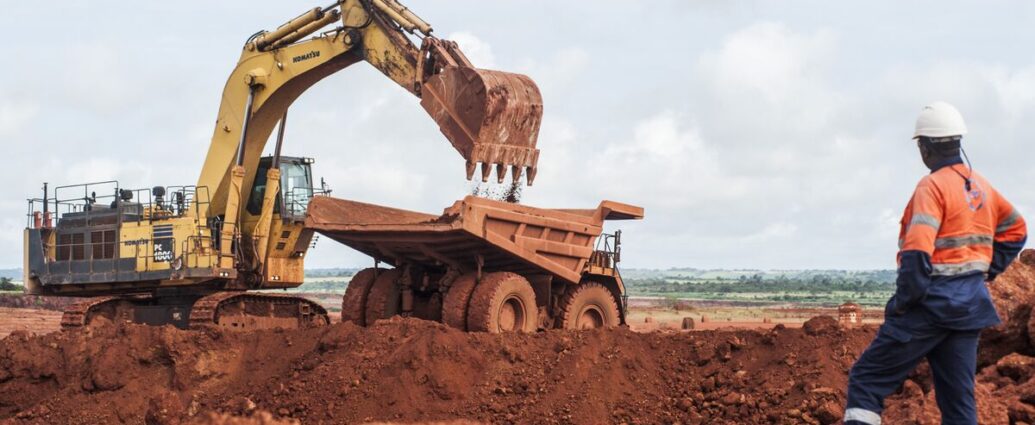
A US trade investigation into Chinese graphite anode materials ended this month without tariffs after the US International Trade Commission (ITC) ruled that imports from China were not harming the development of a domestic industry.In a final vote issued March 12, the commission determined that imports of graphite active anode material (AAM) from China “did not materially injure or threaten the establishment of the US domestic industry,” meaning the anti-dumping and countervailing duties identified by Commerce will not take effect.The ruling ends a trade dispute that began in December 2024 when the American Active Anode Material Producers coalition (AAAMP) filed a petition accusing Chinese suppliers of selling graphite anodes at unfairly low prices and benefiting from state subsidies.The decision halts duties that had been proposed by the US Department of Commerce earlier this year and removes the threat of tariffs that could have exceeded 160 percent on some Chinese graphite imports.Graphite anodes are a key component in lithium-ion batteries used in electric vehicles and energy storage systems. The material is the largest component in the anode of lithium-ion batteries by weight and is considered essential to the growing global battery industry.

​Trade investigation timeline
In January 2025, the Department of Commerce launched anti-dumping and countervailing duty investigations into imports of graphite active anode material from China. Preliminary findings later that year concluded that Chinese producers had received subsidies and were selling the materials at unfair prices.In May 2025, Commerce issued preliminary countervailing duties ranging from 712.03 percent to 721.03 percent for certain companies, with a separate rate of 6.55 percent applied to other exporters.Two months later, Commerce imposed preliminary anti-dumping duties of 93.50 percent on individually examined companies and 102.72 percent on other Chinese exporters.The department confirmed those findings in its final determination on February 11, 2026.Under the final Commerce ruling, anti-dumping duties remained unchanged at 93.50 percent for investigated companies and 102.72 percent for other exporters. Countervailing duties were set at roughly 66.82 percent to 66.86 percent.Combined, the measures would have resulted in tariffs of roughly 160 percent on certain imports and nearly 170 percent for other exporters.

​Industry reactions
Domestic producers seeking trade protection expressed disappointment with the outcome.“This outcome is disappointing for domestic producers who were seeking trade relief in order to create a more level playing field with their Chinese competitors,” said AAAMP spokesperson Erik Olson in a recent statement.Olson added that the investigation demonstrated the influence of Chinese subsidies on the global graphite market.“The evidence produced during the investigation made one thing clear: China’s graphite industry is heavily subsidized and capable of manipulating global markets in ways that make it extraordinarily difficult for domestic producers to compete. That cannot be argued.”Northern Graphite (TSXV:NGC,OTCQB:NGPHF), a Canadian graphite producer involved in efforts to build a Western battery materials supply chain, also reacted to the ruling.“While we are disappointed by the outcome of this case, it is important to recognize that the development of a Western graphite industry is being supported by a range of policy initiatives and industry investments,” said CEO Hugues Jacquemin.Graphite is considered one of the most important battery materials because of its role in lithium-ion anodes. Each electric vehicle battery typically contains significant quantities of graphite in both natural and synthetic forms.Despite its importance, the US currently relies heavily on imports for graphite supply.According to the US Geological Survey, the country does not mine natural graphite domestically and has historically relied entirely on imports to meet demand.

Don’t forget to follow us @INN_Resource for real-time updates!Securities Disclosure: I, Giann Liguid, hold no direct investment interest in any company mentioned in this article.

This post was originally published here
Bitcoin (CRYPTO: BTC) could bottom between $50,000 and $60,000 before rallying to $100,000 by year-end, according to major institutional strategists.

The $50,000-$60,000 Bottom Call

Jeff Kendrick, global head of digital asset research at Standard Chartered, says any dip below $60,000 is a buying opportunity with $50,000 as a potential target. 

“I could see us back to $100,000 by the end of this year,” Kendrick said, targeting mid-to-late May as when risk assets might base.

“Everything internally is improving but the price of the stock is going down,” Kendrick added, comparing crypto’s current state to Jeff Bezos describing Amazon in the late 1990s. 

The underlying infrastructure in crypto is performing well, including on-chain borrowing and lending protocols like Aave.

Bitcoin printed a fresh all-time high on October 6, 2025, then collapsed following Trump’s tariff tweet. 

Tech stock weakness drove the plunge to $60,000 two weeks ago, pushing crypto to trade like a weaker version of tech stocks rather …

Full story available on Benzinga.com

This post was originally published here

Union leaders representing Transportation Security Administration (TSA) workers in Atlanta called on lawmakers Monday to end the Department of Homeland Security (DHS) shutdown, saying the stalemate has crippled its members financially as they continue to work without being paid. 

Aaron Barker, the president of AMG local 554, said the union’s members are financially exhausted as they face a range of fiscal difficulties amid a standoff between lawmakers in Washington over DHS funding on the heels of their first missed full paycheck.

“Unlike other federal agencies such as ICE and CBP, TSA employees are working without pay,” Barker said at Hartsfield-Jackson Atlanta International Airport. “Many are coping with eviction notices. Vehicle repossessions, empty refrigerators and overdrawn bank accounts.”

“Every available financial option has been exhausted, yet these officers are still coming to work to protect the traveling public, facing disciplinary action if they do not show up to work,” he added.

HOW MUCH DO GOVERNMENT SHUTDOWNS COST AMERICAN TAXPAYERS?

About 300 TSA agents have quit, Transportation Secretary Sean Duffy said Sunday, and call-outs have doubled.

Duffy has blamed Democrats for the funding standoff, amid a debate over proposed reforms to U.S. Immigration and Customs Enforcement (ICE), which many Republicans oppose. 

DHS has been partially shut down for more than 30 days as Republicans hold out for a budget proposal that fully funds all parts of the agency. Democrats have said they’re willing to fund individual branches within the department, including TSA, but not Immigration and Customs Enforcement (ICE) or Customs and Border Protection (CBP) until the Trump administration agrees to immigration reform.

Meanwhile, Barker said, TSA personnel are bearing the burden of the standoff. 

TRAVEL EXPERT WARNS AMERICANS TO ‘BOOK NOW’ AS OIL PRICES THREATEN HIGHER AIRFARES

“I’ve heard from officers who cannot afford co-payments for cancer treatments or office visits for their sick children,” he said. 

“Requiring employees to work without pay is unconstitutional, and the financial consequences of this shutdown — damaged credit, missed payments and lost housing — will remain ever after the government reopens,” he added. “This is not a partisan issue. TSA employees did not cause this shutdown, yet they are bearing the burden of congressional inaction.”

A DHS spokesperson told FOX Business that 100,000 DHS workers did not receive their first full paycheck last week, amounting to $1 billion in unpaid wages each month.

“American travelers across the country are facing hours-long airport lines, that will worsen as this shutdown continues,” the spokesperson said. “Democrats are shamelessly playing politics with national security, punishing hardworking TSA workers and their families.”

CLICK HERE TO GET FOX BUSINESS ON THE GO

Barker said essential public services shouldn’t be used as leverage in political disputes, especially while members of Congress continue to receive their own paychecks. He said TSA officers have resorted to finding other ways to make ends meet, such as ridesharing.

“To be quite frank, officers are pissed off. And we’re not just talking about here in Atlanta,” said Barker. “We’re talking about nationwide. The officers are pissed off. They want this to end. They’re ready to get back to their some some normalcy or some consistency within their lives.”

FOX Business’ Max Becall contributed to this report. 

This post was originally published here. 

Donald Trump has spent the better part of 40 years mastering a single, ruthless skill: making other people absorb his losses. He perfected it in Atlantic City, where, as Fortune‘s Shawn Tully reported, his casino empire lost a total of $1.1 billion, twice declared bankruptcy, and wrote down or restructured $1.8 billion in debt, as Trump paid himself roughly $82 million.

Trump also refined his methods in bankruptcy courts over the decades, filing for Chapter 11 protection six times across his business empire and walking away from each implosion with his name still on the marquee. He brought the same instinct to international diplomacy—renegotiating NATO funding commitments, tearing up the original Iran nuclear deal, brandishing tariffs until trading partners blinked. The playbook never changed: manufacture chaos, make everyone else desperate for a way out, then collect.

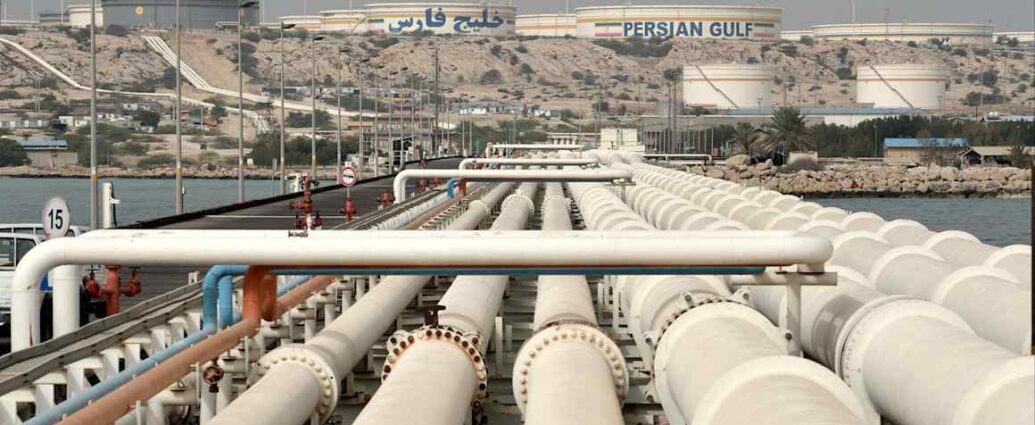
Now, on the third week of an active shooting war with Iran, Trump has run headlong into something his entire operating philosophy was never designed to handle: a 21-mile-wide chokepoint at the mouth of the Persian Gulf that has no CEO to bully, no bondholder to threaten, and no shareholders to absorb the loss. The Strait of Hormuz carries roughly 20% to 25% of the world’s oil supply every single day. It cannot be restructured. It cannot be taken into bankruptcy. And right now, it is effectively closed.

The Deal That Fell Apart

The story begins, as so many Trump stories do, with a negotiation that went sideways. Through late February, Trump’s envoys conducted round after round of indirect nuclear talks with Iran in Geneva and Vienna, demanding that Tehran renounce uranium enrichment entirely. Trump told reporters he was “not happy” with Iran’s posture and that Iranian diplomats were not willing to go far enough. The familiar script seemed to be playing out—maximum pressure, strategic ambiguity, a deal dangled and then yanked back until the other side folded.​

But Iran, unlike Atlantic City bondholders, held a card Trump hadn’t fully priced in. When Trump launched a widely anticipated, yet still seemingly under-rehearsed attack on Iran, alongside Israel, Iranian forces began mining the strait, firing anti-ship missiles at commercial tankers, and deploying drones against vessels traversing the narrow waterway. U.S. Central Command sank 16 Iranian mine-laying vessels in an attempt to clear the passage. It wasn’t enough. Shipping activity through the strait ground nearly to a halt. As of Monday, Iran said traffic was going through the strait—just not for any U.S. allies.

When the Numbers Turn

The economic bill arrived faster than almost any analyst predicted. The International Energy Agency announced an emergency release of 400 million barrels from strategic reserves—a measure rarely deployed—as the conflict severed roughly 8 million barrels per day from global supply. Goldman Sachs revised its 2026 inflation forecast upward by 0.8 percentage points to 2.9% and slashed GDP growth projections by 0.3 points to 2.2%. In a worst-case scenario—a full month of disruption with crude averaging $110 a barrel—Goldman put recession probability at 25%.

For a president who built his second term on the explicit promise of lower prices and economic supremacy, the numbers were damning. The administration had tried diplomatic pressure, strategic reserve releases, and back-channel appeals to OPEC allies. None of it moved the needle. “The U.S. is running out of ways to get oil prices down,” CNBC concluded. “It is up to the military.” In Trump’s world, when a deal goes bad, you find a new counterparty. The global energy market doesn’t work that way.​

Make Someone Else Pay

Confronted with an adversary immune to his usual leverage, Trump defaulted to the strategy he knows best: offload the cost onto someone else. On March 15, Trump told reporters he had “demanded” that roughly seven countries join a coalition to police the waterway, warning that any nation that refused would face a “bad future” with the United States.

It was a classic Trump move—the transactional ultimatum, the threat wrapped in a favor. But the response was a portrait of the limits of his brand of coercion. NATO allies rejected the demand outright. China, which continues importing Iranian oil, reacted with studied indifference. Trump suggested he might cancel a summit with Beijing over it; Beijing did not appear alarmed. The dealmaker had issued his terms. The world declined to countersign.

The Adversary That Won’t Blink

On Friday and Saturday, U.S. forces executed strikes on Iran’s Kharg Island—the hub for roughly 90% of Iranian oil exports—hitting 90 military targets in what Trump called one of the largest operations in the history of the Middle East. And yet, he conceded, Tehran could still launch a drone or use mines and missiles in the waterway. The strait remained dangerous. Tankers stayed away.

Foreign policy analyst Matthew Kroenig put it plainly, telling NPR: “As long as Iran has drones and missiles and continues to fire them, I think many commercial shippers are going to think it’s just too dangerous even with an escort to pass through the strait”. Even after any ceasefire, uncleared mines could keep insurers—and thus tankers—away for months. You can’t renegotiate your way past an unswept mine.​

Trump said he wasn’t ready to make a deal because “the terms aren’t good enough“. In a boardroom, that’s leverage. In the Strait of Hormuz, it’s something closer to a confession. The Art of the Deal was always premised on the other side wanting something badly enough to eventually fold. The strait wants nothing. It simply is — narrow, contested, and utterly indifferent to the brand of the man trying to reopen it.​

For four decades, Trump found someone else to hold the bag when his bets went bad. Standing at the edge of the Persian Gulf, with oil markets convulsing, allies shrugging, and Iranian drones still buzzing over shipping lanes, he is learning what every creditor, contractor, and counterpart he ever stiffed already knew: eventually, the deal comes due.

This story was originally featured on Fortune.com

Effective closure of strait of Hormuz also affecting Bangladesh, India and Pakistan, which have brought in crisis measures

Sri Lanka is introducing a shorter four-day working week to preserve its shrinking fuel and gas reserves, as the Middle East conflict continues to severely disrupt energy supplies in the region.

Countries across south Asia are facing crippling shortages of fuel and LPG gas, which are used for everything from home cooking to cremating bodies, as most supplies have been held up in the Gulf since the US and Israel began bombing Iran.

Continue reading…

This post was originally published here

There is a new trend in prediction markets: betting on whether Bitcoin will go up or down in the next five of fifteen minutes. On Polymarket, a five-minute wager on the price of the largest cryptocurrency has garnered more than $60 million in trading volume in a single day, according to Dune Analytics.

The minute-by-minute wagers on Bitcoin highlight the relative simplicity of bets on prediction markets. As opposed to traditional sports betting, which have an array of complex numbers relating to the spread, moneyline, and total points scored, the prediction market interface has a lower barrier to entry. Users can see what percentage of their peers are voting “yes” about a certain wager and how many are voting “no”. 

On Monday at 1pm ET, some 73% of Polymarket were betting that the price of Bitcoin would go up in the next five minutes. After that five minute interval expired at 1:05 PM ET, the platform promptly served up a new wager for the next five minutes of Bitcoin’s performance and so on. Polymarket-rival, Kalshi, meanwhile is offering bets on whether Bitcoin will go up or down every fifteen minutes. About 37% of users predicted the price would go up between 1:00 PM ET and 1:15 PM ET, but of course that percentage is constantly changing as more people join the betting pool, or close out their existing positions.

These quick-hit bets reinforce how, on prediction market platforms, users can bet on practically anything. People can put money on whether the U.S. will confirm that aliens exist before 2027, which already has seen about $12 million in transaction volume, or whether Jesus Christ will return this year, which is at $45 million in transaction volume. 

Sports are the most popular category to wager on in prediction markets, as they comprise roughly 90% of the bets on Kalshi. Betting on culture has become increasingly popular. Over $120 million was placed on bets about last night’s Oscars on Polymarket and Kalshi, according to Forbes. 

Prediction markets started to receive mainstream attention during the 2024 presidential election, when they correctly predicted Donald Trump’s victory, contrary to many national polls. The two leading platforms, Kalshi and Polymarket, are looking to raise money at a $20 billion valuation, according to The Wall Street Journal. 

This story was originally featured on Fortune.com


Benjamin Netanyahu posted a video to X on Sunday picking up a coffee order to debunk an Iranian conspiracy theory claiming he had been killed in a strike.

The rumor, pushed by Iran’s Tasnim News Agency, included claims that a previous video of the Israeli prime minister was AI-generated because it allegedly showed him with six fingers.

Meanwhile on Polymarket, a single account called “dududududu22” is sitting on $151,000 in positions betting Netanyahu will be “out” before the end of this month.

His position, nearly 3.8 million shares bought at 4.7 cents, is currently underwater by about $26,000.

If he’s correct his position would be worth $3.8 million.

In a troll of the Iranian rumors, Netanyahu’s coffee shop video featured a linguistic Easter egg. When ordering his drink, …

Full story available on Benzinga.com

This post was originally published here

Peter Thiel is taking his ecclesiastical and cultural warnings about the Antichrist on the road. His latest stop? The seat of the Catholic Church.

Over the past year, Thiel, the billionaire venture capitalist, has issued some of the most exclusive invites Silicon Valley visionaries could aspire to receive. The Palantir and PayPal co-founder has hosted a series of lectures around the world dedicated to discussing his own views on the biblical Antichrist, and how it relates to the modern-day discussion of technological risk.

Thiel has spoken about his theories publicly—most notably during a New York Times podcast interview last year—but his deepest musings have been reserved for private sessions with selective audiences in San Francisco and Paris over the past few months. On Sunday, Thiel began hosting the latest edition, a planned four-day lecture series in Rome, first reported last week by the Associated Press.

Theory of the end-times

The contents of Thiel’s sessions are private, but likely to follow a similar format to his previous lectures. In Thiel’s telling, the biblical Antichrist figure prophesied to oppose Jesus Christ to bring on the apocalypse might emerge in the form of a reassuring actor who exerts control by promising safety and an end to the “existential risk” of technological development. It’s a theological interpretation that has turned heads among Silicon Valley elites, and caught Thiel in the crosshairs of both the Italian government and the Holy See.

In Thiel’s framing, the Antichrist is not an outwardly malevolent figure, but rather a comforting administrator, one that promises tighter control of innovation to stamp out the risk of runaway technology—particularly artificial intelligence—replacing humanity. This positioning is a farce, in Thiel’s telling, as the Antichrist is in reality quietly consolidating power and control over society. He has criticized groups wary of technological progress, including AI skeptics and environmentalists such as Greta Thunberg, for being pawns of the Antichrist. 

Thiel’s vision paints Silicon Valley technologists not only as architects of humanity’s future, but as protectors of civilization, often grounding his arguments in his Christian beliefs. His argument blends theological language with Silicon Valley’s anxieties over AI, transhumanism, and decay of meaning, and has been greeted with muted praise by some tech figures, such as fellow Palantir co-founder Joe Lonsdale.

Thiel’s frosty Italian greeting

Thiel’s theory has plenty of skeptics too, and it’s not just AI doomers and climate activists. Ahead of his arrival in Rome, government officials and authorities in the Church pushed back against his theological stance.

“Thiel is above all a political theologian operating at the very heart of the Silicon Valley ecosystem,” Paolo Benanti, a priest who has advised two papacies on matters related to technology ethics and artificial intelligence, wrote in an essay published Saturday, adding that Thiel’s theories are best understood as a “radicalization” of Western values including individuality, technological progress, and the spirit of competition.

“Peter Thiel does not believe humanity can be redeemed,” read an article published last week in Avvenire, a newspaper owned by a conference of Italian bishops. It argued that Thiel’s vision favors replacing democracy and the right of law with an elite “superplutocracy” that would “monitor and protect humanity from the arrival of the Antichrist.” The article additionally claims Thiel’s description of the Antichrist applies to “anyone who places limits on unlimited progress.”

The Catholic Church has taken a more assertive stance on technological advancement in recent years, particularly when it comes to AI. Moral regulation of AI was frequently mentioned by the late Pope Francis. Leo XIV, his incumbent successor, similarly urged audiences during a speech last December to “pause and reflect” on how AI might impact children, and how the technology could be guided to serve the “common good.” 

Thiel’s event in Rome was organized in partnership with the Cluny Institute, an organization housed within the Catholic University of America, and the Vincenzo Gioberti Cultural Association, according to the AP. Neither replied to Fortune’s request for comment. 

In a press release last week announcing Thiel’s event in Rome, the association, which has ties to Italy’s far-right, warned of “more or less hidden” forces that were “bent on destroying what remains of the West.” The association praised Thiel for having the “courage and intellectual liberty” to discuss these dangers.

But those same themes have provoked skepticism and even hostility among some Italian politicians for more grounded reasons. During a parliamentary session this month, lawmakers criticized Thiel’s “scandalous ideas,” arguing that they verged on ideological extremism while calling for more transparency on the relationship between the Italian government and Palantir, the defense technology firm Thiel co-founded and currently acts as chairman for. 

Outside parliament, Thiel’s supporters frame his warnings as a defense of Western spiritual identity amid mounting technological disruption. In Italy’s polarized political climate, however, his Antichrist theory has become as much a political flashpoint as a philosophical one.

This story was originally featured on Fortune.com


nLIGHT Inc. (NASDAQ:LASR) shares surged on Monday. The stock hit a new 52-week high of approximately $69.54.

The catalyst was a 60 Minutes segment aired Sunday night that highlighted laser weapons as a low-cost solution to Iran’s cheap drone threat.

Investor Flags nLIGHT As Key Supplier To Featured Laser System

Individual investor Marc Lehman posted on X Monday, highlighting a connection between nLIGHT and AeroVironment, noting that nLIGHT supplies technology for the AeroVironment Locust system featured in the recent 60 Minutes segment. The post drew over 21,000 impressions.

AeroVironment Inc. (NASDAQ:AVAV) manufactures the Locust laser system. The segment featured AeroVironment CEO Wahid Nawabi explaining the technology’s appeal.

“It changes the economics on how we …

Full story available on Benzinga.com

This post was originally published here
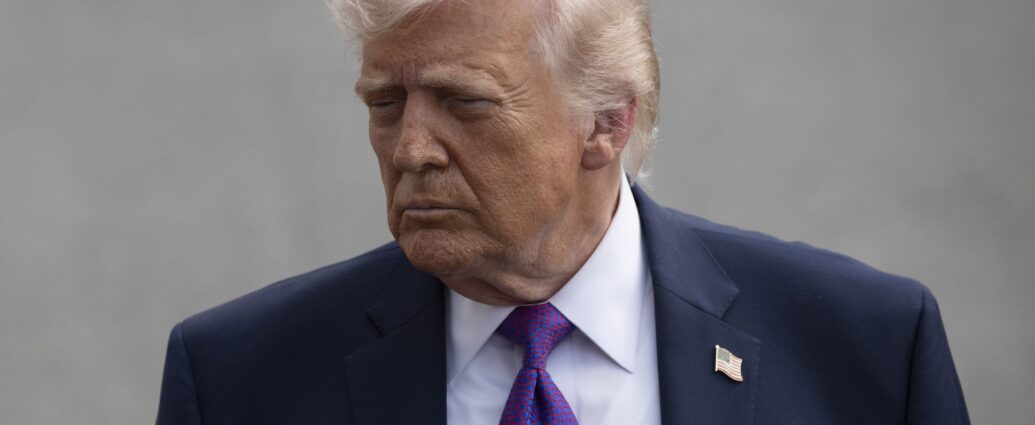
Geopolitical tensions and tightening liquidity could trigger a major sell-off across equities and cryptocurrencies, according to Bloomberg Intelligence senior macro strategist Mike McGlone.

Bitcoin Could Revert Toward Long-Term Mean

McGlone warned in an interview with Cointelegraph on Saturday that escalating tensions between U.S. and Iran could pressure global risk assets.

He predicts U.S. equities could decline by as much as 50%, a scenario that would likely pull crypto markets lower as well.

The Bloomberg Galaxy Crypto Index has already fallen more than 50% from its peak, highlighting weakening momentum across digital assets.

Because cryptocurrencies, such as Bitcoin (CRYPTO: BTC) and Ethereum (CRYPTO: ETH) …

Full story available on Benzinga.com

This post was originally published here

Honda announced a $15.7 billion writedown of its electric vehicle (EV) business last week as the company shifts its U.S. strategy to account for weak consumer demand for EVs.

The second-largest automaker in Japan said Thursday that it will restructure its EV business and cancel three planned battery-powered EV models that were going to be built and sold in the U.S. market.

Demand for EVs has pulled back in recent years as consumers have shown a preference for hybrid vehicles, while President Donald Trump’s administration has pulled back tax credits that helped incentivize EV purchases.

Honda’s move to pull back on its EV plans, as well as to write down the value of some of its operations in China, may cost as much as $15.7 billion, while the company also said it will report its first annual loss in nearly 70 years. The company’s cash outflows stemming from the writedowns will largely be due to the cost of compensating suppliers.

FORD CEO SAYS ‘CUSTOMER HAS SPOKEN’ AFTER EV SHIFT DRIVES MAJOR QUARTERLY LOSS

Honda first unveiled two concept models for its “Honda 0 Series,” including the Saloon sedan, at the CES trade show in Las Vegas in January 2024, and it had expected to roll out the series’ first vehicles this year, starting in North America.

Those plans have now been called off, with Honda canceling the Saloon along with the Honda 0 SUV and the Acura RSX.

Honda will now pivot its U.S. focus to hybrid vehicles and will also look to strengthen lineup and cost competitiveness in India.

ASTON MARTIN TO CUT UP TO 20% OF ITS WORKFORCE

The company also said that it has struggled to compete with newer companies in China that are focused more on short development cycles and software technologies, like advanced driver-assistance systems (ADAS).

“In such a difficult competitive environment, Honda was unable to deliver products that offer value for money better than that of newer EV manufacturers, resulting in a decline in competitiveness,” the company said.

Battery-powered cars accounted for 2.5% of Honda’s 3.4 million global sales last year, or about 84,000 vehicles. 

LAMBORGHINI SCRAPS FIRST EV LAUNCH, CALLS DEVELOPMENT ‘EXPENSIVE HOBBY’

China is the world’s largest auto market and Honda introduced several battery-powered models in the market, but it only sold 17,000 last year, which accounted for just 2.5% of its sales of around 677,000 vehicles in the country and just a fifth of its total EV sales.

Honda said that its initiatives around future EV model introductions will be implemented with flexibility from a long-term perspective while “monitoring the balance between profitability and market trends.”

GET FOX BUSINESS ON THE GO BY CLICKING HERE

The company also said it will announce details related to the reestablishment of its mid- to long-term strategy for its auto business at a press conference in May.

Reuters contributed to this report.

This post was originally published here. 


Pepe (CRYPTO: PEPE) surged 17% Monday, leading memecoin gainers and outpacing Dogecoin’s (CRYPTO: DOGE) 4% rally as trading volume exploded 520% to $1.73 billion.

The Derivatives Setup

Open interest on PEPE futures climbed 11.56% to $228.54 million while 24-hour trading volume exploded 520.51% to $1.73 billion, signaling fresh money entering rather than just short covering. 

Liquidation data showed $98,000 in short liquidations over four hours versus $327,000 in longs, suggesting the rally caught a significant portion of the short side offside while skeptics remained.

PEPE had been more aggressively sold than Dogecoin, setting up a cleaner derivatives squeeze when the macro tailwind arrived. The volume wave dwarfed PEPE’s 30-day average of 1.23 trillion tokens.

The Technical Picture

This post was originally published here
(RTTNews) – After soaring over the past three sessions, crude oil has plunged on Monday as traders resort to profit-taking while the blockade of the Strait of Hormuz showed mild signs of easing.

This post was originally published here
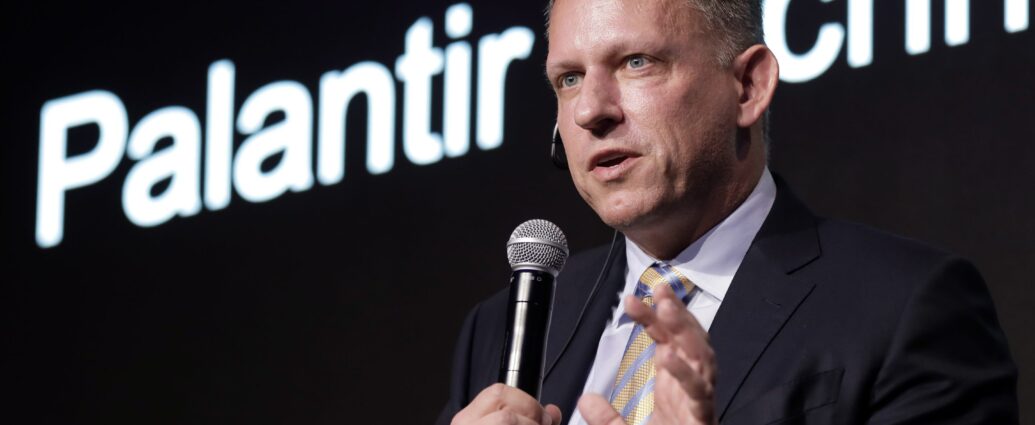

The Canada Pension Plan Investment Board (CPPIB) is reportedly planning to sell approximately $1.5 billion worth of its Asia-focused private equity holdings. 

The assets for sale include stakes in funds managed by Hillhouse Investment, Bain Capital and PAG, sources told Bloomberg. 

CPPIB allocated around $1 billion to Asia-focused strategies managed by these firms between 2014 and 2016, according to information on its website.

The process is understood to be ongoing and plans are subject to change.

The planned sale is part of an effort to reduce the pension fund’s exposure to private equity investments in Asia.

In January, CPP’s global head of private equity …

Full story available on Benzinga.com

This post was originally published here

Nvidia Corporation (NASDAQ:NVDA) has used its GTC conference to unveil some of the major architecture shifts of the AI era, and this year Jensen Huang has teased “chips the world has never seen before.”

Looking at the Kalshi prediction market provides insight into what specific words Huang will use during the two-hour keynote.

What The Market Expects

“Blackwell” and “Data Center” are both at 98%. Nvidia’s current-gen architecture and its core revenue driver are guaranteed talking points.

“Trillion” at 89%. Huang wrote in a blog post that AI infrastructure spending could eventually reach the trillions. If he repeats that framing onstage, he’s telling the market that Nvidia’s total addressable market is still expanding.

“Cosmos” at 81%, down 9 percentage points.

Cosmos is Nvidia’s world foundation model platform for physical AI, powering everything from autonomous vehicle simulation to robotic manipulation.

A 9-point drop suggests traders are less certain Huang prioritizes it in a keynote that may be dominated by chip announcements.

“Photon / Photonics” at 87% points to one of Nvidia’s biggest …

Full story available on Benzinga.com

This post was originally published here
Patrick De Haan, head of petroleum analysis at GasBuddy, is warning drivers that national gasoline prices could reach $3.80–$3.85 per gallon. He says $4 per gallon remains possible but is not imminent. Diesel could climb to $5.05–$5.15 per gallon.

De Haan made the forecast in a series of posts on X (formerly Twitter) on Monday.

National Average Hits Highest Level Since October 2023

GasBuddy data shows the national average gasoline price has already reached $3.70 per gallon. That is the highest level since Oct. 6, 2023.

The national average has risen 23.2 cents over the past week and 80.0 cents from a month ago. It stands 66.1 cents higher than a year ago, De Haan wrote on Substack.

“Americans today will spend $307 million more on gasoline than a month ago,” De Haan posted on X.

The national average diesel price now stands at $4.951 per gallon, up 34.0 cents in the last week. Diesel is approaching the $5 per gallon mark nationally.

Midwest Price Hikes Push …

Full story available on Benzinga.com

This post was originally published here

Forty-two percent of Americans now believe they will carry credit card debt for the rest of their lives. 

Gloomy outlook aside, that is a reflection of how hard it is to escape balances when rates hover near 24% and budgets are already tight. For borrowers in that position, more are starting to look at ways to replace high‑rate card debt with a lower‑rate personal loan they can actually pay down instead of carrying it indefinitely.

According to a survey issued by WalletHub, total credit card balances in the U.S. are now over $1.3 trillion, and the average person carries roughly $11,000 in card debt. More than 1 in 5 Americans say they are “very stressed” about that debt, and a majority say it feels less like a temporary setback and more like a long‑term burden. 

Many also feel the system does not give them many good options, especially when minimum payments barely move the needle.

The engine behind that feeling is the annual percentage rate, or APR. A 24% APR is close to the current average credit card rate, which works out to about 2% interest per month. On an $10,990 balance, that’s roughly $220 in interest in the first month alone.

If you only make the minimum payment, which many issuers set around 2% to 3% of the balance, most of that initial payment goes to interest, not principal. Pay $250, and about $220 covers interest while only $30 reduces what you owe. With that pattern, it can take decades to become debt‑free, and any new charges push the finish line further away.

To see how the math plays out, consider …

Full story available on Benzinga.com

This post was originally published here

Candidates look for deals with rivals to boost chances as major seats including Paris, Marseille and Lyon appear tight

Political parties in France are hastily attempting to negotiate strategic alliances before the final round of local elections this weekend, after a strong showing by the far right and the radical left.

This Sunday’s final-round vote for mayors and local councillors in major cities including Marseille, Lyon and Paris is expected to be close.

Continue reading…

This post was originally published here
More than two weeks into a war President Donald Trump started without asking allies for buy-in, he is now asking for backup, and mostly getting left on read.

Trump spent the weekend demanding that allies, China, and other Asia-Pacific nations send warships to help reopen the Strait of Hormuz, the chokepoint through which a fifth of the world’s oil normally flows. He even warned Sunday that NATO faces a “very bad future” if allies don’t step up, marking another threat just two months after he precipitated an existential crisis for the alliance over Greenland.

Since the U.S. and Iran launched strikes on Feb. 28, Iran has effectively shut the waterway and may have even begun laying mines. Over the weekend, the messaging around the Strait of Hormuz remained muddled: Tehran said that the Strait was “open to all” except America and its allies, while Treasury Secretary Scott Bessent claimed on CNBC Monday morning that it was the U.S. that “allowed” Iranian oil tankers to cross the strait. The price of U.S. oil lowered significantly on Bessent’ s comments, now under $95 a barrel. 

Despite the posturing, only a handful of ships have crossed the Hormuz over the last few days. And the response from the international community to Trump’s calls has varied from a polite silence to outright refusal. 

Germany was very blunt. 

“This war has nothing to do with NATO. It is not NATO’s war,” a spokesperson for Chancellor Friedrich Merz said Monday, adding that Berlin had “not considered” participating before the war began and will not be considering it now. 

Luxembourg’s Deputy Prime Minister Xavier Bettel also laid it on thick, saying that the NATO member is happy to help with satellites and communications but “Blackmail is also not what I wish for.” 

EU foreign policy chief Kaja Kallas said the request falls “out of NATO’s area of action”: a reference to Article 6 of the North Atlantic Treaty, which limits the alliance’s mutual defense obligations to the region north of the Tropic of Cancer.

Still, European officials have their own incentive to keep Hormuz open and fear what Trump may do. Not only does Europe rely on Gulf oil supplies, there’s concern Trump will declare victory in Iran in the coming weeks, pull out of the war, and leave them holding the minesweeper (France and the Netherlands historically have some of world’s best minehunting/sweeping technologies). 

British Prime Minister Keir Starmer offered the warmest language of any leader Monday, saying the UK is “working with allies, including our European partners, to bring together a viable collective plan” to restore navigation, but still committed no ships or timeline. Starmer also defended his refusal to join the offensive, saying he wouldn’t send British forces into a war “without a plan to get us out.”

In Asia, the response has been equally noncommittal. China’s foreign ministry sidestepped questions about sending ships, while Japanese Prime Minister Sanae Takaichi, who visits the White House Thursday, has offered no promise. Trump told the Financial Times he’d like to know Beijing’s position before a planned summit at the end of March—a trip Bessent acknowledged could be delayed, though he insisted any schedule change would reflect logistics as opposed to a rift.

Australia also ruled out sending naval vessels, but said last week it would send a surveillance aircraft to the Middle East. South Korea said it will note Trump’s requests but would be exploring “various measures from multiple angles.”

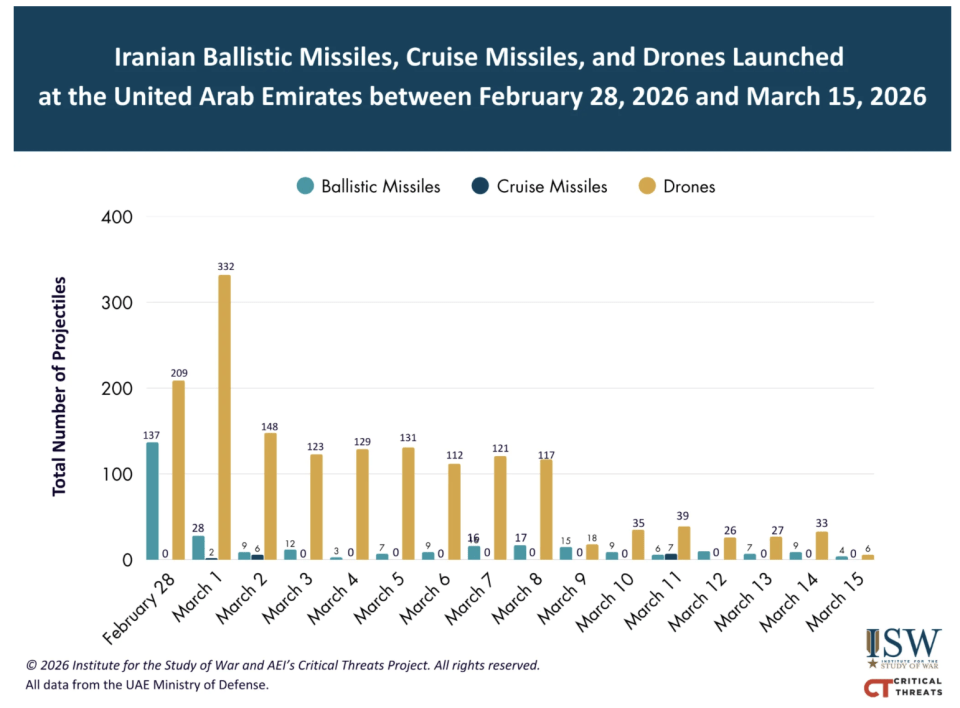
The one bright spot for Washington is that the UAE doubled down on U.S. ties, showing strength after absorbing nearly 2,000 Iranian projectiles. “We don’t take to being bullied around,” Reem Al-Hashimy, the UAE’s minister for international cooperation, told the ABC.

Meanwhile, the cost of inaction keeps climbing. Oil hit its highest level since July 2022 last week, and U.S. gas prices are already up 20% since the war started. The International Energy Agency called the disruption “the largest supply disruption in the history of the global oil market.” 

This story was originally featured on Fortune.com

(RTTNews) – Declining for the fourth consecutive session, gold prices slumped on Monday amid a rebound in U.S. stocks and cooling in oil prices due to profit-taking even as the gulf war continues with full intensity.

This post was originally published here

Bitcoin (CRYPTO: BTC) has cracked $73,000 but remains trapped within a broader range, leaving traders divided on whether the next major move will be higher or lower.

BTC Remains Stuck

According to prominent analyst Trader Mayne, Bitcoin is currently “diddling in the middle” of its range after sweeping liquidity at the lows and bouncing back toward the midpoint.

The key level to watch is $70,000, which roughly aligns with Monday’s high. If Bitcoin holds this level and reclaims the range high, momentum could build for a potential push toward $80,000.

However, the setup remains uncertain. …

Full story available on Benzinga.com

This post was originally published here
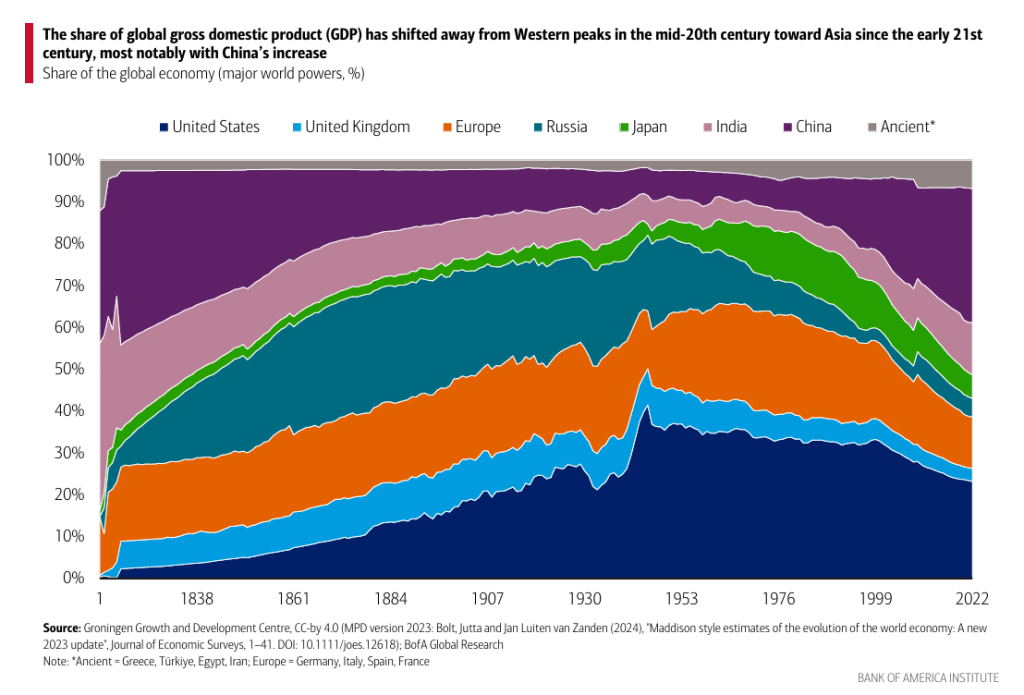
For roughly 1,800 years, the world’s largest economy sat somewhere along the Yangtze River. A new chart from the Bank of America Institute — spanning 2,000 years of global GDP data — shows that America’s moment at the top wasn’t destiny. It was an accident of history. And it’s ending.

The United States emerged from World War II as the undisputed economic superpower, accounting for nearly a third of global GDP at its postwar peak. Prophetically, in 1941, Fortune founder Henry Luce dubbed this era “the American century.”

The U.S. spent the better part of the 20th century treating its position at the top of the economic order as something close to a birthright. “American exceptionalism,” the idea that the country was fundamentally distinct from — and often superior to — other nations due to its unique founding principles, political institutions, historical development, and perceived moral mission in the world, dates back to the precolonial days and John Winthrop’s 1630 articulation of the country as a “city upon a hill.”

But in economic terms, America’s exceptional share of global GDP was a very real thing from the 1860s through the 1950s, as calculated by the Bank of America Institute, citing thousands of years of data from the Groningen Growth and Development Centre‘s Maddison Project database, one of the most comprehensive long-run economic datasets in existence.

This is a bit standard for the Dutch research center and its database based on the ideas of Angus Maddison, a pioneering economist who tracked GDP and living standards across centuries and countries, but if you look at the blue chunk of the chart, showing the U.S. shooting up over the centuries, you’d be forgiven for seeing the U.S. as quite exceptional.

The chart also shows, however, that there’s always been one other exceptional country. The chart plots the share of global GDP held by the world’s major powers from the year 1 AD through 2022. What it shows is both humbling and, for anyone paying attention to the current global moment, entirely unsurprising: the world’s economic center of gravity is shifting back toward where it spent most of recorded history. Back toward Asia. Back toward China.​

The long view

The chart’s most striking feature is not a line going up. It’s a line going down — and then, slowly, back up again.

For roughly the first 1,800 years of the Common Era, China and India together accounted for the dominant share of global economic output. The world was, by this measure, an Asian world. The chart supports the narrative in the epic global history of capitalism written by Harvard’s Sven Beckert, who told Fortune in January that his eight years of studying capitalism’s origins reinforced to him how “weak” and “marginal,” yet also truly global, the dominant way of organizing economic life used to be.

Beckert’s book highlights how ancient mercantile communities of capitalists emerged in the Middle East and Asia, for instance, with the Port of Aden, in Yemen, or Cambay, in modern Gujarat, India. Goods left Aden and traded across oceans as early as 1150, and Song-dynasty China invented paper money hundreds of years before Europe did.

When Europe Rose, and America Peaked

The Groningen data show clearly that Europe’s rise — led by the UK, Germany, Italy, France, and Spain — was a 19th-century phenomenon. The United States didn’t register meaningfully on the chart until the late 1800s, and didn’t achieve its peak dominance until the mid-20th century.​

That peak, visible as a bulging arc of American blue across the chart, coincided with a historically anomalous moment: a Europe devastated by two world wars, a China wracked by civil war and Maoist catastrophe, and an India still emerging from colonialism. In other words, the era of American exceptionalism was also, in large part, the era of everyone else’s misfortune.

“These transitions often followed major geopolitical or financial turning points,” BofA Institute noted in its report — a line that, in retrospect, reads less like historical observation and more like a warning.​

Meanwhile, over the weekend, Bridgewater founder Ray Dalio wrote in Fortune that the 2020s feel to him like a movie he’s seen before, with “the rise of a new type of world order” that he sees as “more like many pre-1945 world orders in which there were great powers conflicts and gunboat diplomacy-type geopolitical moves.”

dalio
Ray Dalio at the Fortune Global Forum in Riyadh, Saudi Arabia, October 2025.
Photograph by Iman Al-dabbagh/Fortune

Dalio’s Principles for Dealing With the Changing World Order described his theory of six cycles of successive breakdowns in financial cycles, with stage six being “a period of great disorder.” The last of these began in 1929 and ended in 1945 after World War II, he wrote, resulting in “clear winners, most importantly the United States, which determined how the new orders would work.”

What is implied, of course, is that the winners of this current period will determine how the next world order will work and who will benefit.

China’s correction

China’s share of the global economy — which had collapsed to negligible levels by the mid-20th century — surged back in the early 21st century, more dramatically than that of any other nation on the chart. By 2024, China accounted for roughly 19.45% of global GDP, nearly triple its share in the year 2000, according to Statista. By 2030, the same data projects China’s share will reach 21.7%.​

China’s economy grew 5.0% in 2025, meeting the government’s official target and seizing a record share of global demand through an export boom. Meanwhile, Beijing’s newly unveiled 15th Five-Year Plan (2026–2030) is explicitly targeting the integration of artificial intelligence into the country’s manufacturing base — betting that the same factory floor dominance that powered China’s rise in global trade will now power its rise in the AI economy. China wants its digital economy to account for 12.5% of GDP by 2030, up from 10.5% in 2025. The plan includes dozens of major infrastructure and industrial projects, national 5G upgrades, and a push to build sovereign AI compute capacity.

The exceptionalism trade falters

For the United States, the picture is more complicated. By nominal GDP, America remains the world’s largest economy — $30 trillion in 2024, with financial markets valued at $79 trillion. Goldman Sachs and JPMorgan have argued that U.S. dominance is structural and durable, citing America’s role as the world’s most innovative, diverse, and resilient economy.​

But the markets told a different story in early 2025. As the so-called “American exceptionalism trade” began to unravel into the “sell America trade,” the war in Iran paradoxically boosted U.S. assets. Still, the S&P 500 is down roughly 2.5% year-to-date, while the broader MSCI Global Index is up 0.8% and the dollar is up 1.76% year-to-date. ​

The structural pressures are real. U.S. GDP per capita — still above $85,000, compared to China’s $13,000 — reflects a prosperity gap that will take decades to close. But per capita GDP is not the same as geopolitical weight. China’s economy grows at 5.2% per year, while America expands at around 2.1%. At those trajectories, the gap in total economic mass narrows every year.​

What the chart really says

The BofA Institute’s report frames today’s shifts as part of a familiar pattern: “renewed focus on affordability, rapid advances in AI, and a broader shift from services back toward manufacturing”. Those three forces — cost deflation, AI disruption, and the reindustrialization of the global economy — all tilt, at least at the margin, toward China’s strengths rather than America’s.​

What the chart ultimately shows is not that American exceptionalism was a myth. It’s that it was a moment — a historically contingent window, opened by catastrophe elsewhere and now gradually closing as the rest of the world heals, industrializes, and competes. For 2,000 years before the American century, the world’s largest economy sat somewhere along the Yangtze River. The line on the chart that shows China’s share plummeting to near-zero and now racing back upward is not a story about China catching up.

It’s a story about the world returning to normal.

This story was originally featured on Fortune.com

Oil broke above $100 a barrel this month for the first time since 2022. The war in Iran has disrupted the Strait of Hormuz, gasoline prices are surging, and the S&P 500 just posted its first three-week losing streak in about a year. As panic sets in, observers wonder whether this is actually recessionary.

Fidelity Investments says not yet — and unlike most Wall Street commentary that deals in vague reassurances, Fidelity put a specific number on it. The number is $135.

In recent market commentary, Fidelity’s director of quantitative market strategy Denise Chisholm and members of the firm’s Asset Allocation Research Team presented the math. 

At approximately $135 to $145 per barrel, American households would spend 5% or more of their income on energy — a threshold that has historically marked the point at which consumers cut back hard enough to drag down the broader economy.

At today’s prices, with Brent around $103 and WTI near $99, there’s a cushion of roughly $32 to $42 per barrel between an oil shock that feels scary and one that actually breaks something.

Why 5% Is The Line

Throughout modern economic history, consumer spending has been resilient to oil …

Full story available on Benzinga.com

This post was originally published here
Elon Musk said he is rebuilding xAI from the ground up just a month after SpaceX acquired his AI startup in one of the biggest mergers of all time.

Following a gradual exodus from xAI, the world’s richest man is trying to reimagine the company with heightened ambitions.

The Tesla and SpaceX CEO added in a post on X last week that xAI was undergoing a process similar to an earlier one at Tesla, which Musk has been CEO of since 2008.

“xAI was not built right first time around, so is being rebuilt from the foundations up,” he wrote in the post.

Musk said the purpose of the SpaceX acquisition is building “orbital data centers,” which he has said are the most cost-effective way of producing AI computing power.

Yet here on Earth, Musk is dealing with a seemingly less lofty, but all-too-important, staffing issue. A pair of xAI cofounders left the company last week and two others bailed last month, Business Insider reported, meaning nine of the original 11 cofounders not named Musk have left the company since 2024. These most recent departures come after an exodus of about a dozen senior engineers.

The precipitous loss of talent has stalled the company’s biggest AI bet. “Macrohard,” its effort to build an AI agent capable of doing anything a white collar worker can do, has reportedly been put on “pause” in the past days as its leader, Toby Pohlen, left the company just weeks after being appointed to head the project.

While all the exits raise questions about the company’s future, Musk has downplayed the brain drain as part of a planned reorganization. Some employees are better suited for the early stage of a venture rather than the later stages, he said at an all-hands meeting last month, according to the New York Times.

Representatives for xAI did not immediately respond to a request for comment.

The xAI CEO is now looking to aggressively hire, albeit from an extremely limited pool of AI-focused workers. Already, the AI company has been able to poach two employees, Andrew Milich and Jason Ginsberg, from AI coding company Cursor, The Information reported.

These hires are key because of the potential growth in the coding tools market, which stood at $7.65 billion as of 2025 and is projected to grow to $22.2 billion by 2030. Cursor itself was valued at $29.3 billion after raising $2.3 billion in a funding round in November.

Despite this successful recruitment, Musk said he and a colleague are looking over rejected xAI applications to look for promising candidates.

“Many talented people over the past few years were declined an offer or even an interview @xAI. My apologies,” he wrote.

This story was originally featured on Fortune.com

XRP (CRYPTO: XRP) surged 3.5% as Teucrium CEO Sal Gilbertie said Ripple could become a top 20 global bank by capitalization at $3 per XRP or a top 10 bank at $6 if the company secures a banking license and holds 40 billion XRP on its balance sheet.

The Banking License Math

Gilbertie on Sunday explained Ripple’s potential path to becoming one of the world’s largest banks by capitalization. 

“There’s one of the leading theories that they just hold that on their balance sheet, they get their banking license, and they become a top 20 capitalized bank in the world,” Gilbertie said on the Coin Stories podcast.

“That’s with XRP at $3. XRP goes to some multiple of $3, they become a top 10 bank, or even the top bank in terms of capitalization,” he added.

The …

Full story available on Benzinga.com

This post was originally published here
Rivian Automotive Inc (NASDAQ:RIVN) shares are trending upward on Monday as investors weigh an analyst upgrade against the public debut of the R2 mid-size SUV.

Analyst Upgrade Sparks Rebound

The recent momentum follows a rating change from TD Cowen. Analyst Itay Michaeli upgraded Rivian to Buy from Hold. He also raised the price forecast to $20 from $17. Michaeli cited a favorable risk-reward profile after a 20% year-to-date decline.

Michaeli’s analysis suggests a massive scale for the new platform. Full-scale U.S. demand for the R2 could reach 212,000 to 335,000 units, the analyst noted. This projection sits significantly above prior market consensus.

The “Tesla Killer” Strategy

CEO RJ Scaringe has labeled the R2 …

Full story available on Benzinga.com

This post was originally published here

The war in Iran is pushing oil and gas prices higher, and while the world economy faces a shock from energy prices, an analysis by Goldman Sachs finds that the conflict is unlikely to lead to a broader supply chain crisis like what occurred due to the COVID-19 pandemic.

Economists at Goldman Sachs found that the Iran war is expected to lead to higher oil prices that will reduce global economic growth by 0.3% of GDP while increasing headline inflation by about 0.5 to 0.6 percentage points over the next year, with a smaller 0.1 to 0.2 percentage point boost to core inflation.

The report noted that risks are skewed toward larger impacts as long as the Strait of Hormuz remains closed to shipping. The Strait is a narrow chokepoint that shipping traffic from the Persian Gulf must pass through to access global sea lanes.

Goldman Sachs assessed that global central banks will be particularly sensitive to inflation concerns in the wake of the supply chain disruptions that occurred due to the pandemic and was a key contributor to a surge in inflation. However, the economists’ analysis sees the Iran war supply shock as being limited to energy as opposed to the broader supply chain.

ENERGY SECRETARY WRIGHT SAYS US COULD SOON ESCORT TANKERS IN STRAIT OF HORMUZ, BUT ‘NOT READY’ YET

“A key difference between 2021-2022 and today, however, is that today’s shock is more narrowly concentrated in the energy sector, whereas the energy price increases in 2022 were only one aspect of a much broader global supply chain crisis and inflation surge,” the Goldman Sachs economists wrote.

One of the reasons for the supply shock being confined to energy products is that most of the developed economies around the world have limited non-energy trade exposure to countries in the Middle East.

The report found that less than 1% of imports to the U.S. and other developed markets like the Eurozone, the U.K., Japan and Canada come from the Middle East. By comparison, China and East Asia account for more than 20% of global trade, Goldman’s analysis noted.

TRUMP SAYS US ‘LARGEST OIL PRODUCER IN THE WORLD,’ BUT PRIORITY REMAINS STOPPING IRAN NUCLEAR CAPABILITIES

Another contrast with the 2021-2022 supply chain disruptions is that fewer disruptions of critical inputs and “just in time” inventory management are anticipated, as the analysis found the Middle East’s potential bottleneck exports are focused on certain chemicals and metals that are unlikely to create significant disruptions.

Goldman Sachs said that methanol appears to be the most likely source of production disruptions, as it’s used in making acetic acid, which helps produce industrial adhesives, solvents and paints. 

Iran is the source of about 20% of global production capacity and while the loss of that supply could have an impact over the longer-term, the economists don’t see clear chokepoints at this time.

TRUMP ADMIN INVOKES DEFENSE PRODUCTION ACT, DIRECTS OIL COMPANY TO RESTART CALIFORNIA OPERATIONS

The third reason the firm sees limited supply chain impacts beyond the energy sector is that the Middle East isn’t a significant trade hub where products are re-exported from.

Vessels such as yachts, tugboats and floating cranes are the main goods that are re-exported from Middle Eastern countries.

“In summary, our analysis suggests that the major risk to global supply and inflation is mostly confined to energy, which limits the risk that the severe supply chain disruptions (and associated surge in inflation) and large second-round inflation effects observed in 2021-2022 will re-emerge,” the Goldman Sachs economists said.

GET FOX BUSINESS ON THE GO BY CLICKING HERE

This post was originally published here. 

The war in Iran has sparked a global energy crisis that has rocked markets and sent oil prices surging to their highest level in four years. The chances of a quick resolution appear to be deteriorating as the conflict escalates, as do hopes that the U.S. economy might escape unscathed.

The war has effectively blocked off the Strait of Hormuz, a vital energy corridor that links oil and gas producers in the Persian Gulf with the rest of the world. The closure has cut off the roughly 20 million barrels of oil that normally flow through the strait each day, according to the International Energy Agency. The IEA estimates the conflict is removing roughly eight million barrels daily from the global supply, making the crisis the biggest oil supply disruption in history. Oil prices have been on a rollercoaster as a result. Brent crude, an international benchmark that cost around $70 a barrel before the war, grazed $120 last week and has since settled between $90 and $100. 

The swings have already caused gasoline prices for U.S. drivers to rise, but it might not be enough to force the severe downturn some economists have warned of. Price levels so far might only have a marginal impact on economic output over the long run, according to a report published Friday by Oxford Economics, an advisory firm. 

But that scenario rides on a relatively quick return to pre-war price levels over the next few months. The longer the strait remains closed and the higher prices rise, the faster the economic situation around the world—including in the U.S.—deteriorates.

Breaking parts of the economy

Oxford Economics uses a standard rule of thumb to estimate the economic impact of pricier oil: Every time oil gets $10 more expensive for a sustained period—determined to be around two months—it amounts to a 0.1% decline in GDP due to higher inflation and slower growth. If prices average $100 for two months, it would erase a few tenths of a percentage point of global GDP growth, but a recession would likely be avoided, according to the report.

The breaking point for the economy, Oxford Economics found, will be if oil prices average around $140 a barrel for two months. At that price, spillover effects would be much harder to contain, and many parts of the world would be flirting with economic decline.

“There are mild contractions in the Eurozone, the UK, and Japan, while the U.S. nears a temporary standstill and layoffs push up the unemployment rate, leaving it close to a recession,” the report’s authors wrote.

The problem with calculating the economic consequences of higher oil prices is that the implications are exponential. The more prices rise, the more knock-on effects could happen to hurt the economy. Higher-for-longer oil and transportation costs would begin to spill over into food and other goods, making inflation an across-the-board problem rather than a primarily fuel and energy-focused one. The Federal Reserve and other central banks would also be more inclined to tighten their interest rate policy if it became clear oil prices would remain high, dampening down economic activity. 

The final complication is more psychological. Sustained high oil prices could lead to a “deterioration in the collective psyche,” according to the report, as expectations of high prices become fixed among consumers. And in the car-dependent U.S., where consumers pay particularly close attention to gasoline prices, fuel inflation would risk crowding out households’ disposable income and lower spending elsewhere, also contributing to a slowdown.

Uncertain outcomes

Under this worst-case scenario, U.S. inflation would likely peak at around 5% in the second quarter of 2026, up from 2.4% currently, according to Oxford Economics’ modeling. This would be the highest inflation since March 2023. Such readings would likely push the Federal Reserve to adopt a more hawkish stance and potentially favor hiking rates this year. The Fed is likely to hold steady on rates this week, but the Iran conflict has also made many forecasters inclined to expect no cuts at all this year.

While the $140 scenario is a serious warning, Oxford Economics notes that the odds of this outcome remain low for now. A more plausible scenario, according to the authors, would be for oil prices to average around $100 per barrel, in line with where prices have fallen for most of the past few weeks. Much depends on when the conflict might wind down and the strait becomes safe to navigate again, allowing oil and natural gas exports to leave the Gulf once again. Trump administration officials recently said several weeks could still pass before hostilities subside.

Oil prices moderated on Monday on the back of several U.S. announcements signaling supply boosts, including the temporary loosening of sanctions targeting Russian oil exports, Iranian tankers receiving permission to leave the Gulf, and President Donald Trump’s pleas to other countries to help secure the strait. The IEA-coordinated release of 400 million barrels of global emergency oil reserves has also helped reassure markets with a limited buffer.

But oil prices have become accustomed to price swings during this war. Early in the conflict’s second week, after Trump wrote on Truth Social that higher oil prices were a “small price to pay” for achieving U.S. goals in Iran, oil prices jumped 25% overnight to just below $120 a barrel, before retreating later in the week.

This story was originally featured on Fortune.com

Find insight on Posco Holdings, Lynas Rare Earths, aluminum prices and more in the latest Market Talks covering Basic Materials.

This post was originally published on this site.

At Sunday night’s Oscars, fan-favorite Sinners struck gold and walked away with four wins. The horror film’s star Michael B. Jordan triumphed as best actor, and its director, Ryan Coogler, took home the award for best original screenplay. But just one decade before the $365 million worldwide box-office success was sweeping the awards ceremony, its director was drowning in student loans.

“I was 200 grand in debt for film school. It was bad,” Ryan Coogler revealed on the WTF With Marc Maron podcast last April. “We don’t come from no money.”

It was 2015, and Coogler was on the verge of breakout success—but his wallet didn’t show it. 

At the time, the director had already filmed the critically acclaimed film Fruitvale Station with Jordan. With the A-list actor as his muse, the budding filmmaker took on the tall task of creating a Rocky spinoff series, also starring Jordan: Creed. 

He began shooting the first movie in the series, which went on to make $42.6 million in its opening weekend on a $35 million budget. 

But the $200,000 in student loans from attending Southern California’s School of the Cinematic Arts was still burning a hole in his pocket. “I wasn’t making no money,” he added. 

How Ryan Coogler went from $200K in debt to a $25M net worth

The 39-year-old director’s win with Creed marked the first of many to come: Creed II and Creed III also shattered ticket sales expectations; Black Panther and its sequel Wakanda Forever did well over $2 billion at the worldwide box office; Judas and the Black Messiah was nominated many times for Golden Globes and Academy Awards; and four time Oscar-winner Sinners brought in at least $365 million at global box offices. 

While he didn’t confirm whether or not his student debt has been wiped clean yet, Coogler is far past worrying about his repayment plan.

After making some of the biggest superhero and sports films, his net worth is estimated at roughly $25 million. None of it may have ever happened if it weren’t for Coogler confiding in his girlfriend at the time—now wife—about how his creative-writing teacher recognized his potential as a screenwriter. 

“[My wife] bought me a screenwriting software, Final Draft,” Coogler said. “I found something that I really loved.”

The world’s most successful people often have rags-to-riches stories

Coogler’s start as a burgeoning creative riddled with debt isn’t an uncommon story. Some of the world’s most successful people have their own rags-to-riches story of how they managed to turn things around.

Queen of television Oprah Winfrey is known for her glitzy audience giveaways and sizable $3.2 billion net worth. She grew up in rural Mississippi in extreme poverty, raised by a single mother. Even when she discovered her passion for radio at just 17, she faced skepticism over her ability to anchor, deemed “unfit for television.” She was demoted from news to daytime TV—which actually proved to be a huge success for the media personality. Thus was born The Oprah Winfrey Show, which reeled in $300 million yearly during its peak. Winfrey later negotiated ownership of the series in 1986, solidifying that her run-ins with poverty would now be a thing of the past.

Do Won Chang, cofounder and CEO of Forever 21, also had rocky beginnings before finding major success. He and his wife, Jin Sook, immigrated to the U.S. from South Korea—their first jobs in L.A. being dishwashing for a coffee shop, and manning a gas station on the side. Chang noticed that most of the men driving the snazziest cars worked in the garment industry, so he took a job at a clothing store. That was the start of his $81 billion love connection with fashion.

“I came here with almost nothing,” Chang said in a 2016 interview with Forbes. “I’ll always have a grateful heart toward America for the opportunities that it’s provided me.”

Airbnb’s Brian Chesky is worth nearly $9.2 billion today—and it’s a far cry from nearly living on the streets back in his twenties. In 2007, Chesky had a problem: He didn’t have enough to cover rent. So he and his roommates hatched a plan that would inspire his empire. They turned their apartment into a bed-and-breakfast, blowing up air mattresses to accommodate guests. Now the CEO’s short-term rental company is worth $78 billion.

“We’re conditioned to avoid taking risks at all the wrong times. Right after college, we’re told to do the safe thing,” Chesky wrote for Fortune in 2014. “But that’s not how life works, and it’s the wrong way to think about risk. Inevitably, things change as you get older.”

A version of this story was published on Fortune.com on April 28, 2025.

This story was originally featured on Fortune.com

In nearly 100 years of Oscar history, only three women have ever been nominated for the Best Cinematography category. On Sunday night, Autumn Durald Arkapaw, director of photography for Ryan Coogler’s Sinners, and the first Black woman ever recognized in the category, made all of them matter.

The win at the 98th Academy Awards was a long time coming, as is evidenced by the sheer lack of women in the field. Women made up just 7% of cinematographers on the top 250 films in 2025, according to San Diego State University’s annual Celluloid Ceiling report. Cinematography also consistently ranks among the lowest categories in terms of female representation across all of Hollywood’s behind-the-scenes roles. 

During her acceptance speech, Arkapaw recognized the weight of the history she was making: breaking a glass ceiling for women in filmmaking. 

“I really want all the women in the room to stand up, because I feel like I don’t get here without you guys,” she said. “I really, really, truly mean that. I have felt so much love from all the women on this whole campaign and gotten to meet so many people. And I just feel like moments like this happen because of you guys.”

A cinematographer, also known as a director of photography (DP), is the person responsible for capturing the visual look and feel of a film or TV production. They are essentially the bridge between the director’s creative vision and what actually appears on screen.

In the entire history of this Oscar category, only three women have ever been nominated before Arkapaw: Rachel Morrison for Mudbound in 2018, Ari Wegner for The Power of the Dog in 2021, and Mandy Walker for Elvis in 2022. Arkapaw mentioned in her acceptance speech that she had personally met Morrison.

How Autumn Durald Arkapaw became an Oscar-winning cinematographer

Arkapaw was destined to be a creative. Born on Dec. 14, 1979, in Southern California of Filipino and African American Creole descent, she was raised by a single mom and her mother’s extensive Filipino family. They were “an artistic and talented bunch,” according to a profile of Arkapaw published by the Alliance of Women Film Journalists. She found inspiration in her mother’s work as a photographer and in a large family photo album; she grew up taking pictures and making short films in iMovie.  

But she later majored in art history at Loyola Marymount University, believing her future was in curating art in New York. One genre film class changed her mind, though. When watching Broadway Danny Rose and Raging Bull on the big screen, it “opened up my mind to film in a new way,” she told Vogue in a September 2025 interview.

“I got excited, and I wanted to know how they were made, and who was behind the camera, and what their job meant,” she added. 

After graduating from LMU, she spent three years at AOL-Time Warner—but in a corporate advertising role. She spent weekends shooting an independent short film and eventually committed to a career in cinematography. The small budgets and limited resources she had early on “gave her the creative freedom and confidence that held her in great stead later when she took on large-scale work,” according to the Alliance of Women Film Journalists. She also enrolled in the American Film Institute, where she steadily built her career, even shooting music videos for artists including The Weeknd, Arcade Fire, and Solange, before breaking into feature films. 

“It sounds crazy now because there weren’t as many female cinematographers [at that time],” she told Vogue. “My parents didn’t even know what a cinematographer was. I’m about to quit a good job, go to film school instead, and end up owing the government lots of money?”

Meeting Ryan Coogler changed her career

Her collaboration with Coogler began with Black Panther: Wakanda Forever in 2022, and she later shot Gia Coppola’s The Last Showgirl in 2024 before working with Coogler again on Sinners. 

Arkapaw also broke technical barriers while shooting Sinners, becoming the first female photography director to shoot on large-format IMAX 65mm film. Sinners took home a record-breaking 16 Oscar nominations, and won four: Best Actor for Michael B. Jordan, Best Original Screenplay, and Best Original Score.

Arkapaw’s philosophy of success has always been rooted in self-belief.

“Believe in yourself more than anyone else,” she told Panavision. “If you have confidence in yourself and your ideas, you can achieve your goals. My mother always taught me I could achieve anything with hard work and belief.”

This story was originally featured on Fortune.com

The U.S. national debt is hurtling toward $39 trillion, but a Washington fiscal watchdog says the more alarming milestone isn’t a dollar figure—it’s a ratio. And it arrives in just five years.

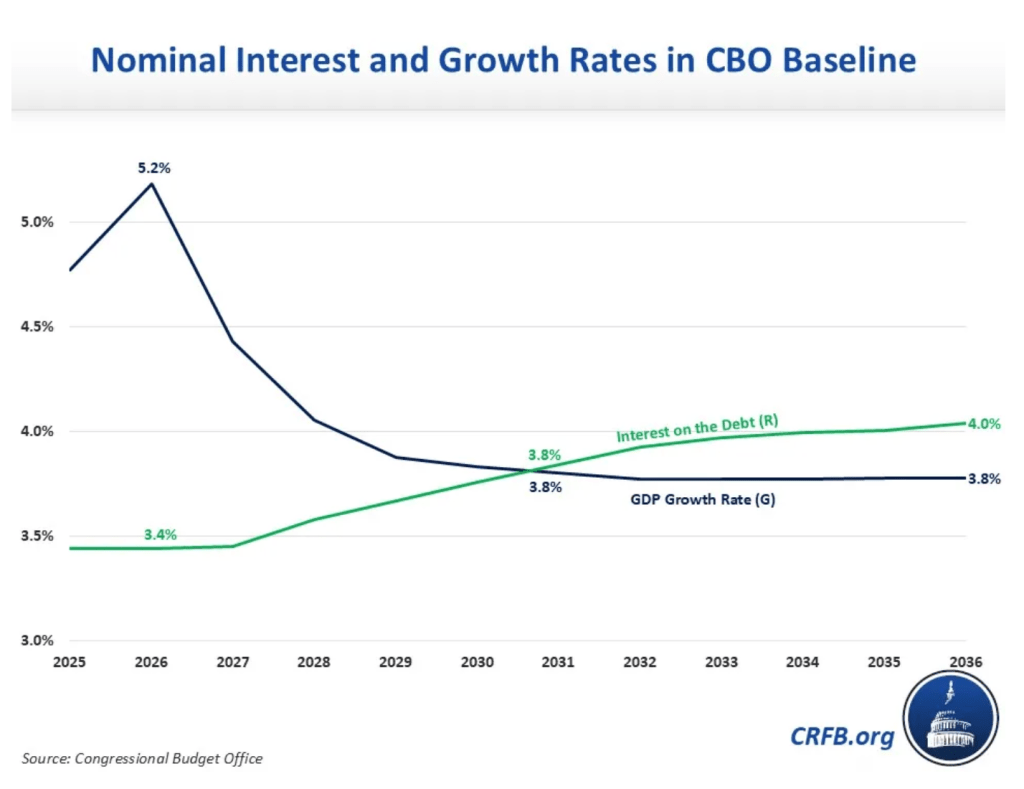
According to a recent analysis from the Committee for a Responsible Federal Budget (CRFB), the Congressional Budget Office’s latest projections show that by fiscal year 2031, the average interest rate paid on the federal debt will exceed the country’s rate of economic growth. In the dry shorthand of economists, “R will exceed G.” In plain terms, that means that the cost of borrowing will be growing faster than the economy’s ability to pay for it.​

“Once interest rates exceed the growth rate…primary deficits will lead debt to grow indefinitely,” the CRFB warned in a blog post published March 9.​

A guardrail, quietly disappearing

For most of the past 60 years—including all of the last 15—the U.S. has benefited from a structural cushion: interest rates on federal debt stayed below the pace of economic growth. That relationship, which economists measure as R<G, meant that even as the government ran persistent deficits, debt as a share of GDP could remain stable or even shrink. The economy, growing faster than the debt’s carrying cost, was effectively eroding the burden over time.​

Real interest rates on federal debt averaged just 0.9% over the past 15 years, while real GDP growth averaged 2.2%. That buffer is now evaporating, according to the CRFB.​

Since 2023, most newly issued Treasury debt has carried yields between 4% and 5%—rates that exceed the economy’s long-term expected growth rate. As older, cheaper debt matures and gets rolled over at these higher rates, the average interest cost on the entire federal debt stock is creeping upward. CBO now projects that by 2031, both R and G will hit roughly 3.8% nominally—and then diverge, with R pulling ahead.​

The spiral mechanism

The CRFB describes what comes next as a self-reinforcing feedback loop. Higher debt pushes interest rates up and slows economic growth. Slower growth reduces tax revenues. Reduced revenues widen deficits. Wider deficits add more debt. More debt pushes rates higher still. “Over time,” the group warns, “this could lead to accelerating growth in the debt, which could eventually be too rapid to correct, absent a major disruption or crisis.”​

Even CBO’s relatively optimistic “baseline” scenario—which does not model additional tax cuts or spending increases—projects the national debt will balloon to an unprecedented 175% of GDP by 2056. By that year, CBO estimates the interest rate will reach 4.2%, against a GDP growth rate of just 3.5%—a gap of 0.7 percentage points. Closing that gap alone, the CRFB calculates, would require roughly $2.7 trillion in annual spending cuts or tax increases—in 2056 alone.​

The political wildcard

The CRFB’s warning carries an implicit rebuke of Washington’s current fiscal trajectory. If lawmakers continue enacting tax cuts and spending increases—as they did in the One Big Beautiful Bill Act, which CBO estimates will add $4.7 trillion to deficits through 2035—the spiral “could arrive sooner and with greater intensity than projected.”​

The national debt is expected to cross $39 trillion within days, up more than $2.6 trillion in the past year alone. But as the CRFB makes clear, the real danger isn’t the next trillion. It’s the arithmetic of what happens when a country can no longer grow its way out of its debt—and the window to act before that moment closes in just five years.

For this story, Fortune journalists used generative AI as a research tool. An editor verified the accuracy of the information before publishing.

This story was originally featured on Fortune.com

Oil markets have lurched from complacency to panic in a matter of days. Brent crude has surged past $100, climbing roughly 50% since hostilities escalated around the Strait of Hormuz — the world’s most critical oil shipping chokepoint.

But one economist believes the market’s reaction may now be overshooting reality.

• State Street Energy Select Sector SPDR ETF stock is showing positive momentum. What’s next for XLE stock?

Robin Brooks, senior fellow at the Brookings Institution and former chief economist at the Institute of International Finance, argues that although markets initially were slow to price the disruption, sentiment may now be running ahead of fundamentals.

“Markets were slow to price the enormity of what was happening a week ago,” Brooks wrote. But with Brent now up about 50% since the …

Full story available on Benzinga.com

This post was originally published here

BitMEX co-founder Arthur Hayes says he has re-entered his Hyperliquid (NASDAQ:PURR) trade, predicting the asset could surge more than fourfold if the protocol’s growth continues.

Reinvesting In Hyperliquid

In an interview with CoinDesk on friday, Hayes said that that he has reinvested in HYPE after previously exiting his position.

He initially sold his holdings around $50–$55, citing concerns over upcoming team token unlocks that could increase selling pressure, as well as growing competition from decentralized perpetual exchanges offering zero-fee trading models.

However, after HYPE fell to roughly $20 in January 2026, Hayes decided to buy back in, pointing to improving fundamentals.

According to Hayes, …

Full story available on Benzinga.com

This post was originally published here

The spike in oil prices was not a good look politically or economically for President Donald Trump after the U.S. and Israel launched their war on Iran, but the military campaign is going well, according to the Institute for the Study of War.

Crude eased somewhat on Monday on signs that more tankers are passing through the Strait of Hormuz, which Iran has virtually locked up after hitting commercial ships. That comes as Iran’s top source of leverage is fading.

“The war in Iran is currently in a phase in which the military trajectory is relatively positive: The United States is steadily destroying Iran’s ability to use its most essential tool in the war—drone and missile attacks—which in turn underpin the entire Iranian strategy,” ISW said in a report Sunday.

While Iran has inflicted significant damage to U.S. installations in the region and allied infrastructure, the pace of its attacks is plunging and hasn’t come close to its original plan for fighting off an existential threat to the regime with overwhelming retaliation, it pointed out.

For example, drone attacks on the United Arab Emirates collapsed from 332 on the second day of the war to just six on Sunday. Ballistic missile attacks fell from a peak of 137 on the first day to four yesterday.

The U.S.-Israeli bombardment has destroyed hundreds of Iranian launchers, and its missile force troops are reportedly demoralized, deserting, and refusing orders, according to ISW.

“Some individual drones have penetrated air defenses and caused politically unacceptable damage to oil infrastructure, but the overall trend in attacks is overwhelmingly positive,” it added.

There’s also little to no evidence the reduced pace of attacks is due to Iran keeping projectiles in reserve to be used later when the U.S. and Israel will have fewer interceptors, the report said.

Such a tactic would be a major gamble that assumes Iran will still have enough launchers left in the future. It also assumes the Islamic Revolutionary Guard Corps retains enough command and control to execute that kind of coordination after the relentless targeting of its leadership.

ISW also noted the last Iranian attack on merchant shipping was on March 11, though it’s unclear whether that was due to less traffic in the Strait of Hormuz or the degradation of Iran’s military capabilities.

Of course, Iran’s plan was never to defeat the U.S. military, with the focus instead on causing political and economic pain, ISW said. Indeed, soaring crude prices have already made gasoline more expensive, threatening higher inflation and public backlash ahead of U.S. midterm elections.

Iran’s strategy rests on inflicting damage in the Gulf, disrupting shipping, activating proxies, committing terrorism, and launching cyber attacks.

“Iran has likely calculated that if these five prongs cause U.S. casualties, drive up oil prices, and impose economic costs on both the US and its Gulf allies, the United States and Israel would make a political decision to end the war without achieving their objectives,” the report said.

ISW expressed confidence the U.S. Navy can reopen the Strait of Hormuz, despite officials describing it as a “kill box” filled with potential threats, while adding “the risk-tolerance of the market will ultimately determine the length of the disruption in the Strait.”

Meanwhile, Trump has called on other countries to send warships to help escort tankers, even warning NATO failure to help him “will be very bad for the future” of the alliance. But so far, there are no takers.

Despite Iran suffering devastating losses on the battlefield, the burden is still on the U.S. to prevent Iran from using economic and political pressure to turn insignificant tactical moves into strategic successes, ISW warned. Still, Operation Epic Fury is working for now.

“The available evidence supports the assessment that the combined campaign is achieving its military objectives thus far but is not yet complete,” ISW said. “Declaring the campaign a failure at this stage is therefore premature. The collapse of Iranian drone and missile attacks—down significantly since Feb. 28—presents a compelling picture that the military campaign is degrading ballistic missile and drone capabilities.”

This story was originally featured on Fortune.com

Efforts to develop domestic rare-earth resources are gaining momentum in Texas as policymakers and industry leaders push to reduce U.S. reliance on China for minerals critical to defense and advanced-technology supply chains.

Texas Land Commissioner Dawn Buckingham joined FOX Business’ Maria Bartiromo on “Mornings with Maria,” Monday to discuss how development of the Round Top rare-earth deposit could help strengthen U.S. national security while generating billions of dollars in revenue for Texas public schools.

Round Top, located in West Texas, is considered one of the richest known deposits of heavy rare-earth minerals in North America. These materials are essential for defense systems, semiconductors and advanced manufacturing. The project has drawn increasing attention as the U.S. looks to challenge China’s long-standing dominance of the global rare-earth supply chain.

TRUMP TO BEGIN STOCKPILING CRITICAL MINERALS WITH $12 BILLION IN SEED MONEY

Buckingham said the state’s mineral resources could play a key role in reshaping that balance while delivering economic benefits in Texas.

“There are 17 rare-earth minerals. We have 15… We’re heavy in the heavies. Those are the really important ones,” Buckingham said, “It’s going to be billions of dollars into public education… We’re breaking China’s stronghold on this market. We are making Texas safer.”

As exploration expands across the region, officials are also focusing on the infrastructure needed to process the minerals domestically.

“We have lots of rare-earth minerals all over the region. We are looking at those deposits right now,” Buckingham said, “It’s going to be billions of dollars to the schoolchildren of Texas, and it’s going to make the United States and the whole world safer.”

CLICK HERE TO GET FOX BUSINESS ON THE GO

This post was originally published here. 

U.S. stocks traded higher midway through trading, with the Nasdaq Composite gaining more than 1% on Monday.

The Dow traded up 0.89% to 46,973.92 while the NASDAQ rose 1.35% to 22,404.50. The S&P 500 also rose, gaining, 1.07% to 6,703.37.

Check This Out: How To Earn $500 A Month From Goldman Sachs Stock Ahead Of Q4 Earnings

Leading and Lagging Sectors

Financial shares climbed by 1.6% on Monday.

In trading on Monday, energy stocks rose by just 0.2%.

Top Headline

Dollar Tree, Inc. (NASDAQ:DLTR) reported upbeat earnings for the fourth quarter on Monday.

The company posted quarterly earnings of $2.56 per share which beat the analyst consensus estimate of $2.52 per share. The company reported quarterly sales of $5.451 billion compared to the analyst consensus estimate of $5.462 billion.

Dollar Tree said it sees FY2026 adjusted EPS of $6.50-$6.90 versus market estimates of $6.69. The company sees sales of $20.500 billion-$20.700 billion, versus estimates of $20.690 billion.

Equities Trading UP
           

  • Urgent.ly Inc (NASDAQ:ULY) shares shot up 164% to $5.36 after the company announced …

Full story available on Benzinga.com

This post was originally published here

A study of analyst recommendations at the major brokerages shows that AngloGold Ashanti plc (Symbol: AU) is the #11 broker analyst pick, on average, out of the 50 stocks making up the Metals Channel Global Mining Titans Index, according to Metals Channel. The Metals Channel Glo

This post was originally published here
Scott Bessent has spent 35 years watching markets. He’s seen currencies collapse, housing bubbles burst, and sovereign debt crises detonate in slow motion. So when the Treasury Secretary sat down with Wilfred Frost on The Master Investor Podcast this past week and was asked what actually worries him about markets—not the movements, but the real fear—his answer was deceptively precise.

“Markets go up and down,” Bessent said. “What’s important is that they are continuous and functioning. In my 35-year career, when people panic is when you’re not able to have price discovery—when markets close, when there is the threat of gating, things like that.”​

It’s a tidy, veteran-investor definition of systemic risk. Volatility, he implied, is fine. Volatility is information. The true crisis arrives when the mechanism that produces prices breaks down entirely—when buyers and sellers can no longer reliably find each other and agree on what something is worth.

Bessent was talking about bond markets and the Strait of Hormuz. But he might as well have been talking about AI stocks (or lack thereof).

The real problem isn’t the selloff

The AI trade has surged and then unraveled in ways that look superficially like a normal correction but feel structurally different. Nvidia posted revenue up 73% year-over-year last quarter and watched its stock fall. The Magnificent 7 is down roughly 7% year to date. DeepSeek rattled the sector in January 2025, and the tremors haven’t fully stopped. On the surface, this reads as a rotation or a valuation reset. Underneath, something closer to Bessent’s definition is at work.​

The problem isn’t that AI stocks are dropping. The problem is that nobody credibly knows what they should be worth—which means price discovery, in any meaningful sense, has been severely compromised for years. And that problem is actually worse than the public market selloff suggests, because the most consequential players in AI have never been subject to market pricing at all.

OpenAI is worth $840 billion—or so its latest funding round implies. Anthropic is valued at $380 billion. xAI at $250 billion. These numbers are not prices. They are negotiated fictions, set in private deals between a small number of investors with massive incentives to mark the sector upward. There is no continuous market, no daily clearing mechanism, no army of short sellers stress-testing the assumptions. There is only the last round, which is whatever the most recent believer agreed to pay. By Bessent’s own definition, this is the condition he fears most: not volatility, but the absence of price discovery entirely.

The tremors are beginning to move downstream. Private credit markets—which rushed in over the past two years to finance AI infrastructure, data center buildouts, and hyperscaler supply chains that traditional bank lenders wouldn’t touch—are sending tremors through markets. Jamie Dimon memorably warned of “cockroaches” in October 2025 when a firm in the space, First Brands, filed for bankruptcy. In February earlier this year, another firm, Blue Owl, rattled markets further by moving to restrict withdrawals. Fortune‘s Shawn Tully warned earlier this month about a potential $256 billion meltdown in the sector.

When the public market begins questioning whether Nvidia’s margins are durable, or whether the $650 billion in projected AI capex actually generates returns, the entire chain of private financing built on those assumptions starts to look shakier. Private credit doesn’t have a ticker. It doesn’t reprice in real time. It reprices in defaults, restructurings, and fund gates—exactly the kind of market event Bessent spent 35 years dreading.

When capital floods a sector on the basis of narrative momentum rather than demonstrated cash flows, prices stop being signals. They become votes. And votes, unlike prices, don’t have to be right. The bill for that distinction, in AI, may be arriving on both sides of the public-private divide at once.

That’s the condition Bessent fears in bond markets: not volatility, but the absence of reliable pricing. AI equities have been living in exactly that condition since at least 2022.

When the crowd is right 85% of the time

Bessent has a framework for this, too—one he shared earlier in the same interview. “The crowd is right 85% or 90% of the time,” he told Frost, describing the macro-investing mindset that made him one of the most successful hedge fund managers of his generation. “It’s really that when things turn, or when you could imagine a different outcome than the consensus, that’s when you can really make a lot of money.”​

He cited his bet against the British pound in the Exchange Rate Mechanism crisis (when he and George Soros helped “break” the Bank of England) and his decade-long short of the Japanese yen—both situations where elite consensus had hardened around a mispricing so obvious in retrospect it seems almost embarrassing. In each case, the problem wasn’t that markets were volatile. The problem was that markets had stopped pricing correctly, then snapped back violently when reality reasserted itself.

That’s precisely the tension AI investors are sitting with now. The question is not whether AI is transformative—it almost certainly is. The question Bessent spent his career asking is the one Wall Street forgot to ask for three years: at what price? And more importantly—is there even a mechanism right now to answer that question honestly?

The Lifeguard’s Lesson

At one point in the interview, Bessent reflected on his teenage years as a lifeguard, offering what he called a lesson that carried into both investing and politics. “Drowning people will try to pull you down,” he said. “many drowning people can just be saved by stand[ing] up,” he added, “so, a lot of times people are panicked, in the water.”​

It’s a striking image for the current AI moment. The next time the market thinks it’s drowning, it could just be panicking in shallow water, thrashing against a depth it can’t measure, precisely because the floor—real, grounded, fundamental value—has never been clearly established. Price discovery doesn’t just tell you what something is worth today. It tells you whether you’re standing or swimming.

For this story, Fortune journalists used generative AI as a research tool. An editor verified the accuracy of the information before publishing.

This story was originally featured on Fortune.com

A former Colorado funeral home owner who helped her ex-husband hide nearly 200 decomposing bodies in a building is asking for leniency when she is sentenced Monday, saying she was a “scared and desperate mother” who was manipulated to keep the family business operating.

Carie Hallford, 48, faces up to 20 years in prison for taking over $130,000 from families for funeral services, including cremations, and often giving them urns full of concrete mix instead. In two cases, investigators found the wrong body was buried. In August, she pleaded guilty to one count of conspiracy to commit wire fraud and admitted that she and her ex-husband Jon Hallford cheated customers and also defrauded the federal government out of nearly $900,000 in pandemic small business aid.

Carie Hallford decided to get a divorce after she was put back in jail in her state case in November 2024, which put her out of reach of her husband’s constant calls and texts and allowed the “fog in her mind from the years of abuse” to lift, according to a court filing by her lawyer, Robert Charles Melihercik.

Federal sentencing guidelines recommend prison time up to eight years since Carie Hallford didn’t have a criminal history. But lawyers for the government are asking U.S. District Judge Nina Y. Wang to sentence her to 15 years, in part for taking advantage of grieving people following one of the largest discoveries of decaying bodies at a funeral home in the U.S.

Families struggle with guilt, shame and nightmares

Those who entrusted their loved ones to the Hallfords struggled with guilt, shame, nightmares and panic attacks since the bodies were discovered in 2023. They were stacked so high in some places that they blocked doorways. There were bugs and maggots. Buckets had been placed to catch leaking fluids.

Prosecutors also want a longer sentence because the former couple, who had offered “green burials” without embalming, lavishly spent a pandemic-era small business loan on vehicles, cryptocurrency, pricey goods from stores like Gucci and Tiffany & Co. and laser body sculpting rather than on their Return to Nature funeral home in Colorado Springs.

Carie Hallford is asking to be sentenced to eight years. In court documents, Melihercik, said Hallford’s actions were motivated by “fear and severe anxiety.” He said Hallford’s former husband used “classic instruments of domestic violence” to control her, including threatening at times to kill himself and her.

The lawyer who represented Jon Hallford in state court, Adam Steigerwald, declined to comment on the abuse allegations. The lawyer who represented him in federal court, Laura Suelau, did not immediately return a call seeking comment.

Carie Hallford was the public face of the business

Some victims are not sympathetic to Carie Hallford, the public face of the business who met with families and assured them their loved ones would be treated with respect.

Emma Williams, whose family entrusted the Hallfords to take care of her father’s remains in 2022, said Carie Hallford had a choice.

“She continued to stay with the business and take advantage of us out her own greed,” she said.

Crystina Page, whose son’s body was left at the funeral home after he was killed in 2019, said Carie Hallford spent four years “feeding the monster” by continuing to accept more business.

“She is just as guilty as he is, except that he couldn’t have done it without her bringing him the bodies,” Page said.

Defense says a shorter sentence would allow for restitution

Carie Hallford says that much of the lavish spending of the government loan money was the result of “love-bombing” as Jon Hallford attempted to apologize to her. She urged her husband to buy a cremator with the loan money, but was too scared to force the issue, Melihercik said in the court filing.

“Although she will be behind bars for the next decade or more, she finally feels free,” Melihercik wrote. He also said a shorter sentence would allow Carie Hallford to be able to return to work and repay the money the couple took from their victims.

Carie Hallford is also facing 25 to 35 years in prison when she is sentenced in state court on related charges next month.

Jon and Carie Hallford each pleaded guilty in December to nearly 200 counts of corpse abuse in state court. The plea deals require their state and federal sentences to be served at the same time.

Jon Hallford was sentenced to 20 years in the federal case and 40 years in the state case. At his sentencing last month in the state case, he apologized and said he will regret his actions for the rest of his life.

“I had so many chances to put a stop to everything and walk away, but I did not,” he said. “My mistakes will echo for a generation. Everything I did was wrong.”

This story was originally featured on Fortune.com

AI isn’t just minting frontier model labs, it’s dragging forgotten venture sectors back into the game.

Healthtech, cybersecurity, biotech, and enterprise SaaS all saw a decisive pickup in early-stage activity in Q4 2025, driven by AI-native startups that look very different from the last cycle’s darlings, according to PitchBook’s latest Emerging Tech Indicator (ETI), which tracks pre-seed through Series B deals done by the top 15 VC firms globally.​

Healthtech is the clearest example of the shift. Health and wellness deals jumped to $678 million across 23 transactions in Q4, more than double the previous eight-quarter average of $332 million and 16 deals. The money is flowing into two buckets: consumer-facing “know your body” platforms and AI tools that make providers’ operations more efficient.​

Function Health, a subscription service that gives members access to a battery of lab tests and personalized insights, raised a $300 million Series B at a $2.5 billion valuation—an 11.5x step-up from its June 2024 Series A. On the enterprise side, Paradigm Health pulled in $78 million for clinical trial management software, while Valerie Health raised $30 million to automate front-office workflows with AI.​

Venture dollars are also returning to brick-and-mortar care, but with an AI angle. Radial Health, a network of mental health clinics, closed a $50 million Series A, and obesity-care chain Knownwell raised $26.1 million. Together, those deals suggest investors are moving away from popular telehealth bets and toward “AI plus services” models that plug into existing care infrastructure rather than trying to replace it.​

Aside from health and wellness, cybersecurity reached a new high. Cyber deals hit a record $643.1 million in Q4 across 15 transactions, with average valuations in the segment jumping to $273.4 million—more than double the previous eight-quarter average of $129.1 million. Ten of those 15 were Series A rounds.

Here, too, the deal list reads like a catalog of “AI + cyber” companies. 7AI raised a $130.6 million Series A for an autonomous threat-detection platform that continuously monitors digital environments. Vega Security secured $120 million for AI-powered threat detection and analytics, while Adaptive closed an $81 million Series B for generative AI–based threat simulations.

Biotech, long out of favor after the 2021 boom, also showed signs of life with deals climbing to 10 in Q4—the most since late 2022. Braveheart Bio raised $185 million in its first financing round to advance cardiovascular drugs licensed from China’s Jiangsu Hengrui Pharmaceuticals, while Expedition Therapeutics secured $165 million for a COPD therapy licensed from Fosun Pharma.​

Even enterprise SaaS—under fire in the public markets for sluggish growth and seat-based pricing—looked surprisingly lively in the emerging tech lens. Q4 SaaS activity reached $313.4 million across 19 deals, with 10 at the seed stage. PitchBook’s analysis argues that what’s getting funded now is “service as software”: products that deliver AI-powered outcomes, not just tools employees have to learn and adopt.​

Against the backdrop of a more cautious overall deal economy—and continued mega-bets on a handful of frontier labs—the ETI data suggests a narrower but sharper playbook at the top of the market. Health, cyber, biotech, and SaaS never truly disappeared from VC portfolios. Elite firms are now willing to lean back into them, so long as the pitch is less “another point solution” and more “AI-native system that moves real-world outcomes.”​

This story was originally featured on Fortune.com

Emanuel Fabian, the Times of Israel’s military correspondent, says Polymarket bettors sent him death threats after he reported that an Iranian ballistic missile struck an open area near Beit Shemesh on March 10 with no injuries.

The Dark Side Of Betting On Conflict

The dispute centers on Polymarket’s “Iran strikes Israel on…?” contract, which has generated $15 million in volume. The contract resolves “Yes” only if an Iranian missile impacts Israeli ground territory. Intercepted missiles do not count.

Fabian reported the missile hit a forested area roughly 500 meters from homes.

That wording would resolve the March 10 contract as “Yes.”

Bettors who wagered “No” on that date wanted him to change his report to say the missile was intercepted, which would flip the outcome in their favor.

What started as messages asking Fabian to clarify his reporting turned into …

Full story available on Benzinga.com

This post was originally published here

European countries on Monday demanded to know more about U.S. President Donald Trump’s plans for the war on Iran and when the conflict might end as they weighed whether to agree to his call to send warships to help shore up security in the Persian Gulf.

Trump has asked allies — including France, China, Japan, South Korea and Britain — to help secure the strait for global shipping. He said the U.S. was talking to “about seven” countries for military support to help reopen the trade route. But he wouldn’t say which ones and gave no indication of when such a coalition might be formed.

Separately, in an interview with the Financial Times, he warned that “if there’s no response or if it’s a negative response I think it will be very bad for the future of NATO.”

As European Union foreign ministers gathered to discuss Trump’s demand, German Foreign Minister Johann Wadephul said it’s important for the United States and Israel to define “when they consider the military aims of their deployment to have been reached.”

“We need more clarity here,” Wadephul told reporters.

German Chancellor Friedrich Merz’s spokesperson, Stefan Kornelius, said underlined “this war has nothing to do with NATO — it is not NATO’s war. NATO is an alliance to defend the alliance area.”

Kornelius said that Berlin “took note” of Trump’s comments, but he added: “The United States did not consult us before this war, and so we believe this is not a matter for NATO or the German government.”

Estonian Foreign Minister Margus Tsahkna also said that U.S. allies in Europe want to understand Trump’s “strategic goals. What will be the plan?”

Their reactions were typical of the cautious response that many in Europe have shown to the U.S.-Israeli war on Iran, although few allies in Europe have openly opposed it. Trump has described his demand for help in the strait as “a very small endeavor.”

Polish Foreign Minister Radek Sikorski invited the Trump administration to go through the proper channels.

“If there is a request via NATO, we will of course out of respect and sympathy for our American allies consider it very carefully,” he said. Sikorski made a reference to Article 4 of NATO’s founding treaty, which allies can invoke if they believe their territory or security is under threat.

‘Not be drawn into the wider war’

As she headed in to chair the meeting of ministers in Brussels, EU foreign policy chief Kaja Kallas said that “it is in our interest to keep the Strait of Hormuz open, and that’s why we are also discussing what we can do in this regard from the European side.”

Kallas said the EU could expand its Operation Aspides naval mission to protect shipping in the Red Sea up into the Persian Gulf. If no agreement is found among the 27 EU countries, those who stand ready to go it alone could form a “coalition of the willing” and provide military support on an ad hoc basis.

The war in Iran, sparked on Feb. 28 airstrikes by Israel and the U.S., has driven up energy prices worldwide, with brent crude up more than 40%. But the conflict has also disrupted the wider global supply chain beyond oil, affecting everything from pharmaceuticals from India, semiconductors from Asia and oil-derived products like fertilizers that come from the Middle East.

Cargo ships are stuck in the Gulf or making a much longer detour around the southern tip of Africa. Planes carrying air cargo out of the Middle East are grounded. And the longer the war drags on, the more likely that there will be shortages and price increases on a wide range of goods.

France has said it is working with countries — President Emmanuel Macron mentioned partners in Europe, India and Asia — on a possible international mission to escort ships through the strait but has stressed it must be when “the circumstances permit,” when fighting has subsided.

French senior officials, speaking anonymously on ongoing talks, said the Netherlands, Italy, and Greece had shown interest and that Spain might be involved in some way.

In London, Prime Minister Keir Starmer said Britain “will not be drawn into the wider war, ” but that it is discussing with the U.S. and allies in Europe and the Gulf the possibility of using mine-hunting drones that the U.K. already has in the region. But he signaled that Britain is unlikely to dispatch a warship.

EU’s refugee concerns

Operation Aspides was formed to thwart attacks to shipping in the Red Sea by Somali pirates and Yemen’s Iran-backed Houthi rebels, who have yet to join the current fray. Saudi Aramco manages a pipeline network that bypasses the Strait of Hormuz to deliver oil to the Red Sea port city of Yanbu.

“If we want to have security in this region, then it would be easiest to actually already use the operation that we have in the region and maybe change a bit,” Kallas said. “There is also talk of coalition of the willing in this regard, but we also need to see what could be the fastest to provide this opening for the Strait of Hormuz, but of course, as you can see, it’s not easy.”

The EU is anxious that a potential refugee crisis in Iran will develop if the war continues.

“Although for now, the conflict has not translated into immediate migratory flows toward the EU, what the future holds remains unclear and necessitates the full mobilization of every migration diplomacy tool we have at our disposal,” said European Commission President Ursula von der Leyen in a statement Sunday.

—-

Associated Press writers Geir Moulson in Berlin, Jill Lawless in London, and Sylive Corbet in Paris contributed to this report.

This story was originally featured on Fortune.com

Prices for gold and oil have moved sharply in recent weeks as escalating geopolitical tensions in the Middle East inject fresh volatility into the global commodities space. Crude prices have surged in recent weeks after disruptions to shipping through the Strait of Hormuz, the narrow maritime corridor that typically carries roughly 20 percent of global oil supply. These ongoing issues have raised concerns that prolonged instability could constrain supply and push energy costs higher.The ripple effects have extended well beyond the energy complex. Rising oil prices can feed inflation expectations, which in turn influence currency markets, interest rates and demand for traditional safe-haven assets such as gold.One closely watched indicator of this relationship is the oil-to-gold ratio, which compares how many barrels of West Texas Intermediate (WTI) crude can be purchased with an ounce of gold. Historically, the ratio often reflects shifts in macroeconomic conditions — higher oil prices during geopolitical crises or supply shocks tend to compress the ratio, while stronger gold prices during financial stress can widen it.As COVID-19 restrictions set in during April 2020, the ratio spiked to 90:1, its highest level. Currently the ratio is 53:1. At the same time, the broader financial backdrop is complicating gold’s traditional safe-haven role. A stronger US dollar and elevated treasury yields have limited the metal’s upside, even as geopolitical risk remains high. The Investing News Network (INN) called on Antonio Ernesto Di Giacomo, senior analyst at XS.com, to discuss how tensions surrounding the Strait of Hormuz, inflation expectations driven by energy prices and shifting monetary policy dynamics are shaping the relationship between oil and gold — and what investors should watch next.

INN: In an email commentary, you noted that safe-haven demand and a rising dollar are having a push-and-pull effect on gold prices. Could you elaborate on this?
Ernesto Di Giacomo (EDG): Gold is currently caught between two opposing forces. On one hand, geopolitical tensions and global uncertainty are increasing demand for traditional safe-haven assets, which naturally supports gold prices. Investors often turn to gold during periods of instability because it is perceived as a store of value that is less exposed to political or financial shocks.On the other hand, the US dollar has been strengthening, which tends to put downward pressure on gold. Since gold is priced in dollars, a stronger dollar makes the metal more expensive for investors holding other currencies, potentially reducing demand. What we are seeing right now is a tug-of-war between these two dynamics: safe-haven flows pushing gold higher, and dollar strength limiting the magnitude of those gains.

INN: Oil and gold prices are often correlated through inflation, risk and economic volatility. How would you characterize their performances lately?
EDG: Recently, both markets have been reacting strongly to geopolitical developments, particularly in the Middle East. Oil prices have been volatile amid concerns about potential supply disruptions, particularly along key shipping routes such as the Strait of Hormuz. This volatility has also fed into broader inflation expectations.Gold, meanwhile, has been moving in a more complex way. While geopolitical tensions normally support gold, investors are also focusing on monetary policy and the path of interest rates. So although oil has been climbing amid supply concerns, gold has not always followed immediately, as higher energy prices can reinforce inflation fears, which in turn may lead central banks to keep interest rates higher for longer.

INN: Gold is typically one of the first assets investors turn to during geopolitical crises, yet we’re seeing it struggle to gain momentum during the current Middle East conflict. What’s different about this moment compared with previous periods of geopolitical stress?
EDG: What makes this moment somewhat different is the macroeconomic backdrop. In previous geopolitical crises, gold often rallied strongly because interest rates were relatively low and the opportunity cost of holding gold was limited. Today the environment is different. US Treasury yields remain elevated, and the Federal Reserve is still cautious about cutting rates too quickly.When yields are high, investors can obtain attractive returns from fixed-income assets, thereby reducing the appeal of holding non-yielding assets like gold. So while geopolitical risks are supporting demand for safe havens, the broader monetary environment is preventing gold from rallying as aggressively as it might have in the past.

INN: You point out that a stronger dollar and rising treasury yields are weighing on gold. Can you explain how that relationship works and why those factors can sometimes outweigh gold’s traditional safe-haven appeal?
EDG: The relationship largely comes down to opportunity cost and currency dynamics. Gold does not generate interest or dividends, so when treasury yields rise, investors have an alternative asset that offers a return with relatively low risk. This makes bonds more attractive compared with holding gold.At the same time, a stronger dollar tends to put pressure on commodities that are priced in dollars. When the dollar appreciates, international investors need more of their local currency to buy the same ounce of gold.As a result, global demand can soften. When both factors, higher yields and a stronger dollar, occur simultaneously, they can sometimes overshadow the traditional safe-haven demand that gold typically receives during times of geopolitical uncertainty.

INN: Oil prices are rising again amid concerns about potential disruptions in the Strait of Hormuz. How closely are gold markets watching energy prices right now, and could sustained higher oil prices change the outlook for precious metals?
EDG: Energy prices are extremely important for the precious metals market because they influence inflation expectations. If oil prices rise significantly and remain elevated, it can feed into higher transportation and production costs across the global economy. That dynamic often translates into broader inflationary pressure.
In that scenario, gold could benefit because it is widely viewed as a hedge against inflation. However, there is also a second layer to consider. If rising oil prices keep inflation elevated, central banks might delay interest rate cuts or even maintain restrictive monetary policy for longer. In the short term, that could limit gold’s upside. Over the medium term, though, persistent inflation risks could eventually strengthen the bullish case for precious metals.

INN: Investors are watching key US inflation indicators like the consumer price index (CPI) and the personal consumption expenditures (PCE) price index. How critical are these data points in shaping expectations for interest rate cuts and, by extension, the direction of gold prices?
EDG: These indicators are extremely important because they directly influence expectations about Federal Reserve policy. The CPI and the PCE index provide insight into whether inflation is moving sustainably toward the Fed’s target.
If inflation data shows that price pressures are easing, markets could increase their expectations for rate cuts. In that environment, gold would benefit from lower interest rates, which reduce the opportunity cost of holding the metal. Conversely, if inflation remains stubbornly high, the Federal Reserve may keep rates elevated for longer, which could continue to weigh on gold in the near term.

Don’t forget to follow us @INN_Resource for real-time updates!Securities Disclosure: I, Georgia Williams, hold no direct investment interest in any company mentioned in this article.Editorial Disclosure: The Investing News Network does not guarantee the accuracy or thoroughness of the information reported in the interviews it conducts. The opinions expressed in these interviews do not reflect the opinions of the Investing News Network and do not constitute investment advice. All readers are encouraged to perform their own due diligence.

This post was originally published here

An offshore wind project targeted by the Trump administration has begun sending power to New England’s electric grid, the developer said Friday.

The Danish company Orsted said Revolution Wind is now generating power and will scale up in the weeks ahead until it is fully operational. Orsted is building Revolution Wind with Global Infrastructure Partners’ Skyborn Renewables to provide electricity for Rhode Island and Connecticut, enough to power more than 350,000 homes and businesses.

Revolution Wind was one of five major East Coast offshore wind projects the Trump administration halted construction on days before Christmas, citing national security concerns. Developers and states sued, and federal judges allowed all five to resume construction, essentially concluding that the government did not show that the national security risk was so imminent that construction must halt.

The Biden administration sought to ramp up offshore wind as a climate change solution.

But President Donald Trump, who often talks about his hatred of wind power, has said his goal is to not let any “windmills” be built. He has signed a spate of executive orders aimed at boosting oil, gas and coal.

White House spokesperson Taylor Rogers said Friday night that Trump “reversed course on Joe Biden’s costly green energy agenda that gave preferential treatment to intermittent, unreliable energy sources and instead is aggressively unleashing reliable and affordable energy sources to lower energy bills, improve our grid stability and protect our national security.” Rogers added in a statement to AP that the administration “looks forward to ultimate victory on this issue.”

Orsted said that at a time of growing energy demand, Revolution Wind will provide price certainty and stability, citing a preliminary analysis by the state of Connecticut that estimates it will lower wholesale energy costs by about $500 million per year by 2028.

“Revolution Wind is adding affordable, reliable American-made energy to New England’s grid, helping to meet growing energy demand and lower consumer costs,” Amanda Dasch, chief development officer at Orsted, said in a statement.

Chris Kearns, acting commissioner of the Rhode Island Office of Energy Resources, called the first power milestone a “significant moment for the state’s clean energy landscape.”

Orsted began construction in 2024 about 15 miles (24 kilometers) south of the Rhode Island coast. The wind farm has 65 of the 11-megawatt Siemens Gamesa turbines, and more than 1,000 people have been working on it.

Connecticut Rep. Joe Courtney, a Democrat, said that because this wind energy is directly transmitted off the New England coast, “its price will not be at the mercy of uncertain global energy markets.” The Iran war is disrupting world energy supplies, the global economy and international travel.

Courtney also said Friday’s milestone “never would have happened without talented Connecticut building trades workers, who persevered through the Trump administration’s illegal halt work orders.”

The order in December was the second time the administration halted construction on Revolution Wind. Work was previously paused Aug. 22 over national security concerns. A month later a federal judge ruled the project could resume.

___

The Associated Press’ climate and environmental coverage receives financial support from multiple private foundations. AP is solely responsible for all content. Find AP’s standards for working with philanthropies, a list of supporters and funded coverage areas at AP.org.

This story was originally featured on Fortune.com

Shares of TeraWulf Inc (NASDAQ:WULF) are surging Monday morning. Investors are reacting to a significant financing update and a broader crypto market rally.

The entered a Delayed-Draw Bridge Credit Agreement on Monday. The deal involves subsidiaries Raylan Finance LLC and Raylan Data LLC. Morgan Stanley Senior Funding, Inc. serves as the administrative agent, according to Benzinga Pro.

The agreement provides a 364-day $500 million senior secured bridge facility. TeraWulf intends to use these proceeds to finance the construction and development of the Company’s data center facility in Hawesville, Kentucky.

Bitcoin Price Triggers Sector Rally

The stock …

Full story available on Benzinga.com

This post was originally published here

Southwest Airlines will stop operating flights at Washington Dulles International Airport and Chicago O’Hare International Airport starting this summer.

The airline announced Friday that the change will take effect June 4, 2026. Flights scheduled on or before June 3 will operate as planned.

Despite the exit from the two major hubs, Southwest said it will continue offering significant service in both metro areas through other airports. In the Chicago region, the carrier will maintain operations at Chicago Midway International Airport, while in the Washington area it will continue service at Baltimore/Washington International Airport and Ronald Reagan Washington National Airport.

MORE THAN 1,800 US FLIGHTS CANCELED AS MASSIVE MARCH STORM DISRUPTS TRAVEL

Southwest currently serves 15 markets from Chicago O’Hare. An airline spokesperson told FOX Business that employees affected at the two airports will have the opportunity to bid for open positions elsewhere across its network.

Customers with reservations that include either airport on or after June 4 will need to change their travel plans. Travelers may rebook or travel standby within 14 days of their original travel date without paying a fare difference.

Passengers can also choose to travel through alternate airports. Options include Chicago Midway, Milwaukee and Indianapolis for Chicago-area travel, and Reagan National, Baltimore/Washington International, Philadelphia and Richmond for the Washington region.

CLICK HERE TO GET FOX BUSINESS ON THE GO

Customers may also request refunds for the unused portion of their ticket – even for nonrefundable fares – as well as optional travel charges tied to flights not taken.

Reuters contributed to this report. 

This post was originally published here. 

The United States’ war with Iran is entering its third week, but Congress has yet to publicly test the Trump administration’s case for the conflict.

Republicans in Congress have so far side-stepped public debate over the war, even as Senate Democrats reach for every tool at their disposal to demand hearings with Trump administration officials. Increasingly frustrated, Democrats are threatening this week to force a series of votes on the war, hoping that the effort to gum up the Senate’s voting schedule will prod Republicans to action.

“We’ve had no oversight whatsoever over what the executive is doing as we’re spending a billion dollars a day, and we have failed to have any real substantive debate or discussion,” said Sen. Cory Booker, D-N.J.

The role of Congress in the deliberations is an unsettled question with enormous stakes, given that lawmakers have the power to shape the trajectory of the conflict as it grows in cost and casualties. So far, 13 military members have been killed and billions of dollars have been spent, but President Donald Trump has not sought congressional approval for attacking Iran.

As the 17th day of the conflict dawned Monday, Republican lawmakers remained mostly resistant to the idea of quickly forcing public testimony before Congress.

How GOP leaders are handling calls for hearings

Senate Majority Leader John Thune told reporters last week that he didn’t expect public hearings specifically on the Iran war, but noted it would inevitably come up in the regular rhythm of testimony on military policy and spending.

“They have briefed us,” Thune, R-S.D., said, pointing to classified briefings from the Trump administration. Those sessions have been held behind closed doors and most lawmakers refuse to disclose more than the broad topics of discussion.

Thune also noted there have been regular news conferences from Defense Secretary Pete Hegseth and Gen. Dan Caine, chairman of the Joint Chiefs of Staff. They are “answering the hard questions that are being asked,” Thune said.

The GOP chairs of committees dealing with national security have also said they don’t have plans in the near term to hold hearings specifically on the war, though some acknowledged the value of lawmaker questioning.

Sen. Roger Wicker, the chair of the Senate Armed Services Committee, argued that the regular run of hearings on Capitol Hill would provide lawmakers with plentiful opportunities to ask questions.

“We’re going to conduct generous oversight, thorough oversight,” said Wicker, R-Miss.

Some Republicans are looking ahead to an expected supplemental budget request from the Trump administration to cover the costs of the war. That request, however, is likely weeks away and faces a difficult path through Congress.

Democrats have pointed out that the Pentagon has already received additional funding from Republicans’ marquee tax cut law that was passed last year and provided funding for GOP priorities, including at the Pentagon.

Wariness growing from some Republicans

Still, agitation from a few Republicans at the lack of high-level responses from the Trump administration is starting to show, especially as they brace for a hefty war bill from the administration.

“I don’t want to just be given the invoice from the Department of Defense, saying this is what it’s going to cost,” said Sen. Lisa Murkowski, R-Alaska. “I want them to be engaged with us.”

She added that it was important for lawmakers to get information both in classified briefings and public hearings “so that the public can better understand this, too.”

Another GOP senator on the powerful Appropriations Committee, Louisiana’s John Kennedy, exited a classified briefing last week fuming that it had been a “total waste of time” because the officials were not able to provide the answers that top-level Cabinet officials could.

Republicans have almost uniformly backed Trump’s decision to launch an attack on Iran, though many are wary of a lengthy conflict. Trump has cycled through different objectives for the war, ranging from crippling Iran’s military capabilities to a demand for “unconditional surrender.”

“I think we have to let the objective play out as far as we can, and if then the effort gets murky on how to get to the objective, that might be a good time to have some hearings, but it’s too early,” said Sen. Cynthis Lummis, a Wyoming Republican.

But as the midterm elections approach, Republicans are also aware that public support for the war remains tepid.

“I wish we could disclose a lot of this publicly because it would make it a whole lot easier to explain to the American people,” said Sen. Mike Rounds, R-S.D., adding that classified briefings were necessary to protect U.S. service members now that the war is under way.

How Democrats may force a debate

Democrats, meanwhile, are threatening to do just about everything in their power to bring attention to the war, even if it means repeatedly forcing votes that fail.

A group of six Democrats has said that unless hearings are scheduled with Hegseth, Secretary of State Marco Rubio and other Cabinet officials, they will call up daily votes on a series of war powers resolutions that if passed would require Trump to gain congressional approval before carrying out any more attacks on Iran. Similar resolutions have already been rejected by both chambers in the Republican-controlled Congress.

The votes, however, would eat up valuable time on the Senate floor and set the ground for a debate on the conflict just as Senate Republicans plan to spend much of the week trying to pass Trump’s priority legislation to impose strict new proof-of-citizenship requirements for voting.

The group of Democratic senators also hinted at using other tactics to slow the Senate’s work on other business.

Sen. Chris Murphy, a Connecticut Democrat, told reporters that unless there is a commitment for public hearings, “We’re not going to let the Senate go on with business as usual. We’re not going to let the Senate be silenced.”

This story was originally featured on Fortune.com

Advanced technology isn’t just automating tasks in the white collar world—AI agents and robots are flipping burgers, stocking warehouses, and even doing household chores. Driverless taxis have also entered the mainstream, despite job loss fears from gig workers. But the leader of autonomous vehicle (AV) business Waymo insists the tech isn’t taking human work. 

“Now that we’ve been in a few markets for a few years, it’s great to be able to see that we haven’t eliminated jobs in those markets,” Waymo’s co-CEO, Tekedra Mawakana, recently told The New York Times.

The $126 billion behemoth of industry, which started out as Google’s self-driving car project, has understandably raised eyebrows from human drivers. It’s the largest AV company in the U.S., serving at least 10 cities with around 3,000 robotaxis and counting. And as more companies including Tesla and Amazon-owned Zoox enter the arena, ride-hailing workers are put on edge. 

Even the CEO of Uber himself believes that most of his company’s rides could have a robot behind the wheel in the next couple of decades.

Humans will be needed to rotate tires and operate fleets in the era of self-driving cars

Waymo’s co-CEO says the shift to driverless will open up new jobs. Instead of being in the driver’s seat, humans will be behind the scenes of the whole operation, fulfilling operational and blue-collar business needs. 

And to support the workforce of the future, Waymo is funding tuition scholarships for U.S. technicians, and partnered with Bronx Community College in creating an automotive technology program.

“Humans are still rotating those tires and working on those vehicles,” Mawakana continued. “We have fleet operators, we have fleet technicians. All of our fleets are fully electric. Those charging companies are building the infrastructure, putting them in city centers, pulling those wires from the utility company.”

Justin Kintz, the global head of public policy at Waymo, tells Fortune that the business’ investments in infrastructure and growing services “create opportunities for Americans of all backgrounds, by bringing a wide variety of new, non-college and trades-work roles to communities around the U.S.”

Robotaxis will have an impact on human drivers—but will strengthen blue-collar work

Automated cars are on the rise, much to the dismay of human drivers and passengers who get stuck navigating the errors of the new technology. 

It’s projected that the U.S. robotaxi market will grow from 1,500 in 2025 to around 35,000 in 2030—around a 90% compounded annual growth rate, according to a 2025 Goldman Sachs report. The automated services could account for 8% of the total American ride-share market in just a few short years.

It’s only natural for drivers to fear for their future careers, especially as they see AI gut company workforces and swipe the jobs of thousands of white-collar employees. About 85% of people believe that the rollout of driverless cars will lead to job losses, and another 70% felt unsure of the technology or that it’s a bad idea for society, according to a recent University of California San Diego analysis of Pew Research Center data. 

And industry leaders like Uber chief executive Dara Khosrowshahi have sounded the alarm that the majority of the business’ trips will be “fulfilled by robots of some kind” within 20 years. However, when one door closes, another one opens. 

It’s projected that in deploying 9 million AVs over the next 15 years, more than 114,000 new jobs in AV production, distribution, maintenance, upgrades, and repairs will be created, according to a 2024 study from Chamber of Progress. Humans won’t be totally left out of the process; companies will need about 190 workers to manufacture and service the cars, for every 1,000 AV created and deployed each year.

The co-founder and CEO of $15.2 billion “super-app” company Grab, Anthony Tan, announced it would be rolling out robobuses in its headquarter city of Singapore this year. But in lockstep with making a large investment in driverless technologies, the business is also considering how to upskill human drivers in the shift. And just like Waymo, the company recognized a few work opportunities for people, including vehicle maintenance and data analysis. 

“We see new kinds of jobs emerging,” Tan said in a 2025 Q&A with analysts. For example, drivers could be remote safety drivers, data labelers; they could change LiDARs, cameras, and so forth.”

This story was originally featured on Fortune.com


In the latest episode of the Inside CRE podcast, NAIOP President and CEO Marc Selvitelli sat down with Carleton Riser, president of Transwestern, for a wide-ranging conversation on development strategy, market timing and how smart capital is positioning for the next upcycle. With more than 30 years in the business, Riser has seen multiple downturns, and the lessons he’s carried forward are shaping how he approaches today’s unique environment.

Another Cycle, Another Lesson

The dot-com bust underscored the fact that “credit actually matters,” Riser said, after markets cratered on the back of “phantom absorption” (where commercial real estate space appears occupied on paper but goes unused). The Global Financial Crisis taught him that “having flexibility in your capitalization matters because when the tide goes out and there’s no liquidity in the market, you need to make sure you’ve got some sort of staying power.”

More recently, the COVID-19 pandemic fueled a surge in multifamily and industrial development, where “the markets got out over their skis, inflation came in, and then an interest rate spike [occurred]. From a development standpoint, we’ve been in a three-year downturn because of that,” he said.

Thankfully, “we have a very diversified business, both geographically and by product type, which I think has served us well through these different fluctuations in the market,” Riser said.

Making Smarter Bets in Today’s Market

With capital markets disruptive and liquidity still constrained, Riser says Transwestern evaluates new projects in two different ways: the cost of upfront pursuit capital and the potential capital markets environment 9-18 months down the road when institutional partners would likely join the deal.

That means only the strongest opportunities make the cut. “The better deals are the first deals to get done as we emerge from this trough,” Riser said. Transwestern is prioritizing projects in submarkets with strong fundamentals, backed by smart underwriting and realistic assumptions around occupancy and rents.

Mixed-use Success Means Flexibility

Mixed-use development is complex but rewarding, Riser said, and requires discipline from day one. Don’t assume a mixed-use project can fix a weaker location: every individual use must stand on its own. Flexibility is key; plans must be able to adapt as market conditions evolve without requiring a complete redesign. Capital stacks should allow each component of the project to attract the right investors.

Avoid what Riser’s team has described as “broken teeth” – a missing piece of the “mix” in a mixed-use project – “which can send your plan sideways… and can be fatal to the first phase.” The complementary nature of the different product types working together is absolutely critical.

Capital is Scarce and Selective

Capital scarcity, particularly for multifamily development, is shaping strategy, Riser said. Investors with dozens of opportunities may pursue only a handful, so differentiation is essential.

On the other hand, mixed-use has become appealing to many partners as both a defensive and offensive play. “We know that if executed properly, a mixed-use project, especially in a Sunbelt market, will drive superior occupancy levels and superior rental rates if that retail offering and that placemaking aspect of the environment is compelling for those ventures as a differentiator versus their alternatives,” Riser said.

Transwestern is staying away from preferred equity and mezzanine debt structures, preferring a more conservative capital stack. “The more leverage, the more pressure you’ve got on your capital stack, the less staying power you have in the event of a market sea change,” he explained.

Fortunately, construction lending has improved, and Riser sees solid absorption trends across the Sunbelt. “In some of these markets, we think there’s a rationale to build today. In some of them, it’s more towards the end of 2026. In some of those, it’s more towards 2027. But we’ve seen a lot of robust absorption in those markets.”

Positioning for the Next Upcycle

Asked what developers should be doing now, Riser didn’t hesitate: control land. But do so carefully. Buying too early or without a clear picture of where capital markets are headed can be risky.

“None of us has a perfect crystal ball, but we are spending considerably more time these days trying to forecast out to early 2027, early 2028, and trying to get comfortable with that when we are putting capital at risk today,” he said.

Success in development is less about predicting the future and more about preparing for a wide range of possibilities.

Listen to the full episode of the Inside CRE podcast.

This post was originally published here. 

A generation ago, Poland rationed sugar and flour while its citizens were paid one-tenth what West Germans earned. Today, the economy of the country has edged past Switzerland to become the world’s 20th largest with more than $1 trillion in annual output.

It’s a historic leap from the post-Communist ruins of 1989-90 to European growth champion, which economists say has lessons on how to bring prosperity to ordinary people — and that the Trump administration says should be recognized by Poland’s presence at a summit of the Group of 20 leading economies later this year.

The transformation is reflected in people like Joanna Kowalska, an engineer from Poznan, a city of around 500,000 people midway between Berlin and Warsaw. She returned home after five years in the U.S.

“I get asked often if I’m missing something by coming back to Poland, and, to be honest, I feel it’s the other way around,” Kowalska said. “We are ahead of the United States in so many areas.”

Kowalska works at the Poznan Supercomputing and Networking Center, which is developing the first artificial intelligence factory in Poland and integrating it with a quantum computer, one of 10 on the continent financed by a European Union program.

Kowalska worked for Microsoft in the U.S. after graduating from the Poznan University of Technology, in a job she saw as a “dream come true.”

But she missed having a “sense of mission,” she said.

“Especially when it comes to artificial intelligence, the technology started developing so rapidly in Poland,” Kowalska said. “So it was very tempting to come back.”

Breaking out of poverty

The guest invitation to the G20 summit is mostly symbolic. No guest country has been promoted to full member since the original G20 met at the finance minister level in 1999, and that would take a consensus decision of all the members. Moreover, the original countries were chosen not just by gross domestic product rank, but by their “systemic significance” in the global economy.

But the gesture reflects a statistical truth: In 35 years — a little less than one person’s working lifetime — Poland’s per capita GDP rose to $55,340 in 2025, or 85% of the EU average. That’s up from $6,730 in 1990, or 38% of the EU average and now roughly equal to Japan’s $52,039, according to International Monetary Fund figures measured in today’s dollars and adjusted for Poland’s lower cost of living.

Poland’s economy has grown an average 3.8% a year since joining the EU in 2004, easily beating the European average of 1.8%.

It wasn’t simply one factor that helped Poland break out of the poverty trap, says Marcin Piątkowski of Warsaw’s Kozminski University and author of a book on the country’s economic rise.

One of the most important factors was rapidly building a strong institutional framework for business, he said. That included independent courts, an anti-monopoly agency to ensure fair competition, and strong regulation to keep troubled banks from choking off credit.

As a result, the economy wasn’t hijacked by corrupt practices and oligarchs, as happened elsewhere in the post-Communist world.

Poland also benefited from billions of euros in EU aid, both before and after it joined the bloc in 2004 and gained access to its huge single market.

Above all, there was the broad consensus, from across the political spectrum, that Poland’s long-term goal was joining the EU.

“Poles knew where they were going,” Piątkowski said. “Poland downloaded the institutions and the rules of the game, and even some cultural norms that the West spent 500 years developing.”

As oppressive as it was, communism contributed by breaking down old social barriers and opening higher education to factory and farmworkers who had no chance before. A post-Communist boom in higher education means half of young people now have degrees.

“Young Poles are, for instance, better educated than young Germans,” Piatkowski said, but earn half what Germans do. That’s “an unbeatable combination” for attracting investors, he said.

Success of an electric bus company

Solaris, a company founded in 1996 in Poznan by Krzysztof Olszewski, is one of the leading manufacturers of electric buses in Europe with a market share of around 15%. Its story shows one hallmark of Poland’s success: entrepreneurship, or the willingness to take risks and build something new.

Educated as an engineer under the Communist government, Olszewski opened a car repair shop where he used spare parts from West Germany to fix Polish cars. While most enterprises were nationalized, authorities gave permission to small-scale private workshops like his to operate, according to Katarzyna Szarzec, an economist at the Poznan University of Economics and Business.

“These were enclaves of private entrepreneurship,” she said.

In 1996, Olszewski opened a subsidiary of the German bus company Neoplan and started producing for the Polish market.

“Poland’s entry to the EU in 2004 gave us credibility and access to a vast, open European market with the free movement of goods, services and people,” said Mateusz Figaszewski, responsible for institutional relations.

Then came a risky decision to start producing electric buses in 2011, a time when few in Europe were experimenting with the technology. Figaszewski said larger companies in the West had more to lose if switching to electric vehicles didn’t work out.

“It became an opportunity to achieve technological leadership ahead of the market,” he said.

An aging population

Challenges still remain for Poland. Due to a low birth rate and an aging society, fewer workers will be able to support retirees. Average wages are lower than the EU average. While small and medium enterprises flourish, few have become global brands.

Poznan Mayor Jacek Jaśkowiak sees domestic innovation as a third wave in Poland’s postsocialist economic development. In the first wave, foreign countries opened factories in Poland in the early 1990s, taking advantage of a skilled local population.

Around the turn of the millennium, he said, Western companies brought more advanced branches, including finance, information technology and engineering.

“Now it’s the time to start such sophisticated activities here,” Jaśkowiak says, adding that one of his main priorities is investing in universities.

“There is still much to do when it comes to innovation and technological progress,” added Szarzec, the Poznan economist. “But we keep climbing up on that ladder of added value. We’re no longer just a supplier of spare parts.”

Szarzec’s students say more needs to be done to reduce urban-rural inequalities, make housing affordable and support young people starting families. They say Poles need to acknowledge that immigrants, such as the millions of Ukrainians who fled Russia’s full-scale invasion in 2022, contribute to economic development in an aging population.

“Poland has such a dynamic economy, with so many opportunities for development, that of course I am staying,” said Kazimierz Falak, 27, one of Szarzec’s graduate students. “Poland is promising.”

___

David McHugh reported from Frankfurt, Germany.

This story was originally featured on Fortune.com

I got mixed feedback from subscribers after I sent this brief note last Sunday night.

Some appreciated the stats that reminded them that volatility is always to be expected. Others noted that the recent pullback was far from nerve-racking and that the note was unnecessary.

I often say that I’m a long-term optimist, but a short-term cautious optimist. This is because while I’m bullish about being invested in the stock market, I’m well aware that the economy often goes into recession and stocks often go into extended downturns. This is just part of the deal.

And believe it or not, I consider myself a relatively anxious person. When the VIX jumps and stock prices drop, my first thought is always, “How much lower could prices go, and should I take some risk off?” I’ve been this way for as long as I can remember.

But with experience and education, I’ve come to understand that it’s okay to have emotional reactions — just don’t start trading on them.

The best defense against making a mistake with your investments is education. This means understanding that long-term investing comes with frequent single-digit pullbacks, many 10%+ corrections, and occasional 20%+ bear markets. Furthermore, it means understanding that it’s difficult to trade these moves in a way that’s more profitable than just buying and holding.

Full story available on Benzinga.com

This post was originally published here

Hyundai has stopped sales of certain 2026 Palisade SUVs and plans a recall after a problem with power-folding seats that the company says may fail to detect contact with an occupant or object.

The announcement comes after a young child died in an incident involving a Palisade that is still under investigation, according to the automaker.

Reuters reported the victim was a 2-year-old girl from Ohio who was killed on March 7.

“Hyundai is aware of a tragic incident involving a Palisade. While Hyundai does not yet have the full details and the incident is still under investigation, a young child lost her life. Hyundai extends its deepest sympathies to her family,” the company said in a press release Friday.

HOUSE GOP SLAMMED BY CONSERVATIVES FOR JOINING DEMS ON CONTROVERSIAL ‘KILL SWITCH’ AMENDMENT

Sales of the 2026 Palisade Limited and Calligraphy trims are currently on hold while Hyundai works with the National Highway Traffic Safety Administration on the recall.

Hyundai said about 68,500 vehicles could be affected, including roughly 60,500 in the United States and nearly 8,000 in Canada.

The automaker said it is developing a recall repair and an interim over-the-air software update designed to improve the system’s ability to detect contact with occupants or objects and introduce additional safeguards.

DRIVERLESS WAYMO VEHICLE STRIKES CHILD IN CALIFORNIA

Hyundai is advising owners to ensure no person or object, including children, is in the seat or seat-folding area before operating the power seat.

“When using the second-row one‑touch tilt‑and‑slide feature to access the third row, customers should avoid pressing the seatback button during entry or exit,” the company said.

CARGURUS BREACH LINKED TO SHINYHUNTERS EXPOSES 12.4M RECORDS

The automaker added that it may offer rental vehicles to affected customers until a permanent repair is implemented.

“Hyundai’s top priority is the safety of its customers, and additional details regarding the interim software update and final recall repair will be provided as they become available,” it said.

This post was originally published here. 

Researchers on Cape Cod, Massachusetts, recently discovered the oldest known recordings of whale sounds and believe the discovery could help understand how the animals communicate.

The recording is the song of a humpback whale, a species of large whale known for its complex songs. Researchers at Woods Hole Oceanographic Institution in Falmouth, Massachusetts, said the sounds were recorded in March 1949 off Bermuda.

The recording is important because it documents whale song during a time when the ocean was quieter, scientists said.

Here’s a breakdown by the numbers.

20 years

The discovery predates the discovery of whale song by almost 20 years.

The recording predates scientist Roger Payne’s discovery of whale song by nearly 20 years. Woods Hole scientists on a research vessel at the time were testing sonar systems and performing acoustic experiments along with the U.S. Office of Naval Research when they captured the sound.

The sounds were recorded with crude audio equipment, but it was preserved on a plastic disc as opposed to tape. That allowed it to stand the test of time.

90 species of whales

More than 90 species of whales, dolphins and porpoises make sounds.

Sound is critical to whales’ survival and important to how they socialize and communicate. Their sounds come in the form of clicks, whistles and calls.

Scientists who study whales say the sounds also allow the whales to find food, navigate, locate each other and understand their surroundings.

10 times louder

Scientists say some parts of the ocean are 10 times louder than they were in the 1960s.

Research from the Scripps Institution of Oceanography in the mid-2000s found that underwater ocean noise off southern California had increased tenfold compared to the 1960s. The subject of ocean noise and its effect on animal life has been the subject of scientific inquiry in the years since.

The recordings discovered by Woods Hole scientists are from a quieter ocean. Scientists said that can help them better understand how new human-made sounds, like shipping noise, affect the way whales communicate.

55,000-pound singers

The humpback whale is possibly the most accomplished vocalist in the ocean, and those songs come from a giant animal that can weigh more than 55,000 pounds (24,947 kilograms). Over the years, humpback whale songs have been recorded for human listening, with many describing the songs as having a haunting, mournful quality.

100,000 copies

“Songs of the Humpback Whale,” an album, has sold more than 100,000 copies.

Payne produced the album in 1970, as the environmental movement was beginning to blossom. It’s the best selling environment album of all time.

The record also helped spark a global movement to end the practice of commercial whale hunting.

This story was originally featured on Fortune.com

Construction is finished on a major Massachusetts offshore wind farm, the first project to reach this stage during President Donald Trump’s time in office.

Offshore construction was completed Friday night on Vineyard Wind with the installation of the final blades, Craig Gilvarg, a spokesperson for the project, said Saturday.

Trump, who often talks about his hatred of wind power, has said his goal is to not let any “windmills” be built. Vineyard Wind was one of five major East Coast offshore wind projects the Trump administration halted construction on days before Christmas, citing national security concerns. Developers and states sued, and federal judges allowed all five to resume construction, essentially concluding that the government did not show that the national security risk was so imminent that construction must halt.

Another one of the five, Revolution Wind, began sending power for the first time to New England’s electric grid on Friday and will scale up in the weeks ahead until it is fully operational.

While Revolution Wind just began delivering power, Vineyard Wind has been doing so for over a year as more turbines were finished. Vineyard Wind is a joint venture between Avangrid and Copenhagen Infrastructure Partners, located 15 miles (24 kilometers) south of Martha’s Vineyard and Nantucket, Massachusetts. It has 62 turbines that will generate a total of 800 megawatts. That is enough clean electricity to power about 400,000 homes.

Massachusetts Attorney General Andrea Joy Campbell has said the completion of this project is essential to ensuring the state can lower costs, meet rising energy demand, advance its climate goals and sustain thousands of good-paying jobs.

The Trump administration has been particularly critical of the Vineyard Wind project because of a blade failure. Fiberglass fragments of a blade broke apart and began washing onto Nantucket beaches in July 2024 during the peak of tourist season. Manufacturer GE Vernova agreed to pay $10.5 million in a settlement to compensate island businesses that suffered losses.

Vineyard Wind submitted state and federal project plans to build an offshore wind farm in 2017. Massachusetts had committed to offshore wind by requiring its utilities to solicit proposals for up to 1,600 megawatts of offshore wind power by 2027. In what might have been a fatal blow, federal regulators delayed Vineyard Wind by holding off on issuing a key environmental impact statement in 2019. Massachusetts Democratic Rep. William Keating said at the time the Trump administration was trying to stymie the renewable energy project just as it was coming to fruition.

The Biden administration signed off on it in 2021, as it sought to ramp up offshore wind as a climate change solution. Construction began onshore in Barnstable, Massachusetts.

The first U.S. offshore wind farm opened off Rhode Island’s Block Island in 2016, at the end of President Barack Obama’s tenure. But with just five turbines, it’s not a commercial-scale wind farm. The nation’s first commercial-scale offshore wind farm officially opened in March 2024, when President Joe Biden was in office. Danish wind energy developer Orsted and the utility Eversource built that 12-turbine wind farm, called South Fork Wind, 35 miles (56 kilometers) east of Montauk Point, New York.

Trump began reversing the country’s energy policies his first day in office with a spate of executive orders aimed at boosting oil, gas and coal. White House spokesperson Taylor Rogers said Friday night that Trump “reversed course on Joe Biden’s costly green energy agenda that gave preferential treatment to intermittent, unreliable energy sources and instead is aggressively unleashing reliable and affordable energy sources to lower energy bills, improve our grid stability and protect our national security.”

___

The Associated Press’ climate and environmental coverage receives financial support from multiple private foundations. AP is solely responsible for all content. Find AP’s standards for working with philanthropies, a list of supporters and funded coverage areas at AP.org.

This story was originally featured on Fortune.com

Sen. John Fetterman, D-Pa., detailed his rationale for refusing to support the SAVE Act in its current form despite acknowledging that voter ID requirements are not “unreasonable.”

“It’s needlessly complicated,” Fetterman said Monday on “Mornings with Maria.” 

The Pennsylvania Democrat stressed that while he supports requiring identification to vote, he believes the House-passed bill goes further than necessary and fails to account for the security of existing voting systems, particularly mail-in ballots.

“I have said it’s not Jim Crow, and it’s not extreme things, but mail-in voting is absolutely secure,” Fetterman said. “Some of the best examples in the country are red states like Florida and Ohio.”

TRUMP VOWS BLOCK ON SIGNING NEW LAWS UNTIL SAVE AMERICA ACT PASSES SENATE

Fetterman pointed to Florida as a model, noting the state passed legislation similar in spirit to the SAVE Act while also affirming the integrity of mail-in voting.

“I would remind people watching [that] Florida just passed the essential version of the SAVE America Act, but they also said mail-in voting is absolutely secure, and that’s going to be part of us going forward,” he said.

Host Maria Bartiromo pressed Fetterman on the issue during the interview, noting that he had previously expressed openness to voter ID requirements and asking what would be needed to secure his support for the bill.

CORNYN REVERSES ON FILIBUSTER STANCE TO PUSH TRUMP’S SAVE ACT IN SENATE

“No one reached out to have more of a conversation… it is turning into more like [a] theatrical kind of thing,” he said.

“If [Republicans] want to have a real honest conversation, sure, absolutely, but overall, I refuse to engage in the extreme kind of rhetoric on either side…”

Fetterman also reminded viewers that requiring voter identification itself is not controversial among most Americans but argued the current legislation goes beyond that principle.

GET FOX BUSINESS ON THE GO BY CLICKING HERE

“It’s not a radical idea for Americans to provide ID, but that’s not what Save America is right now,” he said.

“And they’re attaching all of these other things that is a distraction to the core.”

This post was originally published here. 

A haunting whale song discovered on decades-old audio equipment could open up a new understanding of how the huge animals communicate, according to researchers who say it’s the oldest such recording known.

The song is that of a humpback whale, a marine giant beloved by whale watchers for its docile nature and spectacular leaps from the water, and was recorded by scientists in March 1949 in Bermuda, said researchers at Woods Hole Oceanographic Institution in Falmouth, Massachusetts.

Just as significant is the sound of the surrounding ocean itself, said Peter Tyack, a marine bioacoustician and emeritus research scholar at Woods Hole. The ocean of the late 1940s was much quieter than the ocean of today, providing a different backdrop than scientists are used to hearing for whale song, he said.

The recovered recordings “not only allow us to follow whale sounds, but they also tell us what the ocean soundscape was like in the late 1940s,” Tyack said. “That’s very difficult to reconstruct otherwise.”

A preserved recording from the 1940s can also help scientists better understand how new human-made sounds, such as increased shipping noise, affect the way whales communicate, Tyack said. Research published by the National Oceanic and Atmospheric Administration states that whales can vary their calling behavior depending on noises in their environment.

The recording predates scientist Roger Payne’s discovery of whale song by nearly 20 years. Woods Hole scientists on a research vessel at the time were testing sonar systems and performing acoustic experiments along with the U.S. Office of Naval Research when they captured the sound, said Ashley Jester, director of research data and library services at Woods Hole.

The scientists didn’t know what they were hearing, but they decided to record and save the sounds anyway, Jester said.

“And they were curious. And so they kept this recorder running, and they even made time to make recordings where they weren’t making any noise from their ships on purpose just to hear as much as they could,” said Jester. “And they kept these recordings.”

Woods Hole scientists discovered the song while digitizing old audio recordings last year. The recording was on a well-preserved disc created by a Gray Audograph, a kind of dictation machine used in the 1940s. Jester located the disc.

While the early underwater recording equipment used to capture the sound would be considered crude by today’s standards, it was cutting-edge at the time, Jester said. And the fact that the sound is recorded on a plastic disc is significant because most recordings of the time were on tape, which has long since deteriorated, she said.

Whales’ sound-making ability is critical to their survival and key to how they socialize and communicate. The sounds come in the form of clicks, whistles and calls, according to NOAA scientists who study them.

The sounds also allow the whales to find food, navigate, locate each other and understand their surroundings in the vast ocean, scientists say. Several species make repetitive sounds that resemble songs. Humpback whales, which can weigh more than 55,000 pounds (24,947 kilograms), are the ocean’s most renowned singers, capable of complex vocalizations that can sound ethereal or even mournful.

The discovery of long-lost whale song from a quieter ocean could be a jumping-off point to better understanding the sounds the animals make today, said Hansen Johnson, a research scientist at the Anderson Cabot Center for Ocean Life at the New England Aquarium.

“And, you know, it’s just beautiful to listen to and has really inspired a lot of people to be curious about the ocean, and care about ocean life in general,” said Johnson, who was not involved in the research. “It’s pretty special.”

___

This story was supported by funding from the Walton Family Foundation. The AP is solely responsible for all content.

This story was originally featured on Fortune.com

Pixar’s “Hoppers” held onto the top slot at the box office, bouncing back with $28.5 million in its second weekend, according to studio estimates Sunday, while Colleen Hoover’s “Reminders of Him” added to the author’s successful streak at the box office.

After its $45.3 million debut, The Walt Disney Co.’s “Hoppers” release dipped a modest 37% in its follow-up weekend, a promising sign for an animated movie hoping to have strong legs through March. The Pixar original, about a young woman who transforms into the body of a beaver to help defend a pond from development, is hoping to keep attracting audiences with good reviews (94% fresh on Rotten Tomatoes) and strong audience scores (an “A” CinemaScore).

While many of Pixar’s sequels have been blockbusters on arrival — like 2024’s “Inside Out 2” ($1.7 billion worldwide) — their originals have recently needed time to get going. In 2023, “Elemental” launched with a disappointing $29.6 million but went on to gross a hefty $496.4 million globally.

“Hoppers,” which has taken in $164.7 million globally thus far, has a long way to go to match that, but it’s off to a good start. It faced little direct new competition this weekend. The upcoming Amazon MGM sci-fi adventure “Project Hail Mary,” however, will soon take up IMAX screens and compete for family moviegoers.

Universal’s “Reminders of Him” debuted in second place this weekend with a better-than-expected $18.3 million. The film, starring Maika Monroe as a woman attempting to rebuild her life after prison, is the third Colleen Hoover adaptation to reach the big screen, following 2024’s “It Ends With Us” ($351 million worldwide for Sony) and 2025’s “Regretting You” ($91 million for Paramount).

“Reminders of Him,” which cost about $25 million to make, got poor reviews (56% fresh on Rotten Tomatoes) and notched a not-great “B” CinemaScore with audiences. But the film, the first from a screenplay co-written by Hoover, extends the bestselling author’s popularity with moviegoers.

“ Undertone,” a micro-budget horror movie from A24, opened with $9.3 million. The film, written and directed by Ian Tuason, has been touted as A24’s best horror film since Ari Aster’s “Hereditary” (2018), one of the movies that helped put the indie studio on the map. With a budget of just $500,000, “Undertone” makes particular use of sound design in a one-setting tale about a paranormal podcaster (Nina Kiri) caring for her dying mother.

After its disappointing debut, Warner Bros. “The Bride!” plummeted in its second weekend, dropping 70% with just $2.1 million. The Maggie Gyllenhaal-directed riff on “The Bride of Frankenstein” cost about $80-90 million to produce, but so far has grossed just $11.3 million domestically.

Oscar weekend is often slow in theaters, with the industry’s attention largely focused on Sunday’s Academy Awards. But the trio of moderate successes in “Hoppers,” “Reminders of Him” and “Undertone” lifted moviegoing ahead of Hollywood’s biggest night. Year-to-date ticket sales are up 15.2% from the same point last year, according to Comscore.

Top 10 movies by domestic box office

With final domestic figures being released Monday, this list factors in the estimated ticket sales for Friday through Sunday at U.S. and Canadian theaters, according to Comscore:

1. “Hoppers,” $28.5 million.

2. “Reminders of Him,” $18.3 million.

3. “Undertone,” $9.3 million.

4. “Scream 7,” $8.4 million.

5. “Goat,” $4.7 million.

6. “The Bride!” $2.1 million.

7. “Kiki’s Delivery Service,” $1.7 million.

8. “Wuthering Heights,” $1.7 million.

9. “TMNT II,” $1.5 million.

10. “Crime 101,” $1.1 million.

This story was originally featured on Fortune.com

BitMine Immersion Technologies (NYSE:BMNR) purchased 60,999 Ethereum (CRYPTO: ETH) last week, bringing total holdings to 4.6 million ETH valued at $10 billion as the stock surged 12%.

The $140M ETH Purchase

The purchase was BitMine’s biggest this year in token terms, worth nearly $140 million at current prices. 

Total ETH holdings now stand at 4,595,562 tokens, representing 3.81% of the ETH supply. The firm maintained a $1.2 billion cash position despite ramping up acquisitions.

BitMine now stakes 3.04 million ETH, generating about $180 million in annualized revenue with potential to reach $272 million as it locks up more tokens. 

The firm has staked more ETH than any other entity in the world, with the Composite Ethereum Staking Rate at 2.79% while BitMine’s own operations generated a 7-day yield of 2.81%.

The Iran War Thesis

Chairman Thomas “Tom” Lee said recent geopolitical …

Full story available on Benzinga.com

This post was originally published here
Geopolitical tensions continue to escalate, wreaking havoc on markets… but Bitcoin emerges king.

War Heats Up

Since war broke out 16 days ago, geopolitical tension has seemed to only escalate with each passing day. This has started to cause an increasing degree of volatility in financial markets, as well.

Given the location of the war, oil has become front and center. As geopolitical concerns ramp up, so does the price of oil.

As the price of oil continues to move higher, stock market volatility does as well (with a strong correlation). Tension up = Oil up = VIX up = Equities down.

Not only that, but this move in oil has also driven the bond market lower, too. As oil is a critical component to nearly all of modern life, higher energy prices feed into all facets of modern life.

Remember, bond yields move inversely to the price of the bond. As US Treasury yields climb (due to higher energy prices causing higher inflation), that means that US Treasury prices are moving lower.

Full story available on Benzinga.com

This post was originally published here

For Gen Z, navigating today’s job market can feel daunting—especially as artificial intelligence threatens to upend the very idea of work. But according to Melinda French Gates, that uncertainty is exactly where growth begins.

The billionaire philanthropist said that learning to embrace transitions is the key to personal and professional development.

“If we pause and if we give ourselves time to learn, we can actually grow tremendously during those transitions, whether they’re easy or whether they’re hard,” she said on Bloomberg’s Leaders with Francine Lacqua podcast.

And for new graduates in particular, the 61-year-old said there’s one question that cuts to the heart of it:

“I even tell university graduates these days, you think the transition is when you go through graduation? No, it’s when you wake up the next day and you’re saying, ‘Am I really on the way to where I want to go?’”

It’s a question many Gen Zers are already grappling with as traditional career ladders grow less stable. Early in their careers, young workers are moving on quickly: The average job tenure during the first five years of employment is just 1.1 years, according to recruitment company Randstad. That’s a sharp contrast to earlier generations. Gen Xers and baby boomers typically stayed in their early roles for closer to three years—suggesting today’s young workers are reevaluating their career paths far sooner.

Melinda French Gates’s first post-grad job wasn’t going as planned—but instead of quitting, she embraced the challenge

Learning to question major transitions is something French Gates said she learned early in her career—starting with her first post-grad job. After earning her bachelor’s degree in computer science and her MBA from Duke University, she spent nine years at Microsoft. 

“There weren’t very many women at the time, and it was a rough-and-tumble world. Tech is still pretty tough. It was the boys’ debate society,” she recalled to Bloomberg. “And I thought, ‘okay, I can rise up, I can play this game.’ And I did play the game and I did quite well—I was moving up the ranks in the company.”

But around the two-year mark, doubts crept in: “I realized I didn’t like myself. I didn’t like how I was treating people outside of work, because I was treating them the same way I was treating people inside of work, which was the game we had to play. And I thought, no, this isn’t right for me.”

It’s a realization many young workers may recognize today. As Gen Z switches jobs more frequently than previous generations, questions about culture and values are surfacing earlier in careers. French Gates’ experience speaks to why: when the culture doesn’t match your values, no amount of upward momentum feels like enough. 

But rather than quit and seek opportunities elsewhere, she decided to try something different: shifting her approach to work.

“I thought, ‘okay, before I leave, I will try—inside this company—being who I truly am,’” she said. “And to my surprise, I did not fall flat on my face. I actually rose in the company, and people came to work under me in my division who wanted that type of leadership. And I thought, ‘oh, this can work. There’s no reason for me to be somebody else—be myself.’”

It’s a realization, she said, that often only comes once you’re in the thick of it—but once you are, it’s worth sitting with.

“I don’t think it’s until you get to the next day that you can really, at least for me, start to process the transition and where you are,” French Gates added. “And this is really the heart of what leadership is also like.”

Lisa Su and Julie Sweet agree with Melinda French Gates: embrace hard times—and you’ll find success on the other side

French Gates isn’t alone in her view that leaning into discomfort is one of the surest paths forward. Some of the world’s most successful executives agree.

Lisa Su, CEO of semiconductor company Advanced Micro Devices (AMD) put it bluntly in a commencement address to graduates of Rensselaer Polytechnic Institute last year: “Run towards the hardest problems—not walk, run—and that’s where you find the biggest opportunities, where you learn the most, where you set yourself apart, and most importantly, where you grow.”

“When you choose the hardest challenges,” she added, “you choose the fastest path to growth and the greatest chance to make a difference.”

Accenture CEO Julie Sweet has a reminder of that mantra in her home, with a plaque stating: “If your dreams don’t scare you, they’re not big enough.”

“I look at it every day when I think about where I need to take our company, and where I need to continue to learn as a company,” Sweet said at Fortune’s Most Powerful Women Summit in Riyadh last year.

“So I hope for all of you that your dreams scare you, because that means you’re going to make the impact that I know you can.”

This story was originally featured on Fortune.com

Jürgen Habermas, whose work on communication, rationality and sociology made him one of the world’s most influential philosophers and a key intellectual figure in his native Germany, has died. He was 96.

Habermas’ publisher, Suhrkamp, said he died on Saturday in Starnberg, near Munich.

Habermas frequently weighed in on political matters over several decades. His extensive writing crossed the boundaries of academic and philosophical disciplines, providing a vision of modern society and social interaction. His best-known works included the two-volume “Theory of Communicative Action.”

Habermas, who was 15 at the time of Nazi Germany’s defeat, later recalled the dawn of a new era in 1945 and his coming to terms with the reality of Nazi crimes as something without which he wouldn’t have found his way into philosophy and social theory. He recalled that “you saw suddenly that it was a politically criminal system in which you had lived.”

He had an ambivalent relationship with the left-wing student movement of the late 1960s in Germany and beyond, engaging with it but also warning at the time against the danger of what he called “left-wing fascism” — a reaction to a firebrand speech by a student leader that he later said was “slightly out of place.” He would later recognize the movement as having driven a “fundamental liberalization” of German society.

In the 1980s, Habermas was a prominent figure in the so-called Historians’ Dispute, in which Berlin historian Ernst Nolte and others called for a new perspective on the Third Reich and German identity. They tended to compare what happened under Adolf Hitler to atrocities carried out by other governments, such as the deaths of millions in the Soviet Union under Stalin. Habermas and other opponents contended that the conservative historians were trying to lessen the magnitude of Nazi crimes through such comparisons.

Chancellor Friedrich Merz said that “Germany and Europe have lost one of the most significant thinkers of our time.”

Germany’s center-right leader said that “his sociological and philosophical work had an impact on generations of researchers and thinkers.” Merz praised “Habermas’ intellectual forcefulness and his liberality” and said in a statement that “his voice will be missed.”

Habermas supported the rise to power of center-left Chancellor Gerhard Schröder in 1998. He was critical of the “technocratic” approach and perceived lack of political vision of Schröder’s conservative successor, Angela Merkel, complaining in 2016 of the paralyzing effects on public opinion of “the foam blanket of Merkel’s policy of sending people to sleep.”

He was particularly critical of the “limited interest” shown by German politicians, business leaders and media in “shaping a politically effective Europe.” In 2017, he praised newly elected French President Emmanuel Macron for laying out of plans for European reform, saying that “the way he speaks about Europe makes a difference.”

Habermas was born on June 18, 1929, in Duesseldorf and grew up in nearby Gummersbach, where his father headed the local chamber of commerce. He became a member of the Deutsches Jungvolk, a section of the Hitler Youth for younger boys, at 10.

He was born with a cleft palate that required repeated operations as a child, an experience that helped inform his later thinking about language.

Habermas said he had experienced the importance of spoken language as “a layer of commonality without which we as individuals cannot exist” and recalled struggling to make himself understood. He also spoke of the “superiority of the written word,” and said that “the written form conceals the flaws of the oral.”

His wife, Ute Habermas-Wesselhoeft, died last year. The couple had three children: Tilmann; Rebekka, who died in 2023; and Judith.

This story was originally featured on Fortune.com

Bitcoin (CRYPTO: BTC) is trading just below the $74,000 level as the broader cryptocurrency market enters a period of relative calm, with traders closely watching upcoming macroeconomic data for the next catalyst.

After several weeks of volatility, the largest cryptocurrency by market value has spent the past two days moving within a narrow range. Market participants say the current pause reflects uncertainty around interest rate expectations, inflation trends, and global liquidity conditions that could shape the next move across risk assets.

Ethereum (CRYPTO: ETH), the second largest digital asset, has also stabilized during the same period, suggesting the broader crypto market is waiting for clearer signals before committing to a stronger directional trend.

Bitcoin Stabilizes Near $73,800

As of the latest trading session, Bitcoin is hovering around $73,786 after briefly testing higher levels earlier in the week. The asset has largely remained between roughly $72,500 and $74,500 during the past 48 hours.

Such consolidation periods are common following strong moves. Bitcoin has experienced multiple sharp rallies over the past year, driven by institutional demand, exchange traded fund inflows, and continued adoption of digital assets within traditional finance.

For now, traders appear reluctant to push the price aggressively higher without fresh catalysts from either macroeconomic developments or institutional flows.

Market analysts often view consolidation near key price levels as a potential setup for the next major breakout. The $75,000 mark in particular has become an important psychological threshold for Bitcoin traders.

A sustained move above that level could trigger renewed momentum buying, while a rejection could lead to another period of sideways movement.

Ethereum Moves In Tandem With Bitcoin

Ethereum is currently trading around $2,256, reflecting a similar period of stability across the digital asset market.

The correlation between Bitcoin and Ethereum remains high, especially during macro driven trading environments when investors treat crypto as part of the broader risk asset landscape alongside equities and technology stocks.

Ethereum’s price action has …

Full story available on Benzinga.com

This post was originally published here

The CEOs of the nation’s top airline companies, including American, Delta, Southwest and JetBlue, are imploring Congress to restore funding to the Department of Homeland Security and embrace a bipartisan solution to pay federal aviation workers including airport security officers during the partial government shutdown.

“Once again, air travel is the political football amid another government shutdown,” the executives wrote in an open letter to Congress that was published Sunday online and in The Washington Post.

The letter, which was also signed by the CEOs of the cargo companies UPS, FedEx and Atlas Air, said that Congress should pass the Aviation Funding Solvency Act and the Aviation Funding Stability Act, which would guarantee air traffic controllers are paid regardless of the government’s funding status, as well as the Keep America Flying Act. That measure would offer the same protections to Transportation Security Administration officers tasked to provide security and to screen all travelers.

”It’s difficult, if not impossible, to put food on the table, put gas in the car and pay rent when you are not getting paid,” the letter said.

The current partial shutdown affects only the Department of Homeland Security, which includes TSA. Democrats in Congress refused to fund the department over objections to its immigration enforcement tactics. The lapse marks the third shutdown in less than a year to leave TSA workers temporarily without pay — and once the government reopens, to have to wait for back pay.

Democratic lawmakers have said DHS won’t get funded until new restrictions are placed on federal immigration operations following the fatal shootings of Alex Pretti and Renee Good in Minneapolis earlier this year.

The CEOs noted that with spring break in full swing, FIFA’s World Cup 2026 approaching and celebrations for America’s 250th birthday throughout the year, the stakes are high. The letter said that U.S. airlines expect 171 million passengers this spring season.

As the latest partial shutdown drags on, there have been long security lines at a growing number of U.S airports.

The TSA and Homeland Security have consistently blamed Democrats for the long security lines.

Homeland Security posted on its X account last week that more than 300 TSA agents have quit since the start of the shutdown.


This story was originally featured on Fortune.com