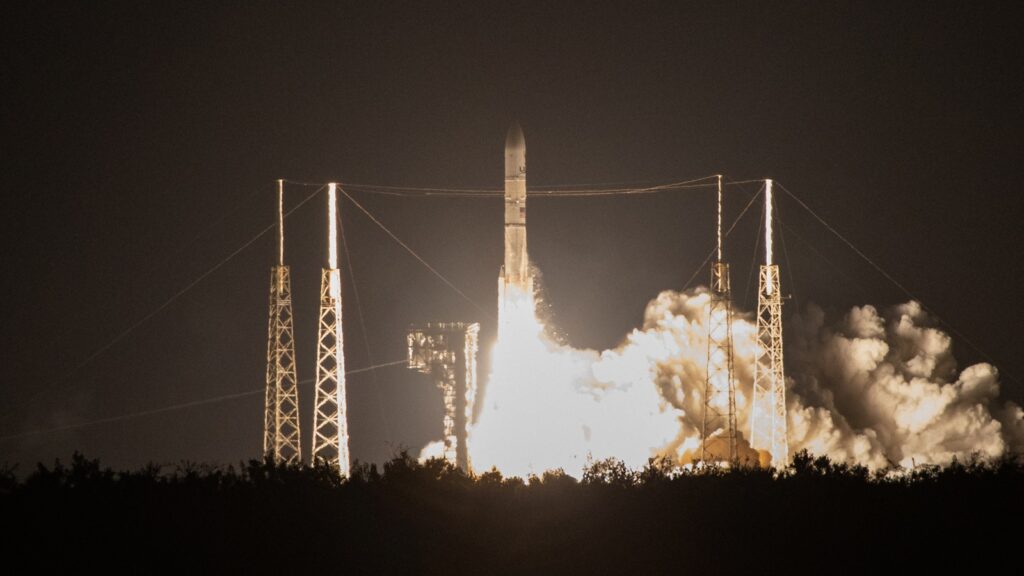
CAPE CANAVERAL, Fla. – Amazon is targeting November 13 for its first satellite launch aboard United Launch Alliance’s Vulcan rocket, a mission carrying 40 Leo broadband satellites, the largest batch the company has planned for a single launch so far.
The mission opens a 38-launch Vulcan contract that Amazon expects to carry more than 1,500 of its first-generation satellites. The company said Monday that Vulcan will deliver close to half of that initial constellation, making the rocket central to its plan to expand satellite internet service.
In its November 9 announcement, Amazon said it has hundreds of flight-ready satellites awaiting launch after completing its 1,000th satellite in early September. Manufacturing satellites and getting them into orbit are separate steps: the production milestone does not mean 1,000 satellites are already operating in space.
ULA’s mission page lists liftoff for Friday, November 13, at 12:54 p.m. Eastern from Space Launch Complex 41 at Cape Canaveral Space Force Station. The launch remains a target, not a completed deployment.
The flight, called Leo Vulcan 1, will use a shorter version of Vulcan’s Centaur V upper stage designed for low Earth orbit, along with six side-mounted solid rocket boosters. Amazon said it will be the first Vulcan mission to fly that six-booster configuration.
Those changes are intended to carry more satellites per flight. Amazon said initial Leo-Vulcan missions will each carry 40 satellites, with larger payload configurations planned as the rocket’s capabilities develop.
The business challenge is launch capacity. A broadband constellation needs repeated deployments to add coverage and network capacity, so a larger payload is useful only if rockets can also fly frequently enough.
Amazon has funded a dedicated vertical integration facility and mobile launch platform at Cape Canaveral. The company said the new infrastructure lets ULA prepare two Vulcan missions at the same time. A second flight, LV-02, is already in preparation and is expected within weeks of a successful first mission.
The company also uses Arianespace, Blue Origin and SpaceX in its launch portfolio rather than relying on a single provider. Its next Ariane 6 mission, Leo Europe 4, is targeting no earlier than November 23 from Kourou, French Guiana.
Amazon said an initial service rollout is expected later this year, followed by wider expansion as additional satellites reach orbit. Monday’s announcement did not give a customer price or a detailed service-availability map. The November 13 launch and the pace of subsequent missions remain the next tests of that rollout plan.
JBizNews Desk | Cape Canaveral, Fla.
© JBizNews.com. All rights reserved. Unauthorized reproduction or redistribution is strictly prohibited.