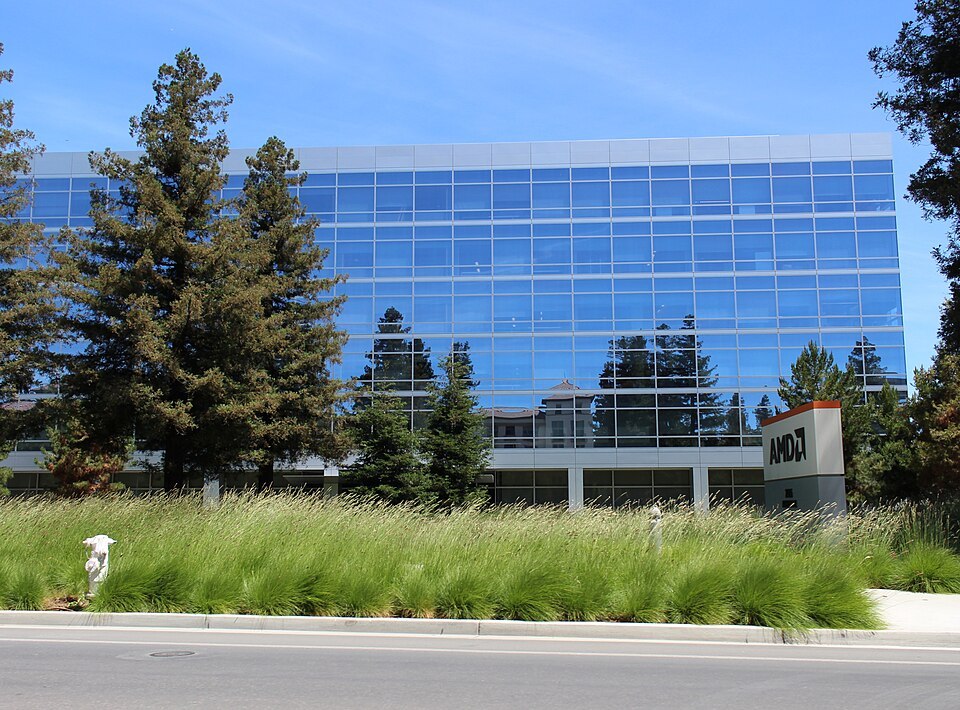
AMD’s headquarters in Santa Clara, California, photographed in June 2020. Photo: Coolcaesar via Wikimedia Commons, CC BY-SA 4.0. Resized.
AMD said Tuesday it will invest $1 billion in Meta’s equity offering as the companies deepen a computing partnership spanning AI processors, networking and software, adding a financial stake to a relationship already built around large purchases of computing equipment.
The chipmaker also said initial versions of its Helios rack-scale AI systems have been installed at Meta and are being tested ahead of a broader deployment. That is an early installation and testing milestone, not a statement that the full planned rollout is complete.
AMD’s announcement did not disclose the equity offering’s price, the number of shares it would buy or when the investment would close. It also did not give a new dollar value for Meta’s purchases of AMD equipment.
From individual chips to complete systems
The relationship covers several layers of Meta’s infrastructure. AMD said its EPYC central processors support the dedicated computing environments behind Meta’s Muse personal AI agent, while its Instinct graphics processors already handle production workloads including AI training, ranking and recommendation systems.
Central processors handle general computing tasks. Graphics processors are used for the parallel calculations involved in training and running AI models. Rack-scale systems combine processors and other equipment into larger units, making networking and software part of the same deployment decision.
AMD said Meta has deployed millions of EPYC processors across multiple generations and is a lead customer for its sixth-generation EPYC chips. The companies are also working on future processor generations, including one called Verano.
Meta was an early customer involved in defining AMD’s MI450 graphics architecture and will deploy a custom Instinct GPU optimized for its workloads, according to AMD. The collaboration is also informing the chipmaker’s future MI500 series and next-generation rack-scale systems.
The software work behind the hardware
AMD said the companies are expanding work on large-scale AI training, optimizing recommendation models on Instinct MI350X processors and contributing changes to the PyTorch, Triton and ROCm software ecosystems.
That software matters because installing chips does not by itself make an AI workload ready to run. The tools used to build, train and operate models must work with the hardware, and changes made for a large customer can become useful to other developers.
AMD also said it provided support from launch for Meta’s Muse Spark Open models on Instinct GPUs and for Muse Glimmer on Ryzen AI personal computers and Radeon graphics processors.
The companies describe their work as building infrastructure at gigawatt scale, but Tuesday’s statement did not specify the capacity already operating, the number of Helios racks in testing or a dated schedule for the wider rollout.
The $1 billion equity investment places AMD on both sides of the relationship: a supplier of computing technology and a planned shareholder participating in Meta’s financing. The announcement does not establish how much future chip revenue that investment will generate. The next concrete milestones are the offering’s terms and the move from initial Helios tests to broader deployment.
JBizNews Desk | Santa Clara
© JBizNews.com. All rights reserved. Unauthorized reproduction or redistribution is strictly prohibited.