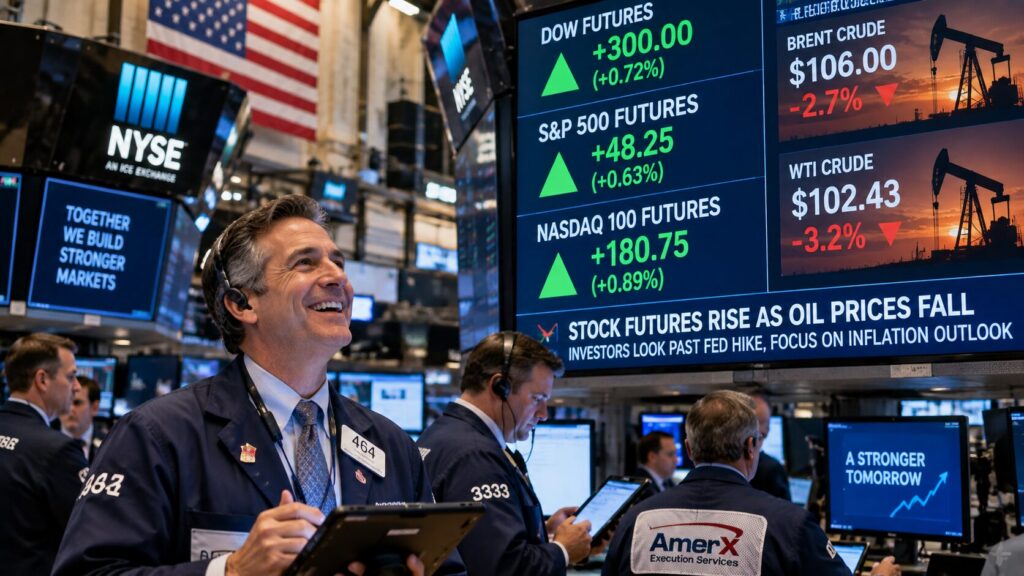
U.S. stock futures climbed Thursday morning as investors moved to claw back Wednesday’s losses, when the Federal Reserve raised interest rates for the first time in three years and rattled markets.
The Dow Jones Industrial Average had dropped 631 points Wednesday, and the S&P 500 closed below 7,600, after the Fed lifted its benchmark rate by a quarter percentage point to a range of 3.75%-4%. Federal Reserve Chairman Kevin Warsh told reporters he was “hard pressed” to call the inflation picture improved, and most policymakers penciled in at least one more rate hike before year’s end. Stocks initially took the widely expected move in stride, then sold off sharply during Warsh’s press conference as his inflation warnings sank in.
By Thursday, the mood had reversed. Dow futures jumped roughly 300 points as two things worked together in investors’ favor: Treasury yields eased back from highs not seen since 2007, and oil prices kept sliding for a second straight day. Brent crude traded near $106 a barrel after losing 2.7% Wednesday, while U.S. crude sat above $102 following a 3.2% drop.
The connection between oil and the stock rebound is direct. Saudi Arabia has been working to fix a damaged pipeline that carries about 7 million barrels of oil a day across the kingdom to its Red Sea coast, and officials now expect to restore roughly half its capacity within days and finish full repairs in about six weeks. That timeline gave traders confidence to unwind some of the risk premium that had built into oil prices, which in turn eased worries that gas and energy costs would keep pushing inflation higher. Lower inflation fears mean less pressure on the Fed to keep raising rates aggressively, which is why stocks, bonds, and oil all moved together Thursday.
Not every voice on Wall Street is fully convinced the selloff is over. Mark Haefele, chief investment officer at UBS Global Wealth Management, said his team remains “positioned for further equity gains while preparing for near-term volatility.” He said that if the Fed’s rate increases stay measured, credit conditions hold steady, and corporate earnings keep growing, “the rally should have scope to broaden across sectors and regions.” His guidance to investors: spread bets across the market rather than loading up on stocks especially sensitive to interest rates or dependent on one theme carrying them higher.
The rate hike itself still matters for everyday costs even as stocks bounce back. A quarter-point increase from the Fed ripples into everything tied to the prime rate — credit card interest, small-business loans, and adjustable-rate debt all get a bit pricier. Mortgage rates tend to follow longer-term Treasury yields more closely than the Fed’s overnight rate, so Thursday’s dip in the 10-year yield offers a small counterweight, but the overall borrowing environment remains tighter than it was a week ago.
For households, that combination cuts two ways at once. Gasoline prices should eventually ease if Saudi Arabia’s pipeline repairs stay on schedule, since crude oil is the biggest single input into what drivers pay at the pump. But the cost of carrying a credit card balance or financing a car just went up, and Fed officials have signaled they aren’t finished raising rates this year. One relief doesn’t cancel out the other; they’re simply moving on different timelines.
Markets will get a clearer read on how durable Thursday’s rebound is once trading opens and investors see whether buying interest holds up through the session. The bigger questions — whether Saudi Arabia’s pipeline comes back online on schedule, and whether the Fed follows through with another rate increase in the coming months — will keep shaping both stock prices and household budgets well beyond this week’s bounce.
JBizNews Desk | Wall Street
© JBizNews.com All Rights Reserved. Reproduction or distribution without written permission is prohibited.