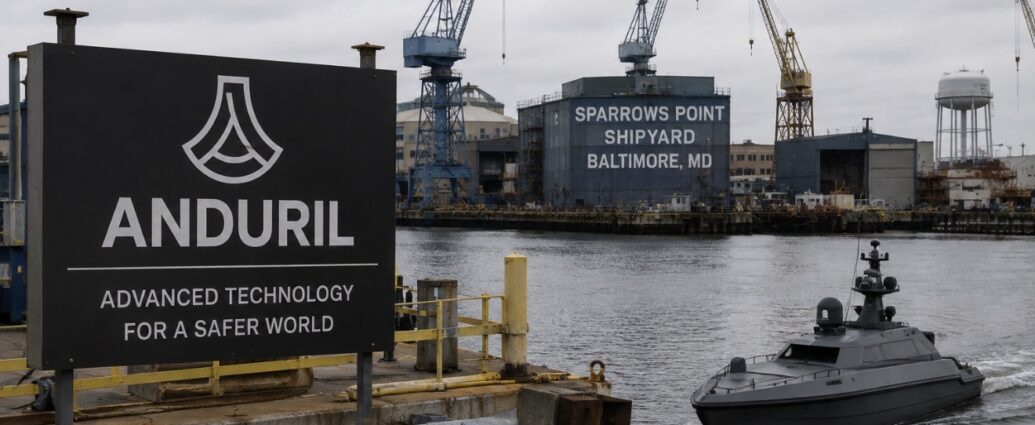
Anduril Industries is in advanced talks to build a drone boat production site at Sparrows Point, the 3,300-acre former Bethlehem Steel complex in Baltimore County, in a deal that could run into the hundreds of millions of dollars and return shipbuilding work to one of the East Coast’s largest deep-water industrial sites.
The defense manufacturer has signed a memorandum of understanding with the operators of the yard, according to reporting published Monday by The Wall Street Journal citing people familiar with the discussions. The facility would handle both manufacturing and on-water testing of the company’s unmanned surface vessels.
No lease has been signed, and the people cautioned that the talks could still fall apart. The office of Maryland Gov. Wes Moore has been involved in the discussions, and any agreement would likely carry state incentives to offset Anduril’s costs. A spokesman for Moore declined to comment. A spokesman for Tradepoint Atlantic, which owns Sparrows Point, did not respond to requests for comment.
The site’s recent history is one of reinvention. Investors began acquiring the former Bethlehem Steel property in 2014 for redevelopment and renamed it Tradepoint Atlantic. It now hosts fulfillment and logistics operations for retailers including Amazon and Home Depot, and two years ago it served as the staging ground for rerouted cargo traffic and wreckage recovery after the Francis Scott Key Bridge collapse — a role that demonstrated the site’s deep-water capacity under emergency conditions. Its shipbuilding past runs deeper still: a 32,000-ton vessel launched at Sparrows Point in 1956 was at the time the largest cargo ship in the country.
Geography is a substantial part of the appeal. A Baltimore-area production site would put Anduril’s boat manufacturing within reach of Washington and of the Coast Guard’s largest shipyard, making testing and integration with the Coast Guard fleet considerably simpler, one of the people familiar with the matter said. That proximity matters for a product line still working its way through certification and fielding.
Anduril’s maritime operation is young and geographically thin. The company revamped a Seattle shipyard for low-rate production, and prototypes of the vessel it is developing with South Korea’s HD Hyundai Heavy Industries are being built in Korea. It also holds a partnership with United Kingdom-based Kraken Technology Group. A Maryland facility would be its first East Coast production capacity for the category.
The push comes despite a recent setback. Anduril lost a Navy competition for medium-size drone boats, an award that left out several bidders and prompted defense-technology executives to take complaints to Congress and, in some cases, to sue the government. Anduril is not among the companies suing.
Entering unmanned surface vessels also puts a large, well-capitalized manufacturer into a field crowded with startups competing for Navy work — including BlackSea Technologies, already based in Baltimore. Anduril has expanded into nearly every corner of defense contracting, from jets to submarines to counterdrone systems, and it now arrives in a market where smaller firms have been the incumbents.
The capital behind the expansion is considerable. Anduril closed a $5 billion round in May at a $61 billion valuation, led by Thrive Capital and Andreessen Horowitz, and has been working to roughly double capacity across its weapons-systems production. Reuters reported on July 24 that the company is in talks for a further raise that could value it near $100 billion, potentially structured in two tranches. That balance sheet is what makes a nine-figure commitment to an idle industrial site plausible.
Demand is the other half of the equation. Drone boats have moved from experiment to fielded capability for militaries worldwide — Ukraine used them to significant effect against Russian forces in the Black Sea, and the U.S. military’s own wartime debut came in the conflict with Iran, where autonomous vessels built by Saronic recovered two Apache crew members after their helicopter was shot down and carried out strikes on Iranian shipping and submarine infrastructure. Surveillance, however, remains the dominant use.
For Maryland, the calculation is straightforward. Sparrows Point employed generations of steelworkers and shipbuilders before the industry left, and the redevelopment that followed has leaned heavily on warehousing and logistics — sectors that generate volume but comparatively modest wages. Advanced manufacturing at scale would change that mix, and it would do so on a site that already carries the berthing, rail access and acreage that took a century to assemble and cannot be easily rebuilt elsewhere.
Whether it happens turns on terms that have not been agreed. The memorandum of understanding is a framework, not a commitment, and the incentive package that would likely accompany any deal has yet to surface publicly. What the talks confirm is that the Navy’s appetite for uncrewed hulls has outrun the handful of small yards currently building them, and that the search for capacity has turned toward the industrial waterfronts the country stopped using.
JBizNews Desk | Baltimore
© JBizNews.com All Rights Reserved. Reproduction or distribution without written permission is prohibited.