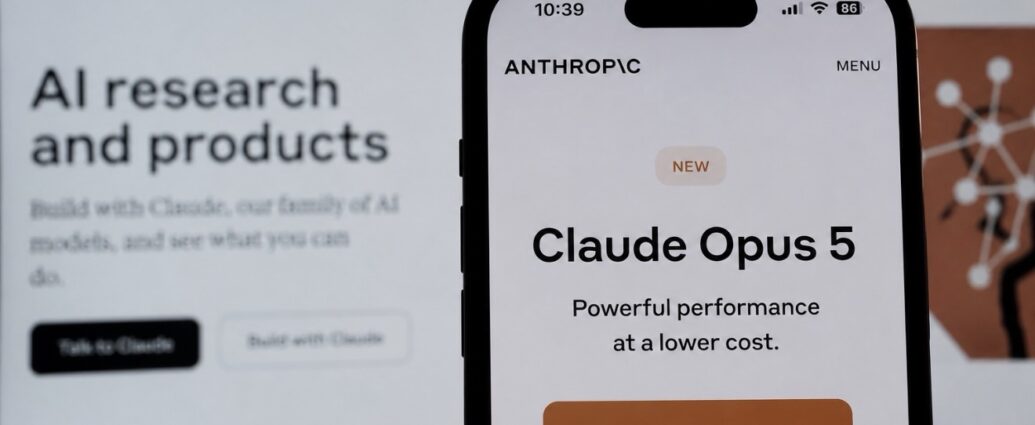
Anthropic is pushing more advanced artificial intelligence into a lower price tier with Claude Opus 5, a new model released Friday for businesses that need complex coding, financial analysis and long-running automated work without paying for the company’s most expensive system.
Available across Anthropic’s platforms and developer tools, Opus 5 costs $5 per million input tokens and $25 per million output tokens, unchanged from the previous Opus 4.8 model. Anthropic says the new version comes close to the performance of its more powerful Fable 5 system at roughly half the price, widening access to capabilities that had remained concentrated at the top of the market.
That shift could matter more to businesses than another round of benchmark gains.
Companies rarely pay for a single AI answer. Costs accumulate as employees analyze documents, software agents run for hours, developers test code and customer-service systems process thousands of requests. A model that completes more difficult work without moving into a higher price category can change whether those projects remain experiments or become part of everyday operations.
Opus 5 was built with long-running agents in mind, allowing it to continue working across larger projects while retaining context and adjusting its approach as tasks evolve. Anthropic is positioning the model for software development, research and professional work that requires more than a short response or one-step instruction.
Speed remains available at an additional cost. A faster version runs at approximately 2.5 times the standard rate and is priced at twice the base level, giving customers a choice between lower operating expenses and quicker completion when time matters more.
Alongside the model launch, Anthropic introduced beta updates intended to improve how developers manage longer tasks and review the work produced by automated systems. Those tools reflect a broader change in the AI market as companies move beyond asking models isolated questions and begin assigning them ongoing responsibilities inside real business processes.
Lower pricing will also increase pressure on competing providers. Businesses comparing AI systems are paying closer attention to the cost of completing a reliable task rather than the cost of generating a single response, especially when models are deployed across large workforces or used continuously through software.
Accuracy and oversight remain central to that calculation. A cheaper model provides little value if employees must spend additional time correcting mistakes, while a more capable system can justify a higher price when it reduces rework or completes assignments that would otherwise require specialized staff.
Anthropic’s release therefore marks more than another model upgrade. As advanced AI becomes less expensive, the competitive advantage is shifting toward companies that can integrate it into daily operations without losing control of quality, security or spending. Opus 5 gives businesses another option for doing that—and raises the pressure on the rest of the industry to deliver more capability without simply charging more for computing power.
JBizNews Desk | Wall Street
© JBizNews.com All Rights Reserved. Reproduction or distribution without written permission is prohibited