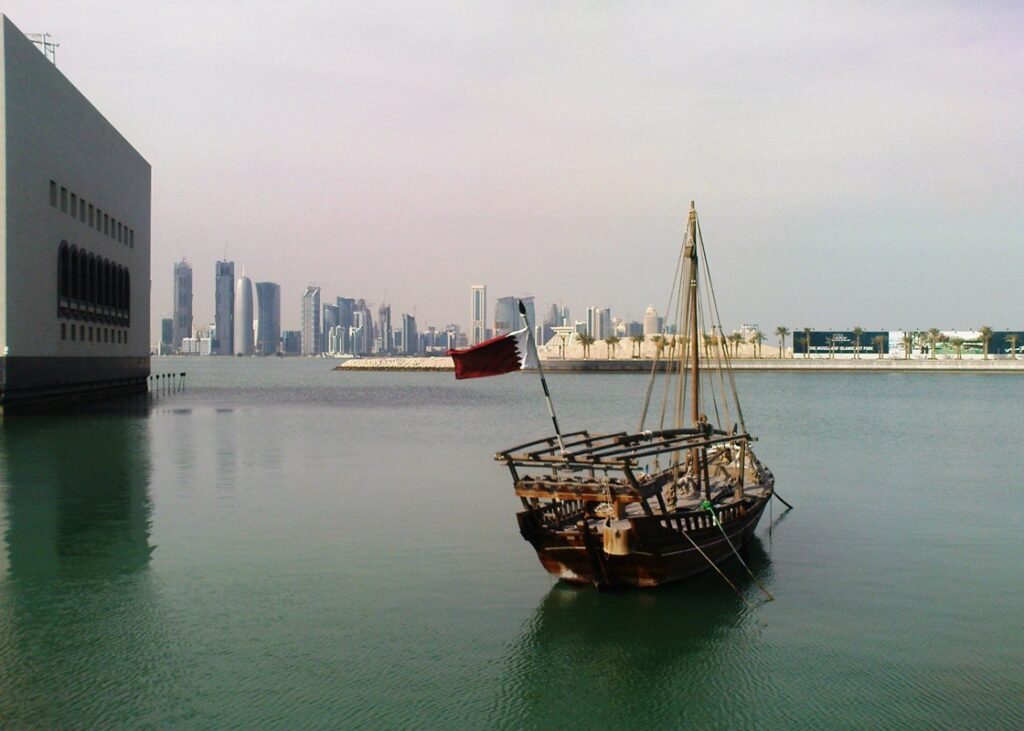
Urbanplay / Wikimedia Commons (CC BY-SA 3.0; 2010 archive; crop).
Iranian Foreign Minister Abbas Araghchi said Qatari-mediated indirect talks between Tehran and Washington were “very intense,” even though the days-long talks ended with no significant movement toward a deal on Monday.
In comments to Iranian state media outlet IRNA, Araghchi claimed that the future of diplomatic efforts depends on the US’s “political rationality,” warning that any renewed military operations against Iran will be met with a heavy response.
Also on Monday, Iran’s President Masoud Pezeshkian said the country’s Supreme Leader, Mojtaba Khomenei, has granted the government “certain authorities” over peace talks.
Pezeshkian said Tehran “will try to resolve the problem with dialogue,” without elaborating, according to state media.
Pezeshkian’s comments came after Tehran’s foreign ministry said that indirect contact between Iran and the United States to end their eight-month war is continuing.
“I can tell you that the dialogs are continuing. However, the issue is complex,” said Foreign Ministry spokesperson Esmaeil Baghaei, adding that the two sides were exchanging messages through mediators.
Amid fears the conflict could reignite after Tuesday’s midterm elections in the United States, China and Russia both spoke out on Monday against the possibility of renewed military action in a war that has hit the global economy.
Iranian sources think US attack more likely than deal
While oil prices fell nearly 4% on Monday on hopes that the latest round of mediation could lead to a diplomatic solution to the crisis, Iranian sources said they believed a new US attack was still more likely than a deal.
Baghaei said the plan Iran had submitted in September to end the war remained the focus of discussions, but he confirmed comments attributed to Araghchi on Saturday that the proposal could be shortened.
“The basis of dialogue and talks between Iran and the US via mediators is still Iran’s seven-step proposal, which is now condensed, making it possible to implement it within two days,” he said.
US President Donald Trump rejected the seven-step proposal in September.
The plan would call for the US to end its blockade on Iranian ports, Iran to reopen the Strait of Hormuz waterway, a US waiver on Iranian oil sales, the cancellation of new sanctions on Iran and then talks on other issues.
Baghaei reiterated that condensing the plan would not change Iran’s underlying stance that a return to talks on the country’s nuclear program could only happen after it verified that all its conditions were met.
Asked whether the possibility of transferring Iran’s highly enriched uranium stockpile to another country was raised in the talks, and whether Iran might agree to that, he said no.
An official briefed on the talks said Iran’s negotiators had left on Sunday but not because of any problems in the talks, and added that a draft proposal was being circulated without elaborating.
The war, which the US and Israel launched on February 28, has led to Iran’s closure of the key Strait of Hormuz waterway, a US blockade on Iranian ports, repeated bouts of Iranian drone and missile fire on Gulf states and renewed conflict in Yemen.
Trump has repeatedly said there would be no new attack on Iran before Tuesday’s midterm elections. Iran has said it will respond to any resumed attack aggressively, with plans to strike targets both within and outside the Middle East.
China, Russia encourage diplomatic efforts
China’s Foreign Minister Wang Yi said on Monday that all parties to the conflict should focus on political solutions rather than resorting to arms again after a meeting with senior Iranian security official Ali Bagheri Kani in Beijing.
In Moscow, the Russian Foreign Ministry said reports of new military action against Iran were a cause for extreme concern and called for increased diplomatic efforts.
Iran’s top security official, Mohsen Rezaei, discussed developments in the Middle East in a phone call with Russian President Vladimir Putin, Iran’s state media reported on Monday.
Underscoring the risks to global energy supply, a Qatari liquefied natural gas (LNG) tanker was struck in the Gulf by unidentified objects on Friday, its operator Nakilat said on Sunday.
While attacks on oil tankers in the Gulf and Red Sea have been common during the conflict, attacks on LNG carriers have been rare, with the last reported incident with a Qatari tanker happening in early July.
Originally published by The Jerusalem Post.
JBizNews Desk | Global
© JBizNews.com. All rights reserved. Unauthorized reproduction or redistribution is strictly prohibited.