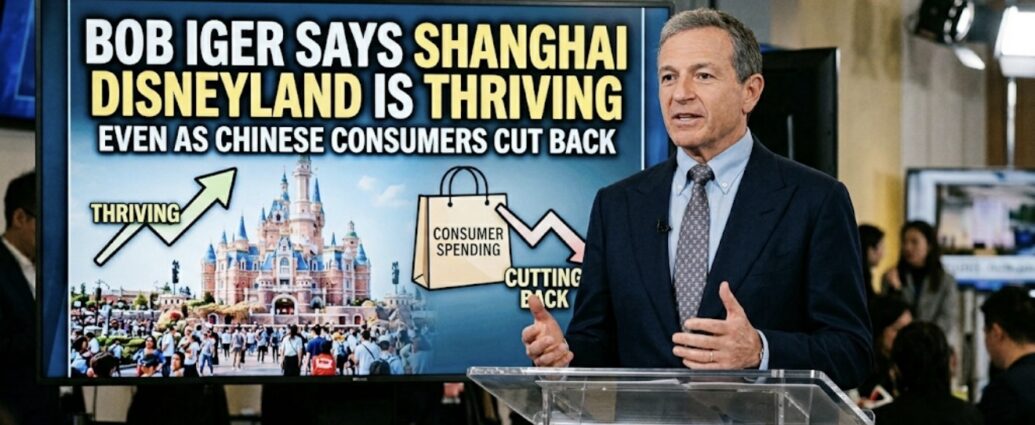
While much of China’s economy is feeling the effects of cautious consumer spending, Bob Iger says one place remains packed: Shanghai Disneyland.
Speaking with CNBC on Friday during celebrations marking the park’s 10th anniversary, the former Walt Disney Company chairman and CEO said the resort remains one of the achievements he is most proud of from his decades at Disney. Iger stepped down as CEO in March, handing leadership to Josh D’Amaro, and now serves as a senior adviser.
His comments come at a time when Chinese consumers have been pulling back spending across much of the economy. Households have become more selective with discretionary purchases as economic growth slows, affecting everything from restaurant visits to clothing sales. Yet Disney’s flagship mainland China resort continues to post strong results.
Shanghai Disneyland, which opened in June 2016, surpassed 100 million cumulative visitors in 2025, according to Disney. The company is also continuing to expand the resort, adding its third and fourth hotels and developing a new Spider-Man-themed land. The expansion follows the successful opening of the world’s first Zootopia land in 2023.
Disney also operates Hong Kong Disneyland, which opened in 2005, giving the company two major theme park destinations in Greater China.
The importance of those parks extends far beyond tourism.
Disney’s Experiences division—which includes theme parks, resorts, cruise operations and merchandise—generated nearly $9.5 billion in revenue during the quarter ended in March, a 7% increase from a year earlier.
The segment now accounts for roughly 40% of Disney’s total revenue and nearly 60% of its operating profit, making it the company’s most important earnings engine.
At the same time, Disney has reported some softness in international attendance at its U.S. parks as overseas travel to America slows. Company executives have pointed to changing global travel patterns and weaker demand from some foreign visitors.
Outside the United States, however, Disney’s parks have remained more resilient, with Shanghai standing out as one of the company’s strongest performers.
Analysts say the reason Chinese consumers continue spending at Disney while cutting back elsewhere comes down to perceived value. Experiences that create lasting memories, social-media appeal and emotional satisfaction continue attracting spending even when households are tightening budgets.
One frequently cited example is the popularity of Disney character LinaBell, whose merchandise and appearances have developed a devoted following among younger Chinese consumers. Market researchers say the character demonstrates how shoppers continue prioritizing products and experiences that deliver emotional value.
The financial trade-offs can be significant.
One university student interviewed by CNBC said she and a friend budgeted 5,000 yuan, or about $735, for a five-day trip to Shanghai. Roughly 20% of that budget was spent during a single day at Shanghai Disneyland. To stay within budget, the travelers reduced spending elsewhere, including choosing less expensive hotel accommodations.
In other words, the Disney visit remained a priority while other expenses were cut.
The resort’s success also highlights Disney’s unique position amid ongoing tensions between the United States and China.
Despite disputes over trade, tariffs and broader geopolitical issues, Disney has maintained strong relationships with Chinese officials. In January, Iger met in Beijing with Chinese Vice Premier Ding Xuexiang, who encouraged Disney to continue investing in the country.
The meeting drew attention because Beijing had previously suggested restrictions on Hollywood film imports as a potential response to U.S. tariff policies. Disney’s continued cooperation with Chinese officials has fueled speculation that the company could eventually pursue a third mainland China resort, potentially in the Greater Bay Area near Guangzhou or in Chengdu.
There are clear business reasons for Disney to focus on theme parks in China.
China maintains strict quotas limiting the number of foreign films allowed into domestic theaters each year, restricting Hollywood’s access to the market. Theme parks face no comparable restrictions. Once developed, resorts generate recurring revenue through admissions, hotels, food, beverages and merchandise sales for decades.
That makes parks one of Disney’s most effective long-term growth strategies in China.
For Iger, Shanghai Disneyland has become a defining part of his legacy as he prepares to depart Disney entirely at the end of the year. The decision on whether Disney eventually expands further in China now rests with Josh D’Amaro, whose background includes leading Disney’s parks and experiences business.
If Chinese consumers continue treating a Disney vacation as a splurge worth protecting, Disney’s next move in China may become increasingly difficult to resist.
JBizNews Desk
© JBizNews.com All Rights Reserved. Reproduction or distribution without written permission is prohibited