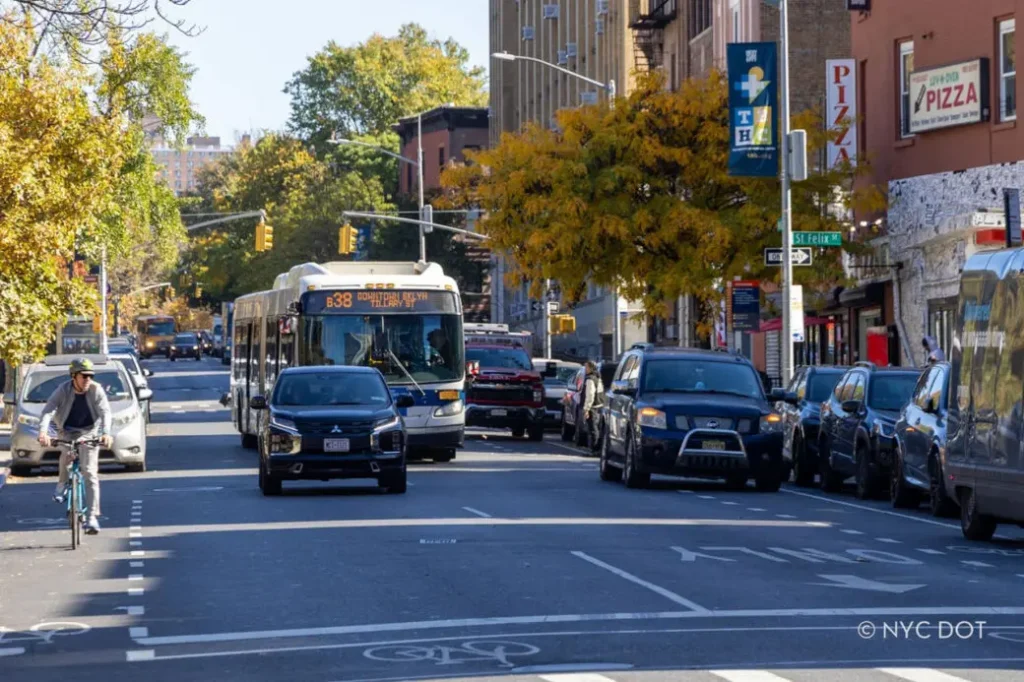
About 18,000 Brooklyn bus riders can soon expect faster service as the city breaks ground on a redesign of DeKalb and Lafayette Avenues. Mayor Zohran Mamdani and Department of Transportation (DOT) Commissioner Mike Flynn on Thursday announced the start of work on the project, which aims to speed up service for daily riders of the B38 bus. The project will redesign DeKalb Avenue from Broadway to Flatbush Avenue and Lafayette Avenue from Ashland Place to Patchen Avenue, adding 2.7 miles of new offset and curbside bus lanes, protected bike lanes, and other street safety improvements.
The B38 runs through neighborhoods including Bed-Stuy, Clinton Hill, and Fort Greene, where reliable and affordable public transportation is vital. Eighty percent of residents within a quarter-mile of the B38 commute to work by public transit, bike, or on foot, and a majority of households don’t own a vehicle.
Currently, both avenues feature curbside parking lanes, two motor vehicle lanes, an unprotected bike lane, and a second curbside parking lane. According to Streetsblog, this layout means that rows of parked cars can easily block the bike lane, while the B38 is forced to compete for space with drivers who double-park.
This bottleneck has caused bus speeds on both avenues to drop as low as four miles per hour during the morning and evening rush hours, when ridership in the area peaks.
Additionally, both DeKalb and Lafayette Avenues are notorious for their street safety issues. Since 2021, crashes along the two corridors have injured a combined 841 people, including 47 who suffered severe injuries. One person has been killed.
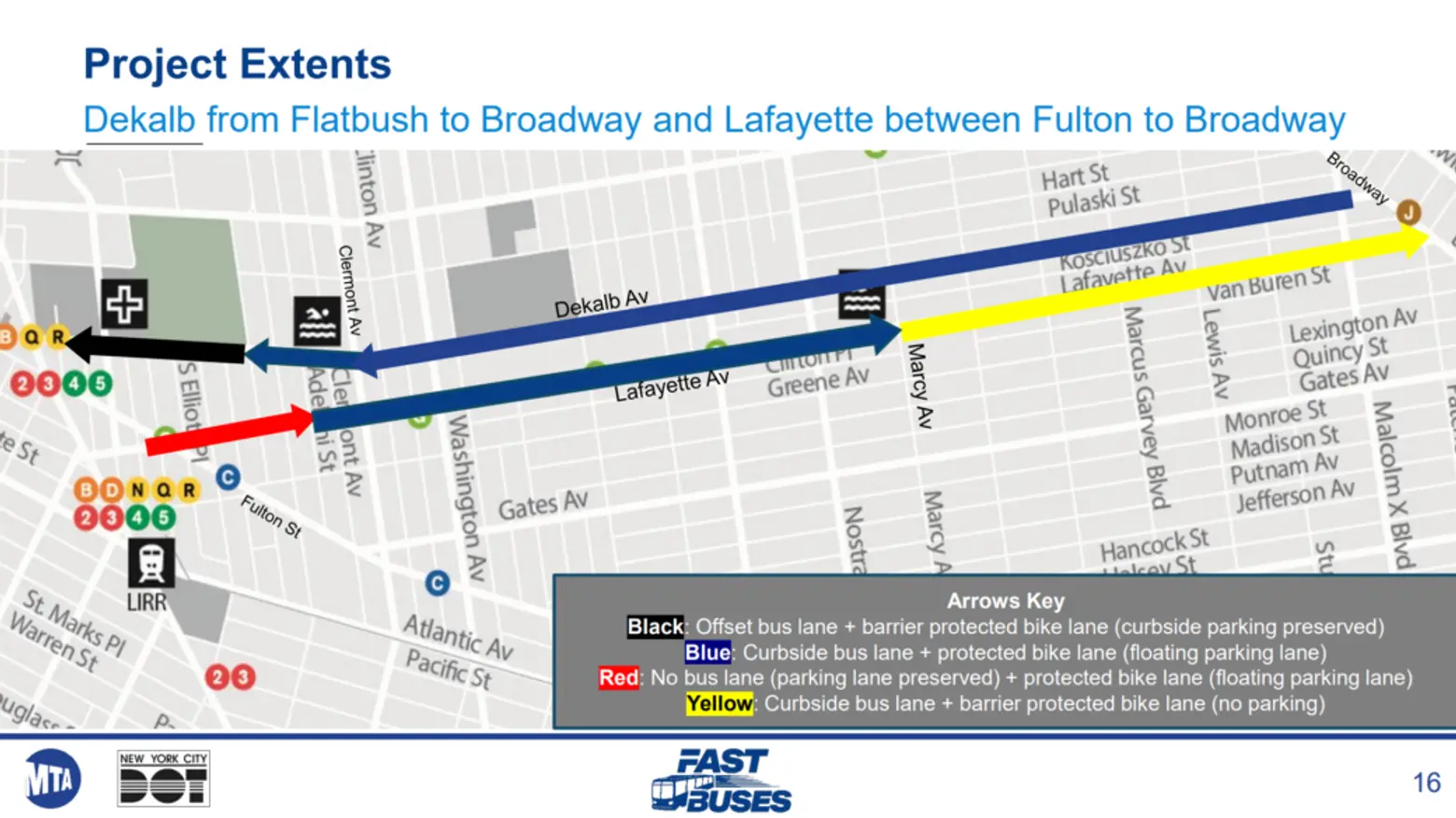
The project aims to address these long-standing issues. First proposed by the Mamdani administration in September, the effort will add a mix of curbside bus lanes operating from 7 a.m. to 7 p.m., a 24-hour offset bus lane, and parking-protected and barrier-protected bike lanes along nearly six miles of streets, as reported by Streetsblog.
On DeKalb Avenue between Malcolm X Boulevard and Cumberland Street, DOT will install a curbside bus lane and a parking-protected bike lane, with a general travel lane between them. Between Cumberland Street and Flatbush Avenue, the agency will install a new 24-hour offset bus lane, a barrier-protected bike lane, and a general travel lane between them.
On Lafayette Avenue between Patchen and Marcy Avenues, DOT will add a curbside bus lane and a Jersey barrier-protected bike lane, with a general travel lane in between. Between Marcy and Classon Avenues, the agency will install a curbside bus lane and a parking-protected bike lane, with a general travel lane between them.
Between Classon Avenue and Adelphi Street, a new curbside bus lane and parking-protected bike lane, with a general travel lane in between, are also slated for installation. The stretch of Lafayette Avenue between Adelphi and Fulton Streets will get a parking-protected bike lane, while the avenue between Fulton Street and Ashland Place will receive a barrier-protected bike lane.
Upon completion, cyclists will benefit from a fully protected route connecting to the protected bike lane on Ashland Place, which leads to the Brooklyn and Manhattan Bridges, the greenway along Flushing and Kent Avenues, and the protected bike lane on Fourth Avenue.
Additionally, aside from a short, paint-only segment on Bond Street, DeKalb Avenue’s protected bike lane will connect to the protected lane on Schermerhorn Street. Lafayette Avenue’s protected lane will also link to the Schermerhorn Street lane once ongoing work on the Boerum Place and Adams Street bike lane redesign is completed later this year, according to Streetsblog.
“New Yorkers shouldn’t have to choose between getting where they need to go on time and getting there safely. On DeKalb and Lafayette, we’re putting that principle into practice with fast buses, protected bike lanes and safer streets,” Mamdani said.
“New Yorkers deserve a city that respects their time and puts their safety first and our administration isn’t waiting a moment to build the streets that do just that,” he added.
The redesign is part of Mamdani and Gov. Kathy Hochul’s “Next Stop: Fast Buses, Better Service” partnership, unveiled in July. The plan aims to speed up bus service along 50 priority corridors across the five boroughs through a mix of service changes, traffic enforcement upgrades, and street redesigns.
So far in 2026, the Mamdani administration has advanced numerous projects to improve bus service and street safety. Examples include redesigns of Brooklyn’s Marcy, Flatbush, and Utica Avenues; the Bronx’s Fordham Road, 161st Street, and Tremont Avenue; and Manhattan’s 34th Street, 116th Street, Madison Avenue, and Lexington Avenue.
“Every New Yorker deserves fast, reliable bus service and safer streets. Your zip code shouldn’t determine whether you have access to high-quality, affordable transportation—and that’s what we’re working to deliver on DeKalb and Lafayette avenues,” Flynn said.
“The redesign of DeKalb and Lafayette will increase bus speeds and improve reliability for bus riders while creating safer routes for all road users and calmer corridors for pedestrians,” he added.
RELATED:
- City will redesign Sunset Park’s deadly Third Avenue
- NYC installs red light cameras at 600 intersections
- Avenue B redesign expands pedestrian space, limits traffic
The post Brooklyn’s DeKalb and Lafayette Avenues getting major bus and bike lane upgrades first appeared on 6sqft.