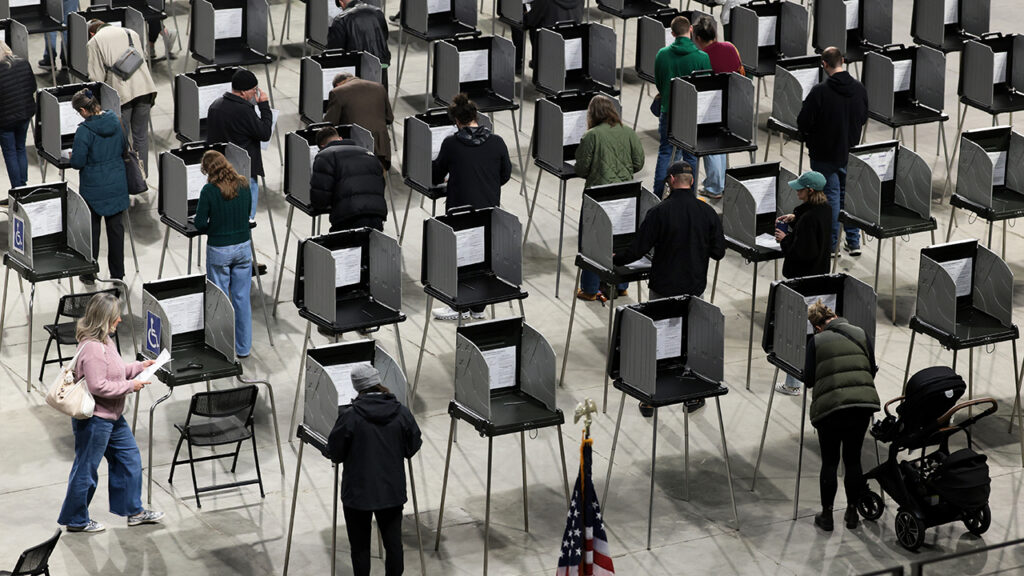
Democrats’ takeover of both chambers of Congress in the midterm elections drew mixed reactions from investors and business leaders Wednesday, with some anticipating greater economic stability and others warning of increased scrutiny of artificial intelligence and data center development.
U.S. stock futures initially declined overnight as investors assessed the potential for tighter regulation of AI, cryptocurrency and data centers. Futures later recovered after President Donald Trump said he would accept the election results, according to Reuters.
“This has helped ease some concerns about prolonged political confrontation and legislative gridlock,” Daniela Hathorn, a senior market analyst at Capital.com, told Reuters. She added that significant policy disagreements would remain likely.
US STOCK FUTURES MIXED AS DEMOCRATS SCORE KEY MIDTERM ELECTION WINS
Some investors also saw potential benefits in a divided government, with Democrats controlling Congress and Republicans retaining the White House.
Deborah Cunningham, chief investment officer for global liquidity markets at Federated Hermes, said the political split could create a “blockade against new legislation.” Financial markets have historically viewed divided government favorably because it can limit major policy changes and reduce uncertainty over new legislation.
For technology companies, however, the election results raised concerns about potential restrictions on AI infrastructure investment, particularly the construction of power-intensive data centers.
Elon Musk, who spent more than $400 million backing Republican candidates during the election cycle, reacted on X after several candidates he supported lost their races.
“Data centers in space looking pretty appealing right now,” Musk quipped on X, later following up with: “Guess my election-interfering space lasers didn’t work this time.”
His remarks came amid concerns that Democratic victories could bring greater scrutiny of the electricity and water demands associated with AI data centers.
In Texas, Democratic Gov.-elect Gina Hinojosa campaigned on maintaining a moratorium on new data center construction until the state addresses those impacts.
Brad Gerstner, CEO of Altimeter Capital, said concerns about a broad halt to AI infrastructure development were exaggerated, although additional regulations could delay some projects. He estimated that 10 to 15 gigawatts of expected AI capacity could be affected, according to MarketWatch.
While technology investors weighed the potential costs of additional oversight, executives in other industries expressed optimism that the election results could create a more predictable business environment.
Continental CFO Roland Welzbacher said companies operating in the U.S. could benefit from greater economic predictability, telling Reuters that stability remained a priority.
“What we need as a company in the U.S. is stability and a reliable economic framework,” Welzbacher said. “Everything which is embracing this is welcome.”
Stefan Schulte, CEO of German airport operator Fraport, also suggested the election results could encourage more international travel to the U.S. by easing concerns about customs-related difficulties, although he cautioned against overstating their significance.
The results also drew a positive response from LinkedIn co-founder Reid Hoffman, a major Democratic donor, who described the outcome as a rejection of the political status quo and urged Democrats to focus on building an economy that benefits more Americans.
CLICK HERE TO GET FOX BUSINESS ON THE GO
“These elections were an overwhelming wave against Trump and his cronies,” Hoffman said, in part, in a thread on X. “Now it’s on Democrats to make a hopeful case for our future – to fight for an economy that serves every American, not just the already rich and powerful.”