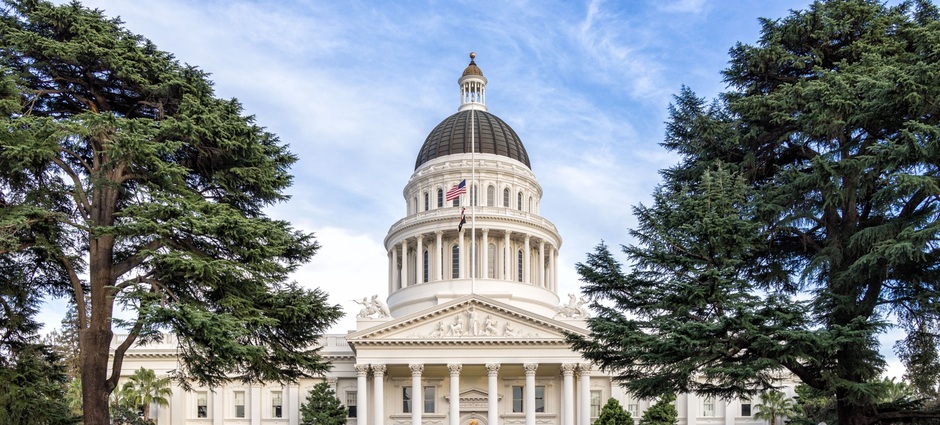
California State Capitol in Sacramento, archive photograph (2014). Andre m / Wikimedia Commons, CC BY-SA 3.0. Cropped.
California faces a projected $2 billion budget shortfall in 2027-28 and annual deficits exceeding $15 billion starting the following year, the state’s Legislative Analyst’s Office warned Wednesday. A sharp stock-market downturn could leave the state with much larger gaps, putting pressure on the money available for public services.
The nonpartisan office’s November 18 fiscal outlook says stronger tax collections and spending reductions already adopted have improved California’s finances compared with last year’s projections. But they have not closed the underlying gap between the state’s ongoing commitments and the revenue expected to pay for them.
The warning centers on California’s dependence on investment gains and stock-based pay among high-income taxpayers. A stock-market boom can bring in more income-tax revenue. If share prices fall, that revenue can shrink while the state still has bills to pay for schools, health care and other services.
Two forecasts, not a prediction that a crash is certain
The report separates its recommended planning forecast from a more severe stock-market crash scenario. The distinction matters: the larger deficit figures are not all part of the same projection.
For its planning forecast, the office assumes somewhat less revenue than recent tax collections might suggest, allowing for market risk without assuming a crash will happen. Under that forecast, California would end 2027-28 with a roughly $2 billion shortfall in its discretionary reserve. Annual deficits would exceed $15 billion beginning in 2028-29.
The separate stress scenario assumes the market peaks at the end of 2026 and falls sharply during 2027. In that case, annual deficits would exceed $30 billion, and cumulative revenue over the forecast period would fall more than $130 billion below the office’s planning forecast.
Those are conditional estimates, not a declaration that a crash is inevitable. The office says the state’s reserves would cover only a fraction of the shortfalls in that scenario, likely requiring lasting spending cuts or revenue increases within a couple of years.
Why a $2 billion gap could require $6 billion in solutions
The analysts estimate California would need about $6 billion in budget solutions to close the projected $2 billion gap and leave approximately $4 billion in its discretionary reserve, around the cushion lawmakers have maintained in recent budgets.
That does not mean $6 billion in spending cuts has been ordered. Budget solutions can include changes to spending or revenue. The state’s constitutional requirement is a balanced budget, with a reserve balance of zero or more, rather than a mandatory $4 billion cushion.
The office recommends lasting measures to address the imbalance, rather than relying on temporary borrowing or delayed spending. It also urges lawmakers to use any better-than-expected revenue to rebuild reserves or repay budget debts.
California has already used many of its easier tools for closing earlier gaps. The report says little one-time spending remains to withdraw, reserves are still being rebuilt and past budget borrowing has accumulated to nearly $30 billion.
The report’s examples of large service reductions or revenue increases illustrate the scale of a possible response to a crash. They are not enacted decisions or a recommendation to eliminate those particular programs. The immediate question for lawmakers is how much volatile tax revenue they can safely commit to services that must be funded year after year.
JBizNews Desk | Sacramento
© JBizNews.com. All rights reserved. Unauthorized reproduction or redistribution is strictly prohibited.