May 1, 2026
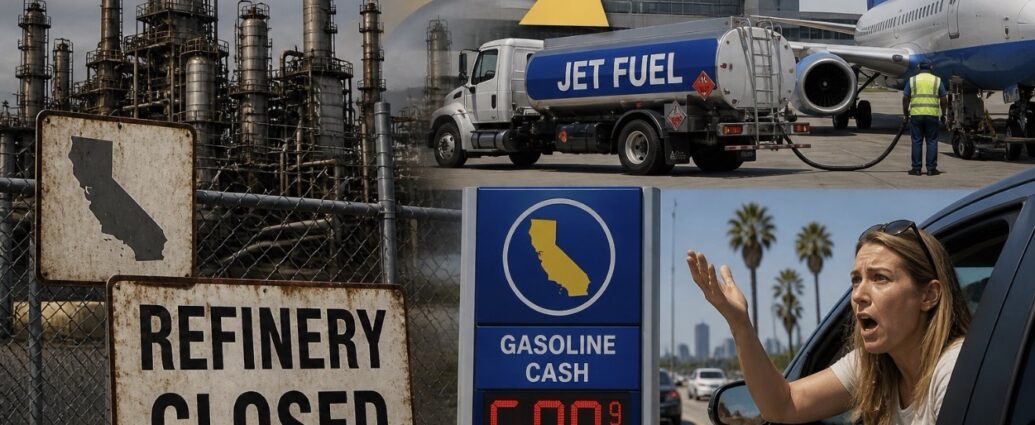
California’s fuel crisis has moved from warning to reality. Two major refinery shutdowns, a sharp turn toward jet fuel production, and a shrinking supply of imports from Asia have combined to push gasoline prices toward $6 a gallon — with analysts warning the worst is still ahead.
The number of refineries operating in California has fallen from 23 in 2000 to just 11 today. The two most recent closures — Phillips 66’s 140,000-barrel-per-day Wilmington complex in Los Angeles, which shut in November 2025, and Valero Energy’s 145,000-barrel-per-day Benicia refinery in the Bay Area, which closed in April 2026 — together removed 17.5% of the state’s refining output from the market. 
Those closures did not just reduce supply. They changed the economics of every refinery still running in the state.
With jet fuel margins now sitting above $85 per barrel — more than $35 per barrel above gasoline — California’s remaining refiners have a powerful financial reason to shift output away from motor fuel. In April, they acted on it: jet fuel production climbed by 20,000 barrels per day and diesel by 16,000 barrels per day, while gasoline output was cut by 32,000 barrels per day.  The refineries are not broken. They are simply chasing the money — and drivers are paying the difference.
Retail gasoline in California is now averaging nearly $5.96 per gallon, roughly $1.20 above where it stood at the end of February and about $1.20 above year-ago levels. Diesel has climbed to $7.48 per gallon, up $2.50 from a year earlier. 
The state cannot easily fill the gap with imports. California’s fuel blend — known as CARB-grade gasoline — is one of the strictest formulations in the world. Most domestic refineries cannot produce it, meaning replacement supply must come from a narrow set of overseas facilities, primarily in Asia and India, arriving by ship across the Pacific.  That supply is now drying up too.
Jet fuel exports from South Korea, Japan, and China to California have dropped to decade lows. South Korean shipments, which averaged 40,000 barrels per day through March, fell to 17,000 barrels per day in April. With only days left in the month, just one confirmed cargo had departed Asia for California. 
Airlines are absorbing the hit alongside drivers. Norse Atlantic Airways scrapped all its summer flights from Los Angeles International Airport. Delta, United, and Air Canada have trimmed routes or raised fares as jet fuel costs at LAX have more than doubled year over year. 
Patrick De Haan, head of petroleum analysis at GasBuddy, said jet fuel availability at major California airports is what concerns him most heading into summer. He warned that widespread flight cancellations remain a serious possibility if no resolution to the global supply disruption emerges in the coming weeks. 
Dan Pickering, founder of Pickering Energy Partners, said California occupies a category of its own. Most states are grappling with higher prices. California is grappling with higher prices and the threat of not having enough fuel at all. “Because availability is tough, the price goes up even more,” he said. 
The longer-term picture is equally stark. A study by University of Southern California professor Michael Mische found that the combined effect of the two refinery closures and layers of new state regulations could push average gasoline prices as high as $8.44 per gallon by year-end 2026 — a potential increase of 75% from prices seen in spring 2025. 
State officials are weighing temporary waivers on CARB fuel specifications to ease import constraints. But a structural fix — a new pipeline into California — is not expected to be operational until 2029 at the earliest. 
For California’s 27 million drivers, that timeline offers little comfort. The refinery closures have already happened. The import shortfall is already here. And the summer driving season has not yet begun.
JBizNews Desk
© JBizNews.com. All rights reserved. This article is original reporting by JBizNews Desk. Unauthorized reproduction or redistribution is strictly prohibited.