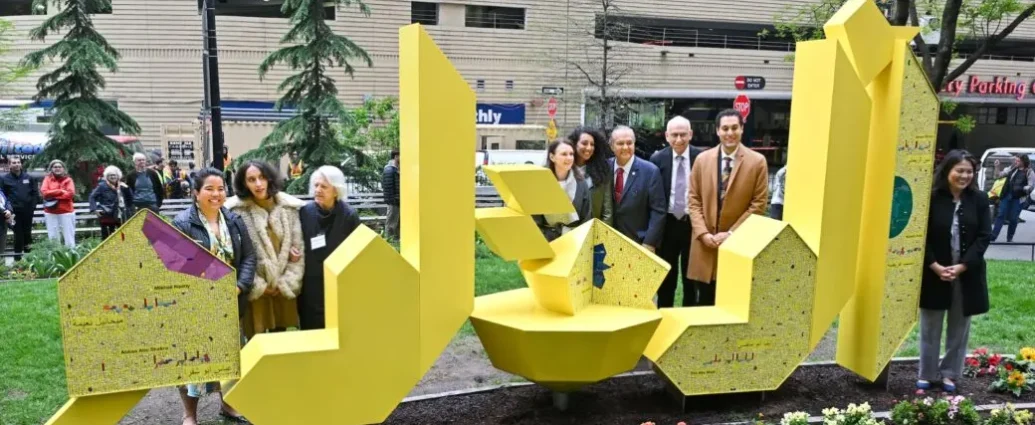
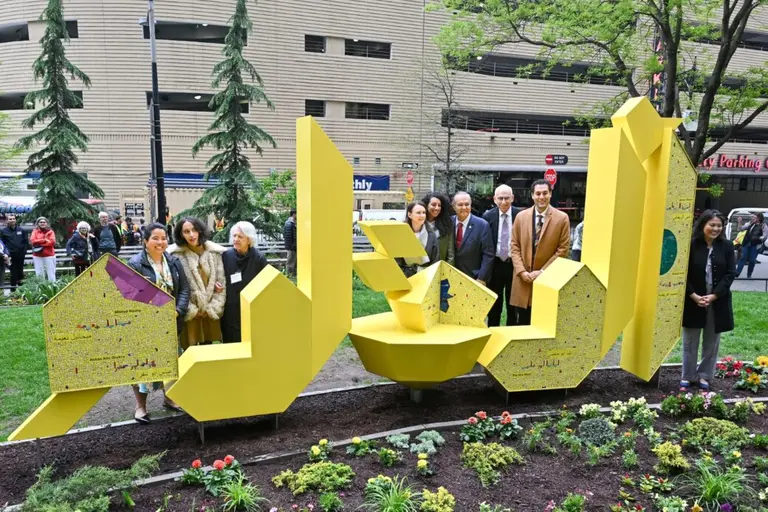
A new public art installation in Lower Manhattan pays tribute to “Little Syria,” New York City’s first Arabic-speaking community, which was displaced in the 1940s when the area was largely demolished to make way for the Brooklyn-Battery Tunnel. On Thursday, the city’s Parks Department unveiled “Al Qalam: Poets in the Park” by artist Sara Ouhaddou at Elizabeth H. Berger Plaza in the Financial District. The piece honors the once-thriving neighborhood, which from the 1880s to the 1940s was home to a vibrant community of influential poets and writers. Ouhaddou reflects on that legacy through abstract calligraphy inspired by Islamic architecture, with the names of nine notable authors inscribed on the sculpture’s surface.
“This project is deeply important to me not just because it is set in NYC—one of the most culturally rich cities in the world—but also because it is, in many ways, one of the defining projects of my life and my artistic practice,” Ouhaddou said.
“Questions of language, writing, translation, and diaspora have since become central to my practice and will never leave me,” she added. “With this work, I hope to offer something that might, in its own way, resonate with others, whether they are visitors, passersby, historians, or descendants connected to this very particular place.”
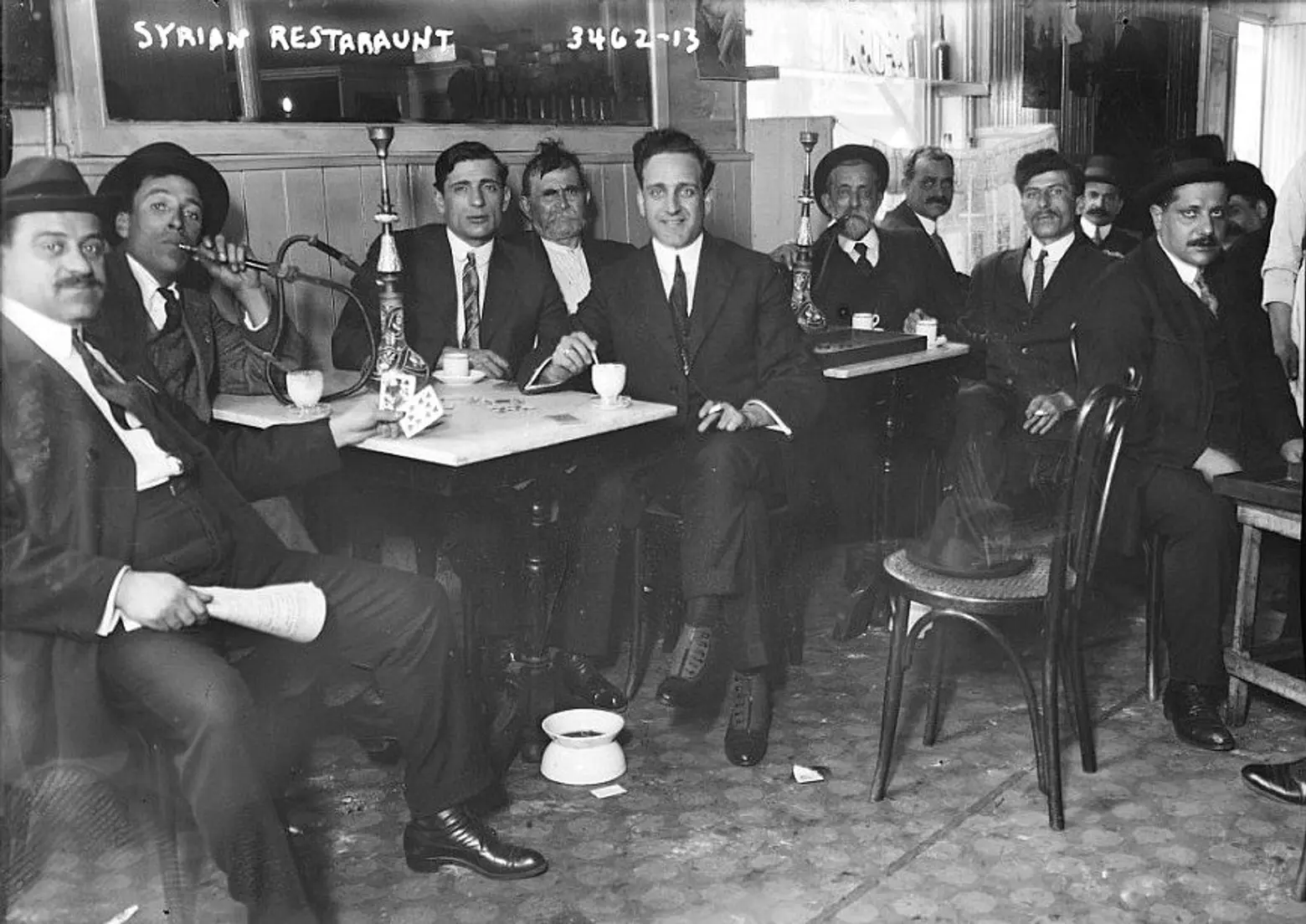
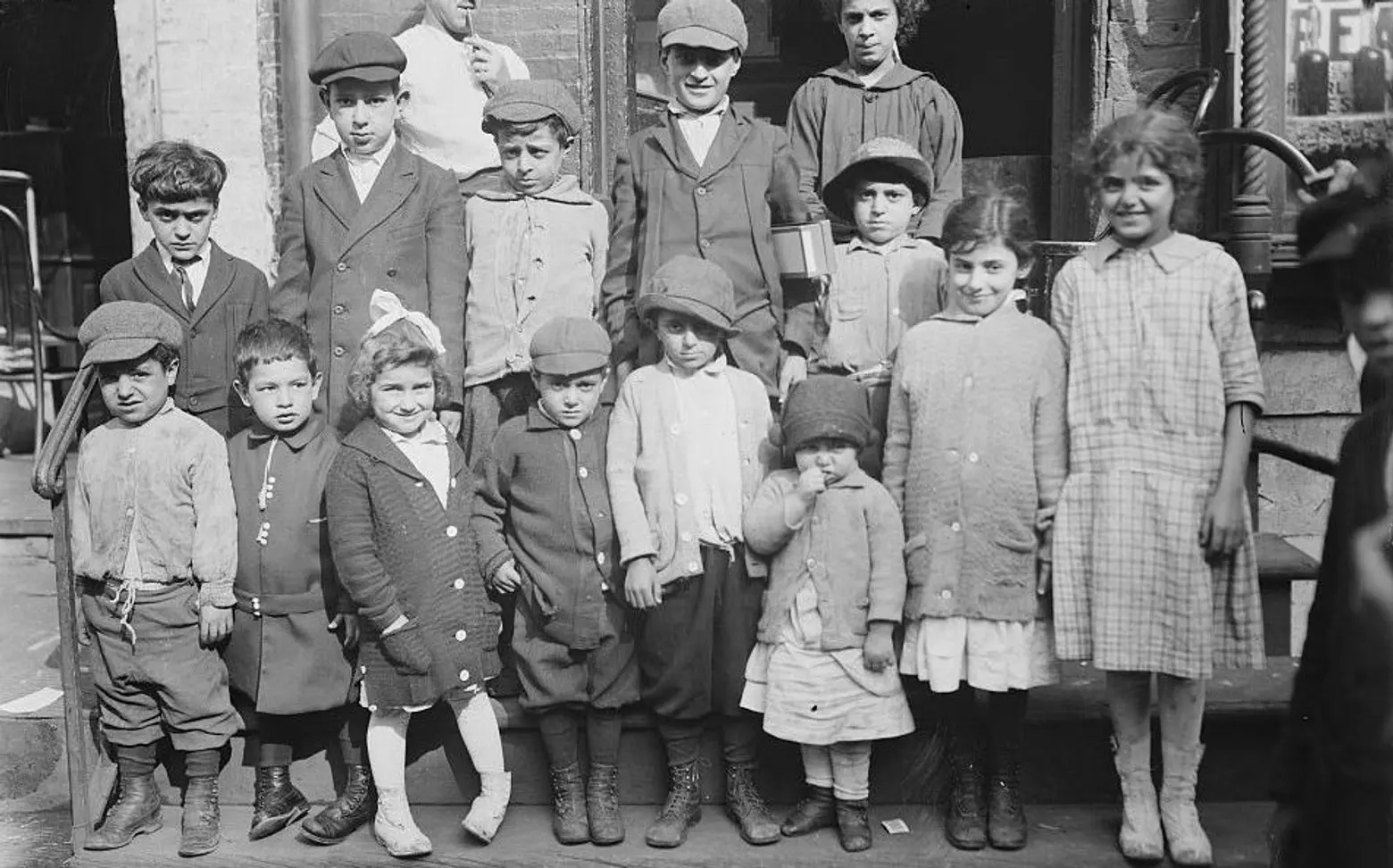
Located just south of the World Trade Center along Washington Street, Little Syria was the nation’s earliest and largest Arabic community. The enclave’s beginnings date back to 1880, when immigrants from modern-day Lebanon, Syria, and Palestine settled along Washington Street. The community was home to about 1,200 Syrians.
It was known for its Turkish coffeehouses, pastry shops, smoking parlors, dry goods merchants, silk stores, and a vibrant community of writers, as 6sqft previously reported.
Founded in 1916, al Rabita al Qalamiyya, a writers’ association, played an influential role in the Arab literary renaissance by developing innovative forms of modern Arabic literature.
However, following the Immigration Act of 1924, which imposed strict immigration restrictions on arrivals from Asia and the Middle East, and the start of construction on the Brooklyn-Battery Tunnel in 1940, the once-thriving enclave faded.
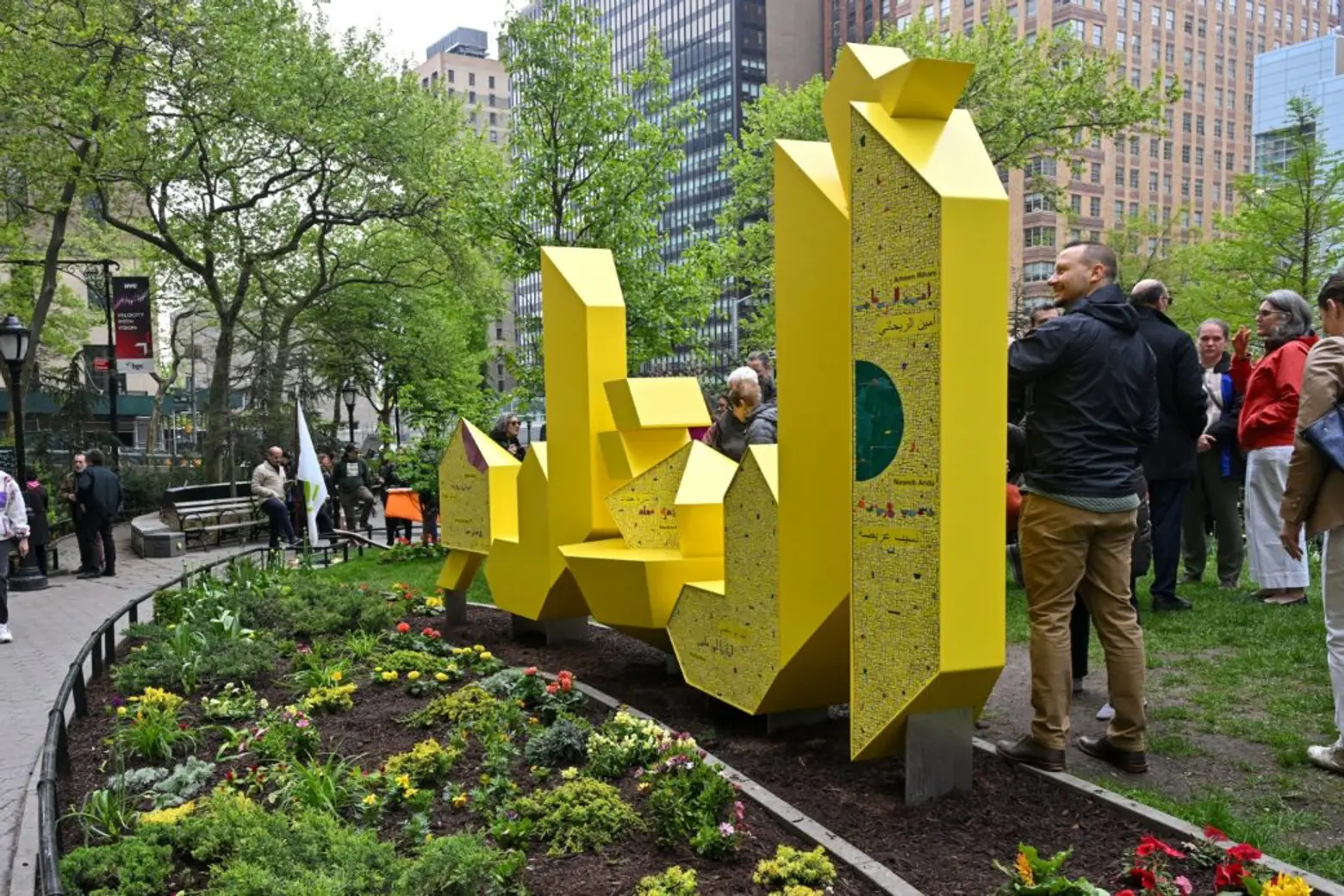
Ouhaddou’s new artwork aims to celebrate the literary legacy of the neighborhood and shine a light on the often forgotten facets of the city’s diverse history. On the plaza’s central lawn, a three-dimensional representation of the Arabic word “al Qalam,” or “The Pen,” is depicted in abstract calligraphy inspired by the geometry of Islamic architecture.
Along the surface of the sculpture are the names of nine writers from the Little Syria community, transliterated into an “abstract alphabet.”
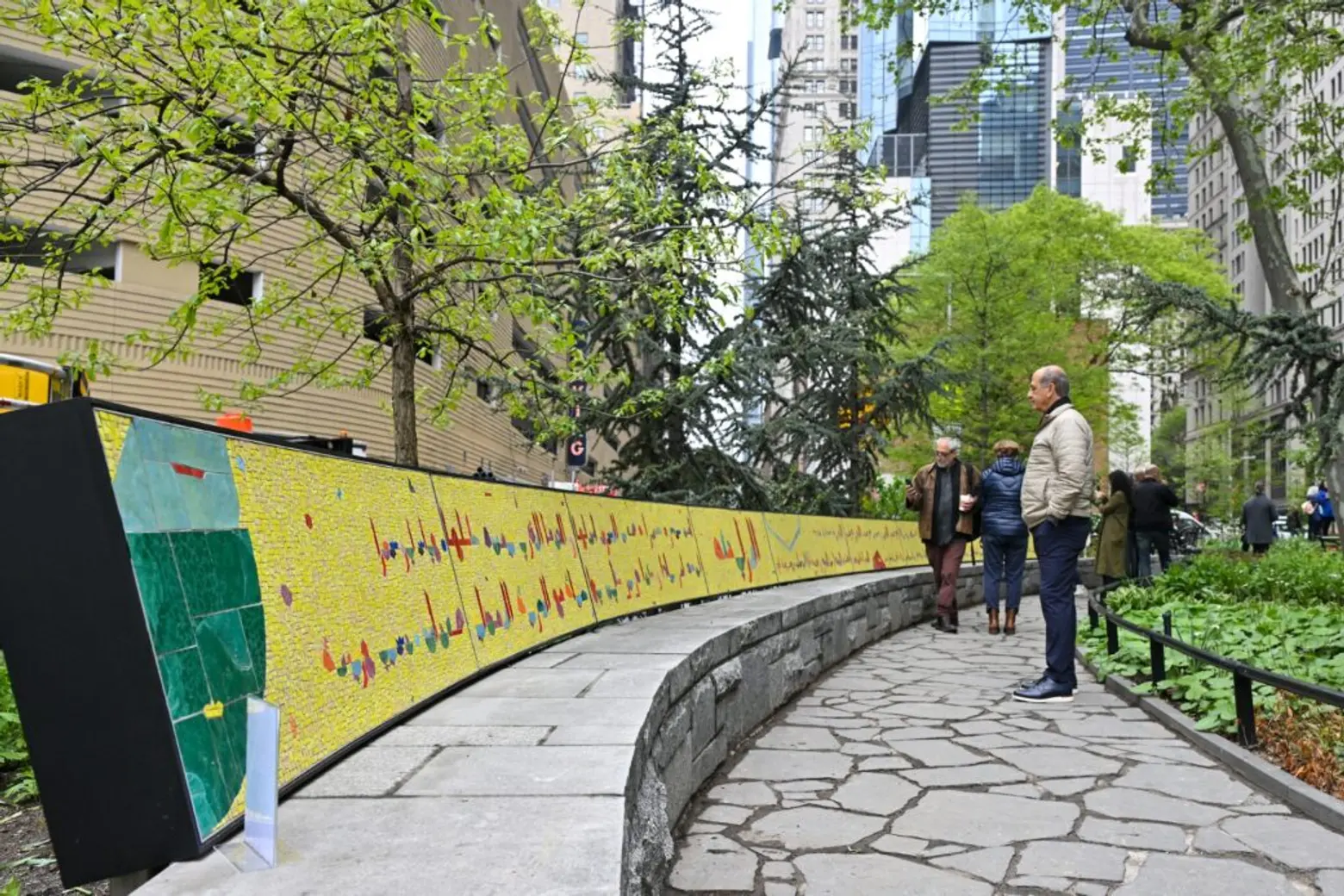
South of the sculpture, two gently curving mosaic panels function as backrests for existing stone benches. The mosaics feature excerpts from works by the honored writers, also rendered in Ouhaddou’s signature script.
Writers and poets featured on the sculpture include al Rabitah’s Elia Abu Madi, Naseeb Arida, Kahlil Gibran, Nadra Haddad, Mikhail Naimy, Ameen Rihani, as well as three prominent figures from the broader literary community who were not members: Abbas Abu Shakra, ‘Afifa Karam, and Agabia Malouf.
The Washington Street Historical Society has also created an augmented reality app that allows visitors to point their phones at the mosaics to hear or read excerpts in Arabic and English, along with short biographies of the writers.
Elizabeth H. Berger Plaza opened in 2021 and, like the sculpture it now hosts, pays homage to the legacy of Little Syria. The landscape is defined by undulating paths with irregular flagstone paving, an oval lawn, raised berms framed by curved rustic walls, cypress and cedar trees, and a variety of shrubs and perennials that offer a scenic refuge from the busy city streets.
These features evoke the landscapes and heritage of the Middle Eastern immigrants who settled in Little Syria in the 19th century.
In 2017, Ouhaddou was selected through a competition hosted by the city’s Department of Cultural Affairs to create a site-specific artwork for the plaza. The Washington Street Historical Society sponsored the design, fabrication, and installation of the artworks and has established a maintenance fund for their ongoing care and preservation.
Fabrication was completed by UAP, EventScape, and Miotto Mosaic Art Studio, with installation handled by Harder Landscaping.
“The culture and history of New York City’s Little Syria will never be forgotten,” Mayor Zohran Mamdani said. “When the community was razed in the 1940s to make way for the Brooklyn-Battery Tunnel, it did not disappear; it lives on across our city, from Atlantic Avenue in Brooklyn to the literary legacy this artwork so beautifully celebrates.”
He added: “I am proud New Yorkers and visitors alike will be invited to rediscover the poetry, architecture and excellence of Little Syria through Sara Ouhaddou’s thoughtful tribute.”
RELATED:
- Preservationists call for landmarking of Little Syria vestiges in Lower Manhattan
- Six things you didn’t know about the Lower West Side
- The history of Little Syria and an immigrant community’s lasting legacy
The post New sculpture in FiDi honors ‘Little Syria,’ NYC’s first Arabic-speaking community first appeared on 6sqft.