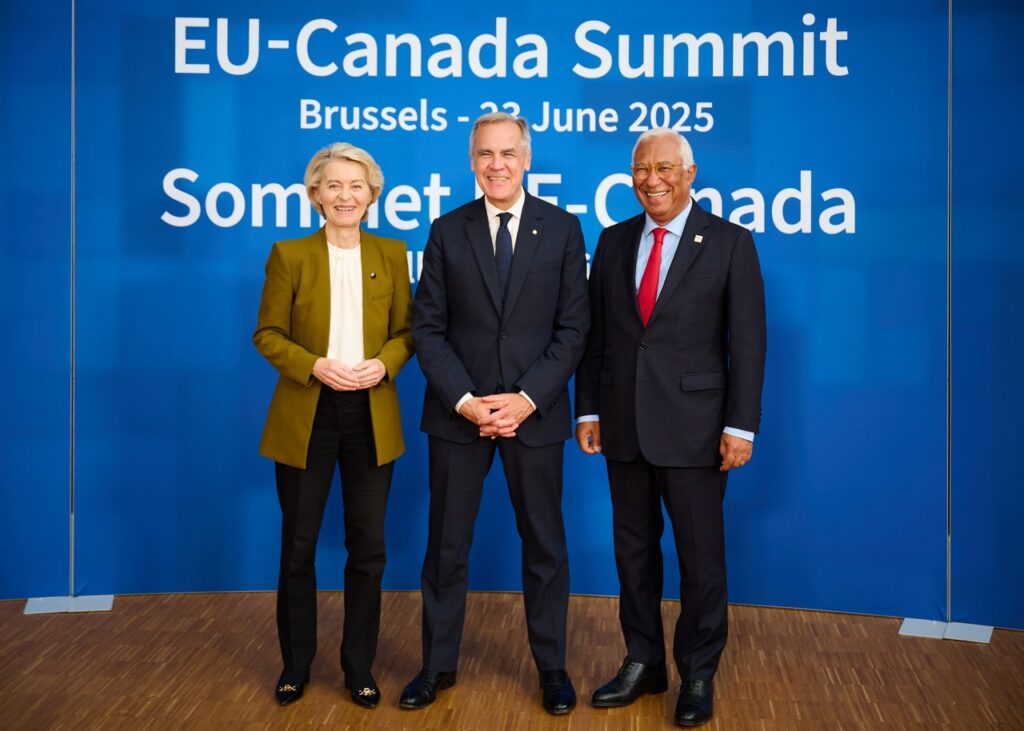
From left: Ursula von der Leyen, Mark Carney and António Costa at the EU-Canada summit in Brussels, June 23, 2025. Archive photo: Dati Bendo / © European Union, 2025, CC BY 4.0. Cropped. Not Friday’s Montreal summit.
Canada and the European Union concluded substantive negotiations on a digital trade agreement Friday and launched an “Alliance for the Future,” widening their cooperation on trade, critical minerals, technology and financial services.
Prime Minister Mark Carney, European Commission President Ursula von der Leyen and European Council President António Costa announced the measures at their October 29-30 summit in Montreal. Their joint statement says the digital agreement is intended to improve legal certainty, facilitate cross-border data flows and strengthen confidence in online commerce.
Concluding negotiations is not the same as putting new trade rules into force. The announcements describe a mix of negotiated agreements, new cooperation and future talks, rather than a single package of benefits already available to businesses and consumers.
A new framework for online business
The digital trade agreement would complement the existing Comprehensive Economic and Trade Agreement, known as CETA. Canada’s International Trade Minister Maninder Sidhu said it would give businesses greater certainty when using electronic signatures and contracts, selling software and digital products, or moving commercial data across borders, while preserving each side’s ability to regulate in the public interest.
Sidhu said Canadian businesses exported nearly C$15 billion in digitally deliverable services to the EU in 2024. That figure describes existing trade, not new sales generated by Friday’s announcement.
The leaders also said they had concluded negotiations on a new competition agreement designed to strengthen cooperation between competition authorities against anti-competitive conduct.
Payments and financial services remain future work
Canada and the EU will support work toward connecting their instant payment systems, with the aim of making cross-border transfers faster and cheaper. They also plan closer cooperation on financial services and capital flows.
Those commitments do not mean that Canadian and European payment systems have already been connected. Canada’s official announcement places the payment initiative and a working group on banking, insurance and fintech among measures to be negotiated or explored in the coming months.
Investment, computing and aircraft production
The joint statement welcomes Canada’s participation in the European High-Performance Computing Joint Undertaking, strengthening links between the two sides’ supercomputing resources. It also says Canada and the European Investment Bank concluded negotiations on an agreement to facilitate investment in Canadian resources, particularly critical raw materials.
Separately, the Canadian announcement lists up to C$2.5 billion in financing for Alberta-based De Havilland to increase waterbomber production capacity, and a contract worth more than C$44 million for Montreal-based Galvion to provide military helmets to Latvia.
The financing announcement should not be read as a completed delivery of firefighting aircraft or as confirmation of a newly purchased 50-plane fleet. The EU joint statement refers to 24 DHC-515 waterbombers for EU member states announced at the previous summit and support for future procurement.
Closer ties, short of EU membership
The leaders also set a timetable to define an “ever-closer association” between Canada and the EU by their 2027 summit, explicitly short of full membership. They outlined future work on research, student exchanges, critical-mineral supply chains, digital infrastructure and security.
For companies on either side of the Atlantic, Friday’s announcements point to potential changes in online trade, investment and market access. The practical effect will depend on the final agreements, implementation and the outcome of the additional talks.
JBizNews Desk | MONTREAL
© JBizNews.com. All rights reserved. Unauthorized reproduction or redistribution is strictly prohibited.