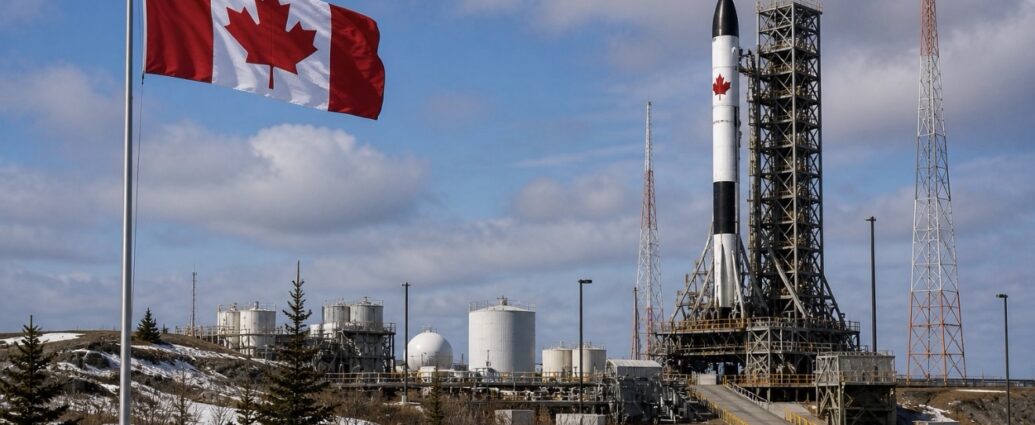
The Canadian Space Launch Act Makes Canada the Last G7 Nation to Establish Sovereign Launch Capability — Backed by $200 Million in Federal Spaceport Investment and a $40 Billion Industry Opportunity
By JBizNews Desk | Ottawa — May 6, 2026
For decades, every time Canada needed to send a satellite into orbit, it had to rely on foreign launch providers — most often the United States. That dependency, long viewed as a strategic vulnerability by policymakers and industry leaders, is now the direct target of new federal legislation that could reshape Canada’s role in the global space economy.
Transport Minister Steven MacKinnon introduced Bill C-28, the Canadian Space Launch Act, in the House of Commons on April 21, creating the country’s first comprehensive legal framework for launching rockets from Canadian soil. If enacted, the legislation would give the federal government authority to license, regulate, and oversee both commercial and government space launches and re-entries — closing a gap that has left Canada as the only G7 nation without sovereign launch capability.
“Canada has reached the moon but still lacks its own sovereign way to space,” MacKinnon told Parliament. “This reliance on the U.S. sends investment out of our country, creates costly delays, and leaves critical infrastructure exposed to decisions beyond our control.”
What the Bill Does
Bill C-28 amends the Aeronautics Act to formally incorporate rockets and launch vehicles into federal aviation law, establishing a regulatory system for launch licensing, safety standards, liability requirements, and national security oversight.
The legislation replaces a patchwork system that relied on temporary programs and outdated frameworks, including the Remote Sensing Space Systems Act of 2005. It grants Ottawa expanded authority over launch site certification, emergency response protocols, and land-use zoning around spaceports — key elements required to support a commercial launch industry.
Rather than creating a standalone statute, the bill modernizes existing law to provide clarity for investors and companies seeking to build and operate launch infrastructure in Canada.
Why Now — And Why It Matters
The push for sovereign launch capability comes amid a broader shift in Canada’s economic and geopolitical strategy.
Tensions with the United States over tariffs and trade policy have prompted Prime Minister Mark Carney’s government to prioritize economic independence across multiple sectors. Space access — once considered a niche issue — is now being framed as a matter of national security and long-term competitiveness.
Rahul Goel, CEO of Canadian aerospace firm NordSpace, highlighted the risks of relying on foreign launch providers: “If we’re launching national security missions to space on foreign rockets, it’s really just foreign nations making national security decisions on our behalf.”
Industry and Defence Minister Mélanie Joly said the legislation strengthens Canada’s economic resilience, while Sean Fraser, Minister for the Atlantic Canada Opportunities Agency, pointed to a parallel $200 million federal investment in spaceport infrastructure in Nova Scotia.
That facility, being developed near Canso by Maritime Launch Services, is expected to become Canada’s first operational commercial launch site, with additional projects under consideration in Newfoundland and Labrador.
The Economic Case
The financial stakes are significant.
Canada’s space sector currently generates about $5 billion in annual revenue, supports more than 13,800 jobs, and produces roughly $2 billion in exports. According to Deloitte, the domestic market could expand to $40 billion by 2040, while the global space economy is projected to reach $1.5 trillion within the next decade.
Government officials say establishing domestic launch capability could unlock billions in new investment, create high-skilled jobs, and reduce reliance on foreign providers — while positioning Canada to compete in a rapidly growing global market.
What Comes Next
Bill C-28 has completed its first reading and remains in the early stages of the legislative process. With a Liberal majority in the House of Commons, passage could come by late 2026 or early 2027, though Senate review may extend the timeline.
MacKinnon said it may take two to three years before rockets begin launching from Canadian soil, with initial efforts focused on satellite deployment rather than crewed missions. He emphasized that Canada will continue to work closely with NASA through the Canadian Space Agency.
For a country that has contributed advanced robotics to space missions, sent astronaut Jeremy Hansen on NASA’s Artemis II lunar program, and built world-class satellite technology — yet has never launched a rocket from its own territory — the legislation represents a long-awaited shift.
If passed, it would mark Canada’s formal entry into sovereign space launch — and a decisive step toward independence beyond Earth’s atmosphere.
JBizNews Desk
© JBizNews.com. All rights reserved.