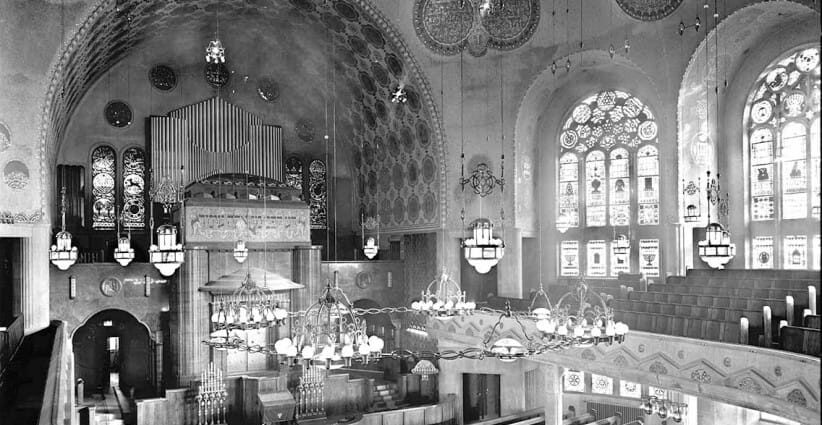
Nearly 90 years after Nazi pogromists burned synagogues, Torah scrolls, musical instruments and scores across Germany during Kristallnacht, an Israeli-born cantor is working to bring the country’s lost Jewish musical heritage back to life.
Assaf Levitin, a Germany-based cantor and deputy chairman of the German Jewish Cantor Association, has launched Hashivenu, a collaboration with the renowned music publisher Edition Peters to recover and republish Jewish cantorial works that disappeared after the destruction of Germany’s Jewish communities. His co-author is Cantor Amnon Seelig, the association’s chairman. The first volume, released on Friday evening ahead of Sukkot, contains 18 works for cantor, mixed choir and organ dating from 1838 to 1938.
The story behind the creation of Hashivenu is historically significant.
The opus brings back into existence the German Jewish cantorial works that were destroyed or disappeared in the Kristallnacht pogroms of November 9-10 1938, under the instruction of the National Socialist Party.
Of the 1,400 synagogues and Jewish institutions destroyed during Kristallnacht, multiple organs, pianos, and other instruments were also burned, as were Torah scrolls, musical works, and other musical items which had been central to the community for 100 years.
Germany: The birthplace of Reform Judaism
Levitin’s meticulous archival renewal creates a full circle: Germany is the birthplace of Reform Judaism, and Levitin is allowing canonical music of this tradition to reenter Reform spaces once more.
The collection itself spans the spectrum of religious practice – not just Reform Judaism. It includes the works of Yisrael Meyer Japheth of Frankfurt, who wrote for a male acapella choir with male altos and sopranos, and the work of Jackob Dymont, who wrote a cantor male solo and male choir acapella score for Kabbalat Shabbat.
But what Levitin said makes the collection so interesting is the music written for organ and a mixed choir. Of course, this kind was meant to be played in a reform setting, as female voices and instruments were not allowed in Orthodox synagogues on the Sabbath.
“The common denominator of this period is that it was the time of the Haskalah, and this was the first time when Jews went to study in universities. Musicians went to study in music academies at the height of the Romantic era, [which influenced their composition].”
As an example, Levitin spoke of Salomon Sulzer in Vienna, who had earned enough money to commission composers to write pieces for him. Sulzer asked his friend, the famous early Romantic composer Franz Schubert, to write music for Psalm 92. This became the only piece of music Schubert composed for a synagogue in Hebrew.
“Some of these pieces were written by very, very good and well-known composers of their time who were not even Jewish, and they had many organ players who were not Jewish composing music for the synagogue,” Levitin said, nevertheless stressing that non-Jewish composers were the exception.
The process of sifting through the archives was lengthy.
There are 400 titles in the Freimann collection in Frankfurt, which is where the pieces were sourced from. The whole collection is around 20,000 pages. Some scores are just two pages, but some are thick books.
“For example, the cataloged title ‘Schir Zion’ by Salomon Sulzer shows just the year and the city where it was published, but then you open it and see that Schir Zion is the volume for Shabbat and has 400 pages with 700 titles in it. Even if you throw out some works, you may still be left with 150 pieces to look into.”
“I had to explore the liturgical context and if it’s good enough,” Levitin continued, adding that not everything the composers wrote was “necessarily amazing.”
“Sometimes, they wrote one or two amazing pieces, and the rest is okay. But some of some things are really excellent music. And I just wanted to represent as many composers as possible.”
He did, however, say to himself that there was no need to preserve works if they are “not good enough.”
“My take as a musician is I have to save it if I cannot leave it in oblivion. The things where it’s just a crying shame that nobody knows it.”
Kristallnacht: ‘The night where music died’
Kristallnacht, he said, was “the night where music died.”
“Where could you do a service with an organ after Kristallnacht? All the organs were burned down, never to be rebuilt. After the Shoah, they didn’t have the cantors anymore: either they fled, or they were murdered. And the congregations, the people who came back to Germany, they didn’t have the synagogues with organs. They quickly built small synagogues; nobody thought of building the organ again.”
Levitin spoke of how important it is to present this collection as a body of German music – part of the German canon – rather than purely Jewish music intended for synagogue.
He recalled a conversation with a friend who is a German conductor, who told him: “This is German music. It was written in German by German composers in Hebrew for the synagogue, but this is a whole genre of German music.”
“I was very moved that he said that,” mused Levitin. “Because the part that Jews took in the cultural life in Germany until the Nazis came was huge. It was important for me to talk about not only how terrible it is that everything disappeared, but to take a look at the work and say ‘this is sublime music, this is excellent music.'”
While the current collection focuses on Shabbat, Levitin plans the next collections to focus on Yom Kippur, Rosh Hashanah, Hanukkah, and life cycle, among others.
He and his team are halfway through the second collection, but he hopes the whole anthology will be completed in about 4-5 years.
He told The Jerusalem Post that his work is intended to be comprehensive. “I do not want to only bring one or two pieces back in the repertoire and say ‘never again.'”
“I don’t want ‘never again.’ I want it back.”