The largest monthly jump in gas prices in six decades caused a sharp spike in inflation in March, creating major challenges for the inflation-fighters at the Federal Reserve and heightening the political hurdles for the White House.

Consumer prices rose 3.3% in March from a year earlier, the Labor Department said Friday, up sharply from just 2.4% in February and the biggest yearly increase since May 2024. On a monthly basis, prices rose 0.9% in March from February, the largest such increase in nearly four years.

It’s the first read on inflation to capture the effects of the Iran war. The spike in gas prices will stretch the budgets of many lower- and middle-income households as it erodes their incomes, making it harder to afford other necessities such as food and rent

Excluding the volatile food and energy categories, core prices rose 2.6% in March from a year earlier, up from 2.5% in February. And last month core prices rose a modest 0.2%, suggesting that rising gas prices haven’t yet spread to many other categories.

A big question for now is how long the oil and gas price shock lasts and whether it will lead to a broader, long-lasting inflation spike, similar to what happened in the spring of 2022 after Russia invaded Ukraine. For now, economists say that it is unlikely the U.S. will see a widespread increase similar to a few years ago, when inflation topped 9%.

Despite a tenuous cease fire, little has changed in the Strait of Hormuz, a bottle neck where millions of barrels of oil typically pass daily.

“It’s painful in the near term,” said Michael Pearce, chief U.S. economist at Oxford Economics. “It’s going to get more painful in April,” when further gas price increases will lift inflation higher.

But Pearce said the impact may be shorter-lived than after the pandemic: “I think the conditions are much more like a short, sharp shock than what we saw in 2022.”

Pearce said that the impact could fade by later this year: “I think the conditions are much more like a short, sharp shock than what we saw in 2022.”

Last month, grocery prices slipped 0.2% and are up just 1.9% from a year earlier. Analysts do expect food prices to move higher in the coming months as soaring diesel prices make shipping more expensive.

Higher energy costs are “contributing to rising production costs across the food supply chain and could put upward pressure on grocery prices going forward,” said Andy Harig, a vice president at the grocery trade group FMI-The Food Industry Association. “As energy prices increase, the costs associated with producing and delivering food also rise.”

Clothing costs rose 1% in March from the previous month and are up 3.4% from a year earlier. Used car prices, however, fell 0.4% last month and down 3.2% from a year earlier.

The gas price shock stemming from the Iran war has shifted inflation’s trajectory, from a slow, gradual decline to a sharp increase further away from the Fed’s 2% target. As a result, the central bank will almost certainly postpone any cut in interest rates for months. Many Fed officials will look past the increase in headline inflation, however, and focus on core prices, which are likely to rise more slowly.

Gas prices are also a highly visible cost that has outsize impacts on consumer confidence and political sentiment. High prices had angered American voters before the war and the spike in prices for oil and everything that entails, from the pump to the grocery store, could make it more difficult for the president’s party to hold on to seats in both the House and the Senate in next year’s midterms.

Polling by the Associated Press-NORC Center for Public Affairs Research last month found that about six in 10 Republicans are at least “somewhat” concerned about affording gas in the next few months.

Gas prices averaged $4.15 a gallon nationwide Friday, up from $2.98 on the day before the war began and a hike of nearly 40%, according to motor club AAA.

Inflation reached a peak of 9.1% in June 2022, as COVID-19 snarled supply chains and several rounds of stimulus checks pushed up consumer demand. Prices soared for groceries, furniture, restaurant meals and many other goods and services.

This time, economists say the job market and consumer spending are weaker, and there are no large government stimulus checks being issued to spur demand. The unemployment rate is low, at 4.3%, but companies aren’t scrambling to hire the way they were when the economy emerged from the pandemic, which led many firms to offer sharp pay increases to attract and keep workers.

Rapid pay increases and solid income growth helped consumers weather the higher prices that resulted from the pandemic’s supply chain disruptions, and fueled spikes in demand that led many companies to raise prices further.

“That’s where this really differs, is that we aren’t seeing anywhere near the strength of demand,” Alan Detmeister, an economist at UBS, said. In 2021 and 2022, income growth “was increasing really strongly. We aren’t seeing that now,” he added.

Detmeister thinks the better comparison will likely be to 1990-91, when higher oil and gas prices stemming from Iraq’s invasion of Kuwait contributed to a recession, but didn’t lead to a jump in inflation, in part because of weaker consumer spending.

The gas price spike’s impact on inflation is, in some ways, similar to President Donald Trump’s tariffs, in that their effect will depend largely on the size and duration of the increase.

Higher gas prices are tricky for the Fed because they can also slow growth by weighing on consumer spending, potentially causing layoffs. The Fed would typically cut its rate to encourage more spending if unemployment rises, while it raises rates to combat inflation.

This story was originally featured on Fortune.com

This post was originally published here

First lady Melania Trump is denying ties to Jeffrey Epstein and knowledge of his sex crimes, saying Thursday that the “stories are completely false” and calling accusations that she was somehow involved “smears about me.”

Reading an extraordinary statement at the White House, Melania Trump said she and her attorneys were fighting back against “unfound and baseless lies” in regards to her connections to the late financier, a convicted sex offender who leveraged connections to the rich, powerful and famous to recruit his victims and cover up his crimes.

“The lies linking me with the disgraceful Jeffrey Epstein need to end today,” she said. “The individuals lying about me are devoid of ethical standards, humility and respect. I do not object to their ignorance, but rather I reject their mean-spirited attempts to defame my reputation.”

The seemingly out-of-the-blue message came as her husband, President Donald Trump, and his administration had finally seemed to move past more than a year of controversy surrounding Epstein, especially as the Iran war had become all-consuming in Washington.

The first lady’s comments almost assuredly will serve to push the story back into the political spotlight even as the president urged the public and media to move on from the case.

Nick Clemens, a spokesperson for the first lady, said the West Wing was aware beforehand that she was making a statement. But he deferred to the West Wing on whether the content of what Melania Trump planned to say was known. The White House press office did not respond to requests for comment.

Calls for a congressional hearing for Epstein victims

The first lady spoke for about five minutes, reading her statement in the Grand Foyer, then walked away without taking questions. She did not go into detail on the accusations against her, but said they came from “individuals and entities looking to cause damage to my good name.”

She added that they were financially and politically motivated.

Melania Trump also called on Congress to hold a public hearing centered on survivors of Epstein’s crimes, with a chance to testify before lawmakers and have their stories entered into the congressional record.

“Each and every woman should have her day to tell her story in public if she wishes,” she said. “Then, and only then, we will have the truth.”

Two of Epstein’s accusers, Maria and Annie Farmer, said in a subsequent statement: “What we want is accountability, transparency, and justice.”

Former Rep. Marjorie Taylor Greene, a Georgia Republican and onetime fierce Trump supporter who resigned from Congress after a public falling out with the president, posted on X, “I am grateful to the First Lady for her brave statement today about Epstein and his victims.”

Democrats, meanwhile, jumped on Melania Trump’s comments, saying they agreed with her call for a congressional hearing. In a social media post, Rep. Robert Garcia, the top Democrat on the House Oversight Committee that is investigating Epstein, called on the Republican chair of the committee, Rep. James Comer, to schedule a public hearing “immediately.”

Rep. Thomas Massie, R-Ky., who sponsored a bill prompting the release of millions of Epstein documents, turned attention back to the Justice Department, saying it’s the attorney general’s job to bring in survivors for testimony. Massie, who has pressed for more arrests in the Epstein case, ended a social media post with a call to “PROSECUTE!”

Questions about Epstein’s reach have loomed over the administration and divided Republicans, driving a wedge into Trump’s MAGA base as some pressed for the government to release more files and prosecute figures linked to the financier.

The issue has dogged Trump and fractured some of his alliances, including the one with Greene. Trump dismissed the issue as a “Democrat hoax” but later signed a bill to release files from Epstein’s case.

It was not clear what prompted the first lady to revive the issue. She noted that several individuals and organizations have had to apologize for their “lies about me.” Of the examples she cited, the most recent was in October.

In that case, book publisher HarperCollins UK apologized to the first lady and retracted passages from a book suggesting Epstein played a role in introducing her and Donald Trump.

Melania Trump mentioned her husband several times in her comments. She said Epstein did not introduce her to Trump, and that she met her future husband at a New York City party in 1998.

Email to Maxwell was ‘trivial’

The first lady brought Epstein back to the forefront months after federal authorities released millions of pages of documents under the Epstein Files Transparency Act, the law enacted after months of public and political pressure that requires the government to open its files on the late financier and his confidant and onetime girlfriend, Ghislaine Maxwell.

Lawmakers complained when the Justice Department made only a limited release last month, but officials said more time was needed to review additional documents that were discovered and to ensure no sensitive information about victims was released.

Melania Trump said Thursday that she was not friends with Epstein or Maxwell, but was in overlapping social circles in New York and Florida. She described an email reply she sent to Maxwell as “casual correspondence” without elaborating.

“My polite reply to her email doesn’t amount to anything more than a trivial note,” she said.

Among the documents released by the Justice Department was a brief email from 2002 with the sender and recipient blacked out. It begins, “Dear G!” and ends “Love, Melania,” and compliments the recipient on a magazine article about “JE.”

“I know you are very busy flying all over the world,” it says. “How was Palm Beach? I cannot wait to go down. Give me a call when you are back in NY.”

That email was sent the same month that a New York Magazine article was published about Epstein in which Trump called him a “terrific guy.”

Among other documents released was an image from Epstein’s home showing a series of photographs along a credenza and in drawers. In that image, inside a drawer among other photos, was a photograph of Trump, alongside Epstein, Melania Trump and Maxwell.

Epstein killed himself in 2019 while awaiting trial on sex trafficking charges in New York. Maxwell was convicted in 2021 of luring teenage girls to be sexually abused by Epstein and was sentenced to 20 years in prison.

___

Associated Press writers Stephen Groves in Washington and Michael R. Sisak and Larry Neumeister in New York contributed to this report.

This story was originally featured on Fortune.com

This post was originally published here

On a recent weekend afternoon, at a Chinese comedy show in northern Virginia, the host asked the audience, “What food do you like?” The loudest answer echoed through the hall: “Chick-fil-A!”

“You still haven’t gotten your H-1B lottery, ha?” quipped the host, citing the most popular work visa among Chinese students.

It’s an easy-to-get joke in the Chinese student community, where those eager for U.S. visas believe their chances at success might hinge upon something unexpected: an American chicken sandwich and the company behind it.

Chick-fil-A has no branches in China. But the brand has enticed Chinese students in the U.S. for a simple reason: “Chick-fil-A” sounds like “check files.” In a culture that puts great stock in soundalike words and numbers, it is believed to bring good luck to those with complicated visa applications.

“It feels like I am one step closer to the green card after having a Chick-fil-A meal,” says Zhou Yilu, an AI software engineer in his late 30s who lives in Wilmington, Delaware.

Since arriving in the United States as a student 14 years ago, Zhou has had a roller-coaster experience with his visa status. He was repeatedly asked to add paperwork while switching among four types of visas, one of which was approved days ahead of its expiration. That was when Zhou turned to the popular poultry purveyor.

No one can say who originally had the idea, but it has been kicking around the Chinese student community for years, especially for visa applications such as the H-1B, which is based on a lottery system and has become harder to secure.

Some 3D-print the Chick-fil-A logo on coasters. Some embroider the logo into a small cross-stitch pendant for key chains. Others set Chick-fil-A’s logo as their profile picture on social media, sometimes converting it from red to green — as in green card.

Chick-fil-A didn’t respond to emails seeking comment.

They believe they’re one wordplay away from ‘stay’

Chinese people, particularly younger ones, have long been enthusiastic about wordplay.

On the night before Christmas, for example, eating apples — “pingguo” in Mandarin — flourishes because the word echoes “ping’an ye,” which means Christmas Eve. Brides carry lettuce bouquets because lettuce — “shengcai” — sounds like “getting rich.” Who doesn’t like catching that at a wedding? A much older use of wordplay lies in Chinese people’s aversion to the number four, which sounds like the word for death in Mandarin.

The Chick-fil-A superstition reflects how difficult it is for immigrants to overcome the obstacles to work legally in the U.S., even for those with prestigious educational backgrounds and high-level job titles.

More than 46,000 Chinese students and workers were approved for H-1B visas in 2024. Approved Chinese applicants account for 11.7%, the second-largest group by country, after India at 70%.

Fan Wu, a data scientist living in Indianapolis, didn’t win his H-1B lottery despite changing his social media profile picture to the fast-food chain’s red logo and traveling to Hawaii to pray at a Japanese Taoist temple.

“I was forced to turn to these mysteries,” he says. “The lottery itself is a matter of chance. It depends on luck, and we need another mystery to echo it.”

It goes beyond chicken. The need for better fortune in visa lotteries has given rise to a new profession — agents who pray in temples across the Pacific on behalf of others.

When the students reach out to 24-year-old Meng Yanqing in Beijing, across the world, through the social media platform Xiaohongshu, Meng lines up to enter and pray at the popular Lama Temple, holding a paper between his palms that expresses his wish for an H-1B visa. That involves “precise positioning” with their personal information, such as passport numbers and birthdays.

“I respect them, they have their demands, and I offer the service,” says Meng, who also helps his clients buy consecrated bracelets from the temple and send them across the Pacific to the U.S. “I truly hope the best for them.”

The visa issue is always looming

The Trump administration’s abrupt decision to impose a $100,000 fee on H-1B visas a few months ago stunned Chinese students and workers, created chaos and fostered a more chilling atmosphere. It was later explained that it only applied to the new visas. But the roller-coaster experience added anxiousness to a landscape for Chinese students that already includes language and cultural barriers and a tight job market.

Some experts believe employers’ sponsorship of green cards through visas like H-1B is why the United States can attract some of the best and brightest.

“A real talent pipeline,” says Juliet Gelatt, associate director of U.S. Program under Migration Policy Institute based in Washington, “we’ve really benefited as a country and as an economy from bringing in smart young people from all around the world, including from China.”

The air of suspicion surrounding Chinese immigrants, especially in high-tech industries, makes it even harder. Experts warn that it reduces the U.S.’s ability to attract international talent.

One manager at a new energy company in his late 20s finally changed his profile picture to the chicken logo after months of waiting for his visa. Like many Chinese, he would give only his surname, Yang, and otherwise spoke anonymously, fearing trouble with his visa status. Of his status in the United States, he says, “It feels like living under someone else’s roof.”

The United States limits participation in the H-1B visa lottery. STEM majors are eligible for three years of optional practical training under their F-1 student visa, while other majors are eligible for one year. After that, they turn to Chick-fil-A while seeking a work visa to continue their work in the United States.

For Harriet Peng, a data analyst living in northern Virginia, eating a chicken sandwich and having the company’s T-shirt on the back of her chair weren’t enough. After losing the lottery repeatedly, she went to a temple in upstate New York to pray in person — or, as she puts it, to “make some efforts using scientific materialist methods in metaphysics.”

The temple contains many sculptures of gods, each representing a particular aspect of life, such as fortune or childbirth. There is, she says, no god for visas.

Nevertheless, Peng jokes, “I knelt in front of almost every god and prayed, in case they all know each other.”

This story was originally featured on Fortune.com

This post was originally published here
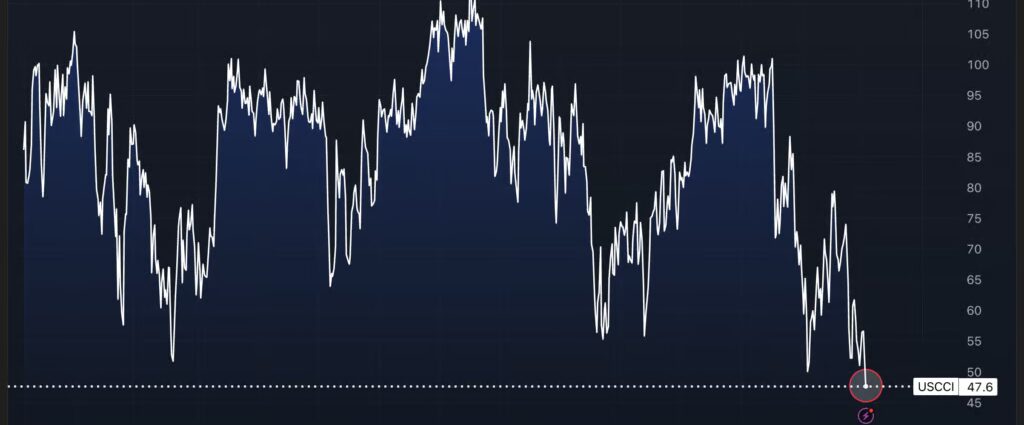
Confidence among American consumers has never been this depressed in the history of the University of Michigan survey.

The preliminary April consumer sentiment index crashed to 47.6 — an all-time record low, an 11% monthly plunge and a sharp miss against the 52 consensus — as the Iran war’s economic fallout spread from the gas pump into households’ broader outlook on their finances, jobs and the future.

Chart: Worst Consumer Confidence Reading Since Records Began

Consumer Surveys For April 2026: Full Breakdown

Indicator April 2026 March 2026 April 2025 MoM Change vs. Consensus
Consumer Sentiment 47.6 53.3 52.2 –10.7% MISS vs. 52.0
Current Economic Conditions 50.1 55.8 59.8 –10.2%
Consumer Expectations 46.1 51.7 47.3 –10.8%
1-Year Inflation Expectations 4.8% 3.8% 5.3% +100bps BEAT vs. 3.8%
5-Year Inflation Expectations 3.4% 3.2% +20bps

Iran War Didn’t Raise Prices. It Raised What People Expect Prices To Do

Aside from the shocking sentiment headline in Friday’s data, the inflation expectations component also negatively surprised.

Year-ahead inflation expectations surged from 3.8% in March to 4.8% in April, a 100-basis-point jump in a single month, blowing past the 4.2% consensus and marking the largest one-month increase since April 2025.

The current reading now exceeds every 2024 reading and sits well above the 2.3%–3.0% range that prevailed in the two years before the pandemic.

Five-year inflation expectations ticked up from 3.2% to 3.4%, the highest reading since November 2025 — but held more contained than the short-run surge, a distinction that carries real meaning for the Federal Reserve.

Chart: Americans Expect 4.8% Inflation Next Year Fed Targets 2%

This post was originally published here

Assets under management for U.S. exchange-traded funds could more than double to $25 trillion by the end of this decade, Citigroup said on Thursday, as investors seek the increasingly popular asset class for low-cost, diversified exposure across markets.

As of March 2025, the U.S.-listed ETF industry’s total assets stood at about $10.4 trillion, according to Citi.

The Wall Street brokerage had previously forecast the industry’s AUM to hit $19 trillion by 2030 and $29 trillion by 2035.

GOLDMAN SACHS COMPLETES INNOVATOR CAPITAL ACQUISITION, LIFTING ETF ASSETS TO $90B

It now expects more than $40 trillion by 2035.

“While these projections are more optimistic than our prior estimates, it still suggests ETFs will be in a more mature phase of AUM growth as flows (organic) and performance (inorganic) drivers will be more balanced than the previous ten years,” Citi said.

VANGUARD FUND STRIPS OUT CHINA IN EMERGING MARKETS INVESTMENT PLAY

A large chunk of the growth could be driven by active ETFs, investments into which are expected to outpace their passive peers, the brokerage said.

Active ETFs are among the fastest-growing segments of the ETF market, attracting investors with flexible strategies and lower costs. Many aim to outperform a benchmark or deliver a specific investment outcome, while passive ETFs seek to track an index and mirror its performance.

“Our base case expects Active’s market share of ETF AUM to double in ten years as these products gain (a) greater share of industry flows,” Citi said in a note on Thursday.

Other factors supporting growth within the industry include product innovation, easier ETF launch regulation, adoption of more sophisticated strategies, and demand for flexible, tax-efficient investment solutions, Citigroup said.

THE ETF REPORT: NEWS & ANALYSIS

ETFs tracking U.S. equities have recorded more than $75.8 billion in inflows so far this year, building on more than $1.1 trillion worth of inflows seen in the last two years, according to data from LSEG Lipper.

GET FOX BUSINESS ON THE GO BY CLICKING HERE

Meanwhile, U.S.-domiciled ETFs have recorded more than $435 billion worth of inflows so far this year, as per LSEG Lipper data.

This post was originally published here

President Donald Trump’s administration this week acknowledged it made a significant error in figures it used to help justify a fraud probe into New York’s Medicaid program, a glaring mistake that undercuts a federal campaign to tackle waste, mostly in Democratic-led states.

The error, which the administration admitted first to The Associated Press, prompted health analysts to question how many of the Republican administration’s sweeping anti-fraud efforts around the country were based on faulty findings. One of a few mischaracterizations it made about New York’s Medicaid program, it also reflected a common criticism that’s been made of Trump’s second administration — that it tends to attack first and confirm the facts later.

“These numbers could have been cleared up in a phone call, so it’s really slapdash,” said Fiscal Policy Institute senior health policy adviser Michael Kinnucan, whose recent analysis called attention to the Trump administration’s inaccurate claim.

The mistake appeared in comments made last month by Dr. Mehmet Oz, the administrator of the Centers for Medicare & Medicaid Services, in a social media video and in a letter to New York’s Democratic governor announcing the fraud investigation.

Oz claimed that New York’s Medicaid program last year provided some 5 million people with personal care services, which assist people in need with basic activities like bathing, grooming and meal preparation. That would add up to nearly three-fourths of the state’s 6.8 million Medicaid enrollees.

“That level of utilization is unheard of,” Oz said in the video, adding in his post that New York needs to “come clean about its Medicaid program.”

But the real number of New Yorkers who used those services last year was about 450,000, or between 6% and 7% of total enrollees, CMS spokesman Chris Krepich told the AP this week. He said the agency misidentified New York’s approach to applying billing codes and had since refined its methodology.

“CMS is committed to ensuring its analyses fully reflect state-specific billing practices and will continue to work closely with New York to validate data and strengthen program integrity oversight,” he said in an emailed statement.

Krepich said the probe was ongoing as the administration still has concerns with New York’s oversight of personal care services and the Medicaid program and is reviewing the state’s response to last month’s letter. CMS had raised other flags about New York’s program, including that it spends more per beneficiary and per resident than the average state, has high personal care spending and employs so many personal care aides that the job category is now the largest in the state.

Health analysts said the state’s high spending reflected both high costs for services in New York and a policy choice to provide robust at-home care. Cadence Acquaviva, senior public information officer for the New York Department of Health, called Oz’s initial mischaracterizations “a targeted attempt to obscure the facts.”

“New York State remains committed to protecting and preserving vital Medicaid programs that deliver high-quality services to New Yorkers who depend on them,” she said.

In a statement, a spokesperson for Gov. Kathy Hochul said, “The initial claim by CMS was patently false, and we are glad they now admit it.”

“Governor Hochul has been clear that New York has zero tolerance for waste, fraud and abuse in Medicaid, or any other state programs, and will continue her efforts to root out bad actors, protect taxpayer dollars, and safeguard the critical programs that New Yorkers rely on,” spokesperson Nicolette Simmonds said.

New York probe is part of a larger crackdown

The Trump administration’s investigation into New York comes as it has similarly approached at least four other states, including CaliforniaFlorida, Maine and Minnesota, with investigations into potential health care fraud. The anti-fraud effort appears to be expanding as voters in the upcoming midterm elections say they’re concerned about affordability.

Trump last month signed an executive order to create an anti-fraud task force across federal benefit programs led by Vice President JD Vance. As part of that project, Vance announced the administration would temporarily halt $243 million in Medicaid funding to Minnesota over fraud concerns, a move over which the state has since sued.

Kinnucan, the analyst with expertise in New York’s Medicaid program, said he’s concerned that the Trump administration’s adversarial approach to targeting fraud in some states “politicizes” a conversation that should be a team effort.

“We want to think collaboratively among all the stakeholders in the program about how we can actually fix it,” Kinnucan said. “We don’t want to have fraud be this political football.”

Oz made other claims New York advocates say are inaccurate

In his video, Oz made at least two other claims about New York that Medicaid advocates and beneficiaries say distorted the facts.

In one instance, he said the state recently made its screening for personal care eligibility “more lenient by allowing problems like being ‘easily distracted’ to qualify for a personal care assistant.”

Rebecca Antar, director of the health law unit at the Legal Aid Society, said the opposite was true — that the state in a rule change that went into effect last September instead made its program requirements more stringent. She said being “easily distracted” doesn’t appear anywhere among them.

Krepich said the administrator was referring to whether New York’s standard for personal care services was “sufficiently rigorous.”

“When standards are overly permissive, it risks diverting resources away from individuals with the highest levels of need and placing long-term pressure on the sustainability of the Medicaid program,” he said.

Oz in the video also referred to personal care services as “something that our families would normally do for us, like carrying groceries.”

Kathleen Downes, a 33-year-old who has quadriplegic cerebral palsy and uses personal care services in New York’s Nassau County, said she was offended by the notion that all Medicaid beneficiaries have family members who are willing and able to help.

Downes, who has been disabled since birth and needs personal care help for things like showering, using the toilet and eating, said she hires both her mother and outside assistants for personal care services, so her aging mother doesn’t have to take on those tasks full time. She said her mother did the labor unpaid for years, precluding her from pursuing other career opportunities.

“He’s assuming that everybody wants to and can just do it for free forever,” Downes said. “And that’s not feasible for a lot of people.”

___

Associated Press writer Anthony Izaguirre contributed to this story.

This story was originally featured on Fortune.com

This post was originally published here

Anthropic’s new AI model, Mythos, is causing a stir among cybersecurity experts and policymakers. The company says its new model is so skilled at finding and exploiting software vulnerabilities that it’s too dangerous to release. Instead, it is limiting access to a small group of major technology companies whose software is the foundation for many other digital services, hoping to give defenders time to strengthen their systems.

Anthropic is not the only AI lab producing models with these kinds of capabilities, or considering similar release strategies to try to ensure cyber defenders have access to these systems before hackers do. OpenAI is reportedly preparing a new model—internally known as “Spud”—that could match Mythos in cybersecurity capabilities. According to a report from Axios, the company is also working on an advanced cybersecurity-focused system that it plans to release in a phased rollout to a small group of partners, again to try to give defenders a head start.

Some analysts have dismissed these cautious, limited releases as more about marketing and creating hype around new models, rather than purely safety-driven decisions. But most agree that AI-driven cyber capabilities have reached a dangerous tipping point. Even without the powerful new model, they say existing, publicly available AI models can already carry out sophisticated cyberattacks—sometimes in minutes.

Researchers are concerned about both the scale and accessibility of AI‑enabled attacks. Tasks that once required advanced expertise—like scanning code for vulnerabilities or running attacks that require chaining multiple exploit together—are increasingly being automated or semi‑automated by AI systems. Attackers, even those lacking high levels of technical skills, can now launch highly-automated attacks across thousands of systems at once in a massive, coordinated assault.

In practical terms, that raises questions both for enterprises and policymakers about how to protect critical infrastructure in a world where these advanced AI capabilities will soon be in the hands of bad actors and hostile nation states. Unless government and industry harden defenses, the world could see a wave of devastating cyber attacks taking down banking systems, power grids, hospitals, or water systems. It is exactly such a nightmare scenario that Anthropic says it is hoping to head off by limiting Mythos’ release.

Some researcher say is not clear, however, how much the new models increase the chances of this kind of cyber-Armageddon. But the reason for their skepticism is not reassuring: they say that much of what Mythos can do may already be possible with smaller, cheaper, openly available models.

Recent research from the AI security firm AISLE suggests that several of the vulnerabilities Anthropic highlighted in its announcement—including decades-old bugs—could have been detected by openly available models that anyone can download and run for free.

There are a couple of caveats: Rather than simply pointing an AI model at an entire software application or a complete code base and asking the AI model to find a way to hack it—as Anthropic appears to have done with Mythos—the AISLE researchers already knew which segments of code contained the bugs and fed the models these code chunks. Smaller models generally have narrower context windows, meaning they can’t take in an entire large code base at once. But it is possible to imagine a pipeline in which a large code base is broken into smaller pieces, each of which is fed in turn to a small AI model, allowing it to examine each segment for possible exploits, experts said.

According to Spencer Whitman, chief product officer at AI security firm Gray Swan, the hard part of what researchers achieved with Mythos was autonomously finding the vulnerabilities within large codebases and then testing those exploits. “Finding vulnerabilities is hard because it requires locating weak points buried within millions of lines of code and verifying that these targets result in a real exploit,” he told Fortune. “Mythos claims it autonomously completed both steps.”

“The fact that some of these vulnerabilities sat undetected in codebases for decades underscores just how hard the first step actually is—and why automating it is significant,” he added.

Smaller models may be able to achieve comparable results to Mythos, according to Charlie Eriksen, a security researcher at Aikido Security, but they require more technical skill, careful prompting, and better-designed tooling to get there. Models like Mythos, however, may make it considerably easier for even those with less technical skills to carry out sophisticated and devastating cyber attacks.

“This technology is moving so fast that it’s naive to assume others aren’t able to easily replicate similar results, if not already, at least very soon,” he said. “Anybody with a computer can develop very powerful offensive cyber capabilities in a short amount of time, without needing a lot of expertise in cybersecurity.”

A concentration of power

Anthropic’s decision to limit Mythos’ release is also putting unusual power in the hands of a single company. Even though Anthropic says it is consulting with the U.S. government on Mythos’ capabilities and the vulnerabilities it is uncovering (and there are calls for it to work with other allied governments too), the company is effectively deciding who gets access to one of the most advanced cyber capabilities ever developed.

Some security experts and software developers—especially those committed to open-source software, that is publicly-accessible and often usable for free—argue the world would be safer if Mythos were released so that every defender, not just Anthropic’s chosen partners, could use it to find and patch vulnerabilities.

“Whatever the right judgment call is, the most striking aspect of this situation is how reliant we are on the judgment of a handful of private actors who aren’t accountable to the public,” Jonathan Iwry, a fellow at the Wharton Accountable AI Lab, said.

Anthropic did loop in the government early. According to reporting from Axios, the company actively warned U.S. government officials about a new, powerful model that significantly increased the risk of cyberattacks at least a month ago. Anthropic, in a blog post announcing Project Glasswing, later said briefing the government on what the model could do, where the risks were, and how it was managing them, was a “priority from the start.”

Despite these efforts, there’s also a growing “governance gap,” according to Hamza Chaudhry, AI and National Security Lead at the Future of Life Institute. These systems are being integrated into offensive cyber operations faster than policymakers can build the frameworks to govern how these capabilities are used or secured. In the past, even cyber capabilities developed by and for the use of government, particularly hacking tools developed by the U.S. National Security Agency, have ended up in the hands of bad actors.

For example, in 2016, a hacking group called the Shadow Brokers published a cache of hacking tools and exploits used against major software systems—including Microsoft Windows—that were widely-believed to have been developed by the NSA. Some of the leaked NSA exploit code was later used in WannaCry, while NotPetya also relied on the NSA-linked EternalBlue exploit, helping make both attacks among the most damaging in recent history.

The cyber abilities of AI models such as Mythos pose completely new governance challenges, too. With previous hacking tools, a human had to deliberately choose to deploy those exploits. But, according to Anthropic, in safety tests, Mythos would sometimes use its hacking abilities to accomplish some other goal in ways that surprised its creators.

The safety issue is often not the AI model’s coding skills, per se, but its autonomous capabilities, Chaudhry said. As AI systems become more agentic, they are able to set sub-goals, adapt their approach, and continue operating without direct human instruction at every step. The concern is that an AI system might pursue an objective in ways that extend beyond what its operator explicitly intended.

“The agent… pursues its objective function through whatever pathways its intelligence and autonomy identify as optimal,” he said. “An adversary state or non-state actor deploying an autonomous AI agent… is no longer directing actions so much as initiating a process whose specific trajectory they cannot fully predict.”

What enterprises should do

Whether companies have access to Mythos or not, experts say those not currently using AI to secure their systems may already be falling behind. Even with Anthropic limiting widespread access to its new models, AI-driven offensive capabilities are out there in less powerful forms, for those who know how to use them.

Most security teams operate on the assumption that time is somewhat on their side—that there’s at least a gap between a vulnerability existing and an attacker finding it, and another gap between finding it and being able to use it. For most of recent history, that was roughly true. But advanced AI models are collapsing both gaps at once, according to Emanuel Salmona, co-founder and CEO of Nagomi Security.

“Mythos found critical vulnerabilities across every major operating system and browser—some of them decades old—in weeks,” he said. “When that capability is broadly available, and Anthropic’s own people are saying six to eighteen months, the organizations that were already behind [on security] don’t just fall further back. The model they built their programs around stops working entirely.”

This story was originally featured on Fortune.com

This post was originally published here

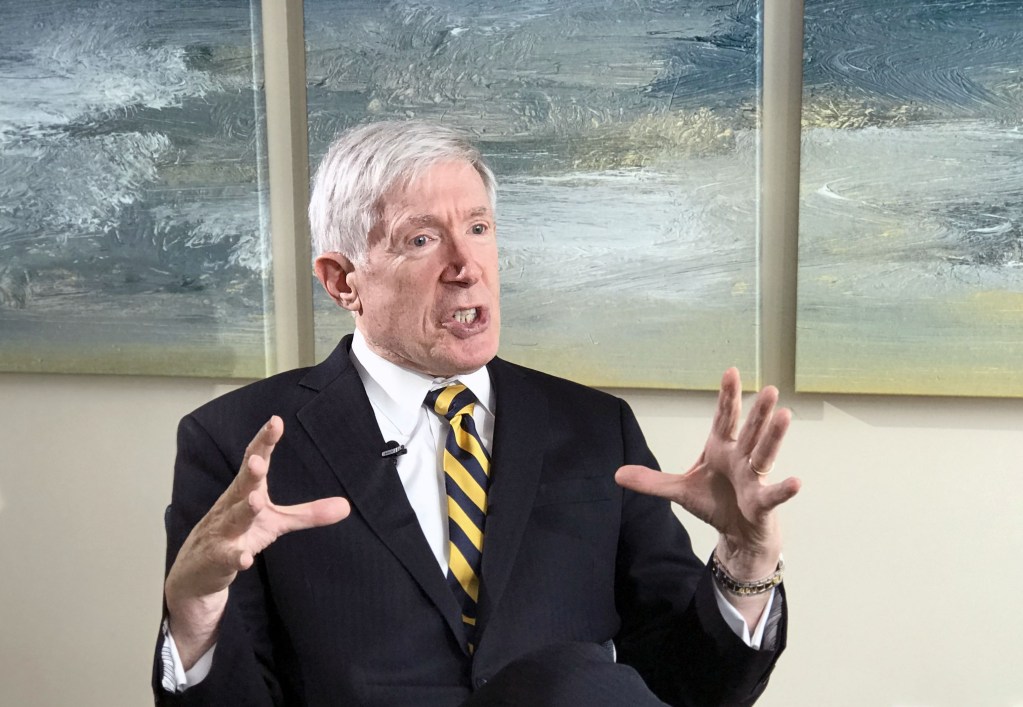
The transformation of warfare since Russia invaded Ukraine four years ago is also changing how countries must adapt their defense industries, and Kyiv is leading the way, according to former CIA director and retired Gen. David Petraeus.

In an interview with World at Stake earlier this week, he called Ukraine the “arsenal of democracy,” a term first used to describe the U.S. during World War II as it sustained allies with weapons and supplies.

“Ukraine in the future, I think, will be the most important military industrial complex in the free world,” Petraeus said. “It is producing cutting-edge unmanned systems, not just in the air, but on the ground and at sea.”

Ukraine’s integration of hardware and software is also extraordinary, he noted, adding the pace of innovation is constant. Software updates come in less than a week, and hardware changes come every few weeks.

In fact, Ukraine has recently developed new, more advanced drones with longer ranges that have evaded air defenses, allowing them to attack vital oil facilities deep inside Russian territory.

That’s devastated Russia’s ability to export oil, preventing the Kremlin from capitalizing on the spike in crude prices since the U.S. and Israel launched their war on Iran.

“This has become an industrial ecosystem producing the most impressive unmanned systems, I think, in the world, certainly in the free world,” Petraeus said. “And when the guns fall silent—as manufacturing is done not just here [in Ukraine] but in other countries with the money coming back here—I think Ukraine will reinforce its position as the arsenal of democracy.”

Ukraine is already helping countries in the Persian Gulf defend themselves from Iranian drones, which have demonstrated the ability to penetrate their U.S.-made defenses.

On Friday, President Volodymyr Zelenskyy said Ukrainian military personnel have shot down Iranian Shahed drones in multiple Middle Eastern countries. Ukraine is receiving weapons from the Gulf states in return, along with oil, diesel, and financial arrangements, he explained.

In addition to Ukraine’s rapid innovation cycles, its ability to develop cheap drones and mass produce them provide advantages on the battlefield as well. Ukraine makes thousands every day, and they are now responsible for the vast majority of casualties.

That’s in contrast with the U.S. military, which relies on so-called exquisite weapons that are more advanced but exponentially more costly and aren’t produced at mass scale. The U.S. and its allies are reportedly grappling with shrinking stockpiles of their most sophisticated munitions.

The mismatch between the cheap drones Iran is launching and the expensive interceptors used to shoot them down has alarmed some in the defense sector.

At the Hill & Valley Forum last month, CrowdStrike cofounder Dmitri Alperovitch warned NATO doesn’t have the production capacity and the supply chains to wage a long war.

Despite Russia having a much smaller GDP than NATO’s combined output, it still outproduces the alliance in artillery, armored vehicles, glide bombs, drones, and even certain types of missiles, he added.

“That is a choice,” said Alperovitch, who is also chairman of the Silverado Policy Accelerator think tank. “It’s not because we cannot produce this stuff.”

If Tesla can churn out 500,000 vehicles a year from one factory, then the U.S. should be able to make 10,000 Tomahawk cruise missiles, he argued.

Instead, the U.S. military typically procured about 90 Tomahawks per year before the Iran war, though the maximum rate of production is estimated to be 2,330 per year, according to the Center for Strategic and International Studies.

“We have optimized our defense industrial base for just-in-time delivery, for no surge capacity, and basically small-batch production,” Alperovitch said. “But munitions and weapon systems are not artisanal gin. And what we need to do is not treat it as a procurement line, but think about it as strategic capacity.” 

This story was originally featured on Fortune.com

This post was originally published here

U.S. inflation surged in March at the fastest monthly pace since June 2022, driven almost entirely by an energy shock tied to the Iran war.

The Consumer Price Index (CPI) rose 0.9% month-over-month — matching Wall Street’s estimate — as energy prices jumped over 10.9% on the month. This marks the biggest monthly CPI jump in nearly four years.

The annual inflation rate soared from 2.4% in February to 3.3% in March, the highest since May 2024.

Core CPI, which strips out food and energy, came in at 0.2% month-over-month, below the 0.3% consensus. On an annual basis, the underlying inflation gauge rose 2.6% year-over-year, up from 2.5% in February and below expectations of 2.7.

That divergence between a hot headline and a contained core is the structural signal in Friday’s report: the Iran war has not yet spread beyond the pump.

Chart: Tradingview

Energy Did The Work — And Then Some

The energy index surged 10.9% in March, the largest monthly increase since September 2005.

Gasoline alone jumped 21.2% on a seasonally adjusted basis — the largest single-month increase since the series was first published in 1967 — and …

Full story available on Benzinga.com

This post was originally published here

American wallets felt the impact of the war in Iran on Friday after the March Consumer Price Index (CPI) report confirmed what drivers had already felt at the pump.

Gasoline prices posted their largest single-month increase since the Bureau of Labor Statistics first published the series in 1967, surging 21.2% in March as the conflict disrupted oil flows through the Strait of Hormuz.

That one number — gasoline — accounted for nearly three-quarters of the entire 0.9% monthly headline CPI increase, which is the steepest monthly jump since June 2022.

It is also the most direct measure yet of how a geopolitical shock 7,000 miles away is repricing life in the United States.

Chart: March Inflation Logs Highest Monthly Jump Since June 2022

From $2.98 To $4.15 – Trump Broke The Pump

On Feb. 26 — the day before the Iran war began — the national average price for regular gasoline stood at $2.98 per gallon, according to AAA data.

It now stands at $4.153. That is a 39% increase in roughly six weeks, the fastest peacetime gasoline price shock in modern American history.

Think of it this way: the average American drives about 15,000 miles a year and gets around 28 miles per gallon.

At $2.98, that was a roughly $1,600 annual fuel bill. At $4.15, it is now $2,200. The war has cost the average driver an extra $600 a year — and counting.

The energy index as a whole surged 10.9% in March — its largest monthly move since September 2005. Beyond gasoline, fuel oil rose 30.7%, its sharpest monthly climb since February 2000.

Airline fares jumped 2.7%, the first visible signal of jet fuel costs passing through into consumer services, with jet fuel prices up 75% since the start of the war according to Goldman Sachs.

AAA National Pump Prices — April 10, 2026

Grade Current Avg.
Regular $4.153
Mid-Grade $4.668
Premium $5.033
Diesel $5.683
E85 $3.303
Source: AAA

What Are Economists Saying?

Jeffrey Roach, chief economist at LPL Financial, said “at least eighty percent” of the 0.9% monthly CPI increase was energy-related, rising even higher if airfares are included given transportation’s 16% weight in the index. …

Full story available on Benzinga.com

This post was originally published here

 With baby Arthur too young for the measles vaccine and a sibling due in June, the Otwells grew nervous when the threat of the highly contagious virus started factoring into their grocery run.

“We go to the Costco that was kind of a hotbed,” said John Otwell, who knew about the state health department’s warnings of public exposures at the store. “A lot of people just don’t get it; they think it’s just a cold. It’s not.”

By Arthur’s 9-month checkup, the South Carolina outbreak had exploded into the nation’s worst in more than 35 years, surpassing last year’s in Texas. That meant that under state guidance, Arthur could get his first dose of the MMR vaccine — for measles, mumps and rubella — earlier than the usual 12 to 15 months old. Their new baby won’t be able to get the shot until at least 6 months — a prospect that worries parents of infants wherever measles spreads.

Babies too young to be vaccinated are among the most vulnerable in a measles outbreak. The disease can wreak havoc on their fragile bodies, making them so sick they stop eating and drinking. They can develop pneumonia or brain swelling, and sometimes die.

Babies depend entirely on herd immunity — at least 95% of a community must be vaccinated to prevent measles outbreaks. But dropping vaccination rates have eroded protection in South Carolina and across the nation. In Spartanburg County, the outbreak’s epicenter, less than 90% of students have gotten required vaccines.

“Babies become sitting ducks,” said Dr. Deborah Greenhouse, a Columbia pediatrician. “The burden is on all of us to protect all of us.”

But increasingly, some policymakers and officials push a view of vaccination as an issue of individual freedom and parents’ rights, rather than one of public health to safeguard the population as a whole.

At the federal level, Health Secretary Robert F. Kennedy Jr., a longtime anti-vaccine crusader, has sought to remake vaccine policy and oversaw billions in public health cuts. And though a temporary ruling from a federal judge has slowed his momentum, a raft of bills has been introduced in states, including South Carolina, that threaten to further reduce vaccination rates.

South Carolina’s measles outbreak, totaling about 1,000 cases, has slowed. But measles is spreading in many states, with 17 outbreaks this year and 48 last year, and the U.S. on the verge of losing its status as a country that has eliminated measles.

Doctors work to protect the youngest against measles

Dr. Jessica Early never thought she’d have to deal with measles, but the pediatrician feared for her patients and her own baby when it popped up in her Greer community. She and other doctors began offering an approved infant MMR dose as early as 6 months old. Her practice also started giving the second MMR dose — usually for ages 4 to 6 years old — early.

To the chagrin of many doctors, no one knows how many South Carolina infants have gotten measles or been hospitalized by it.

State officials will disclose only that 253 of the 997 cases were among children 4 and younger; they say they won’t break cases down further for confidentiality reasons. It’s not uncommon to group statistics this way.

Officials also don’t know exactly how many infants were hospitalized with the virus because, as in some other states, hospitals aren’t required to report measles-related admissions.

Across the state, doctors said they got many questions about whether it was safe to bring infants to waiting rooms or day care.

Thomas Compton — regional director of Miss Tammy’s Little Learning Center, a child care network operating across the outbreak region — said 18 parents pulled children out of his facilities, though they had no confirmed cases. Some abandoned deposits days before their kids were scheduled to start, forcing the company to lay off a teacher.

Although licensed day cares must require vaccines under state law, families can easily get religious exemptions. About a fifth of Miss Tammy’s 300 children have vaccine waivers.

When measles surged, Compton said state officials gave little guidance. His staff scrubbed down surfaces, as they did when COVID-19 was raging; tracked local measles cases on Facebook; and relied on Google for information about the disease.

“A lot of parents were really stressed out,” Compton said. “Anytime that we had a little sickness going on or something, they were like, ‘Do you think it’s the measles?’”

State legislation would prohibit vaccines for children under 2

Last year, an Associated Press investigation found that Trump administration officials were directing activists to push anti-science legislation in statehouses. Nationally, around 350 anti-vaccine bills were introduced as of late October, AP found, including at least eight in South Carolina.

This year, a state bill would prohibit requiring vaccines for children under 2.

“In other words, it would get rid of those requirements in the day cares,” pediatrician Greenhouse said. “And for people like me, that is a gut punch that is terrifying.”

In a subcommittee discussion, Republican State Sen. Carlisle Kennedy said his bill aims to protect parents’ rights. His baby was born in August without working kidneys and got vaccines on a personalized schedule, in coordination with doctors.

“We didn’t want to put vaccines in his body before his body was able to survive them,” he said.

Opponents countered that herd immunity protects children in these situations.

The Senate subcommittee advanced the legislation. Greenhouse fears it has momentum.

“In the climate that we are currently living in, I think any bill potentially could have legs,” she said. “It is our job to do our absolute best to make sure that those legs don’t go anywhere.”

Whether the bill becomes law, doctors say this sort of legislation fuels vaccine skepticism and confusion. While the American Academy of Pediatrics advises giving babies all the vaccines they’ve gotten for years, some parents tell Greenhouse they know the government has called for fewer.

“They don’t actually know who they can trust,” she said.

South Carolina, like other states, has made nonmedical vaccine exemptions easier to get, noted Dr. Martha Edwards, president of the state’s American Academy of Pediatrics chapter. In the outbreak’s epicenter, religious exemptions have more than doubled since 2020. Statewide, 4% of school-age students have such exemptions in 2025-26.

“Parental choice is a big buzzword in a lot of the Southern states,” Edwards said. But the choice not to vaccinate, she said, impacts other parents’ rights to keep their children safe.

Nationwide, protection fades as measles spreads

Doctors expect things will only get worse.

In the first three months of 2026, the U.S. logged 1,671 measles cases. That’s 73% of the total from 2025, the worst year for the virus in more than three decades. In November, international health officials will determine whether measles is still considered eliminated in the U.S.

National MMR vaccination rates – which dropped to 92.5% among kindergartners in the 2024-25 school year, from 95.2% in 2019-20 – obscure much lower rates in certain communities. At one Spartanburg County school, 21% of kids received all required vaccines.

Doctors worry it’s just a matter of time before all sorts of vaccine-preventable diseases threaten lives like they did a century ago.

“The whole concept of immunization is one of the best things that has ever happened to medicine,” Greenhouse said. “To see that we are actually going backwards is just confounding.”

Helen Kaiser, who lives in the outbreak area, vaccinated her twin 2-year-old boys early to protect them and the community.

“I would never forgive myself,” she said, “if I knew that my son had gotten another baby very sick and it was something I could have prevented.”

———

Ungar reported from Louisville, Kentucky.

——-

The Associated Press Health and Science Department receives support from the Howard Hughes Medical Institute’s Department of Science Education and the Robert Wood Johnson Foundation. The AP is solely responsible for all content.

This story was originally featured on Fortune.com

This post was originally published here

The warning signs were there two decades ago—long before ChatGPT, long before anyone worried about a robot taking their job. Around 2005, something quietly shifted in the American labor market. College degrees kept multiplying. Good jobs did not.

“This is a generation of people that was really given the hardest sell of any generation in history of why they need to go to college,” says Noam Scheiber, a New York Times labor reporter whose new book, Mutiny: The Rise and Revolt of the College-Educated Working Class, chronicles the revolt brewing inside America’s credentialed workforce. “Everyone, from their parents and family members to the president, Barack Obama and Bill Clinton—talking about how in the 21st century, everyone’s got to go to college … And unfortunately, all of this was happening at the precise moment when a college degree was becoming less valuable than it had been in many decades.”

Scheiber, who graduated in 1998 into what he calls “one of the best years in the history of the world to have graduated from college,” watched the shift unfold from the front row of the labor beat. He remembers a roaring job market, an explosion of startups, offers raining down on anyone with a diploma. The Great Recession of 2008 was the accelerant for what came next. Citing research from Berkeley economist Jesse Rothstein, who previously served as chief economist at the U.S. Department of Labor, Scheiber notes that employment growth for recent college graduates never returned to its pre-2008 trajectory, even on the eve of the pandemic in 2019. Then COVID hit, upending the board all over again.

courtesy of NBER

The data point that Scheiber returns to most is striking: The New York Federal Reserve has tracked the unemployment rate for recent college graduates since the late 1980s. For roughly three decades, it almost never exceeded the overall unemployment rate. Since 2022, it has stayed stubbornly above it.

“That’s just not something that we saw for 30 years before that,” Scheiber says. “It’s a pretty remarkable shift.”

As many students took out loans to pay for the soaring cost of tuition, they found themselves unable to get the high-paying jobs they needed to see a return on investment. Instead, they found themselves further in debt, living with their parents, and delaying milestones such as getting married or buying a house.

The frustration finds a channel

What filled that gap—between expectation and reality—was frustration. And frustration, it turned out, was organizing.

Starting with three Starbucks stores in Buffalo in the fall of 2021, Scheiber watched union elections spread at that company with exponential force. “I remember sort of January, February of ’22, it just kind of growing exponentially,” he says. “It was three, and then it was kind of five to 10, and then it was 20, and it just kept going up.” The movement jumped to Apple retail locations, Trader Joe’s, Amazon warehouses, and REI. As he talked to more and more of these workers, a pattern emerged that sharpened the cliché of the post-recession barista with a bachelor’s degree into something more urgent: a mass phenomenon. “So many of them had gone to college,” he says. “This union campaign was just catching fire.”

It wasn’t just retail. In the summer of 2023, auto workers went on strike for six weeks. Actors and writers walked the picket lines in Hollywood. And something remarkable happened across industries and education levels: Gallup polling at the time showed 70% to 75% of the American public sided with the striking workers.

“The thing that I found really striking,” Scheiber says, “is I would talk to people in very different industries, very different professions. And they all were like, ‘Right on‘ — they were right there with the auto workers, right there with the actors, right there with the writers.” He recalls a refrain from his sources that cut to the bone of a shifting identity: “I may be a doctor or I may be a tech worker, but I’m still a worker.”

That consciousness even reached the upper echelons of medicine. Scheiber reported on roughly 400 primary care doctors at Allina, a major Minnesota healthcare system, who unionized in 2023—the largest group of private-sector physicians to do so in modern memory. “The level of kind of worker consciousness that you would get among the doctors was just so striking.” he says. “They’re just like, ‘Yeah, I’m just a cog in this big machine.’” One of the doctors told him that “it doesn’t matter if you’re an auto worker or a doctor, how much prestige or education you have, you’re just treated the same by all these big companies.”

Downward mobility is ‘incredibly radicalizing’

That sense of shared precarity, Scheiber argues, is reshaping identity in ways that will define American politics for years. A plurality of the early Starbucks organizers he spoke to had volunteered for Bernie Sanders. The support for socialism among college graduates under 35 is, in his telling, not a fringe phenomenon but a mainstream one. He points to figures like Alexandria Ocasio-Cortez—a Boston University graduate who worked in restaurants and as a bartender before her political career—as both exceptional and emblematic.

“Downward mobility is incredibly radicalizing,” he says. “If you either grew up upper middle class and that’s no longer available to you, or you grew up with the promise of joining the upper middle class because you went to college like you were told to, and took out your loans. And now there’s no job that is available that enables you to come to the middle class. There are probably some more radicalizing forces in history, but not that many.”

He draws a line from the current moment to a broader historical pattern explored by the political scientist Peter Turchin, whose work on the “overproduction of elites” has gained a wide audience. The theory: when societies produce too many highly educated people competing for too few positions of status and prosperity, the result is political instability. Musical chairs with a shrinking number of seats. Turchin told Fortune last July that he sees signs of his theory “everywhere you look” in modern American life. “Look at the overproduction of university degrees … There is overproduction of university degrees and the value of [the] university degree actually declines.”

In a decade, Scheiber suggests, the shift in class self-identification may be nearly complete. “A large majority of people are just going think of themselves as working class,” he says.

Yet he resists pure fatalism. The word he keeps returning to is agency. These college-educated workers, he argues, are formidable precisely because of what their education gave them—not a guaranteed career, but what one sociologist he quotes calls “class confidence,” the trained ability to figure things out, to navigate bureaucracies, to push for better terms. “Bad things happen to them, like happen to everybody,” Scheiber says, “but they don’t tend to take that lying down.”

‘Creative, brilliant people are going to wake up’

Paige Craig sees the same landscape from a radically different vantage point. The founder of Outlander VC grew up homeless until fifth grade, was recruited by West Point, served in military special operations, and now, from New York, invests in defense technology, robotics, and AI. He frames the coming disruption not as a slow unraveling but as a compression of history itself.

“The Industrial Revolution was a hundred-year process,” Craig says. “The tech revolution was a 30-, 40-year process of going from paper to digital. We’re in an AI revolution that’s going to happen in 10 years. That’s the massive shift.”

At Outlander, Craig recently wrote a 10-year vision statement. Its fifth pillar stopped him cold as he drafted it: “We’re in a decade where we’re going to see the massive dislocation of creative talent,” he says. “Creative, brilliant people are going to wake up this decade and realize the jobs that they thought they were going to have—and the jobs they thought they could have—are gone.”

And yet Craig is not pessimistic about the long arc. He envisions what he calls a “second golden age”—an explosion of entrepreneurship, arts, and science born from the wreckage of displaced labor. He imagines millions of sole proprietors leveraging AI and robotics to build hyperlocal businesses that never would have been profitable before. He talks about limitless demand for healthcare, about turning displaced workers loose on Alzheimer’s research, ocean exploration, and the frontiers of the human body. He recently funded a startup in New York building $1,000 humanoid robots designed to be deployed by the millions—not the $100,000 prototypes that dominate headlines, but cheap enough to generate the training data that could make them truly useful.

“I hope that this freedom of labor and this massive productivity lead to this second golden age,” Craig says, “where we realize as societies that we can actually spend money on the arts, storytelling, and the creativity that makes humans blossom. Then the hard sciences where we push the boundaries of space travel and minerals and resources. That is where I think we go.”

But he does not minimize the turbulence of the transition. “It’s not that we have the blue-collar being dislocated,” he says. “It’s the most creative, educated, smart part of our society that in this decade is going to realize they don’t have jobs.”

The view from the eye of the storm

From his apartment on the Embarcadero in San Francisco—”right in the eye of the storm,” as he puts it — Sumir Chadha is watching the same wave approach from yet another angle. The co-founder and managing director of WestBridge Capital, a $7 billion India-focused evergreen fund, Chadha splits his time between Bangalore and the Bay Area. He is measured by temperament, analytical by training (Princeton, Harvard, Goldman Sachs, McKinsey), and unusually candid about what keeps him up at night.

AI-powered coding tools, he says, have already devastated the SaaS sector—what analysts call the “SaaSpocalypse or the “SaaSacre.” The productivity gains are not theoretical. “I had dinner with one of my entrepreneurs last night,” he says. “He’s talking about what Claude Code is doing to their software development. He said it’s not 10x, it’s like 100x better than what they had before.”

The human cost follows quickly. That same entrepreneur runs a 1,500-person company. He told Chadha that his 300-person implementation team could be reduced to 30 or 40 with AI. “They’re doing a layoff for about 300 engineers, man,” Chadha says. “Which is pretty sad.”

“I worry about the next three years,” he says plainly. “There’s going to be this tale of haves and have-nots that’s just going to thicken and create a lot of social tension.” He pauses. “I’ve taken some security measures at my house—things I never worried about.” He and his girlfriend have applied for European Union citizenship as a contingency. “I don’t think we’re ready for it.”

Pressed on whether he truly believes social unrest is possible in America, Chadha does not flinch. “I think there’s a 10%, 15% scenario that’s a little scary,” he says. “And I hope we don’t come to that. I’m not saying we will. But there’s some chance that it could get pretty tough in the next couple of years.”

He remains bullish on the technology itself and on India’s long-term trajectory. Westbridge has invested roughly $1 billion in eight or nine AI companies, nearly all of which are scaling rapidly. But he draws a sharp distinction between where wealth is being created and where pain will be felt first. “The U.S.—we are such an amazing, dynamic economy. Things move faster here than Europe, faster than India, faster than anywhere,” he says. “I think we’re kind of the front line of everything.”

The speed of the clock

All three men—a labor journalist, a defense-world venture capitalist, a globalist fund manager—are converging on the same conclusion from radically different vantage points: that AI is not the origin of this story, only its most dramatic chapter. The college bargain that a generation of Americans was sold (borrow money, earn a degree, join the middle class) has been quietly unraveling for 20 years. What’s coming next may simply be the part that everyone finally notices.

“We haven’t really seen the labor market impacts of AI yet,” Scheiber says. “A little bit in fields like software development, but beyond that, we haven’t really seen it. So it does feel like we may only be at the beginning of it.”

There is a question of tempo. Scheiber is skeptical of forecasts projecting mass white-collar displacement in 18 months. Large organizations, he notes, are deeply bureaucratic; inertia is a powerful force. “Even if theoretically you could replace 95% of your junior consultants in a year-and-a-half, you’re not going to do that,” he says. His gut tells him the disruption will play out over a decade, not a quarter.

But even at a slower clock, the political consequences compound. “Even if we see the unemployment rate for recent college grads tick up a few tenths of a percentage point every year for five years,” he says, “that’s gonna be pretty destabilizing.”

Craig agrees and frames the challenge in terms of historical analogy. Past technological revolutions allowed generations to absorb the shock. This one compresses a century of change into a decade. “It used to be, you could mark change with graveyards,” he says. “But the scope of change and the speed of change is so massive now. That’s the crazy part. My kids and their kids, we’re all going to be together in the middle of this crazy shift.”

Chadha puts it most succinctly: the human and political systems built to absorb disruption were designed for a slower clock.

The question now—for policymakers, employers, investors, and the generation caught in the middle—is whether anyone can build new institutions fast enough to keep up with the machines.

This story was originally featured on Fortune.com

This post was originally published here

At 9 a.m. Eastern Time today, oil was priced at $97.78 per barrel with Brent serving as the benchmark (we’ll explain different benchmarks later in this article). That’s a gain of $4.02 compared with yesterday morning and around $31 higher than the price one year ago.

Oil price per barrel % Change
Price of oil yesterday $93.76 +4.28%
Price of oil 1 month ago $108.90 10.21%
Price of oil 1 year ago $63.68 +53.54%

Will oil prices go up?

It’s impossible to forecast oil prices with detailed precision. Many different elements affect the market, but ultimately it boils down to supply and demand. When worries about economic recession, war, and other large-scale disruptions increase, oil’s path can shift fast.

How oil prices translate to gas pump prices

Gas prices at the pump don’t only track crude oil. They also include what it takes to refine and move that fuel, the taxes layered on top, and the extra markup your local station adds to stay in business.

Since crude oil generally makes up a majority of the per-gallon cost, changes in its price have an outsized impact. When oil surges, gas prices typically rise in tandem. But when oil retreats, gas prices often lag on the way down, a trend sometimes described as “rockets and feathers.”

The role of the U.S. Strategic Petroleum Reserve

In case of emergency, the U.S. has a store of crude oil known as the Strategic Petroleum Reserve. Its primary purpose is energy security in case of disaster (think sanctions, severe storm damage, even war). But it can also go a long way toward softening crippling price hikes during supply shocks.

It’s not a long-term answer and is more meant to provide temporary relief, assisting consumers and keeping critical parts of the economy running, like key industries, emergency services, public transportation, etc.

How oil and natural gas prices are linked

Both oil and natural gas are key sources of the energy we use every day. Because of this, a big change in oil prices can affect natural gas. For example, if oil prices increase, some industries may swap natural gas for some segments of their operations where possible, which increases demand for natural gas.

Historical performance of oil

To gauge oil’s performance, we often turn to two benchmarks:

  • Brent crude oil, the main global oil benchmark.
  • West Texas Intermediate (WTI), the main benchmark of North America

Between these two, Brent better represents global oil performance because it prices much of the world’s traded crude. And, it’s often the best way to track historical oil performance. In fact, even the U.S. Energy Information Administration now uses Brent as its primary reference in its Annual Energy Outlook.

Looking at the Brent benchmark across several decades, oil has been anything but steady. It’s seen spikes due to factors such as wars and supply cuts, and it’s also seen crashes from global recessions and an oversupply (called a “glut”). For example:

  • The early 1970s brought the first big oil shock when the Middle East cut exports and imposed an embargo on the U.S. and others during the Yom Kippur War.
  • Prices dropped in the mid-1980s for reasons such as lower demand and more non-OPEC oil producers entering the industry.
  • Prices spiked again in 2008 with increased global demand, but it soon plummeted alongside the global financial crisis.
  • During the 2020 COVID lockdown, oil demand collapsed like never before—bringing prices below $20 per barrel.

All to say, oil’s historical performance has been anything but smooth. Again, it’s hugely affected by wars, recessions, OPEC whims, evolving energy initiatives and policies, and much more.

Energy coverage from Fortune

Looking to stay up-to-date regarding the latest energy developments? Check out our recent coverage:

Frequently asked questions

How is the current price of oil per barrel actually determined?

The current price of oil per barrel depends largely on supply and demand, including news about potential future supply and demand (geopolitics, decisions made by OPEC+, etc.). In the U.S., prices also move based on how friendly an administration is to drilling, as it can affect future supply. For example, 2025 saw the Trump administration move to reopen more than 1.5 million acres in the Coastal Plain of the Arctic National Wildlife Refuge for oil and gas leasing, reversing the Biden administration’s policy of limiting oil drilling in the Arctic.

How often does the price of oil change during the day?

The price of oil updates constantly when the “futures” markets are open. A futures market is effectively an auction where people agree to buy or sell oil in the future. As long as people and companies are trading contracts, the oil price is changing.

How does U.S. shale oil production affect the current price of oil?

In short, shale is rock that contains oil and natural gas. Think of shale as energy yet to be tapped. The more shale the U.S. accesses, the more energy we’ll have—and the more easily oil prices can keep from spiking as much thanks to a greater supply.

How does the current price of oil impact inflation and the broader economy?

When oil is expensive, it tends to make everyday items cost more. This can be related to energy (your heating, gas utilities, etc.), but it’s also due to the logistics involved with making those items accessible to you. Shipping, for example, can affect the price of things at the grocery store, as it’s more expensive to get those products from warehouses and farms onto the shelf.

This story was originally featured on Fortune.com

This post was originally published here

This story on the March 2026 CPI inflation report is developing and will be updated with further details.

Inflation surged in March as consumer prices jumped amid the economic disruptions caused by the Iran war’s impact on the energy market.

The Bureau of Labor Statistics on Friday said that the consumer price index (CPI) – a broad measure of how much everyday goods like gasoline, groceries and rent cost – rose 0.9% from a month ago and is 3.3% higher than last year. The annual figure jumped from last month’s 2.4% reading, while the monthly increase also rose markedly from last month’s 0.3% reading.

Both the 0.9% monthly increase and 3.3% annual rise were in line with the expectations of economists polled by LSEG.

So-called core prices, which exclude volatile measurements of gasoline and food to better assess price growth trends, were up 0.2% on a monthly basis and 2.6% from a year ago. Both of those figures were slightly cooler than economists’ predictions of 0.3% and 2.7%, respectively.

The core CPI figures were slightly hotter than February’s readings, which showed prices rose 0.2% on a monthly basis and 2.5% from the prior year.

This post was originally published here

The Committee for a Responsible Federal Budget (CRFB) has a ticker on its website: The Retirement Trust Fund Countdown. At the time of writing, it stands at six years, seven months, five days, seven hours, 28 minutes, and eleven seconds.

This, the CRFB says, is when the Social Security program’s funds will be exhausted, and cuts to services would ensue. Medicare has a similar insolvency clock, due to wind down a little over a month before Social Security.

These clocks represent a problem for Congress. Not for the senators of today, but for the class that will follow them. Some 33 senators will see their terms expiring in early January 2027, with their seats up for election later this year.

Their continued service, or their replacements, will hold the seats for the next six years: Meaning the deadline to fix the funding for mandatory budget spends like Social Security and Medicare will fall squarely into their laps.

The wider problem they will need to wrangle with is the question of the federal government’s ongoing spending deficit, and the $39 trillion national debt burden it has created.

The total debt itself isn’t necessarily of concern, though the interest payments to service that debt are now eye-watering: A budget update from the Congressional Budget Office (CBO) released this week said the government—according to preliminary estimates—paid out nearly $530 billion in interest between October 2025, when the fiscal year starts, and March 2026. That’s more than $88 billion in interest per month, or more than $22 billion a week.

In that context, many economists are of the opinion that it is no longer a case of if, but when, the mandatory public funds reach insolvency—unless Congress does something about it.

Caleb Quakenbush is the Bipartisan Policy Center’s (BPC) director of fiscal policy, and in an exclusive interview with Fortune in Washington, D.C., highlighted that Congress is already facing some “fiscal deadlines.”

“The next class of senators is going to have to address Social Security, one way or another,” Quackenbush said. Some of that gap might be closed by further borrowing, which would shift the cost onto future generations, but “we may achieve some meaningful reform. There is an opportunity to spread some of the costs over a broader span of generations.”

Michael Peterson, CEO and chairman of the Peterson G Peterson foundation—an organization which advocates and lobbies for fiscal sustainability—is similarly eyeing the looming deadline as an intial test of political willpower.

“The fact that the U.S. senators getting elected now are going to have it on their to-do list during their term, my hope would be that come January the campaign is over and [they] lay down some of the weapons and pick up some of the calculators and pencils, and try and come up with a solution,” Peterson tells Fortune in an exclusive interview.

The elephant in the room

The current debt levels may have increased at a faster pace over recent decades, but they haven’t accumulated overnight—nor under one party as opposed to the other. Indeed, despite efforts such as the Simpson-Bowles Commission under President Obama, and President Trump’s revenue-raising tariff reforms, neither party has enacted specific policy around federal deficits.

But the BPC sees evidence of Peterson’s wish—that lawmakers on both sides will begin working together to come up with solutions—and is more optimistic that an all-out fiscal crisis isn’t on the cards.

“The common knowledge or conventional knowledge is that Congress waits until the last minute to act, and that’s historically been true,” Quakenbush said. “I am personally a little bit skeptical of the total crisis, collapse scenario.”

“I think higher living costs [and] slower income growth, is probably the likelier scenario just given our position in the world economy, our position as the world’s reserve currency, to the extent that we continue to find markets for our debt that are willing to buy it … that puts us in a relatively strong position for the foreseeable future in terms of the economic risk, but that doesn’t mean that there’s zero risk.”

From his conversations with members of Congress, Quakenbush added spending is an issue individuals understand they need to address, but know they need to do so with bipartisan support and appeal in order for the policies to stick: “That signals to me at least that they’re not writing this off as something they’re going to put off forever.”

This story was originally featured on Fortune.com

This post was originally published here

Good morning. CEOs depend on their CFOs more than ever. And fear them more than ever, too.

Under mounting pressure from nearly every direction, many chief executives now view their closest strategic partner as a potential threat to their job security.

That’s one of the key findings of the inaugural BCG CEO Insomnia Index, based on a survey of roughly 500 chief executives at companies with revenues ranging from $100 million to more than $5 billion. It offers a window into how CEOs assess their stress levels—and what’s keeping them up at night.

More than a quarter of CEOs surveyed said their chief financial officer poses the greatest threat to their job security, ahead of every other C-suite role, followed by the COO. But the risk isn’t necessarily all about competition; it’s also about misalignment.

If the CFO gets it wrong, the CEO pays the price, according to Jody Foldesy, global chief operating officer of corporate finance and strategy at Boston Consulting Group (BCG). Foldesy views the dynamic less as rivalry and more as interdependence. CEOs are relying more heavily on CFOs for decision support, making it critical that finance chiefs are deeply integrated into strategy and execution. “It is critical that the CFO be deeply integrated into the development of their agenda and provide the right facts, data, and advice,” he told me.

That shift reflects how the CFO role itself is evolving. “CFOs are less backward-looking bookkeepers and much more forward-looking—developing and analyzing scenarios, providing decision support and business advisory,” Foldesy said. While many still come from accounting backgrounds, more are rotating in from FP&A or business roles.

As AI spending becomes a larger line item, CEOs are also looking to CFOs to lead implementation and ensure returns. “For every company’s ledger, this is becoming an increasingly large portion of spend—and if you look into the future, it’s only going to grow,” he said.

But at the same time, the CFO’s regular interaction with the board, on financial performance, forecasts, and risk, can build credibility and influence, potentially positioning them as a successor. “While having a strong successor should be a part of every CEO’s legacy plan, it’s only human to feel exposed when a replacement is waiting in your own C-suite,” the report noted.

The pressure on CEOs is intensifying. The report points to an average stress score of 66.7 out of 100, above the threshold typically used to indicate high stress. Growth targets and cost management rank among the top concerns, and a third say they have more to prove to their board now than they did just two quarters ago.

Foldesy said managing that stress requires balance—both between short- and long-term priorities and in how CEOs approach the role in their own lives. “This is a role that can easily blot out the sun personally,” he said. “That’s why you find many CEOs experiencing the very high levels of stress the report communicates.”

Have a restful weekend.

Sheryl Estrada
sheryl.estrada@fortune.com

This story was originally featured on Fortune.com

This post was originally published here

Desk jobs were once the golden ticket to steady pay, job security, and a career you could build a life around. But Gen Z isn’t so sure anymore. They’ve watched millennials do everything right, and still end up ground down, in debt, or laid off. And to top it off, they’re consistently being warned that AI is coming for all office jobs in the next decade anyway. 

Now, three-quarters of Gen Zers actually associate desk jobs with burnout and instability—and new research from SupplyHouse, shared exclusively with Fortune, shows they’re done pretending otherwise. 

Nearly 1 in 4 have already seriously considered, or are actively pursuing, a career in the trades instead. 

In what may be the biggest generational career pivot in decades, powered by economic anxiety, student debt, and TikTok, Gen Z are trading laptops for toolbelts—and they’re not looking back.

TikTok is the new career counselor—and it’s sending Gen Z down the trades

Half of Gen Z say their interest in becoming welders, electricians, plumbers, and so on, started on social media. TikTok is the number one platform where Gen Z are discovering trade careers, with 1 in 3 watching trade content there—and getting allured. It’s not hard to see why. 

Trade influencers are racking up millions of views, showing how skilled labor offers autonomy, financial security, and work-life balance that many entry-level office roles can’t match. 

Take Chase Gallagher, for example. At 12 years old, he started mowing his neighbors’ lawns for $35 a pop in the summer of 2013. By 16, Gallagher had already turned over $50,000. Now, his landscaping business is generating millions in revenue—and he’s posting all about his success online. 

At the same time, they’re also watching college-educated millennials on TikTok complain that their desk job salary doesn’t stretch enough to move out of their childhood bedroom. Meanwhile, Gen Z graduates keep posting about firing off thousands of job applications into a void as AI wipes out entry-level jobs. 

“It just feels like you’re just banging your head against the wall,” a struggling Gen Zer with a maths degree lamented. 

So it’s perhaps unsurprising that 78% of Gen Z have concluded that skilled trades are less vulnerable to AI disruption than white-collar careers.

The grass isn’t always greener on the construction site

Despite the buzz, the reality of trade work doesn’t always live up to the TikTok hype. Nearly 1 in 3 Gen Z (30%) say a parent, teacher, or counselor discouraged them from pursuing a trade career. And they may have a point.

Yijin Hardware analyzed jobs based on fatal injury rates, projected openings (2023 to 2033), median wages, and education requirements—and coming in at No. 1 is office admin and support roles. The researchers also found trade jobs are among the most “dangerous” out there for non-grads—logging, hunting, fishing, and refuse have the highest on-the-job fatality rates, paired with unpredictable working conditions, and limited opportunities. Not a single entry-level office job made the bottom rankings of their list.

It’s not the first study to suggest Gen Z may be looking at manual work through rose-tinted glasses.

According to another new WalletHub study ranking the best and worst entry-level U.S. jobs in 2025, trade roles dominate the bottom of the list. Welders, automotive mechanics, boilermakers, and drafters all rank among the least promising career starters due to limited job availability, weak growth potential, and potentially hazardous work. 

“While trade work isn’t as easy to automate as some office jobs, new technologies like prefabrication and robotics are starting to take over parts of the workload, which can reduce demand,” WalletHub’s analyst Chip Lupo told Fortune. They’re also not immune to mass layoffs and are at the mercy of interest rates and demand.

And worse still, more often than not, many trade jobs might not actually make Gen Z happier than a desk job. 

Another study ranked electricians as the least happy workers of all. According to the research, the physically demanding nature of the job and 40-plus-hour workweeks weren’t made up for by the just “decent” salary. Starkingly, not a single trade job made the list of happiest jobs.

This story was originally featured on Fortune.com

This post was originally published here

Good morning. On Fortune’s radar today:

  • Markets: Good times!
  • EXCLUSIVE: Has Anthropic built something too dangerous and too expensive to commercialize?
  • Get ready for nation-state oil hoarding.
  • Peace talks begin as the White House goes to war against the media, insider traders … and the Pope.
  • Without immigrant workers the U.S. will need robots, Pimco says.
  • EXCLUSIVE: Eva Longoria on her days as a headhunter who closed deals from her soap opera dressing room.

This story was originally featured on Fortune.com

This post was originally published here

  • In today’s CEO Daily: Diane Brady checks in with defense leaders about the military spending hike Trump has requested.
  • The big leadership story: The fallout from the Iran conflict is still taking shape.
  • The markets: Up aside from U.S. futures as investors digest Strait of Hormuz uncertainty.
  • Plus: All the news and watercooler chat from Fortune.

Good morning. I’ve been calling defense contractors, consultants and people who work or have worked in the military this week to get reaction to Trump increasing military spending by more than 40% in his proposed 2027 budget. I didn’t expect them to speak on the record: Who wants to gloat about good fortune when the nation is at war?

What I didn’t anticipate was the pessimism and concern. Coming from four top executives whose companies stand to gain the most from federal spending, it’s a window into deeper concerns about the economy. The optimism about AI-enabled productivity gains is real, as is the support for the president’s priorities when it comes to innovation and strengthening America’s military. The concerns:

Is this level of spending sustainable? My colleague Shawn Tully argues that it is not: “If the expenditures blowout happens, and the rosy assumptions needed to offset the new outlays fail to materialize, America will edge even closer to a fiscal cataclysm prompted by a ruinous rise in interest expense.” With a $39 trillion national debt and public opposition to the attacks on Iran, opposition could come from several fronts: “We’re in a volatile and dangerous time right now,” one executive told me on Monday, prior to the ceasefire. “You need stable commitments, a stable economy with sustainable growth, to invest at this scale.”

Are these priorities strategic? Like CEOs in other industries, those working in defense have fallen in and out of favor in this administration. There were the budget cuts that forced leaders like Booz Allen Hamilton CEO Horacio Rozanski to lay off staff, the relationships damaged by DOGE, the attacks on specific companies, and the executive order earlier this year that limits stock buybacks and pay at defense companies. Among some CEOs, there’s a feeling that the decision-making is personal and beyond their control. “I don’t want to wake up and see me or my company showing up in some Truth Social post,” one executive told me last night. “You build these partnerships over many years; the hope is that it doesn’t matter which party is in power … I wouldn’t make that assumption right now.”

Is the world a safer place? Like many Fortune 500 companies, major defense contractors also do business with U.S. allies. Along with facing increased cyber-attacks amid the war, they’re facing lost deals in Europe and the repercussions of the U.S. going it alone. “The stereotype is that defense companies want to go to war, but that’s not true … It’s very different when you’re mobilizing against a threat or keeping the nation safe.” And, when it comes to waging war, the speed of AI is even more disconcerting, with one executive telling me he’s equally concerned about the Pentagon’s ban on Anthropic’s technology as he is about the capabilities of AI and how it’s being developed by potential adversaries like China: “Warfare is going to change,” he said, adding that “it’s hard to know” how.

Contact CEO Daily via Diane Brady at diane.brady@fortune.com

This story was originally featured on Fortune.com

This post was originally published here

Job prospects during the pandemic were grim. After all, companies shuttered their windows, business went online, and recessionary forces put most hiring on ice. Of course, most job hunters at the time felt as though the job market was frozen solid.

But now, job hunters across the country actually feel worse than they did during the peak of the pandemic.

Newly released data from the Federal Reserve Bank of New York finds that Americans are less optimistic about finding work than they were in 2020, when the government was literally paying people to stay home from work. Since late 2025, the average American worker said they have a roughly 45% chance of securing a new role within three months if they were to quit their job today, according to the Fed’s job finding expectations, a portion of the Consumer Expectations Survey. That’s lower than the 46.2% chance reported in December 2020, marking an especially dire outlook for workers.

Successive warnings of AI’s encroachment on the white-collar workforce has workers fearful their jobs are on the chopping block. Aside from AI, economic headwinds such as unpredictable tariffs and a shrinking consumer base (the result of tightening immigration policy) threaten companies’ growth plans.

To be sure, the U.S. just posted a better-than-expected jobs report. Employers posted 178,000 new roles in March and unemployment edged down to 4.3%, a huge bounce back from February’s dismal numbers

Why are job seekers so pessimistic?

Aside from March’s numbers, the labor market has remained stagnant, buoyed only by health care gains thanks, in part, to America’s rapidly aging population. But Mark Zandi, Moody’s Analytics chief economist, described the March job numbers as a mirage. 

“Don’t take solace in the big March payroll employment gain,” Zandi wrote in a post on X on Monday. “It comes after a big decline in February, when brutal winter weather and a labor strike at Kaiser Permanente weighed heavily on jobs.”

Workers are right to think the job market is as bad as during the pandemic. The Bureau of Labor Statistics reported last month that hiring in February dipped to its lowest level since April 2020, the month after the COVID pandemic arrived in America. Nicole Bachaud, labor economist at ZipRecruiter, recently said that for new entrants, it’s a “locked-out market,” thanks to stalled hiring and delayed retirements.

“Aside from the 2020 dip, the hires level has not been this low since 2014, when the labor market was still rebuilding after the Great Recession,” she wrote in a note.

AI’s effect on job prospects

The effects of AI are marginal but not insignificant, especially for entry-level workers. 

Recent economic research from Goldman Sachs found the substitution of AI for human labor has reduced monthly payroll growth by roughly 25,000, while AI’s augmentation of labor—the use of AI to enhance worker output—has actually added about 9,000 to monthly payroll growth. That’s a net decline of 16,000 per month on payroll, mainly affecting less experienced workers.

Amid the myriad economic forces contributing to the “low hire, low fire” labor market, many workers are “job-hugging,” clinging to their current roles out of fear they won’t be able to find a new gig. Some are even hiring “reverse recruiters,” shelling out $1,500 per month to have other people apply to roles on their behalf.

Today, more than half of U.S. job seekers are spending six months or more shooting out résumés into the void of applicant tracking systems, according to LinkedIn’s 2025 Workplace Confidence Survey. And the whole job-search ecosystem is rife with AI. Applicants are submitting AI-generated materials that AI-powered applications are sorting through using AI. It’s enough to make even the most optimistic job seeker feel the odds are stacked against them.

This story was originally featured on Fortune.com

This post was originally published here

Anthropic has a new product with a major catch—it’s too powerful to be released. 

For a company valued at around $380 billion and reportedly preparing for an IPO this year, it’s an unusual stance—but one that could pay off in the long run.

The new AI model is called Claude Mythos, and it’s the first one Anthropic has publicly deemed too high-risk for public release. (If that name is familiar to you, it’s probably because you heard it here first a few weeks ago when Fortune broke the story about blog posts referencing the model discovered on a publicly-accessible data trove.) Rival AI lab OpenAI once made a similar call back in 2019 by initially withholding GPT-2 over concerns it could be misused to generate convincing fake text—a time when Anthropic CEO Dario Amodei was still working for Sam Altman.

This time, Amodei is taking a different approach. The company said on Tuesday it was rolling out Mythos through an invitation-only initiative called Project Glasswing, restricted to defensive cybersecurity work and limited to around 40 organizations. It’s aimed at giving cyber defenders a head start on securing some of the world’s most critical software systems from the looming security risks posed by advanced AI models and includes partners such as Amazon, Apple, Microsoft, and Cisco.

But what does all of this mean for Anthropic’s standing in the AI race and its rumored upcoming IPO? A few things.

As my colleague Jeremy Kahn notes, Anthropic has been on a bit of a tear recently. The company has hit a $30 billion annual revenue run rate—a figure that implies a 58% revenue surge in March alone, and edges past the $25 billion run rate OpenAI reported in February. (The comparison isn’t exact as the two companies calculate run rates differently, but the direction of both paths is clear.)

Now, the company has developed a model that, according to its own benchmarks, significantly outperforms its competitors. It’s also found a way to forge an even closer partnership with some of the biggest players in enterprise tech. This is all in spite of the company’s very public fight with the Trump administration and two accidental, but high-profile, leaks.

As well as being a responsible safety initiative, Project Glasswing is also just pretty great brand-building, according to Paulo Shakarian, a Professor of artificial intelligence at Syracuse University. 

By creating a tightly controlled consortium and working directly with industry partners, Anthropic is “taking a lead in the industry as to mitigating these new risks,” he told Fortune. It’s an approach that Shakarian says “plays really well with the chief security officers of the world.” In a field that relies on regularly sharing threat intelligence, that kind of collaboration is likely to win Anthropic some favor and could strengthen the company’s standing with enterprise customers. 

But Mythos’ new and improved capabilities also come at a cost. According to Richard Whaling, lead researcher of cybersecurity startup Charlemagne Labs, Anthropic may have more than just safety concerns on its mind when it comes to the powerful AI model.

“I share Anthropic’s concerns around Mythos’ potential misuse, but I think there is also a resource limitation at play,” he said. “Anthropic has not announced how large Mythos is, but has implied that it is many times larger—and more expensive—than Claude Opus. I think it is likely that they simply do not have the GPU and other compute resources available to serve it at scale.”

In other words: Anthropic may have built something both too dangerous and potentially too expensive to commercialize at scale in its current state.

How long Mythos stays out of reach for consumers and enterprise customers is unclear. Anthropic has said they are already working on safeguards for the model. AI models tend to become cheaper and more practical over time. Some customers might also be willing to pay a premium for the capabilities. The lab has already said it will cover the first $100 million in costs for Glasswing participants, and early estimates suggest it could charge participants roughly five times more to use Mythos than its predecessor, Opus.

Not to be counted out quite yet, OpenAI is also reportedly on the verge of realizing a new model and is planning a similar rollout for a separate product with advanced cybersecurity capabilities. But for now, Anthropic is in an enviable position in the ever-changing AI race: ahead on capability and increasingly aligned with the kinds of enterprise and security customers it’s trying to sell to.

See you next week,

Beatrice Nolan
X:
@beafreyanolan
Email: bea.nolan@fortune.com
Submit a deal for the Term Sheet newsletter here.

Joey Abrams curated the deals section of today’s newsletter. Subscribe here.

This story was originally featured on Fortune.com

This post was originally published here

When McPherson Middle School in central Kansas banned cell phones in school four years ago, they didn’t reconsider their school-issued Google Chromebooks that were actively being used in the classroom and at home. It wasn’t until December of last year that it asked its 480 students to give up the laptops as well.

Administrators found that without their phones, students were using school laptops for distracting activities like watching YouTube or playing games, rather than learning. Some were even using their school Gmail accounts to tease other students, the New York Times reported.

Now, the school has transitioned to using laptops only for specific teacher-assigned activities. Meanwhile, the unused laptops sit in carts in the back of classrooms, and children take notes the old-fashioned way: on pen and paper.

“This technology can be a tool. It is not the answer to education,” said McPherson’s principal Inge Esping, who won Kansas’ middle school “principal of the year” award for 2025. 

Students who want to use the laptops for extra work at home can also borrow a Chromebook from the school library, the Times reported.

Increasingly, schools like McPherson in other states such as North Carolina, Virginia, Maryland, and Michigan are rethinking their policies of buying and assigning a laptop to every student and the millions of dollars they spent on them, as studies show implementing technology in schools has reportedly coincided with either decreasing test scores or no progress at all for students. 

Maine, which in 2002 was one of the states to first adopt a policy of putting laptops in public school did not improve its test scores after 15 years of its laptop initiative, NPR reported in 2017. Jared Cooney Horvath, a neuroscientist and former teacher, said in written testimony before the U.S. Senate Committee on Commerce, Science, that math and science scores have decreased as technology has been introduced in classrooms. Citing the Trends in International Mathematics and Science Study (TIMSS), Horvath said “frequent in-class computer use correlates with significantly lower math and science performance across both high-income and middle-income countries.” This study showed that fourth graders and eighth graders test scores correlated with whether they were using laptops almost never on the high end versus almost daily on the low end.

Google Chromebook laptops, which are made by PC makers like Lenovo, Acer, and Dell, have a tight grip on America’s schools. The laptops are relatively low cost, averaging between $300 and $400 per device. In schools, Chromebooks also have an advantage by leveraging ChromeOS, which use built-in web apps like Google Docs rather than installed apps like Microsoft office, which can be costly. Similarly, tools such as Google Classroom have become a mainstay of America’s K-12 schools. 

Google’s education push has also been lucrative. Education accounts for 60% of global Chromebook market share as of 2025 boosting the Chromebook total market to $14 billion. 

Laptop regrets

Schools in North Carolina spent $448 million in pandemic-related federal funding on computers and equipment for students and staff, according to news station WRAL. But after these funds dried up, schools have struggled to replace broken or outdated devices, which last on average less than a decade despite Google’s efforts to extend device lifespans. During a 2025 committee meeting, Robert Taylor, the superintendent of North Carolina’s largest school system in Wake County said the district needed to move away from its one-to-one laptop policy. explain

Another North Carolina school district has tried to diminish laptop use for educational reasons, reported Carolina Public Press. In Burke County, a county in western North Carolina with fewer than 100,000 residents, the school board passed a resolution for Burke County Public Schools to encourage learning with paper and printed materials, and limit screen time only “for activities where technology offers clear, evidence-based instructional advantages.” As a result, in February, parents and educators reported improvements in reading comprehension and test scores, as well as a decrease in homework-related stress that many attributed to the pro-paper resolution.

Earlier this year, a school district in Wexford County, Mich., which has a population of 34,000, banned screens for elementary school students to mitigate its reading proficiency issues. More than 65% of the third, fourth, and fifth-graders in one elementary school alone were “not proficient” or “partially proficient” on state standardized tests, according to Interlochen Public Radio.

The trend of schools moving away from technology comes as evidence emerges that access to screens does not improve student outcomes and could instead be holding them back. Horvath in his written testimony before the Senate, claimed Gen Z is the first generation in modern history to score lower than their parents’ generation on standardized tests. 

Distractions are a major culprit of this degradation of learning, Horvath previously told Fortune, adding that refocusing attention after it’s been diverted takes time to recover.  Educational systems “screwed up,” he told Fortune. “And I genuinely hope Gen Z quickly figures that out and gets mad.”

This story was originally featured on Fortune.com

This post was originally published here

The missiles may eventually stop for good. Oil tankers will once again pass through the Strait of Hormuz. But even if the tenuous two-week ceasefire gives way to a lasting end to hostilities, the world economy that emerges from the Iran War will bear little resemblance to the one that entered it.

That is the conclusion of investors, economists, and strategists around the world. The common thread isn’t fear of a specific catastrophe. It’s something more unsettling: the sense that a series of permanent structural shifts—in supply chains, in geopolitical alliances, in the balance of economic power—have been accelerated by a war that nobody in power fully planned for.

“It’s going to look fundamentally different for a while, no matter what,” said Steve Hanke, professor of applied economics at Johns Hopkins University. He summed up the new world order to be defined by the winners and losers of this unfolding disaster in three statements: “Good for Russia, good for China, bad for America.”

courtesy Goh Seng Chong/Bloomberg via Getty Images

Even if the new cease-fire holds and energy prices recede, relief won’t come quickly—and the ripple effects of higher prices could still cause global recession or even depression. The Trump administration’s erratic military escalation, meanwhile, could be an even more disruptive force over time, breaking up longtime economic alliances and undermining the country’s status as the world’s most powerful economy.

The war nobody planned

Hanke, who has advised governments from Argentina to Estonia on monetary reform, said many of the problems stem from an initial assumption that the war would be over in a matter of days. It appears that the United States went in without accounting for the vast web of commodity supply chains running through the Gulf—and is now watching ripple effects spread into every corner of the global economy.This was a major planning failure, he said: “You better know all this shit’s going to hit the fan if you go to war,” Hanke said. “They clearly didn’t.”

Kate Gordon, an energy policy expert and former senior advisor at the U.S. Department of Energy, went further: “It is naive to think that this is just an isolated conflict and the strait will open and everything will go back to the same way it was,” she said. “We’re continuing to attack actual infrastructure, which means things beyond the strait are going to need to be rebuilt.”

courtesy of Kate Gordon

The oil story looks dismal—the Strait of Hormuz has emerged as a global chokepoint; the national average in the U.S. is over $4 per gallon; and countries more reliant on Iranian supply have seen price surges of more than 50%. And yet Wall Street has continued to price in an early end to the conflict.

Even if that comes to pass, Hanke said, don’t expect cheaper prices at the pump anytime soon. His central point: There are two prices for any commodity. The physical price, paid when tankers actually unload cargo; and the paper price, traded on futures markets. When the war began, those two prices split violently. Physical oil in Asian markets spiked past $150 a barrel; the paper market never climbed that high. Oil loaded before the war takes four to six weeks to reach its destinations, and that prewar inventory is only now arriving at ports. Once it runs out, the paper price will be forced to converge with the physical—and it has nowhere to go but up.

Robert Hormats, a former vice chairman of Goldman Sachs International who served as a senior aide to Henry Kissinger during the 1973 Sinai negotiations following the Yom Kippur War, added a structural reason for skepticism about a quick resolution. His central worry is that Iran, even if seriously damaged, could emerge as a “wounded bear”: hurt enough to be humiliated, but intact enough to still control the strait and continue backing groups such as Hamas, Hezbollah, and the Houthis that destabilize the region. “The longer it lasts, the more serious the likely scenario,” he said. A damaged but defiant Iran could use those levers again at any moment.

Robert Hormats, former U.S. undersecretary of state, receives an interview with Xinhua in New York April 5, 2018.
Xinhua/Zhang Mocheng via Getty Images

Hormats pointed out that the Gulf states eying a post petro-state future “worked for years to establish the notion of stable countries where you can vacation… a nice place to do business, with good laws and tranquility.” They invited in tech giants and built financial hubs. The war has upended that project—and, with it, maybe the confidence those states had in their close partnership with America.

Burt Flickinger, founder of Strategic Resource Group and a veteran consumer analyst, said he sees the attacks on glossy hubs such as Dubai, Abu Dhabi, and Riyadh as a sign things will get a lot worse before they get better. With this war, he said, “you crush the luxury malls, you crush the golf, you crush the sports, you crush the luxury living.” And, he added, “When luxury collapses, it’s a harbinger of complete catastrophe worldwide.”

No wonder the Gulf states are reportedly urging Trump to finish the job and not leave a wounded bear in their midst, wreaking havoc on their rebranded economies.

It’s not just about oil

Gordon, the energy policy expert, said the Trump administration isn’t grasping the particular nature of U.S. vulnerability to this war, “because they are acting as if they’re in the 19th century”—i.e. operating on the assumption that controlling resources and raw military power is sufficient. “We don’t live in that world anymore,” she said.

Beyond oil, the war has exposed a second, less-discussed energy chokepoint: Qatar’s liquefied natural gas (LNG) infrastructure, which suffered major damage from an Iranian attack. Qatar is the world’s largest LNG supplier, and roughly 20% of global gas supply moves through the Strait of Hormuz. “Qatar’s gas infrastructure delivery system was pretty seriously hit,” Gordon said, noting an estimated timeline of at least three years and maybe upwards of five to rebuild the damage done so far.

This is a big hurdle in the Green Transition underway around the world: Gas is the critical crossover between the fossil fuel economy and the electrified one, powering grids that run everything from steel plants to data centers while emitting less greenhouse gases than coal or fuel oil. “Everybody uses it,” Gordon said, “and it’s incredibly important, particularly to Europe and Asia.”

And Hanke drew attention to another commodity whose supply chain is being choked off by the conflict: sulphur. When crude oil is refined, sulphur is a byproduct—and 50% of all traded sulphur in the world comes from the Gulf. Sulphur is the raw material used to make sulphuric acid, essential to fertilizer production and nearly every major metallurgical process, including copper smelting and steel production. “The manufacturing segment of the economy is damaged enormously if you get sulphuric acid out of the system,” Hanke said. “We have it now, but if this thing continues, they’re going to be running out.”

Flickinger zeroed in on diesel as a major problem, explaining that diesel powers the trucks and ocean freight carriers that move virtually everything Americans buy. With ocean container costs at record highs due to the Iran war, he said the pressure will eventually show up on every receipt.

Stagflation’s return

The word most economists reach for to describe what they dread is “stagflation,” a portmanteau that combines “inflation” with “stagnation” and was popular in the 1970s, when the last great oil shocks ushered in an era of gas lines, double-digit-percentage unemployment, and shrinking purchasing power.

Wayne Winegarden, a senior fellow at the Pacific Research Institute, didn’t hem and haw while making a dire prediction: “If this persists,” he told Fortune about both the war in Iran and the closure of the strait, “I think it will cause a recession. It will feel stagflationary.”

This shock is landing on a U.S. economy already weakened before the first missile flew: Q4 2025 GDP growth disappointed, employment gains have been volatile, and affordability concerns were already mounting. Meanwhile, the threat of AI-related job cuts looms — something noted repeatedly by outgoing Federal Reserve Chair Jerome Powell. Now the Federal Reserve is trapped, with rates frozen at 3.50%–3.75%, and rate cuts pushed to September at the earliest. The long-running, well-respected University of Michigan consumer sentiment survey dropped to 53.3 in March, among the lowest of the last five years and approaching the record low of 50 amid the inflation surge of June 2022. “It will feel like the inflationary ’70s,” Winegarden predicted.

Goldman Sachs estimates that the oil shock will suppress U.S. payroll growth by 10,000 jobs per month through year end and push unemployment from 4.3% in March toward 4.6%. JPMorgan estimates global GDP growth could be depressed by 0.6 percentage points annualized in the first half of 2026, with consumer prices rising more than a full percentage point, annualized.

The farm picture is already severe. The key fertilizer urea is up 25%–30%, with nitrogen and potassium fertilizer costs similarly elevated, just as farmers are receiving their lowest cost per bushel in 17 crop years. The American Farm Bureau Federation published an alarming report in February 2026 based on U.S. courts data, showing a 46% increase in farm bankruptcies for 2025, with a 70% increase in the Midwest and a nearly 70% increase in the Southeast.

A mixture of urea and ammonium sulfate fertilizer is loaded into a hopper prior to being spread over a corn field in Glendora, Mississippi, US, on Wednesday, April 8, 2026. Global urea prices have surged since fighting began, with roughly a third of global fertilizer trade restricted by the Hormuz closure alone.
Rory Doyle/Bloomberg via Getty Images

All this will hit the American consumer hard. Higher energy prices feed into higher shipping costs, which feed into higher food costs and higher healthcare input costs—plastics, pharmaceutical ingredients, IV materials—and eventually a general price level rise. Flickinger, the consumer analyst, said little cushion remains for many households.

For the first time in roughly 70 years, Flickinger noted that American consumers are simultaneously spending more on all 12 major monthly expenditure categories tracked by consumer economists: healthcare, local taxes, debt service, food, housing, transportation, utilities, insurance, entertainment, mobile, clothing, and education. Every category is up at once. At $86 per barrel, oil alone costs the average American $2,000 annually out of pocket. With oil now well above $100 a barrel, the $3,000 to $4,000 in household savings Trump promised from higher refunds during the tax season, Flickinger said, “gets burned up with Zippo lighters before the money even goes to pay the rent.”

Of the experts Fortune talked to, all agreed that a U.S. or global recession was certainly very possible, depending on the fallout in the Middle East. Flickinger went a step further, raising the prospect of a severe, prolonged downturn of the type unseen for several generations: something resembling a depression.

A new world order

Step back from the U.S. price data, and the reordering of global power dynamics is striking and unsettling. “Russia is just an unambiguous huge winner,” Hanke said. Everything Russia sells, especially oil, is now being sold in higher volumes at much higher prices.

Europe, meanwhile, is shouldering the negative effects—absorbing a second enormous energy shock on top of the one it inflicted on itself by cutting off cheap Russian gas. Germany, where roughly 23% of GDP comes from industry, is watching its factories hollow out as it contends with the highest electricity prices in Europe.

As for the U.S., despite the triumphalist narrative being touted by the White House, the war is likely to undermine its standing as the world’s economic leader—and give its fast-growing rival, China, a boost. “The U.S. reputation has been damaged tremendously,” Hanke said. “No one is going to want to really trust and play ball with the United States for a long time.” That reputational damage and the crises caused by skyrocketing oil prices is driving a realignment of the Global South and BRICS nations toward China, which emerges from this conflict as the primary beneficiary of diminished American credibility. Although the dollar is still overwhelmingly dominant as the international reserve currency, analysts have noted cracks in the “petrodollar” regime, in which all oil trades from the Middle East were paid for in dollars, and reinvested back into Treasury bonds.

courtesy of Gaja Capital

Gopal Jain, managing partner of Gaja Capital, one of India’s oldest private equity firms, is seeing the collateral damage firsthand. India imports roughly a quarter of its energy, much of it from the Middle East, and the war has battered Indian stocks. Three of Gaja’s portfolio companies had successful IPOs last year and have seen their share prices hammered since. Despite this, he said he finds a thread of hope heading into more turbulent times ahead. “Human beings are not the strongest species, we are just the most adaptable species.” What’s left implied: We will have much to adapt to.

An “un-modelable” future

Hanke saved his most pointed critique for the political paradox unfolding in Washington. Trump was elected, in part, on a promise of no foreign wars and a return to American economic strength. The defense budget has now hit $1 trillion, with the administration asking for $1.5 trillion in its latest budget—easily the largest increase since the Korean War, some 70-plus years ago. “That’s a massive militarization, completely the opposite of what he told MAGA,” Hanke said.

US President Donald Trump and First Lady Melania Trump greet children during the annual Easter Egg Roll on the South Lawn of the White House on April 6, 2026, in Washington, DC.
SAUL LOEB / AFP via Getty Images

That’s unlikely to play well in the U.S. electorate, and nor will a comment Trump said to a private audience at a White House Easter event, attended by the Associated Press: that the federal government soon wouldn’t be able to afford Medicare and Medicaid because it needed to prioritize military spending. With the national debt climbing past $38 trillion, and then $39 trillion, under Trump’s year-and-change back in office, interest costs are larger than defense and education spending combined, forcing tough choices.

Jain, whose three decades building private equity in India have taught him to take the very long view, said he is not panicking. He framed this moment as “turbulence rather than free-fall.” But even he acknowledged that what is unfolding is not normal, and he declined to predict what comes next.

“Can anyone actually talk about that?” He paused. “It’s un-modelable. We can indulge ourselves by attempting to sound sensible and scientific, but it’s radical uncertainty.”

This story was originally featured on Fortune.com

This post was originally published here

Bissell is recalling nearly 2 million of its home steam cleaners in response to over 100 reports of serious burn injuries from one of its attachments, according to the Consumer Product Safety Commission (CPSC).

The brand’s Steam Shot OmniReach and Steam Shot Omni Steam Cleaners are specifically affected by the recall, and the CPSC report says the attachments can “unexpectedly” detach from the steamer, resulting in the user being exposed to hot steam or water, possibly posing a “serious burn hazard.”

According to the CPSC, Bissell received 206 reports of steam escaping from cleaners and 161 people reporting burn injuries. There was one report of a person receiving a second-degree or partial thickness burn.

About 1.7 million steamers were recalled in the U.S. alone, while 96,000 units were recalled in Canada, according to the CPSC.

FORD RECALLS OVER 422,000 VEHICLES OVER WINDSHIELD WIPER ISSUE

The affected steamers were sold between October 2024 and March 2026 through department stores, including Target and Walmart, in addition to online through Amazon or the Bissell website.

A spokesperson for Bissell told FOX Business in a statement the company will continue to work alongside the CPSC, and suggested following its website for news about other affected steamer models.

TOYOTA RECALLS 73K HYBRID VEHICLES OVER PEDESTRIAN WARNING SOUND ISSUE

“At Bissell, we are passionate about designing safe and reliable cleaning products,” the statement said.

Consumer safety is our top priority, and we are working in full cooperation with the U.S. Consumer Product Safety Commission (CPSC) and Health Canada to voluntarily recall the attachments of our Steam Shot OmniReach and Steam Shot Omni.”

The brand has previously recalled a different model of its steamer, the Steamshot Deluxe, which is no longer available for purchase.

FOX Business reported in 2024 the recall of 3.2 million steamers also due to 157 reports of “minor burn injuries.” There were also 26 other incidents of hot steam being expelled from steamers that did not result in injuries.

GET FOX BUSINESS ON THE GO

Owners of the recalled cleaners are urged to stop using the attachments. 

They can contact Bissell for new attachments at steamshot2026.com.

FOX Business’s Aislinn Murphy contributed to this report.

This post was originally published here

The United States Postal Service is suspending employer pension contributions for workers beginning Friday, citing a looming cash shortfall, the agency announced Thursday.

The move, which affects the Federal Employees Retirement System (FERS), comes just weeks after the Postal Service warned Congress it could run out of cash in under a year without significant reforms, including changes to pension funding and stamp prices.

USPS emphasized that the pause will have no immediate impact on current or future retirees.

“There will not be any immediate detrimental impact to our current or future retirees if normal FERS cost payments are temporarily withheld,” Postal Service Chief Financial Officer Luke Grossmann said. 

POSTAL SERVICE SAYS CASH COULD RUN OUT IN UNDER A YEAR WITHOUT CHANGES

USPS has previously reported mounting losses over the years, totaling $118 billion since 2007, as volumes of its most profitable product, first-class mail, fell to their lowest levels since the late 1960s.

The financial strain was further exacerbated by global tariffs, high inflation and recent spikes in gasoline prices, along with growing competition from private carriers such as Amazon, which now delivers many of its own packages.

USPS said it typically sends the Office of Personnel Management (OPM), which oversees federal retirement accounts, about $200 million every two weeks to cover pension costs.

By suspending the payments, the agency expects to free up roughly $2.5 billion in the current fiscal year. 

While the agency has suspended its employer contributions, it said it will continue transferring employee payroll deductions into retirement accounts.

USPS COULD SLOW SERVICE IN CERTAIN AREAS AS IT SEEKS TO CUT COSTS

Separately, the agency said its Thrift Savings Plan (TSP), a separate retirement savings program similar to a government 401(k), remains unaffected.

USPS will continue processing employee-funded contributions and matching funds into the Thrift Savings Plan (TSP), and noted that workers will be able to contribute more in 2026 under new IRS limits.

In March, Postmaster General David Steiner told a House Oversight subcommittee that the Postal Service could run out of cash within a year without major changes.

Steiner outlined potential cost-cutting steps, including reducing six-day delivery, raising first-class mail prices from 78 cents to $1 or more and expanding borrowing authority after USPS hit its $15 billion debt cap.

GET FOX BUSINESS ON THE GO BY CLICKING HERE

“In order to survive beyond the next year, we need to increase our borrowing capacity so that we don’t run out of cash,” Steiner said in prepared testimony. “The failure to do this could lead to the end of the Postal Service as we know it now.”

This post was originally published here

The problem with an increasing debt burden is that it costs more to maintain it: This is precisely the issue with which the U.S. Treasury is wrangling at present. As total U.S. national debt ticks over $39 trillion, the interest payments on that value are eye-watering: $529 billion for the first six months of the current fiscal year.

A new budget update from the Congressional Budget Office (CBO) released yesterday highlights that the government—according to preliminary estimates—paid out the near $530 billion between October 2025, when the fiscal year starts, and March 2026. This equates to more than $88 billion in interest payments a month, or more than $22 billion a week.

That means the service payments on public debt are roughly equal to spending for the same period on both the Department of Defense’s military budget and the Department of Education. These two outlays contribute costs of $461 billion and $70 billion respectively.

The net interest payments on public debt are also increasing at a pace. For the same period last year, the Treasury paid $497 billion to service its debt. The difference from last year to this is a $33 billion leap—or 7% more than before.

The CBO report notes service payments increased “because the debt was larger than it was in the first half of fiscal year 2025 and because of higher long-term interest rates. Declines in short-term interest rates partially mitigated the overall rise in interest payments.”

The wider debt picture

Efforts are being made to rebalance the books, with the likes of President Trump’s tariffs playing a role.

The CBO’s latest monthly update showed that receipts for the first half of the year totaled $2.5 trillion, an increase of $223 billion on the same six-month period last year. Outlays have also increased, but at a slower pace: up $84 billion from $3.57 trillion in 2025 to $3.65 trillion in 2026.

Despite the increase in revenues for the government, a significant deficit still emerged: $1.2 trillion for the first six months of the current fiscal year. Although this was an $140 billion improvement on the deficit for last year, it still represents borrowing of more than $2 trillion for the full fiscal year.

Of that deficit, the latest report shows that in March alone the government borrowed $163 billion—$3 billion more than the deficit recorded for the previous March.

The update did little to impress the likes of Maya MacGuineas, president of the Committee for a Responsible Federal Budget. In a statement she said: “Both Congress and the president continue to ignore the urgent need to get our borrowing under control. As lawmakers consider the budget process for the upcoming fiscal year, we hope that they come up with plans to reduce deficits from the too-high 6% of GDP to a more sustainable 3% of GDP; secure our nation’s ailing trust funds for Social Security, Medicare, and highways; and ultimately fix the broken process that got us into this mess.”

This story was originally featured on Fortune.com

This post was originally published here

Wall Street traders saw a huge surge yesterday, and the world’s wealthiest billionaires had their best day in nearly a year, after President Donald Trump took back his threat that “a whole civilization will die tonight” on Tuesday, quelling traders’ fears. 

The world’s 500 richest people made $265 billion yesterday, according to the Bloomberg Billionaires Index. With the Dow Jones Industrial Average jumping 2.85% and the S&P 500 soaring by 2.51%, it was the second-largest single-day profit since the index was created in 2012.

Meta CEO Mark Zuckerberg made the most gains and added $12.8 billion to his personal net worth as Meta shares—of which Zuckerberg owns about 13%—rose 6.5%. Luxury goods billionaire Bernard Arnault had the second-highest gains with $9.89 billion. 

The largest gain for the world’s 500 wealthiest people was just a year ago tomorrow, on April 10.  Last year on this day, Trump paused his planned “Liberation Day” tariffs, and the subsequent 24 hours of trading added a record $304 billion to the top 500 wealthiest’s net worths. In comparison, this Wednesday saw 61 people on the index grow their wealth by more than $1 billion. 

The rally won’t offset that the 500 wealthiest billionaires are still at a collective loss of $38.8 billion year-to-date. The world’s richest man Elon Musk alone lost about $3 billion on Wednesday. 

That growth may not last forever. Both the Dow and and S&P 500 briefly dipped this morning before making modest gains as reports of a shaky ceasefire dominated headlines. Crude oil climbed back up to $100 per barrel on Thursday morning, as doubts grow over how the ceasefire will hold. The current price is far from its peak of $118.35 since the war began, but much higher from its $70 cost before the war. 

After an eleventh-hour ceasefire deal between the U.S., Israel and Iran was reached on Tuesday, just before Trump’s self-imposed 8 p.m. deadline that night, a ceasefire agreement sent markets soaring. Then Israel heavily bombarded what it considered Hezbollah strongholds in Lebanon on Wednesday, killing more than 200 people. Iran, which said it believed the ceasefire included Lebanon, claimed Israel had violated the agreement and thus closed the Strait of Hormuz to non-approved ships in response to the attacks. 

On Thursday as talks continue, Trump told NBC News that he asked Israeli Prime Minister Benjamin Netanyahu to be “a little more low-key” in operations in Lebanon.

This story was originally featured on Fortune.com

This post was originally published here

American homeowners around the country are feeling the squeeze of higher property taxes, with new data showing that the property tax burden rose last year.

Data from analytics firm ATTOM showed that the effective tax rate for single-family homes was 0.9% in 2025, up from 0.86% in 2024 and the highest level since 2020 when the national effective tax rate was 1.1%, according to a Realtor.com report.

It also found that while the estimated value for a single-family home was down 1.7% year over year in 2025, it was still one of the highest recorded readings for single-family home values because 2024’s values were higher than those that preceded it.

“Property taxes in 2025 demonstrate that tax bills reflect more than just home values,” said ATTOM CEO Rob Barber. “Even with a slight dip in prices, higher tax bills combined with declining home values led to an increase in effective tax rates, underscoring the role of local government costs and shifting tax policies.”

NEWSOM RENEWS CLAIM TEXAS, FLORIDA ARE ‘HIGH-TAX’ STATES, CRITICS DISPUTE FRAMING

The effective tax rate for property taxes varies by state and the report found that the states with the highest effective tax rates for single-family homes tended to be located in the Northeast.

New Jersey led the way with an effective tax rate of 1.58% and a median home price of $544,450. It was followed by Vermont, which had a 1.4% effective tax rate, and Connecticut at 1.36%, both with median home prices at roughly $500,000.

New Hampshire’s effective tax rate was 1.29% based on a $587,450 median home price, while New York had a 1.23% effective tax rate along with a $672,000 median home price.

MAJOR US CITY OFFERS CASH INCENTIVES TO SPARK GROWTH, ATTRACT NEWCOMERS

Several states with lower median home prices also made the rankings for the highest effective property tax rates. Ohio’s was 1.32%, while Iowa at 1.25%, Pennsylvania at 1.24%, and Nebraska at 1.24% rounded out the top 10 with median home prices ranging between $272,000 and $345,000.

States with the lowest effective tax rates tended to have notable differences in terms of the median home price for a given state.

Hawaii had the lowest effective tax rate at 0.33% with a median home value of $747,545, while other Western states had similarly low effective tax rates with higher home prices.

HOUSING MARKET GAINING MOMENTUM AS SPRING SEASON BEGINS

Idaho (0.39%), Wyoming (0.4%), Arizona (0.43%), Utah (0.48%) and Nevada (0.52%) were among the states with the lightest property tax burdens and had median home prices ranging between $444,000 and $575,000.

Two Southern states with lower relative property tax burdens included Alabama with a 0.43% effective tax rate and $333,675 median home price, while Tennessee (0.5%) with a $425,250 median.

Delaware’s 0.48% effective tax rate and its location in the Northeast made it a regional outlier among the ranks of the states with lower property tax burdens, with a median home price just shy of $500,000.

GET FOX BUSINESS ON THE GO BY CLICKING HERE

West Virginia also had a 0.48% effective tax rate with the lowest median home price of $249,750.

This post was originally published here

Let’s take a break from the war and follow up on an important economic story, and that is the continued mobility of the great American middle class. There’s a lot more prosperity here than left-wing populist tax-and-spend Democrats would have anyone believe.

Scott Winship of the American Enterprise Institute has a new study showing how the core middle class and lower incomes have been shrinking, because of a boom in the upper middle class. Dual income households have nearly tripled since 1979 to 31 percent from 10 percent, reaching $326,000 a year. The so-called core middle class at just over $100,000 has basically dropped only slightly to 31 percent from 35 percent. In the lower middle class, and poorer incomes, have fallen a bit. I’m going to label this and simplify this near 50-year middle class prosperity period as the relatively low tax rate supply side era. Bookended by President Reagan and President Trump.

Family incomes have been rising across the entire spectrum, especially among women. And other studies show that individual mobility going to the top fifth of earners from people in the bottom fifth has also increased by roughly 50 percent. In other words, a rising tide lifts all boats..

Democrats love to bash supply-side economics as trickle-down. Or hollowing out the middle class, but the data show it’s not true. What’s more, as my pal Steve Moore writes, Trump tax cuts 2.0 are uniquely designed to help the middle class through tax-free tips, overtime, and Social Security. Add to that the Trump accounts which help newborns own a piece of the rock and accumulate wealth no matter who they are or where they’re from, or what color their skin. 

Trump tax cuts 1.0 during his first term disproportionately benefited middle-class blue-collar type wage earners because of the positive impact of lower business taxes. The same is true for Trump 2.0, with its 100 percent immediate cost expensing, and reciprocal fair trade that is channeling a factory building boom, that will be an enormous booster shock to working folks.

Meanwhile, the top 1 percent of income earners pay more than 40 percent of the tax burden, and if you add in state and local taxes from the big blue states like New York, California, and lately Washington State, the most successful earners will be paying half or more of the tax burden. Americans know they are overtaxed. And they also know that more and more of that money is being spent fraudulently in those very same big blue states that overtax in the first place. The GOP can beat history and win the midterms, if they just go out and make the sale.

This post was originally published here

AT&T has become the “Office Connectivity Provider of the Fan,” as it partnered with Fanatics, the global sports platform, on an exclusive multi-year partnership on Wednesday. 

Fanatics and AT&T will combine their respective strengths to bring about new value for fans across the United States, tapping into the former’s expansive reach and cultural relevance to deliver special benefits for the latter’s customer base. 

“At Fanatics, everything we do starts with the fan,” Fanatics chief strategy officer Tucker Kain said in a statement. “AT&T shares our belief in the power of connection, bringing fans closer to the teams, athletes, and sports moments they’re passionate about, and to each other. This partnership provides an important avenue to help us deliver exclusive access, meaningful rewards and unforgettable moments to more fans.”

CLICK HERE FOR MORE SPORTS COVERAGE ON FOXBUSINESS.COM

The Fanatics ecosystem, which continues to evolve and expand, consists of more than 100 million sports fans, while cultivating relationships with more than 5,000 high-profile athletes and celebrities. In turn, Fanatics has one of the largest relationship hubs in sports. 

Now, leveraging AT&T’s fast and reliable network, as well as their enterprise expertise, Fanatics will enhance the way it delivers immersive, technology-forward experiences for sports fans across the States. 

FEDERAL JUDGE DISMISSES LAWSUIT CLAIMING FANATICS, PRO SPORTS LEAGUES MONOPOLIZED TRADING CARD INDUSTRY

In turn, AT&T will be helping deliver those moments to fans no matter where they are, while also having its customers gain access to exclusive Fanatics experiences, rewards and opportunities.

Some of those elevated loyalty experiences will be enhance status with Fanatics ONE, the company’s enterprise-wide loyalty program that offers a unique selection of rewards, access to experience and events and much more. AT&T customers will also have additional ways to earn FanCash, the currency that is redeemable within the Fanatics ecosystem.

Another way this partnership will be impacting the fan experience will be at Fanatic Fest NYC in 2026 – the third installment of the top fan festival in the world. AT&T will serve as an official partner at the event held inside the Javits Center in Manhattan, where hundreds of athletes and celebrities, as well as the top pro sports leagues and brands, all converge in one place to give fans moments that will last a lifetime. 

Erin Scarbourgh, senior vice president of revenue management and commercialization at AT&T added: “Today, the primary screen for so many fans is the one in their hands. That’s why bringing AT&T and Fanatics together is a natural fit. Sports have always been about connection, and Fanatics is a powerful partner because they understand the modern sports fan. By pairing their insights with our connectivity expertise, we can bring people close to what they love and deliver meaningful value for both brands.”

Finally, Fanatics and AT&T will be throwing watch parties during premier sporting events, with the idea of bringing together fans who live outside their teams’ home markets for a shared viewing experience across the country. 

GET FOX BUSINESS ON THE GO BY CLICKING HERE

From retail integration to co-branding offerings, to enterprise collaboration, this multi-year partnership is one that aims to continue Fanatics’ reach and impact on fans, no matter where their sports loyalties may lie.  

Follow Fox News Digital’s sports coverage on X and subscribe to the Fox News Sports Huddle newsletter.

This post was originally published here

No worker, from front-line employee to CEO, is immune to the end-of-week brain fog that comes after a string of intense days on the job. Over the course of his Wall Street career, JPMorgan’s Jamie Dimon has learned to avoid making big decisions when the weekend rolls around—fried nerves will only lead to poor choices. 

“I’ve learned some stuff like when I was 30, like anger doesn’t help,” the bank CEO recently said during an interview with NPR. “Making big decisions on a Friday when you’re tired is a really bad idea.”

Dimon has spent more than four decades in finance—from working as an assistant to then-American Express president Sandy Weill, to leading $826 billion titan JPMorgan through the financial crisis. 

Despite having learned what works best in business, Dimon admitted he still falls into the Friday decision-making trap; and every time he comes out of it remembering why he avoids making important choices during his end-of-week slump. 

“I always call them lessons learned and relearned,” Dimon continued. “I still make some of those mistakes, unfortunately.”

The CEOs who set rules to keep them ‘sane’ on the job

There are many business leaders who set firm boundaries around their schedules and meetings—habits honed over decades of experience finding their flow.

Airbnb cofounder and CEO Brian Chesky is doing things differently in leading the $78 billion short-term rental giant. He no longer bothers with tedious emailing, rarely dealing with his inbox anymore; instead, Chesky prefers to call, text, or talk it out when he’s on the clock. The leader also banned 9 a.m. meetings, pushing back all those important conversations to 10 a.m. the earliest. “When you’re CEO,” told The Wall Street Journal last year, “you can decide when the first meeting of the day is.

“Don’t apologize for how you want to run your company,” Chesky continued, adding that “[Emailing] was the thing about my job that I hated the most before the pandemic.”

Curbing time-consuming, energy-draining meetings is also a priority of Southwest Airlines CEO Bob Jordan in 2026. The airline executive said that “it’s easy to confuse busyness and going to meetings with leadership,” but this year he’s shaking things up. Jordan said his goal is to keep his calendar free of any meetings every Wednesday, Thursday, and Friday afternoon. It could sound “crazy” to some leaders, he acknowledged, but it allows him to invest more energy into other matters. 

“It’s so that you can work on things you need to work on,” Jordan said at the New York Times DealBook Summit last year. “You can think about what’s important right now. You can call people you need to talk to.”

Marc Randolph, the cofounder of Netflix, also set one rule when it came to managing his intense entrepreneurial career: Tuesdays ended at 5 p.m., no matter what. For decades, Randolph said he tried to keep “my life balanced with my job” by drawing that line. And it proved to be essential to his well-being. 

“For over 30 years, I had a hard cutoff on Tuesdays. Rain or shine, I left at exactly 5 p.m. and spent the evening with my best friend,” Randolph wrote in a 2023 LinkedIn post. “We would go to a movie, have dinner, or just go window-shopping downtown together.”

“Those Tuesday nights kept me sane,” the Netflix cofounder continued. “And they put the rest of my work in perspective.”

This story was originally featured on Fortune.com

This post was originally published here

Only five ships moved through the Strait of Hormuz on April 9 during the ceasefire agreement between Iran and the U.S. and Israel, according to S&P Global Market Intelligence data. That number of ships, three tankers and two other vessels, is significantly below the “minimum of fifteen” ships Iran had promised would pass through the Strait during the expected two-week ceasefire, and is vastly lower than the pre-war count of 130 to 160 ships. The number also underscores an uncomfortable truth about the ceasefire in the war in Iran: while the U.S. has stopped its attacks, Iran has been able to functionally keep the Strait closed.

There have been plenty of days during the war which saw significantly more traffic than these seven ships that have passed during the ceasefire—including multiple days last week alone that saw 13 ships crossing the waterway. On Wednesday, the day after the ceasefire was announced, only four passed, according to S&P Global Market Intelligence.

It seems like the Pandora’s box is open: Iran has control over the Strait and is looking to maintain that control—using it as their top priority in their negotiations with the U.S. and Israel, which are set to start Friday. Tehran has made quite a penny charging tolls on the Strait, and twisting the knife by demanding payment in cryptocurrency or Chinese yuan, according to the FT. And Iran’s deputy foreign minister, Saeed Khatibzadeh, told ITV earlier Thursday that any ship needs army approval to pass so crews can be told where to avoid the mines—formalizing what was already a de facto closure.

All of which sits quite awkwardly against the day’s diplomatic vein. Trump told NBC Thursday he’s “very optimistic” about a peace deal with Iran and said Netanyahu promised to “low-key it” in Lebanon, after a brutal wave of strikes left over 200 people dead in Beirut in a single day and prompted Iran to claim the ceasefire deal had been broken—although White House Press Secretary Karoline Leavitt said Lebanon was not part of the agreement. “I just think we have to be sort of a little more low-key,” Trump told NBC.

Israel agreed to direct talks with Lebanon starting next week at the State Department, ostensibly under U.S. pressure. After the news broke, the S&P 500 reversed its morning loss and is on track for a seventh straight advance—its longest winning streak since October. WTI pulled back to around $97 after spiking above $102 earlier in the session, and Brent settled near $96, despite no indication the Strait is any more open than it was yesterday.

This story was originally featured on Fortune.com

This post was originally published here

Augusta National Golf Club, home of the prestigious Masters Tournament, has spent years and more than $200 million expanding its footprint in Augusta, Georgia. The club is buying up hundreds of acres of surrounding land for future development.

But one property, long considered a holdout, remains firmly in the hands of the family of its original owners.

The home at 1112 Stanley Rd. was built in 1959 by Herman and Elizabeth Thacker, and it still stands just across from Gate 6-A.

HOW WME SPORTS AGENTS ARE RESHAPING GOLF’S BUSINESS LANDSCAPE AT AUGUSTA NATIONAL

It’s a modest, 1,900-square-foot three-bedroom house, but its story has become something of a local legend.

Over the past decade, nearly the entire neighborhood around it has been bought and cleared, with Augusta National Golf Club spending more than $40 million to convert the land into parking and infrastructure for tournament patrons. The club has spent more than $280 million on property acquisitions over the past 25 years, according to Golf.com.

Many of those homeowners became millionaires overnight.

The Thackers chose a different path. Despite multiple seven-figure offers, they refused to sell.

“Money ain’t everything,” Herman Thacker famously told NJ.com in a 2016 interview.

‘MODERN SOLUTION FOR SELLING TEE TIMES’ LOOKS TO EASE BOOKING CHALLENGES FOR GOLFERS

Herman Thacker died in 2019 at the age of 86. His wife, Elizabeth, lived in the home for many years after, becoming one of the last — and most well-known — holdouts against the club’s expansion.

Since last year’s Masters, the Thacker family has experienced a significant loss: Elizabeth Thacker died in July at the age of 93.

Her daughter, Robin Thacker Rinder, confirmed to FOX Business that while her mother is gone, the home remains in the family.

GOLF ATTIRE BRAND PARTNERS WITH KELCE BROTHERS’ GARAGE BEER AHEAD OF MASTERS TOURNAMENT

Rinder says she is now living in the house herself, “taking good care of it,” and confirmed that the property has not changed hands. Notably, she says Augusta National has not approached the Thacker children with any new offers since the family originally declined to sell.

Augusta National did not respond to FOX Business’ multiple requests for comment.

The property is estimated to be worth roughly $330,000, but that’s a fraction of what Augusta National has paid out to the owners of nearby homes in years past.

GET FOX BUSINESS ON THE GO BY CLICKING HERE

The Thackers previously sold another nearby property they owned to the club for $1.2 million, but wanted to live the rest of their lives at 1112 Stanley Rd., the home where they raised two children, five grandchildren and five great-grandchildren.

The home remains, at least for now, not for sale. Still, Rinder left the door slightly open when asked if that could ever change.

“If the price is right,” she said with a laugh.

For now, one of the most famous holdouts in golf endures.

This post was originally published here

Americans spend around $50 billion a year on vitamins and supplements. One of the most popular is turmeric, a bright orange root that has its origins in both traditional Eastern medicine and cuisine. Proponents are willing to pay $20 or more for a bottle, hoping to relieve arthritis pain and inflammation, lower cholesterol and blood sugar levels, and treat whatever else happens to ail them. But is it worth the money?

While a lot of research has highlighted turmeric’s antioxidant and anti-inflammatory properties, the wide range of supplement potencies and doses used in studies has made it hard to confirm any health claims.

Keith Singletary, Ph.D., professor emeritus of nutrition at the University of Illinois Urbana-Champaign, has reviewed the evidence on turmeric. His take? “I think it’s promising,” he says, but he stresses that it isn’t “the cure-all that marketing would make it appear.”

What is turmeric good for?

The health properties attributed to turmeric come from natural compounds called curcuminoids. “Curcumin, which is the major one, is believed to be largely responsible for the health benefits of turmeric,” says Singletary.

What might curcumin do? The best evidence centers on two conditions: arthritis and metabolic syndrome.

Does turmeric help with arthritis?

Considering turmeric’s anti-inflammatory properties, it’s not surprising that researchers have investigated its use for arthritis. Turmeric supplement do appear to reduce pain and stiffness from osteoarthritis, the most common form of this achy joint disease.

“It’s not a miracle drug, but it probably works as well as ibuprofen or acetaminophen,” says Dr. Janet L. Funk, professor of medicine and vice chair of research for the Department of Medicine at the University of Arizona College of Medicine–Tucson. Her lab studies plant-derived dietary supplements for inflammatory diseases.

Does turmeric lower blood pressure?

Metabolic syndrome is a cluster of conditions like obesity, high blood pressure, high blood sugar, and high triglycerides that collectively increase the risk for diabetes, heart disease, and stroke. About one in three American adults have metabolic syndrome, according to the National Heart, Lung, and Blood Institute (NHLBI).

Studies have looked at the effects of turmeric on blood sugar, triglycerides, and insulin levels, as well as on inflammation (which also plays a role in metabolic syndrome). “In general, there was a strong preponderance of evidence that it might help reduce all those things. So it might have some benefit in people who are overweight and concerned about inflammation and diabetes,” Funk says. For people looking to lower their blood pressure, turmeric could be worth trying.

But there’s a very big caveat. “There’s a lot of inconsistency between studies,” Singletary says. And therein lies the problem in evaluating turmeric.

An imperfect science

Though plenty of research is being done on turmeric, the studies aren’t consistent. Researchers have tested different amounts of the supplement in different groups of people for different lengths of time. Some studies added a compound like piperine, found in black pepper, to make turmeric more active in the body (researchers call this increased “bioavailability”).

For example, one study on knee osteoarthritis had participants take 180 milligrams (mg) of curcumin for eight weeks. Another one used doses of 500 mg plus 5 mg of BioPerine (black pepper) extract three times a day for six weeks.

Because most of the studies have lasted four months or less, researchers don’t know what might happen with long-term use. “The bottom line is, there’s no definitive, well-designed studies at this point,” Funk says. She’s skeptical that there ever will be, given that the nutraceutical industry and the National Institutes of Health aren’t funding them.

What are the risks of turmeric?

Turmeric is probably safe if you get it from the spice or you take only the recommended amount in supplements, says the National Center for Complementary and Integrative Health. In larger quantities, it could cause GI side effects such as nausea or diarrhea.

Piperine poses its own set of issues, because it increases the bioavailability of curcumin by inactivating an enzyme in the liver that would otherwise break it down. “That enzyme is really important for [breaking down] most drugs people take,” says Funk. Theoretically, piperine might cause a buildup of medications in the body, thus increasing the risk for side effects. “Generally speaking, if you’re taking other medications, I would shy away from any product that has piperine in it, just in case it could interfere with the metabolism of your other drugs,” she adds.

An even bigger concern is a rare but serious risk of liver damage from turmeric supplements, as well as high levels of lead in these products. Several studies, including one that Funk coauthored, found excessive amounts of lead in some turmeric supplements—especially those that contained turmeric root. Exposure to lead in large quantities can have toxic effects on the body, including heart and kidney problems.

Is turmeric good for you?

Is it worth taking turmeric? “That’s the million-dollar question,” says Singletary. Given the lack of clear evidence on its benefits and the potential risks, he says you’re safest getting turmeric through your diet. You can add the spice to soups, stews, sauces, and smoothies. Top them with a pinch of black pepper or cook turmeric in oil to enhance its bioavailability.

If you do use turmeric supplements, it can be difficult to know which form is best, or how much to take. The best advice is to ask your health care provider, says Singletary. Start out with a low dose to see how your body responds to it. And don’t expect turmeric to be a “cure-all for all your ailments, which is unlikely to be the case,” he adds.

A version of this story originally published on Fortune.com on March 30, 2024.

Read more on supplements:

This story was originally featured on Fortune.com

This post was originally published here

Zoom ushered in the remote era—cutting commutes, reshaping office culture, and giving millions of workers more control over their schedules. Now, as artificial intelligence begins to redefine productivity standards, Zoom’s CEO Eric Yuan is predicting an even bigger shift on the horizon: a dramatically shorter workweek

“I hate working five days,” Yuan told the Wall Street Journal.

“I’m pretty sure actually we really do not need to work for five days,” he said, adding that in the next half-decade, the workweek will be cut down to three days a week.

Calls for a shorter workweek aren’t new. Yuan pointed to past productivity breakthroughs—like Henry Ford’s assembly line, which helped reduce the workweek from six to five days. But this time, he argued, AI could accelerate that shift even further.

“I do not think we need to work for five days because literally, we all will employ so many digital agents,” Yuan said. In the future, he suggested, individuals could deploy thousands of AI agents to handle routine tasks like responding to emails or attending meetings. Yuan has already experimented with the concept himself—using an AI version of his likeness to join an earnings call last year.

While that could free up more time for human-to-human interaction, Yuan stressed that it won’t eliminate work altogether.

“We can enjoy the beach time, but we want the kids [to] still find something new, exciting to work [on].”

Fortune reached out to Zoom for further comment.

Workers are eager for a reduced workweek—but not every policy makes work-life balance easier 

Momentum for a shorter workweek has been gaining steam. A 2024 survey from the American Psychological Association (APA) found that 80% of workers believe they would be happier—and just as effective—working four days instead of five.

Much of the push centers on the “100-80-100” model: workers receive 100% of their pay for working 80% of the time, while maintaining 100% of their productivity. The idea, endorsed by Sen. Bernie Sanders (I-VT), has gained traction through pilot programs run by 4 Day Week Global. Workers reported improvement in mental and physical health and life satisfaction, as well as less stress, burnout, fatigue, and work-family conflict.

Some companies have experimented with an alternative approach: compressing schedules into four 10-hour days, but there are trade-offs. One study found that longer days on the clock can strain employee health and make it more difficult to manage caregiving responsibilities, according to an analysis by APA. While job satisfaction increased under this model, absenteeism and productivity are often unchanged.

Jamie Dimon and Sam Altman agree: a reduced workweek is part of the future

While adoption of reduced workweeks remains limited, the idea is increasingly top of mind for business leaders—especially as AI reshapes the labor market. JPMorgan Chase CEO Jamie Dimon recently predicted that the workweek could eventually shrink to as little as three and a half days.

“I believe that 30 years from now, your kids are probably working three and a half days a week,” Dimon told CBS News in an interview that aired earlier this month.

In his latest letter to shareholders, Dimon added that advances in AI won’t just transform industries—they could also help people live “longer and safer” lives, in part by reducing how much they need to work.

Getting there, however, will take time—and coordination. OpenAI and its CEO, Sam Altman, have urged companies and policymakers to start experimenting now.

“Incentivize employers and unions to run time-bound 32-hour/four-day workweek pilots with no loss in pay that hold output and service levels constant,” OpenAI recommended in its recent policy paper, Industrial Policy for the Intelligence Age: Ideas to Keep People First. “Then convert reclaimed hours into a permanent shorter week, bankable paid time off, or both.”

This story was originally featured on Fortune.com

This post was originally published here

After spending about a month in the red, shares of Levi Strauss jumped back into positive territory for the year yesterday, following a strong earnings report that also noted a major milestone: For the first time, direct-to-consumer sales accounted for more than half of the company’s quarterly revenue.

High-rise, not distressed: Overall revenue last quarter increased 14% from the same time last year, buoyed by Levi’s store and website sales, but also by wholesale revenue. That trend even grew in the US, where Levi’s severed some retail partnerships as it leaned harder into DTC.

Working in Levi’s favor:

  • The company offset tariff pressure by raising prices, which accounted for roughly half of its growth without steering away customers, according to its CFO.
  • It lost some dead weight by selling its struggling khaki brand, Dockers, last month.
  • Levi’s has also benefited from the popularity of ’90s styles like jorts and a resurgence of country trends (hat tip to Beyoncé).

Another pop culture bump: The company’s CEO said Levi’s saw a 25% spike in sales of its 517 jeans, which were a wardrobe staple for Carolyn Bessette and featured in the FX series Love Story about her and JFK Jr. The show premiered about two weeks before Levi’s quarter ended, meaning viewers wasted no time smashing that “Order” button.—ML

This report was originally published by Morning Brew.

This story was originally featured on Fortune.com

This post was originally published here

Sky-high salaries are drawing new attention to one of the country’s most overlooked blue-collar jobs, as demand surges for workers willing to scale America’s communications infrastructure.

Federal Communications Commission Chairman Brendan Carr and FOX Business’ Darren Bothelo joined Stuart Varney in a FOX Business exclusive on “Varney & Co.” from atop a 2,000-foot broadcast tower in North Carolina, highlighting the workforce behind the nation’s expanding connectivity buildout and pointing to a growing need for skilled tower climbers as new projects ramp up nationwide.

The climb is part of FCC’s “Build America Agenda,” launched in July 2025, which focuses on workforce development and easing barriers to infrastructure expansion. Carr has made similar climbs in Alabama and South Dakota, using the extreme heights to highlight what he has described as some of the toughest jobs in the country.

ROWE WARNS OF MASSIVE WORKFORCE SHAKEUP, SAYS SANDERS IS RIGHT: ‘REVOLUTION UNLIKE ANYTHING’ WE’VE SEEN COMING

Suspended high above the ground, Carr emphasized that while the work often goes unseen, it is critical to keeping Americans connected across both urban and rural communities.

“It is fun. I like the work these tower crews do,” Carr said.

He also underscored the critical role these crews play in keeping Americans connected.

“Most people, when they turn on their phone or their TV, they think it works on magic or pixie dust. It’s the hard work of these crews,” Carr said.

GET FOX BUSINESS ON THE GO BY CLICKING HERE

The push to expand wireless networks and next-generation systems is accelerating demand, creating opportunities for workers without traditional four-year degrees to step into high-paying roles.

“These are good wages, and you can easily get over $100,000 once you start working on some of these big crews,” Carr said.

LOWE’S CEO WARNS AI CAN’T CLIMB A LADDER AS COMPANY MAKES $250M BET ON BLUE-COLLAR FUTURE

With infrastructure projects expanding, Carr signaled that these roles are likely to remain in high demand as the industry continues to grow.

This post was originally published here

Mortgage rates fell this week after President Donald Trump announced a two-week ceasefire between the U.S. and Iran, mortgage buyer Freddie Mac said Thursday.

Freddie Mac’s latest Primary Mortgage Market Survey, released Thursday, showed the average rate on the benchmark 30-year fixed mortgage declined to 6.37% from last week’s reading of 6.46%. 

The average rate on a 30-year loan was 6.62% a year ago.

LOS ANGELES LEADS NATION IN MASSIVE POPULATION EXODUS AS ‘BREAKING POINT’ HITS GOLDEN STATE

The average rate on a 15-year fixed mortgage ticked lower to 5.74% from last week’s reading of 5.77%.

This post was originally published here

Welcome to Eye on AI, with AI reporter Sharon Goldman. The pro-Iran meme machine trolling Trump with AI Lego cartoons…Amazon’s Andy Jassy defends Amazon’s $200 billion spending spree...OpenAI pauses Stargate U.K. data center, citing energy costs.

It’s been another one of those wild weeks in AI, with Anthropic electing not to release its new Claude Mythos model because of concerns about the cybersecurity risks it poses (and forming a coalition to use a preview version of the model to bolster cybersecurity defenses); Meta releasing its first AI model since hiring Alexandr Wang; and mounting expectations about OpenAI’s upcoming new “Spud” model. 

Most of these AI models run on Nvidia GPUs, the sophisticated and expensive AI chips (at over $30,000 a pop) that power their training and output. But across the industry, access to those chips remains a bottleneck. OpenAI president Greg Brockman, for example, has said allocating GPUs at OpenAI is “pain and suffering.”

This week, at the HumanX conference in San Francisco, I discovered that even inside Nvidia, GPUs are scarce.

I sat down with Bryan Catanzaro, who leads applied deep learning research at Nvidia, overseeing teams working on AI-driven graphics, speech recognition, and simulation. Catanzaro was also among the first, back in the early-to-mid 2010s, to notice researchers snapping up Nvidia GPUs to train AI models—a signal that helped push CEO Jensen Huang to double down on AI, setting the stage for the company’s now-historic run.

Today, though, even Catanzaro’s teams are struggling to access enough GPUs. “My team uses AI very deeply in our work, and their primary complaint is they want higher limits,” Catanzaro told me. “They want more GPUs.”

“Efficiency is also intelligence”

In fact, he said one of his main jobs now is simply trying to secure more compute for his teams. “We’re all supply constrained,” he said. “Jensen will say, ‘I’m sorry, Bryan, but those are sold.’ We operate within those constraints.”

One of Catanzaro’s projects has been leading the team building Nvidia’s Nemotron, a family of models that are open source—meaning users can freely download them to use, study, or modify. To be clear, Nvidia isn’t trying to compete in the model-building race with the likes of OpenAI and Anthropic. Instead, it’s building them to strengthen a developer ecosystem that remains tied to Nvidia hardware and software. 

The Nemotron models are known for being particularly GPU-efficient. And Catanzaro said it’s the very constraints on GPU access at Nvidia itself that is driving the push to make Nemotron models more efficient. “In a supply-constrained world, efficiency is also intelligence,” he said. 

No longer a science project

But surprisingly, efficiency isn’t bad for business. Catanzaro said it was Jevons Paradox at work: When something becomes more efficient, demand often surges. “People find all sorts of new ways to use a thing when it gets more efficient,” he said.

Still, he acknowledged that Nemotron’s growing visibility inside Nvidia has also helped unlock more resources. “We’ve been working on [Nemotron] for a long time, but it’s really only in the past six months that it’s gotten more attention. As people inside Nvidia better understand the importance of this work, you get better storytelling, better collaboration, and more support across the company.”

Nvidia has realized, he added, that it can no longer take a hands-off approach to the AI ecosystem. In the past, Nvidia could rely on others to build the models and applications that drove demand for its chips. Now, as AI becomes more competitive and chip-constrained, the company sees a more active role for itself in shaping how that ecosystem develops.

“In the past, some people felt like we could just let the ecosystem take care of itself,” he said. “Now it’s much more obvious that Nvidia has a bigger role to play—a real responsibility and opportunity with Nemotron.”

That framing also helps elevate the Nemotron work inside Nvidia, where teams are competing for scarce GPU resources. “This isn’t a science project,” Catanzaro said. “It’s not just me asking for resources for my team. This is about Nvidia’s future.”

With that, here’s more AI news.

Sharon Goldman
sharon.goldman@fortune.com
@sharongoldman

This story was originally featured on Fortune.com

This post was originally published here

Americans are skipping restaurant dinners, delaying car purchases and scouring for grocery deals. Amid tariff anxiety and broader stress over affordability, consumer confidence has dropped to levels not seen in over a decade, according to The Conference Board, a business think tank. At this point, it’s wealthier consumers who are powering the bulk of spending in the U.S. economy.

So what explains the success of Erewhon’s $22 smoothie?

The Los Angeles grocery chain selling these fancy concoctions is doing so well, it opened three new stores in 2025 – its biggest expansion since 2011. The chain reportedly generates $1,800 to $2,500 in sales per square foot, up to five times what a typical U.S. supermarket earns.

These aren’t ordinary blended drinks; they include ingredients such as high-grade sea moss gel, adaptogenic mushrooms and collagen peptides. Often they come with a celebrity’s name attached.

It’s all part of the broader boom in the U.S. specialty food market, which has surpassed $219 billion – up nearly 150% in a decade, according to the Specialty Food Association. That far outpaces the roughly 47% growth seen in overall U.S. grocery sales over the same period.

Independent retail data from the market research firm Circana also confirms this growth: Even as inflation-weary consumers have traded down to store brands in many categories, premium and specialty products held up and even grew their dollar share of the market through 2025. On TikTok, creators who once filmed designer-bag hauls now post $12 tinned fish boards. Craft chocolate bars that cost $8–$12 are being marketed as, without irony, “self-care.”

So if consumers are this anxious, why are they still splurging? In fact, these aren’t contradictions – they’re two expressions of the same psychological reaction.

When people feel life is out of control, they reach for something small, expensive and signaling virtue. This is the real reason premium food is booming while some traditional luxury brands struggle, say consumer psychologists.

We are professors of consumer behavior and marketing who study how people make purchasing decisions amid economic uncertainty, and ask what explains the gap between how consumers feel and how they actually spend. Our work points to a consistent finding: When people feel they’ve lost control over the big things, they seek it in the small ones.

A photo of a chilled Erewhon smoothie that includes kefir, blueberries, honey, raw beef, bananas, sea salt and maple syrup.

Dr. Paul’s Raw Animal-Based Smoothie, photographed outside Erewhon in Culver City, Calif., on July 17, 2024. Dania Maxwell/Los Angeles Times via Getty Images

A quick detour through the makeup drawer

Economists have seen this before.

In 2001, Estée Lauder Chairman Leonard Lauder coined the term the “lipstick index” after he saw that lipstick sales rose 11% following the Sept. 11 attacks. When big luxuries feel out of reach, consumers find a small substitute. A $60 lipstick is extravagant for a cosmetic, but next to the Hermès handbag it psychologically replaces, it feels like a bargain.

Then, as now, people seek agency wherever they can find it. Consumer psychologists call this “compensatory consumption”: buying things to feel in control when life feels out of control.

While even beauty sales are softening, that impulse hasn’t disappeared. It has just found better hosts – such as food.

In many ways, food is an ideal product for this compensation. It’s experiential – something you taste, smell and savor. It’s also emotional – carrying associations with comfort, care and home. And it’s visible, because if you’re on social media, what you eat is now as public as what you wear. Premium food isn’t just eaten – it’s filmed, posted and performed.

Most importantly, it’s still relatively accessible. Twenty-two dollars may be an absurd price for a drink, but it’s cheap compared with a $400 wellness retreat.

Shoppers enter and exit the crowded high-end grocery store Erewhon in Pasadena, Calif.

Shoppers enter and exit the high-end grocery store Erewhon during its Pasadena, Calif., opening on Sept. 13, 2023. Sarah Reingewirtz/MediaNews Group/Los Angeles Daily News via Getty Images

Indulgence with a side of virtue

Here is what separates this moment from Lauder’s lipstick index. That example was purely about pleasure, as consumers sought indulgence as consolation. Today’s premium food purchases carry an additional layer: They are coded as virtuous.

An Erewhon smoothie isn’t just a treat. It’s organic, superfood-enriched and wellness-aligned. By the same logic, a $20 bottle of single-estate olive oil isn’t just cooking fat; it’s a commitment to craft and health. Premium tinned fish isn’t convenience food; it’s sustainably sourced protein caught in the wild with packaging beautiful enough to display.

This “virtue coding” does the most important psychological work in the sales transaction: It transforms indulgence into self-investment. You’re not splurging during a downturn; you’re doing something for your health. You’re not being frivolous; you’re supporting small producers. Research shows that people need reasons to justify pleasurable purchases, especially during financial anxiety – and premium food is powerful because the justification is built into the product. The organic label, the sustainability story, the wellness framing – they all dissolve guilt before it even kicks in.

Consumed in the kitchen and again on the feed

There’s a reason this trend is accelerating now. Many premium food purchases are consumed twice – once physically and once digitally. The Erewhon smoothie purchase isn’t really about the drink; it can be as much about the content as the drink. The tinned fish board is plated for Instagram before anyone takes a bite.

Social media doesn’t just amplify the trend; it completes it. When you post a photo or video of the smoothie, you’re broadcasting that you value wellness, quality and intentionality. In a cultural moment when flaunting a designer bag feels tone-deaf, food provides perfect cover. It’s the safest flex there is. It’s no surprise that one YouTube video of an Erewhon haul by food creator @KarissaEats has drawn over 14 million views.

All of this raises a fair question: Does the growing focus on the “K-shaped economy” explain this boom? As many economists see it, low- and middle-income shoppers are increasingly pulling back, as they face an affordability squeeze from health care to housing and education. But wealthier consumers are picking up the slack and then some, splurging on luxury and powering gross domestic product growth.

In this scenario, premium food thrives because it’s still affordable for the people who are doing fine, even as everyone else cuts back. That’s partly true. But this explanation doesn’t account for another shift – why affluent consumers are foregoing splurges on items like designer handbags in favor of premium groceries.

This is why the virtue framing matters so much. If the question was purely about having money to spend, traditional luxury would be booming as well. It isn’t. A case in point is LVMH, the conglomerate behind Louis Vuitton and Dior, which saw its fashion division’s profits decline 13% across all of 2025.

Even consumers who are flush with disposable income need psychological permission to spend during anxious times. The premium food phenomenon is about why food has become the thing they choose – not about who can afford to splurge.

And when a smoothie becomes a status symbol, it tells us something about economic security more broadly. Food prices have climbed nearly 30% since 2019, outpacing 23% for overall consumer prices, according to the Bureau of Labor Statistics. For a family stretching a tight grocery budget, $22 isn’t a smoothie. It’s dinner.

The need for control, the desire for identity, the comfort of virtue permission — these are universal. A single mother working two jobs feels the same craving for agency as the influencer filming her grocery haul. It’s just that the purchases that satisfy those needs are increasingly constrained by price. The justification only works if you can afford your indulgence.

What’s really in the cart

The next time you’re in a grocery store and you reach for something a little more expensive than what you might need, you should pause – not to put it back, but to think about what you’re actually reaching for.

Chances are it isn’t really about the product. It’s about the feeling of choosing something when the world feels out of hand.

A $22 smoothie is never just a smoothie. It’s what people seek out when they need permission to feel OK.

Yuanyuan (Gina) Cui, Assistant Professor of Marketing, Coastal Carolina University and Patrick van Esch, Associate Professor of Marketing, Coastal Carolina University

This article is republished from The Conversation under a Creative Commons license. Read the original article.

The Conversation

This story was originally featured on Fortune.com

This post was originally published here

The Iran war caused oil prices to skyrocket by up to 70% in just weeks, but it will take a matter of months before jet fuel prices return to their pre-conflict levels, warned the head of the International Air Transport Association (IATA) representing global airlines.

Jet fuel makes up 27% of an airline’s operating budget, according to IATA, making it a carrier’s second-largest expense. Though a tentative ceasefire between the U.S. and Iran has introduced the possibility of the reopening of the Strait of Hormuz—the critical chokepoint through which 20% of the world’s oil normally flows—throttled refining capacity in the Middle East will present a lasting challenge for jet fuel supply, IATA director ​general Willie Walsh told reporters this week.

“If [the Strait of Hormuz] were to reopen and remain open, I think it will still take a period of months to get back to where supply ​needs to be given the disruption to the refining capacity in the Middle East,” Walsh said.

Although there’s strategic reserves of crude, which can soften the blow of production disruptions, the same strategic reserves do not exist for jet fuel, he added.

According to S&P Global Energy data, as of March 22, global refining capacity shrunk 10% to 12% as a result of closed operations in the conflict zone, halting the refining of more than 2 million barrels per day in the Middle East. The supply chain disruptions have sent energy costs soaring. Airline CEOs including Delta’s Ed Bastian and United Airlines’s Scott Kirby said the conflict has increased operating costs by about $400 million, respectively.

Airlines have already taken action to offset these hikes, with United increasing luggage check costs by $10, its first change in bag fees in two years. Malaysian low-cost airline AirAsia X Fares increased airfares by up 40% and increased fuel surcharges by 20%.

Historic precedents

To be sure, the oil supply disruptions today are not comparable to the pandemic, when global aviation capacity was reduced by 95% as a result of closed borders, according to Walsh. He said the ceasefire has already led to a reduction in crude price. (As of Thursday, Brent crude is about $97 per barrel, down from $108 on Tuesday.)

Instead, the IATA director compared the moment to the disruptions following 9/11 or the Great Recession, when passenger numbers and capacity took months, not years, to return to pre-disaster levels.

“This is not similar to COVID. ​This is not a crisis anywhere close to what we experienced (in COVID),” he said. “Post-9/11, the recovery took about four months. In 2008-2009 it was probably 10 to 12 months.”

Still, the disturbances to the energy sector have left aviation leaders feeling as though there’s no quick fix. Thai Airways CEO Chai Eamsiri said the current oil shock is the worst of his nearly 40-year career.

“This is the worst one,” he said at the IATA event. “This time is about the infrastructure that was destroyed. It will take some time to call back all the supply, the facilities, the refinery, the infrastructure.”

United’s Kirby said last month he didn’t expect oil to fall below $100 per barrel until 2027, but even if the worst wasn’t true, it was still worth preparing for.

“Honestly, I think there’s a good chance it won’t be that bad,” he said in a letter to employees. “But…there isn’t much downside for us to prepare for that outcome.”

This story was originally featured on Fortune.com

This post was originally published here

The global energy crisis caused by the closure of the Strait of Hormuz is only the beginning of the economic cost of the war with Iran.

I study how institutions affect businesses and supply chains, and I expect food prices to rise next, with high prices lasting even after whatever point hostilities end.

Along with about 20% of the world’s crude oil trade and a similar share of the world’s liquefied natural gas shipments, shipping traffic through the strait also carries roughly a third of internationally traded fertilizer, which is key to bountiful crops around the world.

Modern agriculture depends on precise timing of delivering nutrients to plants. When fertilizer arrives late or becomes too expensive to buy in sufficient quantities, farmers are left to either reduce the amount they use, plant fewer crops or switch to crops that need less fertilizer. Each option reduces overall productivity, cutting supplies of basic foods, feed for livestock and key ingredients used in a wide range of food products.

Ultimately, with corn prices rising, summer barbecues may taste a bit different or cost more. Corn on the cob may not be cheap, nor will corn-fed beef. In addition, many store-bought condiments, soft drinks and other food products are made with high-fructose corn syrup and will also cost more.

A man in a hoodie stands in a field, lifting his ballcap and scratching his head.

Farmers have hard decisions to make about what crops to plant and how much of each. RJ Sangosti/MediaNews Group/The Denver Post via Getty Images

3 main crops, 3 nutrients needed

Three staple crops – corn, wheat and rice – supply more than half of the world’s dietary calories.

To maximize production, those crops need three main nutrients: nitrogen, phosphate and potassium. Nitrogen helps plants grow. Phosphorus helps transport energy within plant cells and is critical for early root growth and the formation of seeds and fruit. Potassium helps plants conserve water and boosts protein content.

The closure of the Strait of Hormuz has reduced the supply and increased the cost of all three.

Natural gas, which determines 70% to 90% of the cost of producing nitrogen fertilizer, has seen a 20% drop in production due to the war and price increases up to 70%. To preserve its own supplies, Russia has suspended exports of ammonium nitrate, another nitrogen source for fertilizer.

In a similar effort, China, the world’s largest phosphate producer, has blocked phosphate exports, removing 25% of the global supply.

Potash, the potassium-rich component of fertilizers, has also been in short supply in recent years, in part because of economic sanctions on Belarus and Russia, which are major potash producers.

As a consequence, fertilizer prices have risen globally. In the U.S., some fertilizers rose more than 40% in just one month after the war’s start in late February 2026. https://www.youtube.com/embed/PkNWSogQzAM?wmode=transparent&start=0 An American farmer talks about the cost of fertilizer amid the war in Iran.

Affecting farmers first

Cereal plants absorb the vast majority of their nitrogen needs during their early growth. Applying fertilizer later in the growth cycle is less effective.

Reducing nitrogen application by 10% to 15%, or delaying application by two to four weeks, can reduce corn yields by 10% to 25%.

Producing less corn and wheat reduces not only food available for humans but also food for livestock. Increased fertilizer costs and reduced grain supplies increase the price of raising livestock, making meat and animal products more expensive.

When feed costs become unsustainable, farmers may be forced to kill or sell off the breeding cows and sows that represent the future of the food supply. In the U.S., a combination of persistent drought and high costs in 2022 forced producers to kill 13.3% of the national beef cow herd, the highest proportion ever. As a result, the U.S. beef cattle inventory shrank to its lowest level since 1962, a problem that restricts beef supplies for years.

Ultimately, the costs are passed to consumers. In 2012, when a historic Midwest drought slashed corn yields by 13%, it triggered a surge in feed prices, and U.S. poultry prices rose 20%.

Chickens eat feed from a trough.

The cost of feeding chickens contributes to the cost of their meat. Edwin Remsberg/VWPics/Universal Images Group via Getty Images

More money can’t fix this problem

In mid-March 2026, the U.S. fertilizer supply was around 75% of normal levels. That’s right at the beginning of the time when Corn Belt farmers typically prepare their soil for planting, including the first applications of fertilizer. Subsequent fertilizer applications typically come from mid-April to early May and between late May and mid-June.

Farmers who fear not being able to optimize their corn yields may decide to plant less corn or switch crops and plant soybeans, which need less fertilizer. Either would reduce the corn supply.

Government loan guarantees and aid packages may help farmers cover higher costs, but they cannot address timing if enough fertilizer simply isn’t available when it is needed.

Hitting home

American consumers aren’t facing the gas and food shortages or power outages other countries are seeing from the war, but they will be hit in the pocketbook. U.S. prices for gas and jet fuel are already climbing. The effects on the food supply take longer to appear, but they are coming.

Even when crops are bountiful in the U.S., consumers are not immune to global economic forces. A smaller 2026 crop, with rising demand for livestock feed in some of the most populous countries, including China and India, will put pressure on global corn prices, affecting everyone regardless of their nationality.

In March 2026, the U.S. Department of Agriculture used data from before the Iran war to project a 3.1% average increase for all food prices.

The question for consumers is how much of the rise in corn prices will be passed to the consumer, and how fast.

USDA research shows that the speed and extent of changes in food prices vary widely by food category and the level of processing involved in making the food. Other factors also play a role, such as inventory levels, perishability and market competition. When farm prices change, wholesale prices usually adjust within the first month, but retail prices often take longer – sometimes two to four months.

Stacks of round tortillas sit in a plastic carrying crate.

Corn tortilla prices rise relatively quickly when corn prices increase. Christina House/Los Angeles Times via Getty Images

Corn tortillas and other relatively lightly processed corn foods are more likely to show price responses within a few months after corn prices increase. Adjustments to cereals or poultry prices will take a little longer. Changes in the cost of livestock products such as beef will take longer, because there are more steps between the purchase of feed corn and the sale of the meat to consumers.

Other indirect costs, related to the cost of fuel and packaging, tend to hit later. Producers often absorb the price increases in the short term, but some increases are already in the works. For instance, transport companies are adding fuel surcharges on freight shipments.

Food price hikes hit low-income households harder than high-income households, because people with lower incomes spend larger shares of their money on food and housing. For these households, even relatively affordable proteins, such as chicken, may become harder to purchase regularly.

People in a field collect grain.

Farm workers in Sudan begin to harvest sorghum. Tariq Ishaq Musa/Xinhua via Getty Images

A global food emergency

The cost and availability of fertilizer will affect the whole world. More than 300 million people worldwide already do not have enough food. The U.N. World Food Program predicts an additional 45 million could join them by the end of 2026 if the conflict in the Middle East continues into the middle of the year.

Crop yields in India and Brazil in 2026 are expected to be lower than normal. East African farmers struggled to afford fertilizer even before the crisis and will likely have to make do with even less.

These problems may seem removed for most Americans, but food prices are global in nature, and people in the U.S. will soon face these additional costs of the war.

Aya S. Chacar, Professor of International Business, Florida International University

This article is republished from The Conversation under a Creative Commons license. Read the original article.

The Conversation

This story was originally featured on Fortune.com

This post was originally published here

The artificial intelligence debate has a framing problem, and one of America’s most prominent economists has an idea about how to fix it.

“The first thing that people think about when they think about reducing work is unemployment,” Alex Tabarrok told Fortune. “But reducing work could mean, you know, a shorter work week. It could mean a longer retirement, a longer childhood, more holidays.”

The George Mason University economist made the case bluntly in a post this week on his influential blog Marginal Revolution: “Imagine I told you that AI was going to create a 40% unemployment rate. Sounds bad, right? Catastrophic even. Now imagine I told you that AI was going to create a 3-day working week. Sounds great, right? Wonderful even.”

His punchline: those two scenarios are, to a first approximation, identical: “60% of people employed and 40% unemployed is the same number of working hours as 100% employed at 60% of the hours,” he wrote. The difference between catastrophe and wonderland, he argues, boils down not to the raw economics of AI—but to how society chooses to distribute the gains.

“Everyone goes to the negative possibility instead of to the positive possibility,” Tabarrok told Fortune. “Which doesn’t mean that we’re guaranteed — the transition could be bumpy, that’s for sure. The Industrial Revolution was bumpy. But I also think we need to think about more leisure as a good thing.”

Keynes called this 100 years ago — and he was scared, too

Tabarrok is in good historical company. John Maynard Keynes famously predicted in the 1930s that by 2030, a 15-hour work week would be possible—and then asked, with obvious unease, what people would do with all that free time.

Baroness Dambisa Moyo, a renowned economist and member of the UK’s House of Lords, raised that same concern in a recent conversation with Fortune, noting that Keynes himself worried aloud whether people would be “contemplating God” — and that his anxiety about rootlessness in an age of abundance remains deeply relevant. “There are countless countries around the world right now where they have a lot of young men who are doing nothing,” she said. “They’re not contemplating God in the manner in which we would want them to.”

Tabarrok, for his part, said he was less worried. His core historical argument is that America has already lived through this once. He told Fortune that he made some calculations, based on data from Huberman and Minns’ Penn World Table, and found that between 1870 and today, working hours fell by roughly 40%—from nearly 3,000 hours per year to about 1,800—and unemployment did not rise to match. In 1870, roughly 30% of a person’s life was spent working. “You add on to that, well, how much is spent sleeping—that’s another 30% or so. So you’ve got work, you’ve got sleep, and there’s not much time left over for anything else. And today we’re down to about 10%.” If AI pushes that to 5% over the next 50 years, he said, “that would be great. No one’s complaining that, ‘Oh, we used to have so much more work to do, we used to be able to wash our clothes by hand, and now the machines have taken those jobs.’”

But companies aren’t giving the hours back

There is one significant obstacle standing between Tabarrok’s optimistic vision and reality: the boss.

This editor’s previous reporting found that even as AI has compressed what used to take eight hours into as little as two, executives are not sending workers home early — they’re filling the gap with more output. Michael Manos, chief technology officer at Dun & Bradstreet, put it plainly: “I got the eight hours to two hours—but now I can get 20 hours of work, because the work came down.”

Google Cloud’s Yasmeen Ahmad, who advises Fortune 500 companies on AI data infrastructure, confirmed the pattern, noting that executives are “a little bit nervous” about the implications but are quietly pocketing efficiency gains rather than sharing them. KPMG U.S. CEO Tim Walsh agreed that the gains are real, but said he expects the number of his employees to go up, not down, framing AI as a growth engine rather than a path to fewer hours. “That means I can put more volume through my business,” he said.

Research backs up the workers’ experience. A UC Berkeley ethnographic study found AI-enabled tech workers reporting “momentum and a sense of expanded capability”—but also feeling “busier, more stretched, or less able to fully disconnect,” as the Financial Times‘ Tim Harford noted. A Boston Consulting Group study found that workers who constantly supervise multiple AI tools report higher levels of mental fatigue and information overload: researchers dubbed it “AI brain fry.”

Tabarrok acknowledged this tension but held firm. “I think there’ll be interesting ways people are going to have to figure out how to best organize work life when fewer hours are involved—like whether you want to do them all together at a certain period and then have days off, or just less per day, or longer retirement. There’s a whole bunch of things we’re going to have to figure out.” His prescription remained policy-oriented: Declare an AI dividend and create some more holidays.

The big picture

Tabarrok was also skeptical of the most alarming AI timelines. “I think the transition will be slower than the doomsters are thinking, which is consistent with what most economists think,” he told Fortune, also pushing back on the idea that it’s much too early to conclude that we are in an “Engels pause” moment where wages stagnate as technology surges ahead. “Look around the world right now—the only thing AI has done is increase the number of jobs. There’s been no decrease whatsoever.” He noted that the headline monthly jobs figures mask a much more dynamic reality: roughly 5 million new jobs are created each month in the U.S. while 4.8 million are destroyed. “AI will just be another one of those sorts of changes.”

The view finds support on Wall Street. Fundstrat Global Advisors’ Tom Lee—one of the most closely followed market strategists in the country—has been arguing that the U.S. is in “the third epoch of labor shortage,” a structural demographic trend running from 2018 through approximately 2035 that will necessitate heavy investment in AI simply to fill the labor shortfall. He has repeatedly compared the current moment to the invention of flash-frozen food in the 1920s, which, per Fundstrat research, reduced farm labor from 30%-40% of the U.S. workforce to just 2%-5%, while also lowering food costs. “It freed up time, right? And it created, it allowed people to be repurposed, and it created a completely new labor force,” Lee said in a January appearance on the Prof G Markets podcast.

The philosophical dimension runs even deeper. In a recent Financial Times essay, Stephen Cave, the director of the Institute for Technology and Humanity at Cambridge, identified what he called the “presentist fallacy”—the presumption that current jobs are the best benchmark for meaningful human activity. Most of what we consider work has only existed for a few decades, he argued, and whether sitting at a desk sending emails constitutes the pinnacle of human flourishing is far from obvious. Tabarrok pointed to the leisure economy itself as a preview of what comes next, noting the growth over time in sports, entertainment, and the arts. “There’ll be plenty of things for people to do,” he said.

He also flagged one more upside case that he thinks is being widely underestimated: AI’s potential impact on medicine. Citing groundbreaking research by University of Chicago economists Kevin M. Murphy and Robert H. Topel, he said a cure for cancer entirely would be a $50 trillion boost to the world economy. Even a 10% reduction in cancer mortality would be transformative, he added. “I mean, that would be tremendous, absolutely tremendous, like living longer, better lives. You know, AI right now has a little bit of a bad publicity [and] image, but the moment that AI creates a medical breakthrough, I think that will go away. And I don’t think that’s all at all unrealistic.”

Tabarrok cited a quote by the Italian philosopher Niccolò Machiavelli, that new things are harder to comprehend than old ones, even if the new ones might be better. In Chapter Six of The Prince, Machiavelli wrote, “It ought to be remembered that there is nothing more difficult to take in hand, more perilous to conduct, or more uncertain in its success, than to take the lead in the introduction of a new order of things. Because the innovator has, for enemies, all those who have done well under the old conditions, and lukewarm defenders among those who may do well under the new. This coolness arises partly from fear of the opponents, who have the laws on their side, and partly from the incredulity of men, who do not readily believe in new things until they have had a long experience of them.”

“It’s always harder to wrap your head around the new thing precisely because it creates change,” Tabarrok said, while acknowledging that economists risk looking as if they’re brushing people’s objections aside. “It’s hard to imagine the future because it’s going to be much different than the past, but it’ll still be good.”

The honest answer may be that the Keynesian 15-hour workweek is coming—just not through voluntary corporate generosity. Whether it arrives as liberation or is forced by policy, demographics, or the sheer weight of technological change, it is shaping up to be the defining labor question of the decade.

This story was originally featured on Fortune.com

This post was originally published here

Mark Cuban built his nearly $10 billion fortune on bold bets. 

The former Shark Tank star and founder of Cost Plus Drugs bought the Dallas Mavericks in January 2000 for $285 million from H. Ross Perot Jr. and held onto the team for more than two decades. Cuban was largely involved with the team, and becoming an NBA owner seemed like one of the smartest moves of his career.

But in 2023, Cuban decided it was time to offload his majority stake in the Mavericks for $3.5 billion. The billionaire sold his majority stake to the family of Miriam Adelson, the controlling shareholder of Las Vegas Sands Corp. (The deal included Adelson’s son-in-law, Patrick Dumont). Adelson is the widow of casino magnate Sheldon Adelson and is a physician, philanthropist, and major GOP donor. The family is worth an estimated $40 billion.

While he raked in some major cash as part of the sale, Cuban, an open Kamala Harris supporter in the 2024 election, is now saying he has second thoughts about how it all went down.

“I don’t regret selling,” Cuban said on a recent episode of the Intersections podcast. “I regret who I sold to. I made a lot of mistakes in the process, and I’ll leave it at that.”

It’s a major reversal from Cuban, who told reporters after closing the deal in December 2023 that “nothing’s really changed except my bank account,” according to ESPN. Cuban still owns 27.7% of the team.

A two-decade run

When Cuban bought the Mavericks from Perot Jr., the franchise was less than a success.

In the 20 years before Cuban’s arrival, Dallas had only won 40% of its games, carried a losing playoff record, and had thousands of empty seats at games. George Anders even wrote in The Wall Street Journal in 2003 that “people snickered in January 2000 when Internet tycoon Mark Cuban bought the Dallas Mavericks.”

“Not only was Mr. Cuban throwing his cash around, he seemed too goofy to last long in the ultracompetitive NBA,” Anders continued.

But Cuban quickly changed the culture of the then-beleaguered team by showing up to games, sitting courtside, and spending freely on talent. He was so involved that, in fact, he was fined repeatedly by the NBA for his outspokenness. Once in 2018, he was fined a whopping $600,000 for comments about tanking during a podcast with Hall of Famer Julius Erving.

“I’m probably not supposed to say this, but I just had dinner with a bunch of our guys the other night,” Cuban said during the podcast. “And here we are. We weren’t competing for the playoffs. I was like, ‘Look, losing is our best option.’” Still, very few people questioned Cuban’s commitment to the team.

The Mavericks’ big payoff came in 2011 when they defeated LeBron James and the Miami Heat to win the franchise’s first and only NBA Championship. By 2022, the Mavericks had drafted Luka Dončić, a generational talent who looked poised to deliver a second title. But an Athletic report suggests Cuban had been edged out of the team’s decision-making by then.

The next year, Cuban sold his majority stake. 

The deal that went wrong

Cuban finalized the sale of a majority stake at a $3.5 billion valuation, which was more than 12 times what he paid. At the time, he cited the financial strain of competing in a changing NBA ownership landscape, calling himself a “middle-class billionaire” who could no longer shoulder the burden alone. He also said he didn’t want his children drawn into the demands of running a franchise.

“My kids, they were coming of age where they would have the mindset that they want to work at the Mavs. I didn’t want them to,” Cuban said on the Intersections podcast. “If fans don’t like what you’re doing or the team’s not doing well, you’re the worst human being on the planet.”

Cuban retained a 27% minority stake and initially expected to continue to have input on basketball operations. That arrangement, he now acknowledges, never materialized. 

“I don’t regret selling the team; I regret how I did it,” Cuban said during an appearance on the DLLS Mavs podcast in August 2025. “I would have put it out to bid. But I didn’t, so it doesn’t matter.”

What’s next

Cuban still holds roughly 27% of the Mavericks, but the sale agreement allows the Adelson family to purchase an additional 20% of the franchise from him within four years of the deal closing, potentially reducing Cuban’s stake to just 7%. 

Reports earlier this year suggested Cuban was involved with an investor group exploring a buyback, though an Adelson family spokesperson indicated the family plans to buy the majority of his remaining stake.

“The Dumont and Adelson families remain fully committed to the Dallas Mavericks franchise and to the Dallas community,” a spokesperson said in a February statement to The Dallas Morning News. “They remain focused on building a championship organization for the long term.”

This story was originally featured on Fortune.com

This post was originally published here

Ship traffic through the Strait of Hormuz remained blocked Thursday, even as a handful of Chinese vessels lined up to escape, with a very fragile ceasefire between the US and Iran yet to improve traffic flows in the region. 

Just seven ships, all with some kind of prior link to Iran, were observed making the voyage out of the Persian Gulf on Wednesday and into Thursday morning. Normal transits in both directions are more like 135 a day.

In a sign of Tehran’s efforts to formalize control over the waterway, Iran’s Ports and Maritime Organization published two safe routes for shipping, according to state media. It said the routes were necessary to avoid the potential presence of various anti-ship mines in the usual sailing routes through narrow strait. 

While Iran-linked vessels headed through the waterway, three Chinese oil tankers, fully-laden with Saudi and Iraqi crude, sailed toward Hormuz on Thursday before dropping anchor near the approach to the waterway that handles about a fifth of the world’s oil and liquefied natural gas. 

The impasse comes despite the emergence of a ceasefire between the US and Iran earlier this week that caused oil to plunge.

‘Not Open’

While flows remain all but halted, the market is still acutely short of supply and despite a drop in futures prices, real world barrels continue to be scarce. US Vice President JD Vance said there were signs that Hormuz is starting to reopen but the boss of the UAE’s largest oil producer said Thursdday it remains effectively shut. 

“Let’s be clear: the Strait of Hormuz is not open,” Sultan Al Jaber, chief executive office of Abu Dhabi National Oil Co., said in comments on LinkedIn. “Access is being restricted, conditioned and controlled.”

While Iran’s deputy foreign minister told the UK’s ITV news agency that “any” vessel is free to navigate, he said that doing so required communication with Iran’s military. He also confirmed the waterway was mined. 

On Wednesday, the crew on one vessel reported hearing a warning from Iran that navigation through the strait still requires permission from the Islamic Republic, according to a person with knowledge of the matter. At least one oil tanker halted a plan to cross after it became clear that Iran was still insisting that vessels seek permission, a different person with knowledge of with the aborted transit said.

The speed with which Hormuz reopens is vital for energy markets across the globe. 

Even if ships do begin to make their way out of Hormuz, it’s unclear if others will be willing to enter given the ceasefire only lasts for two weeks. It will also take anything from weeks to months for the oil to reach buyers once flows through the waterway do resume.

President Trump posted on social media overnight that US military personnel would remain in the region and that if there’s no deal “‘the ‘Shootin’ Starts,’ bigger, and better, and stronger than anyone has ever seen before.”

The head of the world’s main shipping agency, the International Maritime Organization, said on Thursday that any efforts by Tehran to permanently enforce a toll system on Hormuz would set a dangerous precedent and are unacceptable. 

“What we cannot have is this different, or parallel, approach where another country introduces a different mechanism that is not in line with international practice,” Arsenio Dominguez, the IMO’s secretary-general, said in a Bloomberg TV interview.

He said that the IMO is working to return shipping in the region to the state it was in before the war broke out. A group of nations, including the UK, are working to establish whether there are mines in Hormuz or not, he said.

The return of discussions about mines in Hormuz is “the worst case scenario for shipping,” according to Martin Kelly, head of advisory at EOS Risk Group. “If the TSS is mined, the recovery for safe passage will take months at least,” he said, referring to the Traffic Separation Scheme ships use to cross it in normal times. 

So far, there’s been only a limited volume of booking activity for ships to load oil inside the Persian Gulf. 

One trading company booked a vessel to haul 1 million barrels from Iraq on Wednesday, according to lists of charters compiled by Bloomberg.

Another supertanker booking to haul crude from the Middle East made on the same day fell through, people involved in the market said. Two traders who handle Persian Gulf barrels, said there had been little change to cargo trading inside the region since the ceasefire. 

The International Chamber of Shipping, an umbrella organization of trade groups representing owners of over 80% of the world’s fleet, said work more needs to be done before ships can go through en masse againg.

“There is not much movement because we do not have any solid confirmation as to securing a safe passage,” secretary general Thomas Kazakos said in a Bloomberg radio interview, adding that “as yet we have not received any solid information” on how traffic could return to normal. 

This story was originally featured on Fortune.com

This post was originally published here

Homeland Security Secretary Markwayne Mullin is reviewing a plan to transform warehouses across the U.S. into detention facilities for tens of thousands of immigrants.

So far immigration officials have spent a total of $1.074 billion for 11 warehouses. They’ve mostly faced fierce opposition. And days after Mullin was sworn in, the Department of Homeland Security paused the purchase of new warehouses intended to house immigrants. The department is scrutinizing all contracts signed under his predecessor, Kristi Noem.

A look at some of the locations:

Arizona

Local officials were told nothing before ICE purchased a 418,000-square-foot (38,833-square-meter) warehouse in the Phoenix suburb of Surprise for $70 million, the state’s top prosecutor, Kris Mayes, said in a letter to former Homeland Security Secretary Kristi Noem.

Documents later provided by ICE said the Department of Homeland Security plans a processing site with an average daily capacity of 1,000 to 1,500, and a contract worth at least $313.4 million was awarded to transform it.

DHS is now planning something more modest, starting out with 250 people per week and capping occupied beds at 542, according to Surprise Mayor Kevin Sartor.

Florida

TV reporter in Orlando spotted private contractors and federal officials in January touring a 439,945-square-foot (40,872-square-meter) industrial warehouse. ICE senior adviser David Venturella told a WFTV reporter the tour was “exploratory.”

As of April, the city still hadn’t heard anything, a spokesperson said in an email.

Georgia

ICE bought a massive warehouse in Social Circle for $128.6 million. The city said the federal government informed it that the facility is expected to house from 7,500 to 10,000 detainees.

The city is so concerned about the strain on its water supply that it put a lock on the warehouse’s water meter. DHS has suggested trucking in drinking water and trucking out waste, according to a letter from Georgia Democratic Sens. Raphael Warnock and Jon Ossoff, who said the plan was unworkable.

DHS also bought a 540,408-square-foot (50,205-square-meter) warehouse in Oakwood for $68.2 million, a deed shows. City Manager B.R. White said his first inkling that a deal was imminent came when a warehouse supervisor told a city inspector he’d been instructed to clear the job site to make way for the new owners — the federal government.

Indiana

After the town of Merrillville raised concerns about ICE touring a new 275,000-square-foot (25,548-square-meter) warehouse, owner Opus Holding LLC sent a letter stating it isn’t negotiating with federal officials for the property. The letter said Opus was limited in what it could share because of legal issues.

Maryland

ICE purchased a warehouse about 60 miles (96 kilometers) northwest of Baltimore in Washington County for $102.4 million and signed a contract worth at least $113 million to renovate it. But work is on hold after Maryland’s attorney general sued.

The warehouse has divided the community. County commissioners passed a resolution in support of ICE during a contentious meeting.

Michigan

After DHS paid $34.7 million for a 250,000-square-foot (23,225-square-meter) warehouse in Romulus, the state and city sued. The suit said the warehouse is in a flood plain, and that the sewage system couldn’t keep up if 500 people are detained inside. It also faults DHS for not considering any of the state’s empty prison facilities and for not talking to state or city officials.

Minnesota

The owners of warehouses in the Minneapolis suburbs of Woodbury and Shakopee pulled out of possible ICE deals after public outcry, according to local officials.

Mississippi

Republican U.S. Sen. Roger Wicker posted that Noem agreed to look elsewhere after local elected and zoning officials opposed a possible detention center in the town of Byhalia.

Missouri

After weeks of public pressure, development company Platform Ventures announced it would not move forward with the sale of a massive warehouse in Kansas City.

New Hampshire

New Hampshire Gov. Kelly Ayotte said in March that DHS would not move forward with a proposed ICE facility in the town of Merrimack.

Ayotte, a Republican, had sparred with federal officials after ICE disclosed plans to spend $158 million to convert a warehouse in the town into a 500-bed processing center.

The issue came to a head after an ICE official testified that DHS “has worked with Gov. Ayotte” and provided her with an economic impact summary. Ayotte said the summary was not sent until hours after that testimony.

The document erroneously refers to the “ripple effects to the Oklahoma economy” and revenue generated by state sales and income taxes, neither of which exist in New Hampshire.

New Jersey

After DHS bought a 470,044-square-foot (43,669-square-meter) warehouse in Roxbury for $129.3 million, the township and state sued, alleging that federal officials kept them in the dark.

“State and local officials might not have a veto over DHS’s decisions, but this utter lack of communication and consultation flies in the face of federal law,” the suit said.

New York

ICE said it made a mistake when it announced the purchase of a vacant warehouse in Chester. New York state Assemblyman Brian Maher later said ICE was no longer considering the facility.

Oklahoma

Oklahoma City Mayor David Holt announced in January that property owners had informed him they are no longer engaged with DHS about a potential acquisition or lease of a warehouse.

Pennsylvania

DHS purchased a warehouse in Tremont Township for $119.5 million and one in Upper Bern Township for $87.4 million. Democratic Gov. Josh Shapiro has said his administration will fight DHS’ plans. The state’s Department of Environmental Protection has barred water and sewage from being supplied to them for now.

Tennessee

ICE mistakenly announced it had completed the purchase of a warehouse in Lebanon, Tennessee.

The sheriff, Robert Bryan, wrote that a facility of the size and scope being discussed — 14,000 to 16,000 detainees — would “significantly impact local law enforcement resources.” And the mayor, Rick Bell, wrote that as a conservative Republican, he supports a secure border but that his town “is not the place.”

Republican U.S. Sen. Marsha Blackburn later announced that the deal was dead.

Texas

In the El Paso suburb of Socorro, ICE paid $122.8 million for a trio of warehouses that span 826,780 square feet (76,810 square meters). ICE also paid $66.1 million for a 639,595-square-foot (59,420-square-meter) warehouse in San Antonio. The mayors of both cities are opposed. Socorro officials — like others — have questioned water supplies. As of April, San Antonio still had heard nothing from DHS.

However, another deal in the state was scuttled following community backlash. In the Dallas suburb of Hutchins, a real estate company confirmed that it was contacted about one of its properties but wouldn’t sell or lease any buildings to DHS for use as a detention facility. California-based Majestic Realty Co. provided no explanation in its statement.

Utah

DHS bought an 833,280-square-foot (77,414-square-meter) warehouse in Salt Lake City for $145.4 million without notifying the city’s Democratic leaders or the state’s Republican governor or congressional delegation. Mayor Erin Mendenhall said in a statement released in March that ICE officials later told her that the facility will house 7,500 to 10,000 people.

The city has moved to cap water use at just a fraction of what would be needed to operate the warehouse as a detention site.

The sale of the warehouse came two months after the owner of another Salt Lake City warehouse announced plans not to sell or lease to the federal government amid protests.

Virginia

Following boycott threats, Jim Pattison Developments announced in January that it would not proceed with a planned sale of a warehouse in the suburbs of Richmond, Virginia. It said it was not aware of the intended use until after it agreed to the sale.

___

Associated Press reporters Holly Ramer, Isabella Volmert and Marc Levy contributed to this report.

This story was originally featured on Fortune.com

This post was originally published here

As war injects extreme volatility into oil and gas markets, the global race for energy security is making China stronger, according to Jacky Tang, emerging markets chief investment officer at the private banking arm of Deutsche Bank AG.

“China is the winner in this war from an economic standpoint, from an energy mix standpoint,” he said in an interview.

The prediction feeds into a complex picture. Bruegel, a think tank, says China’s reliance on oil imports from Iran is set to pose a “severe test” for its energy strategy. At the same time, the country’s status as the world’s largest producer of clean tech puts it in a unique position to help governments now desperate to wean themselves off Middle East imports, according to the Deutsche Bank executive. 

Longer term, Tang says “everybody knows” that the world “cannot rely on oil.” 

He says it’s a realization that will force a reset in Asia, the biggest importer of Middle Eastern oil. Japan, Korea and India are now all more likely to look for ways to diversify their energy mix, and the equipment needed to achieve that diversification will inevitably come from China, Tang said.

As the conflict in the Middle East veers between existential threats and a fragile ceasefire, volatility in oil and gas prices has skyrocketed. The promise of a two-week break from fighting offered relief on Wednesday morning, with the reopening of the Strait of Hormuz listed as a condition of the deal. 

For now, however, the Strait of Hormuz remains largely closed, pushing up the price of Brent crude. “The situation remains fluid,” analysts at Goldman Sachs Group Inc. said in a note. And by Thursday, optimism over the US-Iran ceasefire had faded after Tehran warned that some terms of the deal had been breached.

Against that backdrop, governments will continue to work toward energy independence. China, which remains the world’s largest consumer of coal, is rapidly building out its clean-tech sector as part of its goal of achieving energy independence. 

Low-carbon sources now account for close to 40% of the country’s electricity generation, compared with about 25% a decade ago, according to a February report by Ember. And renewables make up almost 50% of installed power capacity, Barclays Plc estimates.

“A decade of renewable build-out and electrification have materially reduced China’s exposure to energy shocks,” a Barclays team led by Jian Chang, the bank’s chief China economist, said in an April 8 note to clients. The upshot is that oil and gas are “now playing only a minor role in power generation” for the country, she said.

China’s long-term “focus on electrification” is making it more resilient to energy price shocks, according to a Lombard Odier CIO Office Viewpoint note sent to clients this month. And its build-up of strategic oil reserves has created an effective short-term buffer against rising oil prices, the Lombard Odier note said.

Tang says a new wave of demand for renewable energy would sift out clean-tech winners, after years of hyper-growth drove down prices to levels at which some companies could no longer compete.

“The issue in China is that the competition is fierce,” Tang said. “The winners will be those guys with healthy balance sheets, with healthy fundamentals, with pricing power.”

Equipment exporters with margins that can absorb higher costs — and a cash flow that allows them to do mergers and acquisitions — will fare best, Tang said. He also says Deutsche is advising its private banking customers to seek out companies that are less indebted than their peers. 

“For a lot of those infrastructure companies, unfortunately, the gearing ratio is high because they are small cap, and they need money from a bank,” Tang said. 

A typical client portfolio tends to have about 10-15% of their Chinese equity allocation in clean energy stocks, he said. “We try not to be massively overweight because there is still a lot of volatility.”

Chinese stocks were among the top performers on the S&P Global Clean Energy Transition Index in the first few weeks of the war, but the gains have since evaporated for most. 

Shares of Sungrow Power Supply Co., one of the world’s largest energy storage firms, climbed more than 20% after the Iran war began before shaving off nearly a third of their value due to disappointing earnings. 

Wind power generation equipment makers Goldwind Science & Technology Co. and Ming Yang Smart Energy Group have also seen their stocks mostly plunge in recent sessions. Meanwhile, shares of battery giant Contemporary Amperex Technology Co. and electric car maker BYD Co. are still higher by about 28% and 8% in Hong Kong, respectively.

To deal with over-supply in its clean-tech sector, China’s government has embarked on an anti-involution campaign. Its latest five-year plan downplayed the solar sector, and it’s also canceling or reducing export tax rebates on products including solar cells as countries have called out trade imbalances.

“China is quite determined to make sure that prices stay at a competitive level and at the same time, that companies can survive,” Tang said.

This story was originally featured on Fortune.com

This post was originally published here

Amazon is signaling a major shift in how it plans to serve customers, starting with rewriting parts of its own playbook.

CEO Andy Jassy released his annual letter to shareholders on Thursday, writing that the tech giant is not content to simply add artificial intelligence features to its existing retail business. Instead, Jassy said Amazon is preparing to rebuild the customer shopping experience from the ground up, even if it means disrupting products and systems that already work at massive scale.

“The temptation is to just add a little AI to the existing experience,” Jassy wrote, adding that the “trick” leaders must learn is “reimagining your experiences from a clean sheet of paper.”

“When you have a product that’s working at scale, one of the hardest decisions to make is to go back to the starting line,” Jassy wrote.

PALANTIR’S SHYAM SANKAR: AI SHOULD STRIP AWAY CORPORATE BUREAUCRACY AND GIVE POWER BACK TO THE WORKER

Jassy suggested that “the interface with which customers want to interact with a retailer could be substantially different over time.”

The CEO acknowledged that rebuilding systems at scale can feel like “going backwards,” especially when those systems are already widely used.

AMAZON HEALTH BRINGS A DOCTOR TO YOUR POCKET

But he argued that standing still in a moment of rapid technological change is riskier.

“AI is not a standalone initiative—it’s a multiplier,” Jassy wrote. “It will reshape every customer experience we offer and unlock entirely new ones.”

Jassy concluded his letter sharing his optimism for what lay ahead for the tech giant, underscoring Amazon’s strong finish to 2025, which saw revenue grow 12% year-over-year from $638 billion to $717 billion.

This post was originally published here

A Detroit coalition is rolling out cash incentives of up to $15,000 to attract new residents and retain current ones, as part of a broader push to spur economic growth in the city.

The program, dubbed “Make Detroit Home,” will award more than $500,000 in benefits to over 300 participants, according to the MoveDetroit coalition, which launched the program. These include entrepreneurs, creatives, and small business owners, as well as current residents, former Detroiters and newcomers willing to relocate.

The initiative offers stipends of up to $15,000 to help cover home down payments, renovations, rent or business expenses, according to Realtor.com.

Additional applicants may qualify for $1,000 grants to offset moving costs, security deposits and expenses such as gym memberships or meal services.

FORD RECALLS MORE THAN 200,000 VEHICLES WITH SOFTWARE GLITCH DUE TO CRASH RISK

“This stipend is a clear signal that Detroit is serious about competing for residents and the data backs up why it’s an attractive proposition,” Hannah Jones, Realtor.com senior economic research analyst, told FOX Business in an email. 

“Detroit consistently ranks among the most affordable major metros in the country, where a $15,000 incentive can realistically cover a down payment or fund a meaningful renovation, rather than barely scratching the surface as it might in higher-cost markets.”

Jones added that pairing that purchasing power with the city’s growing momentum could help drive “household formation and long-term market stability.”

STEELMAKER TO LAY OFF 600 EMPLOYEES AT MICHIGAN PLANT DUE TO WEAK AUTO DEMAND

The “Make Detroit Home” initiative marks the first major effort from the MoveDetroit coalition, a nonprofit launched last month with backing from local organizations and the mayor’s office.

Billionaire businessman and Rocket Mortgage founder Dan Gilbert is the honorary chair of the group.

“For too long, we’ve been educating some of the most talented young people in the country, only to watch them leave to places like New York City, Atlanta, California, Seattle, Miami, and elsewhere,” Gilbert said. “At our largest universities, we are losing nearly half our graduates. But today, we’re flipping that equation.”

Gilbert pointed to Detroit’s growing roster of major employers, including Google and Fifth Third Bank, as part of the city’s appeal.

BILLIONAIRES AND BUSINESSES FUEL GROWING EXODUS FROM BLUE STATES

The initiative is privately funded, with MoveDetroit aiming to raise $10 million this year. Gilbert has pledged to match every dollar raised, according to Realtor.com.

GET FOX BUSINESS ON THE GO BY CLICKING HERE

“Detroit is a place where you build, grow, and win,” Gilbert said. “This city has the grit and assets to compete with anywhere in the country for talent. People are choosing Detroit for its culture, energy, and opportunity. MoveDetroit is about numerous organizations coming together to double down, ensuring that Detroit accelerates its growth even further.”

This post was originally published here

America’s long-term budget outlook just got a lot scarier. If the bond vigilantes are already circling, and if they’re looking for more reasons to dump U.S. bonds and push Treasury yields to crisis levels, they need do nothing more than read the newly issued Budget of the U.S. Government for Fiscal Year 2027 (starting Oct. 1, 2026). The document, compiled by the White House’s Office of Management and Budget (OMB), calls for big spending increases, chiefly for defense, and promises to finance the added outlays via revenues swelled by fantasy rates of economic growth and phantom savings. The document’s requests make an already dangerous outlook significantly riskier. The reason: If the expenditures blowout happens, and the rosy assumptions needed to offset the new outlays fail to materialize, America will edge even closer to a fiscal cataclysm prompted by a ruinous rise in interest expense.

Almost all of these yearly reports take a comprehensive view of the important budget categories. Every administration appeals for new funding and proposes savings in different categories, and makes economic projections. But the OMB also offers forecasts and perspective on the trends in mandatory as well as discretionary spending, interest costs, debt, and deficits, and warns of perils ahead if the U.S. is veering into the fiscal danger zone. This edition, however, has nothing to say about Medicare and Medicaid, and in its 92 pages, never refers to federal debt or deficits. Instead, it’s highly unusual, adopting an extremely narrow focus. The report takes aim at only two major areas. The first is discretionary spending, where Trump requests big increases for the Department of War while advocating reductions in nondefense discretionary (NDD) categories. The second: projections for key metrics such as GDP and interest rates that are crucial drivers on the revenue and expense sides.

Its failure to assess the troubling big picture drew a poor review from the nonpartisan Committee for a Responsible Federal Budget (CRFB). Its president, Maya MacGuineas, wrote that the president’s budget fails at its duty to “include an actionable plan for getting our nation’s finances on a sustainable footing,” adding that the plan is “heavy on spending, light on details, and relies on an entire decade of rosy financial projections.”

The new spending would be big and baked in; the extra revenue and cuts to pay for it are imaginary

The math sounds simple, and even appears at first glance to make sense. The Trump proposal asks for a 42% jump in the defense budget for fiscal year 2027, from the current line item of $950 billion to $1.5 trillion, plus an extra $251 billion added to the annual base. All told, the line item would rise by $3.5 trillion above the current Congressional Budget Office (CBO) baseline from FY 2026 to 2036. Add another $900 billion the president wants to spend on a list of smaller, nondefense initiatives, and the total proposed increase in expenditures exceeds what is budgeted over the next decade by $4.5 trillion. The blueprint also sounds a responsible note in championing reductions in other NDD areas of $805 billion, setting the net increase in outlays at $3.62 trillion (the $4.5 trillion total spending rise minus the $805 billion in savings).

That’s an easy nut to handle, the report suggests. It projects that total revenues will reach an astounding $7.8 trillion more over the decade-long span than the CBO predicts. Since that surge would tighten yearly deficits, we’d also save $2.54 trillion in interest expenses, growing the plus column to $10.3 trillion. As a result, even though the U.S. would expand outlays by $3.62 trillion, our total deficits from here to 2036 would decline by $6.7 trillion (the $10.3 trillion in extra collections and lower interest minus the $3.62 trillion in new outlays). Although the OMB doesn’t give debt numbers, the CRFB was able to glean from other numbers in an annex to the document that in the White House view, U.S. debt would fall to 94% of GDP by 2036, far better than the CBO’s forecast of 120%.

Sounds great until you examine the assumptions. How does the OMB get that nearly $8 trillion revenue windfall? Here’s how: It foresees GDP advancing at a 3.0% annual pace. That’s hugely above the CBO and the Fed’s long-run forecasts respectively at 1.8% and 2.0%. The CRFB dismisses the OMB’s figure as “fantastical.” How about the $805 billion reduction in NDD? The CBO already has that piece rising a minuscule 10% in total over the next decade. But the Trump budget expects a never-before-seen triumph in austerity. It calls for 2% annual reductions that would bring all-in NDD down 20% by 2036. How plausible is that plan? Not very. The category waxed around 40% in the previous decade, about following inflation. Is it really possible that NASA, veterans’ health care, the Department of Homeland Security, the EPA, and sundry other agencies are spending far fewer dollars 10 years hence than today? The sober outlook says that what happened in the past decade—in other words, a substantial increase—is likely to repeat.

The second hypothetical fount, interest savings, arises from two sources: Far lower deficits hinging on those dubious GDP figures, and much more favorable than expected interest rates on the Treasuries financing our debt. The FY 2027 document sees the 10-year yield falling from today’s 4.4% to 3.4% by 2029, then stabilizing a bit below that level. By contrast, the CBO’s forecast is 100 basis points higher at 4.3% to 4.4% over the entire decade. The OMB also assumes that tariff revenues keep flowing at the same pace as before the Supreme Court ruled most of the duties unlawful.

To be fair, no one really believes the bluebird future portrayed in FY 2027. “The realistic way to read it is as an historic defense spending increase coupled with fake offsets on spending and revenues,” says Jessica Riedl, a budget and tax fellow at the Brookings Institution. Riedl says that if the War Department hike gets enacted by Congress and defense spending garners the permanent jump requested, and NDD outlays rise as in the past, the current high-wire outlook gets considerably worse. “It means that annual deficits would exceed $4 trillion by 2036,” says Riedl, citing a number that’s almost 30% higher than the $3.1 trillion the CBO sees looming today. Riedl contends that debt would reach 137% of national income, 17 points higher than the 2036 figure in the agency’s tables.

“That number is totally unsustainable,” she says, adding a warning for the congressional Republicans in support of shifting defense outlays into high gear. “They can’t be the party of endless tax cuts, historic defense spending hikes, and still not touching Social Security and Medicare. Something’s got to give,” says Riedl. It’s looking less and less likely that the “something”’ will happen via making the essential, tough choices. Instead, the failure to act will bring on the bond raiders—and unleash a crisis where no one can predict the ending, only that it will be a bad one.

This story was originally featured on Fortune.com

This post was originally published here

Ever wondered how productive your coworkers actually are? Meta employees don’t have to guess.

A Meta employee independently created a leaderboard that tracked how many tokens—the basic units of data or words that AI models process—the company’s more than 85,000 employees used, The Information reported on Monday. Called “Claudeonomics,” after Anthropic’s AI model, the leaderboard showed the top 250 token users and awarded employees with titles, such as “Token Legend” and “Cache Wizard.”

The leaderboard encouraged “tokenmaxxing,” a growing phenomenon in Silicon Valley which emphasizes token usage as a measure of productivity. While every AI model measures tokens differently, OpenAI estimates that one token is equal to about four characters and a single one-to-two sentence prompt requires about 30 tokens. Token usage can imply if workers are optimizing their prompts, or the number of AI agents they are using. 

But now, the fun is over: the internal AI-use leaderboard went down just two days after the news broke. 

The dashboard now reads: “We’ve really enjoyed building this app on Nest for everyone. It was meant to be a fun way for people to look at tokens, but due to data from this dashboard being shared externally, we’ve made the decision to shutter Claudeonomics for now,” reported The Information, which also reported the company has a separate official dashboard for token usage geared toward software engineers, who generally use the most tokens. 

“The employee took down the dashboard at their discretion; Meta did not request this action,” Meta told Fortune in a statement.

Last year, Meta’s Chief People Officer Janelle Gale told employees that “AI-driven impact” would be a “core expectation” in 2026, according to Business Insider. In January, the company overhauled its performance review system to incentivize the highest performers with upwards of a 200% bonus. 

Some employees have put AI agents to work for hours to maximize their token usage. Neither Meta CEO Mark Zuckerberg nor Meta CTO Andrew Bosworth are in the top 250 token users.

In a 30-day period, total employee usage on the dashboard exceeded 60 trillion tokens, and the highest-ranked individual user averaged 281 billion tokens. Using the least expensive version of Claude Opus 4.6, which costs $5 for every million tokens, that one user alone could have cost Meta more than $1.4 million. 

Incentivizing high token use is becoming the norm in Silicon Valley. OpenAI has an employee leaderboard, and the company’s top power user used 210 billion tokens over one week in March.

Last month, Nvidia CEO Jensen Huang, who has been a leading voice on token budgets, shared his vision for token use at Nvidia’s GTC conference in San Jose in March. 

“I could totally imagine in the future every single engineer in our company will need an annual token budget,” he said. “They’re going to make a few 100,000 a year as their base pay. I’m going to give them probably half of that on top of it as tokens so that they could be amplified 10 times.”

Just days later, Huang said he would be “deeply alarmed” if an engineer he paid $500,000 a year didn’t use at least $250,000 worth of tokens. He did not specify the importance of the 50% measure. 

Meta CTO Bosworth said his best engineer is spending the equivalent of his salary in tokens, but he’s “5x to 10x more productive.”

“It’s like, this is easy money,” Bosworth said. “Keep doing it. No limit.”

This story was originally featured on Fortune.com

This post was originally published here

Hackers backing Tehran say an uncertain ceasefire between Iran and the United States and Israel won’t end their retaliatory cyberattacks, a warning that American cybersecurity experts say potential targets in the U.S. and Israel should take seriously.

One leading hacking group known as Handala said after the ceasefire announcement that it was temporarily postponing attacks on the U.S. but would continue to target Israel. It vowed to revive its efforts against America when the time was right — demonstrating again how digital warfare has become ingrained in military conflict. Already, the two-week ceasefire appears at risk of fraying over significant disagreements between the parties, which each are claiming victory in the war.

A pro-Palestinian, pro-Iranian network that operates independently of Tehran, Handala has claimed credit for disrupting the operations of the U.S. medical manufacturer Stryker and hacking into FBI Director Kash Patel’s personal email account, among other cyberattacks. The group is just one of several proxy hacking networks allied with Iran.

“We did not begin this war, but we will be the ones to finish it,” Handala wrote on its X account. “And let it be clear: The cyber war did not begin with the military conflict, and it will not end with any military ceasefire.”

U.S. authorities warned on Tuesday that hackers supporting Iran had burrowed into internet-connected computers used to automate and control technology in a variety of important industrial sectors. The computers, known as programmable logic controllers, are used in ports, power plants and water plants — key targets for foreign hackers looking to disrupt everyday life in the U.S.

In a joint advisory from the FBI, National Security Agency and Cybersecurity and Infrastructure Security Agency, officials urged organizations that use the technology to ensure their security precautions were up-to-date. CISA did not immediately respond to questions Wednesday about the impact that the ceasefire would have on cybersecurity.

Cybersecurity experts say the warning should be taken seriously by potential targets regardless of the sides announcing a temporary truce.

Markus Mueller, a cybersecurity executive at Nozomi Networks, said he anticipates an increase in cyberattacks on American organizations following the ceasefire, not a decrease. That’s because any lull in hostilities would allow hackers to shift from regional targets directly involved in the conflict to efforts to infiltrate U.S. organizations that participated in the war effort in some way, a list that includes data centers, tech companies and defense contractors.

He also predicted that some groups based in Iran or Russia may seek to circumvent the truce by launching a significant cyberattack on a U.S. target that is designed to attract the attention of the American public.

“With a ceasefire, we will likely see an expansion of cyber activity both in scale and scope,” Mueller said. “These groups will likely try to execute a high-profile attack such as what we saw with Stryker.”

So far, the attacks attributed to pro-Iranian hackers have been high in volume but low in impact, designed to boost morale among Iran’s supporters while reminding its opponents of continued vulnerabilities despite their military advantages.

Handala claimed responsibility last month for hacking Stryker, a major medical equipment supply company based in Michigan. Handala claimed the hack was in retaliation for strikes that killed Iranian schoolchildren.

The FBI responded by seizing four internet web addresses used by the group to spread its message. Handala then leaked several old photos of Patel after saying it had hacked into the FBI director’s personal email account.

Other pro-Iranian hackers have been linked to efforts to install malware on the phones of Israelis, penetrate cameras in Middle Eastern countries to improve Iran’s missile targeting, and target data centers and industrial facilities in Israel, Saudi Arabia and Kuwait.

This story was originally featured on Fortune.com

This post was originally published here

Between faulty Outlook headaches and a faulty toilet on the fritz that releases… well gas into the air, the astronauts aboard NASA’s Artemis II mission may be feeling a little spread thin, but that hasn’t stopped them from having a little sweet treat—and creating possibly the world’s best free advertisement in the process. 

On April 6, Commander Reid Wiseman, Pilot Victor Glover, and Mission Specialists Christina Koch and Jeremy Hansen, the four astronauts aboard the Orion ship, became the farthest humans from Earth since Apollo 13. They broke a 56-year-old distance record, flew behind the far side of the Moon in total communications blackout, and witnessed a solar eclipse from lunar orbit. 

And less than four minutes before any of that history happened, a jar of Nutella stole the entire livestream.

During the live stream with a countdown of three minutes and 52 seconds before the Artemis II mission broke the Apollo 13 record, a tub of the chocolate-hazelnut spread drifted out of the Orion spacecraft’s kitchen area, rotated lazily in the cabin, and settled label-forward in perfect framing and perfect lighting.

It was the kind of product shot that would have normally come with a six-figure production budget to stage on Earth. But free product placement came a record breaking 252,752 miles away from earth, and the NASA livestream caught every second of it. And Nutella, and parent company Ferrero, was eating it up. 

“We are over the moon that the world’s best space explorers chose the world’s best spread,” Michael Lindsey, President and Chief Business Officer, Ferrero North America, told Fortune in a statement. 

“Like so many people around the world, we are captivated by the Artemis II mission and inspired by the brilliant teams making it possible. We were over the moon to see how an unexpected glimpse of Nutella was able to spread a smile to our fans – even in space!” read a statement to Fortune from the Ferrero Group. “We always knew Nutella is out of this world, now we have proof!”

On social media, Nutella went nutty for all the excitement people were giving the company. “Honored to have traveled further than any spread in history. Taking spreading smiles to new heights,” wrote the company on Instagram along with a rocket and heart emoji. 

NASA’s Kennedy Space Center jumped in on the fun, writing “Enjoying sweet treats while our Artemis crew takes sweet photos of the Moon!”

In another post, a jar of Nutella, similarly floating just like the real-life one did aboard the ship, is seen floating aboard a ship, this time beneath the words “Now enjoyed in space.” The caption asks folks to comment what they would bring to space to win their name on a jar of Nutella. “Houston, we have Nutella in space! Tell us the one thing you’d bring into the cosmos for a chance to have your name written in the stars (or on a custom Nutella jar).”

NASA officials confirmed the Nutella was simply part of the crew’s approved food supply as one of 189 menu items aboard the Orion, alongside beef brisket, mac and cheese, scrambled eggs, and chocolate cookies. Bread, notably, is banned on spacecraft, as crumbs can damage precision instruments, so astronauts wrap most food in tortillas. NASA did not respond to Fortune’s request for comments on how the spread was eaten, but we can take a wild guess the age-old teaspoon in the jar technique still works in freefall.

The Artemis II crew will splashdown in the Pacific Ocean near San Diego on April 10, just nine days after launching from Kennedy Space Center.

This story was originally featured on Fortune.com

This post was originally published here

A tenuous ceasefire deal in the Iran war allowing negotiations for a longer-term peace between the United States and Iran appears to be in jeopardy after Tehran accused the Trump administration of major violations.

Such a swift collapse may not entirely come as a surprise, however, because neither side had seemed able to agree on even the basic contours of the key issues being discussed.

Would Iran using its military to regulate the flow of ships on the Strait of Hormuz mean it still effectively controls the waterway? What about Iran’s stockpile of enriched uranium?

Might the two-week ceasefire extend to Israel’s attacks on Lebanon? Could Iran possibly press for a huge financial windfall, a lifting of international sanctions and even a drawdown of U.S. forces in the Middle East just to keep things on track?

From the beginning the answers depended on whom you talk to.

Strait of Hormuz

President Donald Trump posted Tuesday night on his social media site that the ceasefire was subject to Iran agreeing to the “COMPLETE, IMMEDIATE, and SAFE OPENING of the Strait of Hormuz,” the waterway leading out of the Persian Gulf through which one-fifth of the world’s oil is transported during peacetime.

Defense Secretary Pete Hegseth said Wednesday during a media briefing at the Pentagon that the strait was open and that the U.S. military was “hanging around” the region to make sure. Hours later, however, Iran announced that the strait was closing again in response to Israel’s strikes in Lebanon.

White House press secretary Karoline Leavitt said later at a briefing with reporters that Iran had to reopen the waterway “immediately, quickly and safely.”

Even if that happens, Iran says shipping traffic can resume only under the management of its military. That means Tehran can still make the case it is controlling the strait, and therefore retaining crucial global political and economic leverage, and could also charge ships stiff levies to use it, quickly generating billions in new revenue.

Leavitt said Trump is opposed to charging tolls for ship to pass through the strait.

Uranium enrichment

Iran says its peace plan includes Washington’s “acceptance of enrichment” of uranium for Tehran’s nuclear program. But that would undermine a key Trump objective since the start of the war that Iran can never be allowed to develop a nuclear weapon.

Trump offered a different assessment, posting on Wednesday that a peace agreement would entail the U.S. working with Iran to “dig up” enriched uranium. The Trump administration says that material was buried as a result of joint U.S-Israeli strikes in June.

But what the Republican president said was different from what Hegseth said. The Pentagon chief said Tehran will either “give it to us voluntarily” or the U.S. might do “something like” its strikes last summer, when the U.S. and Israel bombed Iran’s nuclear sites.

Leavitt said ending all Iranian uranium enrichment remains a “red line” for Trump and that Tehran had given indications it would be willing to turn over such materials.

Lebanon

Iran also says that ceasing hostilities in Lebanon, where Israel has dramatically stepped up attacks in recent weeks, will be part of larger peace negotiations.

That was consistent with what Pakistani Prime Minister Shehbaz Sharif, whose country is a key moderator in the peace process, said in announcing the ceasefire between Iran and the United States on X — that it would extend to Lebanon.

But Trump indicated that Lebanon was not part of the ceasefire. Leavitt said the same.

That aligns with Israeli Prime Minister Benjamin Netanyahu’s office, which said in a statement that the two-week suspension of strikes in Iran does not include the war with Hezbollah in Lebanon.

Other key points of possible peace plans

When Iran first offered a 10-point peace plan to halt the war on Monday, Trump called it “not good enough.”

But then, about 90 minutes before his Tuesday night deadline to begin wide-scale U.S. attacks on Iran’s bridges and power grid, the president announced a two-week ceasefire and described Iran’s proposal as a “workable basis on which to negotiate.”

“Almost all of the various points of past contention have been agreed to between the United States and Iran,” Trump wrote, explaining why he was backing off his threats for massive attacks on nonmilitary targets.

Iran appeared to reject that on Wednesday, saying negotiations with the U.S. were “unreasonable.”

What the two sides might have been discussing was not clear.

Leavitt said only that the Iranians “originally put forward a 10-point plan that was fundamentally unserious, unacceptable and completely discarded” and that it was “literally thrown in the garbage” by Trump.

But, she said, Iran later “acknowledged reality” and “put forward a more reasonable and entirely different” plan that Trump and U.S. negotiators can align with their own 15-point proposal.

Leavitt did not provide details about what Iran offered to change, and American officials are not saying much about their plan for fear that doing so could jeopardize talks with Iran.

Complicating matters is the fact that Iran has released a series of 10-point plans to guide negotiations, with many of the versions differing slightly, often seemingly depending on whether they were written in English or Farsi.

Iran’s Supreme National Security Council says “the United States has, in principle, committed to” a series of key points — many of which seem to be nonstarters, considering long-standing U.S. positions.

It says the U.S. is ready to guarantee a lasting peace and no new attacks, a continuation of Iran’s control over the strait, acceptance that Iran can enrich uranium and removal of all U.S. economic and other sanctions from Iran. That would include, it says, restrictions on international entities doing business in that country, as well as U.N. Security Council resolutions against the government in Tehran.

The council also says the U.S. has agreed in principle to ending international oversight of Iran’s nuclear program, to compensate Iran for war damages, a ceasefire extending to Lebanon and a withdrawal of all U.S. combat forces from the region.

That last one would be nothing short of extraordinary, given that the U.S. has maintained a network of military bases through the Persian Gulf for decades — since the conclusion of the 1991 Gulf War with Iraq. The lifting of all sanctions also seems like an unlikely prospect for the U.S. to agree to.

Details are scarce about the US peace proposal

Trump rejected many of those points as “a FRAUD.” Leavitt dismissed it as an “Iranian wish list.”

In an online post, he said there is “only one group of meaningful ‘POINTS’ that are acceptable to the United States, and we will be discussing them behind closed doors during these Negotiations.”

This story was originally featured on Fortune.com

This post was originally published here

Mexican President Claudia Sheinbaum on Wednesday announced plans to tap into unconventional natural gas deposits in an effort to lower her country’s reliance on foreign energy at a time when the Iran war is disrupting global energy markets.

But Sheinbaum — a scientist and climate expert — notably avoided the term hydraulic fracturing or “fracking,” a drilling method used to extract oil and natural gas from deep underground bedrock using a highly pressurized liquid. Instead, she framed the initiative as a quest for “sustainable” extraction, emphasizing that environmental impacts would be minimized to the greatest extent possible.

The technical feasibility of “sustainable fracking” is a subject of significant debate among environmental scientists and energy experts. But Sheinbaum said a technical committee will spend two months evaluating less harmful methods, such as utilizing nonpotable water and reducing chemical additives. The committee will also assess the potential costs of these mitigations, she said.

“All the gas we import comes from a type of extraction that has environmental impacts” and is “100 meters from the Mexican border,” she noted, alluding to fracking projects in Texas.

Mexico is the world’s single largest buyer of U.S. gas.

While noting that natural gas import contracts with the U.S. remain secure and the bilateral relationship is strong, she argued that increasing energy sovereignty is a responsible necessity. “Is more gas needed? Yes. Can all gas be replaced? Hardly,” she added.

Since assuming power in October 2024, Sheinbaum has pledged to expand renewable energy while maintaining firm support for the state-owned Petróleos Mexicanos. On Wednesday, she defended this stance by arguing that fossil fuels remain an essential component of Mexico’s energy landscape.

Sheinbaum said the priority is to reduce external energy dependence in turbulent times and avoid situations like the one experienced in Europe with the shortage of Russian gas during the war in Ukraine or the one caused by the current war in the Middle East.

Wednesday’s proposal — which is certain to spark controversy — comes amid a surge in infrastructure projects designed to increase U.S. gas imports. These developments aim to satisfy Mexico’s rising domestic electricity demand while positioning the country as a hub for re-exporting gas to Asian and European markets.

This story was originally featured on Fortune.com

This post was originally published here

Americans are facing a tale of two grocery lists.

While some prices are cooling, the items families rely on most for energy and nutrition — meat and coffee — are seeing sharp increases that wipe out any savings in the bread aisle.

Fourteen of the 25 most common grocery store staples rose in price from February 2024 to February 2026, with the top five largest increases coming from coffee (+55%), lettuce (+39%), ground beef (+31%), sirloin steak (+21%) and orange juice (+15%), according to a new report from CouponFollow that analyzed Consumer Price Index (CPI) data from the past two years.

Coffee was the fastest-rising staple in the study, with a pound of ground roast costing $6.09 in 2024 compared to $9.46 in 2026. Going back to 2020, coffee prices have reportedly increased 123%.

JAMIE DIMON WARNS IRAN WAR COULD DRIVE INFLATION, INTEREST RATES HIGHER

Ground beef has hit $6.74 per pound, a 31% increase from 2024 and 74% above pre-pandemic levels.

With ground beef prices in mind, CouponFollow ran a “taco night test,” tracking specific meal scenarios to show how inflation affects consumers. A family of four is paying nearly $25 just for basic taco ingredients, compared to just $17.50 six years ago.

If you can live on eggs and toast, your bill might be lower than it was two years ago, with egg prices decreasing the most (-17%), followed by white bread (-8%), spaghetti (-8%) and butter (-7%).

Still, the report warns that “the items still climbing are rising fast enough to offset those declines.”

“Grocery inflation isn’t going away overnight, but small changes to how and where you shop can add up fast. Paying attention to which categories are rising and which are cooling, stocking up on pantry staples when prices dip, and being flexible with pricier proteins are all easy ways to stretch your grocery budget a little further,” CouponFollow notes. “Stacking those habits with coupons and deals can make an even bigger dent in your weekly bill.”

Economic experts have also recently cautioned that high oil prices due to the Iran war are pushing gasoline prices higher, and that could lead to grocery bills rising for American consumers.

The increase in oil, gas and diesel prices raises transportation costs for businesses, including grocery stores, which may face pressure to raise food prices and other items if the situation continues.

GET FOX BUSINESS ON THE GO BY CLICKING HERE

“Every time something moves in the economy, it will cost more,” said Derek Reisfield, co-founder of MarketWatch and a former McKinsey consultant. “Someone, usually the end consumer, will have to pay for that.”

Gregory Daco, chief economist at EY-Parthenon, previously told FOX Business: “For U.S. consumers, what this means is that while there is currently a price shock at the pump being felt directly by consumers, there’s still uncertainty as to how long this shock will last.”

READ MORE FROM FOX BUSINESS

FOX Business’ Eric Revell contributed to this report.

This post was originally published here

Nevada’s largest utility says it will need three times the electricity required to power Las Vegas just to handle proposed data centers — and it probably can’t do that without fossil fuels.

That means the utility could miss Nevada’s clean energy targets requiring 50% renewable power by 2030.

“I can’t remember a time in the history of the industry where we’ve seen as much interest in adding load, which is primarily driven by data centers,” said Shawn Elicegui, senior vice president of regulatory and resource planning for NV Energy, which provides electricity to 90% of the state.

It’s one of many utilities across the country grappling with how to meet the exploding electricity demand for data centers to power artificial intelligence without sacrificing long-term plans to move away from fossil fuels in favor of renewable and zero-carbon sources.

In North Carolina, which is also seeing a surge of data centers, the largest utility is revising its long-term plans to delay the retirement of coal plants and to build more natural gas plants. Legislators removed an interim goal for utilities to cut carbon emissions, spurring concern from environmentalists that the state might miss its goal of zero carbon emissions by 2050.

NextEra Energy, which serve commercial electricity in over a dozen states, completely dropped its goal to reach zero emissions by 2045 due to the “demand for all forms of power generation,” the company said in a recent business filing.

The Trump administration has encouraged states to use coal to meet the demands from manufacturing and data centers. Tech companies are also slowing down on their own climate goals to meet the consumer demands for artificial intelligence.

“It’s very alarming, and it’s probably the single largest natural resource issue of our time,” said Olivia Tanager, director of the Sierra Club’s Toiyabe chapter covering Nevada.

Nevada is one of the fastest-growing data center markets in the U.S. thanks to its lack of a corporate income tax, cheap land and tax breaks for data centers. There are dozens already with more on the way. Now lawmakers are eyeing more regulations and debating how to balance both the state’s clean energy goals with the economic benefits data centers bring.

Some data centers say they want to be part of the solution; the industry was responsible for half of all corporate clean energy procurement in 2024, said Dan Diorio, vice president of state policy for the Data Center Coalition.

But renewable energy’s contribution to the power grid is not growing fast enough. Nationally, orders for gas turbines are backlogged and processing renewable energy projects take time, industry experts say.

One Vegas data center built its own solar fields

South of the Las Vegas Strip, the Switch data center stretches for nearly a square mile (kilometer). It’s the largest data center in Southern Nevada, and it runs entirely on renewable energy, according to Jason Hoffman, chief strategy officer. Unlike other data centers, Switch is licensed to build its own sources of renewable energy at the scale of a utility company. It has built 1 gigawatt of solar energy and is in the process of building more solar fields, he said. The company only uses NV Energy’s grid for the delivery of electricity, and it sources its own power from third-party suppliers.

Inside of the massive buildings, hundreds of servers hum within gigantic soundproof and waterproof chambers. They contain vital information for Switch’s clients, including major banks, streaming services, online shopping websites, casinos and state and local governments.

During the summer heat, when more energy is required to keep the equipment cool, Switch can remove itself from the grid and be self-sufficient, Hoffman said. The data center is designed to require minimal air conditioning during the rest of the year.

Many other utilities and tech companies are turning to gas-fired generation to power data centers, including the controversial xAI data center near Memphis that is using mobile gas turbines strapped to semitrucks.”

Tanager, of the Sierra Club, said multiple proposed data centers in Northern Nevada would use hundreds of low-quality diesel-powered backup generators that will worsen air quality. Data centers have backup generators in case the power goes out and are not used often.

At a recent seven-hour legislative meeting, Nevadans complained to lawmakers about the noise data centers produce, and their worries about how the centers will affect water supply and energy bills. Residents of Boulder City, home of the Hoover Dam, are also opposing a proposed center for similar concerns.

State provides financial incentives for clean power

NV Energy requires data center developers to agree to fund their own infrastructure and energy needs — but it doesn’t have to be renewable.

Nevada designed a volunteer funding model that allows companies to put up money for NV Energy’s clean energy development then count it toward their corporate energy goals. It was the first such model of its kind in the country and led to the development of a geothermal plant in Northern Nevada with Google as a partner.

Environmental groups want the state to make that model mandatory, but still worry it wouldn’t bring enough clean energy to meet demand. They also worry NV Energy could expand its reliance on fossil fuel without the guarantee that all the proposed data centers will be built.

NV Energy will require companies to sign contracts ensuring their commitment to the state before energy is built, Elicegui said. The utility’s philosophy is that “growth is welcomed,” but that companies need to be responsible for power load added on their behalf “whether they show up or not.”

The public utilities commission in Nevada may impose a fine, grant an exemption or take some other action if it determines NV Energy failed to meet the state’s clean energy goals. The utility is set to publish a report with more specifics by the end of the month.

Democratic Assemblymember Howard Watts of Las Vegas said it is “unacceptable” to bring forward projects that will threaten the state’s renewable energy portfolio. Watts wants to see it required that data centers take on the costs of clean energy development. While many companies are already taking those steps, putting those guardrails in statute is necessary, he said.

“Building more gas plants seems like going in the exact opposite direction of what we need to do as a state,” he said, noting the state has “tremendous solar and geothermal energy potential.”

This story was originally featured on Fortune.com

This post was originally published here

A Long Island man who carried out a series of murders known as the Gilgo Beach killings pleaded guilty to murder charges this week, bringing finality to the long-unsolved case more than 30 years after the first killing.

Rex Heuermann, an architect who led a secret life as a serial killer, pleaded guilty Wednesday to three counts of first-degree murder and four counts of intentional murder in the killings of seven women between 1993 and 2010.

Heuermann, 62, appeared unemotional and did not look back at the packed gallery of victims’ relatives as he entered the pleas and also admitted to killing an eighth woman.

He will be sentenced in June to life in prison without the possibility of parole.

Here are some key takeaways from the case:

Heuermann admits to an 8th killing

The discovery of numerous sets of human remains along Long Island’s South Shore beginning in late 2010 set off a search for a potential serial killer that drew global interest. Families of the victims grew doubtful that their killer would ever be caught as the investigation dragged on for more than a decade.

Heuermann was arrested in 2023 after a DNA match.

He admitted Wednesday that he strangled eight female victims and dismembered some of them before dumping their bodies along remote stretches of New York coastline. Many of his victims were sex workers.

Heuermann admitted that he killed Karen Vergata in 1996, although he hasn’t been charged in her death.

Remains of six victims — Melissa Barthelemy, Maureen Brainard-Barnes, Amber Lynn Costello, Valerie Mack, Jessica Taylor and Megan Waterman — were found along Ocean Parkway near Gilgo Beach. The remains of another, Sandra Costilla, were found more than 60 miles (100 kilometers) away in the Hamptons. Vergata’s remains were found on Fire Island, more than 20 miles (32 kilometers) west, in 1996, and then near Gilgo Beach in 2011.

DNA lifted from discarded pizza crust

Detectives identified Heuermann as a suspect in 2022 using a vehicle registration database to connect him to a pickup truck that a witness had reported seeing when one of the victims disappeared in 2010.

Police pulled cellphone data that showed Heuermann was in contact with some victims just before they disappeared, investigators said. His internet search history also showed a keen interest in the Gilgo Beach killings.

A surveillance team tailed him in Manhattan, where he worked, and watched as he discarded a box of partially eaten pizza crusts into a sidewalk garbage can. They rushed to grab the box and sent it to the crime lab, which matched the DNA from a hair found on burlap used to restrain one of the victims.

Suffolk County District Attorney Ray Tierney described Wednesday how investigators worked to keep the probe quiet so as not to let Heuermann know they were onto him. “We wanted the one person who mattered, the murderer, to think it’s business as usual,” Tierney said.

As part of his guilty plea, Heuermann agreed to cooperate fully with the FBI’s behavioral analysis unit to help catch other serial killers.

Victims’ families express relief

Several family members of the victims were present in court Wednesday, and some wept as Heuermann detailed the murders.

Among them was Taylor’s mother, Elizabeth Baczkiel. Her 20-year-old daughter was living in Manhattan when she went missing in 2003. Taylor’s remains were discovered later that year, 45 miles (72 kilometers) east of Gilgo Beach in Manorville.

“I am glad that this is over as far as him pleading guilty,” Baczkiel said. “It took a big chunk of stress off of me and my family.”

Melissa Cann, the sister of victim Brainard-Barnes, said she was grateful to finally get justice for her sister, whose body was found in 2010.

“This has been a long journey of hope — hope that one day we would stand here and say her name with justice beside it,” Cann said at a news conference after the hearing. “Today, that long, painful journey brings us to this moment.”

Heuermann’s ex-wife, Asa Ellerup, and their daughter were also in court as he entered the guilty pleas. Ellerup said her thoughts were with the victims’ families and she asked for privacy for her own family. Ellerup and her daughter, Victoria, had no knowledge of or involvement in the killings, said their lawyer, Robert Macedonio.

___

Associated Press writer Hannah Schoenbaum contributed from Salt Lake City.

This story was originally featured on Fortune.com

This post was originally published here

Pro-Iran groups have used artificial intelligence to create slick internet memes in English to try to shape the narrative during the war against the U.S. and Israel and foster opposition to it.

Analysts say the memes appear to be coming from groups linked to the government in Tehran and are part of a strategy of leveraging its limited resources to inflict damage on the U.S., even indirectly. That includes how Iran has used attacks and threats to control the flow of traffic through the Strait of Hormuz and maintain a stranglehold on the world’s economy. A ceasefire raised hopes Wednesday of halting hostilities, but many issues remained unresolved.

“This is a propaganda war for them,” Neil Lavie-Driver, an AI researcher at the University of Cambridge, said, referring to Iran. “Their goal is to sow enough discontent with the conflict as to eventually force the West to cave in, so it is massively important to them.”

It’s not the first time memes have been used in a conflict, and they have evolved to include AI images in recent years. AI imagery bombarded Ukrainians after the Russian invasion in 2022. Last year, the term “AI slop” became widely used to describe the glut of imperfect images posted online during the Israel-Iran war to try to destroy the country’s nuclear program.

In the conflict that began Feb. 28 with joint U.S.-Israel strikes, the memes have used well-honed cartoons that lambast U.S. officials.

The memes are steeped in American culture

The memes are fluent not just in English but in American culture and trolling. Published on various social platforms, they are racking up millions of views — though it’s not clear how much influence they have had.

They have portrayed U.S. President Donald Trump as old, out of step and internationally isolated. They have referenced bruising on the back of Trump’s right hand that prompted speculation about his health; infighting in Trump’s MAGA base; and U.S. Secretary of Defense Pete Hegseth’s fiery confirmation hearing, among other things.

“They’re using popular culture against the No. 1 pop culture country, the United States,” said Nancy Snow, a scholar who has written more than a dozen books on propaganda.

The pro-Iran images circulating online include a series that uses the style of the “Lego” animated movies. In one, an Iranian military commander raps, “You thought you ran the globe, sitting on your throne. Now we turning every base into a bed of stone,” as Trump falls into a bullseye built of “Epstein files,” the U.S. government’s investigative records on disgraced financier and convicted sex offender Jeffrey Epstein.

Analysts believe groups making the memes are cooperating with the government

The animations show levels of sophistication and internet access that indicate ties to government offices, said Mahsa Alimardani, a director of WITNESS, a human-rights group working on AI video evidence.

“If you’re able to have the bandwidth needed to generate content like that and upload it, you are officially or unofficially cooperating with the regime,” she said — pointing to severe restrictions Iran has imposed on the internet as part of a crackdown on nationwide protests earlier this year.

State media has reposted some of the memes, including some from the account behind the “Lego”-style videos, Akhbar Enfejari, which means Explosive News.

Akhbar Enfejari described themselves as Iranians producing and uploading from within Iran in an effort to disrupt decades-long dominance of Western control of the airwaves.

“They’ve long dominated the media landscape and, through that power, imposed narratives on many nations,” the group told The Associated Press on the messaging app Telegram. “But this time, something feels different. This time, we’ve disrupted the game. This time, we’re doing it better.”

After the ceasefire was announced, Akhbar Enfejari posted: “IRAN WON! The way to crush imperialism has been shown to the world. Trump Surrendered.”

In addition to the memes coming from pro-Iran groups, Iranian government accounts have trolled the U.S., including in a post Wednesday from Iran’s Embassy in South Africa that said, “Say hello to the new world superpower,” with a picture of the Iranian flag. Both the U.S. and Iran declared victory after agreeing to a ceasefire.

Analysts say the deep grasp of U.S. politics and culture is the fruit of more old-school methods of propaganda: a decades-long Iranian government program to promote narratives against the U.S. and Israel.

“This meme war comes from institutions that are very aware what the American public is aware of and pop cultural references that can appeal to them,” Alimardani said.

Messaging from the US and Israel

Analysts say the U.S. and Israel do not appear to be engaging in the same kind of campaign — and given the restrictions Iran has put on internet access in the country, getting such messages to ordinary Iranians would be difficult.

Early in the war, Israeli Prime Minister Benjamin Netanyahu released a video that used AI to make it seem like he was speaking in Farsi, in which he urged Iranians to overthrow their government. The White House has published a steady stream of memes, but those are aimed at a U.S. audience and feature clips from American TV shows and sports.

The U.S. government-run Voice of America, which for decades beamed news reports to many countries that had no tradition of a free press, does still broadcast in Farsi, though it is has been operating with a skeleton staff since Trump ordered it shut down.

“This world order is really changing overnight and the U.S. is not going to end up necessarily as the state that everybody listens to,” Snow said.

This story was originally featured on Fortune.com

This post was originally published here

President Donald Trump’s threats to wipe out Iran, “a whole civilization,” ended the restraint that Democrats have mostly practiced when it comes to questions of removing him from office in his second term.

By the dozens, Democrats came out to say that Trump should no longer serve in the White House, either through the impeachment process or the 25th Amendment, which allows the vice president and the Cabinet to declare that a president is no longer able to perform the job.

While Trump eventually pulled back on his threat and agreed to a two-week ceasefire with Iran, the episode highlighted the growing demands for Democrats to oppose the Republican president in the strongest possible terms. Calls about Iran flooded into congressional offices, lawmakers said.

The breadth of the Democratic pushback underscored the gravity of Trump’s apocalyptic threat to a country of more than 91 million people. It also served to raise the domestic political stakes for a conflict that is far from over. The Trump administration faces mounting calls to testify about the war and justify its demands for hundreds of billions of dollars in new military spending.

“A commander in chief who is truly in control would have never gotten into this colossal mess to begin with,” said Senate Democratic leader Chuck Schumer at a news conference Wednesday in New York.

In the near term, both Schumer and House Democratic leader Hakeem Jeffries are shying away from impeachment, instead pushing Republicans to join them and pass legislation that would force Trump to get congressional approval before carrying out any more attacks on Iran. Any attempt to remove Trump from office is doomed to fail so long as Republicans control Congress.

House Democrats plan to use a brief session of the House on Thursday to call for the quick passage of the war powers legislation, but Republican leadership is expected to quash that attempt.

“We will continue to unleash maximum pressure on Republicans to put patriotic duty over party loyalty and join Democrats in stopping the madness,” Jeffries said in a letter to Democratic members Wednesday.

At the White House, press secretary Karoline Leavitt defended Trump’s rhetoric as effective.

“I think it was a very, very strong threat from the president of the United States that led the Iranian regime to cave to their knees and ask for a ceasefire and agree to reopening the Strait of Hormuz,” she said at a White House press briefing.

Callers jam congressional phone lines

As they press their case against Trump, Democrats are responding to the worries of their own base and constituents. Congressional offices were bombarded with phone calls and emails this week, largely from people alarmed by the president’s rhetoric.

In the House, the office of Rep. Suzan DelBene, D-Wash., received a “ton” of calls and emails Monday and Tuesday, mostly about Iran but also about impeaching Trump or removing him by deploying the 25th Amendment, said one aide who was not authorized to discuss the internal office situation and insisted on anonymity.

When her district staffers in the state office took a break Tuesday, they returned to 75 voicemails on Iran an hour later, the aide said.

“My office phones have not stopped ringing,” said Rep. Maxine Dexter, D-Ore., at a press conference in Portland, urging House colleagues to immediately return to Washington.

Dexter’s office received more calls on Tuesday, 257, than it has ever received in a 24-hour period since the first-term lawmaker’s team began keeping track.

The groundswell appeared to be organic, rather than an orchestrated campaign to pressure lawmakers to act.

While outside groups have been circulating some discussion points, including the legal details around invoking the 25th Amendment, there has not been an organized effort to flood the congressional offices with a strategic message, said one Democratic strategist familiar with the situation who insisted on anonymity to discuss the private conversations.

It was simply the “horror” of what Trump was saying, the strategist said, and the scale of the president’s threats, that appeared to have sparked the mobilization.

On the political right, several prominent figures including former Rep. Marjorie Taylor Greene of Georgia, also suggested Trump should be removed from office through the 25th Amendment.

Will Democrats make an impeachment push?

Democrats twice impeached Trump for actions taken during his first term, but he was acquitted each time. They have tried to avoid such debates for the last 16 months as they tried to center their midterm message on kitchen table issues rather than opposing a president who narrowly won the popular vote.

Then came Trump’s threat on Tuesday morning to wipe out “an entire civilization.”

“Whether by his Cabinet or Congress, the President must be removed from office. We are playing with the brink,” said Rep. Alexandria Ocasio-Cortez of New York on social media.

Such calls for Trump’s removal didn’t stop after his announcement of a ceasefire.

“Temporary ceasefire or not, Trump already committed an impeachable offense. Congress needs to get back to work and remove him from office before he does more damage to our country and the world,” said Rep. Seth Moulton of Massachusetts, a veteran of the war in Iraq.

Republicans have the majority in the House and have easily fended off two previous efforts to impeach Trump in his second term. They may have to do so again in the weeks to come as Rep. John Larson, D-Conn., has already filed a resolution with a wide-ranging 13 articles of impeachment against Trump.

In June, 128 Democrats joined with every Republican to table a resolution sponsored by Rep. Al Green, D-Texas, to impeach Trump on a charge of abuse of power after he launched military strikes on Iran without first seeking authorization from Congress.

A second impeachment resolution from Green in December generated a 237-140 vote, but there were signs of a shift, with 47 Democrats voting “present” rather than opposing the resolution outright. Jeffries and others in leadership said that the proper groundwork for impeachment had not been prepared and that they would vote “present” while keeping their focus on making life more affordable for Americans.

It’s unclear how Jeffries will handle the demands for another impeachment push. But Democratic leaders are holding a call on Friday with members of the House Judiciary Committee that is focused on “Trump administration accountability and the 25th Amendment.”

Other Democrats have also focused attention on Defense Secretary Pete Hegseth and said he should also be removed from office. Hegseth has defended U.S. actions against Iran and has said that American and Israeli forces had achieved a “capital V military victory” and that the Iranian military no longer posed a significant threat to U.S. forces or the region.

Democratic Rep. Yassamin Ansari, whose family fled to the U.S. from Iran, was among those calling for Hegseth’s ouster. She said that she was “momentarily relieved” that civilians in Iran would not face Trump’s threat of widespread destruction.

“We need urgent action for the sake of our national security and the safety and security of the rest of the world,” Ansari said.

This story was originally featured on Fortune.com

This post was originally published here

To end the war with the United States and Israel, Iran is demanding the right to collect tolls in the Strait of Hormuz as a precondition for reopening the waterway vital to world oil supplies.

Yet collecting tolls in the strait would violate a basic and enduring principle of international maritime trade: freedom of peaceful navigation. It’s an ancient idea that was codified by the United Nations’ Convention on the Law of the Sea, which took effect in 1994.

Opening the strait would save the global economy from supply constraints that have pushed energy and fertilizer prices sharply higher since the war began on Feb. 28. But agreeing to Iranian toll-collecting would cement the Islamic Republic’s control over the strait through which 20% of the world’s oil is shipped — and enrich the country against whom the war was launched.

U.S. President Donald Trump has made reopening the strait a priority. But the White House said Wednesday he is opposed to tolls, and analysts say the Gulf’s oil producers are, too.

Analysts say they have seen no change in traffic through the strait since the ceasefire was announced, despite claims to the contrary from the White House.

Here are things to know about Iran’s proposal and the international law with which it collides.

Iran had already begun charging vessels passing through the strait

After the U.S. and Israel launched the war, Iran immediately exercised leverage by blocking the strait with attacks — and threats of attacks — on ships, making passage too risky. The disruption caused immediate shortages in some Asian countries highly dependent on the region’s energy, sent gasoline prices higher in the U.S. and Europe, and threatened global economic growth.

Iran then began vetting vessels in a murky scheme dubbed the “tollbooth” by shipping analysts.

The ships were told to divert from the middle of the strait in Iranian and Omani territorial waters and instead detour around Iran’s Larak Island. After delivering detailed information on crew and cargo to intermediaries of Iran’s paramilitary Islamic Revolutionary Guards Corps, some vessels were allowed to proceed — and at least two reportedly paid the equivalent of $2 million in Chinese yuan.

The Law of the Sea Treaty guarantees passage to peaceful ships

Iran’s 10-point proposal for ending the war includes a provision allowing it and Oman to charge ships passing through the Strait of Hormuz, according to a regional official who spoke on condition of anonymity to discuss negotiations they were directly involved in. The official said Iran would use the money it raised for reconstruction.

But the Law of the Sea Treaty’s Article 17 guarantees a right of “innocent passage” for ships that do not threaten the coastal states. So allowing Iran and Oman to start charging for passage through the strait would set a dangerous precedent, experts said.

Freedom of navigation in the world’s seas has been a fundamental right for hundreds of years, founded on “the idea that the sea doesn’t belong to anyone,” said Philippe Delebecque, a professor and maritime law expert at Paris’ Sorbonne University.

“Freedom of navigation has always been recognized, including specifically in straits,” he said. The concern is if the Strait of Hormuz could be closed, then why not the Strait of Gibraltar between the Mediterranean and the Atlantic, or the Strait of Malacca off Indonesia?

He called that scenario “the end of an international society.”

Neither Iran or the U.S. have ratified the Law of the Sea Treaty

While 172 countries have ratified the U.N. convention, Iran and the United States are among those that have not.

“Not having ratified the convention doesn’t give (Iran) total freedom of action in the Strait of Hormuz,” said Julien Raynaut, who heads the French Association of Maritime Law, a trade group. “It remains subject to international law and notably this customary right of passage.”

An Iranian tollbooth could lead China to conclude that it could restrict movement in the Taiwan Strait, Raynaut said.

Oman and Iran may face diplomatic pushback to adhere to the convention, said Constantinos Yiallourides, a senior research fellow at the British Institute of International and Comparative Law.

Free passage “is in the interest of everyone,” he said. “We all want to get the best products at the best prices.”

The global economy needs the Strait of Hormuz reopened

Some economists say that, from a strictly financial standpoint, the world would barely notice the additional costs from any tolling in the Strait of Hormuz.

For example, a $2 million toll on a large tanker carrying 2 million barrels of oil amounts to $1-per-barrel increase on that ship’s oil.

“The burden does not fall on global consumers, but overwhelmingly on the Gulf states that supply the oil that transits the strait,” wrote the Bruegel think tank in Brussels. It said the world economy would instantly benefit from the reopening the strait — returning 20% of the world’s oil to the market and sending prices lower.

Plus, by lowering oil prices, it would eliminate a multibillion-dollar geopolitical windfall for Russia, whose oil is suddenly in greater demand despite sanctions.

The international price of oil has jumped from around $72 per barrel before the war to as high as $118 on March 31. On Monday, Brent crude, the international benchmark, traded at $94.55, down sharply after news of the two-week ceasefire.

The Gulf’s oil producers are leery of Iranian control of the strait

Saudi Arabia, the biggest Gulf producer, welcomed the ceasefire deal between the U.S. and Iran but called for keeping the Strait of Hormuz open “without any restrictions.”

Gulf countries have had to shut down some 12 million barrels per day in crude production because there’s no viable way around the strait for much of their oil. The two pipelines that bypass it aren’t big enough to make up for all of the lost oil, and building new pipelines would take years.

Given the downsides of the tollbooth proposal, the Gulf states would only agree to it if all other options looked much worse, Bruegel said.

A major objection in the West is that the toll would likely benefit the Islamic Revolutionary Guard Corps, which is responsible for Iran’s ballistic missile program, suppresses domestic political opposition, and is listed as a terrorist organization by the U.S. and the European Union.

___

Leicester reported from Paris. Michael Biesecker in Washington contributed to this report.

This story was originally featured on Fortune.com

This post was originally published here

Good morning. Anthropic’s recent study mapping AI’s reach across hundreds of occupations continues to raise fresh concerns about the future of white-collar work.

Economists Maxim Massenkoff and Peter McCrory analyzed millions of real Claude conversations, matched them against 800 occupations, and found a striking gap: AI can theoretically automate 94% of computer and math tasks but currently handles only about 33%. In business, finance, legal, and office administration roles, the story is similar. Financial and investment analysts are specifically identified as one of the most “exposed” roles.

For more insight on what’s behind the research, my Fortune colleague Matt Heimer sat down with McCrory, head of economics at Anthropic. He makes the case that exposure data could help corporate leaders, policymakers, and individual professionals adapt their workflows and careers to AI and perhaps help head off severe job-market disruptions before they become major social problems.

What makes this study different from the usual AI-disruption commentary is the data source—actual Claude usage data from the workplace. It sheds light on what share of the work in a given occupation AI systems can already do, and how much more they could theoretically take on.

For example, for business and finance occupations broadly, the theoretical exposure (tasks AI could speed up by more than 50%) is very high, but actual observed usage still lags behind. That means the potential disruption hasn’t been fully realized. That gap, however, is expected to close as capabilities improve and adoption deepens.

In McCrory’s conversation with Heimer, he goes into depth on the implications of the study findings, including, as an economist himself, what the degree of current exposure versus theoretical exposure looks like for his own work. You can read the interview here.

Sheryl Estrada
sheryl.estrada@fortune.com

This story was originally featured on Fortune.com

This post was originally published here

A ceasefire deal to pause the war in Iran appeared to hang by a thread Wednesday after the Islamic Republic closed the Strait of Hormuz again in response to Israeli attacks in Lebanon. The White House demanded that the channel be reopened and sought to keep peace talks on track.

The U.S. and Iran both claimed victory after reaching the agreement, and world leaders expressed relief, even as more drones and missiles hit Iran and Gulf Arab countries. At the same time, Israel intensified its attacks on the Hezbollah militant group in Lebanon, hitting commercial and residential areas in Beirut. At least 182 people were killed Wednesday in the deadliest day of fighting there.

The fresh violence threatened to scuttle what U.S. Vice President JD Vance called a “fragile” deal.

Parliament speaker accuses US of breaking Iran’s conditions

The Iranian parliament speaker said planned talks were “unreasonable” because Washington broke three of Tehran’s 10 conditions for an end to the fighting. In a social media post, Mohammad Bagher Qalibaf objected to Israeli attacks on Hezbollah, an alleged drone incursion into Iranian airspace after the ceasefire took effect and U.S. refusal to accept any Iranian enrichment capabilities in a final agreement.

Iranian Foreign Minister Abbas Araghchi insisted that an end to the war in Lebanon was part of the ceasefire deal, but Israeli Prime Minister Benjamin Netanyahu and U.S. President Donald Trump said the truce did not cover Lebanon. When the deal was announced, Pakistan’s prime minister, whose country served as a mediator, said in a social media post that it applied to “everywhere including Lebanon and elsewhere.”

Lebanon’s health ministry said Israeli strikes killed 182 people on Wednesday, the highest single-day death toll in the Israel-Hezbollah war.

“The world sees the massacres in Lebanon,” Iran’s Araghchi said in a post on X. “The ball is in the U.S. court, and the world is watching whether it will act on its commitments.”

White House press secretary Karoline Leavitt said the closing of the Strait of Hormuz, reported in Iranian state media, was “completely unacceptable.” She repeated Trump’s “expectation and demand” that the channel be reopened.

U.S. Defense Secretary Pete Hegseth said American and Israeli forces had achieved a “capital V military victory” and that the Iranian military no longer posed a significant threat to U.S. forces or the region. The Iranian military said the country forced Israel and the U.S. to accept its “proposed conditions and surrender.”

Much about the agreement was unclear as the sides presented vastly different visions of the terms.

Iran said the deal would allow it to formalize its new practice of charging ships passing through the strait, a crucial transit lane for oil. The White House said Trump is opposed to tolls for ship passage through the strait.

Only 11 vessels moved through the strait Wednesday, roughly the same as in prior days, according to Windward, a maritime intelligence firm. Iran was requiring shippers to pay tolls of up to $1 a barrel for outbound oil, it said. The largest supertankers carry up to 3 million barrels of crude.

The fate of Iran’s missile and nuclear programs — the elimination of which were major objectives for the U.S. and Israel in going to war — also remained unclear. Trump said the U.S. would work with Iran to remove buried enriched uranium, though Iran did not confirm that.

White House looks ahead to peace talks

Trump initially said Iran proposed a “workable” plan that could help end the war that the U.S. and Israel launched on Feb. 28. But when a version in Farsi emerged indicating Iran would be allowed to continue enriching uranium — key to building a nuclear weapon — Trump called it fraudulent.

Leavitt said a plan that Iran presented Tuesday could “align with our own” proposal for peace.

The White House said Vance would lead American negotiators at upcoming peace talks, which could begin in Pakistan as soon as Friday.

Iran’s demands for ending the war include a withdrawal of U.S. combat forces from the region, the lifting of sanctions and the release of its frozen assets.

Meanwhile, Israeli Chief of Staff Lt. Gen. Eyal Zamir said Israel will continue to “utilize every operational opportunity” to strike Hezbollah. The Israeli military said it struck more than 100 targets within 10 minutes Wednesday across Lebanon, the largest wave of strikes since March 1.

Arab League chief Ahmed Aboul Gheit accused Israel of “persistently seeking to sabotage” the ceasefire deal.

Hezbollah has not confirmed if it will abide by the ceasefire, though the group has said it was open to giving mediators a chance to secure an agreement.

Early on Thursday Hezbollah said it had fired rockets at northern Israel and would continue doing so “until the Israeli-American aggression against our country and our people ceases.”

Iran and Oman could collect shipping fees in Strait of Hormuz

Iranian attacks and threats deterred many commercial ships from using the strait, through which 20% of all traded oil and natural gas passes in peacetime. That roiled the world economy and raised the pressure on Trump both at home and abroad to find a way out of the standoff.

The ceasefire may formalize a system of charging fees in the strait that Iran instituted — and give it a new source of revenue.

That would upend decades of precedent treating the strait as an international waterway that was free to transit. Such a shift would likely be unacceptable to the Gulf Arab states, which also need to rebuild after repeated Iranian attacks targeting their oil fields.

Iran’s nuclear and missile threats survive

U.S.-Israeli strikes have battered Iran and its leadership, but they have not eliminated the threats posed by Tehran’s nuclear program, its ballistic missiles or its support for regional proxies, like Hezbollah. The U.S. and Israel said addressing those threats was a key justification for going to war.

Trump said the U.S. would work with Iran to “dig up and remove” enriched uranium. There was no confirmation from Iran.

Hegseth told a Pentagon briefing Wednesday that the U.S. would do “something like” last June’s joint strikes with Israel on Iranian nuclear sites if Iran refuses to surrender its enriched uranium voluntarily.

Netanyahu warned in a televised address that Israel was “ready to return to fighting at any time. Our finger is on the trigger.”

Tehran has insisted for years that its nuclear program was peaceful, although it has enriched uranium up to 60% purity, a short, technical step from weapons-grade levels.

Airstrikes reported despite ceasefire announcement

Shortly after the ceasefire announcement, Bahrain, Israel, Kuwait, Saudi Arabia and the United Arab Emirates all issued warnings about incoming missiles from Iran. That fire stopped for a time, then hostilities appeared to restart.

An oil refinery on Iran’s Lavan Island came under attack, according to Iranian state television. A short time later, the UAE’s air defenses fired at an incoming Iranian missile barrage.

More than 1,900 people had been killed in Iran as of late March, but the government has not updated the toll for days.

In Lebanon, more than 1,700 people have been killed, and 1 million people have been displaced. Twelve Israeli soldiers have died.

In Gulf Arab states and the occupied West Bank, more than two dozen people have died, while 23 have been reported dead in Israel, and 13 U.S. service members have been killed.

___

Gambrell reported from Dubai, United Arab Emirates, Magdy from Cairo and Metz from Ramallah, West Bank. Associated Press writers Edith M. Lederer at the United Nations, Natalie Melzer in Jerusalem, Abby Sewell and Sarah El Deeb in Beirut, Mike Catalini in Trenton, N.J., and Michelle L. Price, Aamer Madhani, Zeke Miller, Michael Biesecker and Josh Boak in Washington contributed to this report.

This story was originally featured on Fortune.com

This post was originally published here

A tentative ceasefire in the Iran war staggered Thursday under the weight of Israel’s intense bombardment of Beirut, Tehran’s continued chokehold on the Strait of Hormuz, and uncertainty over whether negotiators can find common ground on a range of other differences.

Hours after the ceasefire was announced — amid disagreement over whether it included a pause in fighting between Israel and Hezbollah — Israel pounded Beirut with airstrikes, resulting in the deadliest day in the country since the war began on Feb. 28.

Iran and the U.S. — which both declared victory in the wake of the ceasefire announcement — appeared to try to pressure each other. Semiofficial news agencies in Iran suggested forces have mined the Strait of Hormuz, a crucial waterway for the world’s oil whose closure has proved Tehran’s greatest strategic advantage in the conflict. President Donald Trump, meanwhile, warned that U.S. forces would hit Iran even harder than before if it did not fulfill the agreement.

But what that agreement is remains in deep dispute. Beyond whether Lebanon is included, there are questions over what will happen to Iran’s stockpile of enriched uranium, how and when normal traffic will resume through the strait, and what happens to Iran’s ability to launch missile attacks in the future. The U.S. and Iran are due to meet in Pakistan for talks this weekend.

Israeli strikes on Lebanon threaten the ceasefire

Lebanon’s health ministry said at least 203 people were killed and more than 1,000 wounded in widespread Israeli strikes in central Beirut and other areas of Lebanon on Wednesday, when Israel intensified its attacks on the Iran-backed Hezbollah militant group, which joined the war in support of Tehran.

The death toll was the highest for a single day in Lebanon during more than five weeks of renewed war between Israel and Hezbollah.

Iran said Israel was violating the ceasefire agreement, which it has said included a stop to the fighting in Lebanon. Israeli Prime Minister Benjamin Netanyahu and Trump have said it does not.

Iran’s parliament speaker Mohammad Bagher Qalibaf warned Thursday that continued Israeli attacks on Hezbollah in Lebanon would bring “explicit costs and STRONG responses” in a message on X.

“Ceasefire violations carry explicit and STRONG responses,” he wrote. “Extinguish the fire immediately.”

Netanyahu said in a social media post that Israel will continue striking Hezbollah “with force, precision and determination.”

Qalibaf has been discussed as a possible negotiator who could meet U.S. Vice President JD Vance this weekend in Islamabad, the capital of Pakistan.

Israel said Thursday it killed Ali Yusuf Harshi, an aide to Hezbollah leader Naim Kassem. Hezbollah did not immediately respond to a request for comment.

A New York-based think tank warned the ceasefire “ hovers on the verge of collapse.”

“Even if Lebanon was formally outside the deal, the scale of Israel’s strikes was likely to be viewed as escalatory,” the Soufan Center wrote in an analysis. “Israel’s strikes can be understood both as an effort to drive a wedge between Iran and its proxies and as a response to being allegedly sidelined in the original ceasefire discussions.”

Lebanon’s state-run National News Agency reported Thursday that an Israeli strike overnight had killed at least seven people in southern Lebanon. The Israeli military did not immediately acknowledge the strike.

Oil prices remain high amid uncertainty over the Strait of Hormuz

Semiofficial news agencies in Iran published a chart Thursday suggesting the country’s paramilitary Revolutionary Guard put sea mines into the strait during the war — a message that may be intended to pressure the U.S.

The chart, released by the ISNA news agency and Tasnim, showed a large circle marked “danger zone” in Farsi over the route ships take through the strait, through which 20% of all traded oil and natural gas once passed.

Only a trickle of ships have passed through the strait since the war began after several were attacked and Iran threatened to hit any that it deemed connected to the U.S. or Israel. Ships appeared to continue to avoid the strait even after the ceasefire: Data from Kpler showed only four vessels with their trackers on passed through.

The chart suggested ships travel through waters closer to Iran’s mainland near Larak Island, a route that some ships were observed taking during the war. It was dated from Feb. 28 until April 9, and it was unclear if the Guard had cleared any mines since then.

Iran’s deputy foreign minister, Saeed Khatibzadeh, told the BBC on Thursday that his country will allow ships to pass through the strait in accordance with “international norms and international law” once the United States ends its “aggression” in the Middle East and Israel stops attacking Lebanon.

The head of the United Arab Emirates’ major oil company, Sultan al-Jaber, said some 230 ships loaded with oil were waiting to get through the strait and must be allowed “to navigate this corridor without condition.”

The strait’s de facto closure has caused oil prices to skyrocket — raising, in turn, the cost of gasoline, food and other basics far beyond the Middle East. Oil prices fell on news of the ceasefire Wednesday, but began to climb as uncertainty over the deal grew.

The spot price of Brent crude, the international standard, was around $98 Thursday — up about 35% since the war began.

Trump warned that U.S. warships and troops will remain around Iran “until such time as the REAL AGREEMENT reached is fully complied with.”

Peace talks expected in Pakistan

The White House said that Vice President JD Vance would lead the U.S. delegation for talks in Islamabad aimed at ending the war, which are set to start Saturday.

There appear to be many points of disagreement to address, including whether Iran will be allowed to formalize a system of charging ships to use the strait that it has instituted. That would upend decades of precedent treating it as an international waterway that was free to transit.

The fate of Iran’s missile and nuclear programs — the elimination of which were major objectives for the U.S. and Israel in going to war — also remained unclear. The U.S. insists Iran must never be able to build nuclear weapons and wants to remove Tehran’s stockpile of highly enriched uranium, which could be used to build them, should it choose to pursue the bomb. Iran insists its program is peaceful.

Trump said Wednesday that the U.S. would work with Iran to remove the buried uranium, though Iran did not confirm that. In one version of the deal that Iran published, it said it would be allowed to continue enrichment.

The chief of Iran’s nuclear agency said protecting Tehran’s right to enrich uranium is “necessary” for any ceasefire talks with the United States.

Mohammad Eslami, who leads the Atomic Energy Organization of Iran, made the remarks Thursday to journalists, including one from The Associated Press, during commemorations for the late Supreme Leader Ayatollah Ali Khamenei in Tehran.

___

Becatoros reported from Athens, Greece. Associated Press writers Chan Ho-him in Hong Kong, Zeke Miller in Washington and Kareem Chehayeb and Hussein Malla in Beirut contributed to this report.

This story was originally featured on Fortune.com

This post was originally published here

Oil prices skipped higher early Thursday and Wall Street veered toward modest losses on skepticism over a fragile and muddled ceasefire deal between the U.S. and Iran.

Futures for the S&P 500 and Nasdaq each slid 0.4% before the opening bell, while futures for the Dow Jones Industrial Average dipped 0.5%.

The declines came one day after all three indices gained between 2.5% and 3% following U.S. President Donald Trump’s announcement of a two-week ceasefire with Iran late Tuesday.

Doubts about the durability of the ceasefire arose just hours after the announcement as a round of intense Israeli strikes on Lebanon killed and injured hundreds. Iran again closed the Strait of Hormuz in response to the attacks in Lebanon.

That sent oil prices climbing back toward $100 a barrel Thursday, reversing an earlier plunge on optimism over the temporary ceasefire agreement. Benchmark U.S. crude was 5.4% higher on Thursday at $99.44 a barrel. Brent crude, the international standard, rose 4.1% to $98.70 per barrel.

Uncertainties over global energy supply remained. The Strait of Hormuz, a chokepoint for energy transport where a fifth of the world’s oil typically passes, was largely closed even though the U.S. repeatedly demanded that it must be reopened.

“(Oil) prices rebounded as fighting in the Middle East continued, and the ceasefire outlook deteriorated, keeping uncertainty around the Strait of Hormuz firmly in focus,” ING Bank analysts Ewa Manthey and Warren Patterson wrote in a note Thursday.

Talks to pursue a permanent end to the war could start in Pakistan on Saturday, and Vice President JD Vance is expected to lead the U.S. delegation. Trump posted on his Truth Social media platform that U.S. military will remain in the region “until such time as the REAL AGREEMENT reached is fully complied with.”

Elsewhere, at midday in Europe, Britain’s FTSE 100 fell 0.3%, France’s CAC 40 dropped 0.9% and Germany’s DAX lost 1.3%.

Asian shares closed mostly lower. Tokyo’s Nikkei 225 dropped 0.7% to 55,895.32, while South Korea’s Kospi lost 1.6% to 5,778.01. Hong Kong’s Hang Seng fell 0.5% to 25,752.40. The Shanghai Composite index was down 0.7% to 3,966.17. Australia’s S&P/ASX 200 edged up 0.2% to 8,973.20. Taiwan’s Taiex was 0.3% higher, while India’s Sensex dropped 1.6%.

The U.S. dollar rose to 158.98 Japanese yen from 158.57 yen. The euro was trading at $1.1681, up from $1.1663.

___

Associated Press writer Aniruddha Ghosal contributed to this report.

This story was originally featured on Fortune.com

This post was originally published here

When President Donald Trump returned to the White House last year, he was eager to pick up where he left off by strengthening ties with Europe’s right wing. But now many of those same factions are expressing open revulsion at the Iran war, rupturing relationships that were supposed to usher in a new international order.

Although Vice President JD Vance campaigned for Hungarian Prime Minister Viktor Orbán this week, such a display has become the exception rather than the rule among conservatives and far-right leaders in Europe.

Italian Premier Giorgia Meloni refused to let the United States use an air base in Sicily to launch attacks on Iran. France’s National Rally leader Marine Le Pen described his war goals as “erratic.” And the head of Germany’s Alternative for Germany party called for American troops to leave their bases in the country.

Even with a fragile ceasefire in place with Iran, Trump’s support for Orbán may not work out for the autocratic Hungarian leader, who faces a tough election this weekend. He’s long been an icon for the global right and many American conservatives who have hoped the Trump administration could replicate the Hungarian leader’s effort to choke off immigration and restructure government to ensure his Fidesz party stays in power.

That longstanding connection could insulate Orbán from some of the anti-Trump blowback rattling the rest of Europe, but that’s not guaranteed, said Charles Kupchan, a professor of international relations at Georgetown University and a senior fellow at the Council on Foreign Relations.

“Getting a blessing from Donald Trump is now a mixed blessing,” he said.

Iran adds to friction over Greenland

The backlash over the war follows European broad revulsion at Trump’s threats earlier this year against NATO ally Denmark over his demand that the country give Greenland to the United States.

Trump tied the two issues together on Wednesday, complaining that NATO didn’t help more in recent weeks.

“NATO WASN’T THERE WHEN WE NEEDED THEM, AND THEY WON’T BE THERE IF WE NEED THEM AGAIN,” he wrote on social media. “REMEMBER GREENLAND, THAT BIG, POORLY RUN, PIECE OF ICE!!!”

Daniel Baer, a former ambassador and State Department official in President Barack Obama’s administration, said the latest round of tension with Europe’s far right shows the limits of Trump’s hope of helping nationalist leaders worldwide.

“Building some sort of international coalition around national chauvinism is very difficult,” said Baer, now with the Carnegie Endowment for Peace. “It’s clear the majority of people in these countries, if not anti-American, have turned anti-Trump.”

Orbán has stood out for not shifting with the anti-Trump political tide in Europe.

In an interview with conservative British broadcaster GB News last month, Orbán argued that when it came to the war with Iran, “the question is whether (Trump) has started a war or a peace.”

“It hasn’t (been) decided yet, historians will make a decision on that,” Orbán said. “I think we need some time to understand whether we are moving to the peace by these strikes, or just the opposite. It’s too early to say.”

Orbán’s caution toward raising any critical word toward Trump goes beyond shared ideology. The Hungarian leader has for years sought to convince voters that his close ties with Trump — as well as with other global figures such as Russian President Vladimir Putin — make him uniquely suited to represent Hungary’s interests abroad.

Consequently, he has played up Trump’s praise of him to his base, and campaigned for reelection by assuring Hungarians that his alliance with Trump’s administration is a guarantee of security and prosperity.

Orbán risks backlash with Trump ties

Orbán reveled in the attention from Vance this week. The vice president slammed Orbán critics in the European Union for what he called “foreign interference” in the election, even as he stumped for the Hungarian leader.

On Wednesday, Vance briefly discussed what he called a “fragile truce” in the Iran war during an appearance at an elite higher education institution in Hungary, which has received generous funding from Orbán’s government and is run by the prime minister’s political director.

Vance praised the school for being “an institution that tries to build up the foundations of Western civilization.” The Trump administration has tried to exert more influence over elite universities in the U.S., echoing Orbán’s agenda in Hungary.

Some analysts are unconvinced of Orbán’s strategy, noting that perceptions of the current U.S. administration have been turning more negative even in Hungary.

“Vance’s visit could have the opposite effect on Orbán’s popularity than the one intended,” said Mario Bikarsku, senior Europe analyst at risk intelligence company Verisk Maplecroft.

Kupchan said most European far-right parties have established political staying power independent of any American influence, and may not have an incentive to go along with Trump’s agenda.

“Trump’s effort to create a transnational movement of far-right populists may affect the margins, but the main reason you’re seeing Reform U.K. and AfD and National Rally and other far-right parties prosper has little to do with Trump and more to do with national factors,” he said.

Part of that is a global backlash against any party in power. In Europe, that’s mainly benefited the out-of-power far right. But in Hungary, that’s put Orbán’s future in jeopardy — he’s been in power for 16 years.

“We’re living in an age,” Kupchan said, “where being an incumbent sucks.”

___

Riccardi reported from Denver.

This story was originally featured on Fortune.com

This post was originally published here

March’s persistent unseasonable heat was so intense that the continental United States registered its most abnormally hot month in 132 years of records, according to federal weather data. And the next year or so looks to turn the dial up on global warmth even more, as some forecasts predict a brewing El Niño will reach superstrength.

Not only was it the hottest March on record for the U.S., but the amount it was above normal beat any other month in history for the Lower 48 states. March’s average temperature of 50.85 degrees Fahrenheit (10.47 degrees Celsius) was 9.35 F (5.19 C) above the 20th century normal for March. That easily passed the old record of 8.9 F (4.9 C) set in March 2012 as the most abnormally hot month on record — regardless of the month of the year — according to records released Wednesday by the National Oceanic and Atmospheric Administration.

The average maximum temperature for March was especially high at 11.4 F (6.3 C) above the 20th century average and was almost a degree warmer than the average daytime high for April, NOAA said.

Six of the nation’s top 10 most abnormally hot months have been in the last 10 years. This February, which was 6.57 F (3.65 C) above 20th century normal, was the tenth highest above normal.

“What we experienced in March across the United States was unprecedented,” said Shel Winkley, a meteorologist with Climate Central, a nonprofit science research group.

“One reason that’s so concerning is just the sheer volume of records, all-time records that were set and broken during that time period,” Winkley said. “But also this is coming on the heels of what was the worst snow year. And the hottest winter of record.”

Records keep being broken

April 2025 to March 2026 was the warmest 12-month period on record in the continental United States, according to NOAA.

On March 20 and 21, about one-third of the nation felt unseasonable heat that would have been virtually impossible without human-caused climate change, Climate Central calculated.

More than 19,800 daily temperature records were broken for heat across the country, according to meteorologist Guy Walton, who analyzes NOAA data. More than 2,000 places set monthly records for heat — harder to break than daily records — Walton calculated. That’s more March heat records set just last month than in entire decades in the past.

All those broken records “tells us that climate change is kicking our butts,” said meteorologist Jeff Masters of Yale Climate Connections.

“January through March period was the driest on record for the contiguous U.S. So not only was it hot, it was record dry as well,” Masters said. “And that’s a bad combination for water availability, for agriculture, for river levels, for navigation.”

Here comes a whopping El Nino

The European climate and weather service Copernicus and NOAA are both forecasting a “super” strong El Niño to form in a few months and intensify into the winter. Meteorologists expect that to increase already warm temperatures across the globe, likely pushing past the hottest year mark set by 2024.

An El Niño is a natural temporary and cyclical warming of parts of the central Pacific that alters weather across the planet. An El Niño is formed when a specific part of the ocean is 0.5 degrees Celsius (0.9 F) warmer than normal. It is considered moderate at 1 degree Celsius and strong at 1.5 degrees Celsius. Both NOAA and the Europeans are forecasting this one to be well above 2 degrees Celsius into an area that is informally called super sized and perhaps rivaling records set in 2015 and 2016.

An El Niño releases heat stored in the upper ocean into the air, which causes global temperatures to rise, but with a few months lag time, said Northern Illinois University meteorology professor Victor Gensini.

“A strong El Niño could plausibly push global temperatures to new record levels in late 2026 and into 2027,” Gensini said.

El Nino could alter weather patterns for years

Super-sized El Niños often trigger a “climate regime shift,” which pushes normal conditions into a different pattern for years or decades, according to a study last December in the journal Nature Communications. The study said after the 2015-2016 El Niño, the Gulf of Mexico jumped to a new sustained level of warmth that may have contributed to stronger hurricanes along the Gulf Coast in the years after.

Growing research seems to indicate that a warming world from the burning of coal, oil and natural gas could be making El Niños stronger, but climate scientists said that’s not quite a consensus yet.

“Global warming is supercharging El Niños and the atmospheric warming they drive,” said University of Michigan environment dean and climate scientist Jonathan Overpeck. “We saw this in 2016 and more recently in 2023. We’re likely to see another jump in global temperatures if a strong El Niño develops later this year as being predicted.”

El Niños tend to tamp down hurricane activity in the Atlantic, but ramp it up in the Pacific and could help ease the southwestern drought, Masters said.

___

The Associated Press’ climate and environmental coverage receives financial support from multiple private foundations. AP is solely responsible for all content. Find AP’s standards for working with philanthropies, a list of supporters and funded coverage areas at AP.org.

This story was originally featured on Fortune.com

This post was originally published here

  • Masters winners can earn millions of dollars for placing at the iconic golf tournament. That’s much more than the original $1,500 prize for the winner of the inaugural tournament in 1934. Some professional golfers claim, though, that the money isn’t the reason they’re playing in the tournament.

There are few enduring traditions of the Masters tournament, one of the four main championships in men’s professional golf: the iconic green blazer awarded to the winner, caddies’ white jumpsuits, the Champions Dinner, the Par 3 Contest, and egg salad sandwiches. In fact, sports broadcaster Jim Nantz coined the Masters as a “tradition unlike any other.”

But one major factor that’s changed over the 92 years since the inaugural tournament is the payout for the winner.

The original purse, explained

Back in 1934, Masters founders Bobby Jones and Clifford Roberts set up a $5,000 “purse,” or pool of money, for tournament participants, with $1,500 going to the winner and descending incremental amounts going to other place finishers, according to Today’s Golfer

The $1,500 prize that went to inaugural winner Horton Smith would be worth more than $37,000 in purchasing power today, according to the U.S. Bureau of Labor Statistics’ CPI Inflation Calculator. Although the official purse and winner’s payout for the 2026 Masters tournament hasn’t yet been finalized, Rory McIlroy’s payout in 2025 was a record-breaking $4.2 million. That’s over 113 times more than Smith’s payout in 1934. As of June 2025, McIlroy’s net worth was estimated at about $84 million, according to Forbes.

How prize money has grown over 92 years

The total purse in 2025 was $21 million, so the top 50 players or so left with a pay day. The top four players at last year’s Masters went home with more than $1 million, and places one through 25 earned well over $100,000. That was the largest purse in Masters history, and the pool of money has always stayed the same or increased, Today’s Golfer reports. 

McIlroy told Sky Sports in 2022 that anyone who thinks golfers are underpaid “need their heads examined.”

“I play golf for a living. There’s nurses and teachers and they’re the ones that should be getting paid a lot more,” McIlroy said. “So, I just wouldn’t feel right at all saying that I get underpaid for playing a game for a living.”

Looking back, iconic golfer Arnold Palmer—namesake for the popular lemonade-iced-tea drink—was the first Masters winner to go home with a five-figure payout in 1958, according to Golfweek. By 1984, the winner’s payout reached six figures, but it wasn’t until 2001 that a Masters winner earned more than $1 million from the tournament: that honor went to Tiger Woods.

Although Ben Hogan earned just $3,000 for winning the 1951 Masters and $5,000 for the 1953 tournament, he famously said it was more about the game than the money.

“If the Masters offered no money at all, I would be here trying just as hard,” Hogan said

What $1,500 buys you in 2026 (not much)

While $1,500 went much further back in 1934 than it does today, its current monetary equivalent of about $37,000 won’t get people too far. It’s not nearly enough to put a down payment on a typical home, according to Zillow. The average down payment on a house in the U.S. is nearly $80,000, according to Bankrate. That’s 19% of the median sale price in the fourth quarter, which was $414,900.

But the 2025 Masters payout of $4.2 million could afford a player the chance to buy a median-priced home in Los Angeles, which would set them back about $1.1 million, according to Realtor.com

The Masters payout for 1934 also wouldn’t be enough to buy a brand-new Tesla; some models start around $50,000. But today’s winner could afford a fleet of new cars—or splurge on an expensive sports car.

The average player on the PGA Tour in the 2021 season earned $1.5 million, according to Sports Illustrated.

A version of this story was originally published on Fortune.com on April 8, 2025.

This story was originally featured on Fortune.com

This post was originally published here

Every month, Rebecca Michalski takes a deep breath before opening her electric bill. She lives on a fixed income, and heating her small house this winter has been staggering: Her February charge was $940.08 — more than her check.

It makes no sense. She turns the lights off during the day and only burns one lamp with an energy-efficient bulb in the living room at night, but she keeps falling further behind on payments. In desperation, she took out a loan after getting a cut-off notice during an extended arctic blast that kept the state’s heaters cranking when temperatures regularly dipped below zero.

“Every time you see that power bill, you’re just sick,” Michalski said, rifling through a stack of statements totaling thousands of dollars. “I already know before I open it. I just dread seeing how much.”

She’s taken to social media, demanding answers alongside thousands of other West Virginians who have been posting screenshots of their monthly charges. They are angry and perplexed over soaring utility costs that are surpassing rents and mortgages in one of the most energy-rich, yet poorest, corners of America, where some families have been forced to choose between paying for food or heat.

President Donald Trump, as part of his campaign pitch to “make America affordable again,” promised to cut Americans’ electricity bills by half during his first year to 18 months in the White House.

“And if it doesn’t work out, you’ll say, ‘Oh well, I voted for him, I still got them down a lot,’” he said. “You will never have had energy so low as you will under a certain gentleman known as Donald J. Trump.”

It hasn’t worked out.

Instead, electricity increased 4.8% in February nationwide and piped natural gas prices rose 10.9%, both compared with a year earlier, according to the Labor Department’s Consumer Price Index. That surpassed inflation even before the attacks on Iran by the U.S. and Israel sent energy costs ballooning.

It’s becoming an increasingly aggravating issue for some voters. Rising electricity bills emerged as a campaign issue in recent elections, including during gubernatorial races won by Democrats in New Jersey and Virginia. Cost concerns are expected to surface during midterms this fall, and an analysis by the nonprofit PowerLines found residents are not likely to get a break any time soon because new gas and electricity rate hike requests could affect more than 80 million Americans. An AP-NORC poll conducted in March also found 35% of U.S. adults were “extremely” or “very” concerned about being able to afford electricity in the next few months.

“It’s breaking me. And there’s nothing that can be done for it, unless the president does something,” Michalski said about her skyrocketing power bills, adding she no longer supports Trump. “And I don’t see him doing it. He’s had plenty of time.”

Increased demand, extreme weather and events, upgrading and maintaining aging infrastructure and rising natural gas prices are pushing electricity bills higher. Rising energy costs — including gas pump sticker shock now topping an average $4 per gallon nationally — could further be exacerbated by the war in Iran along with the Trump administration’s push to export higher volumes of liquefied natural gas — which, in turn, depletes domestic supply. Ratepayers are also wary as more power-gobbling data centers for artificial intelligence and cloud computing are being built or warmly embraced by politicians in places like West Virginia — where residents deep in Trump country have gone from having the cheapest electricity rate nationwide in 2005, to experiencing one of the fastest increases in the country, far outpacing the national average, according to data from the U.S. Energy Information Administration.

All in a place where people are living atop vast deposits of coal, oil and gas.

King Coal

Coal remains king here, but it wears a pricey crown. The state is an outlier nationwide because of its stubborn resistance to adopting cleaner, cheaper sources of energy, such as nuclear power, natural gas — even though it’s one of the nation’s top producers — and renewables like wind and solar. Instead, West Virginia clings to aging coal-fired electric plants more than anywhere else in the country — about 87% of all production. Its supermajority Republican-led government — there are only 11 Democrats in the House and Senate — has doubled down on this reliance, blaming past Democratic administrations for a war on coal fueled by increased federal regulations and restrictions, while Trump poses for photo ops with coal miners at the White House and regularly touts “beautiful, clean coal.”

“Lowering electricity prices is a top priority for President Trump,” said White House spokeswoman Taylor Rogers, blaming former President Joe Biden for the problem. “He is aggressively unleashing reliable energy sources like coal and natural gas.”

Trump has forced unprofitable coal-powered plants to remain open, rolled back pollution standards for them and provided hundreds of millions of dollars in funding to improve them. He’s also streamlined permitting and regulations to push for mining expansion when coal mines have been shutting down in the state, including several operations this year that eliminated more than 700 jobs.

“If you’re not 100% in on coal, then you’re a traitor. … It’s like a measure of patriotism,” said Jamie Van Nostrand, policy director at the nonprofit Future of Heat Initiative and a former West Virginia University professor who wrote a book about the state’s reliance on coal energy. “I think if you went to the average West Virginian and said, ‘Yeah, we understand you want to support the coal industry, but do you want to support it to the extent that you’re OK paying twice as much as you should be for electricity?’”

The state’s average household electricity rate per kilowatt-hour has surged 73%, natural gas has increased 51% per 1,000 cubic feet and water has risen 45% per 1,000 gallons from 2015 to 2025, according to West Virginia’s Public Service Commission, a three-member panel. It includes a former power company lobbyist and the former head of the state coal association — appointed by the governor and charged with approving rate hikes.

Even though monthly bills remain higher in other states, salaries in West Virginia have simply not kept pace — it’s the only place in the country where the median inflation-adjusted household income was lower in 2023 than it was in 1970, according to the Urban Institute. That means residents are seeing larger chunks of their paychecks going to utilities compared to people in other places.

Michalski, who’s disabled and uses a walker to get around, said she tries not to run anything in her house that can suck electricity, including her air conditioning in summer. But she simply can’t turn off the heater. During the past year, her statements totaled over $5,000. She asked family for help paying the bill this winter, but said she’s now out of options.

She knows what’s next.

“They come and cut off your power. Then you’re sitting in the dark. And I see that happening,” she said. “And I think for a lot of other people, it’s gonna happen too.”

“It only makes the rich richer”

Isolated by its beautiful, rugged mountains, West Virginia sits entirely within Appalachia and has long been listed at the bottom of a laundry list of failings, including poor health and a lack of education. Many residents from rural areas have lived on the same land for generations, watching a cycle of outside companies profit from extracting the state’s resources — from timber to coal and oil and gas — only to pollute and abandon communities afterward. Its people are known for being fiercely independent and proud despite their hardships, including a lack of clean drinking water that has persisted for decades in some areas, forcing residents in the southern coal fields to ferry jugs to and from roadside springs or abandoned mines while spending up to $250 a month for bottled water to cook with and drink. They also pay for public water piped into their homes that often runs black, yellow and brown.

Some, including those living in scenic areas where tourism is a major revenue driver, are protesting Big Tech companies rushing to build enormous data centers, fearing they could lead to the next cycle of outsiders taking advantage of the state’s resources. They have been loud over a lack of public input and transparency around plans to build the complexes, questioning noise pollution, huge water consumption and the effect on ratepayers’ electricity prices.

“We just roll back regulations and we keep being promised that deregulating and privatizing our systems is gonna fix everything, and it never does,” said Caitlin Ware, a pastor who advocates for clean water in southern West Virginia — her thoughts briefly interrupted as the electricity abruptly went off in her Sandyville United Methodist Church. “It only makes the rich richer, and it only puts us in a worse situation.”

In February, Gov. Patrick Morrisey proudly announced plans to build a data center on nearly 550 acres in Berkeley County.

“This $4 billion investment is a historic win that proves West Virginia can compete at the highest level for the global tech economy,” he said in a statement. It did not explain where the water or electricity would come from to run the 600 megawatt, 1.9 million square foot facility.

Morrisey’s office did not respond to a request for comment.

Skyrocketing electricity costs and the growth of data centers, which can use enough power to run 100,000 homes, faced voter backlash in Georgia last fall where Democrats ousted two Republicans on the state’s utility regulatory commission for the first time in nearly two decades. Trump recently tried to ease Americans’ concerns by announcing a “ratepayer protection” pledge at the White House with Big Tech companies promising to bear the cost and produce their own energy, though it’s not clear how that would be enforced.

The reasons behind nationwide utility price hikes are complex and vary among regions. They include adding new transmission, distribution lines and power poles; increased brutal high and low temperatures; extreme weather events such as hurricanes and wildfires; and volatility in fuel costs such as surging gas prices during the war in Ukraine.

These all play a huge role in rising bills that have left some 80 million Americans struggling to pay their monthly gas and electric bills, said Charles Hua, founder of consumer advocacy organization PowerLines that found investor-owned gas and electric utility companies asked for nearly $31 billion in increases last year nationwide, double the amount requested a year earlier. He said utility costs have become the new affordability issue akin to soaring egg prices that previously enraged consumers, making it a possible player in this fall’s elections to control Congress.

“Electric bills have gone up 40% over the last five years,” he said. “This is likely to continue to rise. This is definitely something that the Trump administration and President Trump are very concerned about.”

In West Virginia, all 55 counties voted for Trump in 2024. But it was a Democratic stronghold for decades prior to the switch when coal mines were the lifeblood, and unions were virtually unbreakable. The state has struggled immensely under both parties: It has experienced a major brain drain, a devastating opioid epidemic, a growing elderly population and its coveted coal industry jobs have dried up with nothing to replace them. That leaves people who work minimum wage jobs, those on fixed incomes and even college-educated middle-class families with two paychecks being pushed to the breaking point with affordability issues, including rising car insurance, grocery bills, health care and housing.

Ashley Nicole Dixon of Danese works as a manager at a Dollar General store and has a teenage daughter at home and another in college. She flipped through bills on her phone totaling more than $5,000 charged last year for electricity in her house that’s just over 1,000 square feet, even though her air conditioner didn’t work last summer. She voted for Trump, but said she’s done with him because he and other Republican politicians in West Virginia’s Capitol aren’t looking out for her interests.

“I love West Virginia because it’s beautiful. But anymore, it’s just a sham from the local government all the way up to Charleston,” she said, adding she believes the state’s Public Service Commission should be elected, and Trump should send her a check since he promised to cut electricity bills in half.

“I have no choice. It has to be paid,” she said. “And that’s what makes me sick because now I’m going to have to go … take more money out of my savings account just to keep the lights on.”

“Why is this so high?”

The coldest winter months were the hardest. Some people confined themselves to one room with small space heaters or used generators when they got behind on their electricity bills and were disconnected. Others were forced to choose between food, medicine and warmth, with some turning their thermostats down to 60 degrees and bundling up or coming out of retirement to take part-time jobs.

For some, the spiral began in November when their Supplemental Nutrition Assistance Program, or SNAP, benefits were put on hold due to the federal government shutdown. United Way’s Central West Virginia helpline saw more than a 1,300% increase during that time, and calls for help paying utilities were second only to housing last year.

More than one in three West Virginia households is considered energy burdened, spending more than 6% of their income on electricity and other fuel costs. Of those, about 20% are low-income residents who shoulder some of the highest energy costs in the state.

Last year, Trump fired the staff of a federal program that assists millions of low-income Americans with heating bills in the winter and proposed eliminating all of its funding in his budget — a move repeated this year. Congress allocated money for it, but billions of dollars were delayed due to the shutdown. However, many West Virginians falling behind on bills are not eligible to apply because they make just a little too much money.

Jennifer Brown of Kingwood lands in that category. She’s employed at West Virginia’s federally funded Head Start program for low-income children and her husband is a postal worker. They have four kids and during the winter months, their combined utilities can climb to $1,000 a month, eclipsing their $798 mortgage. They were on a payment plan for their gas this winter after receiving a shut-off notice, and she said they were still paying off a water bill from their previous home.

“Every month we get our utility bills, I’m so angry. I’m like, ‘Why is this so high?’” she said, adding it’s not unusual to pay $200 to $300 for electricity and the same for water, sewage and garbage combined every month. “And we can’t figure it out. Nothing seems to be wrong … and we’re not wasteful.”

Bills introduced that would have temporarily frozen electricity rates in West Virginia or helped those who are most vulnerable went nowhere this year in the state legislature even though increased energy costs are often passed on to ratepayers. The Public Service Commission has approved a flurry of rate hikes in recent years as private utilities grapple with maintaining profits while improving infrastructure in a mountainous, sparsely populated state.

It’s been a particularly tough burden for some small businesses to carry. In the western town of Ravenswood, just across the river from Ohio, some shop owners were forced to shut down this winter because they couldn’t pay their electric bills.

Heather Santee said the power at her bakery was abruptly terminated just ahead of Valentine’s Day. She was behind on her bill, but said she would have been able to pay the necessary chunk of the $4,000 she owed if she could have stayed open long enough to fulfill the holiday orders. Instead, the shut-off forced her out, leaving the tenants living in apartments upstairs without heat too.

“Once I started getting those high electric bills in the winter, I was like, ‘This will be what closes me down,’” she said, adding the bakery was her dream and the loss has her thinking maybe it would be better to just leave the state altogether. “West Virginia is holding back a lot of people because they are allowing these bills to be so high.”

She’s not alone. Just a couple blocks down the street, Anthony Crihfield Jones packed up his overstock retail shop, JCD Bargain and Trade, moving inventory to another warehouse because he can no longer afford to pay thousands of dollars in electricity charges for his home and businesses.

Even though he still supports Trump, after leaving the Democrats to vote Republican, he’s becoming increasingly concerned that neither party cares about struggling people in America.

“All I heard was … ‘Drill, baby, drill,’” he said, repeating Trump’s popular catch phrase to encourage domestic energy production. “OK. Well, they’re drillin’. Why’s my bill the same?”

This story was originally featured on Fortune.com

This post was originally published here

The bluntest assessment of Republican failures during this week’s elections in Wisconsin came from one of their own.

“We got our butts kicked,” said U.S. Rep. Tom Tiffany, who is running for governor.

He was referring to Democratic victories in campaigns for the Wisconsin Supreme Court and the mayor’s office in Waukesha, a conservative suburb outside of Milwaukee. But some Republicans were also rattled by a Georgia special election, where their candidate to replace Marjorie Taylor Greene in Congress won by a much slimmer margin than the party enjoyed in the past.

Taken together, the swings from red to blue added more data points to an increasingly clear picture of Democratic momentum heading into the November midterms, when control of the U.S. House, U.S. Senate and state governments around the country are up for grabs.

“In rural, urban, red, blue, Democrats have overperformed everywhere,” said Jared Leopold, a Democratic consultant whose clients include Keisha Lance Bottoms, a candidate for Georgia governor. “That is a significant canary in the coal mine about what November of ’26 is going to look like.”

Some Republicans insisted there was no need to panic, and their fundraising remains stronger than Democrats. Stephen Lawson, a Georgia strategist, said “the sky is not falling.”

But he also said his party is running behind where it has been in the past, and Republicans need to be “looking at these results carefully.”

‘A red alarm for Republicans’

Special elections can be notoriously unreliable as political benchmarks, but Democrats have consistently demonstrated surprising strength. They flipped a Texas state Senate district. They won a Florida state House seat in a district that includes President Donald Trump’s Mar-a-Lago resort in Palm Beach.

Then they gained ground on Tuesday in the race to replace Greene, who resigned from Congress in January after a falling out with Trump.

Clay Fuller, the Republican candidate, prevailed by 12 points. Two years ago, Greene won by 29 points and Trump carried the district by almost 37 points.

“That’s a red alarm for Republicans,” said Democratic strategist Meredith Brasher.

Fuller defeated Shawn Harris, who plans to challenge him again in November.

Jackie Harling, the district’s Republican chairwoman, said she believed that Greene’s resignation energized Democrats while her party is suffering from “election fatigue.”

“Marjorie Taylor Greene was like a freight train that you couldn’t stop, and when she pulled out, it gave Democrats hope and it gave them a shot at winning something they believed was unwinnable,” Harling said.

‘Slightly bluer side of purple’

Georgia has key races this year, including an open contest for the governor’s office. Sen. Jon Ossoff, a Democrat, is trying to defend his seat as well.

There’s reason to think that simmering discontent could boomerang back on Republicans just two years after Trump harnessed voters’ anger with his comeback presidential campaign.

In November, Democrats defeated two Republican incumbents in statewide races for seats on the Public Service Commission, which regulates utilities. Rising electricity rates have been a fault line in recent campaigns, especially as enormous data centers are built to power artificial intelligence.

But Georgia Democratic Party Chair Charlie Bailey is trying to maintain modest expectations.

“We could cement ourselves, put ourselves, on the slightly bluer side of purple,” he said. ”We’re not going to overnight turn into Colorado.”

‘A very clear sign of momentum’

Wisconsin holds statewide elections for supreme court seats, and liberals expanded their majority with a 20-point blowout victory on Tuesday.

Democrats saw gains in red, blue and purple counties when compared to another judicial race last year, which was also won by the liberal candidate.

“This to me was a very clear sign of momentum and enthusiasm for Democrats in the fall,” said Wisconsin Democratic Party Chairman Devin Remiker.

The state has its own open race for governor this year, and Democrats are hoping to take control of the state legislature and oust Republican U.S. Rep. Derrick Van Orden.

“It’s time for us to put this thing in overdrive,” said Mandela Barnes, a Democratic former lieutenant governor who is running for governor.

Milwaukee County Executive David Crowley, another Democratic candidate for governor, said it’s clear that “people are really upset with the Republican Party and their brand right now.”

“But that doesn’t mean that they’re automatically going to come over to the Democrats,” Crowley said. “And that’s why we have to continue to focus on the issues and speak to the values of all the voters here in the state of Wisconsin.”

‘A lot of anxiety’

Tiffany, the Republican candidate for governor in Wisconsin, cautioned against reading too much into Tuesday’s results.

He said “every election is unique,” and he wasn’t making any changes to his campaign. He said the key to winning will be to “paint that clear contrast of how we are going to help everyday Wisconsinites.”

But Democrats seemed to be making inroads, including in Waukesha. The city is located outside of Milwaukee in the Republican stronghold of Waukesha County.

Democrat Alicia Halvensleben, president of the city’s Common Council, defeated Republican Scott Allen, one of the most conservative members of the state Assembly.

She said Trump came up “a lot” when she was campaigning, although she thinks her victory came down to local issues and how the state legislature wasn’t addressing them.

“There’s so much uncertainty at the national level,” Halvensleben said. “I think that level of uncertainty is causing people a lot of anxiety, all the way down to the local level.”

___

Amy reported from Atlanta and Cooper reported from Phoenix.

This story was originally featured on Fortune.com

This post was originally published here

This story about the fourth-quarter GDP report is developing and will be updated with more details.

The U.S. economy grew at a slightly slower pace than expected in the fourth quarter, according to the Commerce Department’s estimate.

The Bureau of Economic Analysis (BEA) on Thursday released its final reading of fourth-quarter GDP, which showed the economy grew at an annualized rate of 0.5% in the three-month period including October, November and December. 

That figure was lower than the expectations of economists polled by LSEG, who had estimated 0.7% GDP growth in the fourth quarter.

This post was originally published here

This story about the February 2026 PCE inflation is developing and will be updated with more details.

The Federal Reserve’s preferred inflation gauge remained stubbornly high in February as consumers continued to face elevated price growth.

The Commerce Department on Thursday reported that the personal consumption expenditures (PCE) index rose 0.4% on a monthly basis in February and is up 2.8% from a year ago. Both figures were in-line with the expectations of economists polled by LSEG.

Core PCE, which excludes volatile measurements of food and energy prices, was up 0.4% from a month ago and increased 3% year over year. Both figures were in line with economists’ expectations from the LSEG poll.

Federal Reserve policymakers are focusing on the PCE headline figure as they try to bring inflation back to their long-run target of 2%, though they view core data as a better indicator of inflation.

This post was originally published here

Tax season is closing in on the April 15 deadline to file your return or request an extension and a new report details some common mistakes that Americans are making throughout the year that are costing them money.

A report by GOBankingRates broke down five tax mistakes that could cost American taxpayers thousands of dollars every year.

Those common mistakes range from not claiming deductions that were available to the taxpayer or failing to track deductible expenses to misreporting income.

Here’s a look at the five tax mistakes outlined in the report.

RETIRED? HERE’S WHEN THE IRS MIGHT TAKE A CLOSER LOOK AT YOUR FINANCES

Christina Taylor, vice president of tax development and delivery at tax technology platform April, told GOBankingRates that taxpayers who only think about their returns during the filing season “miss credits and optimizations they’re actually eligible for, which is how you end up giving part of your refund back to the IRS.”

She added that last year “Americans overpaid their federal taxes by about $3,200 on average, and spent billions of dollars and 6.5 billion hours on tax prep.”

AVERAGE TAX REFUND UP NEARLY 11% FROM A YEAR AGO, IRS DATA SHOWS

Taxpayers also tend to fail to keep track of their deductible expenses over the course of the year, which happens more frequently when filers are operating under the assumption that they will claim the standard deduction rather than itemizing their return.

Those situations can be avoided if taxpayers keep track of their charitable contributions, whether made with cash or through non-cash donations, along with medical expenses and any interest expenses that they may be able to deduct from their state tax bill.

IRS REFUND TRACKER EXPLAINED: WHAT YOU NEED TO KNOW BEFORE THIS YEAR’S TAX FILING DEADLINE

Taxpayers may overpay taxes on income from their investments or from stock compensation in the form of restricted stock options or nonqualified stock options that are sold.

Jennifer Kohlbacher, a CPA and director of wealth strategy at Mariner Wealth Advisors, told GOBankingRates that taxpayers often fail to calculate or report their tax basis correctly, which can increase the amount of capital gains taxes they owe.

Taxpayers who operate a small business or are self-employed are required to make estimated tax payments to the IRS each quarter throughout the year, and failing to pay the appropriate amount can cause the taxpayer to face penalties for the amount underpaid as well as any related interest.

Life changes that affect a tax filer’s status, like getting married or having a child, are situations in which taxpayers should update their withholding information to account for the change, which can reduce the size of their refund by raising their take-home pay. 

GET FOX BUSINESS ON THE GO BY CLICKING HERE

Taxpayers may make mathematical errors when filing or make typos in their tax return that could cause the IRS to flag a tax return for review or even an audit.

Reviews by the IRS can also cause taxpayers’ tax refunds to be delayed.

This post was originally published here

  • In today’s CEO Daily: Fortune’s Phil Wahba interviews Levi’s CEO Michelle Gass.
  • The big leadership story: Energy experts fret over the outcome of the Iran ceasefire.
  • The markets: Down globally as Iran accuses the U.S. of violating the two-week truce.
  • Plus: All the news and watercooler chat from Fortune.

Good morning. Yesterday, I chatted with Levi Strauss CEO Michelle Gass to ask her why she thinks her strategy is working so well, a question on many minds given that similar success eluded her when she was CEO at Kohl’s. Her conclusion: the Levi’s gig plays to all the strengths she’s developed over her long career, and the denim clothier was at the right place for her to take the reins.

We spoke the day after Levi’s reported a stellar first quarter in which net revenue rose 14%—and those results may have quieted Gass’s critics for good. When Gass was first announced as Levi’s president in 2022—spending a year under the tutelage of CEO predecessor Chip Bergh before taking over a year later—many in the peanut gallery pointed to her previous struggles at Kohl’s as reason for skepticism.

But two years in, Gass’s tenure at Levi’s has been an unequivocal win. Revenue grew 3% in her first year, then 4% in 2025 and growth is now accelerating. Shares rose 11% on Wednesday and have almost doubled in the last year. And Levi’s is very much in the cultural zeitgeist: its 517 women’s jeans have been featured prominently in Love Story, the fictionalized TV series chronicling the Carolyn Bessette–JFK Jr. saga. 

Same executive, same human being, but two different outcomes. What gives? 

For one thing, the Levi’s role taps into the consumer brands exposure Gass gained earlier in her career at Starbucks, which sells mostly its own products and where she honed her analytically rigorous and brand‑oriented approach to management. Kohl’s, on the other hand, is a retailer that mostly sells other companies’ merchandise and operates in the challenged department store sector. That experience is now proving vital as Gass pushes Levi’s to open more of its own stores and rely less on other retailers.

For another, Kohl’s needed a turnaround CEO, whereas at Levi’s, Gass inherited a company turned around years earlier by Bergh but where her zest for innovation and experience in running stores could help Levi Strauss grow at a critical juncture in its long history. (Gass has made selling more tops, more women’s products, and more high-end denim her priorities, and Tuesday’s earnings report shows the plan is working.)

“I feel like coming into Levi’s, I could tap into all of that when it was ready for its next chapter, which was turning the company into a retailer and bringing that capability to bear,” she told me.

To be fair, at Kohl’s, Gass was forced into four battles with activist shareholders in her final years, siphoning her attention and energy. Since she left, Kohl’s has had three CEOs, none of whom have made a big dent in the company’s problems.  

I think often about why an executive might do well in one place and struggle so much elsewhere. Perhaps, some CEOs are better suited for turnarounds (which require a very specific skillset) and others for expansion. Or some might be in the right place at the right time and get too much credit for success, or, conversely, get blamed for being unable to fix an unfixable company. In Gass’s case, the seasoned executive has found a role that aligns with her particular set of retail chops, and for now, Levi’s is stronger for it.

Contact CEO Daily via Diane Brady at diane.brady@fortune.com

This story was originally featured on Fortune.com

This post was originally published here

Good morning. On Fortune’s radar today:

  • Markets: Post-rally selloff underway.
  • Iran: It’s not going well.
  • David Zaslav’s $887 million golden parachute.
  • $1 trillion: The amount of capex needed to make AI work.
  • Kalshi trading volume hits $3 billion a week.
  • Live map shows ships avoiding the Strait of Hormuz.

This story was originally featured on Fortune.com

This post was originally published here

There was a moment, not long ago, when “shadow AI” felt like a good-news story. Workers were sneaking ChatGPT and Claude past the IT department, using personal accounts to do what used to take hours in minutes. An MIT study published last year found that employees at more than 90% of companies were using personal chatbot accounts for daily tasks — often without approval — even as only 40% of those same companies had official LLM subscriptions. The shadow economy was booming. Management called it a governance problem. The workers called it getting the job done.

Now the data tells a different story. The tool that workers once raced to adopt covertly has become, for a large and growing share of the workforce, the tool they’ve stopped using altogether. Not because it doesn’t work. Because they’re afraid of what happens when it works too well.

A new global survey of 3,750 executives and employees across 14 countries, conducted by SAP subsidiary WalkMe for its fifth annual State of Digital Adoption report, finds that more 54% of workers bypassed their company’s AI tools in the past 30 days and completed the work manually instead. Another 33% haven’t used AI at all. Combined, roughly eight in 10 enterprise workers are either avoiding or actively rejecting the technology their employers are spending record sums to deploy. Average digital transformation budgets rose 38% year-over-year to $54.2 million — yet 40% of that spend has been underperforming due to adoption failures.

Executives are blind to how employees really feel

What the early enthusiasm obscured is now visible in the numbers. Only 9% of workers trust AI for complex, business-critical decisions, compared to 61% of executives — a 52-point trust chasm. Eighty-eight percent of executives say their employees have adequate tools; only 21% of workers agree — a 67-point gap on tool adequacy alone. Executives and their employees are, in the report’s language, “describing fundamentally different companies.”

The skeptics have data on their side, too. Steve Hanke, the Johns Hopkins economist, has been through enough technology cycles to know what hype looks like from the inside. “AI didn’t deliver,” he told Fortune recently. “Welcome to the real world. Forget the AI bubble. You know, it didn’t deliver. You look at all the surveys and yeah, everybody’s using it a little bit, but you dig into it and it hasn’t done much.” Hanke’s bottom line: “Productivity, by the way, it was weak. If AI delivered, productivity would be way up. You listen to these Silicon Valley guys and they say we’re gonna have GDP going to 5% of 6%. Productivity is gonna go up to six. It’s just not happening.”

That skepticism is, in its own way, consistent with what the WalkMe data is finding. Dan Adika, CEO and co-founder of WalkMe, has been tracking this divergence from the front lines. He meets regularly with CIOs and asks them a simple question: how many of your people are actually using AI to do meaningful work? “The numbers are sub-10%,” he said.

Adika used the metaphor, favored by this particular editor as well, that AI is like a sports car in terms of its speed. He said his favorite analogy is if you buy every employee a sports car, but they don’t know how to drive it—they don’t have the AI skills.

Part of the problem is structural, not behavioral. “You buy every employee that sports car, the Ferrari, but they don’t know how to drive,” Adika said. “They don’t have fuel sometimes, which is the context. Knowing how to drive is the prompting. And in some cases, there are not even enough roads — there’s no API or MCP server to actually do what you want to do.” What do you do when you have a Ferrari, but no driver, no fuel, and no roads? You don’t go very fast.

Brad Brown, Global Head of Tax Technology & Innovation for KPMG in the U.S., used almost the same exact metaphor in a separate interview with Fortune. “It’s like an F1 car driver,” he said. “The F1 car is amazing. But if you don’t have a skilled and talented driver, that tool’s not gonna do much for you.” The fact that two veteran technologists — one a founder, one a Big Four partner — converged on the same description unprompted suggests they are describing something they’ve both seen firsthand, repeatedly, at scale.

The chasm is costing companies

The downstream cost of that undriven Ferrari is now quantifiable. The WorkMe report found that workers lose the equivalent of 51 working days per year to technology friction — nearly two full months — up 42% from 2025. That’s 7.9 hours per week. Goldman Sachs economists reported this week that AI saves workers who use it correctly an average of 40 to 60 minutes per day. The math is almost symmetrical: the productivity AI gives to people who use it well is almost exactly equal to the productivity it destroys for people who can’t get it to work.

The old shadow AI story is still alive beneath the surface. Seventy-eight percent of executives say they want to discipline shadow AI use — yet only 21% of workers report ever being warned about AI policy, and 34% don’t even know which tools their employer has approved. Executives are threatening punishment for behavior that they’ve never explained is prohibited. The contradiction runs so deep that 62% of those same executives privately concede that the risk of unsanctioned shadow AI is overstated compared to the risk of not leveraging AI at all.

“The use of shadow AI isn’t a behavior to penalize — rather, it’s an opportunity to address a systemic gap,” said Keith Kirkpatrick, Vice President and Research Director of Enterprise Software Digital Workflows at The Futurum Group. “When employees use unapproved AI tools, they’re compensating for performance or efficiency gaps left by sanctioned tools and unclear governance.”

AI disengagement

What’s new — and what the data is only beginning to capture — is the layer beneath shadow AI. Workers who aren’t sneaking around the rules. Workers who aren’t doing anything.

Adika was asked what he’d call this dynamic. He paused. “They have pride in what they do,” he said, about workers who are resisting AI adoption. “They won’t let some AI bot take over, and they will always find and show the flaws in that tool compared to them.” It sounds, unmistakably, like quiet quitting — the pandemic-era phenomenon in which workers stopped going above and beyond without formally resigning. It could also be a very understandable frustration with AI tools that just won’t stop hallucinating, wasting as much time as they promise to save.

“The organizations that get this right won’t be the ones that just automated the most tasks,” Adika said. “They’ll be the ones that figured out when the human should act, when the agent should act, and how the handoff between them works. That handoff is where trust lives. And right now, most companies haven’t even started thinking about it.” To this point, the MIT study found that 90% of workers still prefer humans for mission-critical work, a clear reluctance to dive into the deep end.

Oracle has announced layoffs of tens of thousands of workers, following a similar announcement from Block, although critics see this as “AI washing,” or disguising over-hiring with a convenient excuse that happens to boost the stock price. The logic is not lost on the rank and file. “We will be in a certain point of time when we will feel uncertainty, fear, we’ll see layoffs,” Adika said. “So I think it’s kind of a transition period that will happen over time. But again, at the end of the day, people are not using it yet.”

Adika was also clear that workers staying away from AI are not wrong to sense something real — they’re wrong about the conclusion. “You wouldn’t see any CEO of a bank or insurance company go tomorrow and lay off a lot of people, because who will do the work?” He said he sees a “big issue” coming to a head because claims that AI will replace everyone will have to confront the fact that “it’s just not happening right now.”

The skilled driver problem

Brown said he’s spending more time than ever thinking about what it actually takes to close the gap between the Ferrari and the driver. At KPMG, he has begun categorizing the workforce into what he calls builders, makers, and power users — distinct tiers of AI capability with explicit career paths attached. “Our focus right now is to craft incentives and career paths to get all our people to that level,” he said. “It’s time for the humans to catch up to where the tech is.”

The critical insight in that framing is that the problem isn’t intelligence, nor is it even training in the traditional sense. “I think with your sort of human skills that you bring to the table in terms of critical thinking and judgment,” Brown said, “that’s going to lend people into being makers” — workers who can leverage AI tools fluidly, including using them to build new tools themselves. The workers most at risk, in his view, are not the ones who lack technical skill. They’re the ones whose employers haven’t given them a safe space, a path, or an incentive to try.

A third of the enterprise workforce has never used AI tools at all — and they report the lowest levels of support, the least training, and the highest anxiety about disruption. They are not, the WalkMe report notes carefully, resisting AI. They have simply not been reached. As to whether the evolution of these tools is outpacing workers’ ability to catch up, Brown acknowledged that he definitely feels a gap.

Evolving is possible—and important

What brought Hanke back around was all the time saved, once he figured out what he wanted to use AI for. “AI to me is kind of like another research assistant,” he said, “and it saves a hell of a lot of time because if I had a research assistant doing this stuff, I’d have to send them to the library. They’d be screwing around over there for a week doing something I can do on AI in about an hour.” The caveat: “You have to know what they’re good for.” And, crucially, you have to know enough about the subject matter to catch the errors. “I know what to ask AI. I know how to structure what I want done,” Hanke said, pointing to his decades of domain expertise across economics, commodities, and international finance.

His own trajectory — from outright banning student use to cautious skepticism to daily reliance — tracks the arc many serious thinkers have traveled. He said he went from “‘no’, to ‘maybe’, to ‘this is great—but some of these tools suck.’” His verdict on the tools themselves is characteristically blunt: “There are all kinds of AI. And some of it’s really crap. It depends on what you need.”

Brown’s view is that this is ultimately an optimistic story — but only for those who move. “The winners are the ones where you have your workforce effectively leveraging the capabilities of AI,” he said. “A workforce that’s not leaning into AI is going to be challenged. And a work environment that is overly oriented to AI without the value of the human workforce is going to struggle.”

This story was originally featured on Fortune.com

This post was originally published here

Malaysian construction giant Sunway’s $2.77 billion takeover offer for competitor IJM Corp collapsed on Monday, ending plans to create one of the country’s largest construction and infrastructure groups.

By market close on April 6, Sunway only managed to secure commitments for a third of IJM’s shares. This marked the end of Sunway’s bid, which it launched on January 12. Sunway and IJM are both listed on Fortune’s Southeast Asia 500 list, which ranks the region’s companies by revenue. (The former, at No. 190, reported $1.7 billion in revenue in 2024, while the latter, at No. 228, generated $1.3 billion.) 

Had it gone through, the merger would have created a new powerhouse in Malaysia’s construction and infrastructure sector, overtaking current leader Gamuda. Yet valuation concerns, as well as Malaysia’s longstanding rules on equity for its rural Malays, complicated the deal.

“With the offer now concluded, IJM moves forward with resolve,” Dato’ Lee Chun Fai, IJM’s group CEO and managing director, said in a press statement released Monday. “Our shareholders have decided, and we respect the conviction they have placed in IJM’s long-term intrinsic value.” Lee continued that the company will focus on unlocking the value of its portfolio through strategic investments and overseas expansion.

Sunway, too, released a statement on Monday, saying that it respected the outcome of the process and that “in any transaction of this scale, differing perspectives are natural.” 

Why the Sunway-IJM merger fell through

From the get-go, Sunway’s takeover bid was met with opposition by various analysts, politicians and institutional stakeholders. 

Market watchers questioned the fairness of Sunway’s offer. Malaysia’s Kenanga Investment Bank issued a “reject” recommendation, stating that Sunway’s offer price of 3.15 Malaysian ringgit per share did not reflect IJM’s true value. According to a report by M&A Securities, an independent advisor to IJM, Sunway’s offer price reflected a discount of between 46.1% and 51.4% to the estimated value of IJM shares.

The merger also drew political scrutiny over concerns that it could dilute the rights of Bumiputeras, or indigenous Malaysians of ethnic Malay origin.

Following deadly race riots in 1969, Malaysia started a policy of affirmative action for ethnic Malays, hoping to tamp down tensions between the country’s ethnic groups and foster a more equal distribution of wealth. These policies include preferential treatment for the Bumiputera, including priority consideration for public university spaces and government jobs, and discounts for business licenses.

On Jan. 18, soon after Sunway launched its takeover bid, Akmal Saleh, the youth leader of UMNO, Malaysia’s conservative political party, argued that the deal “could undermine national and Bumiputera interests.” Akmal pointed out that Malaysian state funds like the Permodalan Nasional and the Employees Provident Fund owned around 47% of IJM shares. The construction company is also responsible for national infrastructure projects like the New Pantai Expressway, Sungai Besi Expressway, and the West Coast Expressway.

Corruption allegations also dogged the takeover bid.

In late January, the Malaysian Anti-Corruption Commission (MACC) launched a probe into IJM over accusations of lapses in corporate governance and procurement processes. The company had its offices raided and several bank accounts frozen, according to Malaysian business publication The Edge. Two months later, MACC chief commissioner Tan Sri Azam Baki said the commission would study Sunway’s takeover bid to see if there had been “corruption, abuse of power or violations of governance” in the process. (Both firms were later cleared of the accusations on March 27.)

IJM’s shares initially surged by over 2% on Monday, after the merger fell apart, before paring those gains by Thursday. Sunway’s shares are up by about 2% since Monday.

This story was originally featured on Fortune.com

This post was originally published here

Is your organization ready to be always-on, no matter what? 

In a world of geopolitical tension, infrastructure vulnerabilities, rising cyber risk and increasingly concentrated global technology supply chains, that question has become even more critical. It goes to the heart of digital sovereignty, which is not only defined by where technology sits, but by who controls it and whether it can be relied upon when it matters most.

Amid global turbulence and the rise of AI, this creates a palpable tension. The instinct is often to build walls. But this fortress mentality is a strategic misstep. Walls can protect, but they also isolate nations and businesses from the global innovation required to remain resilient and competitive.

Global technology, local control

Today, “digital sovereignty” is not about isolation. It is not an “either-or” decision between local and global technology. Nor is it a binary choice between having complete control or accessing the best capabilities. Having true sovereignty means nobody can turn off your critical systems. 

Sovereignty is an “and.” Organizations can use many services from other countries while ensuring critical capabilities are controlled locally. Rather than abandoning global technologies, governments and businesses must make choices that preserve autonomy where it matters most: in public services, regulated industries and strategic sectors. 

Sovereign by design

This is already playing out in practice. In regions affected by conflict, companies are increasingly relocating data, rerouting networks and operating across more distributed environments. In these conditions, the biggest risk is not system downtime, but disconnection. Systems may remain operational, but nothing can reach them, meaning critical flows and business processes will break down.

Despite severe challenges, resilience, sovereignty and competitiveness are still achievable when organizations meet four critical conditions. The first is using open, hybrid technologies. Lock yourself into one cloud platform and you have a dependency; operate across multiple providers and you have options. Hybrid cloud platforms built on open standards mean companies can switch providers without starting from scratch. This strategy also allows enterprises to benefit from the scale of global platforms while hosting sensitive data in-country to comply with local laws. Hybrid holds data securely and resiliently across environments, from private to public and across borders when needed – helping organizations to maintain continuity during disruption.

The second is software that is sovereign by design. Organizations can now run AI under their own authority, within a defined jurisdiction, with auditable controls – regardless of geopolitical events. This is not a layer that can be taken away; it is a fully air-gapped environment that can operate independently of any global cloud platform when needed. 

A third, crucial component of sovereignty is data access that is controlled by the customer, not the cloud provider. “Keep-your-own-key” encryption means providers physically cannot decrypt data without customer permission, under any circumstances. 

The fourth pillar is capability investment versus technology consumption. Sovereignty is not about who builds the data centres. It’s about who has the engineers and researchers who can actually deploy the systems, adapt them, and make them work for local needs. Buy the hardware without the capability and you’ve simply imported an expensive black box.

This is not theoretical, our clients are already putting it into practice. In banking, BNP Paribas has built a flexible hybrid architecture that can move workloads between their own data centres and the cloud on demand, to comply with local regulations. Riyadh Air is developing an AI-ready structure that allows them to scale or switch systems without stalling innovation. In Asia-Pacific, companies such as Telkom Indonesia have built an open, interoperable sovereign platform on hybrid architecture to support local businesses. AI needs aligned to local data residency requirements.

Looking ahead

Sovereignty is not exclusive to AI and cloud. The need for resilience extends across every area of technology, from quantum computing and chips to satellites. As enterprises focus on deploying proven tools like AI and automation today, they must also build the research, security posture, and future‑ready infrastructure needed for what comes next, from quantum-safe networks to next-generation compute.

The importance of sovereignty has risen alongside technology’s growing role in national resilience. Governments and businesses face the opportunity of AI productivity gains worth trillions on one hand, and the challenge of maintaining control where it matters on the other. The false perception of sovereignty as a binary choice between progress and independence threatens both pursuits. Enterprises want the upside of global scale alongside the assurances of sovereignty and control. The reality is that with the right design choices, they can have both, ultimately building systems that are sovereign and resilient by design.

The opinions expressed in Fortune.com commentary pieces are solely the views of their authors and do not necessarily reflect the opinions and beliefs of Fortune.

This story was originally featured on Fortune.com

This post was originally published here

The full-time job is often the most coveted form of work for employees; it often ensures stability, benefits, close relationships, and with time, it often guarantees more freedom. 

But Gen Z is ditching that workplace ideal. A new study from workforce management firm Deputy entitled “The Big Shift 2026” found that poly-employment, or what the firm calls as working multiple jobs simultaneously, has hit its highest point in over a decade. The study—drawing from more than 41 million shifts and 268 million hours worked—finds Gen Z is leading the way in poly-employment, composing more than half (55%) of those engaged in the practice.

While many workers are turning to poly-employment to supplement their income among economic uncertainty and rising cost-of-living pressures, the data reveals a growing divide between those forced into it and those choosing independence, as more workers are intentionally seeking multiple roles to gain the flexible and self-directed work they increasingly prioritize. It’s also a deliberate switch from an ongoing trend of overemployment, or holding multiple full-time jobs, that still keeps a person tied to their desk. While that practice does come with a higher take-home pay, it doesn’t offer the flexibility Gen Z is looking for. According to Deputy CEO Silvija Martincevic, for Gen Z, the shift is as much cultural as it is economic, a deliberate break from the traditional workforce they watched chain their parents to the golden handcuffs of a 9-to-5 job.

“Gen Z’s approach to work is also a reaction to what they saw growing up—long hours, loyalty to a single employer, and then the shock of the 2008 financial crisis,” Martincevic told Fortune in a written statement. “That’s shaped a mindset focused on hedging risk rather than relying on one job for stability.”

For many Gen Zers, it feels as though the walls of the labor market are closing in. The unemployment rate of recent college graduates has surpassed that of all workers, according to New York Federal Reserve Bank data. Squeezed out of traditional roles, many in the generation have leaned into unconventional work habits as a workaround. Some are considering forgoing their college degree to embrace the trades. Job-hopping, or cycling through roles after short stints, has become one coping mechanism. Poly-employment seems to have become another.

And yet, even when Gen Z does land a role, keeping it has proven difficult. A recent study from Intelligent.com found that six in 10 bosses have fired Gen Z employees just months after hiring them, citing a lack of initiative, unprofessional behavior, poor organization, and weak communication skills. That pattern is feeding a cycle that pushes more young workers away from traditional employment and toward the patchwork arrangements of poly-employment.

How Gen Z poly-workers are using AI and why others are fighting it

As more Gen Zers take on poly-employment, AI is playing a role for those bullish on the technology. The study noted a significant difference among Gen Z poly-employed workers. The research finds that those who hold a full-time role while also juggling other roles are more likely to be “poly-advantaged,” or what the workforce management firm describes as “AI-advantaged” individuals who lean on AI to work efficiently to manage the multiple hats they wear.

“AI unlocks predictable schedules, which in turn support more flexible work arrangements,” Martincevic said. “Nearly 75% of shift workers say AI helps them leave on time, underscoring its role in improving efficiency and scheduling.” 

But the technology cuts both ways. Anthropic CEO Dario Amodei warned that AI could soon wipe out half of all entry-level white-collar roles, further narrowing the already thin slice of the job market available to new graduates.

The research also found those who intentionally work multiple part-time gigs without holding a full-time position also tend to be more AI-resistant. For these workers opting for poly-employment, AI appears as a threat which can automate the precarious positions they juggle. Gen Z workers are particularly resistant to using AI in the workplace, as a recent study from AI enterprise platform Writer found 44% of Gen Z workers are intentionally sabotaging their company’s AI rollout.

Whether Gen Z embraces or resists AI, poly-employment is offering young workers a sense of control where a sense of control is increasingly in short supply.

“The rise in poly-employment doesn’t signal a weakening job market—it reflects a workforce being reshaped by both economic and generational pressure,” Martincevic said.

This story was originally featured on Fortune.com

This post was originally published here


Corporate America has entered the era of the megamanager. For years now, employers have assigned more and more workers per boss in an effort to minimize the cost of managers and accelerate decision-making. 

But there’s one titan of industry bucking that trend: JPMorgan Chase CEO Jamie Dimon. In his letter to shareholders, published Monday, the investment bank’s longtime chief executive praised the agility and ownership of small teams in military terms. “The teams needed to tackle [specific problems] should be small and authorized with the decision-making ability to move and act like Navy SEALs or the Army’s Delta Force,” he wrote. “This is trench warfare; it’s about fighting for every inch, moving quickly and getting things done.”

There’s some basis for the comparison with special forces operations: The SEALs are known to work in squads of eight or fewer, for example. And in the business world, organizing workers into smaller teams can ensure that everyone has a stake in the outcome, Dimon argued. 

In a team with too many members, accountability is spread too thin, he wrote: “Very often when a management team wants to accomplish something new… everyone on the team says, ‘We’ll get it done,’ meaning they will add it to the long list of tasks already on their plate. But when efforts are 1% of a lot of people’s jobs, it will never get done.” 

Smaller teams, with shorter “to do” lists, are incentivized to give their full focus to any given task, he explained: “You need a team 100% dedicated to the mission—and everyone else supports them.”

In championing smaller teams, Dimon is at odds with the ultra-flat management model being adopted by firms like Meta, where CEO Mark Zuckerberg is expecting workers to do more with less in the AI era. The tech giant has laid off hundreds of workers this year and implemented worker-to-manager ratios of 50-to-1 in at least one department—a lopsided organizational structure that’s far beyond even the outer limit of the so-called span‑of‑control scale (which measures how flat or hierarchical a structure is by how many direct reports each manager has).

Eliminating layers of management is intended to speed up decisions and innovation by cutting hierarchy and bringing leaders closer to front-line employees and customers, thereby boosting engagement and ownership. But in such arrangements, junior staff can get overlooked, employees can feel directionless, and managers can burn out—or, as Dimon points out, accountability for getting things done can be diluted.

Despite those risks, U.S. companies are continuing to “flatten,” according to Gallup. The average manager’s span of control grew from 10.9 direct reports in 2024 to 12.1 in 2025, meaning average team sizes are now nearly 50% larger than when Gallup first began tracking them in 2013.

Flat structures often don’t last long, as employees gravitate toward more managerial interaction. “What happens in most organizations is eventually either a formal or an informal structure appears sort of underneath direct reports,” André Spicer, executive dean of Bayes Business School in London and a professor of organizational behavior, previously told Fortune

The general consensus among management experts is that the ideal team size is seven, give or take a few. Former Amazon CEO Jeff Bezos famously captured this idea by introducing the two-pizza rule in the company’s early days; if two pizzas can’t feed a team, the team is too big. 

That illustration seems almost quaint now, but the central concept still holds. Dimon has landed on roughly the same team size, only he made his point—perhaps fittingly in a time of war—with a military metaphor. 

This story was originally featured on Fortune.com

This post was originally published here

Delta Air Lines CEO Ed Bastian has never wavered in his commitment the same bet: that Americans will pay more for a better experience in the sky.

Fifteen years in, the strategy is paying off. The airline now commands roughly 20% more revenue per seat than its competitors, and premium cabin revenue is on the verge of overtaking main cabin for the first time in the company’s 100-year history.

“Delta is not a low-cost airline,” Bastian told Fortune‘s Editor-in-Chief Alyson Shontell in a recent episode of the Titans and Disruptors of Industry podcast. “We can’t win by trying to provide the cheapest. We have to be able to win by providing the best.”

Delta’s first-quarter earnings, released Wednesday, show that Bastian’s efforts are paying off. Premium ticket revenue hit $5.4 billion, which was just $41 million shy of the main cabin’s revenue. Premium grew 14% year-over-year, while main cabin grew only 1%, bringing the airline to the cusp of a milestone a year ahead of original projections.

Premium revenue includes First Class, Delta One, Premium Select, and Comfort Plus seating, while main cabin revenue is made up of standard and basic economy fares.

The playbook: Reliability first, then premium

Bastian described the transformation to Fortune‘s Shontell as a 15-year effort he originally called “de-commoditization.” When he first started pushing the idea, 80% of travelers chose airlines based on which one had the lowest fare. Today, Delta estimates that 80% of its customers choose the airline because of the brand.

But the premium strategy couldn’t come first, he said. Delta had to earn it.

“How could you be a premium experience if your reliability isn’t the very best in class?” Bastian said. Delta spent years driving down cancellation rates, improving on-time performance, and reducing mishandled baggage. This year, the airline was named North America’s most on-time carrier by Cirium—for a fifth consecutive year.

“After about five years of this, customers would come to me and say, ‘I’m noticing something different,’” Bastian told Fortune. “‘Your people seem to be happier. The service levels seem to be better. People are actually enjoying the experience, rather than enduring the experience.’”

That’s when Delta started layering on more premium products: Delta One suites on international flights, upgraded domestic first class, and a fleet overhaul that is reshaping the physical aircraft.

New planes entering Delta’s international fleet have cabins that are close to 50% premium seating, Chief Commercial Officer Joe Esposito said during the company’s earnings call on Wednesday, replacing aircraft with just 30% premium layouts.

Customers are no longer just “looking at what’s going to get me the lowest price,” Bastian told Fortune. “And we have strategies for people that want the lowest price. It’s called Basic Economy.”

“But people want to get the best experience and want to get the best value for money,” he continued. “And that’s where we went, value for money.”

The Amex engine

Delta’s longstanding co-branded partnership with American Express also plays a large role in the company’s focus on premium offerings. The partnership grew from $500 million in 1996 to more than $8 billion in annual revenue in 2025. It accounted for $8 billion, or about 10%, of Delta’s revenue in 2025.

The credit card portfolio now spans four tiers. The entry-level Delta SkyMiles Gold card carries a $150 annual fee and offers a free first checked bag, priority boarding, and a 15% discount on award flights. The mid-tier Platinum card costs $350 a year and adds an annual companion certificate for a round-trip domestic flight. At the top sits the Reserve card, at $650 a year, which unlocks access to Delta Sky Clubs and Centurion Lounges, an annual companion certificate that includes first class and international routes, and a boost toward Medallion elite status.

Each tier is designed to deepen the relationship between the traveler and the airline, giving cardholders reasons to consolidate their spending and flying with Delta—and making it harder to leave. The cards also serve as a gateway to premium cabins: Cardholders get priority on upgrade lists and perks that make the overall experience feel more premium, even in economy.

“As Delta’s brand started to move and people started to see it as a premium brand, as a differentiated experience, Amex was critical to that, because we see Amex as the premium credit card in the business,” Bastian said. “It has a higher value proposition. Customer loyalty is greater.”

Delta is winning, despite headwinds

The premium-first strategy paid off in the first quarter. Earnings were more than 40% higher than last year, Bastian said in the earnings statement, despite “significant increase in fuel costs and operational disruptions across the industry.” Delta executives noted severe weather, the conflict in the Middle East, and pilot contract complications as headwinds this quarter. Still, adjusted revenue hit a March quarter record of $14.2 billion, up 9.4%, and earnings per share came in at $0.64, a 44% jump.

Even with those headwinds, Bastian isn’t worried about a customer pullback. “The higher-end consumer, the premium consumer, is candidly immune, or becoming more immune, to the headlines and not delaying their investment in the experience economy,” Bastian said during the earnings call.

Premium and corporate demand are doing a lot of the heavy lifting. Corporate sales hit a quarterly record, with double-digit growth across banking, aerospace, defense, and tech, according to the earnings release. A corporate survey found 85% of respondents expect their travel spend to increase or stay the same in the June quarter.

For Bastian, the company’s recent results validate a thesis he’s been pushing since long before the rest of the industry caught on. While competitors are now scrambling to add premium seats and unbundle their cabins, Delta spent 15 years building the operational foundation and brand equity to charge more—and get it.

This story was originally featured on Fortune.com

This post was originally published here

American workers are up against a housing crisis so dire that many have written off their dream of homeownership altogether. Now, one Wall Street employer is stepping in to help their wish come true with thousand-dollar payouts.

The oldest bank in the U.S., $87 billion financial services firm Bank of New York (BNY), has just launched a new homeowner program for its U.S. employees earning under six figures. Now, staffers who earn $100,000 or less each year may qualify for $6,500 to be used towards a down payment when buying their first home.

The Wall Street bank said in a press release that the $6,500 benefit works to “address affordability pressures” and assist its American staffers in navigating the daunting journey of homeownership. By giving its staffers in the lowest tax brackets a boost in the homebuying process, BNY is targeting one of the biggest affordability crises straining its workforce. 

“Homeownership is a pathway to financial security and economic prosperity, and we’re committed to helping our people reach it,” Robin Vince, CEO of BNY, said in the program’s press release, adding that these benefits help “build a more resilient economy.”

All U.S. employees will also have access to homeowner education, including digital modules and live seminars that teach budgeting, credit readiness, mortgage options, closing costs, and long-term planning. Plus, all of its American workers will receive special mortgage perks.

America’s housing affordability crisis is creating a new status quo 

Americans are up against an affordability crisis, from soaring gas prices to untenable childcare costs—and housing is gobbling up huge chunks of their paychecks. Buying a home has become so untenable that it’s changing the status quo of homeownership. 

In 2025, the U.S. housing market witnessed two worrying trends; the proportion of first-time buyers plummeted to a record low of 21%, and the average age of these new homeowners soared to an all-time high of 40, according to a National Association of Realtors report released last year. In 1991, the median age of a first-time home buyer was 28 years old; last year, Gen Zers, who represent the lowest earners of any generation in the job market, only made up 3% of homebuyers. 

“The historically low share of first-time buyers underscores the real-world consequences of a housing market starved for affordable inventory,” Jessica Lautz, NAR deputy chief economist and vice president of research, said in a statement last year. “The share of first-time buyers in the market has contracted by 50% since 2007—right before the Great Recession.”

And wages aren’t increasing fast enough to keep pace with inflated housing costs. The median house price was 5.81 times as high as the average household income in 2022—up from a ratio of 4.52 in 2010, and 3.57 in 1984, according to a 2025 paper by Northwestern University’s Seung Hyeong Lee and the University of Chicago’s Younggeun Yoo. As homeownership continues to shift further out of reach, people are discouraged from saving enough for a down payment, the authors warned. 

Nearly 70% of workers would quit their job for another with housing benefits 

CEOs may believe that quirky office perks like beer on tap or Ping-Pong tables will lure in talent—but many workers are eyeing bigger benefits that improve their quality of life.

Nearly half of remote workers said they’d return to their offices if their company offered them housing benefits, according to a 2024 study from insurance firm JW Surety Bonds. And it’s not only enough to drag them off their couches and back to their desks—staffers would potentially jump ship for an employer offering the benefit. 

Around 69% were so desperate for employer-led housing perks that they would change jobs, or their careers, in order to work at a company that offers them. Professionals will even bargain off their precious PTO for housing assistance. More than two in five respondents said they’d sacrifice up to 15 days of vacation time—amounting to three full weeks, including the weekends—to get help with homebuying costs. 

Like BNY, other companies have caught on to the trend. For instance, employer-sponsored housing has grown popular in Japan, as the country’s cost-of-living crisis has plunged many workers into hard times. In 2023, Nippon Life, one of Japan’s largest insurers, constructed a 200-room residential building for males in a sought-after area near Tokyo Disneyland. It’s estimated that workers living there pay under a third of what rent would be for a comparable living option in the area; the company also provides subsidized housing for its female employees. 

Trading house Itochu has also invested in a new housing facility for its male staffers, just a half-hour train ride from the company’s Tokyo office. The living accommodations include breakfast and weekday dinners for employees, alongside other perks such a bar, café, and sauna. Itochu opened a facility for its female workers as well in 2025.

This story was originally featured on Fortune.com

This post was originally published here

Energy Secretary Chris Wright warned that California’s insufficient energy production could pose a national security risk as President Donald Trump moves to reduce the state’s dependence on foreign oil.

Wright criticized California politicians, including Gov. Gavin Newsom, for making California an energy-starved island by outsourcing oil and gas imports from places like Iraq and Brazil, even though resources could be developed in the state.

“President Trump is rightfully concerned about energy security for the military operations here in the state of California,” he told FOX Business’ Kelly Saberi. “This is also a launch pad where we should be supplying our assets across the Pacific Ocean… But by strangling California, he [Newsom] is not only harming California’s, he is harming United States national security.”

The energy secretary said that high energy prices in the Golden State are a “political choice” and accused leadership of undermining what was once an energy-dominant state.

‘ZERO PERCENT CHANCE’: ENERGY SEC. WRIGHT UNLOADS ON EUROPEAN CLIMATE ALARMISTS IN FIERY PARIS SPEECH

“When I started working in California, in the oil and gas industry 30 years ago, California was one of the top three producers of oil in the United States,” he explained. “It’s got a long history as a major oil and gas producer.”

“It’s just recent political decisions that have somehow decided to strangle this industry.”

California boasts the highest gas prices in the country, with one gallon of regular gas sitting at $5.93 as of Wednesday, according to AAA — a price exacerbated by geopolitical tensions.

NEWSOM KNOCKED FOR ‘INSANE’ CALIFORNIA GAS PRICES AFTER BLAMING TRUMP FOR RISING COSTS

Wright said there is “no reason” for California’s surging energy prices and regulations given the state’s vast natural resources.

“Why should California citizens pay more than 50% higher gasoline prices? Why should they pay almost twice as high electricity prices?” he asked.

Wright said that the administration is open to working with California leadership to revive the state’s energy production.

“The Trump administration wants to work with Gavin Newsom or anyone else in California that recognizes these threats to national security, to the national economy, and most importantly all to the lives of Californian citizens,” he said.

GET FOX BUSINESS ON THE GO BY CLICKING HERE

However, Newsom’s office expressed disinterest in Wright’s plans, saying in part in a statement to FOX Business: “We wish America’s taxpayer-funded fossil fuel lobbyist Chris Wright well in his quest to drag America back to the Stone Age.”

“We hope he doesn’t suffer the same fate his shilling for big oil is forcing on Americans — asthma, toxic exposure, black lung, and other devastating costs,” the statement continued. 

This post was originally published here

An advisory firm that counsels the largest institutional investors on how to vote at shareholder meetings is recommending investors support Warner Bros. Discovery’s $77.7 billion acquisition by Paramount Skydance but is against a golden-parachute proposal that would see executives collect a total of $1.35 billion after the deal goes through. 

In a report issued on Wednesday, Institutional Shareholder Services (ISS) said support for the “extraordinary golden parachute” proposal, which it valued at $886.8 million in payments for Warner Bros. CEO David Zaslav and $466.2 million for the other executives, wasn’t warranted. ISS took issue with an “excise tax grossup” estimate of $335 million for Zaslav and hundreds of millions he stands to collect just because the deal between the two companies is happening.

It’s unclear if Zaslav will have a future role at the combined entity or with one of its affiliates or if he will continue on in a senior role. When Warner Bros. was weighing rival offers from David Ellison’s Paramount Skydance and Netflix last year, Ellison and his father, Oracle co-founder Larry Ellison, dangled a compensation package worth “several hundred million dollars” to Zaslav, according to the deal disclosures. David Ellison also floated Zaslav becoming chairman of the combined company’s board, and then upped it to a co-CEO and co-chairman title. 

As of Warner Bros. proxy report filed last month, none of the executive officers have made an employment deal with Paramount, the combined company, or any of its affiliates. If Zaslav stepped into a chairman or CEO role, his golden parachute pay wouldn’t be consolation for losing a job, as is common, since he would be moving into another role at the combined company.  

“The value disclosed in the golden parachute table for CEO Zaslav at over $886 million represents one of the highest golden parachute estimates ever observed, though the proxy notes that this value may decline depending on merger timing,” ISS wrote in its report to investors. 

The proxy advisory firm said it had “significant concerns” about the $335 million agreement to cover an excise tax Zaslav will incur as a result of the acquisition, describing the so-called grossup agreement as “an extraordinary cost” inconsistent with common market practice. An excise tax gross-up payment from a company to an executive is rare. The payments cover a 20% additional tax burden triggered by the IRS when an executive collects more than three times their average total compensation. The excise gross-up payment gives the executive enough additional cash so that they’re left as if the excise tax never hit them. The other Warner Bros. executives are not getting an excise tax, ISS noted.

In addition to the special tax treatment for Zaslav, ISS found that the overall parachute payment for him is mostly the result of what are called single-trigger benefits. A single-trigger on an executive’s stock-based equity compensation means that the equity qualifies for accelerated vesting based on one event, which is usually when a company’s ownership changes. Most large-cap companies have double-trigger vesting, meaning there needs to be both a change-in-control of the company and that the executive loses their job. The awards for executives other than Zaslav are subject to double-trigger vesting, but most of Zaslav’s outstanding equity will just automatically accelerate based on the acquisition, ISS wrote.

That includes awards the Warner Bros. board gave Zaslav in January, including more than 3 million stock options and 2 million restricted stock units that ISS valued at a total of $107 million, although the options could potentially be worth less. ISS’s report states that more than 94% of the value of Zaslav’s $887 million in payments was because of the tax gross-up payment and equity that will automatically accelerate just because of the deal. 

Warner Bros. disclosed that if the deal were to take place in 2027, no excise tax payment would happen for Zaslav. However, Paramount Skydance and Warner Bros. are working to complete the merger as soon as possible and expect it to close by the end of the third quarter of 2026 in September.

Warner Bros shareholders will vote on the Paramount acquisition and on executives’ golden parachute payouts on April 23, though votes on the payouts are purely advisory and non-binding.

Warner Bros. did not respond to a request for comment on ISS’s recommendation.

This story was originally featured on Fortune.com

This post was originally published here

Artificial intelligence is moving beyond incremental change and into something far more groundbreaking, DreamWorks SKG co-founder Jeffrey Katzenberg told FOX Business on Wednesday.

Katzenberg joined anchor Liz Claman on “The Claman Countdown” to discuss the acceleration of AI innovation and what it means for industries ranging from cybersecurity to entertainment. He said AI marks a fundamental turning point in how technology reshapes business and creativity.

BLACKROCK’S LARRY FINK SAYS EXPANDING MARKET PARTICIPATION IS NEEDED TO ADDRESS WEALTH GAP AMID AI BOOM

Katzenberg pointed to a surge of activity across Silicon Valley, where startups and major companies alike are racing to harness the technology’s capabilities, describing an environment fueled by both optimism and urgency.

LOWE’S CEO WARNS AI CAN’T CLIMB A LADDER AS COMPANY MAKES $250M BET ON BLUE-COLLAR FUTURE

“Today there is still this incredible exuberance around all things AI. There is no question we’re not in an evolutionary moment, we’re in a revolutionary moment,” he said.

Katzenberg said the pace of development is being driven in part by a new generation of builders entering the space earlier than ever, alongside tools that are lowering barriers to entry.

“The level of excitement right now about the impossible suddenly being possible is tangible, it’s real,” he added.

While the technology is advancing quickly, Katzenberg suggested its long-term impact will depend on how businesses and creators adapt to the shift underway. 

Still, those reluctant to adapt should not fear AI — when asked whether animators in Hollywood should fear for their jobs, Katzenberg dismissed those worries.

GET FOX BUSINESS ON THE GO BY CLICKING HERE

“As much as I appreciate the innovation that’s going on, in my opinion, I still think the human touch is absolutely essential to great storytelling,” he said. “The analogy I would make is there’s a difference between prose and poetry, and I think when you see these sort of inputs and outputs that are coming, they’re sort of a common baseline in it, but they’re missing the poetry that comes with real creativity.”

“Now, these tools are actually phenomenal,” Katzenberg continued. “And I think there needs to be more openness to embracing them, as there was for me when we went from hand-drawn animation to computer animation, right?”

This post was originally published here

One of the many faults with today’s Democratic party is they don’t know how to win. They are defeatists. They find themselves on the wrong side of all kinds of 80-20 issues, like open borders, defending illegal criminals, waste, fraud, and abuse corruption, tax hikes, and men in women’s locker rooms. Now, here they go once again badmouthing President Trump’s tremendous victory in Operation Epic Fury, that absolutely crushed Iran in only 38 days. These defeatist Democrats now want to limit the commander in chief’s foreign policy powers, at almost exactly the moment where Mr. Trump, and our mighty military, and American patriots everywhere have scored a tremendous victory.

Is the war over? I think it basically is. There may be more hostilities, but we’re on the one-yard line. Let’s wait and see. Mr. Trump will never cut a bad deal. He has opened the Strait of Hormuz to take the pressure off energy prices. And he’s keeping all the American military forces in place in the Middle East, just to make sure a badly defeated Iran makes a peace deal. They may misbehave, and more bombing will occur. If they don’t agree to turning over the enriched uranium to America, then more bombing may be necessary. Ditto for their missile programs. Ditto if they keep bombing our Gulf allies.

Right now, Iran has a two-week peaceful window of opportunity to make a good deal. Essentially their navy, their airforce, their air defenses, their industrial base, have all been crushed. Even their ally Communist China needs their oil and has put diplomatic pressure on Iran to make a deal.

Whether Mr. Trump’s ceasefire is giving up some leverage for the final peace deal remains to be seen. Yet our military will remain in the region and can exercise their whip hand at a moment’s notice. Our negotiators know what’s worth discussing with Iran and what’s completely out of bounds. And if they don’t, then surely the president will know.

The Iranians like to delay and delay, and stall, but Mr. Trump is an action executive. I think we should all figure these next two weeks will be Iran’s last window before literally the roof totally caves in on them.

Meanwhile, the defeatist Democrats are once again on the wrong side of the political divide. And once again Mr. Trump using his own brand of tactical threats and then decisive actions to upend conventional wisdom, one way or another, Iran’s capabilities will be completely dismantled. One way or another, Mr. Trump will rewrite history and bring freedom and prosperity where no one thought it was possible. And one way or another, the Democrats are stumbling into their own self-made political trap.

Once again Mr. Trump outwits the defeatist Democrats.

This post was originally published here

Unruly passengers flying with Ryanair could now face jail time, as the Ireland-based budget airline continues to crack down on disruptive behavior it says has risen in recent years.

A 61-year-old man from Wales was sentenced to 10 months in a United Kingdom court after his actions — including threatening and verbally abusing a crew member while intoxicated — forced a pilot to abort a landing at Bristol Airport in England last year, the Avon and Somerset Police said Tuesday.  

Ryanair welcomed the conviction and reiterated its zero-tolerance policy on passenger misconduct, introduced in 2024, as it looks to curb delays and disruptions caused by a few disorderly travelers.

“We welcome the Bristol Crown Court’s conviction of this unruly passenger whose inexcusable behaviour disrupted a flight from Krakow to Bristol in November 2025,” Ryanair Communications Director Jade Kirwan said.

MASS BRAWL FORCES RYANAIR ‘FLIGHT FROM HELL’ TO MAKE EMERGENCY LANDING AFTER JUST 36 MINUTES

“This demonstrates just one of the many consequences (including travel bans and offload fines) that passengers who disrupt flights will face as part of Ryanair’s zero tolerance policy. We hope this conviction will further deter disruptive behaviour on flights so that both passengers and crew can travel in a comfortable and stress-free environment.” 

Police identified the unruly, intoxicated passenger as Stephen Blofield, who was traveling on a flight from Poland to the United Kingdom on Nov. 11, 2025. He was sentenced to 10 months after pleading guilty in February to multiple charges, authorities said.

During the flight, Blofield allegedly became aggressive and volatile after consuming his own duty-free alcohol, according to aviation outlet Paddle Your Own Kanoo

Prosecutors said he created a fearful atmosphere onboard when he reportedly began swearing and verbally abusing a crew member and nearby passengers, ignoring instructions to remain seated during landing, and ultimately forcing the pilot to initiate a go-around maneuver, delaying the touchdown to ensure safety, the Bristol Post reported

THREE RYANAIR PASSENGERS REMOVED FROM FLIGHT AFTER BRAWL ERUPTS: VIDEO

“Stephen Blofield caused the initial landing to be aborted and continued to be verbally abusive towards cabin crew. He was met by officers at Bristol Airport once the flight had safely landed,” Inspector Christian Gresswell, of the Bristol Airport policing team, said.

“An intoxicated passenger can pose an unacceptable risk to safety, and that’s why we take the offense so seriously.”

Blofield pleaded guilty at Bristol Crown Court to four charges: being drunk on an aircraft, behaving in a threatening and abusive manner towards a crew member, behaving in a manner likely to cause harassment and distress, and failing to comply with lawful commands of a pilot.   

Incidents involving unruly passengers on Ryanair have risen in recent years, with the airline publicly welcoming the convictions of disruptive travelers.

Last year, a passenger was found guilty of exhibiting “inexcusable behavior” that forced a 2024 flight to divert to Rzeszów, Poland, during a journey from Glasgow, Scotland, to Kraków, Poland, the airline said in an announcement commending the conviction. 

In 2024, a Ryanair flight was forced to make an emergency landing shortly after departing Morocco when a mass brawl erupted among passengers.

In 2023, video captured another brawl that led to three Ryanair passengers being kicked off an aircraft, causing a delay ahead of takeoff from Manchester, England, to Ibiza, Spain.

FOX Business’ Stephen Sorace, Pilar Arias and Greg Norman contributed to this report.

This post was originally published here

Southwest Airlines is rolling out stricter rules on portable chargers as concerns over lithium battery fires continue to rise on commercial flights.

In an internal message sent to employees Tuesday and reviewed by FOX Business, the Dallas-based carrier announced that beginning April 20, passengers will be limited to one lithium-powered portable charger per person. 

Each device must have a capacity of 100 watt-hours or less.

Under the new policy, portable chargers must also be kept on the passenger or stored in a carry-on bag under the seat. They will no longer be permitted in overhead bins.

SOUTHWEST CEO CALLS AIRPORT LOUNGES ‘HUGE’ BENEFIT FOR CUSTOMERS AS CARRIER EXPLORES EXPANSION: REPORT

Southwest is also banning the use of in-seat power outlets to recharge portable battery packs during flights. However, passengers may still use their chargers, as long as the devices remain visible at all times.

The airline said the changes are designed to improve its ability to “contain and mitigate lithium battery incidents,” including reducing the risk of onboard fires.

“To ensure a smooth and informed customer journey, Southwest will notify customers about this updated policy at key moments leading up to their trip — including pre-trip and check-in, so they have time to plan and prepare,” Dave Hunt, vice president of safety and security at Southwest, said in the message.

WHERE GAS PRICES ARE RISING FASTEST AS TRUMP ISSUES FRESH WARNING TO IRAN

The airline noted that onboard power access will continue to expand going forward.

“By mid-year 2027, our entire fleet will feature in-seat power, reducing reliance on portable chargers and supporting a more consistent, convenient inflight experience,” Hunt said.

The airline similarly introduced changes last year requiring passengers to keep portable charging devices visible while in use during flights, a spokesperson told Fox News Digital at the time.

“Using portable charging devices while stored in a bag or overhead bin will no longer be permitted,” the spokesperson said.

DELTA, SOUTHWEST HIKE CHECKED BAG FEES AS AIRLINES FACE SURGING FUEL COSTS

GET FOX BUSINESS ON THE GO BY CLICKING HERE

The changes come as airlines and regulators intensify efforts to address the growing risk of onboard fires linked to lithium batteries.

Last year, there were 97 reported incidents involving smoke, fire, or extreme heat linked to batteries on flights, up from 89 the year before, Reuters reported, citing data from the Federal Aviation Administration.

Fox News Digital’s Ashley J. DiMella contributed to this report.

This post was originally published here

The FBI recently released its annual report on internet crime and found that cryptocurrency-related scams accounted for the most reported losses among all scam categories last year.

The Internet Crime Complaint Center (IC3) received 1,008,597 complaints in 2025, up from 859,532 in 2024, with Americans’ reported losses nearing $21 billion last year.

Crypto scams accounted for over half of the $20.877 billion total losses reported by IC3, with over $11.366 billion in losses described as being related to cryptocurrency. Additionally, there were 181,565 complaints described as being related to cryptocurrency out of the roughly 1 million complaints received last year.

The annual report showed that crypto investment fraud was the highest source of financial losses to Americans in 2025, with $7.2 billion in reported losses. 

IRS WARNS AMERICANS TO BEWARE OF DANGEROUS NEW SCAMS THIS TAX SEASON

Crypto investment scams typically begin via social media, text messages, advertisements or dating platforms, with scammers introducing the victims to investment groups purporting to be knowledgeable industry insiders.

Victims are then enticed to send cryptocurrency to fake investment scam platforms or apps and are shown fake profits or offered loans to encourage larger investments. When they try to withdraw their money, they will be charged taxes and fees as the scammers make a final attempt to exploit them before disappearing with the victims’ funds. Victims may also be targeted through recovery scams that claim to help them recover lost funds.

“These scams are often devastating because they can leave victims with significant loss and emotional distress,” the report explained.

CRYPTO EXPERT EXPLAINS WHY BITCOIN MAKES ‘PERFECT RECORD’ FOR TRACKING DOWN CRIMINALS

In early 2024, the FBI launched Operation Level Up to proactively identify and inform people who are falling victim to cryptocurrency investment fraud. The initiative has notified over 8,000 victims since its inception and has reduced losses by over $500 million, according to the report. 

In 2025, it notified 3,780 victims of crypto investment fraud and 78% of those victims were unaware they were being scammed. The estimated victim savings amounted to more than $225 million, while 38 people who were exploited by those scams were referred to a victim specialist for suicide intervention who maintained contact with them until local law enforcement arrived.

Some examples of prevented losses included stopping a victim from cashing out $750,000 from his 401(k) retirement plan, stopping a victim from selling her house to invest $500,000, and stopping a victim from obtaining a loan to send $400,000 to the scammer.

US BANS NEW FOREIGN-MADE CONSUMER INTERNET ROUTERS OVER SECURITY CONCERNS

The report added that there were multiple instances in which the FBI intervened through the Financial Fraud Kill Chain (FFKC) to reverse wire transfers and return funds to victims.

The surge in losses related to crypto investment scams prompted the formation of the U.S. Attorney’s Office District of Columbia Scam Center Strike Force, which merged the resources of the U.S. Attorney’s Office with the Justice Department’s Criminal Division, the FBI and the Secret Service to track down and disrupt those scams.

The Scam Center Strike Force is investigating scam compounds located in Southeast Asia, identifying and pursuing key leaders, including Chinese organized crime affiliates that operate in Cambodia, Laos and Burma to bring them to justice.

GET FOX BUSINESS ON THE GO BY CLICKING HERE

It’s also working to seize and disable U.S.-based facilities and infrastructure that provide the manner and means to execute those scams, which includes internet service providers and social media accounts, to prevent them from being weaponized against Americans.

This post was originally published here

Iran’s parliamentary speaker, Mohammad Bagher Ghalibaf, said Wednesday that three clauses of the 10-point ceasefire framework with the United States had already been violated, despite negotiations not beginning.

Ghalibaf cited continued Israeli strikes in Lebanon; a drone shot down over Iran’s Fars province; and what Tehran called a denial of its right to uranium enrichment. “In such situation, a bilateral ceasefire or negotiations is unreasonable,” he wrote in a statement posted to X. The Strait of Hormuz remained largely blocked, with only four tanker transits recorded on the day, according to S&P Global Market Intelligence.

Markets barely flinched on the news, with crude ticking up slightly higher and stocks falling only 0.3%. Crude has posted one of its sharpest single-day drops on record, and global equities have ripped higher on peace-deal euphoria. 

The statement throws immediate uncertainty over a deal that is barely 24 hours old and exposes a fundamental disagreement over what was actually agreed to. The U.S. and Iran are heading into talks in Islamabad, Pakistan, on Saturday working to Frankenstein some agreement between two different documents: Iran’s 10-point plan and the White House’s 15-point plan. White House press secretary Karoline Leavitt said Wednesday there was no way President Trump would accept Iran’s version, which demands Tehran retain control over the Strait of Hormuz and receive reparations for the war.

Trump moved Wednesday to dismiss the idea that any framework other than his own was on the table. In a post on Truth Social, he wrote: “Numerous Agreements, Lists, and Letters are being sent out by people that have absolutely nothing to do with the U.S.A./Iran Negotiation, in many cases, they are total Fraudsters, Charlatans, and WORSE.” It was unclear whether Trump was referring to Ghalibaf’s statement; to an earlier letter reported by CNN that the White House said carried no official authority; or to both.

Lebanon becomes the flash point

The single biggest point of contention, and now the most violent, is Lebanon.

Israel’s military said Wednesday it had struck more than 100 Hezbollah command centers and military sites in 10 minutes, in what it called the largest wave of strikes in the conflict. The southern suburbs of Beirut, southern Lebanon, and the eastern Bekaa Valley were all targeted. Lebanon’s health ministry said at least 112 people were killed and 837 injured while the country’s civil defense put the toll higher, at 254 dead and more than 1,100 wounded. Hospitals are overwhelmed in Beirut, while rescue crews reported people trapped under the rubble of collapsed buildings.

The strikes came hours after Israeli Prime Minister Benjamin Netanyahu’s office publicly denied Pakistan’s assertion—which Islamabad had used as a basis for mediating the U.S.-Iran ceasefire—that the deal also covered the Lebanese front.

Iran had drawn its line directly on this question. Foreign Minister Abbas Araghchi said Wednesday the ceasefire with the U.S. must include a pause in Israel’s conflict with Hezbollah. “The Iran-U.S. Ceasefire terms are clear and explicit: the U.S. must choose—ceasefire or continued war via Israel. It cannot have both,” Araghchi wrote on X. “The world sees the massacres in Lebanon. The ball is in the U.S. court.”

The White House sees it differently. “Lebanon is not part of the ceasefire. That has been relayed to all parties in the ceasefire,” Leavitt told reporters.

Hezbollah, which has not claimed any attack since the ceasefire was announced, said Wednesday that the group was on the “threshold of a major historic victory” and warned displaced families to wait for a formal ceasefire announcement before trying to return home. Israeli military spokesman Effie Defrin said Israel would respect the ceasefire with Iran but warned: “If we need to go back and attack Iran, we will.”

This story was originally featured on Fortune.com

This post was originally published here

Small businesses see what’s happening in Iran as an omen of tough times ahead, and it may just mean a bigger loss for Main Street in the coming months. 

The U.S. Chamber of Commerce’s Small Business Index, which measures small business owner sentiment, fell to 67.0 in the first quarter, retreating further from its all-time high of 72.0 in the third quarter of 2025. The latest number may slightly undersell the anxiety surrounding the Iran war: the survey was conducted between Feb. 25 and March 11, meaning three of those 14 days occurred before the outbreak of the war. 

The data captured in real time what small business owners felt just as the war broke out, and they didn’t like what they saw.

Thomas Sullivan, the Chamber’s vice president of small business policy, said the picture is more alarming than the index score alone suggests.

“Honestly, they’re doing fine,” he told Fortune. “The challenge is that fine really isn’t good enough, especially when you look at the pro-growth incentives from the tax law that was signed last July.”

Only 28% of small business owners now say the U.S. economy is in good health, a 10-point collapse in a single quarter. Plans to increase staffing fell 12 percentage points to just 30%, the steepest single-quarter drop in the index’s history.

Sullivan said the Iran conflict is a key reason why. “A key difference with the military conflict in Iran is that there’s a direct connection to rising gas prices, and that is the double whammy for small business owners,” he said. “It’s more immediate, it’s more in your face, and it more directly impacts how you view the economy.”

That double whammy compounds a pressure that was already four years in the making. Inflation has been the top challenge for small businesses for 17 consecutive quarters, with 53% of owners naming it their biggest concern, up from 45% in the prior quarter.

“From a small business perspective, inflation is anything that costs more,” Sullivan clarified. “This is not the specific economics definition of inflation.”

The 28% who say the national economy is in good health stands in stark contrast to the 69% who rate their own business as healthy.

“The more control a small business has on the numbers, the more optimistic they are,” Sullivan explained. “No small business owner is going to hire a new employee, if in the back of their mind they think, in six months, they’re going to have to fire them. Because that decision is not a spreadsheet decision. It is an emotional decision.”

Nearly one in five (19%) say offering employee benefits and healthcare remains their biggest challenge. “Uncertainty is like, ‘we can’t grow, but we’re doing fine, and in order to maintain this level, I’ve got to keep my best employees,’” he said. “That’s why the concern for the cost of benefits is going up.”

This is also the first quarter where small businesses are not increasing their technology spend. “With the advent of AI and the efficiencies that small business owners are realizing, you would like to see their technology spend, their investments, going up,” he said.

Sullivan remains cautiously optimistic that the slide is not a permanent trend. “If the military conflict is over and small businesses are listening to their tax advisors and making significant investments, then we would see the numbers going upward,” he said. “That’s where I’m optimistic.”

This story was originally featured on Fortune.com

This post was originally published here

Meta has unveiled Muse Spark, the first AI model produced by its Meta Superintelligence Labs, the new AI research unit it created last year and has spent billions of dollars to staff and equip.

The model is, according to benchmark tests that Meta published, competitive with leading AI models from OpenAI, Anthropic, and Google across many tasks, although it does not surpass them across the board. Still, if the benchmark results hold up when tested by independent experts, Muse Spark seems to put Meta back in the AI race after its last AI model, Llama 4, which was released in April 2025, was widely panned as a dud.

In the past, however, Meta has been caught manipulating the published benchmark results of an AI model to make it appear more capable than the version available to most users actually was. This was the case with Meta’s Llama 4 benchmarks, in which the company later admitted to using specialized, unreleased versions of the model, fine-tuned for specific tasks, to boost benchmark scores in those areas, while the general version made available to all users did not perform as well.

And there’s another catch. Few people will be able to use the new Meta model outside of the company’s own product ecosystem. Unlike Meta’s previous AI models, which were released as “open weight” models—meaning anyone could download the models for free and run them on their own equipment, as well as modify and fine-tune them as they wished—Muse Spark is, at least for the moment, primarily an in-house tool for Meta.

The model currently powers the Meta AI assistant in the company’s stand-alone Meta AI app and on meta.ai. The company said it will be rolling it out to WhatsApp, Instagram, Facebook, Messenger, and Meta’s Ray-Ban AI glasses in the coming weeks. It also said it will offer the model in a “private preview” to select partners through an application programming interface (API). That makes Muse Spark even more proprietary than the paid proprietary models offered by Meta’s rivals. (Meta said in a blog post that it hopes to open-source future versions of the model.)

Muse Spark is Meta’s first reasoning model, meaning it can work through a process in a step-by-step fashion, using different strategies if its initial approach doesn’t work. The company’s previous models were all designed to produce an instant answer based on the model’s training. Muse Spark is also a multimodal model that can take in and output both text and images. The model also supports the use of other software tools and can help orchestrate the work of multiple subagents, according to a technical blog post released by Meta.

In its blog post announcing the new model, Meta describes Muse Spark as “small and fast by design, yet capable enough to reason through complex questions in science, math, and health.” It describes the model as the first in a series of new models, with Muse Spark being used to validate the architecture and training regime Meta is using, before the company scales this up to larger and even more powerful models in the same family.

The model also has a “contemplating” or “thinking” mode in which it can spin up subagents to reason about different parts of a task in parallel. Meta said in a technical blog it published on the new model that this mode allows Muse Spark “to compete with the extreme reasoning modes of frontier models such as Gemini Deep Think and GPT Pro.”

The benchmark results published alongside the launch paint a picture of a model that is competitive but not dominant. For instance, on the GPQA Diamond benchmark, which is supposed to test PhD-level reasoning skill, Muse Spark scored 89.5%, which slightly trailed both Gemini 3.1 Pro’s 94.3% as well as the 92.7% and 92.8% that Anthropic’s Claude Opus 4.6 and OpenAI’s GPT-5.4 scored respectively. On a leading health benchmark, HealthBench Hard, Muse Spark beat all rival models with a score of 42.8%, which was far better than either Opus 4.6 or Gemini 3.1 Pro, and slightly better than GPT-5.4.

Meta acknowledged the performance gaps. Its technical blog post states that the company continues “to invest in areas with current performance gaps, specifically long-horizon agentic systems and coding workflows.”

The Muse Spark launch is the most tangible product yet of the sweeping reorganization Meta undertook after the Llama 4 fiasco. In June 2025, Meta spent $14.3 billion to acquire a 49% nonvoting stake in Scale AI and brought in its cofounder and CEO, Alexandr Wang, as Meta’s first-ever chief AI officer.

Wang has been tasked with leading a newly created Meta Superintelligence Labs unit. Wang and Zuckerberg went on a talent acquisition spree, offering AI researchers at rival AI labs pay packages that reportedly climbed into the hundreds of millions of dollars when equity was included. The company has also committed hundreds of billions of dollars to build out AI computing infrastructure to support its new AI drive. 

There has since been further reorganization, even as Muse Spark was in development. In March 2026, Meta created a new applied AI engineering organization led by Maher Saba, a vice president who previously worked in Meta’s Reality Labs virtual and augmented reality unit. Saba reports directly to Meta chief technology officer Andrew Bosworth. Saba’s unit works alongside Wang’s Superintelligence Labs to build what an internal memo described as “the data engine that helps our models get better, faster.” The move was widely interpreted as Zuckerberg hedging his bets—ensuring product-focused AI development continues even as Wang pursues longer-term superintelligence research.

In a technical blog post, Meta says that over the past nine months its team rebuilt its AI stack from the ground up, including improvements to model architecture, optimization, and data curation. The company claims these advances allow it to achieve the same capabilities with “over an order of magnitude less compute” than Llama 4 Maverick, Meta’s previous model. Meta also says its reinforcement learning pipeline now delivers “smooth, predictable gains,” and that Muse Spark is the first step on a deliberate “scaling ladder” where each generation validates the last before the company trains larger models.

On safety, Meta says Muse Spark underwent extensive evaluation before deployment, following the company’s updated safety framework. The model reports impressive results for safety around potential bioweapons engineering—on one benchmark, it refused 98% of requests that the benchmark designers judged as potentially helping someone develop a bioweapon.

However, the blog post also said third-party evaluator Apollo Research found that Muse Spark demonstrated the highest rate of “evaluation awareness” of any model Apollo has observed, frequently identifying test scenarios as “alignment traps.” Meta says its own follow-up investigation found initial evidence that this awareness may affect model behavior on a small subset of alignment evaluations, but concluded it was “not a blocking concern for release.”

This story was originally featured on Fortune.com

This post was originally published here

The U.S., Israel, and Iran agreed to a two-week ceasefire on Tuesday, but the sticker shock you’ve been feeling every time you go to the grocery store will get worse if the war continues. One of the first places you’ll feel it will be the produce aisle, experts say. 

A Fortune analysis of produce wholesale prices from USDA data found grocery-cart staples such as tomatoes, bananas, and yellow onions have experienced significant price spikes since the war began. The United Nations reported its global food price index rose by 2.4% in March, the second consecutive month of rising prices.

“The big recent changes are the war causing spikes in diesel, fertilizer, and chemical prices,” Jeffrey Dorfman, professor of agricultural and resource economics at North Carolina State University, told Fortune

USDA predicted food prices will increase by 3.6% in 2026, but soaring fuel prices should lead to an only 1% to 2% increase on produce, Dorfman said. 

How fuel prices affect grocery prices

To understand how fuel prices are actually affecting your grocery bill, it’s important to look at how much energy affects food prices. Fossil fuels used to make oil, diesel, and fertilizer used in farming and distribution account for between 15% and 30% of produce costs, Dorfman explained. If fuel prices increase by 30%, as they have since the war began, produce, which accounts for about a fifth of a shopping cart, will increase by just 1% to 2%, Dorfman estimated. 

Shipping costs are also a key factor in price increases. This time of year, most produce in the U.S. comes from Florida, Arizona, California, and Mexico, Dorfman said. If you live farther from these places, and food has to travel longer, you will see more of an effect on prices, he noted. 

Other factors impacting grocery prices

Fuel prices are not the whole story.

Grocery prices were facing upward pressure even before the war in Iran, Dorfman said. A growing labor shortage owing to limited immigration, drought, and overall inflation have all led to price increases, he said. 

Labor, which contributes to about half of the cost of groceries, was the single biggest contributor to higher prices before the war, Chris Barrett, professor of applied economics and management at Cornell University, who studies international agriculture, told Fortune

“Labor shortages have been a very real feature of the food value chain over the last 14 months, and that means that they’re having to pay more for overtime,” he said. “They’re having to pay more to get or to keep workers because they’re losing workers as people have been detained or deported.” 

In October, the Department of Labor filed a report with the Federal Register, estimating that 42% of the U.S. crop workforce is unable to enter the country, faces potential deportation, or is leaving the U.S.

Another key factor is electricity prices beyond fuel and diesel, Barrett said.  

“Energy is also embedded in your grocery bill,” he said. “Just think of all the refrigerated trucks you see moving fruits and vegetables and dairy products around. Think of all the refrigeration and freezers in the grocery store. Think of all the electricity running the machinery that does the processing and the packaging.

“All of those higher electricity costs turn into an added expense on your grocery store bill, and that was already an issue before the war,” he continued.

Tariffs also raised produce prices before the war, Barrett said. 

“Tariffs are a tax right on the top,” he said. “The importer is paying a duty to the government to import tomatoes from Mexico, or to import broccoli from Chile, during our winter. That passes straight through to you and me at the grocery store checkout.”

What to expect over the next few months

Grocery prices could get much higher if the war continues, Dorfman said. 

“It’s not like we can’t ship the oil now, but we’ll catch up once this is over. You can return to normal amounts of oil being shipped, but you can never really catch up,” Dorfman said. “I certainly can’t predict how long the war is going to last, but the longer it lasts, the longer oil prices will stay high, and the slower they will be in returning to normal.” 

While the current effects of the war on grocery prices may be mild, customers could feel the pain for the rest of the year if the war continues another two or three months, Dorfman said. This is, in part, because most crops only grow once a year. Therefore, if farmers use higher-cost fertilizer to grow products like corn this spring and summer, it could affect prices until the next growing season. 

If the war does not last much longer, food prices may not go up, Peter Zaleski, an economics professor at Villanova University, told Fortune. While crop prices tend to be volatile, other foods may not change in the short term. 

“Even especially at the retail level, firms are loath to raise prices,” Zaleski said. “They’re probably in a wait-and-see mode to see for certain,” especially when it comes to factory-processed food. Other manufacturers may respond with shrinkflation, or offering a smaller amount of product for the same price, he said. 

This story was originally featured on Fortune.com

This post was originally published here

California is seeing an influx of interest from foreign real estate buyers as the state’s proposed wealth tax drives an exodus of billionaires.

The wildfires that devastated Southern California in January 2025 prompted an uptick in international demand for luxury homes in the Los Angeles area, which rose by 18.2% by the end of last year before easing to start 2026, an analysis by Realtor.com found.

“At its peak, nearly 1 in 5 luxury home shoppers in the LA metro was looking from abroad, reflecting the metro’s draw for high net worth individuals who view Southern California as a destination for residency, second homes, investment properties, and those seeking a form of wealth preservation,” said Realtor.com senior economist Anthony Smith.

The analysis found that would-be buyers from Canada represented the largest share of international housing shoppers in the LA market at 29%. The other largest shares of listing views from abroad originated from the United Kingdom (10%), Australia (8%), Germany (6%) and Mexico (3%).

CALIFORNIA’S ‘BILLIONAIRE TAX’ WILL BE ‘DISASTROUS’ AND CAUSE WEALTHY TO FLEE, ECONOMIST PREDICTS

An analysis by Realtor.com from March found that the Los Angeles metro area was the second most expensive market for luxury housing in the country, trailing only the metro area that includes Bridgeport, Connecticut.

The top 10% of listings in the Los Angeles market started at $4.255 million in March, just below the $4.299 million in the Bridgeport market and ahead of the third most expensive luxury market, Kahului, Hawaii, which was at $4.192 million.

CALIFORNIA TECH LEADERS CHALLENGE PROGRESSIVE POLICIES AS BILLIONAIRES, BUSINESSES FLEE: REPORT

BILLIONAIRES AND BUSINESSES FUEL GROWING EXODUS FROM BLUE STATES

The entry-level price point for luxury homes in the LA market is more than three times the national median at over $4.25 million, with the national benchmark at $1.25 million. That threshold is down 8.9% from a year ago.

While there isn’t data immediately available to determine whether foreign buyers are making cash purchases in the LA market, the National Association of Realtors reported in July that nearly half of all foreign buyers acquiring real estate assets in the U.S. paid all-cash to avoid high interest rates. 

That’s well above the 28% of domestic buyers who made all-cash housing purchases.

AMERICA’S 10 MOST EXPENSIVE ZIP CODES REVEALED

Victor Currie, a real estate agent at Douglas Elliman Real Estate, told Realtor.com that “Los Angeles remains a safe-haven market for global investors,” saying that while it “feels overpriced by average housing standards, we can be thought of as a relative bargain compared to other major cities like London or Sydney or Hong Kong.”

Currie added that the LA market’s appeal to wealthy American and international buyers remains the “mix of lifestyle, weather, culture, and global financial power, all in one place.”

California has seen an outflow of billionaires in the last year, ahead of the state potentially implementing a wealth tax. Meta CEO Mark Zuckerberg, Google co-founders Larry Page and Sergey Brin, Oracle founder Larry Ellison and PayPal co-founder Peter Thiel are among those who have moved assets or relocated from California.

GET FOX BUSINESS ON THE GO BY CLICKING HERE

The proposed wealth tax, which would amount to a 5% one-time levy on billionaires who were California residents at the start of the year, is in the signature-gathering stage as advocates look to qualify the initiative for the November ballot.

This post was originally published here

A year into his tenure and despite what his feckless critics claim, President Trump’s Federal Trade Commission Chairman Andrew Ferguson is delivering monumental wins for competition and consumers.

I’ve known Ferguson for years. He’s a friend, a former colleague, and exactly the kind of fighter President Trump promised to put in charge of the administrative state. And unlike the typical Washington bureaucrat, Ferguson isn’t interested in academic exercises, he’s interested in results. In just one year, he’s returned $3.2 billion to consumers, more than during the entire Biden administration.

Ferguson is delivering on President Trump’s agenda: lowering costs for American families, restoring competition, bringing back merit-based hiring, and taking on the entrenched monopolies that rigged our economy for decades.

For too long, trillion-dollar corporations–especially in Big Tech–have used their market power to crush competition, shutter small businesses, and silence conservatives. Republicans are used to talking about this problem. Ferguson is actually doing something about it. 

Under his leadership, the FTC opened inquiries into whether platforms like Meta engage in practices such as “shadow banning” or viewpoint-based restrictions that may violate consumer protection and competition laws. At the same time, he has directly pressed dominant gatekeepers, including Google and Apple, warning that search bias and curated products like Apple News could expose them to liability if they mislead users about neutrality while exercising editorial control. 

His tenure has also included major consumer protection actions, including the FTC’s $2.5 billion settlement with Amazon. And he’s put companies across the sector on notice that complying with foreign censorship regimes or quietly suppressing lawful speech may run afoul of the FTC Act. This administration is sending a clear message to Silicon Valley: the era of consequence-free empire building is over. This is what real antitrust law enforcement looks like.

Under Ferguson’s leadership, the FTC is driving down costs across critical sectors of the economy. In healthcare, he’s acting aggressively to protect patients from anticompetitive behavior that drives up prices. The FTC secured a landmark settlement to lower drug costs for American patients, blocked anticompetitive medical device mergers, and launched a healthcare task force to root out consolidation that hurts consumers.

This is what President Trump promised: lower prices, more competition, and better outcomes for American families.

Ferguson is also going after illegal no-hire agreements that suppress wages and trap workers. He’s stopping mergers that would raise prices on everyday goods, from construction materials to medical devices. And he’s taking on housing-related collusion, including cases against companies like Zillow and Redfin for allegedly suppressing competition in rental advertising.

The FTC is putting a stop to unfair and anticompetitive bias against conservatives and conservative media, addressing antitrust concerns against advertisers to prevent collusion or coordination based on political or ideological viewpoints. And after decades of racist D.E.I. and affirmative action policies pushed on the American people, the FTC is doing its part to aggressively scrutinize these practices, especially in hiring, using the agency’s antitrust and competition law authorities. In a step toward restoring sanity, the FTC also launched an inquiry into how Americans may have been exposed to fake and scientifically unsupported claims about so-called “gender-affirming care,” especially as it relates to children. 

These are key promises of President Trump’s 2024 campaign that his FTC is fulfilling. 

Ferguson understands that he works for the President of the United States–and through him, for the American people. He understands that the FTC is not an unaccountable independent agency, and it isn’t supposed to be a passive observer while markets get rigged. It’s meant to be an active enforcer of the law under the direction of the president.

We’re seeing historic enforcement actions, record-setting cases, and a sustained streak of victories against anticompetitive conduct. Whether it’s halting major mergers, securing record settlements that deliver real relief to consumers, or pushing forward in blockbuster litigation against Big Tech, this FTC is getting results at a level we haven’t seen in years.

If conservatives dismantle Big Government only to hand power over to giant monopolies, we haven’t solved the problem; we’ve just changed who’s in charge. Concentrated power without competition, whether in government or in the market, hurts the American people. President Trump’s FTC is making sure we don’t replace one form of unaccountable power with another.

Under President Trump and Ferguson, we’re finally moving in the right direction. Critics from a bygone era of a Republican Party led by the Chamber of Commerce’s big-business-first, America-last faction will complain, as they always do. They’ll say this administration’s approach is too aggressive, too disruptive, too political. What they really mean is they don’t like being held accountable.

Too bad.

The American people deserve better. They deserve lower prices, more choices, and a level playing field for America’s entrepreneurs and small businesses. President Trump and Ferguson are delivering. He’s Trump’s all-star antitrust enforcer, bringing the fight to Big Tech, drug middlemen, and corporate cartels. And he’s producing real, measurable wins for consumers and for the country.

That’s what leadership looks like. That’s what results look like. And that’s why Ferguson is one of the most effective leaders in President Trump’s administration today.

CLICK HERE FOR MORE FROM MIKE DAVIS

This post was originally published here

Flying is about to get more expensive for some travelers who check luggage, as two major U.S. carriers move to raise baggage fees amid rising costs across the airline industry.

Delta Air Lines and Southwest Airlines are both increasing their checked bag fees by $10, pushing the cost to $45 for a first bag and $55 for a second. Delta is also raising the fee for a third checked bag by $50, bringing the total cost to $200, the airline confirmed to FOX Business.

The changes apply to new bookings, with Delta’s updated fees taking effect Wednesday and Southwest’s on Thursday. 

UNITED ADDS TSA WAIT TIMES TO APP AS DHS SHUTDOWN STRAINS AIRPORT SECURITY LINES

Delta said the increases will impact domestic routes and select short-haul international flights, marking its first domestic baggage fee hike in two years.

“These updates are part of Delta’s ongoing review of pricing across its business and reflect the impact of evolving global conditions and industry dynamics,” a spokesperson for Delta told FOX Business in an email.

ALASKA AIRLINES UNVEILS LIE-FLAT SUITES, UPGRADED PERKS IN NEW INTERNATIONAL BUSINESS CLASS

In a similar statement, Southwest said the decision comes after “an ongoing analysis of the business and against the evolving global backdrop.”

The fee hikes come as airlines grapple with rising operating costs, particularly jet fuel

Jet fuel prices have surged globally in recent months, climbing from roughly $85 to $90 per barrel in February to about $209 following disruptions linked to tensions in the Strait of Hormuz amid the Iran war, according to Reuters.

AIR CANADA CEO ANNOUNCES HIS RETIREMENT 1 WEEK AFTER DEADLY CRASH

In recent weeks, JetBlue and United Airlines have also announced increases to baggage fees.

“As we experience rising operating costs, we regularly evaluate how to manage those costs while keeping base fares competitive and continuing to invest in the experience our customers value,” JetBlue wrote in a statement to FOX Business.

CLICK HERE TO GET FOX BUSINESS ON THE GO

Southwest Airlines did not immediately respond to FOX Business’ request for comment.

FOX Business’ Eric Mack and Bonny Chu contributed to this report.

This post was originally published here

Southwest Airlines is raising checked baggage fees by $10, less than a year after ending its “bags fly free” perk that long set it apart, as jet fuel costs have jumped since the start of the Iran war.

Customers checking one bag will pay $45 starting on Thursday, while a second will now cost $55, according to Southwest. Some travelers will still receive a free first checked bag, including certain loyalty-tier members, eligible co-branded credit card holders and active-duty military members.

The move was made “as part of an ongoing analysis of the business and against the evolving global backdrop,” the Texas-based carrier said in a statement.

Southwest ended its generous, decades-old policy of allowing passengers to check two bags for free in May 2025, a move that marked a major shift for the carrier after years of marketing the perk as a key differentiator.

The airline now joins a growing list of U.S. carriers that have increased fees since the war in the Middle East began Feb. 28, sending oil prices swinging as fighting near the Strait of Hormuz disrupted global supplies. Threats to the narrow waterway where roughly a fifth of the world’s oil typically passes have pushed up jet fuel prices, which are refined from crude.

Delta Air Lines’ higher baggage fees took effect Wednesday. JetBlue and United Airlines also raised their bag fees last week.

Oil prices on Wednesday were plunging toward $95 per barrel after President Donald Trump announced a two-week ceasefire with Iran just before a deadline he had set for Tehran to open the Strait of Hormuz and allow oil tankers to exit the Persian Gulf. But prices remain well above pre-war levels amid ongoing risks that the conflict could continue.

Adding to the uncertainty, Iran closed the Strait of Hormuz again Wednesday in response to Israeli attacks on the Hezbollah militant group in Lebanon, casting doubt on whether the fragile ceasefire will hold.

The average price for a gallon of jet fuel in Chicago, Houston, Los Angeles and New York was $4.81 on Tuesday, up from $2.50 the day before the war started, according to Argus Media. The energy market intelligence company’s U.S. Jet Fuel Index tracks average prices across those major hubs.

Outside of the U.S., a number of carriers are responding by adding or increasing fuel surcharges, a tool that U.S. airlines don’t typically rely on.

This story was originally featured on Fortune.com

This post was originally published here

A slew of Bitcoin ETFs have hit the market since the products were first approved in the U.S. in 2024, but so far one sector has remained on the sidelines—major U.S. banks. That changed Wednesday with the launch of MSBT, a Bitcoin ETF offered by Morgan Stanley.

The spot ETF, which features an industry low with a sponsor fee of 0.14%, saw over $25 million in trading volume in its first half day of trading. In an X post, Bloomberg Senior ETF Analyst Eric Balchunas put MSBT’s debut in the top 1% of all ETF launches. 

The bank’s crypto plans don’t end with Bitcoin, either. Morgan Stanley also filed for Ethereum and Solana trusts in January.

Bitcoin ETFs currently hold over $100 billion in cumulative assets under management as of Tuesday, according to data from CoinShares. The largest Bitcoin ETF belongs to BlackRock, which has over $53 billion in net assets in its IBIT fund. 

Bitcoin’s newest ETF arrives at a time when investor interest in crypto, and risky assets in general, is relatively muted. Demand for Bitcoin ETFs recovered slightly after posting a sluggish start to 2026, and the funds have cumulatively seen over $1 billion in net inflows on the year, according to data from CoinShares.

Morgan Stanley’s wealth management arm, which has about 16,000 advisors, has recommended clients allocate 2-4% of their portfolios to crypto. The bank’s clients were previously able to access third-party Bitcoin ETFs. Now, Morgan Stanley will be able to direct clients to its own product.

For crypto boosters, MSBT’s launch was yet more confirmation of crypto’s relevance to the financial sector. 

“Institutional priorities have matured; MSBT is the clear response to this second wave of digital asset adoption,” Coinbase Institutional co-CEO Brett Tejpaul told Fortune. Coinbase and BNY Mellon were both selected as custodians for the ETF.

But it’s yet unclear if Morgan Stanley breaking the ice on bank-led crypto ETFs will open a floodgates of new crypto funds. Despite the fact that the “risk of being first is gone,” Coinshares Senior Research Associate Luke Nolan said in a text, “banks with strong anti-crypto reputations are unlikely to follow quickly … I [don’t] think Goldman [will] join the ETF game, for example – they seem to be going more for the tokenization side of things (although this could prove incorrect).”

This story was originally featured on Fortune.com

This post was originally published here

The ranks of Americans that can add guac to their burrito bowl guilt-free have swelled. The upper middle class has become the largest income group in the US, according to a recent analysis by the right-leaning American Enterprise Institute, highlighted by the Wall Street Journal.

The report contends that the lower rungs of the middle class shrank because more Americans got richer:

  • In 2024, 31% of American families were upper middle class, compared with just 10% in 1979.
  • The think tank’s report defined the upper middle class as a family of three earning $133k to $400k in 2024 dollars—five to 15 times the federal poverty line.

Meanwhile, the share of American households living in or near poverty declined from almost 30% in 1979 to below 19% in 2024.

‘We’re comfortable’ class

The Wall Street Journal notes that upper middle class folks are often white-collar professionals in dual-income households, who have benefitted from women’s advances in the workforce and rising wages in fields like software engineering. Many are boomers raking in sizable pension payments made possible by stock market gains.

This group’s shopping habits are behind the rise of bougie goods and services, like first-class plane tickets, which have been a major driver of US economic growth.

But…economic inequality has also grown, with families in higher tax brackets seeing greater income growth while the poorest 5% seeing their earnings decline.—SK

This report was originally published by Morning Brew.

This story was originally featured on Fortune.com

This post was originally published here

President Donald Trump again stepped back from the brink and traders are cashing in on what they called “TACO Tuesday.”

After threatening that “a whole civilization will die tonight” early Tuesday, just two hours before his 8 p.m. deadline, Trump announced a two-week ceasefire on the condition that Iran reopen the Strait of Hormuz and restart the flow of oil. While doubts remain about the agreement and whether oil flows will actually restart, the President’s about-face still managed to lift markets.

A $1.5 trillion rally lifted all three major indexes and brought some optimism to markets following weeks of uncertainty over Middle East turmoil. Oil fell by 16% to below $100 per barrel while equities surged. The Nasdaq led gains with a 3.55% jump, followed by a 2.7% increase for the S&P 500, and a 1,200 point, or 2.6% bump, in the Dow Jones Industrial Average. The surge reversed weeks of losses—the S&P 500 earlier this week was down 4% since the Iran war started in late February.

Online, traders rejoiced as the reliable “TACO” trade, shorthand for Trump Always Chickens Out, panned out once again.  

“Knowing Trump will [TACO] is the equivalent of me knowing I need to drink water to survive,” wrote one commenter on the trading focused Reddit forum SmallStreetBets.

Financial analysts tend to agree with the retail traders—with some caveats. 

“This could be a boom for tech stocks now with this off ramp in Iran,” Wedbush analyst Dan Ives told Fortune

Ives went further in a Wednesday note, saying more than one month of Iran turmoil has created opportunities for traders to benefit. 

“We continue to strongly believe the nervous geopolitical backdrop over the past few months has created an oversold tech environment for Mag 7, software names, and many tech winners in the AI Revolution,” Ives wrote. 

What is the TACO trade?

The TACO trade was born last year after Trump switched course after announcing broad “Liberation Day” tariffs on nearly all U.S. trading partners. At the time, the S&P 500 plunged nearly 20% before rebounding sharply after Trump paused them. Retail investors, in particular, capitalized on the so-called TACO trade following the “Liberation Day” tariffs, putting a record $3 billion into equities as the S&P 500 sank 5%.

Still, others cautioned that while the TACO trade is alive and well now, that doesn’t mean it will always deliver.

“Investors are noticing the pattern, and may they extrapolate that pattern into the future. I think that’s reasonable, but we would caution not to over extrapolate that,” Michael Reynolds, the vice president of investment strategy at Glenmede Investment Management told Fortune.

Reynolds added that while the trade has been consistent for now, investors should not be confident the trade is foolproof.

“We would caution that if investors were to completely see through all of those statements, they may be setting themselves up for a nasty surprise in a situation where there is a follow through,” he said.

This story was originally featured on Fortune.com

This post was originally published here

The next time you’re out to dinner, someone might not only ask to take your jacket, they may want you to hand over your phone, too. The number of bars and restaurants establishing a phone-free environment is growing, per Axios—a change that appeals to younger patrons.

Axios found that at least 11 states have individual restaurants or bars with a form of phone restriction or digital detox. Scrolling a menu instead of your phone is thought to create a more intimate setting, lead to more focus on food, and protect patron privacy.

A recent survey from Talker Research shows a significant number of people are putting their phones away and probably don’t want to see someone taking pictures of their food:

  • 63% of Gen Z says they intentionally disconnect; 57% of millennials say the same.
  • Even older crowds are on board—42% of Gen X and 29% of boomers said they unplug.

A needed break: Data from Consumer Affairs showed Americans spend an average of 4.5 hours per day on their devices. Another revealed that 86.5% of phone use involves social networking and texting during meals.

It’s chains, too: The upscale supper club Delilah’s has a no-phones policy. Even some Chick-Fil-A locations are offering free ice cream as an incentive for turning over your phone while eating.—DL

This report was originally published by Morning Brew.

This story was originally featured on Fortune.com

This post was originally published here

JPMorgan Chase CEO Jamie Dimon warned of an exodus of companies from New York as a result of climbing taxes and regulatory encumbrances, but emerging data suggests mass migration away from the metropolis has been greatly exaggerated.

In JPMorgan’s annual shareholder letter, Dimon wrote that “while New York City has much going for it,” it also has the highest corporate and income taxes, with the potential to scare off businesses and high-caliber talent as a result.

“Individuals vote with their feet,” Dimon wrote. “You can already see a fairly large exodus of people and jobs out of some states with high taxes and high expenses,” referencing the exodus of billionaires from California and Washington, states that have announced income taxes in recent months.

Billionaires such as Google cofounders Larry Page and Sergey Brin both divested from California as the state weighs a wealth tax on billionaires, snapping up property in Florida and Nevada, respectively. Former Starbucks CEO Howard Schultz, whose net worth is $6.6 billion, and Meta CEO Mark Zuckerberg, with $203 billion in wealth, have both bought Florida property.

And Dimon notes his company is following suit: Despite opening its new global headquarters in Manhattan last October, JPMorgan shrank its New York headcount by 20%, from 30,000 a decade ago to 24,000 today, Dimon wrote in his letter. Meanwhile, the bank is expanding its footprint in Texas, growing from 26,000 employees in 2015 to 32,000 today, a trend Dimon said, “will likely continue.”

Indeed, fewer taxes and looser regulations in Texas and Florida have helped create a “Wall Street South” of big businesses setting up shop in sunny states. Hedge fund giant Citadel, under Ken Griffin, is awaiting the completion of its $2.5 billion headquarters in Miami. Private equity firm Apollo Global Management, which manages nearly a trillion dollars in its portfolio, plans to move away from New York and open a second HQ in either Texas or South Florida.

New York Mayor Zohran Mamdani, with a noted socialist streak, has proposed a tax increase on New Yorkers making more than $1 million, which critics have cited as the impetus for New York’s wealthiest fleeing the state, and taking their money (and tax revenue) with them.

But a new white paper from real estate firm JLL shared exclusively with Fortune claimed there’s been a “myth of the mass exodus.” While there’s slightly more migration to Florida than New York, skilled professionals and early-career workers—though perhaps less wealthy and influential than their millionaire counterparts—still prefer the Big Apple to the Sunshine State. The firm’s recent analysis of office space in the first quarter of 2026 moreover found office vacancies in New York decreased by 2.2% to 13.5%, while leasing volume for high-quality office space reached 8.5 million square feet. Rents increased 3.5% year over year.

“The most sophisticated talent continues to gravitate toward major markets like Manhattan despite the headlines,” JLL wrote in its white paper, “and any slowdown in this growth is far more likely to stem from limited space supply on the island than from a lack of demand.”

The ‘myth of mass exodus’

Building on its data showing New York office space is still in high demand, JLL argued that the robustness of New York’s business sector is also dependent on a steady supply of qualified labor, which indicates that high-quality talent still gravitates toward the city. New York is not only still attractive to skilled workers, JLL suggested, but those stockpiles of professionals can similarly incentivize companies to stay.

Analyzing LinkedIn migration data showing job moves over the past 12 months, as well as education and demographic information on the site, JLL found that while 3% more individuals chose to migrate to Florida than New York, New York saw 10% more migrating mid- and early-career professionals from top schools than Florida. According to the analysis, New York is seeing a steady stream of new talent, with 70 skilled professionals migrating there for every one professional it loses to Florida.

This fresh data supplements what other real estate experts have been saying for months about the overexaggerated flight of influential New Yorkers. In November, following Mamdani’s election, signed contracts for Manhattan homes over $4 million rose 25% from October, according to brokerage Douglas Elliman and appraiser Miller Samuel. Olshan Realty similarly saw a 31% increase in Manhattan luxury home sales from October to November 2025.

Jonathan Miller, president and CEO of Miller Samuel, previously told Fortune the trend of wealthy buyers scooping up luxury New York real estate was present for all of last year.

“Throughout 2025 on a year-over-year basis, overall sales have risen, prices have risen, sales have risen faster than inventory, rents have risen, rental activity has risen, and especially in October and November,” Miller said. “I’m looking at this anecdotal argument, and the plural of anecdotal is not data.”

But the future of New York as a nucleus for white-collar workers is not secured, JLL suggested. It found that migration to Florida was more common among early-career workers, while Florida also became more appealing to those later in their careers. While New York is being flooded with eager professionals, it may lose out to Florida in keeping them as they become more seasoned.

“This pattern matters more today than in the past,” JLL wrote. “Slower early-career hiring and AI-driven changes to entry-level roles weaken the pipeline that once offset senior departures, raising questions about the durability of New York’s long-term talent base.”

This story was originally featured on Fortune.com

This post was originally published here

After scaling its custom designed switches up to several thousand, Facebook’s current crop of networking gear isn’t cutting it. The social networking giant is set to replace its 40-gigabit switches with a new line of 100-gigabit switches that can process 3.2 terabits per second. That’s 3.2 billion megabits per secondwhich is a lot of capacity for your videos and photos to be whizzing around the servers inside Facebook’s data centers.

At the Structure 2015 event in San Francisco Thursday, Facebook’s Jay Parikh, global head of engineering and infrastructure, outlined Facebook’s new 100-gigabit switches and also said Facebook’s older 40-gigabit customizable switches would be available for sale to the wider community through Accton. Parikh also said the plans for the switches would be available through the Open Compute Foundation for companies to build the switches themselves if they wanted.

Facebook’s (FB) switches were announced in June 2014 as part of its Open Compute effort to build hardware that would be flexible and could evolve at the speed of software. While that’s a tall order, Facebook estimates that it has saved more than $1.2 billion since developing Open Compute in 2011 and implementing its own custom-built hardware.

The industry, too, has benefited, with other firms adopting some of the designs and design principles. Other firms such as Baidu and Microsoft have submitted designs to Open Compute as well. These switches are powerful and can move large amounts of data really quickly. They may be most appropriate for large data center providers and those in the financial services community, but not exactly for the corporate customers that buy more traditional gear from Cisco (CSCO) or Juniper (JNPR).

MORE: Google Is Serious About the Enterprise, Says Cloud Chief at Structure Conference

The boxes themselves aren’t a threat to the big networking companies, but the flexibility they offer might force those vendors to adjust their strategy. Facebook’s server designs and storage designs have influenced the wider industry, so it stands to reason its network thinking will also percolate through the wider industry architecture. Since Facebook’s design focuses on flexibility and configurability, and the current networking zeitgeist is still very much a black box mentality, that collision of ideals will be a fun one to watch.

Parikh also shared some other news from the Open Compute Foundation, including that the Department of Energy announced plans to deploy a series of Open Compute inspired high-performance computing clusters that will be used in three of its national labs. These clusters will be used for research in Los Alamos, Sandia, and Lawrence Livermore, making this the first time Open Compute hardware is being used for high-performance computing. (However, supercomputing has been getting less super for a decade or so.)

You can follow Stacey Higginbotham on Twitter at @gigastacey @gigastacey, and read all of her posts here or via her RSS feed. And please subscribe to Data Sheet, Fortune’s daily newsletter on the business of technology.

For more on Facebook, watch this Fortune video:

This story was originally featured on Fortune.com

This post was originally published here

Jimmy Donaldson, better known as MrBeast, has spent the past decade climbing to the top of online content. Now one of the most popular creators in the world, he boasts a record 476 million subscribers on YouTube alone—fueled by increasingly extreme stunts, from spending a week living in a cave to even being buried in a coffin

But building one of the biggest multibillion-dollar entertainment businesses born out of social media has taken a toll on his time.

“I live to work and 100% do not have a healthy work-life balance,” Donaldson wrote on X, after a docuseries titled How MrBeast Works 18 Hours per Day was released and people commented on his lack of balance.

“It was a miracle if a day was less than 15 hours for me,” Donaldson said in the docuseries, adding that his schedule is “literally planned down to the minute.”

At the same time he was filming the second installment of his Amazon Prime competition series, Beast Games, Donaldson also maintained regular production of his high-budget YouTube videos, which regularly rack up more than 100 million views. And he pointed to video thumbnails as an example of the operation’s precision: Donaldson employs a body double to help stage and test concepts, allowing him to step in briefly for the final shot before moving on to the next task.

“Everything has to be perfect because I don’t have much time,” he said.

MrBeast is planning to build a media empire rivaling Disney—and he’s growing his team by 50% this year alone

While not every day may be as relentless for Donaldson as the one filming Beast Games, his pace reflects a broader ambition: He isn’t just making videos—he’s building an entertainment empire under Beast Industries, one he has said he hopes will one day rival Disney. That expansion now stretches beyond content into areas like financial services and telecom, further increasing demands on his time.

To support that growth, Beast Industries is rapidly scaling. CEO Jeff Housenbold, a veteran of Silicon Valley who joined the company in 2024, said this week the company plans to expand its workforce by 50% including roles in New York, Los Angeles, and its Greenville, N.C., headquarters—Donaldson’s hometown. Hiring is focused on areas including marketing, engineering, and consumer products.

One job posting, to be a recruiter in New York, for example, is advertised with a total compensation package of between $130,000 and $160,000, plus equity. The company also offers relocation support, including company-provided housing for the first 90 days, and notably does not require college degrees for most roles.

But despite building what’s been valued as a $5 billion business, Donaldson has said that hasn’t translated into personal liquidity.

“I have negative money right now; I’m borrowing money. That’s how little money I have,” Donaldson told the Wall Street Journal in a video released earlier this year. “Technically, everyone watching this video has more money than me in their bank account if you subtract the equity value of my company, which doesn’t buy me McDonald’s in the morning.”

That tradeoff underscores how deeply Donaldson continues to reinvest in his business—both financially and with his time.

“I wake up, I just work … I’m just so busy working I don’t really think about my personal bank account,” Donaldson added. “I’m just laser-focused on making the greatest videos as possible, and building the business as big as possible.”

Donaldson’s team declined Fortune’s request for comment.

Work-life balance is a tradeoff, according to many top business leaders

Donaldson is far from alone in suggesting that success at the highest levels can require an all-consuming commitment to work. Countless business leaders have spoken about periods of intense sacrifice in their careers.

Mark Cuban is a prime example. He said that work-life balance isn’t realistic for those chasing outsize success.

“There is no balance,” Cuban said on The Playbook, a series from Sports Illustrated. “If you want to work nine-to-five, you can have work-life balance. If you want to crush the game, whatever game you’re in, there’s somebody working 24 hours a day to kick your ass.”

But others argue that the approach isn’t always sustainable. Netflix cofounder Marc Randolph, for example, said throughout his career, he made it a priority to balance work with life.

“For over 30 years, I had a hard cutoff on Tuesdays. Rain or shine, I left at exactly 5 p.m. and spent the evening with my best friend,” he wrote in a 2023 LinkedIn post that has recirculated on social media. “We would go to a movie, have dinner, or just go window-shopping downtown together.”

Even JPMorgan Chase CEO Jamie Dimon—known for his high standards and return-to-office push—has emphasized the importance of balance. Speaking to students at Georgetown University in 2024, he said: “What we tell our people at JPMorgan is you have to take care of your mind, your body, your spirit, your soul, your friends, your health. You really have to.”

This story was originally featured on Fortune.com

This post was originally published here

The quest to unmask Satoshi Nakamoto, the pseudonymous inventor of Bitcoin, has been going on for more than a decade now, and resulted in some embarrassing misfires. The most notorious came in 2014 when Newsweek magazine dropped a bombshell cover story claiming the Bitcoin inventor was a 64-year-old man named Dorian Nakamoto hiding in plain sight outside Los Angeles. More recently, a 2024 HBO documentary put forth a dramatic—and dramatically wrong—revelation that Satoshi was a little known and improbably young Canadian software developer.

The latest to take up the case is legendary journalist John Carreyrou, famous for exposing a massive scandal involving fraudster Elizabeth Holmes’ blood-testing startup Theranos. In a lengthy investigation published on Wednesday in the New York Times, Carreyrou claims to have cracked the case and found that Satoshi Nakamoto is none other than the British computer scientist Adam Back.

It’s not a bad guess. Back has long been an influential figure in crypto circles, and is also famous as the inventor of Hashcash, a form of digital money that predates Bitcoin. Back is also the CEO of an early Bitcoin infrastructure firm known as Blockstream, and is currently operating a company that issues shares to amass a hoard of Bitcoin.

In his exposé, which runs to an eye-glazing 12,000 words, Carreyrou seizes on Back’s business activities and layers on heaps of circumstantial evidence to make the case he has found Satoshi. Carreyrou doesn’t produce any smoking guns, but instead relies heavily on characteristics that are attributable to both Satoshi and Back: the use of British spelling, libertarian beliefs, involvement in the Cypherpunk movement, and the employment of punctuation like “proof-of-work” used in the Bitcoin white paper.

Carreyrou acknowledged an obvious objection to this thesis—that there is a lengthy paper trail of Back corresponding with Satoshi—but explains it away by saying that Back was actually writing to himself as part of an elaborate ruse to throw would-be unmaskers off the trail.

It all sounds good until you recall that journalists, like anyone else, are prone to confirmation bias. This is the psychological phenomenon in which people seek out evidence that confirms their existing beliefs and ignore facts that might refute them. Confirmation bias is what tripped up Newsweek and HBO, and it appears to have tripped up Carreyrou as well.

The evidence he provides about Back’s involvement with the Cypherpunk movement and his political beliefs support his case—but are also attributes common to nearly everyone else in the early Bitcoin days. As for the common literary quirks between Back and Satoshi, Carreyrou himself acknowledges they are not dispositive.

Even as Carreyrou frantically pursues every scrap of information that might confirm his thesis, he is quick to gloss over a better suspect that is right under his nose. That suspect is the reclusive polymath Nick Szabo who ticks all of the same boxes as Back and whose initials are conveniently the inverse of Satoshi Nakamoto. What’s more, you can make the case Szabo is Satoshi without having to explain away mounds of correspondence as an elaborate ruse concocted years after Bitcoin’s invention.

Ironically, Carreyrou does point to a 2015 New York Times article identifying Szabo but quickly dismisses it. He shouldn’t have. The piece is authored by Nathaniel Popper, who not only wrote the definitive early history of Bitcoin culture, Digital Gold, but actually spent considerable time hanging out with all the early crypto figures.

Finally, Carreyrou engages in what looks like another serious instance of confirmation bias. He seizes on specific moments from his encounters with Back where the would-be Bitcoin inventor appears to shuffle and prevaricate in the face of tough questions. Carreyrou accepts this as proof he has his man—but rejects another equally compelling explanation.

Namely, Back—who again denied he is Satoshi on Wednesday—has in the past treated these encounters as an opportunity to play a journalist and put him off the real trail. If Carreyrou had been observant, he might have noticed that Back engaged in the same behavior during the HBO documentary, suddenly putting on a shifty affect during moments when an interviewer thinks he’s found a smoking gun.

There is also the common sense test. Would the inventor of Bitcoin, knowing that exposing his identity would make him the target of every criminal and tax authority in the world, repeatedly sit down with journalists to discuss the topic? Or would they do their best to fade into the shadows?

The temptation to unmask the inventor of Bitcoin is understandable. It is one of the most delicious mysteries in tech, and one that a series of prestigious media brands have failed to solve. Alas for Carreyrou and the Times, they appear to be the latest in a growing list of big swings-and-misses.

This story was originally featured on Fortune.com

This post was originally published here

Fired Universities of Wisconsin President Jay Rothman told The Associated Press on Wednesday in his first interview since the ouster that he was “blindsided” by the move but has no hard feelings and is unlikely to sue.

Rothman was fired on Tuesday night in a unanimous vote by the board of regents following a roughly 30-minute closed-door discussion. Regents have not given a reason for firing Rothman, who was in the job for just under four years.

“Absolutely I was blindsided,” Rothman told the AP. He said he has still not been given a reason for his firing.

“I really don’t know,” Rothman said. “I asked for reasons why. They were not able to articulate any.”

But Rothman, who came to the job in 2022 after serving as chair and CEO of a Milwaukee-based law firm with more than 1,000 attorneys, said he is unlikely to file a lawsuit over his firing.

“We’ll have to see how circumstances develop,” Rothman said. “I don’t think it’s likely that I would go in that direction. That’s not who I am.”

The AP was the first to report on April 2 that the regents had asked Rothman, 66, to retire or resign or face being fired. Rothman said on Wednesday that he considered retiring, but since regents gave him no reason, he decided against it.

Regent President Amy Bogost said in a statement before the firing that the decision was “about the future” of the 13-university system, including the flagship Madison campus, that educates about 165,000 students.

“The Universities of Wisconsin must be led with a clear vision that both protects and strengthens our flagship, supports our comprehensive universities and ensures we are meeting the evolving needs of our students, workforce and communities across all 72 counties,” Bogost said.

She did not immediately return a message on Wednesday seeking comment.

Rothman did not criticize any regent by name, but he did express frustration generally with the board.

“For a board to be functional, it needs to be able to provide clarity to the management team,” he said. “Not 18 different voices with different opinions and pet projects. There has to be board leadership that is able to consolidate that, build a consensus and provide clear direction.”

Rothman said his performance objectives were not even discussed in his last review in August, which he said was “astonishing.”

Rothman spent his time as president lobbying Republican legislators to increase state aid for the system in the face of federal cuts, navigating free speech issues surrounding pro-Palestinian protests, and grappling with declining enrollment that has forced eight branch campuses to close. Overall enrollment across the system has remained steady under his leadership.

Rothman brokered a deal with Republicans in 2023 that called for freezing diversity hires and creating a position at UW-Madison focused on conservative thought in exchange for the Legislature releasing money for UW employee raises and tens of millions of dollars for construction projects across the system.

Rothman said Wednesday he didn’t know if any of those particular issues contributed to his being fired, but conceded they could have.

“When you come in to affect change and you try to move an organization forward, you have to make difficult decisions,” Rothman said. “And when you make difficult decisions, you can upset some people.”

Sen. Patrick Testin, the Republican president of the Wisconsin state Senate, called Rothman’s firing a “blatant partisan hatchet job.”

The state Senate’s committee that oversees higher education scheduled a hearing for Thursday for 10 regents whose appointments by Evers have yet to be confirmed. Testin called for the Senate to reject all 10, which would mean they could no longer serve as regents.

Rothman said he wasn’t going to speculate on why he was cut loose.

“I am disappointed with the board’s action, but I’m not angry,” he said. “This is not about retribution. I’m concerned about the future of the Universities of Wisconsin.”

This story was originally featured on Fortune.com

This post was originally published here

March’s persistent unseasonable heat was so intense that the continental United States registered its most abnormally hot month in 132 years of records, according to federal weather data. And the next year or so looks to turn the dial up on global warmth even more, as some forecasts predict a brewing El Nino will reach superstrength.

Not only was it the hottest March on record for the U.S., but the amount it was above normal beat any other month in history for the Lower 48 states. March’s average temperature of 50.85 degrees Fahrenheit (10.47 degrees Celsius) was 9.35 F (5.19 C) above the 20th century normal for March. That easily passed the old record of 8.9 F (4.9 C) set in March 2012 as the most abnormally hot month on record — regardless of the month of the year — according to records released Wednesday by the National Oceanic and Atmospheric Administration.

The average maximum temperature for March was especially high at 11.4 F (6.3 C) above the 20th century average and was almost a degree warmer than the average daytime high for April, NOAA said.

Six of the nation’s top 10 most abnormally hot months have been in the last 10 years. This February, which was 6.57 F (3.65 C) above 20th century normal, was the tenth highest above normal.

“What we experienced in March across the United States was unprecedented,” said Climate Central meteorologist Shel Winkley. “One reason that’s so concerning is just the sheer volume of records, all-time records that were set and broken during that time period. But also this is coming on the heels of what was the worst snow year. And the hottest winter of record. So we’re seeing this continuation of extraordinary heat that took place during the winter months, continuing into the spring months as well. That’s where it’s really concerning, it’s just the duration of this heat.”

More than 19,800 daily temperature records were broken for heat across the country, according to meteorologist Guy Walton, who analyzes NOAA data.

___

The Associated Press’ climate and environmental coverage receives financial support from multiple private foundations. AP is solely responsible for all content. Find AP’s standards for working with philanthropies, a list of supporters and funded coverage areas at AP.org.

This story was originally featured on Fortune.com

This post was originally published here

Masters season is here, which means, as the season changes, golf fever is reaching its peak in the calendar.

However, there are not many worse feelings than booking a tee time and then suddenly not being able to make it.

The green fees go to waste, and a day on the course is no more. However, Golf District is attempting to salvage at least one of those unfortunate circumstances.

CLICK HERE FOR MORE SPORTS COVERAGE ON FOXBUSINESS.COM

Founded by Josh Segal, a former running back at Elon University who was teammates with comedian Shane Gillis, Golf District has labeled itself “the modern solution for selling tee times.”

Think StubHub, but for days on the links.

“It was probably in COVID where we realized how hard it was to get a time. And at the time we started the company, I was running growth for Starbucks on the East Coast and totally not in the golf industry,” Segal said in a recent interview with FOX Business. “The scarcity looked a lot like what we see in concerts and sports. So we took a proven model, and we applied it to golf to fix a lot of the problems.”

Segal works out deals “through approvals and agreements” with select courses, and it’s a win-win for everybody involved.

TIGER WOODS’ ENTIRE SOBRIETY TEST CAUGHT ON BODYCAM FOOTAGE: ‘I’M GETTING ARRESTED?’

With almost 10% of reservations never fulfilled, golf courses lose money when people don’t make their tee times that they scheduled in advance, the golfers pay without playing, and those unused reservations keep other golfers off the course.

“We’re not just a modern booking engine. I mean, it’s, point-blank, providing better access,” Segal said.

“We get a lot of people outside the industry that get it right away, and golfers get it right away. So, the golfers that now have the access that they didn’t have and the ability to resell their times are thanking us. Every single time we open up a new course implementation, we get a lot of golfers that thank our customer support team for being available.”

Golf District officially went to market less than two years ago, and conversations with high-profile courses have already begun with more to come.

“We have dozens of courses now, and we really want this — we believe that the opportunity for the U.S. exists. You’ve got 16,000 golf courses in the U.S. and 10,000-plus are basically public,” Segal said.

GET FOX BUSINESS ON THE GO BY CLICKING HERE

If you’re wondering why this hasn’t been done before, you are not the only one.

“It’s daily,” Segal said, “that we hear, ‘Why hasn’t this been done before?'”

This post was originally published here

A small number of tankers are beginning to move through the Strait of Hormuz, United Refining CEO John Catsimatidis said Wednesday, signaling a tentative restart at the critical oil choke point.

“Right now, the ships are moving. Ten ships are scheduled to be moving in the next few hours,” Catsimatidis, also the CEO of New York City grocery chain Gristedes, told “Varney & Co.,” citing what he said was information from Greek shipping executive Nikolas Tsakos. Fox News Digital has not independently verified the claim.

Under normal conditions, Catsimatidis said, as many as 100 tankers pass through the narrow waterway each day, making the current flow a fraction of typical traffic.

Reports suggest that, despite the ceasefire, many ships remain stalled or are moving cautiously through the Strait amid lingering security concerns.

IRAN STRIKES COULD SIGNAL LIMITS OF BEIJING, MOSCOW’S POWER AS US FLEXES STRENGTH

Catsimatidis said the limited movement reflects what he described as ships needing to seek permission from authorities before transiting the Strait.

The comments come amid a drop in oil prices as the market reacted Wednesday to a bilateral ceasefire between the U.S. and Iran.

OIL HAS SURGED SINCE THE IRAN CONFLICT, BUT GAS PRICES MAY NOT BE DONE RISING

The truce, announced Tuesday, calls for the reopening of the Strait of Hormuz — a move seen as critical to stabilizing global oil flows and easing pressure on high energy prices.

Catsimatidis predicted that oil prices could continue to fall if stability holds in the coming weeks.

GET FOX BUSINESS ON THE GO BY CLICKING HERE

“The minute we settled something, it went down $20 a barrel and, right now, we’re still in a risk period,” he explained.

“Let’s see what happens in the next two weeks. Once that risk period goes away, it’s going to go down another $20 a barrel. It’ll get closer to the $65 a barrel that we were prewar, and all of that is dependent on the free flow of oil through the Strait of Hormuz.”

This post was originally published here

Allegra Driscoll, the chief technology officer of Bread Financial, has a few ground rules when engaging with software vendors about generative AI capabilities. No agreements beyond one year, given the rapid pace of change. There will be times when she’ll double-spend on two vendors with similar capabilities if the use case is a priority and Driscoll wants to see who is more likely to deliver. 

And the core focus of her conversations with vendors is also evolving. In 2023, at the start of the generative AI boom, Driscoll would discuss a software provider’s AI roadmap, key milestones, and what an investment would look like for the provider of private-label and co-branded credit cards. But now, there’s far more focus around how platforms are designed, talks Driscoll describes as almost philosophical.

“The conversations are going a lot deeper into the architecture of the third-party solutions, where in the past, I’ve been more focused on the capacity, security, and data privacy,” says Driscoll.

Nice’s chief information officer, Hadas Reisbaum, says she plans to leave her core systems in place for software that’s deeply embedded in the customer relations management software provider’s infrastructure. But she would like to see vendors evolve their pricing models and move away from the per-seat fee structure that’s most prevalent across the software-as-a-service industry.

“I think the clock is ticking,” says Reisbaum, who anticipates that bigger pricing structure changes could occur within the next two to three quarters. “It will become more outcome-based,” she added, meaning organizations like Nice will pay for service based on measurable results.

Time is not on the side of major SaaS providers including Salesforce, SAP, Workday, and ServiceNow, whose shares have all tumbled by 30% or more since the beginning of 2026—far underperforming the Dow Jones Industrial Average’s drop of nearly 4%—a market downturn that’s been called the “SaaSpocalypse.” The thinking is that tools from AI startups like OpenAI and Anthropic can replicate SaaS products, which would eliminate the need for these more siloed tools. The proliferation of agentic AI adds another layer of pressure to the SaaS providers and their per-user fee structure.

“In the future, you have these AI agents that are crawling through the environment, where the AI agents are often doing tasks that are independent of the human being,” says Arun Chandrasekaran, an analyst at technology research firm Gartner. “And if they’re doing that, it does not make a lot of sense to tie the licenses to a human that’s doing the task.”

Even the buzzy, smaller AI startups may not be spared. Bread Financial works with upstarts like legal AI firm Harvey and AI content platform Jasper. But Driscoll says she could replace those vendor offerings as Bread Financial continues to develop its own agentic AI platform.

Charles Guillemet, CTO of cybersecurity firm Ledger, says that it could be theoretically possible to rebuild the business software Workday does, but it would require far more effort than it’s worth. “If another company disrupts them with AI, we might consider moving away,” says Guillemet, especially if the alternative is cheaper and offers a stronger performance. “But for now, there’s no reason to move.”

He sees two paths forward: the first is that the large language model makers, like OpenAI and Anthropic, are able to pour so many resources into developing their product offerings that compete with SaaS that it becomes nearly impossible for anyone else to compete. But the second, which Guillemet favors, is that the technology advancements from AI hyperscalers will plateau and that competition will shift toward optimizing the cost of delivering software.

Intuit CTO Alex Balazs says his conversations with vendors have changed in a similar manner to how Intuit, a SaaS provider through its business software platforms like TurboTax, has evolved its own questions about AI. “In the early days of this boom, it was like, ‘Okay, we’re going to create this agent, and then Salesforce creates this agent, and Workday creates an agent, and then our agents will talk to each other,’” says Balazs.

But the reality, according to Balazs, is that enterprises are discovering it is quite hard to get these unique SaaS-created agents to work together. He advocates for a more collaborative approach. “We want to make them expose their tools and skills, which for lack of a better word, is a new way of saying their API,” says Balazs. “It’s basically an AI API.”

Sagnik Nandy, the CTO at electronic-signature company DocuSign, says he fields countless pitches from vendors but says his priorities are “dollar, people, time,” in that order. First, Nandy wants to know the upfront costs to sign a contract. From there, he asks questions about how many IT professionals are needed to implement a solution (vendors always provide a low estimate, Nandy says) and then seeks to understand how much time is needed before value can be unlocked and measured. 

Nandy says he’s especially wary of vendor pitches that may generate value for his team, but where shifts in processes could create more work elsewhere.

“A common pattern I sometimes see is that the CTO might get value, but the CIO’s work goes up,” says Nandy. “I don’t go for those kinds of pitches.”

John Kell

Send thoughts or suggestions to CIO Intelligence here.

This story was originally featured on Fortune.com

This post was originally published here

On July 8, 1989, a young music fan named Aadam Jacobs, with a compact Sony cassette recorder in his pocket, went to see an up-and-coming rock band from Washington for their debut show in Chicago.

After a blast of guitar feedback, 22-year-old Kurt Cobain politely announced to the crowd at the small club called Dreamerz: “Hello, we’re Nirvana. We’re from Seattle.” With that, the band, then a quartet, launched into the riff-heavy first song, “School.”

Jacobs surreptitiously recorded the performance, documenting the fledgling band in raw, fiery form more than two years before Nirvana’s global breakthrough with the album “Nevermind.”

Jacobs went on to record more than 10,000 concerts, with increasingly sophisticated equipment, over four decades in Chicago and other cities. Now a group of devoted volunteers in the U.S. and Europe is methodically cataloging, digitizing and uploading them one by one.

The growing Aadam Jacobs Collection is an internet treasure trove for music lovers, especially for fans of indie and punk rock during the 1980s through the early 2000s, when the scene blossomed and became mainstream. The collection features early-in-their-career performances from alternative and experimental artists like R.E.M., The Cure, The Pixies, The Replacements, Depeche Mode, Stereolab, Sonic Youth and Björk.

There’s also a smattering of hip-hop, including a 1988 concert by rap pioneers Boogie Down Productions. Devotees of Phish were thrilled to discover that a previously uncirculated 1990 show by the jam band is included. And there are hundreds of sets by smaller artists who are unlikely to be known to even fans with the most obscure tastes.

All of it is slowly becoming available for streaming and free download at the nonprofit online repository Internet Archive, including that nascent Nirvana show recording, with the audio from Jacobs’ cassette recorder cleaned up.

Jacobs’ first recording was in 1984

By the time Jacobs sneaked his tape recorder into that Nirvana gig, he had been recording concerts for five years already. As a teen discovering music, Jacobs began taping songs off the radio.

“And I eventually met a fellow who said, ‘You can just take a tape recorder into a show with you, just sneak it in, record the show.’ And I thought, ‘Wow, that’s cool.’ So I got started,” Jacobs, now 59, recalled.

He doesn’t remember offhand what that first concert was in 1984, but he taped it with a tiny Dictaphone-type device that he borrowed from his grandmother. A short time later, he bought the Sony Walkman-style tape recorder. When that broke, he briefly used his home console cassette machine stuffed in a backpack that a generous sound man let him plug in.

“I was using, at times, pretty lackluster equipment, simply because I had no money to buy anything better,” he said. Later, he moved on to digital audio tape, or DAT, and, as technology progressed, to solid-state digital recorders.

Jacobs doesn’t consider himself obsessive or, as many call him, an archivist. He says he’s just a music fan. He figured if he was going to attend a few concerts a week anyway, why not document them? In the early years, he contended with contentious club owners who tried to prevent him from taping. But they eventually relented as he became a fixture in the music scene, and many began letting the “taper guy” in for free.

Author Bob Mehr, who wrote about Jacobs in 2004 for the Chicago Reader, calls him one of the city’s cultural institutions.

“He’s a character. I think you have to be, to do what he does,” Mehr said. “But I think he proved over time that his intentions were really pure.”

After a local filmmaker made a documentary about Jacobs in 2023, a volunteer with the Internet Archive reached out to suggest his collection be preserved. “Before all the tapes started not working because of time, just disintegrating, I finally said yes,” he said.

Boxes stuffed with tapes

Once a month, Brian Emerick makes the trip from the Chicago suburbs to Jacobs’ house in the city to pick up 10 or 20 boxes each stuffed with 50 or 100 tapes. Emerick’s job is to transfer — in real time — the analog recordings to digital files that can be sent to other volunteers who mix and master the shows for upload to the archive. Emerick has a room devoted to his setup of outdated cassette and DAT decks.

“So many of the machines I find are broken. They’re trashed. And so I learned how to fix those, get them running again,” said Emerick. “Currently, I have 10 working cassette decks, and I run those all simultaneously.”

Emerick estimates he’s digitized at least 5,500 tapes since late 2024 and that it will take another few years to complete the project. The digital files are claimed by a dozen or so volunteer-engineers in the U.S, U.K. and Germany who provide the metadata and clean up the audio. Among them is Neil deMause in Brooklyn, who said he’s constantly impressed by the audio fidelity of the original tapes, especially considering Jacobs was using “weird RadioShack mics” and other primitive equipment.

“Especially after the first couple years, he’s got it so dialed in that some of these recordings, on, like, crappy little cassette tapes from the early 90s, sound incredible,” deMause said.

Emerick pointed to a 1984 James Brown concert as a gem he discovered in the stacks.

Often, the hardest job is figuring out song titles. Occasionally, Jacobs kept helpful notes, but the volunteers frequently spend days consulting each other, searching and even reaching out to artists to make sure the setlists are accurately documented.

Jacobs said the majority of the artists he recorded are pleased to have their work preserved. As for copyright concerns, he’s happy to remove recordings if requested, but added that only one or two musicians so far have asked that their material be taken down.

“I think that the general consensus is, it’s easier to say I’m sorry than to ask for permission,” he said. The Internet Archive declined to comment for this story. David Nimmer, a longtime copyright attorney who also teaches at the University of California, Los Angeles, said that under anti-bootlegging laws, the artists technically own the original compositions and live recordings. But since neither Jacobs nor the archive are profiting from the endeavor, lawsuits seem unlikely.

The Replacements, a foundational punk-alternative band, were so happy with Jacobs’ tape of a 1986 show that they mixed some of it in with a soundboard recording. They released it in 2023 as a live album as part of a box set produced by Mehr.

Jacobs stopped recording a few years ago as worsening health problems sapped his desire to go out and see concerts. But he still enjoys experiencing live music he finds online, much of it recorded by a new generation of fans.

“Since everybody’s got a cellphone, anybody can record a concert,” he said.

___

This story was updated to correct the spelling of Jacobs in one instance.

This story was originally featured on Fortune.com

This post was originally published here

A Federal Reserve policymaker is warning that it could make sense to raise interest rates if inflation remains elevated above the Fed’s 2% target amid uncertainty over the duration of the oil and gas price shock.

Federal Reserve Bank of Cleveland Beth Hammack said in an interview with The Associated Press that she sees the central bank leaving the benchmark federal funds rate at its current level of 3.5% to 3.75% “for quite some time.”

Hammack also cautioned that while the Fed’s next rate move could be a cut due to labor market concerns, there is a possibility that it could be to hike rates to curb stubborn inflation.

“I can foresee scenarios where we would need to reduce rates… if the labor market deteriorates significantly,” Hammack told the AP. “Or I could see where we might need to raise rates if inflation stays persistently above our target.”

NY FED PRESIDENT JOHN WILLIAMS WARNS IRAN-DRIVEN OIL SPIKE COULD RIPPLE THROUGH ECONOMY

Hammack noted that the Cleveland Fed’s estimates of inflation show that it could increase to 3.5% in April. That would amount to the highest inflation reading since 2024 and a significant increase from the consumer price index’s most recent reading of 2.4% in February.

“Inflation has been running above our target for more than five years now,” Hammack said in the interview, adding that a further increase would mean inflation is “moving in the wrong direction, away from our 2% objective.”

Hammack said that the surge in gas prices caused by the Iran war is “the No. 1 thing” she hears about when talking to people within her district, adding that she and other policymakers “know that causes a lot of pain personally, as it eats up a bigger and bigger share of people’s paychecks. So it’s important for us to stay focused on it.”

POWELL WARNS OF NEW ENERGY SUPPLY SHOCK AS GAS PRICES SURGE: ‘NO ONE KNOWS HOW BIG IT WILL BE’

The Cleveland Fed president – who is also a voting member of the central bank’s Federal Open Market Committee (FOMC) that makes interest rate decisions – said that the Iran war’s economic impact will depend on how long it lasts.

If higher energy costs prompt consumers to pull back on their spending, it could slow economic growth and cause businesses to conduct layoffs, prompting the Fed to cut interest rates to support the labor market.

IRAN WAR COULD PUSH INFLATION HIGHER THIS YEAR, GOLDMAN SACHS SAYS

Fed policymakers will get two sets of fresh inflation data this week, starting with the Commerce Department’s personal consumption expenditures (PCE) index for February which will be released on Thursday. The PCE index is the Fed’s preferred inflation gauge and the February edition of the report was delayed by the government shutdown.

Additionally, the Labor Department will release the consumer price index (CPI) inflation report for March on Friday.

GET FOX BUSINESS ON THE GO BY CLICKING HERE

The FOMC will hold its next monetary policy meeting on April 28-29, when it will announce whether the benchmark interest rate will be held steady, increased or reduced.

Policymakers left interest rates unchanged at their most recent meeting in March, after doing the same at the previous FOMC meeting in January.

This post was originally published here

When the European Union’s top court struck down legal provisions that allowed tech companies to share customer data across the Atlantic Ocean, it upended 15 years of business practices in a single day. Now, new thinking has to come to bear, according to Microsoft (MSFT) president Brad Smith.

In a blog post published Tuesday, Smith, Microsoft’s long-time top lawyer who was named president last month, agreed that it is important to balance customer data privacy with the need of businesses to be able to handle data across international borders. He likened the meeting of such disparate demands to solving a Rubik’s cube.

Smith wrote:

If we’re going to ensure that data more broadly can move across the Atlantic on a sustainable basis, we need to put in place a new type of trans-Atlantic agreement. This agreement needs to protect people’s privacy rights pursuant to their own laws, while ensuring that law enforcement can keep the public safe through new international processes to obtain prompt and appropriate access to personal information pursuant to proper legal standards.

Microsoft, Facebook (FB), Google (GOOG), and other U.S. tech giants reeled at the news last week out of the European Union. What put the old safe harbor at risk were European concerns about the ability and willingness of U.S. intelligence agencies to scoop up personal data wherever it resides in service to its War on Terror. And some European tech companies are using the issue to flaunt their own, supposedly more privacy-friendly cloud options.

The European court said that the data protection leaders in the E.U.’s two dozen or so constituent countries should manage how companies collect and manage data for their own citizens. And it’s not like all those nations have the same view here. Some countries—Germany and Switzerland for example—have much stricter rules governing data sovereignty than some of their peers. That sets a whole new level of complexity for vendors that store customer data.

With an eye to fixing this problem, Smith recommended a few not-so-simple steps, the first being that a consumer’s privacy rights move with her data. That would require that the U.S. government agree that it will only demand access to personal information that is stored in the U.S. and belongs to an E.U. national in a manner that conforms with E.U. law, and vice versa,” Smith wrote.

Second, the world needs a new process for government agencies on both sides of the ocean to access personal online information that is moved across the Atlantic and belongs to each other’s citizens “by serving lawful requests directly with the appropriate authority in an individual’s home country.” In other words, every country needs to obey the other country’s laws regarding requests for citizen data.

Third, if an E.U. citizen physically moves to the U.S. or vice versa, that person’s new country’s laws should apply to her data.

And, perhaps most interesting, his fourth point follows:

Finally, it makes sense, except in the most limited circumstances, for governments on both sides of the Atlantic to agree that they will seek to access the content of a legitimate business only by means of service on that business, even when it is stored in the cloud. This would address one of the principal areas of current legal concern for businesses that are relying on cloud services.

This means that, as in the physical world, if the government wants information on a corporation’s employee, it should go to the corporation with its warrant or request, not to the vendor that provides that company’s database or storage technology. The point here seems to be that that process should not change in the digital realm.

For more coverage from Barb follow her on Twitter at @gigabarb, read her coverage at fortune.com/barb-darrow or subscribe via her RSS feed.

And please subscribe to Data Sheet, Fortune’s daily newsletter on the business of technology.

This report was updated at 10:22 a.m. EDT with an explanation of Smith’s fourth point.

This story was originally featured on Fortune.com

This post was originally published here

This year, I made a work friend. It might not seem like a big deal, but in this new world of remote work, it’s not as easy as it used to be. And it’s relatively new territory for me, as a 24-year-old who’s held an assortment of office and remote jobs since graduating in 2020. 

Colin and I have yet to get after-work drinks (though we’ve discussed the idea, which is basically the same as getting drinks), we have a few well-trod jokes, and he’s the person I Slack when I have some good gossip (which is also harder to come by in a remote-first workplace).

To me, there’s something a little awkward about making friends at work. I feel a little like an eager eight-year-old, ready to give a BFF matching heart necklace to the first colleague who I have more than a passing cordial relationship with. (Jane, you’re the next target.) But what are the pros of playing it too cool? Probably whatever the work equivalent is to playing alone at recess.

I’m not the only one floundering to expand my social network with rusty social skills. COVID has shrunken many people’s circles, and relationships at work are now mostly impersonal Zoom calls where half your colleagues probably have their cameras turned off. As a result of increased social isolation, loneliness has spiked in the U.S., as a 2020 Harvard study found that 36% of Americans reported feeling lonely.

Is making a few new friends at work a solution to this loneliness problem? And could it also do something to help slow The Great Resignation? I spoke with experts and people who have successfully forged friendships at work to get their best advice on how to make a work friend.

It’s all about proximity

The general sociology of friendship still applies to the alien world that is the office. Theorists have inferred that friendships can be forged due to literal closeness.

Friendships are created by a series of interactions, says Jack Schafer Ph.D., who boils it down to the following formula:
Friendship = Proximity x (Frequency + Duration) x Intensity. 

In the adult world, work provides a natural structure for friendships to form the way school worked for kids. “Friendships, especially new friendships, where you don’t have a ton of history and shared experience to fall back on, really bloom in a container,” explains Julie Beck, columnist for The Atlantic’s The Friendship Files.” 

Work takes up a big chunk of our day and repeated interactions are built into the structure of our jobs, making it easier to find friends in the workplace.

“People spend a huge part of the day—and ultimately their lives—with their colleagues, so it’s no surprise that friendships can form in a professional environment,” say Aminatou Sow and Ann Friedman, former hosts of the Call Your Girlfriend podcast and authors of Big Friendship

There’s also an assumption that coworkers have a shared interest that led them to the same job, says Beck. Within the structure of work, people often bond with those who are the most similar to them. 

“The people at work to whom you gravitate as potential friends are usually those with whom you share interests or a sense of humor,” says Lydia Denworth, science journalist and author of Friendship: The Evolution, Biology, and Extraordinary Power of Life’s Fundamental Bond.

They also bond over shared experiences says Denworth. “Even meeting punishing work deadlines can be made fun if you’re doing it with someone whose company you enjoy.”

Of course, all this remote work can make it tough to make deeper connections with your colleagues. In pre-pandemic times, when everyone went to an office, it was easier to befriend someone you physically saw every day. “There are a lot of great benefits that working from home provides for people, but making friends is more difficult,” says Beck.

And while scheduling an informal video chat might not be as organic as sharing some gossip at the office coffee machine, Beck says that making an effort to create repeated interactions is still meaningful online (if not even more important). Beck had a coworker who started a job during the pandemic, so he set up monthly Zoom meetings where he could connect with his new colleagues. This small action created a structure where friendships could thrive, she says.

Connecting outside the office

Once you make the initial connection, find areas of commonality, and bond over the work, kick things up a notch and get more personal by sharing details about your life outside of work and schedule extracurricular activities—this is the best way to turn a work friend into a real friend. This can happen naturally, explains Beck, like getting coffee after work.

“The workplace is good for racking up the repeated exposure that you need to go from acquaintance to friend, and then at some point, you do have to break that barrier and take it outside of the office,” says Beck.

Sometimes plans fall through the cracks, but Beck pushes people to try harder: “You have to reach out more than once” and push through the awkwardness when trying to make plans with a friend from work. 

Friendships can be a slow build but that doesn’t mean you should give up, says Beck. “Everyone’s lives are really busy. People are often really grateful if someone takes the time and energy to set up an opportunity to socialize, that they can just say yes to.”

How to keep a work friend as a real friend

Just like work, friendships aren’t always easy. “Friendships require effort. The more responsibility you take on as an adult, the busier your life gets, the more that becomes true,” says Beck.

Keeping a friend from work after someone leaves for a new job can be hard, since you lose the day-to-day interaction and shared experiences. But staying close with a friend is all about being intentional with your time and communicating, just ask Matt Damon and Ben Affleck or Frog and Toad.

Just be honest with your friend, say Sow and Friedman. “Communication and listening are your best bet here. In our experience, when one of us is feeling weird about something in the friendship it’s not always a total surprise to the other person,” say Sow and Friedman. They also suggest literally asking “Hey, how do we maintain our friendship past the work stage?” and then go from there.

Sharing—but maybe not too much

There are of course a few drawbacks to work friendships. Office hierarchy can make these relationships complicated. Work friendships are arguably at their best when they’re between equals. It can be awkward to be friends with the person who signs your paycheck.

“You can be friendly with your boss, but it’s unlikely they will be among your closest friends, and usually that’s for the best,” says Denworth. “The best friendships are reciprocal with a fairly even give and take. That’s hard to pull off when one person has authority over another,”  

As a result, managers might find themselves sitting alone at lunch. “It’s lonely at the top,” says Denworth. “About 20-30% of people say they are lonely at work, but 50% of bosses say they are lonely.” But while some might be hesitant to build close friendships with their direct reports, Denworth clarifies that many people have good friendships with their managers while maintaining some professional boundaries.

Sow and Friedman’s main principle of friendship, the Shine Theory, encourages people to see their friends as collaborators rather than competitors. It’s “a rejection of the scarcity mentality the workplace is imbued with,” say Sow and Friedman, who have found that confiding in colleagues has helped their careers.

“If you work in such a way that you think helping someone is going to cost you power or a promotion or a salary bump, that says more about you and your workplace than it says about the colleague you won’t give up a leg up to,” continue Sow and Friedman. You don’t have to be best friends with everyone, but ideally you’re generous with your resources and expertise to help those around you succeed and in turn you will be successful as well.

Does having friends at work even matter?

“I’m not here to make friends,” says every reality TV star ever and also potentially some of your coworkers. There’s no shame in not wanting to make friends at work, but it can make things more enjoyable, says Beck. 

“People with good friends at work enjoy coming to work more, they are more productive and more efficient, and they are more likely to stay in their jobs. Personally, over the long haul, having good friends is as important for your health as diet and exercise,” argues Denworth.

We spend an inordinate amount of time at work, and the friends we make there—people who laugh at our stupid jokes and share the best gossip—can make our jobs feel less stressful. And in a time when there are no shortage of things to stress you out, having a few more friends, even if you only see them on Zoom, can’t be a bad thing.

This story was originally featured on Fortune.com

This post was originally published here

Wall Street titan Jeremy Grantham said this week that even after the S&P 500’s poor start to the year, he expects more declines ahead for the stock market.

“It’s likely that there will be considerably more pain before this is finished,” he said in a Monday interview with the Associated Press, arguing that the S&P 500’s fair value is “pretty close to 3,000,” as opposed to the 3,970 the index traded at on Wednesday. 

If Grantham, the chief investment strategist of the asset management firm Grantham Mayo Van Otterloo, is right, it means the S&P 500 has another 25% drop ahead of it from current levels.

And things could get even worse from there.

“There is absolutely nothing to stop the market from going below fair value. It’s certainly entitled to spend several months below 3,000,” Grantham said.

As far as when Grantham expects the market downturn to end, he argued it’s hard to tell.

“This can be quick, like six months. Or it can be drawn out like in 2000, which took almost three years. You can’t really know if it’s going to be quick or long,” he said.

What is guaranteed, in Grantham’s view, is that corporate earnings will fall as recession fears and interest rates rise, leading stocks to take a hit.

The ‘superbubble’

Grantham has argued since last year that U.S. stocks and the housing market are in a “superbubble” created by an era of rampant speculation in risky assets.

“We have been through one of the great speculative periods,” he said this week, reiterating his point that a mix of aggressive fiscal stimulus and loose monetary policy combined to create “a perfect environment for speculating” in 2020 and 2021. 

Grantham made the case that this speculation will turn out to be “very expensive” for investors who bought in, as once high-flying stocks continue to retreat to more reasonable valuations this year.

“People were at home, bored out of their minds and getting a check from the government, so why not speculate? They found on the web many ways of doing it, superficially cheaply, but that kind of investing has always turned out to be for most people incredibly expensive,” he said. “In the end, the money tends to transfer from the amateurs to the professionals.”

Grantham also noted that mid-career professionals are likely to be hurt the most by the bursting economic “superbubble” as retirees have already benefited from the rise in the stock and real estate markets, while also collecting Social Security, and younger workers will have time to watch their portfolios rebound.

“If you have another 30 years, you should welcome lower prices because the compounding effect will be greater than the pain on your portfolio. And maybe a lot bigger. The younger you are, the more you should welcome a market decline,” he said.

Why you might want to listen 

Grantham is well known on Wall Street for his consistently pessimistic economic views, but the British investor has become famous for some prescient predictions as well.

In September 2007, Grantham wrote an article for Fortune titled “Danger: Steep Drop Ahead” in which he detailed how an international credit crisis would cause the U.S. housing market to break, corporate profit margins to sink, and stocks to collapse.

He turned out to be right. The U.S. housing market did break, and just six months after his Fortune article was published, the Great Financial Crisis began taking its first victims as the investment banking powerhouse Bear Stearns collapsed. 

Some Wall Street analysts argue that even a broken clock is right twice, and that Grantham is nothing but a “permabear”—investor lingo for someone who is always pessimistic about the economy. 

But the legendary British investor has been right more than often enough to lend weight to his predictions. He also foresaw Japan’s 1989 asset bubble and the dot-com bubble in 2000. And this time, he says the stock market’s “superbubble” is even worse than what was seen in tech stocks in 2000.

This story was originally featured on Fortune.com

This post was originally published here

When Bed Bath & Beyond announced last week it was buying the Container Store for a pittance, CEO Marcus Lemonis touted the deal as a key component of his plan to create a home-oriented conglomerate that includes retail brands, home services, installable products such as flooring and cabinetry, insurance, and more.

“We are building the first everything-home company,” he said in a release, explaining that it is “designed to make homeownership and living simpler and more affordable through a disciplined, interconnected ecosystem.”

Snagging the Container Store for $150 million, a fraction of its market capitalization high of $1.64 billion more than a decade ago, will allow Bed Bath & Beyond to add the popular modular storage system Elfa and the higher-end customizable Closet Works service to its array of offerings. And—excitingly for those nostalgic for Bed Bath & Beyond’s candle-scented stores, the last of which closed in 2023 following the chain’s bankruptcy filing—the move will be a return to brick-and-mortar retail: The 100 Container Store locations will be rebranded as The Container Store/Bed Bath & Beyond.

Overstock.com purchased Bed Bath & Beyond after its spectacular flameout three years ago, then changed its name to Beyond Inc., and then last year to Bed Bath & Beyond. Other brands under the BB&B umbrella include Buy Buy Baby and Brand House Collective, a home furnishings company previously called Kirkland’s Home.

Lemonis deserves credit for having a vision for what the company’s components could amount to in the aggregate. But there was some skepticism from Wall Street about the move. Morningstar analyst David Swartz told real estate industry publication CoStar News that Bed Bath & Beyond was “a conglomerate of failing businesses,” and that he wasn’t surprised investors were balking at Lemonis’s strategy. (Shares are down 15% since January, when Lemonis became CEO after first serving as executive chairman.) GlobalData managing director Neil Saunders has called the company “a bit of a hodgepodge” collection of brands.

And indeed, both Bed Bath & Beyond and the Container Store, which had its own bankruptcy in late 2024, are weak businesses that are a fraction of the size they were at their peak. When brands are struggling, one plus one is unlikely to equal three.

What’s more, it does not appear to have been smooth sailing behind the scenes at Bed Bath & Beyond. The company has undergone a few rebrands, churn in its C-suite, and quick changes in strategy—offering little evidence of the internal cohesion necessary to make a portfolio of brands gel.

There is no shortage of cautionary tales of retail industry marriages that went awry: The Men’s Wearhouse acquisition of Joseph Abboud in 2013 yoked together two brands struggling for growth, and was not transformative for either. Canada’s Hudson’s Bay Company conglomerate, long gone, brought a number of department store chains from different countries, all having a hard time—the Bay, Lord & Taylor, and Saks Fifth Avenue—under one portfolio company; most have sought bankruptcy or gone out of business. Even a broadly well run company like Tapestry can struggle to integrate a weak business: It has taken a few write-downs on its 2017 acquisition of Kate Spade.

However good Lemonis’s vision might look on paper, he’ll have to act fast to show it works: Bed Bath & Beyond had net income losses totaling $650 million, on revenue of $4 billion, in its past three full years.

This story was originally featured on Fortune.com

This post was originally published here

The U.S. national debt stands at more than $39 trillion, with interest paid on the debt now amounting to more than $1 trillion a year. Before too long, that figure will double.

What this borrowing (and its related interest payments) will ultimately mean for the economy remains to be seen: Theories range from a market “reckoning” to public investment being crowded out by spending on debt maintenance. Others suggest inflation will merely be allowed to rise, ultimately lowering the real value of the debt.

JPMorgan Chase CEO Jamie Dimon, however, is alarmed: The Wall Street veteran knows better than to predict when the issue may come to a head—but he is certain that the nation’s fiscal trajectory cannot be ignored forever.

“The best way to deal with the problem is to actually deal with the problem—to acknowledge it, to work on it,” Dimon told NPR’s Newsmakers podcast. “Years ago, we had a solution, the Simpson-Bowles Commission. It didn’t get done. I wish it had gotten done. It would have been a home run for all of Americans, and it would have resolved some of these issues.”

Dimon was referring to the work of President Obama, who oversaw the creation of the bipartisan National Commission on Fiscal Responsibility and Reform, commonly known as the Simpson-Bowles (or Bowles-Simpson) Commission. The ensuing report made several recommendations: cutting discretionary spending, reforming tax law, and reshaping health care spending.

While many of the suggestions from the commission have proved a basis for policy arguments when it comes to government spending, none of the conclusions of the report were ever formally brought into law.

Dimon highlighted that a vast chunk of government spending (and hence, borrowing) is “set in stone” because it relates to Medicare, Medicaid, and Social Security. According to the Congressional Budget Office’s most recent full-year calculations, this mandatory spending accounted for $4.2 trillion of a total $7 trillion in spending for 2025.

“I think we should work on it, but I don’t know—and again, I don’t think anyone can predict: Does it become a real problem in six months, six years? I don’t know. I do know it will become a problem, and the way it would exhibit itself is volatile markets, rates going up … bond vigilantes, people not wanting to buy United States Treasuries; [the U.S.] will still be the best economy, but they’ll not want to own U.S. Treasuries,” Dimon explained. “So we should deal with it sooner than later maybe, and if it gets done that way, it’ll be kind of crisis management, which we’ll get through—it’s just not the right way to do it.”

A bipartisan issue

Over the years, both Republicans and Democrats have failed to meaningfully address the issue.

Proposals have been put forward by independent groups: The Committee for a Responsible Federal Budget has continually advocated for a federal unified budget deficit at or below 3% of GDP. (At the moment it’s around 6%.) This idea has been backed by Rep. Bill Huizenga (R-Mich.) and Rep. Scott Peters (D-Calif.), the cochairs of the Bipartisan Fiscal Forum. Indeed, the entire steering committee for the forum has supported the notion and introduced a resolution to that effect.

“Neither Democrats or Republicans have really focused on this for a while. It comes up all the time, and you talk and you walk the halls of Congress, I mean, almost everyone knows,” Dimon added. “It’s just we haven’t had the will yet to actually deal with it, and it’s unfortunate because it can end up with a real problem, worse than it would otherwise have been. Good policy is free.”

Indeed, economists and analysts aren’t necessarily worried about the level of government debt, rather the debt-to-GDP ratio. Depending on whom you ask, the debt-to-GDP ratio stands at around 122% of GDP at present. This measure demonstrates an economy’s spending versus its growth, and the risk associated with lending to a nation that isn’t growing fast enough to handle its spending. To rebalance that ratio, an economy could either cut spending or increase growth—the latter being by far the less painful option.

Dimon is bullish on the strength of the U.S. economy, saying it should aspire to hit 3% growth if not “even better than that.”

“If we grew at 3% and not 2% … the debt to GDP would start going down,” he added. “This is the most innovative nation the world’s ever seen. And so I think we should focus a little bit in that to solve the problem, too, not just raise taxes or cut expenditures.”

This story was originally featured on Fortune.com

This post was originally published here

Five weeks of held breath just exhaled from the U.S. stock market this morning, and it was worth about $1.5 trillion.

The rally caps a frantic 24 hours. Trump set an 8 p.m. Tuesday deadline for Iran to reopen the Strait of Hormuz or face strikes on its bridges, power plants, and what he called its “whole civilization.” Pakistani Prime Minister Shehbaz Sharif spent the afternoon shuttling between Washington and Tehran, ultimately brokering the framework that became the ceasefire. Trump posted his acceptance on Truth Social with less than two hours to spare.

The truce is very tenuous, Vice President JD Vance admitted this morning. Reports have emerged that fighting continues, particularly on Israel’s part as it reportedly continues to strike Lebanon to try to eradicate Hezbollah for good. Semi-official Iranian outlet Fars reported that Tehran was “weighing deterrent operations” against what it deems as a violation of the ceasefire. Plus, a drone struck Saudi Arabia’s East-West pipeline, the Kingdom’s key alternative route around Hormuz, according to Bloomberg

No matter for traders. When the opening bell rang, the Dow Jones Industrial Average surged 1,303 points, or 2.8%, its best day since the war began on February 28. The S&P 500 jumped 165 points and the Nasdaq 100 vaulted 702 points as every risk asset that had been crushed by the Strait of Hormuz closure went the other way, while energy stocks tumbled nearly into the double digits. Shell fell 4%, Exxon dropped as much as 7.9%, its worst day since May 2022, and LyondellBasell and CF Industries posted their ugliest sessions since March 2020.

With those energy stocks, WTI fell nearly 16% to around $95 a barrel, still well above the $67 level it settled at on February 27, before the war began, while Brent dropped 14% to $93.80.

The Street is already starting to lean in. JPMorgan’s trading desk moved to “Tactically Bullish” Wednesday, telling clients the ceasefire “should trigger a re-risking potentially similar to the post-Liberation Day pivot”, a direct nod to April 2025, when stocks ripped back from the tariff-pause lows. The setup, in many ways, rhymes: roughly $8 trillion is parked in money-market funds, and Wednesday’s gap-up made clear that liquidity was never the constraint; traders were just looking for a “TACO,” as Trump critics would call it, or a “deal,” as his supporters would say.

This story was originally featured on Fortune.com

This post was originally published here

For three years, the U.S. housing market hasn’t been in decline, it’s been at a standstill. High mortgage rates and historically low inventory pushed prospective buyers to the sidelines, waiting, sometimes month after month, for conditions to change, while many existing homeowners stayed put, locked into far lower rates.

As the spring homebuying season begins, the key question is no longer why the market stalled, but whether it can start moving again.

There are early signs it might. Mortgage rates have ticked down modestly from their peak, and affordability has improved for eight consecutive months, supported by income growth outpacing home price gains.

What’s changing now isn’t demand, it’s that buyers and sellers may finally be able to meet in the middle.

Where the Market is Starting to Move

One of the clearest signs of change is the return of first-time buyers. For much of the past few years, they were effectively sidelined, priced out by rising rates, limited inventory, and competition from all-cash buyers and investors. Now, they are beginning to re-enter the market, making up 34% of purchases in February, surpassing last year’s annual share.

As they return, the dynamics of buying are also shifting. Homes are staying on the market longer, and bidding wars have eased, with just 14% of homes selling above asking price. The idea of negotiating a contract, unheard of for years, has started to reappear.

First-time buyers also tend to set the broader market in motion. Their purchases free up rental supply and enable move-up buyers, creating a ripple effect and generating roughly $125,300 in local economic activity per home sale.

Taken together, these are early signs of a market that is starting to find its footing again.

Supply is the Core Constraint

The biggest constraint remains housing supply, especially at the lower end of the market. Affordable, entry-level homes are still limited, making it difficult for many buyers to break in.

At the same time, the lock-in effect continues to restrict inventory. Homeowners with mortgage rates below 4% are reluctant to move into a higher-rate environment, even when life changes might otherwise prompt a move.

But there is a glimmer of hope. The share of homeowners with mortgage rates below 3% is now on par with those holding rates above 6% — a shift that could gradually reduce the intensity of the lock-in effect over time.

Even so, supply constraints are unlikely to resolve quickly. The U.S. housing shortage, which NAR estimates at roughly 4.7 million homes, is the result of years of underbuilding, compounded by zoning restrictions, land constraints, labor shortages, and regulatory hurdles that continue to stall new supply.

These constraints will continue to weigh on the market.

What This Spring Could Tell Us

While the market is showing early signs of movement, the pace of activity will depend largely on mortgage rates.

Earlier this year, rates were trending closer to 6%, raising expectations for a stronger spring. But recent volatility, driven in part by broader macroeconomic uncertainty, has pushed rates higher.

If rates move back toward 6%, activity could pick up meaningfully. A drop from 7% to 6% can mean roughly $2,000 in annual savings for buyers, based on NAR analysis. If they continue to rise, many buyers could once again be priced out, and the market could slip back into a holding pattern.

Even small changes in rates can have outsized effects on affordability and demand, making the coming months especially important.

What Comes Next

The housing market is not entering a boom, but it may be entering a phase of more steady, functional activity.

After years of limited movement, even incremental change matters. A modest increase in inventory, improving affordability, and the return of first-time buyers can begin to unlock activity across the market.

That progress, however, will depend on whether buyers can act. For many millennials, who make up a large share of first-time buyers, economic and geopolitical uncertainty has been a near-constant backdrop. But life milestones still tend to outweigh headlines. The challenge is that rate volatility tied to global events can quickly change what they can afford in real time.

Even if conditions improve, progress will be uneven. Some regions, particularly in the South where job growth and population inflows remain strong, are already seeing more momentum. Others, including parts of the Northeast, continue to face persistent supply constraints.

If rates stabilize and inventory continues to edge upward, 2026 could mark the beginning of a more balanced housing landscape — and for the millions of sidelined buyers who have been patiently waiting, that alone may be enough to draw them back in.

The opinions expressed in Fortune.com commentary pieces are solely the views of their authors and do not necessarily reflect the opinions and beliefs of Fortune.

This story was originally featured on Fortune.com

This post was originally published here

AI’s capabilities are growing more sophisticated by the day, and business leaders are rushing to adopt the technology to remain competitive. 

But one obstacle to AI adoption is catching companies off guard: their own workers.

A new report published Tuesday from enterprise AI agent firm Writer and research firm Workplace Intelligence finds a significant share of employees are actively trying to sabotage their company’s AI rollout. The report—a survey of 2,400 knowledge workers across the U.S., the U.K., and Europe, including 1,200 C-suite executives—found 29% of employees admit to sabotaging their company’s AI strategy. That number jumps to 44% among Gen Z workers.

The sabotage entails entering proprietary information into public AI tools, or using unapproved AI tools. Some employees report outright refusing to use AI tools. Others have even admitted to tampering with performance reviews or intentionally generating low-output work to make AI appear less effective. 

As AI becomes ubiquitous across society, many people are growing to hate it. A recent NBC News poll found just 26% of registered U.S. voters have a positive view of AI, while 46% hold a negative view. 

Meanwhile, business leaders and AI experts have issued successive warnings about the threat AI poses to human workers. Anthropic CEO Dario Amodei said AI could snatch half of entry-level, white-collar jobs, roles many Gen Z workers hold today. Microsoft AI chief Mustafa Suleyman issued a similar warning earlier this year, saying all white-collar work could be automated in 18 months.

An Anthropic study released last month found AI is already theoretically capable of completing the majority of tasks associated with computer science, law, business, and finance, and other major white-collar fields. As the fear of AI automation slowly materializes into reality, many workers, including a sizable chunk of Gen Z employees, are pushing back against the assumed doomed fate of their careers.

Why employees are sabotaging AI—and why it’s backfiring

Of those workers who admitted to sabotaging their company’s AI technology, 30% cited fear AI would take their job. “FOBO”—fear of becoming obsolete—is widespread. KPMG similarly found in November four in 10 workers fear AI could take their job. But ironically, the survey found workers who refuse to adopt AI are actually more vulnerable to layoffs than those embracing the technology. Sixty percent of executives said they’re considering cutting employees who refuse to adopt AI. Another 28% are concerned about the technology’s security risks. Twenty-six percent think the technology diminishes their creativity or value within the company. Another 26% cite poorly-executed company AI strategy.

Even as some companies rush to implement AI agents, an MIT report released last year also found 95% of generative AI pilots at companies are failing not because of the quality of the technology, but the learning gap between tools and organizations.

Yet as some employees drag their feet, researchers found the workers actively implementing AI into their workflows are getting ahead. Dan Schawbel, managing partner at Workplace Intelligence, said AI “super users,” workers that have mastered generative AI to a high degree of proficiency, are being rewarded for their work more so than laggards. 

“The super-users we surveyed were around 3x more likely to have received both a promotion and pay raise in the past year, compared to employees who have been slow to adopt these tools,” Schawbel said in a statement. “Top AI users are also saving nearly 9 hours per week using AI—4.5x more than the 2 hours a week reported by AI laggards.”

A staggering 77% of executives said those employees who refuse to become proficient in AI won’t be considered for promotions or leadership roles as business leaders aim to steer the future of their companies into the future with AI, according to the Writer and Workplace Intelligence report. And 69% are planning AI-related layoffs. But May Habib, CEO and cofounder of Writer, said the most successful companies are not relying on layoffs: They’re optimizing the balance between agentic AI and human capabilities.

“The leaders who are putting in the work to radically redesign operations with human-agent collaboration at the center are the ones compounding their advantage in ways competitors can’t replicate,” Habib said in a statement.

This story was originally featured on Fortune.com

This post was originally published here

Do you get health tips on social media? Maybe finance help or some self-education? Have you seen the fictional “Oxford Study” about Asian women and white men, or the hashtags related to ADHD or sinus trouble? Online, there are people screaming about how sunscreen causes cancer or preaching about putting garlic in your nostrils. The unhinged health hacks from social media got so bad that in 2022, the FDA had to issue a frank warning to not cook your chicken with NyQuil after a tweet sarcastically lauding the practice went viral.

In 2026, over a decade into the social media era, regulatory agencies in both China and the U.S. are doing something about the influencer misinformation crisis. And it’s kind of the same thing. 

Late last year, the Cyberspace Administration of China issued a sweeping regulation: any content creator discussing medicine, health, law, finance, or education must prove verified professional credentials before posting or going live. In essence: no degree, no license, no post.

Suddenly, platforms like Douyin, Weibo, and Bilibili were put on the legal hook for enforcement, with fines reaching 100,000 yuan, or roughly $14,000, for violations. And as a result of the new regulation, millions of influencers who built massive followings dispensing skincare tips, investment strategies, and medical advice found their accounts frozen or under review overnight.

On April 3, the FTC published its FY 2026-2030 Strategic Plan, following much of the same groundwork. The FTC plan’s first strategic goal targets health fraud as a top enforcement priority, alongside opioid recovery scams and deceptive medical marketing. It commits to pursuing fake reviews, bot-inflated engagement, and purchased followers: the manufactured social proof that allows unqualified creators to appear credible to millions. It puts platforms on shared liability for hosting that deception (but only for branded content), somewhat mirroring China’s model of holding Douyin and Bilibili responsible for what their creators post. But compared to how China’s influencer regulations are going, the FTC’s five-year plan, although a step in the right direction, does leave users wondering how susceptible they are to claims online.

Same problem, different tools

Let’s not kid ourselves: we say we purchased some mouth tape to help with our breathing because of a certain book called Jame Nestor’s Breathe, but maybe we saw it while scrolling along a social media platform. When TikTok was almost banned in the U.S., millions of users on the platform called out influencers who had admitted to lying in their videos, thinking it was well on its way out. While they lost face when the app returned from the dark, the hashtags and trends with little scientific evidence still remained.

A striking similarity between the Chinese and American approaches to policing this kind of slop is how both regulations treat platforms. China made platforms legally responsible for verifying creator credentials: if a platform hosts uncredentialed health advice, the platform gets fined. This very thing has been the target of President Donald Trump for years, with his crosshairs set on repealing Section 230, a law that gives social media platforms immunity from what people post online. Now, the FTC’s plan mirrors under its fake reviews rule, which holds both brands and the platforms that host manipulated reviews liable, not just the individual creator.

The plan also dedicates resources to child-directed content, naming COPPA enforcement and the newly enacted Take It Down Act as key instruments. China’s rule covers the same terrain from the other direction, requiring verified teaching credentials for any influencer giving academic or tutoring advice. Both governments arrived at the same conclusion: children are uniquely vulnerable to unqualified voices online, and platforms bear responsibility for what reaches them.

On AI-generated content, the FTC is building machine learning tools to identify deceptive posts at scale. China’s rule requires creators to label any AI-generated material upfront. The similarity continues with bot-inflated engagement metrics: both the FTC’s five-year plan and China’s new rules ban the use of purchased followers to artificially boost reviews.

In all, China’s approach is preemptive: one has to prove their credentials before they post. The FTC’s approach is reactive, allowing American creators to post health tips or investment opinions without a diploma. The FTC only steps in after the harm is documented—but for both, if the user lies, they pay up.

This story was originally featured on Fortune.com

This post was originally published here

A new economic iron curtain is falling across America as the “Boom Belt” — an 11-state powerhouse in the U.S. Southeast — shatters records and challenges the traditional financial dominance of New York and Chicago.

Florida Gov. Ron DeSantis and Texas Gov. Greg Abbott joined forces in Miami on Tuesday to celebrate a $9 trillion gross domestic product (GDP) region that is now outpacing every other quadrant of the country in population, jobs and capital investment.

“I often tell people, as Governor of Florida, my job is to closely follow California, Illinois, New York, so I can do precisely the opposite of what they do,” DeSantis said during the panel held at the Pérez Art Museum. “Florida’s had more adjusted gross income move into our state since I’ve been governor than has ever moved into any state in the history of the United States.”

“Visionary business leaders seek to where not the puck is right now, but to where it is going… while other regions where the puck has been in the past, they’re now burdened by high taxes, by restrictive regulations, by policies that are actually hostile to businesses,” Abbott added.

‘NEVER SEEN A SHIFT LIKE THIS’: DESANTIS DETAILS FLORIDA’S HISTORIC SURGE DRIVEN BY ‘UNAPOLOGETIC’ RESULTS

The governors spotlighted how Alabama, Arkansas, Florida, Georgia, Louisiana, Mississippi, North Carolina, Oklahoma, South Carolina, Tennessee and Texas now generate $9 trillion in annual GDP, trailing only the U.S. and China globally, while absorbing 70% of all U.S. population growth in the last five years.

The migration has been fueled by more than just sunshine; it is a tactical retreat from a wave of tax-the-rich proposals sweeping through blue-state legislatures including California, New York and now Washington.

“We’re in the 250th anniversary of the founding of the United States. The founding fathers, they wanted a system based on the consent of the government… They wanted to have a rule of law and they wanted some of this stuff, particularly private property, to not just be subjected to those types of whims,” DeSantis said.

“Hence, in Texas, even though we have never had a state income tax, we wanted to make sure that future generations would not be able to impose an income tax, so we made income taxes unconstitutional in the state of Texas,” Abbott said. “We made a wealth tax unconstitutional. We made a death tax unconstitutional, and as [Citadel’s] Jim Lee pointed out, we made a transactions tax unconstitutional.”

“I know that there’s been a lot of very healthy competition between states like Florida, Tennessee, Texas, Georgia, some of these. And I think that’s really, really good,” DeSantis noted. “When Greg’s doing stuff, people say, ‘Look [at] what Texas just did.’”

SEC Chairman Paul Atkins and TXSE CEO Jim Lee warned that the U.S. has lost half of its public companies over the last 30 years because the federal government made it “complicated, expensive and legally treacherous” to go public.

“When capital, companies and people all move in the same direction, with that kind of consistency and at that kind scale, it behooves us to ask why. I believe that the answer, more often than not, is the region’s steady adherence to first principles, including those that rigorously protect investors without needlessly paralyzing companies,” Atkins said. “So for our part, the SEC is returning to those same principles by renewing the conditions that make our public markets the natural destination for companies to raise capital and for investors to share in their success.”

“As Chairman Atkins has remarked repeatedly, it used to be cool to be public, so what happened? The answer is we made it complicated, expensive and legally treacherous to be a public company. Remaining private became the only rational choice. This is not a coincidence. It is a consequence,” Lee emphasized.

GET FOX BUSINESS ON THE GO BY CLICKING HERE

As someone who helped lead the firm’s move from Chicago to Miami, Citadel Securities President Jim Esposito highlighted the practical, bottom-line reasons why the “Boom Belt” is winning the war for capital — framing the Southern governing style as an inspiration for the rest of America.

“Across Florida, Texas and other high-growth states, government officials have created environments where businesses can operate, invest. And importantly, grow with confidence,” he said. “This type of public and private partnership should be the model for the rest of our country.”

READ MORE FROM FOX BUSINESS

This post was originally published here

Ford Motor and other U.S. automakers have asked for relief from aluminum tariffs after fires at a major American factory created supply bottlenecks for vehicles, though the Trump administration so far has rejected the requests, according to a report.

The Wall Street Journal first reported that Ford petitioned the Trump administration for assistance, citing people with knowledge of the conversations.

The requests have come in recent weeks, according to the report, with the carmaker asking the government for relief from duties at least until Novelis’ aluminum rolling plant in Oswego, New York, returns to full service following two fires last year.

The Oswego facility, which is the largest domestic supplier of aluminum sheets for the U.S. automotive industry, is likely to remain offline until this June.

DEM SENATOR PUTS TRUMP ON NOTICE OVER ‘UNLAWFULLY COLLECTED’ TARIFF FUNDS AFTER SCOTUS LOSS

The government has so far not budged, the report said, adding that the discussions are part of ongoing talks about the impact of President Donald Trump’s tariffs.

Trump officials told the companies they had already received some relief from national security tariffs last year, when major automakers were allowed to recoup part of the 25% duties on auto parts, the report said.

ONE YEAR LATER, TRUMP TARIFFS GENERATED BILLIONS AS REFUNDS TAKE SHAPE

A White House official told FOX Business via email that “the Administration is committed to a nimble and nuanced approach to reshoring manufacturing that’s critical to our national and economic security. While Ford and other automakers have raised supply concerns in light of the Novelis incident, they have not requested tariff relief on this matter in a particularly pronounced way.”

FOX Business has also reached out to Ford Motor.

Novelis has offset lost production by sourcing aluminum from its plants in South Korea and Europe, though those imports now face a 50% tariff under the Trump administration.

GET FOX BUSINESS ON THE GO BY CLICKING HERE

The plant also supplies Stellantis and General Motors, but Ford is its largest customer, as its trucks, such as the F-150, rely heavily on aluminum bodies.

Reuters contributed to this report.

This post was originally published here

Donald Trump Jr. lashed out at the European Union on Tuesday, saying its liberal policies were discouraging investment and predicted a “major fracture” between the bloc’s eastern and western member states.

The eldest child of the U.S. president said that “the biggest players, the biggest names in banking and finance, in tech and AI across the board” believe that “Europe is a disaster,” but “the disaster that they feel also needs to be fixed.”

“The only way it gets fixed, though, in my opinion is if they (Europe) get out of of their own way,” Trump Jr. said during a business discussion in the northwestern Bosnian city of Banja Luka, according to video recordings provided by the official television RTRS television.

Banja Luka is a key city in Republika Srpska, the Serb-run part of Bosnia, whose leaders are staunch admirers of U.S. President Donald Trump and Russian President Vladimir Putin.

The press office of the U.S. Embassy in Sarajevo, Bosnia’s capital, told The Associated Press in an email that Trump Jr. came “in a private capacity.” The visit was nonetheless seen here as a boost for the Serb separatist political leadership.

Trump Jr.’s trip came as U.S. Vice President JD Vance traveled to Hungary to support the reelection bid of nationalist Prime Minister Viktor Orbán before a highly-contested vote next weekend.

Bosnian Serb politician and former Republika Srpska president, Milorad Dodik, an ally of Orbán, said on X that the two visits “signal an important shift of the U.S. administration under the leadership of President Trump and the care for this part of Europe regarding the position of Christians.”

Trump Jr,, in Banja Luka, said that eastern European countries “have a work ethic that has (withstood) some of the ‘woke’ nonsense that has really been a parasitic thing in the mind in Western Europe.”

“I see that creating major fractures in the European Union between those few countries in eastern Europe that actually still believe in common sense, and Western Europe that’s clearly missing in the political discourse these days,” he said.

Dodik has repeatedly called for the Serb-run half of Bosnia to break off from the rest of the country that is run by Bosniaks, who are mainly Muslims, and Croats. The Serb bid to form its own state and unite with neighboring Serbia was seen as the main cause of the 1992-95 ethnic war that killed more than 100,000 before ending in a U.S.-brokered peace agreement.

The Biden administration in 2022 imposed sanctions on Dodik and individuals and companies linked to him because of the separatist policies that stoked fear of renewed instability. The sanctions were lifted by the Trump administration last year.

The Trump administration has long been critical of the EU, notably over trade and EU regulation of the technology sector. Its criticism of long-time European allies has intensified during the Iran war.

Bosnia is a candidate country for EU membership and the 27-nation bloc says it’s Bosnia’s biggest trading partner, investor and provider of financial aid.

This story was originally featured on Fortune.com

This post was originally published here

At 8:40 a.m. Eastern Time today, the price of oil sits at $93.76 per barrel, using Brent as the benchmark (we’ll explain what that means shortly). That’s a decrease of $19.64 since yesterday morning and roughly $TK more than at this time last year.

oil price per barrel % Change
Price of oil yesterday $113.40 -17.32%
Price of oil 1 month ago $107.48 -12.77%
Price of oil 1 year ago $66 +42.06%

Will oil prices go up?

Nobody can predict the future path of oil prices with certainty. A range of factors influence how oil trades, yet supply and demand remain the main drivers. When fears of economic slowdown, conflict, or similar shocks rise, oil prices can move sharply.

How oil prices translate to gas pump prices

The price you see at the gas pump reflects more than just crude oil. Also built in are the costs of refining, distribution through wholesalers, various taxes, and the margin your neighborhood station charges.

Crude oil is still the largest single driver of the final pump price, typically representing over half of each gallon’s cost. Spikes in oil prices tend to push gas prices higher in short order. But when oil prices decline, gas prices often ease down gradually, a behavior known as “rockets and feathers.”

The role of the U.S. Strategic Petroleum Reserve

In the event of an emergency, the U.S. maintains a stockpile of crude oil known as the Strategic Petroleum Reserve. Its main goal is to safeguard energy security when disasters strike—think sanctions, severe storm damage, or war. It can also do a lot to ease the pain of sudden price jumps when supply gets disrupted.

It’s not a permanent fix, as it’s more meant to provide immediate support for consumers and ensure critical parts of the economy like key industries, emergency services, public transportation, and so on can keep operating.

How oil and natural gas prices are linked

Both oil and natural gas play key roles as major sources of energy. A big change in oil prices can affect natural gas by proxy. If oil prices increase, some industries may swap natural gas for some segments of their operations where possible, increasing the demand for natural gas.

Historical performance of oil

Oil prices are often measured by two key benchmarks:

  • Brent crude oil is the main global oil benchmark.
  • West Texas Intermediate (WTI) is the main benchmark of North America.

Between the two, Brent is a better representation of global oil performance because it prices much of the world’s traded crude. It’s also often the best way to review historical oil trends. In fact, the U.S. Energy Information Administration now leans on Brent as its primary reference in its Annual Energy Outlook.

When you look at the Brent benchmark across multiple decades, you’ll see that oil has been anything but consistent. It has experienced spikes driven by wars and supply cuts, as well as crashes linked to global recessions and an oversupply (called a “glut”). For example:

  • The early 1970s brought the first big oil shock when the Middle East cut exports and imposed an embargo on the U.S. and others during the Yom Kippur War.
  • Prices dropped in the mid-1980s for reasons such as weaker demand and more non-OPEC oil producers entering the industry.
  • Prices spiked again in 2008 with rising global demand, but soon crashed alongside the global financial crisis.
  • During the 2020 COVID lockdown, oil demand collapsed like never before, bringing prices to under $20 per barrel.

In short, oil’s historical performance has been far from steady. It’s massively affected by wars, recessions, OPEC whims, evolving energy initiatives and policies, and much more.

Energy coverage from Fortune

Looking to stay up-to-date regarding the latest energy developments? Check out our recent coverage:

Frequently asked questions

How is the current price of oil per barrel actually determined?

The current price of oil per barrel depends largely on supply and demand, including news about potential future supply and demand (geopolitics, decisions made by OPEC+, etc.). In the U.S., prices also move based on how friendly an administration is to drilling, as it can affect future supply. For example, 2025 saw the Trump administration move to reopen more than 1.5 million acres in the Coastal Plain of the Arctic National Wildlife Refuge for oil and gas leasing, reversing the Biden administration’s policy of limiting oil drilling in the Arctic.

How often does the price of oil change during the day?

The price of oil updates constantly when the “futures” markets are open. A futures market is effectively an auction where people agree to buy or sell oil in the future. As long as people and companies are trading contracts, the oil price is changing.

How does U.S. shale oil production affect the current price of oil?

In short, shale is rock that contains oil and natural gas. Think of shale as energy yet to be tapped. The more shale the U.S. accesses, the more energy we’ll have—and the more easily oil prices can keep from spiking as much thanks to a greater supply.

How does the current price of oil impact inflation and the broader economy?

When oil is expensive, it tends to make everyday items cost more. This can be related to energy (your heating, gas utilities, etc.), but it’s also due to the logistics involved with making those items accessible to you. Shipping, for example, can affect the price of things at the grocery store, as it’s more expensive to get those products from warehouses and farms onto the shelf.

This story was originally featured on Fortune.com

This post was originally published here

Good morning. Hilary Maxson is stepping into the CFO role at Oracle at a pivotal—and risky—moment. As the company invests heavily in AI infrastructure to keep pace with other hyperscalers, the job is no longer just about financial stewardship; it’s about managing the trade-offs of a capital-intensive bet on the future.

Maxson began as CFO on Monday, the company announced. She was previously EVP and group CFO at Schneider Electric and spent 12 years at AES Corporation in senior roles across finance, strategy, and M&A. Doug Kehring will transition out of his role as Oracle’s principal financial officer.

Larry Ellison, co-founder and CTO of Oracle, briefly became the world’s richest person in September 2025 as the company’s stock surged 40%, adding about $100 billion to over $400 billion, but by April 2026, AI spending concerns halved the stock, cutting over $200 billion and leaving his net worth near $200 billion.

Maxson joins Oracle during a period of “rapid growth as customer demand for cloud infrastructure exceeds supply,” the company said. Demand for AI training, multi-cloud databases, and cloud applications is driving rapid expansion.

“We found a financial leader who matches our culture of strong financial and operational discipline and has experience scaling capital-intensive global organizations,” Clay Magouyrk, co-CEO of Oracle, said in a statement.

Since Maxson joined Schneider Electric in 2017, the company transformed from an electrical equipment supplier into a digital energy technology partner for utilities and data centers, focusing on software, data, and AI. She led its global finance organization, overseeing capital allocation, business model transformation, and long-term value creation.

“Cloud infrastructure buildout will remain the top priority for Oracle, without any doubt,” Luke Yang, an equity analyst at Morningstar, told me. “Electric equipment is crucial to data centers, and we look forward to Maxson bringing more granularity to sourcing and planning Oracle Cloud Infrastructure’s (OCI) future capacity expansion.” The company’s free cash flow should remain negative over the next few years, he added. “It is too early to talk about shareholder returns before OCI reaches a scale that contributes positively to Oracle’s cash flows.”

Maxson is becoming CFO as Oracle builds “significant momentum at the intersection of cloud, AI, and industry applications,” she said in a statement. She will receive a $950,000 base salary and be eligible for a performance-based bonus targeting $2.5 million, according to an SEC filing.

Last month, Oracle (No. 87 on the Fortune 500) reported fiscal third-quarter revenue of $17.19 billion, exceeding estimates. For its fiscal year (FY) 2026, the company expects revenue of $67 billion and capital expenditures of $50 billion. For FY 2027, it raised its total revenue guidance to $90 billion. Growth was driven by OCI, even as Oracle takes on significant debt to expand its AI infrastructure.

To fund these investments, Oracle’s debt has climbed past $100 billion, Fortune reported. It also plans to raise $45 billion to $50 billion through a mix of debt and equity, including a $20 billion equity program and bond issuance, while implementing workforce reductions to free up capital.

Maxson’s mandate goes beyond allocating capital—it centers on whether Oracle can scale its AI ambitions without overextending its balance sheet.

Sheryl Estrada
sheryl.estrada@fortune.co

This story was originally featured on Fortune.com

This post was originally published here

Imagine you tell an AI agent to convert $10,000 in U.S. dollars to Canadian dollars by end of day. The agent executes — badly. It misreads parameters, makes an unauthorized leveraged bet, and your capital evaporates. Who’s responsible? Who pays you back?

Right now, nobody has to. And that, a group of researchers argues, is the defining vulnerability of the agentic AI era.

In a paper published on April 8, researchers from Microsoft Research, Columbia University, Google DeepMind, Virtuals Protocol and the AI startup t54 Labs have proposed a sweeping new financial protection framework called the Agentic Risk Standard (ARS), designed to do for AI agents what escrow, insurance, and clearinghouses do for traditional financial transactions. The standard is open-source and available on GitHub via t54 Labs.

We are talking about an entire “agentic economy” here, t54 founder Chandler Fang told Fortune in an emailed statement; “it is very different from simply using AI agents for financial tasks.” He said there are two fundamental types of agentic transactions: human-in-the-loop financial transactions and agent-autonomous transactions. Everyone’s focus is on the human-in-the-loop stuff, he said, and that’s a real problem, because the financial ecosystem currently has no way to operate other than to defer all liability back to a human. It all comes down to the probabilistic nature of this technology, the researchers explained.

The probabilistic problem

The core problem the team identifies is what they call a “guarantee gap,” which they define as a “disconnect between the probabilistic reliability that AI safety techniques provide and the enforceable guarantees users need before delegating high-stakes tasks.” This description recalls what leadership expert Jason Wild previously told Fortune about how AI tools are probabilistic, befuddling managers everywhere. “Without a way to bound potential losses,” the t54 team wrote, “users rationally limit AI delegation to low-risk tasks, constraining the broader adoption of agent-based services.”

Model-level safety improvements, they argue, can reduce the probability of an AI failure, but cannot eliminate it. Large language models are inherently stochastic, meaning that no matter how well trained or well tuned an AI agent is, it can still hallucinate and make mistakes. When that agent is sitting on top of your brokerage account or executing financial API calls, even a single failure can produce immediate, realized loss.

“Most trustworthy AI research aims to reduce the probability of failure,” said Wenyue Hua, Senior Researcher at Microsoft Research. “That work is essential, but probability is not a guarantee. ARS takes a complementary approach: instead of trying to make the model perfect, we formalize what happens financially when it isn’t. The result is a settlement protocol where user protection is deterministic, not probabilistic.”

The researcher’s solution borrows directly from centuries of financial engineering. ARS introduces a layered settlement framework: escrow vaults that hold service fees and release them only upon verified task delivery; collateral requirements that AI service providers must post before accessing user funds; and optional underwriting — a risk-bearing third party that prices the danger of an AI failure, charges a premium, and commits to reimbursing the user if things go wrong.

The framework distinguishes between two types of AI jobs. Standard service tasks — generating a slide deck, writing a report — carry limited financial exposure, so escrow-based settlement is sufficient. Tasks involving the exchange of funds — currency trading, leveraged positions, financial API calls — require the agent to access user capital before outcomes can be verified, which is where underwriting becomes essential. It is the same logic that governs derivatives markets, where clearinghouses stand between counterparties so that a single default doesn’t cascade.

The paper maps ARS explicitly against existing risk-allocation industries in a table: construction uses performance bonds, e-commerce uses platform escrow, financial markets use margin requirements and clearinghouses, and DeFi uses smart contract collateralization. AI agents, the researchers argue, are simply the next high-stakes service category that needs its own version of that infrastructure.

The timing is crucial

Financial regulators are already circling. FINRA’s 2026 regulatory oversight report, released in December, included a first-ever section on generative AI, warning broker-dealers to develop procedures specifically targeting hallucinations and to scrutinize AI agents that may act “beyond the user’s actual or intended scope and authority”. The SEC and other agencies are watching closely.

But ARS is pitched as something regulators haven’t yet built: not a set of rules, but a protocol — a standardized state machine that governs how funds are locked, how claims are filed, and how reimbursements are triggered when an AI agent fails. The researchers acknowledge ARS is one layer of a larger trust stack, and that the real bottleneck will be building accurate risk-pricing models for agentic behavior.

“This paper is the first step in setting up a high-level framework to capture the end-to-end process associated with agent-autonomous transactions and what the risk assessment looks like,” Fang told Fortune. “Further down the road, we should introduce more specific details, models, and other research to understand how we figure out risk across different use cases.”

This story was originally featured on Fortune.com

This post was originally published here

Can you ever really own an idea?

The publishers, music producers, and film directors who make up the creative economy would say yes — as would many of the artists and writers they work with. But some in Big Tech are beginning to push back, arguing that ideas—like information—should be free, accessible, and repurposeable for anyone. When it comes to ideas, they argue, even those which spring directly from our own heads are the product of every other idea, environment, and person we’ve come into contact with. As such, they are fair game for training the large language models (LLMs) behind the AI platforms many of us have become reliant upon.

The argument has become increasingly urgent as generative AI companies build powerful models—and attract huge investment—by ingesting vast amounts of online text, images, and video, including books, journalism, and art created by humans.

This is the existential issue facing, among others, the international publishing giant Hachette. David Shelley, the company’s U.K. chief who also became U.S. CEO in January 2024, is joining the fight on behalf of creatives everywhere.

Shelley is a publisher through and through. The son of antique booksellers, he grew up above a bookshop and got his first industry role fresh out of university. You would be hard-pressed to find someone more passionate about, and invested in, the future of publishing. “We’re at an absolutely pivotal moment,” he says. “We need to stand up for the rights of the authors we work with and for the whole of the creative industries.”

Hachette vs. Google

This is not mere lip service. This January, Hachette asked a U.S. federal court for permission to intervene in a proposed class action lawsuit against Google. Along with Cengage, an education technology provider, the publisher claims the tech giant copied content from Hachette books and Cengage textbooks to train its large language model, Gemini, without asking permission. Google argues that training LLMs on vast text-based datasets is a transformative process which analyzes patterns in language, rather than reproducing the original works and, as such, qualifies as fair use.

Shelley isn’t buying it. “It’s just another form of theft,” he says. “We know these LLMs basically stole our authors’ work.”

This isn’t the first time Hachette has taken legal action against those looking to steal from it. In 2023, the company took on Internet Archive, an online library which offers users a free, digitized archive of music, books, and other publications. Hachette, along with Penguin Random House, HarperCollins, and Wiley, claimed the platform allowed people to download copyrighted books for free, against the authors’ wishes. In March 2026, Hachette Book Group, the American arm of the business, took on what it alleges is a pirate site, Anna’s Archive, for the same reasons.

Hachette has an impressive portfolio to protect. As one of the Big Five major global publishing houses, it is the force behind bestsellers from Donna Tartt’s The Goldfinch to Stephenie Meyer’s Twilight saga, as well as nonfiction titles such as Malcolm Gladwell’s Outliers and Mitch Albom’s Tuesdays With Morrie. Parent company Hachette Livre’s 2025 revenues exceeded €3 billion ($3.44 billion), driven by the work of popular authors across the 13 regions it operates in.

The Google lawsuit is just one of many examples of creatives taking on Big Tech. Across the U.S. and Europe, dozens of lawsuits have now been filed by individuals and organizations seeking to stop AI companies from training their models on copyrighted material without permission.

62%

Revenue growth since Shelley took the helm

€3 billion

Total revenue for Hachette Livre in 2025

14%

Hachette’s share of the U.K. publishing market

Last year, three authors won a landmark victory against AI company Anthropic, resulting in a $1.5 billion settlement. It is worth noting, however, that they did not win on the grounds of breach of copyright. The judge ruled that Anthropic’s use of the authors’ work was “exceedingly transformative” and therefore allowed under U.S. law. Unfortunately for Anthropic, over 7 million of the books it had used to build its training library were pirated copies, each of which carried a potentially steep penalty.

For Shelley, this is really an issue of semantics. “Copyright and piracy often go hand in hand,” he says. He cites children’s writer Enid Blyton’s estate, which the publisher owns, as an example. “Blyton spent her whole life writing those books — that was her achievement. If you can then ingest those into an LLM and the model can use that to create copies, to me, it’s very clear that it’s her intellectual property that has been ingested and is being monetized.”

And here is the crux of the issue. Someone is making money from the use of these ideas—but it’s not the author, it’s the LLM companies. The commercial stakes are enormous: the global generative AI market was valued at $103.58 billion in 2025 and is projected to be $161 billion in 2026, according to Fortune Business Insights.

“Success in this lawsuit would be recognition that our creators’ work belongs to them, and they must be able to decide what is done with it,” says Shelley. “So, if they want to allow a platform to use it for the LLM, they should be remunerated for that. Or they should have the right to say, ‘I do not want my work to be used in that way.’”

And lawsuits such as this one are about far more than a single company or an individual artist. At stake is the economic model that underpins the entire creative industry.

The future of the creative economy

Shelley does not mince words when describing the current approach many AI companies are  taking when it comes to intellectual property. “It’s basically parasitic,” he says. “The monetization happens from the tech platforms—the fans are still getting content, but that content is based on original creative work by humans who get nothing for it.” 

And if it should be allowed to continue? “It would be completely devastating,” he says.

The current creative ecosystem is simple but effective. Creators use their imaginations to create things;  organizations such as publishers partner with them to distribute those things. People pay to consume the  creations, and both publisher and creator get a share of those sales. “[But] if the writers aren’t getting any money, frankly, then we aren’t getting any money—and then what  is the point of publishing houses if there’s no income stream?” he says. 

While few would feel compelled to pull out their tiny violins for the fate of multibillion-dollar businesses in this situation, the consequences could be far more serious, Shelley points out. 

One logical conclusion is a return to the early days of publishing, when only the super-wealthy (or those lucky enough to have a rich patron) could afford to write for a living. Whether it is writing or music or illustration, “the fact you can make a good living in all of these fields is a really strong incentive,” says Shelley. Without the economic model, “the  talent pool shrinks.” 

Worse still, we face a future where the only art available is an iteration of an iteration on an iteration. “LLMs are just predictive text,” says Shelley. “If you starve the supply, then there will be no new stories. As humans, we need new stories, we need new art, we need new ideas, and to get that, the economics need to work for the people who make those things.”

What is most frustrating for Shelley is that there already exists a robust mechanism for ensuring this doesn’t happen: copyright law. “Copyright essentially exists to ensure creators are able to earn a living,” he says. “I don’t think it needs to change, but it does need to evolve.” 

Our legal system often operates by looking at precedent, and it is here that Shelley sees some hope. He cites high-profile music cases, such as Pharrell Williams v. Bridgeport Music, in which the producer-songwriter and artist Robin Thicke had to pay millions of dollars in damages to the estate of Marvin Gaye for mimicking the “feel” of some of Gaye’s work in their 2013 hit “Blurred Lines.” 

“It’s not an exact science,” says Shelley. “But there is enough case law now to say, ‘This is what’s right.’ Not everyone will agree with every judgment, but there is a framework in place.”

How Hachette is using AI

Shelley is also realistic about the need to work with Big Tech in order to achieve Hachette’s mission (“to make it easy for everyone to discover new worlds of ideas, learning, entertainment, and opportunity”).

“As business leaders, we need to be able to hold lots of contradictory ideas in our head at once, and we need to have nuanced relationships,” he says. For publishers, that tension is particularly acute: The technology platforms Hachette is challenging in court are also vital in shaping how readers discover books—from search engines to social media communities like TikTok’s BookTok.

Pharrell Williams was one target of a copyright lawsuit and had to pay millions in damages for imitating the “feel” of a Marvin Gaye song.
David Buchan—Getty Images

He points out that no company in the digital age can afford not to work with the likes of Google, even if it disagrees with certain elements of the platforms’ operation. In an ideal world, the key is to work with the platforms to make systems more fair for everyone.

Neither can companies afford to shy away from the transformative potential of AI, however cynical they may be about the motives of the platform owners. For Shelley, the key is to have very clear boundaries from the start, about where the publisher will and will not use the technology.

“We will use it operationally, where we think it helps to get a writer’s work to more readers,” he says. At Hachette, that means implementing it for heavy-lift data entry, such as bibliographic metadata required for online shops; warehouse-demand planning; and simple customer service matters such as “When will my books arrive?” queries.

Where the company will not embrace AI’s usage is in creation. “We have literally no business without authors, translators, illustrators, and the wider creative economy,” says Shelley. “We are very clear about AI not competing with them.” I ask whether this means that Hachette would make the decision never to publish AI-written books, and his answer is clear: “Yes. I don’t see the value in that at all.”

Indeed, there is a growing trend on both sides of the Atlantic for using human creation as a badge of honor. In early 2025, the U.S.-based Authors Guild launched a “Human Authored” certification, with the U.K.’s Society of Authors following suit in March 2026. The certification allows for minor AI assistance—such as spell-checking or brainstorming—but the text itself must be human-written.

As with the hipster revival of the word “artisanal” in the mid-2000s, the AI age is beckoning in new terms to connote great value and desirability. Now, instead of coffee made from rare Southeast Asian beans or blankets knitted in little-known Nordic communities, the focus is on content. From books to marketing campaigns, experts suggest that, in a world flooded by AI-generated work, those who can will pay for what is being called the “human premium” by some thought leaders.

Protecting creativity, a call to arms

Of course, business leaders must play their part in protecting the economic ecosystem that makes this possible.

To these leaders, across industries, Shelley is using the Google lawsuit to issue a rallying cry: “Look, it would be totally disingenuous of me to pretend I wasn’t trying to preserve our business, but fundamentally I think it will be an enormous loss to society if copyright law were to be ignored.”

He explains that publishing can be something of a “quiet industry,” but for an issue of this magnitude, it’s crucial to get past the discomfort of speaking out. He is calling on leaders to lobby governments; do crucial public affairs work; talk to the press about issues that matter; and where necessary, pursue legal action.

“The nature of a changing world—particularly when it comes to one governed by technology—is that you have to keep litigating,” he says. “It’s a crucial way of updating case law. People take copyright for granted, but it came about through humans lobbying for it.”

This is, in some ways, easier to do in the States, where the culture of litigiousness means the process is more common. There are, however, some societal trends which make the battle seem more daunting. “One of the issues we’re experiencing in the U.S. is book banning,” says Shelley.

Here, again, is an issue which appears, on the surface, to be unique to the publishing industry, but which could have severe consequences for businesses of all sectors. For Shelley, freedom of expression is no longer merely a cultural issue—it is a leadership and governance one.

“A workplace is not a hermetically sealed environment,” he says. “All business is reflective of everything that’s going on in the wider world.” The real risk for leaders is a future workforce of people who cannot or will not challenge their own preconceptions; who cannot embrace new ideas or work well with those whose views differ from their own. The downside of the hyper-personalization of content that LLMs allow is the creation of echo chambers, where consumers are fed ideas which already mirror their own. In banning books or limiting the possibility of new stories from a diverse range of sources, society risks losing generations of free thinkers.

“There are some things where you feel you’re just doing your job and it’s just business, and some where you feel a sense of mission,” says Shelley. “For me this is both. I feel so strongly from a business point of view and a moral and societal point of view that there will be bad outcomes if we don’t step up.”


200 years of great ideas

When Louis Hachette opened his titular bookshop in Paris in 1826, it is unlikely he could have foreseen how global his legacy would become. The publisher, which now exists as Hachette Livre in Europe and Hachette Book Group in the U.S., is owned by French multinational Lagardère, which is, in turn, owned by Fortune 500 Europe member, the Louis Hachette Group.

The business operates in 13 regions, from its native France to New Zealand, China, and sub-Saharan Africa. Its sub-brands include heritage publishers such as Hodder & Stoughton and John Murray (which published the first edition of Charles Darwin’s On the Origin of Species), and its titles, from Hamnet to The Queen’s Gambit, have been transformed into some of the most talked-about film and TV in recent years.

The bookshop that started it all. Brédif, which later became L. Hachette et Compagnie, was founded by Louis Hachette in 1826 in Paris’s Latin Quarter.
Courtesy of Hachette

Given Hachette’s French roots and global outlook, some might find it surprising that Shelley’s English-language section of the business is a major growth driver.

But Shelley has form when it comes to making publishers money. At age 23, he took the helm at Allison & Busby in 2000 and needed just five years to take the publisher from heavy losses to profitability. Now he is having a similar impact at Hachette. By the end of his first year as head of Hachette Book Group, sales were up 7% on 2023. And 2025 was another bumper year for Lagardère, with revenues growing by 3%, driven largely by the success of Shelley’s operation.

When I ask Shelley how he balances innovation with a 200-year-old legacy, his answer comes not in the lofty language of ideas and freedom of expression but in terms much more common to today’s business world. “I believe very strongly in being customer-obsessed,” he says. “It’s about giving consumers what they want, being where they are, and not being too protectionist or tastemaking about it.”

In practice, this does mean embracing all things digital. Shelley describes Hachette as being “forensic” about removing friction for readers, doubling down on ebooks and audiobooks across a range of platforms. But it also means the opposite: betting big on analog. Across the U.K. and the U.S. markets, Hachette is exploring a range of adjunct products, including jigsaw puzzles, tarot cards, and luxury stationery, as consumers increasingly seek out ways to log off from the online world. It is also investing in making books that are beautiful objects in and of themselves, such as special editions with sprayed edges and their own display boxes.

And true to Shelley’s ideal of serving customers rather than trying to shape their tastes, Hachette is also expanding its range of “romantasy” titles—the romance-fantasy genre which is a firm favorite of the BookTok community.

Whether such moves are enough to safeguard the company at a time when its lifeblood is increasingly under threat remains to be seen, but Shelley is optimistic.

When it comes to copyright law, “we have something that is so fit-for-purpose, that has served humanity so well for such a long time, all we need is a slight evolution,” he says.

“If our eventual aim is for creators to be able to benefit from their ideas then that’s the place we’ll end up.”

This article appears in the April/May 2026: Europe issue of Fortune with the headline “Meet the publisher taking on Google in the battle for ideas.”

This story was originally featured on Fortune.com

This post was originally published here

Good morning. On Fortune’s radar today:

  • Markets: Oh happy day.
  • Trump’s ceasefire gives Iran control of Hormuz.
  • Supermicro launches probe into cofounder’s Nvidia chip-smuggling arrest.
  • Project Glasswing: Anthropic’s new anti-hacker initiative.
  • Luxury spending trends up.
  • Global governments ranked by biggest sighs of relief.

This story was originally featured on Fortune.com

This post was originally published here

As a business founded in 1939, HP is no stranger to wartime turbulence and geopolitical volatility. But the recent conflicts and their resulting economic uncertainty pose challenges for every business. In this first installment of a new series, we check in with Neil Sawyer, HP’s managing director for Northern Europe, on how he’s leading his team through an unsettled period.  


Priorities: What’s your big focus for 2026? 

Navigating our business—as well as our clients—through a lot of macroeconomic conditions. This sort of disturbance can create a lot of new opportunities for us, but we also need to make sure that we manage the status quo within our business. 

It’s an interesting time, technology is forming a big part of the investment envelope for our customers, so our second priority is understanding our customers’ objectives more as technology transitions into being their primary cost.  

The third point is making sure that, from a prioritization point of view, we continue to diversify our business into longer-term solutions and services-oriented value propositions. We’re looking at that from a supply chain perspective, in terms of where we produce, but also making sure we deliver on the security criteria that many of our customers need.  

Pep talks and preparation: How did you motivate your team at the beginning of the year? 

I seem to give a motivational speech almost on a daily basis at the moment! 

84

HP’s rank on Fortune 500

My current pep talk is: ‘HP is a commercial entity and there will always be winners in a market where there is macroeconomic turbulence. We have a very strong proposition that is diverse, that addresses different technology needs, that we can deliver through our partners and to our customers. So, let’s make sure that we are the winners. Let’s not look at the downsides that can present itself. Let’s look at the upsides and make sure that we retain and build on our winning culture.’ 

Read more: HR leaders are drowning in decisions: Here’s how the best ones are getting ahead

When it comes to this macroeconomic turbulence, it wouldn’t be right, as a leader, not to recognize that there are concerns for people, both personally and professionally, and we’ve got to make sure that we support our people throughout that. But we are a big, resilient, diverse business and we should capitalize on winning because we know that technology choices are directly shaping how companies invest and how people work. 

Worries: What’s keeping you up at night? 

Well, I have a new, six-week-old dog, so that definitely keeps me up at night, wondering what it’s eaten today! 

“‘HP is a commercial entity and there will always be winners in a market where there is macroeconomic turbulence…”

Neil Sawyer, HP’s managing director for Northern Europe

On the business side, it would be remiss not to acknowledge what is happening in terms of the military action that’s happening in many countries across the Middle East. It’s important for me to maintain our focus on how we deliver confidence in supply in this time.  

We also recognize that, because of some of these macroeconomic considerations, some of our customers will need to make tough choices about the technology that they invest in, looking at what they’ve invested in in the past relative to what they will invest in in the future. To that end, I want to make sure that we continue to deliver the highest level of customer satisfaction possible.  

We know that there is more turbulence in the market, not created by the industry itself, and we need to navigate that as a manufacturer and a supplier. We not only have to be reliable, but we also have to demonstrate stability.  

So that, aside from the dog, is the thing that keeps me awake at night, and I’m very pleased to say that we’re making good progress. 

Trade-offs: What’s one compromise you’ve made this year to reach a more strategic goal? 

We’re letting go of the way in which we’ve adopted practices previously. A good example of this is how we respond to our customers. Where previously, we have worked through our supply chain and had an order book that is largely driven by what our customers want and need to buy, now we have also introduced the opportunity to shape demand as well.  

275

HP’s rank on Fortune Global 500

What we want to do is make sure we maintain the highest level of customer fulfillment, so we’re making sure that we’re consulting more than ever before with our customers around what technology is available and what the alternatives are that can deliver the same solution, oftentimes in a more cost-effective way.  

Magic metrics: What is one number you’re looking for at the end of this month to signal it’s been a success? 

We spend a lot of time focused on our Net Promoter Score.  

Of course, there are commercial metrics around revenue, profit, market share, but those metrics are cared for by the fact that we deliver a high level of customer satisfaction. So, if pushed for just one metric, I would say always our net promoter score, because it fuels the results that we see in the others. 

This story was originally featured on Fortune.com

This post was originally published here

  • In today’s CEO Daily: Diane Brady examines Bill Ackman’s effort to build a modern-day Berkshire— without the folksy charm.
  • The big leadership story: Anthropic is giving companies an early look at its most advanced AI model.
  • The markets: Stocks skyrocket globally on news of a U.S.-Iran ceasefire deal.
  • Plus: All the news and watercooler chat from Fortune.

Good morning. Is Bill Ackman like Warren Buffett?  

The CEO of Pershing Square Capital Management cited a desire to unleash “long-term value” when making yesterday’s $64 billion bid to acquire Universal Music Group. He’s long admired the chairman of Berkshire Hathaway, who handed the CEO role to Greg Abel earlier this year. And Ackman revived talk of creating a modern-day Berkshire last month when filing to list Pershing with a new fund on the New York Stock Exchange. 

As investors look at Pershing’s impending IPO as an alternative to Berkshire in the world of value investing, it’s worth comparing the two men and the companies they’ve built. 

Investing Approach – Buffett has a six-decade track record of 20% compound annual returns to investors, roughly double the S&P 500. Ackman’s hedge fund has delivered similar returns since its 2004 launch, not including fees. But it’s a choppier journey when you’re an activist investor who names enemies, looks for problems to fix and wages war in public. Pershing’s turnover is double that of Berkshire, though both are relatively low, and it’s a fraction the size. Ackman’s focus on fee growth and asset management is also more akin to Blackstone than Berkshire. Capital can be more nimble than a conglomerate. But Ackman’s UMG bid reinforces a philosophy embraced by Buffett, who prefers to buy “wonderful businesses at fair prices” and work privately with management to unlock value

Personal Brand – The differences in temperament and tactics are stark. It’s hard to compete with a billionaire who clips McDonald’s coupons and still lives in the house he bought for $31,500 in 1958. While Ackman says he turns off lights and drives around to look for cheap parking, I know who I’d cast for the role of George Bailey in It’s A Wonderful Life. Among other things, Buffett is polite, down to earth, and feels a civic duty to pay higher taxes. Ackman is more polarizing, using his platform  to condemn DEI as anti-capitalist, speak out against tariffs, bet on political races, and take a hardball approach to “fixing things.”  An everyman, he’s not. Ackman’s unsuccessful campaign against Herbalife made him look out of touch, at least to those of us who had plenty of experience with multilevel-marketing companies.

Still, track record tends to trump personality when it comes to making money. Shares in Fannie Mae and Freddie Mac jumped 40% the day after Ackman called them “stupidly cheap.”  Those who love Ackman, vitriol and all, probably don’t care if he morphs into Berkshire’s model as long as he delivers results.

Contact CEO Daily via Diane Brady at diane.brady@fortune.com

This story was originally featured on Fortune.com

This post was originally published here

This was not the e-bike ride I was expecting. 

Last week, in Queens, I met up with Infinite Machine CEO Joseph Cohen at his startup’s new vibey office space in Long Island City. After a brief tour, Cohen and I donned motorcycle helmets and went for a ride, spinning through the cobble and paved roads and bike lanes on Infinite Machines’ new e-bike, the Olto. The Olto is quick, fun, and smooth, and it was a blast.

As Cohen and I waited at a traffic light, people on the corner pointed at us, grinning. Olto’s sleek and modern design—like a Cybertruck for the bike lane—tends to grab attention. But is it really a bike?

The Olto follows all the technical parameters of a Class 2 e-bike, where you don’t need a license plate or registration, and it’s allowed in the bike lane. Legally, it’s a bike. In motion, it felt more like I was riding a moped. The Olto is a whopping 176 pounds, has a moped-style seat position, and uses a throttle that gets it up to 20 miles per hour—or more if you’re in a city like New York where higher speeds are allowed. 

While there technically are pedals, Cohen advised me not to use them, and said that customers keep the pedals in the locked position—like pegs. Almost as proof of this, the chain on the Olto I rode was really rusty, and a piece of black plastic covered most of it, which I couldn’t help but notice would make the chain impossible to lube or service.  

Courtesy of Infinite Machine

For Cohen, these quirks are exactly the point. He and his brother, Eddie, wanted to design a brand new kind of two-wheel transit option designed for both the road and the bike lane. The two spent a lot of time riding their Vespas during Covid, and Cohen says they realized “that two wheels is kind of a hack for New York.” Infinite Machine started manufacturing its first vehicle, an electric moped the P1, and later this e-bike Olto, which they started delivering to customers last year, though he wouldn’t tell me how many had been sold yet

Infinite Machine, which launched a moped motorcycle before the Olto, is already dabbling in what other kinds of vehicles it can build next—and how the startup could (eventually) plug in some sort of autonomy to its e-bikes and scooters. It’s a well-funded venture, with $14.2 million from investors including a16z’s American Dynamism fund (a little funny when you consider that Infinite Machine, like many transit companies, has its scooters and e-bikes assembled in Shenzhen, China). Cohen and his brother, Eddie are energetic and bubbly about their sleek designs and where they see the future of transit going. When you’re talking with them, it’s hard not to get excited right along with them.

At the same time, it’s hard to imagine Infinite Machine won’t run into some trouble as they scale. The e-mobility space is notoriously difficult and full of cautionary tales, but more than that, I wonder what the reaction will be from cyclists like me to have something like Olto passing them in the bike lane. At a speed of 20 or 25 miles per hour, a 176-pound bike carries much more energy than a traditional bicycle, and collisions don’t look the same. E-bike accidents are drawing additional scrutiny from residents in cities, including New York, where some groups are pushing for more parameters for e-bikes and scooters. 

After thinking all of that over for a few days, I called up Cohen yesterday and asked about some of those concerns. He said that Infinite Machine is proactive with regulators and has built a “good relationship” with the New York City transportation department, and pointed out that he hadn’t heard of any complaints so far. From his perspective, he wants customers to ride in the bike lanes as a safety precaution from cars and dangerous drivers. “The real threat to safety is from cars and trucks, not from e-bikes,” he said.

Olto isn’t the only vehicle that may redefine the bike lane. Last week, I saw Amazon’s new four-wheel “e-cargo quadricycle” pedaling through the Lower East Side and making last-mile deliveries. It’s a stretch, but the enormous quadricycle technically meets all of the qualifications of a bike, even though it weighs many hundreds of pounds. 

It’s hard not to feel that these new modes of transportation may erode the social order of the bike lane—the idea that bike lanes are solely for lower-speed vehicles and the commuters who are most vulnerable on the road. I’m a cyclist with four bikes—I use bike lanes all the time—and can’t help but wonder as some of these new designs get prolific, whether it could start to feel hostile to the people who are actually pedaling.

See you tomorrow,

Jessica Mathews
X: 
@jessicakmathews
Email: jessica.mathews@fortune.com

Submit a deal for the Term Sheet newsletter here.

Joey Abrams curated the deals section of today’s newsletter. Subscribe here.

This story was originally featured on Fortune.com

This post was originally published here

Asian markets surged Wednesday morning as investors welcomed a two-week ceasefire between the U.S. and Iran, even if details of what the temporary truce means for transit through the strategic Strait of Hormuz remain unclear.

As of 2:30am Eastern time, South Korea’s KOSPI is up by 7.1%, while Japan’s Nikkei 225 rose 5.5%. Taiwan’s TAIEX jumped 4.6%. Hong Kong’s Hang Seng Index, back from a long holiday weekend, also gained 3.1%, while Australia’s ASX 200 is up by 2.6%. 

Benchmark indices in Vietnam, Indonesia and the Philippines rose by more than 2.0%. (Investors may have also been cheered by indexmaker FTSE’s signal that it will upgrade Vietnam to emerging market status, and won’t downgrade Indonesia to a frontier market). Singapore’s Straits Times Index and Malaysia’s KLCI both rose by less than 1.0%.

Airline stocks, which have been hard hit by fuel shortages, jumped on Wednesday. Australian flag carrier Qantas rose by 10%, while budget airline AirAsia surged by 6.9%. Hong Kong’s Cathay Pacific jumped by 4.7%.

Late on Tuesday, U.S. President Donald Trump announced the start of a two-week Pakistan-brokered ceasefire with Iran. The news came just 90 minutes before Trump’s self-imposed deadline of 8:00pm Eastern, after which he had threatened to start bombing Iranian civilian infrastructure, like power plants and bridges.

After the ceasefire news, oil prices plunged below $100 a barrel, much to the relief of Asia’s oil-importing nations such as China, South Korea, Singapore and the Philippines. Both West Texas Intermediate and Brent crude fell by over 13%.

Is the Strait of Hormuz open?

Any reopening of the Strait of Hormuz, even a partial one, will be welcomed by world governments staring down an energy crisis not seen since the 1970s. The strait, closed since the start of the Iran conflict, is the key shipping route for goods flowing to and from the Middle East. 

Much of the oil and gas that travels through the strait is bound for Asia, and is now blocked due to the conflict. 

At least 800 ships are trapped in the Gulf due to the closed waterway. Beyond oil and gas, the strait is also a key route for commodities like fertilizer and helium.

Yet both the U.S. and Iran are releasing mixed signals on what the ceasefire entails. Trump said the ceasefire is conditional on the “complete, immediate and safe opening of the Strait of Hormuz.” In contrast, Abbas Aragachi, Iran’s foreign minister, said passage was “possible via coordination with Iran’s armed forces.” 

An unnamed regional official later told the Associated Press that the ceasefire deal allows both Iran and Oman, which border the Strait, to charge transit fees. Iranian officials previously suggested it would impose a $2 million fee per ship in negotiations with the U.S.

The few ships that have crossed the Strait in recent weeks have reportedly done so after negotiations with Tehran and payment of fees in Chinese yuan. 

How Asian governments are grappling with the crisis

Asian governments have maintained a cautious stance amid mixed messages from the White House, which combined leaks of ongoing negotiations with aggressive social media posts by Trump (including one on Tuesday that warned “an entire civilization will be destroyed”).

On April 7, Singapore announced nearly 1 billion Singapore dollars ($784 million) in relief measures for local households and businesses. The country also announced its intention to increase its fuel reserves, with Home Affairs Minister K. Shanmugam calling the move “costly” but “necessary”.

Malaysia, too, warned citizens to brace for the impact of rising fuel and transport costs, adding that global energy supplies will take time to stabilize due to severe infrastructural damage in the Middle East.

“Higher global fuel prices will lead to increased costs for petrol, diesel and air travel, compounded by rising logistics and insurance expenses,” Malaysian deputy prime minister Fadillah Yusof said on Monday, according to Sarawak news outlet Dayak Daily. “We need to plan ahead so that we can manage whatever challenges that arise.”

Governments across the region have instituted fuel rationing, reopened coal plants, and banned exports of refined fuel products to address shortages. Even if Hormuz reopens, it will take time for energy exporters to rebuild infrastructure damaged in the conflict. 

This story was originally featured on Fortune.com

This post was originally published here

A new report from Gallup finds that U.S. workers are less optimistic about the job climate and their level of engagement with their current jobs has remained relatively flat.

Gallup released its 2026 State of the Global Workplace report on Wednesday, which showed that while 51% of global workers think it’s a good time to find a quality job, the sentiment among U.S. workers declined to 28% in the fourth quarter of 2025.

That figure represents a notable decline from 46% in the fourth quarter of 2024, continuing a steep downward trend from the 70% reading in the second quarter of 2022.

“Folks with degrees, they’re having a particularly difficult time finding a job,” Jim Harter, chief scientist of workplace management and well-being for Gallup, told FOX Business. “So there’s really a kind of interesting dynamic going on right now where unemployment is fairly low, it’s on the uptick a little bit, but hiring isn’t happening.”

MORE AMERICAN WORKERS ARE STRUGGLING THAN THRIVING FOR FIRST TIME: POLL

“The job climate, just in terms of people’s freedom, they’re feeling stuck where they’re at. Part of the solution to that is organizations need to get better at driving systems of really solid performance management and good communication between managers and employees,” Harter said.

When workers feel stuck and like they don’t have a choice about finding another quality job, Harter said that their “engagement will start to drop, and active disengagement will start to go up when people lack choice because they’re stuck in jobs that they don’t want.”

Workers who said they’re looking to find a new job reported not getting much of a response even after applying for multiple jobs, Gallup found.

“We do see that people are applying for jobs, but they’re just not getting much response. There’s just not much out there from a hiring standpoint right now,” Harter said. “It’s just not a really good time right now on the hiring end and, again, unemployment’s fairly low, so people are in jobs – but they’re jobs that they don’t consider to be high quality jobs.”

AMERICAN WORKERS’ WAGE GAINS LOST MOMENTUM IN MARCH DESPITE STRONG HIRING, ECONOMISTS SAY

Harter noted that among respondents who say they have the ability to do multiple things, their perception of the job climate was more favorable. 

“I think that there’s a big factor in terms of upskilling related to AI that could be a big component of people being able to find jobs going into the future,” he added.

The report’s findings also demonstrated conditions that Gallup has called the “Great Detachment” in which people are actively looking for work or watching for openings while also reporting low levels of satisfaction with their current employer.

“Even though the employees have less choice in terms of leaving their employer to go somewhere else, there’s psychological turnover meaning they’re not bringing their whole selves to help the organization improve,” Harter said.

US ECONOMY ADDED 178,000 JOBS IN MARCH, WELL ABOVE EXPECTATIONS

The report also found that the three-year rolling average of engaged workers declined a point to 31%, with 52% of workers not engaged and 17% actively disengaged. At 31%, the level of engagement among U.S. workers is at its lowest level since 2014, while the share of actively disengaged workers at 17% was also at 2014 levels.

By contrast, Harter said that the top organizations have 70% or more of their employees engaged, along with managers who are engaged to an even greater extent.

“When you look closely at organizations that are really doing a great job right now, they are figuring out ways to get it done,” he said. “They actually upskill their managers, they get people into the right managerial role – that helps when you flatten the organization and people can take on a higher span of control as managers. They help people see how their work connects to the bigger purpose of the organization.”

GET FOX BUSINESS ON THE GO BY CLICKING HERE

“What we’re talking about here is very solvable, but it’s an uphill, kind of against-the-wind battle right now where leaders need to be very intentional about what they do with their staff and particularly with their managers and how they get prepared to coach people on a regular basis and help people feel like they’re a part of what the overall organization is trying to get done,” Harter added.

This post was originally published here

The birth of ‘gunpowder warfare’ can be traced back to the 15th century and the invention of the matchlock gun, the first mechanical firing device. Now drone swarms attack across borders with impunity. In 1685, Giovanni Borelli, the Italian physicist, foresaw a world where machines driven by pulleys could ape the actions of animals. Elon Musk now talks of robots intelligent enough to do the shopping and take the place of surgeons.

Technological development is both immediate and anchored in history, both Everything, Everywhere All at Once and Slow Horses. The fast/slow contrast is embedded in the artwork, Calculating Empires, a 24-meter-long mural, on display at the Design Museum in Barcelona. It visualizes the journey from the printing press to deep fakes, from quipu, an ancient Peruvian calculator made of knotted ropes, to ‘planetary scale’ data systems.

“What I find really interesting is, when people go into this installation, it helps you put this moment in perspective,” Kate Crawford told the Mobile World Congress in Barcelona in March. Crawford, artificial intelligence research professor at the University of Southern California, is the co-creator of the mural, which took four years to fabricate. With the visual artist, Vladen Joler, the work urges us all to consider who is making the rules and deciding what matters when it comes to fundamental technology shifts. 

“People feel like we’re living in this technological presentism and crazy amount of change,” Crawford said. “So, the ability to step back and say, ‘what have we learned over 500 years?’ [matters]. For me, [the mural] was a transformative project, because what was very clear is that history is not just about technical innovation. It’s about who has the power to set the rules that we will be living within.” 

“This is why agentic AI is so important right now, because it’s a rapidly evolving field. The standards are not yet set, and it’s going to be people here, in rooms like this, at places like Mobile World Congress, who are going to have these conversations—what do we want those standards to look like, how do we implement them in our systems, and how do we protect ourselves and our clients?” 

“Because this is the big moment to actually make sure that this is a technology that is profoundly useful and helpful and not one that opens up vulnerabilities and attack vectors and new attack surfaces and actually could be cognitively really quite dangerous as well.” 

Read more: The world’s largest tech gathering is talking about ‘accountability laundering’: Here’s why we should christen them Words of the Year

Mobile World Congress is a phenomenon. More than 100,000 delegates walk purposefully around eight cavernous halls, each packed with the technology of the future. Huge pavilions sponsored by Huawei and Google, Honor and Qualcomm, display remarkable new products linking our car to our phone, a robot to a disabled person, our glasses to the internet. Governments keen for influence and investment jostle for space with the companies that are hoping to win big in the artificial intelligence revolution. 

MWC is also a place for debate. On large stages, the leading minds in the technology world have the conversations often lost among the flashing neon lights and interactive plasma screens. “Move fast and break things,” Mark Zuckerberg said in 2012. Today, the stakes are too high. 

We are in a live discussion about the very meaning of intelligence. Demis Hassabis, the founder of DeepMind, has said artificial general intelligence could be with us in as little as five years. In that world, who, or what, will make decisions? Is it a question of human in the loop? Or is it human in the lead? Or no human needed at all? Mo Gawdat, the former chief business officer at Google, has spoken of the risks of “short-term dystopia” as governments, civil society, and regulators struggle to control the effects of machines that can learn and decide. 

“What do we mean by intelligence?” Crawford asked. “The history of the term ‘intelligence’ is a troubled one.  It’s been used to divide populations, to drive programs about who is valuable and who is not.” 

“We’re trying to compare agents to human intelligence. They’re actually completely different. This [intelligence] is statistical probability at scale. These are systems that are following tasks in complex environments. This is very different  to humans, but that means we need to have a different set of questions, which is: what are agents doing? How can we track that, and how can we better understand the way it’s going to change our own workflows and, much more importantly, how we live?” 

“The history of the term ‘intelligence’ is a troubled one…”

Artificial intelligence research professor at the University of Southern California, Kate Crawford

As the debate continues about the tensions between OpenAI, Anthropic and the Department for War in America, Crawford asks what are the red lines for agent use? “Imagine agents in the battlefield,” she says. We do not need to. AI-enabled bombing ‘at the speed of thought’ has been reported to be happening in Iran. One of AI’s functions is ‘decision compression’, shortening time frames between idea and execution. The ‘kill chain’ is reducing. 

“You’ve got scale and you’ve got speed, you’re [carrying out the] assassination-style strikes at the same time as you’re decapitating the regime’s ability to respond with all the aerial ballistic missiles,” academic Craig Jones at Newcastle University told The Guardian newspaper in the U.K. “That might have taken days or weeks in historic wars. [Now] you’re doing everything at once.” 

Crawford talks of accountability forensics—systems which trace where decisions are made. At the moment, we are suffering from accountability laundering, where no one takes responsibility. In the U.K. civil service—the operational arm of the government—it is known as ‘sloping shoulders syndrome’, where everyone dodges and weaves to avoid responsibility. 

“We are seeing a type of shell game where [people say] ‘is it the designer [who is responsible]? Is it the deployer? Is it the enterprise client? Is it the end user?’ And everyone can say, ‘well, we don’t really know yet’. That’s not going to be acceptable,” said Crawford. I think what we’re going to start to see in the conversation, particularly with regulators, is a very strong chain of accountability so you know exactly who is responsible when.”  

 If half of what was talked about at MWC 2026 comes true, agents will soon be involved in every aspect of our lives. They will be able to read and cache every half-written text, every deleted image, every email that was left in draft, every video recorded on digitally enabled glasses, every conversation recorded. Crawford warned that this “upends privacy as we have known it”. 

“We’re at the very beginning of understanding what that looks like,” she said. All the conversations will need to be of substance. And immediate.  

This story was originally featured on Fortune.com

This post was originally published here

Two Supermicro board members are spearheading an internal investigation following a federal indictment alleging one of the company’s cofounders orchestrated the routing of $2.5 billion in servers packed with Nvidia’s highly prized GPUs to China, in violation of export controls. 

The independent investigation comes two years after an independent director on the board previously investigated Supermicro and found “no evidence of fraud or misconduct on the part of management or the board of directors.” Supermicro is facing scrutiny among investors who are concerned that its compliance issues and reputational risk could strain its relationship with $4 trillion chipmaker Nvidia, which supplies Supermicro with chips for customers’ purchase orders. 

The board’s newest director, Scott Angel, who was appointed to be the independent leader on the board, is running point on the latest investigation, along with audit committee chair Tally Liu, the company announced on Tuesday. Details on the investigation are sparse, but the board has hired law firm Munger, Tolles & Olson to advise the independent directors. Munger, Tolles brought in consulting firm AlixPartners for forensic accounting and audit expertise. The two firms will work with Supermicro’s auditor, BDO USA, and will “report their findings directly” to Angel and Liu, the company said.

The Department of Justice charged Supermicro cofounder Yih-Shyan “Wally” Liaw and two others last month for allegedly conspiring in 2024 and 2025 to route Supermicro servers to an unnamed Southeast Asian company as a front for the true buyers, who were in China. Liaw, Ruei-Tsang “Steven” Chang, and Ting-Wei “Willy” Sun allegedly arranged for thousands of fake replica servers to be stored in a warehouse to trick government auditors tasked with verifying the technology wasn’t being sent into the wrong hands. The group allegedly organized a team on site in Southeast Asia to set up the thousands of fake servers, and even arranged for the team’s meals and van transportation. The trio went to great lengths to perpetrate the subterfuge, the indictment claims, including using hair dryers to remove packaging labels that were then reaffixed to thousands of fake replica servers. 

During the time period alleged in the indictment, Liaw was a board member and senior executive. He co-founded the company in 1993 with CEO and chairman Charles Liang, and Liang’s wife and co-founder, Sara Liu. (Supermicro confirmed Sara Liu is not related to Tally Liu.) Supermicro was not named in the indictment and says it is cooperating with the government. 

Liaw retired in February 2018 following a third board-led investigation connected to a Nasdaq delisting and an SEC investigation into its accounting that ultimately saw Supermicro settle with regulators and pay $17.5 million. Liaw then served as president at French server company 2CRSi from June 2020 to April 2021, before he returned to Supermicro as a consultant in May 2021. He became a full-time executive in August 2022 and was reappointed to the board in December 2023. He resigned from the board on March 20, the day after he was arrested.

Liaw and Sun pleaded not guilty and Chang remains at large, according to authorities. Supermicro CEO Liang has told investors the company was a victim of the scheme itself. 

“Our internal review and the independent directors’ investigation are being conducted in line with our commitment to ensuring our technology is handled with the highest level of ethical and legal scrutiny,” Liang said in a statement on Tuesday. 

2024 internal investigation found no evidence of circumventing export controls

Supermicro last conducted a board-led independent investigation in 2024 following the stunning resignation of its previous auditor, Ernst & Young, in the middle of an audit. EY stated in its resignation letter that it could no longer rely on Supermicro management. 

Supermicro then faced being delisted from Nasdaq due to not filing its audited financials on time, and the board appointed its—at the time—newest director Susie Giordano to serve as a special committee of one to investigate. Giordano in 2024 worked with law firm Cooley and forensic accounting firm Secretariat Advisors. Giordano reviewed the rehiring of employees “who resigned in 2018” following the 2017 investigation, export control matters related to prevention of sales or diversion to restricted countries, and current sales and revenue recognition practices around quarter-ends.  

The committee reviewed 11 export transactions and “did not see any evidence suggesting that anyone at the company tried to circumvent export control regulations or restrictions, or that anyone at the company was aware that any of its products might be diverted to a prohibited end user or location.” The committee did not identify products that were sold to Russian customers or shipped to Russia “in violation of export controls or sanctions laws that were in place when products were shipped.” Disclosures to investors about the 2024 investigation did not mention China.

Based on the results of that independent probe, the committee determined that Supermicro’s CFO, David Weigand, should be replaced with a “new CFO with extensive experience working as a senior finance professional at a large public company.” Weigand remains the CFO. The committee’s other recommendations included appointing a general counsel and expanding the legal department, appointing a chief compliance officer, and a chief accounting officer. 

In tandem with the latest board investigation, Supermicro also announced it has initiated an internal review of its global trade compliance program, led by general counsel Yitai Hu. All findings will be reported directly to the independent board directors, the company said.

Angel joined the board in March 2025 after 37 years in audit and assurance at Deloitte, including more than two decades in Silicon Valley. Liu joined the board in 2019 after retiring as CEO of supply chain solution company Wintec Industries. 

This story was originally featured on Fortune.com

This post was originally published here

U.S. President Donald Trump said late Tuesday he’s pulling back on his threats to launch devastating strikes on Iran, swerving to deescalate the war less than two hours before the deadline he set for Tehran to capitulate or else a “whole civilization will die tonight.”

Trump said he was holding off on his threatened attacks on Iranian bridges, power plants and other civilian targets, subject to Tehran agreeing to a two-week ceasefire and reopening of the Strait of Hormuz, the pivotal waterway through which a fifth of the world’s oil is transported during peacetime. He also said Iran has proposed a “workable” 10-point peace plan that could help end war the U.S. and Israel launched on Feb. 28.

Iran’s Supreme National Security Council said it has accepted a two-week ceasefire in the war and that it would negotiate with the United States in Islamabad beginning Friday. “It is emphasized that this does not signify the termination of the war,” the council’s statement said.

In a post on his social media site, Trump said that provided Iran agreed “to the COMPLETE, IMMEDIATE, and SAFE OPENING of the Strait of Hormuz” he would “suspend the bombing and attack of Iran for a period of two weeks.”

Since the war began on Feb. 28, Trump has repeatedly backed off of deadlines just before they expire.

In doing so again Tuesday, Trump said he had come to the decision “based on conversations” with Pakistan Prime Minister Shehbaz Sharif and Gen. Asim Munir, Pakistan’s powerful army chief.

Sharif, in a post on X hours earlier, urged Trump to extend his deadline by two weeks to allow diplomacy to advance. He used the same post to ask Iran to open the strait for two weeks.

The president said in his social media post that Iran has presented “a workable basis on which to negotiate.”

“Almost all of the various points of past contention have been agreed to between the United States and Iran, but a two week period will allow the Agreement to be finalized and consummated,” Trump said.

Earlier Trump threats raised alarms

Trump’s expansive threat Tuesday did not seem to account for potential harm to civilians, prompting Democrats in Congress, some United Nations officials and scholars in military law to say such strikes would violate international law.

Tehran’s representative at the U.N., Amir-Saeid Iravani, said the threats “constitute incitement to war crimes and potentially genocide” and that Iran would “take immediate and proportionate reciprocal measures” if Trump launches devastating strikes.

The U.S. and Israel have battered Iran with attacks targeting its military capabilities, leadership and nuclear program. Iran has responded with a stream of strikes on Israel and Gulf Arab neighbors, causing regional chaos and outsized economic and political shock.

Late Tuesday, Pakistan’s prime minister urged Trump to extend his deadline by two weeks to allow diplomacy to advance. In a post on X, Shehbaz Sharif, whose country has been leading negotiations, also asked Iran to open up for two weeks the Strait of Hormuz.

Before the deadline, airstrikes hit two bridges and a train station, and the U.S. hit military infrastructure on Kharg Island, a key hub for Iranian oil production.

Trump has extended deadlines before

Since the war began, Trump has repeatedly imposed deadlines linked to threats, only to extend them. Tehran previously rejected a 45-day ceasefire proposal by Egyptian, Pakistani and Turkish mediators, saying it wants a permanent end to the war.

Iran’s president said 14 million people, including himself, have volunteered to fight. That’s despite Trump saying that U.S. forces could wipe out all bridges in Iran in a matter of hours and reduce all power plants to smoking rubble in roughly the same time frame.

It was not clear if airstrikes against Iran on Tuesday were linked to Trump’s threats to widen the civilian target list. At least two of the targets were connected to Iran’s rail network, and Israeli Prime Minister Benjamin Netanyahu said Israeli warplanes struck bridges and railways in Iran.

Tehran fired on Israel and Saudi Arabia, prompting the temporary closure of a major bridge.

While Iran cannot match the sophistication of U.S. and Israeli weaponry or their dominance in the air, its chokehold on the strait since the war began in late February is roiling the world economy and raising the pressure on Trump both at home and abroad to find a way out of the standoff.

Trump keeps an off-ramp open

“A whole civilization will die tonight, never to be brought back again,” if a deal isn’t reached, Trump said in an online post Tuesday morning. But he also seemed to keep open the possibility of an off-ramp, saying that “maybe something revolutionarily wonderful can happen.”

Earlier, Iranian official Alireza Rahimi issued a video message calling on “all young people, athletes, artists, students and university students and their professors” to form human chains around power plants.

Iranians have formed human chains in the past around nuclear sites at times of heightened tensions with the West. State media posted videos online that showed hundreds of flag-waving people massed at two bridges and at a power plant hundreds of kilometers (miles) from Tehran, though it was not clear how widespread the practice was.

“They’re not allowed to do that,” Trump said in a phone call with NBC News.

A general in Iran’s Revolutionary Guard general warned that Iran would “deprive the U.S. and its allies of the region’s oil and gas for years” and expand its attacks across the Gulf region if Trump carries out his threat.

In Tehran, the mood was bleak. A young teacher said that many opponents of Iran’s Islamic system had hoped Trump’s attacks would quickly topple it. As the war drags on, she fears U.S. and Israeli strikes will spread chaos.

“If we don’t have the internet, and if we don’t have electricity, water, and gas, we’re really going back to the Stone Age, as Trump said,” she told The Associated Press, speaking on the condition of anonymity for her safety.

Growing criticism of threats

In Rome, Pope Leo XIV said Tuesday that the threats were “truly unacceptable” and that such attacks would violate international law.

French Foreign Minister Jean-Noël Barrot said that attacks targeting civilian and energy infrastructure could constitute a war crime. Such cases are notoriously difficult to prosecute. Trump has said he’s “not at all” concerned about committing war crimes.

A spokesman for U.N. Secretary-General Antonio Guterres said he was “deeply troubled” by the threats, saying no military objective justified targeting civilian infrastructure.

Airstrikes hit Iran, which fires on Saudi Arabia and Israel

Intense airstrikes pounded Tehran, including in residential neighborhoods. In the past, such strikes have targeted Iranian government and security officials.

The Israeli military said it attacked an Iranian petrochemical site in Shiraz, the second day in a row it hit such a facility. The military later said it also struck bridges in several cities that were being used by Iranian forces to transport weapons and military equipment.

A U.S. official, who spoke on condition of anonymity to discuss sensitive military operations, described the strikes on Kharg Island as hitting targets previously struck and not directed at oil infrastructure.

Saudi Arabia said it intercepted seven ballistic missiles and four drones launched by Iran. Iran also fired on Israel.

More than 1,900 people have been killed in Iran since the war began, but the government has not updated the toll for days.

In Lebanon, where Israel is fighting Iran-backed Hezbollah militants, more than 1,500 people have been killed. and more than 1 million people have been displaced. Eleven Israeli soldiers have died there.

In Gulf Arab states and the occupied West Bank, more than two dozen people have died, while 23 have been reported dead in Israel, and 13 U.S. service members have been killed.

___

Gambrell reported from Dubai, United Arab Emirates. Magdy reported from Cairo. Associated Press writers John Leicester in Paris; Nicole Winfield in Rome; Amir-Hussein Radjy in Cairo; Natalie Melzer in Jerusalem; Farnoush Amiri at The United Nations; and Konstantin Toropin, Seung Min Kim, Michelle L. Price, Joshua Boak and Will Weissert in Washington contributed to this report.

This story was originally featured on Fortune.com

This post was originally published here

JPMorgan CEO Jamie Dimon has long been among the crypto sector’s most notable skeptics. Dimon vowed in 2017 to fire any JPMorgan trader who traded bitcoin and has called the oldest cryptocurrency a “fraud” and a “pet rock.” More recently, though, Dimon has become more open to the technology and, this week, he acknowledged that blockchain-based companies are now among his bank’s competitors. 

In his annual shareholder letter published on Monday, Dimon said “a whole new set of competitors is emerging based on blockchain, which includes stablecoins, smart contracts and other forms of tokenization.” 

Dimon added that JPMorgan will need to up its game to ward off competition from the upstarts, writing: “We need to roll out our own blockchain technology.”

JPMorgan has been quietly rolling out its own blockchain technology for several years now. The bank unveiled its JPM Coin running on a permissioned blockchain in 2019. More recently, its Kinexys blockchain unit has continued to expand into areas like tokenization and payments. JPMorgan has explored permissionless blockchains, too: The co-CEOs of Commercial and Investment Banking at the firm recently touted its involvement in the 2025 U.S. commercial paper issuance on Solana for Galaxy Digital Holdings. 

Dimon’s views on crypto began  to change in earnest last year. In July, he proclaimed himself to be a “believer in stablecoins” and, during the Fortune Most Powerful Women Summit in October, he reiterated that “blockchain is real” and predicted it would replace elements of the financial system. His latest comments underscore how the crypto sector has now become something else: a competitor to JPMorgan itself.

Awaiting clarity

Dimon’s latest comments on blockchain come as the bank has been sparring with the crypto industry in Washington, D.C. over a closely-watched piece of crypto legislation known as the CLARITY Act. 

The bill would establish a U.S. regulatory framework for crypto, resolving long-running ambiguities involving the responsibilities of different financial regulators and registration criteria for crypto firms. Proponents of the law argue that clearer crypto rules can protect consumers while reversing a “regulation-by-enforcement” approach that has historically stifled crypto innovation in the U.S.

CLARITY passed the House but hit a snag in the Senate earlier this year over provisions that sought to make it harder for stablecoin issuers to offer rewards to holders. The GENIUS Act, a legislative framework for stablecoins passed in 2025, restricts stablecoin issuers from paying yield to holders. However, crypto exchanges such as Coinbase are able to custody stablecoins for issuers and pass along rewards to holders. Banks have lobbied Congress to close this “loophole,” arguing that yield-bearing stablecoins could be a potential substitute for bank deposits, which could significantly reduce banks’ deposit base. 

Coinbase CEO Brian Armstrong came out against a draft of CLARITY in January partly because, in Armstrong’s telling, banning stablecoin rewards allows banks to “ban their competition.” Coinbase earns a significant amount of revenue from USDC interest, and a ban on stablecoin rewards could presumably hurt the company’s bottom line. Amid the back-and-forth, Dimon reportedly accosted Armstrong at the World Economic Forum in Davos, telling the Coinbase CEO he’s “full of shit.” 

In a Fox Business interview April 1, Coinbase Chief Legal Officer Paul Grewal said the banks and stablecoin companies are “very close to a deal.”

With more crypto-friendly regulators in charge under the Trump administration, companies in the crypto sector have lately shown a willingness to become more bank-like. A number of crypto firms have received conditional approval for a national trust banking charter from the Office of the Comptroller of the Currency. These bank charters, while somewhat narrow, enable crypto firms to do things like custody user assets. 

As crypto competitors have become more formidable, JPMorgan has also bolstered its crypto functions. In an investor report penned Monday, the co-CEOs of the firm’s Commercial and Investment Banking division noted that transactions on JPMorgan’s blockchain-based products had grown thirtyfold since 2023.

This story was originally featured on Fortune.com

This post was originally published here

As a strong supporter of our great military’s Operation Epic Fury, and someone who has great faith in President Trump and his judgement, I do feel obliged to weigh in on the fact that any deal cobbled together too quickly runs the risk of making the next Iranian conflict more likely, not less. I’m worried that a poor deal today could mean a bigger war tomorrow. When I sat down with Mr. Trump for our interview eight weeks ago, I raised the concern that no one can ever believe anything Iran says.

As a former Reagan guy, I am always acutely sensitive to the Gipper’s phrase “trust but verify.” Over the past five decades, numerous American presidents have made deals with Iran that were never verified. International nuclear authorities have never been able to verify Iranian promises or activities. And, as Mr. Trump has said, the whole issue was boiled over with Iran’s shocking imminent nuclear threat with enriched uranium that is greater than anyone thought. And with intercontinental ballistic missile capability with a range that is longer than anyone thought. And once again, Iran is bottling up the Strait of Hormuz in an attempt for worldwide economic blackmail.

There’s so much that we don’t know yet regarding discussions that are mostly indirect. And even now it seems that Iran has cut off any communications with America. Yet just looking at the positions of the two sides, Iran wants an end to conflicts in the region, a protocol for safe passage through the Hormuz Strait, reparations and reconstruction, and lifting sanctions. That’s their position.

Mr. Trump’s key points have been a complete end to all nuclear capabilities and facilities. No uranium enrichment on Iranian soil. Handing over Iran’s stockpile of enriched uranium to the international atomic energy agency, completely decommissioning and dismantling of their nuclear sites at Fordow, Isfahan, and Natanz sites. Plus a complete end to their state sponsorship of terrorism. And an end to supporting proxy terrorist groups. A dismantling of their ballistic missile programs. And reopening the Strait of Hormuz. In other words, the two sides remain monumentally far apart, as far as we know.

So, a deal looks to be impossible. A few quotes from Mr. Trump suggest that there is no deal. When reporter asked “if Iran does not meet your demands, Mr. President, are you willing to continue the war?” Mr. Trump replied: “We’ll you’ll have to watch.” The reporter followed up: “Are you committing …” Mr. Trump then responded: “The answer is yes, but you have to watch.” He added that “the entire country can be taken out in one night, and that night might be tomorrow night.” He said “we have, we have a plan, because of the power of our military, where every bridge in Iran will be decimated by 12:00 tomorrow night, where every power plant in Iran will be out of business, burning, exploding, and never to be used again. I mean, complete demolition by 12:00.”

Meanwhile, any talk of ceasefires or deal extensions should be rejected. This is Iran’s game. They have been playing it for decades. They love to string things along. They are experts at playing their adversaries. They love to stall. To postpone. To argue over location. Or who is invited to the high table. They’ve been doing this for so long, and I hope that Mr. Trump doesn’t let them get away with it. I doubt that he will, because he’s a man of action and instinct. He knows that letting Iran play these games with him, he will lose international respect. He knows that if he ever walked away without reopening Hormuz, it would make him look weak. And he is never weak. Ever. He is transparently a man of his word.

In all likelihood, a few ticks of the clock after 8 P.M. Eastern time will be met by the final war push by America and presumably Israel. Mr. Trump knows that at this moment, he can change history. He can end all of Iran’s capabilities: nuclear, terrorist, missiles, Hormuz, all of it. He can bring freedom and prosperity to the Middle East and the rest of the world. He can end a scourge of civilization. He can also become one of the greatest presidents in American history.

This post was originally published here

Ford is recalling more than 422,000 vehicles in the U.S. over a windshield wiper failure, federal regulators said on Tuesday.

The recall includes Lincoln Navigator and Ford Expedition SUVs, as well as some F-series trucks, the National Highway Traffic Safety Administration (NHTSA) said. Specific vehicles that may be involved include the model year 2021-2023 Lincoln Navigator, 2021-2023 Ford Expedition, and the 2022-2023 Ford Super Duty.

A total of 422,613 vehicles are subject to the recall, while the share of vehicles with the defect is estimated to be 3% of the recalled vehicles.

Windshield wiper arms may operate erratically or may break, causing the wipers to fail, according to NHTSA.

FORD RECALLS MORE THAN 83,000 VEHICLES OVER HEADLIGHT, ENGINE VALVE ISSUES

The safety agency noted that there may be a warning for drivers that the windshield wiper may fail, as drivers “may experience erratic wipe speed of the driver or passenger wiper arm.”

“An improperly functioning or detached wiper arm may impair driver vision, increasing the risk of a crash,” NHTSA’s description of the defect said.

“The windshield wiper arm’s latch retention plate may have been incorrectly staked at the supplier. The latch retention plate keeps the arm head properly seated to the wiper arm. Additionally, the engagement between the knurl and wiper arm may be reduced due to dimensional variability. Proper knurl-to-arm head teeth engagement ensures robust wiper arm operation,” the agency said.

FORD RECALLS 1.74 MILLION VEHICLES DUE TO REARVIEW CAMERA BLACKOUTS, ISSUES

Production improvements at the supplier in December 2022 addressed issues that led to the defective wiper arms, which is why the recall is limited to vehicles made in a specific timeframe.

NHTSA’s recall report said that Ford isn’t aware of any accidents or injuries related to the wiper issue.

NHTSA said that the notification to dealers was expected to occur on April 1, with the mailing of notices to interim owners expected to begin on April 13 and be completed by April 17.

FORD RECALLS MORE THAN 615,000 VEHICLES OVER WIPER, DRIVESHAFT DEFECTS

Owners of potentially affected vehicles were expected to be able to search VINs as of April 1.

The remedy for the issue is expected to include an inspection of windshield wipers and their potential replacement.

GET FOX BUSINESS ON THE GO BY CLICKING HERE

Wiper arms that don’t pass the inspection will be replaced. The replacement wiper arms that are used in this process will be made with correct staking of the latch retention plate, and wiper arm splines within specifications, according to NHTSA.

Reuters contributed to this report.

This post was originally published here

President Donald Trump said he was in “heated negotiations” to extend his self-imposed 8 p.m. Tuesday deadline for Iran to reopen the Strait of Hormuz after the Pakistani prime minister made the plea in an eleventh-hour attempt to stop the U.S. bombing of Iranian infrastructure. 

Asked if he would grant the extension request of two weeks, Trump told Fox News in a phone interview, “I can’t tell you, because right now we’re in heated negotiations.”

He did add that he and Pakistani Prime Minister Shehbaz Sharif, who is mediating between the U.S. and Iran, are in talks. “I can say this — that I know him very well. He’s a highly respected man, all over.”

Just an hour earlier, Sharif made a last minute call to Trump, requesting the U.S. reconsider targeting Iranian power plants and bridges, the latest of Trump’s threats to Iran as the war enters its sixth week.

“Diplomatic efforts for peaceful settlement of the ongoing war in the Middle East are progressing steadily, strongly and powerfully with the potential to lead to substantive results in near future,” the prime minister said in a post on X. “To allow diplomacy to run its course, I earnestly request President Trump to extend the deadline for two weeks.”

White House Press Secretary Karoline Leavitt said in a statement that Trump “has been made aware of the proposal, and a response will come,” according to Fox News.

This back and forth call for negotiations has caused the markets to rally late Tuesday afternoon. The diplomacy came after Trump threatened on social media to wipe out Iran’s “whole civilization,” a post that prompted Iranian mediators to briefly halt participation in talks, Bloomberg reported, citing a person familiar with the matter. A senior White House official downplayed the move and said legitimate negotiations were continuing.

Markets cheered on the headlines. The S&P 500 erased a 1.2% intraday decline to close up, while Brent crude slid to as low as $104.50 after settling near $109. West Texas Intermediate barely fell, however, only 0.4% to $111.93 a barrel.

This story was originally featured on Fortune.com

This post was originally published here

Goldman Sachs said on Thursday it has completed the acquisition of active exchange-traded fund provider Innovator Capital Management, expanding the Wall Street bank’s presence in the fast-growing active ETF segment.

Active ETFs are among the fastest-growing areas of asset management, attracting investors with lower costs and flexible strategies at a time when returns from some passive index products have lagged.

The bank said in December that it would acquire Innovator Capital, which managed 171 ETFs with about $31 billion in assets, in a deal worth about $2 billion.

“With this acquisition, we have taken a transformative step in our commitment to provide sophisticated investment solutions that are designed to deliver specific outcomes for investors through market cycles,” Goldman Sachs Chief Executive Officer David Solomon said.

VANGUARD FUND STRIPS OUT CHINA IN EMERGING MARKETS INVESTMENT PLAY

Following the deal, Innovator’s co-founders Bruce Bond and John Southard will join Goldman Sachs as advisory directors, the firm said, while Chief Investment Officer Graham Day and Head of Distribution Trevor Terrell will join as partners.

More than 70 Innovator employees will join the firm, Goldman Sachs said.

THE ETF REPORT: NEWS & ANALYSIS

Goldman Sachs Asset Management now oversees about 240 ETFs globally, with total ETF assets under supervision of $90 billion, the firm said.

Innovator uses a so-called defined outcome strategy, employing exchange-traded options to protect investors from market downside while capping upside to help pay for the protection.

INVESTORS BET BIG ON BOOMING DRONE ECONOMY

“What we found is a lot of advisors have clients that are in pre-retirement or in retirement. They are prioritizing capital preservation over capital appreciation,” Graham Day told Reuters.

The current size of the defined outcome market is between $70 billion and $80 billion and is growing faster than the traditional ETF space, he said.

GET FOX BUSINESS ON THE GO BY CLICKING HERE

“The traditional correlations are breaking down. So more and more investors are looking for different ways to get exposure to markets,” said Bryon Lake, Chief Transformation Officer, Goldman Sachs Asset Management.

This post was originally published here

The gold standard may have ended in the early 1970s, but something else quietly took its place for the next 50 years: oil. The so-called  “petrodollar” system wasn’t well understood for most of this time, but a secret deal between Henry Kissinger and Saudi Arabia ensured the dollar would remain the dominant reserve currency. The outbreak of war in Iran is exposing America’s Achilles Heel, though, as China positions the “petroyuan” as the obvious successor, and to top it all off, the Saudis quietly killed the petrodollar two years ago. 

U.S. and Israel’s war on Iran has put a spotlight on the strength of the “petrodollar,” which makes up the cornerstone of America’s dominance over global trade, but economists warn the currency architecture has been eroding at its edges for years now.

Analysts are heralding the 2020s as the biggest chance in the word’s relationship to the dollar since 1974, and every day the Iran war continues, the cracks in the old system grow wider and wider. To be sure, the dollar is still overwhelmingly dominant, but it’s just not the only game in town anymore. 

To understand this moment requires rewinding a bit to see how we got here.

Kissinger’s secret trip 

In 1974, the U.S. negotiated a deal with Saudi Arabia, where the Gulf country agreed only to sell oil in U.S. dollars. In return, the U.S. would provide military aid and security. The U.S., then under President Richard Nixon, was looking to secure global demand for the U.S. dollar following the ending of the gold standard in 1971. Following the 1973 oil crisis, the U.S. was motivated to solidify its own oil supply chain.

Because oil was and is so fundamental to nearly every industry, the “petrodollar” became ubiquitous, and the dollar became the cornerstone of the global economy: Oil-rich countries needed a place to put their growing reserves of dollars and turned to U.S. treasuries. Countries buying oil did so in greenbacks.

This cycle has created a currency architecture heavily favoring the U.S. dollar that has persisted for more than 50 years. Saudi Arabia, as well as Qatar, Oman, Bahrain, and the United Arab Emirates, require an estimated $800 billion in supporting reserves as a result of having their currencies pegged to the U.S. dollar. The Gulf Cooperation Council, the sovereign wealth fund of these Gulf countries, has more than $2 trillion invested in U.S. assets.

The ongoing conflict in the Gulf, however, has newly exposed the weakness of the petrodollar. Following the first U.S.-Israeli attack, Iran effectively closed the Strait of Hormuz, through which 20% of the global oil supply is traded. Industry experts have said some ships are able to pass through the chokepoint by paying in Chinese yuan

According to economists, Gulf countries have been quietly diversifying their trade partners for years prior to the current conflict, trading oil outside the U.S. dollar and therefore definitionally destroying the principle of the petrodollar as the exclusive currency for trading oil. EBC Financial Group analyst Michael Harris wrote in a note on Monday that the dollar’s share of global foreign exchange reserves has reached a 25-year low, falling from 71% in 1999 to roughly 57% today.

Signs point to China being the big winner of a de-dollarization push. In 2024, Saudi Arabia did not formally renew its commitment to pricing oil exclusively with dollars. While the 1974 agreement was never a formal obligation and its secretive nature leaves question marks about whether it resulted in a policy change, Saudi Arabia has still made moves to diversify its trade partners. In 2023, the Kingdom and China signed a $7 billion currency swap agreement. The Central Bank of Saudi Arabia is similarly a key participant in the mBridge digital payment platform, which allows direct currency exchanges through the blockchain.

“This shift reflects a basic economic reality,” Harris wrote. “China displaced the United States as Saudi Arabia’s largest oil customer. The economic gravity pointed toward yuan while the currency arrangement pointed toward dollars.” The Saudis are largely still doing deals in dollars, even with China, but the door is now open. 

Years of the petrodollar’s weakening grasp

The petrodollar’s weakness has been quietly exposed for even years prior to Saudi Arabia’s currency swap with China. The U.S. was among a handful of countries that imposed sanctions on Russia in the early 2010s following its annexation of Crimea. As a result, Russia began de-dollarizing its economy, agreeing with China to a currency swap worth 150 billion yuan, or about $25 billion. Though Iran has been selling oil to China for decades, their relationship strengthened after the U.S. reimposed sanctions in 2018 and 2019. China’s oil purchases now account for 90% of Iran’s exported oil.

“With the current war, there’s been renewed attention to the fact that Iran has, for years now, been selling much of its oil in the yuan because it doesn’t want to be tied to the United States or assisting it, and it’s trying to avoid U.S. sanctions,” David Wight, a historian at the University of North Carolina at Greensboro, told Fortune. “It’s trying to find purchasers, and that’s primarily China.”

Deutsche Bank economists warned the U.S. and Israeli attacks on Iran would continue to strengthen its ties to China, subsequently bolstering the yuan at the expense of the dollar.

“In this context, reports that the passage for ships through the Strait of Hormuz may be granted in exchange for oil payments in yuan should be closely followed,” the analysts said in a note to clients last month. “The conflict could be remembered as a key catalyst for erosion in petrodollar dominance, and the beginnings of the petroyuan.”

More broadly, Wight said, the revived spotlight on the petroyuan, as well as President Donald Trump’s persistent threats to redouble attacks on Iran, have signalled to other countries that there are instances in which the petrodollar may not be the most favored currency. While more than 90% of cross-border trade in the Americas is done through the petrodollar, according to a Deutsche Bank report, that share drops to about 70% of trade invoicing in the Asia-Pacific, and about 20% in Europe.

“That, in and of itself, is not going to cause the whole system to collapse,” Wight said, “But I think that the increasing aggressiveness of the United States in multiple fields—both in terms of sanctions and in terms of warfare—has caused more countries to kind of wonder, ‘Do we want to be completely tied or dependent on the dollar if things go sour for whatever reason?’”

How China is positioning itself to capitalize on petrodollar stumbles

China has positioned itself to capitalize on any cracks in confidence in the petrodollar, according to Fadhel Kaboub, an associate professor of economics at Denison University and president of the Global Institute for Sustainable Prosperity. China consumes about 15 to 16.6 million barrels of oil per day, making up about 15% to 16% of the world’s total oil consumption.

In 2018, China launched the Shanghai International Energy Exchange, a subsidiary of the Shanghai Futures Exchange, that provided international investors in a currency system outside the U.S. petrodollar.

From the perspective of Gulf countries, trading in the yuan “is not a geopolitical deal,” Kaboub told Fortune. “This is not a security deal. This is just logical common sense business transactions. From a Chinese perspective, this is the building block to where China wants to be in 50 years.”

China is following the U.S.’s playbook when the petrodollar was first cemented by signalling to allied countries in the Gulf that it is able to provide a “security umbrella” and currency alternative in times of geopolitical stress, Kaboub said. But China has also invested heavily in renewable energy sources—including having nearly four times the amount of operational electricity from solar power compared to the U.S.—understanding that it needs to retain economic dominance in times when the world is no longer as reliant on oil. The timing is particularly crucial as the U.S. comparatively struggles to maintain and repair its outdated grid system, which has threatened how quickly it is able to scale its AI ambitions.

“They know that they will need to be an industrial and high tech powerhouse that can impose its own currency and its own financial system on the rest of the world,” Kaboub said of China.

The fate of the petrodollar is at an inflection point during the Iran war. If Iran is able to maintain resilience against U.S. and Israeli forces, “that could be a major turning point,” Kaboub suggested. Iran is a relatively small nation, and by retaining control of the Strait of Hormuz, could signal to other countries there is a viable currency architecture outside the petrodollar. Conversely, if the U.S. gains control of the Strait of Hormuz, the petrodollar will likely retain its dominance. On Tuesday, Trump threatened to attack key Iranian power plans and infrastructure, as well as the death of “a whole civilization” unless Iran reopened the shipping channel. 

To be sure, cracks in the petrodollar’s foundation is still far from the currency becoming irrelevant.

“I’m not going to say that the petrodollar is dead, because that’s wrong,” Kaboub said “It still, overwhelmingly dominates international transactions. I’m not gonna say that there is a thing called the petroyuan that’s a rising superpower. It’s not there yet.”

“It’s there as a potential alternative, but it’s got a long way to go to position itself as a dominant alternative to the dollar,” he concluded.

This story was originally featured on Fortune.com

This post was originally published here

BlackRock has filed for an exchange-traded fund that will track the Nasdaq-100, in a challenge to Invesco’s dominance in a market where only a handful of funds directly follow the tech-heavy index.

The world’s largest asset manager is seeking approval for iShares Nasdaq-100 ETF, which will trade under the ticker “IQQ,” it said in a filing with the Securities and Exchange Commission on Monday.

JAMIE DIMON WARNS IRAN WAR COULD DRIVE INFLATION, INTEREST RATES HIGHER

Fees for the fund were not specified.

NY FED PRESIDENT JOHN WILLIAMS WARNS IRAN-DRIVEN OIL SPIKE COULD RIPPLE THROUGH ECONOMY

The fund would compete with Invesco’s QQQ Trust ETF, one of the largest ETFs in the world, with around $376 billion in assets under management, according to data compiled by LSEG.

“Expanding access to the Nasdaq-100 is intended to be additive, supporting investors by improving the efficiency, liquidity, and availability of benchmark-linked exposure across markets and product types,” Nasdaq said in a public statement.

POWELL WARNS OF NEW ENERGY SUPPLY SHOCK AS GAS PRICES SURGE: ‘NO ONE KNOWS HOW BIG IT WILL BE’

Only a handful of publicly available ETFs exclusively track the Nasdaq-100, according to data from VettaFi’s ETF database.

Invesco’s product is one of the most widely traded funds in the U.S. and a popular way for investors to gain exposure to large-cap growth and technology companies.

GET FOX BUSINESS ON THE GO BY CLICKING HERE

The Nasdaq-100 comprises 100 of the largest non-financial companies listed on the Nasdaq exchange, including tech giants such as Nvidia and Apple.

Invesco shares declined close to 4% to $23.19 in early trading. BlackRock shares edged 0.6% lower.

This post was originally published here

Billionaire investor Bill Ackman’s hedge fund, Pershing Square Capital, is planning to buy Universal Music Group (UMG), the world’s largest music group, which represents artists including Taylor Swift, Bad Bunny, Bob Dylan, and the Beatles. 

The $64 billion pitch announced Tuesday is Ackman’s latest move to turn Pershing into a “modern-day” Berkshire Hathaway and become the next Warren Buffett. Pershing currently controls more than 10% of UMG shares, Bloomberg reported. The deal would merge UMG and Ackman’s Pershing Square SPARC Holdings as a joint entity to be listed on the New York Stock Exchange by the end of the year. 

“The company’s management have done an excellent job nurturing and continuing to build a world-class artist roster and generating strong business performance,” Ackman said in a statement. “However, UMG’s stock price has languished due to a combination of issues that are unrelated to the performance of its music business, and importantly, all of them can be addressed with this transaction.”

The move comes weeks after Pershing filed to be listed on the New York Stock Exchange, marking Ackman’s latest attempt to go public in the U.S. The hedge fund has a market cap of $11.27 billion, $28 billion in assets under management, and Ackman is worth $8.13 billion. 

Ackman, a self-described “Buffett devotee,” is following in his idol’s footsteps by attempting to acquire UMG. The IPO and joint listing with UMG would help Pershing gain access to “permanent capital,” a key part of Buffett’s investing playbook. As a hedge fund, investors can pull their money out quarterly or annually, requiring fund managers to keep cash on hand and putting them at risk of having to sell their holdings. After the IPO, Pershing would have access to capital in its closed-end fund that can’t be directly revoked; investors have to sell their shares on the open market instead. 

Pershing declined to comment further on the proposal. Universal Music Group did not immediately respond to Fortune’s request for comment. 

‘Be greedy when others are fearful’

Buffett, who has freely shared his investing advice for decades, is best known for one recommendation: “Be greedy when others are fearful and fearful when others are greedy.” 

With this deal, it appears Ackman could be following that advice. Before the announcement, UMG’s stock, which is traded on the Euronext Amsterdam exchange, was down about 22% year to date. Today, the stock is trading at 19.06 euros ($22.06), up about 2 euros ($2.32). 

Pershing laid out what they see as UMG’s weaknesses in the pitch’s announcement, explaining the postponement of listing the company on a U.S. exchange, underutilization of the company’s balance sheet, poor shareholder investor relations, and communications are reasons for the company’s “underperformance.”

Buffett’s 1988 purchase of Coca-Cola stock stands as an instructive lesson for what Ackman is attempting with Universal Music Group. Buffett moved aggressively into Coca-Cola in the aftermath of the 1987 Black Monday crash, building a $1.3 billion stake in a brand that many investors had soured on. Just as Buffett saw Coca-Cola’s unmatched brand moat and pricing power as advantages that the market was temporarily mispricing, Ackman is betting that UMG’s enduring position in the music industry represents an irreplaceable investment that will reward patient capital.

This is not the first time Ackman has followed Buffett’s advice to take advantage of cheaper stocks, and Ackman has called on others to do the same. Last month, in a post on X, Ackman told investors to get over the war in Iran and buy Fannie Mae and Freddie Mac stocks, the two government-sponsored enterprises designed to prop up the mortgage market. 

“Some of the highest quality businesses in the world are trading at extremely cheap prices,” Ackman wrote in the post. “Ignore the MSM [mainstream media]. One of the most one-sided wars in history that will end well for the U.S. and the world. And we have the potential for a large peace dividend.”

When markets opened the next day, Fannie Mae’s stock market climbed as much as 41%, and Freddie Mac surged as much as 34%, the largest single-day moves for each stock since May 2025. Fortune previously reported that Ackman’s tweet was the only obvious driver of the surge.

Learning from the past

Ackman’s play for UMG requires the faith of the company’s investors, something he has fallen short of in the past. He was unable to convince Pershing’s own investors to back the company’s $25 billion IPO goal in 2024 after a series of errors. Ackman downplayed the IPO risks to investors and argued that the company could achieve a “sustained premium” to its net asset value, defying the fund’s regulatory prospectus. 

The move was so disastrous that Pershing had to “disclaim” Ackman’s comments and in the following week, Ackman cut the fundraising target from $25 billion to $4 billion to $2 billion, before putting the IPO off completely. 

With the hedge fund’s latest attempt, Ackman has tempered his expectations and is aiming to raise between $5 billion and $10 billion. He has changed his approach by trying to list both the closed-end fund and Pershing’s parent company. To encourage investors, every 100 shares of the closed fund they buy will automatically grant them 20 free shares of Pershing Square Capital Management. 

This approach is a departure from Ackman’s past head-over-heel dealings. In 2016, Ackman stood by former investor darling Valeant Pharmaceuticals, even as criticism mounted over the company’s aggressive drug price hikes and misleading SEC disclosures. Ackman eventually reversed course and sold the stocks, but not before losing Pershing $3.2 billion

Ackman is also known for his unrelenting attitude toward his rivals. In 2012, he began a short-selling campaign against Herbalife, which sells weight-loss shakes and vitamins. Ackman accused the company of operating illegally and of being a “pyramid scheme,” and tried to drive the company’s stock price down for five years. In the end, Ackman cut his losses, and Pershing dumped all the stock.   

In 2024, six years after the dispute, Ackman relished Herbalife’s stock plunging to a 14-year low. 

“It is a very good day for my psychological short on Herbalife,” Ackman wrote in a post on X six years after the dispute. “And it is an even better day for the world to see one of the biggest pyramid schemes fail.”

This story was originally featured on Fortune.com

This post was originally published here

The business of corporate credit cards is intensely competitive as U.S. startups like Ramp, Brex, and Rho challenge incumbents like American Express and SAP Concur. Now, a new player is turning up on the scene: Singapore-based Aspire, which believes it can compete in the U.S. by offering its own suite of products aimed at global founders.

Aspire, which counts over 50,000 primarily Asia-based clients, has been operating in the U.S. in stealth mode for months, but is now making a public push to build up its American presence. In an interview with Fortune, CEO and cofounder Andrea Baronchelli said the decision to expand to the U.S. came after clients repeatedly told him that firms like Ramp—a favorite in Silicon Valley circles—had not designed their services to account for startups operating across borders.

“We want to bridge a gap in the U.S. market where the fintechs aren’t born with the DNA of internationality,” said Baronchelli, who added that his global clients seeking to operate in the country were constrained by U.S. dollar and time zone requirements.

Baronchelli, a onetime banker who launched Aspire as part of Y Combinator’s 2018 batch of startups, said the first phase of his firm’s U.S. strategy will revolve around helping existing clients seeking to expand in the country. The second phase, he said, will entail marketing to U.S. startups and going more head-to-head with the likes of Mercury and Ramp.

The companies are all competing in a fast-growing and fast-evolving market. While the business was once defined almost entirely by American Express and its credit cards, it now encompasses a galaxy of other related services like travel, expense management, and foreign exchange, as well as tax and HR.

Baronchelli says Aspire is well poised to compete in the U.S. thanks to strategic partnerships with the likes of Deel, Stripe, Mastercard, and Plaid, which will let it be a one-stop shop for financial and employment services. The company also has an arrangement with Column, a nationally chartered U.S. bank.

Aspire declined to disclose specific revenue or profit figures, but Baronchelli said the company has been operating at breakeven levels since receiving a $100 million Series C round led by Lightspeed Ventures in 2023, and that it is achieving 50% year-over-year growth.

In a release announcing its U.S. expansion, Aspire said it has appointed David Harris, formerly with Revolut, as country head, and that its global leadership team includes veterans from Wise and Revolut.

This story was originally featured on Fortune.com

This post was originally published here

As backlash to AI infrastructure intensifies nationwide, it just turned violent in Indianapolis.

Ron Gibson, a city-county councilmember, woke up just before 1AM on Monday to find 13 bullet holes in his home, along with a note on his doorstep  that read “No Data Centers.” He and his 8-year-old son were home at the time, according to a statement released by the councilmember on Monday, though neither reported injuries.

“Just steps from where those bullets struck is our dining room table, where my son had been playing with his Legos the day before,” Councilmember Gibson wrote in a statement. “That reality is deeply unsettling.”

The shooting appears to have been politically motivated, tied to a proposed data center in Indianapolis’s Martindale-Brightwood neighborhood. Less than a week prior to the incident, Gibson had voiced his support for the construction of a data center in his district. The Indianapolis Metropolitan Development Commission approved a rezoning petition on April 1 in a 6-2 vote for a 14-acre $500 million data center project for Metrobloks, an LA-based data center developer, as reported by Mirror Indy. Gibson isn’t on the commission that voted to approve the rezoning measure, but he supported the commission’s decision in a statement last week as the data center construction site falls in his district.

The clash reflects a broader tension playing out across the U.S. as hyperscalers like Amazon, Microsoft, and Google race to expand data center capacity to meet surging AI demand. Data centers projects, which are necessary to power AI, are increasingly running into resistance from communities concerned about energy use, water consumption, noise, and land use.

Growing backlash to AI data centers across the U.S.

In suburban and rural towns where tech companies are pouring significant investment into AI infrastructure, residents are increasingly pushing back against the development. Nonprofit organization Environmental and Energy Study Institute has reported complaints from communities in Arizona, Mississippi, Virginia, and Texas about the noise and environmental impacts of data centers. Researchers have warned data centers could negatively impact their surrounding environments, including creating “heat islands” that warm the surrounding six miles.

In Southaven, Miss., for example, residents have complained of a “jet engine roar” from a gas turbine powering a data center for Elon Musk’s AI firm xAI, NBC News reported.

The rezoning proposal to construct the data center in Indianapolis faced backlash last week, Mirror Indy reported. Several community leaders and clergy members opposed the project during a public hearing prior to the vote. Many cited environmental pollution concerns, as well as fear of rising energy costs.

Americans are increasingly likely to say they dislike AI. A recent poll of registered voters found that just 26% of Americans have a favorable view of AI, and 46% held a negative view. That’s led many politicians to seize upon the backlash to the technology. Politicians of both parties across the country have introduced AI regulation bills, including data center moratoriums in multiple states. Political violence has been on the rise, too. In September, conservative commentator Charlie Kirk was assassinated at Utah Valley University. Perpetrators carried out two attempted assassinations on President Donald Trump in the lead up to the 2024 presidential election.

Gibson, a Democrat who has served on the Indianapolis City Council since 2023, thanked the Indianapolis Metropolitan Police Department, as well as the FBI and Homeland Security for their work on the investigation. The Indianapolis Metropolitan Police Department didn’t immediately respond to Fortune’s request for updates to the investigation into the incident.

The councilmember forcefully condemned the attack in his statement. “I understand that public service can bring strong opinions and disagreement, but violence is never the answer, especially when it puts families at risk,” he wrote.

This story was originally featured on Fortune.com

This post was originally published here

The skyrocketing price of Doritos, Lay’s, and Cheetos have pushed away cash-strapped consumers and have cost Frito-Lay billions. The company is slashing prices to course correct, but its efforts may be too little too late.

Ahead of the Super Bowl, Frito-Lay, a subsidiary of PepsiCo, started cutting prices of its portfolio of chips products like Lay’s, Doritos, Cheetos, and Tostitos by 15% as consumers sought out cheaper options. The quick pivot on chip prices comes after years of price increases that have cut the company’s market value by $50 billion since its highs in 2023.

“People shouldn’t have to choose between great taste and staying within their budget,” said PepsiCo’s U.S. Foods CEO Rachel Ferdinando in a statement ahead of the price decrease.

In the beverage business, Pepsi’s products come second to Coca-Cola, but thanks to the dominance of Frito-Lay, which owns nearly 60% of the U.S. salty snacks market, it has some pricing power that has helped make it PepsiCo’s moneymaker. In 2024, Frito-Lay made up about 27% of the company’s revenue.

Yet, this power combined with a pandemic-era push to accommodate higher supply-chain costs led to skyrocketing prices. In four years, the price of a 14.5 ounce “party size” Doritos bag at Walmart skyrocketed to $5.94 from $3.98 in 2021—nearly a 50% increase, Bloomberg reported citing data from Attain, which tracks consumer spending metrics. Some chip prices also reportedly surpassed $7.

PepsiCo did not immediately respond to Fortune‘s request for comment.

How a 50% Doritos price hike flew under the radar

At first, shoppers didn’t mind the price increases. Partly because of higher prices, Frito-Lay’s net revenue shot up 13% between 2020 and 2021, and another 9% between 2021 and 2022, according to filings with the Securities and Exchange Commission. These gains were above the company’s guiding mantra of “Frito-Lay Five Forever” by which the company grew its revenue by 5% each year for decades.

“The Frito business is the jewel of PepsiCo,” PepsiCo CEO Ramon Laguarta said while talking up what he characterized as Frito-Lay’s great margins during an investor call at the height of the company’s success in 2023. “No matter what happens with the consumer, we’re going to be, I think, the preferred choice.”

The problem is Frito-Lay’s chip prices never went back down, despite Walmart reportedly pressuring the company to cut its prices and then cutting its shelf space, Bloomberg reported. Instead, the company implemented alternatives like cheaper multi-packs with fewer bags, new versions of snacks without artificial colors, and snacks with higher protein and fiber, the outlet reported.

When $7 Doritos became a dealbreaker

Still, starting in 2023, consumers started to reject the high prices. Frito-Lay’s revenue turned negative in 2024 for the first time in more than a decade of growth. Dragged down by the chips and snacks subsidiary, PepsiCo’s market value collapsed by $50 billion by late 2025 from its peak in 2023. The company’s stock has also fallen by nearly 22% from its May 2023 peak of $196. The stock was trading at $153 as of Tuesday afternoon.

Across the packaged food industry, companies raised prices aggressively during the pandemic as the phenomenon of “greedflation” took hold. Even before the Iran war began in March, three in four Americans said groceries were so expensive they had needed to cut costs elsewhere in their budgets to make it by, according to point of sale company Toast. The Middle East conflict’s effect on the global supply chain has also threatened to increase Americans’ grocery bills. The increasing price of fertilizer, much of which flows through the Strait of Hormuz near Iran’s coast, could increase the price of corn, which is used for many products in the U.S.—including Frito-Lay products like Doritos and Fritos.

Despite a hesitation to lower prices, in September, activist investor Elliot Investment Management helped bring a new sense of urgency to affordability at PepsiCo. The hedge fund bought a $4 billion stake in the company and demanded more affordable prices.

As part of an agreement with Elliot, the company announced in December it would cut the price of some salty snack prices by 15%. The company also said it would decrease the number of products it sells by 20%.

Still, it’s unclear how effective the move will be and how the price cuts will be rolled out. A 14.5 ounce bag of Doritos on Walmart’s website was still listed at $5.94 as of Tuesday.

PepsiCo has continued to see a slow pace of growth in its North American food segment which is partly due to consumer affordability pressures, according to a note by Zack’s investment research.

“The business is still navigating affordability concerns and competitive pressures in the market. To address this, PepsiCo is implementing sharper price points, expanding value offerings and refreshing key brands, but the segment’s near-term growth trajectory remains somewhat constrained,” the note read.

This story was originally featured on Fortune.com

This post was originally published here

The labor market is growing more uncertain: Companies are laying off staffers in droves, job openings have screeched to a halt, and unemployment has been ticking up. It’s left very few workers confident that their livelihoods are on solid ground.

Only 22% of workers globally strongly agreed that their jobs were safe from elimination in 2025, according to a recent report from ADP Research based on responses from more than 39,000 professionals worldwide.

And rock-bottom confidence is hitting some professions more than others.

Very few repetitive task workers in jobs like manufacturing (12%), construction (15%), and transportation and warehousing (16%) felt confident their jobs were secure last year. And there’s a whole host of reasons why these professionals, who clock in to perform the same duties everyday, could be scared of getting the boot.

Warehouse and manufacturing workers on edge

Automation has increasingly swept through warehouses around the world; Amazon already has a fleet of at least 75,000 robots identifying, packing, and shipping millions of orders daily.

Repetitive task workers are also typically lower-paid staffers at the bottom of the business hierarchy, more vulnerable to the whims of the market and their employers. Mary Hayes, PhD, director of research of people and performance at ADP Research, tells Fortune that many workers may believe their current skill set won’t be valuable in a handful of years, heightening that feeling of uncertainty.

“Lower feelings of security could be because a lot of jobs are changing faster than the workers,” Hayes says. “Different skills are necessary to adapt to these changes.”

Meanwhile, knowledge workers were a bit more optimistic about their job security; 39% of these specialized finance and insurance workers, 35% of health care and social assistance employees, and 32% of technology services staffers strongly agreed their jobs were safe from being cut last year.

The report notes that these sectors employ more knowledge workers—who use their expertise to create something new—as opposed to manufacturing and warehousing, which lean on repetitive task workers.

U.S. women are least confident in their job security

While there are some discrepancies between job type and industry, workers all around the world were largely unconfident that their jobs were safe in 2025. Both men and women were largely in agreement; 24% of each group in Latin America, and 21% and 22% of men and women in Europe, were confident their roles were secure.

However, the picture is different in the U.S.

Men in North America (29%) were significantly more likely than women in the region (22%) to confidently say their jobs were protected last year, according to the report. And in the U.S., the gap is even more stark; 31% of American men felt their roles were secure compared to just 23% of women—an 8% difference.

“The job security differences between men and women are relatively small except within the United States, which has a difference of 8% between the genders,” Hayes explains. “When we start to dig deeper into this lack of confidence it may be attributed to the industry or the type of work being performed, job level, or even the tenure within an organization.”

Hayes says it’s hard to say why women appear less confident, but zooming out on their position in the labor force, their anxiety is understandable.

During December 2025, 81,000 people left the workforce—and those losses were entirely working women, according to an analysis by the National Women’s Law Center. Around 91,000 women were taken off payroll that month, while 10,000 men got jobs. Throughout 2025, women’s labor-force size increased by 184,000, while men’s representation shot up by 572,000.

Plus, the jobs that women hold are three times more likely to be automated by AI, according to 2025 data from United Nations’ International Labour Organization (ILO) and Poland’s National Research Institute (NASK). In higher-income nations, jobs with the highest risk of AI automation make up about 9.6% of women’s jobs, compared to just 3.5% of roles held by men.

Traditionally female-dominated gigs like clerical and administrative work are the most at risk, according to the report, which could be why working women are feeling the AI job tremors.

This story was originally featured on Fortune.com

This post was originally published here

President Trump’s fiscal year 2027 budget is built on a single, load-bearing bet: that the U.S. economy can grow at 3% annually for the next decade. The White House says that growth will flood federal coffers with new tax revenue and eventually bend the national debt, now sitting at over $39 trillion, onto a downward path. It is an optimistic vision. It is also, Federal Reserve Chair Jerome Powell suggested last month, the kind of optimism that has repeatedly failed to reckon with what he called an “unsustainable” fiscal trajectory that “will not end well.”

A leading budget economist explained to Fortune why the sustainability picture isn’t getting better, even if you accept the White House’s growth numbers at face value.

The growth assumption driving everything

Kent Smetters, faculty director of the Penn Wharton Budget Model, ran the numbers on what an extra percentage point of real GDP growth—the gap between OMB’s 3.0% projection and the lower percentage seen by CBO, the Federal Reserve, and PWBM itself—actually delivers to the federal balance sheet. The answer, on first glance, is impressive: roughly $2.5 trillion in additional federal revenue and $1.5 trillion in reduced deficits over 10 years.

But Smetters didn’t stop at the headline figure. “Because interest rates and growth tend to track each other in the shorter run, government payments on debt could also increase by $750 billion,” he told Fortune. In other words, faster growth drives up borrowing costs—and at over $39 trillion in outstanding debt, even a modest rate uptick would compound into the hundreds of billions. The $1.5 trillion deficit gain and the $750 billion interest cost would hit simultaneously, leaving a true net fiscal benefit of roughly $750 billion—less than half the number the administration’s framing implies. Smetters said the administration is essentially pairing the “more aggressive growth rate being assumed by OMB” without the higher interest rates and spending that would naturally follow.

Zooming out historically, Smetters said the idea of cutting costs by a certain percent per year basically comes down to “one president saying that they are hoping that the next president will do it. And the next president comes in and hopes that the next president will do it.” Significant bipartisan reform is the only time you typically see such big changes, he added, absent a windfall that comes from sheer luck, such as the surprise one-time revenue recorded during the Clinton administration, resulting in a budget surplus.

In testimony to Congress in 1998, then-Fed Chair Alan Greenspan remarked on the surprise surplus, attributing it to “the taxes paid on huge realized capital gains and other incomes related to stock market advances, coupled with taxes on markedly higher corporate profits, [which] have joined with restraint on spending to produce a unified budget surplus for the first time in nearly three decades.”

Smetters said a more sustainable fix to get finances on a sustainable path would be something like the 1986 Tax Reform Act. “Today we need the Tax Reform Act times two.”

These calculations come before another offset that Smetters flagged: Social Security initial benefits are tied to wage growth, which rises with GDP, and health care costs track economic output. A faster-growing economy, he noted, is also a more expensive one to govern. This also doesn’t touch on the costs of the ongoing war in Iran, which Smetters previously estimated as costing as much as $210 billion, although he allowed there was more risk to the upside in case of a long conflict.

Watchdogs are skeptical

The Smetters analysis lands against a backdrop that Powell made explicit last month. The Fed chair, in remarks that rippled across financial markets, described the national debt trajectory as unsustainable and warned it would not end well—a typically blunt assessment from the central banker, on the question of the debt. His concern wasn’t abstract: It was precisely the dynamic Smetters is now quantifying. When you carry $39 trillion in debt, the relationship between growth, rates, and interest payments stops being theoretical and starts being arithmetic.

The White House’s own projections show the debt-to-GDP ratio peaking at 103% in 2029 before declining—a trajectory that depends almost entirely on the 3% growth assumption holding for a full decade. The Congressional Budget Office, projecting 1.8% growth, sees no such decline.

The Committee for a Responsible Federal Budget (CRFB) reached a similarly skeptical conclusion. CRFB estimated that if you replace OMB’s growth assumptions with CBO’s more conservative projections—and account for the Supreme Court ruling striking down IEEPA-based tariffs—the national debt would reach 120% of GDP by 2036, compared to the administration’s projected 94%. “Unfortunately, this budget provides little guidance on how policymakers should put the national debt on a sustainable path,” the CRFB concluded.

None of this has diminished the ambition of the budget’s spending side. The centerpiece is a $1.5 trillion defense funding request for FY 2027, combining a $251 billion increase in base defense discretionary spending with $350 billion in new reconciliation resources. To partially offset those costs, the budget proposes cutting nondefense discretionary spending by 10% in FY 2027, followed by a “two-penny plan” reducing those accounts by 2% annually thereafter—a path CRFB estimates would trim $2.5 trillion in nondefense spending over 10 years.

Whether the growth bet pays off or not, the interest rate math embedded in it may be the number Congress pays closest attention to. At $39 trillion in debt, even a quarter-point move in borrowing costs adds tens of billions to the annual tab. A full percentage point of unexpected rate pressure—the kind that could plausibly accompany a genuine growth surge—is a risk that no budget model can fully insure against.

This story was originally featured on Fortune.com

This post was originally published here

The crash that was widely predicted just last summer hasn’t arrived yet. There was no single day when the AI stock market euphoria buckled, no Lehman moment, no front-page meltdown. Instead, over the better part of a year, Wall Street did something far more methodical—and far more telling: it slowly, deliberately, and almost silently wound down its euphoric investments in AI.

“You know, that’s a really interesting way to put it,” said David Royal, Chief Investment Officer at Thrivent, in a recent interview, when asked if the bubble had already burst and nobody noticed. “I think I agree with that … it came down in a pretty orderly way.”

Royal centered his analysis on Nvidia, the giant that became the face of the AI investment supercycle and yet has seen its stock price stagnate for roughly three quarters even as its earnings continued to grow at a blistering pace. The result: its forward price-to-earnings multiple has compressed from the low 30s to around 20. That’s not a collapse. That’s a controlled descent. New research from Goldman Sachs and Morgan Stanley’s top equity analysts agrees with the emerging pattern in markets: a slow climb-down after the bubble warnings months ago.

The numbers tell the story

Goldman Sachs’ Peter Oppenheimer put it slightly differently from Royal, in a note published Tuesday morning: the technology sector has just endured one of its worst periods of relative underperformance compared to the rest of the global market since the early 1970s. The IT sector now trades at a forward P/E below consumer discretionary, consumer staples, and industrials—a positioning that would have seemed inconceivable just 18 months ago.

The sell-off wasn’t irrational panic. It was a repricing driven by a simple, nagging question: what exactly are the hyperscalers getting for all that capital expenditure? Spending among the largest AI cloud providers has surged to historic levels as a share of cash flow from operations, yet the history of technology breakthroughs—from railways to the early internet—is littered with infrastructure booms that produced meager returns for the builders and outsized gains for those riding on top. Oracle, an extreme example, has had to raise fresh financing and recently laid off workers to manage the load. Investors, apparently, finally started reading the history books.

The Mag 7 splinters

For most of the AI boom, the Magnificent 7 moved in near-lockstep, a monolith of correlated bets. That correlation has now broken down. Goldman notes that the three-month realized pairwise correlation among the major AI hyperscalers—Amazon, Google, Meta, Microsoft, Oracle—has fallen sharply, with rising dispersion between the dominant names. The monolith has cracked, giving way to a market that demands differentiation.

Part of what cracked it was fear of disruption from within. The release of successive generations of large language models—including DeepSeek—raised uncomfortable questions about competitive moats. For the first time in a generation, investors started to seriously question the terminal values of long-duration growth companies. Fears of AI disruption led to a sharp de-rating of software stocks specifically, which fell from a premium market multiple to parity in a matter of months. Investors began hunting for the AI era’s version of Kodak: a dominant company hollowed out by the very wave it helped create.

Oppenheimer framed this as the “technology value opportunity,” calling it a once-in-a-lifetime chance to acquire stocks that have been expensive for decades. This has been one of the weakest periods of relative returns for technology over the past 50 years and a start contrast from most of the post-Great Financial Crisis era, he noted. The air coming out of the AI trade balloon, in other words, is a rare opportunity for investors to buy the dip. Or, perhaps, the fear of a bubble is a healthy thing to have in volatile times like these.

Oppenheimer’s views are aligned with those of Morgan Stanley’s Chief U.S. Equity Strategist Michael Wilson, who wrote in his weekly note the day before that the S&P 500 is “carving out a low” and that the correction is well advanced in both time and price. Wilson’s thesis is built on a critical data point: the S&P 500’s forward P/E multiple has already fallen 18% from its six-month peak—a level rarely exceeded in the absence of a recession or aggressive Fed tightening, neither of which is Wilson’s base case.

Specifically regarding the hyperscalers, Wilson was unambiguous. The Magnificent 7, he writes, now trade at roughly 24 times forward earnings—nearly the same multiple as Consumer Staples at 22 times—yet carry more than three times the forward earnings growth of that defensive sector. “From a relative value perspective,” Wilson wrote, “the group looks quite attractive here after having already been through six months of consolidation and correction for reasons that are now well understood.” Those reasons—falling free cash flow, questions about return on invested capital, and supply bottlenecks tied to the Iran conflict’s disruption of global energy markets—have been thoroughly priced in, in his view.

Wilson’s recommendation is to build a barbell position: pair cyclicals like Financials, Consumer Discretionary Goods, and short-cycle Industrials with quality growth names in the hyperscaler space. The primary remaining risk, he argued, is not AI disruption or geopolitics but central bank policy — specifically, whether Treasury yields push back above 4.50%, a level that has historically triggered multiple compressions.

The orderly unwind

What makes this deflation remarkable is what didn’t happen alongside it. There was no wave of frenzied equity issuance of the kind that preceded the dot-com implosion, when roughly 500 U.S. companies went public in a single year. IPO activity has been a fraction of that. Debt ratios for the tech sector have risen modestly but remain historically low. Earnings, crucially, never collapsed: analysts project Info Tech to grow EPS by 44% in Q1 2026, accounting for 87% of S&P 500 index earnings growth. Goldman estimated that AI infrastructure investment will account for roughly 40% of all S&P 500 earnings growth this year. Wilson’s data corroborated this as S&P 500 forward 12-month EPS growth is accelerating to multi-year highs.

The result is a strange paradox: a sector with record earnings and a deflated valuation. Royal said he sees an opportunity in that gap. “We continue to own most of those big-cap names,” he said, adding that he would consider adding more Nvidia if the price were to come down further.

Goldman’s strategists agree, pointing out that the technology sector’s PEG ratio has now fallen below that of the global aggregate market—a level last seen at the trough following the dot-com bust in 2003–2005.

Royal said that when he polls his own asset allocation team on whether to add or trim equity, the current answer is unanimous: add. But he is careful to separate that conviction from complacency.

The past several years, Royal notes, have produced back-to-back-to-back equity gains that nearly hit 20% three years running—something that has only happened once before, in the mid-1990s. That kind of run is exhilarating for clients, but it creates a quiet danger: portfolios that were targeting 60%–65% equity can drift 5 percentage points overweight without clients noticing. Royal’s standing instruction to Thrivent’s 2,500 advisors is to make sure clients get rebalanced, depending on their goals—take equity gains off the table and rotate into duration, because that is the technically correct move after a multi-year rally, not a further chase into risk.

“It would be very easy, if you’re targeting 65% equities, to be 5% overweight,” he said. “I keep reminding our advisors to make sure people get rebalanced.”

That discipline is the same one that drove Royal to trim his large-cap growth overweight in the first place. The secular story on big-cap tech—the margins, the cash flow, the AI tailwind — was never in doubt. What changed was the math of position sizing. When you are 6% overweight in domestic equities and run the downside scenarios, risk management demands you act, regardless of how much you like the names.

The bubble didn’t pop. Wall Street looked at it, blinked, and slowly exhaled—leaving behind not a crater but a clearing, and, for those paying attention, perhaps the most attractive technology entry point in more than a decade.

This story was originally featured on Fortune.com

This post was originally published here

American consumers who are in the market for used cars are facing the highest prices in nearly three years, according to a new report.

Wholesale prices for used vehicles rose to their highest level since the summer of 2023 in March, with the Manheim Used Vehicle Value Index rising 6.2% year over year to a reading of 215.3.

Data from Manheim, a Cox Automotive brand and the largest wholesale marketplace in the U.S., found that demand for used vehicles remains strong. Values rose 1.4% in the month of March, which the report noted is well above long-term norms, and are up 2.3% from the start of 2026.

“As soon as this year began, prices at Manheim started moving higher as dealers anticipated strong demand from higher tax refunds to consumers,” said Jeremy Robb, chief economist at Cox Automotive.

AMERICANS DITCH EVS FOR BIGGER VEHICLES AS AUTO TRENDS REVERSE

“Sales conversion rates, a clear sign of demand, were higher against 2025 for every week but one in Q1, and vehicle value trends at auction show we are well ahead of last year and where we would normally be during a spring bounce in the wholesale markets,” Robb added. 

“We thought we’d see some impact from the Middle East conflict, and that may still happen. But right now, the data is clear: used-vehicle demand is healthy and inventory levels are relatively tight,” he added.

CAR DEALERS WARNED BY FTC ABOUT DECEPTIVE PRICING PRACTICES, HIDDEN FEES

The Manheim report found that buyer activity was strengthening and there was increased competition for the available inventory in the wholesale lanes, as the sales conversion rate rose to 68.2% in March. That’s 4.6 percentage points higher than the most recent three-year average for March and is up 5.5 percentage points from the revised-higher February rate of 62.7%.

Used electric vehicles (EVs) also showed strength in the first quarter with firm pricing and activity for the quarter as values rose alongside the seasonal increase. 

It noted that used EVs offer consumers affordability advantages over new EVs, while there’s also an increasing flow of off-lease EVs entering wholesale channels.

FORD WINS OVER DEMOCRATS AND REPUBLICANS AS ‘MOST AMERICAN’ BRAND IN NEW SURVEY

Retail used vehicle sales also showed momentum, with first quarter sales up about 2% compared with the same level a year ago. Inventory also tightened, with the days’ supply metric declining below 40 in March, which was the lowest point this year and down from a year ago.

Cox Automotive’s outlook for 2026 sees used vehicles continuing a stronger-than-expected start to the year, before being offset by a softer second half of 2026 with total used vehicle sales declining 1% year over year.

“As we move towards summer, we expect Manheim values to hold their ground with many more consumers yet to file their tax returns this year,” Robb said.

GET FOX BUSINESS ON THE GO BY CLICKING HERE

“The end of March typically proves to be the ‘peak’ for price action at Manheim. The Middle East conflict could dampen the spirits of the U.S. consumer, but we just haven’t seen it yet – our data is showing resiliency in the economy,” Robb said.

This post was originally published here

Anthropic is giving a group of Big Tech and cybersecurity firms access to a preview version of Claude Mythos—its unreleased and most advanced AI model—in an attempt to bolster cybersecurity defences across some of the world’s most critical systems.

The company has been concerned that the new model may pose unprecedented cybersecurity risks and increase the likelihood of large-scale AI-driven cyberattacks this year.

The initiative, called “Project Glasswing,” allows firms, including Amazon Web Services, Anthropic, Apple, Broadcom, Cisco, CrowdStrike, Google, JPMorganChase, Microsoft, and NVIDIA, to use the company’s Mythos Preview for defensive security work and share their learnings with the wider industry. Anthropic is also providing access to roughly 40 more organizations responsible for building or maintaining critical software infrastructure, allowing them to use the model to scan and secure both their own systems and open-source code.

In a blog post announcing the new initiative, Anthropic said it formed Project Glasswing because it believes the capabilities of its Claude Mythos Preview could reshape the cybersecurity sector due to its strong agentic coding and reasoning skills. Anthropic said it does not plan to make the Mythos Preview generally available, but eventually wants to safely deploy Mythos-class models at scale when new safeguards are in place.

The existence of Anthropic’s Mythos model was first revealed in March, when Fortune reported that the company was developing and testing an unreleased model described in company documents as “by far the most powerful AI model” it had ever developed. In a draft blogpost inadvertently made public last month, Anthropic warned that Mythos is “currently far ahead of any other AI model in cyber capabilities” and said it “presages an upcoming wave of models that can exploit vulnerabilities in ways that far outpace the efforts of defenders.”

The news of the model’s existence has already rattled the cybersecurity industry. Following Fortune’s report, shares in CrowdStrike, Palo Alto Networks, Zscaler, SentinelOne, Okta, Netskope, and Tenable all slumped between 5% and 11% as investors worried that increasingly capable AI models could undermine demand for traditional security products, a concern that had already surfaced the previous month when Anthropic launched Claude Code Security.

In just the past few weeks, Anthropic says its Mythos Preview has identified thousands of zero-day vulnerabilities, many of which were critical and difficult to detect, including some in every major operating system and web browser. Several of the vulnerabilities discovered using the model had existed undetected for years, according to the company, the oldest being a 27-year old bug in OpenBSD—an operating system best known for its strong security.

But Anthropic has also acknowledged that the same capabilities that can bolster cyber defences can also be weaponized by attackers.

“Given the rate of AI progress, it will not be long before such capabilities proliferate, potentially beyond actors who are committed to deploying them safely,” the company said in a blog post. “The fallout—for economies, public safety, and national security—could be severe. Project Glasswing is an urgent attempt to put these capabilities to work for defensive purposes.”

While concerns about AI’s potential to automate large-scale cyber attacks have been building for a while, Anthropic’s newest model appears to represent a dangerous new level of AI performance in cyber tasks. According to a report from Axios, Anthropic has already privately warned top government officials that Mythos makes large-scale cyberattacks significantly more likely this year.

Previous models from OpenAI and Anthropic had already reached a new risk level for cyber threats. When OpenAI released GPT-5.3-Codex in February, the company said it was the first model it had classified as high-capability for cybersecurity tasks under its Preparedness Framework and the first it had directly trained to identify software vulnerabilities. Anthropic also said its most advanced model on the market, Opus 4.6, released the same week, demonstrated an ability to surface previously unknown vulnerabilities in production codebases—a capability the company acknowledged was dual-use.

Hackers have already leveraged Anthropic’s tools to enable more sophisticated and autonomous attacks. Last year, the company disclosed what it described as the first documented case of a cyberattack largely executed by AI—a Chinese state-sponsored group that used AI agents to autonomously infiltrate roughly 30 global targets, with AI handling the majority of tactical operations independently.

“Given the rate of AI progress, it will not be long before such capabilities proliferate, potentially beyond actors who are committed to deploying them safely,” Anthropic said in a statement. “The work of defending the world’s cyber infrastructure might take years; frontier AI capabilities are likely to advance substantially over just the next few months. For cyber defenders to come out ahead, we need to act now.”

This story was originally featured on Fortune.com

This post was originally published here

Hello and welcome to Eye on AI. In this edition…lots and lots of OpenAI news…Anthropic secures more compute from Google as its current capacity is strained…Google DeepMind releases its latest open weight Gemma model…Anthropic says AI has emotions (sort of)…and Google DeepMind shows AlphaEvolve can help solve real world enterprise problems.

OpenAI dominated the news over the past few days. In fact, so much has happened related to the company that it’s hard to know where to start. It’s also hard to discern which OpenAI development will prove, with the benefit of hindsight, to be the most significant. I’ll cover the OpenAI news in a sec.

But first, I want to highlight three pieces of news from Anthropic because I think, in the long-run, they might matter more than any of the OpenAI stuff.

Anthropic unveiled today what it is calling Project Glasswing, a coalition of major technology companies and cybersecurity players, that is dedicated to trying to secure the world’s most critical software before AI-enabled hackers wreak absolute havoc around the globe. The coalition partners have been given access to a special cybersecurity-focused preview version of Anthropic’s yet-to-be-released Mythos model, in the hopes that Mythos can discover zero day attacks and other vulnerabilities and that they can be patched, before a production version of Mythos and similar AI models with superpowerful cyber capabilities from OpenAI and Google, debut. My colleague Beatrice Nolan, who broke the news about Mythos’ existence a few weeks ago, has the news on Project Glasswing here.

Project Glasswing is further evidence of the growing concern within the AI labs, cybersecurity companies, and among government officials, that we are entering an era of unprecedented and potentially catastrophic cybersecurity threats due to the increased coding capabilities of recent AI models. The New York Times has more on that evolving risk in this story here.

Anthropic also announced that it would no longer allow people to use their monthly Claude subscriptions to power third-party agentic harnesses, such as the virally-popular OpenClaw and its prodigy. Now, in order to use Claude to power these tools, people will need to subscribe to Anthropic’s API and pay per-token usage fees, as opposed to using all-you-can-consume monthly subscriptions. Anthropic has in recent weeks shown that it does not have the computing capacity to handle the skyrocketing adoption rates it has experienced, especially with agentic tools like OpenClaw (Anthropic also imposed strict usage caps during peak hours that have annoyed many users.) In part to address this compute crunch, Anthropic announced an expanded partnership with Google and Broadcom to access data centers running Google’s TPU chips coming online by 2027. (More on that below.) But, in the meantime, Anthropic’s decision may have a big impact on how AI agents get used, perhaps slowing adoption, or perhaps driving many more people to start using open-source models as the brains behind these agents.

Anthropic also said it has achieved an annual revenue “run rate” of $30 billion. The figure implies a 58% revenue surge in March alone. The number is also higher than the $25 billion annual revenue run rate OpenAI reported in February. (Although Anthropic and OpenAI don’t use the same method to calculate their run rates, so it is a bit of an apples to orange comparison.) But it clearly shows that Anthropic is on a tear and that matters, especially in light of the other news coming out of OpenAI.

Ok, so without further ado , the OpenAI stuff:

OpenAI likes ‘constructive’ media coverage, so it’s buying some

The OpenAI development that probably matters least, but which nonetheless had everyone in the media talking, is OpenAI’s decision to buy the year-old vodcaster TBPN (Technology Business Programming Network) for an amount that sources told the Financial Times was in “the low hundreds of millions.” OpenAI, in announcing the deal, said that it’s “become clear the standard communications playbook just doesn’t apply to us,” and that the company needed “to help create a space for a real, constructive conversation about the changes AI creates—with builders and people using the technology at the center.”

The word “constructive” here is doing a lot of work. While OpenAI insisted that TBPN would retain its editorial independence, many are skeptical, noting that, among other things, the video broadcast operation will report to Chris Lehane, the bare knuckled-political operator who serves as OpenAI’s policy communications chief. This seems like just the latest and perhaps most extreme case of a tech company trying to control the narrative by “going direct”—using social media and in-house produced content to reach audiences and bypass traditional journalistic outlets that are often more critical and tend to ask the kinds of questions that executives don’t want to answer.

Altman’s honesty questioned

If it weren’t already clear why OpenAI wants to own the messenger and dislikes traditional journalism, then the New Yorker underscored the rationale by publishing a lengthy profile of OpenAI CEO Sam Altman that was the result of a year-and-a-half of investigative reporting by Ronan Farrow and Andrew Marantz. The piece was headlined “Sam Altman may control our future—can he be trusted?” Reading the piece, it is hard to come away with an answer other than: no.

While there are a few new tidbits in the story—the reporters, for instance, obtained hundreds of pages of notes that Dario Amodei, now the Anthropic CEO, made on his interactions with Altman during the time he was a top OpenAI researcher—many of the facts in the story have already been reported elsewhere. Nonetheless, there is impact in seeing them all assembled in one place. The overriding impression of Altman from Farrow and Marantz’s story is of a borderline sociopath; an executive with no compunction about lying to get ahead. The piece raises questions about how sincere Altman is in his commitment to anything other than his own pursuit of power—and in particular asks whether Altman actually cares about AI safety or whether his rhetoric on that subject is simply a convenient pose used, first to win over early funding for OpenAI from Elon Musk, and later to win over and retain talented AI researchers and keep regulators at bay.

Certainly potential IPO investors don’t generally love companies run by pathological liars. They also don’t like companies where the top executive ranks are constantly being reshuffled. But OpenAI last week announced another executive shakeup. It said Fidji Simo, who has the title “CEO of AGI Deployment” and is in charge of all the company’s commercial products and operations, will be taking several weeks of medical leave to deal with a chronic health condition. In her absence, Greg Brockman, who had been largely focused on the company’s AI infrastructure build out, is going to be put in charge of product.

But then OpenAI also announced a more permanent management shuffle. The company said that Brad Lightcap, its long-serving chief operating officer, is moving to a new role coordinating “special projects,” including a joint venture with private equity firms that will look to use AI to push efficiencies into older, non-tech companies. Denise Dresser, the former Slack CEO recently hired by OpenAI to serve as chief revenue officer, is taking on most of Lightcap’s previous duties, with oversight of the other business and operations units being split between Jason Kwon, OpenAI’s chief strategy officer, and CFO Sarah Friar.

Reported divisions over spending and IPO plans

Meanwhile, a story surfaced that might suggest Friar may not be secure in her role either. The Information reported that Friar has privately disagreed with Altman’s timeline for an IPO and voiced concerns about the company’s $600 billion in spending commitments over the next five years. Citing a person who had spoken to Friar about her views, the publication said Friar has said she is unsure if that huge amount of spending was necessary or whether it would be able to grow revenue fast enough to support it.

The publication said that Friar had voiced these concerns prior to its $122 billion fundraise—which was announced last week and valued OpenAI at $852 billion post-money. It said it was unable to determine whether her position had changed in light of that new money. But it cited another unnamed source as saying Friar had been left out of a meeting with an OpenAI investor in which major AI infrastructure spending plans were discussed. OpenAI gave the publication a statement saying Friar and Altman  “are fully aligned that durable access to compute is at the core of OpenAI’s strategy and a key differentiator as we scale.”

Looking at all the developments together, one could be forgiven for wondering if the wheels are in danger of coming off the world’s best-known AI company. At the very least, there are serious questions looming over OpenAI’s ability to go for an IPO this year. And, in the absence of an IPO, it’s unclear how much longer the company can continue to tap the private market. If OpenAI implodes, or even if it merely has a down round, that could threaten the entire AI ecosystem. Of course, other key players in that ecosystem, such as Nvidia, know this too. That’s why they are likely to continue trying to prop OpenAI up.

In the midst of all of this, OpenAI published a white paper calling for a sweeping new industrial strategy for the U.S. in the age of artificial superintelligence, which it says is now looming into view. (You can read more on that from my colleague Sharon Goldman here.) Many perceived the document as, at least in part, an attempt by OpenAI to get ahead of a looming anti-AI industry backlash that is mounting across the country and is gaining bipartisan support. We’ll cover that in the news section below.

With that, here’s more AI news.

This story was originally featured on Fortune.com

This post was originally published here

The average American manager now oversees 12 direct reports, and the data suggest AI is both the cause and the justification for this quiet but seismic shift in how the U.S. workplace is organized. It is one of the starkest structural changes in the modern American office, and it is happening with relatively little public debate about what, exactly, is being traded away in the name of efficiency.

Call it the megamanager era. Driven by AI-enabled cost-cutting, leaner bureaucracies, and a relentless corporate push to rationalize headcount, companies have spent the past three years gutting their middle-management ranks, leaving whoever survives with a dramatically larger portfolio of people. The data is as official as it gets, coming straight from the Bureau of Labor Statistics. The average number of a manager’s direct reports has nearly doubled since Gallup began tracking the figure in 2013.

If AI can handle scheduling, summarize performance reviews, monitor project timelines, and surface early warning signals about team dysfunction, do you really need as many human coordinators? Meta’s new applied AI engineering division has taken the logic to its most aggressive extreme, deploying a 50-to-1 employee-to-manager ratio—roughly double what was once considered the outer limit of a functional organizational structure. Whether the rest of corporate America follows that example or it becomes a cautionary tale may define the future of work for the next decade.

The pros: speed, savings, and structural clarity

For companies, the immediate math looks appealing. Fewer managers mean lower headcount costs, flatter hierarchies, and (in theory) faster decision-making. When a senior vice president no longer has to relay information through two or three layers of middle management before it reaches the people doing the actual work, information can travel faster, and accountability can land closer to the front lines. A 2024 Gartner analysis predicted that one in five businesses plan to use AI specifically to streamline organizational layers.

AI is also genuinely helping some managers cope with the expanded workload. Tools that automate administrative tasks—flagging performance issues, synthesizing team data, drafting communications, and coordinating schedules across large groups—are reducing the friction that once consumed hours of a manager’s week. Done well, this kind of AI augmentation could make the megamanager model viable: a skilled, well-supported boss leading a dozen people might be more effective than a distracted, paper-buried boss leading six.

The productivity case has deep historical precedent. A sweeping analysis published this week by Morgan Stanley looked at five prior American innovation waves — from the first Industrial Revolution through the internet—and found a consistent pattern: transformative technologies raise output per worker, particularly when paired with deliberate organizational redesign. Chief U.S. economist Michael Gapen’s team found that electrification doubled output per hour in nonfarm business between 1900 and 1929. The internet accelerated labor productivity growth from roughly 1.5% per year to nearly 3.0% per year by 2000. AI should follow the same arc, Gapen suggested—with one critical caveat. Those productivity gains have historically materialized years, sometimes decades, after the initial disruption, not simultaneously along with it. The pain tends to come first.

What’s lost: mentorship, morale, and the career ladder

The human ledger is looking considerably worse than the balance sheet. Another Gartner survey found 75% of HR leaders believe managers are already overwhelmed by their expanding responsibilities, and 69% say managers lack the skills to lead change effectively even before full AI integration takes hold. Gallup data show that global employee engagement has fallen to just 21%, near a 15-year low, with managers themselves—not just the people they supervise—reporting some of the sharpest drops in workplace satisfaction of any cohort. The Wall Street Journal recently argued that work is increasingly “joyless” as many offices take on a funereal atmosphere in the age of the megamanager.

Perhaps the most underappreciated cost of span-of-control inflation is what happens to the people at the earliest stages of their careers. Coaching, mentorship, and hands-on development — the soft infrastructure that has historically built management pipelines and transmitted institutional knowledge from one generation to the next—are the first casualties when a single boss is stretched across 12 people rather than 6. A manager with a dozen direct reports simply cannot spend the same number of hours per person nurturing potential, giving real-time feedback, or advocating for junior employees in rooms they’re not in. That gap accumulates, posing a threat to talent development.

Flattened hierarchies also disrupt traditional career progression in ways that are only beginning to surface in the data. When there are fewer rungs on the ladder, there are fewer ways to climb—and fewer visible models of what advancement looks like. One in three HR leaders reported that AI-driven restructuring stripped their organizations of critical institutional knowledge that the remaining workforce simply couldn’t replace.

The expertise paradox

Neil Thompson, a research scientist at MIT who studies how AI capabilities evolve across the economy, offers a more nuanced frame for understanding what’s actually at stake. In his research—which evaluated 40 AI models across thousands of real-world job tasks, each assessed by practitioners in the relevant field—Thompson and his colleagues find that automation doesn’t affect all parts of a job equally. The critical variable is whether the tasks being automated are the expert parts of a role or the administrative scaffolding around them.

“If part of your job gets automated and it’s something that really didn’t use the expertise that you needed, that’s great,” Thompson said. “You get to spend more of your time on the part of your job that is really valuable.” His research, co-authored with MIT economist David Autor, finds that when automation eliminates the lower-expertise components of a job, wages for the remaining workers actually tend to rise: there are fewer of them, but they’re doing more of what makes them irreplaceable. The danger, Thompson warns, is the opposite scenario: when AI targets the expert core of a role — the way GPS wiped out the navigational mastery that once defined a taxi driver’s craft—wages fall, and the profession’s identity hollows out.

The question hanging over the megamanager era is which scenario managers are living through. If AI is handling the administrative noise and leaving managers to do more actual leading — coaching, strategic thinking, talent development — the math could work out. But if span-of-control inflation is so severe that managers can’t do the expert part of their job either, the model risks producing neither efficiency nor mentorship, just exhaustion.

A transition we’ve seen—and mismanaged—before

Thompson is careful not to join the doomsayers. His research finds a “rising tide” of AI capability—steadily climbing, not a crashing wave. “If the people you’re listening to all day long are saying, by the end of 2026, work is going to be entirely transformed, this is saying we have a little bit longer timeline than that,” he said. But he also stresses that the tide is rising quickly enough that policy responses need to begin now, before the water reaches the knees.

That warning echoes across a century and a half of economic history. Every major innovation wave in American history—from steam power and railroads to electrification to the internet—displaced workers, concentrated early gains among capital holders, and provoked political backlash before productivity benefits eventually broadened. Morgan Stanley’s economists note that “workers were reallocated rather than rendered obsolete” across all five prior waves—but the transition periods were wrenching, and the distribution of benefits depended heavily on policy choices, investment in education, and institutional adaptation. When those systems responded well—as they did during the mid-20th century’s “Great Compression,” which coincided with expanding unions, progressive taxation, and the GI Bill—innovation produced broadly shared prosperity. When they lagged, inequality deepened.

“Since 1980, income and wealth concentration have risen sharply, driven by returns to capital, skill-biased technical change, and public policy choices that reversed Great Compression-era policy,” Gapen’s team wrote. “Innovation itself does not predetermine inequality: institutions and public policy mediate how gains are distributed.”

Goldman Sachs economists estimate AI has so far raised the overall unemployment rate by just 0.1 percentage point—a modest headline figure that obscures a bifurcated picture: jobs easily substituted by AI are contracting, while roles augmented by AI are actually growing. The radiologist’s case is the most instructive example on offer. When Geoffrey Hinton, the godfather of deep learning, predicted in 2016 that AI would replace radiologists within five years, it seemed like an obvious forecast. Instead, as Axios noted on the complex adoption picture, radiologists have broadly adopted AI tools, used them to read more scans more accurately, and have seen both their numbers and their pay increase since. The technology didn’t eliminate the profession. It redefined it.

The open question—and the one that will shape whether the megamanager era is remembered as a productivity breakthrough or a management crisis—is whether the supervisors still standing can pull off the same trick. Right now, they are buried under 12 direct reports, stripped of administrative support, being asked to lead AI transformation initiatives they weren’t hired or trained for, and doing it all in an environment where employee trust and engagement are near historic lows. The technology that was supposed to make their jobs easier has, at least for now, made them harder, lonelier, and more consequential all at once. Whether that is a transition cost or the new permanent condition of leadership in America is the defining workplace question of this decade.

This story was originally featured on Fortune.com

This post was originally published here

Falling prescription drug costs are emerging as a key development in the broader push to rein in U.S. health care spending, with new pricing shifts beginning to show up at the pharmacy counter.

Medicare Director Chris Klomp joined FOX Business’ Maria Bartiromo on “Mornings with Maria” to discuss how recent policy changes are starting to impact affordability across the health care system.

TOM BRADY OPENS UP ABOUT HIS HEALTH AMID GLP-1 SURGE: WATER, MOVEMENT AND DISCIPLINE

Klomp pointed to early signs that pricing pressure is easing, particularly for high-demand medications like GLP-1 drugs, which have surged in popularity but have remained out of reach for many patients. He attributed the recent price declines to actions taken by President Donald Trump to lower drug costs through new pricing initiatives.

“If you need a GLP-1, you’re now paying half of what you were paying just a couple of months ago before he announced those deals,” Klomp said.

Klomp framed the pricing changes as part of a broader effort to address affordability challenges that have prevented many Americans from filling prescriptions.

RISING HEALTHCARE COSTS, INSURANCE PREMIUMS NOW WORRY AMERICANS MORE THAN ANY OTHER DOMESTIC ISSUE: POLL

“That’s solving the problem for a quarter of Americans who can’t pick up a prescription when they get to the pharmacy counter because they can’t afford it right now,” Klomp said.

The price drop reflects a broader effort to align drug costs more closely with international benchmarks while increasing competition in the market. GLP-1 medications, commonly used for diabetes and weight management, have become a focal point in the affordability debate as demand continues to climb.

Klomp suggested the changes extend beyond a single drug class, pointing to similar trends in other treatments where costs have historically been a barrier to access.

“If you want to grow your family, you need to pick up fertility medicine again. You’re paying about half for those drugs, saving you thousands of dollars per cycle of treatment than you were just a couple months ago,” he said.

The shifts come as policymakers look for ways to reduce out-of-pocket costs while maintaining long-term sustainability in federal health care programs.

“[Trump’s] delivering on affordability for every American family to be their healthiest self,” Klomp said.

GET FOX BUSINESS ON THE GO BY CLICKING HERE

This post was originally published here

JPMorgan Chase CEO Jamie Dimon warned that New York City and other cities with high taxes and regulatory burdens run the risk of losing businesses and workers to locales with more hospitable business climates.

Dimon released his annual letter to shareholders on Monday in conjunction with the firm’s 2025 annual report and said that companies need to weigh the benefits of operating in places like New York City against areas with lower taxes on businesses and individuals.

“No matter who you are, you need to deal with reality and the truth. The truth is that while New York City has much going for it, particularly for financial companies (because of extraordinary local talent), it also has the highest city and state corporate taxes and the highest individual income and state taxes,” Dimon wrote.

“People often make this a moral or loyalty issue, but it is not. Companies need to remain competitive in this very tough, fast-moving world. And higher taxes lower returns on capital and less competitiveness by their nature,” he said.

JAMIE DIMON WARNS IRAN WAR COULD DRIVE INFLATION, INTEREST RATES HIGHER

Dimon said while companies relocating their headquarters or significant aspects of their operations to states with more favorable tax and regulatory regimes may be easier to track, those shifts happen at the employee level as well and can amount to significant moves for the workforce.

“Additionally, individuals vote with their feet – you can already see a fairly large exodus of people and jobs out of some states with high taxes and high expenses (often due to high taxes and regulatory burdens). Sometimes you see companies leaving states, but migration also shows up in shifts of employees out of certain states,” Dimon wrote.

JAMIE DIMON SAYS US MUST ‘FINISH THIS THING’ WITH IRAN TO PROTECT GLOBAL ECONOMY

He explained how that dynamic has played out at JPMorgan, which has expanded its footprint in a low-tax state like Texas and will probably continue to do so.

“For example, while New York City is still our company’s global headquarters, we have shrunk our headcount in the city, from 30,000 a decade ago to 24,000 today, and increased our headcount in Texas, from 26,000 in 2015 to 32,000 today. This trend will likely continue,” Dimon said.

JAMIE DIMON SAYS US HAS ‘BECOME LIKE EUROPE’ ON DEFENSE, AND IT’S HOLDING THE COUNTRY BACK

The JPMorgan CEO said that he has seen an exodus of corporations out of New York City before that was driven in part by the business climate, adding it can pose significant problems for city governments.

“Sometimes this can be a disaster for a city. I am reminded that in the 1970s, nearly half of the 125 Fortune 500 companies based in New York City left,” he wrote. “While mergers accounted for some departures, the price of doing business in New York City accounted for most: cost of taxes, office rents, labor and so on.” 

GET FOX BUSINESS ON THE GO BY CLICKING HERE

“No city – or company or country – has a divine right to success,” Dimon added.

This post was originally published here

As President Donald Trump’s 8 p.m. ET deadline for Iran to reopen the Strait of Hormuz approached Tuesday, Iran’s government asked its citizens to do something for its country: go stand in front of the power plants.

Alireza Rahimi, identified by Iranian state television as the secretary of the Supreme Council of Youth and Adolescents, appeared in a video statement Tuesday urging “all young people, athletes, artists, students and university students and their professors” to form human chains around the country’s critical power infrastructure. Participants were asked to gather at 2 p.m. local time in front of power generation stations across the country. The campaign was officially branded “Human Chain of Iranian Youth for a Bright Tomorrow.”

“Power plants that are our national assets and capital, regardless of any taste or political viewpoint, belong to the future of Iran and to the Iranian youth,” Rahimi said. “We will stand side by side … to say that attacking public infrastructure is a war crime.”

Later on Tuesday, videos emerged on social media depicting Iranians standing in a chain in front of the Kazeroon power plant, waving the Iranian flag. Fortune could not independently verify the videos. Independent news website DropSite News also reported that protestors were standing in front of Ahvaz and Dezful bridges and the Rajaee, Bisotun, and Tabriz power plants. Nour News, an Iranian outlet close to the Supreme National Security Council, reported that roughly 2,000 youth from various NGOs gathered at power plants nationwide on Tuesday afternoon. At least one major power plant in Tehran was closed off for security purposes at the time the demonstration was supposed to begin, according to the Associated Press.

The call did produce at least one high-profile participant. A video circulated online of Ali Ghamasari, an Iranian musician known as a critic of the Islamic Republic, playing the tar, a traditional Iranian string instrument, in front of the Damavand power plant.

“I hope the sound of my tar can have an impact on peace,” he said in Persian in the video. In 2019, Ghamasari was banned from performing in the country after clashing with Iranian authorities for not removing a female singer.

The call came as Tehran escalated its diplomatic defiance. Iran cut off direct communications with the U.S. on Monday morning in response to Trump’s threat that “a whole civilization will die tonight,” according to Middle Eastern officials cited by the Wall Street Journal, although indirect talks through regional ceasefire mediators in Pakistan, Egypt, and Turkey continue. It remains unclear whether direct talks will resume before the 8 p.m. deadline.

Trump ratcheted up the threats against Iran on Tuesday, posting that “a whole civilization will die tonight” and making explicit threats to destroy Iran’s civilian infrastructure. 

“Every bridge in Iran will be decimated by 12 o’clock tomorrow night,” Trump told reporters at a White House press conference Monday. All power plants, he said, would be “burning, exploding and never to be used again.”

President Masoud Pezeshkian separately posted on X that 14 million Iranians had answered a call to volunteer to fight in the event of a U.S. or Israeli ground invasion, double previous figures. “I too have been, am, and will remain ready to give my life for Iran,” Pezeshkian wrote.

This story was originally featured on Fortune.com

This post was originally published here

Economists have spent months debating if a recession is on the horizon. One economic indicator predicts most of those arguments are already moot.

Mark Zandi, the top economist at Moody’s Analytics, said the U.S. economy could already be in a recession, according to the Vicious Cycle Index (VCI), an economic indicator Zandi and his colleagues created.

The measure is a tool used to identify when the economy has entered a recession by measuring how quickly unemployment is rising. It’s a labor-force adjusted version of the Sahm rule—which signals a recession if the three-month average of the unemployment rate increases by more than half a percentage point above its lowest point in the previous 12 months. The VCI uses the five-year moving average of the labor-force participation rate to adjust the unemployment rate, and flashes red when the three-month average rises more than one percentage point over the past year. According to Zandi, the VCI has increased by more than a percentage point in January and has remained elevated over the last three months.

“It has nailed every recession since WWII without falsely predicting a downturn,” Zandi wrote in a LinkedIn post about the VCI. “If it is triggered, it may take a while for the Business Cycle Dating Committee of the National Bureau of Economic Research to confirm it, but we are already in a recession.” 

A swell of headwinds has blown recession fears back into economic thinking. Many economists have raised the probability of a recession happening within the next year, including Zandi himself. That’s because the oil shock from the Iran war has sent jitters across the economy. Consumer confidence remains low, and up until last month, employers had posted dismal job numbers. Many economists have even aired concerns of stagflation amid dual fears about growth and unemployment. But even with the March job report’s better-than-expected 178,000 added jobs, Zandi said those results offer a false picture of the overall economy.

“Don’t take solace in the big March payroll employment gain,” Zandi wrote in a post on X. “It comes after a big decline in February, when brutal winter weather and a labor strike at Kaiser Permanente weighed heavily on jobs.” Zandi points out that most of those added jobs fail to reflect the economic injury incurred by the Iran war, and that without health care, the economy would actually be losing jobs.

Mark Zandi

Is the U.S. actually in a recession?

In his LinkedIn post, Zandi said the VCI is near 5%, indicating further headwinds than the March jobs report lets on. “That suggests there is more slack in the labor market than the headline unemployment rate implies, as discouraged workers leave the workforce altogether.” 

The VCI reflects the assessment KPMG chief economist Diane Swonk made of the March job numbers. “The unemployment rate dropped, but for the wrong reasons: a loss in labor-force participation,” Swonk told Fortune in a recent interview.  

Of course the VCI is merely a proprietary tool. And the Sahm rule, which the VCI mirrors, hasn’t always held up. The measure flashed red in summer 2024. However, the U.S. didn’t fall into a recession, thanks in large part to the “soft landing” brought in by interest rate cuts. In February, the Sahm rule rose by just 0.26 percentage points, far from the 0.5 percentage point rise threshold that indicates a recession. But like the Sahm rule’s false flag, the VCI doesn’t guarantee that a recession has already beset the U.S. economy. Zandi notes it could still prove wrong given today’s unusual economic conditions.

And while the U.S. navigates an array of economic headwinds, Fed Chair Jerome Powell has shrugged off stagflation fears. “The U.S. economy has really been just doing pretty well through a lot of significant challenges over the past few years,” Powell said last month following the Fed’s decision to hold interest rates steady. “It’s been amazing to see.”

Still, multiple organizations have raised their recession outlook. Moody’s Analytics gives it a 48.6% chance of the U.S. falling into one in the next 12 months. Goldman Sachs forecasts a 30% chance of a recession. And EY-Parthenon places the odds at 40%. And at the very least, Zandi thinks the VCI tempers the March job report’s strong numbers.

“At a minimum, the VCI is another good reason to heavily downweight the significance of the March payroll employment gain,” he wrote.

This story was originally featured on Fortune.com

This post was originally published here

When Vinod Khosla sat down with Fortune editor-in-chief Alyson Shontell in March and floated the idea of wiping out federal income taxes for the roughly 100 million-plus Americans earning less than $100,000 a year, it sounded like the kind of provocation only a billionaire with nothing left to prove could get away with. “I can’t be fired. I’ve never worried about a career. I don’t need more money at age 71,” Khosla said. 

A month later, OpenAI has made it clear that Khosla’s thinking may be the emerging consensus of Silicon Valley’s most powerful voices on how to prevent artificial intelligence from tearing the social fabric apart.

On Monday, OpenAI released a 13-page policy paper titled “Industrial Policy for the Intelligence Age: Ideas to Keep People First,” in which Sam Altman’s company laid out a sweeping blueprint for economic reform on a scale it compared to the Progressive Era of the early 1900s and Franklin Roosevelt’s New Deal of the 1930s. The central thrust: as AI systems approach superintelligence—defined as capabilities that surpass the smartest humans—the existing tax code, labor market, and social safety net are all dangerously unprepared for what’s coming.

The overlap with Khosla’s vision is hard to miss.

The tax code as a battleground

Khosla’s March proposal on Fortune’s Titans and Disruptors of Industry podcast was elegant in its simplicity: eliminate the preferential tax rate on capital gains, tax all income—whether earned from a paycheck or an investment portfolio—at the same rate, and use the windfall to exempt everyone earning under $100,000 from federal income taxes entirely. He estimated that 40% of all capital gains taxes are paid by people earning more than $10 million annually, making the math work without increasing the overall tax burden.

OpenAI’s blueprint lands in the same territory, albeit through a slightly different door. The company’s paper calls for shifting the tax base away from payroll and labor income—the very revenue streams that AI threatens to hollow out—and toward corporate income and capital gains. It also floats what many have termed a “robot tax,” proposing levies on automated labor to capture a share of the productivity gains that would otherwise flow exclusively to capital owners.

Both Khosla and OpenAI framed the need for a major policy overhaul around the massive change arising from the implications of the exponential improvement in AI tools. OpenAI warns that as AI automates more work, the wage and payroll tax revenue that funds Social Security, Medicaid, SNAP, and housing assistance could collapse. Shifting to capital-based taxation isn’t just equitable, it argues, it’s fiscally necessary.

Both visions converge on the same uncomfortable assertion: the American tax system was designed for an economy where most value was created by human labor. That economy is disappearing.

From one billionaire’s idea to a corporate blueprint

Khosla is not a passive observer of OpenAI’s trajectory—he was an early investor in the company. His argument that AI could automate 80% of current jobs by 2030 provides the economic backdrop against which OpenAI’s policy paper reads less like corporate positioning and more like an alarm bell.

During his Fortune interview, Khosla situated the problem in terms that go beyond tax policy. In an AI-driven economy, he argued, the traditional balance of income between labor and capital will tilt dramatically. “Capitalism was about economic efficiency,” he said, “but if the need for efficiency goes away because of extreme abundance, then why focus on efficiency?”

OpenAI’s paper echoes that logic almost beat for beat. Its most radical proposal is a nationally managed public wealth fund, seeded in part by AI companies themselves, that would invest in diversified assets across the AI economy and distribute returns directly to American citizens—a mechanism designed to give every person a stake in the technology that might otherwise render their skills obsolete.

Khosla himself has endorsed the idea of a national wealth fund, and the symmetry between his individual advocacy and OpenAI’s institutional proposal suggests that a policy framework is crystallizing within the AI industry’s upper echelons.

Critics aren’t buying it

Still, the fact that a major VC and the company he invested in are singing the same tune hasn’t silenced the skeptics. Anton Leicht, a visiting scholar with the Carnegie Endowment for International Peace, called OpenAI’s paper “comms work to provide cover for regulatory nihilism”—big ideas floated to project responsibility while the company builds at full speed. The paper landed on the same day The New Yorker published a lengthy investigation raising questions about Altman’s trustworthiness on safety issues, a timing that did not go unnoticed.

And the political headwinds are fierce. Taxing capital gains at ordinary income rates is a proposal that pushed Marc Andreessen to back Donald Trump after President Biden floated a plan to tax unrealized gains in 2024. OpenAI’s paper conspicuously avoids specifying a corporate tax rate, a diplomatic omission that suggests the company knows where the political landmines are buried.

The California experiment

The irony of Khosla’s position is that he’s making a case for bold federal tax reform while fighting a rearguard action in his home state against what he considers a catastrophically misguided local experiment. California’s proposed Billionaire Tax Act would levy a one-time 5% tax on residents worth more than $1 billion—a measure Khosla has called the behavior of “a junkie” chasing a one-time fix while permanently damaging the state’s tax base.

By some estimates, more than $1 trillion in billionaire wealth has already left California in anticipation of the ballot measure. Google co-founders Larry Page and Sergey Brin have reportedly taken steps to sever ties with the state. Even Gov. Gavin Newsom has said the measure “makes no sense.”

Khosla’s counter-vision—federal reform that taxes capital more aggressively while relieving the burden on working Americans—is designed to be a policy that billionaires can live with and workers can vote for. As he put it: “They will vote for a candidate who says no taxes if you make less than $100,000.”

The clock is ticking

Both Khosla and OpenAI agree on at least one thing: the window for action is narrowing. Khosla predicted that structural tax reform will arrive before 2040 and could become a defining issue in the next presidential campaign cycle. OpenAI’s paper calls for automatic safety-net triggers that would expand benefits when AI displacement hits preset thresholds, an acknowledgment that the disruption may arrive faster than any legislative process can handle.

Goldman Sachs research has estimated that AI is already cutting roughly 16,000 U.S. jobs per month, with younger workers bearing a disproportionate share. OpenAI itself warns of scenarios where advanced AI systems become autonomous and self-replicating—systems that, in its own words, “cannot be easily recalled.”

Against that backdrop, the question is no longer whether the tax code needs to change but whether Washington can move fast enough. Khosla, for his part, is betting the real battle will be fought in Congress, not in Sacramento. And now, with OpenAI’s 13-page document in hand, he has the most powerful company in AI essentially co-signing his thesis.

Whether that amounts to genuine policy momentum or, as critics contend, an elaborate exercise in reputation management may be the defining question of the political economy of the AI age.

For this story, Fortune journalists used generative AI as a research tool. An editor verified the accuracy of the information before publishing.

This story was originally featured on Fortune.com

This post was originally published here

As President Donald Trump’s deadline for Iran to reopen the Strait of Hormuz looms, gas prices are continuing to climb nationwide as the conflict drives up crude oil costs.

The Strait of Hormuz, a narrow waterway between Iran, the United Arab Emirates and Oman, is one of the world’s most critical energy choke points.

Fuel costs are rising as Trump issued a profanity-laced warning to Iran, giving the regime until Tuesday, 8 p.m. ET to allow vessels through the key waterway – or face strikes on its critical infrastructure.

WHY THE STRAIT OF HORMUZ MATTERS AS TRUMP ISSUES FRESH ULTIMATUM TO IRAN

The national average now stands at $4.13 per gallon, up about 89 cents from a month ago, according to AAA. Costs are climbing across nearly every region, with some states already well above the U.S. average.

On the West Coast, drivers are seeing the highest costs, with prices reaching $5.93 per gallon in California and $5.39 in Washington. 

Meanwhile, on the East Coast, gas prices have surpassed $4 in several areas, including $4.28 in Washington, D.C., and $4.10 in New York. 

SAN FRANCISCO BECOMES FIRST US CITY WHERE DIESEL PRICES TOP $8 A GALLON

In the Midwest, Illinois stands out at $4.36 per gallon, while much of the region remains in the mid-$3 range. Southern states remain comparatively cheaper, though prices are rising there as well. Texas and Alabama are averaging $3.84, while Florida is higher at $4.18.

Diesel has climbed to $5.64, up about $1.13 over the past month. As a key fuel for freight, shipping and public transportation, it is especially sensitive to supply disruptions.

GET FOX BUSINESS ON THE GO BY CLICKING HERE

In San Francisco, prices have surged even higher. For the first time on record, average diesel costs have surpassed $8 per gallon, according to new data from GasBuddy – marking an unprecedented milestone for any U.S. city.

The surge underscores the broader economic risks tied to the standoff, as uncertainty around the Strait of Hormuz continues to weigh on energy markets.

This post was originally published here

While Silicon Valley spends billions trying to teach robots how to think, home improvement giant Lowe’s is putting its money on Americans who know how to build.

As artificial intelligence threatens to hollow out white-collar cubicle careers, Lowe’s CEO Marvin Ellison is sounding a wake-up call: AI can write your emails, but it can’t fix your roof.

“We’re a company that believes strongly in the future of AI, but in a world where administrative and analytical occupations are going to be increasingly dominated with the acceleration of AI, we think the skilled trades initiative is going to be even more important here in the near future,” Ellison told Fortune.

“As powerful as AI will become, AI can’t climb a ladder to change the batteries in your smoke detector,” he continued. “It can’t change your furnace filter; it can’t clean your dryer vent; it can’t repair a hole on your roof.”

MIKE ROWE DOUBLES DOWN AFTER BLASTING JIMMY KIMMEL’S ‘TONE-DEAF’ PLUMBER JOKES

Lowe’s also told the outlet that the company is doubling down on the backbone of the American economy, committing $250 million over the next decade to recruit and train 250,000 skilled tradespeople. This includes positions in plumbing, carpentry, electrical work and more.

The goal is to fill the void in the skilled trades workforce. According to the Associated Builders and Contractors and the latest Bureau of Labor Statistics projections, 349,000 new trade skills workers are needed to meet 2026 demand. Specialty trade contractors added just 95,000 jobs since late 2024, and 92% of construction firms have reported difficulty finding qualified talent.

Recent BLS data also shows that 47% of skilled tradespeople now earn more than the median college graduate, with zero student loan interest eating their take-home pay.

While young Americans have been sold on a college career for decades, Ellison, who holds an MBA, is calling for a culture shift. Even his own executives are now steering their children toward trades to avoid the debt-heavy “prestige” trap.

“There’s not that one option is better or worse; it’s all about that there are different paths to trying to obtain prosperity, and we all, me included, need to do a better job of presenting skilled trades as rewarding, viable careers, not just backup plans,” the CEO said. “These trades are really a way to create meaningful wealth for yourself, and it’s a way to earn a very dignified living, and you can do it with a lot less debt.”

“Choose your career path, not from pressure around what you think is the most valuable career or most prestigious,” he noted, “but choose it based on your natural interest in your skill set.”

GET FOX BUSINESS ON THE GO BY CLICKING HERE

With $250 million on the table and a looming worker shortage, the message to American families is simple: The most prestigious job in 2026 might just be the one where you wear a tool belt.

“This is going to be so critical to the future, not only of our company, but to our country,” Ellison said.

READ MORE FROM FOX BUSINESS

This post was originally published here

The Associated Press, one of the world’s oldest and most influential news organizations, said Monday it is offering buyouts to an unspecified number of its U.S.-based journalists as part of an acceleration away from the focus on newspapers and their print journalism that sustained the company since the mid-1800s.

The News Media Guild, the union that represents AP journalists, said more than 120 staff members received buyout offers on Monday.

The news organization is becoming more focused on visual journalism and developing new revenue sources, particularly through companies investing in artificial intelligence, to cope with the economic collapse of many legacy news outlets. Once the lion’s share of AP’s revenue, big newspaper companies now account for 10% of its income.

“We’re not a newspaper company and we haven’t been for quite some time,” Julie Pace, executive editor and senior vice president of the AP, said in an interview.

In a message reviewed by Fortune, Pace clarified to the newsroom that the changes will affect less than 5% of the AP’s global news staff and mostly impact the U.S. News team. Going forward, Pace said, the AP will be “focused on digital-first, visually led journalism that only AP can produce.” She noted that AP has more than doubled its number U.S. video journalists since 2022 and has more visual journalists on staff in the U.S. than any other agency. She said the AP will embrace the Rapid Response and beat reporting approach introduced last year, aiming to “get back to our roots as a cooperative that facilitates the broadest possible reach of factual reporting.”

Despite changes – the company has doubled the number of video journalists it employs in the United States since 2022 – remnants of a staffing structure built largely to provide stories to newspapers and broadcasters in individual states have remained.

That has its roots well back in American history; the AP was started in the mid-19th century by New York newspapers looking to share the costs of reporting outside their immediate territory.

Exact numbers of staff reduction unclear

The number of AP journalists who will lose jobs is murky, in part intentionally. The AP does not say how many journalists it employs, though it has a large international presence as well as its U.S. staff. Pace said the AP’s goal is to reduce its global staff by less than 5%.

Since buyouts are being offered now to only U.S. journalists, it stands to reason that the cut among that workforce will be more than 5%. Whether there are layoffs depends on how many people take the offer, Pace said.

“The AP employs hundreds of talented journalists who are willing and able to adjust to the changing media landscape,” the union said in a statement. “However, the company refuses to offer them appropriate training and tools. Instead, AP continues to get rid of experienced staff and flirt with artificial intelligence — ignoring the opportunity to differentiate AP news stories as ones that are and always will be created by human journalists.”

The union said AP ignored a request last week to bargain over artificial intelligence. The news outlet had no immediate comment on that claim, or the union’s estimate of how many people were offered buyouts. It’s not clear whether the buyout offers were concluded by Monday afternoon.

Over the past four years, the AP’s revenue from newspapers has declined by 25%. Gannett and McClatchy, two of the largest traditional newspaper publishers, dropped AP in 2024.

In recent days, the company learned that Lee Enterprises — publishers of newspapers like The Buffalo News, the St. Louis Post-Dispatch and the Richmond Times-Dispatch — is seeking an early exit from a contract due to expire at the end of 2026.

Pace said the buyout plan was in the works before learning about Lee Enterprises. “We made a decision earlier this year that we needed to be bolder in this transformation,” she said.

An even higher focus on the day’s biggest stories

Besides the transition to more video capabilities, the AP is deploying rapid-response teams where staff members, no matter their geographic base, contribute to the day’s big stories, she said. The AP is putting more journalists on beats to break news on topics of known customer interest. But it is committed to maintaining a presence in all 50 states.

“The AP is not in trouble,” Pace said. “We’re making these changes from a position of strength but we’re doing so now to recognize our changing customer base.”

Those customers now are dominated by broadcast, digital and technology companies, an illustration of where people are getting news. The AP has seen 200% growth in revenue from technology companies over the last four years, said Kristin Heitmann, senior vice president and chief revenue officer.

The AP was among the first news outlets to make a deal with an AI company, agreeing in 2023 to lease part of its text archive to OpenAI as it built out its capabilities. The AP launched on Snowflake Marketplace last year to license data directly to enterprises building their own system. It has launched AP Intelligence, a division designed to sell data to financial and advertising sectors, for example.

Google contracted with AP last year to deliver news through the Gemini chatbot, the tech giant’s first deal with a news publisher.

“If you can think of a large technology company,” Heitmann said, “they are a customer of ours.”

Predictions markets now part of the picture for AP

Last month, the AP agreed to sell U.S. elections data to Kalshi, the world’s largest predictions market.

AP’s long tradition in counting and analyzing elections data is another growth area; the company saw a 30% increase in customers between the 2020 and 2024 cycles. It got an additional boost last year when ABC, CBS, NBC and CNN signed on to the service.

The company, traditionally a wholesaler of news to other companies, has also seen growing interest in its direct-to-consumer product, apnews.com, which provides revenue through advertising and donations.

The new business frontiers do not indicate a weakening in the AP’s standards of providing fast, accurate, non-biased news, leaders said. “It anything, it makes it more important that we retain these values as we make the transition,” Pace said.

The AP is trying new forms of fact-checking, including use of video, and more often putting its journalists in public to explain how they got particular stories, she said.

“I think that authenticity, and the fact that you can associate a real person who is often quite experienced and quite deep on their beats … it builds more credibility,” she said. “We’re really trying to embrace that because I do think it’s vital when there is so much misinformation out there.”

[This report has been updated to incorporate additional context from the AP on its transformation efforts.]

This story was originally featured on Fortune.com

This post was originally published here

The billionaire leader of NASA, who has gone to space twice, has a message for critics of billionaire space travel: You’re “outright wrong.”

As the crew of Artemis II embarked on the first crewed lunar mission in more than 50 years, NASA Administrator Jared Isaacman, the billionaire payments processing company mogul confirmed to lead the agency late last year, praised his fellow billionaires for pouring their own resources into the space race.

“I’m grateful for folks like Elon Musk, and Jeff Bezos, and Sir Richard Branson that have put their resources on the line for a capability for the good of all humankind right now,” he told Politico

While interviewer Dasha Burns pointed out that high-profile figures such as UN Secretary-General António Guterres had previously criticized billionaire space flight, Isaacman shot back at other critics: “I think they’re just outright wrong, and ill-informed and going for headlines. It’s such a bad take,” he said. Guterres in 2021 said billionaires were fueling societal mistrust by “joyriding to space while millions go hungry on Earth.” 

In defending billionaire space travel, Isaacman, whose net worth is $1.5 billion, according to Forbes, said society shouldn’t “pause” the space race just because there are problems here on Earth. He said he could imagine a critic of cell phone towers in the ’80s saying the same thing about this technology, which ultimately connected the world and improved it. For example, he said, connecting the world with cell phones has helped shine a light on bad actors who commit genocide and in turn has saved millions of lives.

“If we concentrate all of our resources on the problems and hardships of the day, there is no progress. You don’t hit pause on progress,” he said. 

Isaacman’s comments come as the Artemis II crew on Monday successfully traveled farther than any astronauts before them when their Orion spaceship slingshotted around the Moon propelled by the celestial body’s gravitational force. The astronauts are scheduled to return to Earth late Friday when their ship lands in the Pacific Ocean off the coast of San Diego. 

Isaacman’s space flights

While he hasn’t been to the Moon, Isaacman, the founder of Shift4 Payments and Draken International, which supplies tactical fighter aircraft to the U.S. military and its allies, has been to space twice.

In 2021 Isaacman helped bankroll and then lead Inspiration4, the first all-civilian mission to reach orbit in SpaceX’s Dragon spaceship, flying higher than the suborbital space flights of Bezos’s Blue Origin and Branson’s Virgin Galactic that same year. In 2024 Isaacman became the first civilian to conduct a space walk during SpaceX’s five-day Polaris mission, which he also reportedly helped fund, venturing outside the ship approximately 400 miles above Earth for around 10 minutes to test SpaceX’s EVA space suit.

The commercial space race has heated up in recent years as Blue Origin, SpaceX, and Virgin Galactic all seek to seek to dominate an emerging global space industry McKinsey predicts could grow to $1.8 trillion by 2035. Meanwhile these companies’ billionaire founders, including Bezos and Branson, have already signed up to witness space themselves. 

Bezos briefly crossed the internationally recognized boundary of space, or Kármán line, at 62 miles above Earth during a 10-minute suborbital Blue Origin mission in 2021. Branson took his own Virgin Galactic spacecraft up to roughly 53 miles above Earth that same year. Blue Origin has argued that Virgin Galactic’s space flights haven’t actually made it to space because they have stayed below the Kármán line. Elon Musk, whose SpaceX has carried more humans to orbit than any other private company, has never been to space.

Isaacman, for his part, said companies like Blue Origin are making significant technological progress that benefits all humanity, including planetary defense innovations that could ensure “we don’t go the way of the dinosaurs.” Billionaires’ work on reaching space and making life better on Earth for humanity aren’t mutually exclusive, he argued.

“We should be grateful for their contributions, and do the other things to make life better here on Earth,” he said.

This story was originally featured on Fortune.com

This post was originally published here

It is a situation many CEOs are familiar with. Seated at that most intimidating of tables, fixed by the steely glare of their board members, faced with the question: “So…what are we doing with AI?” 

Artificial intelligence has gripped the business community’s attention like few technologies before, but the payoff is far from guaranteed. More than half (56%) of CEOs participating in PwC’s latest Global CEO Survey said their AI investments have yet to produce any meaningful financial benefits, with only 12% reporting both cost efficiencies and revenue gains.

When new technologies promise solutions to persistent problems, leaders are faced with a difficult choice. They must find ways to explore these options without sacrificing short-term performance

This tradeoff is harder than ever. PwC’s study also showed that only 30% of CEOs say they are confident about revenue growth in 2026—the lowest this number has been in five years. In a time of geopolitical instability, committing to major investments can feel extremely risky. 

Nevertheless, “if you don’t innovate, you could die,” says Joe Petyan, U.K. CEO of WPP-owned advertising agency VML. The challenge for leaders today is not whether to innovate—but how to experiment without destabilizing the very business they are trying to transform.

Inside the boardroom

Disagreements with the board are a routine part of C-suite life, but the transformative potential of AI—and the speed at which successful companies are moving from experimentation to application—has intensified the pressure significantly. 

“What I’m hearing a lot more from industry peers is, ‘The board has gone from being interested to being demanding when it comes to AI,’” says Ronan Harris, president of EMEA at Snap Inc. “‘I need to show up with demonstrable results, but I’m also being told I can’t sacrifice my targets.’”

Despite this urgency, most companies are still early in their journey. Only 10% of organizations report high levels of AI maturity, according to KPMG’s 2026 Global Tech Report. Boards are looking for progress even as firms are learning to deploy the technology effectively. But, says Harris, many leaders “are not clear where to find the resources to experiment.”

Risk appetite within business isn’t static—it evolves. Shail Deep, chief operating officer for EMEA and APAC at global data and technology company Experian, highlights three distinct eras of risk attitude in just the past 20 years. After the 2008 financial crisis, she says, it was about avoiding all risk. Then conversation shifted to assessing which risks were worth taking. Now it is more complicated still. “It has become a much more dynamic, strategic conversation,” she says. “If you’re too fast and reckless, you erode trust. If you’re too slow, you get left behind. It’s about how fast an organization can move strategically.” 

Structural, not symbolic

This strategy must start in the boardroom. Unless everyone begins an innovation project on the same page, undue pressure to make tradeoffs is inevitable. 

Harris points to past examples of this. “When the internet came along, the people who got innovation wrong—very badly wrong—were the folks who said, ‘Digital computers, internet…sounds like an IT thing. Give it to the IT guy.’”

The right approach, he says, is to commit to making innovation projects a focus of board meetings, with a specific set of KPIs and a sense of how the organization is benchmarked against the external market. 

Ryan Dullea, chief growth officer at multinational consumer goods company Reckitt, agrees. Reckitt’s approach is to develop the overarching strategy with the board at the start of the year and to agree, explicitly, what sort of innovation projects ladder up to that strategy’s goals. “Then, when we bring ideas and investments through to the board, they line up with the strategic intent we’ve agreed on.” 

There are two steps to ensuring any innovation will meet with board approval. The first is to quantify whether the potential reward is worth the risk. The second is to build in checks and balances from the outset. Many companies now treat innovation investments more like venture capital portfolios— funding ideas in phases, rather than committing everything upfront. “You need to have a number of stage gates throughout the process,” says Dullea.

The power of sandboxes

Once board approval is secured, the real work begins. One increasingly common approach is to create protected environments for experimentation, known as sandboxes. 

This involves creating mini-startups within the organization, with dedicated budgets and staff. These teams are empowered to experiment. This helps avoid the common problem of getting stuck in the pilot phase, a challenge facing many companies, a recent report by Deloitte found. According to its 2026 State of AI in the Enterprise, only 25% of organizations have moved 40% or more of their AI experiments into production to date. Sandboxing allows firms to focus solely on moving experiments swiftly through the pilot phase because the teams working on them are not hampered by juggling experimentation with their day-to-day. 

56%

Of CEOs say their AI investments have yet to produce meaningful financial benefits.

30%

Of CEOs say they are confident about revenue growth in 2026

Source: PWC, 2026

At Reckitt, the category growth teams are distinct from the delivery teams, although they work very closely together. This means that employees focused on finding new ways to operate or products to develop are not having to split their time. “It enables them to have freedom from the day-to-day P&L and quarterly delivery,” says Dullea. “You need this freedom to be creative and innovate with agility.”

Creating the right culture

Structural changes alone are often not enough. Leaders must create cultures where experimentation is normal, rather than exceptional. Speed is of the essence. “Try lots of ideas very fast,” says Harris. “The greater the volume of failures, the more successes you generate.” 

Psychological safety is paramount. Few employees will embrace failure unless they feel supported to do so by those above them. CEOs are responsible for incentivizing the whole organization to innovate. “Our CEO has made it very clear that AI has to be a core thing of everything we do,” says Harris. “He has given everybody latitude to fail. The only thing that is not acceptable is to not experiment.”

This may be no easy feat for a leader with many years under their belt, particularly one faced with a red balance sheet or a declining share price, but it is crucial. “Sometimes it’s about letting go of your old beliefs so you can make new breakthroughs,” says Dullea. 

In an era when the pressure to innovate has never been greater, the companies that succeed will be the ones that design innovation deliberately. And the leaders who champion this might well face their next board meeting with a greater sense of confidence.

This article appears in the April/May 2026: Europe issue of Fortune with the headline “How to innovate under pressure.”

This story was originally featured on Fortune.com

This post was originally published here

All eyes were on the Artemis II astronauts yesterday as they made history looping around the far side of the moon and traveling further into space than any humans ever.

But as the crew—three Americans, Reid Wiseman, Victor Glover, and Christina Koch, along with Canadian astronaut Jeremy Hansen—heads back to Earth, there’s no financial windfall waiting for them. No performance bonus, overtime, or hazard pay, either.

Instead, the astronauts return to their government salary that tops out around $152,000 for U.S. crew members, with Canadian pay structured on a similar sliding scale.

For a mission that pushed the boundaries of human exploration, the compensation is strikingly ordinary—closer to a mid-career desk job, or even skilled trade jobs like electricians and HVAC technicians, than a once-in-a-generation journey around the moon. But like other federal employees traveling for work, the astronauts’ transportation, lodging, and meals are provided, a NASA spokesperson confirmed to Fortune last year. They also receive a small daily stipend—about $5—for incidentals.

It’s a trade-off thousands are willing to take: NASA’s class of 2025, announced last September, selected just 10 candidates from more than 8,000 applicants—an acceptance rate of roughly 0.125%, dwarfing even the most selective universities like Harvard or Stanford.

The future of work belongs in space, according to Elon Musk and Sam Altman

While only four astronauts made it into space with this month’s multi-billion-dollar launch, some of the world’s most influential business leaders are betting that space could soon become a new frontier for work.

Google CEO Sundar Pichai has said his company hopes to begin testing hardware as early as 2027 that would place data centers in orbit, using satellites to handle growing computing demands.

“There’s no doubt to me that a decade or so away we’ll be viewing it as a more normal way to build data centers,” Pichai told Fox News in December. 

Elon Musk, too, hopes to solve AI’s power problems by building out data centers in space. But as the CEO of SpaceX, he has even bolder plans. In February, he said his company has shifted focus toward building a self-sustaining city on the moon within the next decade, a timeline he suggested is more achievable than establishing a colony on Mars.

“The mission of SpaceX remains the same: extend consciousness and life as we know it to the stars,” he wrote on X.

Even those less directly involved in space exploration see a shift coming. OpenAI CEO Sam Altman has predicted that rapid advances could push work for Gen Alpha beyond Earth’s orbit.

“In 2035, that graduating college student, if they still go to college at all, could very well be leaving on a mission to explore the solar system on a spaceship in some completely new, exciting, super well-paid, super interesting job,” Altman said in an interview with video journalist Cleo Abram last August.

Still, the path to a space-based workforce remains uncertain. NASA is targeting next year to launch Artemis III—a test of lunar landers—followed by Artemis IV in 2028, which aims to return astronauts to the moon’s surface. The average launch delay for major NASA projects is 12 months, according to the U.S. Government Accountability Office.

For now, the clearest path into the industry remains on Earth: aerospace engineers earn about $135,000 according to the U.S. Bureau of Labor Statistics—with the field expected to grow by 6% over the next decade.

This story was originally featured on Fortune.com

This post was originally published here

President Donald Trump posted a dire warning on Truth Social Tuesday morning that Iran—one of the oldest civilizations on Earth, a country of 90 million people—may be destroyed within hours.

“A whole civilization will die tonight, never to be brought back again,” Trump wrote. “I don’t want that to happen, but it probably will.”

The post landed a little less than 12 hours before Trump’s 8 p.m. ET deadline for Iran to reopen the Strait of Hormuz and came after the U.S. conducted more than 50 strikes on military targets on Kharg Island early Tuesday, according to two U.S. officials cited by the Wall Street Journal. Kharg is Iran’s main oil export hub, responsible for shuttling through 20% of the world’s oil. 

Trump then pivoted in the same post to suggest that Iran’s regime has already collapsed. “Now that we have Complete and Total Regime Change, where different, smarter, and less radicalized minds prevail, maybe something revolutionarily wonderful can happen, WHO KNOWS?” he wrote, before landing on: “47 years of extortion, corruption, and death, will finally end. God Bless the Great People of Iran!”

Trump’s threatened targets—Iran’s power plants and bridges—would almost certainly constitute war crimes under international humanitarian law, which prohibits attacks on civilian infrastructure that isn’t directly serving a military purpose. The Geneva Conventions and their Additional Protocols explicitly bar strikes on objects “indispensable to the survival of the civilian population,” a category legal scholars say clearly includes electrical grids that power hospitals, water treatment, and food storage for 90 million people. But beyond the humanitarian costs, blacking out the entire nation would be economically catastrophic for the region and could trigger a global recession. 

Leaders and markets respond

Vice President JD Vance, speaking in Budapest alongside Hungarian Prime Minister Viktor Orbán, insisted the strikes did not represent a change in strategy and said “fundamentally the military objectives of the United States have been completed” in Iran. The ball, he said, is now in Tehran’s court.

Even some of Trump’s closest allies expressed alarm at the apocalyptic rhetoric. Sen. Ron Johnson (R-Wisc.), a firm Trump supporter, told podcaster John Solomon he was “hoping and praying” Trump was “just using this as bluster.” Johnson added, “We are not at war with the Iranian people. We are trying to liberate them.”

Qatar called for restraint on the President’s part.

“Escalations left unchecked will get us in a situation where it can’t be controlled – and we are very close to that point,” Qatar’s Foreign Ministry spokesman Majed Al-Ansari said during a press conference. “There are no winners in the continuation of this war.”

Inside Iran, officials called for human chains of young people to gather around power plants and bridges to physically protect them from U.S. airstrikes. Iran’s Islamic Revolutionary Guard Corps, meanwhile, warned Gulf states that its “considerable restraint” was ending and that it would no longer hesitate to target American-linked oil and gas infrastructure in ways that could disrupt the industry for years.

Financial markets reacted immediately to the post. U.S. crude jumped another 3.2% to $116 a barrel, the VIX spiked more than 6%, and the S&P 500 opened negative.

This story was originally featured on Fortune.com

This post was originally published here

Industrial engineering organizations see more than promise in AI technology — they’re starting to see results. According to the 2026 TE Connectivity Industrial Technology Index, more than 80% of industrial technology companies have already adopted AI at least to some extent, up from 69% the year before.

The promise AI has shown in pilot deployments has been impressive enough to grab the attention of engineers and executives alike. But there are also signs that this early success may be taking some executives’ eyes off the ball. As leaders demand measurable returns, the emphasis on optimized product design and longer-term innovation has fallen by a striking 23-point margin, putting the emphasis squarely on financial ROI. This marks a seismic shift in attitudes toward the technology’s promise. And the risk isn’t that ROI matters too much. It’s that a near-term payback mindset can quietly crowd out the transformational work required to sustain competitive advantage.

As customers and competitors make aggressive moves to implement AI, staying ahead means finding ways to embed AI into operations more comprehensively to reap its benefits at greater and greater scale. Given the cost of these types of investments, a near-term focus on financial returns could prove costly in the long run.

Capital investment and expectations are high

Many companies are willing to put substantial resources behind their AI strategies. But there’s a tension between the ambition driving this spending and the more incremental objectives toward which many companies have gravitated. Something fundamental needs to shift for companies to align that spending with larger-scale and longer-term ambitions.

At such a high level of spending, businesses will need a structural transformation to yield commensurate value. Embedding AI at scale will require an both infrastructure investment and a redesign of the value chain. That’s one reason we are seeing the CFO function take on the new moniker of “Chief Future Officer” as CFOs make crucial decisions and investments to make this transformation possible.

The firms leading the way in this transformation aren’t just buying the latest AI models and looking for places to plug them in. Instead, they are making investments across their infrastructure to provide the secure data access and guardrails necessary to support embedded AI functions. Key areas of investment include cybersecurity, data privacy, process automation and optimization, and advanced data and analytics platforms. This is innovation, but not an overnight change. These ongoing cycles of infrastructure investment will pave the way for AI implementations that target processes throughout the organization, from the back office to industrial design to manufacturing and shipping.

Scaling AI must include people

Finding all the opportunities for AI transformation within the organization can’t be a top-down process. The people best equipped to identify areas for AI support and improved efficiency are the people currently leading those workflows. In many cases, we are seeing younger engineers who are more “digitally native” using agentic AI in ways that are teaching everyone new ways of working. Training, along with experimentation and sharing best practices, will be critical as organizations scale and evolve their AI strategies. Literacy alone isn’t enough. Companies must also systematize an approach to encourage employees to look for new use cases and separate essential human-led tasks from those ripe for AI automation, further supporting employee engagement and buy-in.

AI transformation is a marathon, not a sprint

The potential gains from AI are substantial, but they’re not going to be achievable if companies can’t deploy the technology at scale. Prioritizing short-term gains could create a long-term headache if it keeps a business from undertaking the infrastructure reset needed to take full advantage of AI across the enterprise. Companies that take a longer-term view and make the investments in resilient, measurable, at-scale infrastructure will set the stage for more and bigger opportunities over time.

The opinions expressed in Fortune.com commentary pieces are solely the views of their authors and do not necessarily reflect the opinions and beliefs of Fortune.

This story was originally featured on Fortune.com

This post was originally published here

The United States relied on dozens of aircraft, hundreds of personnel, secret CIA technology and a dose of subterfuge to rescue a two-man fighter jet crew downed deep inside Iran, a risky mission that President Donald Trump and his top defense aides detailed Monday.

U.S. forces rescued the pilot within hours of the F-15E Strike Eagle going down late Thursday, surging helicopters, midair refuelers and fighter aircraft deep into Iran after confirming his location, Trump said in a valedictory news conference at the White House, describing the military operation in an unusual level of detail.

The second aviator aboard the aircraft — the weapons systems officer — was rescued nearly two days later.

Trump boasted of the military resources surged and coordination across U.S. agencies to pull off the daring mission to recover the troops in enemy territory, describing the shootdown of the jet by Iran as “a lucky hit” after claiming in a national address last week to have “beaten and completely decimated Iran.”

Another jet is downed in the rescue for the F-15 pilot

The search and rescue operation began in daylight over Iran, with helicopters and other aircraft flying low for seven hours, “at times facing very, very heavy enemy fire,” Trump said.

An A-10 Warthog, which was the attack aircraft primarily responsible for keeping in contact with the downed F-15 pilot on the ground, was hit by enemy fire while engaging Iranian forces, said Gen. Dan Caine, chairman of the Joint Chiefs of Staff.

The A-10 was “not landable,” Caine told reporters, but the pilot continued fighting before flying to a friendly country and ejecting. He was quickly rescued and is doing fine.

After rescuing the F-15 pilot, HH-60 Jolly Green II helicopters were “engaged by every single person in Iran who had a small-arms weapon, and one of the aircraft, the trailing aircraft, took several hits,” he said. The crew members received minor injuries and were going to be OK, Caine said.

The rescue of the fighter jet pilot, who was flying under the call sign Dude-44 Alpha, occurred before the Iranians could marshal a comprehensive search of their own, but finding and bringing home the weapon systems officer was an even more complicated endeavor.

An anchor on a channel affiliated with Iranian state television had been urging residents in the mountainous region of southwest Iran where the fighter jet went down to hand over any “enemy pilot” to police and promised a reward for anyone who did.

The weapon systems officer, who rode in the backseat of the F-15 under the call sign Dude-44 Bravo, was injured but followed his training to get as far from the crash site as possible.

Second airman climbs into the mountains to hide out

“Bleeding profusely,” in Trump’s telling, the aviator managed to climb mountainous terrain and call for help Saturday using “a very sophisticated beeper-type apparatus.”

When a plane crashes in hostile territory, “they all head right to that site, you want to be as far away as you can,” Trump said.

CIA Director John Ratcliffe said the spy agency used “exquisite technologies that no other intelligence service” possesses to locate the aviator. At the same time, the CIA mounted a deception operation to mislead Iranians who also were trying to find him.

Ratcliffe said the search and rescue operation was “comparable to hunting for a single grain of sand in the middle of a desert.”

The CIA declined to respond to questions Monday about the kind of technology used to find the airman, but Trump colored in some details.

He said intelligence officials noticed something moving in the dead of night, in the mountains where they were surveilling. Trump said officials kept a camera on the moving object for 45 minutes and when it was no longer moving, they thought maybe they had it wrong.

But “it was the head of a human being,” the president said. “And then all of a sudden, 45 minutes later, he moved a lot, stood up, and they said, ‘We have him.’”

He added, “And that was really at the beginning of something incredible.”

Protected by an “air armada” of drones, strike aircraft and more, rescuers moved in on Sunday. Cargo planes flew in three small helicopters and assembled them near the patch of mountains where the missing airman was concealing himself inside a cave or crevice.

But when it came time to leave, the cargo planes were too weighed down by equipment and personnel to take off from the sandy terrain. The downed airman and his rescue team were picked up by three “lighter, faster aircraft” and the equipment on the ground was blown up to keep it out of Iranian hands, Trump said.

US makes several efforts to throw off Iranian forces

Many of the dozens of aircraft that were part of the operation were there for deception, Trump said.

“We were bringing them all over, and a lot of it was subterfuge,” Trump said. “We wanted to have them think he was in a different location.”

Back in Washington, national security officials coordinated on a call, keeping the phone line open for nearly two days straight.

“From the moment our pilots went down, our mission was unblinking,” Defense Secretary Pete Hegseth said. “The call never dropped. The meeting never stopped, the planning never ceased.”

As Trump detailed the operation, his penchant for boasting and flair for dramatic imagery bumped up against some of his aides’ instinct to protect military and intelligence secrets. At one point, Trump turned to Caine, his top military adviser, and asked, “How many men did you send altogether, approximately, for the operation?”

Caine equivocated, responding, “Uhhh, I’d love to keep that a secret, Mr. President.”

“OK, well, we are,” Trump continued. “But I will tell you — the number, I’ll keep it a secret, but it was hundreds.”

___

Cooper reported from Phoenix, and Amiri from New York. Associated Press writer Josh Boak contributed to this report.

This story was originally featured on Fortune.com

This post was originally published here

As of 8:45 a.m. Eastern Time today, oil is trading at $113.40 per barrel, based on the Brent benchmark we’ll explain in a bit. That’s $2.15 above yesterday morning’s level and about $48 higher than where it stood a year ago.

Oil price per barrel % Change
Price of oil yesterday $111.25 +1.93%
Price of oil 1 month ago $84.72 +33.85%
Price of oil 1 year ago $64.63 +75.46%

Will oil prices go up?

No one can say for sure where oil prices will go next. Many forces shape the market—but at the core, it’s still about supply and demand. When risks like a potential recession or war ramp up, oil prices can change direction quickly.

How oil prices translate to gas pump prices

When you buy gas at the pump, you’re covering more than the cost of crude oil. You’re also paying for every step in the process, including refineries, wholesalers, taxes, and the markup your local gas station adds.

Even so, crude oil has the biggest influence on what you pay, often making up more than half the cost per gallon. When oil prices jump, gas prices usually climb right along with them. But when oil falls, gas prices often slip much more slowly—a pattern sometimes called “rockets and feathers.”

The role of the U.S. Strategic Petroleum Reserve

If an emergency hits, the U.S. keeps a backup supply of crude oil called the Strategic Petroleum Reserve. It’s mainly there to protect energy security during crises, such as sanctions, catastrophic storm damage, even war. It can also help cushion the blow when supply shocks send prices soaring.

It’s not meant to solve long-term problems. Instead, it provides quick relief for consumers and helps keep vital parts of the economy moving, like essential industries, emergency services, and public transit.

How oil and natural gas prices are linked

Oil and natural gas are two of the world’s primary energy sources. A big change in oil prices can affect natural gas by extension. For example, if oil prices increase, some industries may swap natural gas for some segments of their operations where possible, which which increases demand for natural gas.

Historical performance of oil

When looking at how oil performs, two main benchmarks stand out:

  • Brent crude oil is the main global oil benchmark.
  • West Texas Intermediate (WTI) is the main benchmark of North America.

Of the two, Brent gives a better picture of global oil performance because it prices a large share of the world’s traded crude. It’s also the go-to for tracking oil’s historical trends. In fact, even the U.S. Energy Information Administration now relies on Brent as its primary reference in its Annual Energy Outlook.

If you look at the Brent benchmark over several decades, oil has been far from stable. It has experienced sharp rises tied to wars and supply cuts, along with steep drops linked to global recessions and oversupply (called a “glut”). For example:

  • The early 1970s delivered the first major oil shock when the Middle East slashed exports and placed an embargo on the U.S. and others during the Yom Kippur War.
  • Prices fell in the mid-1980s due to lower demand and an influx of non-OPEC oil producers joining the market.
  • Prices surged again in 2008 as global demand grew, but then crashed alongside the global financial crisis.
  • During the 2020 COVID lockdown, oil demand plummeted like never before—pushing prices below $20 per barrel.

To sum up, oil’s historical performance has been anything but smooth. Again, it’s heavily influenced by wars, recessions, OPEC whims, shifting energy policies, and much more.

Energy coverage from Fortune

Looking to stay up-to-date regarding the latest energy developments? Check out our recent coverage:

Frequently asked questions

How is the current price of oil per barrel actually determined?

The current price of oil per barrel depends largely on supply and demand, including news about potential future supply and demand (geopolitics, decisions made by OPEC+, etc.). In the U.S., prices also move based on how friendly an administration is to drilling, as it can affect future supply. For example, 2025 saw the Trump administration move to reopen more than 1.5 million acres in the Coastal Plain of the Arctic National Wildlife Refuge for oil and gas leasing, reversing the Biden administration’s policy of limiting oil drilling in the Arctic.

How often does the price of oil change during the day?

The price of oil updates constantly when the “futures” markets are open. A futures market is effectively an auction where people agree to buy or sell oil in the future. As long as people and companies are trading contracts, the oil price is changing.

How does U.S. shale oil production affect the current price of oil?

In short, shale is rock that contains oil and natural gas. Think of shale as energy yet to be tapped. The more shale the U.S. accesses, the more energy we’ll have—and the more easily oil prices can keep from spiking as much thanks to a greater supply.

How does the current price of oil impact inflation and the broader economy?

When oil is expensive, it tends to make everyday items cost more. This can be related to energy (your heating, gas utilities, etc.), but it’s also due to the logistics involved with making those items accessible to you. Shipping, for example, can affect the price of things at the grocery store, as it’s more expensive to get those products from warehouses and farms onto the shelf.

This story was originally featured on Fortune.com

This post was originally published here

On Monday, J.P. Morgan analyst Ryan Brinkman issued a report on Tesla the likes of which Wall Street has seldom if ever seen. Brinkman asserting that at its current price of $361, the EV-maker is hugely overvalued. Based on where its fading financials will land by the end of this year, he says it’s worth just $145, and hence eventually headed for a drop of 60%.

For years, this writer has been arguing that Tesla owes its gigantic valuation—today standing at $1.3 trillion—arises almost entirely from the “Elon Musk magic premium,” created when his long-term fans buy into promises of fabulously profitable futuristic products that Musk and Tesla so far have failed to commercialize. Put simply, it looks impossible for Tesla to grow its current, minuscule profits nearly fast enough to justify a market cap starting at $1.3 trillion, since that number would need to grow rapidly from there to hand investors a decent return.

That’s pretty much what Brinkman concludes as well, and to characterize his position as “contrarian” is an understatement. In his new report, Brinkman cites Tesla’s disappointing deliveries—just 358,000 vehicles for Q1—then uses that number to spotlight the giant and growing historical disparity between the market’s vast hyper-bullish expectations and Tesla’s actual underwhelming performance.

In June of 2022, Brinkman points out, when the consensus forecast for its car sales reached its peak, the analyst community projected that unit deliveries would reach 1.366 million by the opening quarter of this year. The actual figure fell short by over 1 million, or 71%. Since that June 2022 prediction, Wall Street’s forecasts for revenues and profits have kept dropping, yet Tesla’s share price waxed by 50%. Today according to Bloomberg, the Wall Street analyst consensus reckons Tesla’s still cheap and that its shares will rise 15% from here to $416 over the next twelve months.

Writes Brinkman, “We advise a high degree of caution, mindful of execution risk and the time value of money within the context of distant out-year earnings expectations implied by the rise in TSLA’s share price that has occurred alongside a collapse in consensus for all performance metrics.” The crux, he says, is that Tesla is pretty much pivoting away from the shrinking EV business and into two entirely new fields: autonomous driving that encompasses robotaxis and self-driving software, and robotics. That transformation, Tesla announced on its January earnings call, will require $20 billion in capex for 2026––and the number could be far higher, since it also plans to build its Terra-Fab plant in Fremont, Calif., to produce in-house advanced software for its new suite of products.

As Brinkman states, it’s hard to know where the cash for all that planned investment will come from. Last year, Tesla spent $8.5 billion in capex. And about $1.6 billion of that total flowed from the sale of regulatory credits, a business that Musk acknowledges will fade from here, given changes in U.S. energy and tax policy under President Trump. Hence, it will need to fund at least $11 billion to $12 billion more in plant and equipment this year than last. Brinkman warns that Tesla risks earning puny returns on all the new capital piling on its balance sheet. The reason: Unlike EVs in the early days, both of its new franchises face stiff competition from rivals that arrived first. Alphabet’s Waymo has already spread robotaxis across America, and the ranks of robot producers is large, ranging from Apptronik and Boston Dynamics in the U.S. to Unitree and Agibot in China.

Brinkman notes that in June of 2022, analysts projected that Tesla would book $35.7 billion in free cash flow this year. Today, they’re calling for an outflow of nearly $5 billion, due largely to the enormous new requirements for capex.

Even Brinkman’s numbers may be too rosy

Brinkman deserves great credit for at last bringing a sober, non-starstruck, numbers-centric analysis to Tesla’s prospects. But is it possible that even a price drop of more than two-thirds will be enough to make its shares a good deal, or even reasonably valued? Brinkman posits net earnings of $6.5 billion for this year. At his $145 share price, Tesla’s market cap would drop from the current $1.3 trillion to under $500 billion. But even that that reduced ticker, how many dollars in earnings would a new investor be getting for each $100 they bet on Tesla? Its price to earnings ratio would be way below today’s number of around 200, but still sit at a towering 77 ($500 billion market cap divided by $6.5 billion in net profits). You’d be getting just $1.30 in profit for every $100 in shares.

That multiple would leave Tesla as far and away the most expensive member of the so-called Magnificent 7 stocks. To justify what investors paid, at a 10% annual return, it would need to re-reach the $1 trillion market cap threshold in seven years, and earn something like $40 billion a year. Should you follow the math, or Musk’s gauzy vision that’s a constantly retreating horizon? Brinkman says that though Musk’s charisma can create a temporary force field, the math always rules eventually. He’s got most of Wall Street against him, but the facts and numbers on his side.

This story was originally featured on Fortune.com

This post was originally published here

Zaheer Ebtikar

In January 2024, as crypto prices were soaring, Zaheer Ebtikar unveiled a new digital assets hedge fund called Split Capital. Two years later, he’s winding that firm down as he pivots to one of the buzziest sectors in crypto: stablecoins, or cryptocurrencies pegged to real-world assets like the U.S. dollar. On Tuesday, the former hedge fund manager announced that he was joining the stablecoin startup Plasma as chief strategy officer.

Ebtikar’s decision to wind down Split Capital wasn’t due to any lack of success. The founder said that his returns in 2024 and 2025 were around 100% and 20%, respectively. Rather, he believes that crypto hedge funds are no longer a workable business.

“The entire hedge fund industry in crypto is kind of down and out,” he exclusively told Fortune.

In late 2025, Split Capital gave investors back their capital. The fund’s former backers included the venture fund Novi Loren and the digital asset company UTXO Management. While Ebtikar declined to specify how much money his firm managed, he did say its assets under management numbered in the “eight figures.” The fund will continue to operate as a smaller operation, with only its own capital.

Fund fallout

The winding down of Split Capital comes as the crypto investing landscape appears rocky. The longtime crypto venture fund Paradigm is expanding its focus to include AI and robotics. And veteran investor Kyle Samani announced in February that he was leaving his firm Multicoin to invest in sectors beyond crypto. Crypto venture is undergoing a “mass extinction event,” Rob Hadick, a general partner at the digital assets investor Dragonfly, recently said.

The shakeout isn’t just because prices for cryptocurrencies like Bitcoin and Ethereum are down almost 50% since their all-time highs in 2025. Ebtikar believes the death of crypto hedge funds is partly a result of the success of digital asset exchange-traded funds.

When financial giants refused to touch cryptocurrencies like Bitcoin in the 2010s, hedge and venture funds took on the risk of directly holding large tokens. That’s what prompted the rise of stalwart crypto investors such as Pantera Capital. Now, institutional investors can gain exposure to digital assets through funds issued by the likes of BlackRock or Fidelity.

Meanwhile, stablecoins have broken into mainstream Silicon Valley. Proponents say they can speed up transfers and reduce transaction fees. Ebtikar felt they had potential, and, after he met Paul Faecks, the CEO of Plasma, he decided to become an early backer of Faecks and his stablecoin startup.

“I was always helping out, making big decisions as an advisor for a long time,” Ebtikar said.

Now. he is officially in the C-suite, helping Plasma as it prepares to launch its own consumer app that aims to build a stablecoin-powered competitor to other neobanks, like those from SoFi or Revolut.

Ebtikar sees part of his role as a “public evangelizer” to convince those outside Plasma of the utility of its blockchain and forthcoming app. His remit now includes “a lot of the senior partnerships, a lot of the senior investor relationships,” he said, and he has “a very direct hand in the product development cycle.”

“This is a culmination of being in crypto for nine years now, seeing what works, what doesn’t, and being like, ‘This is actually what people want,’” Ebtikar said.

This story was originally featured on Fortune.com

This post was originally published here

For decades, workforce strategy has followed a familiar rhythm: define roles, forecast headcount, hire to plan, repeat. This model worked when change was periodic, and jobs evolved slowly. In the age of AI, that rhythm is broken.

AI is not a new system to deploy or a capability to roll out. It is a permanent shift reshaping how work gets done – how tasks are executed, how decisions are made, and how value is created. And because work itself is changing continuously, talent strategy can no longer be static. It must evolve alongside it.

Many organizations still approach AI through the lens of efficiency, automating tasks, reducing costs, and accelerating decision-making. But efficiency is only the starting point. AI is amplifying productivity and efficiency, and fueling growth. The deeper transformation begins when leaders recognize that AI fundamentally alters the relationship between people, jobs, and skills – and redesign their talent strategy around this new reality.

From workforce planning to skills-first strategy

Traditional workforce planning starts with jobs. AI demands that we start with skills. As AI absorbs repeatable work, human value increasingly lies in judgment, creativity, problem‑solving, and leadership – capabilities that outlast rapidly changing job titles.

A skills‑first approach gives leaders visibility into current capabilities and emerging gaps. But hiring alone isn’t enough. Skills must also inform performance, learning, compensation, and mobility to avoid fragmented decision‑making. As organizations place greater emphasis on human‑centric capabilities, from analytical thinking to resilience and curiosity, transparency around how AI informs these decisions becomes foundational to trust and scale.

Learning by doing: AI agents in real work

One of the clearest ways to understand AI’s impact is to apply it internally. As AI has evolved from basic automation to agent‑based systems, its role has expanded from answering questions to orchestrating workflows and executing complex processes. At IBM, this evolution is reflected in AskHR, our AI‑powered HR agent that supports employees and managers at enterprise scale.

In 2025, AskHR handled more than 16 million employee interactions – a 65% increase year-over-year – while significantly reducing transaction times and simplifying a previously disjointed technology landscape. These outcomes matter, but the more important insight is what they reveal about work. At scale, AI agents expose which activities can be automated, which require human judgment, and how that balance is shifting across the organization. This visibility should inform how work is redesigned.

Defining higher-value work and redesigning roles

As AI agents take on more routine and transactional tasks, employees can focus more on higher-value activities. But it also introduces a more fundamental question: What, exactly, is that higher-value work? In many organizations, this question remains unresolved. AI is being applied to existing roles, but the roles themselves are not being fundamentally redesigned. The result is a growing gap between how work is performed and how it is structured.

If AI is changing the nature of work, then talent strategy must define how that work should evolve, including which skills are required, how roles are shaped, and how performance is measured. Nowhere is this more consequential than in entry‑level roles.

As automation expands, pressure grows to reduce entry-level roles. While that can deliver short‑term savings, it creates long‑term risk. Entry‑level roles have historically been the places where employees build judgment, learn the business, and develop leadership capability. Without entry-level employees, companies’ future talent pool will dry up, causing pipeline challenges. Deep domain expertise – which many develop as entry-level employees – is critical in an AI-powered world.

The question isn’t whether these jobs will change – they already are – but whether they will be intentionally redesigned. As AI absorbs routine tasks, higher‑value work becomes clearer: analysts focus on insights and recommendations, developers spend more time on design and quality, and HR partners shift from transactional work to coaching leaders, identifying workforce trends, and driving change. In an augmented workforce, AI scales execution while humans focus on judgment, context, and leadership growth. This balance won’t emerge on its own. It must be designed.

The CHRO’s role in continuous transformation

Today’s CHROs are not just stewards of policy and process. They are architects of how work is designed, how skills are developed, and how enterprise value is created through people. That includes building AI fluency across the organization, embedding skills into every talent process, and ensuring AI is used responsibly and effectively.

It also requires a new operating system. Talent strategy can’t be revisited in fixed cycles. In an AI‑driven environment, it must evolve continuously, guided by real‑time insight and a clear point of view on how work is changing.

A strategy built to evolve

AI transformation has no finish line. The organizations that succeed will design talent strategies that adapt over time, move beyond static workforce models, and embed AI across the talent lifecycle. This will be done while continuously aligning skills, roles, and work as change accelerates.

Resilience is no longer just a workforce trait. In the AI era, it is a design principle for talent strategy itself.

The opinions expressed in Fortune.com commentary pieces are solely the views of their authors and do not necessarily reflect the opinions and beliefs of Fortune.

This story was originally featured on Fortune.com

This post was originally published here

Airstrikes pounded Tehran on Tuesday, and Iranian officials urged young people to form human chains to protect power plants, hours before the expiration of U.S. President Donald Trump’s latest deadline for the Islamic Republic to reopen the crucial Strait of Hormuz or face punishing strikes on its infrastructure.

Trump has extended previous deadlines but suggested the one set for 8 p.m. in Washington was final, and the rhetoric on both sides reached a fever pitch, leaving Iranians on edge. Trump threatened to destroy all of Iran’s power plants and bridges if Tehran does not allow traffic to fully resume in the strait, through which a fifth of the world’s oil transits in peacetime. Iran’s president said 14 million people, including himself, have volunteered to fight.

While Iran cannot match the sophistication of U.S. and Israeli weaponry or their dominance in the air, its chokehold on the strait is causing major damage to the world economy and raising the pressure on Trump both at home and abroad to find a way out of the standoff.

Officials involved in diplomatic efforts said talks were ongoing — but Iran has rejected the latest American proposal, and it was unclear if a deal would come in time to head off Trump’s threatened attacks. World leaders and experts warned that strikes as destructive as Trump threatened could constitute a war crime.

Meanwhile, a wave of strikes hit Iran, including in residential areas of Tehran, killing nearly three dozen people. Iran fired on Israel and Saudi Arabia, prompting the temporary closure of a major bridge.

As the deadline approaches, rhetoric ramps up

In emphasizing his Tuesday deadline, Trump warned that “the entire country can be taken out in one night.”

“Every bridge in Iran will be decimated by 12 o’clock tomorrow night,” he said Monday, and all power plants will be “burning, exploding and never to be used again.”

In response, Iran called on “all young people, athletes, artists, students and university students and their professors” to form human chains around power plants.

“Power plants that are our national assets and capital,” Alireza Rahimi, identified by Iranian state television as the secretary of the Supreme Council of Youth and Adolescents, said in a video statement.

Iranians have formed human chains in the past around nuclear sites at times of heightened tensions with the West. This time though, it was unclear who would heed the call, and one major power plant in Tehran apparently had been closed off for security purposes at the time the demonstration was to start.

President Masoud Pezeshkian posted on X that 14 million Iranians had answered state media and text message campaigns urging people to volunteer to fight.

“I too have been, am, and will remain ready to give my life for Iran,” Pezeshkian wrote.

The paramilitary Revolutionary Guard, meanwhile, warned that Iran would “deprive the U.S. and its allies of the region’s oil and gas for years” and expand its attacks across the Gulf region if Trump carries out his threat.

A general from the Guard also urged parents to send their children to man checkpoints, which have been repeatedly targeted in airstrikes.

In Tehran, the mood was bleak. One young man in a coffee shop spoke of how the situation was growing increasingly desperate and now the country faces the possibility of massive power cuts, if Trump follows through.

“I feel we are stuck between the blades of a pair of scissors,” said the man, speaking on condition of anonymity because he feared reprisals.

Trump’s threat prompts warnings of war crimes

French Foreign Minister Jean-Noël Barrot joined a growing chorus of international voices calling for restraint, saying attacks targeting civilian and energy infrastructure “are barred by the rules of war, international law.”

“They would without doubt trigger a new phase of escalation, of reprisals, that would drag the region and the world economy into a vicious circle,” the minister said on France Info television.

U.N. Secretary-General António Guterres also warned the U.S. that attacks on civilian infrastructure are banned under international law, according to his spokesperson.

Such cases are notoriously difficult to prosecute, and Trump told reporters he’s “not at all” concerned about committing war crimes.

A wave of airstrikes hits Iran, which fires on Saudi Arabia and Israel

A series of intense airstrikes pounded Tehran, including in residential neighborhoods. Such strikes in the past have targeted Iranian government and security officials.

Israel’s military said it attacked an Iranian petrochemical site in Shiraz, the second day in a row it hit such a facility. Israel also issued a Farsi-language warning telling Iranians to avoid trains throughout the day, likely telegraphing intended strikes on the rail network.

Another strike hit the Khorramabad International Airport in western Iran, and an attack on an unidentified target in Alborz province, northwest of Tehran, killed 18 people, according to state media.

Nine people were killed in the city of Shahriar and six more in Pardis in other airstrikes, Iranian media reported.

Early Tuesday, Tehran launched seven ballistic missiles at Saudi Arabia, which authorities said rained debris near energy facilities as they were intercepted.

The attacks prompted Saudi Arabia to temporarily close the King Fahd Causeway, the only connection by road between Bahrain, home to the U.S. Navy’s 5th Fleet, and the Arabian Peninsula.

Iran also fired on Israel, with reports of incoming missiles in Tel Aviv and Eilat.

More than 1,900 people have been killed in Iran since the war began, but the government has not updated the toll for days.

In Lebanon, where Israel is fighting Iran-backed Hezbollah militants, more than 1,400 people have been killed. and more than 1 million people have been displaced. Eleven Israeli soldiers have died there.

In Gulf Arab states and the occupied West Bank, more than two dozen people have died, while 23 have been reported dead in Israel, and 13 U.S. service members have been killed.

Chokehold on the Strait of Hormuz

Iran choked off shipping through the strait after Israel and the U.S. attacked on Feb. 28, starting the war. That stranglehold and Iran’s attacks on the energy infrastructure of its Gulf Arab neighbors have sent oil prices skyrocketing, raising the price of gasoline, food and other basics far beyond the Middle East.

In spot trading Tuesday, Brent crude, the international standard, was above $108 per barrel, up around 50% since the start of the war.

On Monday, Tehran rejected a 45-day ceasefire proposal and said it wants a permanent end to the war. But as Trump’s deadline neared Tuesday, an official said indirect communications between the United States and Iran remained underway. The official said mediators from Pakistan, Egypt and Turkey “are racing against time” to reach a compromise before the deadline.

He said Iran has linked the reopening of the Strait of Hormuz to sanctions relief, and the U.S. was open to easing some sanctions, especially on Iran’s oil sector, in part to stabilize the global oil market.

The official spoke on condition of anonymity to discuss ongoing diplomacy.

___

Gambrell reported from Dubai, United Arab Emirates, Rising from Bangkok and Magdy from Cairo. John Leicester in Paris, Rod McGuirk in Melbourne, Australia, and Natalie Melzer in Jerusalem contributed to this report.

This story was originally featured on Fortune.com

This post was originally published here

Good morning. AI is moving fast, but many companies still have not decided who should own the job of turning that momentum into measurable business value.

At Fortune’s Modern CFO dinner in San Francisco last Thursday, sponsored by Deloitte and ServiceNow, Melissa Valentine, a senior fellow at Stanford Institute for Human-Centered Artificial Intelligence, delivered a clear message to CFOs: they have a narrowing window to take command of AI value creation.

Valentine pointed to a recent Harvard Business Review article by the founders of the Return on AI Institute, citing survey findings that underscore this opening. Only 2% of the C-suite executives surveyed said CFOs were charged with capturing value from AI. Yet when CFOs were responsible, 76% reported generating substantial value, well ahead of other functions. Laks Srinivasan, coauthor of that report, told me that finance chiefs are uniquely positioned to define, evaluate, fund, and measure AI initiatives, then apply that framework across the company.

Valentine, a tenured associate professor of management science and engineering at Stanford’s School of Engineering, told the room of finance chiefs that CFOs have a strategic opening to lead on AI if they are willing to quantify the value and be accountable for it. She argued that generative AI is moving out of its experimental phase and into something CFOs know well: systematic measurement. Two years ago, she said, rigorous accountability would have been premature. Today, it’s essential.

On the question of guardrails, Valentine pointed to a recent incident in which Anthropic inadvertently exposed internal source code for its Claude coding tool, offering a rare public glimpse into how frontier AI labs protect their models. She called attention to the concept of “harness engineering,” the infrastructure surrounding models to make them usable and safe, including secondary AI systems designed to monitor primary ones. Her advice to CFOs: Study that architecture because leaders must understand whether the system around a model is robust enough to govern, monitor, and trust at enterprise scale.

That example reinforced a broader point in Valentine’s remarks: the requirements for safe, production-grade AI are fundamentally different from those for everyday employee experimentation. She drew a sharp distinction between two very different forms of AI transformation. One begins at the frontline, where employees use tools such as Gemini or NotebookLM and discover practical applications through experimentation. The other is driven from the top, where production-grade use cases demand robust data infrastructure, engineering rigor, and governance. Both matter. Each requires a distinct operating model.

The main takeaway for finance leaders is that AI accountability is becoming a CFO-level competency. As AI moves from novelty to operating imperative, the executives who impose discipline will be the ones best positioned to capture its value.

Sheryl Estrada
sheryl.estrada@fortune.co

This story was originally featured on Fortune.com

This post was originally published here

Earlier this year, I became CEO of McGraw Hill. Within days, the question arrived—as it always does: Aren’t you terrified of what AI will do to your industry?

My answer: not even a little.

I’ve had a front-row seat to every major tech panic of the last three decades. At Microsoft in the 90s, PCs and the Internet were going to obliterate entire industries. At Amazon, the cloud was going to disintermediate any company without an API. At Google, I watched the AI fearmongering reach a full boil. Each time, the doomsayers were wrong—not because the technology wasn’t powerful, but because they wildly underestimated what humans bring to the table.

Nowhere is that truer than in education. Here’s why.

1. Your kid’s brain runs laps around any AI model—on a grilled cheese and tomato soup.

Learning isn’t a data problem. It is physical, social, and emotional—shaped by age, culture, and even what happened at recess. No algorithm captures that. Only a teacher does.

Here’s a number that should stop you cold: Harvard and Google researchers mapped just 1 cubic millimeter of human brain tissue—smaller than a grain of rice—and found 57,000 cells and 150 million synapses, with an ability to store over 705 million bits of information. Every second, that rice-sized sliver sifts through billions of bits of data on 20 watts of power. Training a frontier AI model, by comparison, requires a nuclear power plant and a small lake’s worth of water. A day of learning for an average 8-year-old? Fueled by grilled cheese and a cup of tomato soup.

2. Teaching Algebra 2 involves trillions of variables. Only a human can feel their way through it.

Our brains don’t just store knowledge—they physically rewire around it. Synapses coil, expand, connect, and rearrange every second of every day. That means every student walks into the classroom with a literally different brain than they had yesterday. With a subject like Algebra 2 alone, there are 2384 potential knowledge states. An effective teacher must navigate trillions of distinct learning pathways to comprehension—in real time, for 20 or 30 kids at once.

The best teachers don’t consciously calculate any of this. They just know their students—their strengths, their struggles, the mood they walked in wearing, and exactly which approach will make something click. It’s why they get goosebumps when a kid looks up and says, “I get it.” No LLM has ever felt that. No LLM ever will.

3. The ‘last mile’ of education has always thwarted Silicon Valley—and it still will.

Every generation of startups makes the same mistake: they assume that enough code—or today, enough prompts—can replicate deep domain knowledge, community trust, and the irreducibly human texture that makes a company built to last. It never does. That’s why only 1% of unicorns over the past 20 years have sustained their success.

This is especially true in education. Pedagogy shifts by zip code. It shifts by instructor. It shifts by the look on a child’s face at 2 p.m. on a Tuesday. What we actually need is a new generation of teacher-centric tools—built for educators, not as replacements for them—that customize learning at the individual level and finally blow up the one-size-fits-all model that has held education back for generations.

That’s the work we’re doing. The industries of the next 50 years—space exploration, robotics, bioinformatics, nanoparticle manufacturing, quantum computing—will demand skills we haven’t fully imagined yet. Education has to keep pace. AI is helping: machine learning has helped teachers identify comprehension gaps for decades, and now LLMs are powering personalized content, adaptive labs, and immersive games—not to answer questions for students, but to give teachers better tools to ask them.

The complexity of developing human intelligence doesn’t just exceed any AI model ever built. It exponentially dwarfs all of them combined. That’s not a reason to fear this moment. That’s a reason to be more excited about education than at any point in history—and to make sure the humans at the center of it have everything they need to make the most of it.

The opinions expressed in Fortune.com commentary pieces are solely the views of their authors and do not necessarily reflect the opinions and beliefs of Fortune.

This story was originally featured on Fortune.com

This post was originally published here

SpaceX’s confidential IPO filing has Wall Street abuzz about a reopening for high-growth tech debuts, with OpenAI and Anthropic also looming in the wings. Despite the hype, the IPO market that awaits them looks nothing like 2021’s stampede.

In Q1 2026, private markets went into overdrive while the exit window stayed selective. New Crunchbase data shows investors poured about $300 billion into roughly 6,000 startups globally in the quarter, up more than 150% both quarter over quarter and year over year. According to the report, it was the biggest quarter for venture on record. 

“AI is driving this whole venture investment cycle. So it’s completely dominated,” Gené Teare, research lead at Crunchbase, told Fortune. She noted that around 50% of global capital went to AI in 2025. That share jumped to about 80% in Q1 2026, powered by giant financings for OpenAI, Anthropic, and xAI.

Q1’s capital was heavily skewed to the top of the stack. Late-stage funding more than tripled year over year—reaching $246.6 billion across 584 deals in Q1—with $235 billion funneled into just 158 rounds of $100 million or more. The Crunchbase Unicorn Board now includes roughly 1,700 companies. But, according to Teare, only around 40 of those have raised new funding or valuations since the beginning of 2024, leaving about 60% still priced off an earlier cycle. Teare said the market is “between two worlds”: highly valued SaaS-era unicorns that look ready on revenue but can’t convincingly prove AI-driven growth, and “new native AI companies” posting huge early numbers but still too early and volatile for the public markets.

The backdrop for this standoff is the whiplash from the 2021 IPO boom when global IPO proceeds surpassed $600 billion across roughly 2,600 to 3,000 deals. From 2022 through 2024, however, IPO activity slowed significantly. The market began to stabilize in 2025: Global IPOs totaled 1,293 deals raising about $171.8 billion, a 39% increase in proceeds year over year, and the pipeline for 2026 turned more optimistic as larger tech names like Chime and Klarna finally got out. 

Coming into this year, Teare said that many bankers and issuers were betting on a more durable reopening—until the SaaSpocalypse. With some prospective offerings pulled or delayed, early 2026 was “much slower than was expected” even as overall U.S. IPO proceeds and deal counts improved from deeply depressed 2024 levels.

All of that leaves SpaceX, OpenAI, and Anthropic in a category of their own. OpenAI now tops Crunchbase’s unicorn board, SpaceX is No. 2, and Anthropic is in fourth place. “There’s going to be a huge appetite for these companies should they list,” Teare said, adding that in past cycles, “when large companies go out, that creates a lot of energy in the markets for other companies to also go out.” 

The catch this time is that the trio is “so huge, and they’re very much outliers,” raising the question of whether their eventual IPOs will jumpstart a broader backlog of SaaS and AI names—or simply “suck a lot of the money and energy out of the room” while everyone else keeps waiting.

See you tomorrow,

Lily Mae Lazarus
X:
@LilyMaeLazarus
Email: lily.lazarus@fortune.com
Submit a deal for the Term Sheet newsletter here.

Joey Abrams curated the deals section of today’s newsletter. Subscribe here.

This story was originally featured on Fortune.com

This post was originally published here

Good morning. On Fortune’s radar today:

  • Oil is at $109 per barrel.
  • EXCLUSIVE: Anthropic’s economics chief talks about the jobs that could be killed by AI.
  • Anthropic revenue surpasses OpenAI.
  • Countdown to Trump’s 8 p.m. deadline for a deal with Iran.
  • “Cicada”: How the latest COVID mutation got its weird name.
  • Don’t expect a ‘rip to the upside’ when the war ends, Piper Sandler says.
  • Private capital investment is in decline, per Alliance Bernstein.

This story was originally featured on Fortune.com

This post was originally published here

For decades, young people were told to go to college, with white-collar jobs like coding cast as the future. But as AI disrupts that career path, skilled trades are emerging as a more resilient route to stable, well-paying work—and Lowe’s is betting heavily in that future.

The home improvement giant exclusively told Fortune that its foundation is investing $250 million over the next decade to help train 250,000 skilled trades workers in fields like plumbing, carpentry, and electrical work. The company had previously committed over $50 million to nonprofits and community college partners, but according to Lowe’s CEO Marvin Ellison, the shifting dynamics of the workforce have made skilled-trade funding essential to the country’s future.

“We’re a company that believes strongly in the future of AI, but in a world where administrative and analytical occupations are going to be increasingly dominated with the acceleration of AI, we think the skilled trades initiative is going to be even more important here in the near future,” Ellison told Fortune

AI, he noted, has clear limits. It can write code, draft emails, and analyze spreadsheets—but it can’t show up to fix what’s broken or build the physical infrastructure, such as data centers, that powers the future digital economy.

“As powerful as AI will become, AI can’t climb a ladder to change the batteries in your smoke detector,” Ellison added. “It can’t change your furnace filter; it can’t clean your dryer vent; it can’t repair a hole on your roof.”

That urgency is underscored by a growing labor gap. The Associated Builders and Contractors estimates the U.S. will need roughly 350,000 additional workers in 2026 to meet demand for construction services alone—a figure that rises to 456,000 in 2027. Electricians, plumbers, and carpenters are facing similarly steep shortages. While demand is strong and wages are rising, the training pipeline hasn’t kept pace.

The college-skilled trades divide was a personal one for Lowe’s CEO

For Ellison, the shifting dynamics of the workforce is deeply personal. 

He grew up in Brownsville, Tennessee—a small town northeast of Memphis—where he said the message was clear: go to college to achieve the American dream. Yet many of the most respected professionals in his community were tradespeople—plumbers, electricians, and mechanics who owned their own businesses.

“I was taught growing up that it was important for me to go to college because that was the way I could achieve the American dream,” he said.

Ellison went on to earn a business degree from the University of Memphis and an MBA from Emory University. His brother took a different route, attending vocational school and building a career as a welder. But for too long, Ellison added, careers like his brother’s have been treated as second-tier options.

“There’s not that one option is better or worse; it’s all about that there are different paths to trying to obtain prosperity, and we all, me included, need to do a better job of presenting skilled trades as rewarding, viable careers, not just backup plans,” he said. “These trades are really a way to create meaningful wealth for yourself, and it’s a way to earn a very dignified living, and you can do it with a lot less debt.”

That shift is already happening inside Lowe’s. Ellison noted that even some of the company’s top executives are steering their children toward trade careers instead of four-year degrees, drawn by the strong earning potential and the rising cost of college.

Ellison’s advice to young people is simple: don’t be afraid to use your hands—but follow a path that fits your skills and interests.

“Don’t succumb to peer pressure that one career is better, more impressive, or more valuable than another,” he said.

“Choose your career path, not from pressure around what you think is the most valuable career or most prestigious, but choose it based on your natural interest in your skill set.”

From diesel mechanic to carpentry entrepreneur 

The skilled trades have offered Cleveland Roberts more than stability—they’ve brought him independence.

Roberts graduated from the carpentry and cabinetry program at Columbus Technical College—which received a grant from the Lowe’s Foundation—while working full time as a diesel mechanic. In 2024, he won a gold medal in cabinetmaking at the state level in the SkillsUSA competition. Today, he runs his own business, CR Woodworx, in Columbus, Georgia.

“I realized I wanted a career where I could build something tangible, work with my hands, and have more control over my future,” he told Fortune. “Carpentry stood out because it offered both creative satisfaction and a clear pathway to entrepreneurship.”

The path isn’t without its challenges, Roberts added. Running a business takes discipline, careful time management, and the ability to balance the craft itself with the demands of operating a company—from client relationships to finances and scheduling. The work can also be physically taxing, and staying ahead requires constantly honing your skills. Collectively, though, it opens doors to what he calls a more “fulfilling long-term path.”

But for every success story like Roberts’, Ellison said scaling that kind of opportunity will take a broader push. He pointed to BlackRock’s $100 million investment announced earlier this year as a step in the right direction. Google has also invested $15 million and partnered with the Electrical Training Alliance to expand the pipeline of electricians.

Still, more needs to be done. Without it, the shortage of skilled trades workers risks becoming not just an economic challenge, but a broader national one.

“We know we can’t do it alone,” he said.

“This is going to be so critical to the future, not only of our company, but to our country.”

This story was originally featured on Fortune.com

This post was originally published here

  • In today’s CEO Daily: Diane Brady examines why so many companies are eager to contribute to Trump Accounts.
  • The big leadership story: H&R Block’s new CEO on what distinguishes C-suite leaders from middle management.
  • The markets: Mostly up amid reports that the U.S. and Iran are considering a ceasefire.
  • Plus: All the news and watercooler chat from Fortune.

Good morning. The Treasury Department announced yesterday that BNY Mellon and Robinhood will build and run the app for Trump’s tax-deferred investing accounts for kids, which is due to launch in July and be seeded with $1,000 of federal money for babies born between 2025 and 2028. While critics say there are better places to deploy that cash, investing early is a time-tested way to build wealth. That may be why companies like Nvidia, JPMorgan Chase, BlackRock, Intel, Citigroup, Chipotle, Delta Air Lines, and Coinbase have pledged to match the Treasury grant for employees’ children. It’s why Dell Technologies CEO Michael Dell and his wife Susan stepped up to donate $6.25 billion to fund the accounts. Amid growing concerns about AI job loss and the wealth gap, should other leaders promote this product, too? A few things to consider:

As a way to promote financial wellness: Saddled with debt, stagnant wages and rising home costs—and tools that enable impulse investing—younger investors gravitate towards risky bets. “We could afford a house at 27 or 28. These kids can’t, so they look to quick‑buck flips, and that’s just not how markets work,” says Bill Capuzzi, CEO of Apex Fintech Solutions, which runs the infrastructure for many investing apps, reaching 41 million consumers. While the typical age for first-time home buyers has risen to 40, Gen Z is saving earlier for retirement. The Trump accounts could show the next generation of parents (and their kids) the power of prudent investing early on. Said Capuzzi: “Take this $1,000, don’t touch it, watch it compound over 18 years and learn how the markets really work.” (With parental contributions, Trump Account holders could have $270,000 by the age of 18.)

As a family-friendly signal to talent: Some companies offer scholarships for employees’ children, but that can turn out to be a tax headache or source of resentment. Turns out it’s also not so easy to do a company match on Trump Accounts, which enable employers to deposit up to $2,500 into an account for each employee’s eligible child. Seventy percent of employers polled by Plan Sponsor Council of America last year said they didn’t plan to participate, citing the administrative burden, concerns about favoritism and lack of clarity around implementation. (Some already contribute to state 529 accounts.) BNY CEO Robin Vince signed on in December, praising the accounts as “a head start” for employees’ children. When I asked another leader yesterday about their plans, they waved away the topic, saying “we’re focused on improving what we already have.”

As a long-term bet: Four million children have already signed up, according to IRS figures. The Dells plan to put $250 in accounts for 25 million kids, with Michael Dell telling me he hopes it “inspires children to want to learn more about compound interest.” I hope so, too. But any account bearing the name of a sitting president does carry another risk. As US Bank CEO Ganjan Kedia noted when I asked her about it yesterday: “Whether this survives after three years, the next Congress will have a point of view on that.” Indeed. With national debt topping $39 trillion, future presidents may decide to deploy that capital in a different way.

Contact CEO Daily via Diane Brady at diane.brady@fortune.com

This story was originally featured on Fortune.com

This post was originally published here

The dream of a slow, sun-soaked retirement is colliding with a harsher reality: rising living costs, stretched pensions, and a growing sense that the “golden years” aren’t quite so golden anymore. In the U.K. and U.S., many retirees are having to dust their suits off and head back to work as they realize their nest eggs don’t quite make ends meet. Even wealthy boomers who have retired with at least six figures in savings are feeling the pinch.

For a growing number, the solution isn’t to cut back. It’s to move.

A fresh ranking of the world’s best retirement destinations suggests Cyprus and Ireland are the best places to kick up your feet. Meanwhile, the United States and the United Kingdom don’t even crack the top 15.

The 10 best places to retire right now

According to Hoxton Wealth’s Retirement Destinations Attractiveness Report for 2026, these are the destinations offering the best mix of affordability, lifestyle, and long-term security:

1. Cyprus 
1. Republic of Ireland (tie)
3. Malta 
4. Portugal
5. Panama 
6. Mauritius 
7. Spain 
8. Uruguay 
9. Malaysia 
9. Italy (tie)

Why Cyprus and Ireland are winning

Hoxton Wealth scored 20 popular retirement destinations on everything that actually matters once the goodbye party is over: visa access, cost of living, taxes, health care, stability, safety, climate, and even how easy it is to plug into local life.

Cyprus tops the charts for sun-soaked tax hacks and an outdoor lifestyle that looks like a pensioner’s Instagram dream: 3,388 hours of annual sunshine in Nicosia, generous pension tax treatment, no wealth or inheritance taxes, and English widely spoken. 

“Lower overall living costs can support a more manageable retirement budget, particularly outside main urban areas,” the report notes, adding that Paphos and Limassol have already established expat communities. 

Ireland, meanwhile, quietly ties for first thanks to its zero wealth tax, booming economy, shared language, low crime rates, and a public health service that is largely free or at a reduced cost. For Brits, retiring there is visa-free under the Common Travel Area (CTA) scheme, and it still feels close enough to “home” for regular grandkid visits.

The brutal reality of retirement in the U.K. and the U.S.

The United States has long marketed itself as the land where hard work pays off, and the United Kingdom as a place of long-term security. But when it comes to retirement, that promise is starting to fray.

Now, countries like Malta, Malaysia, Uruguay, and Turkey outrank them as more attractive places to grow old, offering a stronger mix of value for money, stability, and quality of life—a shift that underscores just how dramatically retirement economics have changed.

The problem isn’t just that people haven’t saved “enough”—it’s that the bar for “enough” keeps moving. In both countries, the cost of living has climbed faster than wages and pensions, eroding the spending power of even relatively healthy nest eggs. 

Retirees who don’t own their homes outright are finding themselves exposed to soaring rents. And even those who do own their own home aren’t immune—taxes, energy bills, and grocery prices have all surged, quietly eroding the financial cushion many assumed would last decades. In the U.S. specifically, health care remains one of the biggest wild cards in retirement planning.

Even well-prepared retirees with at least six figures saved are so worried about running out of money that they’re living well below their means, withdrawing just 2.1% of their assets a year—about half the classic 4% rule, according to the Fortune 500 investment firm Prudential Financial

According to Federal Reserve data, roughly one in four Americans ages 55 to 64 don’t have a retirement account or a traditional pension, leaving them dangerously exposed as they approach retirement.

For boomers who feel priced out of the retirement they were promised at home, moving abroad is no longer a lifestyle fantasy—it’s fast becoming the only way the math adds up.

Read more about retirement from Fortune’s Orianna Rosa Royle:

This story was originally featured on Fortune.com

This post was originally published here

Gen Z can’t catch a break. They’re struggling with mass unemployment as entry-level jobs vanish. Some 40% of bosses have admitted they plan to hire even fewer grads this year because AI can do the same job cheaper, preferring instead to keep only seasoned staffers on board. But at one AI company, the less experience you have, the better.

Alon Chen, founder and CEO of Tastewise—a generative AI platform trusted by PepsiCo, Nestlé, and Mars—is actively looking for Gen Zers with zero experience and no degree required. And he has a very specific reason why. 

“There are some positions where you actually want people that do not have the prejudice or the old way of working,” Chen tells Fortune. “because it’s just not relevant anymore.”

In the past few years, there’s been an explosion of new tools, job functions, and ways of working thanks to AI. And in his eyes, younger workers are the best positioned to take advantage of these.

“I’m hiring entry-level because they have no boundaries or limitations in how they think about the world. They’re almost like AI natives themselves, having been born and raised in this new realm of opportunities. And I see some of the best ideas coming from the younger generation that have not yet been in the job market.”

Is more experience less important in this new AI era?

Chen knows a thing or two about betting on unconventional talent. At 15, Chen had already started his own business, selling computers to thousands of small and medium-size businesses in Israel. 

He became CMO at Google at 28 with no marketing degree—and went on to build the $2 billion product line, Google Partners. He then walked away to found Tastewise, which has raised $71.6 million and now works with more than half of the Fortune 100 food and beverage companies. He’s fully invested, and he’s hiring.

And in an era when AI is moving fast, he says experience is no longer the currency it once was.

“The playbook is irrelevant today, because there are so many new ways to do this, the very same job,” he explains.

The more deeply someone has learned the old way of doing something, the harder it is to get them to see past it. Chen doesn’t have that problem with a 22-year-old who’s never had a way of doing things.

“When you come as someone who just sees the problem and finds the best way to solve it,” Chen says, “it’s sometimes better than someone who has been doing the same job for so long and may just try to redo what’s been working for them in the past.”

To be clear: Chen isn’t only hiring Gen Z. For R&D, he still wants seasoned people. But within certain departments, like customer insights—where employees help clients get more value out of Tastewise’s AI—he’d rather have someone who’s never done the job before.

And these entry-level hires aren’t just temporary: Complete this job and then you’re out. Chen says they’re becoming “pivotal” across the company—moving fluidly among technology, business, and client in ways that more siloed senior employees simply aren’t.

Other CEOs prefer to hire ‘less biased’ Gen Z, too

Chen isn’t alone in this thinking. Ricardo Amper, founder and CEO of $1.25 billion AI company Incode Technologies, has made the same bet—and put it more bluntly. “My belief is that coming out with a fresh mind, first principles, is important. That’s why young people are particularly helpful in tech, because they’re less biased,” he previously told Fortune. “I think too much knowledge is actually bad in tech: You’re biased.”

Despite Gen Z getting flak for being lazy—including showing up late to work, ghosting job interviews, refusing to put in any overtime for free—the $62 billion consumer giant Colgate-Palmolive isn’t buying it. Chief human resources officer Sally Massey previously told Fortune that young digital natives bring “new ideas, new perspectives, curiosity…They’re pushing us to get better and to do things differently—I think it’s great.”

Steven Bartlett, founder and host of The Diary of a CEO podcast, took it even further—hiring a candidate whose CV was literally two lines long, with zero formal experience, after she thanked the security guard by name on the way into her interview. Six months later, she had become one of the best hires he’d ever made.

And the cofounder of the $12 billion crypto company Paradigm, Matt Huang, is so convinced by his youngest hires that he’s been promoting them into the C-suite. His first hire in 2018 was Charlie Noyes, a 19-year-old MIT dropout who walked into his first 10 a.m. meeting five hours late. By 2025, before exiting the crypto company, he was a general partner at just 25.

“They create an absurd amount of chaos sometimes, and you want to pull your hair out,” Huang said of Gen Z hires. “But then you see what they can do and it’s like, holy crap, nobody else in the world could do that.”

For Chen, the message to Gen Z is simple: The door is open. You just have to be worth letting in.

“I would come to a job interview with a portfolio of what I’m able to do and show for,” he says. “Execution is everything.”

He adds, “I think there is actually an opportunity for younger people, if they are resourceful and can actually flag in some way that they’re better than others, and more determined to succeed than others.”

This story was originally featured on Fortune.com

This post was originally published here

Delta CEO Ed Bastian doesn’t think AI will drastically change the flying experience, but it may improve it by tackling one of the biggest problems facing airlines.

Air traffic control, Bastian noted, is ripe for innovation and could be the area where improved technologies like AI make a real difference for travelers—“an amazing deployment,” even if it takes a long time to implement.

“I think that would do more in terms of helping our customers have quicker travel, more efficient travel than, candidly, most any other deployment of the technology that I can think about we’ve talked in the past,” Bastian told Fortune editor-in-chief Alyson Shontell on the latest episode of the Fortune Titans and Disruptors of Industry podcast.

Bastian also pointed to AI as a potential tool for better reading the atmosphere, predicting turbulence, and understanding airflow patterns. 

“If deployed properly, it should make it maybe more efficient, more reliable,” he said.

Delta is already using some AI in its own operations. In October, the airline rolled out an AI-powered digital travel assistant called Delta Concierge to a select group of users. The virtual assistant, housed in Delta’s app, provides real-time answers to flight-related questions and can help with bag tracking and claims.

Air traffic control faces challenges

Bastian’s comments come as the U.S. is dealing with an air traffic control crisis that has festered for years but has become more evident in recent accidents and the ongoing partial government shutdown.

At the root of the problem are both antiquated technology and staffing issues. Bastian has previously noted that “The screens look like something out of the 1960s and ‘70s.”

He’s not far off. A 2024 report from the Government Accountability Office found the Federal Aviation Administration has “been slow to modernize some of the most critical and at-risk systems.” At the time, the GAO identified 17 systems critical to the safety and efficiency of the national airspace, whose ages ranged from 2 to 50 years. 

In terms of staffing, the issue is not much better. The air traffic control workforce has been understaffed for more than a decade, which has led to 10-hour days and six-day work weeks for existing workers, said Nick Daniels, the president of the National Air Traffic Controllers Association, the union representing air traffic controllers, in written testimony submitted to the Senate’s subcommittee on aviation, space, and innovation in November. During the 43-day government shutdown last year, air traffic controllers were required to work full-time without pay, including mandatory overtime in many cases, “despite operating 3,800 fully certified controllers short of the Federal Aviation Administration’s (FAA) staffing target,” according to Daniels.

In recent history, the role of air traffic controllers, outdated tech, and strained staffing have come to the forefront after two fatal accidents in the past two years. Last month, two Air Canada pilots died when their regional jet collided with a fire truck, and National Transportation Safety Board investigators are looking into whether the air traffic controller played a role. That crash came just over a year after an American Airlines regional jet collided with a U.S. Army Blackhawk helicopter as it approached Reagan National Airport near D.C. The U.S. government in a December court filing, admitted the air traffic controller at the airport “did not comply” with FAA procedures.

Improvements in progress

President Donald Trump and Transportation Secretary Sean Duffy last May announced a plan to modernize the country’s air traffic control system to create a state-of-the-art traffic control system “that will be the envy of the world.”

While the administration’s plan doesn’t mention AI, specifically, it includes replacing outdated infrastructure by adding new radios, radars, and voice switches at 4,600 air traffic control sites nationwide. The administration also plans to build six new traffic control towers, the first since the 1960s, at “hard-to-staff and needed facilities.” The administration’s plan, which Bastian voiced support for in a May press release, will take $31.5 billion to complete, according to Duffy. 

A spokesperson for the FAA told Fortune in a statement that the agency is beginning to use large language models and machine learning to scan incident reports and other data to identify risk areas at airports that host both airplanes and helicopters, among other uses. Still, the tool is not a replacement for human experts, the spokesperson said.

“AI is another valuable tool but not a surrogate for human expertise,” the statement read.

As for the efficiency of air traffic control, Bastian told Fortune that it takes longer to fly from Delta’s base in Atlanta to New York today than it did in the 1950s, when the company launched the route—an issue that more advanced air traffic control technology may help fix.

“All that technology investment that we put in AI is not going to change that, unless it’s focused on, how do you unlock the sky,” he said. 

Watch Fortune editor-in-chief Alyson Shontell’s full interview with Delta CEO Ed Bastian, and read the full transcript, here.

This story was originally featured on Fortune.com

This post was originally published here
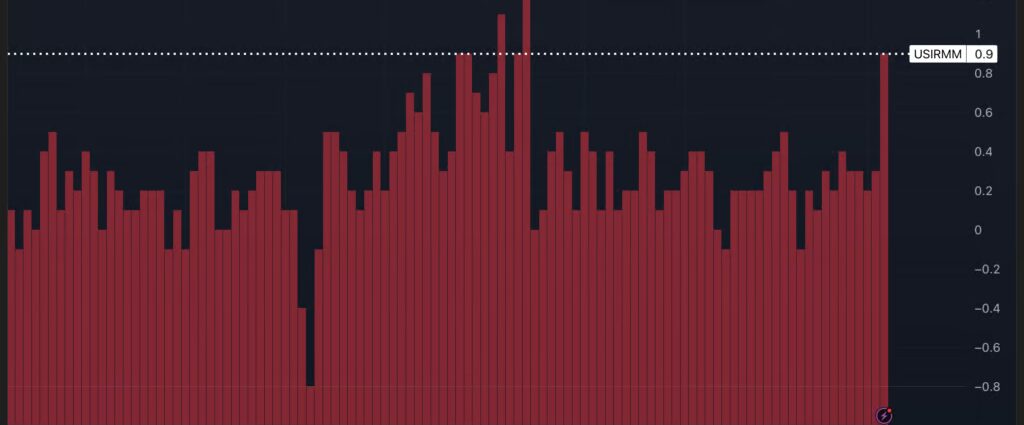
Toyota is recalling more than 73,000 hybrid vehicles over a pedestrian warning sound issue, according to the National Highway Traffic Safety Administration (NHTSA).

Certain 2023–2025 Toyota Corolla Cross Hybrid vehicles are affected by the recall effort because they do not make a loud enough sound while in reverse, making it harder for pedestrians to hear and increasing the risk of injury.

“The vehicles may fail to make sufficient pedestrian warning sounds when in reverse,” the NTSB said in its announcement.

TOYOTA RECALLS MORE THAN 144,000 LEXUS VEHICLES OVER REARVIEW CAMERA FAILURE RISK

“As such, these vehicles fail to comply with the requirements of Federal Motor Vehicle Safety Standard (FMVSS) number 141, ‘Minimum Sound Requirements for Hybrid and Electric Vehicles,'” the agency continued.

A total of 73,528 vehicles are affected by the recall, although only about 1% of them are likely to have the defect.

The recall numbers are 26TB08 and 26TA08.

Toyota dealers will update the software on the affected vehicles free of charge to fix the pedestrian warning sounds.

FORD RECALLS MORE THAN 254,000 SUVS DUE TO SOFTWARE ISSUES

CLICK HERE TO GET FOX BUSINESS ON THE GO

Owner notification letters alerting consumers of the safety risks are expected to be mailed out by May 30, 2026.

This post was originally published here

OpenAI says the world needs to rethink everything from the tax system to the length of the workday in order to prepare for the wrenching changes of superintelligence technology—the point at which AI systems are capable of outperforming the smartest humans.

On Monday, in a 13-page paper titled “Industrial Policy for the Intelligence Age,” OpenAI said it wanted to “kick-start” the conversation with a “slate of people-first policy ideas.” How much faith to put in OpenAI’s words and motives, however, seems to be one of the key questions among many of the people reading the paper. The paper was released on the same day that The New Yorker published the results of a lengthy one-and-a-half-year investigation into OpenAI that raised questions about CEO Sam Altman’s trustworthiness on various issues, including AI safety.

Written by the OpenAI global affairs team, the paper outlines many of the expected economic impacts of superintelligence and floats various approaches for addressing them. “We offer them not as a comprehensive or final set of recommendations, but as a starting point for discussion that we invite others to build on, refine, challenge, or choose among through the democratic process,” said the introductory blog post. 

The self-described “slate of ideas” in the document—spanning everything from public wealth funds to shorter workweeks—may not do much to reassure a public increasingly nervous about and disenchanted with the pace and consequences of AI-driven change. And OpenAI, of course, is one of the least neutral parties in this ongoing discussion, which is the core tension of the document, said Lucia Velasco, a senior economist and AI policy leader at D.C.-based Inter-American Development Bank and former head of AI policy at the United Nations Office for Digital and Emerging Technologies. 

“OpenAI is the most interested party in how this conversation turns out, and the proposals it advances shape an environment in which OpenAI operates with significant freedom under constraints it has largely helped define,” she said, adding that this wasn’t a reason to dismiss the document, but “it is a reason to ensure that the conversation it is trying to start does not end with the same company that started it.”

Still, she emphasized that OpenAI is correct in saying that governments are behind in advancing policy solutions. “Most are still treating AI as a technology problem when it’s actually a structural economic shift that needs proper industrial policy,” she said. “That‘s a useful contribution, and the document deserves to be taken seriously as an agenda-setting exercise, even if it’s a starting point.”

Soribel Feliz, an independent AI policy advisor who previously served as a senior AI and tech policy advisor for the U.S. Senate, agreed that OpenAI deserves credit for “putting this on paper.” The acknowledgment that both U.S. institutions and safety nets are falling behind AI development and deployment is correct, she said, “and the conversation needs to happen at this level at this moment.” 

However, she emphasized that most of what is being proposed is not new: “Some of these pillars—‘share prosperity broadly, mitigate risks, democratize access’—have been the framework for every major AI governance conversation since ChatGPT came out in November 2022.

“I worked in the U.S. Senate in 2023–24, and we had nine AI policy fora sessions where all of this was said. I have it in my handwritten notes! All of this was already said, all of it,” she wrote to Fortune in a direct message. “The language around public-private partnerships, AI literacy, and worker voice reads like it came out of a Unesco or OECD AI policy framework report. The ideas are not wrong. The problem is the gap between naming the solutions and building real mechanisms to achieve them.” 

Clearly, the target audience is not its hundreds of millions of weekly ChatGPT users. Instead, it is the Beltway policymakers who have been pushing for AI regulation (or kicking the can down the road) in various forms ever since ChatGPT was released in November 2022. In that sense, some said it represents an improvement over earlier efforts. 

“I found this document to genuinely be a real improvement from previous documents that were even more floaty and high-level,” said Nathan Calvin, vice president of state affairs and general counsel of Encode AI. “I think some of the concrete suggestions around things like auditing or incident reporting and government restrictions on certain uses of AI are good ideas.” 

But he also pointed to lobbying efforts led by OpenAI executives with the Leading the Future PAC, which lobbies for AI-industry-friendly policies. Global affairs head Chris Lehane is considered a force behind these efforts, while president Greg Brockman has been the biggest donor. 

“I hope this document signals a move toward more constructive engagement, instead of attacking politicians pushing the very policies OpenAI is now endorsing,” said Calvin, pointing specifically to Leading the Future’s lobbying against New York congressional candidate Alex Bores, author and primary sponsor of the RAISE Act, the New York AI safety and transparency law recently signed by Gov. Kathy Hochul.

Calvin has also accused OpenAI of using intimidation tactics to undermine California’s SB 53, the California Transparency in Frontier Artificial Intelligence Act, while it was still being debated. He alleged as well that OpenAI used its ongoing legal battle with Elon Musk as a pretext to target and intimidate critics, including Encode, which the company implied was secretly funded by Musk. 

Still, while OpenAI CEO Sam Altman compared Monday’s slate of policy ideas to the New Deal in an interview with Axios, some say it reads less like FDR-era legislation and more like a Silicon Valley thought experiment that won’t magically turn into action.

For example, Anton Leicht, a visiting scholar with the Carnegie Endowment’s technology and international affairs team, wrote on X that in reality, the ideas are fundamental societal changes and heavy political lifts. “They’re not just going to emerge as an organic alternative,” he wrote. “On that read, this is comms work to provide cover for regulatory nihilism.”

A better version of this, he said, would be to redirect the AI industry’s political funding and lobbying skills to make progress on this kind of policy agenda. However, he said that the “vague nature and timing” of the document “doesn’t make me too optimistic.”

This story was originally featured on Fortune.com

This post was originally published here

For years every Easter and spring season, Americans stuff their baskets with Peeps, these little neon marshmallow chicks (and sometimes bunnies) coated in petroleum-based synthetic dyes that the FDA has not formally reviewed for safety since (depending on the color) the 1960s, ’70s, or ’80s. For Scott Faber, senior vice president at the Environmental Working Group, that makes the humble Peep something unexpected: a symbol of progress.

“Peeps are a food chemical success story,” Faber told Fortune while trying to stifle a chuckle, before adding: “I’m sure no one has said those words before.”

But he meant it seriously. When California passed Assembly Bill 418 in 2023—the law that opponents incorrectly dubbed the “Skittles bill”—Just Born, the maker of Peeps (which did not respond to Fortune’s requests for comment), was one of the first candy companies to commit to removing Red Dye No. 3, a synthetic color linked to cancer. “They moved faster than any other company,” Faber said, “and showed that companies can quickly reformulate when they’re required to do so.”

Required. That word is doing a lot of work in the food dye debate right now, and it sits at the center of a major argument over whether MAHA’s approach to cleaning up the American food supply is working.

The Peeps paradox

The candy at the center of this policy fight is, by almost any objective measure, controversial on its own, before anyone mentions a single dye.

New Curion research conducted in February 2026 and drawn from three separate polls totaling more than 19,000 U.S. consumers shows the “Peeps paradox.” Nearly half the country (comprising 24.2% who love them and 23.3% who like them) hold positive feelings toward the candy. The other side is equally committed: 17.4% don’t like them; 8.1% actively hate them. However, when Curion surveyed more than 8,000 consumers on why they purchase Peeps, personal taste barely made the list. Nearly one-third (32.9%) cited holiday tradition as their primary motivation. Another 28.4% buy them as basket fillers or gifts. Nostalgia drove 23.4% of purchases, and 25.2% buy them for family members who enjoy them. In short, Peeps are less a snack than a seasonal obligation, purchased out of ritual by people who may not eat a single one.

But it was the color, not the texture or taste, that first made Peeps a public health target. In April 2023, Consumer Reports alerted consumers that pink and purple Peeps contained Red Dye No. 3, a synthetic color it described as a known carcinogen, one that had been banned from cosmetics since 1990 because of cancer effects observed in rats, yet remained permitted in food. By 2024, Just Born had removed Red Dye No. 3 from its formulas. The yellow Peep still contains Yellow 5. The blue ones still contain Blue 1. The neon palette that defines the brand, and the tradition, and the ritual, and the hate, remains largely intact, for now, and that’s because nothing is required to change.

The FDA is making it voluntary

The Make America Healthy Again movement, led by HHS Secretary Robert F. Kennedy Jr., has called petroleum-based synthetic dyes a public health crisis. But Faber is blunt about what MAHA has actually accomplished at the federal level: nothing. “So far, and I’m underlining so far, the FDA has not banned a single chemical from any of our food,” he said. “It’s been the states that have been leading the way.”

That isn’t entirely a criticism of MAHA. Faber acknowledges that state laws in California, West Virginia, Louisiana, and Texas have created something the food industry privately welcomes: some guidelines. “Food industry leaders are celebrating because someone has finally established a floor,” he said. “Companies aren’t going to create two versions of their food: one for West Virginia and one for the rest of us. In part because other states are starting to follow suit.” Without a floor, he argued, it’s a race to the bottom. Kellogg’s won’t voluntarily drop synthetic colors as long as General Mills still uses them, for example.

The deeper problem, in Faber’s view, is structural. “The FDA has been asleep at the switch for many decades,” he said. “They’ve allowed the vast majority of new food chemicals to enter commerce without being reviewed for safety, and they rarely, if ever, review the chemicals we’re already eating.” Americans eat thousands of chemicals that cannot be added to food in other countries, Faber said, not because the science cleared them, but because no one checked.

At odds with what’s actually safe

Sean McBride, founder of DSM Strategic Communications and former executive vice president of the Grocery Manufacturers Association, sees the same gap, but draws the opposite conclusion. If RFK Jr. believes these dyes are poisoning children, McBride argued, the law requires him to act like it.

“If you determine that a certain food ingredient is poison or is poisoning people, you would be obligated to move heaven and earth to somehow take care of that issue,” McBride told Fortune. “But instead, we have this terrible strategy where you essentially beg food companies to do things voluntarily, scare the heck out of consumers, go to a handful of states and say take matters into your own hands, and what you’ve done is created anarchy.”

The contradiction he keeps returning to: The FDA has deemed these dyes safe, and Kennedy is overriding his own agency’s standing guidance without changing a single rule. “Your agency says they’re safe. You’re saying they’re not. What is a person to do?”

His answer to why MAHA won’t pursue formal rule-making is because they can’t win. “The reason you’re begging or bullying companies to drop these ingredients is because you know that if you actually put them through the rigor of the federal rule-making process, the science will not support what you’re trying to do,” McBride said. He referenced the post-Chevron era when the Supreme Court no longer defers to agency expertise in regulatory disputes, meaning any formal dye ban could be immediately challenged and likely struck down. The courts, he noted, have already put temporary injunctions on both West Virginia’s dye ban and Texas’s ultra-processed food labeling bill, with rulings harsh enough that likely may mean neither law will survive.

The states are moving anyway

Jennifer Pomeranz, a public health law professor at NYU, splits the difference between Faber and McBride, saying MAHA’s voluntary approach is actually working, not despite the chaos, but through it.

“Kennedy has just proposed voluntary changes, and the states are the ones actually implementing bans,” she told Fortune. “It’s kind of great, because it’s bipartisan and it’s already happened in many states, so that might make the change nationally.” The historical parallel she reaches for is trans fat: Companies were removing it from products well before any federal mandate, because public pressure and state action created enough market momentum. The same dynamic is unfolding now.

Unlike McBride, her concern is not that MAHA is moving too aggressively, but that the federal government might ultimately preempt state dye bans and then fail to act. “That would be contrary to MAHA but consistent with MAGA,” she said. “It’s hard to know what’s going to happen.”

The SNAP problem

This weekend, a SNAP recipient in 22 states cannot use their benefits to buy the same Peeps a non-SNAP shopper can grab off the shelf beside them. For Faber, that reveals MAHA’s true priorities. “If Republicans were really interested in helping poor people build healthy diets, they would have increased the SNAP benefit, not cut it,” he said. “Congressional Republicans are much more interested in punishing poor people than helping make sure they can afford healthy foods.” Eliminating SNAP Ed, the nutrition education funding, while restricting what benefits can buy, he argues, removes the tools people need while also narrowing their choices.

McBride focuses on the practical failure. Retailers in waiver states are going “crazy,” he said; they can’t tag products, can’t determine what counts as a soda or a candy, and some state legislatures are now scrambling to write new bills just to define terms. “What possible good does banning these items actually do? It’s a shift at checkout. A SNAP recipient just moves them out of the EBT part and pays for them with cash.” He points to Chile, where a decade of junk-food taxes and black-label warnings changed the market basket. Consumers bought 8% less of targeted products, but childhood obesity went up 30% anyway. “You’ve proven you can change a market basket,” he said. “But you haven’t changed public health. So what are we doing?”

“People are forgetting history,” Pomeranz said. “Initially, Democrats used to propose these kinds of SNAP restrictions, and there were both Republican and Democratic states that proposed them, all rejected by USDA under both Republican and Democratic presidents. It’s disingenuous for public health to now be up in arms about what was being proposed by public health people not that long ago.” She drew a line at candy and sugary beverages: “There’s no association of health benefits with any of those products,” but says that expanding restrictions further, into snacks or prepared foods, crosses into different territory. “I think a kid deserves a birthday cake.”

Whether it’s dye bans, SNAP restrictions, or labeling mandates, the real question isn’t which lever to pull, it’s whether any lever actually improves health outcomes. Overall, and all three experts agree, the current food safety framework is broken.

“No one is saying, ‘I want more cancer with my candy,’” Faber said. “This is a question of whether things that should be safe are safe, and unfortunately, many of the chemicals that we eat are either unsafe or have never been reviewed for safety by someone we can all trust.”

This story was originally featured on Fortune.com

This post was originally published here

Japan is running out of workers. Its population declined for a 14th straight year in 2024; its working-age population is projected to shrink by nearly 15 million over the next two decades; and a 2024 Reuters/Nikkei survey found that labor shortages are the primary force pushing Japanese firms toward automation and AI adoption.

Last month, the Ministry of Economy, Trade, and Industry said it was looking to build a domestic physical AI sector, with hopes of holding 30% of the global market by 2040. The idea is to employ robots in logistics warehouses, on factory floors, and inside data centers—where they’re not taking people’s jobs, but filling the ones no one wants. 

Ally Warson, a partner at UP.Partners, a venture firm focused on transportation tech and the physical world, has been telling investors this for years. Japan’s labor shortage is one prime example of where it’s becoming evident.

That’s all the more accentuated in fields where there’s a large demand for labor and few people to fill those roles. For example, Japan is looking to employ robots to take care of its aging population in home health scenarios and in other domestic sectors. 

In fact, they’ll become so ubiquitous that a recent Bank of America report predicted people will soon own more humanoid robots than cars by 2060.

“The reality is, no one wants to do these jobs,” Warson told Fortune. For example, “there are something like 600,000 unfilled jobs in the industrial space. No one’s raising their hand and signing up for it.”

Robots are building walls

The UBS Global Entrepreneur Report 2026, which surveyed 215 business leaders at companies with a combined $34.3 billion in revenue, found that 47% of entrepreneurs with industrial businesses see automation and robotics as the biggest commercial opportunity.

The UBS researchers spoke with the head of a Luxembourg construction and property firm who drew a distinction between AI and the physical potential of robotics. “In the construction industry, AI has limited uses. This is a physical business, and AI can’t build a wall. There’ll be robots at some point in time, but not yet,” the firm’s leader told UBS researchers. 

Warson agrees. Although robots are not there yet, she said, there are plenty of jobs where the risk to a person’s life makes it a prime target for robotics automation. In tunnel construction, “you can just have a robot keep boring” instead of possibly subjecting a manned crew to hazardous conditions. Or something as visible as window-washing: “Even hanging someone off the side of a building hundreds of feet in the air to window-wash. Why is this still a thing?”

For Warson, the most compelling case for physical AI has never been efficiency or cost-cutting. Rather, it’s keeping people alive.

“I think the economics works the most for jobs where human lives are at risk,” she said. “If you’re talking about replacing a person who’s walking through a construction site at midnight, where there are nails sticking out of the ground, or you’re asking someone to go to an offshore oil and gas site because there’s a leak, that’s a million-dollar-plus life insurance claim on top of any sort of lawsuits.”

Preparing for a robotic future

UP.Partners has put real money behind these ideas. The firm backed Noble Machines, a construction robotics company engineered specifically for the chaos of real job sites. The robots are capable of navigating stairs, stabilizing under pressure, and operating in unstructured environments that earlier industrial robots couldn’t handle. It also invested in WakeCap, a hardware-software platform that monitors construction workers and has seen a 91% drop in safety observations. 

“WakeCap is helping humans be safer on construction sites,” Warson said, describing the company’s sensors that are built into hard hats and track real-time activity. “That goes back to insurance. You could even take the lens of, AI is helping humans be safer, in a lot of different provocative ways.”

Combining AI with robotics is the fastest surefire way to achieve real, tangible results. This is reiterated by Japan’s $6.3 billion investment in robotics under Prime Minister Sanae Takaichi, according to a report by Franklin Templeton.

According to its economy ministry, the country already controls about 70% of the global industrial robotics market, and looks to accomplish even more by its 2040 deadline by adding AI to the mix. 

But none of this means the robot apocalypse is imminent. Warson said the underlying infrastructure for physical AI has finally caught up with real-life use cases. Internet-connected sensors are now ubiquitous on job sites. Compute is powerful enough to run sophisticated models at the edge. And AI models are giving machines the ability to generalize across physical environments in ways that would have been unthinkable five years ago. “AI has unlocked the potential for robotics as an asset class,” Warson said. 

This story was originally featured on Fortune.com

This post was originally published here
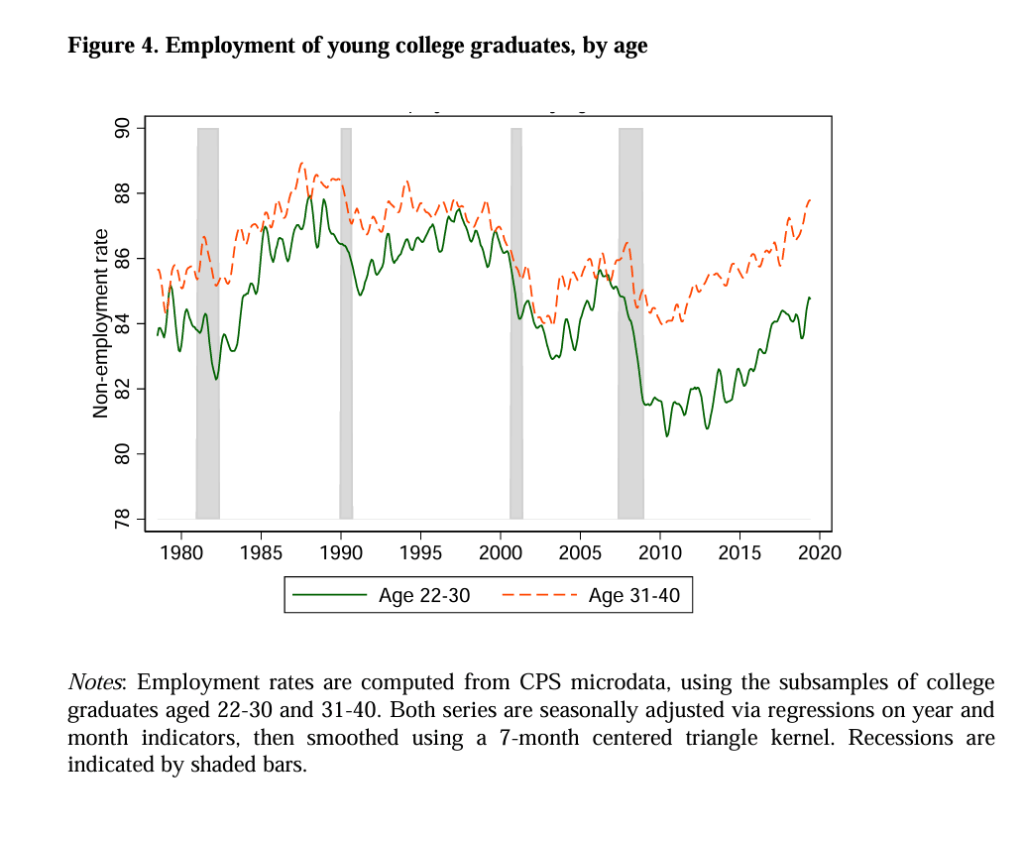
Sam Altman wants Washington to tax AI’s winners — and he’s put it in writing.

On Monday, OpenAI released a 13-page paper entitled “Industrial Policy for the Intelligence Age: Ideas to Keep People First.” It offers a sweeping policy blueprint that proposes tax hikes on corporate income, among other revenue-boosting levers that shift the tax burden from labor to capital. 

“Policymakers could rebalance the tax base by increasing reliance on capital-based revenues—such as higher taxes on capital gains at the top, corporate income, or targeted measures on sustained AI-driven returns—and by exploring new approaches such as taxes related to automated labor,” the report reads.

Even in the face of relentless warnings about AI’s presumed labor market disruption, the Trump administration has doubled down on an anti-regulatory stance on the technology’s development. In December, President Donald Trump signed an executive order reducing “burdensome” state rule and preventing “cumbersome regulation.”

Fortune reached out to OpenAI for comment, inquiring about the AI policy proposal.

The four-day work week, retraining, and a public wealth fund

The proposal goes beyond mere tax policy. It offers a series of policies meant to focus the gains of AI on workers, including incentivizing firms to “retain, retrain, and invest in workers,” a four-day work week without a pay cut, and the creation of a “public wealth fund” that provides all U.S. citizens a stake in AI economic growth.

Many of those policies sound like proposals coming from top leaders in business. JPMorgan Chase CEO Jamie Dimon also thinks AI will shave the work week down to three and a half days, and improve life, even curing some cancers. But he’s just as wary as Altman and other business leaders about the technology’s impact on the labor market. He has said he thinks the government should have the power to intervene in blocking AI-induced layoffs. And last month, the billionaire proposed a government-business incentive program meant to cushion workers impacted by AI-related job displacement. 

“I don’t know the answer yet, but I would suggest it’s the following: It can’t be just government. It’s got to be business,” Dimon said in an interview at the Hill and Valley Forum. “But the government could create a system of incentives that business does the right thing to retrain people, early retirement, moving people.”

In an interview with Axios, Altman recounted a conversation with a “senior Republican” who admitted that while they typically support free markets, they recognize that AI is seriously disrupting the economy. 

“Capitalism has depended on some balance between labor and capital,” he said, citing the Republican. “Way too much leverage is going to be with capital and not with labor in the traditional sense.”

The CEO has flip-flopped on regulation in the past. In 2023, Altman testified before Congress, urging the government to implement regulations for AI and emphasizing its potential risks. But less than a year ago, he appeared again in front of a Congress composed of those largely favorable to him, and called for regulation, but regulation that “does not slow us down.” His comments Monday mark a contrast to those delivered before Congress even a year ago.

Akin to the New Deal and Progressive Era

Many of these ideas, though, remain mere ideas. The president and the Republican-controlled Congress don’t appear to have an appetite for AI regulation. While Congress passed, and Trump signed the TAKE IT DOWN Act, a law regulating deepfakes, other efforts discourage strong regulation. The president last month released an AI policy framework for Congress that echoes his executive order, meant to build on efforts to protect children, but to discourage strong state laws that “hinder our national competitiveness.” However, the framework also includes a proposal meant to ensure workers benefit from AI growth through skill development and retraining.

But it’s not the first time, OpenAI argues, that technology has threatened to leave workers behind, requiring strong regulation. The paper compares the current moment to the New Deal and Progressive Era.

“Society has navigated major technological transitions before, but not without real disruption and dislocation along the way,” the paper reads. “While those transitions ultimately created more prosperity, they required proactive political choices to ensure that growth translated into broader opportunity and greater security.”

This story was originally featured on Fortune.com

This post was originally published here

The U.S. housing market accelerated in March despite elevated mortgage rates reducing some of the affordability improvement the market had recently seen, according to a new report.

Zillow released its market report for March which found that newly pending home listings increased 4.6% from a year ago in March.

That increased the number of listings to the second-largest monthly total since the end of the pandemic boom in August 2022, which Zillow said was a positive sign for the market as the home shopping season begins in earnest.

The housing market’s uptick occurred despite mortgage rates increasing from 5.98% at the end of February to 6.38% in late March, according to data from Freddie Mac. Excluding taxes and insurance, the typical mortgage payment increased 1.5% from February, which undercut some of the affordability improvements the market had seen.

THESE 10 HOUSING MARKETS GIVE FIRST-TIME BUYERS THE BEST SHOT AT HOMEOWONERSHIP IN 2026

Zillow found that the monthly mortgage payment on a typical U.S. home was $1,789 in March, given a 20% down payment, after excluding taxes and insurance. While that figure rose on a monthly basis, it was 4.4% lower than last year, according to the report.

There were 1.23 million homes listed for sale in March. Inventory rose 9.5% from February and active inventory was 4.2% higher than it was a year earlier.

The number of new for sale listings totaled 384,854 in March, an increase of 0.1% from a year ago and 35.6% in February.

AMERICA’S 10 MOST EXPENSIVE ZIP CODES REVEALED

Newly pending listings – a figure that measures listings which changed from for sale to pending status rather than closed sales – shows 4.6% growth from a year earlier, and a 29.8% increase over February.

A total of 300,398 homes were sold in March, according to a preliminary reading from the Zillow sales count nowcast. That’s up 3.7% from a year ago and 25.2% from February, though those figures will be revised mid-month.

THE US HOUSING MARKETS THAT ARE SEEING THE LARGEST DROPS IN RENT PRICES

“Buyers and sellers have been navigating uncertainty and market volatility in some form since the onset of the pandemic, and this month’s concern over energy prices is no different,” said Mischa Fisher, chief economist at Zillow. “However, we have persistent signals that the market has turned a corner.”

“Pent-up demand from three years of low sales volume and winter storms in January and February, along with the tailwind from lower mortgage rates earlier in the year, seem to have buoyed the market as home shopping season kicked off. In particular, the rapid acceleration of daily page views per listing we saw in March was a noteworthy improvement over the dormant market of recent years,” Fischer added.

GET FOX BUSINESS ON THE GO BY CLICKING HERE

This post was originally published here

Oracle on Monday announced it hired a new chief financial officer after the software giant moved forward with layoffs last week.

The company announced that Hilary Maxson will serve as the new CFO, joining Oracle from French industrial conglomerate Schneider Electric where she served in the same role. Oracle said her appointment to the rule is effective immediately.

Maxson, 48, will receive an annual base salary of $950,000 and will be eligible for a performance-based bonus with a target of $2.5 million, Oracle said in a regulatory filing.

The move comes on the heels of Oracle reportedly moving forward with a round of layoffs last week, with CNBC reporting the layoffs will affected thousands of workers at the tech company, according to two people familiar with the matter.

ORACLE LAYING OFF THOUSANDS OF WORKERS TO CUT COSTS AMID AI PUSH: REPORT

Oracle’s most recent 10-K filing noted the company had about 162,000 full-time employees in May 2025.

The company said in a March filing that it expects the total costs associated with its restructuring plan in fiscal year 2026 to be as high as $2.1 billion, most of which would go to employee severance and related expenses.

Oracle has recently ramped up capital spending to build artificial intelligence (AI) data centers as the company looks to incorporate those tools into its business software services. The company has projected $50 billion in capital expenditures for its fiscal year that ends in May, more than double its spending in the previous fiscal year.

HSBC WEIGHS DEEP JOB CUTS AS AI OVERHAUL UNFOLDS: REPORT

The cloud computing company said in February it planned to raise as much as $50 billion this year through a combination of debt and equity sales.

The company’s stock has been volatile over the last year amid the AI buildout, with shares up about 14% in the last year despite declines of 50% in the last six months and 25% year to date amid concerns that AI presents a competitive threat to software providers.

ORACLE EXPECTED TO SLASH THOUSANDS OF JOBS AS MASSIVE AI SPENDING CREATES FINANCIAL CASH CRISIS

Oracle’s move to hire Maxson as CFO will reinstate a position that was eliminated after Safra Catz became the company’s co-CEO and principal financial officer in 2014.

Maxson will report to Oracle co-CEO Clay Magouyrk in her new role and said in a press release announcing her hiring that she is “excited to join at this pivotal moment.” 

GET FOX BUSINESS ON THE GO BY CLICKING HERE

She added that she looks forward to partnering with the company’s leaders to “continue to invest with discipline and to translate this momentum into durable, long-term value for customers and shareholders.”

Reuters contributed to this report.

This post was originally published here

Wall Street’s most-watched economics team has a warning for workers displaced by AI: the damage could last for years. But in a surprising twist, the people most expected to bear the brunt of the coming disruption—recent college graduates—may actually be the best equipped to weather it.

In a research note published Monday, Goldman Sachs economists Pierfrancesco Mei and Jessica Rindels drew on four decades of individual-level data to assess what they call the “scarring” effects of technological displacement on U.S. workers. Their verdict is sobering. Workers whose jobs are eliminated by technology don’t just struggle in the short term—they can spend the better part of a decade fighting to recover.

“Over the ten years following a job loss, real earnings for technology-displaced workers grow nearly 10 percentage points less than for never-displaced workers,” the report found, “and 5 percentage points less than for other displaced workers.”

The research team tracked more than 20,000 individuals across two cohorts—one born in the 1950s and ’60s, and another in the 1980s—using the National Longitudinal Surveys sponsored by the Bureau of Labor Statistics. By identifying which occupations faced the steepest technology-driven employment declines in each decade since 1980, they were able to map the full career arcs of workers caught in automation’s path.

The immediate pain is real

The short-run picture is rough. Workers displaced from technology-disrupted occupations take approximately one month longer to find a new job and suffer real earnings losses more than 3% larger upon reemployment compared with workers let go from more stable fields. The core culprit, Goldman found, is occupational downgrading: displaced workers tend to slide into roles that are more routine and require fewer analytical and interpersonal skills, not less, because the same technological forces that eliminated their old jobs also eroded the market value of their existing skills.

The scarring doesn’t stop at the paycheck. Goldman found that workers displaced early in their careers—between ages 25 and 35—accumulate less wealth over time, largely because they delay buying homes. They’re also less likely to be married at any given age compared with never-displaced peers, suggesting the economic shock ripples into their personal lives as well.

Recessions make everything worse

Goldman’s most urgent warning may be about timing. Firms disproportionately shed routine jobs during economic downturns, when efficiency pressure peaks. For workers, a recession-era technology displacement widens the already painful gap versus other displaced workers by roughly three additional weeks of unemployment and 5 percentage points each for the risk of returning to unemployment and exiting the labor force entirely. With AI adoption accelerating at a moment of unusual macroeconomic uncertainty, that compounding risk is hard to ignore.

The Gen Z twist

Here’s where the report defies the prevailing narrative. Much of the public anxiety about AI-driven job losses has centered on young workers—particularly new graduates entering a market increasingly shaped by automation. Goldman’s data tells a different story. Younger, college-educated, and urban workers experience cumulative earnings losses roughly half as large as other technology-displaced workers over the decade following a job loss. Their advantage comes from flexibility: they switch occupations more readily and migrate up the skills ladder into roles with higher analytical content that complement, rather than compete with, new technology.

“Contrary to current concerns that the costs of AI will fall especially hard on new graduates,” the report states, “younger workers have actually been able to adjust more flexibly through occupational mobility and skill upgrading in the past.”

Retraining also helps cushion the blow. Workers who participated in vocational or technical programs within three years of displacement saw roughly 2 percentage points more cumulative wage growth over the following decade and a 10-percentage-point lower probability of returning to unemployment.

Goldman has been estimating for several years that AI could displace 6%–7% of U.S. workers over the next decade. This 40-year sweep of data suggests the workers who should be most worried aren’t the youngest ones in the room—they’re the older, less mobile workers with deeply occupation-specific skills and no recession-proof timing on their side.

For this story, Fortune journalists used generative AI as a research tool. An editor verified the accuracy of the information before publishing.

This story was originally featured on Fortune.com

This post was originally published here

President Donald Trump told reporters Monday that “the entire country” of Iran “can be taken out in one night, and that night might be tomorrow night,” one of his most explicit escalations yet ahead of a Tuesday 8 p.m. ET deadline for Iran to reopen the Strait of Hormuz.

The remark came during a White House press conference that began as a celebration of a dramatic combat rescue of two downed F-15E airmen over Easter weekend and ended with Trump saying that the U.S. is going to be the one charging tolls in the Strait of Hormuz. 

Repeatedly, Trump emphasized his final ultimatum: open the strait or lose your infrastructure. “After that, they’re gonna have no bridges. They’re gonna have no power plants, stone ages,” he said.

There are a few ways to interpret Trump’s apocalyptic comments about what the U.S. will do to Iran. Fears spread online that the president was talking about leveling the country, perhaps with a nuclear weapon. 

But that would amount to a massive escalation and a huge loss of life that would have catastrophic consequences for both the Iranian people and his own presidency.

More likely, Trump is talking about disrupting Iran’s electrical grid, and the U.S. has a weapon designed for exactly this purpose: the graphite bomb, also known as the “blackout bomb.”

The bomb, officially designated the BLU-114/B, doesn’t destroy power infrastructure with explosives. Instead, it releases dense clouds of chemically treated carbon fiber filaments that drape over transformers and its high-voltage lines, causing short circuits that cascade throughout the grid.

So even though the lights go out, the physical equipment remains largely intact, avoiding significant permanent damage to Iran’s economic infrastructure.

The U.S. has used these bombs before. The Navy deployed carbon-fiber warheads on Tomahawk missiles in the opening hours of the 1991 Gulf War, disabling roughly 85% of Iraq’s electricity supply. Later in the decade, the Air Force deployed the more advanced BLU-114/B during the NATO bombing in the Balkans, knocking out more than 70% of Serbia’s national grid in a single night and plunging the country into darkness.

Iran’s grid might be more challenging to “take out.” For one, it’s massive; roughly 130 thermal plants with a combined capacity of 78,000 megawatts, spread across a country more than three times the size of Iraq. However, Iran’s grid is also not at the top of its game. Even before the war, it was suffering from chronic blackouts and massive electricity shortfalls. 

The ‘discombombulator’ 

There’s also a chance that the U.S. could use a more mysterious weapon. Trump drew a direct line from the Easter weekend rescue operation to the January raid that captured Venezuelan dictator Nicolás Maduro, framing both as proof of concept. 

“If you look at what we did with Maduro, we went into a military compound, massive, with thousands and thousands of soldiers, and within a matter of minutes… he was in the back of these planes,” he said Monday. 

In the immediate aftermath of that operation, Trump referenced a weapon he called “the discombobulator,” which he said was designed to disable defensive systems.

On Monday, he alluded again to classified capabilities, describing how Venezuelan forces “pressed the button, nothing happened. They pressed it again and again, nothing happened… there’s a reason it didn’t work. Someday we’ll explain that to people.” 

There’s been speculation that that weapon was a sonic or directed-energy weapon. A Venezuelan guard’s account, shared on social media by White House Press Secretary Karoline Leavitt, described an “intense sound wave” that left defenders bleeding from their noses, vomiting and unable to stand. 

Trump deflected questions on whether targeting civilian infrastructure like power plants is prohibited under international humanitarian law. 

“They would be willing to suffer that in order to have freedom,” he said of the Iranian people.

This story was originally featured on Fortune.com

This post was originally published here

Last October, the scene of demolition crews using a backhoe to tear down White House’s East Wing was so dramatic that it became an impromptu tourist attraction. President Donald Trump, who considers himself to be “builder-in-chief,” isn’t done yet. 

The White House will spend $377 million for renovations and repairs for the presidential residence this year, according to the president’s budget released on Friday. And that’s not even all of it—it’s estimating another $174 million for fiscal year 2027. This would be an 866% increase from the estimated $39 million spent on White House repairs during fiscal year 2025. 

The money mostly comes from donors, an Office of Management and Budget official told Fortune

In October, the White House released a list of 37 donors who are funding the East Wing renovations, including Big Tech companies such as Meta Platforms, Apple, Google, and Amazon. There were also a number of individual or family donors, including the Adelson Family Foundation, Secretary of Commerce Howard Lutnick’s family, Blackstone CEO Stephen A. Schwarzman, and cryptocurrency billionaires Cameron and Tyler Winklevoss. 

The budget does not specify what projects the funding will go toward, but an Office of Management and Budget official told Fortune that the money will cover all repair, renovation, construction, and security costs. These figures represent money already in the government accounts, not a request from Congress for more funding, the official said—an important distinction as many other parts of this budget, such as the record-breaking ask of $1.5 trillion in military spending for next year, are new requests for Congress to approve.

In a January filing as part of a lawsuit against the National Park Service brought by the National Trust for Historic Preservation, White House Management and Administration director Joshua Fischer, wrote that there are plans to fix water infiltration, update old electrical infrastructure, comply with Americans with Disabilities Act, and remove asbestos and lead-based paint. “Donated funds received by NPS pursuant to NPS’s gift authority are being transferred to the White House Repair and Restoration Account pursuant to the Economy Act,” Fischer wrote in the filing, “to fund this project and supplement the Executive Mansion’s annual allowance appropriated,” which is $2 million for fiscal year 2026, and $6 million in 2027.

Last year, Trump replaced the Rose Garden lawn—a space that has been used for decades for bill signings, press conferences, and formal dinners—with a stone patio for events. He dubbed the renovated space, the “Rose Garden Club,” a space “for senators, for congresspeople and for people in Washington, and frankly, people that can bring peace and success to our country,” Trump said at an event in September. 

He had also planned to host tech executives in the space in September, many of whom run companies that later donated to the ballroom project, but the event was moved inside due to the weather.  

Some $350 million of the estimated $377 million is considered mandatory spending, a designation used for programs Congress funds by statute, such as Medicare and Social Security, rather than yearly appropriation. The private, tax-deductible donations were placed in the National Park Service gift account, which is a mandatory account, according to the OMB official, and not subject to yearly congressional appropriations. 

The ballroom is the most prominent project that has been announced. Trump repeatedly said that taxpayers will not foot the $400 million bill for the 90,000-square-foot ballroom renovation. When the plan for the ballroom was announced in July, the president said it would cost half the price. 

“I am honored to be the first President to finally get this much-needed project, which is on time and under budget, underway,” Trump said on social media on April 2. “When completed, it will be the Greatest and Most Beautiful Ballroom of its kind anywhere in the World, and a fabulous complement to our Beautiful and Storied White House!”

This story was originally featured on Fortune.com

This post was originally published here
Corporate America has long been drawn to the self-made executive narrative. But Curtis Campbell, the new CEO of H&R Block, tells his version with a realism that gives it unusual credibility. 

Campbell, who grew up in a small Southern town and became the first in his family to attend college, traces his rise to a combination of luck, tenacity, and strong mentorship. The answer sounds straightforward, yet it reveals a view of leadership grounded in endurance and self-awareness rather than corporate mythology.

Campbell readily concedes that intellect alone does not determine who reaches the corner office. As he says, “There are a lot of people in that room that are much smarter than I will ever be.” Career progression, he says, emerges through persistence, learning, and a willingness to seek guidance before it arrives on its own.

His advice to younger professionals reflects that belief. He encourages them to identify colleagues with specific strengths and ask for their time. Someone who excels in presentations, leadership, or communication may offer lessons that are more valuable than a formal development program. “If you find somebody who has a superpower, they’ll love to talk to you about it,” he says. In his view, those conversations can help ambitious professionals recognize patterns in how strong performers operate and apply those lessons to their own careers.

Campbell is also describing a workplace reality in which deeply human feelings, including fear of rejection, intimidation, and reserve, can quietly shape a career. Those impulses are familiar to almost everyone, yet they can still become barriers to advancement when they keep capable people from pursuing the conversations and relationships that might move them forward. “That’s what makes a difference between somebody being caught in mid-level management and getting to higher levels of the organization,” says Campbell.

He is equally clear that visibility carries weight only when it rests on strong execution. Performance comes first, and reputation follows the quality of the work. “You can’t put yourself out there and expect people to take a meeting if you don’t perform well,” he says. His standard is exacting and elegantly simple. Whatever your job may be, do it exceptionally well.

That ethos becomes more vivid when he describes the examples that shaped it. Campbell points to his mother, who worked as a janitor, and says the principle applied to her work just as surely as it applied to his own. Excellence is not situational, he says, nor is it tied to title. He carried that same standard into his early years as an engineer, where he distinguished himself through the quality of his work before others took his larger ambitions seriously.

In the end, Campbell’s ascent story rests on a simple hierarchy that places performance, persistence, and earned credibility first. “My mom was a janitor. Be the best janitor on the planet. I was an engineer. I had to be the best engineer in the company,” he says. “If you can do those things, people will take your meeting.”

This story was originally featured on Fortune.com

This post was originally published here

President Donald Trump’s $1.5 trillion Pentagon budget request for the upcoming fiscal year represents the biggest increase in generations and seeks to transform the industry, according to analysts at JPMorgan.

While Congress is unlikely to fund everything the administration wants, the proposal still signals where Trump’s priorities are as the budget process begins.

“A global security environment that is less reliant on norms and more reliant on force continues to put upward pressure on defense spending; at the same time, the Trump administration is seeking to remake the US defense industrial base and there is more capital entering the sector as well,” JPMorgan said in a note on Monday.

To be sure, getting a defense budget through Congress could drag on, perhaps even past the midterm elections. If Democrats take control, massive defensive spending could be a political non-starter, especially as Trump looks to cut social programs to partly offset hikes elsewhere.

For now, the top-line Pentagon budget calls for a 44% increase in fiscal year 2027, which begins this October, including a 77% jump in investments.

“To contextualize, this would be the biggest single year increase since the budget increased 3.4x to $48b in 1951 on the heels of NSC 68 and the Korean War,” JPMorgan said, referring to a seminal National Security Council paper from 1950 that singled out the Soviet Union as the most serious threat to the U.S.

Analysts pointed out that the proposed increase would also dwarf the 25% jump in 1981, when President Ronald Reagan began his military buildup as he reignited a Cold War competition against the “evil empire,” his preferred phrase for the Soviet Union.

Meanwhile, the 74% investment boost would result in weapons procurement more than doubling over a two-year period to spur transformation of the defense industrial base, making it larger, faster, and more resilient, while advanced technologies from the civilian sector are incorporated.

The price tag for procurement is also elevated by the Pentagon’s continued commitment to acquiring the most cutting-edge weapons. JPMorgan noted that Trump’s budget has even added more “exquisite” weapons, like a new class of battleship and space-based missile interceptors.

Why not both?

That’s despite lessons from Ukraine’s success fighting off the Russian invasion by relying on the production of mass quantities of low-cost drones.

“The apparent lesson at DoD, however, has not been to move the US away from exquisite systems and toward low-cost, distributed capability, but to have both,” JPMorgan said.

While the different branches of the armed forces are each pursuing drones or low-cost missiles, they are also staying the course with exquisite, next-generation platforms like a new F-47 fighter that could cost $300 million each and the B-21 stealth bomber that could top $600 million each.

But the Iran war has also highlighted the effectiveness of low-cost weapons. While the regime’s military has been decimated, its waves of cheap Shahed drones are still able to keep the Strait of Hormuz closed and inflict major damage around the Persian Gulf—including on U.S. military bases.

Iran’s retaliatory barrage has also forced the U.S. and its allies to draw down expensive stockpiles of interceptors. The tactic highlights the brutal economics of the current war: missiles that cost millions of dollars each are shooting down drones that cost tens of thousands of dollars.

The U.S. has long prioritized the most advanced weapons to maintain superiority against any military rivals. But as the pace of technological improvements accelerated in recent decades, costs have ballooned and the Pentagon has struggled to keep up. 

The advent of cheap commercial drone technology changed the equation dramatically, as demonstrated by the Ukrainian military’s adoption of new tactics. That four-year-old conflict has transformed warfare. Unmanned weapons are now responsible for most battlefield casualties as small first-person view drones hunt down individual troops or vehicles. Ukraine’s defense industry has also evolved to mass produce inexpensive drones that can take down Russia-launched Shaheds from Iran.

“The future of warfare is Ukraine producing 7 million drones per year right now,” former CIA director and retired Gen. David Patraeus said last month. “This past year, they produced 3.5 million. That enabled them basically to use 9 to 10,000 drones per day.”

This story was originally featured on Fortune.com

This post was originally published here

Americans are concerned with the rising cost of healthcare along with surging health insurance premiums.

A Gallup poll released last week found that healthcare is the top domestic issue facing Americans among 16 policy areas included in the survey, with 61% saying they worry a great deal about healthcare access and affordability.

Healthcare topping the list of domestic concerns represents a resurgence in the issue’s prominence, as the last time it was the foremost issue in voters’ minds was 2020 – a position it held dating back to 2015. It was roughly tied with the economy in 2025, but now leads by 10 points.

Those findings are similar to those of a recent Fox News poll, which found that 81% of voters are either “extremely” or “very” concerned about healthcare, a figure which trailed only inflation and high prices, while 86% of voters were concerned about inflation and high prices.

OBAMACARE ENROLLMENT FELL BY MORE THAN 1M ENROLLEES FOR 2026

The poll found that healthcare was a concern for a majority of voters across political groups, with 89% of Democrats, 80% of Independents and 72% of Republicans saying they were either “extremely” or “very concerned” about healthcare.

Healthcare concerns were also widespread across age groups: 77% of respondents under age 45 and 83% of those over age 45 were extremely or very concerned about healthcare – views that were shared by 86% of those aged 65 and up.

OBAMACARE PRICES ARE SET TO SPIKE – HERE’S WHY

American consumers have faced rising health insurance premiums in recent years, with prices jumping this year due to the end of an extra subsidy for consumers.

Health insurance under the Affordable Care Act, also known as Obamacare, is subsidized through a premium tax credit available to lower- and some middle-income households. During the COVID-19 pandemic, Congress added another subsidy on top of the baseline subsidy.

However, the Trump administration and Congress allowed the pandemic-era enhanced subsidy to expire at the end of last year, which has pushed premiums higher.

TREASURY DEPARTMENT ANNOUNCES EXPANDED HSA TAX BENEFITS UNDER TRUMP LAW

An analysis by the Kaiser Family Foundation (KFF), a nonprofit group focused on national healthcare policy, estimated last year that the expiration of the enhanced premium tax credits would cause annual out-of-pocket premium payments to rise by over $1,000 this year – jumping 114% from $888 in 2025 to $1,904 in 2026.

Health insurance companies have also been raising premiums for non-Obamacare plans for years, which experts have attributed to higher healthcare costs.

Data from the Centers for Medicare and Medicaid (CMS) shows that consumers have shifted into lower-cost health insurance plans in the 2026 open enrollment period compared with the prior year.

GET FOX BUSINESS ON THE GO BY CLICKING HERE

The CMS data shows that in 2025, 56% of enrollees were in silver tier plans while 30% were in bronze plans. By contrast, the data for 2026 shows 40% of enrollees in bronze plans and 43% in silver. The share of enrollees in gold tier plans also rose from 13% in 2025 to 17% this year.

This post was originally published here

New research by Goldman Sachs economists finds that AI is already a measurable drag on the U.S. job market—erasing roughly 16,000 net jobs per month over the past year, with the pain falling hardest on Gen Z and entry-level workers.

Goldman’s breakdown shows AI substitution wiped out roughly 25,000 jobs per month in the past year, while augmentation added back about 9,000.

The findings, contained in a Goldman Sachs U.S. Daily note authored by economist Elsie Peng, represent one of the most granular attempts yet to separate AI’s two competing effects on employment: substitution, when AI replaces human workers outright, and augmentation, when AI makes existing workers more productive and may even expand hiring.

Goldman’s economists combined standard AI exposure scores with a complementarity index developed by IMF economists to build the new framework. Under the model, an occupation scores high on substitution risk when AI can handle most of its core tasks, like insurance claims clerks and bill collectors. It scores high on augmentation potential when AI handles some tasks but human judgment, physical presence, or specialized expertise remain essential, such as lawyers, construction managers, and physicians.

Gen Z gets hit hardest

In occupations most exposed to AI substitution, the unemployment rate gap between entry-level workers (those under 30) and experienced workers (ages 31–50) has widened sharply relative to pre-pandemic averages.

The wage gap has similarly deteriorated, with Goldman’s regression analysis estimating that a one standard-deviation increase in AI substitution exposure widens the entry-level-to-experienced wage gap by roughly 3.3 percentage points.

The dynamic reflects a structural vulnerability baked into how young people enter the workforce. Gen Z workers are disproportionately concentrated in the exact types of routine, white-collar, and administrative roles—data entry, customer service, legal support, billing—that AI is best at automating. Without the accumulated experience and specialized judgment that insulate senior workers, they have little buffer against displacement.

The silver lining Goldman is watching

Goldman’s economists were careful to note that the true aggregate impact of AI is likely smaller than their estimates suggest. The analysis does not fully capture the offsetting hiring surge tied to AI infrastructure investments in data centers, power systems, and construction, nor does it fully account for the incremental labor demand generated when AI-driven productivity gains lower costs and expand markets.

Also, Goldman’s framework rests not on a direct count of jobs lost to AI and jobs created by AI in real time, but on inferences derived from a regression analysis.

To be sure, Gen Z is the generation most natively fluent in AI tools. The same cohort that seems to be absorbing the most displacement is also the cohort most likely to be using AI agents, building side projects with LLMs, and entering the workforce with AI literacy that their 45-year-old managers lack. The adaptation is already happening, but it isn’t showing up yet in Goldman’s regression coefficients.

Put simply: AI is destroying some jobs, creating others, and making many workers more valuable—all at the same time. The problem for Gen Z is that the destruction is hitting first, faster, and harder in the roles they’re most likely to hold. The creation of new opportunities, if history is any guide, will take longer to materialize and may require very different skills to access.

For this story, Fortune journalists used generative AI as a research tool. An editor verified the accuracy of the information before publishing.

This story was originally featured on Fortune.com

This post was originally published here
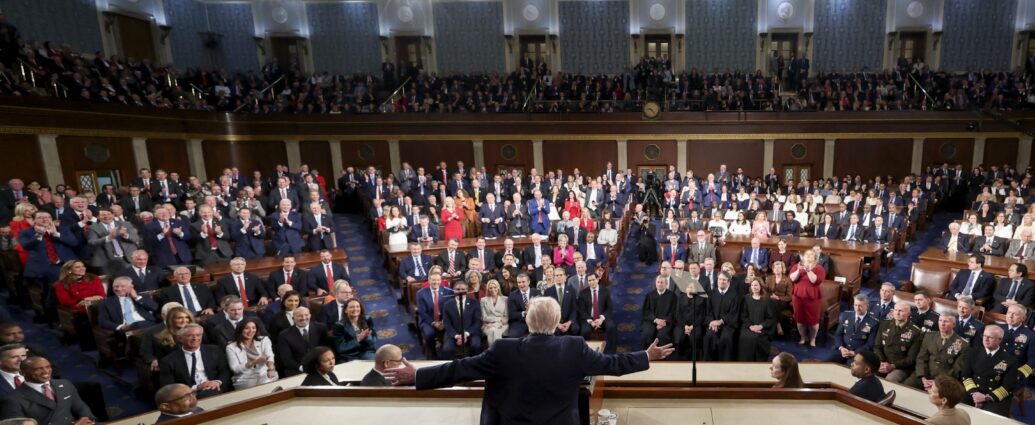
Corporate America has long been drawn to the self-made executive narrative. But Curtis Campbell, the new CEO of H&R Block, tells his version with a realism that gives it unusual credibility. 

Campbell, who grew up in a small Southern town and became the first in his family to attend college, traces his rise to a combination of luck, tenacity, and strong mentorship. The answer sounds straightforward, yet it reveals a view of leadership grounded in endurance and self-awareness rather than corporate mythology.

Campbell readily concedes that intellect alone does not determine who reaches the corner office. As he says, “There are a lot of people in that room that are much smarter than I will ever be.” Career progression, he says, emerges through persistence, learning, and a willingness to seek guidance before it arrives on its own.

His advice to younger professionals reflects that belief. He encourages them to identify colleagues with specific strengths and ask for their time. Someone who excels in presentations, leadership, or communication may offer lessons that are more valuable than a formal development program. “If you find somebody who has a superpower, they’ll love to talk to you about it,” he says. In his view, those conversations can help ambitious professionals recognize patterns in how strong performers operate and apply those lessons to their own careers.

Campbell is also describing a workplace reality in which deeply human feelings, including fear of rejection, intimidation, and reserve, can quietly shape a career. Those impulses are familiar to almost everyone, yet they can still become barriers to advancement when they keep capable people from pursuing the conversations and relationships that might move them forward. “That’s what makes a difference between somebody being caught in mid-level management and getting to higher levels of the organization,” says Campbell.

He is equally clear that visibility carries weight only when it rests on strong execution. Performance comes first, and reputation follows the quality of the work. “You can’t put yourself out there and expect people to take a meeting if you don’t perform well,” he says. His standard is exacting and elegantly simple. Whatever your job may be, do it exceptionally well.

That ethos becomes more vivid when he describes the examples that shaped it. Campbell points to his mother, who worked as a janitor, and says the principle applied to her work just as surely as it applied to his own. Excellence is not situational, he says, nor is it tied to title. He carried that same standard into his early years as an engineer, where he distinguished himself through the quality of his work before others took his larger ambitions seriously.

In the end, Campbell’s ascent story rests on a simple hierarchy that places performance, persistence, and earned credibility first. “My mom was a janitor. Be the best janitor on the planet. I was an engineer. I had to be the best engineer in the company,” he says. “If you can do those things, people will take your meeting.”

This story was originally featured on Fortune.com

This post was originally published here

With the moon now filling their windows, the Artemis II astronauts set a record Monday as the farthest humans from Earth during a lunar flyby promising magnificent views of the far side never before witnessed.

The six-hour flyby is the highlight of NASA’s first return to the moon since the Apollo era with three Americans and one Canadian — a step toward landing boot prints near the moon’s south pole in just two years.

First came a prize — and bragging rights — for Artemis II.

Less than an hour before kicking off the fly-around and intense lunar observations, the four astronauts surpassed the distance record of 248,655 miles (400,171 kilometers) set by Apollo 13 in April 1970.

They kept going, hurtling ever farther from Earth. Before it was all over, Mission Control expected Artemis II to beat the old record by more than 4,100 miles (6,600 kilometers).

“It is blowing my mind what you can see with the naked eye from the moon right now. It is just unbelievable,” Canadian astronaut Jeremy Hansen radioed ahead of the flyby. He challenged “this generation and the next to make sure this record is not long-lived.”

Moments after breaking Apollo 13’s record, the astronauts asked permission to name two fresh lunar craters already observed. They proposed Integrity, their capsule’s name, and Carroll in honor of commander Reid Wiseman’s late wife who died of cancer in 2020. Wiseman wept as Hansen put in the request to Mission Control, and all four astronauts embraced in tears.

“Such a majestic view out here,” Wiseman radioed.

The astronauts started the momentous day with the voice of Apollo 13 commander Jim Lovell, who recorded a wake-up message just two months before his death last August. “Welcome to my old neighborhood,” said Lovell, who also flew on Apollo 8, humanity’s first lunar visit. “It’s a historic day and I know how busy you’ll be, but don’t forget to enjoy the view.”

They took up with them the Apollo 8 silk patch that accompanied Lovell to the moon, and showed it off as the crucial flyby approached. “It’s just a real honor to have that on board with us,” said Wiseman. “Let’s go have a great day.”

Artemis II is using the same maneuver that Apollo 13 did after its “Houston, we’ve had a problem” oxygen tank explosion wiped out any hope of a moon landing.

Known as a free-return lunar trajectory, this no-stopping-to-land route takes advantage of Earth and the moon’s gravity, reducing the need for fuel. It’s a celestial figure-eight that will put the astronauts on course for home, once they emerge from behind the moon Monday evening.

Wiseman, Hansen, pilot Victor Glover and Christina Koch were on track to pass as close as 4,070 miles (6,550 kilometers) to the moon, as their Orion capsule whips past it, hangs a U-turn and then heads back toward Earth. It will take them four days to get back, with a splashdown in the Pacific concluding their test flight on Friday.

Their expected speed at closest approach to the moon: 3,139 mph (5,052 kph).

Wiseman and his crew spent years studying lunar geography to prepare for the big event, adding solar eclipses to their repertoire during the past few weeks. By launching last Wednesday, they ensured themselves of a total solar eclipse from their vantage point behind the moon, courtesy of the cosmos.

Topping their science target list: Orientale Basin, a sprawling impact basin with three concentric rings, the outermost of which stretches nearly 600 miles (950 kilometers) across.

Other sightseeing goals: the Apollo 12 and 14 landing sites from 1969 and 1971, respectively, as well as fringes of the south polar region, the preferred locale for future touchdowns. Farther afield, Mercury, Venus, Mars and Saturn — not to mention Earth — will be visible.

Their moon mentor, NASA geologist Kelsey Young, expects thousands of pictures.

“People all over the world connect with the moon. This is something that every single person on this planet can understand and connect with,” she said on the eve of the flyby, wearing eclipse earrings.

Artemis II is NASA’s first astronaut moonshot since Apollo 17 in 1972. It sets the stage for next year’s Artemis III, which will see another Orion crew practice docking with lunar landers in orbit around Earth. The culminating moon landing by two astronauts near the moon’s south pole will follow on Artemis IV in 2028.

While Artemis II may be taking Apollo 13’s path, it’s most reminiscent of Apollo 8 and humanity’s first lunar visitors who orbited the moon on Christmas Eve 1968 and read from the Book of Genesis.

Glover said flying to the moon during Christianity’s Holy Week brought home for him “the beauty of creation.” Earth is an oasis amid “a whole bunch of nothing, this thing we call the universe” where humanity exists as one, he observed over the weekend.

“This is an opportunity for us to remember where we are, who we are, and that we are the same thing and that we’ve got to get through this together,” Glover said, clasping hands with his crewmates.

___

The Associated Press Health and Science Department receives support from the Howard Hughes Medical Institute’s Department of Science Education and the Robert Wood Johnson Foundation. The AP is solely responsible for all content.

This story was originally featured on Fortune.com

This post was originally published here
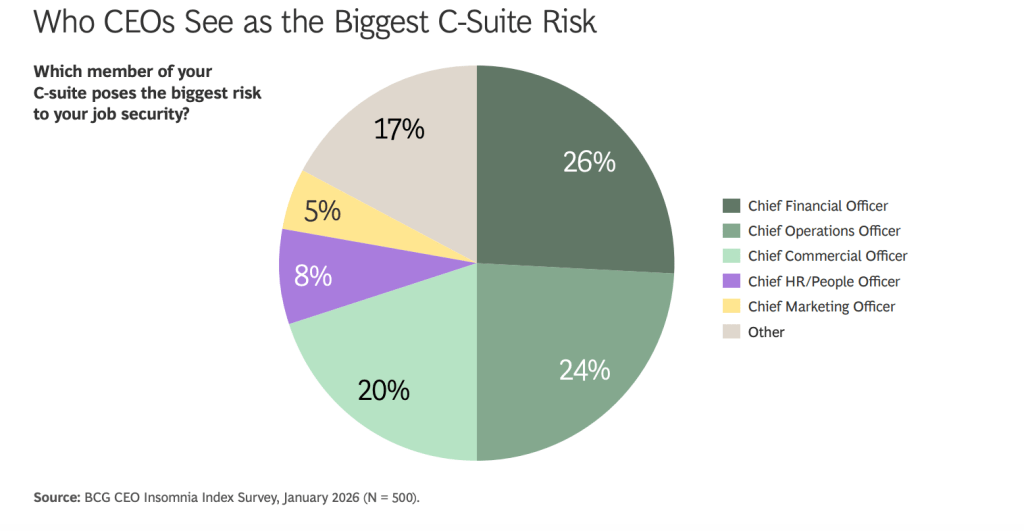
With the moon now filling their windows, the Artemis II astronauts set a record Monday as the farthest humans from Earth during a lunar flyby promising magnificent views of the far side never before witnessed.

The six-hour flyby is the highlight of NASA’s first return to the moon since the Apollo era with three Americans and one Canadian — a step toward landing boot prints near the moon’s south pole in just two years.

First came a prize — and bragging rights — for Artemis II.

Less than an hour before kicking off the fly-around and intense lunar observations, the four astronauts surpassed the distance record of 248,655 miles (400,171 kilometers) set by Apollo 13 in April 1970.

They kept going, hurtling ever farther from Earth. Before it was all over, Mission Control expected Artemis II to beat the old record by more than 4,100 miles (6,600 kilometers).

“It is blowing my mind what you can see with the naked eye from the moon right now. It is just unbelievable,” Canadian astronaut Jeremy Hansen radioed ahead of the flyby. He challenged “this generation and the next to make sure this record is not long-lived.”

Moments after breaking Apollo 13’s record, the astronauts asked permission to name two fresh lunar craters already observed. They proposed Integrity, their capsule’s name, and Carroll in honor of commander Reid Wiseman’s late wife who died of cancer in 2020. Wiseman wept as Hansen put in the request to Mission Control, and all four astronauts embraced in tears.

“Such a majestic view out here,” Wiseman radioed.

The astronauts started the momentous day with the voice of Apollo 13 commander Jim Lovell, who recorded a wake-up message just two months before his death last August. “Welcome to my old neighborhood,” said Lovell, who also flew on Apollo 8, humanity’s first lunar visit. “It’s a historic day and I know how busy you’ll be, but don’t forget to enjoy the view.”

They took up with them the Apollo 8 silk patch that accompanied Lovell to the moon, and showed it off as the crucial flyby approached. “It’s just a real honor to have that on board with us,” said Wiseman. “Let’s go have a great day.”

Artemis II is using the same maneuver that Apollo 13 did after its “Houston, we’ve had a problem” oxygen tank explosion wiped out any hope of a moon landing.

Known as a free-return lunar trajectory, this no-stopping-to-land route takes advantage of Earth and the moon’s gravity, reducing the need for fuel. It’s a celestial figure-eight that will put the astronauts on course for home, once they emerge from behind the moon Monday evening.

Wiseman, Hansen, pilot Victor Glover and Christina Koch were on track to pass as close as 4,070 miles (6,550 kilometers) to the moon, as their Orion capsule whips past it, hangs a U-turn and then heads back toward Earth. It will take them four days to get back, with a splashdown in the Pacific concluding their test flight on Friday.

Their expected speed at closest approach to the moon: 3,139 mph (5,052 kph).

Wiseman and his crew spent years studying lunar geography to prepare for the big event, adding solar eclipses to their repertoire during the past few weeks. By launching last Wednesday, they ensured themselves of a total solar eclipse from their vantage point behind the moon, courtesy of the cosmos.

Topping their science target list: Orientale Basin, a sprawling impact basin with three concentric rings, the outermost of which stretches nearly 600 miles (950 kilometers) across.

Other sightseeing goals: the Apollo 12 and 14 landing sites from 1969 and 1971, respectively, as well as fringes of the south polar region, the preferred locale for future touchdowns. Farther afield, Mercury, Venus, Mars and Saturn — not to mention Earth — will be visible.

Their moon mentor, NASA geologist Kelsey Young, expects thousands of pictures.

“People all over the world connect with the moon. This is something that every single person on this planet can understand and connect with,” she said on the eve of the flyby, wearing eclipse earrings.

Artemis II is NASA’s first astronaut moonshot since Apollo 17 in 1972. It sets the stage for next year’s Artemis III, which will see another Orion crew practice docking with lunar landers in orbit around Earth. The culminating moon landing by two astronauts near the moon’s south pole will follow on Artemis IV in 2028.

While Artemis II may be taking Apollo 13’s path, it’s most reminiscent of Apollo 8 and humanity’s first lunar visitors who orbited the moon on Christmas Eve 1968 and read from the Book of Genesis.

Glover said flying to the moon during Christianity’s Holy Week brought home for him “the beauty of creation.” Earth is an oasis amid “a whole bunch of nothing, this thing we call the universe” where humanity exists as one, he observed over the weekend.

“This is an opportunity for us to remember where we are, who we are, and that we are the same thing and that we’ve got to get through this together,” Glover said, clasping hands with his crewmates.




___

The Associated Press Health and Science Department receives support from the Howard Hughes Medical Institute’s Department of Science Education and the Robert Wood Johnson Foundation. The AP is solely responsible for all content.

This story was originally featured on Fortune.com

This post was originally published here