

Opinion | Abdul El-Sayed’s Black Vote

Opinion | France ‘on the Brink of Civil War’

Gunmen Kill Seven in Church Attack in Jordan


Melania Trump Brokers Russia-Ukraine Ceasefire in Humanitarian Breakthrough, Newsmax Reports
First lady secures agreement to halt fighting in Russian-occupied Ukrainian city, opening the way for food, medical aid and civilian evacuations beginning October 29.
WASHINGTON | October 23, 2026 — First lady Melania Trump has negotiated a temporary ceasefire between Russia and Ukraine, securing an agreement to suspend military operations in the Russian-occupied Ukrainian city of Oleshky to allow desperately needed humanitarian assistance and civilian evacuations.
The agreement, announced Friday by the White House and first disclosed on Newsmax by the first lady’s senior adviser, Marc Beckman, is scheduled to take effect October 29.
Speaking on Newsmax’s National Report, Beckman revealed that representatives of both countries had signed the agreement just hours before his television appearance, following more than a month of negotiations led by the first lady.
The White House confirmed that Melania Trump and her representative worked directly with Russian and Ukrainian leadership to establish the terms, procedures and timing of the localized ceasefire.
The agreement represents an unusual diplomatic intervention by an American first lady in a war that has continued since Russia’s full-scale invasion of Ukraine in February 2022.
Thousands Trapped in a Humanitarian Disaster
Oleshky, located across the Dnipro River from Kherson in southern Ukraine, had approximately 24,000 residents before the war. Today, an estimated 1,700 to 2,000 remain, primarily elderly civilians unable to escape, along with approximately 50 children.
Residents face severe shortages of food, drinking water, medicine and electricity. Roads surrounding the city are heavily mined, while drone attacks have made evacuation attempts extremely dangerous.
Some residents have reportedly resorted to eating grass and weeds to survive.
Under the agreement, civilian representatives from Russia and Ukraine will jointly enter Oleshky, assess residents’ needs, coordinate deliveries of food, clean water and medical supplies, and arrange safe passage for those wishing to leave.
Residents will be permitted to choose whether to evacuate toward Ukrainian-controlled territory or Russia.
“The situation in Oleshky is dire,” Melania Trump said in a statement Friday, describing a city on the brink of humanitarian catastrophe.
Newsmax Granted Exclusive Access
Newsmax reported that it has secured exclusive television access to accompany Russian and Ukrainian civilian observers entering Oleshky on October 29.
According to Beckman, representatives of both governments agreed to allow the American news organization to document the operation, providing outside visibility into the delivery of humanitarian aid and the evacuation process.
The arrangement follows diplomatic channels established through the first lady’s earlier efforts to reunite children separated from their families during the conflict.
According to the White House, those efforts have already helped reunite 34 children through six family-reunification operations.
Beckman said the first lady became aware of Oleshky’s humanitarian emergency during her Fostering the Future Together initiative, held alongside the United Nations General Assembly in September.
She subsequently engaged both governments, ultimately securing agreement on a temporary suspension of fighting in the city.
A Limited Ceasefire With Broader Diplomatic Implications
The agreement does not establish a nationwide ceasefire or end hostilities elsewhere in Ukraine.
Its immediate purpose is humanitarian: allowing civilians access to essential supplies and enabling those who wish to leave the occupied city to do so safely.
Ukraine’s chief negotiator, David Arakhamia, confirmed that ceasefire arrangements and humanitarian corridors were forthcoming, according to Reuters. Russia had not immediately issued its own public confirmation at the time of initial reporting.
Beckman expressed hope that cooperation between the two governments on a limited humanitarian initiative could eventually contribute to broader diplomatic progress.
However, the agreement’s effectiveness will depend on whether both sides observe the ceasefire, humanitarian teams can safely reach residents and evacuation routes remain secure.
For Melania Trump, the announcement marks a significant expansion of her humanitarian diplomacy, placing the American first lady in a direct negotiating role between two nations engaged in one of Europe’s deadliest conflicts in decades.
For the remaining residents of Oleshky, the immediate stakes are far more personal: food, medicine, safe passage and the possibility of escaping a city devastated by nearly five years of war.
JBizNews Desk | Washington, D.C.
© 2026 JBizNews. All Rights Reserved.


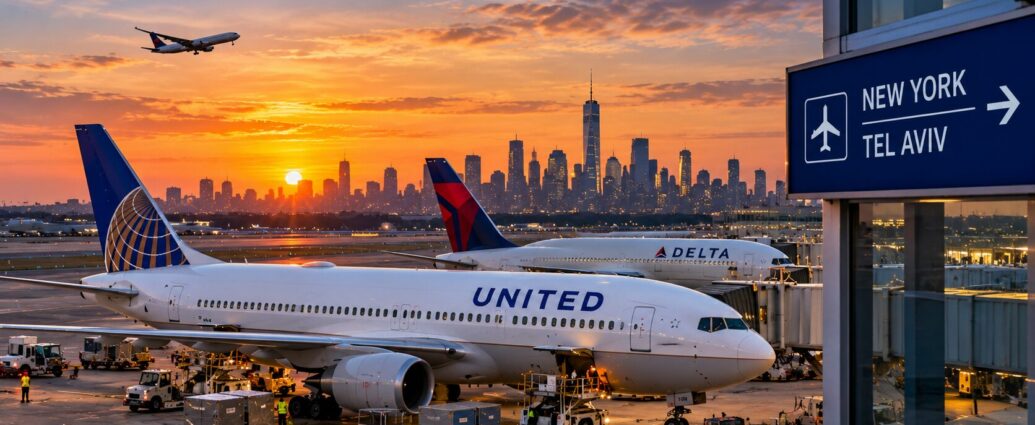
New York–Israel Airfares Fall 25% as Airlines Restore Service, but Deep Discounts Remain Limited
United and Delta lead price reductions exceeding 30%, with some winter round-trip fares below $900 as competition returns to the transatlantic route.
JBizNews Desk | New York
Airfares between New York and Tel Aviv have fallen an average of 25% over the past six weeks, driven by increased airline competition, expanded flight capacity and softer demand following the Jewish holiday travel season.
New industry pricing data shows that United Airlines and Delta Air Lines have made particularly aggressive reductions, cutting average round-trip fares by approximately one-third as American carriers resume service to Israel and compete with El Al, Arkia and Israir.
The reductions mark a significant reversal for a route that has experienced unusually high prices and limited availability through much of the year.
However, while promotional fares as low as $600 have appeared for selected connecting itineraries, current flight searches indicate that many nonstop tickets remain considerably more expensive, particularly for travelers with fixed departure and return dates.
United and Delta Lead the Price Declines
An airfare analysis conducted by Israeli travel company lastminute.co.il found that United’s average round-trip fare dropped from $1,844 to $1,237, a reduction of 33%.
Delta recorded an even larger percentage decline, with average fares falling from $1,980 to $1,245, representing a 37% reduction.
El Al and Arkia also reduced prices, although the changes were more modest.
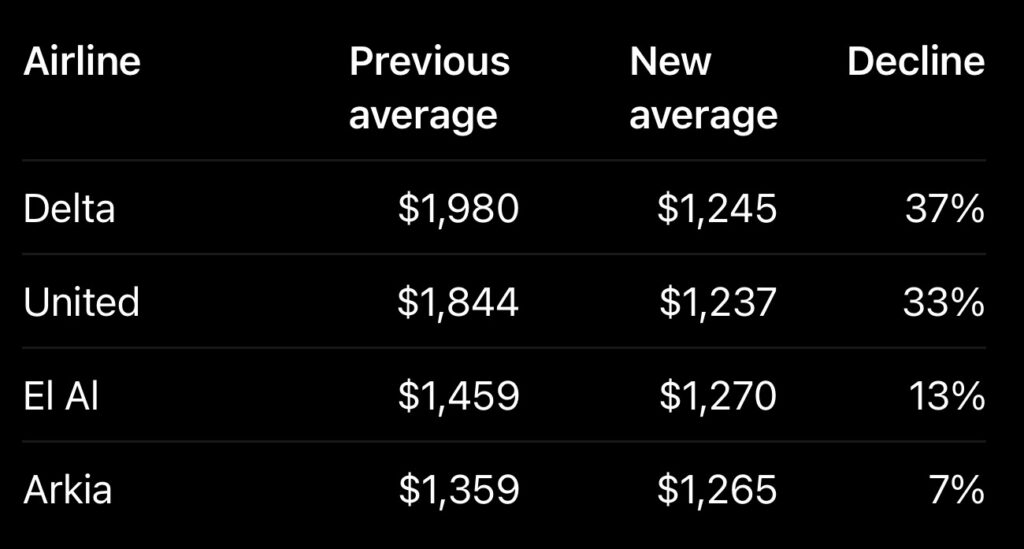
The figures represent average round-trip fares for comparable post-holiday October travel periods, including baggage, rather than guaranteed prices available on every departure.
January Fares: What Travelers Can Actually Find
Looking ahead to winter 2027, airfare searches show additional opportunities for savings, although prices vary significantly by airline, routing and dates.
A Google Flights review identified United nonstop round-trip tickets from Newark to Tel Aviv starting around $1,150 for selected travel dates, while Arkia displayed fares around $848 for certain January departures.
Condor, which offers connecting service, appeared at approximately $820 for a January 14 departure and January 30 return.
Other travel industry findings identified Delta round-trip fares around $878 for mid-January and selected El Al flights near $773 for early March.
Israeli airfare platform Secret Flights has also reported promotional Delta nonstop fares approaching $650 for certain dates in early 2027. Those specific promotional tickets could not be independently confirmed as currently bookable.
The differences illustrate an important limitation of advertised airfare reductions: A traveler searching for a particular week, especially on United’s nonstop Newark service, may still encounter fares of $1,500 or more, even as industry averages decline.
More Airlines Are Restoring Competition
For much of the recent period of disrupted service, El Al and Arkia operated with relatively little direct competition from American airlines.
United and Delta resumed Israel operations in September following extended suspensions related to regional security conditions, while Israir entered the New York market with additional long-haul service.
The expanded capacity initially failed to reduce prices substantially because demand remained strong through Rosh Hashanah, Yom Kippur and Sukkot.
With holiday travel behind the market, additional available seats are now creating greater pricing pressure.
The average November round-trip fare across five participating carriers stands at approximately $1,223, according to the industry survey.
Israir had the lowest reported average at $1,135, followed by United at $1,190, Arkia at $1,230, Delta at $1,265 and El Al at $1,295.
Why Airfares Are Falling Despite Rising Costs
The decline comes despite higher operating expenses for airlines, including increased aviation fuel costs.
Industry executives have indicated that expanding capacity and restoring competition are placing downward pressure on ticket prices even as carriers continue to face substantial costs associated with long-haul operations.
Seasonal demand also plays an important role.
Travel prices between New York and Israel typically rise during major Jewish holidays and peak summer travel, while January and February can present lower-cost opportunities for passengers with flexible schedules.
For consumers, the returning competition may provide meaningful financial relief after years of elevated fares and limited flight choices.
A family purchasing five round-trip tickets at $1,200 rather than $1,800 could save approximately $3,000, illustrating the potential financial significance of additional competition.
What Comes Next for Israel Travel
The latest figures suggest that the New York–Tel Aviv aviation market is moving away from the severe capacity shortages that previously enabled airlines to command substantially higher fares.
American Airlines remains absent from the route, with its return previously postponed until late March 2027, meaning competition has not yet been fully restored.
Airlines will now have to balance passenger demand, operating expenses and ticket pricing as additional capacity becomes available.
For travelers planning winter visits to Israel, the key development is not that $600 round-trip tickets have become standard. Rather, the market is offering a wider range of prices, greater airline choice and the possibility of substantial savings for passengers who can adjust their travel schedules.
The larger economic story is that competition is finally beginning to work in travelers’ favor on one of the most important international routes connecting the United States and Israel.
JBizNews Desk | New York
© 2026 JBizNews. All rights reserved.



Israel’s New Center of Gravity


China’s Wealthy Scramble to Protect Offshore Fortunes as Beijing Imposes 20% Tax and Tightens Capital Controls
JBIZNEWS | GLOBAL ECONOMY | FRIDAY, OCTOBER 23, 2026
BEIJING — China’s wealthiest entrepreneurs and families are confronting an increasingly aggressive campaign by Beijing to tax overseas fortunes, triggering asset sales, urgent financial restructuring and growing concerns that the government is tightening its control over private wealth at a time of mounting economic pressure.
At the center of the crackdown is a sweeping 20% tax regime covering offshore trusts, investment structures long used by Chinese billionaires and business founders to hold corporate shares, real estate and financial assets outside mainland China.
An October 22 reporting deadline has intensified the pressure, with wealthy individuals rushing to calculate their tax liabilities, raise cash and reconsider how they manage their international fortunes.
The consequences extend well beyond China’s richest households. The crackdown threatens to disrupt capital flows into Hong Kong, Singapore and other international financial centers while increasing uncertainty for foreign investors and Chinese companies seeking overseas capital.
A $1.7 Trillion Offshore Wealth Market Faces Scrutiny
China’s offshore wealth is estimated at approximately $1.7 trillion by Boston Consulting Group, highlighting the enormous pool of assets potentially exposed to tighter tax enforcement.
For years, wealthy Chinese entrepreneurs established offshore trusts in jurisdictions including Singapore, the Cayman Islands and the British Virgin Islands. These arrangements offered investment flexibility, succession planning and opportunities to diversify wealth internationally.
Beijing’s new regulations change the financial calculations.
The rules impose a 20% tax on certain gains associated with transferring assets into offshore trusts and on income generated through those structures. The measures also reach back to specified transactions dating to January 2023.
The deadline for disclosing previously untaxed offshore income and assets has forced some investors to liquidate holdings or seek financing.
According to Reuters, some wealthy families have begun selling shares, unwinding trusts and borrowing against company stock to meet anticipated liabilities. In exceptional cases, individuals have explored changing their citizenship or residency arrangements.
However, advisers caution that changing nationality or moving overseas does not automatically eliminate Chinese tax obligations, particularly when authorities determine that a person’s principal economic interests remain in China.
Why Beijing Is Pursuing Overseas Wealth
The government’s campaign comes as China struggles with the financial consequences of a prolonged property downturn, weak domestic demand and pressure on local government budgets.
For decades, land sales provided substantial revenue to local authorities. The collapse of China’s property market has sharply reduced that funding source, intensifying the search for additional tax revenue.
Offshore wealth presents an increasingly attractive target.
The government has strengthened its ability to track overseas financial holdings through international tax-information exchanges and domestic financial reporting systems.
Tax authorities have also reportedly established specialized teams to examine wealthy individuals, using corporate disclosures, public wealth rankings and other financial records to identify potential liabilities.
The campaign represents more than an effort to collect unpaid taxes. It also gives Beijing greater visibility into how Chinese private wealth moves across international borders.
Financial Markets Face New Selling Pressure
The crackdown could have significant consequences for Hong Kong’s stock market, particularly among businesses whose founders hold shares through offshore trusts.
Investors facing large tax liabilities may be forced to sell publicly traded stocks even when market conditions are unfavorable.
That creates potential selling pressure unrelated to a company’s underlying financial performance.
Chinese technology companies listed in Hong Kong and the United States could be particularly exposed because many founders structured their holdings through offshore vehicles during earlier waves of initial public offerings.
Financial institutions serving wealthy Chinese clients also face uncertainty as families reassess trusts, insurance policies and international investment accounts.
Nevertheless, analysts caution against assuming the new taxes will trigger a widespread market collapse. Much depends on how authorities enforce the rules, whether payment arrangements are offered and how much cash investors must raise.
Singapore and Hong Kong Face a Changing Wealth Landscape
The tightening regulations create a challenge for two of Asia’s leading financial centers.
Singapore has attracted substantial Chinese private wealth through its banking sector, family-office industry and established legal framework.
Hong Kong remains a central gateway for mainland Chinese investment and international capital.
Both financial centers benefit from helping wealthy families manage cross-border assets.
However, stronger Chinese tax enforcement could reduce the advantages of some offshore structures and increase compliance costs for their clients.
The risks are not necessarily limited to existing accounts. Wealthy individuals considering future international investments may hesitate if they fear additional taxation, retroactive assessments or changing restrictions on capital movements.
The Bigger Question: Will China’s Wealthy Continue Investing?
The most consequential effect may be on confidence.
Private entrepreneurs play an important role in financing business expansion, technological development and new investment. Their willingness to commit capital depends partly on predictable regulations and confidence in the protection of their assets.
Beijing argues that taxation and enforcement are necessary to ensure compliance and protect government revenue.
But sudden changes to the treatment of longstanding offshore structures can make financial planning more difficult, particularly when investors face uncertainty about how regulations will be applied.
China must therefore balance two competing economic objectives: increasing tax revenue and maintaining an environment in which entrepreneurs are willing to invest and grow their businesses.
For global investors, the immediate concern is whether the crackdown produces additional stock sales and capital-market volatility. The longer-term question is whether tighter government control over offshore wealth weakens confidence in China’s private sector.
China’s wealthiest families are discovering that holding assets outside the country no longer necessarily places those fortunes beyond Beijing’s financial reach.
JBizNews Desk | New York
© 2026 JBizNews. All Rights Reserved.





Moderna Crashes After 700% Rally, AT&T Rebounds From Earnings Selloff as Oil Surges Above $110 on Middle East Threats
JBizNews | Markets & Business | October 22, 2026
NEW YORK — Three major market-moving developments are confronting Wall Street Thursday: Moderna’s extraordinary stock-market rally has suffered a dramatic reversal after the premature release of cancer-vaccine trial results; AT&T is recovering from an earnings-driven selloff despite raising its profit forecast; and global oil prices have surged as attacks on Saudi Arabia and escalating tensions with Iran threaten energy supplies.
The developments illustrate three different risks facing investors: biotechnology valuations built around future breakthroughs, telecommunications companies struggling to turn customer growth into stronger shareholder returns, and geopolitical instability capable of pushing inflation higher.
Moderna: A 700% Rally Meets a Brutal Reversal
Moderna shares plunged as much as approximately 25% Thursday, falling toward $181 after closing Wednesday at $245.81, as investors reacted to clinical data concerning the company’s experimental personalized cancer vaccine developed with Merck.
The collapse followed one of the most extraordinary biotechnology rallies of 2026.
Moderna’s stock traded as low as $22.28 in November 2025 before climbing to a 52-week high of $254.48 on October 21. That represented an increase of more than 1,000% from its low. Even after Thursday’s steep decline, the stock remained several times above its depressed levels a year earlier.
The company, once heavily dependent on its COVID-19 vaccine franchise, has been repositioning itself around messenger RNA technology for cancer treatment and other diseases.
The latest turbulence followed the premature disclosure of Phase 3 clinical trial findings involving Moderna’s individualized cancer therapy, intismeran autogene, administered alongside Merck’s Keytruda to patients with high-risk melanoma.
The treatment demonstrated a 42% reduction in the risk of cancer recurrence or death compared with Keytruda alone, based on the study’s reported hazard ratio of 0.58. Another measure suggested a 38% reduction in the risk of distant cancer spread or death.
The results were clinically encouraging, but investors had already priced considerable success into Moderna’s shares.
The European Society for Medical Oncology confirmed that an embargo on the trial data had been breached and released the findings following their circulation online.
The selling intensified as investors questioned whether the results justified Moderna’s substantially higher valuation and how successfully its personalized treatment could be extended to additional cancer types.
The central concern is not necessarily that Moderna’s cancer technology failed. It is that the stock’s enormous advance had created expectations that even positive clinical results struggled to satisfy.
At approximately $190–$193 during the sharp selloff, Moderna had surrendered more than $50 per share from Wednesday’s closing price. The session’s reported trading low near $181 underscored the severity of the reversal.
The stock’s recent high around $254 is now a significant reference point for investors evaluating whether the previous rally can resume. Conversely, Thursday’s lows could become important in determining whether further liquidation develops.
The upside case depends on regulatory progress, additional survival data and evidence that Moderna can translate personalized cancer treatments into a commercially viable business.
The downside involves further valuation compression, disappointing clinical developments, regulatory delays and the potentially substantial costs of bringing individualized therapies to market.
Moderna’s remaining gains underscore how dramatically investor expectations have changed in less than a year. Its collapse demonstrates how quickly those expectations can reverse.
AT&T: Higher Profit Forecast, Yet Investors Initially Sold
AT&T shares rebounded approximately 3% Thursday to trade near $22.63 after suffering a 6.45% decline Wednesday, when the telecommunications company reported stronger earnings and revenue but failed to convince investors that its underlying operating challenges had disappeared.
The stock closed Wednesday at $21.91, down from $23.42 Tuesday, despite management increasing its 2026 adjusted earnings forecast to approximately $2.40 per share from its previous range of $2.25 to $2.35.
AT&T reported third-quarter revenue of $32.3 billion, an increase of 5.3% from a year earlier, exceeding analyst expectations of approximately $31.69 billion. Adjusted earnings of 65 cents per share also topped forecasts of roughly 60 cents.
Customer growth was substantial.
The company added 379,000 postpaid phone subscribers and a record 769,000 advanced internet customers, including 442,000 fiber customers and 327,000 fixed-wireless subscribers.
Approximately 43% of households purchasing AT&T’s advanced home internet services also use its wireless services, providing an important opportunity to improve customer retention and increase revenue per household.
AT&T is attempting to build a more durable business through the combination of fiber-optic broadband and wireless connectivity.
Yet Wall Street’s initial response exposed concerns about competition, higher operating expenses and whether customer additions can translate into sustainable earnings growth.
Operating expenses increased approximately 3.6%, reflecting higher equipment and advertising costs.
The company’s share price has also weakened considerably from its 52-week high of $29.44 in March. At approximately $22.63 Thursday afternoon, the stock remained about 23% below that peak, although it stood roughly 14% above its July low of $19.89.
Unlike Moderna, AT&T has not experienced a doubling or tripling of its share price over the past year. Its investment appeal is centered more on recurring cash flow, dividends, financial discipline and its ability to grow steadily in a mature market.
Management expects free cash flow of at least $18 billion in 2026, rising to more than $21 billion by 2028, while targeting substantial dividend payments and share repurchases.
For investors, a recovery toward the $29.44 yearly high would represent approximately 30% upside from Thursday’s $22.63 trading level. A return to the $19.89 yearly low would imply roughly 12% downside. These are historical reference points, not predictions.
The question for AT&T is whether improving fundamentals can overcome the market’s concerns about costs, competition and capital spending.
Oil: Brent Surpasses $110 as Attacks on Saudi Arabia Raise Regional Supply Risks
Oil markets delivered a third major shock Thursday as escalating attacks on Saudi Arabia and renewed tensions involving Iran pushed global benchmark Brent crude above $110 per barrel.
Brent initially rose to approximately $110.11, while U.S. West Texas Intermediate crude advanced to $98.12. As trading progressed, Brent climbed above $112 and WTI briefly crossed $100.
Reports of Brent reaching approximately $113 marked a five-month high, reflecting mounting concern that the Middle East conflict could further threaten energy production and transportation.
Yemen’s Iran-aligned Houthi militants launched attacks on Saudi targets Wednesday, including a civilian airport in Dammam and an oil field.
The attacks reportedly killed three people and injured several others.
The security situation prompted the United States to order certain diplomatic personnel and family members to leave missions in Saudi Arabia.
Investors are particularly concerned about the possibility of additional attacks on Saudi oil infrastructure and disruptions affecting shipments through the Strait of Hormuz, one of the world’s most strategically important energy corridors.
Iran has also warned about risks to energy transportation in the region, raising the prospect of higher insurance costs, shipping disruptions and a further geopolitical premium in crude prices.
The economic implications reach far beyond energy producers.
Higher crude prices can push gasoline, aviation fuel, transportation and manufacturing costs upward, potentially slowing consumer spending and complicating central-bank efforts to control inflation.
For oil producers, higher prices can boost revenue and earnings, provided operations and shipments remain uninterrupted. Airlines, trucking companies, manufacturers and energy-intensive businesses face the opposite pressure.
The next major question is whether oil can sustain prices above $110 or whether a reduction in regional tensions allows the geopolitical premium to retreat.
A prolonged interruption to Gulf energy supplies could send prices higher. Conversely, a reduction in attacks and evidence that production and shipping remain secure could trigger a sharp pullback.
What Wall Street Is Watching Next
Together, these developments highlight three distinct challenges facing markets entering the final months of 2026.
Moderna represents the risk of extraordinary stock appreciation running ahead of fundamental business results. Its long-term opportunity remains substantial, but its valuation has become highly sensitive to clinical outcomes.
AT&T represents the challenge facing established companies that are delivering improved operating performance without necessarily receiving an immediate reward from shareholders.
Oil represents a much broader economic threat because sustained increases in energy prices affect corporate margins, household budgets, inflation expectations and potentially interest rates.
The three developments are not directly connected, but their combined consequences could influence investor sentiment across biotechnology, telecommunications, transportation and energy.
For now, Moderna investors are assessing how much of the company’s cancer-treatment potential is already reflected in its valuation. AT&T investors are deciding whether the latest earnings report marks a stronger long-term business trajectory. And global markets are watching whether the Middle East conflict threatens to create another sustained energy shock.
The common denominator is the widening gap between expectations and risk. Moderna’s expectations became enormous, AT&T’s remain cautious, and oil’s geopolitical risk is rapidly rising.
How investors price those differences will help determine where capital flows next.
JBizNews Desk | New York
© 2026 JBizNews. All rights reserved.


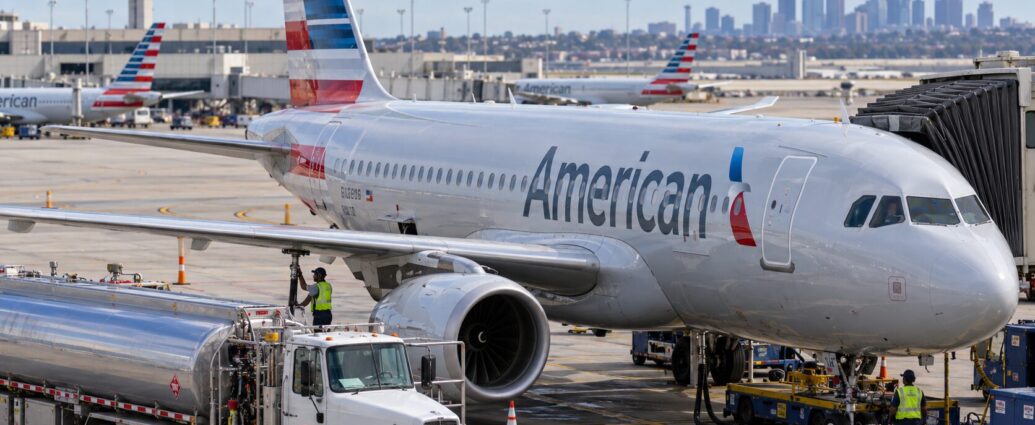
American Airlines Posts $269 Million Loss as Fuel Costs Surge 68%, Warns of Further Losses Ahead
JBizNews | Aviation & Markets | October 22, 2026
FORT WORTH, Texas — American Airlines reported a $269 million third-quarter loss Thursday despite record revenue, as soaring jet fuel prices overwhelmed strong passenger demand and forced the carrier to forecast additional losses through the remainder of 2026.
The results underscore a growing financial challenge facing the airline industry: passengers are flying, ticket prices are rising, and revenues are reaching records, but escalating operating expenses are consuming the gains.
American’s quarterly revenue climbed 19.3% to $16.3 billion, exceeding expectations. Yet fuel expenses surged 67.5%, adding approximately $1.9 billion to the company’s operating costs compared with a year earlier.
The airline reported a net loss of $269 million, or 41 cents per share, compared with a $114 million loss a year earlier. Excluding special items, the loss was $182 million, or 28 cents per share, better than Wall Street had anticipated.
Record Revenue, Deteriorating Profitability
American’s results reveal the widening gap between strong travel demand and the cost of operating a major global airline.
The carrier paid an average of $3.85 per gallon for jet fuel during the third quarter, compared with $2.37 a year earlier. Its total quarterly fuel bill reached approximately $4.6 billion.
Even strong performance across its passenger business could not offset the increase.
Premium cabin revenue increased 22.9%, while main cabin revenue rose 19.5%. Corporate travel revenue climbed 27.6%, marking the sixth consecutive quarter of double-digit growth in that segment.
The figures suggest Americans and corporate travelers remain willing to pay for air travel, but higher fares have not been sufficient to protect American’s profitability.
Fourth-Quarter Outlook Signals More Pain
The airline expects its financial pressures to intensify during the final three months of the year.
American projects an adjusted fourth-quarter loss of 50 cents to $1.10 per share, even as revenue is expected to grow between 19.5% and 22.5%.
The company anticipates paying approximately $4.70 per gallon for jet fuel, nearly double its cost during the same period last year.
At that price, American expects its fourth-quarter fuel bill to increase by approximately $2.8 billion year over year.
For the full year, management now forecasts an adjusted loss of $1 to $1.60 per share, abandoning its previous outlook that included the possibility of a profit.
The reversal is particularly significant because the company is experiencing historically strong revenue growth while moving further away from profitability.
Middle East Conflict Adds Industrywide Pressure
The surge in aviation fuel prices has been intensified by the continuing conflict involving Iran, which has disrupted energy markets and pushed costs higher for carriers worldwide.
Airlines have raised ticket prices to recover their increased expenses, but the pace of fuel inflation has outstripped those increases.
The pressure is extending across the industry, with competitors including Delta Air Lines and United Airlines warning that carriers may need to restrain capacity growth to protect margins.
American has already indicated that its network expansion in 2027 will slow relative to 2026 as management adjusts to elevated fuel prices.
The airline also faces additional exposure because it does not currently hedge its fuel purchases, leaving its operating expenses directly vulnerable to movements in energy prices.
Investors React to Worsening Forecast
American Airlines shares fell approximately 4% in early trading Thursday as investors focused on the deteriorating earnings outlook rather than the stronger-than-expected quarterly revenue.
The market reaction highlights concerns about how long airlines can sustain strong sales growth without converting that revenue into meaningful profits.
Chief Executive Robert Isom acknowledged that historically high fuel prices had substantially affected the company’s financial results, while emphasizing efforts to improve efficiency, strengthen premium services and restore profitability.
American expects to achieve nearly $1 billion in annualized savings by the end of 2026 through operational improvements, technology investments and restructuring initiatives.
However, the scale of the fuel-cost increase demonstrates how quickly external pressures can overwhelm internal cost reductions.
What It Means for Travelers and Investors
For travelers, persistent fuel-cost pressure could translate into continued higher ticket prices and slower expansion of flight schedules, particularly if airlines reduce capacity to protect profitability.
For investors, American’s earnings illustrate that record revenue alone is no guarantee of financial strength.
The central question is whether airlines can continue passing higher fuel costs to customers without weakening demand.
American’s third-quarter results offer a sobering answer: Even a nearly 20% increase in revenue was not enough to prevent a substantial loss.
The company’s return to profitability may ultimately depend as much on global energy markets as on the number of passengers filling its aircraft.
JBizNews Desk | Fort Worth, Texas
© 2026 JBizNews. All rights reserved.

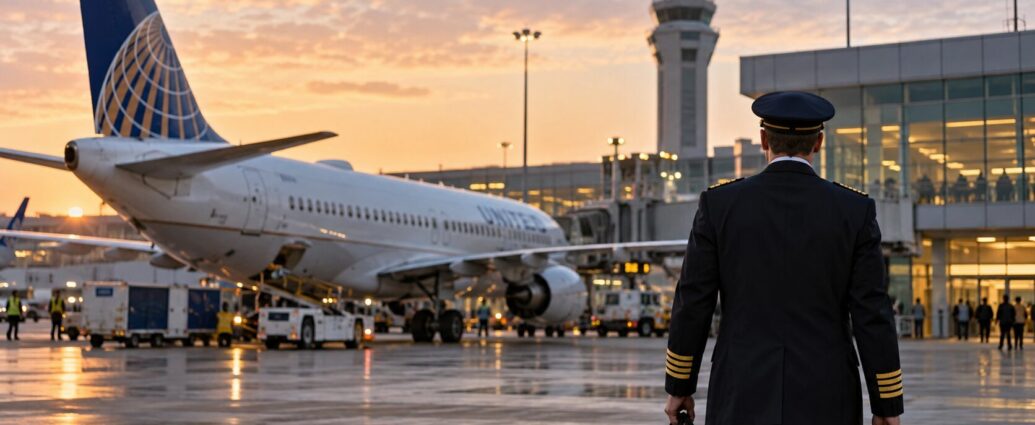
Israel Bars United Airlines Pilot Over Alleged Hezbollah Support, Raising Questions About U.S. Airline Security
JBizNews | Aviation & National Security | October 22, 2026
Israeli authorities have restricted a pilot linked to United Airlines following allegations of support for Iran and Hezbollah, exposing questions about airline vetting standards and the handling of security warnings.
JERUSALEM / CHICAGO — Israel has barred a pilot identified as working for United Airlines from operating flights into the country following allegations that he expressed support for Iran’s government, the Islamic Revolutionary Guard Corps and Hezbollah. The decision has raised questions about aviation security, employee screening and how airlines should respond when foreign governments flag potential threats.
The pilot, identified as Sina Amjadian, became the subject of an Israeli security review after the Ministry of Diaspora Affairs and Combating Antisemitism forwarded allegations concerning his social media activity to transportation and intelligence officials.
The reports alleged that Amjadian shared material sympathetic to Iran’s leadership and organizations designated as terrorist groups by the United States. However, the underlying allegations have not been independently verified, and the material initially provided to Israeli authorities included accusations published by third parties rather than authenticated original posts.
Despite those limitations, Israeli security authorities determined that the information warranted restricting the pilot from serving on flights entering Israeli airspace.
The distinction between Israel’s action and the pilot’s reported employment status is significant.
Israeli media reported that Amjadian had operated domestic U.S. and Canada routes for United and was not qualified to operate the wide-body aircraft used on the airline’s Israel service. Consequently, the Israeli restriction would not affect his existing assignments.
However, in a separate statement to aviation publication Paddle Your Own Kanoo, United said the pilot was not currently flying for the airline. The company did not clarify whether he remained employed, had been suspended or had separated from United.
That discrepancy leaves a central question unresolved: What action, if any, did the airline take after the security concerns surfaced?
A Security Warning Following a Cockpit Attack
The Israeli decision comes approximately three weeks after a September 30 security emergency aboard a Flydubai passenger aircraft bound for Tel Aviv.
During that flight, the first officer reportedly assaulted the captain and attempted to seize control of the aircraft. The plane experienced a rapid descent before the crew regained control and diverted to Saudi Arabia.
The incident prompted Israeli authorities to intensify their scrutiny of foreign flight crews and review the procedures governing access to Israeli airspace.
There is no evidence connecting Amjadian to the Flydubai incident. Nevertheless, the episode underscored a critical vulnerability in commercial aviation: Pilots are entrusted with extraordinary operational authority once an aircraft is airborne.
Unlike passengers, flight crew members have direct access to aircraft controls, navigation systems and cockpit procedures, making effective screening a fundamental component of aviation security.
The Challenge for United Airlines
The controversy presents a broader question for United Airlines and the aviation industry.
When a foreign government identifies a potential security concern involving an airline employee, what level of evidence should be required before that employee is restricted from flying?
Israel’s action demonstrates that its authorities considered the allegations serious enough to warrant a precautionary restriction. It does not, however, establish that the pilot committed misconduct, violated aviation regulations or represented an actual threat.
Political expression, criticism of Israel and Iranian nationality are not, in themselves, evidence of a safety risk. At the same time, substantiated support for terrorist violence by an individual entrusted with passenger aircraft would raise significant concerns requiring investigation.
Airlines must distinguish between protected political expression, unverified accusations and credible evidence of dangerous conduct.
The stakes extend beyond international routes. Commercial aircraft operating within the United States and Canada carry passengers who depend on the same rigorous safety standards as those traveling overseas.
Questions for Aviation Regulators
The case also raises questions about the responsibilities of U.S. aviation regulators and airline operators when foreign intelligence or security agencies identify concerns involving flight personnel.
The Federal Aviation Administration regulates pilot certification and aviation safety, while the Transportation Security Administration oversees significant elements of transportation security, including aviation security requirements.
An Israeli restriction does not automatically invalidate an American pilot’s certification or establish grounds for disciplinary action. Nevertheless, credible security warnings can warrant independent review by the airline and appropriate authorities.
The essential questions are whether the allegations were verified, whether a formal risk assessment was conducted and whether the resulting decision adequately protected passengers while respecting the employee’s rights.
The Larger Issue: Passenger Confidence
For United Airlines, one of the nation’s largest carriers, the implications extend beyond a single pilot.
Aviation depends on public confidence that every individual entrusted with an aircraft has undergone appropriate scrutiny and meets demanding professional and safety standards.
Israel has exercised its authority to prevent a pilot from operating flights into its airspace. United has stated that the individual is not currently flying for the airline, but the circumstances surrounding that status remain unclear.
Until those questions are resolved, the case illustrates the difficult balance between precautionary security measures, due process and transparency.
For passengers, the expectation is straightforward: Security concerns should be evaluated promptly, independently and consistently, regardless of whether the flight is heading to Tel Aviv, Toronto or Chicago.
JBizNews Desk | Jerusalem / Chicago
© 2026 JBizNews. All rights reserved.

Opinion | Republicans, Act on Russia






Opinion | Putin Plays Hostage Geopolitics
Russian Drones Devastate Uman, Ukraine, Threatening City That Draws Tens of Thousands of Jewish Pilgrims
Russian strikes destroy a major retail center and damage homes, a hotel and university property in the city where Rabbi Nachman of Breslov is buried, raising new concerns about the safety of Jewish visitors.
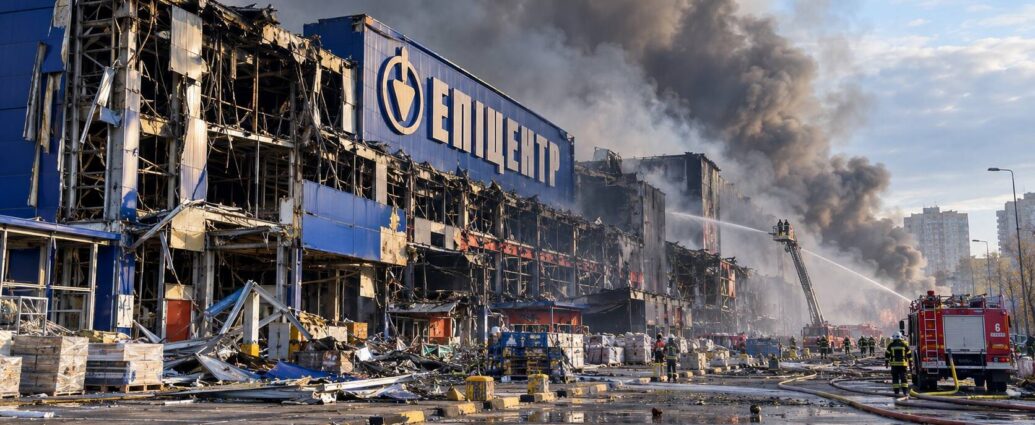
UMAN, Ukraine | October 21, 2026 — Russian drones struck Uman, Ukraine, in repeated attacks Wednesday, setting a major shopping center ablaze, damaging homes and other civilian properties, and bringing the dangers of the war directly into one of the Jewish world’s most important pilgrimage destinations.
The attacks are especially alarming because Uman is home to the gravesite of Rabbi Nachman of Breslov, the revered Hasidic leader whose burial place attracts tens of thousands of Orthodox Jews each year and visitors seeking prayer and spiritual inspiration throughout the year.
According to Ukrainian regional authorities and local reports, the overnight attacks struck the Epicentr home-improvement hypermarket, triggering a major fire that devastated the commercial property. A private home was destroyed, a hotel was damaged by the force of an explosion, and subsequent drone activity caused damage at Uman National University and other civilian locations.
Local reporting Wednesday afternoon indicated that five residents had sought medical assistance following the attacks, with two hospitalized in conditions described as not serious.
Emergency crews battled extensive flames at the Epicentr complex. Their work was complicated by the threat of additional strikes, forcing firefighters to withdraw temporarily to safer locations. Explosives specialists subsequently inspected the affected property.
A Strike in a City Sacred to Orthodox Jews
For the international Jewish community, the location of the attacks makes the developments particularly disturbing.
Rabbi Nachman’s gravesite is located in Uman’s historic Jewish pilgrimage district, surrounded by synagogues, prayer facilities, guesthouses and other services established to accommodate the constant flow of visitors.
The Epicentr retail center, located on Kyivska Street, is elsewhere in the same city. Authorities have not established that the gravesite itself was struck, and a precise distance between the reported impact locations and the burial site has not been independently confirmed.
Nevertheless, the repeated explosions, damage to civilian infrastructure and ongoing security operations have brought renewed concern to a city where Jewish pilgrims regularly travel to pray.
The threats extend beyond the annual Rosh Hashanah pilgrimage. Uman receives visitors throughout the year, including individuals and families traveling from Israel, the United States and Europe.
During Rosh Hashanah alone, approximately 50,000 people are estimated to visit Rabbi Nachman’s tomb, according to research published by the Israel Democracy Institute in September.
For those considering a visit, Wednesday’s attacks raise immediate questions about personal safety, transportation, local accommodations and the ability to pray without the threat of further drone strikes. The extent of any direct interruption to access to the gravesite has not yet been established.
A City Built Around Prayer and Pilgrimage
Rabbi Nachman died in Uman in 1810. Over the generations, his burial place has developed into an internationally recognized destination for Jewish prayer.
The surrounding neighborhood supports a network of synagogues, kosher food establishments, lodging facilities and businesses serving visitors.
What began as a religious gathering among Breslov Hasidim has grown into one of the largest recurring Jewish pilgrimages in the world.
Russia’s continuing attacks now present another dimension of risk for visitors traveling into Ukraine, where civilian air travel has remained suspended since the full-scale invasion began in 2022.
Commercial Destruction and Renewed Security Concerns
Beyond the religious implications, the destruction at Epicentr represents another significant blow to Ukrainian civilian commerce.
Large retail centers provide employment, merchandise and important commercial services to surrounding communities. Their destruction creates immediate challenges for local businesses and residents already coping with years of wartime disruption.
Wednesday’s strikes affected multiple civilian locations across Uman and required emergency responders to confront the danger of further attacks while attempting to contain the damage.
The attacks underscore a broader reality: a city that has become a global destination for Jewish prayer is simultaneously exposed to the destruction of a continuing war.
For Jews worldwide who consider Uman a place of spiritual connection and prayer, the latest strikes are a disturbing reminder that even one of Judaism’s most cherished pilgrimage destinations is not beyond the reach of the conflict.
JBizNews Desk | Uman, Ukraine
© 2026 JBizNews. All Rights Reserved.








Netanyahu Pressures Haredi Party to Exit Israeli Election as Coalition Vote Concerns Grow
JBIZNEWS | WORLD POLITICS | OCTOBER 21, 2026
JERUSALEM — Israeli Prime Minister Benjamin Netanyahu held a late-night meeting with the leader of a newly formed ultra-Orthodox political party, seeking to persuade him to withdraw from next week’s national election amid concerns that his candidacy could cost Netanyahu’s political bloc crucial votes.
The meeting, held shortly after midnight in Petah Tikva, brought Netanyahu face-to-face with Moti Leitner, chairman of the Haredi Public Party, just six days before Israelis head to the polls on October 27.
According to Israel National News, the meeting was arranged at the request of the Prime Minister’s Office as Likud officials intensified efforts to prevent smaller parties from drawing votes away from Netanyahu’s coalition partners without securing enough support to enter parliament.
Leitner has not ruled out withdrawing, but he is demanding binding political commitments before agreeing to end his campaign.
Negotiations Focus on Government Role and Haredi Representation
Discussions between Likud representatives and Leitner’s party have included proposals for a joint public announcement with Netanyahu and a possible government appointment overseeing issues affecting Israel’s ultra-Orthodox population.
A separate report by Ynet said Likud campaign manager Zvika Brot offered Leitner a government position with responsibility for programs involving hundreds of millions of shekels, including Haredi education and workforce integration.
But Leitner is seeking more than assurances from Netanyahu.
He wants Israel’s established Haredi parties, Shas and United Torah Judaism, to endorse any agreement, fearing they could otherwise block the promised reforms after a new government takes office.
At the meeting, Leitner reportedly made clear that meaningful negotiations could not advance without their participation.
A Small Party With Potentially Significant Electoral Consequences
Under Israel’s electoral system, a political party must win at least 3.25% of the national vote to enter the 120-seat Knesset.
Votes cast for parties that fail to reach the threshold do not translate into parliamentary seats.
That presents a political risk for Netanyahu. If the Haredi Public Party attracts voters who might otherwise support Likud or its coalition partners but fails to enter parliament, those votes could reduce the bloc’s ability to secure a governing majority.
Recent polling has consistently shown Leitner’s party below the electoral threshold.
The party has nevertheless maintained that it represents a constituency underserved by established ultra-Orthodox political leadership.
Its platform includes greater attention to education, employment, economic opportunity, military-service arrangements and the financial pressures facing Haredi families.
Economic Issues Add Another Dimension to the Election
The dispute extends beyond coalition arithmetic.
The Haredi Public Party has positioned itself as an alternative for ultra-Orthodox voters seeking changes in education, employment opportunities and representation.
Those questions carry broader economic implications for Israel, where workforce participation, education policy, housing affordability and the integration of a growing Haredi population remain important long-term challenges.
An agreement involving government authority over these policies could have consequences beyond the immediate election, depending on the responsibilities and funding ultimately assigned to the proposed position.
Six Days Before the Vote, No Agreement
Leitner had previously insisted that his party would remain in the election, arguing that its supporters deserve independent parliamentary representation.
His latest discussions with Netanyahu suggest negotiations remain possible, but no withdrawal agreement has been announced.
The immediate question is whether Netanyahu can secure an arrangement acceptable to Leitner and the established Haredi parties before Tuesday’s vote.
For Netanyahu, even a relatively small number of votes could matter in the contest to assemble a parliamentary majority.
For Leitner, the decision involves balancing the possibility of winning independent representation against securing policy commitments through an agreement with Netanyahu.
With Israel’s October 27 election approaching, the outcome of these negotiations remains unresolved.
JBizNews Desk | Jerusalem
© 2026 JBizNews. All Rights Reserved.


Chinese AI Tool Linked to Hacks in Japan




Fifth Foreign Company Withdraws From Jerusalem Cable Car Project, Raising Questions Over Its Future
JBIZNEWS | ISRAEL • INFRASTRUCTURE
JERUSALEM, October 21, 2026 — An Italian engineering consultancy has become the fifth foreign company to withdraw from Jerusalem’s controversial cable car project, creating another obstacle for a major tourism and transportation initiative intended to improve access to the Western Wall and the Old City.
The company, ROPES, had been identified by the Jerusalem Development Authority as a prospective consultant for the project. However, its chief executive, Stephan Obexer, told The Guardian that the company would not proceed because of an existing commitment in India.
The withdrawal follows years of international scrutiny surrounding the project, which supporters describe as an important transportation improvement and opponents criticize over its potential impact on Jerusalem’s historic landscape and Palestinian neighborhoods.
A Major Transportation Investment
The proposed 1.4-kilometer cable car system would connect western Jerusalem with the area near the Old City’s Dung Gate, providing access to the Western Wall and nearby historical attractions.
Supporters, including Israel’s Tourism Ministry and Jerusalem municipality, say the system could transport as many as 3,000 passengers per hour while reducing pressure on congested streets and providing an alternative to conventional road transportation.
The Israeli government approved the project in 2019, and the country’s High Court upheld the planning decision in 2022.
Foreign Companies Continue to Withdraw
ROPES is the fifth international company reported to have stepped away from involvement in the project.
Last month, the Jerusalem Development Authority published its intention to award the Italian consultancy a contract without a public tender.
Although the company’s chief executive cited other business commitments, Italian media reported that its owner had reconsidered an earlier decision to participate. The company has not issued a formal public statement explaining its withdrawal.
Previous departures by foreign firms have raised questions about the project’s ability to attract international engineering and technical partners amid continuing controversy.
Supporters and Critics Clash Over Jerusalem’s Future
The planned route would pass above parts of Silwan before reaching a terminal associated with the City of David development near the Old City.
Opponents, including preservation specialists, architects and archaeological organizations, argue that the cable car could damage the historic skyline, affect local residents and redirect tourist traffic away from established routes through Jerusalem’s Old City.
Supporters maintain that improving accessibility to one of Israel’s most visited religious destinations is a legitimate transportation objective and that the system offers a practical alternative to additional road construction.
What It Means for the Project
The latest withdrawal underscores a growing challenge for the project’s planners: securing experienced international partners for an infrastructure initiative carrying substantial political, cultural and reputational sensitivities.
The departure does not mean the cable car has been canceled. Israeli authorities have continued preparations to advance the project.
However, repeated withdrawals could complicate procurement and technical planning, potentially increasing the burden on the Jerusalem Development Authority to identify alternative contractors.
For Jerusalem, the broader question is whether a project designed to improve tourist access can move forward while addressing opposition from preservation organizations and affected communities.
JBizNews Desk | Jerusalem
© 2026 JBizNews. All rights reserved.