Rhode Island could become another state that allows faith-based organizations to build affordable housing on land they own without rezoning.

The bill is gaining traction alongside two others aimed at boosting the Ocean State’s housing supply and creating more affordable options.

Like many states, Rhode Island has grappled with a housing crisis as rents and home prices rise amid too little new supply. Lawmakers opened this year’s session with a sixth package of housing reforms.

In addition to the “yes in God’s backyard” legislation, state lawmakers are considering bills to re-legalize single-room occupancy housing and create a new financing incentive to convert commercial buildings into affordable housing.

All three measures have strong support from most housing advocates across the state. Several spoke in favor of the bills during a long committee hearing Monday night.

Faith-based affordable housing

State Rep. June Speakman, who introduced the Faith-based Affordable Housing Act, cited California as an example of by-right development for such properties. California has been on the leading edge of by-right reform, with lawmakers passing a faith-based law in 2023.

“It’s too soon to determine how well it’s working,” Speakman said, but noted the need to create more housing options.

Her bill would create a statewide framework allowing faith-based organizations to develop affordable and mixed-use housing on land they own. It would also set uniform statewide development standards and curb local barriers such as discretionary denials and restrictive zoning rules. The Rhode Island Housing and Mortgage Finance Corporation would oversee compliance and refer violations to the attorney general.

Matt Netto, associate state director for AARP Rhode Island, said in written testimony that older adults are among the people most affected by the state’s housing affordability crisis.

“As housing costs increase, too many older adults are forced to make difficult choices or leave communities where they have lived for decades,” Netto said. “Expanding a wider range of lower-cost housing options is essential to ensuring older Rhode Islanders can remain housed safely and with dignity in the community of their choosing.”

SRO bill changes

Speakman also introduced the “Restoring Options in Occupancy Models Act,” based on a legislative template the Institute for Justice has been urging states to adopt. The bill is being amended after negotiations with stakeholders.

“After some negotiations with stakeholders, we narrowed the bill slightly to apply only to areas zoned for multifamily, commercial or mixed use,” Sam Hooper, legislative counsel with the Institute, told The Builder’s Daily.

The original bill would have allowed SROs in single-family areas, but that provision drew objections from the Rhode Island League of Cities and Towns. The revised version also sets a minimum tenancy of 90 days to distinguish SROs from short-term rentals.

At the hearing, housing advocate Kristina Brown said SRO development could help repurpose vacant buildings, including offices, schools and other hard-to-convert properties, into housing.

“It gives the developer, the builder, options on how to reuse that property and bring it online, which we think benefits both residents who are looking for different types of housing options as well as municipalities who want to see these properties put back online,” she said.

Adaptive reuse funding

To encourage converting commercial properties to housing, H 8142 would create a state program and fund to finance adaptive-reuse and mixed-use housing projects. It requires affordable housing units and labor-related conditions, and the bill would pair with labor union pension fund investments.

Speakman, who also introduced this bill, said that, like the other two bills, it would “take advantage of already developed spaces without having to intrude on increasingly scarce vacant land or put increasing pressure on water and sewer resources.”

The only pushback came from Rhode Island Housing’s Amy Rainone. Rainone said her organization supports incentives for adaptive reuse projects, but raised concerns about how they would interact with other incentives, such as low-income housing tax credits. She also said the way the incentives target tenants could “potentially run afoul of some fair housing requirements.”

This post was originally published on here

Lamacchia Realty has acquired Weichert Realtors – Briotti Group, expanding its Connecticut presence with new offices in Waterbury and Wolcott, the company announced Wednesday. The deal brings broker-owner Stephen Briotti and 24 agents under the Lamacchia banner as the firm continues an acquisition-driven growth strategy across New England. Financial terms of the deal were not disclosed.

The Briotti Group, a long-time Weichert franchise, focuses on the purchase and sale of single-family homes and income properties in the Greater Waterbury area. The firm is known for its knowledge of local neighborhoods, schools and pricing trends, according to the announcement.

The acquisition gives Lamacchia Realty four Connecticut offices: its existing Southington and Milford locations, plus the newly added Waterbury and Wolcott branches. Lamacchia Realty first entered Connecticut in November 2022 when 15 agents joined from another brokerage along with regional sales managers Beth Byrd and Gina Shumilla.

“I’m very excited and grateful to have Stephen and all of his wonderful agents now a part of us here at Lamacchia Realty,” owner and founder Anthony Lamacchia said in the announcement. “After three and a half years of being in Connecticut, I’ve finally found an acquisition with a great company that will help us grow our market share in central Connecticut.”

Briotti has been licensed since 1978 and opened his own office in Wolcott in 1995. After affiliating with a national franchise and opening a second office in 1999, he grew the business to more than 80 agents at the height of the market, serving “thousands of clients,” according to the company.

“After seeing how the real estate business has evolved over the last 30 years, I want simply the best for my agents,” Briotti said. “Aligning our future goals with Lamacchia Realty … agents will hone their skills and use the proven systems and strategies to sustain growth in their careers.”

The Waterbury office agents joining Lamacchia Realty include Arlene Nuzzo, Bonnie Crafa, Carlo Bettini, Cynthia N. Laurie, Deon Robinson, Dot Dorso, Lee Palmieri, Liz Faustino, Mark Poveromo, Mercedes Baus, Rick Zappone, Theresa Gorman, William James Walton Sr. and Patsy O’Connell. The Wolcott roster includes Charlie Leogrande, Cheryl Grabowski, Claire Julien, Dayanara Chacon, Fernando Barreiro, Lisa James, Maria Vilar, Mary Lou Smail, Michelle Lee Byrne and Tino Rebelo.

Byrd, now a regional sales manager with Lamacchia Realty in Connecticut, said bringing in a local incumbent team with deep ties should accelerate the company’s share gains in New Haven County and central Connecticut.

“This partnership not only strengthens our presence in the region, but also enhances our ability to deliver greater resources, broader exposure and results for both our agents and the clients we serve,” Byrd said.

Gaining market share in smaller metros

This is Lamacchia Realty’s 13th acquisition in New England over the past two and a half years, according to the company. Recent deals have included brokerages in Massachusetts and Rhode Island markets such as Milford, East Providence, Newburyport, Amesbury, Shrewsbury, Pittsfield, Dalton, Easton, Auburn, Springfield, Falmouth, Fall River and Seekonk.

Lamacchia Realty said this deal shows that it is continuing to use roll-ups of established local firms to gain market share in smaller metros. For independent broker-owners in New England and Connecticut, it underscores ongoing consolidation pressure and the availability of regional acquirers. For agents in central Connecticut, the move could mean more marketing, tech and lead generation resources wrapped around an existing local brand and client base.

Lamacchia Realty said it will launch an aggressive marketing push in the Waterbury and Wolcott areas in the coming weeks, including billboards, social media, postcards, newspaper and TV advertising. The firm said operations will remain “business as usual” for clients while Lamacchia’s management integrates its lead products, services, training and technology with the incoming team.

In 2024, Lamacchia Realty closed 4,632 transaction sides for a total sales volume of $2.53 billion according to RealTrends Verified data. This earned the firm the No. 106 and No, 96 rankings in the country for sides and volume, respectively, in the 2025 RealTrends Verified Rankings.

This article was generated with the help of HousingWire Automation and reviewed by a HousingWire editor before publication. The system helps convert company announcements and industry data into HousingWire-style news coverage.

This post was originally published on here

Rocket Close announced Thursday that it has significantly reduced the time required to process mortgage documents by deploying a generative artificial intelligence (AI) solution developed in collaboration with Amazon Web Services (AWS).

Rocket Close, which processes about 2,000 abstract document packages daily, previously relied on manual workflows that took up to 10 hours per package amid rising volumes. Each package averages roughly 75 pages and contains complex legal and financial records tied to property ownership and lending.

Through the new system, processing time has been reduced to less than two minutes per package while maintaining about 90% accuracy in document classification and data extraction.

“The human will step into almost all of the transactions, whether it’s verifying the data or looking at the exceptions, so that we’re ensuring that we’re doing the right thing for our clients and making sure that they have the proper homeownership rights to the property,” Nathan Schrauben, chief information officer for Rocket Close, said in an interview with HousingWire.

The solution combines Amazon Textract for optical character recognition and Amazon Bedrock for document analysis. Textract converts scanned documents into machine-readable text, while Bedrock uses large language models to classify documents and extract relevant data fields.

“The Textract product that Amazon has is one of the industry leaders. We’ve benchmarked it against other leaders in this space, and they seem to come out on top,” Schrauben added.

Removing roadblocks

Abstract document packages — which can include deeds, mortgages, liens, tax filings and court records — present challenges due to inconsistent formatting, handwritten notes and varying document structures. Rocket Close’s system processes more than 60 document types and extracts structured data across categories such as loan details, ownership history and legal judgments.

“There’s no specific format or standard in which you’re going to receive a package. So what that typically does is you need human experts on the other end in order to process these because you need human judgment. And so that’s where the slowdown happens,” said Sri Elaprolu, director of the AWS Generative AI Innovation Center.

That’s where AWS comes in, Elaprolu said. The automation addresses several operational challenges, including high processing costs, scalability limits and the risk of human error. Previously, the company required an estimated 1,000 hours of manual processing daily.

“We’ve worked closely with the Rocket team in understanding that we’re not the mortgage processing experts; we’re coming from it from a technology perspective,” he said. “Our customers have the domain knowledge of their business. Nobody knows better than them, and so our job is to collaborate with our customers [and listen to] the specific knowledge about their workflows that we’re trying to automate.”

Elaprolu said that the start of the collaboration began with a “discovery process” that allowed AWS to understand Rocket’s systems and problems before building a proof of concept.

“We then sat down and had Rocket experts validate [the concept] with real data flowing through the system, or at least simulated that data that’s pretty close to real, to see if it would give correct outcomes,” he said. “Very often, you’re not going to get it right in the first pass, so we keep tweaking and adjusting. … Our goal is not just automation but … to make sure that the AI that we’re using understands this domain, understands these databases and applies them the proper way.”

Testing showed consistent performance across multiple evaluation phases, with accuracy rates ranging from about 89% to 91% across tens of thousands of data fields.

‘We want humans in the loop’

The cloud-based system is designed to scale to more than 500,000 documents annually and handle increased volume without proportional staffing increases. AWS said the improvements are expected to reduce costs, speed up customer service and support business growth.

“It relieves the human specialists who are in the workflow today to be focused on more complex packages that a system is not going to be able to handle,” Elaprolu said.

Following a successful proof of concept, Rocket Close plans to move the system into full production and expand its use to other workflows, including loan processing, purchase agreements and title clearance documentation.

“We anticipate every two to four weeks that we’re adding a new document into our workflows to allow our clients and our team members the ability to process through much more scale,” Schrauben said.

Schrauben also said that the company intends to implement continuous improvement processes and update its AI models as newer versions become available.

“We’re not looking to get anybody out of the loop. We want humans in the loop because humans are really good at the really tough stuff, like explaining things that are not as straightforward to other clients, especially in the title space. We believe that this technology is unlocking that,” Schrauben said.

This post was originally published on here

Success in homebuilding over the ages shows a rare, often counterintuitive balance between what changes in an instant and what remains timeless. 

Living legends of the business – like NVR founder Dwight Schar – wise up to the fundamental role of land in housing, understanding that it holds a genomic key to homes, prices, processes, and people, enabling each lot to generate lasting value in an ever-evolving landscape.

From early on, Schar understood that wisdom, which is equal parts science, art, and alchemy, leaves no room for shortcuts, skipping the tedious details, or getting around the occasional pain of learning things the hard way.

For over 40 years as the leader of NVR, Inc., Schar built what many consider the most financially disciplined large-scale homebuilding company in the United States. The company that developed under his leadership – focused on conservative growth, land discipline, and returns on invested capital – largely shapes how today’s generation of homebuilders thinks about risk.

Yet Schar’s worldview began far from the boardroom.

“You need a team to win”

“I moved to my uncle’s Ohio farm when I was 12 years old,” Schar recalls in an email exchange with The Builder’s Daily. “I had chores in the morning… milking cows, getting in crops, cleaning up… everything before school started. Then after school, more chores were waiting for me… the cows didn’t wait for me.”

Hard work was simply the structure of daily life.

“But I liked working hard… the focus, the hours… it was fun, in a way. I certainly learned about being responsible on the farm.”

Team sports reinforced those lessons. “You need a team to win,” he says. “You learn how to get along with teammates for the greater good.”

At 17, Schar left the farm with little more than determination.

“I left the farm with nothing but a paper bag holding my clothes. That’s all I took.”

He stayed with a teammate’s family to finish high school at Norwayne High in Creston, Ohio, before attending Ashland College in Ashland, Ohio, where he earned a teaching degree. Paying for school required resourcefulness. At one point, facing tuition he couldn’t afford, he walked into a bank and asked for help.

“I made an appointment with the president of the local bank. I told him about my money problem… and he told me to write the check, and he would hold that check until I had the money that would allow it to clear.”

Schar worked construction jobs, hung drywall, painted houses, and spent overnights in a foundry. The lesson stayed with him.

“Don’t be afraid to ask for help. So many people were good to me, helped me… now I do my best to help others in need.”

Those who can, do

His formal career started in the classroom, but teaching was short-lived. During that time, Schar took electives in business courses – accounting, marketing, business law – subjects he says influenced his thinking much more than the semester he spent teaching.

Soon after, the purchase of his own home changed his trajectory.

“The guy who sold me the house told me to come sell houses with him in my free time,” Schar says. “I gave it a try… and I sold that house right away.”

The buyer, a banker who paid in cash, told Schar’s manager he’d be a fool not to hire him full-time.

“He did,” Schar says. “And here we are.”

Schar soon joined Ryan Homes, then led by another of homebuilding’s legends, Ed Ryan, and quickly became one of the company’s most aggressive land operators.

“Land is the key to everything else in our business,” he says.

His approach was methodical. In markets across the Midwest, Schar mapped out growth corridors, divided them into quadrants, and targeted the best development opportunities.

“I drove 60,000 miles a year and worked 16-hour days.”

Efficiency became another key aspect of his approach. At Ryan, Schar significantly cut down the number of home designs.

“They were building 100 different house types. I cut that down to 35,” he says. Standardizing components such as windows, doors, and roofs allowed Ryan to reduce waste and accelerate production.

In the Washington, D.C. area, the strategy was successful quickly.

“In two years, we were the largest homebuilder in the market… we still are today.”

By 1980, Schar started his own company, NVHomes – named for the Northern Virginia area where he had built his reputation. Seven years later, NVHomes bought Ryan Homes in a $312 million deal that created NVR, Inc.

The company quickly became one of the nation’s largest builders.

But the strategy that defined Schar’s career would emerge from a crisis.

The throes of opportunity

After the leveraged buyout that created NVR in 1987, the housing market collapsed during the savings-and-loan crisis. The industry’s traditional method – buying large tracts of land with borrowed money – left many builders dangerously exposed.

NVR was no exception.

Between 1988 and 1991, sales fell by roughly half. By 1990, the company had posted losses exceeding $260 million. Contract cancellations surged, and financing evaporated.

“You can manage risk that’s under your control… how fast to grow… how much to save,” Schar says. “But you can’t manage political risk.”

Congress passed sweeping financial reforms after the S&L collapse, which caused bank lending to builders to dry up.

“Liquidity dried up… credit dried up… banks would not lend money to builders and we suffered through that… along with so many others.”

On April 6, 1992, NVR filed for Chapter 11 bankruptcy protection.

The company was transformed by the restructuring that followed.

Lessons learned

NVR moved away from the industry’s land-heavy approach and started obtaining options on lots from developers instead of buying them raw land and financing its development. This “just in time” lot acquisition model significantly lowered capital needs and debt risk.

“Number one is taking less risk in land,” Schar says. “We didn’t buy land… we optioned the lots from the developers.”

The company also enforced strict internal discipline.

“We had a 10% rule,” Schar says. “We never wanted to grow more than that in any year because you can handle 10% repeatedly and keep your eye on the ball.”

NVR emerged from bankruptcy in 1993 with a radically different structure and culture. The new model emphasized return on invested capital and operational efficiency over rapid expansion.

That philosophy helped NVR stay profitable during the housing crash of the late 2000s, when many competitors faced heavy losses.

Schar attributes success more to discipline than to strategy.

“When times are good,” he says, “some builders think it’s never going to end… and then they find out they’re undercapitalized, overextended.”

For Schar, the lesson was straightforward.

“The most important thing is to stick to a conservative business plan… keep an even keel and have the reserves to see your way through hard times.”

Today, NVR generates nearly $9 billion in annual revenue and has served over half a million homeowners across the country. But Schar measures success differently.

“I think I am most proud of the organization,” he says. “The sustainable culture, the quality of what we build and the people who give their all.”

Homeownership itself remains central to his thinking.

“Owning a house is a part of the American dream… I’m proud to be a part of that.”

The next chapter

Even after retiring from NVR in 2022, Schar has remained deeply engaged in development and civic life – now applying the same discipline that defined his homebuilding career to a broader canvas of commercial real estate and community development.

As a significant shareholder, principal in Comstock Partners, and strategic advisor to Comstock Holding Companies, Inc. (Nasdaq: CHCI), Schar has played a central role in shaping the company’s evolution into a fee-based, asset-light, debt-free real estate services platform. The model – rooted in long-term asset management agreements, vertically integrated property management services, and recurring revenue streams – mirrors the capital efficiency and risk discipline he pioneered at NVR.

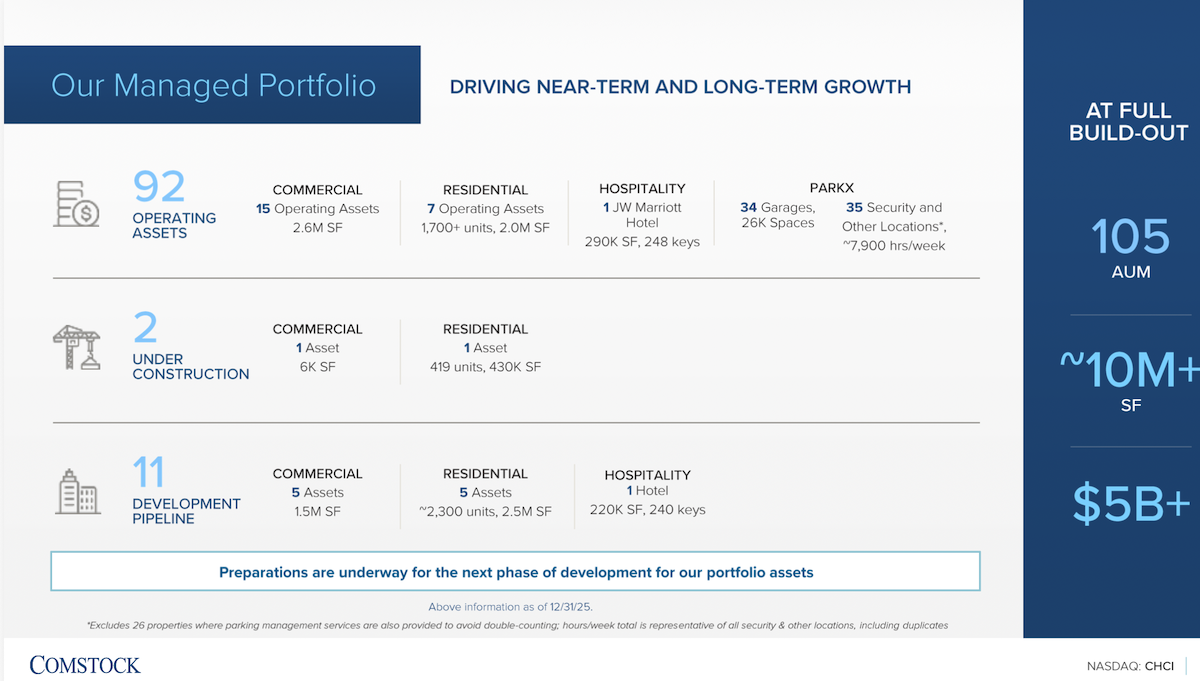
At Comstock, that philosophy is reflected not only in how assets are financed but also in how they are conceived, developed, acquired, and operated over time. The company manages and operates a portfolio that is expected to include well over 100 assets and cover approximately 10 million square feet at full-build out, with a pipeline that extends into the next decade and a total value exceeding $5 billion. 

Screenshot 2026-03-30 at 11.28.48 AM
Source: company materials

Comstock’s core business model is designed to generate consistent, recurring income through asset and property management agreements while maintaining a streamlined balance sheet. This approach has driven steady increases in revenue and EBITDA over the past several years and has also provided Comstock with the flexibility to pursue new growth opportunities without overextending capital.

Projects like Reston Station and Loudoun Station – large-scale, mixed-use, transit-oriented developments anchored by Metro rail – continue the story of Schar’s ongoing belief that real estate success ultimately depends on place-making: blending residential, commercial, hospitality, and public spaces into environments that can grow and adapt over time. 

At the same time, Comstock’s expansion into institutional joint ventures and emerging platforms like data center campus development highlights a forward-thinking strategy that combines operational expertise with external capital, enabling the company to grow while keeping its low-risk, high-return profile. 

The throughline is clear. NVR redefined how homes could be built with less capital at risk. Comstock applies that thinking to how entire districts can be developed, managed, and sustained over time.

“Beyond business, what I admire most about Dwight is his deep commitment to fostering the American Dream and to improving the lives and futures of others through his philanthropic initiatives,” said Chris Clemente, CEO of Comstock. “While more than 100,000 homes built by his companies are at the center of the American Dream for countless families, his extraordinary contributions to Inova Schar Cancer Institute and the Inova Schar Heart & Vascular Center in Fairfax, Virginia, have helped save many lives. His generous support of George Mason University and other institutions has also helped shape the next generation of doctors, nurses, teachers, political leaders, and business leaders. I am truly honored to have Dwight as a business partner, mentor, role model, and friend.”

For Schar, the magnetic appeal of the work stays as basic as it was on the farm.

“It’s fun,” he says. “It’s still fun. The fun is in the doing.”

Alongside his business activity, Schar and his wife have donated more than $150 million to healthcare and education initiatives, including major gifts to the Inova Health System and George Mason.

The motivation, he says, connects back to the same philosophy that shaped his career.

“Housing is the foundation of our civilization,” Schar says. “Homes create our communities… neighborhoods… schools… kids growing up together.”

For the next generation of builders, his advice remains rooted in restraint and patience.

“You have to play the long game and you have to fully understand risk,” he says.

“Be smart… don’t be greedy… don’t overextend… and always have some capital in your back pocket.”

Then he adds the perspective earned over a lifetime in one of America’s most cyclical industries.

“It’s a marathon… not a sprint.”

This post was originally published on here

“Most men appear never to have considered what a house is, and are actually though needlessly poor all their lives because they think that they must have such a one as their neighbors have.” — Henry David Thoreau, Walden.

The National Association of Realtors (NAR) said on 3.24.2026 that from January 2019 to January 2026: “The median single-family home appreciated by 58.6% over this period, which serves as a good baseline for overall values in the housing market.” Manufactured and “Mobile homes that include land in the listing increased in value by even more, by 70.1%,” per NAR’s research. Mobile and manufactured homes on leased land: “appreciated by less than single-family [site built, conventional] homes, at 51.6%.” What that means is that manufactured housing, even in land-lease communities (sometimes errantly called ‘mobile home parks’ or ‘trailer parks’), are appreciating at about 88% of the rate as single family housing and manufactured homes on owned land are outpacing conventional housing appreciation by 19.6%.

That’s groundbreaking news for a nation where tens of millions are hungering for inherently affordable housing that doesn’t require subsidies.

From a HousingWire article: “If the 21st Century ROAD to Housing Act is the end of the conversation, then we have already lost.” “The politicians who supported this bill are right to be worried. The median home price in early 2026 remains nearly five times the median household income, a ratio that is fundamentally unsustainable. Young voters, in particular, are no longer looking for incremental change; they are looking for a path to the equity-building machine that defined the middle class for their parents and grandparents.” That author made several useful points but missed this one. Only HUD Code manufactured homes are “inherently affordable.” The NAR Research shows manufactured homes are a wealth-building tool.

In an evidence-linked article, WND said there is a “simple legislative fix needed to solve America’s housing crisis.”  It stressed that while all types of housing are needed, because conventional builders can’t meet the price-points and demand, millions of more manufactured homes are essential. Per HousingWire on 3.10.2026: “HUD’s own research shows that, for more than 50 years, lawmakers and public officials have repeatedly promised fixes that never materialized.” That fact-backed op-ed cited the Senate’s issues brief. “The Senate ironically proves their bill won’t work in their own…brief. Myth 5: The ROAD to Housing Act preempts local zoning decisions. Fact: By design, the 21st CenturyROAD to Housing Act does not preempt local or state zoning. This is one reason why the U.S. Conference of Mayors and the National League of Cities support the bill. Chairman Scott believes zoning decisions are best made locally, not in Washington.” Sorry, but Chairman Scott and anyone who holds that view are clearly wrong. Who says? How about a county commissioner?

Per Polk County Commissioner Bill Braswell: “Affordable Housing: Why manufactured homes must be part of the solution.” “For decades, Americans have demanded a solution to the affordable housing crisis. That discussion almost always begins with the question: What is government going to do about it? My view is simple. Government is not capable of solving this problem and history proves it.”

“…Unfortunately, manufactured housing, commonly referred to as mobile homes, has been stigmatized for decades. Local governments across the country have often regulated them out of existence, based on outdated perceptions that no longer reflect reality.

Today’s manufactured homes are built to dramatically higher standards than in the past. They are safer, more energy-efficient, more storm-resistant, and far more attractive than older models. They can be installed quickly, and most importantly, they remain one of the only truly affordable paths to homeownership.”

As HousingWire previously reported, there is a seemingly curious mix of Braswell, Pew, Governor Gavin Newsom (CA-D), and the arguably notorious Frank Rolfe, who are among those who have shed critical light on why the housing crisis hasn’t been solved.

California overcame local zoning by using statewide preemption to boost accessory dwelling unit (ADU) production.

HUD‘s own researchers, Pamela Blumenthal and Regina Gray, have said that zoning and local regulation are common problems.

Ranking Member Maxine Waters (CA-D) on the House Financial Services Committee (FSC) called for a conference committee on 3.22.2026 to resolve the differences between the House and Senate bills

Rep. Waters and some of her colleagues made this prior outreach to then HUD Secretary Mel Martinez (R).

“Unfortunately, discrimination against the siting of manufactured homes continues to undermine its full potential to meet the needs of low-income homebuyers.” Citing a “Ford Foundation study on manufactured housing notes that “zoning and code rules continue to be a major barrier,” and that “the vast majority of local governments continue to discriminate against manufactured housing, thereby limiting its potential to meet the need for affordable housing.” You have made homeownership a top Administration priority, emphasizing opportunities for low-income Americans. You have also made reducing local barriers to affordable homeownership a top priority, announcing on June 10th a Department-wide effort to break down such barriers, in order to create “an environment to increase minority homeownership.”

A group of Democratic lawmakers who were part of the bipartisan coalition that adopted the Manufactured Housing Improvement Act (MHIA, 2000 Reform Law) wrote this.

“We understand that HUD may have concerns about its legal authority to implement this particular proposal. But, we believe HUD should have taken this opportunity to use its expanded legal preemption authority under the [Manufactured Housing Improvement] 2000 Act to develop a Policy Statement or regulation to make it clear that localities may not engage in discriminatory practices that unfairly inhibit or prohibit development and placement of manufactured housing. We understand that some in the industry have asked HUD to take such action and we urge HUD to be responsive to this request.”

Waters and her colleagues also stated the following to the then HUD Secretary.

“Thus, the 2000 Act expressly provides, for the first time, for “Federal preemption,” and states that this should be “broadly and liberally construed” to ensure that local “requirements” do not affect “Federal superintendence of the manufactured housing industry.” Combined with the expansion of the findings and purposes of the Act to include for the first time the “availability of affordable manufactured homes,” the 2000 Act changes have transformed the Act from solely being a consumer protection law to also being an affordable housing law.

More specifically, these combined changes have given HUD the legal authority to preempt local requirements or restrictions which discriminate against the siting of manufactured homes (compared to other single family housing) simply because they are HUD-code homes. We ask that HUD use this authority to develop a Policy Statement or regulation to address this issue, and we offer to work with you to ensure that it comports with Congressional intent.”

Sec. Martinez failed to do what Waters and her colleagues asked.

While there were multiple factors, the combination of local zoning barriers plus more limited financing, manufactured housing production plunged in the 21st century from the levels experienced from 1995-2000.

Table 1 Based on information from MHARR, IBTS, MH Merchandiser, MHI, and other sources (including our own tabulations and analysis).
HUD Code Manufactured Home Production by Years National Totals Average annual production for years shown
1995-2000 2,033,545 338,924
2001-2025 2,436,452 97,458

That difference between production levels in the closing years of the 20th century compared (1995-2000) to the 21st century (2001-2025) reveals an eye-opening data point. The annual deficit in production from the last six years of the 20th century vs. the production of HUD Code manufactured homes in the 21st century is 241,466. Multiply that deficit by 25 years: 241,466×25= 6,036,650. That six-million-unit deficit is soberingly similar to the estimated 4-8+ million U.S. housing units needed, based on various sources and estimates for how many affordable housing units are needed in the U.S.

Restated, that table is another data point demonstrating how critical manufactured housing is to the nation’s affordable housing needs.

MHARR stresses that two amendments could fix the zoning and financing barriers by mandating routine enforcement of laws that have existed since 2000 and 2008. In fairness to the Manufactured Housing Institute (MHI), they have at times said similarly.

But that begs the question. If MHI wants to see federal “enhanced preemption” and the Duty to Serve (DTS) mandate enforced by HUD and the FHFA, then why have they failed to join MHARR in publicly calling for exactly that by Congress? Because the bottom line is that without millions of more inherently affordable HUD Code manufactured homes, there will be no solution to the affordable housing crisis. The math, legislative language, and history prove that to be true. So why did MHI endorse both the House and Senate bills without any call for amendments? Additionally, why does MHI so routinely fail to properly promote studies or statements like those cited herein?

President Donald J. Trump (R) signed executive orders (EOs) “Removing Regulatory Barriers To Affordable Home Construction.” Those EOs were signed the day after the Senate enacted its version of the 21st Century ROAD to Housing Act. The “Secretary of Housing and Urban Development…and the Director of the Federal Housing Finance Agency (FHFA)…within their respective authorities, consider eliminating unduly burdensome rules and reforming programs that constrain residential development and impede housing affordability.” That could be interpreted by HUD and the FHFA in a manner consistent with the two MHARR amendments.

No 21st-century Democrat or Republican Administration properly mandated federal preemption, nor DTS for chattel manufactured home lending.

  • Not Bush-Cheney (R),
  • Not Obama-Biden (D),
  • Not Trump-Pence (R),
  • Not Biden-Harris (D).

This is true despite Senator Joe Biden (DE-D) reportedly supporting/voting for both HERA 2008 and the Manufactured Housing Improvement Act of 2000.

Special interests often prefer the status quo and favor legislation or regulations that largely preserve it. That’s true for special interests in manufactured housing, which MHI tends to represent. The so-called predatory manufactured home firms’ business model is based on allowing too few new manufactured homes and communities to be built. Sam Landy-UMH Properties style thinking are how the many defeat the money earned by firms defending against antitrust claims, 8 of 11 of which are MHI members (Google case Case#1.23-cv-06715 Filed 1.26.26 Judge Franklin U. Valderrama SECOND_AMENDED complaint). If the Trump Administration and/or Congress want to do more than virtue signal or posture, overcoming zoning and finance barriers via mandates ala MHARR’s proposed amendments is how that could be swiftly accomplished. Over 50 years of jawboning ought to give way to mandates that work.

Tony Kovach is the co-founder of ManufacturedHomeProNews.com and ManufacturedHomeLivingNews.com.

This column does not necessarily reflect the opinion of HousingWire’s editorial department and its owners. To contact the editor responsible for this piece: zeb@hwmedia.com.

This post was originally published on here

The HousingWire Mortgage Rankings launched this week to give the housing industry a standardized, transaction-based view of origination activity across the country. The rankings are powered by InGenius data and they’re built on recorded mortgage transactions, not submissions or self-reported numbers.

That matters because most industry “top producer” lists are based on submissions, self-reported volume or company-level marketing claims. By contrast, HousingWire’s rankings pull from recorded mortgage transactions and assign credit to the loan originator of record.

That has several implications:

  • It normalizes how production is counted across lenders, geographies and market cycles.
  • It highlights the actual loan officer tied to a given transaction, not just a brand or team name.
  • It creates a more objective way to benchmark against peers and track share over time.

On a recent episode of the HousingWire Daily podcast, Editor-in-Chief Sarah Wheeler spoke with Rate Mortgage president and top producer Shant Banosian about his top ranking, which illustrates how the methodology works in practice and why the rankings matter for loan officers, lenders and referral partners.

In Banosian’s case, the HousingWire data shows him near the top of the national rankings by volume and units, but just shy of the $1 billion mark he has achieved in other years. Internally, his team’s metrics clear that threshold and the gap is a live example of how methodology affects where originators land.

Banosian said the difference stems from how his team attributes loans to individual originators.

“If one of my team members runs as a point person for the application of the client, we just recognize them as the loan officer on the transaction,” he said. “We feel like it’s a really great way to do things and a clean, compliant way to do things as well.”

Why this matters for the industry

For lenders and branch managers, the move to transaction-based rankings raises the bar on transparency and comparability:

  • Compliance and attribution: The rankings reflect who is on the loan as the originator of record, which aligns with how regulators and secondary market investors expect to see responsibility assigned.
  • Recruiting and compensation: Producers and managers can compare performance with confidence that everyone is being measured the same way, regardless of internal team structures or marketing choices.
  • Market strategy: Lenders can see which products and channels are producing real, closed-loan volume in a given market, not just leads or applications.

The product-specific breakouts in HousingWire’s rankings also reveal competitive dynamics that are not always obvious from headline volume numbers.

For example, in the HELOC category, where one originator did almost 2,000 loans, it’s easy to see the opportunity missed by other lenders who failed to recapture that business. For loan officers, that kind of product-level insight is a reality check on retention and cross-sell performance.

Using rankings as a retention and product map

The Mortgage Rankings break out top performers by loan amount, overall volume, purchase and refinances. They also rank originators based on loan type, including FHA, VA, non-QM, HELOCs and USDA, and they include a category for top brokerage originators. That structure is designed to do more than just showcase big numbers; it helps housing professionals see where business is actually being won and lost.

On the podcast, Banosian connected the rankings to a broader point about client recapture. “The average consumer, once they enter their homeownership journey, will take out 11 or 12 mortgages throughout the course of their lifetime,” Banosian said. “Most loan officers are lucky if they capture one or two of those. My mission is to capture 10, 11 or 12 of those.”

HousingWire’s product-level rankings can highlight where that gap shows up in the real world, whether it’s HELOCs, cash-out refis, reverse mortgages or subsequent home purchases.

Viewed this way, the Mortgage Rankings become:

  • A scorecard: showing who is dominating in specific product niches
  • A retention audit: exposing where past customers are going for their next loan
  • A strategy guide: pointing to segments — like HELOCs, VA or reverse — that may warrant more focus in a lender’s product and marketing plans

Impact on originators’ positioning

Because the rankings are standardized and third-party, they also function as a credibility tool for originators who are building a personal brand with real estate agents, financial advisors and consumers.

Loan officers can use objective placement in the rankings to:

  • Support conversations with referral partners about experience and capacity
  • Differentiate themselves in competitive listing situations where agents want certainty of close
  • Align their public marketing with verifiable production metrics

At the same time, the transaction-based nature of the data will likely push teams to be more intentional about how they assign originator-of-record status within pods and branches. To outside observers scanning the rankings, the originator named in the recording data is the producer.

A new benchmark for a changing market

The launch of the Mortgage Rankings comes at a time when the industry is trying to understand who is actually growing in a market that is still struggling with rate uncertainty, borrowers locked-in to low rates and in some areas, low inventory.

Despite the challenges over the last several years, millions of homes have still changed hands since rates left the 2s and 3s, and origination volume has shifted into refis, HELOCs, VA loans and other niches as conditions changed. Lenders, investors and referral partners need a way to see — based on closed loans — who is adapting, not just who is marketing well.

HousingWire’s rankings aim to answer that question at the loan officer level.

By anchoring the lists in recorded transactions and breaking out leaders by channel and product, the Mortgage Rankings give housing professionals a more precise way to:

  • Benchmark performance
  • Identify emerging competitors
  • Spot product opportunities
  • Validate claims made in recruiting and marketing

For originators like Banosian, who continue to rank among the top producers in the country under this stricter methodology, it is another data point they can use in the market. For the industry, the rankings provide both a mirror and a roadmap for where to focus next.

This post was originally published on here

I love Jerusalem Demsas’ “Housing Breaks People’s Brains” article in The Atlantic from November 2022.

For me, it’s a trailhead for understanding why efforts and solutions aimed at the housing access and attainability crisis for so many Americans often short-circuit and fizzle before they can fix anything.

Demsas’ unflinching reporting on “localism and shortage denialism” homes in on the root – supply – causes of the crisis, offering what evolved into the Abundance movement a solid foundation for grasping housing’s vicious circle of challenges.

I was reminded of that work – and the book On the Housing Crisis that followed it – at a recent day-long gathering of people who love housing, work in housing, and are dedicated to creating more of it. Eight panels. Eight hours. Nearly 50 thought-and-practice leaders gathered in mid-March 2026 in Washington, D.C.

As elegant a phrase as “housing breaks people’s brains” may be, though, it ultimately has its cause-and-effect backward.

It’s people who break housing, not the other way around.

People stand in the way of “more” – because “more” ultimately means something they don’t want and choose not to allow.

Those choices show up in votes, lawsuits, community resistance, approval denials, delay tactics that run out the clock on capital, and countless other ways of saying no without quite saying no, and making decades disappear.

And in that context, too many priorities, too many would-be solutions, amount to no priorities at all – because any one of them can clash with the others, at any given time, to stop progress.

Which leads to a harder question that sat just beneath the surface of the Washington gathering:

What if the housing crisis is no longer primarily a problem of insufficient ideas, but of too many?

A housing supply summit

At some point in almost every serious conversation about housing, the answers start to pile up. That moment came early and often on March 18 at the National Housing Supply Summit: Applied Innovation in Washington, D.C.

Over a full day hosted and organized by Matt Hoffman, managing partner of HousingTech, and Dennis Steigerwalt, president of Housing Innovation Alliance, nearly 50 leaders – policy experts, capital providers, developers, technologists, and operators – moved through a speed-dating-style agenda of ideas aimed at addressing America’s structural housing shortage.

No one in the room doubted the scale and chronic nature of the problem. The United States remains underbuilt by millions of homes (pick a number between 3 million and 8 million), even as affordability pressures suppress demand and inventories rise in certain local markets.

The Summit’s purpose was not to diagnose the issue, but to trailblaze ways forward – how to build faster, finance more efficiently, streamline approvals, deploy technology, and expand the workforce needed to produce housing at scale.

The ideas arrived like waves, a tidal surge throughout the day. Zoning reform strategies. Construction innovation. AI-driven efficiency improvements. New financing methods. Workforce pipelines. Consumer-focused business models.

Each makes sense. Each addresses a real constraint. Each, in isolation, would open doors to more.

The rule of three

Taken together, they pointed to something more complicated – and more uncomfortable.

The housing challenge is no longer a shortage of solutions.

There is a surfeit of them.

And that excess might be part of the problem.

The instinct, when confronted with a crisis as large and persistent as housing, is to add. Add tools. Add policies. Add incentives. Add requirements to ensure that outcomes are equitable, sustainable, resilient, and politically viable.

But housing has become a system where addition carries a cost.

Every new priority introduces another layer of friction – another approval, another condition, another delay, another risk factor that must be priced into a deal. Each requirement, on its own, is defensible. Together, they accumulate into something that increasingly prevents projects from penciling, from moving, from existing at all.

In that sense, the Summit echoes a deeper truth that has been building across the industry: the constraint on housing production is not simply capital, land, labor, or demand.

It is complexity. And it is political will.

Complexity, at scale, behaves like resistance. And political will is made, at least in part, of resistance.

It is not that housing “breaks people’s brains.” It is that people, through layered decisions and competing priorities, break housing. Each differing view may reflect a rational interest. Collectively, they form a system that defaults to “no” far more often than it enables “more.”

There is a strategic principle that helps explain this dynamic: when an organization has too many priorities, it effectively has none.

Housing, today, operates in precisely that condition.

At the federal level, the system is asked to deliver affordability, climate resilience, equity, safety, and economic growth. At the state and local level, those objectives are layered with zoning controls, infrastructure constraints, and political considerations. At the project level, developers and builders face capital costs, entitlement risk, construction challenges, and uncertain demand.

Priority clash and how to solve it

Each layer adds goals that range from noble and heartwarming to pragmatic and doable. But the cumulative effect is algorithmically-multiplicative friction.

The result is not better housing outcomes.

It means there are fewer housing outcomes.

That tension – between ambition and execution – was present throughout the Summit.

It surfaced most clearly in a panel focused on financing innovation, where Jonathan Lawless, now with Bilt Rewards and a longtime leader at Fannie Mae, pointed toward something deceptively simple.

Rather than proposing another comprehensive framework, Lawless highlighted a pair of overlooked or underappreciated realities.

One is the fragmented nature of housing production. A large share of homes in the United States are built by small operators – often firms with five or fewer employees – who, especially in today’s capital lending context, lack access to scalable, repeatable financing structures.

The other is that, in many cases, land is not the binding constraint it is assumed to be. A meaningful share of listings – particularly in urban and inner-ring locations – are for vacant lots. The issue is not their existence, but their usability.

The system struggles to connect land, capital, builder capacity, and consumer demand in a way that is consistent and scalable.

Lawless’s answer is not to add complexity, but to remove it.

His concept centers on private-sector, market-rate, low-hanging-fruit aggregation: bringing together small builders under a common platform, pairing them with standardized home designs, aligning those designs with pre-approved zoning and permitting pathways, and connecting the entire system to construction-to-permanent financing that can operate at scale.

On the demand side, the idea extends to how land is presented. Instead of listing vacant lots as abstract opportunities, they would be marketed with “what-it-could-be” renderings – complete with a home design, a price point, and a financing path that turns speculation into a product.

None of these elements is individually novel.

What is novel is the discipline of combining them – and, more importantly, of subtracting the variables that typically disrupt them. What Lawless’s model does, in effect, is reduce the number of moving parts.

  • It limits design variability by standardizing plans.
  • It mitigates entitlement risk by working within known frameworks.
  • It lowers financing friction by aggregating projects into investable pools.
  • It simplifies the consumer experience by turning land into a finished offering.
  • In doing so, it makes a trade that the housing system has historically resisted: it gives up a degree of flexibility in exchange for speed, certainty, and scale.

More requires trade-offs

That trade is not without cost. It runs against long-standing preferences for customization, local control, and bespoke development approaches.

But it aligns directly with what the system lacks most.

Throughput.

If there was an undercurrent running through the Summit’s conversations, it was the recognition that friction – more than any single constraint – is the defining challenge of housing today.

That friction is not purely technical. It is human.

It lives in incentives, narratives, risk tolerance, and institutional inertia. As Lawless has noted in other contexts, markets do not change simply because better solutions exist. They change when the perceived benefits of those solutions exceed the costs—organizational, cultural, and political—of adopting them.

Housing, as a system, is particularly resistant to that shift.

  • Local stakeholders protect neighborhood character.
  • Policymakers balance competing constituencies.
  • Capital providers price uncertainty conservatively.
  • Builders avoid projects where timelines and outcomes are unclear.

Each actor behaves rationally within their own frame.

The system, as a whole, produces less housing than it needs.

This is where the idea of alignment becomes critical. A functional housing system requires participants to accept partial trade-offs in order to achieve a shared outcome. Without that alignment, the default condition is gridlock.

The takeaway from Washington is not that the industry lacks innovation. If anything, the Summit demonstrated an abundance of it. The deeper insight is that innovation alone is insufficient.

What matters is execution, action, and the willingness of the unlike-minded to agree to work on one thing.

That kind of execution, at the scale required to impact the housing gap by building more, depends on simplification.

  • Fewer steps in the approval process.
  • Fewer bespoke elements in design and delivery.
  • Fewer layers of financing complexity.
  • Fewer competing mandates imposed on each project.

Less.

Not as an ideological stance, but as an operational necessity.

Because in a system as interconnected and friction-laden as housing, every additional variable increases the likelihood of delay, cost escalation, community opposition or failure.

For leaders across the housing ecosystem – builders, developers, policymakers, capital providers—the strategic challenge ahead is not to identify more solutions.

It is to choose. To decide which priorities are essential and which can be deferred. To recognize that attempting to optimize for everything simultaneously results in optimizing for nothing.

That is a difficult shift. It requires trade-offs that are often politically and economically uncomfortable. But it also offers a path to something the industry has struggled to achieve for decades: sustained, scalable production.

No reason why not now

There is an old proverb that captures the moment.

The best time to plant a tree was 40 years ago. The second-best time is today.

Housing missed the first opportunity. Years of underbuilding, layered with increasing complexity, have created the deficit the industry now confronts.

The question is whether it will miss the second.

The National Housing Supply Summit made one thing unmistakably clear.

The knowledge is there. The tools are there. The applied brilliance and career-long passion are there. The urgency is there. What remains in question is whether the system can do something far harder than inventing new ideas. Whether it can simplify.

Only by doing less – fewer priorities, fewer constraints, fewer competing objectives – can the housing business and industry community finally deliver what it has long promised, and what the country urgently needs:

More.

It’s what abundance is made of.

This post was originally published on here

Housing demand is still holding up on a year over year basis, even as mortgage rates sit at 6.64%, a level that has historically marked a key dividing line for demand.

That is the backdrop Logan Mohtashami laid out in this week’s Housing Market Tracker, where he wrote that “we are at a key inflection point for mortgage rates.”

But this week’s regional data shows a different shift already underway: demand is holding, but pricing gaps are making deals harder to close.

While demand remains positive on a year over year basis, regional data shows growing friction between buyers and sellers, with more listings being pulled, more contracts falling apart and pricing behavior diverging across markets.

Inventory is rising, but sellers are stepping back

Inventory is increasing seasonally, with active listings rising to 713,549 last week.

But in several major metros, a growing share of sellers are choosing not to transact at current conditions. In Riverside-San Bernardino, more than a third of homes leaving the market are being pulled rather than sold. Miami-Fort Lauderdale shows a similar pattern.

Instead of adjusting price to meet buyers, some sellers are stepping back altogether. That creates a layer of potential supply that could return quickly if conditions improve.

Miami underscores the shift. The market has lost more than 1,000 listings over the past four weeks during peak spring season, suggesting sellers are stepping back faster than new supply is coming on the market.

Deals are getting harder to close

Demand is still there, but it is not converting at the same rate.

Purchase application growth slowed last week as rates moved higher, and local data shows more transactions failing between contract and close.

In Nashville, more than one in four listings has come back to market after failing to close. Atlanta and Houston are seeing similar patterns.

Financing strain, appraisal gaps and simple pricing mismatches are all contributing. For housing professionals, that means pipeline risk is rising even where demand still looks healthy.

Pricing is starting to split

At the national level, pricing trends still look relatively stable, with roughly one-third of listings seeing price reductions, in line with last year.

But local behavior tells a different story.

In some more affordable markets, competition is pushing prices higher. El Paso and Oklahoma City are both seeing an elevated share of listings with price increases.

In Spartanburg, South Carolina, that share jumped sharply in a single week, signaling a sudden influx of demand.

The result is a market where pricing is no longer moving in one direction. Some markets are softening, while others are seeing renewed competition.

Some markets are still moving cleanly

Not every market is seeing friction.

In cities like Cleveland and Minneapolis, homes are still moving quickly, with demand strong enough to absorb available supply without hesitation.

These markets show what alignment looks like — where buyers and sellers are still able to meet at prices that clear the market.

The contrast is important. It shows this is not a uniformly weakening market, but an uneven one where outcomes depend heavily on local conditions.

What to watch next

As mortgage rates continue to move, the first signs of change are not showing up in national demand data. They are showing up in behavior.

Housing professionals should watch for signs that sellers are stepping back, deals are taking longer or failing to close and pricing is becoming more market-specific.

The housing market is not breaking under higher rates. But it is becoming harder to close the gap between what sellers want and what buyers will accept.

In this environment, success will depend less on reading national trends and more on understanding how local markets are adjusting in real time.

For deeper context on rates, demand signals and the macro backdrop shaping housing activity, read HousingWire’s Housing Market Tracker weekly analysis. To track real-time data in national and local markets, get access to HousingWire Intelligence. HousingWire used HousingWire Data to source this story. This article is based on single-family residence data through March 27, 2026. For enterprise clients looking to license the same market data at a larger scale, visit HW Data.

This post was originally published on here

In today’s challenging homebuilding environment, builders are often presented with a lesser-of-evils choice: maintain a strong sales pace at the expense of slimmer margins, or sacrifice market share in favor of higher profitability. 

Multi-regional private homebuilding powerhouse Ashton Woods chose the former, increasing its community count and maintaining its sales and closings pace, according to a Q3 2026 quarterly report released earlier this week.

However, elevated incentives and difficult market conditions, combined with a slight shift to entry-level homes, put downward pressure on sales prices, profit margins and revenues. 

As many builders slow down their sales pace or shift away from entry-level homes in favor of a higher-margin product mix, Ashton Woods is taking an opposite approach. 

Maintaining a strong sales pace 

Ashton Woods, one of the largest private homebuilders in the United States, posted total revenues of $79.27 million, down roughly six percent from a year ago. Net income fell by a much larger 30 percent year-over-year. 

The builder’s home sales gross profit margin declined to 16.6%, down by 80 basis points compared to a year ago. Meanwhile, the average sales price of homes fell to $353,000, down from $361,000 from during Q3 2025. 

“When you think about the margins, the pressure really is coming from incentives, which is market-driven, as well as additional land costs coming through on our newer neighborhoods,” Zack Sawyer, CFO at Ashton Woods, said during a conference call held on Tuesday. 

During the call, CEO Ken Balogh acknowledged that demand was “choppy” to start the year. 

“We are seeing a nice spring season. Traffic has been up, just choppy. It’s been choppy for quite a while,” Balogh said. “Then you get to March, and we have this environment with rates going up. If you have the right incentives in place and the right inventory available to sell, we found that we’re still able to sell at a pretty strong pace.”

To that end, Ashton Woods kept sales and closings roughly on par with Q3 2025, while also increasing community count and backlog orders year over year. As Balogh stated, Ashton Woods employed generous incentives to maintain this strong sales pace and has continued to do so as mortgage rates spiked in March. 

“I think the biggest immediate impact to us has been that it costs a little more to buy some of our financing incentives to where they need to be,” he explained.

In pursuing a high sales pace, Ashton Woods has taken a page out of other “pace over price” builders, such as Smith Douglas Homes, Hovnanian Enterprises and Lennar. Conversely, Tri Pointe Homes, which specializes in move-up homes in top-tier locations, has decided to hold the line on pricing and incentives in exchange for a slower sales pace. 

The entry-level gambit

A deeper look at the quarterly report indicates that sales prices held roughly steady for both entry-level and move-up homes over the last year. However, the entry-level segment accounted for a slightly higher share of closings, which weighed on average selling prices. 

Backlog orders were strong at 1,945, compared to 1,606 a year ago. This increase was entirely due to an uptick in entry-level home orders, which now account for 52.4% of Ashton Woods’ backlog, compared to 48.4% a year ago. 

While a relatively small shift, the increasing entry-level share is notable, as those buyers are the most sensitive to mortgage rate spikes, affordability pressures and economic uncertainty. 

Executives didn’t comment on what led to this change, so it’s not clear if the growing emphasis on entry-level was incidental, market-driven or a concerted strategy. However, this shift runs counter to a broader industry trend, as some national homebuilders have deemphasized entry-level homes in favor of a more established buyer profile that offers higher margins. 

Beazer Homes, for example, plans to reduce its share of closings from home offerings priced below $500,000 by double digits by the end of fiscal year 2026. This is because incentives in those lower-priced communities are typically three to five points higher than in premium-priced communities. 

Hovnanian Enterprises is also selling through its low-margin, entry-level homes in peripheral submarkets as it works to emphasize a higher-margin, move-up product mix in sought-after locations. 

The vast majority of Ashton Woods’ entry-level closings came from Starlight Homes, its entry-level brand that largely emphasizes spec homes. 

Conversely, Ashton Woods’ move-up segment primarily focuses on built-to-order, semi-custom homes that offer personalization through a design studio. These houses typically provide higher margins due to a more resilient buyer profile and profitability-boosting upgrades. 

Margins fell, but by less than public competitors

Despite a growing entry-level share, Ashton Woods managed to hold the line on profit margins, which fell by 80 basis points over the last year. This was a more modest drop than most public builders experienced over the last year. For example:

  • Lennar: 350 basis points decline to 15.2%
  • Hovnanian Enterprises: 490 basis points decline to 13.4%
  • KB Home: 490 basis points decline to 15.3%
  • PulteGroup: 290 basis points decline to 24.7%
  • D.R. Horton: 230 basis points decline to 20.4%

Regional Emphasis

Ashton Woods operates in 18 metro areas across the Sun Belt, including in Georgia, Texas, Florida, North Carolina, South Carolina, Arizona and Tennesse. On the conference call, executives confirmed that the Phoenix, Dallas and Austin markets alone accounted for a combined 35 percent of their business. 

The builder is also expanding its footprint. Last year, Ashton Woods announced that it would expand into Colorado and the Denver market, with communities expected to open for sale this year. The company additionally bolstered its Florida operations with new communities in Jacksonville that are set to deliver in 2026.

This post was originally published on here

Fourteen months after California’s Palisades wildfires destroyed nearly 5,900 homes, the first fully rebuilt residence has come to market, offering the clearest pricing test yet for post-fire demand.

The newly built contemporary home — listed at just under $7.5 million — comes after the original was just one month from completion when it was destroyed.

The listing arrives as rebuilding activity gains traction, with roughly 650 permit approvals to date and nearly 475 burned lots having traded.

Anthony Marguleas of Amalfi Estates, who co-listed the property with Dan Urbach of Compass, told HousingWire that permitting timelines have proved faster than many anticipated — averaging approximately three and a half months.

The real obstacle isn’t permits

Marguleas said the real obstacle for homeowners has been misunderstood.

“There’s a misconception,” he said. “People have been reading news and [thinking the problem] is about obtaining insurance. I tell them, ‘No, it’s not obtaining insurance, it’s insurance payouts.”

His own experience illustrates the bind facing many property owners. Marguleas lost his home in the fires and is now rebuilding.

“I had to start construction. Most people have to start construction because they’re going to run out of loss of use funds,” he said. “It’s a chicken and the egg. You don’t want to start your rebuilding because you don’t know how much money you’re going to get, if you have enough money to rebuild.”

He noted that many homeowners lacked adequate insurance coverage.

“We had to start our rebuild without knowing we’re going to get the rest of our funds because we’re between a rock and a hard place,” Marguleas said. “We know we’re going to run out of our loss of use funds in about 12 months, and we may not know from our insurance company for another six months.

Insurance covers remains attainable

Despite widespread concern about the availability of new policies, data presented by Marguleas suggests coverage remains attainable.

Premiums have increased — with several major carriers requesting rate hikes of 17% to 34% — but those increases reflect broader market adjustments rather than a lack of availability, he said.

“Getting insurance coverage is not an issue in any way,” he said. “There have been 1,200 properties that have sold since the fires in the high-fire areas — Brentwood Hills, Santa Monica, Palisades — 1,200. None of them had any problem getting insurance.”

There has also been encouraging regulatory movement.

The California Department of Insurance recently approved forward-looking wildfire catastrophe models, allowing insurers to price wildfire risk more accurately.

Carriers using these models must expand coverage in wildfire-prone areas, which should help bring more insurers back into the market, Marguleas added.

A new analysis from the California Department of Insurance and National Association of Insurance Commissioners found that rebuilding to the Insurance Institute for Business & Home Safety Wildfire Prepared Home standard could reduce projected wildfire losses by one-third on average.

Land inventory, developer shift

Of the roughly 5,900 homes lost, Marguleas estimates that about 25% of the lots — roughly 1,475 — will eventually come to market, a figure based on patterns from previous major fires in California and Hawaii.

“There was a lot of misinformation earlier on that people were saying, ‘Oh, 60% or 70% of Palisades [homeowners] are going to be selling and moving out of the area,’” he said. “The reality is, based on how it’s been for going on 15 months, we think it’s going to be closer to the 25% target.”

As of two weeks ago, 483 lots had sold, 27 were in escrow and 173 were active, bringing the total available or sold to 683 — nearly half of the projected total.

But Marguleas detailed how the buyer profile has shifted noticeably in recent months.

An analysis of public records at the end of December showed just over half of buyers were owner-users. Updated research now suggests a different picture.

“It’s getting to 60% to 70% now are developers,” Marguleas said.

He added that many owner-users who purchased elsewhere — in Brentwood, Santa Monica, Newport Beach and Orange County — have opted to hire contractors and develop their original lots for sale rather than forfeit land equity.

“We believe instead of 750 there’s going to be 1,000 or even 1,200 new constructions that will be coming on over the next four years,” he said. “The question is, can the Palisades absorb it — and are there enough buyers out there that can afford to purchase $5 million to $10 million homes? I don’t think there will be. I think it’s going to be an interesting dilemma.”

Pricing the first rebuild

With only a handful of rebuilds expected to deliver in the near term, Marguleas said the first new construction to market typically commands a premium .

Early land sales following the fires saw similar dynamics.

“When the first land came on the market in February, March and April of last year, they got premiums because there was not a lot of land on the market,” he said. “The same will be happening with new construction. The first few new constructions that come on will get premiums because there’s not a lot of them.”

For landowners deciding whether to sell now or rebuild, he noted that land values remain down roughly 30% from pre-fire levels.

A 6,500-square-foot lot in the Palisades’ Alphabet Streets that sold for about $3 million before the fires now trades around $2.1 million.

“The seller is making a decision now — do I take a million dollar hit on equity selling my land today, or do I take that money and invest it?” Marguleas said. “We believe in the next three to five years the land values and property values will go back up to what they were before the fires and eventually surpass it.”

A local market returning

Despite the scale of destruction, Marguleas said the buyer pool for the Palisades remains overwhelmingly local.

“Ninety to 95% of the people that are looking to purchase in the Palisades now — for freestanding homes or for leases or for new construction — are people that lived in the Palisades before and want to get back,” he said. “They’re not outside the area.”

He pointed to signs of the town’s gradual revival such as the reopening of schools and businesses and solid timelines resuming for local projects.

“They see the town getting rebuilt. Every week a new business opens up,” Marguleas said. “It’s the locals coming back. That’s really what we’re seeing, more life coming back into the town.

“It’s the locals coming back and the local saying, ‘Yeah, I’m comfortable here.’”

This post was originally published on here

When UWM Holdings Corp. lost its bid last week to acquire Two Harbors Investment Corp. (TWO), upstaged by an offer from rival CrossCountry Intermediate HoldCo, analysts were not entirely surprised.

“It was such a wild turn of events,” said Eric Hagen, an analyst at BTIG. “But we were not surprised that it broke up.”

The deal would have marked UWM’s first acquisition. The company, founded in 1986 by Jeff Ishbia and led by his son Mat Ishbia since 2013, has historically relied on organic growth. This time, however, it ran into market headwinds and structural challenges tied to its model as it sought to complete a deal. What exactly went wrong? 

Analysts pointed to a sharp decline in UWM’s stock price as a key factor, while the company told HousingWire this has nothing to do with its fundamentals. Shares fell amid a volatile quarter for the mortgage industry as a whole, which included geopolitical tensions involving Iran, a wave of M&A activity and rising mortgage rates

UWM’s stock, which closed at $5.12 prior to the deal announcement, traded near $3.60 on Wednesday morning — well below levels typically required for broad institutional ownership.

“A lot of institutions can’t hold it (at this level), which causes further selling,” said Kevin Heal, a fixed income strategist at Argus Research. “Then you have selling from Mat Ishbia, which I could see as a way to increase the float.” 

UWM is controlled by SFS Corp., whose ownership declined from about 90% at the end of 2024 to roughly 83% at the end of 2025, according to filings with the Securities and Exchange Commission (SEC).

The company has been actively working to expand its public float. A registration statement — under a 10b5-1 plan allowing insiders to trade company stocks — states that SFS Corp. can resell up to 150 million shares of Class A common stock, with about 45.7 million shares remaining unsold at the end of February.

The proposed acquisition of Two Harbors was also expected to support that effort by increasing the number of publicly traded shares. Pro forma estimates suggested the deal could have expanded UWM’s float to roughly 500 million shares, up from about 268 million at the end of 2025. 

In February and March, share sales under the registration statement totaled approximately 11 million shares, according to SEC filings.

Despite expectations that these sales occur and their low volume compared to the ownership structure, the fact that the owners are selling the assets was not “sending a good message” to investors, Heal said. 

A spokesperson for UWM said the 10b5-1 plan “was put in place prior to this deal ever starting” and was designed to increase float — something analysts and investors “have consistently asked for.”

The company also said the plan has “absolutely nothing to do with margin requirements or anything tied to the Suns acquisition.” Mat Ishbia reportedly pledged a significant portion of his equity in UWM Holdings Corp. as collateral to secure loans for his roughly $4 billion purchase of the Phoenix Suns and Phoenix Mercury in 2023.

“Any suggestions otherwise are completely false,” the spokesperson said.

They added that the company’s recent stock decline is not tied to business performance, pointing to an “amazing” fourth quarter and a “strong start in Q1.” The spokesperson added that, relative to peers, the stock is down less on a year-to-date basis.

“The stock price decline can be mostly attributed to our announcement of working with Two Harbors, not tied to our success at the company,” the spokesperson said.

Stock structure was central

UWM’s stock sits at the center of the failed bid for TWO since the transaction was structured as an all-stock deal. As UWM’s share price declined, the offer became less compelling to TWO shareholders.

Under UWM’s proposal, investors would have received 2.3328 shares of UWMC Class A common stock for each share of TWO, implying a value of $11.94 based on UWMC’s Dec. 16 closing price and a total deal value of roughly $1.3 billion. The same offer now would value each share at $8.40 or 30% less.

By contrast, CrossCountry Mortgage offered an all-cash deal valued at $10.80 per share, or about $1.13 billion — removing market risk for sellers.

“United Wholesale had an opportunity to come in with a cash offer to match CrossCountry’s offer. They just don’t have the cash on the balance sheet to support that,” Hagen said. “They don’t operate with a lot of cash. Some of that is intentional since they have an origination machine.” 

UWM said in its most recent earnings report that it had roughly $500 million in available cash.  The company also generated approximately $700 million in adjusted EBITDA in 2025, a proxy for operating performance. While the company could have raised additional liquidity for the acquisition, such a move would have come with trade-offs.

Market constraints may limit that flexibility. “They could tolerate higher leverage to some degree, but I don’t know if the stock can really support much more,” Hagen said.

UWM’s nonfunding debt-to-equity ratio – excluding funding tied directly to loan origination, which turn over quickly and are less relevant for M&A capacity – rose to 2.69x at the end of the fourth quarter, up from 1.66x a year earlier and driven in part by declining equity. 

“The reason this transaction would have worked well for UWM was because it was a stock offer,” said Bose George, an analyst at Keefe, Bruyette & Woods (KBW). “It would have allowed them to use equity to buy Two Harbors at a reasonable price, and help increase their float.”

George added that while a cash deal may have been “feasible,” it did not align with UWM’s broader strategy. One example: “At the end of the year, it looks like they had about 11% to 12% equity funding the warehouse. Normally, you need less than 5%, so it suggests that they’re probably $500 million plus of excess just sitting in the warehouse.”

The UWM spokesperson said the company “has ample access to cash and could have easily completed the transaction with cash.”

But the spokesperson added that “as we dug deeper into the Two Harbors business, it became clear that the primary value was the MSR book. The operational and capital markets components — and some of the other areas we were led to believe would deliver value — were not, as found. Given that, there was no reason for us to try to put forth an all-cash offer because that wouldn’t have been what’s best for UWM.” 

Scale intact despite deal setback

Another key benefit of the proposed transaction was the ability for UWM to expand its MSR portfolio without deploying significant capital. According to George, UWM originates roughly $50 billion per quarter — or $200 billion annually, which is roughly equivalent to the size of TWO’s servicing book.

“But if you retain MSR when you’re originating, you need your own capital to do it. That’s the piece of Two Harbors that we liked. But from the scale standpoint, it’s hard to say that these guys (UWM) are disadvantaged. They’re the biggest U.S. originator.” 

The deal would have added approximately $176 billion in unpaid principal balance of MSRs, nearly doubling UWM’s servicing portfolio to about $400 billion. 

“It made sense at the right price, but we weren’t willing to get much more aggressive,” the UWM spokesperson said.

“At UWM, we’re extremely disciplined and in all our years of doing business, we’ve never acquired another company. We don’t do deals unless there’s something truly valuable there,” they added. “While the MSR portfolio was valuable, UWM originates such high volumes every quarter that we can create that servicing ourselves. Although the MSR portfolio presented potential upside, it was not sufficient to justify pushing beyond our disciplined approach.” 

Hagen noted the deal valuation was at only a modest premium to book value. “The valuation was never very lofty to us. It was always very rational versus the Rocket-Mr. Cooper deal, where they’re buying them at two times book value,” Hagen said. “We feel like they’re not losing a lot by losing the deal. They were never paying a lot for it.” 

Hagen added that the transaction was not expected to be meaningfully accretive to earnings, but rather to cash flow, supported by roughly $150 million in projected synergies. He still views UWM as an attractive name given its valuation and focus on scale and servicing.

From a fundamental standpoint, Hagen said the failed deal does not materially alter UWM’s outlook. “But optically, it’s not a great look to see a deal fall apart.”

This post was originally published on here

When it comes to implementing AI into business workflows, many agents and brokers typically consider things like backend office work, lead, CRM and email management, listing description drafting and marketing collateral creation. But Gary Ashton and Debra Beagle, the broker-owners of REMAX Advantage in Nashville, have found ways to incorporate AI tools into their voice calls. But these aren’t your stereotypical “robo calls.”

Two tools Ashton and Beagle have added to their AI tech stack are Remi from Speculo and Shilo. Speculo’s Remi provides their agents with cold calling and lead generation assistance, while Shilo provides them with call coaching specifically geared toward the agent’s personality. 

With Speculo, Ashton and Beagle’s agents are able to have Remi engage with lead calls that come in, answering questions about the specifications of a certain property or about what services the consumer is looking for. 

“We have licensed inside sales agents that manage all our inbound inquiries, but we use Remi as our safety net if we happen to miss a call,” Ashton said. “We also use Remi as a way to ‘revive’ our database to reach out and initiate contact when that person starts to engage again. The fact that Remi can answer questions about a home, in terms of beds, baths and square footage really helps us focus on the clients that want answers quickly with the bonus of having a direct connection to a live Realtor.”

Fewer, but more valuable conversations

Riley VanderKaay, the co-founder and CEO of Speculo, said this is exactly how he hoped Remi would help agents and brokers. 

“Now, instead you are calling 200 people instead of 2,000 and having more valuable conversations,” VanderKaay said. “We just want to give the real estate agent the power to do the thing they really want to do, which is consult people through the most important transaction of their life. Our value proposition to agents is that we are going to enable them to have better, more relevant conversations and do the things that they actually got their license to do, which is to help people through this experience.” 

VanderKaay said there are specific topics or questions that will trigger Remi to live transfer the call to the human real estate agent or find a time on the agent’s calendar to schedule a follow up call with the human agent. 

“If the consumer is indicating there is an urgency to buying or selling or they start asking questions Remi cannot answer as an unlicensed entity, then that signals to the AI that the consumer needs to speak with a human real estate agent.” VanderKaay said. 

Coaching calls using AI

This, Ashton and Beagle said, allows their agents to have more targeted conversations with consumers, enabling them to provide them with the value only a human real estate professional can. However, the AI applications in calls don’t end there for the team at REMAX Advantage. In order to empower their agents to perform better and reach more desirable outcomes on those calls, Ashton and Beagle have turned to Shilo. 

Billed as a conversational intelligence platform, Shilo listens to and grades calls providing agents with feedback about what they did well as well as areas they could improve. Agents can then “redo”the call via AI role play and work toward a more desirable outcome. 

“As broker-owners, one of the great things is that agents can login 24/7 for online coaching and utilize it when it works for them,” Beagle said. “New agents on our team are required to do two role play calls through Shilo each week at minimum, and we have seen an increase in agent performance from that.”

In addition to being able to redo and role play their own calls as well as calls experienced by other agents in the brokerage willing to share their call logs, agents are now also able to receive actionable feedback and coaching geared toward their specific personality type through Shilo’s Signals product.

Signals analyzes agent calls to surface each agent’s core motivators, fears, conflict style and social orientation. The product then generates individualized coaching recommendations based on how an agent actually communicates. 

“After about 10 calls we create a personality profile for each sales person, and it is crazy how accurate they are,” Justin Benson, the CEO and co-founder of Shilo, said. “But then it [can] provide you with recommendations on how to improve your calls based on your specific personality type.”

Benson said this means, for example, that an agent who exhibits conflict avoidant traits will not be given recommendations that feel unnatural for them to incorporate into his business. 

“Shilo working with agents to identify the best ways for them to respond to things based on their personality type is going to be so helpful for our agents,” Beagle said. 

Brokers can monitor

Shilo also allows brokers to monitor agents’ call logs and call performance to help them identify agents who may need more assistance as well as gain insights into what local consumers are currently concerned about, a feature Ashton and Beagle said they feel makes them more effective leaders for their agents. 

“We really like to review calls and then use that to improve conversational skills with our agents and make sure that we are delivering strong and consistent messaging to all of our clients,” Ashton said.  

Beagle added that it also enables them to see what strategies top performing agents are using to engage with consumers, allowing other agents in the company to learn from their experiences and successes. 

While Shilo is focused on call coaching, Ashton and Beagle said it also helps with some of the backend office tasks most people currently associate with effective ways to incorporate AI, including note taking and scheduling. 

“I also really like the note-taking and task capture features because it provides us with the summary of each call we’re on and then gives us action items and to-do lists, enabling us to leverage our time better and work smarter,” Beagle said. 

Looking ahead, Beagle and Ashton said they are excited to explore more ways these and other tools can help their agents level up their businesses, as the real estate industry embraces AI.

This post was originally published on here

Detroit-based Rocket Companies this week moved to dismiss a lawsuit alleging violations of the Real Estate Settlement Procedures Act (RESPA), arguing that plaintiffs failed to demonstrate injury, relied on claims beyond the one-year statute of limitations and did not sufficiently plead unjust enrichment.

The class-action suit, filed in late January, alleges that homebuyers who began their search through subsidiary Rocket Homes were referred to third-party agents who paid referral fees of about 35% upon closing.

It further claims agents were incentivized to steer borrowers to Rocket Mortgage — even when loan terms were less favorable — or face higher referral fees. Borrowers who were preapproved by Rocket Mortgage were also allegedly funneled to Rocket Homes and matched with agents who paid fees for services the complaint says were not actually provided.

In a March 30 court filing, Rocket argued that RESPA’s Section 8(c) “categorically exempts cooperative brokerage and referral arrangements” such as those described in the complaint. The company said the plaintiffs failed to plausibly allege key elements of a claim, including a qualifying referral, a concrete “thing of valuem” and the existence of an agreement or understanding tied to referrals.

The suit, filed in the U.S. District Court for the Eastern District of Michigan, names plaintiffs Barbara Waller, Elizabeth Johnson and Randel Clark, who allege they were steered to Rocket Mortgage or Amrock, the company’s title affiliate. They are represented by Hagens Berman, a consumer protection law firm that was also involved in similar litigation against Zillow and the National Association of Realtors. 

“There is nothing in the motion we didn’t anticipate, and we have strong answers to all of the points raised,” Steve Berman, managing partner for Hagens Berman, told HousingWire via email.

The motion to dismiss outlines the evolution of Rocket Homes’s business model. Prior to about 2019, it primarily worked with consumers who already had a relationship with Rocket Mortgage, but it has since expanded.

Rocket Homes operates a co-brokerage model in which local agents provide on-the-ground support while the company oversees the transaction. It also enforces a “preserve and protect” policy intended to honor a client’s chosen lender and avoid steering – regardless of who is the lender.

“The ‘preserve and protect’ allegations do not plausibly allege that a ‘referral’ was made to Rocket Mortgage or that Rocket Homes gave partner brokerages a ‘thing of value’ in return; and the ‘reciprocal referral’ allegations do not identify a counterparty or plausibly allege the existence of an agreement or understanding,” the motion states. 

The company further states that the complaint relies on “generalized allegations” and fails to establish actual injury, pointing in part to what it describes as unproven claims previously raised in a case that was dismissed by the Consumer Financial Protection Bureau (CFPB). That suit was filed late in the Biden administration and abandoned under the second Trump administration.

Rocket argued that its arrangements fall within RESPA’s exemption for cooperative brokerage relationships, aka, the “safe harbor.” It requires the parties to be real estate brokerages, and for the payments to be made pursuant to cooperative brokerage and referral arrangements or agreements between agents and brokers. “Both elements are satisfied here,” the filing states.

The motion also argues that plaintiffs fail to plausibly allege either a qualifying “referral” or a “thing of value.” The complaint identifies the potential for future referrals as the alleged benefit to brokerages, but Rocket contends that such possibilities are too speculative to meet RESPA’s definition.

It further argues that merely encouraging the use of affiliated services does not constitute a mutual agreement or understanding required to establish liability.

Rocket is seeking dismissal of all claims with prejudice. If the case proceeds, it asks for the dismissal of Rocket Companies, Amrock and Redfin as defendants.

This post was originally published on here

Dark Matter Technologies has launched Ask Aiva, a conversational AI-powered assistant embedded in its Empower loan origination system (LOS). The technology lets mortgage lenders query their origination environment in plain language and receive instant answers that can be traced to trusted sources, the company announced recently.

Available now to Empower clients and debuting at Dark Matter’s Horizon 2026 user conference, Ask Aiva is designed to surface operational and performance insights from lenders’ own LOS data without requiring custom reports, IT intervention or external business intelligence tools.

“The data lenders need to answer important operational questions has been just out of reach — buried in their own systems,” Sean Dugan, CEO of Dark Matter Technologies, said in a statement. “Ask Aiva changes that by allowing users to ask questions of their origination environment and receive answers they can act on, with the ability to trace those answers back to the source.”

Ask Aiva is built on a retrieval-augmented generation (RAG) architecture. The tool searches connected data sources in real time, retrieves relevant context and generates responses in natural language. Unlike many generic AI chat tools, Ask Aiva is integrated directly into the LOS workflow and is focused on a lender’s own data and configuration.

A key differentiator, according to Dark Matter, is the ability for users to click into each result and see the specific source data elements and logic behind the answer. That audit trail is intended to address common compliance and risk concerns about opaque AI outputs — particularly in a heavily regulated mortgage environment where lenders must be able to show how decisions and metrics were derived.

Dark Matter said Ask Aiva also serves as an embedded support layer for Empower, providing immediate answers to “how do I” questions on system use and configuration without requiring support tickets or long response times from help desks. For lenders, this could reduce training overhead and speed adoption of LOS features across distributed teams.

“The industry has seen a surge of AI tools that operate as bolt-ons, requiring users to leave their core systems and trust outputs without clear visibility into how they’re generated,” said Vikas Rao, chief technology officer at Dark Matter Technologies. “We built Ask Aiva differently. As one of the first AI experiences woven into the fabric of a mortgage LOS and deployed at scale, it gives lenders the ability to trace every answer back to its source, all within the system where they already work.”

Mortgage lenders have been under pressure to leverage their data to manage loan expenses, turn times and capacity planning, but most organizations still rely on static reports or analytics teams to answer basic operational questions. Embedded AI assistants that understand LOS data models and business rules could shorten that feedback loop, especially for line-of-business leaders who need quick insight into pipeline health, loan defects or bottlenecks.

Future releases, Dark Matter said, will expand Ask Aiva’s reach beyond core LOS data. Planned enhancements include support for lender-specific content such as underwriting guidelines, product matrices and internal policies, as well as broader integration across Dark Matter’s loan officer, borrower, broker and seller portals. The company also expects to introduce borrower-facing capabilities and extend Ask Aiva across the rest of its product suite.

For lenders evaluating AI in production environments, the launch underscores a broader shift from experimental pilots to embedded, workflow-level tools that must satisfy regulators’ expectations around explainability and data governance. Tools like Ask Aiva may give operations, risk and compliance leaders more comfort by surfacing not just an answer but the exact fields, rules and documents that inform it.

This article was generated using HousingWire Automation and reviewed by a HousingWire editor before publication. The system helps convert company announcements and industry data into HousingWire-style news coverage.

This post was originally published on here

The National Association of Realtors (NAR) has approved a set of initial governance changes aimed at streamlining its committee structure and reducing duplication.

Changes represent the first phase of a broader effort to modernize the association’s governance model, NAR leadership said.

“These member-led updates are grounded in what we’ve heard from our members”, said 2026 NAR President Kevin Brown. “Realtors have been clear that our governance system must evolve — becoming more focused, more effective and more responsive. These changes mark an important first step.”

The recommendations stem from a multi-source review conducted as part of NAR’s Committee Excellence Program — a key initiative within the association’s 2026–2028 Strategic Plan.

Member surveys, leadership feedback and a full audit of NAR’s more than 95 committees, forums, councils and advisory groups were included in the review.

Findings showed declining confidence in committee effectiveness, overlapping responsibilities across groups and opportunities to better utilize member and staff time.

As a result, NAR leadership approved a series of targeted sunset recommendations that will eliminate select committees and advisory groups whose functions are duplicative or better handled through existing channels or alternative models.

The following groups will be sunsetted as part of this initial phase:

Effective April 1:

  • Large State Forum
  • Medium State Forum
  • Small State Forum
  • State Leadership Idea Exchange Council
  • Reserves Investment Advisory Board

Effective Dec. 1:

  • Amicus Brief Advisory Board
  • Leading Edge Advisory Board
  • Leadership Identification and Development Committee

Changes are expected to reduce structural redundancy, decrease appointment volume and redirect member and staff resources toward committees and engagement opportunities that deliver the greatest strategic value, the association said.

“This process is following a deliberate, data-driven approach”, Brown added. “We are continuing to audit the system, follow the feedback and identify where additional improvements can and should be made. These initial actions will inform further changes.”

This article was generated using HousingWire Automation and reviewed by a HousingWire editor before publication. The system helps convert company announcements and industry data into HousingWire-style news coverage.

This post was originally published on here

Gregory S. Richardson has joined Virginia-based Atlantic Bay Mortgage Group as chief revenue officer, the company announced Thursday.

In his new role, Richardson will lead enterprise revenue strategy and alignment across production, capital markets, product development and institutional investor relationships, according to a press release.

Richardson brings more than 35 years of mortgage banking and capital markets experience to Atlantic Bay. He will oversee secondary marketing, pricing strategy, pipeline hedging and investor relationships while working with the executive team to support production growth, strengthen capital markets execution and advance the lender’s market expansion strategy.

“Greg is a highly respected leader in mortgage banking and capital markets, and we are excited to welcome him to Atlantic Bay,” Brian Holland, founder and CEO of Atlantic Bay Mortgage Group, said in a statement. “His deep experience managing large mortgage portfolios, leading capital markets teams and building strong relationships with institutional investors will play an important role as we continue expanding our production platform and delivering disciplined growth across the organization.”

Richardson most recently served as executive vice president of capital markets at Primis Mortgage, where he was part of the executive leadership team. During roughly three-and-a-half years at Primis, the company saw what Atlantic Bay described as “significant growth” in annual originations, although specific production figures were not disclosed.

Earlier in his career, Richardson held senior leadership roles at MAXEX, Movement Mortgage and AltaMira Mortgage Partners. At Movement Mortgage, he led the capital markets division that managed a $13 billion annual mortgage pipeline and oversaw loan sale execution across agency and institutional investors.

He also previously held leadership roles at Wells Fargo Securities and Wachovia Corp., where he managed a $35 billion residential mortgage portfolio and helped build a $20 billion whole loan acquisition program that generated more than $210 million in excess returns, according to the release.

The addition of a dedicated chief revenue officer with deep secondary and capital markets experience reflects how nonbank lenders are prioritizing execution and pricing in a market defined by volatile rates, thinner margins and intense competition for purchase business. For lenders, disciplined hedging, strong investor relationships and optimized loan sales strategies can be as critical to profitability as front-end production volume.

For retail loan officers and branch leaders, Atlantic Bay’s move signals a continued focus on capital markets sophistication and secondary execution, factors that can influence pricing competitiveness, product mix and turn times in local markets.

Founded in 1996, Atlantic Bay Mortgage Group is a private, full-service mortgage lender headquartered in Virginia Beach, Virginia. The company offers conventional, government and jumbo loans products across multiple states, and it has positioned itself as a purchase-focused lender with a customer-service emphasis.

According to Modex data, the company has 274 sponsored loan officers across 79 branch locations. It closed roughly $3.5 billion in volume across 11,175 units over the past 12 months.

Richardson’s hire comes two months after Atlantic Bay announced the addition of Robyn Zacharias as chief marketing officer. Zacharias has 30-plus years of experience in marketing and advertising leadership roles, including more than 20 years as an agency head where she spearheaded strategic, data-driven campaigns across multiple industries.

Neil Pierson reported and wrote this article with drafting assistance from HousingWire Automation, an editorial tool that helps transform announcements and industry data into HousingWire-style news coverage.

This post was originally published on here

For years, real estate professionals have treated pocket listings as a trade-off: less exposure in exchange for convenience, privacy or control — and often, a lower price. Then, Compass came along with its three-phased marketing plan and turned that idea on its head suggesting that off-market listings have an advantage for sellers because buyers don’t see price reductions or extended time on market data.

eXp and other firms don’t agree with that premise and say that broad exposure through the MLS and other avenues, like Zillow Preview, that allow coming-soon listings but play by the local MLS’s rules, is the key to better transparency and is in the best interest of the consumer.

A new study comes in right in the middle of the fray.

In a preprint paper analyzing more than 700,000 home sales in the Dallas-Fort Worth metro area, researchers found that homes sold off-market — and entered into the MLS with zero days on market — commanded a 1.7% price premium compared to similar properties listed traditionally.

That finding runs counter to the core logic behind the MLS itself: that maximum exposure drives maximum price. Instead, the study argues that limiting exposure can actually strengthen a seller’s negotiating position.

But, is it true?

There is a catch. The paper focuses on one metro area, relies on zero-day MLS entries as a proxy for pocket sales and can’t directly test fair housing concerns or other exclusionary effects. 

But it does offer evidence that off-market strategies can generate real pricing advantages under certain conditions — and that regulation, such as NAR’s Clear Cooperation Policy, can erode those returns without fully stamping out the practice.

The advantage: avoiding the “negotiation discount”

The paper confirms the value of pocket listings as protection from the public pricing process. A point of contention with many brokers and agents is that MLS listings, in most cases, undergo visible price cuts or extended days on market and that signals buyers to negotiate down. Pocket listings sidestep that entirely.

The limited scope study found that off-market homes were about 20% less likely to undergo a price reduction and achieved a 1.6% higher sale-to-list price ratio — nearly identical to the overall premium.

In practical terms, sellers weren’t necessarily getting more than their asking price — they were simply keeping more of it. At the same time, those deals closed faster, suggesting sellers weren’t trading time for price. Instead, the strategy appears to filter for high-intent buyers willing to pay for certainty and access.

Not only a luxury play 

In the past, pocket listings were often associated with high-end properties, but the study found they are used across price tiers. But the payoff is not evenly distributed.

For typical homes, the premium hovered around 1.7%. For luxury properties, it jumped to more than 8%, indicating that exclusivity carries more value when assets are unique and harder to price in a broad market.

That dynamic helps explain why pocket listings remain a niche strategy at the high end — but a highly profitable one when used.

Clear Cooperation didn’t stop pocket listings — it changed them

The study’s most consequential finding centers on what happened after the National Association of Realtors’ Clear Cooperation Policy took effect in May 2020.

The rule was designed to curb private marketing by requiring listings to be entered into the MLS within one business day of public promotion.

It didn’t work in the way many expected.

According to the study, pocket listing activity did not decline after the policy was implemented. If anything, it ticked slightly higher, suggesting agents and brokerages adapted through office exclusives, coming-soon strategies or other workarounds.

While the behavior persisted, the economics didn’t.

Before Clear Cooperation, pocket listings carried a roughly 3.3% premium in the post-2016 sample. After the policy, that premium fell by about 73% to roughly 0.9% — a level that was no longer statistically significant.

In other words: The policy didn’t eliminate pocket listings — it eliminated most of their financial advantage.

What this means for brokers and agents

The findings land at the center of one of the industry’s most heated debates: whether private listings are a strategic tool or a threat to transparency and fair access.

This study suggests they can be both.

Before Clear Cooperation, pocket listings appear to have offered a measurable pricing advantage by reshaping how buyers and sellers negotiate. After the policy, that edge largely disappeared — even as the practice itself survived.

For brokerage leaders, that creates a more nuanced reality.

Pocket listings may still serve a purpose — privacy, control, pre-market price testing — but the data suggests they are no longer a reliable way to outperform the MLS on price.

As noted earlier, this study is a preprint and has not been peer reviewed, and it focuses on a single market. It also does not directly address fair housing concerns tied to off-market transactions.

Still, it adds a critical data point to a debate often driven more by opinion than evidence.

And it raises a question the industry is still trying to answer: If private listings no longer deliver a pricing advantage, what exactly are they for?

This post was originally published on here

A lot of real estate agents overcomplicate their business. The answer can be simpler and more lucrative than most realize. Whether you’re a brand-new agent or a 20-year veteran, the single most important driver of your real estate business comes down to this: Talk to people.

Not the latest CRM. Not your social media strategy. Not your drip campaign sequence. Just conversations — real ones, every single day — with buyers and sellers in your market.

It sounds almost too simple in an industry obsessed with technology and lead generation tools. But the data, and the math, (and my 35+ years teaching this) tell a compelling story.

The six-figure prospecting formula

Here is what one disciplined hour of daily prospecting, five days a week, actually looks like on paper:

  • 1 hour/day prospecting × 5 days a week = 5 hours
  • 5 hours × 4 weeks = 20 hours per month
  • 1 appointment per hour = 20 listing appointments
  • 20 appointments = 5 listings
  • 5 listings = 3 listings sold
  • $10,000 average commission × 3 = $30,000/month
  • $30,000 × 12 months = $360,000 annually

One hour a day. That’s the entire investment. In a housing market where agents are agonizing over interest rate uncertainty and tightening inventory, the lever that moves the needle most isn’texternal — it’s behavioral.

Why agents stall — and how to break through

Fear of the phone is one of the most pervasive and least-discussed obstacles in real estate. On coaching calls, it comes up constantly: agents who have spent hours crafting the perfect script, chosen the perfect time of day and still haven’t dialed.

The honest truth? There is no perfect time. There is no perfect script. The only way to get better at prospecting is to prospect. Every conversation — even an awkward one — sharpens your skills and edges you closer to a transaction.

For agents who tend to procrastinate, the fix is straightforward: block the first hour of every morning for calls, before anything else competes for attention. For agents who perform better later in the day, use that window. Either way, protect the time.

Who to call — and what to say

A common mistake is overcomplicating the contact list. The best prospects are often the closest ones:

  • Sphere of influence: Friends and family already trust you. A check-in call asking how you can help is low-pressure and frequently surfaces referrals.
  • Past clients: The market has shifted. A Neighborhood Market Report showing current home values is a legitimate reason to reconnect — and a demonstration of value.
  • FSBOs: Sellers attempting to navigate offers and contracts alone need professional representation now more than ever, especially in complex deal environments.
  • Expireds: A listing that didn’t sell is a seller who still wants to sell. Many of your competitors have already moved on. You haven’t.
  • Renters: With affordability pressures reshaping buyer timelines, renters represent a pipeline of future clients who may be closer to ready than they think.
  • Open house leads: If you don’t have current listings, offer to host an open house for a colleague. The leads belong to you.

Track it — even imperfectly

Tracking does not need to be sophisticated. A simple two-column chart labeled “Buyer” and “Seller” — with a checkmark after each real estate conversation — is enough to create accountability and momentum.

Even a single checkmark at the end of the day means the business moved forward. That matters more than the size of the contact list or the sophistication of the follow-up sequence.

The 30-day commitment

The proposal is simple: commit for the next 30 days to talking to at least one buyer and one seller every single day about real estate. Not sending emails. Not posting on Instagram. Talking.

Thirty days is long enough to build a habit, generate real pipeline and see measurable results. It is short enough that the commitment feels achievable, even for the most time-pressed agent.

In a market where agents are searching for an edge, the most durable competitive advantage is the simplest one: showing up for the conversations every day, without exception.

Ready? Pick your start day.

Don’t wait for Monday. Don’t wait for the new month. Don’t wait until your database is “organized.” Pick a day — today if you can — and make it Day 1. Write it down. Tell someone. Make it real.

One conversation today. One tomorrow. Thirty days from now, you won’t recognize your pipeline.

Your next level is one conversation away. Go make it.

Darryl Davis, CSP, has spoken to, trained, and coached more than 600,000 real estate professionals around the globe. He is a bestselling author for McGraw-Hill Publishing, and his book, How to Become a Power Agent in Real Estate, tops Amazon’s charts for most sold book to real estate agents.

This column does not necessarily reflect the opinion of HousingWire’s editorial department and its owners.

To contact the editor responsible for this piece: tracey@hwmedia.com

This post was originally published on here

REVERSE plus announced Tuesday that it has integrated proprietary reverse mortgage programs from Smartfi Home Loans into its ANALYZER Pro platform, giving loan officers and brokers the ability to model both proprietary and federally insured Home Equity Conversion Mortgage (HECM) scenarios in a single system.

REVERSE plus, a software-as-a-service provider of reverse mortgage scenario modeling and education tools, said in a press release that the move marks the first time ANALYZER Pro has supported a proprietary reverse mortgage lender. This expands the platform beyond Federal Housing Administration (FHA)-insured HECM products and gives reverse mortgage professionals a broader toolset to evaluate options for senior borrowers.

ANALYZER Pro is built to help LOs configure and clearly explain reverse mortgage scenarios by modeling key variables such as available proceeds, cash-flow options and long-term home equity impact. With Smartfi’s products now included, users can compare proprietary and HECM offerings side by side, test how each responds to rate and home price changes, and document why a particular option may be more suitable for a given borrower.

“ANALYZER Pro was built to bring clarity to what is often a complex and misunderstood part of the mortgage landscape,” said Dan Hultquist, co-founder of REVERSE plus. “By adding Smartfi’s proprietary programs, we’re giving loan officers the ability to evaluate and compare more scenarios, have more informed conversations and ultimately serve borrowers with greater confidence, understanding and transparency.”

REVERSE plus launched in October 2025 with three tools, including ANALYZER. Additionally, the company’s ACCELERATOR product offers self-paced training for loan officers, sales managers and wholesale account executives. And ANSWERS serves as an artificial intelligence-powered answer desk that aims to simplify explanations and guidance on reverse mortgage mechanics.

‘Practical, hands-on’ learning

For Smartfi, a reverse mortgage wholesale lender that partners with mortgage brokers and financial institutions, the integration is positioned as a training and adoption tool. The company said the visuals and side-by-side comparisons inside ANALYZER Pro can help brokers better understand how Smartfi’s proprietary products work and where they may fit.

“Proprietary reverse mortgages represent a large portion of the senior home equity lending landscape,” said Kim Smith, senior vice president of wholesale at Smartfi. “Making our programs available within ANALYZER Pro gives originators a practical, hands-on way to learn our offerings and better understand how our Choice proprietary loan option can uniquely meet the needs of borrowers.”

In April 2025, Smartfi announced a similar tech integration with the HECM Tool, a platform developed by reverse mortgage veteran Tane Cabe, formerly of Fairway Home Mortgage and C2 Financial Corp. Smartfi’s Choice loan was incorporated in response to feedback from HECM Tool users that they wanted a proprietary option to be available.

Smartfi’s focus shifted exclusively to the wholesale channel in September 2025 when it announced the closure of its retail division, which had been operating for roughly a year. Most of its recent business was being closed through broker partners, according to data compiled by New View Advisors.

Reverse Market Insight (RMI) reported that Smartfi was the nation’s 12th-largest HECM lender in 2025, endorsing 387 loans for a market share of 1.4%. Unlike many competitors that saw flat or declining HECM volume, Smartfi’s endorsement count was up 32% year over year.

Additional transparency

Mortgage brokers using ANALYZER Pro say that having proprietary programs available in the same workflow as HECMs addresses a long-running gap in reverse mortgage education and scenario analysis. Instead of relying on static product matrices, loan officers can model borrower-specific variables such as age, property type, existing liens and payout preferences before compaing outcomes across programs.

“Having Smartfi’s proprietary programs available directly in ANALYZER Pro is another game changer,” said Gabe Bodner of OneTrust Home Loans. “What the ANALYZER has done to help borrowers understand how the HECM program really works can now be applied to Smartfi’s proprietary programs. And being able to compare them together makes the conversation easier and more transparent for everyone.”

Reverse mortgage volume remains highly sensitive to interest rates, home values and regulatory changes around HECMs. As more lenders build out proprietary products to reach higher home values or serve borrowers who do not fit standard FHA guidelines, originators must explain complex trade-offs on proceeds, fees, rate structures and long-term equity to senior clients.

Putting both HECM and proprietary options into the same modeling environment can help broker shops and retail lenders standardize loan proposals, reduce compliance risk tied to misaligned product comparisons, and shorten training times for new loan officers entering the reverse space. For wholesale lenders, integrations like this can be a distribution channel, surfacing their products at the point of sale and embedding education directly into originators’ workflows.

The Smartfi integration is available immediately to existing ANALYZER Pro users and is expected to expand as Smartfi rolls out new features and products, according to the announcement.

Neil Pierson reported and wrote this article with drafting assistance from HousingWire Automation, an editorial tool that helps transform announcements and industry data into HousingWire-style news coverage.

This post was originally published on here

HousingWire’s 2026 Rising Stars honor industry leaders age 40 and under who are making an impact across mortgage, real estate and homebuilding. From advancing innovation to supporting their organizations and communities, they represent the next generation shaping housing.

This year’s honorees span a wide range of roles — from entrepreneurs and marketers to operations leaders and technology innovators — but share a common thread: a clear ability to drive impact. Each Rising Star is advancing their organization’s success while contributing to broader progress across the housing industry.

Take a look at the full list of winner’s below to see their accomplishments.

Congratulations to the 2026 class of Rising Stars!

Name Job Title Company Name
Abdel Khawatmi National Brand Ambassador and Area Manager Paramount Residential Mortgage Group Inc.
Adam Krahn Vice President, Mortgage Strategy and Alliances Cotality
Alex Verget Vice President, Business Services Aspen Grove
Aleyna Groves Chief Executive Officer Groves IQ | Groves Capital
Amanda Standley Vice President, Business Development Bluebird Valuation/Class Valuation
Andrew Klein Principal, Product Management U.S. Financial Technology
Angadvir Paintal Senior Technical Product Manager Experian
Anthony Dotson Director of Operations, Closing Supreme Lending
Ashley Bierwolf Head of Collateral Policy HomeVision, Inc.
Avery Shackelford Vice President, Agent Programs Lower
Bo Seamands Senior Vice President, Loan Originations Merchants Mortgage & Trust Corporation
Camryn Cisneros ONE eXp Manager eXp Realty
Charles Goodwin Vice President, Head of Bridge and DSCR Lending Kiavi
Charlotte Brown Vice President, Product and Design Qualia
Charlotte Young Senior Staff Attorney Auction.com
Chase Anderson Regional Sales Manager Fairway Independent Mortgage Corporation
Chris Giannos Chief Executive Officer Humaniz | LPTA Holdings
Chris McDonald Data Research Analyst ATTOM
Conor Breen Vice President, Operations Coldwell Banker Elite
Dan Federico Senior Vice President, Enterprise Sales Anchor Loans
Dan Miedema Vice President, Performance Efficiency Rate
Dominic Parikh General Manager, Real Wallet The Real Brokerage
Eric Krattenstein Managing Director American Heritage Lending, LLC
Felicia Lee Vice President of Technical Services Truework, a Checkr company
Felix Bravo Managing Director, eXp International eXp International (eXp Realty)
Fintan Garrett Director, Financial Planning and Analysis Consolidated Analytics
Hannah McManus Vice President, Marketing Atlantic Bay Mortgage Group
Henry Broeksmit Managing Director of Capital Markets MAXEX
Jake Diekfuss Vice President, Investor & Comergence Enablement Optimal Blue
James Wong Chief Executive Officer MAXA Designs
Jeff Hill Branch Manager Planet Home Lending
Jessica Reed Vice President, Marketing, Brand, Recruiting and Partnerships AnnieMac Home Mortgage
Jon Mullinix Senior Account Executive LendingPad
Jonathan Wright Software Engineer, III Blue Sage Solutions
Joshua Montano Director, Loan Origination Systems American Financial Network, Inc.
Julia Brown Strategic C-Suite Advisor / M+A Consultant / Growth Partner Teloscope Advisors
Kabir Suri Vice President FundingShield LLC
Kate Pisano Lead Strategic Operations Manager First American
Kate Schilling Director of Sales Friday Harbor
Katy Howell Vice President, Product Management Xactus
Kendyl Morris Marketing Manager, Wellness Program Director Lender Toolkit
Kevin Pennington Senior Loan Originator Equity Smart Home Loans
Kimberly Hartnett Executive Vice President, Strategic Growth and Agency Development AmTrust Title Insurance Company
Leah Campbell Director, Product Management Clear Capital
Lindsey Hughes Vice President, Servicing Valuation ServiceLink
Marc-Antoine Juanéda Director, Product Management, Agent Solutions Cotality
Marcus Gilbert Assistant Vice President, Application Development United Wholesale Mortgage
Marisa Adams Vice President, Loss Mitigations LoanCare
Mason Maurer Vice President, Branch Manager Northpointe Bank
Matthew Haenn Vice President, Finance Freedom Mortgage
Matthew Lossmann Head of Distribution and Partnerships Obie
Megan Peagler Senior Vice President, Automation and Performance Cenlar FSB
Micah Dunham Capital Markets Leader NEO Home Loans Powered by Better
Michael Ouellette Staff Product Manager – AI/ML Polly
Morgan Lyons Vice President, Closing Griffin Funding
Morgan Heinrich Marketing Director Supreme Lending
Nicole Krouse Vice President, Marketing Closinglock
Nithya Sam Principal Product Manager Sagent
Nolan Eggert Chief of Staff Vesta
PJ Crescenzo III Vice President, Sales American Pacific Mortgage
PJ Harley Executive Vice President, Business Development Lendz Financial
Ricardo Beer Senior Vice President, Franchise Sales, North America, Central America, South America The Agency
Roberto Galaviz Vice President, FP&A Offerpad
Sarah DeFlorio Vice President, Mortgage Banking William Raveis Mortgage
Seamus Mulroy Director, Data Services Constellation HomeBuilder Systems
Shaun Harkley Head of Sales Rechat
Simon Vassalo Team Leader and Broker/Manager Coldwell Banker Realty
Steven McElroy Director, Strategic Growth, Consumer Direct Newrez
Sydney Barber Head of Product Floify
Thomas Rasmuson Director of Sales Argyle
Timothy Austen Marketing Content Manager LodeStar Software Solutions
Tony Ameti Co-Chief Executive Officer Neighborhood Loans
Tracy Mock Mortgage Sales Manager Gateway Mortgage
Victoria Keichinger Vice President, Head of Marketing Century 21 Real Estate LLC.
William Denslow Co-Founder and Chief Technology Officer Reggora

This post was originally published on here

Opendoor has agreed to acquire the closing and escrow operations of Doma Holdings, a move that would extend the iBuyer’s reach into refinance closings and deeper into title automation, the companies announced on Tuesday. Financial terms of the deal were not disclosed.

The deal, which is subject to regulatory approval, is paired with a three-way partnership between Opendoor, Doma and Fannie Mae on the government-sponsored enterprise (GSE)’s Title Acceptance Program. The initiative allows eligible refinance loans to close without a lender’s title insurance policy, replacing traditional manual title searches with algorithmic risk assessments.

Doma’s technology has been used by Fannie since 2024 in an agreement extended through 2027. Low-risk title refinances are sold to the GSE without lender’s title insurance or an attorney opinion letter (AOL), which has been the case for about 80% of the deals. It results in shorter timelines and lower closing costs. CNBC first reported on the transaction. 

“Closing a home costs too much and takes too long. Not because it has to, but because the industry was never organized to fix it,” Opendoor President Lucas Matheson wrote in a LinkedIn post. “Doma built the technology that makes the risk decision. We close the transaction. This is what it looks like to actually build toward making homeownership more affordable.”

The announcement characterizes lower transaction costs as a bipartisan priority, noting that federal housing policy and private-sector innovation are aligned on expanding options like the Title Acceptance Program.

The acquisition covers Doma’s downstream closing and escrow operations. The unit’s 85 staff members will join Opendoor, bringing lender relationships and operational experience in high-volume closings, according to the announcement.  

Opendoor said it has already closed more than $100 billion in purchase and financing transactions nationwide. The company recently launched a mortgage product, which promises below-market interest rates after the company removed its markup. Doma’s algorithms evaluate title risk for eligible Fannie Mae refis, and Opendoor completes the closing and escrow work.

The iBuyer has long pitched itself as a way to make buying and selling a home “simple, certain and fast,” but the company acknowledged that the closing process has been the hardest part of that promise to deliver. The Doma acquisition is meant to give Opendoor more control over that last mile of the transaction.

Opendoor reported a net loss of $1.3 billion in 2025, although company executives have said the iBuyer is on track to return to profitability.

Flávia Furlan Nunes reported and wrote this article with drafting assistance from HousingWire Automation, an editorial tool that helps transform announcements and industry data into HousingWire-style news coverage.

This post was originally published on here

After a fierce legal battle the home seller commission lawsuit settlements reached by eXp World Holdings, Mark Spain Real Estate, Weichert of North America and Atlanta Communities Real Estate Brokerage in the Hooper lawsuit have received final approval.

On Wednesday, Mark Cohen, an Atlanta-based U.S. District Court judge, granted final approval to the settlements reached by these four brokerage defendants.  

The settlements total $44.05 million, with Mark Spain Real Estate paying $750,000, eXp World Holdings paying $34 million, Weichert of North America paying $8.5 million and Atlanta Communities Real Estate Brokerage paying $800,000. The settlements release the parties from the claims and dismiss the parties from the litigation. 

This final approval comes after a contentious legal battle between the Gibson home seller commission lawsuit plaintiffs and the settling parties in the Hooper lawsuit. Just weeks after eXp, the first of the four parties to reach an agreement, announced its settlement in early October 2024, the Gibson plaintiffs filed a motion to intervene and transfer the case to the U.S. District Court for the Western District of Missouri, where it would fall under the supervision of Judge Stephen Bough. Bough is the judge who oversaw the Sitzer/Burnett trial.

The Gibson plaintiffs claimed that eXp negotiated the agreement with the Hooper plaintiffs “after conducting prolonged, unsuccessful settlement negotiations with Intervenor Plaintiff counsel,” conducting a “reverse auction” in an attempt to gain a “sweetheart deal.”

The Gibson plaintiffs later extended these arguments and objections to the three other settlements reached with the Hooper plaintiffs. Judge Cohen denied this motion to intervene in late March 2025 before granting preliminary approval to the settlements in May 2025. 

In an emailed statement a spokesperson for eXp told HousingWire that the firm was “pleased” with the court’s ruling. 

“This milestone represents a significant step forward in resolving these industry-wide legal challenges and providing certainty for our agents, their clients and our shareholders. We are grateful for the Court’s thorough review of the record and its finding that the settlement is fair, reasonable and adequate,” the spokesperson added. “As the Court noted, this agreement was reached through rigorous, arm’s-length negotiations and provides substantial value to the class while avoiding the risks and costs of protracted litigation. eXp remains committed to transparency and the evolution of the real estate industry.”

According to the ruling, CPT Group will be the notice and claims administrator for the settlement. The parties began sending out class notices to settlement class members last summer. 

In addition to these legal wins achieved by these four brokerages, REMAX notched a win of its own on Wednesday as its settlement in the Batton homebuyer commission lawsuit gained preliminary approval. Like the Gibson plaintiffs, the Batton plaintiffs have sought to intervene in the homebuyer lawsuit settlements obtained by firms in other homebuyer lawsuits.

This post was originally published on here

On Wednesday, QXO announced that it closed its $2.25 billion acquisition of Kodiak Building Partners, locking in a megadeal that pushes the Brad Jacobs-led distributor deeper into the homebuilding supply chain and adds scale in lumber, trusses and other core structural products.

The transaction, first announced earlier this year, combines QXO’s existing roofing and exterior products platform with Kodiak’s $2.4 billion revenue base in lumber, engineered wood, doors, windows, trusses and gypsum. QXO is backed by a $3 billion capital raise completed in January and is pursuing an aggressive consolidation strategy in the fragmented $800 billion building products sector.

With the closing of Kodiak, QXO says its total addressable market more than triples to over $200 billion and now spans nearly every major building products category.

Buying at what QXO sees as the bottom of the cycle

The timing may be as important as the headline price. A QXO spokesperson previously said that the company believes the housing cycle is in a trough and that it is acquiring Kodiak “near the bottom of the cycle.”

According to the company, QXO is paying roughly 10.7x Kodiak’s projected 2025 EBITDA of $211 million and about 0.95x sales, for a total enterprise value of approximately $2.25 billion. When projected cost and revenue synergies are included, QXO pegs the implied multiple at about 7.3x EBITDA.

That pricing and timing strategy fits a broader playbook Jacobs has used in prior industries: buy scale platforms when conditions are soft, integrate them on a common technology backbone and grow through operational efficiencies plus follow-on acquisitions.

Lumber as the first gate

For builders, the most immediate change is QXO’s formal entry into structural categories that tend to be the “first gate” on every project.

“Lumber was always part of QXO’s plan, and this gives us entrée into that market,” a QXO spokesperson said. “Lumber is crucially important because it’s the first point of entry to most projects.”

The acquisition moves QXO beyond roofing and exterior products into lumber, trusses, gypsum and construction supplies, along with complementary fabrication, assembly and installation capabilities. The company says this creates a more complete offering on the exterior side and gives it strategic entry points into interior products and services.

For homebuilders and large general contractors, that could translate into the ability to source a broader portion of the bill of materials — from framing packages and components to roofing, siding and related materials — through a single, scaled distributor.

Cross-selling and vendor overlap

QXO is explicitly positioning the deal as a cross-sell engine into its existing builder and GC relationships. The company says owning Kodiak will:

  • Expand sales opportunities with homebuilders and large general contractors
  • Improve demand visibility across the combined network
  • Sharpen inventory planning and product availability at the local level

Vendor overlap is one of the core levers. Sixteen of Kodiak’s top 20 suppliers are already shared with QXO, according to the company. That common vendor base could support national rebate structures, coordinated promotions and more consistent product specs across regions.

From a builder’s perspective, that overlap may mean more standardized assortments, potentially more stable pricing programs and fewer gaps between what is specified and what a yard can actually deliver.

QXO’s growth ambitions: from $10B to $50B

Closing Kodiak is only QXO’s second major acquisition, following its $11 billion all-cash purchase of Beacon Roofing Supply that closed in April 2025. But Jacobs has articulated a much larger ambition: growing QXO from roughly $10 billion in annual revenue today to $50 billion within about five years.

To get there, Jacobs is pursuing both acquisitions and organic growth. Earlier reporting indicated that QXO has “capacity for more deals” following its equity financings led by Apollo and Temasek, with analysts estimating a war chest of around $10 billion. The company has been linked by market observers to potential targets like Boise Cascade, BlueLinx Holdings and US LBM, among others, as it looks at mid-sized and larger platforms in North America and Europe.

For homebuilders, that trajectory suggests a distribution landscape that could start to look more like homebuilding itself: fewer, bigger players with national or super-regional scale, more sophisticated technology and pricing tools, and greater leverage in negotiations with manufacturers.

AI, integration and the “six levers” at Kodiak

QXO is tying its acquisition moves to a tech and data strategy. Under a chief artificial intelligence officer, the company is working to consolidate conventional distributors onto a single AI-enabled digital platform designed to improve pricing, routing, inventory optimization and sales execution.

At Kodiak specifically, a QXO spokesperson said the company has identified six “controllable levers” it believes give it a realistic path to doubling Kodiak’s revenue over the next several years:

  • Cross-selling to existing builder and GC customers
  • Scaled procurement with shared vendors
  • Improved technology across sales, operations and logistics
  • Network optimization of branches and distribution centers
  • Organizational redesign to support growth
  • Manufacturing and component fabrication efficiency

For builders, those initiatives could show up as changes in how bids are generated, how quickly quotes are refreshed in volatile markets, how deliveries are sequenced to sites and how reliably orders arrive complete and on time. If QXO executes, the pitch to builders will hinge less on unit price alone and more on the total cost of construction and cycle-time reduction.

Operating in a changing M&A landscape

The Kodiak closing lands in what has become a two-track M&A market in building materials. Webb Analytics’ 2025 Deals Report found that 2025 was the busiest year in a decade when measured by facilities acquired, yet the total number of individual transactions dropped 30% from the prior year, and the number of companies making acquisitions fell to its lowest point since 2020.

Megadeals — like QXO’s Beacon Roofing Supply purchase — increasingly defined the market, with four out of 120 reported deals accounting for 85% of acquired supply facilities, according to Webb Analytics President Craig Webb. The QXO–Kodiak transaction builds on that pattern and underscores the potential for continued consolidation led by QXO, Lowe’s, The Home Depot and other large strategics.

For homebuilders, that concentration raises practical questions: how many truly independent local and regional yards will remain over the next five to 10 years, what pricing power large distributors will exert in key categories, and how will technology and scale affect service levels to job sites?

QXO’s completed acquisition of Kodiak signals that its consolidation thesis in building products is fully in motion. The now-expanded company brings together a national roofing platform with a national lumber and structural components network at a point when QXO believes the housing cycle is near a bottom.

For builders, key items to monitor will include:

  • How QXO integrates Kodiak’s local brands and whether service levels improve or change at the yard and jobsite level.
  • Whether QXO’s AI and logistics investments translate into more reliable scheduling, fewer delays and better inventory positions during demand spikes.
  • How pricing programs evolve as QXO leverages its expanded vendor overlap and national scale
  • Which platforms QXO targets next and how those deals reshape availability and competition in specific markets

For now, the message to homebuilders is clear: one of the industry’s most acquisitive distributors just added a major lumber and components platform, and it is signaling that more scale — and more change in the supply ecosystem — is likely ahead.

This post was originally published on here

Shilo has launched Signals, an AI-powered personality assessment that builds DISC behavioral profiles for real estate agents directly from their call recordings, the company announced.

The Phoenix-based AI conversation analysis platform said the new feature analyzes weeks or months of agent conversations to surface each agent’s core motivators, fears, conflict style and social orientation. Signals then generates individualized coaching recommendations based on how an agent actually communicates, rather than how they describe themselves in a survey.

Removes bias and adjusts to agent’s behavior changes

Traditional DISC personality tools rely on self-reported questionnaires, which can bias results or go stale as an agent’s behavior changes. Shilo positions Signals as a way for teams to continuously measure communication style in the background of day-to-day work and tie that to coaching, script changes and lead follow-up strategies.

Every insight generated by Signals is linked back to specific calls with confidence scores, giving team leaders a clear audit trail for why the platform labeled an agent as a particular DISC type or suggested a specific coaching action, according to the announcement.

Brokerages and teams spend heavily on coaching and training but often deliver the same content to every agent. Shilo cites National Association of Realtors (NAR) data showing that 87% of agents leave the industry within five years, and internal estimates that teams waste 40% to 60% of their lead investment due to inconsistent call execution.

Signals is designed to make coaching more precise by tailoring recommendations to how each agent processes information and takes action. For housing leaders, the pitch is that personality-aware coaching could improve conversion on existing leads and reduce churn among agents who may struggle under one-size-fits-all training programs.

Platform has processed more than 3 million calls

Signals runs on Shilo’s proprietary models trained on what the company says is more than 21 years of continuous talk time across more than 7,000 real estate agents. Since launch, the platform has processed more than 3 million calls, which Shilo describes as the largest dataset of analyzed real estate conversations in the industry.

“Transparency to data is core to who we are at Shilo because at a fundamental level it builds trust,” Justin Benson, CEO and co-founder of Shilo, said in the release. “We don’t suggest blind trust of AI in the same way we usually wouldn’t suggest blind trust of another person without the historical backdrop that proves trust. Each signal is given a transparent confidence score and backed by cited evidence from previous conversations you can click into and verify.”

The system automatically builds personality insights from calls agents are already making through existing phone systems and CRM integrations. That removes the need to schedule separate assessments and reduces friction for adoption on large teams.

Each Signals profile includes: DISC personality insights with spectrum bars for Dominance, Influence, Steadiness and Conscientiousness, an “About me” narrative, a plain-language summary drawn from call patterns, core motivations and fears, conflict style and social orientation describing how an agent handles disagreements and builds relationships and personalized coaching recommendations tailored to the agent’s DISC mix

These recommendations are meant to be specific and situational rather than generic. In one example provided by Shilo, the platform suggests that an agent with an SC profile adjust how they speak with high-D or high-I clients by leading with the fastest path to listing rather than process details, and saving the details for the end of the conversation.

Updated as agent makes more calls

As agents make more calls, Signals updates profiles and confidence levels and surfaces new suggestions as patterns change. For managers, that creates a living personality and coaching layer on top of existing call metrics such as talk time, contact rate and appointment set rate.

For real estate and mortgage teams, coaching quality is often the difference between converting online leads and burning them. Conversation analytics platforms have focused largely on script adherence and keyword tracking. Shilo’s move into personality-based insights reflects a broader trend of applying AI not just to what is said on calls, but to who is saying it and how.

By tying personality insights to verifiable call data, Signals aims to give team leaders a framework to decide which agents should be on the phone, which should focus on in-person consultations, and how to adjust scripts for different communication styles. In an environment of tighter lead budgets and higher scrutiny on agent productivity, tools that help align coaching with behavior could influence hiring, routing and training decisions.

Shilo’s broader platform scores calls on a 1-to-5-star scale, delivers per-call coaching with script replacements, creates both agent-level and organization-level insights, automates CRM updates, and generates AI roleplay scenarios from real conversations. Current integrations include Follow Up Boss, Sierra Interactive, BoldTrail, Lofty, CINC, SureSend and Bonzo, with an API-only option for enterprise companies that want custom models.

Editor’s note: This article was generated using HousingWire Automation and reviewed by a HousingWire editor before publication. The system helps convert company announcements and industry data into HousingWire-style news coverage.

This post was originally published on here

The cost of credit scores used in mortgage lending has climbed sharply in recent years, with lenders now paying an average of more than $500 per loan, according to a new analysis from the Community Home Lenders of America (CHLA).

The report, released Tuesday as an update to the group’s 2024 white paper on mortgage credit score pricing, attributes the increase to repeated price hikes by Fair Isaac Corp., the company behind FICO credit scores.

Based on a survey of the association’s independent mortgage bank members, the group said total credit report costs associated with closing a conventional loan have risen from about $50 in 2022 to roughly $540 in 2026. Costs had already climbed to between $150 and $250 by early 2024.

At the same time, the base price charged by FICO for a tri-merge credit report has increased from $1.80 in late 2022 to $30 in 2026 — a more than 1,500% increase over four years, according to the report.

“CHLA is releasing this analysis of the latest FICO credit score price increases, with a call for action to fix a monopoly that, if unchecked, will continue to extract more and more resources from homebuyers,” Rob Zimmer, CHLA’s director of external affairs, said in a statement.

The group said these foundational price increases have outpaced the additional markups applied by credit bureaus and resellers, although these firms have also raised prices. FICO did not immediately respond to HousingWire‘s request for comment.

In its analysis, CHLA said the scale of the increases reflects limited competition in the mortgage credit score market, where lenders are required to use approved scoring models and have few alternatives.

The report also said credit score costs can multiply during the mortgage process because lenders often must pull reports multiple times. Rising credit score fees disproportionately affect younger and first-time homebuyers, who may take longer to qualify and complete a purchase.

CHLA said it expects additional price increases later in 2026, citing the company’s financial profile and prior pricing trends. It also pointed to comments from FICO’s CEO suggesting mortgage credit scores may still be undervalued.

“I’d like to be wrong here on the 2026 price hikes to come, but the die is pretty well cast. If they don’t raise mortgage credit score prices again this fall, the stock drops like a stone. And no CEO wants that,” Zimmer told HousingWire.

CHLA’s report argues that the current system lacks true price competition since lenders must use approved credit scores and cannot easily substitute alternatives. It also said widely used “classic” FICO models are older than newer scoring systems that have not yet been fully adopted in the mortgage market.

Alternative models, including those developed by VantageScore and newer FICO versions, are undergoing or awaiting further testing and approval for broader use in conventional lending.

CHLA urged regulators to accelerate the adoption of competing credit scoring models to increase competition and potentially reduce borrowers’ costs.

The group also urged Fannie Mae and Freddie Mac to “be directed to use their massive data and analytics to each establish their own business subsidiaries to evaluate the creditworthiness of borrowers.”

This post was originally published on here

Another antitrust lawsuit related to the National Association of Realtors’ (NAR) three-way membership agreement has been dismissed.

On Wednesday, Judge Johnathan Grey of U.S. District Court in Detroit, filed a ruling dismissing NAR, Michigan Association of Realtors (MAR), Grosse Pointe Board of Realtors (GPBR), Greater Metropolitan Association of Realtors (GMAR), North Oakland County Board of Realtors (NOCB”) and RealComp II from the Hardy lawsuit.

Filed in August 2024, the Hardy suit claims that the requirement that all agents and brokers in Michigan be members of NAR, their state Realtor association and a local board of Realtors in order to list a property on Realcomp (the local MLS) represents an antitrust violation. The defendants filed their motion to dismiss the lawsuit’s first amended complaint in January 2025

In the ruling, the court found the plaintiffs’ claims that they could not access information in the MLS anywhere else to be “misleading and contradicted by reality.”

Additionally, the court ruled that the “plaintiffs have failed to plead a claim to relief that is plausible on its face.” 

In an emailed statement, an NAR spokesperson wrote that the organization was “pleased” with the ruling, which the association felt reinforces its “position that NAR’s policies foster competition and are not discriminatory.”

“Like other national membership organizations, NAR’s integrated structure is essential to the value we provide our members, and we remain committed to policies that promote competition, transparency, and value for brokers and consumers alike,” the spokesperson added.

In November of 2025, NAR unveiled a series of MLS policy changes, including allowing each MLS to set its own access and membership rules.

Last week a federal court in Louisiana dismissed similar claims filed against NAR in the DeYoung lawsuit. Other federal judges in Illinois, Pennsylvania and Texas have previously dismissed similar lawsuits. 

This post was originally published on here

ERA Real Estate has quietly transformed mergers and acquisitions (M&A) from a tactical growth tool into a pillar of franchise recruitment strategy — closing 24 deals worth more than $1.5 billion in sales volume across 2024 and 2025.

Many of these deals were initiated not by legacy franchisees but by newly affiliated brokers — often within months of joining the brand.

For ERA President Alex Vidal and Senior Vice President of Network Growth and M&A Frank Malpica, this signals a fundamental change in how independent brokers evaluate their future.

With Compass’ recent acquisition of ERA’s parent company Anywhere, Vidal expects that momentum to accelerate.

“I told our team that ERA is the one brand of the nine that stands to benefit the most from this acquisition,” in an interview with HousingWire. “We have the ability to become like what we call our ‘white label/powered by’ model. You’re going to have people that say, ‘Hey, I want in on what [Compass] is doing — whether that be from their tech platform, partnership with Redfin or their aggressive growth — but I don’t know if I necessarily want to become one of these other brands.’

“They can say, ‘I’ll look at becoming ERA Capital Realty, but maybe I’m cool saying Capital Realty being powered by ERA.’ We’re the only one that has that ability.”

Varied recruitment approaches

Rather than pitching a one-size-fits-all brand conversion, ERA has structured its recruitment model around four growth pathways; increasing existing agent productivity, recruiting outside agents, adding ancillary revenue streams, such as mortgage and title, and pursuing M&A.

The approach has found traction among brokers who view the brand as a vehicle for expansion rather than a simple flag-planting exercise.

Malpica noted that brokers typically fall into three mindsets during initial conversations.

“They’re either looking to grow, they’re looking for an exit strategy or they’re going to be out of business in 18 months, and they don’t know it yet,” Malpica said. “That’s a real thing, especially as you think about the macroeconomics of where we’ve been for the last five years — coming out of this massive windfall of upside of business through the COVID years, and then kind of a sharp decline from there.”

One prospect recently offered a succinct summary of ERA’s appeal.

“He looked at me and he said, ‘You know, I think they should repackage ERA and call it Entrepreneurial Real Estate Association,’” Malpica said. “I thought that was brilliant. Entrepreneurship at its core is about freedom, flexibility and choice.”

Deliberate execution over speed

While M&A has long been a brokerage growth strategy, the sales process itself has become more methodical.

ERA intentionally lengthens the front end of recruitment to ensure that new affiliates are positioned to act on acquisition opportunities immediately upon joining.

“I’m not sure that it’s elongated versus more intentionally done,” Malpica said. “You’re never going to generate more excitement in that local market than you are with that massive news of this big partnership. Take advantage of that. You should be actively recruiting on day one.

“In the background, we’re mining and prospecting for acquisition candidates again, even before we get to that announcement date. You just want to keep building momentum so that when they hit the starting line, everybody’s on their front foot.”

That strategy has yielded real-world results.

ERA Experts in Austin, Texas, affiliated with the brand in December 2024. Within five months, broker Matt Menard partnered with Sprout Realty in a collaboration that allowed Sprout Realty to retain its well-known name, becoming Sprout Realty ERA Powered.

By December 2025, the combined entity had acquired Dallas-based 24Fifteen, which now operates as 24Fifteen ERA Powered.

Similarly, Imagine Realty ERA Powered in central Washington state joined ERA in December 2024 with one office.

Through strategic recruiting and targeted acquisitions — including the recent acquisition of Duke Warner Realty ERA Powered, whose 70 agents produced $190 million in sales volume in 2025 — the company has nearly tripled its business since joining the brand.

Rookies inspire legacy brokers

One unintended consequence of the influx of M&A-active new affiliates has been a resurgence among long-tenured ERA brokers, leaders said.

“The rookie pushing you puts you back on your game,” Vidal said. “There’s that friendly banter at the bar, ‘Hey, I beat you last year.’ They’re like, ‘I don’t want to get beat by the new kid. I want to take them on.’ The rookies coming in and doing this are pushing our legacy brokers to remind them, ‘Hey, this is fun, man. Let’s get back to it.’”

Capital and counsel

ERA provides both financial backing and hands-on advisory support for brokers pursuing acquisitions.

“We absolutely help our brokers financially,” Vidal said. “Do they have to use their own capital? Absolutely. But ERA plays a big role in supporting our brokers financially in their M&A endeavors, because they’re franchise agreements and we understand that we’re making an investment not only in our franchisees’ future growth, but in ERA’s future growth, as well.”

Malpica emphasized that the financial investment is only part of the equation.

The company’s team assists with market outreach, valuation, offer construction and post-acquisition integration.

“You can contract with someone who will go out and help you buy companies,” Malpica said. “It’s not a new idea or concept. That’s very transactional. Our team first understands the mindset and the priorities. We’re helping them and consulting through the valuation period.

“They’re constructing offers, but we see offers from thousands and thousands of deals across the network. When we make that investment and we help them acquire the company, we don’t go away.”

Mitigating risk through cultural fit

Despite the aggressive growth trajectory, ERA advises caution.

Malpica said the company constantly reinforces that growth should not come at any cost.

“You look at if there’s a healthy bottom line in the brokerage? Then, you might think, ‘Maybe I should buy it,’” Malpica said. “That’s important, but it’s much further down the priority scale. We first look at the cultural fit of the companies. Is this ultimately going to work? If it’s not, it doesn’t matter how healthy the [profit and loss] is. Ultimately, you’re at risk.”

He pointed to market perception, leadership bench strength and agent concentration as additional factors that must be evaluated before a deal moves forward.

“We don’t eliminate risk, we mitigate,” said Malpica. “One of the ways we mitigate risk is through cultural alignment, and that cultural alignment goes from the leadership team at the selling brokerage all the way down through their agent population.”

With Compass now in the picture, Vidal expects the pace to quicken further.

He said ERA is on track to exceed its annual goals — driven by a model that treats M&A not as a separate initiative but as a core element of the affiliation decision itself.

“[Compass CEO Robert Reffkin] is super bullish on this,” Vidal said. “He’s like, ‘How can we add fuel to the fire and make that even bigger?’”

This post was originally published on here

In June 2025, from HousingWire’s The Gathering stage in Colorado Springs, Leo Pareja, the CEO of eXp Realty, predicted that by 2030, AI would be “table stakes” for brokerages in their offerings for agents. 

Given that 82% of real estate agents integrate AI tools into their business, according to a report by Realtor Property Resource (RPR) published in February, this prediction appears to be on its way to becoming true. According to the report, 71% of agents reported that the biggest value AI provides them is saving time, followed by improving communication (62.67%), strengthening presentation (50.96%) and reducing workload (43.32%). 

For Mitch Bohi, a San Clemente, Calif.-based Compass agent, these statistics ring true to how he thinks about using AI in his business and workflows. 

“You only have a certain number of hours during the day, so I think we often ask ourselves, how do I best utilize those hours and what tools can I put in place to help me along the way?” Bohi said.

Ben Laube, the eXp Realty-brokered team leader of The Ben Laube Homes Team, has a similar approach in choosing where to integrate AI into his business. 

A focus on internal systems

“Over the past year, I have been focusing on making our internal systems more efficient. We started with internal bookkeeping and task tracking and now we are using AI to handle lead intake, follow up and some of the marketing workflows that we have,” Laube said. “The goal was to improve speed and consistency with these tasks and just make our staff more efficient.”

The primary AI tools of choice for Laube and his team are a variety of LLM’s like ChatGPT. Laube uses these LLMs and other coding specific tools to build his own customer relationship management (CRM) platform, which he said has enabled him to more seamlessly integrate custom workflows into the operation. 

“Originally we set out to fix our client intake and qualification process, but we discovered that the tools we were currently using were not AI enabled enough to allow us to take advantage of all AI has to offer. Even building an AI response engine to respond to incoming leads and start the qualification process was too difficult to integrate with the existing CRM we were using,” Laube said.

Coming from a coding and marketing background, this task did not feel too intimidating to Laube, who said he enjoys researching new AI tools to find things that best suit the needs of his team. 

Efficiency is key, especially with forms and contracts

While Bohi also incorporates AI into his business, he takes a different approach than Laube. In his pursuit of increased efficiency, one of the tools Bohi uses to better manage his time is question is Ethica AI’s VoicePilot, which he has access to through his membership with the California Association of Realtors (CAR). Through VoicePilot, Bohi can use voice commands to fill out forms and do things like write offers for clients while on the go. 

“If I get a call from a client wanting to put an offer on a property, but I am out doing showings I can be in the car and have Ethica VoicePilot write the offer,” Bohi said. “It asks me a ton of in-depth questions about everything I need to fill out and by the time I get to my next destination, it’s ready to send to my transaction coordinator to review.” 

He also said it helps ensure that no fields are missed or overlooked on offer forms, allowing him to more effectively and efficiently serve his clients. 

Brokerages are innovating

Bohi is also a fan of the AI tools Compass has integrated into its technology platform. One of his favorite tools tracks which properties his clients view, even telling him if they have viewed the same property multiple times. 

“That shows there is obvious interest in that property and that is not something I would have known in the past unless the client told me,” he said. 

Nyia Johnson, a North Carolina-based Real Brokerage agent, says her firm’s AI assistant Leo has been a game changer for her business. Recently, Johnson used Leo, which was first launched by Real in 2023, to find a property for a client who had very specific needs and a strict budget. 

“I gave Leo the brief of exactly what the client was looking for — something with a payment under $1,700 a month within 20 minutes of a specific school — and I knew that in order to keep everything within their budget I would probably need a new build with builder incentives,” she said. “Leo came back to me with this community I had only kind of considered, but before I took the client out, I was able to go over the numbers and find a way to make it work for them. So, we went to see the property and they fell in love, and we put in an offer the next day.” 

Since then Johnson said she routinely uses Leo to help her find properties as it makes the home search process more efficient enabling her and her clients to act faster, beating out any potential competition. 

Find ways to make agents’ jobs easier

For brokerage leaders strategizing about AI implementation, helping their agents find ways to be more efficient and effective is key. At United Real Estate, David Dickey, the company’s chief technology officer, said this was a primary goal when his team brainstormed and ultimately launched Bullseye AI

“We want AI to be your virtual office assistant that can do that work for you, so you can get out from behind the computer and work with clients,” Dickey said, discussing the recently launched Bullseye AI Assistant. 

One of the main use cases for the assistant Dickey highlighted was CRM management, a task that takes up a lot of time for many agents.

“We are trying to make it really easy to do things in the CRM so that we don’t have to spend time training people how to set up a contact or set up a buyer on a buyer program or setting up a lead boost campaign on social media,” Dickey said.

While it is still early days for the products, Dickey said adoption seems to be going well with logins to the Bullseye platform rising roughly 35% from an average of around 30,000 a month prior to the launch. 

Managing email and creative

While Levi Lascsak, the eXp Realty-brokered co-founder of the Living in Dallas, Texas Team, does use many AI tools to help increase efficiency, including Fyxer.ai, to manage his email inbox, he has also found ways to help him in the creative parts of his business. Lascsak and his team use YouTube videos as a primary marketing and lead generation source. To streamline the process of turning raw footage into an effective post on YouTube, Lascsak uses a variety of AI tools to help with editing, generating titles and video descriptions.

One of his favorites is channelstudio.ai, which was specifically created for YouTube creators. He said he also uses some Adobe AI products including the Adobe Photoshop AI tools to help with image editing and Opus Clip to create more short form videos from the footage he and his team capture for their YouTube channel. 

Where to start

No matter how you hope to integrate AI into your business, agents and brokers said getting started can often feel overwhelming given the plethora of tools on the market. Laube said it was first important for him to weigh the costs and benefits to his team. 

“Rather than playing with every single new tool, we now have our baseline tools that we use for very specific reasons, so there has to be twice the number of features or benefits or cost savings for us to switch away from a tool that we are currently using,” Laube said. “Define your workflows before looking for the right tool.” 

Bohi agrees that oftentimes fewer tools is better. 

“You don’t need 19 AI tools, but you need the ones that free you up to do the tasks that only you can do that are most beneficial to your business,” he said.

Regardless of which AI tools a brokerage uses or which pain points they are looking to solve, it appears that AI tools are not going anywhere. 

“We see AI as this incredible gift that will massively unlock productivity,” Rory Golod, the president of growth at Compass International Holdings, said. “An agent, at their core, wants to spend the majority of their time working with their clients, but a lot of their time gets pulled into administrative non-core tasks. I think you’ll see agents using AI over the next number of years being the ones to grow their businesses at a faster rate than ever before. That’s something we should be celebrating.”

This post was originally published on here

Mortgage applications decreased 10.4% from one week earlier, according to data from the Mortgage Bankers Association (MBA)’s weekly mortgage applications survey for the week ending March 27.

On an unadjusted basis, the index decreased 10% compared with the previous week.

The refinance index decreased 17% from the previous week and was 33% higher than the same week one year ago. The seasonally adjusted purchase index decreased 3% from one week earlier. The unadjusted purchase index decreased 2% compared with the previous week and was 1% higher than the same week one year ago.

“The 30-year mortgage rate, now at 6.57%, reached its highest level since last August and is up half a percentage point from just one month ago. Refinance application volumes declined sharply again last week, dropping 17%, and are down more than 40% compared to last month,” said Mike Fratantoni, MBA’s senior vice president and chief economist.

“Seasonally adjusted purchase application volume also declined over the week, but only by 3%,” he added. “The headwinds of higher rates are being offset somewhat by the buyer’s market in many parts of the country – there are more homes for sale than buyers have seen in some time. … Moreover, purchase applications for FHA and VA loans continue to hold up better than those for conventional buyers. However, the shocks of the jump in rates and the increase in overall economic uncertainty are likely having an impact on buyer confidence.”

The refinance share of mortgage activity decreased to 45.3% of total applications, down from 49.6% the previous week. The adjustable-rate mortgage (ARM) share of activity decreased to 8% of total applications.

By product, the Federal Housing Administration (FHA) share of total applications decreased to 19.5%, down from 19.7% the week prior. The U.S. Department of Veterans Affairs (VA) share increased from 15.9% to 16.1%, while the U.S. Department of Agriculture (USDA) share remained unchanged at 0.5%.

The average contract interest rate for 30-year fixed-rate mortgages with conforming loan balances increased 6 basis points to 6.57%, while rates for loans with jumbo balances increased 14 bps to 6.59%.

The average rate for 30-year fixed loans backed by the FHA rose by 10 bps to 6.25%, and rates for 15-year fixed mortgages rose by 6 bps to 5.89%.

Interest rates for 5/1 ARMs bucked the trend, decreasing from 5.75% to 5.67% during the week.

Xactus Mortgage Intent Index

Xactus‘s Mortgage Intent Index — which analyzes aggregated, anonymized credit-pull activity across the Xactus Intelligent Verification Platform — slipped to 143.1, down from last week’s reading of 146.0.

“Elevated mortgage rates and economic uncertainty continue to create headwinds for borrower intent, dampening what had been a promising start to the spring homebuying season,” said Thomas Lloyd, chief strategy officer for Xactus. “Mortgage intent declined roughly 2% week over week and is approximately 5% below the same week last year, marking the third consecutive weekly decline.”

This post was originally published on here

The U.S. Department of Labor has proposed a rule that would make it easier for retirement plan sponsors to include alternative investments — such as private equity, private credit, real estate and cryptocurrency — in workers’ 401(k) plans while reducing regulatory burdens and the threat of lawsuits.

The rule aims to carry out goals that President Donald Trump outlined in an executive order last summer.

Experts say it could shift some of the trillions of dollars now held in stocks and bonds into more opaque and higher-risk holdings, including private credit.

The first Trump administration issued guidance in 2020 that effectively gave a green light to incorporating private equity, but the Biden administration later took a more cautionary approach, The New York Times reported this week.

The proposal would allow plan overseers to meet fiduciary obligations under federal law by following a “process-based safe harbor” and evaluating investments using six factors — including performance, fees, complexity and liquidity.

“Our goal is to deliver on President Trump’s promise for a new golden age by fostering a retirement system that allows more Americans to retire with dignity,” U.S. Secretary of Labor Lori Chavez-DeRemer said in a statement. “This proposed rule will show how plans can consider products that better reflect the investment landscape as it exists today. This greater diversity will drive innovation and result in a major win for American workers, retirees, and their families.”

The rule is subject to a 60-day comment period ending June 1. Proponents say the addition of alternative investments can boost returns and provide diversification — while critics point to added risks and opacity.

Dennis Kelleher, CEO of the nonprofit Better Markets, called the proposal dangerous.

“The legal immunity created by this safe harbor will incentivize financial advisers to pitch these toxic products,” he told the Times. “(Those) will become ticking time bombs in tens of millions of retirement accounts.”

Alicia Munnell, a senior adviser at the Center for Retirement Research at Boston College, questioned the role of outside influence in drafting the proposal.

“As far as I can see, the only party pushing for private equity in 401(k) plans is the private-equity industry,” she said. “Moreover, private equity comes with numerous negatives, and our studies on the performance of state and local pension plans show that the addition of private equity has not increased the return or reduced the volatility in these plans.”

Since taking office, the Trump administration has proposed additional uses and funding avenues for 401(k) plans — including penalty free withdrawals for home down payments and the creation of a retirement savings plan for workers without an employer-sponsored account.

This post was originally published on here

All eyes are on Lennar’s forthcoming 10-K filing, maybe as soon as Thursday, as a wave of investor questions converges around one central issue: How much financial risk – recognized or not – sits inside the company’s land-light strategy?

In recent days, that question has pitched from a routine analyst inquiry into a whirlwind of accounting scrutiny, capital markets skepticism and sharply different interpretations.

For now, the point is this:

The answers are not yet fully known. What matters for homebuilding leaders is how and why those questions are being asked and what is known.

And a big part of what is known is that Lennar’s bold strategy to shift a key part of its business away from land and real estate speculation toward a data-driven focus on design, construction, retail marketing, sales, and customer service for its homes and neighborhoods has been exactly that – bold, and difficult.

What’s more, the timing for undertaking such a major transformation was never going to be perfect.

As it turns out, however, it could have been a whole lot better than it is now. It has been, is and will likely continue to be a time with an ugly-but-true label: VUCA. VUCA stands for volatility, uncertainty, complexity and ambiguity.

It’s those last two – complexity and ambiguity – that figure most prominently in this analysis.

A statement meant to reassure – and the reaction it triggered

On March 30, Lennar issued a public statement addressing its land-light strategy, its use of land banks, and its accounting treatment.

“The structure, costs, and accounting treatment associated with our land-light strategy have been consistently and transparently disclosed in Lennar’s public filings,” the company said. “We are confident in the accuracy of our financial statements and the adequacy of our public disclosures.”

Lennar characterized the strategy as a long-term transformation:

“We made a strategic decision to migrate our business from a model built around on-balance sheet land ownership… to one built around land option platforms,” the company said, adding that the goal was to operate “as a manufacturing company: disciplined, capital-efficient, and focused entirely on the process of building homes.”

The company also highlighted the operational principles of the model:

“This model strengthens returns on inventory and equity over the long term and builds a more resilient homebuilding enterprise.”

The goal was clear: address increasing investor questions and boost confidence. The reaction to the press release proved to be more complicated, only adding fuel to speculation that something’s up.

As Evercore ISI senior managing director Stephen Kim notes, the release “added extra drama to an already intense debate,” and “probably did more harm than good,” amplifying attention rather than resolving it.

At the heart of the debate is not Lennar’s business strategy itself – but how its financial tactics and for accounting purposes recordings are measured, timed and disclosed.

Three interweaving financial and operational flows are driving investor concern.

Option maintenance fees – and when they show up

Under Lennar’s land-light model, the company pays ongoing fees to land banking partners to maintain purchase options.

As one large regional homebuilding company’s top strategic executive told me:

“An unmentioned factor is the impact of the Millrose deal – and the lot purchase obligations at ever-increasing prices – on their production strategy. My understanding is that the Millrose contracts have cross defaults and they have no alternative to continuing to gag down the lots. This is probably creating pressure to keep starting houses.” 

These fees:

  • Are paid in cash today
  • Often capitalized on the balance sheet
  • And recognized later through cost of goods sold

As Evercore’s Stephen Kim explains, these fees are “paid in cash but capitalized on the balance sheet,” with the effect that they “will lead to lower gross margins in future periods when [they are] eventually amortized.”

That timing dynamic is standard in homebuilding accounting.

What’s under scrutiny is scale.

Management has previously indicated that Millrose-related fees would represent “roughly 100bps headwind to gross margins over the next two years.”

The question now is whether the broader system extends beyond that.

How large is the total land bank exposure?

Millrose is only part of the picture. Investor attention and questions have turned to what lies beyond Millrose – i.e. other large institutional investment-backed land banks – which may or may not involve a whole lot more risk:

  • Exposure to other institutional land banks
  • The scale of capitalized costs tied to those relationships
  • And the degree of disclosure clarity

Evercore notes that the balance sheet line “Deposits and pre-acquisition costs” has grown significantly – even as optioned lot counts declined – leading some investors to infer that non-Millrose exposure could be “2x to 3x as large.” In other words, not a 1% drag on earnings, but rather a 2%-to-3% drag.

That conclusion is not confirmed.

But this debate about what is “under the hood” at Lennar has intensified.

What’s inside the accounting – and what isn’t

A counterpoint under review is that this balance sheet growth indicates more than just land banking.

Evercore emphasizes that the line includes multiple components:

  • Infrastructure spending, including Municipal Utility District investments
  • Land development costs subject to reimbursement
  • Property taxes and other pre-acquisition expenses

In fact, the firm notes that “it is a mistake to think that OMF is the primary driver,” adding that such fees likely accounted for “less than half” of recent increases.

Infrastructure spending alone may account for “over $300 million” of recent growth.

This matters because it introduces a materially different interpretation:

Some of the apparent buildup may represent temporary, reimbursable, or timing-related costs—not structural margin pressure.

The more aggressive interpretation – and its limits

An analysis from Hunterbrook advances what amounts to a sharply critical “kitchen sink” thesis, where a host of issues and inferences are heaped into a grand narrative of unstated business risk. It argues that Lennar’s land banking model may involve substantial ongoing costs:

“Lennar’s pivot to land banking has locked the company into paying… more than $2 billion a year in annual fees,” according to its estimates.

It further contends that these costs may not be immediately reflected in earnings:

“Instead, Lennar appears to be capitalizing some of these disbursements—recording billions… as though it is an asset… This approach… enables Lennar to present better earnings today, at the expense of worse (cost-of-goods-sold) COGS  tomorrow.”

At the same time, the analysis itself acknowledges limits:

  • The accounting treatment “may be perfectly legal”
  • Key details of agreements “are largely kept private”

For business leaders, rather than the conclusion, the analysis signals the range and depth of concerns around interpretations in play.

Context: strategy under pressure, not in isolation

Any assessment of these issues must be based on Lennar’s operating environment.

As detailed in recent coverage, the company has:

  • Prioritized volume over margin
  • Used pricing and incentives as a “circuit breaker”
  • Focused on maintaining production flow despite affordability constraints

As CEO Stuart Miller stated, the strategy is to drive “consistent volume and match production and sales pace,” using margin as a control mechanism. Miller’s characterization here beams a second lens on current performance:

  • Margin compression may reflect strategic pricing choices
  • Or embedded costs yet to be recognized

Untangling those drivers is at the core of current investor analysis.

What the 10-K may be expected to clarify

Against this backdrop, the upcoming 10-K filing has become a focal point. Not because it will resolve every question – but because it could speak to and clarify several key areas:

  • The scale of exposure to land banks beyond Millrose
  • The composition of capitalized costs on the balance sheet
  • The timing of expense recognition tied to option agreements
  • The forward implications for margins and cash flow

Then again, it also may test whether Lennar’s existing disclosures are sufficient – or whether greater granularity may now be required. Stakeholders can tolerate only just so much volatility, uncertainty, complexity and ambiguity, after all.

Why this matters beyond Lennar

If you think this is just a Lennar story, think again. It reflects a broader industry pivot we’ve seen play out dramatically over the past couple of years:

  • Asset-light land strategies
  • Institutional capital partnerships
  • More complex financial structures

Lennar stands as one of the most scaled and boldest implementations of that model. The current moment functions as a real-time case study, and this particular real-time is no ordinary time at all. It’s a VUCA moment and it will stress-test the land-light-asset-light formula’s capacity to shield homebuilders’ notorious cyclical vulnerability. The idea – and NVR‘s practice of it – are right on. For others, the question remains one of how complexity, transparency and market expectations intersect when conditions tighten.

A question, not a verdict

At this stage, three realities coexist:

  • Investor concerns around scale, timing, and disclosure are real
  • More measured analysis suggests some interpretations may overstate risk
  • And definitive answers depend on disclosures not yet fully available

That leaves the market – and the industry – asking a familiar question: How far the asset-light model can stretch before its complexity becomes a focal point of risk.

This post was originally published on here

California lawmakers are weighing bills that would reduce regulatory barriers to revive condominium construction, which has dropped significantly from its peak in the years before the Great Recession.

Assembly Bill 1406 would raise the state’s liquidated-damages limit on new condominium sales from 3% of the purchase price to 6%. Backers frame the bill as “condo deposit reform” to modernize a rule that is among the strictest in the country.

The other bill, AB 1903 filed in February, proposes changing condo construction defect liability rules to create a true “right-to-repair” process for condo defect claims so developers can fix problems without immediate high-stakes litigation. If enacted, the law would line California up with many other states that have similar laws on the books.

Challenges in condo construction

Condo construction has fallen to a fraction of its peak levels in 2005 and 2006, according to a 2024 study by the Terner Center for Housing Innovation at the University of California, Berkeley. In Los Angeles, for example, construction starts topped 8,000 units, dropped considerably during the Great Recession, and never recovered.

The same pattern played out across California’s major metropolitan areas, the study found.

Construction defect litigation and insurance costs shoulder much of the blame. A Terner Center follow-on study estimated the impact on hard costs on an L.A. project could be $8,100 to $18,300 per unit.

“While construction defect liability and related costs are certainly not the sole or even primary cause of relatively tepid condominium development in California, it is an important contributing factor among many others,” the study noted.

Developers have shifted their focus to building apartments instead of for-sale condos.

Reforming condo deposits

The long-standing 3% cap on condo deposits applies to most new, owner-occupied homes with up to four units and is widely treated as a bright-line rule in California residential contracts.

According to Assemblymember Chris Ward, the bill’s sponsor, and California YIMBY, that line is now part of the problem. Developers argue lenders view California condo projects as riskier because builders can only retain a small share of deposits if buyers walk away, making it harder to finance projects and pushing up borrowing costs.

In response, the bill that has passed the Assembly and awaits Senate action would let condo developers keep a larger share of buyers’ deposits when deals fall through, which supporters say is needed to jump-start construction of entry-level ownership housing.

California YIMBY leaders describe the 3% cap as the lowest in the country and note that other states allow higher presale deposits or treat larger liquidated-damages clauses as valid if they are reasonable. In Washington state, for example, a 2021 law lets condo developers collect presale deposits up to 5% of the purchase price.

Supporters say nudging California’s cap to 6% would keep the state on the consumer-protective end of the spectrum while giving lenders more confidence that projects can withstand cancellations. They link the change to the state’s sluggish condo pipeline, arguing that low deposit caps are one reason California builds far fewer condos per capita than states like Washington and Hawaii.

“This proposal is about making it possible to finance the kinds of starter homes that are missing from our market,” Ward said in a January statement after the bill cleared the Assembly. “By updating outdated rules around condo deposits, we can help expand homeownership opportunities for families who are currently shut out.”

Opposition to condo deposit reform

Realtors warn it will expose would-be homeowners to much bigger losses if life changes or financing problems force them to back out. The California Association of Realtors issued a “red alert” on the bill, arguing it would more than triple the effective cap on liquidated damages in some cases and erode long-standing consumer protections.

Opponents also question whether raising the cap would meaningfully increase construction. They say the change would shift risk onto buyers instead of addressing high land costs, fees and other barriers to building.

They make that argument even as Gov. Gavin Newsom signs laws to cut barriers and boost housing construction.

Ward and allied housing groups counter the opposition by noting that other safeguards in the state’s Subdivided Lands Law would remain intact and that the higher cap would simply allow deposits to function as true security for complex, multiyear projects. They also say larger deposits could deter speculative buyers who lock up units early and then abandon contracts, destabilizing project financing.

This post was originally published on here

Jarret Coleman is not on social media posting about interest rate moves or explaining mortgage concepts to the public — a model successfully adopted by some of his peers. Instead, the Greenwich, Connecticut-based loan officer for US Bank takes a more traditional approach to his business.

“I started in 2006 as an assistant to a loan officer, and they basically taught me the value of having real estate agents as referral partners,” Coleman said in an interview with HousingWire.

“As time moved on, that list of agents grew as I continued to expand my outreach and as things moved toward the electronic nature that we’re in today. I communicate with over 1,000 different agents now within my sphere of influence, and certainly I don’t win every deal, but I get enough referrals to grow and maintain my business.”

Coleman joined the industry “when everyone was leaving,” he said. Having just graduated from college, he didn’t have major bills — a relevant advantage in a commission-based industry. Despite the challenging environment, he adopted a simple mentality: “If it’s not broken, why change it?”

The approach has worked well. An introvert who originally went to school to become a meteorologist, Coleman ended up in the mortgage industry, eventually speaking in front of thousands of people to occupy a top position.

In 2025, he was the U.S. mortgage professional who generated the highest total dollar volume of loans at $644.5 million across 606 units, according to the inaugural edition of the HousingWire Mortgage Rankings. The position reflects the full scope of an originator’s production across all loan types and programs, based on mortgage data sourced through InGenius.

Last year was a difficult one, even for the top mortgage originators, as 2025 was characterized by still-high mortgage rates (which went from roughly 7% at the start of the year to 6.2% in December). Meanwhile, persistent housing shortages continued to affect markets across the country.

For the industry’s top-producing LOs, success ultimately hinged on relying on trusted partners, educating borrowers and investing in the quality of their service.

How to differentiate yourself

Shant Banosian ranked No. 2 on HousingWire’s top volume list, originating $638.5 million across 901 units. Based in Waltham, Massachusetts, he divides his time between origination and his role as president of Chicago-based lender Rate. Banosian said that his broader team generated an even higher volume last year, reaching the $1 billion mark.

“I’ve been fortunate and blessed to be surrounded by incredible team members who especially have stepped up a lot more over the course of last year, because I took on the added responsibility of being president of Rate,” Banosian said in an interview with HousingWire Editor in Chief Sarah Wheeler.

“If one of my team members runs as a point person for the application of the client, we just recognize them as the loan officer on the transaction.”

To reach the top ranking of originators, Banosian said the secret is simple: “service” and finding ways to stand out from the hundreds or thousands of competing LOs in a given market.

“Everybody has rates, has access to great products, but how do you differentiate yourself? We look at the obstacles and challenges that our clients and our partners are facing, specifically our real estate agent partners and obviously our end-user consumers,” Banosian said.

​​Banosian also invests heavily in educating partners and borrowers, which he said attracts the right kind of clients.

“If I provide enough information, it motivates people into action,” he added. “Our goal is to do business in every kind of market and really show up for people as they need us.”

While there’s a place for technology — such as automated alerts to notify originators of refinance opportunities — Banosian noted that LOs “can’t automate relationships.” The best originators, in his opinion, consistently focus on the fundamentals: picking up the phone, writing effective emails, building a strong social media presence and tracking clients’ life events.

“The average consumer, once they enter their homeownership journey, will take out 11 or 12 mortgages throughout the course of their lifetime,” Banosian said. “Most loan officers are lucky if they capture one or two of those. My mission is to capture 10, 11 or 12 of those.”

In terms of refinances, Banosian reached $154.8 million in volume last year, compared to $481.9 million in purchase volume, according to the HousingWire Mortgage Rankings.

Coleman’s approach

Coleman, meanwhile, maintained a high share of his business from refinances last year — producing $334 million in refi volume compared to $302 million in purchase volume. The reason? A high volume of purchase loans made in 2022 and 2023 when rates were rising very quickly, which provided the chance to renegotiate with small changes in rates.

“I always found that the key to longevity in this business is to maintain the purchase activity, because refis don’t last forever,” Coleman said.

But there’s a catch: Coleman focuses on high net worth clients, and the larger the loan amount, the less interest savings are needed to have a meaningful impact on a monthly payment. He is an expert in jumbo loans, which sit above the conforming limit of $832,750 for 2026.

Coleman originates many loans within the New York City metro and surrounding areas. Fairfield County, where he is located, was a sleeping county for a decade, from 2010 to 2020, he said. 

“Then, all of a sudden, everything flip-flopped with COVID. No one wanted to be in the city; everyone came roaring back. And we’re still dealing with that now. Demand far outweighs supply,” Coleman said. According to him, $2 million to $4 million homes consistently sell above list price, and he often has to write 10 preapprovals for clients before they actually get an accepted offer.

His clientele largely consists of business professionals buying their first or second home who are on an upward income trajectory.

“They are usually savvy enough so that they’re not necessarily needing the same hand-holding that a brand new first-time homebuyer would need,” he said. “We don’t have to invest nearly as much time to make sure that we’re a right fit for them. If I was dealing solely with first-time homebuyers, it takes much more time and wouldn’t necessarily allow me to operate the same numbers that we were able to do last year, as a rule of thumb.”

So far, Coleman sees 2026 starting off very strong, but it’s the supply issue that he remains concerned about in his market.

“You have a lot of people that want to sell and want to move, but there’s nowhere to move. So they don’t want to list their house until they find the house that they want to move to, and therefore they’re not listing their house. It’s like this revolving circle. I have wrapped my brain around a strategy that might fix this, and I can’t come up with anything.”

Eventually, he noted, people will have to make the decision to list and move if their current home is no longer best for their family. 

“We can do as many preapprovals as we can and put them on a drip campaign where we’ll try to communicate and just keep them apprised of what’s going on in real time, and hope that the right house comes and they’re ready to act. But yeah, that’s the best we can do. Time will tell.”

This post was originally published on here

Jason Abrams moves to new Keller Williams role as chief industry and strategy officer. Keller Williams Realty has named Abrams, a longtime executive and educator, as chief industry and strategy officer, charged with the company’s global learning platform and enterprise-wide initiatives, the company announced Tuesday.

In the new role, Abrams will lead Keller Williams’ global learning strategy and oversee projects designed to position the brokerage as what it calls a “people development company where entrepreneurs thrive,” according to the announcement.

“Jason has dedicated his career to helping agents and broker owners build businesses worth owning and lives worth living,” Chris Czarnecki, the CEO and president of Keller Williams, said in a statement. “He understands that in order to live your best life, you must give your best effort to the parts that matter most.”

Czarnecki said the new position will allow Abrams to scale Keller Williams’ models and systems more broadly across its agent base.

“This new role expands his ability to drive that impact at scale,” he said.

The move comes as brokerages lean harder into training and education as a retention and productivity tool, particularly in the wake of commission litigation, shifting agent compensation structures and a slower transaction market. For large franchisors, differentiated education and business planning support have become central to value propositions for both teams and individual agents.

Abrams has been a visible driver of Keller Williams’ education efforts. Over the past two years, he helped expand the company’s learning platform and serves as host of the “Millionaire Real Estate Agent” (MREA) podcast, which has surpassed 1.8 million downloads and was named the No. 1 real estate podcast in 2026 by HousingWire.

Through the MREA podcast, Abrams focuses on translating Keller Williams’ business models into practical strategies for agents, from lead generation and database building to team structure and financials. For brokers and team leaders, the content is often used as a plug-in to in-house training calendars and recruiting conversations.

“Everything we do starts with one simple idea, it’s not about the money, it’s about being the best you can be,” Abrams said in the announcement. “Our thinking is simple: no one succeeds alone, and people have lived before you; model their success, learn from their failures, and take bold action. When we align learning, strategy, and technology around that mission, we unlock the best version of our industry and lives.”

A 25-year veteran of Keller Williams, Abrams has served as an operating principal, team leader, MAPS coach and founding board member of KW Next Gen. He also runs a mega-agent business whose teams have been recognized by RealTrends Verified, and earlier in his career gained national exposure for his work with professional athletes and as host of HGTV’s “Scoring the Deal.” He was also recognized by HousingWire as a 2025 Marketing Leader.

“At KW, we don’t chase trends; we teach universal truths, which is why the MREA book is even more relevant today than the day it was written,” Abrams said. “We’re just getting started.”

For brokers and agents, the move signals Keller Williams’ continued bet that codified business models, coaching and scalable education content will be a key competitive lever as margins compress, teams consolidate and technology reshapes lead generation and client service.

Editor’s note: This article was generated using HousingWire Automation and reviewed by a HousingWire editor before publication. The system helps convert company announcements and industry data into HousingWire-style news coverage.

This post was originally published on here

The U.S. housing market is facing unprecedented shifts as immigration enforcement tightens, domestic migration patterns evolve and consumer confidence sours, according to a Tuesday webinar hosted by John Burns Research & Consulting (JBRC).

The presentation, “The State of US Demographics and Consumers: Lifts and Drags on Housing for the Year Ahead,” showed immigration at its lowest level in 40 years in 2025, builders reporting sales impacts from policy shifts and consumers becoming increasingly skeptical of “dream home” marketing.

Eric Finnigan – vice president of demographics research at JBRC — opened the webinar with data on immigration in the U.S. since the Trump administration took power last year.

“The (Dallas Federal Reserve) actually estimated that there’s more unauthorized immigrants leaving the country each month than moving in,” he said. “That’s quite rare through the year. We also were tracking policy shifts that were restricting legal channels of immigration, so reducing the number of folks coming into the country.”

A new $100,000 fee applied to companies filing H-1B applications has led to an 87% drop in applications from a year ago, according to a court filing cited by Finnigan.

Finnigan said 2025 immigration fell 82% year-over-year, the lowest level since the mid-80s.

“What I can say here is we forecast this for our clients, going out 10 years, and what that means for housing demand or rent and for sale,” he said. “So, I’m not going to share any forecast here. We reserve all that for our clients. But I can say plan for 2026 to be even lower than 2025.”

The impact on housing is already evident.

A JBRC survey of homebuilders conducted in mid-March found 41% nationwide with sales and buyer traffic negatively impacted by immigration policy shifts.

Regional variation was stark — with 80% of Northwest builders reporting negative impacts.

In the rental market, two-thirds of apartment developers and investors in Florida reported impacts from immigration enforcement.

The resale market also felt the strain. From a June 2025 survey, Finnigan noted that a quarter of agents nationally saw foreign buyers pull back during the spring selling season.

“It’s not all of what drove the weak spring selling season last year, but is a big part, especially if you look at the slower markets,” he said. “It’s the Northwest, Southwest and California.”

Domestic migration cools — even in Sun Belt

With immigration and birth rates falling, domestic net migration has become a primary source of population growth for most metro areas.

But even that engine is slowing.

“Americans are still moving to the south and west. The Sun Belt is still attracting most of the relocating households today,” Finnigan said. “But comparing 2019 to 2025, the domestic migration boost to local housing demand, if you take the average of all the top markets, it’s about half of what it was before the pandemic.”

Some markets that once thrived on migration have cooled.

Florida — which ranked as the fastest-growing state in 2021 — saw domestic net migration turn briefly negative in 2024 and remain weak in 2025.

Yet within the state, Ocala emerged as the fastest-growing metro area last year, according to JBRC data.

“If we’re looking at growth in Florida and projecting growth in Florida, we can’t use the same growth rate in Tampa that we use in Ocala,” Finnigan said.

Midwest markets are beginning to heat up as affordability draws households from pricier coastal regions.

Young families are increasingly moving from high-cost areas along the coasts and Northeast into Texas and the South, Finnegan added.

“[The Midwest] didn’t see the big run ups in price appreciation in 2021 to 2023 that a lot of the big Sun Belt markets saw,” he said. “And then for the relatively stable, we see some of the stalwarts here — the Atlantas, the Dallas and the Nashvilles of the world. You have Riverside, California.

“Some markets have flipped from positive before the pandemic to now negative; central New Jersey, some Florida markets.”

Consumer confidence takes a hit

Maegan Sherlock — manager of consumer research at JBRC — detailed how economic uncertainty has become a primary obstacle for housing transactions.

Half of consumers surveyed currently think the economy is in recession — up from 37% in June 2025.

“Half of consumers are pessimistic about the trajectory of the U.S. economy over the coming year, and that’s the highest share in our survey’s history,” Sherlock said. “Half of consumers also think we’re in a recession. But despite what some headlines might suggest or not, we’re not currently in a recession.

“When asked why they think we’re in a recession, it comes down to a lot of consumers feeling really pinched — thinking that prices for goods and services just they feel too high.”

That consumer mindset is leading to tentative spending — with nearly half saying it’s a bad time to buy a home.

“While they may be moving forward with big spending decisions, they’re doing so in a more measured mindset, and that ultimately translates into slower decision-making timelines,” said Sherlock.

Fear of overpaying tops the list of stressors for prospective buyers. Among homeowners, a quarter are waiting for mortgage rates to decline before purchasing. Among renters, more than half are saving for a down payment.

Economic uncertainty is the second-most-common factor holding both groups back, and Sherlock said its influence has “worsened significantly” since December of last year.

‘Dream home’ marketing, long-term outlook

The concept of the “dream home” is shifting — and in some cases disappearing — for consumers facing affordability constraints, the presentation showed.

Thirty-five percent of young singles and couples and roughly 40% of families report that their definition of a dream home has changed due to current housing market conditions, Sherlock said.

“Specifically for many young consumers, affordability is their primary concern,” she said. “Many feel that achieving homeownership is really difficult and are downsizing their expectations accordingly to match that reality.

“This often means less space, fewer features, maybe a willingness to compromise a little bit more, whether that’s on location or the style of the home, just in order to buy.” More than 60% of prospective buyers said they are willing to compromise on these elements.

Marketing language must evolve accordingly, Sherlock said.

She stressed that consumers are tuning out idealized messaging — with half of respondents rating phrases like “dream home” and “luxury living” as overused and tired.

“Consumers are responding not to aspiration, but to evidence that a message, and more importantly, the product itself, the home, was designed with their constraints and priorities in mind,” Sherlock said. “At the end of the day, we expect this trend is very likely to continue, just given the high pricing, high-interest rate environment that we’re in.

She cited Taylor Morrison’s “Homes Built for Real Life” campaign as an example of veering away from aspirational marketing toward practical, “context-aware” messaging.

Despite near-term headwinds, Finnigan offered a cautiously optimistic long-term view for the housing market.

Societal shifts — including young adults delaying household formation and marriage — have suppressed household growth for years but could reverse.

“What the data shows is that these 25-year-olds that choose to move back in with parents, they’re not stuck there forever,” Finnigan said. “By the time they hit 35, 90% of these folks have moved out on their own.”

He noted that the largest population group today is ages 32 to 38 — the prime first-time homebuying demographic.

“[It will be a] big lift on first-time homebuying demand in the next handful of years,” Finnigan said.

This post was originally published on here

Mortgage rates continued to rise this week, placing more strain on a 2026 spring housing market that was expected to be robust but is now fighting an uphill battle against a slowing economy.

Mortgage News Daily reported Monday that 30-year fixed rates averaged 6.55%. That was up 6 basis points from a week earlier but down 9 bps from a peak of 6.64% on Friday. MND rates are based on best-execution pricing from lender rate sheets.

HousingWire’s Mortgage Rates Center showed that 30-year conforming rates averaged 6.45% on Tuesday, up 17 bps in the past week. Rates for 30-year loans through the Federal Housing Administration (FHA) rose 11 bps to reach 6.17% while rates for 30-year jumbo loans rose 8 bps to 6.22%. HousingWire Data analyzes locked loan rates across all borrower credit profiles.

Ryan O’Malley, the head of portfolio management for Los Angeles-based Ducenta Squared Asset Management, said in commentary last week that mortgage rates have been closely tracking increases in the 10-year Treasury yield, which have been influenced by rising oil prices prompted by the ongoing military conflict in Iran.

“The best case scenario for mortgage rates would be a swift resolution to the Iran conflict, which would likely result in Brent Oil prices dropping back to the $80/barrel range, causing interest rates and mortgage spreads to drop in tandem,” O’Malley said. “Such a resolution could happen in the next 30 days, but if the conflict drags through the rest of the year, mortgage rates could stay in the mid 6% range which would likely dampen demand for housing and consumer loans.”

HousingWire Lead Analyst Logan Mohtashami noted this week that mortgage spreads remain in a more narrow range compared to the past three years. The 6.64% rates seen late last week, for example, would be more than a full percentage point higher if spreads were as wide as they were in 2023.

Affordability takes a hit

Data released Tuesday by First American shows that housing affordability started 2026 at its highest level since August 2022. The company’s Real House Price Index (RHPI) — which adjusts single-family home price changes for fluctuations in household incomes and mortgage rates — was almost 11% lower year over year in January.

First American chief economist Mark Fleming explained that a 90-bps decline in mortgage rates, relatively flat home price appreciation of 0.6% and income growth of 3.1% during the year combined to spur improved affordability. But he cautioned that future data will be less encouraging.

“Mortgage rates have recently moved higher, driven by geopolitical uncertainty and rising energy costs that are contributing to inflation concerns. The uptick in mortgage rates is likely to blunt improvement in affordability,” Fleming said.

“However, affordability is not determined by mortgage rates alone. Income growth and house price trends remain critical. If price growth stays subdued, or declines continue in some markets, and incomes keep rising, those factors can help offset, or at least mitigate, the impact of higher mortgage rates. Ultimately, affordability is determined by the interplay between mortgage rates, home prices and household incomes, and how those forces evolve across local markets.”

On Tuesday, the S&P Cotality Case-Shiller Index showed softening home price appreciation at the national level, with the 0.9% annualized gain in January down from a 1.1% gain in December. Among the markets on the 20-city index, New York City and Chicago saw price growth of 4.9% and 4.6%, respectively, while Tampa posted a 2.5% decline.

Inflation could get stickier

A report released last week by the Organisation for Economic Co-operation and Development (OECD), an international policy development group, concluded that “inflation pressures will persist for longer.”

Across the G20 nations, the group projects that inflation in 2026 will rise to 4% — up from 2.8% in its previous forecast. U.S. inflation is expected to rise to 4.2% this year, up from 2.6% in 2025, before subsiding to 1.6% in 2027. But these projections could become even gloomier.

“Market expectations point to a gradual decline in energy prices, an assumption underpinning current projections,” the OECD explained. “However, a prolonged disruption to shipments through the Strait of Hormuz or sustained closures of oil and gas facilities could lead to significantly worse outcomes.”

At the Federal Reserve, cuts implemented in 2024 and 2025 brought benchmark rates down by a total of 175 bps. But growing inflationary threats have all but ended hopes of further cuts in the near future.

According to the CME Group’s FedWatch tool, 97% of interest rate traders expect the Fed to take no action on rates at the end of April. That compares to 75% who expected no cut at the end of February. Similar levels of pessimism can be observed in the outlook for the Fed’s June and July meetings.

A recent push by Fannie Mae and Freddie Mac to purchase billions of dollars in mortgage-backed securities could nudge rates lower, although market experts say macroeconomics, include the current geopolitical situation, will outweigh that move.

Likewise, policy shifts to reduce the size of the Fed’s balance sheet could also accomplish that task, something Fed Gov. Stephen Miran touched on last week during a speech in Miami.

“Contractionary economic effects of balance sheet reduction can be offset with a lower federal funds rate, so long as we are not at the effective lower bound,” Miran said. “It is therefore likely that a resumption of balance sheet reduction warrants additional reductions in the federal funds rate relative to baseline projections.”

This post was originally published on here

A widely circulated statistic is shaping how agents talk to sellers — but the math behind it tells a very different story.

Across the industry right now, many agents are being given a simple, powerful talking point: “94% of our sold homes were sold on the MLS.”

On the surface, it sounds like a strong endorsement of MLS exposure. It reassures sellers. It reinforces confidence. It positions the brokerage as aligned with broad market visibility.

But the question isn’t whether the statement is true. The question is whether it’s complete.

Because when you look at how that number is calculated, you begin to see a gap — one that has real implications for how agents present strategy, how sellers interpret risk and how trust is built at the listing table.

The hidden variable in the 94% statistic

The issue is not the percentage itself. It’s the dataset behind it. That 94% figure is calculated using only homes that sold.

Not all homes listed. Not all homes marketed. Not all homes taken under agreement. Just the ones that made it to closing. And that creates a very different narrative than most agents—and sellers—realize.

To understand why, consider this:

If a brokerage takes 100 listings:

  • Some go to the MLS immediately
  • Some are marketed privately first
  • Some never generate an acceptable offer
  • Some are withdrawn or expire

Now imagine:

  • Only 50 of those listings make it to the MLS
  • Of those 50 homes, 94% sell

That results in 47 successful MLS sales.

So yes, the brokerage can accurately say:  “94% of our sold homes were sold on the MLS.”

But when you look at the full picture: 47 out of 100 listings actually reached the MLS and sold

That’s not 94%. That’s 47%.

Same data. Entirely different story.

What’s missing from the conversation

The statistic leaves out a critical segment of the market:

  • Listings that never made it to the MLS
  • Properties tested in private channels without success
  • Sellers who lost time in off-market phases
  • Withdrawn or expired listings

These outcomes don’t appear in the headline number. They’re excluded from both the numerator and the denominator. From a marketing standpoint, that makes sense. From a fiduciary standpoint, it creates a problem.

Because the seller sitting across from an agent isn’t asking: “What percentage of sold homes were successful?”

They’re asking: “What’s most likely to work for me?”

The question that actually matters

There is one question that cuts through the noise—and it’s rarely answered:

Of all the listings your brokerage signed last year, what percentage made it to the MLS and sold?

Not just the successful ones. All of them. Because that number reveals something far more important than the 94% ever could:

Whether MLS exposure is the primary strategy, or the fallback after other approaches fail.

And right now, that number is largely absent from the conversation. At scale, that absence matters.

Why this is bigger than one statistic

This isn’t about one company or one talking point. It’s about a broader shift in how data is being used in the industry.

As new listing strategies, pre-marketing phases and off-market opportunities evolve, the way those strategies are communicated matters just as much as the strategies themselves. Selective statistics don’t just shape perception; they shape behavior.

They influence:

  • how agents position recommendations
  • how sellers evaluate risk
  • how trust is established at the outset of a relationship

And over time, they shape the credibility of the industry itself.

What this means for agents

Agents are in a unique position. They sit at the intersection of:

  • brokerage strategy
  • consumer trust
  • real-time decision-making

And while marketing narratives are created at the organizational level, the responsibility for how those narratives are delivered and interpreted rests with the agent.

That means asking one more question before repeating a statistic. It means understanding not just what is being said—but what is being left out. Because sellers aren’t hiring a marketing department.

They’re hiring you.

The bottom line

Data can inform. It can clarify. It can guide. But only when it’s complete.

When a statistic is built on a filtered subset of outcomes, it may still be accurate — but it is not fully transparent. And in a business built on trust, that distinction matters.

Because at the end of the day, the conversation that counts isn’t happening in a boardroom or a marketing meeting. It’s happening at a kitchen table.

And that’s where the full story needs to be told.

Darryl Davis, CSP, has spoken to, trained, and coached more than 600,000 real estate professionals around the globe. He is a bestselling author for McGraw-Hill Publishing, and his book, How to Become a Power Agent in Real Estate, tops Amazon’s charts for most sold book to real estate agents.

This column does not necessarily reflect the opinion of HousingWire’s editorial department and its owners.

To contact the editor responsible for this piece: tracey@hwmedia.com

This post was originally published on here

Single-family home construction declined across every major geography in the second half of 2025 except for sparsely populated micro counties, according to the latest Home Building Geography Index (HBGI) from the National Association of Home Builders.

The HBGI, released March 30 and delayed by last fall’s federal government shutdown, tracks third- and fourth-quarter 2025 permit activity. It shows how affordability pressures and demand for more space continue to pull construction away from dense urban cores and toward smaller markets.

“The HBGI data highlight how affordability and space needs are driving home construction toward lower-density markets,” NAHB Chairman Bill Owens, a home builder and remodeler from Worthington, Ohio, said in the release. “Large metro core counties saw the steepest single-family decline while smaller and micropolitan areas with lower land and construction costs gained momentum.”

For homebuilders, the report underscores a key shift: while national single-family permits were down 7.4% in 2025 compared to 2024, small and micro markets are steadily gaining market share, suggesting more opportunity for builders outside the nation’s most expensive metros.

Single-family: broad declines, micro counties still growing

Across all county types, single-family permit activity weakened in the fourth quarter of 2025 with one exception. Micro counties — low-population, low-density areas — posted a 1.6% gain. That marks the seventh straight quarter of single-family construction growth in these markets, NAHB said.

Large metro core counties, which have the highest population densities, recorded the steepest pullback. Single-family activity in these cores fell 12.8% on a year-over-year four-quarter moving average basis in the final quarter of 2025, the largest decline since 2023.

The shifting geography of construction shows up in market share as well. Between the fourth quarter of 2024 and the fourth quarter of 2025:

Large metro core counties lost 1.0 percentage point of single-family market share.
Small metro core counties — the densest counties in metro areas under 1 million people — remained the largest single-family market, adding 0.3 percentage points.
Micro counties posted the largest gain, up 0.6 percentage points, driven by continued construction growth.

As of the fourth quarter, single-family market share stood at:

  • 15.1% in large metro core counties
  • 24.2% in large metro suburban counties
  • 9.3% in large metro outlying counties
  • 29.4% in small metro core counties
  • 10.5% in small metro outlying areas
  • 6.9% in micro counties
  • 4.5% in non-metro/micro counties

For builders, the data point to a more durable demand base in smaller, more affordable markets and highlight the growing risk of volume compression in large urban cores.

Multifamily construction rebounds across all geographies

In contrast to single-family, multifamily construction strengthened broadly in late 2025. NAHB reported gains in multifamily activity across all geographies in the fourth quarter, the first time every sector has shown quarterly growth since 2023.

Growth was strongest in micro counties, where multifamily construction increased 14.0% on a year-over-year four-quarter moving average basis. The weakest gain was in the outlying counties of large metro areas, which were still up 1.9%.

“While single-family home building continues to face challenges across most of the nation, multifamily construction strengthened across every region in the fourth quarter following two years of uneven performance,” NAHB Chief Economist Robert Dietz said. “Growth returning to large metro core counties coupled with sustained construction in smaller markets signals a more balanced and geographically diverse multifamily sector heading into 2026 than in years prior.”

Market share for multifamily construction continued to tilt toward smaller, less-dense areas, reinforcing a pattern that emerged earlier in the pandemic. From the fourth quarter of 2024 to the fourth quarter of 2025:

Small metro core counties saw the largest market share gain, up 0.6 percentage points.
Large metro outlying counties recorded the largest decline, losing 0.5 percentage points.
All other geographies saw limited change.

Fourth-quarter multifamily market share was:

  • 35.1% in large metro core counties
  • 26.4% in large metro suburban counties
  • 3.7% in large metro outlying counties
  • 25.1% in small metro core counties
  • 4.9% in small metro outlying areas
  • 3.5% in micro counties
  • 1.2% in non-metro/micro counties

Why this matters for homebuilders

The HBGI data confirm that affordability constraints, high borrowing costs and land prices are reshaping where homes are built.

Builders may find more resilient single-family demand and lower cost structures in small metro and micro counties, even as volume in large cores softens. There could be stronger pipelines tied to smaller markets for both single-family and, increasingly, multifamily projects.

This post was originally published on here

In much of the world, the fight against money laundering is focused on real estate like a sniper on the high ground. The fight centers on shell companies. All non-rogue nations have, to a greater or lesser extent, enacted rules to expose beneficial owners of the companies that buy and sell property.  By contrast, the United States continues its halting, Sisyphean climb up the same hill. 

Here in the U.S., it seems that each attempt to advance meaningful real estate transparency must overcome the wearying gravity of deeply embedded privacy concerns, political resistance, and opposition from well-resourced interests. A Texas federal court’s decision striking down FinCEN’s 2024 real estate reporting rule (The Rule) is the latest judicial manifestation of this gravitational drag. (Flowers Title Companies, LLC v Scott Bessent).

AML efforts worldwide

It’s been exactly 40 years since money laundering became illegal in the United States. The TV show Miami Vice began in 1984, and by 1986, Congress had decided that laundering money was bad. The rest of the world joined the chorus, individual nations singing with varying degrees of enthusiasm. 

Now, four decades on, we’ve seen the end of both the Soviet Union and Don Johnson’s pastel suits, and we’ve witnessed the rise of Russian Oligarchs as they plundered Soviet minerals and washed their dirty money through Londongrad. High-end real estate, whether high-rises or low-country ranches, has always been the make-sense way to legitimize eight-figure fortunes. One purchase and the money is clean. Walter White would have to wash 100,000 cars to match the cost of one NYC apartment.

Over the intervening years, organizations have been formed to join the fight. In 1989, the Financial Action Task Force (FATF) was formed in Paris during the G7 Summit, and combating money laundering was its raison d’être. Then, in 2000, the Wolfsberg Group was formed by major banks like Deutsche, JPMorgan, and Citi. It’s an exclusive club, private, of course, that has a voice in all things that affect their handling of client money. The FATF is like the refs at your private school basketball game. The Wolfsberg Group is the donor that built the arena.

In the US, we have FinCEN. It’s a division within Treasury that determines US policy as it implements the Bank Secrecy Act of 1970 and subsequent legislation. Under that aegis, it created Geographic Targeting Orders (GTOs) to keep the oligarchs from buying up every apartment on Central Park South. FinCEN applied GTOs to other major metropolitan areas across the country as well. In a GTO, corporate ownership must be disclosed – no shell company shenanigans.

Then in 2024, FinCEN created “The Rule” by which it attempted to apply a GTO-like approach to all non-financed transactions throughout the US. It was to go into effect in December 2025.

The litigation

Flowers Title Companies decided to fight back. It filed suit in the Eastern District of Texas to block the implementation of The Rule. All parties stipulated that FinCEN has authority to regulate “suspicious transactions.” However, Flowers argued that non-financed transactions are not suspicious and that, therefore, FinCEN had no statutory authority to spread GTOs across the US.

For FinCEN’s part, it argued that non-financed deals are suspicious, citing various statistics, including that “from 2017 to early 2024, approximately 42 percent of non-financed real estate transfers captured by the Residential Real Estate GTOs were conducted by individuals or legal entities on which a SAR has been filed.” The thrust was that non-financed transactions are sketchy.

However, siding with Flowers, the Texas court wrote that FinCEN’s experience with non-financed transactions did not mean that all non-financed transactions are suspicious. It wrote, “the agency fails to explain or show how non-financed residential real estate transactions are categorically ‘suspicious.’ 

A fair interpretation of Texas’ opinion is that Texas refuses the concept of guilt by association. As a result, Texas held that FinCEN’s actions are beyond the scope of its authority.

Reaction

Disagreement with Texas was swift. Some noted that other jurisdictions have already upheld FinCEN’s right to establish GTOs.

Others, like Ian Gary, executive director of the FACT Coalition, have adopted a more derisive tone, stating, “In striking down this rule, the district court in Texas has just sided with cartels, money launderers, and U.S. adversaries and given them free license to continue moving their dirty cash through U.S. real estate.” 

The Texas court admits that Geographic Targeting Orders (GTOs) have been deployed in New York City, but, in essence, dismissed their use in Texas, suggesting that what works in NYC does not work in rural America. This is a curiously parochial view. 

Consider the 2023 sale of Jeffrey Epstein’s Zorro Ranch in New Mexico. The property was sold by his estate, with proceeds intended for victim compensation, yet the buyer’s identity was initially concealed. Then, three years later, it was revealed that the purchaser was connected to the family of a Texas developer. While such opacity may be legally permissible, this arguably calls for a closer look, given that the property had been Epstein’s.

Conclusion

Over more than four decades, the global fight against money laundering has matured into a coordinated effort between governments and NGOs. The Paris-based Financial Action Task Force, with the input of dozens of countries, created its Forty Recommendations, aimed at “best practices” to control money laundering. 

The twenty-fourth of those recommendations calls for disclosure of beneficial owners, to protect against shell corporations hiding dirty money. And nation-states have complied with varying degrees of enthusiasm.

In Ireland, for example, every transfer is public record, and every beneficial owner is disclosed. Similarly, France collects information on all beneficial owners, but due to strict privacy laws, it limits the dissemination of that information to those with a reason to know. But they collect it. The effect is that no one is allowed to anonymously sell a property for $10M to a Russian Oligarch. Or transfer an Epstein property anonymously.

Against that backdrop, it is jarring to see judicial reasoning that treats all-cash, non-financed transactions as inherently unsuspicious. The Texas ruling is out of step with other U.S. courts and with the international community’s efforts to combat money laundering. 

Ultimately, it may be up to Congress to declare that anonymous, non-financed transactions are inherently suspicious. 

Bob Simpson is the founder of DaylightAML, LLC.

This column does not necessarily reflect the opinion of HousingWire’s editorial department and its owners. To contact the editor responsible for this piece: zeb@hwmedia.com.

This post was originally published on here

A new report from the Mortgage Bankers Association’s (MBA) Research Institute for Housing America (RIHA), MBA’s 501(c)(3) trust fund that supports independent research on housing finance and policy, found that while pandemic-era forbearance helped most borrowers avoid foreclosure, the federal Homeowner Assistance Fund (HAF) became a critical backstop for more vulnerable homeowners who needed help beyond traditional loss mitigation.

The study, released Tuesday, examines the $10 billion federal program created in 2021 to assist homeowners affected by COVID-19 and analyzes how HAF dollars were distributed nationwide, how states implemented their programs and the characteristics of borrowers who received assistance.

By the end of 2021, more than 80% of borrowers who entered pandemic forbearance had exited and either resumed payments or paid off their loans, according to the report. Those who continued to struggle often turned to HAF, which was designed to supplement – not replace – existing forbearance and loss mitigation options.

“There has been a lot of attention to COVID-19 era mortgage forbearance policies that are now a permanent part of the loss mitigation waterfall for homeowners with federally backed mortgages,” said Dr. Stephanie Moulton, professor and associate dean for faculty and research at the John Glenn College of Public Affairs at The Ohio State University. “This is the first study to examine the $10 billion HAF program and the homeowners who benefited. The insights from this report help us think about potential gaps in the loss mitigation waterfall and the types of homeowners who may benefit from targeted support when they experience a crisis.”

HAF dollars highly targeted to lower-income households

The RIHA report finds that HAF dollars were highly targeted to lower-income and financially distressed households. More than 90% of HAF funds nationwide went to homeowners with incomes below their area median income.

Beneficiaries were concentrated in communities hit hardest by the pandemic, with higher unemployment and higher mortgage delinquency rates. While most funds were used to cure past-due or cover future mortgage payments, programs also paid non-mortgage housing costs including utilities and property taxes.

HAF assisted not only traditional first-lien mortgages but also reverse mortgages, land contracts and loans with complex title situations securing a principal residence.

For servicers and housing counselors, the data underscores that HAF effectively reached borrowers at the margins of the standard servicing system – including those with non-traditional financing structures and those whose housing costs went beyond the first mortgage payment.

Ohio homeowners studied

The report includes a detailed comparison of Ohio homeowners who received COVID-era mortgage forbearance and those who received HAF, either in addition to or instead of forbearance. More than one in 10 of the roughly 100,000 Ohio homeowners with mortgages at year-end 2019 who later received assistance for missed mortgage payments during the pandemic used HAF in addition to or instead of forbearance.

About 16% of Ohio HAF recipients had previously received mortgage payment forbearance before getting HAF support. Ohio homeowners in forbearance disproportionately held government-backed FHA, VA or GSE loans, consistent with the reach of federal loss mitigation programs.

About one-third of Ohio homeowners receiving HAF assistance had no evidence of a mortgage on their credit file, suggesting use of nontraditional financing, heirs’ property or other complex ownership structures.

Among Ohio homeowners receiving HAF for non-mortgage expenses, 80% had no mortgage appearing on their credit file.

For servicers operating in states with similar HAF designs, the Ohio findings point to a distinct population that may not surface through traditional credit file or agency-loan channels but still faces homeownership instability.

The RIHA research positions HAF as a complement to the now-standard loss mitigation waterfall that emerged during the pandemic. Broad-based tools like across-the-board forbearance stabilized the mortgage market, while HAF addressed more idiosyncratic or structural barriers that forbearance alone could not solve.

“Pandemic-era housing policy interventions proved highly effective in stabilizing the mortgage market and helping the vast majority of homeowners avoid foreclosure during an unprecedented economic shock,” said Edward Seiler, executive director of RIHA and MBA’s associate vice president, housing economics. “The research highlights not only the success of broad-based relief efforts like forbearance, but also the critical role of targeted programs such as the Homeowner Assistance Fund in supporting more vulnerable borrowers. As we look ahead, these findings offer important lessons for how policymakers and industry stakeholders can respond to future economic disruptions while promoting sustainable homeownership.”

This article was generated using HousingWire Automation and reviewed by a HousingWire editor before publication. The system helps convert company announcements and industry data into HousingWire-style news coverage.

This post was originally published on here

Home price growth continued to cool at the start of the year, according to the S&P Cotality Case-Shiller Index released on Tuesday. 

The national home price index rose just 0.9% annually in January to a reading of 326.61, down from the 1.1% yearly increase recorded in December. Both the 10-city composite index (357.44) and the 20-city composite index (336.64) also showed softer home price appreciation in January rising on an annual basis just 1.7% and 1.2% respectively, down from annual increases of 2.0% and 1.4%, respectively, a month prior. 

On a monthly basis, after seasonal adjustment, all three indices reported a month-over-month gain of 0.2%. 

Looking back at 2025, Nicholas Godec, the head of fixed income tradables and commodities at S&P Dow Jones Indices, said splitting the year into two halves helps provide a clearer picture to where we started 2026. 

“The National Index rose 2.2% over the first six months of the period, then fell 1.3% over the most recent six — a swing that explains why annual gains have compressed to under 1% despite prices remaining historically elevated,” Godec said in a statement. 

Lisa Sturtevant, the chief economist at Bright MLS, added that the data for January marks the weakest start to a year for home prices since the early 2010s. 

“While mortgage rates reached their lowest levels in more than three years in early 2026, the reprieve on rates was short-lived as the conflict with Iran has driven rates up in recent weeks. Affordability continues to be a major constraint on the housing market,” Sturtevant said in a statement. “Prospective buyers are waiting for both lower rates and slower price growth and are increasingly asking for concessions from sellers, leading to a more balanced negotiating environment between buyers and sellers.” 

January also marked the eighth consecutive month inflation outpaced annual home price growth, as the Consumer Price Index was up 1.5 percentage points compared to the  0.9% yearly increase for home price appreciation. 

“In real terms, home values have declined modestly over the past year,” Godec said. 

Among the 20 cities in the 20-city index, New York moved up one place from December to take the top-spot recording the largest annual price gain at 4.9%, followed by December’s frontrunner Chicago at 4.6% and Cleveland at 3.6%. At the other end, Tampa yet again posted the largest annual decline, falling 2.5% in January, followed by Denver (-2.05%) and Phoenix (-1.59%). 

visualization

“The national average masks a stark regional divide that continues to define the 2026 housing market. Markets in the Northeast and Midwest continued to post year-over-year home price gains,” Sturtevant said. “Prices fell in markets where inventory has increased the fastest and where demand has cooled.”

As economists look ahead, they say the outlook for the spring housing market remains iffy. 

“While there had been promising signs that affordability was improving, higher rates and growing uncertainty are creating headwinds in the market. Even with cooler demand, home prices are likely to be stable this spring due to the ongoing supply shortfall,” Sturtevant said. “However, expect significant variation across markets, with stronger price appreciation in the Northeast and Midwest where inventory remains constrained, and slower price growth and price declines in markets in the South and West where inventory has climbed.”

This post was originally published on here

The American Land Title Association (ALTA) released a new study measuring the complexity of title production, underscoring how much research and curative work title professionals complete before a real estate transaction can close.

The report, titled Measuring the Complexity of Title Production: A Study of Operational Demands, Risks, and Curative Challenges, surveyed 449 title professionals across 47 states, according to the association’s announcement. The research focuses on the work required to identify risks, review property records and resolve issues before issuing title insurance.

Technology and artificial intelligence are helping the title industry become more efficient, and our members are embracing those innovations,” ALTA CEO Chris Morton said in the announcement. “But the work required to identify and resolve issues in a property’s ownership history still depends on professional expertise. Title experts play a critical role in protecting consumers by resolving problems before closing and ensuring buyers receive clear and insurable title.”

What the study found

  • More than 80% of purchase transactions require reviewing at least 11 documents, while 21% involve reviewing more than 50 records tied to a property’s ownership history.
  • Nearly 60% of transactions require clearing three to five title issues before closing.
  • More than half of title professionals spend at least 11 hours each month on fraud prevention, including wire fraud, identity theft and forged property documents.
  • Mortgage payoffs occur in more than 90% of transactions.
  • HOA dues and transfer fees appear in nearly 57% of transactions and must be resolved before closing.
  • In the curative process, 59% of title professionals identified securing releases for prior mortgages as the most significant challenge.

Title production typically begins with a comprehensive search and examination of a property’s history, often spanning decades of public and private records. Title professionals review deeds, mortgages, liens, easements and probate filings to flag issues that could affect ownership rights.

Once problems are identified, curative work can include resolving unpaid liens, correcting legal descriptions, addressing gaps in the chain of title and coordinating with lenders and government offices to obtain releases for prior mortgages.

Why this matters for housing professionals

The findings come as lenders, real estate agents and title companies face elevated fraud risk and pressure to shorten closing timelines. While automation and AI tools are increasingly used to search and organize records, the study emphasizes that much of the value in title insurance still lies in human judgment and problem-solving during curative work.

For originators and real estate agents, the data helps explain why title timelines can vary and why early file delivery and clear payoff information matter for closing efficiency. For title and settlement companies, the study offers benchmark data on typical document loads, issue counts and time devoted to fraud prevention.

Despite heavier operational demands and growing fraud risks, ALTA said investments in technology and process modernization have improved title production efficiency. Citing industry analysis of NAIC Form 9 annual statements, the association noted that the cost of title insurance coverage has decreased by about 5% in recent years, even as the cost of many other insurance products has climbed.

Title insurance protects buyers and lenders from losses tied to title defects such as liens, ownership disputes, recording errors or undisclosed heirs. Unlike other forms of insurance that respond after a loss, title work is designed to identify and clear issues before closing.

“The title process is far more than a document check,” Morton said. “It’s a detailed review of a property’s history and a problem-solving process that helps ensure buyers can take ownership with confidence.”

The full study is available at alta.org.

This article was generated using HousingWire Automation and reviewed by a HousingWire editor before publication. The system helps convert company announcements and industry data into HousingWire-style news coverage.

This post was originally published on here

Maryland-based real estate agent Irina Norrell has launched a hyperlocal education platform for buyers and sellers in the Washington, D.C., region, aiming to close a growing knowledge gap around agency, commissions and transaction costs in the wake of the National Association of Realtors’ (NAR) commission settlement.

The site, irinanorrell.com, covers Washington, D.C., Maryland and Virginia and is designed as a process-focused resource rather than a lead-generation or search portal, according to a release from Norrell, a real estate advisor with Compass DMV. The launch comes about 18 months after the NAR settlement effectively decoupled buyer and seller agent compensation and accelerated the use of written buyer agency agreements and separate commission negotiations.

Industry surveys and on-the-ground reports suggest many consumers still do not understand the basics of how buyer and seller agents are paid, which services are covered and which requirements stem from the settlement versus local market practice. Norrell’s goal is to offer clear explanations with cited sources and local detail so consumers can navigate those changes with more confidence.

What the platform includes

The site bundles several tools and explainers in one place for the D.C. metro area, including:

  • Step-by-step buyer and seller “blueprints” that cover pricing, timelines, typical costs and what listing and buyer agents actually do for clients
  • A proprietary calculator that models closing costs for both buyers and sellers side by side across D.C., Maryland and Virginia so users can compare scenarios by jurisdiction
  • Monthly market analysis that interprets local data, explains trends and highlights where Norrell sees opportunities for buyers and sellers

Norrell said the resource is intended to fill a gap left by national search portals, brokerage sites and agent marketing pages that tend to prioritize listings and branding over process education and local nuance.

“Ever since I got into real estate, I’ve been trying to build a resource like this — but limited resources meant accepting a result that never matched the vision,” Norrell said in the announcement. “Everyone was asking how AI could help agents — I think I found one way. This site is what happens when an agent and AI collaborate to build something useful for consumers — at a scale that wasn’t possible for a small team before.”

One former client, Tina Revazi, said the platform “answers every question we ever asked you — and ones we didn’t know to ask.”

AI and hyperlocal content

According to the announcement, Norrell used artificial intelligence tools to help design and build the 97-plus-page site, including custom calculators, data visualizations and written analysis. The team argues that AI lowered the time and cost barriers that previously kept small teams from developing consumer-facing resources at this depth.

For housing professionals, the move reflects a broader shift in how AI is being deployed at the agent level: less for generic marketing content and more for packaging local data, documents and compliance requirements into structured consumer education. As buyer agency agreements and fee-for-service options become more common, clear explanations of who pays what, when and why may also support conversations about compensation and value.

Why this matters for the industry

The post-settlement environment is forcing brokers and agents to document their value and fee structures more explicitly, while consumers are being asked to sign buyer representation agreements earlier in the process. That combination has heightened scrutiny of agent fees but has not always been paired with clear explanations of services, cost differences by jurisdiction or how new rules interact with long-standing local customs.

Hyperlocal resources like Norrell’s could become a model for how smaller teams respond: by publishing concrete, jurisdiction-specific breakdowns of closing costs, contract structures and strategic trade-offs rather than relying solely on national guidance or brokerage-wide materials. For lenders and title companies operating in the D.C. metro, this type of consumer education may also help set expectations around fees, timelines and documentation before a file reaches underwriting or closing.

“Consumers have been asking for transparency — and until the industry provides it, the disconnect between what agents do and what consumers think they do will only grow,” Norrell said. “A resource like this benefits everyone: informed clients make better decisions, and agents can deliver the strategic value they were hired for.”

This article was generated using HousingWire Automation and reviewed by a HousingWire editor before publication. The system helps convert company announcements and industry data into HousingWire-style news coverage.

This post was originally published on here

HousingWire on Tuesday announced the launch of the HousingWire Mortgage Rankings, a new performance intelligence product designed to provide a clear, data-driven view of mortgage origination activity across the U.S.

The rankings benchmark mortgage originators based on observed production, offering a standardized view of performance across geographies, loan types and channels.

Historically, the mortgage industry has lacked a published and consistent view of originator performance. Many existing rankings rely on voluntary submissions, creating gaps in coverage and limiting comparability across the market. 

The HousingWire Mortgage Rankings address this by leveraging recorded transaction data to measure production at scale.

“This isn’t a submission-based ranking – it’s a measurement of real market activity,” said Clayton Collins, CEO of HousingWire. “We believe performance recognizes performance. The best professionals improve through repetition and experience, and iron sharpens iron in competitive markets like mortgage. This brings a clear, data-driven view of who is actually producing and growing.”

The rankings are powered by data infrastructure from InGenius, a leading provider of mortgage data and analytics. By analyzing recorded mortgage transactions across the country, the dataset captures a broad view of production activity — including originators who may not participate in traditional, self-reported programs.

This approach enables more complete market coverage and a consistent, apples-to-apples benchmark of performance.

Jeff Walton, CEO of InGenius, emphasized the broader impact of the partnership. “We’re excited to work with HousingWire to bring greater transparency to the mortgage market. Publishing independent, objective production data is a meaningful step forward for the industry,” Walton said.

While certain transactions, such as brokered loans or those recorded under different entities, may not be fully captured in all cases, the methodology prioritizes consistency, scale and objectivity across the dataset.

The Mortgage Rankings are part of HousingWire’s broader performance intelligence platform across housing, building on its track record of benchmarking production and market activity through initiatives like RealTrends Verified and the upcoming HousingWire Homebuilder Rankings.

Beyond benchmarking, the dataset provides insight into how production is distributed across the market, which originators are gaining share, and how performance varies across regions and loan categories.

The result is a more transparent view of mortgage origination activity — helping housing professionals make faster and better decisions. The HousingWire Mortgage Rankings officially launched on March 31, 2026. Select data will also be featured alongside RealTrends Verified in a special section in The Wall Street Journal on April 10.

Methodology overview

The HousingWire Mortgage Rankings provide a comprehensive, data-driven view of mortgage origination performance across the U.S.

The rankings are based on mortgage transactions recorded in official public records for the 2025 calendar year, including purchase loans, refinance transactions and other mortgage activity.

HousingWire leverages data infrastructure from InGenius to aggregate and standardize county-level mortgage recording data across thousands of jurisdictions, creating a unified dataset for analysis at scale.

In addition to public records, proprietary data sources are incorporated to enhance completeness, improve attribution accuracy and provide additional context.

Transactions are attributed to individual loan originators using licensing records and identity matching processes, resulting in a more complete and verified view of production across geographies, loan types and channels.

Ranking categories segment performance across total volume, loan count, loan purpose and loan program, highlighting multiple dimensions of production within the mortgage market.

While every effort is made to ensure accuracy and completeness, the rankings are dependent on the availability, accuracy and timing of publicly recorded data, which may vary across jurisdictions.

The result is a transparent, standardized benchmark grounded in verified transaction data.

This post was originally published on here

Across the U.S., mortgage origination and servicing involve disconnected systems that often rely on manual tasks. It’s an inefficient, costly dynamic that elicits frustration from borrowers and industry participants alike.

Now, the application of AI alongside new data and technology is driving a paradigm shift. Lenders are using AI platforms to improve borrower engagement, help decision-making, and streamline processes across the loan lifecycle — from origination and risk management to servicing and customer support.

Here, one challenge is the sheer amount of fragmented data involved in lending and servicing. When data is messy or incomplete, AI models struggle to deliver reliable results. Additionally, while a recent proliferation of AI startups offers tools that may help processing speed, they often lack the compliance depth, governance controls, and mortgage-specific system-of-record context needed to navigate the market.

Why data, governance and systems-of-record matter

For AI to deliver value — such as predicting borrower behavior or identifying loan-manufacturing inefficiencies — it must be developed with high-quality data, compliance safeguards and industry expertise.

ICE Mortgage Technology is uniquely positioned to address these challenges, with decades of experience in supporting lenders, investors and servicers. The company’s loan origination and mortgage servicing platforms — Encompass® and MSP® — are two of the industry’s systems of record, enabling access to large-scale, best-in-class market and operational data. ICE has integrated AI across its origination and servicing businesses, enabling the automation of multi-step workflows and a shift toward exception-based processing.

From automation to augmentation: Keeping humans in the loop

These AI applications are powered by ICE Aurora, which embeds responsible agentic AI directly into mortgage workflows rather than using standalone tools. This supports regulatory trust through governance, auditability, and system-of-record integration.

Critically, this AI strategy is designed to assist professionals rather than replace them. AI insights are explainable, and logged within the system-of-record, with explicit boundaries established across the business. During the underwriting process, for example, AI will not be used to make final decisions on approvals, pricing, or disclosures. In loan servicing, cash movement, escrow disbursement and investor remittance are explicitly human-authorized actions. Benefits of this approach can include improved loan quality, stronger borrower communication, and shortened cycle times across origination and servicing.

Scaling AI across the homeownership lifecycle

Because ICE’s technology solutions support every stage of the homeownership lifecycle, AI models can train and scale for a variety of use cases. The company also supports the largest industry partner network, with 400+ prebuilt platform integrations, which means clients can access partner-driven AI innovations alongside those at ICE.

Importantly, ICE’s AI systems understand the meaning, structure, and relationships of data across its origination and servicing platform, allowing them to orchestrate highly regulated business processes. To capture the greatest initial benefits from AI, ICE has integrated it into some of the most time-consuming, error-prone lending and servicing workflows to automate manual “stare-and-compare” tasks. This can be supplemented with exception-based processing, so clients can focus on more complex work to help increase loan quality and support business growth. Ultimately, this lowers the cost to originate and service loans, producing savings that can be passed onto consumers.

Where AI is delivering operational value

The capabilities offered by ICE’s AI for mortgages can be broken into key areas. First, AI can help access information and research by providing stakeholders with instant access to compliance support, with business intelligence capabilities to come. In loan origination and servicing, this can help highlight potential risks and inefficiencies in client workflows. AI can also ease the burden of staying compliant with a plethora of shifting regulations by using natural language processing to help lenders — being assistive rather than authoritative — to quickly find answers to complex questions.

Second, AI can help streamline tasks, where a variety of stakeholders can be guided through processes with efficiency and contextual assistance. The use of virtual and text-based AI agents in servicing can help handle payment scheduling, resolve issues, and work directly with borrowers to reduce the need for a phone call. AI service agents can also improve borrower satisfaction and lower costs by predicting call context and summarizing call notes to support accurate responses that reduce handle time.

Additionally, ICE has released purpose-built AI voice and chat agents that are being tested for its mortgage servicing solutions. These can help homeowners answer queries, execute loan management actions and reduce the cost per loan for servicing teams. Other automations include disaster-tracking updates that identify and update loans affected by FEMA disasters, and HELOC credit score-based line adjustments that review customer credit scores and update available HELOC lines. In this process, all sensitive actions remain human-authorized.

The path forward: Intelligent, compliant adoption

As the adoption of AI accelerates across the mortgage sector, applying it in a compliant and intelligent way will be critical to creating value. Here, ICE combines deep mortgage expertise, system-of-record integration, and responsible governance to help the industry adopt AI with confidence and improve the path to homeownership.

Visit ICE

This post was originally published on here

Not long ago, many technology vendors were selling title professionals on a fairly simple idea: one platform, one vendor, every step of the workflow covered. It was an appealing proposition, and a number of providers invested heavily in trying to deliver on it. In fact, some still are.

The concept made sense on its face. Fewer vendors means fewer contracts, fewer support relationships to manage and fewer points where things can break down. What the all-in-one pitch tended to understate, though, is that title agencies don’t operate from a shared template. They can’t. Not when they’re required to operate within a vast patchwork system of regulatory and market requirements that vary widely from state to state and even county to county. A commercial shop serving institutional lenders in a major metro market has genuinely different workflow needs than a regional agency handling residential transactions across rural counties in several states. Expecting both to thrive inside the same predetermined system may have always been a stretch.

That reality has gradually reshaped how title professionals approach their technology decisions. Increasingly, the firms operating the most efficiently aren’t necessarily the ones who found the most comprehensive platform. Rather, they’re the ones who built a thoughtful stack, selecting specialized tools that do their specific jobs well and connect cleanly with everything else in the workflow.

Open systems make that possible in a way that closed ones cannot. When a title production system is built around genuine interoperability, it functions as a hub rather than a proprietary silo. Underwriter connections, AI-powered communication tools and client portals can all feed into a common workflow without requiring manual re-entry or the kind of constant tab-switching that quietly consumes hours every week. The agent stays in one place while the system reaches outward.

Now, in contrast, imagine a world where users would have to wait on, for example, Google or Apple to themselves launch the next popular social media app, simply because there are no third party apps otherwise available. 

There is a meaningful difference, though, between a platform that claims to support integration and one designed around it from the start. True openness tends to show up in practical ways including clear API documentation, no incremental fees charged to partners or customers just for connecting and a product development process that treats user feedback as a source of useful information rather than a distraction. It also means the technology can flex when an agency’s needs shift, rather than the other way around.

Some providers have added integration capabilities to platforms that weren’t originally built for them. That may work reasonably well in some cases, but title professionals who have lived through a poorly-managed third-party connection know there’s a major difference between a system that tolerates integrations and one that was designed to enable them. When something breaks in a bolted-on integration, the support experience tends to reflect the underlying design.

There’s also a longer-term consideration that often goes overlooked: vendor stability. The title technology market has seen providers get acquired, rebranded or folded into larger platforms with some regularity. When an agency has built its entire workflow around a single closed system, a change in that vendor’s ownership or direction can be genuinely disruptive. An open stack is more resilient. If one component needs to be replaced, the rest of the workflow keeps running while the transition happens.

Technology developed by people who have worked in the title industry tends to be organized around a different set of priorities than technology developed primarily to scale for acquisition. The former is usually focused on the actual workflow problems that agents and escrow officers encounter every day. The latter may be technically sophisticated and well-resourced, but those qualities don’t always translate into tools that reflect how title work actually gets done.

Title professionals shopping for technology can usually ask a few questions that will clarify where a vendor’s priorities actually lie. Does the system work with the underwriters and service providers we already rely on, or does it steer toward a preferred internal network? Do integration fees get charged to partners in ways that eventually get passed back to us? What happens to our workflow if this company is acquired in two years?

The end-to-end platform concept fit an earlier, simpler moment in title technology. As the industry has grown more complex and more demanding, a lot of firms have found that the better approach is building a well-connected stack rather than searching for a single system that claims to do everything. The technology serving the industry has been following that shift, and the providers who have recognized it earliest are probably the ones worth paying attention to.

John Freyer, Jr. is the President & Co-Founder of Settlor.

This post was originally published on here

Policy uncertainty is pushing older Americans to delay retirement, shift to conservative investments and boost their emergency savings, according to a new survey.

The findings published last week by the Center for Retirement Research at Boston College show 21% of respondents who’ve yet to retire are postponing retirement while 33% are moving to safer portfolios.

The survey of 1,443 people ages 45 to 79 with more than $100,000 in investable assets was conducted between July 7 and July 31, 2025, by Greenwald Research in partnership with Jackson National Life Insurance.

Researchers explored how participants perceived risks related to Social Security, Medicare and fiscal policy — and how they might act to hedge these risks.

“To be clear, ‘policy uncertainty’ is not about policy change, per se, but rather about the unpredictability of future policy,” the report said. “Even without any change to current policy, for example, a tight and polarized election forces households to consider a wider range of policies than if the election outcome were certain or the policy positions of the candidates were similar.”

Uncertainty depresses economic activity, increases stock market volatility and reduces returns. Unemployment tends to rise with greater uncertainty, while consumption and investment tend to fall. Households’ attempts to protect themselves against specific risks — such as a cut in Social Security benefits — can also backfire, the report added.

By July 2025, policy had changed dramatically on taxation, tariffs, federal debt and Medicaid due to the One Big Beautiful Bill Act, the report explained.

Long-term trends in Medicare and Social Security financing have become more concerning, respondents said. Majorities reported seeing worrying news stories on Social Security’s financial pressures (55%), the cost of Medicare (52%), the size of the federal debt (75%) and tariffs (89%).

Among all respondents, 28% increased the amounts in their emergency funds.

“Overall, the risk that policy uncertainty poses to near-retirees and retirees seems substantial, imposing considerable costs on households as they take precautionary actions, as well as harming the economy,” the report said. “As noted, this survey was undertaken during what now seems to have been a relatively tranquil period in the last 18 months.

“Clearly, an updated survey would show more anxiety and more individuals planning to take actions to protect themselves. These actions have real costs.”

This post was originally published on here

Rory Golod has been named president of growth at Compass International Holdings (CIH), the parent company of Compass, Christie’s International Real Estate, @properties and the Anywhere brands. In this newly created role, Golod will be focused on driving agent success across the company’s unified technology platform.

In an announcement on Monday, CIH said Golod will oversee efforts to help roughly 340,000 real estate professionals across its brands grow their businesses on a single technology platform.

“Myself and my team are going to be leading the effort to bring the Compass technology platform to all of our brands, which is the most important thing we are focused on as a company this year and next,” Golod told HousingWire. “This is important because not all of the agents in our portfolio of brands will be able to benefit from the massive productivity and client experience impact that they can get from being able to use our technology.”

Golod said the firm will spend 2026 focused on rolling the platform out to all of the agents who are part of the owned brokerage operation, such as those at Coldwell Banker Realty, Sotheby’s and Corcoran, while 2027 will see all of the affiliates and franchisees onboarded to the technology platform. 

According to CIH, Golod’s remit covers platform adoption, agent recruitment, mergers and acquisitions, corporate communications and coaching. The goal is to consolidate agents on CIH’s AI-enabled tools to save time, streamline workflows and deepen client service at a time when margins are tight and transaction volumes remain below peak levels.

“I am focused on continuing to drive growth across all of our brands, both from agent recruitment and also M&A,” Golod said to HousingWire. “I am also focused on helping our existing agents grow their businesses and that is what the roll out of the technology platform for all of the brands is really about. We want to be the destination for agents who want to grow their businesses. If you are affiliated with any of our brands, the main reason you should be with us is because we can help you grow your business better than anyone else can.” 

Golod has been with Compass since December 2014, holding several senior roles tied to the company’s expansion. He previously co-led Compass’s entire brokerage business, directed brokerage growth nationwide and served as chief of staff to Reffkin. He most recently served as Compass’s president of growth and communications, a role he has held since April 2023. 

“I was here in the earliest days, back when we were Urban Compass and we only had a very small handful of people and to see where we’ve come as an organization is remarkable. It means everything to me to be a part of this journey,” Golod said, in an interview with HousingWire. “Looking back at the first 10 years, I believe we were setting the stage and building the company to set up for the next 10 years, so they can be even more incredible and spectacular.” 

For brokerage leaders and team owners, the move underscores how large platforms are betting on tighter integration of disparate tools — from CRM and marketing to transaction management and AI assistants — to drive agent productivity and retention. In a post-commission-lawsuit-settlement landscape where agent value propositions are under more scrutiny, CIH is positioning unified technology and structured coaching as core levers for growth.

“My role is really about helping to attract the best agents and companies to the company and then helping to create an environment where they can grow their businesses more so than anywhere else,” Golod said. 

Brooklee Han reported and wrote this article with drafting assistance from HousingWire Automation, an editorial tool that helps transform announcements and industry data into HousingWire-style news coverage.

This post was originally published on here

Austin city lawmakers bent on ensuring the Texas capital sustains momentum in a housing supply expansion that cuts into a home shortage and slows price growth took another step last week.

Thursday, the Austin City Council approved a new package of land-use changes that would accelerate construction of missing-middle housing types such as duplexes, fourplexes and small apartment buildings in walkable, transit‑served areas of the city.

Austin’s planning and zoning staff must draft ordinances and zoning text amendments by March 2027.

Austin’s land-use reform has become a nationally celebrated model for inducing housing supply to bring down prices. Michigan pro‑housing reform advocates, for example, now cite Austin as a standard-setter for what their state should do.

A study on how to stem housing price growth

Austin’s housing prices had been rising before the COVID‑19 pandemic as the metro area’s technology sector rapidly expanded.

The city kicked off a density push in 2019, after voters approved a $250 million housing bond the previous year. City leaders set a goal of producing 135,000 new units by 2027, with roughly half of them constructed for income‑restricted households. Developers received extra height or density in exchange for setting aside income‑restricted units.

In the years since, Austin overhauled its development rules to allow more homes in more parts of the city. Officials opened most traditional single‑family neighborhoods to multiple-unit lots and loosened restrictions that had limited the number of unrelated people who could share a home.

The city also cut the amount of land required for a single house, making it easier to split lots and build smaller homes or cottages. Rules governing building height, setbacks and parking have been relaxed so projects can add more units, especially along major streets and near transit.

Together, these steps made it easier for builders to produce more housing of different types across Austin. The efforts appear to have worked. A recent study from The Pew Charitable Trusts shows how effective the reforms have been in slowing rent growth. Austin now leads the country in rent price declines after several years near the top for rent increases.

Lawmakers push for missing-middle homes

Austin housing officials point to the recent cooling in home price growth as evidence that the rapid pace of new construction is beginning to ease pressure on buyers and renters.

Under the latest resolution, city staff must draft new zoning districts and development standards to make it easier to build smaller multiunit projects that fall between single‑family homes and large apartment complexes.

“Expanding these options helps support more attainable housing over time, creating neighborhoods where people can live closer to jobs, small businesses, and daily needs,” Council Member Paige Ellis, the lead ordinance sponsor, wrote in a social media post. “It also allows Austin to grow more efficiently by making better use of existing infrastructure and supporting a more connected, sustainable city.”

The council’s focus on expanding housing supply by increasing missing-middle options marks the latest front in Austin’s years‑long effort to overhaul its development code, after earlier attempts to rewrite the city’s Land Development Code collapsed amid neighborhood opposition and legal challenges.

Supporters say the incremental packages adopted since 2018 have already allowed thousands of additional homes to progress from blueprint to reality.

Critics warn that faster entitlement and added height could accelerate redevelopment and displacement in vulnerable areas if the city fails to pair them with stronger tenant protections and anti‑displacement tools.

Those concerns will play out over the next year.

Once Austin’s planning and zoning staff finish their work, another round of public hearings and votes will determine how much more capacity the Texas capital can unlock in its remaining underused residential land.

This post was originally published on here

There seem to be very few things that Democrats and Republicans on Capitol Hill can agree on these days, but one of them is that housing has become increasingly unaffordable for the average American. And with good reason: housing affordability is the worst it’s been in over 40 years – since the 1980s when mortgage rates routinely approached 20%.

According to the Federal Reserve Bank of Atlanta, there’s a 37% “affordability gap” today between the income needed to afford a median priced home ($117,403), and the actual median U.S. household income ($85,497). This means that a household with a median income would need to spend 41% of its monthly income on housing, well beyond the 30% amount that’s typically regarded as affordable.

How we got here is a play in three acts. In act one, homebuilders underbuilt for over a decade after the housing market meltdown in 2008, leading to a housing shortage. From 2000 through 2007, builders completed almost 1.4 million single-family homes annually; since then, the number of homes built has averaged just over 767,000 a year.

Meanwhile, the country’s population grew from 304 million to 344 million since 2008, increasing the demand for housing.

The second act stars COVID-19 and the Federal Reserve. The former threatened to decimate the economy; the latter acted to ensure that didn’t happen by deploying a zero interest rate policy while buying over $1 trillion in mortgage-backed securities to provide ample liquidity to the mortgage industry.

This resulted in mortgage rates dropping to historically low levels, and a led to a veritable feeding frenzy among prospective homebuyers. As these buyers rushed to take advantage of low mortgage rates, demand far outstripped supply and bidding wars ensued, causing prices to soar by 30% between early 2020 and mid-2022. But rising wages and low financing costs largely offset these price increases, keeping homes relatively affordable.

Until act three.

That’s when the Federal Reserve, in an effort to get runaway inflation under control, initiated an unprecedented series of hikes to the Fed Funds rate, unsettling the financial markets and causing mortgage rates to double in mid-2022. Affordability was decimated, and many homes were suddenly out of reach for many prospective buyers.

Further complicating supply and demand dynamics, these higher mortgage rates “locked in” many homeowners who might otherwise have listed their homes for sale, but no longer could afford to do so, as it would have meant trading a 3% mortgage for a 7% mortgage on a more expensive property. Inventory tightened up significantly while the population aged into prime home-buying years, with about 5 million adults reaching the age of 35 every year. Many of these potential homebuyers opted to rent, as there were few homes to buy and even fewer they could afford.

So Washington decided to act, vowing to make homes affordable again.

A ROAD paved with good intentions

To address this issue, the Senate has proposed the 21st Century Road to Housing Act, which is a well-intended effort with some commendable ideas – but is also an example of how difficult it is to impact home affordability, and the limits that the federal government has in attempting to do so.

Remember that the White House previously floated a few trial balloons that didn’t meet with much enthusiasm from the housing and mortgage industries, consumers or Congress. There was the 50-year mortgage (which wouldn’t have lowered monthly payments very much, and would have burdened the homebuyer with many thousands of dollars in extra interest payments while delaying equity accumulation).

There was the order to have Fannie Mae and Freddie Mac buy $200 billion in mortgage-backed securities to bring down mortgage rates (which had a short-term impact on rates, but those have since been obliterated by market concerns about the war in Iran). And there was the idea to ban institutional investors from buying single-family homes, a popular but misguided idea which has unfortunately found a place in the Senate bill.

Much of the 303-page ROAD act rehashes existing programs that probably won’t have much of an impact on affordability, either now or in the long run. For example, the first section of the bill, Title 1 – Improving Financial Literacy, is dedicated to evaluating the performance of HUD housing counselors; a worthwhile initiative, but not something that will make a noticeable difference in the market.

Likewise, other sections focus on prohibiting the Federal Reserve from creating a central bank digital currency through 2030; modernizing the appraisal process; improvements in reporting and oversight from government housing and finance agencies; addressing homelessness; raising awareness of loans available through the Veterans Administration; and improving disaster recovery response.

While there’s nothing necessarily wrong with any of these ideas, none of them is likely to improve affordability, and none of them address the fundamental issue of inadequate supply, which is often constrained by local and state government regulatory hurdles. Despite that, there are some aspects of the ROAD act that are noteworthy, and which may ultimately move the needle a bit.

Life in the Fast Lane

Showing that the Senate understands the need to address the housing shortage, the act does offer a few solid ideas for increasing supply. Title 2 – Building More in America enables HUD to prioritize projects based in communities designated as Opportunity Zones for any competitive housing development grants, ensuring that funds go where they’re most needed.

It also creates a program that provides financial incentives for property owners to make necessary repairs to affordable homes that can be used by owner-occupants or renters. And it provides grants to local governments that can be used to convert vacant office, retail, or industrial buildings into affordable housing.

Manufactured and modular homes, which are often much less expensive than traditional ground up construction, are included in the act’s Title 3 – Manufactured Housing for America. That section of the bill eliminates the permanent chassis requirement for manufactured homes, making them less expensive to build, easier to finance and allows them to more aesthetically integrate into neighborhoods.

The bill also increases FHA loan limits on those properties, and reinstates a program that provides funding for repairs to manufactured homes and communities. Additionally, it calls for removing barriers to FHA lending for modular homes and for allowing FHA property improvement loans to be used for the construction of accessory dwelling units (ADUs).

Another interesting aspect of the bill is an attempt to address an unintended consequence of the CFPB’s qualified mortgage rules, which rigidly limit loan officer compensation and have made it difficult for borrowers to find mortgages for low dollar home purchases – even if buyers manage to  find an affordable home, they often have a hard time financing the purchase. The ROAD act calls for the CFPB to adjust these compensation rules in a way that encourages more small dollar mortgages – typically loans of less than $100,000.

Incentives for state and local governments

But perhaps the most encouraging part of the ROAD act is that it acknowledges that the key to affordable housing rests with state and local governments, not with politicians in Washington. To that end, the bill attempts to use federal dollars as both a carrot and a stick to encourage these local entities to allow more homebuilding in their markets – specifically more development of affordable housing.

A great example of this approach is the Build Now Act within the bill, which ties localities’ Community Development Block Grant (CDBG) funding to their housing production, providing bonuses for accelerated homebuilding and funding reductions for those who don’t achieve their housing goals. The bill also changes the rules around CDBG funding to allow it to be used for the construction of new affordable housing.

The ROAD Act includes funding a $200 million annual competitive grant program for local governments that incentivizes regulatory reforms such as streamlined permitting, density bonuses and relaxed zoning, while also demonstrating increases in housing supply. Similarly, there are grants earmarked for municipalities that utilize pre-reviewed housing designs for ADUs, duplexes and townhouses that streamline affordable housing construction.

Finally, the ROAD Act identifies a number of federal regulatory hurdles that will be lowered, such as compliance with the National Environmental Policy Act, in order to simplify and lower the costs of development.

Missed exits and dead ends

While promising, the ROAD Act isn’t perfect, by any means.

Many of the initiatives mentioned above require submission of formal plans back to Congress, and most of those plans aren’t due for a year or more, pushing any market impact out into 2027 or 2028 at the earliest.

The bill also misses some opportunities that should be low-hanging fruit, such as a temporary exemption from capital gains taxes for investors – or even traditional homeowners – who list their properties for sale. There are millions of property owners with more than the $250,000 ($500,000 for married couples) capital gains exclusion that was set back in 1997, and may be enticed to sell if given the chance to protect their equity.

Then, of course, there’s the egregious purchase ban for investors who own 350+ homes. This group – collectively – bought just under 36,000 of the 4 million homes that were sold in 2025, or 0.9%, according to data provided to HousingWire by BatchData. They also sold about 34,000 homes last year, meaning they had almost no impact whatsoever on the market.

And the arbitrary requirement forcing these investors to sell off build-to-rent community homes within seven years to an individual homeowner almost guarantees that these new rental communities of single-family homes won’t be built, depriving the market of much-needed housing units for families who want or need to rent – and possibly raising the rental costs of existing inventory.

As the bill works its way through the reconciliation process with the House and Senate, it will be interesting to see what changes are made, but it’s encouraging to know that improving home affordability is at least on the roadmap for Congress in 2026.

This post was originally published on here

The U.S. homebuilding industry remains more fragmented than outsiders believe, even after years of consolidation. Lennar continues to be one of the biggest builders in the country, but size alone isn’t the main factor anymore; the next advantage comes from blending operational efficiency with customer segmentation.

That is why KB Home appears to be a possible strategic target. KB Home is large enough to matter and small enough to absorb.

KB Home reported about $6.24 billion in revenue for 2025, with Q4 2025 results showing $1.69 billion in revenue, 3,619 homes delivered, and an average selling price of $465,600. In comparison, Lennar delivered 82,583 homes in 2025, generated $34.2 billion, and reported Q4 SG&A of 7.9%, highlighting the scale advantage that defines its business model.

The core thesis is simple.

Lennar could acquire a nationally recognized builder, eliminate redundant overhead, and preserve the parts of KB Home that make it strategically distinct. In a housing market where affordability remains strained and pricing power is no longer a given, that kind of self-help can matter more than waiting for macro conditions to improve.

The cost gap creates the opportunity

The strongest argument for a Lennar KB Home deal is neither sentiment nor brand. It is the cost structure. KB Home’s SG&A profile is significantly higher than Lennar’s, with KB Home projecting Q1 2026 SG&A to be 12.2% to 12.8% of housing revenues, compared with Lennar’s 7.9% in Q4 of 2025 and an expected 8.9% to 9.1% Q2 of 2026.

That gap is what transforms this from a theoretical idea into a credible merger thesis. If KB Home has around $750 million to $800 million in annual SG&A, then a buyer with Lennar’s platform could reasonably aim for $250 million to $300 million in annual savings through integration. These synergies would likely come from removing duplicate public company costs, consolidating corporate functions into Lennar’s existing structure, reducing overlap at the division level, and streamlining systems and marketing expenses.

This approach is not a new concept in Lennar’s history. When Lennar announced its all-stock merger with CalAtlantic in 2017, the companies estimated about $250 million in annual cost savings and synergies, including reductions in overhead, elimination of duplicate costs, and improvements in marketing and technology. This example matters because it demonstrates that Lennar has previously articulated and pursued a similar consolidation strategy.

KB Home brings something Lennar doesn’t fully own

The smarter approach to this acquisition wouldn’t be to eliminate KB Home. Instead, it would be to retain the brand where it provides value. KB Home has increasingly focused on built-to-order (BTO) housing, and recent reports indicate that management anticipates about 70% of deliveries will come from BTO in the second half of 2026.

That gives Lennar more than just extra volume. It creates a unique consumer offer. Lennar’s model has long focused on throughput, standardization, and affordability through scale, while KB Home’s BTO approach appeals to buyers who want more personalization. In a market where entry-level buyers are stretched but still selective, a company that can serve both efficiency-focused and customization-focused buyers has a broader reach.

In that sense, KB Home is more than just an acquisition target; it represents a portfolio extension. Lennar could continue running its main operations while using KB Home as a specialized brand for buyers who prioritize design options and a more consultative purchasing experience. This approach is cleaner than trying to retrofit the entire Lennar platform around customization.

Why the timing works

The best strategic acquisitions often occur when the market is uneasy. Lennar’s Q1 2026 commentary highlighted lower year-over-year deliveries and continued reliance on incentives, even as management anticipated improvements with the spring selling season. KB Home’s recent results also showed pressure, with Q1 2026 revenue down and management shifting more toward BTO to support margins.

That background makes consolidation more necessary, not less. When demand varies, builders can’t rely on quick price increases to cover inefficiencies. They must improve internally. For Lennar, that means increasing the gap between its own costs and those of slower or less efficient competitors.

A well-organized acquisition of KB Home would align with that strategy. It would boost deliveries, expand exposure to key Sun Belt and coastal markets, and offer a straightforward cost reduction narrative for investors. More importantly, it would provide Lennar with a strategic response to a softer housing cycle that doesn’t rely on lower rates arriving on schedule.

What investors would care about

Investors would ask three questions. First, is the valuation disciplined? Second, are the synergies real? Third, can Lennar integrate the business without diluting the very BTO capability that makes KB Home valuable.

The synergy case is the easiest part to defend. Lennar already operates with a significantly lower SG&A ratio than KB Home, and the historical CalAtlantic merger offers a credible blueprint for how management considers cost reduction.

The more challenging issue would be maintaining customer-facing differentiation while aggressively consolidating internally.

That challenge is manageable. The back office can be merged quickly. The consumer proposition should remain unchanged. Lennar’s advantage would come from integrating accounting, HR, finance, IT, and regional management while keeping KB Home’s BTO identity intact where it still resonates with buyers.

The bottom line

If Lennar seeks a deal that is strategically consistent, financially sound, and suited for a slower market, KB Home appears to be one of the cleaner targets among public homebuilders. The appeal isn’t that the combination would be dramatic; rather, it’s that it would be logical: lower overhead, broader segmentation, and increased operating leverage in a housing market that values discipline over optimism.

That is what makes this feel less like speculation and more like a transaction idea grounded in genuine industrial logic. Lennar would not be buying a story. It would be purchasing a spread between its own efficiency and KB Home’s higher cost structure, along with a BTO capability that could become more important in the next phase of the cycle.

This post was originally published on here

Baby Boomers’ decades long control of U.S. housing wealth is not just locking out younger buyers, it’s forcing significant changes to a real estate agent’s job description.

Top-producing agents told HousingWire the industry continues to pivot toward multi-generational advisory work.

Academic research has confirmed why; agents who cannot navigate trusts, estate planning and family gifting strategies risk becoming obsolete.

Jennifer Leahy — founder of the Jennifer Leahy Team at Compass — said the traditional first-time buyer is being redefined before her eyes.

“The most significant structural change we’re witnessing is the acceleration of intergenerational wealth transfer,” she said. “Many younger buyers are entering the market not solely based on their own income, but with meaningful financial support from their parents, whether through down payments, co-purchasing or early inheritance.

“That dynamic is allowing them to purchase at significantly higher price points than they otherwise could, particularly at a time when home values have risen dramatically and affordability has become more challenging. In many ways, it’s reshaping the definition of a ‘first-time buyer.’”

Pamela D’Arc – Compass’s No. 8 ranked agent in Manhattan by sales volume per 2025 RealTrends Verified – has seen the same trend playing out across New York City.

“Parents, spanning generations themselves, are increasingly stepping in as financial anchors for their children — whether they’re in their 20s or 60s — helping them secure a foothold in the city where the cost of entry feels insurmountable for many,” she said. “From co-purchasing to significant monetary gifts, and even the strategic formation of trusts, the role of family wealth in apartment purchases is undeniable.

“This phenomenon transcends price points and neighborhoods, touching nearly every corner of the market.”

Academic research shows historic imbalance

Recent research shows Baby Boomers’ dominance in housing wealth reshaping the real estate market and contributing to long-term inequality.

A working paper from Harvard University and The University of Toronto found that demographic forces are a key driver of sustained housing pressures — helping explain why housing costs remain elevated despite affordability challenges and high demand from younger generations.

A second study for the Michigan Journal of Economics, “The Great Wealth Transfer and Its Implications for the American Economy,” examines how Boomer-held housing wealth will shape future inequality.

As trillions of dollars are passed down, real estate plays a central role. However, the study warns that wealth transfers are highly unequal and tend to reinforce existing disparities.

Families who already own property are far more likely to benefit, making inheritance an increasingly important factor in homeownership access, research said.

A RAND study shows that median households would now be earning $29,000 more per year if income distribution for workers — as a share of annual GDP — returned to 1970s levels.

The Urban Institute’s “Wealth Gap Between Homeowners and Renters Has Reached Historic High” highlights the widening divide between owners and renters.

Research found that the median wealth gap between homeowners and renters was roughly $390,000 in 2022 — driven largely by rising home values — with the average wealth gap sitting at nearly $1.4 million.

Renters and family-backed buyers

Leahy acknowledged that not every younger person would benefit from family wealth. The result, she said, was a market splitting into two distinct tracks.

“There will absolutely be a segment of the population that rents longer, either by choice or necessity,” she said. “So, the industry isn’t shifting in one direction, it’s becoming more bifurcated. As a brokerage, we’re equipped to serve high-touch advisory for buyers using family capital and thoughtful guidance for clients navigating longer-term renting as part of their financial strategy.

“The market isn’t moving away from homeownership; it is redefining who gets to access it and how.”

D’Arc described New York institutions also preparing for this market trajectory.

“Even co-op boards, once notoriously rigid, are adapting,” she said. “The growing prevalence of trusts as purchasing vehicles reflects a recognition of this wealth transfer and its increasingly pivotal role in sustaining the market. This trend — born of estate planning and familial support — underscores both the enduring allure of urban living and the financial realities shaping how New Yorkers call the city home.”

The 10-to-20-year outlook – more inventory but uneven access

Over the next two decades, Leahy predicted a meaningful release of inventory — but not equal access.

“Over the next 10–20 years, I do think we’ll see a meaningful shift,” she said. “As baby boomers [continue to] age and homes begin to transition to the next generation, whether through sale or inheritance, we should see an increase in inventory. That will help rebalance the market and create more opportunity for younger buyers.

“However, access will not be evenly distributed. Buyers with family support will continue to have a significant advantage, while others may face longer entry timelines. So, while inventory may improve, affordability and access will remain key themes shaping transaction volume and pricing dynamics for the next generation.”

D’Arc emphasized that agents must actively guide clients through these complexities rather than simply facilitating transactions.

“I am making more of an effort to stay in touch with clients — buyers, sellers and renters — and help them solve their anxieties and concerns regarding buying or selling,” she said. “I do that by offering concrete solutions to anticipated issues, including capital gains, not knowing where their kids will land, housing options, etc.

“Often, there is misinformation, so I introduce them to tax advisors, estate attorneys and other professionals who can be of help.”

For real estate professionals, the message was clear: adapt to multi-generational advising – or risk being left behind.

This post was originally published on here

The American Land Title Association (ALTA) has renewed TrustLink as an ALTA Elite Provider for 2026, extending the company’s status in a program that highlights vendors serving title and settlement firms’ operational and compliance needs, according to an ALTA announcement.

ALTA’s Elite Provider program recognizes service providers that, in the association’s view, meet specific criteria for industry experience, financial stability, compliance and customer service and that offer discounts or other benefits to ALTA members. The program is designed to help title insurers and settlement services companies vet third-party vendors in a heavily regulated environment where escrow accounting and consumer funds management are under increasing scrutiny.

“The ALTA Elite Provider Program recognizes service providers that demonstrate a strong commitment to supporting the title insurance industry and the professionals who serve consumers every day,” ALTA CEO Chris Morton said in the announcement. “Elite Providers like TrustLink deliver reliable solutions, uphold high industry standards and help ALTA members operate more efficiently in a complex and evolving marketplace.”

TrustLink provides trust accounting services to title and settlement companies, with a focus on reconciliation and regulatory compliance. The company said it has more than 50 years of experience delivering daily and monthly three-way reconciliation supported by dedicated reconcilers. Its services also include segregation of duties, positive pay uploads to financial institutions and verification processes for account activity.

Beyond core reconciliation, TrustLink assists clients with unclaimed property reporting and 1099-S tax filing services, including Taxpayer Identification Number (TIN) matching and reporting support to help settlement agents meet federal and state requirements.

Title and settlement companies rely on TrustLink for critical operational responsibilities, including trust accounting and reconciliation,” Steve Modglin, vice president of operations at TrustLink, said. “Our team is focused on helping clients manage those processes efficiently, while supporting the reporting and compliance requirements they face.”

As part of its Elite Provider offering, TrustLink will waive positive pay setup fees for new customers who are ALTA members, according to the announcement.

Why this matters for title and settlement companies

Escrow and trust accounting has been a focus area for regulators, lenders and underwriters, especially as wire fraud risk and consumer protection standards increase. Many title and settlement firms lean on third-party providers for daily reconciliations, segregation of duties and positive pay controls to reduce the risk of fraud and audit findings.

For ALTA members, an Elite Provider designation can serve as one data point in vendor due diligence and can also offer cost savings tied to specific services. Firms evaluating back-office and compliance functions may look at Elite Provider participants as part of broader efforts to modernize operations, support underwriter requirements and prepare for potential audits.

This article was generated using HousingWire Automation and reviewed by a HousingWire editor before publication. The system helps convert company announcements and industry data into HousingWire-style news coverage.

This post was originally published on here

Citywide Home Mortgage, an affiliate of top-10 U.S. mortgage lender Rate, has promoted Robert Coomer to chief growth officer, tasking the veteran executive with accelerating the lender’s national expansion and branch partnership model.

Coomer joined Citywide in April 2024 as executive vice president and director of sales strategy and growth, according to a company press release issued Monday. In that role, he focused on recruiting, production growth and building a framework that gives branch managers and loan officers more control over local operations.

Citywide, which operates in all 50 states, is pushing for scale at a time when many independent mortgage banks are still recovering from the 2022-23 volume collapse and margin compression. Lenders that can add productive branches and experienced originators while keeping costs in check are better positioned if rates decline and purchase demand rebounds later this year.

“Robert has demonstrated an exceptional ability to attract elite talent while maintaining the client-first, service-oriented culture that defines who we are,” Citywide president and CEO John Cady said in a statement. “His promotion to chief growth officer reflects both his impact on our organization and our confidence in his vision for where we’re headed.”

Coomer has more than 25 years of mortgage experience. Before joining Citywide, he founded and led the Robert Coomer Group, a nationwide lending operation that closed $1.3 billion in 2020 during the refinance boom. He has been a consistent top-producing originator and has held leadership roles at several national lenders.

Citywide said Coomer is known for building high-performing teams and for implementing consumer-focused lending models that balance branch autonomy with clear accountability. That aligns with the lender’s charter branch partnership structure, which gives local operators more control over staffing and marketing while leveraging centralized technology, capital markets and compliance from the parent company.

As chief growth officer, Coomer will work with Citywide’s executive team to set and execute growth strategies across sales, recruiting and market expansion. His remit includes using Guaranteed Rate’s technology and capital resources to support branch-level entrepreneurs.

Founded in 1998, Citywide built its business as a regional lender before joining Guaranteed Rate in 2021. The company now positions itself as a “nimble, boutique” platform backed by the scale and innovation of a national mortgage brand. Citywide has stated a goal of becoming one of the nation’s top 20 mortgage companies by volume.

For lenders and branch managers weighing where to place their licenses in a still-challenging market, executive moves like Coomer’s promotion signal which platforms are investing in growth infrastructure and recruiting. Growth-focused leadership at the corporate level often translates into more resources for market expansion, branch M&A activity and experienced lending teams looking for stronger operational support.

This post was originally published on here

Financial services firm Argyle has integrated its direct-source income, employment and asset verification tools into Vesta’s loan origination system, the companies announced Monday. The move aims to give mortgage lenders embedded access to real-time payroll and banking data inside the LOS.

The integration allows lenders using Vesta to order, view and refresh Argyle verifications from within the core origination workflow, from application through underwriting, according to a press release. By eliminating the need to toggle between systems or manually upload documents, lenders can automate more of their pipeline and reduce file-handling friction for operations teams.

New York City-based Argyle specializes in consumer-permissioned access to data stored in payroll and bank accounts. Its platform is already an authorized report supplier for Fannie Mae’s Desktop Underwriter validation service and an approved service provider for Freddie Mac’s Loan Product Advisor asset and income modeler (AIM). The company explained that lenders are able to plug Argyle data directly into existing validation workflows through the government-sponsored enterprises (GSEs).

San Francisco-based Vesta positions itself as an artificial intelligence (AI)-native LOS and agent platform that combines configurable business rules with autonomous agents to interpret documents, call third-party tools and orchestrate work across teams via an application programming interface (API). The Argyle integration extends that approach into verifications, one of the most labor-intensive and costly parts of manufacturing a mortgage.

“Verification is one of the most operationally intensive parts of the mortgage process,” John Hardesty, senior vice president of revenue at Argyle, said in a statement. “By integrating directly into Vesta’s LOS, we’re helping lenders automate more of their pipeline within the systems they already use every day.”

“With verification costs top of mind for many lenders, this integration highlights Vesta’s commitment to providing a flexible, interoperable platform that meets the evolving needs of the industry,” Vesta CEO Mike Yu said.

The Argyle-Vesta connection is available starting Monday and is already live with initial mutual customers, the companies said, with broader access expected in the coming months.

Why this matters for lenders

Income, employment and asset verification has been a critical focus area for lenders as they work to lower origination costs and shorten cycle times in a market defined by thinner margins and uneven volume. Verification fees and manual follow-ups with employers and consumers can add days of delay and significant overhead to each file.

Direct-source, consumer-permissioned data — pulled in real time from payroll and bank systems and fed straight into the LOS—aims to address several pain points:

  • Lower verification costs: Direct data connections can reduce reliance on traditional verification vendors and manual VOE/VOI processes, potentially cutting per-loan verification spend.
  • Automation and QC: When verification data is structured and machine-readable inside the LOS, lenders can apply rules-based automation and secondary reviews more consistently, supporting GSE validation programs and internal quality control.
  • Operational efficiency: LOS-embedded workflows reduce swivel-chair work between portals, email and internal systems, which is particularly important for lenders consolidating tech stacks after years of vendor proliferation.

For mortgage executives evaluating LOS or verification strategies, the Argyle-Vesta integration illustrates how newer LOS platforms are competing: less as monolithic systems and more as configurable, API-first hubs that can embed income, employment and asset tools lenders already trust. That approach can make it easier to pilot new verification models without replatforming the entire tech stack.

Broader industry context

The timing aligns with several ongoing industry trends:

  • GSE validation and rep and warrant relief: Fannie Mae and Freddie Mac continue to push for data-driven validation of income, employment and assets, with relief from certain representations and warranties when lenders use approved vendors. Integrations like this can make it simpler to operationalize these programs.
  • Heightened fraud and compliance scrutiny: Direct-source data and standardized workflows may help lenders reduce fraud exposure tied to doctored documents, while also creating clearer audit trails for regulators and investors.
  • AI in operations: Vesta markets its LOS around autonomous agents and document interpretation. Embedded verification data gives those tools more reliable inputs, which is critical as lenders test AI-driven underwriting support while maintaining human oversight.

For lenders already on Vesta — or considering a move to an AI-native LOS — the Argyle integration provides another option for consolidating verification workflows and aligning with agency programs while potentially lowering vendor complexity.

This post was originally published on here

The National Hispanic Construction Alliance (NHCA) — an offshoot of the National Association of Hispanic Real Estate Professionals — is nearing its second anniversary and connecting Hispanic workers building homes with the real estate professionals selling them.

Near-term goals include reaching 20 markets by the end of the year and creating a national network that connects contractors, homebuilders, real estate brokerages and lenders.

“Selling a home is a cycle. A lot of times, homes either need repairs to be sold or need to be updated as soon as they’re sold,” said NHCA Executive Director Sergio Barajas told HousingWire. “We’re there at that crossroads where we’re available to identify contractors [in] our membership and can assist.”

Juan Sanchez — broker-owner of Century 21 Bear Facts Realty in Denver and president of Denver’s NHCA chapter — sees the connection between real estate and construction as essential to optimal client service.

“Education is power, and getting to know more about new construction or just the construction industry in general has really helped my brokerage educate our homebuyers, since we now understand the whole process a lot better,” he said.

Connecting lenders, contractors and homebuyers

NHCA’s partnership model extends to lenders who offer renovation loan products such as FHA’s 203(k) program or conventional renovation mortgages.

Barajas said the biggest constraint for lenders looking to increase volume with these products is having a reliable conduit to contractors.

“You don’t want to steer anybody to a specific contractor, but you want to be able to say, ‘Here’s a few contractors that are working with us and are part of our membership. You may want to vet them as potential,’” Barajas said.

The alliance is also working to expand home inventory through easier access to renovation  funds.

“Oftentimes, people run out and say, ‘That’s a three [bedroom]-one [bathroom]. If it was a three-two, I would buy it in the blink of an eye,’” Barajas said. “Think about how much easier it would be to just convert that property to a three-two if you had a contractor that you trusted.”

Hispanic workers drive construction growth

The need for stronger connections between real estate and construction comes as Hispanic workers are becoming increasingly essential to homebuilding industry capacity.

According to NHCA’s 2026 State of Hispanics in Construction Report, Hispanic workers now represent 31% of the construction workforce — up from 28% in 2018.

Between 2018 and 2024, Hispanic workers accounted for  67% of net new workers added to the industry, a gain of more than 646,000 workers.

Henry Galeas, director of operations at NHCA and primary author of the report, said the concentration is even more pronounced in production roles.

“Nearly half of all general laborers and one-third of skilled trades workers are Hispanic,” Galeas said. “They are essential to the operational backbone of the construction industry.”

Yet despite their growing presence in the workforce, Hispanic workers remain significantly underrepresented in leadership roles — accounting for only 15% of management positions and 13% of engineering roles.

Sanchez said the disparity reflects broader patterns he has observed in Denver.

“We’re going to help them become skilled laborers,” he said. “If they’re skilled laborers, maybe they’re trying to grow their own business and they want to become a [general contractor]. We want to give them the tools and the resources to do that.”

The report highlights educational attainment as a key factor shaping career mobility in construction.

Among non-Hispanic construction workers, roughly half have completed some post-secondary education.

“Education is really a big barrier,” Galeas said. “That precludes them from promoting within the construction industry if they are not getting that more formal education.”

Immigration enforcement, aging workforce

Alliance leaders said immigration enforcement actions under the Trump administration have had direct consequences for construction labor supply, particularly in production roles.

Barajas described a member in Nashville with temporary residency status that’s no longer recognized who volunteered to self-deport, fearing that losing his case would mean separation from his wife and two children.

“We’ve been impacted at that very extreme end,” Barajas said.

The National Roofing Contractors Association has reported crews are as short as 40% in some cases, he added.

“That makes sense, because those that are most exposed to raids are those that are out and in the open,” Barajas said. “It’s usually the roofers or the framers. They’re out there exposed.”

“In the midst of a worker shortage, this could have a bigger impact on meeting needs, the injection of workers needed on an annual basis,” said Galeas. “We’re going to constantly fall short. If this is something that’s going to be constant, it’s just going to magnify the impact and the scope of the worker shortage.”

The report also highlights an aging workforce compounding labor pressures.

Workers aged 55 and older account for approximately 58% of total workforce growth since 2018.

“There’s a cliff that we are approaching in the next five to 10 years where a substantial portion of the overall labor force is going to age out,” Barajas said. “We went through a 20-to-30-year cycle where saying you were blue collar was almost like saying a four-letter word. They didn’t plant any seeds during that time period.”

Building pathways to homeownership

For home builders and real estate professionals, the demographic trends carry implications for both labor supply and potential homebuyers.

“How do we get them to be able to participate in the home buying process?” Barajas asked. “Part of that is more education around purchases. For a lot of these folks, the biggest challenge is just lack of information. They already believe they’re priced out of housing.”

Sanchez said many of the Hispanic construction workers he works with in Denver are ready to buy homes but don’t know where to start.

“We’re creating those connections between the builders and the contractors and the real estate community by having focus groups, just informational seminars,” he said. “With that, we can bring everyone together, and we can let the builders and people in construction know about the process.”

Some regional homebuilders in Texas have begun offering incentives to construction workers, allowing them to purchase homes in the developments where they work without waiting in line.

Barajas said that model represents the kind of opportunity the alliance hopes to scale.

“Once we mature, by year five, my desire is that we actually start building and that we start building specifically with that thought process of creating more homeownership opportunities at the very grassroots level, which includes contractors and construction workers,” he said.

This post was originally published on here

California-based mortgage lender loanDepot has partnered with Betenbough Companies to launch Olive Branch Home Loans, a new mortgage company that will serve homebuyers across West Texas, the companies announced Monday.

The strategic partnership is the first to launch under loanDepot’s expanded partnership channel, which is designed to give homebuilders and their affiliates a white-label or joint-venture style option to stand up in-house mortgage operations while outsourcing most of the compliance, technology and fulfillment work to loanDepot.

Joint venture details

Olive Branch Home Loans will be led by Paul Boecker, according to a press release. The new lender will focus on serving buyers of Betenbough’s new homes in markets across West Texas, with the goal of integrating financing into the builder’s sales process and shortening cycle times from application to closing.

Terms of the partnership were not disclosed, and the companies did not provide production targets. loanDepot said Olive Branch will leverage its secondary marketing, capital markets and servicing platform, along with its existing wholesale and correspondent capabilities.

“By combining Betenbough Companies’ understanding of local homebuyers with loanDepot’s operational and customer service expertise, this collaboration puts the customer first, streamlining the process from application to closing and making homeownership more accessible, efficient and personalized,” Dan Peña, loanDepot’s president of partnership lending, said in a statement.

“We’re proud to collaborate with loanDepot to turn our shared customer-first commitment into action as we continue growing our businesses. With this model, we’ll be able to deliver more predictable, faster closings so that our buyers experience a smoother path to move-in day,” Brad Nelson of Betenbough Companies added.

The move comes as large, purchase-focused lenders look to deepen ties with homebuilders to capture limited purchase volume in a high-rate, low-inventory market. Builder-affiliated mortgage platforms have been a key growth and retention strategy for lenders ranging from traditional joint ventures to private-label arrangements.

For homebuilders, an aligned lender can help manage fallout risk, increase certainty of closing and structure incentives, including rate buydowns and closing cost credits, within regulatory guardrails. For lenders, embedded builder channels can provide more predictable purchase pipelines and better visibility into future inventory.

loanDepot, which has been restructuring and shrinking its retail footprint since 2022, has increasingly emphasized partnerships and third-party channels as a way to deploy its technology and servicing platform without the fixed costs of a large brick-and-mortar network.

“This model serves as a reproducible playbook for builders nationwide seeking to launch an affiliated home lending platform without building everything from scratch,” loanDepot said.

loanDepot happenings

The partnership with Betenbough comes after loanDepot reported a $108 million loss in 2025 despite improved origination volumes and operating margins. Company founder and CEO Anthony Hsieh said during an earnings call earlier this month that in the fourth quarter of 2025, loanDepot posted its highest volume for any three-month since 2022 and had a 71% recapture rate from its in-house servicing platform.

The company also announced earlier this month that it was officially returning to the wholesale channel, a move that was previously anticipated by HousingWire and marks the end of loanDepot’s four-year absence from the segment.

loanDepot has also undergone some recent leadership changes, including Alex Madonna’s departure after 16 years to launch his own lending business, Trust One Financial. A few months prior to that, senior vice president of sales Kyle Fleeger left loanDepot to join West Capital Lending (WCL) and lead the development of its career growth platform.

loanDepot and WCL are embroiled in a legal battle, which began in October 2025 when loanDepot accused WCL of illegal hiring practices, data theft and employee poaching. WCL filed a countersuit in March, saying that loanDepot violated the Truth in Lending Act by rewarding loan officers with bonus compensation for steering borrowers into higher-rate loans.

This post was originally published on here

What a legend’s 15-year struggle before stardom can teach real estate agents about persisting through the slow years

On March 1, 2026, Harrison Ford walked onto the stage at the Shrine Auditorium in Los Angeles — to the Indiana Jones theme, no less — and accepted the SAG-AFTRA Life Achievement Award. The room gave him a standing ovation. The tribute reel was a greatest-hits montage of six decades of iconic work: Han Solo. Indiana Jones. Rick Deckard. Jack Ryan. A career that has grossed more than $10 billion at the box office.

But here is the line from his speech that stopped me cold:

“I struggled for about 15 years, going from acting job to carpentry and back to acting, until I finally got a part in a wildly successful film. None of this happened on my own.”

Fifteen years. Harrison Ford — the Harrison Ford — spent 15 years grinding, doubting, hustling side jobs and wondering if it was ever going to happen. And then it did.

Sound familiar?

The struggle is part of the blueprint

Every real estate agent I have ever coached who went on to build a remarkable career had a version of those 15 years. Maybe it was 15 months. Maybe it was three years. Maybe you are in the middle of it right now — calling expired listings that don’t call back, hosting open houses where nobody shows up, watching other agents seem to close effortlessly while you are grinding through every deal like it is uphill in the snow.

Here is what Ford’s story tells us: the struggle is not a detour from the career. The struggle is the foundation of the career.

Actors who never struggled rarely develop range. Agents who never struggled rarely develop resilience. And in a business built on trust, negotiation and navigating human beings through the biggest financial decision of their lives, resilience is not optional — it is the whole job.

Carpentry was not failure — it was fuel

While Ford was waiting for his breakthrough, he picked up carpentry to pay the bills. He literally built things with his hands between auditions. He did not quit acting. He did not declare it over. He found a way to stay alive financially while staying committed professionally.

That is integrity in its truest sense — not just fair dealings with others, but being whole and complete, with nothing missing. Ford did not abandon his craft when the craft wasn’t paying. He doubled down on who he was, even when the world hadn’t yet confirmed it.

Ask yourself: what is your version of carpentry? When the market is slow, when the leads are thin, when the phone is quiet — what are you doing to sharpen the saw? Are you mastering your CMA skills? Deepening your knowledge of contract law? Building your database? Getting better at the listing conversation?

The agents who come out of hard markets stronger are the ones who used the slow time to build something — not just wait for something.

None of this happened on my own

The other line in Ford’s speech that every agent needs to hear was this: “None of this happened on my own.”

He credited George Lucas. Steven Spielberg. His late casting director Fred Roos. His longtime manager Patricia McQueeney. People who believed in him before the world caught up.

In real estate, your version of those people matters just as much. Your broker who took a chance on you. The mentor who showed you how to run a proper listing presentation. The coach who helped you build a business plan instead of just hoping for referrals. The colleague who let you shadow them on a difficult negotiation.

Great real estate careers are never solo performances. They are ensemble productions. The agents who try to figure it all out alone — who are too proud to ask for help, too stubborn to get a coach, too isolated to build a real support system — are the ones who burn out in year two or plateau in year five.

Ford did not make it because he was the most talented guy in Hollywood. He made it because he stayed in the game long enough, built the right relationships, and was ready when the opportunity arrived.

“I’m still a working actor”

Ford also cracked the room up by noting it was “a little weird” to be getting a lifetime achievement award “at the half point of my career.” At 83 years old, he is still working. Still learning. Still showing up on set for Shrinking, still getting Emmy nominations.

That mindset — I am not done, I am not coasting, I still have something to prove and something to give — is exactly what separates agents who build lasting careers from those who collect a few good years and fade out.

The housing market will always cycle. There will be boom years and correction years, high-rate environments and seller’s markets. The agents still standing after 30 years are not the ones who got lucky in one market. They are the ones who never stopped treating this profession like it deserved their best.

The most dangerous lie in real estate

The most dangerous lie we tell new agents is that success should come quickly. That if you are not closing ten deals in your first year, something is wrong with you. That if your first two years are slow, maybe this business is not for you.

I think Harrison Ford would have something to say about that.

Fifteen years is a long time to bet on yourself. But he did. And the world eventually caught up to the bet.

You are building a career, not running a sprint. The slow years are not wasted years — they are the years where character is forged, skills are sharpened, and the foundation is laid for everything that comes after.

Stay in the game. Do the work nobody sees. Build your skills during the quiet. Ask for help. Invest in your craft. And when your breakthrough finally comes — and it will — you will be ready for it.

Because unlike an overnight success story, yours will actually hold up.

Darryl Davis, CSP, has spoken to, trained, and coached more than 600,000 real estate professionals around the globe. He is a bestselling author for McGraw-Hill Publishing, and his book, How to Become a Power Agent in Real Estate, tops Amazon’s charts for most sold book to real estate agents.

This column does not necessarily reflect the opinion of HousingWire’s editorial department and its owners.

To contact the editor responsible for this piece: tracey@hwmedia.com

This post was originally published on here

A federal judge in Louisiana is the latest judge to dismiss an antitrust lawsuit related to the National Association of Realtors’ (NAR) three-way membership agreement. 

Filed in early January 2025 by brokers Carla DeYoung and Carlos Alvarez, along with agents Tammy Jo Williams and Darlene Currie, the DeYoung lawsuit alleges that NAR’s three-way membership agreement violated a plethora of laws including the Fair Housing Act, the Federal Trade Commission Act, the Sherman Antitrust Act and the plaintiffs’ First Amendment rights.

Defendants in the lawsuit included NAR, the Greater Baton Rouge Association of Realtors (GBRAR), the New Orleans Metropolitan Association of Realtors (NOMAR), ROAM MLS and several other Louisiana based defendants.

In a ruling filed last Wednesday, Judge Shelly Dick permanently dismissed the federal antitrust and Fair Housing Act claims against NAR, GBRAR, NOMAR and ROAM MLS.

She also dismissed the same claims against Kenneth Damann, the registered agent for ROAM MLS and executive vice president of GBRAR, without prejudice and gave the plaintiffs three weeks to file an amended complaint. 

Additionally, Judge Dick ruled that the state law claims will be deferred to a later date. This ruling came, as Judge Dick accepted a report and recommendation written by Magistrate Judge Erin Wilder-Doomes earlier this month regarding a motion to dismiss for failure to state a claim filed by the defendants in March 2025.

In her report, Magistrate Judge wrote that despite the plaintiffs’ complaints that “the desirable service (MLS access) is impermissibly tied to the undesired membership in the associations, but nowhere do Plaintiffs explain how their forced membership in the associations harms the consumers.”

“Plaintiffs further assert that Defendants’ policies and practices disparately impact minority consumers and communities access to essential data, equitable competition in the market and market entry. However, there is not a single fact in the Amended Complaint that shows how any of Defendants’ policies specifically limit minority consumers and communities,” the report states. “Therefore, Plaintiffs’ wholly conclusory allegations are insufficient to state a disparate impact claim.”

Judge Dick’s ruling comes despite the plaintiffs filing an objection to the magistrate judge’s report, in which they claim that the report “mischaracterizes persuasive case law,” related to their claims. The judge did not address this argument in her ruling. 

In an emailed statement, an NAR spokesperson wrote that the organization was “pleased” that the court adopted the magistrate judge’s report. 

“As we have previously stated, NAR stands by the pro-competitive, pro-consumer local broker marketplaces, which local associations may choose to provide as a member benefit,” the spokesperson added. “Each local MLS sets its own requirements for determining access to the platform and for governing participants’ conduct on the platforms.”

In November of 2025, NAR unveiled a series of MLS policy changes, including allowing each MLS to set its own access and membership rules.

Federal judges in Illinois, Pennsylvania and Texas have previously dismissed similar lawsuits, however there are other lawsuits related to NAR’s three-way membership agreement pending in Michigan and Maryland. 

This post was originally published on here

Realtor.com is joining Redfin and Zillow in launching its own app integration with OpenAI’s ChatGPT. The company announced the launch of the app on Tuesday. 

According to Realtor.com, the app is a step forward in its strategy to infuse AI technology in the homebuying and renting experience for consumers.

“We built the Realtor.com app in ChatGPT to capture what we call the ‘pre-search’ phase — a window where curiosity turns into a plan. Whether someone is calculating affordability or weighing the pros and cons of different neighborhoods, we want to be their first point of contact,” Mickey Neuberger, Realtor.com’s chiefs consumer and marketing officer, told HousingWire. “By engaging them early with industry leading insights, we can seamlessly guide them to Realtor.com to immerse themselves in photos, videos and insights on the property or to connect with a local expert.”

He added that the integration is about being a bridge that connects curious consumers with the knowledgeable professionals that will serve them best.   

Realtor.com clarified that all listings displayed in the ChatGPT app will remain fully secure and MLS data will be strictly prohibited from being used to train ChatGPT’s model. 

We worked directly with MLSs and associations to get the protections right. Our app in ChatGPT includes a strict prohibition on using MLS data to train AI models,” Neuberger said. “The app only shows a limited preview: a small set of images, price and key facts with clear MLS attribution and routes consumers back to Realtor.com for full listing details and to connect with an agent. We’re setting what we believe is a gold standard for responsible AI in real estate by keeping MLSs and professionals at the center, protecting their data and using AI to send them better‑informed, higher‑intent consumers.”

Users may engage conversationally within the app to establish their budget parameters based on their savings and income. Additionally, Realtor.com said the app supports users’ ability to compare and pinpoint specific geographic search areas based on things like commute times, lifestyle amenities or school zone boundaries.

“It’s exciting to be able to capture more people who are in this pre-search phase of their journey,” he said. “They’re just asking these initial questions around budget, neighborhood and lifestyle, and we can meet them where they are and transition them to Realtor.com to connect with an agent.”

Neuberger is especially excited by how Realtor.com’s app integration will impact first-time homebuyers, who are often the most overwhelmed during the pre-search phase of their homebuying journey.  

“The Realtor.com app in ChatGPT is designed to be a resource that helps turn that anxiety into confidence. It helps them demystify their budget through affordability calculators or explore neighborhoods based on commute times and school boundaries. We’re helping to handle the heavy lifting of the early discovery phase,” he said. “Once they move from ‘what if’ to ‘let’s go,’ they seamlessly transition to Realtor.com where they can see the full picture and, most importantly, find the right agent to guide them through their first closing.”

Zillow was the first real estate firm to launch an app with ChatGPT, debuting its app in early October 2025, followed by Redfin in early February 2026. In addition, Google began piloting a program powered by HouseCanary’s listing portal in certain markets late last year. 

Critics of these integrations have argued that listing portals are violating their IDX licensing agreements, as they have said that the agreements only allow portals to display MLS data on their websites and mobile apps, but not publish or transmit MLS data to other domains.

This post was originally published on here