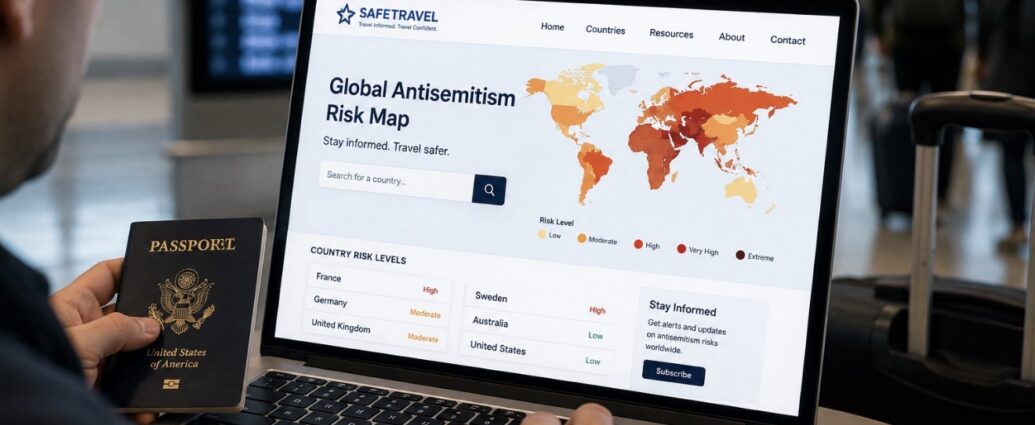
An Israeli developer has built a website that rates countries and cities by how safe they are for Jewish travelers, and hundreds of people are now consulting it daily before booking a vacation. Safe for Jews, a Hebrew and English site created by Shay Yaish, combines artificial intelligence, Israeli government travel advisories and reports submitted by users to generate a risk rating and summary for each destination.
Yaish, 34, left a tech job a year ago intending to start his own venture and came up with the idea while he and his wife searched for somewhere safe for Israelis to visit. He built the site with AI tools, uses AI to keep it updated with news of antisemitic incidents, and checks the output every few days to confirm it looks correct.
How the map reads
The classifications are blunt, and the geography is not what most travel marketing assumes. Among the countries rated safest are the Czech Republic, Albania, Lithuania and Belarus in Eastern Europe; Bolivia, Paraguay and Ecuador in South America; and Japan, Vietnam and Cambodia in the Far East. Nepal, Iceland and Cyprus also rate safe, along with remote destinations including the Marshall Islands, Micronesia, Palau and Tuvalu.
Mainstream destinations fare worse. The United States, Australia and most of Europe carry a “caution” label with a note that Jewish and Israeli symbols should be kept to a minimum. Spain, Canada, the United Kingdom, South Africa and Russia are marked “warning,” advising travelers to stay alert and avoid identifying as Jewish or Israeli. Iran, Afghanistan and Egypt are labeled “dangerous.”
The number of places classified as safe has shrunk over time, the site’s own data shows.
The market underneath
The commercial significance is larger than one founder’s side project. Jewish and Israeli outbound travel is a substantial segment — kosher tour operators, holiday programs, group travel and destination hotels catering to observant travelers add up to a multibillion-dollar business globally, concentrated in a handful of European and Mediterranean destinations that now carry warning labels on this map.
When travelers start screening destinations by perceived safety rather than price or flight time, the effect flows straight to airlines, hotels and local operators. A ratings shift that moves group bookings out of Spain or the U.K. and toward Cyprus, Greece or Eastern Europe reallocates real revenue. Tour operators building programs a year in advance have to price that uncertainty into deposits and cancellation terms.
There is also an insurance angle. Travel insurers underwrite on country risk, and their models are built on political instability, crime and health infrastructure — not on harassment risk for a specific traveler profile. A consumer-facing tool that fills that gap is, functionally, an early version of a risk product no established provider currently sells.
The limits
The site is candid about what it is not. Because it relies on AI and reports scraped from the web, its advisories are not always current or based on rigorous research, and it carries a disclaimer telling users this is not an official rating and that they must do their own research and use judgment.
That matters commercially as much as editorially. A rating that moves booking decisions but carries no methodological audit trail is a liability risk if a traveler relies on it and something goes wrong. Established travel-risk firms sell to corporate clients precisely because their assessments are defensible; a consumer tool built on automated scraping is not in that category, and does not claim to be.
The business model question
Yaish makes no money from the site, which launched a year ago, and hopes to expand it into a hub where Jewish travelers can find Jewish-friendly hotels, kosher restaurants and other resources. That is the obvious path — the ratings draw the audience, and the directory monetizes it through the same booking and referral economics that power the wider travel sector.
Whether the underlying demand persists is not really in question at the moment. “Things are really confusing now for Israelis who want to travel,” Yaish said. A tool built to answer that confusion is a product with a market, and the size of that market is set by conditions no travel startup controls.
JBizNews Desk | New York
© JBizNews.com All Rights Reserved. Reproduction or distribution without written permission is prohibited.