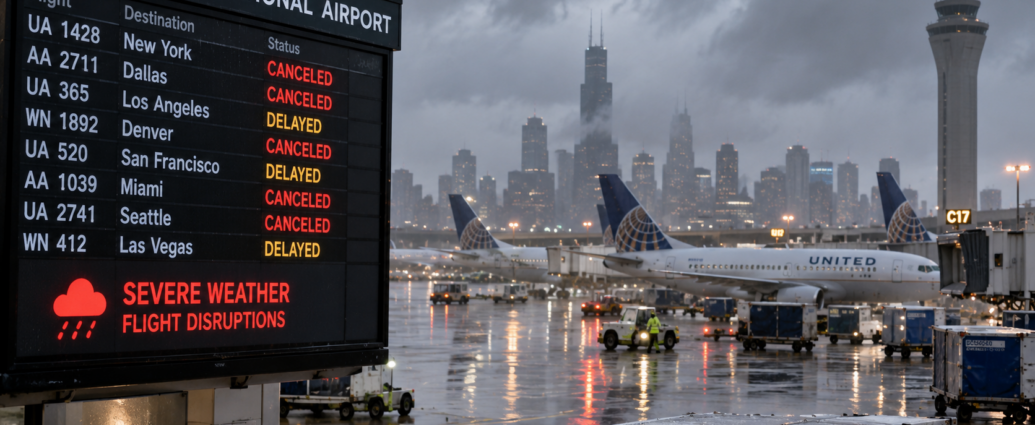
Heavy rain and thunderstorms slammed the Chicago area Saturday, canceling hundreds of flights at the city’s major airports and raising the risk of flooding across northern Illinois as another round of storms threatened to prolong the disruption.
Chicago O’Hare International Airport bore the brunt of the travel problems, with hundreds of flights canceled as storms moved across the region.
By Saturday afternoon, 353 flights had been canceled at O’Hare, while Chicago Midway International Airport recorded another 71 cancellations.
Travelers who did manage to keep their flights faced substantial delays.
The Federal Aviation Administration imposed a ground-delay program at O’Hare, a traffic-management measure designed to keep aircraft at their departure airports when weather or congestion limits how many planes can safely arrive.
The program was scheduled to remain in effect until 10:59 p.m. Saturday.
For travelers far beyond Chicago, the consequences could extend well outside Illinois.
O’Hare is one of the country’s largest connecting hubs, meaning cancellations there can leave aircraft and flight crews out of position and disrupt subsequent flights elsewhere in the airline network.
Flood Threat Extends Beyond the Airports
The same storms disrupting air travel are creating problems on the ground.
The National Weather Service issued a flood watch covering Chicago and numerous communities across northern Illinois as repeated rounds of heavy rain moved through the region.
Forecasters warned that excessive rainfall could produce flash flooding, particularly in areas where drainage systems become overwhelmed or where the ground has already absorbed substantial rainfall.
The threat also extends to rivers.
The National Weather Service warned that heavy rain Saturday combined with additional thunderstorms Saturday night could push portions of the Des Plaines River basin toward flood stage as early as Sunday morning.
Areas being monitored included stretches of the river near Russell, Gurnee, Lincolnshire, Des Plaines and Riverside.
The exact severity remained uncertain because it depended heavily on where the heaviest bands of rain ultimately developed.
Why Repeated Storms Matter
One particularly important factor is how the rain is arriving.
Rather than one continuous period of moderate rainfall, the region has faced multiple rounds of thunderstorms capable of producing heavy downpours.
That can increase flooding risk because soil, drainage systems and waterways have less opportunity to recover between storms.
The National Weather Service warned Saturday that flash flooding caused by excessive rainfall remained possible across portions of north-central and northeast Illinois.
For motorists, even relatively localized flooding can become dangerous quickly.
Water collecting beneath viaducts, on low-lying streets or across roadways can make routes impassable, while moving floodwater can be significantly deeper and stronger than it appears.
Drivers should avoid attempting to cross flooded roads.
Another Difficult Night for Travelers
The immediate concern for airline passengers is that Saturday’s cancellations may not mark the end of the disruption.
Additional thunderstorms and heavy rain were expected Saturday night into Sunday, meaning airlines could face another round of weather-related scheduling problems.
Travelers connecting through Chicago should check their flight directly with their airline before leaving for the airport and continue monitoring it even after an initial departure time has been confirmed.
During major weather events, airlines may also issue travel waivers allowing eligible passengers to change flights without some of the usual penalties or fare restrictions.
Those policies differ by airline and itinerary, making it important for passengers to check the specific waiver covering their ticket.
Passengers whose flights are canceled should also remember that severe weather can affect aircraft and crew positioning. That means a flight scheduled after the rain stops can still be disrupted because the plane or crew needed to operate it may be somewhere else.
Businesses Feel the Disruption Too
The economic effects extend beyond passengers waiting at airport gates.
Chicago is one of America’s most important transportation and logistics centers. Significant disruptions can affect business travelers, cargo movements, hotels, restaurants, ride-share drivers and companies depending on employees or customers traveling through the region.
Flooding can compound those problems by slowing road transportation and preventing workers from reaching businesses even when flights and rail service continue operating.
For local businesses, repeated severe-weather events can mean lost customers, staffing problems and delivery delays — costs that aren’t always visible in the initial reports of canceled flights.
For travelers, the message heading into Sunday is straightforward: don’t assume the itinerary shown when a ticket was booked is still the itinerary that will operate.
Check the airline before heading out, allow additional time for ground transportation and keep an eye on weather alerts if traveling through northern Illinois.
For residents, the concern is increasingly shifting from simply enduring another rainy weekend to how much additional water already saturated communities and waterways can handle.
With more storms possible, Chicago’s travel problems could end before its flooding problems do.
JBizNews Desk | Chicago, Ill.
© JBizNews.com All Rights Reserved. Reproduction or distribution without written permission is prohibited.