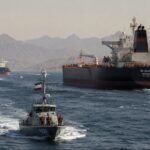
The International Energy Agency reported in its July 2026 Oil Market Report that China pulled roughly 41 million barrels out of its crude inventories during June, one of the largest monthly draws the agency has on record, and that global observed oil stocks rose for the first time in four months as tankers finally cleared the Gulf. Chinese customs data released Tuesday confirmed the other half of the story: crude imports fell to about 6.4 million barrels per day in June, the lowest level in nearly a decade and down roughly 29% from a year earlier.
Put those two numbers together and you get the single most important fact in the oil market right now. The world’s biggest crude buyer stopped buying — and nothing broke.
For four months, traders assumed the closure of the Strait of Hormuz would send prices to records. It did not. Prices spiked, then fell back. Brent averaged $85 a barrel in June, down $22 from May, according to the U.S. Energy Information Administration, and briefly dropped below $70 on July 1, roughly where it sat before the war began on February 28. On Wednesday, with U.S. forces striking Iranian coastal targets and Washington reinstating its naval blockade of Iranian ports, WTI for August delivery traded near $80.14, up about 1%, while September Brent rose to about $85.77.
The reason the ceiling held is sitting in Chinese tanks.
How Beijing built the buffer
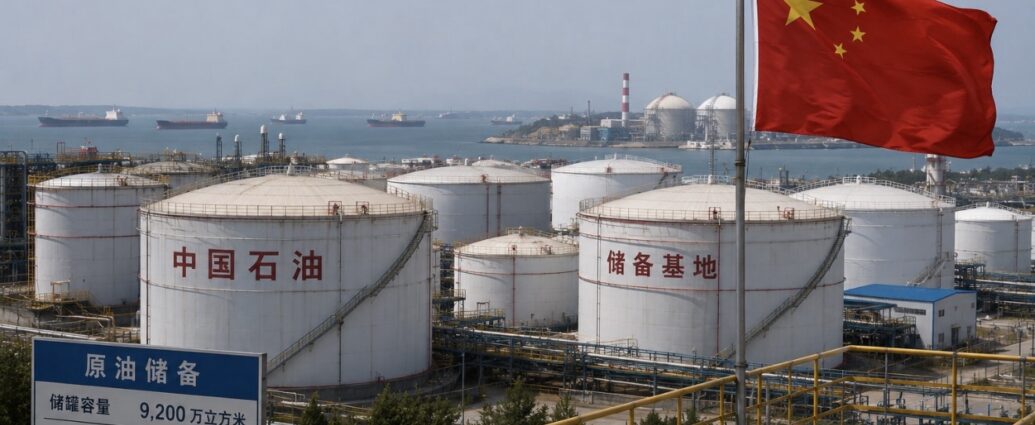
The EIA estimates China spent much of 2025 quietly absorbing roughly 900,000 barrels per day into strategic and commercial storage, buying whenever prices dipped. By the time the war started, analysts estimate the country held somewhere between 1.2 billion and 1.3 billion barrels across commercial tanks and government reserves. The exact figure is a state secret. So are Beijing’s plans for it.
That stockpile turned into a shock absorber. Kpler, the cargo-tracking firm, estimated Chinese seaborne imports fell to about 6.78 million barrels per day in late May, against a 2025 average of 10.66 million. Refinery runs, however, fell far less — roughly 13.1 million barrels per day, down only 1.8 million year over year. The gap came out of storage. Kpler calculated in May that Chinese refiners still held more than 300 million barrels in refinery tanks alone, enough to cover the shortfall for another 60 to 75 days without buying a single extra cargo.
Beijing also protected its government reserves while letting commercial tanks drain. Strategic petroleum reserves grew by 8 million barrels after the conflict began even as refinery inventories fell by 15 million.
What it did to sellers
China’s absence rewrote pricing across Asia. With Chinese refiners out of the bidding, Gulf cargoes went looking for buyers in Europe, India and the rest of Asia. Saudi Aramco cut the price of its flagship Arab Light to Asian customers by $4 a barrel for June-loading cargoes, another $6 for July and a further $11 for August — leaving the grade at a $1.50 discount to the Oman-Dubai benchmark.
Iran got hit hardest. Chinese buyers, suddenly spoiled for choice, walked away from Iranian barrels and took discounted Iraqi, Emirati and Saudi crude instead. Privately owned Shenghong Petrochemical bought roughly 12 million barrels of Gulf crude for July arrival once prices came down. Iranian imports into China are expected to fall to about 556,000 barrels per day in July, the lowest since early 2023, while an estimated 30 million to 34.5 million barrels of Iranian crude float offshore near Southeast Asia waiting for someone to want it.
The IEA said total Gulf oil exports jumped by 6.5 million barrels per day in June to 16.1 million — still far below the 24 million average before the war — with crude and condensate accounting for 85% of the recovery.
The part that matters for business
For decades the answer to “who fixes an oil shock” was Saudi Arabia and its spare production capacity. Traders watched Riyadh. Now they have to watch Chinese tank levels, which nobody publishes.
That changes the risk calculus for anyone who buys fuel — trucking fleets, airlines, chemical makers, manufacturers. The relief in crude prices is not proof the war stopped mattering. It is proof that one buyer chose to sit out, and that buyer’s tanks are finite. Kpler and Vortexa both estimate China has removed about 4 million barrels per day from its normal purchases since late February. When Beijing comes back to restock — and it will — that demand returns to a market that is still short of supply.
The EIA expects global inventories to keep falling by 2.2 million barrels per day in the third quarter. The next rally may not start in Hormuz. It may start the day Chinese refiners pick up the phone.
JBizNews Desk | New York © JBizNews.com All Rights Reserved. Reproduction or distribution without written permission is prohibited.