By JBizNews Desk
June , 2026
Costco’s gas stations have become some of the busiest in America as drivers hunt for savings amid elevated fuel prices. Yet the retailer’s biggest advantage has little to do with oil markets and everything to do with a business model that turns cheap gasoline into customer loyalty.
That may sound strange.
After all, the gas station across the street exists primarily to sell fuel. Costco does not. Yet Costco almost always manages to offer lower prices at the pump than many traditional gas stations.
The reason lies in how the company makes money.
Most gas stations operate on extremely thin fuel margins. The gasoline itself often generates only a small profit. The real money is made inside the convenience store through higher-margin items such as drinks, snacks, coffee, cigarettes, lottery tickets, and prepared foods. Fuel is designed to get customers onto the property, where they hopefully spend more money.
Costco plays an entirely different game.
The warehouse giant’s business model is built around membership fees rather than product markups. Members pay annual fees for the privilege of shopping in Costco warehouses, and those fees have become one of the company’s most important profit drivers.
According to company filings, membership income contributes a substantial share of Costco’s overall profitability each year.
That creates an advantage few retailers can match.
Because Costco earns significant revenue from memberships, it does not need large profits on individual products. The company can afford to keep prices extremely low across many categories while still generating strong overall earnings.
The famous $1.50 hot dog and soda combo is perhaps the best-known example.
For decades, Costco has maintained the same price despite inflation, rising labor costs, and supply-chain disruptions. The purpose is not maximizing profits on hot dogs. The purpose is reinforcing the value of membership.
Gasoline follows the same logic.
Every discounted fill-up reminds customers that their membership is saving them money.
That reinforcement matters because Costco’s most valuable transaction is not a fuel purchase. It is a membership renewal.
The company understands that a member who repeatedly saves money on gasoline is more likely to renew their card year after year.
In that sense, gasoline functions less as a profit center and more as a loyalty program.
Costco also benefits from a scale advantage that smaller competitors simply cannot replicate.
The retailer purchases fuel in enormous volumes and operates high-throughput stations designed to move cars quickly. Most Costco gas stations offer a streamlined setup with limited fuel grades, efficient pump layouts, and minimal staffing requirements.
Unlike traditional gas stations, Costco generally does not maintain large convenience stores attached to its fuel operations.
That means lower overhead costs and faster customer turnover.
The result is a business capable of selling significantly more gallons per location than many independent competitors while maintaining lower operating expenses.
Volume becomes the strategy.
A traditional gas station may need a larger margin on every gallon to cover rent, staffing, maintenance, and convenience-store operations.
Costco can rely on volume and memberships.
The dynamic becomes even more interesting when fuel prices rise.
Most gas stations struggle when prices spike because consumers become more price-sensitive and often reduce discretionary spending. Station owners typically cannot increase margins much without risking customer traffic.
Costco experiences something different.
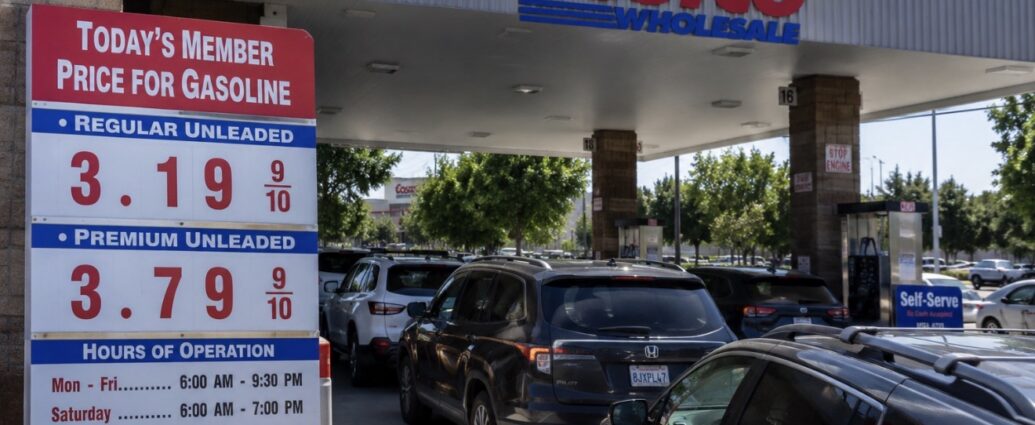
When gasoline prices climb, members often flock to Costco stations specifically because the savings become more visible. Long lines at Costco pumps frequently grow even longer during periods of elevated fuel costs.
That surge in demand reinforces membership value.
Ironically, however, gasoline remains one of Costco’s lowest-margin businesses.
Selling more fuel does not necessarily produce significantly higher profits. In some cases, a larger share of gasoline sales can actually reduce the company’s overall profit margin because fuel earns less than many other products sold inside the warehouse.
But Costco is comfortable with that tradeoff.
The company does not need gasoline to be highly profitable if gasoline strengthens customer retention.
That is why the low prices persist.
Drivers often think they are simply buying cheaper fuel.
Costco sees something larger happening.
Each visit to the pump creates another reason to keep the membership active. Each gallon sold becomes part of a broader relationship between the retailer and the customer.
The fuel purchase is not the final transaction.
It is the beginning of another shopping trip, another warehouse visit, another opportunity to fill a cart, and ultimately another reason to renew a membership.
That perspective explains why Costco continues investing in fuel even though it generates relatively modest margins compared with other parts of the business.
The company is not trying to maximize profit on every gallon.
It is trying to maximize customer loyalty over time.
Cheap gas is not Costco being generous.
It is Costco being patient.
Consumer & Retail — JBizNews Desk
© JBizNews.com All Rights Reserved. Reproduction or distribution without written permission is prohibited.