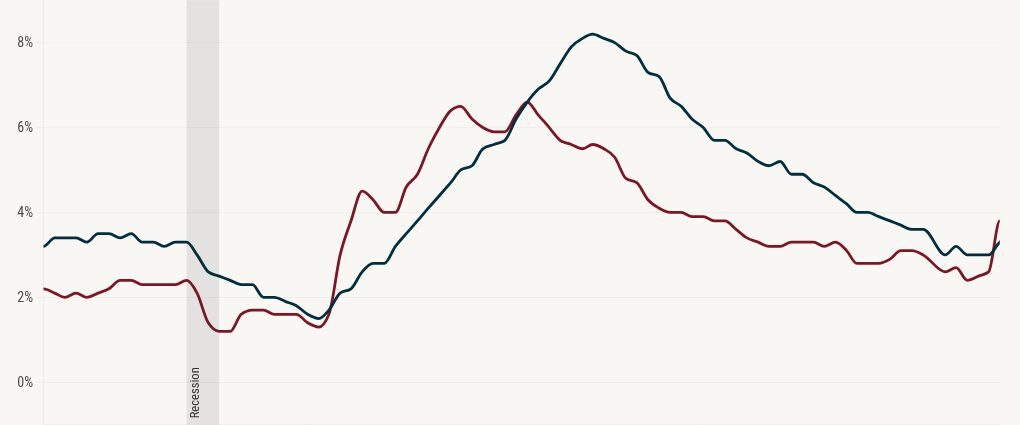
Inflation pulled back slightly in July, according to data released Tuesday by the U.S. Bureau of Labor Statistics.
After falling 0.4% month-over-month in June, the Consumer Price Index for all items was up 0.1% from a month prior in July. However, on a yearly basis, the all items index rose just 3.4% in July, down from a 3.5% annual increase in June.
Month-over-month the shelter index was up 0.1%, which the BLS said attributed to roughly two-thirds of the monthly all items index increase. Both the rent index and the owners’ equivalent rent index was up 0.3% from a month prior. Annually, the shelter index was up 3.2% from a year prior.
According to First American’s senior economist Sam Williamson, the overall decline in inflation may suggest that the recent buildup in price pressures is losing momentum.
“Shelter accounted for about half of July’s monthly increase, but subdued growth in asking rents suggests shelter inflation still has room to cool as those trends work their way into the official inflation data,” Williamson said in a statement.
The all items less food and energy index was up 0.2% month-over-month in July, after remaining unchanged in June. The BLS attributed this increase to increase in the medical care (0.4%), airline fares (2.2%), communication (0.6%), education (0.5%) and recreation (0.2%) indexes.
Year-over-year, the all items less food and energy index was up 2.5%, down from a 2.6% annual jump in June. This is close to the lowest rate of inflation since early 2021.
“That suggests recent price pressures remain relatively contained, with little evidence of a broader acceleration across the economy,” Williamson said.
When broken out the index for food was up 0.1% month-over-month and 3.0% year-over-year. The energy index recorded a monthly decline in July, dropping 1.5% after falling 5.7% in June, as the gasoline index came down 2.9% from a month prior, offsetting a 0.7% monthly increase in the natural gas index and a 0.1% increase in the electricity index. On an annual basis, however, the energy index was up 14.7% in July, largely due to a 24.6% annual increase in the gasoline index, as well as a 4.3% increase in the natural gas index and a 4.2% increase in the electricity index.
“Two relatively soft inflation reports in a row should ease concerns that price pressures were starting to build again after firmer readings earlier this year,” Williamson said. “That gives the Federal Reserve more room to hold the federal funds rate steady at its September meeting, even as some parts of services inflation remain sticky. More broadly, the report reduces some of the inflation risk that had pushed borrowing costs higher in recent months.”
Williamson said that for home buyers, this should mean “a somewhat steadier mortgage-rate outlook” heading into the fall, which he believes may support an increase in market activity.
“Combined with slower house-price growth, rising incomes and more inventory, that gives the housing market more room to rebalance gradually,” he said.