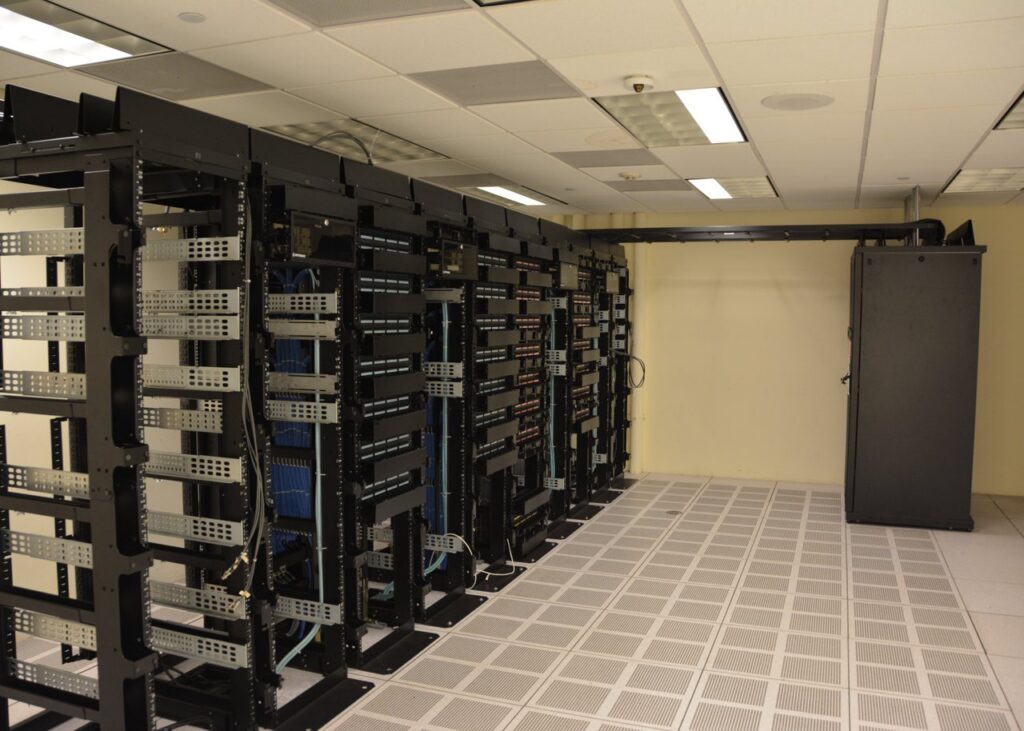
Data-center server racks, November 2015. Archive photo, not an Amazon or Intel facility: Carl Lender / Wikimedia Commons, CC BY 2.0; cropped.
Intel’s nearly 26% premarket plunge Friday and Amazon’s 4.55% decline put two different pressures on the digital economy in view this week: uncertainty about chip demand and supply, and the cash needed to build artificial-intelligence infrastructure.
The companies’ own disclosures do not describe the same problem. Intel reported growing revenue but warned that a PC slowdown would continue into next year. Amazon reported rapid cloud growth and record operating margins, while heavy investment pushed its trailing annual free cash flow deeply negative.
Intel: growth behind it, a weaker revenue quarter ahead
Intel traded at $68.311, down 25.81%, in Nasdaq’s 9:29 a.m. Eastern premarket quote Friday. The move followed its Thursday results and forecast.
In its earnings release, Intel reported third-quarter revenue of $16.5 billion, up 21% from a year earlier. Its fourth-quarter forecast was $15 billion to $16 billion, below the quarter just reported.
Chief Financial Officer David Zinsner said the PC slowdown was expected to continue at least through the first half of next year. Chief Executive Lip-Bu Tan said CPU demand remained robust and identified expanding Xeon supply as an immediate priority.
That combination is more specific than a claim that demand for all chips has collapsed. Intel’s statement describes weakness in PCs alongside a need to increase supply in other parts of its business.
Amazon: cloud growth and a large cash investment
Amazon traded at $232.70, down 4.55%, in Nasdaq’s 9:29 a.m. Eastern premarket quote Friday.
Its third-quarter release showed total sales up 12% to $201.9 billion and Amazon Web Services sales up about 39% to $46 billion. Operating income rose to $28.1 billion, with a 13.9% operating margin that Amazon called its highest ever.
At the same time, free cash flow was a $42.4 billion outflow over the trailing 12 months, compared with a $14.8 billion inflow in the previous comparable period. Amazon attributed the deterioration primarily to a $94.8 billion year-over-year increase in net purchases of property and equipment, principally reflecting AI investment.
Those are trailing annual cash-flow figures, not losses for a single quarter. Amazon continued to forecast approximately $220 billion of cash capital spending for 2026.
What this week’s disclosures establish
The shared market result Friday morning was falling share prices. The company evidence underneath it was mixed: revenue and operating growth alongside supply constraints, uneven demand and large capital requirements.
The releases do not prove that AI investment is failing, that all digital businesses face the same conditions or that one figure alone explains the selloff. They show why operating profit, revenue growth and cash flow need to be read separately.
The share prices above are separate timestamped premarket snapshots, not weekly returns or a forecast for the regular trading session.
JBizNews Markets Desk | NEWS ANALYSIS
© JBizNews.com. All rights reserved. Unauthorized reproduction or redistribution is strictly prohibited.