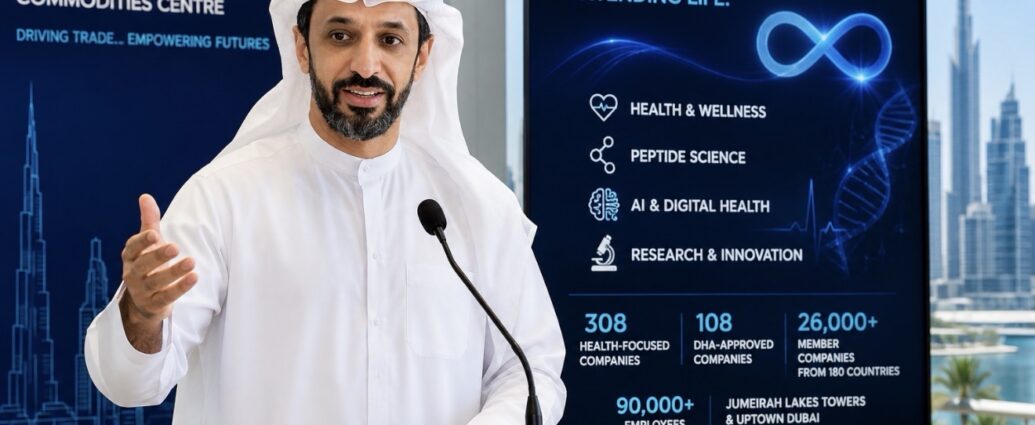
Dubai’s largest free zone is planting a flag in one of the fastest-growing corners of the global health economy. DMCC, the Dubai Multi Commodities Centre, said on Monday that it has formalised a new DMCC Longevity Centre, with Executive Chairman and CEO Ahmed Bin Sulayem unveiling the move in a post on LinkedIn. The step converts a loose cluster of health businesses already operating inside the zone into a structured, commercially defined sector. It builds directly on Law No. (17) of 2026, issued on Wednesday, June 10, by Sheikh Mohammed bin Rashid Al Maktoum, Vice President and Prime Minister of the UAE and Ruler of Dubai, which created the Dubai Longevity Authority and elevated health, wellness and longevity to a strategic economic pillar for the emirate.
The raw material was already there. By DMCC’s own count, the zone hosts 308 health-focused companies, 108 of them approved by the Dubai Health Authority, alongside a broad mix of physical and mental wellbeing centres. The free zone has run regular blood drives, partnered with the wellness firm Nook, and backed causes including the Al Jalila Foundation. What it lacked, Bin Sulayem said, was the formal structure to turn that critical mass into a coherent sector that investors and operators could read clearly.
DMCC’s pitch leans on assets most health hubs cannot match. The plan is to fuse the zone’s commodity-trading backbone, its growing artificial-intelligence and gaming ecosystems, and the carefully regulated arrival of peptide science in the region. The stated aim is to draw the world’s leading peptide businesses and health-related AI services, while positioning DMCC as a trusted bridge between East and West. In an op-ed published in Gulf Business, Bin Sulayem framed the longevity push as less about simply living longer and more about building the systems, institutions and communities that sustain human performance at every level.
The scale behind the announcement is significant. DMCC is regularly ranked the world’s number-one free zone and now counts more than 26,000 member companies from 180 countries, employing over 90,000 people across its Jumeirah Lakes Towers district and the newer Uptown Dubai development. Bin Sulayem has led the centre since 2006, expanding it from a small commodities zone into a sprawling business district spanning trade, logistics, finance and digital assets. Layering a regulated longevity vertical onto that base gives the centre an immediate tenant pipeline that most rivals would need years to assemble.
The wider government framework gives the effort regulatory teeth. Under Decree No. (14) of 2026, Sheikh Hamdan bin Mohammed bin Rashid Al Maktoum, Crown Prince of Dubai and Chairman of the Executive Council, will serve as President of the Dubai Longevity Authority. Helal Saeed Almarri, Director General of the Dubai Department of Economy and Tourism, was named Chairman.
Almarri called longevity and advanced health one of the world’s fastest-growing economic frontiers. He said the authority would offer regulatory certainty across the entire value chain, from research and clinical trials through manufacturing, delivery and patient care. Officials describe what they are building as a sovereign market for advanced therapeutic products, designed to attract investment, industrial capability and specialised talent.
That certainty matters because the underlying market is already moving fast, sometimes ahead of the rules. Peptide therapy clinics have multiplied across Dubai, marketing treatments for recovery, metabolic health and anti-aging, often at prices starting in the high hundreds of dirhams. Much of that activity has run on thin clinical evidence and uneven oversight.
By licensing the full chain, from laboratories to clinics, the new authority is betting that clear standards will pull serious operators and capital into the regulated market rather than the grey one. The Dubai Longevity Authority will coordinate with the Dubai Health Authority, Dubai Health, Dubai Municipality and the Dubai Future Foundation, and says it will hold the sector to international standards.
For Dubai, the economic logic ties directly into the Dubai Economic Agenda D33 and the Dubai Social Agenda 33, which together aim to place the emirate among the world’s top three cities for quality of life. Longevity, wellness and advanced healthcare are treated not as social spending but as an export-grade industry capable of drawing foreign companies, clinical-trial work, manufacturing and high-skill jobs. The emirate has used the same playbook before, standing up dedicated authorities for space, artificial intelligence and virtual assets ahead of most other jurisdictions, then watching companies cluster around the regulatory clarity.
The open questions now are commercial. DMCC will have to prove it can attract genuine peptide and health-AI innovators rather than repackaged wellness brands, and the new authority will have to show its rules can move as quickly as the science. But with a national framework in place, a ready base of 308 companies, and a free zone built to court global capital, Dubai has made its intent unmistakable: it wants to own the business of living longer.
JBizNews Desk
© JBizNews.com All Rights Reserved. Reproduction or distribution without written permission is prohibited.