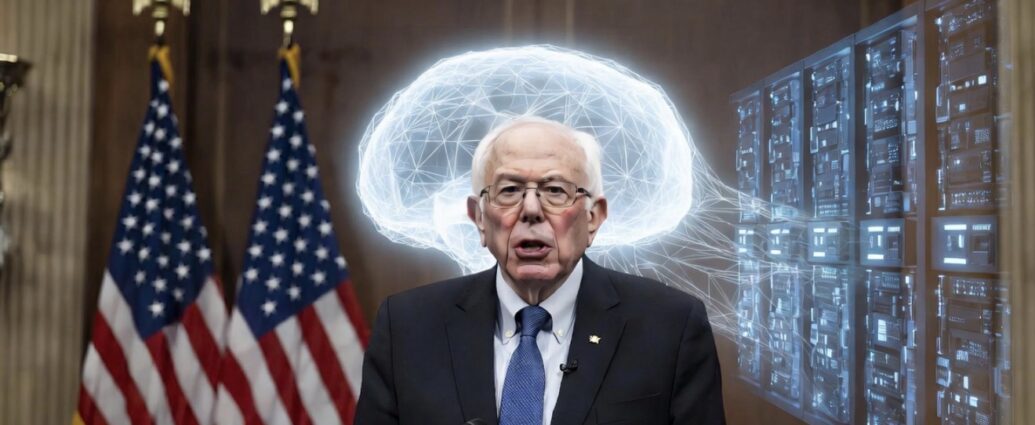
Sen. Bernie Sanders introduced legislation on Thursday that would hand the federal government a 50% ownership stake in the country’s largest artificial intelligence companies and use the returns to send every American a yearly check of more than $1,000. The Vermont independent’s office said the bill, called the American AI Sovereign Wealth Fund Act, would create a national fund worth an estimated $7 trillion at today’s company valuations.
The idea is straightforward, even if the numbers are enormous. The biggest AI firms — defined in the bill as those earning at least $200 million a year in revenue — would pay a one-time tax equal to 50% of their stock. That stock would be placed into a new government fund instead of being sold off. Each year, the fund would pay out 5% of its value. Divided among the U.S. population, Sanders estimates that works out to a starting payment of more than $1,000 per person.
Money generated beyond the annual checks would be steered toward health care, education and housing, according to a summary released by his office. The fund would not be allowed to sell the stocks it holds, and a separate provision would bar the money from ever being used to bail out an AI company.
Sanders pitched the plan as a way to stop a small group of technology billionaires from controlling a technology he says was built on the work of millions of ordinary people. Left unchecked, he argued, AI and robotics threaten the jobs, privacy and mental health of Americans. He pushed back on the notion that he opposes the technology itself. “I’m not a Luddite,” he told reporters, adding that the goal is to make AI work for regular people rather than for Elon Musk and other billionaires.
To run the fund, the bill would set up an Independent Commission for Democratic AI — seven members nominated by the President and confirmed by the Senate, chosen from a bipartisan list supplied by Congress. The commission would hold voting shares in the AI companies and could use them to block business decisions it considers harmful to the public. The legislation would also force large firms that run both AI and non-AI operations to split those businesses apart, so the public’s stake would sit only in the AI side.
There is one large practical problem, and Sanders acknowledged it directly. Many of the most valuable AI companies, including OpenAI and Anthropic, are not currently profitable, which means the dividends meant to fund those $1,000 checks may not materialize right away. Asked what happens if the companies keep posting losses, he said the public would not be exposed to the downside. The American people will not lose money, he argued, because the government would own the stock outright rather than buying it.
The proposal has already drawn responses from inside the industry. Sanders said he spoke with OpenAI chief executive Sam Altman, who agreed in principle that the public should hold equity in AI companies but would not back a 50% stake. Sanders described the conversation as a good discussion and called Altman a good politician, while insisting the interests of AI companies and everyday Americans are not aligned today. He also complained that the firms can spend heavily to defeat candidates who push for regulation.
The broader concept is not confined to the political left. President Donald Trump said earlier this month that his administration was studying ways for the public to take stakes in AI companies and share in their growth. David Sacks, who stepped down as the White House’s AI and crypto czar in March and now co-chairs the President’s Council of Advisors on Science and Technology, said on a widely followed technology podcast that he opposes Sanders’s specific blueprint but is sympathetic to the underlying goal and could support voluntary versions of public ownership.
Sanders noted that the structure is not new. More than 100 sovereign wealth funds operate around the world — from Norway’s oil fund to Alaska’s, which pays residents an annual dividend — sharing public wealth with ordinary citizens. The principle, he said, is simple: when a public resource creates wealth, the public should share in it.
For now, the bill faces long odds. It has not yet been assigned a number, and Sanders said he has not spoken with the White House about it, though he is talking with other senators and senses growing cross-party concern about AI’s effects. Whether the measure advances or not, it sharpens a debate that is moving from Silicon Valley boardrooms into Congress: who should own the value that AI creates, and who should get paid when it does.
JBizNews Desk
© JBizNews.com All Rights Reserved. Reproduction or distribution without written permission is prohibited.