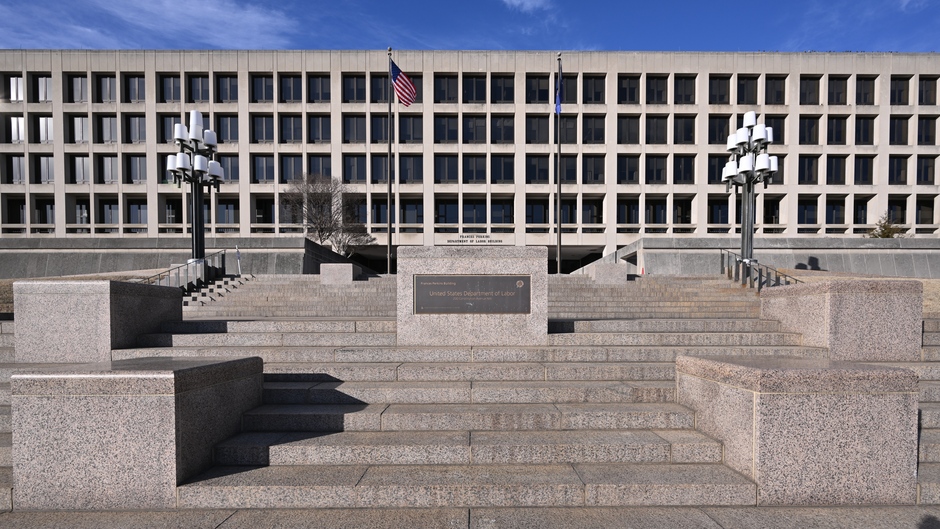
FILE: The Frances Perkins Building, headquarters of the U.S. Department of Labor, in Washington, D.C. Photo: G. Edward Johnson / Wikimedia Commons, ‘Front of the Department of Labor, Washington, D.C.’, CC BY 4.0; cropped and resized.
A business owner reading Thursday’s unemployment-benefit report could find a reason to worry and a reason to relax. Neither is a good enough reason to change a hiring plan on its own.
The Labor Department reported 200,000 initial claims for the week ended November 7, up 9,000 from the previous week’s revised figure. Continuing claims for the week ended October 31 fell by 20,000 to 1,697,000. These figures are seasonally adjusted. The four-week average of initial claims was unchanged at 195,250.
Those numbers deserve attention. They do not deserve more certainty than they can provide.
Initial claims are new applications for benefits. Continuing claims are ongoing claims. They are not a count of every unemployed American, and a fall in ongoing claims does not, by itself, prove that everyone who left the rolls found work.
That distinction matters when a national headline reaches a local payroll.
A distributor deciding whether to add a driver needs to know whether deliveries justify another route. A store considering another employee needs to know whether customer demand can support the wages. The claims report offers background for those decisions. It cannot answer them.
The sensible response to Thursday’s mixed figures is neither a hiring freeze nor a rush to expand. It is a closer look at the evidence inside the business: orders, repeat customers, overtime, cash available for payroll and work that is being turned away because there are not enough people to do it.
If demand is there and the business can afford the position, one weekly increase in claims should not automatically stop a hire. If demand is weakening, a decline in continuing claims should not become an excuse to ignore it.
The report also offers a useful lesson about revisions. Last week’s initial-claims figure was raised from 189,000 to 191,000. That is not a reason to dismiss government data. It is a reason to treat the first reading as a measurement that can improve, rather than a final verdict.
The four-week average helps put a single week’s movement in context. In this release, it did not rise. That does not prove the job market is strong everywhere. It does mean the weekly increase should not be presented as though it already establishes a lasting trend.
Workers deserve the same care. Behind an application for benefits is a household dealing with an interruption in income. A modest national change can still mean a difficult week for a family. Careful reporting should leave room for that reality without turning one release into a declaration that the whole economy is failing.
The best use of this report is to ask better questions, not to borrow a ready-made answer. Watch the next releases. Compare them with what customers are doing. Keep enough room in the budget to handle a setback.
A payroll is a commitment to people and to the future of a business. It should rest on more than one Thursday morning number.
© JBizNews.com. All rights reserved. Unauthorized reproduction or redistribution is strictly prohibited.