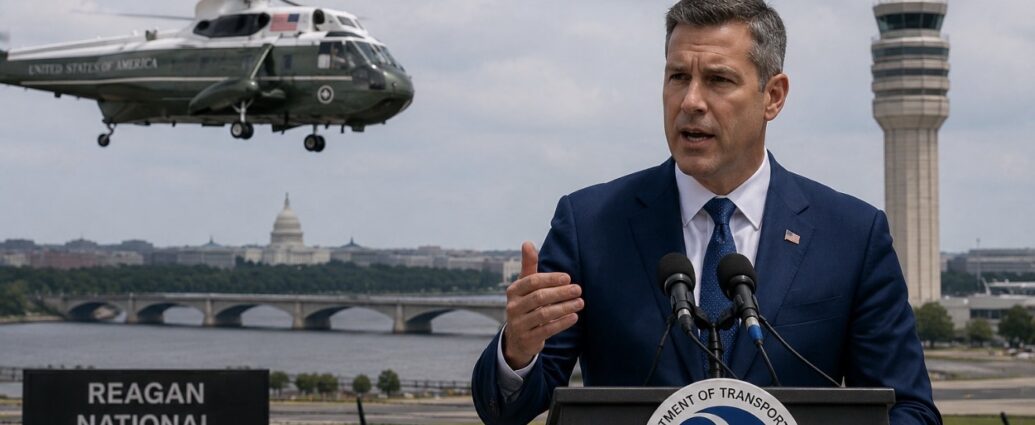
The presidential helicopter and a departing airliner ended up too close to each other last week because the two teams responsible for keeping them apart could not reliably talk to one another. That is the finding Transportation Secretary Sean Duffy disclosed Tuesday, Aug. 11: a communications breakdown between the Marine One team and the Federal Aviation Administration at the staff level, which he said has now been escalated and is being worked on jointly with the FAA and the White House.
The incident happened on the afternoon of Aug. 4, when Marine One lifted off from the Ellipse near the White House carrying President Trump toward Joint Base Andrews and required separation minimums with a commercial regional jet departing Ronald Reagan Washington National Airport were compromised. The airliner was an American Eagle flight operated by Envoy Air. Both aircraft continued to their destinations without further incident. Controllers sent a second arriving regional flight into a go-around about three miles out until the airspace cleared.
Duffy spoke at Newark Liberty International Airport alongside FAA Administrator Bryan Bedford, where the two were marking the opening of a new surface movement radar system. He said investigators had found some telecom issues between the Marine One team and the FAA, that the matter had been elevated, and that he and Bedford are working with the president’s Marine One team on a fix. He added that the flight paths were not converging and that the president was never in any danger.
What Duffy did not say is which communications system failed, what caused the failure, or when the repair will be in place — the details that determine whether this was a one-off or a standing gap in how military and civilian air traffic coordinate over Washington.
The core question under investigation is a procedural one. Commercial departures at Reagan National are supposed to be held while the presidential helicopter is moving through the adjacent corridor, and the jet was cleared to go anyway. Federal rules generally require 1.5 miles of horizontal separation and 500 feet of vertical separation between aircraft in controlled airport airspace, and preliminary tracking data indicates the two came closer than that as the airliner climbed past the helicopter’s altitude. The FAA and the National Transportation Safety Board are both reviewing the event.
The reason this lands hard is the history. In January 2025, a collision between a military helicopter and a commercial jet near the same airport killed 67 people, after which the FAA barred mixed helicopter and jet traffic around Reagan National. Duffy said Tuesday that the prohibition on cross traffic stands, with exceptions only for presidential, law enforcement and first responder movements — and that even in those cases the airspace is shut down rather than shared.
For the airlines, Reagan National is not a marginal piece of the map. It is a major American Airlines hub with heavily constrained slots, a short runway configuration, and a departure corridor that runs directly alongside the most restricted airspace in the country. Every helicopter movement that triggers a ground hold ripples through the day’s schedule, and every incident like this one raises pressure for more holds. The operational cost of the safety fix falls on carriers in delayed departures and missed connections, which is why the industry wants the underlying coordination problem solved rather than papered over with broader stoppages.
The Newark setting was not incidental. The surface movement radar Duffy and Bedford were there to open is part of the FAA’s push to modernize equipment at congested airports after a run of communications outages and near misses, including the telecom failures that disrupted Newark’s operations. The department has been pairing hardware upgrades with an effort to hire and retain more controllers, and Duffy has repeatedly framed near misses as leading indicators rather than isolated events.
The fix now on the table is narrower and more specific: a working communications link between the military unit that flies the president and the civilian controllers who manage the traffic around him. Until the department names the system and the timeline, the assurance that the airspace is shut down during presidential movements rests on the same coordination that failed on Aug. 4.
JBizNews Desk | Washington
© JBizNews.com All Rights Reserved. Reproduction or distribution without written permission is prohibited.