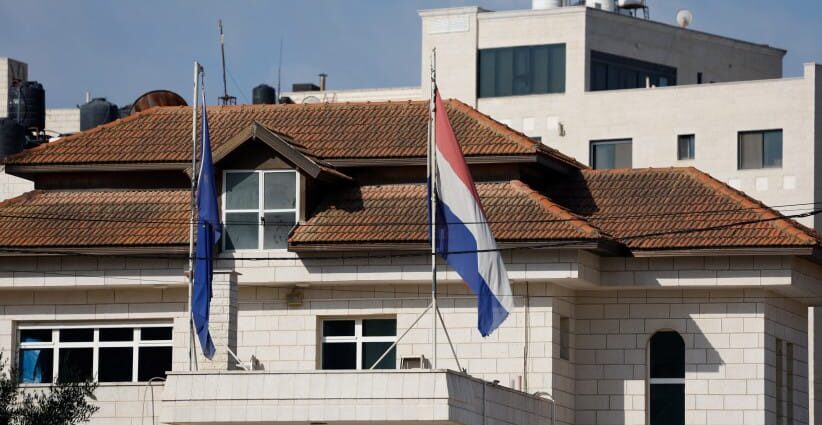
The Foreign Ministry has warned Israelis planning to travel to the Netherlands that they may encounter “lengthy and invasive” luggage inspections following the sweeping implementation of new Dutch sanctions on Israeli goods imports.
The Foreign Ministry and the Israeli Embassy in The Hague said they are monitoring the situation and will update the public as developments unfold.
The ban took effect on September 22, 2026, and covers all Jewish-made goods originating in the West Bank, east Jerusalem, and the Golan Heights. The prohibition additionally applies to goods that are only partially made or produced in the settlements (i.e., if one ingredient is from the area, even if the product was predominantly made in, say, Tel Aviv).
The Jerusalem Post spoke on Monday to a passenger on a Friday flight from Tel Aviv to Schiphol who reported being stopped and her luggage checked.
The woman, who has resided in the Netherlands for 20 years and speaks Dutch, said she was stopped at passport control by two people who asked which flight she had arrived on. Then, after collecting her luggage, she was stopped by a larger group of officials who again asked where she had come from and who searched her case, briefly inspecting items including face cream.
She said the officer who searched her was friendly and spoke Dutch with her, and that she personally did not feel intimidated or concerned but recognized why other passengers may have found the checks intimidating, and said she understood why Israeli officials were taking the issue seriously.
Only 15 Israeli passengers have been stopped
It is important to note that reports (especially Israeli media ones) that all passengers from Israel are being stopped are not correct. The Central Jewish Consultation put out a statement saying that, based on its information, only fifteen travelers were checked on Friday’s flight, and there are “no indications that travelers from Israel are systematically subjected to extra checks at Schiphol.”
The CJO nevertheless continues to oppose the sanction decision, arguing that the measures directly affect Jewish life in the Netherlands, in the connection with family, friends and communities in Israel.
Oscar van Elferen, the spokesperson for Dutch Customs, told the Post Monday that Dutch Customs carries out baggage inspections at various airports in the Netherlands, and that since 22 September, the Israel sanctions measure has become part of these activities.
“Customs determines what and when to inspect based on risk analysis and random checks. We cannot and do not need to inspect every flight. Enforcement of this sanctions measure is no different in that respect,” he said.
Responding to a question about whether Customs will search the bags of passengers who are only transiting the Netherlands on their way to a third country, van Elferen said these passengers would not be checked as “the sanctions measure is intended to prevent certain goods from being imported into the Netherlands or placed on the Dutch market, and that is not the case in this scenario.”
However, he said this “does not exclude the possibility that Customs may carry out an inspection for other reasons,” as Customs enforces many regulations beyond sanctions measures, such as controls on narcotics or products that do not meet European safety standards.
When asked whether it is just Jewish passengers from Tel Aviv to the Netherlands who are being checked, van Elferen said “customs never conducts inspections on the basis of personal characteristics such as religion or nationality.”
He, however, declined to comment on whether there are religious exemptions to the import ban (such as for kosher products or religious art like a ketubah), referring to the Post to the Foreign Ministry. The Ministry referred the Post back to Customs, and so there was no conclusion to this question.
Sa’ar revokes credentials of Dutch diplomats in Ramallah
Israel has already taken responsive measures, with Foreign Minister Gideon Sa’ar revoking the credentials of all Dutch diplomats operating at the Netherlands Representative Office in Ramallah on Sunday.
Sa’ar ordered all of the diplomats to return their documentation to Israel within seven days of the announcement, at which time diplomatic immunities and rights granted by Israel will expire.
“If the Netherlands wishes to continue representing its interests vis-à-vis the Palestinians, it may do so from the territory of the Palestinian Authority and not from the territory of the State of Israel,” Sa’ar stated.
The Israel Product Center (IPC) is a shop and web-shop located in Nijkerk, the Netherlands, run by the Dutch Christian evangelical organization Christians for Israel. It has historically imported and sold many products such as wine, cosmetics, and food items from Israeli settlements in the West Bank and the Golan Heights.
“The ban has, of course, affected our work, because we’re not allowed anymore to sell those products. So as per the 22nd of September, since it’s illegal to sell them, we don’t have them in our shop anymore,” IPC told the Post on Monday.
Prior to the ban, IPC’s inventory consisted of about 15-20% products made in the settlements.
IPC did file a lawsuit against the state, but the judge threw the case out last week. IPC is planning to appeal, but the process may take a few months
The main ground for the suit was IPC’s argument that trade policy falls primarily under the EU’s exclusive competence and that the Dutch government therefore lacked the authority to impose its own import ban. They also argued that the measure could fragment the EU’s internal market by diverting trade through other member states.
The second ground for the suit was that IPC said the ban is “symbolic” but in practice will affect Palestinians.
“In practice, there are not many organizations that are importing these products specifically from the West Bank or Golan or east Jerusalem, so we think that the impact of the sanctions is on the Palestinians working in those factories.”
“Most of the people working in [settlement] factories are actually Palestinians who have a very good salary, mostly higher than the other Palestinians there. It’s also a very good example where coexistence and cooperation is going on. So that’s why we think these kinds of politically motivated acts are counterproductive.”
IPC also called out the unique targeting of Israel.
“Israel is being measured with double standards. Nobody is talking to China about what’s going on in Tibet or what they are doing to the Uyghurs, with the concentration camps. And nobody’s talking to Turkey about Northern Cyprus. But suddenly Israel is the greatest offender in the whole world. It’s a matter of double standards.”
Nevertheless, IPC also wanted to convey a positive story. When the planned bans were announced earlier in the year, IPC realized it had a lot of stock in the warehouse that could only be sold for a few more months. In fact, it had enough stock for two years.
“All our customers were very angry about the trade ban that was being imposed, and in one month, they bought 90% of the whole two-year stock from the Judea and Samaria, which is really amazing.”