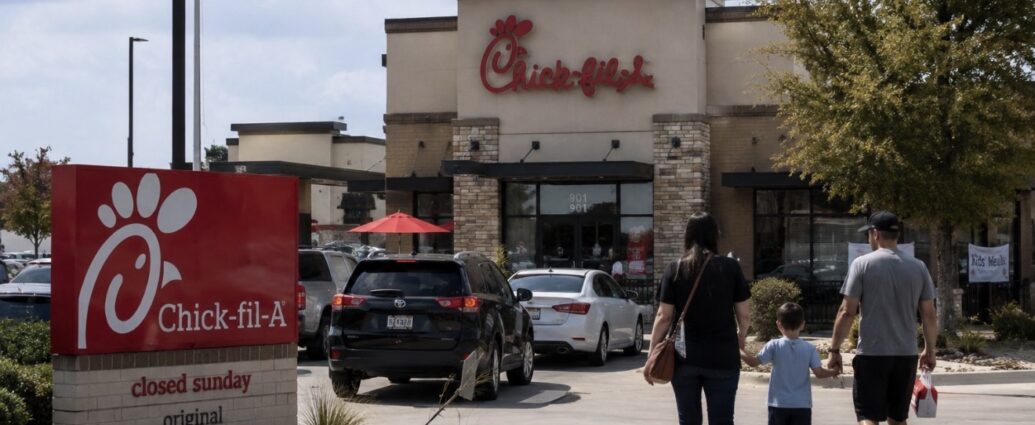
The U.S. Equal Employment Opportunity Commission filed a federal religious-discrimination lawsuit Thursday against a multi-store Chick-fil-A franchise operator in Austin, accusing the company of firing a manager who asked for Saturdays off to observe her Christian sabbath — a striking 2026 enforcement action against an operator of a brand long synonymous with corporate religious observance, and the latest case in a wave of religious-bias lawsuits driven by EEOC Chair Andrea R. Lucas since the start of the Trump administration.
The lawsuit, EEOC v. Hatch Trick, Inc., Case No. 1:26-cv-01275, was filed in the U.S. District Court for the Western District of Texas, Austin Division. Hatch Trick operates multiple Chick-fil-A locations in the Austin area. According to the EEOC’s complaint, the employee — who managed delivery drivers at one of the locations — is a member of the United Church of God denomination, which observes a Saturday sabbath. She disclosed her religious observance during her job interview, and Hatch Trick initially honored her request to keep Saturdays off before management began scheduling her for Saturday hours.
When the employee met with company officials and proposed alternatives that would have kept her in her managerial role while observing her sabbath, Hatch Trick rejected the proposals and instead told her she could keep her religious accommodation only if she accepted a non-managerial delivery-driver position with lower pay, fewer benefits and reduced hours, the agency alleged. When she declined, the company fired her. The EEOC said it sued after pre-suit conciliation failed to produce a settlement.
“The duty under federal law to provide reasonable accommodation of religion reflects an acknowledgement by our society of the importance of faith in workers’ everyday lives and an abiding respect for those who observe religious practices as an expression of that faith,” Ronald L. Phillips, acting EEOC Dallas Regional Attorney, said in a statement Thursday. “Just as adherence to the dictates of one’s own conscience is not optional, so too an employer’s duty under Title VII is obligatory, and the EEOC stands ready to enforce that legal duty.”
The case is the latest in a sharp 2025-2026 ramp-up of religious-discrimination enforcement by the agency under Chair Andrea R. Lucas, who served as acting chair from January 2025 before being elevated to chair by President Donald Trump in November of last year and confirmed by the Senate to a second term ending in 2030. The EEOC in April said it had filed 16 religious-discrimination lawsuits and recovered more than $63 million on behalf of religious workers since January 2025. Recoveries for religious workers totaled more than $48 million in fiscal 2025 alone, a 146% increase from the prior year, the agency said.
“Religious liberty is a first freedom, not a second-class right,” Lucas said last month as the Trump administration released a report on what it called anti-Christian bias. Lucas, a conservative Christian and a former labor and employment attorney at Gibson, Dunn & Crutcher, has said religious discrimination was under-prosecuted during the Biden administration, and has positioned the issue alongside what she calls evenhanded enforcement of civil rights laws targeting DEI-related discrimination, anti-American national-origin bias, and antisemitic harassment. Under Lucas, the agency last year obtained what she has called the largest EEOC settlement to date for victims of antisemitism on behalf of Jewish employees at Columbia University.
The agency has also sued employers over Covid-19 vaccine mandates that, in the EEOC’s view, failed to provide accommodations for workers with religious objections. Lucas previously served on a Trump task force created to study anti-Christian bias in the federal government, and was elevated to the chair role after Brittany Panuccio was confirmed as a second Republican commissioner last fall, restoring the agency’s quorum and clearing the way for a more aggressive enforcement agenda.
For Chick-fil-A, the case is uncomfortable. The Atlanta-based chain has built much of its brand around the legacy of founder S. Truett Cathy, who opened the first restaurant in Hapeville, Georgia in 1946 and gave employees Sundays off so they could “rest, enjoy time with their families and loved ones or worship if they choose,” according to the company’s website. Eighty years later, the EEOC lawsuit underscores that Title VII obligations attach to franchisees regardless of the parent brand’s posture — and that the Civil Rights Act of 1964 requires reasonable accommodation for all sincerely held religious beliefs, including those observed on days other than Sunday. Chick-fil-A corporate is not named in the suit; franchisees are independent operators.
Religious-accommodation case law has been moving in employees’ favor. In Groff v. DeJoy (2023), a unanimous U.S. Supreme Court raised the bar an employer must clear to claim that accommodating a worker’s religious practice would impose an “undue hardship,” requiring proof of substantial increased costs rather than the previous low threshold of more than a “de minimis” burden. The EEOC under Lucas has cited the decision in pressing employers to revisit scheduling and accommodation policies.
The case is likely to be closely watched across the quick-service restaurant industry, which leans heavily on franchise structures and tightly scheduled hourly shifts. Peers including McDonald’s, Yum Brands’ KFC, and Restaurant Brands International’s Popeyes face similar exposure when individual franchisees handle scheduling and religious accommodation requests on their own.
The agency is seeking back pay, lost benefits, compensatory and punitive damages, and a court order requiring Hatch Trick to provide religious accommodations going forward. The message from the EEOC to small-business operators is direct: religious accommodation is not optional, and Title VII obligations run to every employee’s sincerely held belief regardless of the day on which it is observed.
JBizNews Desk
© JBizNews.com. All rights reserved. This article is original reporting by JBizNews Desk. Unauthorized reproduction or redistribution is strictly prohibited.