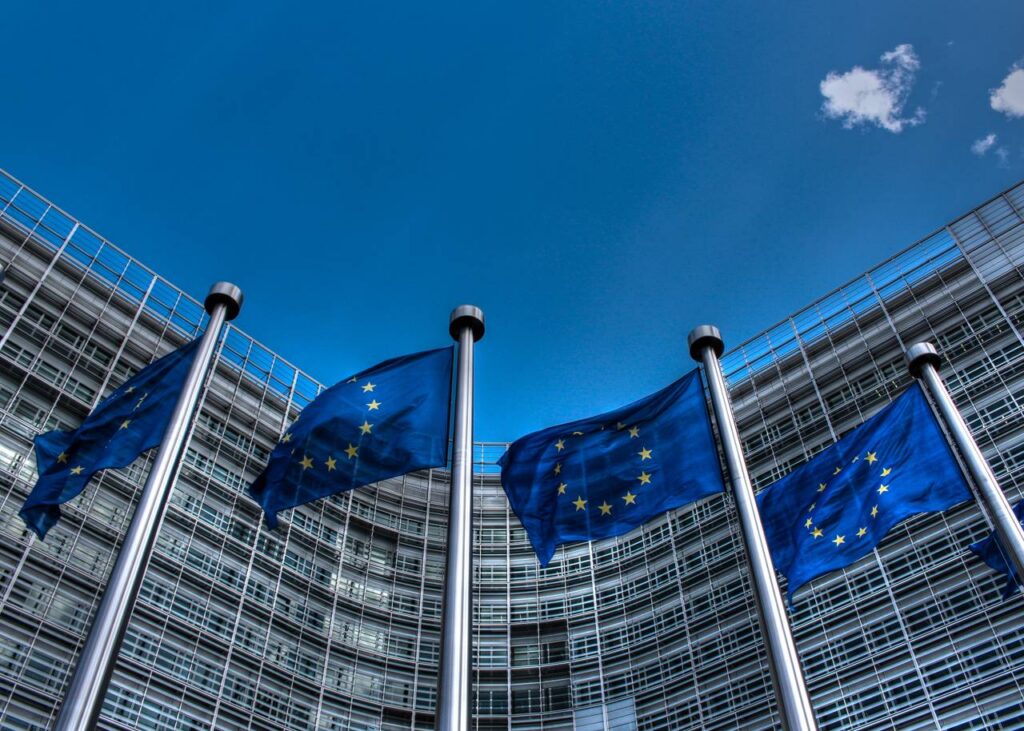
European Union flags outside the Berlaymont building in Brussels, May 2014. Archive photo: Thijs ter Haar / Wikimedia Commons, CC BY 2.0. Cropped.
The euro area’s economy grew 0.4% in the third quarter, slowing from the previous quarter but maintaining an expansion despite a contraction in France, according to Eurostat’s preliminary flash estimate released Friday.
Gross domestic product in the 21-country currency bloc rose by 0.4% from the second quarter after increasing 0.6% in the April-June period. Across the wider 27-country European Union, growth slowed to 0.5% from 0.7%, the EU statistics agency said in its official release.
Compared with a year earlier, euro-area GDP increased 1.3%, up from 1.2% in the second quarter. The EU’s annual growth rate rose to 1.5% from 1.4%. The figures are seasonally adjusted and measure changes in output volumes, rather than nominal growth inflated by prices.
Germany grows while France contracts
Germany’s economy expanded 0.2% from the previous quarter, following growth of 0.3% in the second quarter. Spain grew 0.6%, down from 0.7%, while Italy was flat after expanding 0.2%.
France’s output fell 0.1% after no growth in the second quarter. Lithuania recorded a 1% quarterly decline, the largest contraction among the countries with figures available in the release.
Outside Ireland, Estonia, Spain and the Netherlands shared the strongest quarterly growth rate among the reporting countries, each at 0.6%. Belgium expanded 0.3%, while Austria grew 0.2%, reversing a 0.1% decline in the previous quarter.
Irish estimate comes with a warning
Ireland recorded the biggest quarterly increase, at 5.5%, after 10.2% growth in the second quarter. Eurostat flagged the Irish preliminary estimate as experimental and urged particular care in interpreting it.
The Irish estimate relies predominantly on output data and incomplete sources. It will be revised as expenditure-side information is incorporated, the agency said. The release does not provide a breakdown of how much each country’s performance contributed to the euro-area growth rate.
Early figures remain open to revision
The preliminary estimate is based on data from 19 EU member states, covering 96% of euro-area GDP and 94% of EU GDP. Eurostat stressed that the underlying data sources are incomplete and that the numbers can change as more information becomes available.
The agency did not revise earlier euro-area or EU quarters in this release. Its next third-quarter estimates are scheduled for November 13, with further regular estimates to follow on December 7 and January 19.
The figures show a slower quarterly expansion alongside slightly stronger year-on-year growth, leaving the euro area on a growth path after output stagnated in the first quarter.
JBizNews Business Desk | BRUSSELS
© JBizNews.com. All rights reserved. Unauthorized reproduction or redistribution is strictly prohibited.