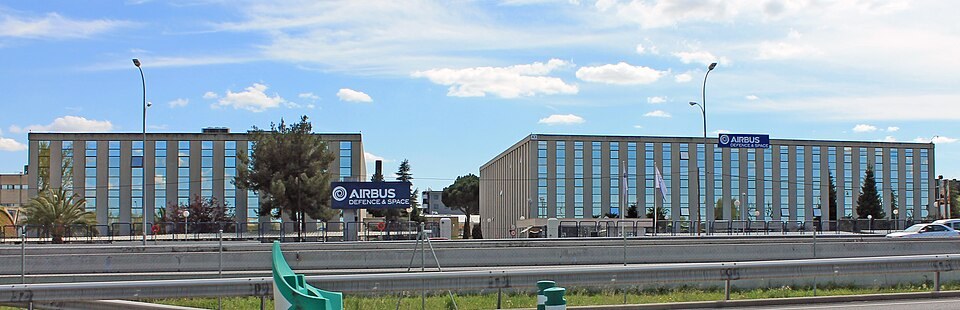
Airbus Defence and Space offices in Madrid in an April 2016 file photo. Photo: Luis García / Wikimedia Commons / CC BY-SA 3.0 ES. Resized.
The European Space Agency said Tuesday it has ordered four more next-generation Galileo navigation satellites, expanding the planned fleet to 16 as Europe invests in a system used by smartphones, transport operators and financial timing services.
Airbus Defence and Space and Thales Alenia Space will each build two additional satellites. Both companies were already under contract to supply six apiece. The new spacecraft are scheduled for delivery in 2031 and launch shortly afterward, ESA said.
The orders extend an industrial programme rather than put new satellites into service immediately. ESA said the first launch of Galileo’s second generation is planned for 2028, following integration and flight testing of the first spacecraft in 2027.
A navigation upgrade with a long delivery chain
Galileo supplies positioning, navigation and precise timing. ESA says the system has served billions of users since its Open Service began in 2016 and is used in rail, shipping, agriculture, financial timing and rescue operations. For those users, the new contracts are about keeping that service available and improving its resilience over many years.
The second-generation satellites will have digital navigation equipment, improved antennas, links that allow satellites to exchange data and an upgraded atomic-clock configuration, according to ESA. These are the components behind the position and time information that reaches equipment on the ground.
Airbus said its satellites will also have protection against jamming and spoofing. Jamming interferes with reception; spoofing attempts to pass off a false signal as a genuine one. Such protection is a planned capability, not a claim that the new satellites have already eliminated those risks.
Airbus said its digital payloads can be reconfigured while in orbit, allowing signals and services to change as users’ needs evolve. Each of its spacecraft will weigh more than two tonnes and is designed for 15 years of operation.
Work spread across European suppliers
ESA said the Thales Alenia Space contract was signed in Rome on October 23 and the Airbus contract in Ottobrunn, Germany, on October 26. Both were announced Tuesday. The agency did not disclose the value of the new orders in its announcement.
Airbus said manufacturing, integration and testing will draw on sites in Backnang, Friedrichshafen, Getafe, Ottobrunn and Toulouse. The two extra spacecraft can use manufacturing capacity already being developed for its existing order, the company said.
The broader second-generation programme is still moving through development and qualification. ESA said system-integration and compatibility tests are under way on the first 12 spacecraft. The four newly ordered satellites will be identical to those already in development.
They will join a first-generation programme of 38 satellites, all but four of which have already launched, according to ESA. That does not mean all 38 are currently operating: the agency’s figure describes the first-generation fleet and launch programme.
Who runs the system
The European Commission funds and manages Galileo under the EU Space Programme. ESA leads the design, development and qualification of the space and ground systems. The EU Agency for the Space Programme, EUSPA, is the service provider responsible for bringing satellites into service and overseeing operations.
ESA placed the additional orders on EUSPA’s behalf for the European Union. For businesses using Galileo, Tuesday’s announcement sets out the next stage of supply and delivery. It does not announce a change to today’s service, a new customer fee or immediate access to the planned upgrades.
JBizNews Desk | Ottobrunn
© JBizNews.com. All rights reserved. Unauthorized reproduction or redistribution is strictly prohibited.