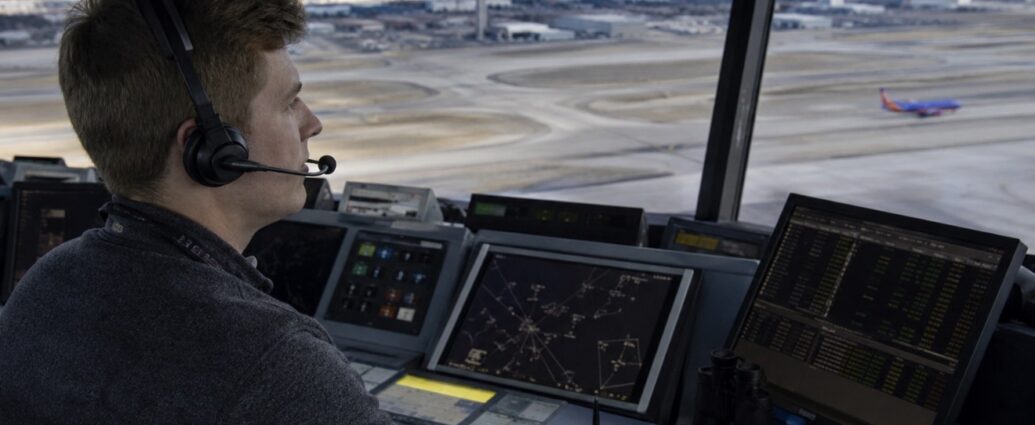
The federal government spent April recruiting video gamers to run American airspace, and the pitch worked. The Federal Aviation Administration has hired more than 2,000 gamers to train as air traffic controllers, hitting 94% of its hiring goal for the year, according to the Transportation Department, with another 2,000-plus candidates in the pipeline behind them. The reasoning is plain: the job is watching several moving objects on a screen, deciding fast, and talking while doing it — which is what the applicants had already been doing for years for free.
The agency launched the campaign in April specifically to reach gamers, arguing they bring multitasking, rapid decision-making and strong spatial awareness to the console, and to pull in younger adults who had never considered the career. The recruitment spot opened on an Xbox logo and cut between gamers and controllers working their screens, under the line that they had been training for this already.
Transportation Secretary Sean Duffy announced the results in a social media post on Aug. 9. He said the campaign broke multiple FAA hiring records, including the most candidates hired in a single year, and credited what he called the agency’s most streamlined hiring process. Speaking Tuesday at Newark Liberty International Airport, Duffy said much of what gamers do while playing is what controllers do managing traffic in the air, and noted that many current trainees started out as gamers.
The response when the hiring window opened was the first sign it would work. The Transportation Department said the agency took 12,350 applications in 24 hours, with 10,779 of those applicants judged qualified — more than double the previous first-day record.
Behind the campaign is a staffing hole that has been years in the making. The FAA counted about 11,000 certified professional controllers in April against a staffing target of 12,563, with roughly 4,000 more in the training pipeline. That 12,563 figure is the full staffing target set in the agency’s 2026 Controller Workforce Plan. The FAA’s 2025 workforce report laid out a plan to hire at least 8,900 controllers over four years, which against more than 6,800 expected departures would net roughly 2,000 additional controllers by the end of 2028. Short staffing is what produces the ground stops, holding patterns and flow restrictions that ripple through airline schedules and freight timetables on any given afternoon.
The economics of the job explain why the pitch lands with people who skipped college. Controllers need no college degree, and those who finish the FAA Academy and complete on-the-job training earn an average of about $155,000. Only about a quarter of controllers hold a traditional four-year degree, which is why the campaign was aimed at young people on alternative career paths. For a 22-year-old with no student debt, few paths reach six figures faster.
Getting hired is not the same as working traffic, and the gap between the two is where the story gets sober. Applicants must be U.S. citizens, under 31 years old, and able to speak clearly over radio equipment. They have to pass the Air Traffic Skills Assessment, clear medical and security review, complete training at the FAA Academy in Oklahoma City, and then finish further training at their assigned facility before they can certify to work traffic alone. That last stretch runs one to three years. Washing out is common, and the 2,000 hires announced this week are people who entered that pipeline, not people currently separating aircraft.
That timeline is the real constraint on relief for airlines and passengers. A controller hired this summer is unlikely to be certified at a busy facility before 2028, which means the towers and radar rooms running short today will still be running short through the next several peak travel seasons. The campaign fixes the front end of the funnel; academy throughput and facility training capacity determine how fast anyone comes out the other side.
There is also less novelty here than the campaign suggests, and that is a point in its favor. The FAA’s own surveys found that nearly all recent academy graduates already identified as gamers — the trait was in the workforce long before anyone advertised for it. A 2021 FAA recruiting video made the same argument, with one controller comparing the work to Call of Duty for the peripheral awareness it demands and another likening it to reading an opponent’s next move in a basketball game. What changed in April was where the government went looking. It stopped screening for those traits through résumés and started buying ad time in front of the people who have them.
JBizNews Desk | Washington
© JBizNews.com All Rights Reserved. Reproduction or distribution without written permission is prohibited.