
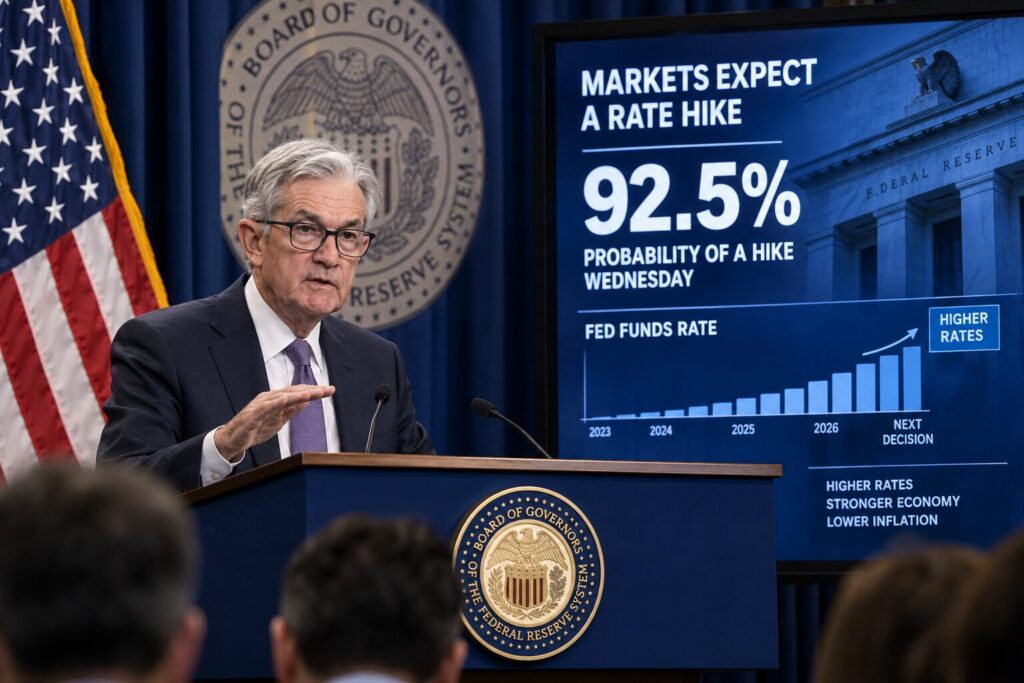
The Federal Reserve is set to announce one of its most closely watched interest-rate decisions of the year Wednesday, with financial markets overwhelmingly expecting policymakers to raise borrowing costs for the first time in more than three years.
The Fed began its two-day policy meeting Tuesday, September 15, and is scheduled to release its decision at 2 p.m. Eastern Time Wednesday. Traders now see roughly a 93% probability that policymakers will raise the federal funds target range by a quarter percentage point, according to CME FedWatch data cited by Reuters.
If the Fed follows through, the benchmark rate would move to a range of 3.75% to 4.00%.
For American households and businesses, the decision matters well beyond Wall Street. A renewed cycle of interest-rate increases could keep borrowing costs elevated for credit cards, business loans, commercial real estate and potentially mortgages.
Inflation Puts the Fed Under Pressure
The sharp change in expectations follows another round of stubborn inflation data.
Consumer prices increased 0.4% in August and were 3.4% higher than a year earlier, according to government data reported by Reuters. The annual inflation rate was unchanged from July and remains above the Federal Reserve’s long-term 2% objective.
Inflation concerns have been intensified by sharply higher energy prices, with crude oil recently moving above $100 a barrel amid disruptions to Middle Eastern energy supplies.
Fresh economic data Wednesday added to the pressure. U.S. retail sales jumped 1.2% in August, substantially more than economists expected, while import prices climbed 0.7% for the month and were 7% higher from a year earlier. Economists said the figures strengthened the case for a rate increase.
Economists Shift Toward a Hike
Wall Street traders are not alone in expecting higher rates.
A Reuters poll conducted following the latest inflation report found 86 of 101 economists — about 85% — expected the Fed to raise rates by 25 basis points at its September 15-16 meeting. That represented a dramatic shift from the previous Reuters survey, when more than two-thirds of economists had expected policymakers to leave rates unchanged.
Economists are also increasingly looking beyond Wednesday.
Among forecasters who provided predictions through March, 37 of 70 expected at least one additional rate increase by the end of March 2027.
That raises a bigger question for businesses and consumers: Is Wednesday’s expected increase a one-time response to inflation, or the beginning of another sustained tightening cycle?
What Higher Rates Mean for Consumers
Another rate increase could eventually show up in several areas of household finances.
Credit-card interest rates and other variable-rate borrowing products tend to react relatively quickly to changes in monetary policy. Consumers carrying balances could therefore face even higher financing costs.
Auto loans and other forms of consumer credit could also remain expensive if rates stay elevated.
Mortgage rates do not move directly with the federal funds rate, but they are heavily influenced by longer-term Treasury yields and expectations for inflation and monetary policy.
The 10-year Treasury yield recently crossed 5%, hitting approximately 5.041%, its highest level in 19 years, as investors adjusted to expectations of tighter monetary policy and persistent inflation.
Businesses Face the Same Squeeze
Companies may feel the effects through higher financing costs as well.
Small and midsize businesses frequently rely on credit lines and bank loans to finance inventory, payroll, equipment and expansion. Higher benchmark rates can make those loans more expensive.
Commercial real estate is another major area of concern.
Property owners that financed buildings when interest rates were substantially lower may face much higher costs when those loans mature and must be refinanced.
Higher interest rates can therefore put pressure on businesses even if their underlying sales remain strong.
Markets Waiting for the Fed
Investors entered Wednesday’s trading session cautiously ahead of the announcement.
The S&P 500 and Nasdaq edged higher while the Dow slipped slightly as markets awaited the Fed’s decision, Reuters reported. Investors are expected to pay particularly close attention to Fed Chair Kevin Warsh’s comments following the announcement for indications about the direction of monetary policy.
The decision itself may therefore be only half of the story.
Markets will be listening for clues about whether policymakers believe inflation requires additional rate increases — and how long interest rates may need to remain elevated.
For households and businesses, that guidance could ultimately matter as much as Wednesday’s expected quarter-point increase.
After several years in which Americans became accustomed to watching for interest-rate cuts, the conversation has changed sharply.
With inflation at 3.4%, oil above $100, resilient consumer spending and Treasury yields near levels not seen in nearly two decades, the possibility of higher-for-longer borrowing costs is once again at the center of the U.S. economic outlook.
JBizNews Desk | Trenton, N.J.
© JBizNews.com All Rights Reserved. Reproduction or distribution without written permission is prohibited.





