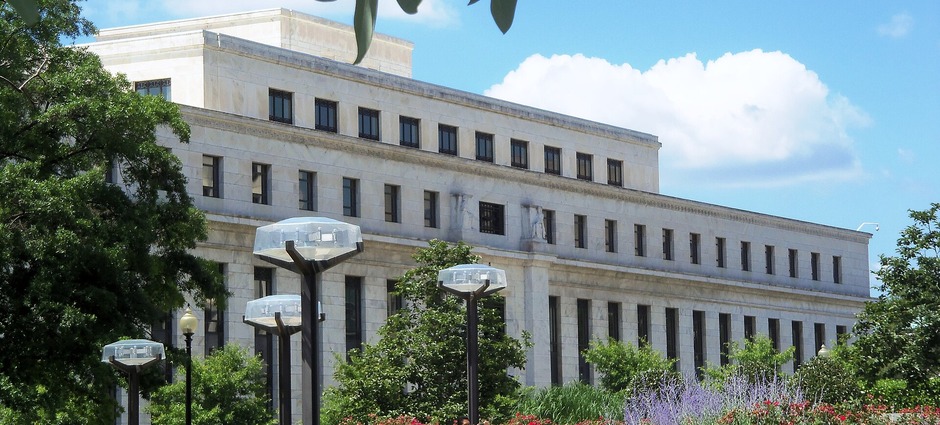
Archive photo: Garden-side view of the Eccles Building in Washington, June 15, 2013, not the October meeting or today’s release. Photo by Farragutful / Wikimedia Commons. Cropped and resized. Photo and crop licensed under CC BY-SA 3.0, separately from the article copyright.
Almost all participants at the Federal Reserve’s October meeting judged that further interest-rate increases would likely be appropriate under their economic outlooks, newly published minutes show, even as the central bank held its benchmark rate unchanged.
The minutes of the October 27-28 meeting reveal broader support for further tightening than the formal vote alone showed. Some participants favored raising rates by a quarter percentage point at that meeting, citing inflation that remained too high and showed few signs of easing.
The Federal Open Market Committee voted 10-2 to maintain its federal funds target range at 3.75% to 4%. Governor Lisa Cook and Cleveland Fed President Beth Hammack dissented, preferring a quarter-point increase. The discussion described in the minutes includes participants who did not have a vote on that decision.
The minutes record views expressed in October. Their publication is not a new rate decision or a commitment to a particular increase at the next meeting, scheduled for December 8-9.
More tightening remained the expected path
Almost all participants judged that further increases would likely be appropriate under their baseline outlooks for inflation and the labor market. A couple said an increase of more than a quarter percentage point could warrant consideration at the next meeting if incoming inflation data were unfavorable.
A few participants who supported holding rates described the October decision as a close call. Many stressed that leaving the range unchanged did not weaken the committee’s commitment to bringing inflation back to its 2% goal.
Officials who backed a pause cited the value of more information about investment demand, financing conditions, geopolitical developments and the effects of September’s rate increase. Future decisions would depend on incoming data, the evolving outlook and the balance of risks.
Borrowing costs and AI financing drew attention
A majority of participants said financial conditions had tightened since September, pointing to higher mortgage rates and wider credit spreads for some higher-risk and AI-related borrowers. Many said higher borrowing costs and more selective lending had weighed on housing, commercial real estate and small-business borrowing.
Almost all participants also discussed the risk that returns on artificial-intelligence investment could disappoint investors. Most noted rapid growth in AI-related debt, much of it through complex and opaque financing structures. Those were financial-stability risks under discussion, not a prediction that an AI-driven crisis was imminent.
For borrowers and businesses, the minutes show why further rate increases remained a possibility despite October’s hold. They do not determine the rate on an individual mortgage, business loan or credit card, or guarantee what the committee will do in December.
JBizNews Desk | Washington
© JBizNews.com. All rights reserved. Unauthorized reproduction or redistribution is strictly prohibited.