The Federal Reserve is moving closer to finalizing major changes to how it tests whether the country’s biggest banks can withstand a severe recession, with regulators aiming to make the annual process more transparent and less volatile for lenders.
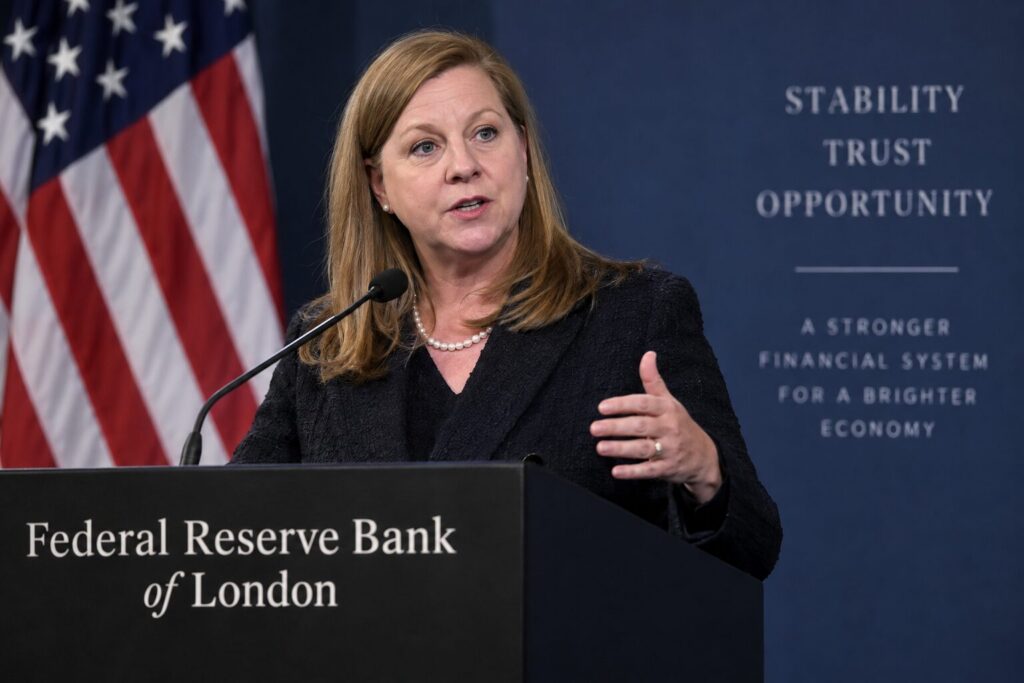
Federal Reserve Vice Chair for Supervision Michelle Bowman said Friday that the central bank’s Board of Governors will consider final revisions to its stress-testing framework in the “coming weeks.”
The overhaul is intended to address longstanding criticism from the banking industry over the unpredictability and limited transparency of the tests.
Bowman, speaking in prepared remarks at an event in London, said finalizing the reforms would “close the book on an opaque and unnecessarily unpredictable framework.”
How the Fed’s Stress Tests Work
The Federal Reserve conducts annual stress tests to determine whether large banks have enough capital to absorb substantial losses while continuing to lend to households and businesses during a severe economic downturn.
Regulators essentially put banks through a hypothetical recession, projecting what could happen to their loans, revenue, losses and capital levels under extreme economic conditions.
The results have historically helped determine a bank’s stress capital buffer, or SCB — an additional amount of capital that a large bank may be required to maintain on top of minimum regulatory requirements.
Banks and industry groups have argued that those requirements can fluctuate substantially from year to year, making capital planning more difficult.
The Federal Reserve itself has acknowledged volatility in its stress-testing models. In 2025, the central bank proposed averaging two consecutive years of stress-test results when calculating the stress capital buffer rather than relying primarily on a single year’s outcome.
Under the proposal, the Fed would use the average of the maximum declines in a bank’s common equity tier 1 capital projected in its two most recent annual supervisory stress tests.
The Fed said the proposal was designed to reduce volatility and was not intended to materially change overall capital requirements.
More Transparency Into Fed Models
The overhaul goes beyond averaging results.
In October 2025, the Federal Reserve proposed broader changes designed to make its stress-testing models and hypothetical economic scenarios more transparent and subject to greater public scrutiny.
Those changes include publishing substantially more information about the models the Fed uses, including equations, variables, coefficients, assumptions and limitations.
The Fed also proposed allowing public comment on material changes to its stress-testing models and annually seeking feedback on the hypothetical scenarios used in the tests.
Bowman said Friday the reforms are intended to improve transparency and accountability while strengthening the reliability of the models used to calculate potential bank losses.
The reforms follow years of criticism from major banks and a 2024 legal challenge from banking industry groups over the Fed’s stress-testing framework.
Stress Tests Could Play Larger Supervisory Role
Bowman also outlined a broader role for stress testing that extends beyond simply determining capital requirements.
She said stress analysis can help regulators identify vulnerabilities at individual banks and direct supervisors toward areas requiring closer examination.
Banks already conduct their own internal stress tests, and Bowman said greater communication between regulators and bank officials could help both sides better understand risks.
“I believe there is tremendous value in comparing notes,” Bowman said.
She also discussed expanded use of “reverse stress testing,” which starts by identifying a severe failure or loss and then works backward to determine what circumstances could cause it.
The approach could help regulators identify risks that might affect not only an individual institution but also banks with similar balance sheets or exposures.
What It Could Mean for Lending
The amount of capital banks are required to maintain matters beyond Wall Street because capital requirements can influence how banks allocate money, manage risk and make lending decisions.
A more predictable stress capital buffer could make it easier for large banks to plan their capital needs from year to year.
However, that does not necessarily mean consumers will immediately see cheaper mortgages, credit cards or business loans. Lending decisions are also influenced by interest rates, credit risk, economic conditions, borrower demand and banks’ individual strategies.
The Federal Reserve says the fundamental purpose of stress testing remains ensuring that large banks have sufficient capital to absorb losses while continuing to provide credit during severe economic downturns.
32 Large Banks Tested in 2026
The Fed subjected 32 large banks to its 2026 stress test, including JPMorgan Chase, Bank of America, Wells Fargo and Goldman Sachs.
All 32 remained above their minimum common equity tier 1 capital requirements under the Fed’s hypothetical severe recession.
Collectively, the banks were projected to absorb nearly $708 billion in losses, while their aggregate common equity tier 1 capital ratio fell from 12.8% to a projected minimum of 11.2%.
The Federal Reserve has already decided that the 2026 stress-test results will not change banks’ current stress-related capital requirements. Existing requirements are being maintained until 2027, when new requirements can be calculated using loss-estimating models that have gone through the Fed’s expanded public-feedback process.
Bowman did not provide an exact date for a final vote on the broader stress-testing reforms, saying only that the Board would consider final revisions in the coming weeks.
The changes would mark one of the most significant revisions to the Federal Reserve’s stress-testing framework since the system became a central part of large-bank supervision following the 2008 financial crisis.
© JBizNews.com All Rights Reserved. Reproduction or distribution without written permission is prohibited.