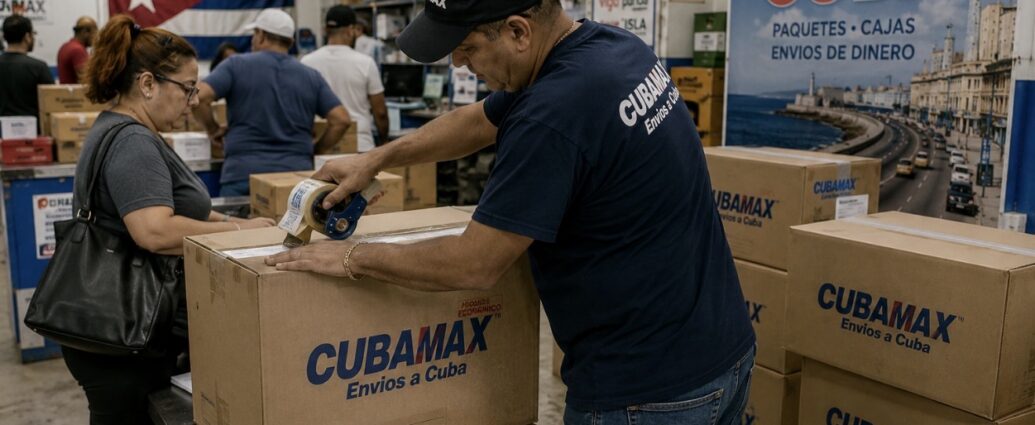
MIAMI — For millions of Cubans, the difference between eating and going hungry now arrives in a cardboard box mailed from South Florida.
As Cuba sinks deeper into the worst economic and energy crisis in its modern history, the packages and cash sent by relatives in the United States have become the island’s most important lifeline, often providing more support than the Cuban state itself.
The pressure intensified this year after a U.S.-led effort to restrict oil shipments sharply reduced Cuba’s fuel supply. It tightened further on January 1, 2026, when a new 1% federal tax took effect on certain remittances sent abroad through cash, money orders, and cashier’s checks.
The scale of the crisis is staggering.
Cuba’s minimum wage is less than $7.50 per month, while average salaries remain only modestly higher.
Inflation has severely eroded purchasing power, leaving many families unable to afford basic necessities.
In that environment, a package containing cooking oil, powdered milk, coffee, medicine, soap, and other essentials is not a luxury.
It is survival.
As one Cuban physician writing from exile observed, in most countries remittances supplement household income.
“In Cuba, they are a condition for survival.”
The money involved is enormous by Cuban standards.
Before the collapse of formal transfer channels, remittances to Cuba totaled approximately $3.7 billion annually in 2019.
Today, formal transfers have declined by roughly 70%, according to independent analysts.
More than 95% of remittance flows now move through informal networks, private couriers, and travelers carrying cash or goods by hand because traditional banking channels have largely broken down.
Much of that disruption traces back to U.S. sanctions and the structure of Cuba’s financial system.
For years, the military-controlled company Fincimex, a subsidiary of the state conglomerate GAESA, handled much of the hard-currency flow into Cuba.
The organization directed significant amounts of foreign currency into government-operated retail chains, including CIMEX, where many consumer goods are sold at prices substantially above U.S. levels.
After the U.S. Treasury Department’s Office of Foreign Assets Control (OFAC) sanctioned Fincimex in 2020, Western Union suspended operations in Cuba, accelerating the shift toward informal transfer networks that remain dominant today.
The center of this system is South Florida.
Home to the largest Cuban community outside the island, Miami has become the operational hub for the movement of money, food, medicine, and household supplies to Cuba.
But even that lifeline has faced disruptions.
Earlier this year, courier company Cubamax suspended home deliveries and limited customers to one package per shipment because fuel shortages on the island made local transportation increasingly difficult.
Although some restrictions were later eased, concerns remain that supply lines could become even more constrained.
The crisis has reignited debate within the Cuban-American community.
For generations, sending money and supplies to relatives was viewed as a family obligation.
Today, some critics argue that every dollar entering Cuba indirectly helps sustain the government in Havana.
Others counter that cutting off remittances would punish ordinary families while doing little to change the political system.
Many economists who study Cuba support the latter view.
Emilio Morales, president of the Havana Consulting Group, argues that stopping remittances would do little to alter the island’s political reality because much of the money now bypasses state-controlled channels entirely.
Instead, those funds support individual households and Cuba’s growing private sector.
The economic impact extends far beyond family budgets.
On the island, remittances help finance thousands of small private businesses, known as cuentapropistas, including restaurants, repair shops, transportation services, and neighborhood retailers.
In Florida, an entire industry has developed around shipping goods and transferring funds, supporting logistics companies, courier services, travel operators, and money-transfer businesses.
When Washington changes remittance policies, both sides of the Florida Straits feel the effects.
The broader geopolitical backdrop continues to complicate the situation.
Following the removal of Venezuelan leader Nicolás Maduro, the United States increased pressure on Caracas to halt oil shipments to Cuba and warned other suppliers against filling the gap.
The resulting fuel shortages have contributed to power outages, transportation disruptions, and deeper economic hardship across the island.
Those conditions have only increased the importance of the packages arriving from Florida.
Each day, customers continue lining up at shipping centers across Miami carrying coffee, powdered milk, clothing, medicine, and household necessities.
Despite rising costs and political controversy, the flow continues.
For millions of Cubans, those boxes remain more than packages.
They are a lifeline.
And for many families struggling through one of the most difficult periods in the island’s modern history, they remain the primary barrier between daily survival and economic collapse.
JBizNews Desk — Miami
© JBizNews.com All Rights Reserved. Reproduction or distribution without written permission is prohibited.