
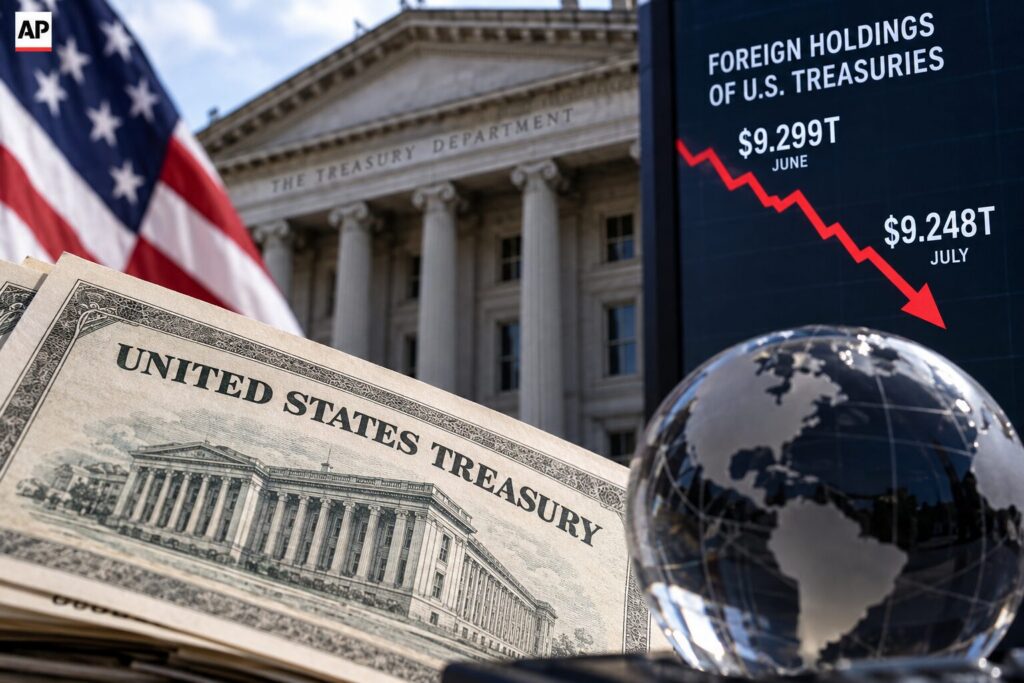
Foreign holdings of U.S. Treasury securities fell in July, interrupting a period of historically high overseas ownership of American government debt as investors confront rising U.S. borrowing costs, persistent inflation concerns and a rapidly expanding federal debt load.
Total foreign holdings of Treasuries declined to approximately $9.248 trillion in July from $9.299 trillion in June, a decrease of about $51 billion and the lowest level since October 2025, according to Treasury International Capital data released September 16.
The pullback comes after foreign Treasury holdings reached exceptionally high levels earlier in the year, including a peak of approximately $9.487 trillion in February.
The July decline does not by itself indicate that overseas investors are abandoning U.S. government debt. Foreign holdings remain historically elevated, and the Treasury’s separate monthly transaction data show that substantial amounts of foreign capital continued flowing into U.S. financial assets during July.
But the country-by-country changes offer a closer look at how some of America’s largest foreign creditors are repositioning their holdings at a time when the Treasury market is under growing pressure.
Japan Remains the Largest Foreign Holder
Japan remained the largest foreign holder of U.S. Treasury securities in July, but its holdings slipped to approximately $1.104 trillion from $1.117 trillion in June.
The decline is notable because Japan has long been one of the most important overseas buyers of American government debt.
Japanese investors are now operating in a substantially different interest-rate environment at home.
Japan’s 10-year government bond yield recently climbed above 3%, reaching its highest level in roughly three decades. At the same time, U.S. Treasury yields have also risen sharply, with the benchmark 10-year yield moving above 5% this week.
Higher Japanese yields can make domestic bonds more attractive to Japanese investors relative to foreign securities, particularly after accounting for the cost of hedging currency exposure.
That dynamic has made Japan’s Treasury holdings an increasingly important figure for U.S. bond investors to watch.
Britain Moves Toward the $1 Trillion Mark
The United Kingdom moved sharply in the opposite direction.
U.K. Treasury holdings climbed to approximately $998.3 billion in July from $939.9 billion in June, an increase of about $58 billion in a single month.
That puts reported British holdings within striking distance of $1 trillion.
However, Treasury data attributed to the United Kingdom should be interpreted carefully.
London is one of the world’s largest financial centers, and securities held through British custodians can ultimately belong to investors elsewhere. Treasury itself cautions that its country-level figures are based largely on custodial data and therefore cannot always identify the true beneficial owner of a security.
For example, a Treasury security owned by an investor in one country but held through a financial institution in another may be recorded under the location of the custodian.
That makes it difficult to conclude that the increase represents British government or household buying specifically.
The Treasury has explicitly warned against drawing overly precise conclusions about individual countries from the monthly holdings figures because of these custodial effects.
China’s Treasury Holdings Continue to Decline
China’s reported Treasury holdings moved lower again, falling to approximately $618.0 billion from $633.4 billion in June.
China was once the largest foreign creditor of the United States and held well over $1 trillion of Treasury securities for much of the previous decade.
Its holdings have fallen substantially over time as Beijing has diversified its foreign reserves and reduced its reported direct exposure to U.S. government securities.
The July figure therefore continues a much longer trend rather than representing a sudden change in China’s Treasury strategy.
Country-level TIC figures also come with the same custodial limitations affecting the U.K. data. Chinese-linked Treasury securities held through financial centers elsewhere may not necessarily appear under China in the monthly table.
$83.7 Billion Still Flowed Into the U.S.
The holdings numbers tell only one side of the story.
Treasury’s separate transaction data show that the United States still attracted substantial foreign capital during July.
Total net Treasury International Capital inflows reached $83.7 billion, according to the September 16 release.
Of that amount, net foreign private inflows were $73.5 billion, while net foreign official inflows were $10.2 billion.
Foreign residents also made $40.6 billion in net purchases of long-term U.S. securities during the month.
But there was a striking difference between private and official investors.
Private foreign investors were net sellers of $3.7 billion of long-term U.S. securities, while foreign official institutions — including central banks and government-related entities — were net buyers of $44.4 billion.
Those figures cover long-term U.S. securities broadly and should not be interpreted as Treasury purchases alone.
The previous month had been considerably stronger. In June, foreigners made $207.1 billion of net purchases of long-term U.S. securities, including $169.8 billion by private investors and $37.3 billion by official institutions.
Why Foreign Treasury Demand Matters to Americans
Foreign demand for Treasuries can seem like a distant Wall Street issue, but it has implications throughout the American economy.
The federal government finances deficits by issuing Treasury bills, notes and bonds.
When investors are willing to buy that debt aggressively, the government can generally borrow at lower yields.
When investors demand higher returns, borrowing becomes more expensive.
Treasury yields also serve as benchmarks across financial markets, influencing rates on mortgages, corporate debt and other forms of borrowing.
That connection has become especially important as yields have risen sharply.
The 10-year Treasury yield reached 5.041% Tuesday, its highest level since 2007, amid inflation concerns, higher oil prices and questions surrounding government debt levels.
Higher Treasury yields can ultimately translate into higher financing costs for businesses, commercial real estate projects and households.
Foreign Investors Are Also Looking Beyond Treasuries
The July holdings figures arrive as evidence emerges that overseas investors are increasingly directing money toward other U.S. assets.
Deutsche Bank analysis reported by the Financial Times found that international investment flows into U.S. equities reached approximately 2.8% of GDP in the year through June, compared with about 2% of GDP flowing into Treasuries.
Strong corporate profits and enthusiasm surrounding artificial intelligence have helped attract foreign money into American stocks even as investors confront higher inflation and concerns over America’s expanding government debt.
That does not mean foreigners have stopped financing the U.S. government.
With more than $9 trillion of Treasury securities still reported in foreign hands, overseas investors remain an enormous presence in the market.
But the composition of that demand matters increasingly as Washington continues issuing large amounts of debt.
A Pause — Not Yet Evidence of an Exodus
One month of declining holdings is not enough to establish a sustained retreat from U.S. Treasuries.
July’s approximately $51 billion decline represents a relatively small move compared with the more than $9 trillion of American government debt held overseas.
The country data also moved in different directions: Japan and China reduced reported holdings while the United Kingdom posted a large increase.
Meanwhile, the broader TIC figures show that foreign capital continued entering the United States during the month.
That makes July’s numbers more complicated than a simple story of foreigners selling America.
The more important question will be whether foreign Treasury holdings rebound in coming months — or whether July marks the beginning of a more persistent change in overseas demand.
With U.S. government debt now around $40 trillion and benchmark Treasury yields recently moving above 5%, the identity of the investors willing to finance that debt — and the interest rates they demand to do so — is becoming increasingly important for Washington, Wall Street, businesses and American households alike.
For now, foreign investors remain major holders of America’s debt.
But July provides another reminder that who buys U.S. Treasuries — and at what price — can ultimately affect borrowing costs throughout the American economy.
JBizNews Desk | Trenton, N.J.
© JBizNews.com All Rights Reserved. Reproduction or distribution without written permission is prohibited.




