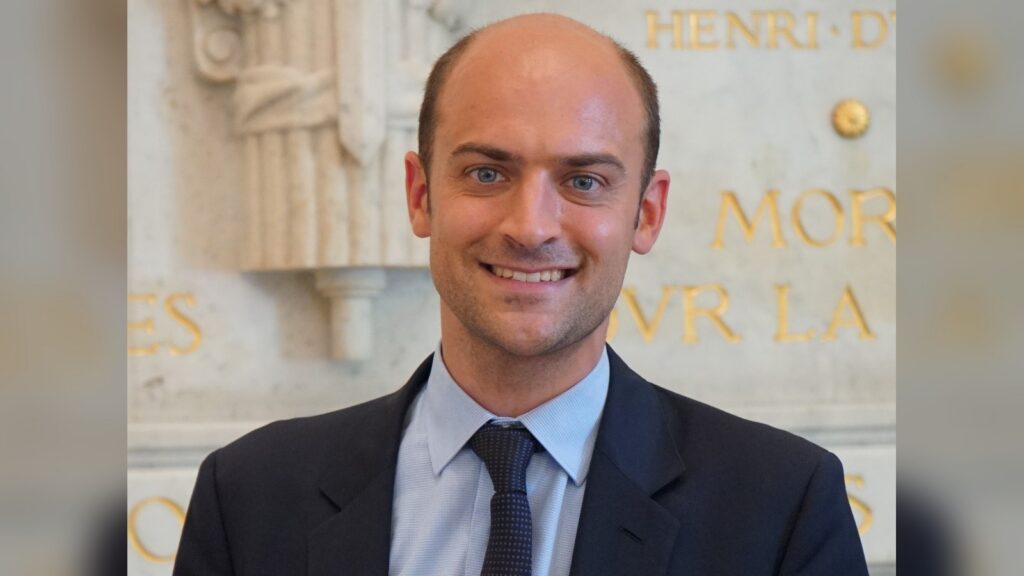
Photo: G. Garitan / Wikimedia Commons / CC BY-SA 4.0
PARIS, France – France’s foreign minister accused Iran’s Islamic Revolutionary Guard Corps on Monday of carrying out the October cyberattack that damaged supermarket refrigeration equipment at nearly 700 French distribution sites. Jean-Noël Barrot said France had summoned Iran’s ambassador and would seek sanctions at the European level.
The photograph is an archival 2017 portrait of Barrot at the Palais Bourbon, not an image from Monday’s press statement.
Speaking to reporters in Paris on November 9, Barrot said the October 11-12 attack had caused damage and fires. His statement publicly attributes the operation to the IRGC and announces a diplomatic response to damage that affected food retailers.
“I am able to confirm that responsibility for this attack lies with the Islamic Revolutionary Guard Corps of the Islamic Republic of Iran,” Barrot said in French in public remarks on Monday. That is the French government’s attribution. It is not a criminal conviction, and the minister did not present the underlying technical evidence in the recorded statement.
Barrot described the operation as an attack of unprecedented scale and aggressiveness, and as the first large-scale cyberattack carried out for sabotage purposes on French national territory.
“It is a major assault on the interests of the nation and on the security of the French people,” he said. He thanked French state services for their work in identifying responsibility but did not describe the forensic findings, identify individual alleged attackers or explain how the government had reached its conclusion.
The immediate diplomatic step was the summons of Iran’s ambassador in France. Barrot said the government had called the ambassador in to protest what he called an extremely serious act. He also promised European-level sanctions against those responsible and other proportionate and necessary measures, whether public or non-public, to respond and deter a repeat.
The sanctions statement is a promise of action, not an announcement that new European restrictions have already taken effect. Barrot did not identify proposed targets, give a date for adoption or set out the legal measures France would seek from its European partners. He also did not specify the other measures he said could follow.
For food retailers, the attack illustrates how remotely controlled equipment can become a business-continuity and physical-safety problem. Barrot’s account concerns damage to refrigeration installations and outbreaks of fire, rather than simply stolen information or a website being taken offline. He gave no updated total for financial losses and did not announce compensation for affected retailers.
The minister said the judiciary was handling the matter and would make its own decisions. The government’s accusation should be kept separate from any later judicial finding about who carried out, ordered or assisted the attack.
JBizNews previously covered the October disruption and subsequent European outages. Monday’s statement specifically describes the October 11-12 campaign affecting French sites. It does not, by itself, establish responsibility for every later refrigeration incident elsewhere in Europe.
That distinction also applies to the separate blood-service incident previously reported in France. Barrot did not discuss that case in these remarks or expressly connect it to the supermarket operation.
The central new development is the French government’s direct attribution and its promised response. The remaining questions include the evidence that can be made public, the outcome of judicial proceedings, the targets and timing of any European sanctions, and whether other refrigeration incidents are connected. The recorded remarks do not include an Iranian response to the accusation.
JBizNews Desk | Paris, France
© JBizNews.com. All rights reserved. Unauthorized reproduction or redistribution is strictly prohibited.